W. H. Pugmire was born in 1951; the kaiju classic Gojira (ゴジラ) was awakened by nuclear testing a few years later in 1954. The giant monster came stomping onto U.S. shores in 1956 as Godzilla, King of the Monsters!, edited, dubbed, and with added footage of actor Raymond Burr to make a substantially different film from the original—but it the first Japanese feature to become a commercial hit in the United States, and went on to spread the love of giant monsters internationally as well.
Japanese science fiction, fantasy, and horror film fandom in the United States began as an outgrowth of science fiction fandom; period fanzines included the occasional kaiju film that made it to the U.S. as they would other international science fiction, fantasy, and horror films. The films were shown in movie theaters and drive-ins, but there was often limited press coverage and no availability for private screenings. If you missed Gigantis the Fire-Monster (1955) or The Manster (1961), you were simply out of luck, and would be lucky to see a grainy black-and-white photograph in a film magazine like Famous Monsters of Filmland.
In 1957, however, Screen Gems, a television subsidiary of Columbia Pictures, produced its Shock Theatre package—a group of older horror films that could be aired for local broadcast. Thus began the tradition in the U.S. of the local horror host, who acted (and sometimes interacted) with these cheap classic films for an often precocious audience, who stayed up late into the night to watch monster movies. It became a popular staple, and more film packages followed as horror hosts proliferated. Re-runs made it possible for these films to gain a new and wider audience, and by the 1960s a package called Creature Features, including the Japanese kaiju movies of the 1950s, was released.
GIGANTIS, THE FIRE MONSTER
The only time I saw this show was on a late TV movie feature about five years ago. because my father is anti-monster/horror and fantasy/sf, I had to creep from my bedroom and turn the set on very low—dad’s bedroom was just above the set—so, I could not hear what was happening and that furthered my difficulties. My memory, thus, is not very detailed about the film. […] I’d like to see this film again, if just to see how much of the plot I’ve forgotten. I just hope it comes on some Saturday movie show so I don’t have to strain my eyes and ears, fearing that every sound I hear is the demon in the bedroom just above.
—Bill Pugmire, Jr., The Japanese Film Fantasy Journal #7 (Mar 1971) 13
in Early Kaiju Fandom Volume 5: Japanese Fantasy Film Journal (2026) 196
The broader access to Japanese science fiction, fantasy, and horror films in the 1960s and 70s spurred the growth of related fandom in the U.S. (As did the growing media footprint from Marvel comics adaptations, toys, etc.) Specialist fanzines began to emerge, sharing information on Japanese productions past, present, and future.
Bradford Grant Boyle began publishing his fanzine Japanese Giants in the mid-1970s. In later years, he began a fanzine archive project and in 2024, he published the first of the Early Kaiju Fandom series, reprinting these now-obscure and early fanzines to preserve them for fans and scholars. Not just those interested in Japanese films, but for those who are interested in fandom itself, the way fans organize, their interactions, the often crude but energetic output of their devotion.
I began picking up these books more out of general than specific interest; print-on-demand books are low print run almost by default, can disappear at any time, and once out of print are often unobtainable at any price. Nor was I disappointed when the books arrived; the scans were clear, the zines themselves had the charm that often marks enthusiastic amateur productions. Before the internet, wikis, and even home video, there were teens putting these together using typewriters and stencils, laying them out with X-acto knives and glue. They’re fun.
So imagine my surprise when I found a letter from a young W. H. Pugmire in volume 5. And then another, and an article, and…
I was a huge horror film nut as a kid (Famous Monsters ofFilmland #69 is dedicated to me), and I lived for horror films. My first fanzines were a combo of SF (my high school girlfriend who was my co-editor was into SF —indeed, her parents had met at an early meeting of the Nameless Ones) and horror films. I was determined, in high school, that my future career was to be an actor in horror films, but that changed when I was sent to Ireland as a Mormon missionary and became obsessed with horror fiction.
—W. H. Pugmire, Chunga #22 (Jan 2014), 30
Today, Wilum Hopfrog Pugmire (born: William Harry Pugmire; 3 May 1951–25 Mar 2019) is best known as a Lovecraftian author, poet, and editor; and for his contributions to punk literature. His early interactions with fandom have been noted previously—he famously appeared in Famous Monsters of Filmland #69 (Sep 1970) in his “Count Pugsly” makeup—but his love of giant monster films isn’t something that’s really been examined in any depth, and there’s something fascinating about reading through these early writings and getting a better idea of the young man who wrote them. Not a renowned Lovecraftian author; not yet the persona of Wilum Hopfrog Pugmire; but an earnest fan with a gift for writing and a lot of evident enthusiasm.
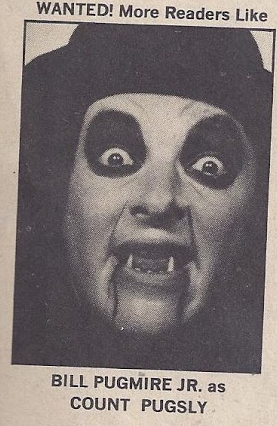
This led to a certain degree of notoriety:
I first encountered the name “Bill Pugmire” around 1970, in the pages of Famous Monsters of Filmland, to which he frequently contributed letters of comment, and in Greg Shoemaker’s venerable Japanese Fantasy Film Journal, to which he also contributed letters and columns. In my young mind at the time, I considered him famous.
—Stephen Mark Rainey, “R.I.P. Wilum H. Pugmire” (26 Mar 2019), The Blog Where Horror Dwells.
The Japanese Fantasy Film Journal was edited and published by Greg Shoemaker from 1968-1983, for a total of 15 issues. Early issues were mimeographed, then apparently offset-printed, and at last professionally printed for the final issues. In terms of length, early issues ran less than 20 pages (including covers), while later issues tended to be ~40 pages. General contents varied, but often included entries on a number of Japanese sci-fi, fantasy, and horror films (or related non-Japanese films, like The Valley of Gwangi) in brief, followed by more in-depth reviews of select films. Shoemaker also covered some early Japanese animation, and included fanfiction, advertisements, and a letters page. Issues were illustrated with a combination of homegrown artwork and stills from films (taken from various sources).
W. H. Pugmire in the Japanese Fantasy Film Journal
The following list is a survey of Pugmire’s contributions to the Japanese Fantasy Film Journal, as an aid for anyone interested. Entries take the form of:
- JFFM #Issue Number.Issue Page number [Page number in Early Kaiju Fandom Volume 5]. Title of piece (if any). Description of contents. (Other comments.)
Selected quotations from the material will follow some entries.
- JFFM 5.18 [129]. “Are you ready for… SEATTLEHORBS???” Advertisement for a xeroxed sci-fi, horror, and fantasy film fanzine, edited by W. H. Pugmire and Brian Wise.
- JFFM 6.3-4 [138-139]. Letter. Discussion of what should go into an editorial and letters page. Comment on Destroy All Monsters (1968), and a comparison of the Godzilla films to the Frankenstein films. Mention of Speed Racer (1967-1968). (Letters from Ernie Farino would reference Pugmire’s letter in JFFM 7.6 [189] and JFFM 8.43 [264].)
- JFFM 7.4-5 [187-188]. Letter. Comments on JFFM #6, including the reviews of The Valley of Gwangi (1969), The Mysterians (1957), and the anime Marine Boy (1965).
- JFFM 7.13 [196]. “Film Comment.” A series of comments on various kaiju films by fans, including Pugmire’s thoughts on Gigantis, The Fire Monster (1959). (JFFM 8.7-9 [228-229] contains a rebuttal to the “Film Comment” article, including a response to Pugmire on Gigantis.)
- JFFM 8.4 [225]. Letter. Comments on JFFM #7, including comments on Gamera, the Giant Monster (1965), Frankenstein Conquers the World (1966), Jesse James Meets Frankenstein’s Daughter (1966), and the anime Prince Planet (1965-1966).
- JFFM 8.9 [230]. “Fanzines Corner.” Includes an advertisement for Pugmire’s Flabbergasting Rambling #3:
Flabbergasting Ramblings #3 (25¢; Bill Pugmire, 5115 S. Mead St., Seattle, Wash. 98188; photo-copy: 8 ½x 11 ) Last issue of this variety zine so that Bill can devote more time to fantasy films publications. It covers such things as the “Blondie” comics, “Did Sherlock Holmes Kill Dracula?”—about linking characters in literature, and an odd item on ghosts in Hamlet. Interesting reading.
- JFFM 10.5-6 [302-303]. Letter. Comments on JFFM #9, and on fanzines reviews.
- JFFM 10.19-21 [316-318]. “Matango: Pro and Con.” Joint article on Matango (1963) by Pugmire and Fred Ray. Pugmire reviewed the film positively, Ray was negative in his critique. (JFFM 11.3-6 [342-345] includes letters responding to this article. An advertisement for this issue in Son of the WSFA Journal #137 mentions the piece.)
- JFFM 11.38 [377]. “Fanzines Corner.” Includes an advertisement for Pugmire’s zine Lovecraftian Midnight Fantasies.
Midnight Fantasies (Bill Pugmire, 5115 South Mead St., Seattle, Wash. 98118; free; offset; published every 4 months; 8 ½x 11) A personal zine of very good quality that deals primarily with Lovecraft, Bloch, Derleth, Arkham House, et. al. An informal zine—a meandering sort of publication. Send for Bill’s current issue, but print run is limited so you may have to wait for a copy.
With issue 12, the Japanese Fantasy Film Journal shifted format and focus; with more professional layout, more and better art, and fewer letters and fan articles, and Pugmire’s contributions seem to stop. Whether this reflects Pugmire dropping the zine (not surprising given its irregular schedule and the price increasing from 50¢ to $3 an issue), or just Shoemaker’s changes to the zine making appearances in the zine less likely are unclear.
Late in life, Pugmire still remembered JFFJ fondly:
How I loved JFFJ! I remember writing a long positive critique of MANTAGO for an issue, and film-maker Fred Ray wrote a counter-critique slagging the film. I lost all my copies of JFFJ from water damage, alas.
—W. H. Pugmire, Comment (12 Jun 2011) on “Greg Shoemaker on The Japanese Fantasy Film Journal,” Sidelong Glances of a Pigeon Kicker.
Each of these fanzines is a time capsule; a snapshot into an era of fandom and popular culture, and the surprising thing isn’t to find a random contribution from W. H. Pugmire in a fanzine from the 1970s—it’s finding an intact copy of such a fanzine at all. Many of these zines had very limited circulation and there were little or no serious archival efforts to preserve them. Even today, when university libraries (like the Hevelin collection at the University of Iowa) and private groups like the First Fandom Experience and the Fanac Fan History Project are making an effort to preserve and reproduce fanzines, there are huge gaps in what is being preserved.
So kudos to Brad Boyle and the Early Kaiju Fanzine series, for helping to preserve a part of our culture that might otherwise easily be lost. Certainly, it is fun to see what W. H. Pugmire’s thoughts were on giant monster movies, as a part of his general love of monsters and horror.
Bobby Derie is the author of Weird Talers: Essays on Robert E. Howard and Others and Sex and the Cthulhu Mythos.
Deep Cuts in a Lovecraftian Vein uses Amazon Associate links. As an Amazon Associate I earn from qualifying purchases.
 Deep Cuts in a Lovecraftian Vein