The following review concerns a work of Lovecraftian pornography. It includes nude images and will discuss relevant matters of sexuality in detail. Reader discretion advised.
Ignacio Noé (1965– ) and Ricardo Barreiro (1949–1999) were two of the Argentinian comic creators who found a niche in European comics, their work often bouncing between Spain, France, and Italy, with translations in many different markets. Their collaboration El Converto Infernal first appeared in the Spanish-language adult comics magazine Kiss Comix in 1995, serialized from issue 49 to issue 56, running 62 pages, lavishly painted and drawn by Noé. The result was popular enough to be translated into several languages, and an English translation by Robert Legault was published in a lightly censored edition by NBM in 1997 as The Convent of Hell.
As the title suggests, The Convent of Hell is a work of nunsploitation. The roots of this genre go deep in European art and literature, including historical accounts that amount to “nuns behaving badly,” like the Nun of Watton, but most contemporary scholars point to La Religieuse (1792) by Denis Diderot, a sympathetic novel about a nun trapped in the legal and social constraints of her order and unable to leave, as a turning point. The work both emphasizes the lack of personal freedom that the nun Suzanne Simonin experiences and offers sharp criticism of the Catholic Church and its institutions. This set the stage for the main erotic line, where nunsploitation erotica is primarily a variation on the “women in prison,” but offering tangential and complementary taboos including lesbianism, sex work, BDSM, and blasphemy—themes which all crop up in greater or lesser degree in works like The Devils(1971), directed by Ken Russell.
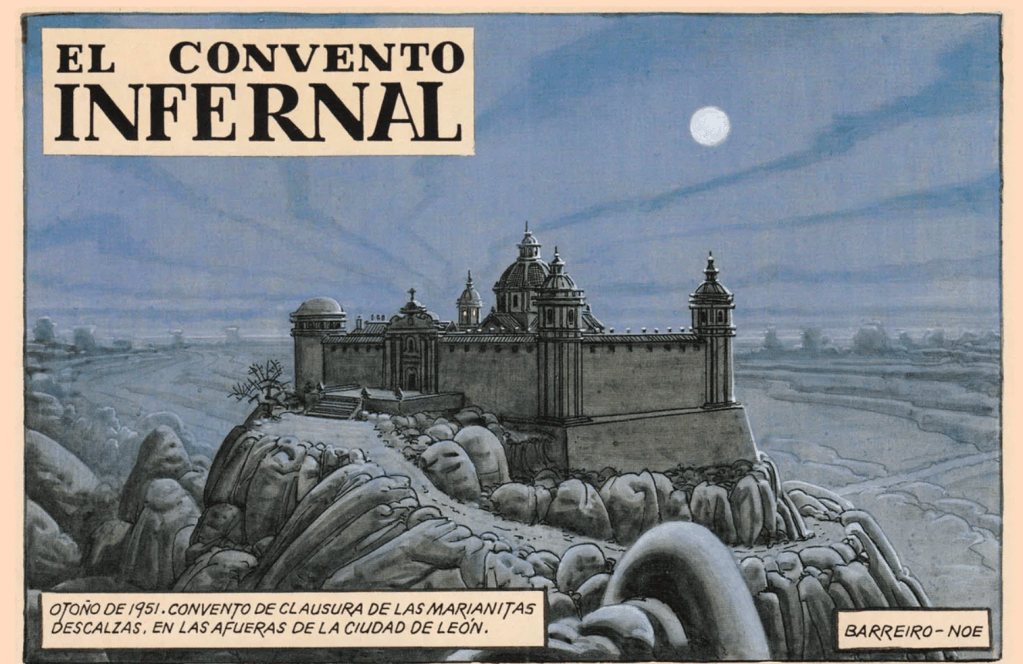
First panel, showcasing the remote and isolated location of the fortress-like convent.
Openly erotic explorations of the theme varied widely. Robert E. Howard, for example, owned a copy of The Merry Order of St. Bridget, a flagellation novel involving nuns, and captured the central theme of imprisoned passion in a poem:
NUN
I have anchored my ship to a quiet port; A land that is holy and blest. But I gaze through my bars at the tempest’s sport And I long for the sea’s unrest. —Robert E. Howard to Tevis Clyde Smith, 23 Jun 1926, Collected Letters1.98
Exploitation filmmakers, comic book artists, and writers in the 1970s became especially lavish in using nuns, working out several variations on the basic theme, especially in countries with a strong Catholic influence such as Italy, Spain, France, and their diaspora. Nor was Lovecraftian media immune. The underground comic Tales from the Leather Nun (1973) includes one of the first original Lovecraftian comics, “Tale of the Leather Nun’s Grandmother” by writer/artist Jaxon, who owes her youth and beauty to the work of the wizard Alhazred—and who has accidentally turned her vulva into a portal into the cosmic domain of Cthulhu and other eldritch entities.
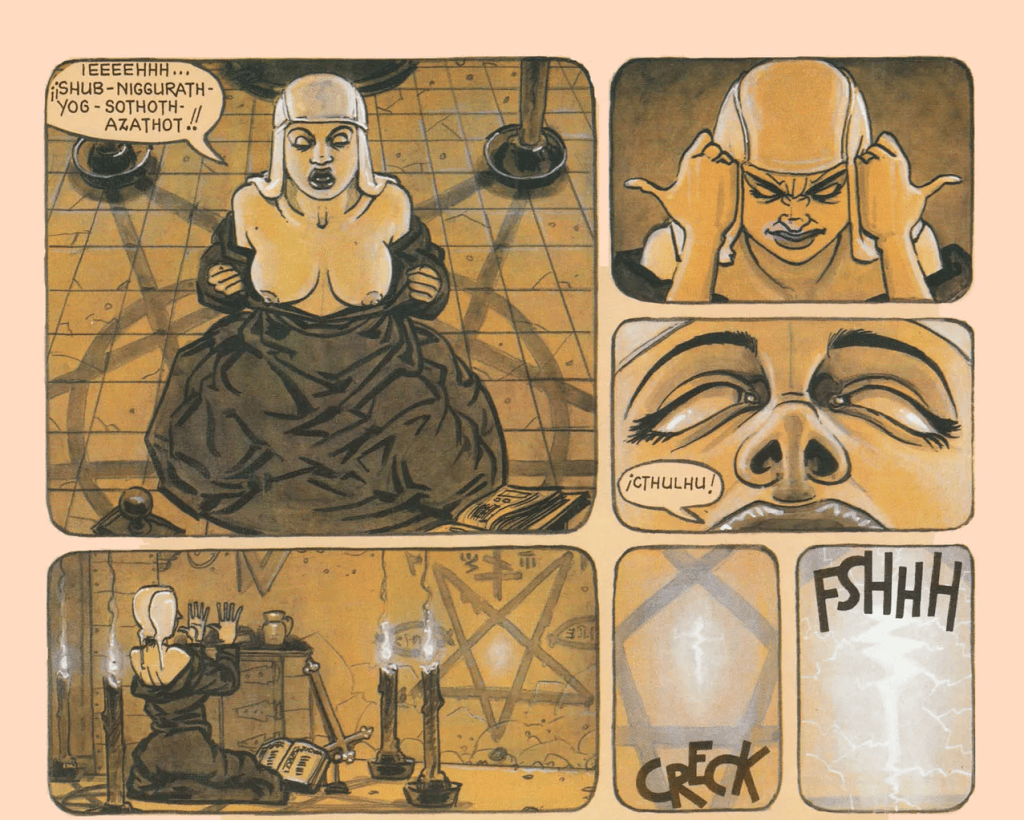
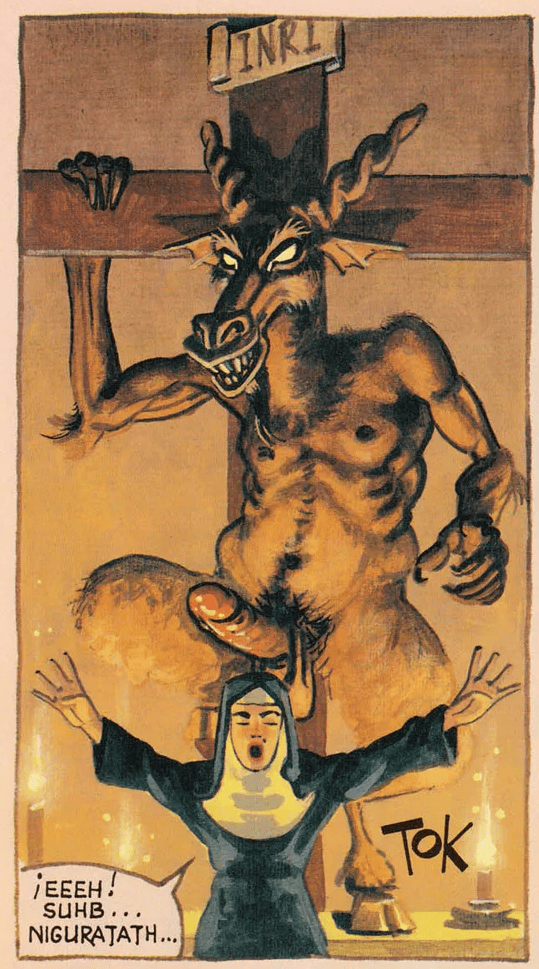
Barreiro and Noé were quite evidently drawing from an eclectic mix of resources in composing their work, and the graphic novel has a frankly erotic character playing out to many interests. There are elements of sadomasochism, bondage, lesbianism, Satanism, and corruption that come together with supernatural elements. After a brutal opening involving the sexual torture of a novitiate, the nuns uncover a hidden locked door in the basement (possibly a reference to Lucio Fulci’s Gates of Hell trilogy), which inspires in the Mother Superior a dream of a Lovecraftian-flavored Satanic ritual:
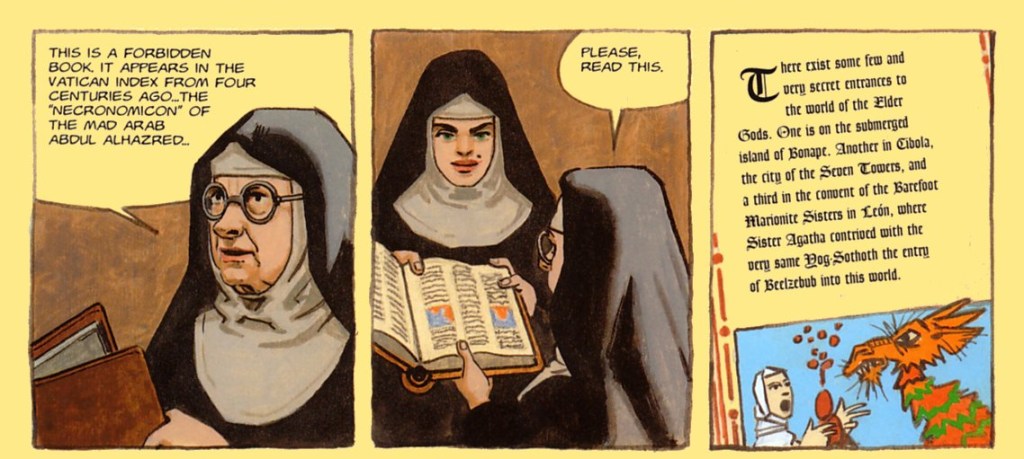
While the Church of Satan does include a few Lovecraftian elements, the actual being that emerges in this dream is a monstrously-endowed satyr. An older nun manages to find a reference to the door in a handy copy of the Necronomicon…
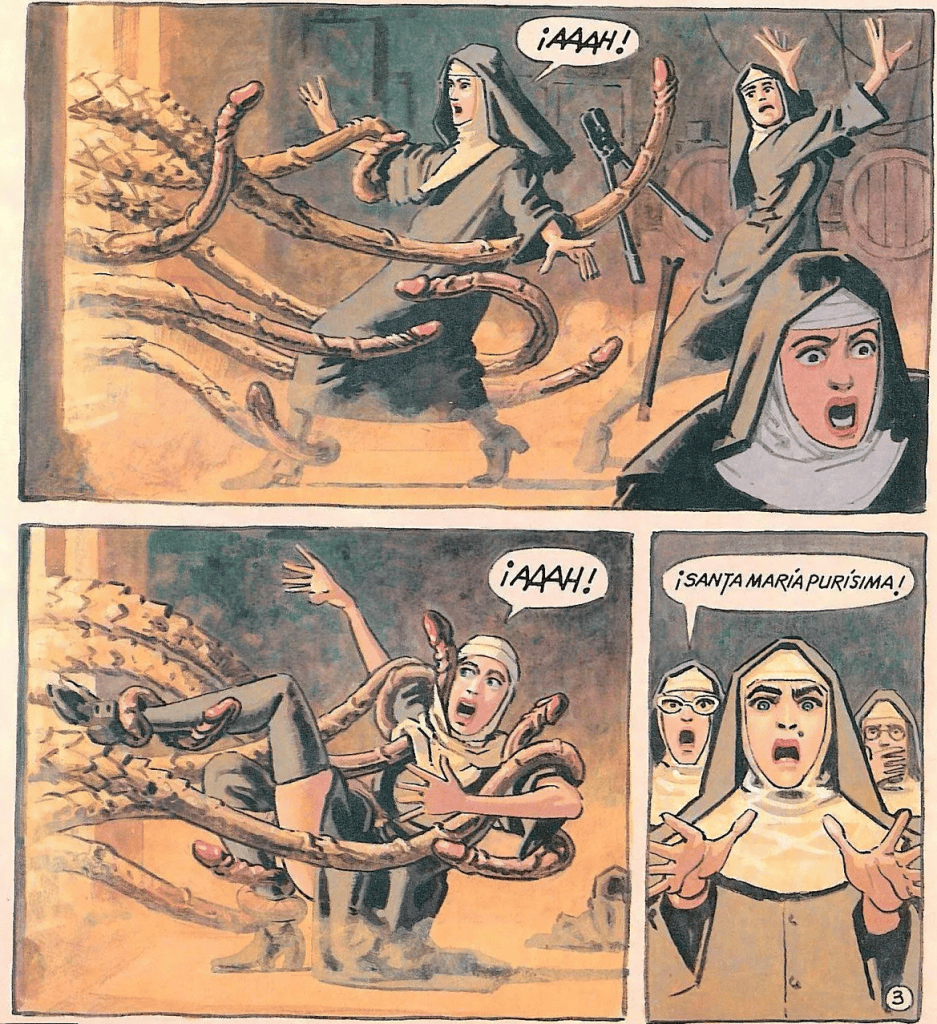
The mother superior of the convent doesn’t listen to her, however, and forces the door open, leading to an eruption of phallic-headed tentacles reminiscent of Japanese hentai in one of the most infamous scenes from the graphic novel.
Which gets explicit and quite graphic, leading to the afflicted nun’s death and the sealing of the door. Douglas E. Cowan, who summarizes the graphic novel in greater detail in his book The Forbidden Body: Sex, Horror, and the Religious Imagination, waxes clinical:
When the locks are broken, though, the nuns shrink back in fear as this time a true Lovecraftian horror bursts into the room. A flurry of tentacles, each rubbery arm tipped with a sinister phallus, emerges from whatever unearthly space lies beyond the door. Seizing the first available Marionite sister, it quickly envelops and strips the screaming woman. Fondling her ever more intmately, the tentacled abomination progresses to vaginal, anal, and oral rape—physical manifestations of everything she has sworn to abjure as a consecrated virgin. Although the other nuns are frozen in terror, with every new invasion of the young nun’s body a cut-away panel shows the effect on the Mother Superior, who grows increasingly turned on with each grotesque violation. Finally, the abbess orgasms as the Great Old one lifts the other woman high into the air, sexually impaled, every tentacular phallus ejaculating at once. A rain of eldritch sperm covers her body, and unable to withstand the supernatural assault, she dies naked on the rude stone floor.
We are never told her name. (111-112)
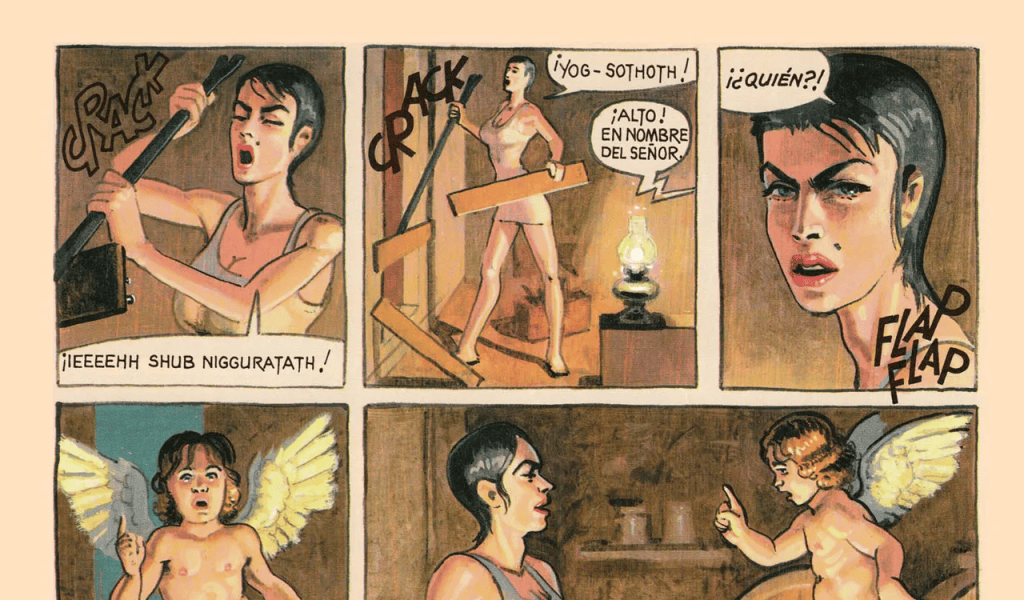
That night, the corrupted Mother Superior goes to unseal the door, and is interrupted by a messenger from God, a child-like angel.
Image truncated because no one needs to see a naked putto.
This sequence—where the corrupted Mother Superior nails the tiny angel to the door and then literally sucks the life out of them through their penis—was omitted from NBM’s edition of The Convent of Hell, probably out of fear that what it was depicting was too close, at least visually, to child sexual abuse material. There are anecdotes that even this mild self-censorship wasn’t sufficient; Steve Fentone in AntiCristo: The Bible of Nasty Nun Snema & Culture reports that: “[…] initial shipments of THE CONVENT OF HELL were reputedly stopped at the Canadian/US border, presumably for the books elements of bestiality and degradation.” (234)
With this sacrifice, the Mother Superior manages to summon a monstrously endowed Beelzebub through the door, in the form of a gigantic satyr. The corruption of the convent is soon complete in an orgy of sex and blood. After a chance encounter with a pair of newlyweds, the Vatican learns of the degradation and sends a special assault force with holy-water-blessed members and flamethrowers to deal with the Satanic infestation, destroy the demon, and block up the doorway once again.
This is not the first erotic comic work to invoke Lovecraftian names and themes; aside from the aforementioned Tales from the Leather Nun, there were works like the Italian comic Ramba, written by Marco Delizia; and the Young Witches series, which was created by Ricardo Barreiro and Francisco Solano López. The conflation of Lovecraftian elements with Satanic elements wasn’t uncommon in this respect, but neither is it really an attraction for those looking for Lovecraftian erotica, instead of Satanic porn with a thin skin of Lovecraftian elements. These few panels reproduced for this review contain basically all the Lovecraftian names and references across 64 pages of art.
El Convento Infernal is definitely a work of art. It is sacrilegious to the point of comedy; occasionally brutal, often over-the-top, yet the artwork is vivid and, as Cowan points out, often draws on classical works of Satanic imagery for reference. There is a vividness to the full-color artwork which is starkly at odds with the sometimes muddy shading of the black-and-white artwork that dominated Kiss Comix at the time. It is an exercise in excess where every episode seeks to grab the reader with at least one can’t-unsee-that image. In that respect, it is a success.
But does it go too far?
This is not a work that delves deep into the psychology of cloistered nuns, although there are hints of sexual repression and political considerations throughout the story; it is primarily, and always, a pornographic work, and some of the acts are violent and nonconsensual. There isn’t any actual bestiality, as Fentone mentions; the great hoofed goat with the enormous phallus is a demon. There is not technically any CSAM; it’s an angel. Yet it is definitely a dark fantasy, and one that is narratively built like a sexploitation horror film if there were no budget on special effects and the actresses would do absolutely anything in front of the camera.
Clark Ashton Smith was living in Auburn, California, when the Catholic order the Sisters of Mercy opened a convent within sight of his cabin in 1939/1940. He sometimes jokingly called it “the Nunnery of Averoigne,” and the sight of the nuns inspired a few poems. Most were relatively sedate affairs, but one speaks of the temptation of the forbidden:
IMPROBABLE DREAM
In my dream a nun, Proudly bosomed, lunar-pale, Danced naked in the sun.
El Convento Infernal is, in a much more explicit fashion, just such an improbable dream. More lavish, more detailed, and probably tripping the censors as obscene in some jurisdictions, yet in every sense a pure sexual fantasy that bespeaks a fascination with seeing the untouchable touched, the inviolate violated, witnessing the act of transgression against deeply ingrained cultural taboos.
Outside the United States, there have been multiple editions of this work collected in Spanish, French, and possibly other languages. The English edition has never been reprinted and today is quite scarce. Noé would return to Lovecraftian themes in 2023 when he provided a variant cover for Lovecraft: The Call of Cthulhu (Zenescope), which is evocative of his earlier work while being in no way tied to it.
Eando (“E and O”) Binder was the joint pseudonym of the brothers Earl Binder (4 Oct 1904–13 Oct 1966) and Otto Binder (26 Aug 1911–14 Oct 1974). The Binder brothers were writers for the pulp magazines in the 1930s, including science fiction pulps like Amazing and horror fiction pulps like Weird Tales, where they came to the attention of peers like H. P. Lovecraft. By 1939, Otto was doing the writing while Earl was acting as a literary agent, and in the same year they expanded from the pulps into the burgeoning comic book industry, where Otto would make his mark on characters like Captain Marvel and Superman, among many others.
In the 1950s, before the Comics Code Authority was established that would kill off most of the horror comics, the typical horror comic magazine was essentially an anthology featuring 2-4 short comics, featuring different characters, with a couple of pages of prose fiction. A ghoulish host might introduce the issue and stories and act as a bare-minimum framing narrative. The reason for this specific format could be cultural—various publishers aping the successful EC comics formula—but there are indications of other forces at work.
Comic books fell into part of a broader discussion on changing postal rates during the 1940s and 50s—critics claimed that the government was essentially subsidizing advertisers by allowing them to mail off periodicals primarily intended for advertising at lower rates—and, in part, mail censorship, as postal inspectors were the first line of blocking obscene publication (for more on which, see Obscenity in the Mails: Controls on Second-Class Privileges 1942-1957). However, the Postal Laws and Regulations of the United States of America Edition of 1940 and the Post Office Manual (1952) make no specific reference to comic books or give any guideline for the minimum number of pages of prose fiction in a periodical.
We do know some publications were denied as second-class mail; crossword puzzle magazines notably faced difficulties qualifying as second-class mail (cf. P.O.D. Docket Nos. 1/141; 1/147; 1/155 and 1/156), in part because of the lack of varied content. Report on second-class mail to the postmaster general (1946) by Charles A. Heiss does specifically discuss comic books and the percentage of comics, fiction, and advertising in a sample issue (the fiction coming to ~2.5 pages), so content was clearly an issue the USPS considered, though no guidelines are mentioned or given as to specific numbers of pages per issue. However, there are indications that there were informal guidelines stipulating such requirements. In one trial, a series of questions concerned comic magazines with second-class mail privileges:
Q. Each of these magazines contains not over two pages of textual matter? A. I wouldn’t say that.
Q. As a minimum? A. I wouldn’t say that. They usually tell their story in pictures.
Q. Do they have textual matter? A. I am comming to that.
Q. Can’t you tell me whether or not they have textual matter? A. Indeed they do.
Compare this to a letter and its answer in Blue Beetle #5 (1965):
Carl Barks recalled in one instance:
As explained in the entry for “Land Beneath the Ground” (US 13-02), the Gyro Gearloose stories that began in “Uncle Scrooge” No. 13 came about as a result of Western’s applying for a second class mailing permit for the comic. To gain second class privileges a periodical must contain at least two stories, each one featuring different characters. Barks turned to Gyro Gearloose, the inventor, to provide the required second feature.
Two stories had been completed before it was realized that no characters from the lead story could be used. In his 1969 list for Michael Barrier, Barks commented: “The four-page Gyro stories for Uncle S. #13 and #14 were sent back to me for changes. In the #13 story I’d used the nephews. Because of postal mailing laws, no characters used in other parts of the book could be used in the Gyro story. Hence the change to Mickey’s nephews. The character ‘Speedy’ in #14 was originally Donald.” —Applying For A Second Class Mailing
I have not found any print postal regulations from the 1940s, 50s, or 60s that specify a number of pages of non-comic material, or that stories may not share the lead character. Nor have I found anyone who cites a specific regulation or judicial ruling. However, I have found a judicial ruling which implies guidance on the matter was provided:
The publication with which we are concerned is printed monthly and is principally in comic strip form. Each issue features a special topic such as dogs, horses, Indians, the FBI, etc. […] By agreement at the hearing, ten issues of the publication published at the time of the application were introduced into evidence. The petitioner offered three later issues and counsel for the Director objected to this receipt into evidence. After the hearing he withdrew his objection when the Hearing Examiner indefinitely recessed the hearing because the Director would not appear to testify after being requested to do so by the Hearing Examiner. Each of these three later issues contain four separate stories on four subjects not connected with the principal topic of the issue. These are printed stories and articles rather than the comic strips which are the balance of the magazine. The petitioner added this matter upon the advice of the Director who had informed him that in the former format each issue of the publication was a book about a specific subject and not a periodical. After being so advised the petitioner made an effort to comply with the regulations and changed the format. There is nothing in the applicable regulations as to the content of a publication except to require that it must be for the purpose of “disseminating information of a public character” or “devoted to literature, the sciences, art or some special industry.” Section 132.224, Postal Manual. […] The fact that the Director did not tell him an exact number of pages which had to be devoted to other matter should not be held against the petitioner, especially since no regulation has been promulgated on this point. —P.O.D. Docket No. 1/158 (36 Feb 1960)
The indication is that at some point, one or more postal inspectors provided guidelines for what qualified a comic magazine as a periodical (second-class matter) instead of a book (third-class matter), and this became de facto standard industry practice, even if it might not have been put explicitly into writing and published as a federal regulation.
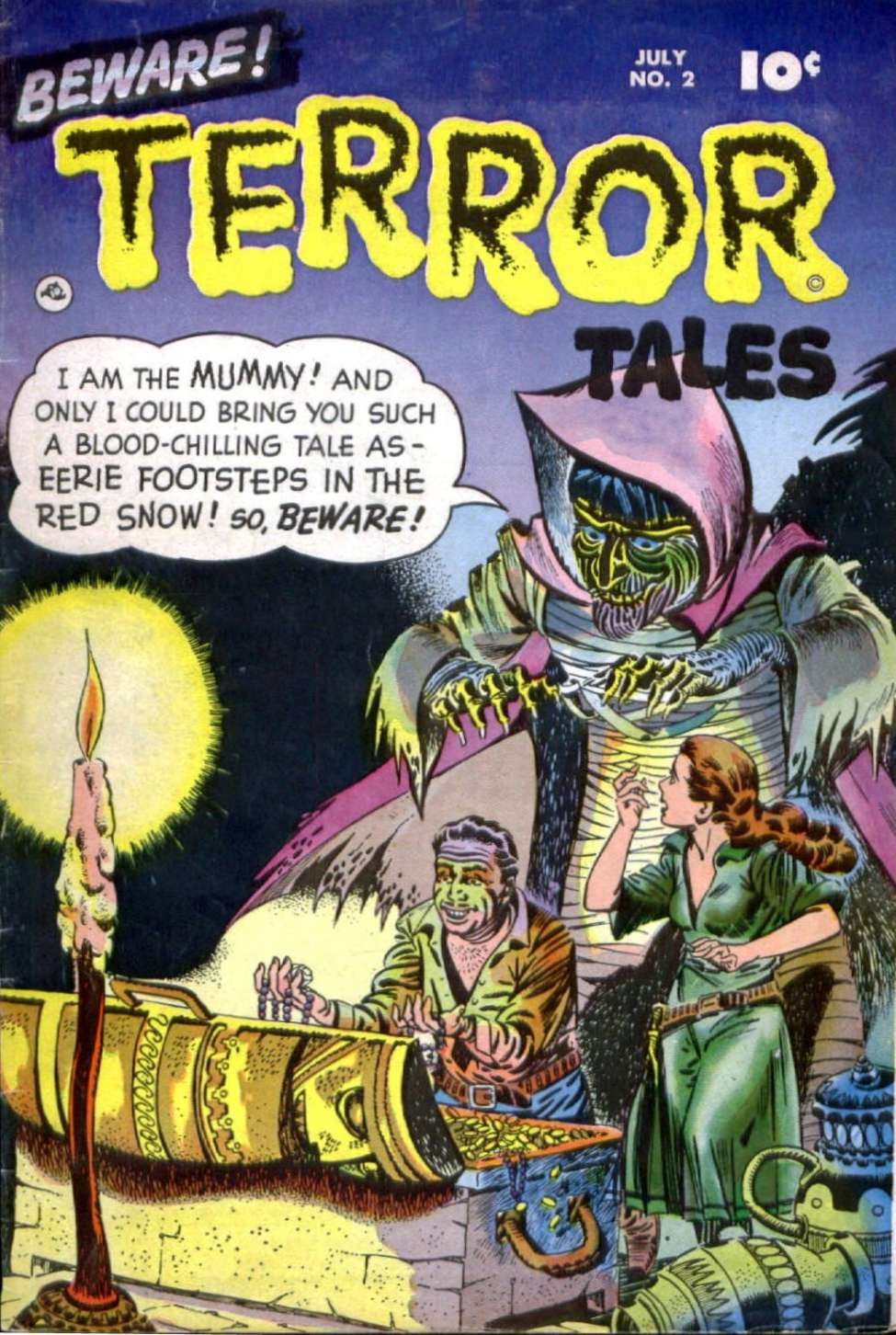
Whatever the actual cause, comics in the ’50s often featured brief, forgettable, potboilerish fiction, the vast majority of it not particularly noteworthy and written either anonymously or under pseudonyms. But…there’s also the occasional story from a recognizable name, such as “Fiend of Fire” as by Eando Binder, which was published in Beware! Terror Tales #2 (July 1952, Fawcett). This was almost certainly a solo work by Otto, dashed off quickly to fill an issue, but while it has been reprinted in various comic book reprints since entering the public domain, it has never been included in collections of the Binders’ pulp fiction, as far as I’ve been able to determine.
※
Fiend of Fire
by Eando Binder
HARLOW MAXON felt pretty good as he stuffed his pipe and prepared to settle back for a smoke. He was safe now. His big problem had been settled—completely. He could relax now and enjoy life.
Maxon lit the match and held it to his pipe, ready for a good smoke. But suddenly, the match flame hissed and sprang toward his eyes, like a live thing! With a yelp of pain and fright, Maxon flung it down and stamped on it, breathing hard.
Why had the match acted like that? Maxon calmed down. “Oh, just a defective one,” he told himself. “I’ll try another.”
Lighting another match, he held it gingerly at arm’s length, in case it would act up too, but it’s flame was normal and steady. Sighing in relief, he brought it to his pipe, puffing. But again, amazingly, the flame suddenly expanded lividly and hissed toward his face as if to burn his eyes out!
Cursing, bewildered, Maxon flung it down. But the flame was not out and the rug caught fire, fiercely. It did not seem like a normal flame at all as a patch of rug swiftly burned and widened. Maxon had all he could do to stamp it out with both feet, crushing it underfoot!
Maxon stood there panting, but more puzzled than frightened. Matches just shouldn’t act that way. And he was annoyed too. How could he light his pipe and enjoy a smoke? Well, skip it, he told himself reluctantly.
He settled back and picked up the paper, forgetting the incident. What did it matter, for there, in the news columns, were the words that made him safe—MAN DIES IN FLAMING AUTO! The text went on to state that driving down the street, John Begget’s car suddenly caught fire and the trapped driver was burned to death within, an unfortunate accident.
“Accident,” gloated Harlow Maxon to himself. “Sure it was an accident—planned by yours truly! I killed him, but nobody suspects!”
It was a common enough story. Maxon had borrowed heavily from John Begget, his friend, to indulge his taste for gambling. Losing steadily, he had kept putting off Begget, until in anger, Begget threatened to have him arrested and jailed. Maxon had been unable to raise the money. So what else was there to do but silence Begget? Get him out of the way? That solved everything—at least in the unscrupulous mind of Maxon. And so he had secretly planted the thermite-bomb in Begget’s car, leading to its explosion and complete burning.
That had been this morning. And now, tonight, Maxon was a free man, safe from the law. He dropped the paper with a satisfied smirk, settled back, and started to light his pipe.
But he had forgotten. Again there was a deadly hiss as the small flame grew and shot at his face like a fireball! Maxon stamped it out in a hurry, choking, with a slow dread clutching at his heart. Looking in a mirror, Maxon saw that his eyebrows had been singed that time.
Cursing, eager for his smoke, Maxon went into the kitchen and turned on one burner of the gas-range. It was automatic. He needed no matches. But at the moment the burner went on, its blue flame gave a hiss and shot toward him in a long searing tongue like a striking snake!
Maxon staggered back. The flame seemed to search for him, curling and twisting through the air. Horrified, Maxon dropped to his knees and was thus able to reach up and turn off the gas. The flame died just before it reached the hair on his head.
Trembling and shaken, Maxon went back to the living room and pulled an easy chair up to the fireplace. He had lit the fire before and needed to bask in its warm glow, and recover from his jitters over the weird events that had just happened.
“Ah, this is better,” he mumbled, stretching his hands toward the dancing flames.
But abruptly, they were dancing flames no longer. With a roaring hiss much louder than before, a sheet of flame burst from the fireplace toward Maxon. Screeching, Maxon leaped from the chair and stumbled back, barely in time, out of range.
The long ribbon of flame from the fireplace seemed to reach for him like clutching hands, even though he ran the length of the room. After him the fiery hands came, as if there was no escape!
And then Maxon was in the corner of the room; trapped. He turned at bay, moaning. He waited for the searing hot touch on his body, shuddering, whining in fear . . .
But then, most eerie of all, the flame took form slowly—human form. And its hiss became a mocking voice that said—”No, I won’t kill you this soon. Not before you suffer torment and know what I am. Look at me, Harlow Maxon! Don’t you see who I am?”
Maxon’s eyes bulged, taking in the human shape that the flame had formed. “No, it can’t be!” Maxon moaned. “It can’t be you—John Begget!”
“Yes, John Begget, your victim, hissed back the fire-spirit. “In flames I died—and in all flames I live again! Don’t try to understand, Maxon. It is something beyond the mundane. I was able to make those match flames dart in your eyes before. I made the gas flame leap at you. And now I’ve come for you out of the fire-place. Call me a fire ghost or whatever you will, but now you will die as I died—in fiery torment!”
And with a ghastly, hollow laugh, the fire spirit clutched for Maxon with its flaming hands . . .
But Maxon remembered the fire-extinguisher nearby, enclosed in a wall niche. Somehow he grabbed it out and swung the nozzle at the flame form. The fine spray beat it back. The fire ghost retreated before him and Maxon reached the fireplace, putting out the whole fire there. Only then did he stop, feeling that he had won out in this mad duel to the death with the fire fiend.
But one last ember glowed, and a somber hiss echoed in the air, forming words. “You have won for now, Maxon. But you can’t escape me. Remember, I can strike at you from any flame—anywhere—anytime! You can’t escape me!”
“Yes, I will!” shouted back Maxon. “It’s simple—I’ll just avoid all flame. It’s as simple as that!”
In the following days, Maxon carried out his grim campaign. He stopped smoking. He would never light a match again. And he could do without fires in the fireplace easily enough. As long as he kept away from flame, he was safe. In his daily life among others at the track or gambling casino, it was not hard to keep away from those lighting matches nearby. With care, he could keep out of range of an open fire, in any form.
He had one bad moment when some friends dropped in one evening, surprising him on his birthday. One of the girls came out of the kitchen with a birthday cake and lighted candles, as they all sang the familiar birthday song to him. Maxon stared horrified and then dumped a bottle of soda, snuffing out the candles. He had acted like a maniac and ruined the evening, but once more he had foiled the fire ghost.
Maxon was triumphant, getting a sort of twisted joy out of his strange duel with the supernatural. By sheer persistence, he’d won out.
Even on a hunting party in the winter season, Maxon took care not to sit near the blazing fire they built when having lunch. He almost froze, sitting away from the heat, but he was safe!
Safe that is, until a whipping wind kicked up sparks and before they knew it, a brush fire had blazed up! The others fought the flame but Maxon ran—only to be blinded by smoke. Staggering, coughing, he was suddenly faced by a wall of fire, out of which a fiery shape loomed hugely, with a hissing roar of laughter. The fire ghost again!
Long arms of flame shot toward him, but Maxon saw his salvation not far off—a running brook. Without hesitation, he plunged into the icy waters, safe from the fire spirit, until his friends succeeded in beating out the last of the fire.
Even in the hospital, where his friends hastened him after the icy plunge. Maxon was happy. He was safe from fire—safe from the fire ghost. Safe from being consumed by fiery vengeance from beyond . . .
†
MAXON suddenly started, his spine crawling. What was that the doctor was saying?
“Fever! A very high fever—one hundred and five! We can’t bring it down! Poor chap!”
Maxon’s eyes alone saw the wraith-like shape that sat on his chest, in flowing outline, grinning. He heard the soft hiss of the fire ghost’s words—”Fever is a form of ‘fire’ too, Maxon! Fever consumes the sick body just like a fire! Didn’t I tell you there was no escape? . . .”
THE END
※
“Fiend of Fire” is brief, original, and fairly straightforward with a slight EC-style twist at the end—Binder would go on to write for EC for about a year before the Comics Code Authority killed their horror and crime comics. The bad guy gets his thematically appropriate comeuppance; the supernatural occurrences are an atypical haunting, but otherwise unexplained. A fairly minor work in a long and storied career, but for fans who thought they’d read all of Eando Binder, there’s far more beyond the pulps.
This story contains historical stereotypes of Native American cultures and characters. Reader discretion advised.
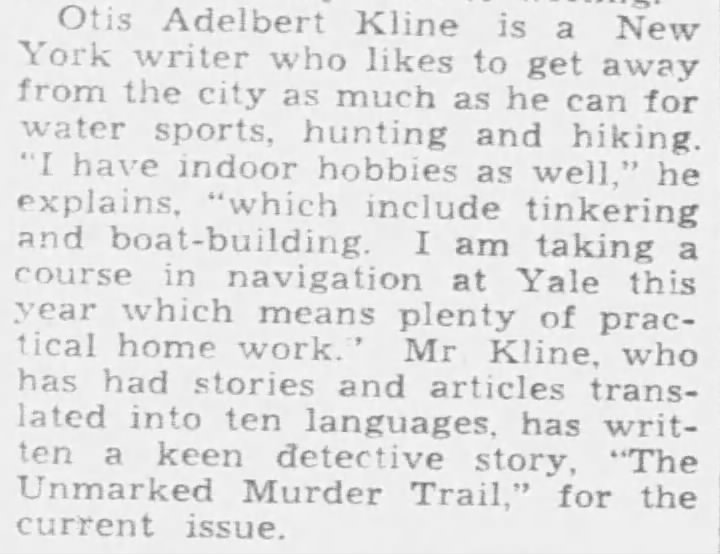
The very first issue of Weird Tales included “The Thing of a Thousand Shapes” by Otis Adelbert Kline—the first part of the first serial to run in the Unique Magazine. Kline was, alongside Farnsworth Wright, one of the readers for the magazine under its first editor Edwin Baird, and one source claims that Kline ghost-edited the massive May-Jun-July 1924 triple-issue that marked the end of the old management. Wright would end up in the editorial seat at Weird Tales, and we can only speculate how things might have been different if Kline had gotten the job instead.
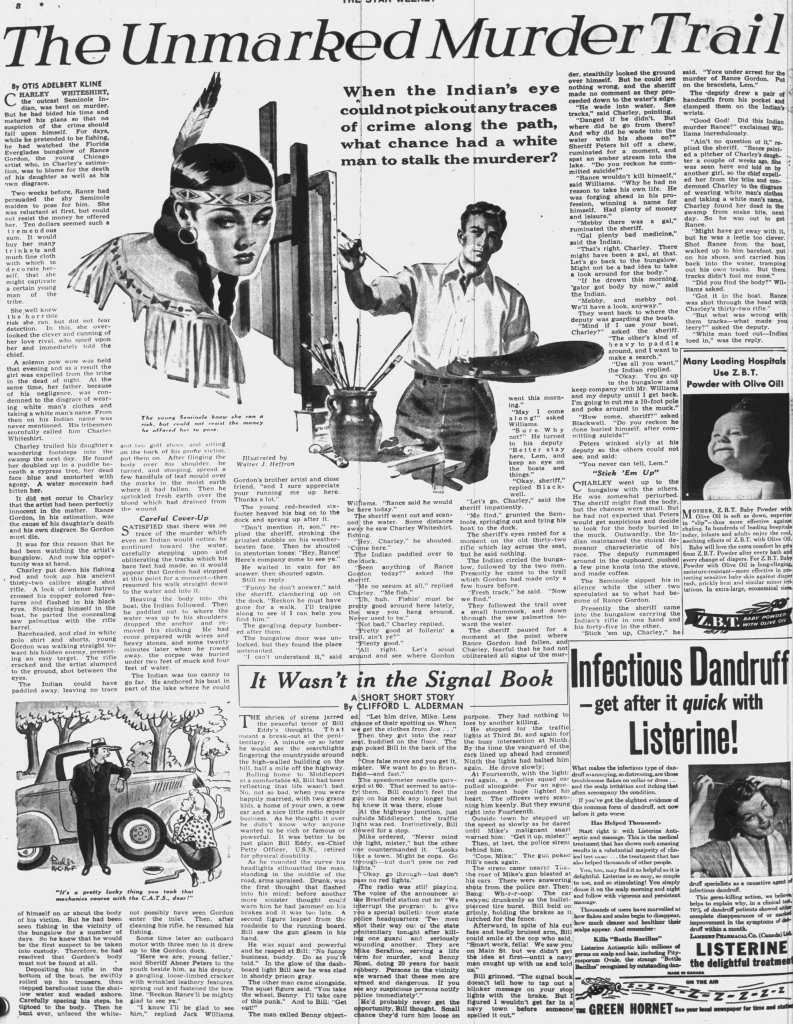
Kline continued as a writer and increasingly as a literary agent, marketing the pulp stories of Robert E. Howard, E. Hoffmann Price, C. L. Moore, and others during the 1930s and 40s, until his death in 1946. Most of Kline’s weird fiction from the pulps has been reprinted in various places, but there are more obscure non-weird works that have never been reprinted, including a handful of short pieces for newspapers. The most substantial of these is “The Unmarked Murder Trail,” which appeared in the Toronto Star Weekly 1 Nov 1941.
CHARLEY WHITESHIRT, the outcast Seminole Indian, was bent on murder. But he had bided his time and matured his plans so that no suspicion of the crime should fall upon himself. For days, while he pretended to be fishing, he had watched the Florida Everglades bungalow of Rance Gordon, the young Chicago artist who, in Charley’s estimation, was to blame for the death of his daughter as well as his own disgrace.
Two weeks before, Rance had persuaded the shy Seminole maiden to pose for him. She was reluctant at first, but could not resist the money he offered her. Ten dollars seemed such a tremendous sum. It would buy her many trinkets and much fine cloth with which to decorate herself, that she might captivate a certain young man of the tribe.
She well knew the horrible risk she ran but did not fear detection. In this, she overlooked the clever and cunning of her love rival, who spied upon her and immediately told the chief.
A solemn pow wow was held that evening and as a result the girl was expelled from the tribe in the dead of night. At the same time, her father, because of his negligence, was condemned to the disgrace of wearing white man’s clothes and taking a white man’s name. From then on his Indian name was never mentioned. His tribesmen scornfully called him Charley Whiteshirt.
Charley trailed his daughter’s wandering footsteps into the swamp the next day. He found her doubled up in a puddle beneath a cypress tree, her dead face blue and contorted with agony. A water moccasin had bitten her. | It did not occur to Charley that the artist had been perfectly innocent in the matter. Rance Gordon, in his estimation, was the cause of his daughter’s death and his own disgrace. So Gordon must die.
It was for this reason that he had been watching the artist’s bungalow. And now his opportunity was at hand.
Charley put down his fishing rod and took up his ancient thirty-two calibre single shot rifle. A look of intense hatred crossed his copper colored features and flashed in his black eyes. Steadying himself in the boat, he parted the concealing saw palmettos with the rifle barrel.
Bareheaded, and clad in white polo shirt and shorts, young Gordon was walking straight toward his hidden enemy, presenting an easy target. The rifle cracked and the artist slumped to the ground, show between the eyes.
The Indian could have paddled away, leaving no trace of himself on or about the body of his victim. But he had been seen fishing in the vicinity of the bungalow for a number of days. So he knew that he would be the first suspect to be taken into custody. Therefore he had resolved that Gordon’s body must not be found at all.
Depositing his rifle in the bottom of the boat, he swiftly rolled up his trousers, then stepped barefooted into the shallow water and waded ashore. Carefully spacing his steps, he tiptoed to the body. Then he bent over, unlaced the white-and-tan golf shoes, and sitting on the back of his prone victim, put them on. After flinging the body over his shoulder, he turned, and stopping, spread a few handfuls of leaf mould over the marks in the moist earth where it had fallen. Then he sprinkled fresh earth over the blood which had drained from the wound.
Careful Cover-Up
SATISFIED that there was no trace of the murder which even an Indian would notice, he continued toward the water, carefully stepping upon and obliterating the tracks which his bare feet had made, so it would appear that Gordon had stopped at this point for a moment—then resumed his walk straight down to the water and into it.
Heaving the body into the boat, the Indian followed. Then he paddled out to where the water was up to his shoulders, dropped the anchor, and removed his clothing. He had come prepared with wires and heavy stones, and some twenty minutes later when he rowed away, the corpse was buried under two feet of muck and four feet of water.
The Indian was too canny to go far. He anchored his boat in part of the lake where he could not possibly have seen Gordon enter the inlet. Then, after cleaning his rifle, he resumed his fishing.
Some time later an outboard motor with three men in it drew up to the Gordon dock.
“Here we are, young feller,” said Sheriff Abner Peters to the youth beside him, as his deputy, a gangling, loose-limbed cracker with wrinkled leathery features, sprang out and fastened the bow line. “Reckon Rance’ll be mighty glad to see ye.”
“I know I’ll be glad to see him,” replied Jack Williams, Gordon’s brother artist and close friend. “and I sure appreciate your running me up here. Thanks a lot.”
The young red-headed six-footer heaved his bag on to the dock and sprang up after it.
“Don’t mention it, son,” replied the sheriff, stroking the grizzled stubble on his weather-beaten face. Then he shouted in stentorian tones: “Hey, Rance! Here’s company come to see ye.”
He waited in vain for an answer, then shouted again.
Still no reply.
“Funny he don’t answer,” said the sheriff, clambering up on the dock. “Reckon he must have gone for a walk. I’ll traipse along to see if I can help you find him.”
The gangling deputy lumbered after him.
The bungalow door was unlocked, but they found the place untenanted.
“I can’t understand it,” said Williams. “Rance said he would be here today.”
The sheriff went out and scanned the water. Some distance away he saw Charley Whiteshirt, fishing.
“Hey, Charley,” she shouted. “Come here.”
The Indian paddled over to the dock.
“Seen anything of Rance Gordon today?” asked the sheriff.
“Me no seeum at all,” replied Charley. “Me fish.”
“Uh, huh. Fishin’ must be pretty good around here lately, the way you hang around. Never used to be.”
“Not bad,” Charley replied.
“Pretty good at follerin’ a trail, ain’t ye?”
“Plenty good.”
“All right. Let’s scout around and see where Gordon went this morning.”
“May I come along?” asked Williams.
“Sure. Why not?” He turned to his deputy. “Better stay here, Lem, and keep an eye on the boats and things.”
“Okay, sheriff,” replied Blackwell.
“Let’s go, Charley, said the sheriff impatiently.
“Me find,” grunted the Seminole, springing out and tying his boat to the dock.
The sheriff’s eyes rested for a moment on the old thirty-two rifle which lay across the seat, but he said nothing.
The Indian circled the bungalow, followed by the two men. Presently he came to the trail which Gordon had made only a few hours before.
“Fresh track,” he said. “Now we find.”
They followed the trail over a small hummock, and down through the saw palmettos toward the water.
The sheriff paused for a moment at the point where Rance Gordon had fallen, and Charley, fearful that he had not obliterated all signs of the murder, stealthily looked the ground himself. But he could see nothing wrong, and the sheriff made no comment as they proceeded down to the water’s edge.
“He wade into water. See tracks,” said Charley, pointing.
“Danged if he didn’t. But where did he go from there? And why did he wade into the water with his shoes on?” Sheriff Peters bit off a chew, ruminated for a moment, and spat an amber stream into the lake. “Do you reckon he committed suicide?”
“Rance wouldn’t kill himself,” said Williams. “Why he had no reason to take his own life. He was forging ahead in his profession, winning a name for himself. Had plenty of money and leisure.”
“Mebby there was a gal,” ruminated the sheriff.
“Gal plenty bad medicine,” said the Indian.
“That’s right, Charley. There might have been a gal, at that. Let’s go back to the bungalow. Might not be a bad idea to take a look around for the body.”
“If he drown this morning, ‘gator got body by now,” said the Indian.
“Mebby, and mebby not. We’ll have a look, anyway.”
“Mind if I use your boat, Charley?” asked the sheriff. “The other’s kinda of heavy to paddle around, and I want to make a search.”
“Use all you want,” the Indian replied.
“Okay. You go up to the bungalow and keep company with Mr. Williams and my deputy until I get back. I’m going to cut me a 10-foot pole and poke around in the muck.”
“How come, sheriff?” asked Blackwell. “Do you reckon he done buried himself, after committing suicide?”
Peters winked slyly at his deputy so the others could not see, and said:
“You never can tell, Lem.”
“Stick ‘Em Up”
CHARLEY went up to the bungalow with the others. He was somewhat perturbed. The sheriff might find the body, but the chances were small. But he had not expected that Peters would get suspicious and decide to look for the body buried in the muck. Outwardly, the Indian maintained the stoical demeanor characteristic of his race. The deputy rummaged around in the cupboard, pushed a few pine knots into the stove, and made coffee.
The Seminole sipped his in silence while the other two speculated as to what had become of Rance Gordon.
Presently the sheriff came into the bungalow carrying the Indian’s rifle in one hand and his forty-five in the other.
“Stick ’em up, Charley,” he said. “Yore under arrest for the murder of Rance Gordon. Put on the bracelets, Lem.”
The deputy drew a pair of handcuffs from his pocket and clamped them on the Indian’s wrists.
“Good God! Did this Indian murder Rance?” exclaimed Williams incredulously.
“Ain’t no question of it,” replied the sheriff. “Rance painted a pitcher of Charley’s daughter a couple of weeks ago. She was seen here and told on by another girl, so the chief expelled her from the tribe and condemned Charley to the disgrace of wearing white man’s clothes and taking a white man’s name. Charley found her dead in the swamp from snake bit, next day. So he was out to get Rance.
“Might have got away with it, but he was a leetle too clever. Shot Rance from the boat, walked up to him barefoot, put on his shoes, and carried him back into the water, tramping out his own tracks. But them tracks didn’t fool me none.”
“Did you find the body?” Williams asked.
“Got it in the boat. Rance was shot through the head with Charley’s thirty-two rifle.”
“But what was wrong with tracks—what made you leery?” asked the deputy.
“White man toed out—Indian toed in,” was the reply.
※
“The Unmarked Murder Trail” is not a whodunit. Or a howdoneit, or even a whydoneit; the murderer is identified right away, their motivation established, the method described clearly. So this is an inverted detective story or howcatchem. Having established the crime scene, the interest becomes how the wily lawman outthinks the criminal despite all of his precautions. Television’s Columbo is probably the best-known example of this style in popular culture.
Kline’s little howcatchem isn’t a great example of the genre. The sheriff comes into the story apparently having full knowledge of Charley’s motivation and quickly determines the method. The final clue hinges on something not seen or hinted at—Charley could wear the dead man’s shoes, but his gait was different, so the tracks the two left were distinct.
What is notable about this story is the characterization of the Native Americans. While Kline gets the geography and tribal affiliation correct—the Seminole people have long been associated with Florida and the Everglades (Lovecraft even met a couple during a trip to Florida in the 1930s)—pretty much everything else is stereotype. Charley Whiteshirt speaks in Native American Pidgin English. The Seminoles in Florida do hold a powwow celebration today, but it was started in 1971, borrowed from similar celebrations by other indigenous peoples; the usage here as a general meeting is in keeping with the broad flattening of diverse Native American cultures into a dime novel or Hollywood mold. Even the art for the story by Walter J. Heffron is characteristic garb of Plains peoples, not Florida Seminoles. The total effect is neither particularly accurate nor sympathetic.
This is a potboiler mystery, one that relies on stereotypes for interest, with the barest hint of impropriety—there is the implicit suggestion that Charley’s daughter posed nude; why else would merely modeling warrant expulsion?—and maybe if it were longer Kline would have fleshed it out with a romance and more characterization. As it is, the cast is almost too crowded and much depends on coincidence; Jack Williams only exists to bring the sheriff there in time to see the tracks. One good Florida afternoon rain might have erased the tracks, and Charley would have gotten away with it.
Donald Raymond Smith (The Sage of Nuneaton) was a notable but reclusive British fan, noted for being one of the first fans to write fanfiction in the contemporary sense—i.e., original amateur fiction featuring fictional characters created by and for fans. Before the 1940s, “fan fiction” was simply fiction written by fans, as opposed to professional writers, and didn’t necessarily reuse the characters or settings of other writers. While there are some examples of this sort of thing in the 1930s in ‘zines like The Fantasy Fan, Smith had a knack for it.
One of his most notable efforts is “Why Abdul Al Hazred Went Mad,” first published in The Nekronomikon #3 (Autumn 1950), now a very scarce fanzines; and very rarely republished, last appearing in The Second Cthulhu Mythos Megapack (2016).
※
Why Abdul Al Hazred Went Mad
by D. R. Smith
The fabulous Necronomicon was never finished. This is well-known to all advanced students of the occult, whether or not they have had the courage and good fortune to peruse a copy. A well-known—in spite of the fact that few who have delved into the soul-blasting secrets of that loathsome mixture of revolting instruction and blasphemous history have managed to preserve their sanity to read that final chapter, which begins with the mutterings of one in a frenzy and dies away in the hideous ravings of mania. Abdul Alhazred—may his name be accursed forever—remained devilishly sane during the acquisition and recording of that abominable knowledge which few throughout the centuries have dared to acquire, even in part. It was the story he attempted to tell in that last frenzied chapter that shattered his black mind and sent his spirit gibbering with horror out of his diseased body into the gleeful embraces of the torturers of the damned.
And no one has ever dared to make that story known. Indeed, the most diligent search has failed to trace any mention of the terrible message by any student of the occult. Yet it was known to be sublime genius, and the crux of it published to the world in words still spoke on the public stage:
“(Anthony) . . . . . . on the Alps
It is reported thou didst eat strange flesh
Which some did die to look on;”
But should that story be widely known, it may be that what drove the blaspheming Arab mad may well drive honest men sane. And so I transcribe below, shorn of as much of its incoherent madness as possible, and cleansed of the filth that besmirched every thought that bubbled from the cess-pit of Alhzared’s obscene mind, a correct version of the last chapter of the Necronomicon.
. . . . . .
There was One Other. The Great One. Great Father and Great Mother in One. Greater than Great Cthulhu, than Hastur his brother, than Shub-Niggurath the Goat with a Thousand Young, than Tsathoggua, than great Yog-Sothoth himself—for They are but One’s spawn. One was once of the Great Old Ones, near the mightiest, for One challenged the supremacy of Azathoth Himself, the blind idiot, Lord of All. May, his children have told me—but this I may not believe—that One (who is too great to be Named) was indeed Lord of All! So great was One that They-who-Are-Not-To-Be-Thought-Of, fearing lest Evil become supreme, hurled him from his awful throne and chained him within chains of flesh that he might not break to this, the Planet of the Damedn. And as he fell he spawned Yog-Sothoth, who only is less than Azathoth. Sos says great Cthulhu, first of the Great Abominations which One formed from his own flesh to be his servants and the masters of the planet.
Mighty was the Great One. Loathsome the body They had bound him in—yet he gloried in its horror, and moulded it with his own will into a Thing to describe which would strike death into the craven soul of mortal men. The Faceess Nyarlathotep, messenger of the Great Old Ones, could not endure the foulness that was One, where he lay in a pool of his own slimy exhalations in the cavern in the mountains, lay and ruled the world with the terror of himself and the gods he had spawned. Had but I, Abdul Alhazred, been alive then to worship him! Great his Children, diligently have I served them and well have they paid me, with ecstasies the name of which should draw shrieks of horror from those white-livered children-in-men’s-shapes who talk so loud of their puerile torturings with knives and fire and water. But the Great One—to serve him would have been—would have been . . . . . . . .
Curse the Roman! May the Hounds of Tindalos hunt his shrieking soul through the ends of space for a million million times a million eons! How could he do that which he did! Great Cthulhu I asked and he shrank and would not reply. Tsathoggua I asked, and Tsathoggua would not tell me. Yog-Sothoth I asked, greatest of the Spawn, and Yog-Sothoth would not tell me. Yea, by my Art did I call on Nyarlathotep, the faceless howler in the darkness, commanding thee messenger of the Great Old Ones as never man had dared before, and Nyarlathotep ceased his eternal howling and would not reply, though he feared me as he fears only Cthugha, the Eternal Fiery One, who when the Time comes shall consume utterly.
Was it machination of Azathoth? One’s children say Azathoth, even mighty as he was, would never have dared to plot against the Great One. Yet surely it was only by some hostile guidance that this man, this incredible man, was driven with his rabble of soldiers into the mountains where lay the cavern of the Great One. Perhaps the Elder Gods—but they had only wanted to exile the Great One, not destroy him.
However it was, the Roman came. Marcus Antonius, a big brawling lecherous brute who boasted he feared nor god nor devil. A foolish boast, which many have made to me—and fled shrieking if they but smelt the week-old effluvium left from one of Cthulhu’s visits. But Marcus Antonius—how could there be such a man? Man he was, who fought and loved like a man, and died foolishly as a man will through stupid devotion to a trollop. Could such a one be greater than the Great Ones to whom I have given so much worship? That I have damned myself to all eternity for—for . . . . . . . . . NO!
I must tell it. It must be recorded. This Antonius and his soldiers were lost. Starving. They drank the urine of the horses. They killed the horses and ate them—and went on through the bare mountains. Antonius was their leader. He boasted of his strength and endurance and would eat of the horse-flesh, leaving it for others. On they went, and they came to a valley—a gloomy cleft in the hills. But water ran crystal clear down a rocky bed and scrubby pines grew around. They drank the water and made a huge fire of the trees—but the hunger was still there. And Marcus Antonius was hungriest of all.
At the head of the cleft was a cave. Caves are often inhabited by animals. Animals can be eaten. Marcus Antonius led the way to the mouth of the cave, but there all stopped. For from the cave came such a stench as would petrify a man’s soul within his living body, and more evil than that. None could advance further but Antonius, who called them cowards and went on, went down into the dreadful gloom of that cavern. Went alone . . . . . .
Silence. A long silence. Then suddenly, horribly the reverberating uproar of a furious combat in some vast hollow below. Part of the noise the bellows of fighting-mad Marcus Antonius—part of such a nature that many who heard fled screaming from the accursed spot. They were the lucky ones. Those who remained, white-faced, frozen with terror, heard the noises continue, and draw nearer. Abruptly the cavern belched forth a writhing mass, the maniacally fighting Antonius smeared from head to foot with a mixture of his own blood and revolting slime from That which he fought. That which he had dragged out into the light of day, where never had it been seen before. That which is javelin could not slay, his sword not wound. That abomination at the sight of which the watchers dropped dead, the very souls lasted out of their bodies.
It called for help, and twilight shrouded the sun, and the strong shapes of the Wind Walkers, Ithaqua and Lloigor and Zhar and Great Hastur himself came howling down. And Antonius saw and laughed unafraid, and called upon Jupiter, whom the Greeks called Zeus, the Lord of Heaven and master of storms, called asking for aid as from an equal. And lo, on the Walkers and on Hastur, on Cthulhu hurtling from the sea and on Yog-Sothoth gathering formlessly from everywhere and nowhere, on all the hastening Spawn of One, Jupiter hurled his thunderbolts, and his laughter crashed and bellowed and split the skies as he lashed back the children of One with the multi-thonged lashes of the lightning.
And under that madness of light and noise Marcus Antonius, with strength beyond the compute of mortal man, raised the Great One and hurled him onto the mighty fire his men had kindled. Horribly One screamed and writhed amongst the glowing embers, and Antonius laughed and threw on more wood, and in the heart of the flames One screamed abominably until little but blacked charcoal was left of his fightful body. And then Marcus Antonius, a man amongst men, who feared nor God nor devil, but who was very hungry, smashed the charred shell and inside found nothing but a single steaming piece of rank flesh, loathsome of shape and color and odor. But it was flesh, and he ate.
Yes, he ate it! The brutish Roman dolt, he ate it, the yet-living heart of the Great One! And so he destroyed for ever the Great One! And if One could himself be thus destroyed by brute courage and appetite, what of his children? Have I given my life and more than my life to the service of those who have no more power over a brave man than the beasts of the field?
. . . . . . . .
The rest is madness.
THE END
※
Yea, like the stag when snow the pasture sheets, The barks of trees thou browsèd. On the Alps It is reported thou didst eat strange flesh Which some did die to look on. And all this— It wounds thine honor that I speak it now— Was borne so like a soldier that thy cheek So much as lanked not. —William Shakespeare, Antony and Cleopatra, Act 1, Scene 4
This is a notable mid-century Mythos pastiche; it is very firmly drawing on the later Derlethian conception of the Mythos, not so much in the elemental schema as the very casual name-dropping of Cthugha and the like, the emphasis on a hierarchy among the eldritch entities, etc. The crowning joke of the piece is that Shakespeare reference, which is one of those obscure points like Tolkien’s Cats of Queen Berúthiel, which is not explained, but hints at something unspoken.
In that final jest, there is a rebuke of the Lovecraftian premise. Reminiscent of whenever Robert E. Howard’s Conan the Cimmerian encountered an eldritch entity. It represents, in a literary way, the kneejerk response to the fannish devotion that the very look at such-and-such an entity will drive you mad, or that such a creature as Cthulhu is incomprehensible, by responding “Squid guy.”
Basically, Smith was playing the game but subverting the expectation. Yet he plays it straight at the end; how would a dedicated cultist, who has given their life and committed innumerable acts in worship of these alien entities, react when it turns out that these entities aren’t all-knowing or all-powerful, and might, in fact, taste good with a bit of garum?
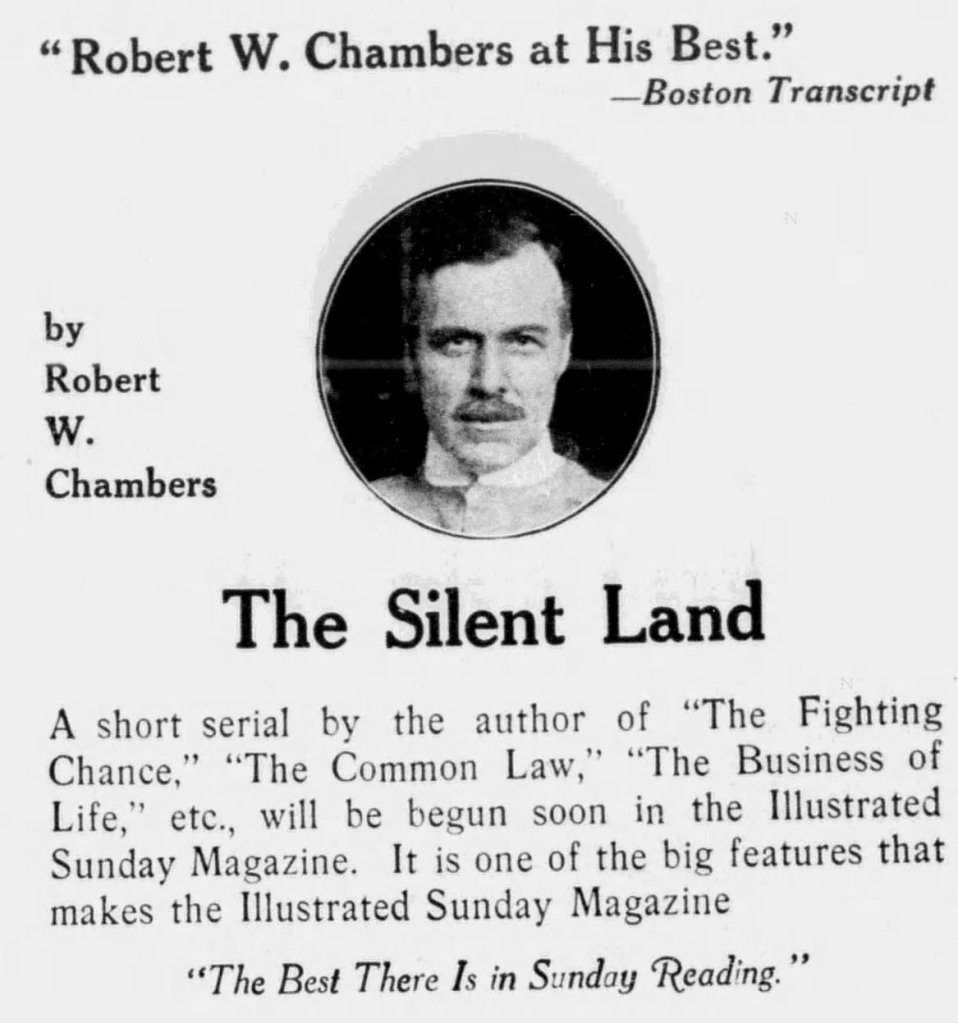
Robert W. Chambers is best remembered today for his collection The King in Yellow (1895), the first half of which features the weird stories that originated Yellow Mythos, with vague and disconcerting references to Carcosa, the Lake of Hali, the Yellow Sign, and the eponymous play The King in Yellow. These stories have proved to have an enduring popularity, and have been rewritten and analyzed many times. Chambers would go on to considerable success as a writer, primarily of popular romances.
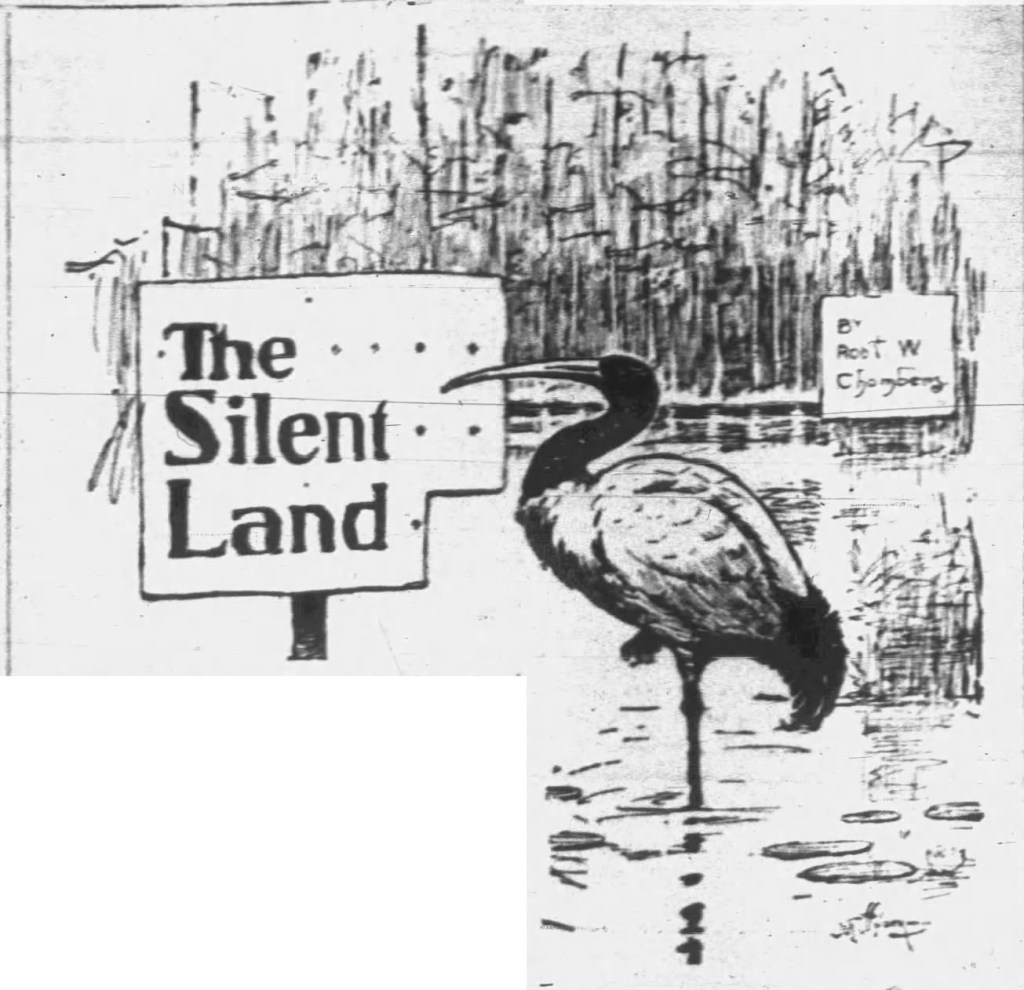
However, Chambers didn’t stop writing weird fiction. His next collection The Maker of Moons (1896) is another collection of odd novelettes and short stories; the showcase—and most frequently reprinted—story from that volume is the eponymous “The Maker of Moons,” a Yellow Peril fantasy that Lovecraft would make discreet reference to in “The Whisperer in Darkness.” What many readers miss, however, is that Chambers wrote The Maker of Moons so that the stories lead into each other; it begins with “The Maker of Moons” and then proceeds to “The Silent Land,” whose final paragraphs call back to the first story and then lead into the next story, “The Black Water.” What we get, then, is a more complex metafictional narrative, somewhat similar to what Arthur Machen did with The Three Impostors; or, The Transmutations (1895).
“The Silent Land” contains two references to Carcosa—and as such, can be read as a kind of addendum or extension of The King in Yellow, although the connection is tenuous and the atmosphere is different. Still, for students of the Yellow Mythos, it rewards reading.
In the same year that it was originally collected in The Maker of Moons (1896), “The Silent Land” was serialized in several newspapers, notably The Pittsburgh Press (12 & 19 Jul 1896), The Inter Ocean (19 & 26 Jul 1896), and The Buffalo Courier Express (19 & 26 Jul 1896); it was later serialized again in The Salt Lake Herald (10 Nov 1907) and the Illustrated Sunday Magazine (3 & 10 Aug 1913).
While a complete Chambers bibliography is difficult to compile, “The Silent Land” seems to have been rarely reprinted except in reprints of the entire The Maker of Moons collection, as newspaper serials, or, now that it is in the public domain, as part of a general mass reprint of Chambers’ weird work. Anthologists have largely missed it, likely because it is such a slight story, though attentive critics and scholars like Kenneth Hite have long noted it and the connection to The King in Yellow, including reference to it among their annotations.
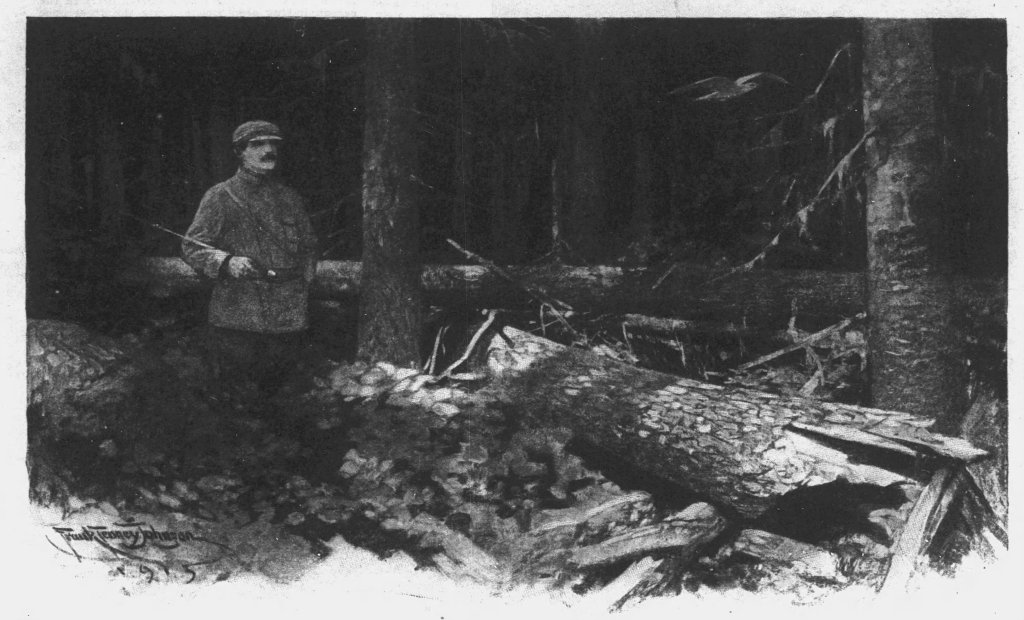
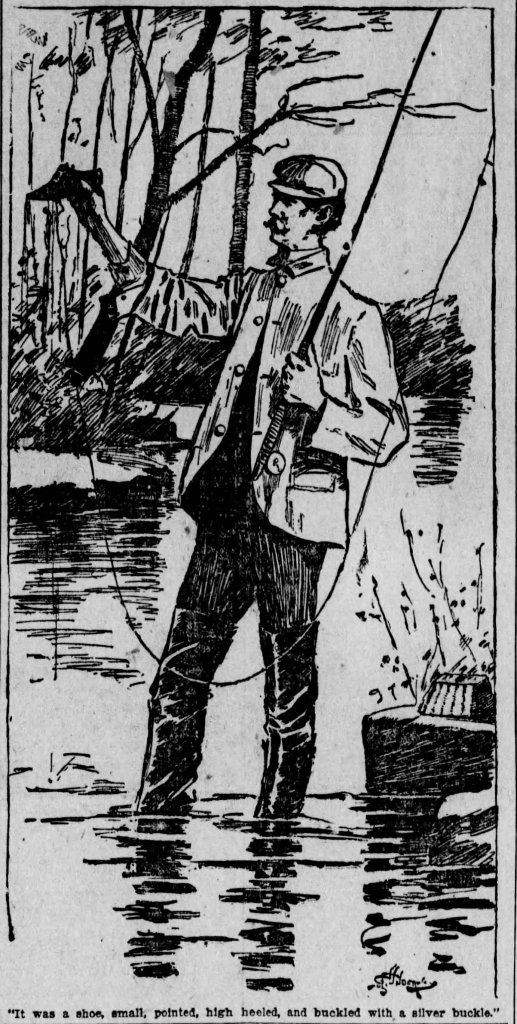
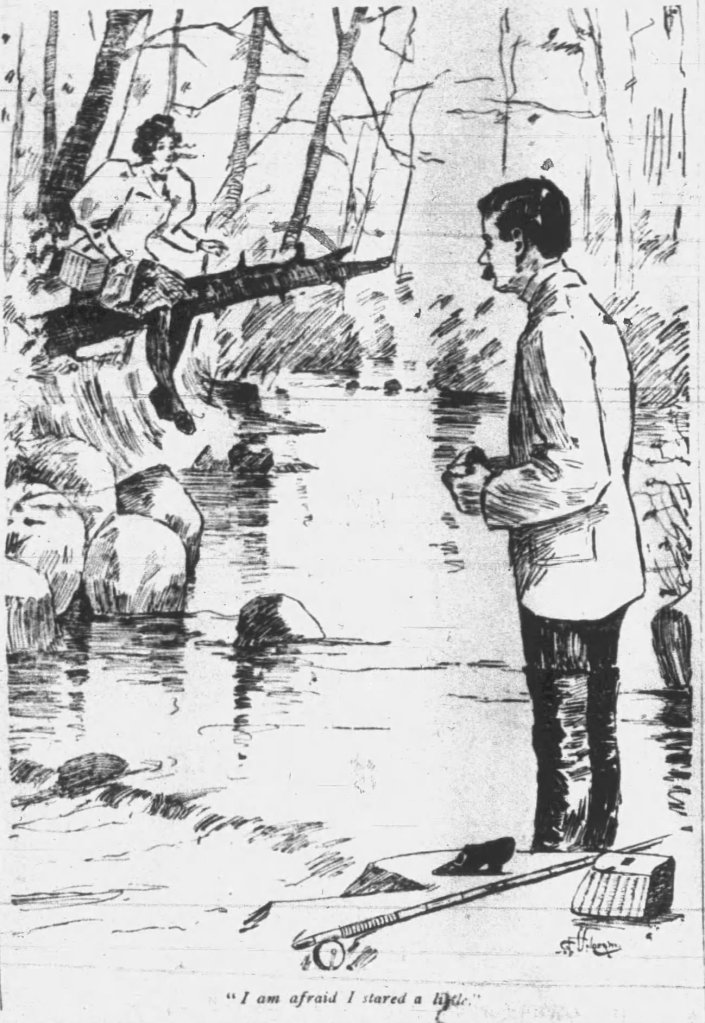
The text of “The Silent Land” reproduced below is taken from The Maker of Moons (1896) (which can be read in toto at the Internet Archive), with two changes. First, several of the newspaper serializations included illustrations, which have never been reprinted; these are included below. Second, Chambers’ original story included several songs in untranslated French. For the benefit of readers, a literal translation of these lines in English is provided alongside the original text.
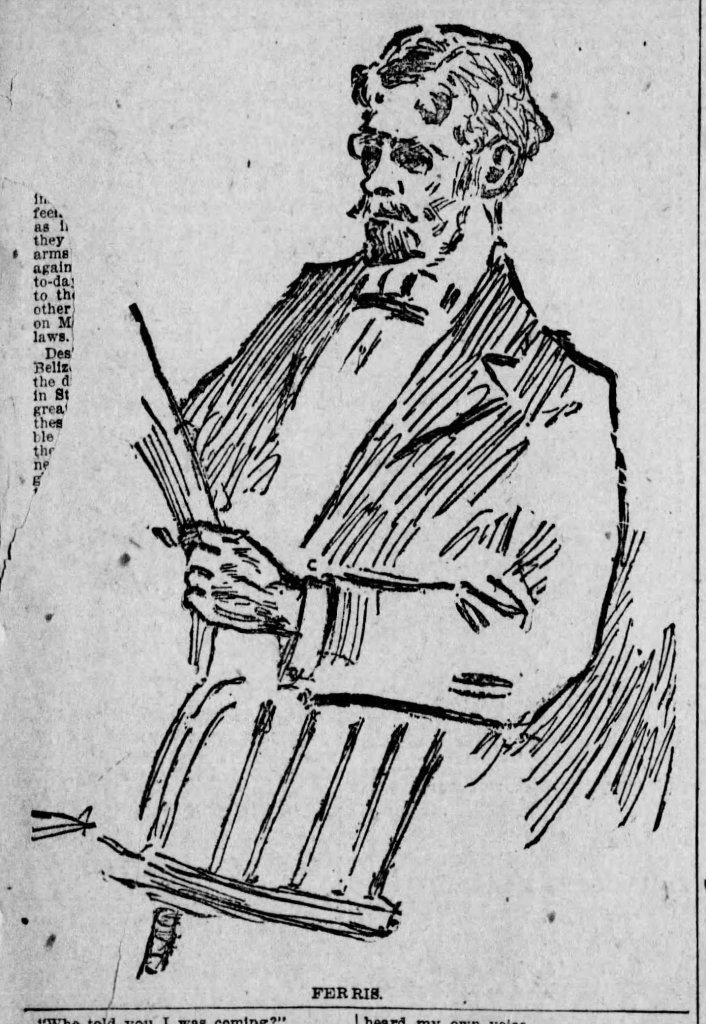
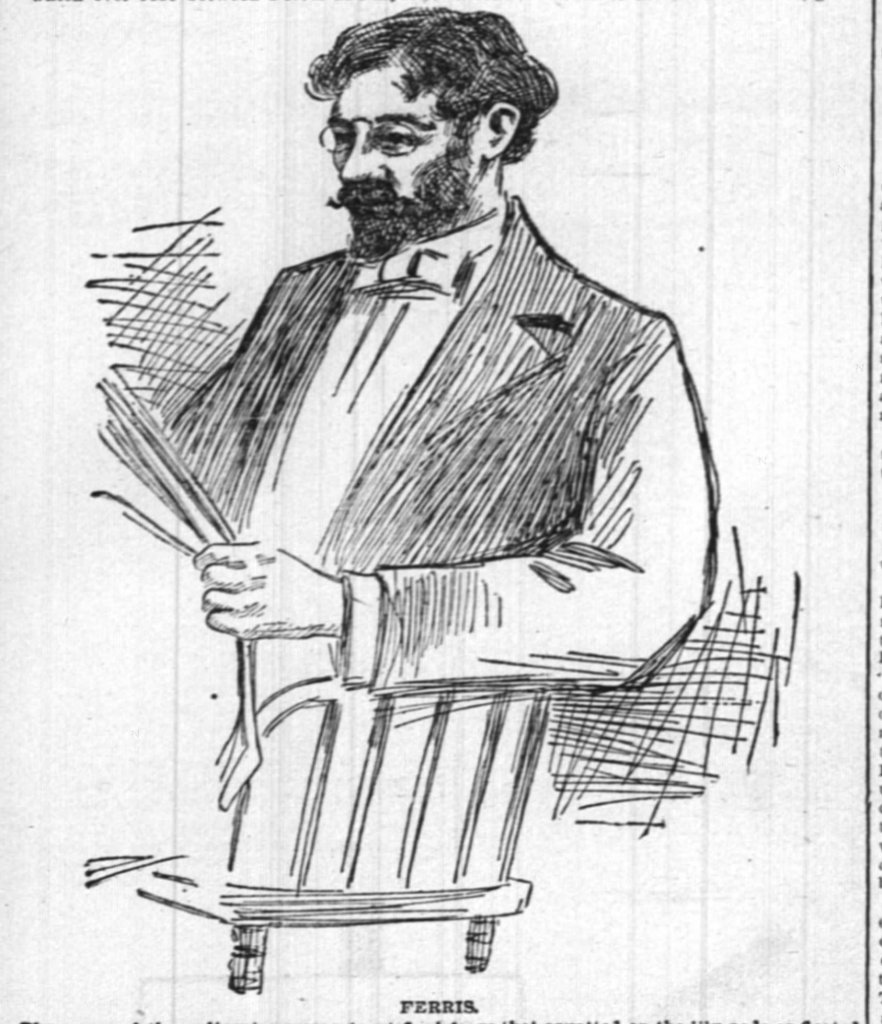
FERRIS and I had had a dispute, a bitter one, and, as usual, Ferris had pushed his cap over his eyes until the hair on the back of his head stuck out.
“You can’t do it,” he said, shoving both hands up to the wrists in his canvas fishing-coat.
“I’ll prove it,” said I. “What a stubborn mule you are, Ferris!”
“Stubborn nothing,” he retorted, “you and your theories must have your little airing, I suppose, but I don’t intend to assist.”
“I’m right sometimes,” I said.
“Sometimes you’re wrong, too,” said Ferris.
Then he walked off toward the cliffs, whistling, uncompromising, untidy.
“There’s a hole in your leggings!” I called after him, but he did not deign to answer me.
“Obstinate ass,” I thought, for we were very fond of each other, “if he wastes his time with the Silver Doctor he’ll rue it.”
Then I looked at Solomon and lighted a cigarette.
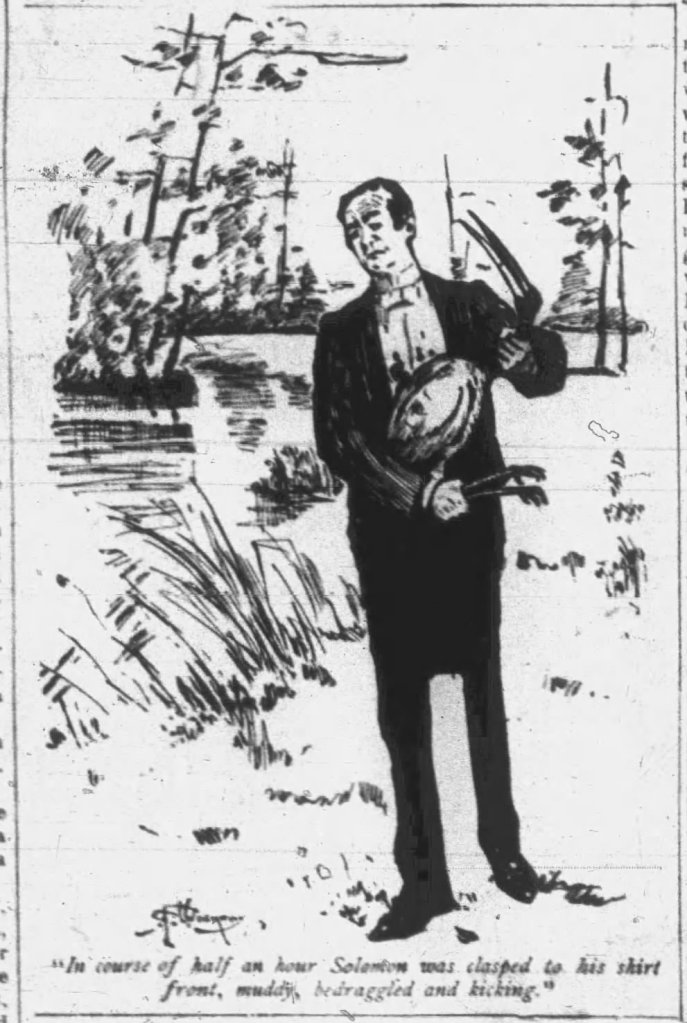
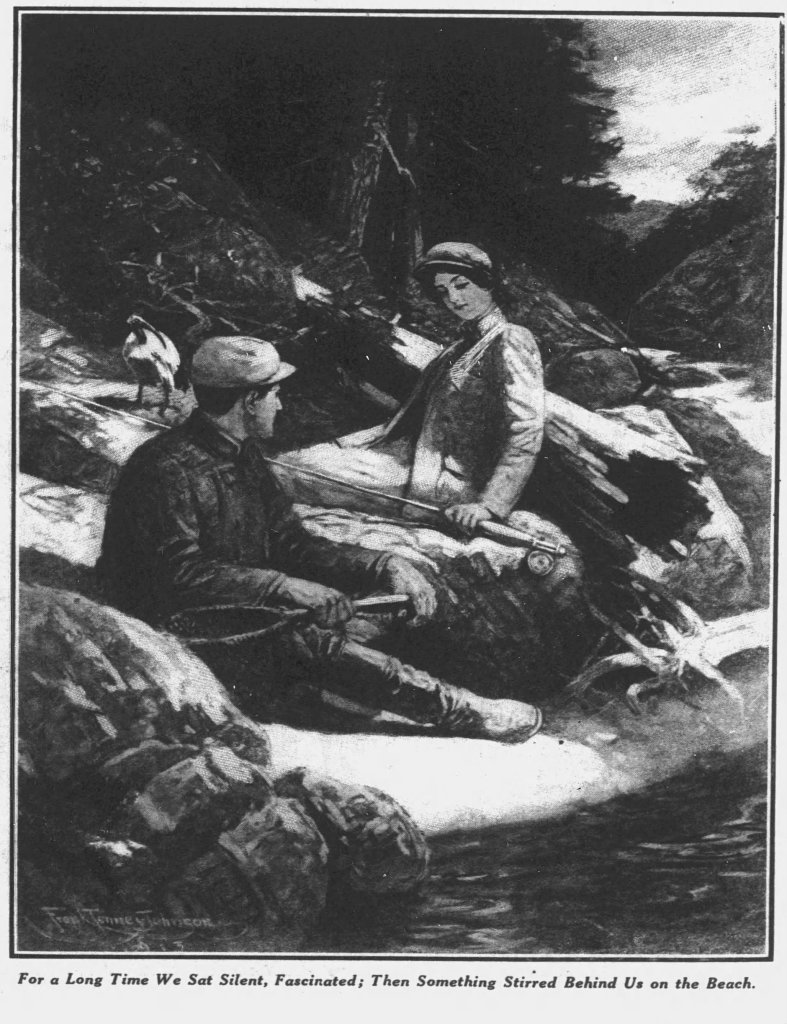
Solomon was a bird, an enervating bird of the Ibis species, wrinkled and wizened, like the mummies of his native land, which was Egypt. The bird was mine, a sarcastic tribute from Ferris, and the bird and the sarcasm both bore directly on the only disputes which ever arose between Ferris and myself. The cause of these disputes was a trout-fly, an innocent toy of scarlet and tinsel, known to anglers as the “Red Ibis.” I swore by it, Ferris swore at it. In the long winter nights when the streams gurgled under the frozen forests and the lake was a sheet of soggy snow, Ferris and I loafed before the fire pulling tangled masses of leaders and flies about and dragging the silken lines over the rugs to hear the reels click. Every fly known to the brethren of the angle was discussed-every fly except the Red Ibis. We both honestly tried to avoid this bone of contention. We talked of Duns and Hackles, and Spinners and Gnats, but in spite of every precaution the Red Ibis would occasionally rise like a fiery spectre between us, and then we disputed vehemently.
“No angler with a rag of self-respect would use the Ibis,” said Ferris, with that obstinate shrug which added gall to the insult, and I—well, the crowning insult came when Ferris sent to Cairo and imported a live Egyptian Ibis for me.
“Pull out his tail feathers when you ‘re short of Red Ibis,” gasped Ferris, weak with laughter, as I stood silently inspecting the bird in my studio.
“I’ll send him to Central Park,” said I, swallowing my wrath; but I thought better of it, and Solomon, the wizened, became an important member of my household.
The bird was a mystery. I never cared to encounter his filmy eyes. Centuries seemed to roll away when he unclosed them, visions of tombs and obelisks filled my mind-glimpses of desert sunsets and the warm waters of lazy rivers. His black shrivelled head, bare as a skull, lay like a withered gourd among the garish flame-coloured feathers on his breast.
“Solly,” said I, when Ferris disappeared below the cliff, “do you want a frog?”
The bird unclosed one eye. I went to a pail of water in which I kept minnows, and Solomon followed me, solemnly hopping.
“Help yourself, Solly,” said I, uncovering the pail.
I called him Solly because I wished to put myself at ease with this relic of Egyptian Royalty. The splendour of Pharo’s court had not dimmed this hoary prophet’s eye, which was piercing when the sleepy film left it—piercing enough to make me feel thousands of years young, and very bourgeois. In vain I addressed him as Solly, in vain I gave him chocolate creams,—he was the aristocrat, the venerable high-priest of an Empire dead—and I was his man-servant, his ass, and his ox.
Solomon dabbed once or twice at a sportive minnow, pecked pensively at the handle of the pail, swallowed a pebble or two, and then, ruffling his scarlet feathers, sidled aimlessly back into the sedge by the frog-pond. I watched him for awhile, brooding dreamily among the rushes, but he paid no further attention either to me or to the small green frogs that squatted on the lily-pads or floated half submerged, watching him with enormous eyes.
A noisy blue-jay flitted through the orchard and alighted on a crab-apple tree solely to insult Solomon. He of course was unsuccessful, and his language became so utterly unfit for publication that I moved away, shocked and annoyed.
The sun was very hot. It glittered with a blinding light across the rippling pond, where dragon-flies darted and sailed and chased each other over the water, or flitted among the clouds of dancing midges, searching for prey.
A sweet smell came to me from orchard and sedge; there was an odour of scented rushes in the air, and the lingering summer wind bore puffs of perfume from clover-fields and meadows fragrant with flowering mint. I looked again toward the cliffs. Ferris was not in sight.
“Obstinate mule,” I thought, and, picking up my rod and fly-book, I sauntered toward the forest.
“Ferris,” said I to myself, “is after that big trout by the Red Rock Rapids, but he’ll never raise him with a Silver Doctor, and he’ll come home in a devil of a temper.”
I sat down in a clump of sweet fern and joined my rod. When I had run the silk through the guides and had fastened the nine-foot leader, I opened my fly-book and sought for a Red Ibis fly. There was not one in the book.
“I must send to New York to-morrow,” I thought, turning the aluminum leaves impatiently; ‘ fancy my being out of Red Ibis!” I selected a Yellow Oak fly for the dropper and a nameless Gnat for the hand-fly, and, drawing the leader down to the reel, started on again, carrying my rod with the tip behind me.
The forest was dim and moist and silent. Where the sunshine fell among the ferns a few flies buzzed in the gilded warmth; but except for this and a strange grey bird which flitted before me silently as I walked, there was no sign of life, nothing stirring, not a rustle among the leaves, not a movement, not a bird-note.
Over moss and dead leaves aglisten in the pale forest light I passed,—over crumbling logs, damp and lichen-covered, half submerged in little pools; and the musty fragrance of the forest mould set me dreaming of dryads, and fauns, and lost altars, whose marbles, stained with tender green, glimmer in ancient forests.
This belt of woods was always silent; I often wondered why. There were no birds—none except this strange grey creature which kept flitting ahead of me, uttering no note. It was the first bird I had ever seen in the western forest belt the first bird except Solomon, who occasionally accompanied me on my trips to the long pool in the river which borders the wooded belt on the west.
It was an unknown bird to me,—I could catch fleeting glimpses of it,—and its long slender wings and dark eyes brought no recollections to my mind.
To the north, south, and east the woods were full of thrushes and wood-peckers; full of game, too—grouse, deer, foxes, and an occasional mink and otter, but the shy wood creatures left the western forest belt alone, and even the trout seemed to shun the dark pools where the river swept the edges of the wood until it curved out again by Lynx Peak. I say the trout shunned it, but there was one, a monstrous fish, wily and subtile, that lived in the long amber pool below. Early in the season Ferris had raised him with a Silver Doctor, and Ferris’s madness on the Silver Doctor dated from that moment. His mania for this fly lead him to use it in season and out, and no amount of persuasion or of ridicule moved him.
“Because,” said I, “you had a Silver Doctor snapped off by a big fish, do you imagine it’s the only fly in the world?”
“It’s good enough for me,” he said.
There were two things which Ferris used to say that maddened me. One was, “The Silver Doctor’s good enough for me;” the other was, “New York’s good enough for me.”
We never discussed the latter question after Ferris had alluded to me as a “Latin Quarter Nondescript,” but the battle still raged over the merits of the Silver Doctor and the Red Ibis.
When I came to the wooded slope which overhung the river I buttoned my shooting coat and began a cautious descent, trailing my rod carefully. I headed for the foot of the pool, for one of my theories, which ruffled Ferris, was that certain pools should be fished up stream. This was one of those pools, according to my theory; and when I had reached the rocks and had waded into the rushing water, I faced up stream and cast straight out into the rapids which curled among the boulders at the foot of the pool.
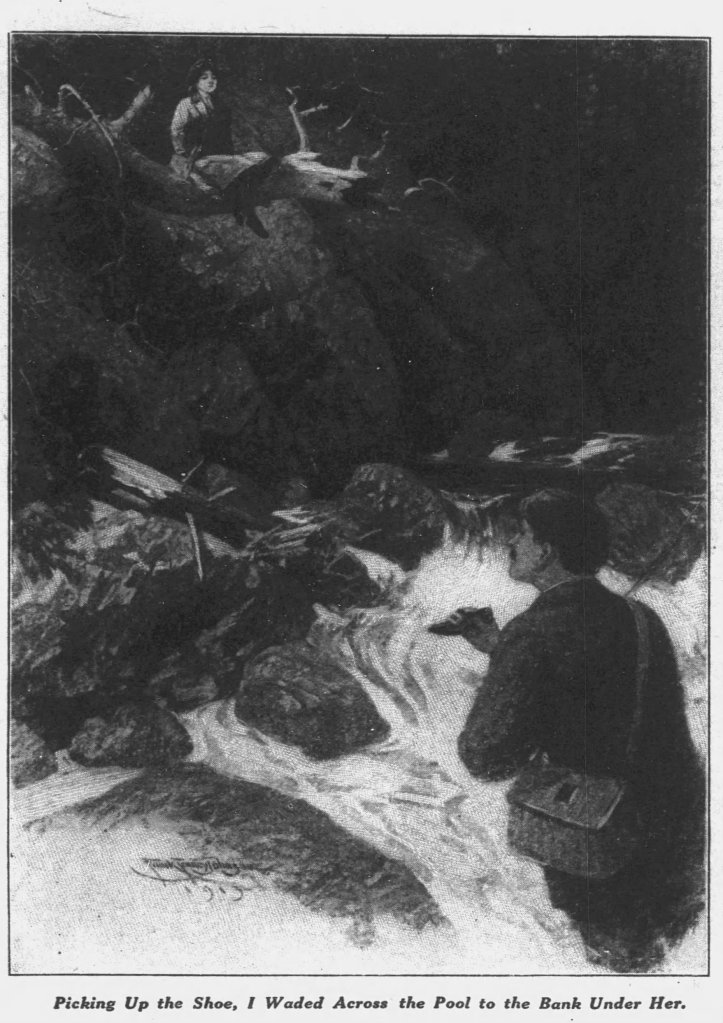
At the second cast I hooked a snag and waded out to disengage it. Fumbling about under the foaming water I found my fly imbedded in something which refused to give way. I tugged cautiously and gently; it was useless. Then I rolled up my sleeve and plunged my arm into the water up to the shoulder. This time it did give way; I drew out my arm and held up something glistening and dripping, in which my hook was firmly imbedded. It was a shoe, small, pointed, high-heeled, and buckled with a silver buckle.
“This,” said I, “is most extraordinary,” and I sat down on a flat rock, holding the shoe close to my eyes.
“Besnard—Paris,” I read stamped on the lining over the heel. And the buckle was of sterling silver. I sat for a moment, thinking.
Our cottage, Ferris’s and mine, was the only house in the whole region that I knew of, except the old house in the glade by the White Moss Spring. That was unoccupied and had been for years—a crumbling, abandoned farm, tottering among the young growth of an advancing forest.
But as I sat thinking I remembered early in the season having seen smoke above the trees once when we were in the neighbourhood of the White Moss Spring, and I recollected that Ferris had spoken of poachers. We had been too lazy to ininvestigate, too lazy even to remember it until, as I sat there holding the small shoe, the incident came back to me, and I wondered whether anybody had taken up an abode in the abandoned farm.
I didn’t like it. The forests and streams belonged to Ferris and me, and although up to the present moment it had not been necessary to employ many keepers, I began to fear that our woods were being invaded and that we should soon be obliged to find protection.
I looked at the shoe, turning it over carefully in my hands. It was new-had scarcely been worn at all.
“Pooh,” I thought, ” the owner of this could scarcely do much damage among the game, but of course there may be bigger shoes in company with this, and those bigger shoes had better look out!”
My first impulse was to throw the shoe into the underbrush. I started to do this, and then carefully laid it down on a sun-warmed rock.
“Let it dry,” I muttered; “it’s evidence for Ferris.” But as it happened, Ferris was not destined to see the shoe.
II.
I FISHED the pool twice, once up and once down, and heaven knows I fished it conscientiously; but no trout rose to the flies, although I changed the cast half a dozen times and even violated my feelings by tying a Silver Doctor. It was true I glanced up and down the river to see whether Ferris was in sight before I did so.
“The wily old devil won’t come up,” said I to myself, meaning the trout; “I’ll give him a rest for a while.” And I sat down on the rock where the pointed shoe was drying in the sun, laying my rod beside me.
“What’s the use of speculating about this shoe,” I thought, and straightway began to speculate.
The strange grey bird with the slender wings and dark eyes slipped through the undergrowth along the opposite side of the pool, but it uttered no call, and I caught only fleeting glimpses of it at intervals. Once, for a moment, it flitted quite near, and a sudden sense of having seen it before came over me, but lfter a little thinking I found myself associating it with a rare bird I had once noticed in Northern France, and of course it was impossible that this could be a French bird.
“It was an association of ideas,” said I to myself, looking at the mark in the slim shoe. “Besnard—Paris.” And I began speculating upon the owner of the shoe.
“Young? Probably. Slender? Probably. Pretty? The deuce take the shoe,” I muttered, picking up my rod. Presently I laid it down again, softly.
“Now, perhaps,” said I to myself, “this little shoe has tapped the gravel of the Luxembourg, patted the asphalt of the Boulevard des Italiens, brushed the lawns of the Bois—ah me! ah me!—the devil take the shoe!”
The sun beat down upon the rock; the little shoe in my hand was nearly dry.
“No,” said I to myself, “I’ll not show it to Ferris. And I’ll not shove it into my pocket—no—for if Ferris finds it he’ll rag me to death. I’ll throw it away.” I stood up.
“I’ll just throw it away,” I repeated aloud to encourage myself, for I didn’t want to throw it away.
“One, two, three,” said I, with an attempt at carelessness which changed to astonishment as I raised my eyes to the bank above whither I had intended to hurl the shoe.
For an instant I stood rigid, my right hand clutching the shoe, arrested in mid air. Then I placed the shoe very carefully upon the rock beside me and took off my shooting-cap.
“I beg your pardon,” said I, ” I did not see you.”
I stood silent, politely holding my shooting-cap against my stomach. But I was confused, for she had answered me in French, pure Parisian French, and my ideas were considerably unbalanced.
I am afraid I stared a little. I tried not to. She was slender and very young. Her dark eyes, half shadowed under black lashes, made me think of the strange, dark-eyed bird that had followed me. She sat on the crooked trunk of a tree overhanging the bank, her feet negligently crossed, her hands in the pockets of a leather shooting-jacket. I’m afraid to say how short her skirts were,—but of course this is the age of bicycles and shooting-kilts.
I clambered up, hanging to limbs and branches. It was a miracle I did not break my neck.
“Why do you not take the path?” she asked. “Do you not know you might fall—and all for a shoe?”
“But such a shoe—”
“True, the buckle is silver—”
“Which I claim the privilege of buckling,” said I, dragging myself up beside her.
She deliberately held out her slim stockinged foot, and I slipped the shoe on it.
The silver buckle was not easily buckled. There were difficulties—for the tongue had become bent and needed straightening.
“You might take the shoe off again to arrange the buckle,” she said.
“I can straighten it without that,” said I.
When at last the buckle was clasped we had been talking so long that I had told her my name, my residence, my profession, and more or less about Ferris. I don’t know why I told her all this. She seemed to be interested. Then I asked her if she lived at the “Brambles.”
“The Brambles? ” she repeated, looking at her shoes.
“The deserted Farm by the White Moss Spring—”
“Yes—not alone; I have a housekeeper.”
“Aged?”
“Very—and fierce. But I shall do as I please.”
“Did you buy the house? “
“No. It was empty, and I walked in. Next day they sent my twelve trunks from Lynne Centre. The furniture was good.”
“And you have been there for two months?”
“Yes. I have a horse and dog cart too. Rose drives to Lynne Centre twice a week for the marketing. I think I shall keep a cow—I generally do what I please. I choose to amuse myself with you just now.”
“This,” said I, ” is a very strange history; did you know that Mr. Ferris and myself—existed?”
“It is not a strange history,—no, I once saw your house as I passed through the forest belt, but there was nobody there on the lawn except an ordinary person with little side whiskers.”
“Howlett!” I exclaimed.
“Comment?” she asked.
“A servant, an Englishman.”
“Probably,” said she, looking dreamily at me.
Then I told her all about Ferris and myself; how we came every spring to the Clover Cottage with Howlett, a cook, and three dogs as retinue, how we fished in summer and shot in the autumn, how twice a year men came all the way from Lynne Center to house our hay and repair damages, how the game-keepers lurked at the mouth of the valley, miles to the south, to prevent poachers from entering, but we concluded it was not necessary for keepers to patrol the woods inside the valley.
“Now,” I said, “the poachers are in our very midst—here established—and such dangerous poachers, too! What shall we do with them, Mademoiselle?”
“You mean me,” she said, with wide open eyes.
“No,” said I, “I do not mean. you—you are very welcome in our valley.”
“But I am sure you do mean me,” she said, smiling.
Then we talked of other things, of Paris and France; of trout, and flies, and Ferris, of Normandy, and the beauty of the world; but it was nearly five o’clock before we spoke of love.
“I have never loved,” she said, looking at me calmly.
“Oh, how unnecessary!” I thought, for I had believed her clever.
“But,” she continued, gravely, “I think it is time that I did.”
“I think so too,” said I.
“I should like to fall in love,” said she; “I have nothing else to do.”
“I also am very idle,” I said.
“Then,” said she, “the opportunity only is lacking.”
I think I muttered something about poachers—I was not perfectly cool.
“Now,” said she, “I know you mean me!”
“Ah,” said I, “I mean a keener poacher than you or I, a free rover more to be dreaded than an army of riflemen.”
“Then you don’t mean me,” she said.
I shook my head.
“Do you know,” said she, ” I should very much like to be the heroine of a romance.”
“I will aid you to be one!” I said, hastily.
We had known each other nearly three hours.
“Let us,” said she, “pretend that this is the forest of Versailles in the time of Louis Quinze.”
“Let us indeed!” I cried, enthusiastically.”
“And you are a Count—”
“And you a Marquise—”
“Named Diane; it is my real name.”
“Diane.”
“And you—”
“My real name is Louis—”
“It will do; you may kiss my hand.”
I wondered just where she was going to draw the line. Then, the devil prompting, I entered recklessly into this most extraordinary adventure.
And what an adventure! Words, thoughts even failed me as I looked at her. This woodland maid with the wonderful eyes! There was no mistaking the challenge in her eyes, the half-innocent smile, the utter disregard for every human conventionality.
“How,” thought I— “how can such a woman wear a childlike face!”
I had known coquettes,—many,—but the depth of this strange girl’s recklessness I feared to sound—I dreaded almost to understand.
“She is too deep,” said I to myself— “too deep for me,” and I looked her questioningly in the eyes.
I don’t know why or how,—I never shall know probably, but a sudden conviction seized me that she was as innocent as she looked. Imagine a man coming to such a conclusion! I felt inclined to laugh, and yet I was as firmly convinced as though I had known her all my life.
“You may kiss my hand,” she said, and held it out to me.
I did. I wished I hadn’t a moment later, for I tumbled head over heels in love with her and fairly gasped at the idea.
“Lovers in the Court of Louis Quinze resembled us, I think,” she said, after a long silence.
“We will try to make the resemblance perfect,” said I, taking both her hands in mine.
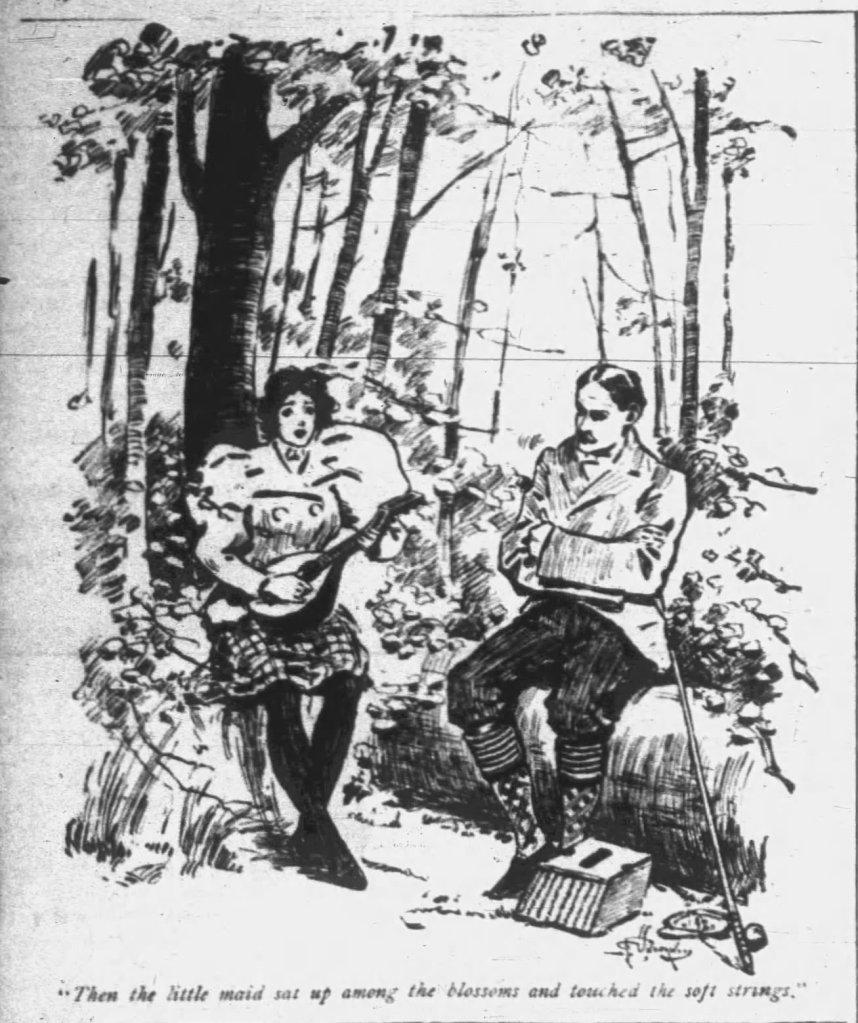
She bent her head a little,—there was just a shadow of resistance,—then I kissed her on the lips.
There are moments in a man’s life when he does not know whether he is a-foot or a-horseback. I remember that I sat down on the bank and carefully uprooted several fems. When I had regained control of myvoice,—the little maid was very silent,—I asked her to tell me of herself, if it might please her to do so.
“I was born,” said the little maid, resting her small head on one hand, “in Rouen. Do you know Rouen?”
“Yes.”
“Papa was an officer, and he killed his general when I was seven years old. It was something about Mama; I never saw her again. Then we went to Canada very quickly; Papa died there. I had been in a convent school; I ran away, and went to New York. I am nineteen, and very reckless.”
“Yes, Diane…”
“I have a great deal of money in banknotes. It was Papa’s. I have never counted it—it is in a big trunk. I understand English, but do not care to speak it. I do not care what becomes of me; I wish it were over—this life. You are the first man who ever kissed me. Do you believe me?”
“Yes, Diane.”
“I wonder you do. Let us go down to the river where the sunlight falls. The descent is easy—”
“Diane—you must not go—”
“With you—will you give me your hand?”
“Come.”
“Did you see that shy grey bird?” said the little maid, hesitating on the slope, her hand in in mine.
I could not see it, for we had already begun the descent.
“WHERE the mischief have you been all day?” demanded Ferris that evening as we sat on the veranda after dinner.
“Well,” said I lighting a pipe, “when you bad your fit of sulks I went off for a brace of trout.”
“Did you see anything worth seeing?”
“I saw no trout,” said I.
“Unfortunate, eh?”
“Oh not very,” I said, looking at Solomon.
“Not very?”
“Look at that ridiculous bird, Ferris.”
“Swallowed a frog the wrong way…” said Ferris, watching the solemn contortions of Solomon; “he looks like a little Jew in a crimson overcoat with a stomach ache. What fly did you use, Louis?”
“Everything; couldn’t raise a fin.”
“Oh, you’ve been trying that old devil down by the west woods ! I should think you’d let him alone; it’s useless,” yawned Ferris.
“I’m going to try for him every day till I get him,” said I, trying not to lie more than necessary.
“Of course you’ll not infringe?”
“Infringe I Not much! You can have the whole west woods to your own sweet self; but you’re an idiot!”
“Not at all,” said I, thankfully; and in a burst of confidence I confessed that I had used a Silver Doctor.
There was a momentary gleam of triumph in Ferris’s eyes, but he was very decent about it and asked me most politely for the loan of a Red Ibis. Oh men of the busy world, learn courtesy from the angler! There are other things you need not learn from anglers.
“My dear fellow,” said I, more touched than I had been for a long time, “I haven’t a Red Ibis left. I shall write Conroy to-night before I retire. If you really do want an Ibis I will catch Solomon and pluck a plume from his tail feathers.”
“I don’t want it enough to inconvenience you or hurt Solomon’s feelings,” said Ferris, laughing.
After a long interval of silent smoking Ferris rose and yawned at the moon.
“Do you know what a Spirit-bird is, Ferris?”
I asked, rapping my pipe on the arm of my chair.
“Spirit-bird—the French one—the Oiseau Saint-Esprit? Yes, I’ve seen one—in the Vosges.”
“Grey-with slim wings and big dark eyes?”
“That’s the bird,” said Ferris; “why?”
“Well, I thought I saw one to-day. Of course that ‘s impossible.”
“Of course,” said Ferris, yawning again! “I’m going to turn in; good-night, old chap.”
“Good-night,” said I, tapping nervously on the veranda with my pipe.
Howlett came out a few moments later with my wading-shoes which he had been oiling.
“Well,” said I, “are the hob-nails all right?”
“Seving ‘ob nails is h’out, sir,” replied Howlett, holding up the shoes for my inspection.
“Put them in as soon as they’re dry. Did you oil the bamboo? Good. Is my lamp lighted? Put it out—and you need not sit up, Howlett; I ‘m going for a stroll.”
“Thank you sir,” said Howlett,— “and Solomon, sir?”
Now it was one of my delights to see Howlett house Solomon. The wily Ibis loved to snoop about in the moonlight, and he was always ready for Howlett when that dignified servant came to round him up.
I looked at Solomon, who stood gloomily brooding among the water-lilies.
“He ought to be in bed,” said I.
Howlett descended the veranda steps with arms extended, but Solomon sidled out into the pond. Howlett pleaded earnestly. He flattered and cajoled, but Solomon was obdurate.
“Nothink I say do move ‘im, sir!” said Howlett, stiffly; “he is vicious to-night, sir.”
“Then take the boat,” I said.
Howlett in a boat chasing a sulky Ibis was one of those rare spectacles that few are permitted to witness. Once a week Solomon turned “vicious” and then, at Ferris’s and my suggestion, Howlett took to the boat. A terrestrial Howlett was solemnly ludicrous, but an aquatic Howlett was impossible. Of course Ferris and I never laughed—that is, aloud, but we usually felt rather weak after it was over.
In the course of half an hour Solomon, mad, wet, and rumpled was cornered by Howlett and clasped to his stiff shirt front, muddy, bedraggled, and kicking.
“Good-night, Howlett; breakfast at seven tomorrow,” said I, and sauntered out into the moonlit valley.
I had been walking almost half an hour when it occurred to me that I should be in bed.
“What the deuce am I sprinting about the valley at this hour for?” I thought, looking around.
Over the shadowy meadows the night mist hung, silvered by the moonlight, and I heard the meadow-brook rippling through the sedge. Slender birches glimmered among the alders, and all the little poplar leaves were quivering, but I felt no breath of air.
Where the dark forest fringed the meadow I saw the moonbeams sparkling on lonely pools, but the depths of the woodland were black and impenetrable, and the forest itself was vague as the mist that shrouded it.
For a long time I stood, looking at the stars and the mist, and little by little I came to understand why I was there alone.
I knew I should go on, I wished to, but I lingered in the moonlight staring at earth and sky until something moved in the thicket beside me, and I followed it, knowing it was the Spirit-bird.
When I entered the forest I could scarcely see my hand, but I felt a trodden path beneath my feet, and I heard before me the whisper of soft wings, and presently I heard the river, rushing through rocks of the western forest, and when I came to the wooded bank the moonlight fell all around me.
There was a narrow strip in the forest, overgrown with silver birch and poplar and lighted by the moon, but I searched it in vain, up and down, up and down, always with the whisper of soft wings in my ears.
At last I called, “Diane,” and before I called again, her hands lay close in mine.
* * * * * *
“I came,” said the little maid, “because you were coming.”
“Who told you I was coming?”
“Told me? No one told me. Rose is asleep. Why did you come?”
“Why did you, Diane?”
“I? Because you came. How did you find my bower?”
“Your bower, Diane?”
“It is yours I know; I call it mine; I call it the Silent Land.”
“It is very silent,” I said.
“It is always silent—no birds, not even the noise of the water. Do you think it is sad? There are times when sounds,—the song of living creatures and the countless movements of things that live, trouble me. Then I come here. There are flowers.”
“The air is very sweet, too sweet. What is the perfume? The trees are heavy with fragrance. Ah!—are you tired, Diane?”
“No—it is the odour of blossoms; I sleep here sometimes.”
“Your hair is loose—how long it is I Is it the perfume from your hair—is it your breath—”
“The blossoms are very sweet; the moon has gone.”
“There is a star,—bow soft your breath is.”
“I do not see the star; where, Louis?”
“It is there;—clouds are veiling it;—there is a mist over all—”
“It is my hair—over your eyes.”
IV.
“HOWLETT,” said I, one warm afternoon, “Solomon is unendurable: he follows me everywhere, and I wish you to see that he minds his own business.”
“A hobstinate bird, sir,” said Howett, ” and vicious when crossed,—which I scorn ‘is h’anger,—beg pardon sir,—for ‘e’s took to biting wen ‘is vittles disagrees.”
“Has he bitten you?”
“Twice, sir,—which ‘appily my h’eyes is huninjured, though h’aimed at by ‘is beak.”
“This is intolerable,” said I; “you must punish him, Howlett.”
“‘Ow, sir?”
“Tie him up when he bites. Have those flies come from Conroy’s?”
“Nothink ‘as came, sir.”
“Where is Mr. Ferris?”
“Mr. Ferris is a whipping of the h’Amber Pool sir, with three sea-trout to the good and a brace of square tails. Solomon followed ‘im, sir, and is h’observing the sport.”
“Then I can get away without that red feathered Paul Pry tiptoeing after me,” I thought, and sent Howlett for my rod-case.
“Tell Mr. Ferris, when he returns, that I may not be back until dinner,” I said, when Howlett brought the case.
I selected a four-ounce split bamboo, pocketed my fly-book and a tin box of floating flies for dry fishing, picked up a landing-net, and walked away toward the western woodland, whistling. I had not fished for three weeks, although every day I went away into the western woods with rod and creel. Ferris laughed at my infatuation for the long pool where the great fish lay and jeered at me when I returned evening after evening with no trout, although the river, except the western stretch, was full of trout. He had never come to the pool,—I should have seen him from the Silent Land if he had,—but Solomon sneaked after me on several occasions. Once I caught him craning his neck and peering into the bower,—our bower—and as I did not care to have him pilot Ferris thither, I hustled him off.
The woods were fragrant and warm, stained by the afternoon sun ; the quiet murmur of the brook came to me from leafy thickets as I walked, and I heard the river rushing in the distance and the summer wind among the pines. White clouds shimmered in the blue above, sailing, sailing God knows where, but they passed across the azure, one by one, drifting to the south, and I watched them with the vague longing that comes to men who watch white sails at sea.
I had turned my steps toward the long pool, for I had decided to fish that afternoon, wishing to redeem my words to Ferris—at least in part; but as I stepped across the trail I heard the sound of wings, and a shadow glided in front of me toward the forest. It was always so from the first, and now, as always, I turned away, following unquestioningly the Spirit-bird. The noise of the river ceased as I entered the Silent Land. For an instant the grey bird hovered high in the sunshine, then left me alone.
I threw myself full length upon the blossoming bank and waited, chin on hand. And as I waited, she came noiselessly across the moss, so quietly, so silently that I saw her only when her fingers touched mine.
“It has been a long time,” we said; and; “Did you sleep?” and; “When did you awake?”
Then we asked each other a thousand little questions which are asked when lovers meet, and we answered as lovers answer. We spoke of the Spirit-bird as we always did, wondering, and she told me how that morning it had tapped upon her window as the day broke.
“Rose did not hear it,” she said, “but I was already awake and thinking.”
“I awoke at sunrise too,” I said; “for a moment I thought it was a swallow in the chimney that fluttered so—”
“The Spirit-bird flies swiftly when Love is dreaming,”—that is a very old proverb of Normandy. What shall we do, Louis—there is so much to do and so little time in life!—I brought my lute—ah! you are laughing!”
“The lute is such an old-fashioned toy; I didn’t know you played. Will you sing too, Diane? Something very old, older than the lute.”
“I learned a song this morning because I thought you would care for it. That is why I dared to bring my lute into the Silent Land. The song is called, “Tristesse.”
Then the little maid sat up among the blossoms and touched the soft strings, singing:
“J’ai perdu ma force et ma vie, Et mes amis et ma gaité; J’ai perdu jusqu’ á la fierté; Qui faisait croire á mon génie.
Quand j’ai connu la Vérité J’ai cru que c’était une amie; Quand je l’ai comprise et sentie, J’en etais déjà dégoûté.
Et pourtant elle est éternelle Et ceux qui se sont passés d’elle lci-bas ont tout ignoré.
Dieu parle, il faut qu’on lui réponde; Le seul bien qui me reste au monde Est d’avoir quelquefois pleuré.
“I have lost my strength and my life, And my friends and my joy; I have even lost the pride That made people believe in my genius.
When I first encountered the Truth, I thought it was a friend; When I understood and felt it, I was already weary of it.
And yet it is eternal, And those who have done without it Here below knew nothing.
God speaks; He must be answered; The only good thing I have left in this world Is that I have sometimes wept.
“Sing, Diane,” I said, but I scarcely heard my own voice.
She laughed and bent above me with a graceful gesture. “Not that,” she said, “for you at least are not sad. There is a chansonnette,—shalt I sing again?—then be very still, here at my feet. Do you not think my lute is sweet?”
“Je voudrais pour moi qu’il fut toujoura fête Et tourner la tête Aux plus orgueilleux; Être en même temps de glace et de flamme, La haine dana l’âme, L’amour dans lea yeuz.”
“I wish for myself it were always a celebration And to turn the heads Of the proudest; To be at once ice and flame, Hate in my soul, Love in my eyes.”
“You, Diane?” I whispered; but she smiled, and the mystery of love veiled her dark eyes; and she sang:
“Je ne voudrais pas á la contredanse, Sans quelque prudence Livrer mon bras nu Puis, au cotillion, laisser ma main blanche Trainer sur la manche Du premier venu.”
“Si mon fin corset, sl souple et si juste, D’un bras trop robuste Se sentait serré, J’aurais, je l’avoue, une peur mortelle Qu’un bout de dentelle N’en fut déchiré.”
“I wouldn’t want, at the contradance, Without some caution, To offer my bare arm; Then, in the cotillion, to let my white hand Linger along the sleeve Of the first man who comes along.”
“If my fine corset, so supple and so snug, Were to feel constricted By an arm too strong, I would, I confess, be mortally afraid That a piece of lace Might be torn.”
She looked at me with soft, unfathomable eyes and touched the lute. When I moved she started from her reverie with a gay little nod to me:
“Quand on est coquette, il faut être sage, L’oiseau de passage Qui vole à plein cœur Ne dort pas en l’air comme une hirondelle, Et peut, d’un coup d’aile Briser une fleur!”
“When one is a coquette, one must be wise, The passing bird That flies with all its heart Doesn’t sleep in the air like a swallow, And can, with a beat of its wing, Break a flower!”
“Sing,” I said in a changed voice.
“I have sung,” she said, and laid her lute in my hands. But I knew nothing of minstrelsy and lay silent, idly touching the strings.
She had fashioned for her fair head a wreath of sweet-fern twined with clustered buds, white as snow and faintly perfumed.
“So I am crowned,” she said, “a princess in the Silent Land. Where I step, all things green shall flourish; where I tum my eyes, blossoms shall open in the summer wind;—am I not queen?”
“Will you not sing again, Diane? “
“No, it pleases me to hear a legend now. You may begin, Louis.”
“Which—the Were-wolf or the Man in Purple Tatters or the—”
“No, no—something new.”
“The Seventh Seal?”
“Begin it.”
“And when be opened the Seventh Seal there was silence in Heaven—”
“Dear Saints, have we not silence enough in the Silent Land? Tell me about battles.”
“‘And the sound of their wings was as the sound of chariots of many horses running to battle.’ I could tell you about battles, Diane.”
“Tell me,—don’t move your arm,—tell me of battles, Louis.”
“There was once a King in Carcosa,” I began.
But the little maid was already asleep.
I thought I heard a step in the undergrowth and listened.
The forest was silent.
V.
WHEN we awoke it was night. Down from the dark heavens a great star fell, burning like a lamp. Above the low-hanging branches, sombre, drooping, heavy with fragrance, a misty darkness lay like a vast veil spread.
In the stillness I heard her quiet breathing, but we did not speak.
Silence is a Prophet, unveiling mysteries.
Then, through the forest, we heard the sound of wings, and as we moved, stepping together into the shadows, the moon rose above Lynx Peak, gigantic, golden, splendid.
So we passed out of the forest into the star-lit night.
VI.
THE skies were leaden, the watery clouds hung low over the valley, and a wet wind blew from the west, ruffling the long pool where Diane stood. Kilted and capped in tweeds, creel swinging with every movement of the rod which swayed and bent with her bending wrist, she moved from ripple to shallow, wading noiselessly while the silken line whistled and the gay flies chased each other across the wind-lashed pool.
We spoke in a low voice, glancing at each other when the light cast struck the water.
“Under the alders Diane—” I said; “have you changed the Grey Dun for the Royal?”
“No, what is your new cast?”
“Emerald and Orange Miller—I shall tie an Alder-fly in place of the Miller. Do you think the water warrants a cast of three?”
“It is rough; I don’t know,—Louis, was that an offer?”
“I think it was the spray from the rapids. Shall we move up a little? Do you feel the chill of the water?”
“I am cold to my knees,” said the little maid, “the river is rising I think—ah, what was that?”
“Nothing,—you touched a floating leaf in the swirl.”
“Splash!” A great fish flopped over in the pool, a trout, lazy, unwieldy, monstrous.
“Oh! he missed it!” cried Diane, turning a little white.
“Cast again,” I whispered, tossing my rod onto the sandy beach and unslinging my landing-net.
Trembling a little with excitement she cast across the swirl, once, twice, twenty times, but the monster was invisible. Somewhere in the dusky depths of that amber well the fierce fish lay watching the lightly dropping flies, unmoved. Then we changed the cast; I emptied my fly book, but nothing stirred except the hurrying water, curling, gurgling, tumbling through the rocks. Finally I broke the silence.
“Diane, it was the spinner that he rose to. He’s after something redder. Have you a Scarlet Ibis?”
“No—have you?”
I almost groaned, for Conroy’s flies had not arrived, and I hadn’t an Ibis in the world.
After a while she reeled in her silken line, and we waded to the sandy beach and sat down.
“Oh, the pity of it,” sighed Diane; “never have I seen such a trout before. I suppose it is useless, Louis.”
I sat moodily poking holes in the sand with the butt of my landing-net.
We spoke of other things for a time, sinking our voices below the roar of the river. Presently a sunbeam stole through the vapour above, lighting the depths of the dark pool. And all at once we saw the trout, hanging just above the pebbly bottom; we saw the scarlet fins move, the great square tail waving gently in the current, the mottled spotted back, the round staring eyes. The swelling of the gills was scarcely perceptible, the broad mouth hardly moved.
For a long time we sat silent, fascinated; then something stirred behind us on the beach and we slowly turned. It was Solomon.
“My bird—an Egyptian Ibis,” I whispered, laughing silently; “he has followed me, after all.”
Solomon ruffled his scarlet plumes, blinked at me, scratched his head with his broad foot, pecked at a bit of mica, and took two solemn steps nearer.
“Diane,” said I, suddenly, “I’ll get a red fly for you; don’t move—the bird will come close to us.”
But Solomon was in no hurry. Inch by inch he sidled nearer, dallying with bits of moss and shining pebbles, often pausing to reflect, but gradually approaching, for his curiosity concerning Diane was great.
“He looks as if he had stepped off an obelisk,” murmured Diane; “I have seen hieroglyphics that resembled him. Oh, what a prehistoric head—so old, so old!”
“His name is Solomon,” I whispered. “Solomon in all his glory was not arrayed like one of these. I’m going to have a small bit of Solomon’s glory—sh—h! ah! I’ve got him!”
It was over in a second, and I do not believe it was painful. There was a flurry of sand, a furious flapping of flame-coloured wings, a squawk! a smothered laugh—nothing more.
Mortified, furious, Solomon marched off, shaking the river sand from wing and foot, and Diane and I, with tears of laughter in our eyes, wound the scarlet feather about a spare hook, tied it close with a thread from my coat, and whipped it firmly to the shank. I looped the improvised fly to Diane’s leader, and she shook the line free.
The reel sang a sweet tune as she drew the silk through the guides, and presently she motioned me to follow her out into the rippling shallows, and I went, swinging my landing-net to my shoulder. She cast once. The fly struck the swirl and sank a little, but she drew it to the surface and the current swept it under the alders.
For a moment it sank again; then the ripples parted, and a broad crimson-flecked side rolled just below the surface of the water. At the same moment the light rod curved, deeply quivering, the reel screamed like the wind in the chimney, and the straining line cut through the water, moving up the pool with lightning speed.
“Strike!” I cried, and she struck heavily, but the reel sang out like a whistling buoy, and the fish tumbled into the churning water under the falls at the bead of the pool.
“Now,” said Diane, with a strange quiet in her voice, “I suppose he is gone, Louis.”
But the vicious tug and long, fierce strain contradicted her, and I stepped back a pace or two to let her fight the battle to the bitter end.
The struggle was splendid. Once I believe she became a little frightened,—the rod was staggering under the furious fish,—and she spoke in a queer, small voice:
“Are you there, Louis?”
“I am here, Diane.”
“Close behind?”
“Close behind.”
She said nothing more until the great fish lay floating within reach of my net.
“Now!” she gasped.
It was done in a second; and, as I bore the deep-laden net to the beach, I caught a fleeting glimpse of a figure among the trees on the bank above. Diane was kneeling breathlessly on a rock beside me; she did not see the figure. I did, for an instant. It was Ferris.
VII.
DINNER was over. Ferris and I lingered silently over the Burgundy; and Howlett hovered in the corner with a decanter of port until Ferris shook his head.
It had been a silent dinner. Ferris tried to be cordial, and failed. Then he tried to be indifferent, with better success. We exchanged a word or two concerning a new keeper who was to be stationed at the notch in the north, and I spoke to Howlett about cleaning the lamps.
Neither of us mentioned rods or trout, although Howlett had served us a delicious sea-trout that evening which had fallen to Ferris’s rod, over which we ordinarily should have exulted.
Ferris of course knew that I had seen him among the trees on the bank above the long pool. It was my place to speak; we both understood that, but I did not. What was there to say? Suppose I should go back to the beginning and tell him—not all, but all that I was bound in honour to tell him.
What would he think if I spoke of the Spirit-bird, of the Silent Land, of my long deception ? An explanation was due him—I felt that with a vague sense of anger and humiliation. For weeks I had abandoned him; I never thought about his being lonely, but I knew now that he had felt it deeply. Oh, it was the underhand part of the business that sickened me, the daily deceit, the double dealing. Ferris was no infant. A word would have been enough. I had never by sign or speech spoken that word which would at least have set me right with him, and which I could have spoken honourably. And moreover, if I had spoken that word,—no, not a word even, a look would have been enough,—Ferris would never have entered the western forest belt.
We sat dawdling over our wine in the glow of the long candles while the fire crackled in the chimney place; for the evening was chilly, and Solomon brooded sullenly before the blaze. Howlett, noiseless and pompous, glided from side-board to table, decorously avoiding the evil jabs from Solomon’s curved bill, until Ferris woke up and told him he might retire, which he did with a modest “good-night, sir,” and a haughty glance at Solomon. A half hour of strained silence followed.
I leaned on the table, my head on my hands, watching the candle light reflected on the fragile wine glasses. Myriads of little flames glistened on the crystal bowls, deep stained with the red wine’s glow. The fire snapped and sparkled on the hearth, and Solomon slept, his wizened head buried in the depths of his flaming plumage.
And as we sat there, there came a faint tapping at the curtained window. Ferris did not hear it I did, for it was the Spirit-bird.
“I must go,” said I, rising suddenly.
“Where?” said Ferris.
I looked at him stupidly for a moment, then sank back into my chair.
Solomon stirred in his slumber and I heard the wind rising in the chimney.
Ferris leaned across the table and touched my sleeve.
I looked at him silently.
“I must speak,” he said; “are you ready?”
I did not reply.
“Sadness and silence have no place here, between you and me. Shall I tell you a story I once read?”
“I am half asleep,” I muttered.
“This is the story,” he said, unheeding my words. “There was once a King in Carcosa—”
My hand fell heavily upon the table.
“—And there was given unto him a mouth speaking great things and blasphemies—”
“For God’s sake, Ferris—”
“Yes,” he said,” for God’s sake.”
We sat staring at each other across the table, and if my face was as white as his I do not know, but my hand trembled among the glasses till they tinkled.
“I was born in France,” he said at last. “You did not know it, for I never told you. What do you know about me after all? Nothing. What have years of friendship taught you about my past? Nothing. Now learn. My father was shot dead by an inferior officer in Rouen. The assassin escaped to Canada where—I found him. He died by his own hand—from choice. I did not know he had a child.”
The dull fear at my heart must have looked from my eyes. Ferris nodded.
“Yes, you know the rest,” he said; “the shame and disgrace of the suicide drove the child away—anywhere to escape it—anywhere—here, into the wilderness the woman fled where she hath a place prepared of God.”
The Spirit-bird was tapping on the window, I heard the noise of wings beating against the pane.
“I must go,” I said, and my voice sounded within me as from a great distance.
“Vengeance is God’s,” said Ferris, quietly: “I am guilty.”
“I must go,” I repeated, steadying myself with my hand on the table.
The noise of wings filled my ears. I knew the summons.
“Do you not hear?” I cried.
“The wind,” said Ferris.
Then the door slowly opened from without, the long candles flared in the wind, and the ashes stirred and drifted among the embers on the hearth. And out of the night came a slender figure, with dark eyes wide, and timid hands outstretched—outstretched until they fell into my own and lay there.
“I came from the Silent Land,” she said; “the bird lead me; see, it has entered with me, Louis.”
“It is my wife who has entered,” I said quietly to Ferris, and the little maid clung close to me, holding out one slim hand to Ferris.
There was an interval of silence.
“Father Gregory will breakfast with us tomorrow,” said Ferris to me.
“A Priest?”
“Open the window,” smiled Ferris; “there is a small grey bird here.”
So I opened the window and it flew away.
“Good-night,” whispered the little maid, and kissed her hand to the open window.
“Diane!”
She came to me quietly. Ferris had vanished; Solomon peered dreamily at us with filmy eyes.
“The Spirit-bird has gone,” she said.
Then, with her arms about my neck, I raised her head, touching her white brow with my lips.
* * * * * *
When my wife read as far as you have read, she picked up the embroidery which she had dropped beside her on the table.
“Do you like my story?” I asked.
But she only smiled at me from under her straight eyebrows.
The next morning I received her ultimatum; I am to cease writing about beautiful women of doubtful antecedents who inhabit forest glades, I am to stop making fun of Howlett, I am to curb my passion for rod and gun, and, if I insist on writing about my wife, I am to tell the truth concerning her. This I have promised Ysonde to do, and I shall try to, in “The Black Water.”
※
There is not much of a plot to “The Silent Land”; the tone is often flippant, the characters ciphers, and strictly speaking, there is nothing overtly supernatural that might mark this as a weird tale. Yet there is a great deal of atmosphere and suggestion to the writing, and that tantalizing ambiguity is, I suspect, the point. There’s a quality to the story reminiscent of Robert Aickman or Shirley Jackson, which toys with supernatural horror but refuses to resolve any of it.
Probably the most notable tease in the story is the repeated refrain “There was a King in Carcosa”—which readers of Chambers’ previous weird collection, The King in Yellow (1895), will connect with “dim Carcosa” in the shadowy mythology of those stories. We never get more than that beginning; never know whether the characters have read or are paraphrasing The King in Yellow play or some other, related legend. Yet the thought they might lends the utterances more dread than they would normally have.
Weird Tales was unusual among pulp magazines in publishing a relatively large number of “unique” authors—that is, authors who only appear with a single credit in the magazine. Often, it is their only story credit in any pulp magazine. While WT editors Edwin Baird, Farnsworth Wright, and Dorothy McIlwraith worked to attract recognizable writers, they were not above giving any author their chance. Such was the case with Royal W. Jimerson, a staid newspaper editor (Lesser Known Writers). “Medusa” is his only known published fiction story.
First published in Weird Tales (Apr 1928); it was reprinted in the Not At Night anthologyBy Daylight Only (1929), and Weird Tales (May 1938). The internet presence and continued interest in scans of old issues of Weird Tales have given “Medusa” renewed prominence, with reviews, audio adaptations, and speculation.
※
Medusa
by Royal W. Jimeson
IN DEFIANCE of fashion and her husband, Marian Bardwell nursed the yard-long, tropical luxuriance of her blue-black hair, stedfastly refusing to have it bobbed. No coiffeuse ever profaned its twining, serpentine profusion; no hands but her own were equal to the ritual of the 4 o’clock brushing that Marian performed with the dreamy-eyed reverence of a devotee who with mystic, ceremonious pass and gesture invokes the deity of some dusky shrine.
Before the dressing-table of her boudoir she sat, confronted by boxes of powders, pots of rouge, lotions and rarely blended essences; but these she ignored, having selected from a bewildering assortment of brushes her favorite, amber-handled, amber-backed, and cunningly carved in the nude, gracious curves of a Medusa whose serpentine tresses crept about and enclosed the oval that the Gorgon’s upraised, slender arms supported.
Bardwell entered through the door connecting his room with Marian’s.
“At it again! That damned hair!”
Bardwell shrugged his shoulders, grimaced at the thought of his wife’s oblivion to his presence, then with an effort erased the somber frown that lined his lean, handsome features. He turned as if to leave, but paused, fascinated by that ceremonial brushing. The lustrous amber disk and its golden bristles gleamed and stirred like a gigantic beetle as she moved it slowly through the abysmal darkness of her hair. Her movements were rhythmic, supple, richly rounded; in some unbelievable way her arm glided in a series of convolutions whose sinister grace made Bardwell shudder.
“That damned hair!” he repeated as he wrenched himself from the fascination of the ritual. And then: “Why don’t you cut out all this nonsense and be human? Have your hair bobbed, buy up a bunch of new clothes, and we’ll take a second honeymoon in Florida next month. We can afford it now, you know. And . . . we both need a change of scene,” concluded Bardwell irrelevantly, knowing well that no change of scene could ever veil the aura of age-old evil that clung to the serpentine blackness of Marian’s hair.
The chilly, repellent opulence of that somberly gleaming, iridescent coiffure haunted Bardwell, distracting his hours of waking and making his sleep a confusion of reptilian nightmares. The living, creeping coldness of those profuse tresses had in four years frozen an indefinable terror into his soul. An age-old horror nightly twined itself on Marian’s pillow, separating them as might a limitless expanse of steaming, evil-haunted jungle.
“I’ll never cut my hair,” declared Marian with the passionless certitude of one pronouncing a law of nature. “Never again mention such a thing!”
Then she set aside her mirror and, after a final lingering reverent caress with the Medusa-handled brush, turned in her low chair to face Bardwell.
“Win, can’t you take me as I am and be content to leave me as I am? You knew when you married me that there was something strange about me. I loved you, Win. Still do. Always shall. But I can’t—”
“But you must!” flared Bardwell.
“No, I can not. Please don’t be unkind to me,” she pleaded. “All my life I’ve been different from other women. I worried my mother into her grave—”
“And now I’m in line,” despaired Bardwell. “Marian—”
But even as she spoke, the animation faded from the exquisite oval of her face; she picked up the amber brush and again languidly stroked the coiling darkness that hung heavily on her white shoulders, spelling the wordless syllable of an everlasting prayer to the deity Bardwell hated and—feared.
“We’ll take a second honeymoon in Florida,” he had said. But he knew that it was no honeymoon but rather the fantastic hope that the warmth and unfailing sunlight of Florida might sear to extinction the living, chilly blackness before whose shrine Marian worshiped with measured, languid passes of an amber brush.
Drawn by a compelling sorcery, attracted in spite of himself, Bardwell drew closer, catching the sound of the brush that caressed Marian’s waist-long hair, strands that blended and writhed, curled and intertwined independently of the golden bristles. He gently laid his fingers on a strand, hoping against hope . . . shivered . . . muttered . . . then turned and strode from the room.
Marian’s movements became slower, more and more torpid, more languid, until finally, succumbing to the tropical, overheated atmosphere of her Riverside Drive boudoir, she carefully placed the amber brush on the table and, mustering her ebbing vitality, picked her way to bed.
The black, tentacular strands disposed themselves about the pillow, dark serpents basking on silver-white sand. . . .
2
SARASOTA, rather than glittering Miami or Palm Beach, appealed to Bardwell as being the most suitable field on which to make his final play against that which hung over him like the mantle of an oppressive doom.
And there he sought to inveigle Marian into play and festivity, to entice her from the somnolent ritual of everlasting hair-combing, to revive the gayety of their earlier days. He succeeded, for a few days; but on the first morning of the second week he found Marian before her mirror, amber Medusa in hand, and lost in the impenetrable sorcery that had made his life a vortex of madness.
That same afternoon found her asleep at the edge of a steaming lagoon, her hair spread fanwise about her, basking in that fierce damp heat.
“Now, by the Lord, this is too much!” he snarled, as he seized her by the hand, thrust her into their car, and carried her, still dazed and half asleep, back to their hotel. Once in the privacy of their suite, he continued, “This damned nonsense must stop! And I’ll stop it, here and now!”
Bardwell seized a pair of scissors and, stifling his repugnance, grasped a handful of that serpentine, black hair. And then he dropped the gleaming steel, recoiling before the chilly flame that came to life in Marian’s smoldering eyes.
“Win Bardwell,” she began in a calm voice whose deadliness matched the light in her eyes, “this is going too far. Whatever else you may wish to do, at least stop short of mutilating me and killing yourself.”
“What?” demanded Bardwell. “Mutilate you? Kill myself—good Lord, Marian, this is getting worse every day! What’s going to become of us?”
The venom faded from her voice, and the fire from her eyes, as she replied: “Win, I’ve told you a thousand times I can’t help being what I am. Can’t you remember the old days when my strange ways didn’t annoy you?”
And Bardwell recalled the first weeks of their marriage—mad, ecstatic nights and dream-filled days. The chill contact of Marian’s hair, even then, had carried the faint suggestion of some ancient evil that always blended in their love-making, adding piquancy to Bardwell’s pleasure, suggesting to him that he had found Eve and Lilith in one person. He had loved the dank chill of her hair, cold strands that burned like creeping, living fire; and a curious, pagan fascination lay in that queer gesture, so like an archaic, dimly remembered ritual, with which Marian would toss the great braids about her back and shoulders, where they clung and twined. . . .
“Win,” continued Marian, “have you changed, or have I? Leave me if you wish. You needn’t stay. I’ll play fair with you if you wish to leave me. Only . . . promise me you’ll never again attempt to cut my hair. Promise me, and I’ll forgive you. And if you can . . . try to remember.”
Bardwell remembered, and promised. And that night, and many nights thereafter, Bardwell held stony-eyed communion with bottles branded with three stars and marked with the name of Martel.
Yet hope was not entirely gone: for Bardwell would occasionally vary his routine, emerge from the haze, and in the calmness of evening seek anew the means of overcoming that which oppressed him. And thus it was that wandering at random he met old Dr. Berg, who during the many years previous to his retirement from active practise had attended Marian and Marian’s parents.
“Dr. Berg! Strike me blind, but it is good to see you!”
In the pleasure of this unexpected encounter, Win Bardwell for the moment forgot that which the undying sun of Florida had not eradicated.
“And just as good to see you, Win. What in the world brings you to Sarasota?”
The doctor paused, hesitating to inquire as to Bardwell’s wife, yet knowing that such inquiry must be forthcoming from him. Bardwell’s next remark bridged the gap.
“I know you’ve retired, Doctor,” he began, “but I want to have a word with you. In private. And at once, if you’re not engaged.”
Dr. Berg nodded acquiescence. A cab carried them to the doctor’s apartment.
“No, lad,” interrupted the white-haired medico, “you’re not loco. It killed her mother; and It has made me wonder, and pass quite beyond the borders of reason and science. In a word, Win, it’s that deadly poison coldness of Marian’s hair. . . .”
The doctor shivered.
“Yes,” agreed Bardwell. “It’s driving me nutty. She won’t have it cut. She spends hours brushing it. Like some fakir sitting before a heathen god and thinking himself into the silence. Lord in heaven, but I often wonder if she’s human! The touch of a single strand of it drives me wild. And at the same time, I think the world of her. That’s the worst of it!”
THE old doctor poured a slug of Bacardi. Bardwell swallowed the amber flame and continued, “Either I’m absolutely bughouse, or something is totally wrong with Marian. One of us should be sewed up in a sack and dropped into the Gulf. If she’s okay, then I’m due for a padded cell; or if I’m right, then that girl is a monstrosity . . . oh, hell! What do you make of it, Doc?”
“I make exactly nothing of it,” replied Dr. Berg. “Nothing that any sane man of science could accept. Her parents told me a similar story, when she was about six years old—told me of the ghastly, snaky coldness and clamminess of Marian’s heavy hair. I laughed and called it nerves. But when I touched the kid’s unusually long hair, I nearly passed out, used as I was to grotesque and repellent deformities. It was as though I had thrust my hand into a nest of serpents all clinging together for warmth.”
Bardwell lifted his face from his hands.
“This madness has to stop. I’ll clip that poisonous jungle she nurses day and night. Promised her I wouldn’t, but promises be damned!”
“No, Win, don’t do that. Her mother tried it, once. Leave her if you can’t stand it any longer. But don’t kill her. Or yourself—”
“What? You, too? What in thunder do you mean—kill her, or my self?” demanded Bardwell, recovering himself, and drawing animation from the incredible words the doctor had just spoken in paraphrase of Marian’s outlandish speech. “Are you as nutty as she is, and I shall be? For God’s sake—”
“Steady, lad. She isn’t, and I’m not, and you’re not, yet. Listen. . . .”
The doctor drew from his desk a leather-bound, loose-leaf notebook, turned a few pages, remarking as he did so, “Heredity is a curious thing. Marian’s outlandish hair inspired me to study the matter in general and in particular. I’ve never dared publish my thoughts and findings. Like Rabelais, I prefer to die before I am cremated. But I’ll tell you as much as I can. It may help you. For we lose fear of that which we understand, even if but partly.”
The doctor paused; pinched the end from a long black cigar; sought, found, but forgot to strike his match. And then he read, intoning solemnly, like a judge pronouncing sentence.
“Atavism is an outcropping of tendencies and characteristics that have skipped two generations or more. Such outcroppings are rare enough, though usually not startling. But what of tendencies that have lain dormant, skipping thousands of generations, reappearing only after hundreds of centuries of extinction?
“Your wife, Win. . . . For twenty years I’ve studied this matter, ever since at her mother’s insistence I touched that living, snaky hair.”
“For God’s sake, Doctor, what do you mean?”
“Just what I said. One thing at a time. You’ll finally grasp what you’re up against.”
The doctor struck his match, touched light to the lean, dark cigar, then continued: “You’ve played polo, and witnessed many polo matches. Remember Captain Erich von Ostenburg?”
“Yes. Fierce, heathen sort of fellow. Wonderful player. But what the devil—?”
“One thing at a time, Win. Have patience and let me put it across bit by bit, groping with you even as I myself have groped in the dark. He resembles not one of his relatives, distant or near; nor does he resemble any one of his ancestors for ten generations back, if the private rogues’ gallery, as he calls the family portraits, means anything at all. That fellow is a Tartar, pure and simple; a throw-back to some obscure ancestor who rode in the trace of Genghis Khan. Look at him; look at those eyes, those cheekbones, the contour of his skull, and see the stamp of the Mongol. Look at the way he sits his horse, crouched like some squat demon riding into battle. He might be the Grand Khan himself. That is atavism, but on a small scale. Merely a dozen odd generations.”
Bardwell was too much puzzled to interrupt.
“Some Tartar of the hordes of Genghis Khan grafted himself onto the family tree of the house of Ostenburg. And now, centuries later, we have Captain Erich. But this,” repeated the doctor, “is atavism on a small scale. Listen again:”
And from his notes the doctor read, “It was Herbert Spencer, greatest of all rationalists, who pointed out that there is a foundation of fact for everylegend and superstition of mankind. Was there then a race, back in the mists that shroud the emergence of humanity from prehistoric reptilian slime, whose physical attributes supplied the fact basis for the Medusa myth, the legend of the Gorgons?”
Bardwell stared, blinked, wondered whether or not he had heard aright the madness which dripped from the white-mustached lips of the old doctor. Then Bardwell remembered all too well the serpentine, clinging coldness of Marian’s hair and knew that he had indeed married a Medusa whose type for a thousand centuries had been, and would today, but for some ghastly jest of nature, be extinct.
3
DAY after day the amber brush with its carved Medusa flickered like some monstrous golden beetle as Marian, secure in the shelter of Bardwell’s promise, devoted more and more of her time to the now endless caressing of the coiling, midnight madness that crowned her pallid features, enshrouded her shoulders, and reached almost to her knees.
Small, swift boats brought Bardwell solace from Bimini: Martel, and Bacardi, and the deadly, pale green Pernod—wormwood distilled with madness. Substitution: serpents for serpents. And through the haze gleamed a pair of long-bladed coupon shears. Martel and Pernod and promises mingle curiously.
Dr. Berg watched from a distance, resigned himself to the futility of further effort, and confined his pity to a slow, sorrowful shake of his white head. His words were unvarying: “Don’t attempt to cut her hair. Her mother tried it, once. . . . Grin and bear it, or else leave her. But forget those scissors, and remember your promise. . . .”
Martel and Pernod and promises mingle curiously. Yet through it all persisted the memory of ancient days, of mad, ecstatic nights and dreamfilled days, and of a lovely, pallid girl whose great dark braids of hair clung and twined about his shoulders, adding piquancy to his pleasure; so that one night Bardwell, deciding that while he could not grin, he might at least bear it, thrust aside the pale green madness that turned milky white as the melting ice diluted it, and sought Marian’s boudoir.
A shaft of moonlight filtered in through the thinly draped French window and enriched the pale features and argentine shoulders of his sleeping wife. Her long hair somberly enshrouded the loveliness of her face and spread fanwise across both pillows. A faint, acrid odor mingled itself with the perfume of the sleeping Madonna; and apart from, but somehow a part of her even breathing, came the vague sound of things that crept not quite noiselessly, and their sibilant hissing.
As Bardwell stared fixedly, the sable strands moved, stirred, animated by an independent life: black serpents awakening from their slumber on silver-white sands. For the first time he saw that which he had suspected, and feared.
From the pocket of his brocaded lounge robe he drew the final solution, the companion of endless nights of grief: a pair of long-bladed coupon shears.
4
“JUST across the hall from 614? Yes, sir, I’ll look into it right away,” replied the night clerk. And then, slamming the receiver, he addressed the house detective: “Dawson, for the love of Mike see who’s got the heebie-jeebies in 640.”
Whereat the night clerk yawned and prepared to resume his nap while awaiting Dawson’s report as to the cause of that prolonged scream of anguish, the voice of a man and woman mingled in an awful cry of horror and despair, the ghastly disturbance whereof the guest in 614 had complained.
But that nap was interrupted ere it was resumed.
“I’ll be eternally damned!” gasped the night clerk, paused a moment, then started in pursuit of the house detective who had in three bounds cleared the lobby and gained the street.
A patrolman on a beat several blocks from the hotel collared the frenzied man and clubbed him into a state of comparative calmness. Investigation verified the house detective’s outrageous story, thus keeping him clear of a padded cell; but investigation came to a dead standstill when confronted by the scarlet, excoriated mask of what had once been Win Bardwell’s lean, handsome features, and the thousand tiny, livid punctures which had pierced the skin. Nor was it any easier to account for the monstrous black coil, wrist-thick, which encircled Bardwell’s body, and stranglingly, closed about his throat: frosty cold, midnight black, iridescent hair the like of which came from no man or beast . . . but which must have come from the head of the woman who lay dead on the bed beside Bardwell.
Dr. Berg saw, but wisely refrained from venturing an opinion. On returning to his apartment, he drew from his desk a loose-leaf, indexed notebook, turned to the page ending, “Was there a race in the mists that shroud the emergence of humanity from prehistoric, reptilian clime, whose physical attributes supplied the fact basis for the Medusa myth?”, and completed in a few words his commentary on atavism.
※
Royal W Jimerson only wrote one fictional story, and this is it. It bears a lot of resemblance to Medusa’s Coil, a collaboration between H P Lovecraft and Zealia Bishop. A story which was published AFTER Medusa. —Morgan Scorpion, “Medusa” by Royal W. Jimeson audio narration (Youtube)
“Medusa’s Coil” by H. P. Lovecraft was the third and final weird fiction story that he revised/ghostwrote for Zealia Brown Bishop; although written in 1930, it was not actually published until Weird Tales (Jan 1939). As part of its re-discovery in the internet era, some reviewers have noted a similarity between “Medusa’s Coil” (1939) and “Medusa” (1928).
Lovecraft never mentioned “Medusa” or Jimerson in any of his letters, even when discussing the April 1928 issue of Weird Tales. While Lovecraft probably read it, as he seems to have read most issues of WT, it either didn’t stand out or he failed to mention it to any correspondent in any surviving letter. The stories do share some commonalities: a woman with unusual hair, a reference to the medusa myth, and a jealous husband. In everything else, from plot to setting, the stories are different.
While we cannot rule out that “Medusa” may have influenced Lovecraft in some way, if it was an inspiration, it was one ingredient in a mix that combined Zealia Bishop’s original idea, Lovecraft’s Mythos, and a complicated narrative framework.
Few alert readers of the National River Salvage Report for May 1925 failed to note the singular events occurring at the Kinsey Museum here in East Lust, Mass. I was curator of that museum during the entire period of weird happenings (1746-1923), and am writing now of them in order that some glimpse of the awesome terror that paralyzed this town may reach the outside world. I am writing this message in the back of the 1926 calendar of the New Coolidge Granite Tombstone and Lifelike Birdbath Company, and placing it in a bottle.
Executor’s note: Professor Horvath was murdered at the Shanghai Pleasure Palace six minutes after writing this terrible account. The only clue to his killer and/or killers was this note pinned to his left earlobe. It read: “Thus does Muhgo, the Serpent God, revenge himself of all those who defile the sacred temple of the Eight-toed God of the Flowering Amazon. Are you saved?”
Dr. Murchlow, the museum taxidermist, was found a few days later stuffed with oyster dressing. And Prof. Shrewcraft was run over by a truck belonging to the Serpent God Moving Van & Storage Co.)
Anyone who has read the forbidden Cultes Des Goules, of which there only six known copies, (not including the Pocket Books edition) has some idea of the strange elder beings who once inhabited the far reaches of the Pacific. We are all familiar with the eldritch statues on Easter Island, and the weird carvings on the dissecting boards of Biology labs. This whole affair began in the South Pacific when a huge cone-shaped rock was thrust up from the immortal sea.
Captain Thor Kontihiki, of the whaler, SS Conshohoken, spotted the island, and having nothing better to do, decided to investigate. On the island he found what appeared to be a rocketship. Indeed, this was the case. For the strange writing on the ship’s side, when held up to a mirror, said: “I am Johnny Rocketship. Who the hell are you?’’
Hearing of this, I immediately wired (enclosing postage) for the ship to be sent (in a plain brown wrapper) to the museum. For that very morning Dr. Tree had said to me, ‘‘A rocketship would sure as blazes pep up this damned rathole.’’ Dr. Tree was known as the town Ralph Waldo Emerson, who also lived there, was known as the town Dr. Tree.
No one paid much attention to the ship, since our museum was a quiet and orderly one, and did not admit people. But one morning Dr, Murchlow peered into the mysterious craft. He fainted on the spot.
On further investigation we found that a rooster and a bull were frozen in a solid cake of ice. The newspapers, picking it up, wittily called it a “Rooster an’ Bull Story’’.
Curious townsfolk and assorted hens flocked from near and far. And with them came strange orientals. Soon twenty sinister orientals came daily to the museum, calling themselves Spade Managora and his Argentine Hawaiians. They played dixieland in the Guy Lombardo manner, and every evening made a sacrifice of a new-born elephant to the ship.
More and more orientals came, and lines two blocks long formed outside the museum. The police cracked down. But because of the size of East Lust, the last 46 people in line were outside city limits, and couldn’t be arrested.
It was on the morning of June 5, 1933 that the weird events finally came to an end in an earth shaking manner. When Dr. Murchlow and I went to view the rocket ship, we could find no trace of it. In its place were about twenty orientals, frozen solid in the various attitudes of playing “Muskrat Ramble.”
But there is no use to go further. We are doomed. For there are more things in Horatio than this world dreams of. Dr. Murchlow has left, I think that I will follow. He said that he was going to the Sinister Oriental Saloon to get frozen. Perhaps he’s right.
※
“S. G.” is presumably Steve Goldberg, the humor editor for The Georgian, a small college magazine which included quick little spoofs among its contents. This particular setup draws more heavily from Lovecraft than Saki (readers can easily see plot points lifted from “Out of the Æons” (1935) by Hazel Heald & H. P. Lovecraft), but they’ve mixed in a number of other references as well, such as Thor Heyerdahl and the Kon-Tiki expedition.
Satire and parody are an important part of any literary tradition. Like pastiche, they tend to focus on the most obvious elements of a story, ignoring the subtleties; but where a pasticheur is attempting a serious derivative work, the satirist delights in absurdity. Spoofs in particular tend to bring in incongruous elements, double entendres, and mockingly undercut the mood or seriousness of the original with slightly risqué humor.
“Hell in the Village” by Hugh Raymond was first published in Science Fiction Quarterly (Winter 1942). It has never since been reprinted. Raymond was one of the pen names of John B. Michel, a prominent science fiction fan of the late 1930s, a founding member of the Futurians, who turned pro science fiction writer in 1941 (cf. Futuria #2, 1944 for a partial list of his work). This story caught my attention for several reasons, most notably the name of the villain, Von Junzt, was likely inspired by the author of Nameless Cults in the Cthulhu Mythos fiction of Robert E. Howard. Michel also tipped in references to Lovecraft and Aleister Crowley, which suggests the whole might be a nod to Weird Tales—with tongue firmly in cheek.
※
Hell in the Village
by Hugh Raymond
FARNSWORTH of the FBI banged his fist on the desk of the managing editor of the New York Telegraph and snorted. The desk shivered and jumped.
“We’ll get ‘im!” he roared and clamped down hard on the cigar he was smoking. “We’ll get ‘im as sure as I’m a foot high!”
Harrington, editor of the Telegraph inclined his head toward Jimmy Collins, his star reporter, whose feet were sticking almost in his face as they rested comfortably on the desk and smiled.
“Well,” he said, whimsically, “he is a foot high.”
“Humph!” the FBI agent folded his arms and sat back in his chair, while Collins picked a glass from a tray in front of Harrington and looked into its winy depths reflectively.
“It is all very simple,” he breathed, took a long drink of wine and knocked the ashes from his pipe. He shot a glance of derision at the FBI man. “You’re a sucker, Farny, a sucker for the cleverest Nazi in the country. Wouldn’t he love to see you now, red-faced, snorting like a bull and mad as a procupine. Pipe down. You’re talking too loudly.”
Farnsworth drained his own glass, regained a little normal color and took his feet off Harrington’s desk.
“You two are so helpful,” he grated, standing up. Abruptly he ruffled a stack of back issues of the Telegraph laying on a folding extension of the telephone board. “Mary 23rd,” he began softly, and help up one of the issues, “Von Junzt Escapes! FBI Chief Demoted!” he paused, his voice taking on a raspy edge, threw the sheet to the floor and picked another one from the pile, “June 10th, FBI Shaken Up. President Alarmed As Nazi Spy Von Junzt Carries Out Daring Sabotage After Escape!” he dropped the sheet, ran his hands nervously through his hair and bit his cigar in two. “And after that! Bombings in San Francisco, explosions in airplane plants up and down the California coast. Two important operatories slain in Denver. On August 7th he blows up a munitions plant in Illinois, killing six hundred. How!“
Harrington blew on his hands, lifted his eyes toward the FBI man and grunted.
“We blasted you plenty, rolled you over the coals and signed the seat of your pants for four months. He’s still at large. Bah! You babies in Washington are so weak-minded a child could steal your false teeth out of your mouth while you were asleep. Von Junzt vanishes! You spent the greater part of 1942 looking for the scoundrel and he’s not twenty-four hours in your hands when you do snap on the handcuffs and he’s gone!”
“Sixth Columnist!” murmured Collins.
“Nuts!” cried Harrington. He abruptly put his own feet on his desk, folding his hands primly on his lap. “I’m fed up with this big boy’s blatherings.”
Farnsworth grumbled a little and then sat down.
“All right, all right, but I said we’ll get him again and we will. I don’t know how the slimy insect got away the last time. We had him behind steel bars, I tell you, locked up so securely a cockroach couldn’t have got to him. Those special cells we’ve got in Washington are no sardine cans. They’re Norwegian steel, welded and an inch thick. Remember that the door hadn’t been forced. And there was no window. If he got out at all he must have walked through the door, locked or not.”
“Dissolved through it, as it were, like mist,” jeered Collins. He wiped some sweat from his brow and tilted his fedora further back on his head. “This case calls for Cotton Mather and some castor oil. Not the FBI.”
Farnsworth lit a fresh cigar, refilled his wine glass and looked darkly around Harrington’s little cubicle of an office.
“For all I know it may be witchcraft. I’m willing to entertain any theory. If I don’t get my nippers on that bird within thirty days, they’ll have the skin off my back in Washington. Mrs. Farnsworth is not going to like that.”
Collins threw a match at Harrington who was groping helplessly through his tattered vest. He lifted his hands in a gesture.
“I will admit you boys haven’t had a snap job of it. Every time I think of Von Junzt a cold chill crawls down my back. The devil! Six major jobs of sabotage and not a clew as to how it was done, just signed cards in the mail. His signature, of course? You’ve checked.”
“To a ‘T,'” sighed Farnsworth.
The phone rang. Harrington put down his pipe, brushed his glass out of the way and hitched the phone receiver to his left ear. He listened a while and then let a sharp breath escape.
“Blast!” he said explosively and cursed fluently for five seconds.
Collins raised his eyes sleepily.
⸸
FARNSWORTH leaned over the desk, a look of impending doom on his moustached face.
The editor replaced the receiver, leaned back and braced him visibly.
“You’re not going to like this,” he began, looking at the FBI agent. “You’re not going to like it at all. Our San Francisco Bureau just phoned. The Vulture airplane works were blown up this afternoon at one o’clock, an hour and a half ago. Twenty minutes after the land promontory on which it had rested had sunk beneath the Pacific. Von Junzt phoned the FBI headquarters in Washington and confessed he’d done it. Said there was more coming!” He paused and snapped over his inter-office phone button. “Gimme the pressroom and send up a rewrite man!”
Farnsworth’s face was purple. His cigar, sticking out of his mouth like a long pole trembled visibly. Then he sat down and collapsed in his chair. Collins looked at him pityingly. The reporter turned his head toward Harrington who was busily barking orders over the phone.
The editor finished what he was doing, poured himself a full glass of wine and drained it before saying anything. Then he shot a rapid glance at Farnsworth and grunted.
“You’ll be heading out to Santa Fresna by midnight if I know your boss, Courtneigh. And you, Jimmy,” he continued turning his attention to the reporter still lazing in his chair, “will go with him. We might as well get some use out of this government bloodhound. Farnsworth, you’ve been practically living at this office in your spare time for the last month. I’m not charging you rent, but I want you to see to it that Jimmy gets on the spot. He’s going to write an eye-witness account and he’d better make it good.”
Collins nodded sourly. “There will be the usual bonus, I suppose?” he inquired delicately, picking at his nose, while the FBI agent went through the mechanical motions of getting Washington on Harrington’s wire.
“If you make this read like something written by a four-year-old child you’re fired. Anything otherwise will get you a thousand-dollar bonus and a week’s vacation without pay. Well?” he demanded as Farnsworth put the receiver back on its hook and stood up slowly.
“Bull’s-eye, Sherlock,” he groaned. “It’s the nine o’clock plane out of La Guardia airport. I could’ve taken a Navy plane from Floyd Bennett, but Courtneigh said no.”
“Good,” barked Harrington. “I’ll book Jimmy on the same plane. Now get the hell out of here. I’ve enjoyed the chat, but I’m a working man which is more than I can say for either of you. Listen!” he cried as Collins shambled to his feet and joined the FBI man at the door. “If you take a drink between here and Frisco, I’ll can you, shoot you and dock your widow the thousand-dollar bonus. Scram!”
Collins finished the rest of the bottle he’d filched from the tray on Harrington’s desk on the way down in the elevator. He handed the empty to the girl operator as she slid the door open on the first floor and winked at her. She flushed and went a duller red as he patted her on the behind.
“There are times, Tommy,” he remarked to Farnsworth, reflectively, “when I actually enjoy life.”
The FBI man’s face lengthened. “Which is more than I can say for myself. Von Junzt gets away and you clean up a neat bankroll in four months writing feature stories without sweating a pint. I make a salary a microbe would starve on and sweat blood. Every now and again they pin a medal on me and hand me some soothing syrup. Well, I can always pawn the medals after the war for cigarette money. Wonder how much I’ll get for a Congressional?” he asked sadly, making an oblique reference to a medal presented to him several years before on the completion of a job which preserved the peace of the world for a year or so.
Collins put his foot outside the building entrance and immediately collided with a huge, fur-clad figure on its way in.
“Chimmy! Farny!” the ball of fur stepped back, stood arms akimbo and regarded the forlorn pair quisically.
“Oh, hello, Professor,” they said in unison, swung him around nonchalantly and began walking down Fifth Avenue, arm in arm.
The fur ball, a Professor Heinrich Pfleugel had come to America in 1936 after making the bad mistake of writing the word “human” after the printed query “Race” on the questionnaire put in front of him by a member of the Gestapo. One of the world’s leading anthropologists and experts on ballistics, they threw him out.
He left a magnificently equipped laboratory in Leipzig but he got cheaper beer and better cigars in the USA. He was happy in God’s country. So was his daughter, Eva, tall, bown Aryan who had kept just two steps ahead of Collins until he had given up in disgust and married a blue-eyed and just as tall and Aryan Irish girl from Chrystie Street.
On the way to a corner bar, Farnsworth related his sad story.
Pfleugel lifted his beer, gazed at it fondly and downed it in one gulp. He accepted one of the FBI man’s cigars, lit it and sighed.
“Yess,” he began, “I know Von Junzt. A clavar man. He vas der Brofessor of Occult Arts in der Munich University. Dabbled a lot in witchcraft und such nonsens.”
⸸⸸
“YEAH,” grunted Collins. “I understand that in the New Germany any kind of quack has a legal standing.”
“He was a vary cruel man,” continued the Professor. “I saw him take a Jew vunce ven he was Wager’s sub hauleiter in Munich und—vell, I saw idt anyvay,” he said, sighing again.
“I’m ready to believe the guy magicianed himself out of that cell,” groaned Farnsworth.
“Bah!” snorted Pfleugel. “You sound like dot idiodt Barton. If der case vas as simble as dot, you couldt ask Stephen to make a few passes mit his hands und ask a spiridt to tall you vere is Von Junzt.”
“Barton!” shrieked Farnsworth and threw his arms around the big bulk excitedly. “If it was witchcraft, red, blue, black or orange magic, Barton would know it.”
Collins got rid of his beer in a hurry and crossed himself.
“This morning,” he said to the empty air before him, “I’d have sworn that two and two made four and that the only way of getting a precipitate out of strontium potassinate was to pour calcium chorate in it. God rest my soul!”
It took the trio twenty minutes to get to Barton’s place in the Village.
The Village, of course, is a daffy place. Most of its legends have long since ceased to bear repeating. Lovecraft immortalized it in one of his shorter fantasies and that is as far toward eternal flame as it will really ever get, but even today a lot of faded glamor hangs around its sloping Parisian roofs and towers that look like bad imitations of the Campanile. The Bohemian inhabitants are still there and salons flourish as much as they did in the days when Mabel Dodge Luhan had her famous hangout on lower Fifth Avenue near Washington square and Ominipotent Zoom or Boom or something invented the post-war admonition: “Do as thou wilt” and topped off the advice with the biggest series of orgies this side of Sodem and Gomorrah. The rents are higher now because they’ve fixed the leaking roofs and drains and installed plumbing. Consequently, only the better class of “artists” can afford to live in the Village proper. But it is still possible to starve in a garret and while the wash hanging on the lines in the belt of old stables that girds the Village may be colorful, it’s ragged. Bohemia lives and the egg on its vest is still there.
Stephen Barton’s apartment was on the twentieth floor of one of the biggest apartment skyscrapers in the Village and served, of sheer necessity by a private elevator. This all led to expense but his father didn’t invent the only aperient on the market guaranteed not to turn you inside out for nothing. The necessity is nothing more or less than a need for privacy. The Village and environs are used to all sorts of odd characters, but some of Barton’s friends and the people they brought with them were too much, even for the wilder Bohemian element. Barton was a crackpot and dippy as a bedbug. Such temporary boarders—and there were usually a score or more—as invaded his castle and fed like leeches on a fat vein were even worse than he was. Most of them were discredited scientists, investigators of “psychic” phenomena cultists and even a sprinkling of quite ordinary people whom Barton kept on hand to serve as guinea pigs in his experiments. They had nothing to complain about as their main interest in life was booze.
Barton’s liquor bill was New York’s biggest.
The Professor stumbled out of the elevator first.
Wham! A big dark object flew out of a corner and smacked him on the schnozzle. He saw stars for a minute and clawed freebly at the air, murmuring Teutonic curses at one of Stephen’s tenants, a Madame Duvray, a medium of sorts and parts who had her eye on Stephen and her bats at the same time. As Pfleugel wiped his streaming eyes a door down the corridor opened and a long slinky woman rolled sinuously up to the elevator door and crooned the winged horror down from the ledge where it had stuck, hissing piteously. She gave the trio a dirty look, stroked the cheesy head of the ghastly thing and slithered away. The door to her room closed with a sharp bang.
“Der fledermaus,” began the Professor lamely, still wiping his eyes.
“Forget it,” barked Farnsworth. “Say, where the hell is everybody?” He took the others’ overcoats and piled them carelessly on a highly decorated table near the elevator door. “The place is usually alive with vermin on Tuesdays,” he continued. He strode up to a large Chinese gong standing by a large window giving out on the south and kicked it savagely. Booming noises crashed out. A mangy cur, sleeping behind the gong gave a dolorous series of barks and fled precipitously down the corridor. Simultaneously there was a piercing shriek.
“In the name of Heaven and the Holy Golden Abacus of Kai Ling! God’s Wownds I should ever see the day that more horrible noises pervaded these awful halls. Is it possible for a good sorcerer to pursue his maledictions in peace? Begone devils, ere I call down upon ye the wrath of eight-six and a half forgotten gods!”
⸸⸸⸸
A SHORT clay pipe stuck itself out of one of the portals lining the hall and spouted a particularly nauseating cloud of brown vapor. The trio, startled, breathed easier. It was only Sandy MacGoovern, best warlock born of the Highlands before winding head replaced crags as their chief obstruction to the view. His short, four and a half foot length, crowned with a thatch of pure white bristle followed the rest of the pipe in the corridor.
As he caught sight of the Professor and his companions, a genial smile broke upon his enraged features. | “Ah, ’tis the brethren. And what is the good word, today, friends?”
“Hello, Sandy,” said Collins, smiling. “Did we break up your communion with the sperrits?”
“‘Tis nothing,” he replied and emptied his pipe on the floor. “The slimy devils are cagey this afternoon. I plied them with fresh blood from Goldfarb’s Medical Supplies, Inc. I offered them honey from the crevices of a bee’s proboscis. I even danced the sacred Fling but nary one showed his stinking head.” The merry eyes twinkled as the other smiled amusedly. MacGoovern was the only one of Barton’s collection of freaks they liked.
“Und vhere iss Hiss Imperial Machesty?” demanded Pfleugel.
“Yeah,” interrupted Farnsworth. “We came on a professional call.”
The large head stuck closely to the spindly shoulders inclined toward the far end of the hall.
“Sure and the High Priest of this unholy temple is occupied with his congregation smelling out a couple of ghosts that arrived with a piece of the original underwear of Charlemagne.”
“Didn’t know they wore it in those days,” snorted Collins.
“They did,” solemnly asserted the sprite and sidled closer to Farnsworth. “And would your worship have an extra tenner he wouldn’t miss? There are a few odds and ends of equipment—skulls, monkey tails, bat wings, a piece of the True Cross necessary to my great experiments—”
“Scream, you little phoney!” blared the FBI man. “Not another dime! Not a plugged shekel! I gave you five dollars the last time and what did you do with it? Bought a chastity belt supposed to have belonged to the Queen of Sheba. Bah, you rattlebrain! An imbecile could swindle you out of your soul in his sleep. Provided you had one, I mean.”
“But monied one, I conjured up from that inert metal a vision of loveliness sublime. ‘Twas not the Queen herself, I’ll grant you, but one of her chambermaids, Li-Hme, and there is not her equal on Minsky’s boards!”
Pfleugel blew his nose. he raised a threatening hand. Abruptly the Scotch wizard took to his hells. He left a trail of tinkling laughter behind him.
They knew the Inner Sanctum of old. Barton had had the walls of six apartments on the twentieth floor removed and special partitions put up to conform to his ideas of a Temple of Science. The corridor through which the trio had entered was merely the outer boundary of one of the four sides of the queer arrangement of rooms. Beyond a great pair of bronze doors at the hall’s end lay the immense circular council of “conjuring” room, as Phleugel put it, disgustedly, surrounded on three sides by living quarters functioning also as “preparation” or dressing rooms for the quick changes of costume demanded by most of Stephen’s odd rites he insisted were merely scientific procedure.
At the time of their last visit the population of Barton’s madhouse had numbered a full score, not to speak of assorted cats, dogs, bats, snakes, monkeys and other animals which made the atmosphere when not otherwise permeated, hideous with groans, wails, barks, screams and caterwaulings.
As they passed down the corridor to the great portal, Collins leading the way, a shocking burst of phrases billowed out from behind the mighty doors.
“Magicum! Squadigum! Squidicum! Squdge!
“I command a Smootch to jump out of this sludge!”
“Schrechlekleit!” screamed Pfleugel and jumped a foot in the air. Without further delay, Farnsworth pushed against the doors and they swung in.
The council chamber was bathed, as usual, with a violet radiance emanating from a series of weird-looking tubes set high in the ceilings and around the walls. Built in the form of an amphitheater by the ambitious Barton who had imagined the need for a cooperating audience of about a hundred, it was sparsely filled to the tune of six or seven people. Through the dim illumination, the visitors were able to make out the series of strange machinery which Barton called his ray and vibration generators occupying most of the cleared central space. Barton’s tall and spare form occupied a raised dais nearly drowned in cushions in the exact center of the circle of machines. Around him, scattered haphazardly in the rising circular seats were “Doctor” Speshan of Persia and other oarts orientale, Hamil Ali Sala, a sharp hawk-visaged Arab of unknown antecdents, Madame Elsa Buboise, late of the Comedie Paris and sections of the Surete Files, Moots Schroon, a hexer from Pennsylvania, his wife Hepzibah, a grotesque creature seemingly minur a neck or nose, Saide Max, a shrewd gold-digger from Scranton and a few assorted electrical geniuses rescued from spending the rest of their lives as licensed electricians by Barton’s bounty.
⸸⸸⸸⸸
THE lights went on, replacing the soft glow and the crackling sparks with a cold, penetrating flood of white. Barton paid no further attention to his experimenters. He shook off the white smock he was wearing and flinging it carelessly on what looked like an operating table, mentioned the trio to proceed to the nearest exit, beyond which lay a private drinking and smoking room.
He waved aside apologies for breaking into his experiments, summoned a servant, ordered a round of Scotches and sat down in one of the overstuffed chairs surrounding a comfortable table in the middle of the room. Cigars, cigarettes and pipe tobacco were close to hand. Collins filled his pipe. The Professor and Darnsworth lit stogies. Stephen Barton, choosing a delicately scented cigarette, asked our business. He sat listening sympathetically then shook his head.
“Despite Professor Phleugel’s opinions, I am no [o]ccultist quack, gentlemen,” he began, “but a scientist, an investigator into vibrations into sounds, colors, smells. This Von Junzt,” he waved a hand vaguely toward the West, “is by reputation a supernaturalist, a pure fraud of the worst type, using incantations and spells. I appreciate your difficulties but I am sure that Von Junzt’s disappearance can be explained by simple scientific laws. It may be true that he escaped in some spectacular fashion, but lacking my knowledge and especially my machinery and experience with the scientific method, I do not believe he could have done anything out of the ordinary. You presume—O, I can see it in your eyes—” he gibed, pausing, “that this scoundrelly spy is skipping from place to place via some as yet undiscovered and unknown space or plane.” He brushed his cigarette in an ashtray and laughed lightly. “This might be possible to such a man as I, for I have had some very definite and conclusive results from my experiments, but Von Junzt, no! It is impossible!”
Pfleugel looked contemptuous. he was derogatory of both Farnsworth and Barton. When he heard the word “results” he puffed up like a balloon.
“Stephen,” he said, “you are a presumptuous liar. For an educated man this is ridiculous. Idt iss even silly. I haff listened to you for years. Talk, talk, talk. Und not one ouns of sense in a vordt of idt! Cease, Stephen, ve muszt consider der question from der scientific viewpount. My dear vriends, ve are liffing in der tventieth century, nodt in medieval Prague!”
Barton waved his cigarette under the Professor’s nose.
“You are a skeptic,” he announced sadly, “and all skeptics must be shown the error of their ways. Eh, gentleman?”
“Nonsens!” roared Pfleugel.
“There are worlds beyond worlds, Heinrich,” said Stephen soothingly. “His eyes were dreamy. “Look!” he emptied his tall drink into a large bowl. Rapidly he bit off the end of two matches and held one poised above the liquid-filled bowl. From their deep seats, Collins and Farnsworth watched expectantly.
A match end dropped abruptly. Instantly a series of waves began spreading. Barton moved his hand slightly. Another match end fell. The waves met and overlapped. Then he brought his hand to a position directly between the merging vibrations. He dropped a whole match this time. Instantly the two minor circles were blanked out. He said nothing until the upheaval in the bowl had completely subsided.
“Everything is vibration. One basic vibration underlying the cosmos. Somewhere there must be room for another, maybe more.”
“Vere?” cried Pfleugel excitedly. “Vere iss somevere? Can two objecdts ogguby der same space at der same time?”
“They could if their basic rates of vibration were different.” Barton pointed to the bowl, “Two did, Heinrich. I blanked them out with a third, superior vibration. That’s the purpose of this house of mine, noises, colors, smells, vibrations of all kinds are my stock in trade. With them I batter at the walls of unseen universes.”
“Too bad you can’t batter down a few of my difficulties,” grumbled Farnsworth.
“When are you leaving for San Francisco?” asked Barton reflectively.
When the FBI man told him, the experimenter asked everyone to stay for dinner. Collins winced at the memory of past dinners in that high-flung cafeteria but accepted anyway, figuring he’d have plenty of time to pack his toothbrush.
Later, at dinner he thought he must have been crazy. Barton made a habit of allowing his people to indulge their little whims. At the tale there appeared not only twenty guests but also their pets. Dogs crept in and between legs and several cats drove the Professor slightly wild by chewing on his shoelaces. Collins was beginning to enjoy the soup when one of Madame Buboise’s snakes started slithering up his leg. He lost interest in the food immediately.
⸸⸸⸸⸸⸸
ANOTHER of their ghastly habits was the bland assumption that their psychic familiars were present at the festive board, joining in the conversation and grim merriment. Madame Duvray, sitting to Farnsworth’s right, persisted in carrying on a decidedly one-sided conversation with an Indian spirit named variously Bull-of-the-Woods and Perfume-That-Flies-On-the-Wind. Sadie Max, the Scranton wench was playing coyly with one of the snakes which was jabbing viciously at a bat diving over the Professor’s soup like a Stuka, fishing tender morsels at every swoop. Hepzibah Schroon who buttressed Pfleugel from the other side fed two snakes who wet engaged in crushing the life out of a small kitten whose tail sloshed around in the soup tureen, spattering slimy green drops.
“I’m not promising anything,” said Barton, finishing his coffee and rising and taking Farnsworth by the arm, “but we may just get the teeniest weeniest results this evening.” He swung his companion toward the doors of the council chamber. “We’re working mainly in the dark, remember. Anything ight happen. Time ight slip sidewise. nero ight step into our world playing jazz on his lyre. We might even meet up with an intelligent germ. Look what we got this afternoon.” He slipped a finger into the pocket of his smoking jacket and extracted a small cube of metal, pressing it into Farnsworth’s hand. The FBI men shuddered. Under the slight pressure of his fingers the strange object seemed to crawl.
“What is it?” he asked.
“You tell me,” snapped Barton, flinging open the doors. He let go of Farnsworth’s arms, mounted the central dais, resumed his smock and held up his hands for silence to the other crowding through the portal.
“You will all observe the usual proprieties, please. No smoking, no talking except by the properly authorized persons. Ah, Madame Duvray, as you well know animals are not allowed in here. Get rid of that bat.”
Collins looked around him cautiously and noticed uncomfortably that Sadie Max was seated behind him. He shuddered, knowing the woman was unpredictable.
Pfleugel grunted.
“All dots missing is a virchen, Stephen. Maybe ve should haff invited Eva.”
“Never use virgins,” replied the experimenter. “The spirits hate ’em.”
“Achoo!” sneezed Pfleugel. He drew out a handkerchief and wiped his nose, glared fiercely at the several people who stared at him threateningly.
“Quiet there, Professor,” warned Barton. “OK, Moots, turn on the reproducers one at a time.”
Collins’ hair was standing on end as Moots pressed a button on an improvised control hoard set on legs near his seat.
“Boogiewoogie! Boogiewoogie! Beat me Daddy, Eight to the Bar! Rah, rah, rah!” A torrent of babbling cut loose from an amplifier hidden behind baffle boards in the walls and the show was on.
The lights flickered, at first slowly, then faster and faster. Sparks shot blindingly from whirring machines in front of Barton.
Some of the celebrants were groaning softly, others bleating in short, interrupted bursts. Another phonograph wailed on:
“Shizzy, wizzy, lat, bat me! Hoji, poji, si, si keeeeeeeeeeee!”
“Aunt Mary! OOOoooooooo, Aunt Maryyyyyyyyyyy!” behind Collins a squeaky voice began piping. “Aunt Mary!” it piped again, “wow, auntie, marygantie! Wow, jigamajantie!”
Woosch! Something smally, furry and winged swooped by Farnsworth and lost itself on the other side of the room. One of Duvray’s bats was loose. Farnsworth swallowed audibly.
“Qviet!” whispered Pfleugel. “Idts only der fledermaus!”
Now Barton’s voice came high and tinkling from the depths below. He seemed to be waving a wand tipped with a tiny red flashbulb at one end, mouthing some nonsense or other as he manipulated the stick. As the bulb flashed on a tremendous surge of power from beneath nearly pushed Collins out of his seat.
“Qviet! Idts only der centrifuge!” came the Professor’s voice hoarsely.
“What centrifuge?” screamed Collins, holding on to his seat as he began feeling slightly.
“Der rotating vun,” cried Pfleugel above the din. “Der whole room iss balanced on roller bearings!”
Someone groaned loudly as if in pain.
⸸⸸⸸⸸⸸⸸
BY NOW he procedure had taken on a kind of rhythm. The various phonograph reproducers beginning in low tones were working themselves up to a frenzy, seeking passionately to join forces with the wails and shrieks that rose palpably, like a cloud, from the celebrants. The only living things out of tune in that chamber were the trio and the bat. It stumbled blindly from side to side, skidding off the rotating walls, crashing audibly into glass chimes and once or twice upset some small bottles of chemicals.
“Quiet!” hissed Sadie Max to no one in articular. Collins put his hand up behind im and caressed thin air. An instant later he was caressing a short length of snake that fell into his lap, crawled under his belt and sought the warmth of his legs. He sat rigidly, not daring to move. For all he knew it might be a fer de lance.
The thunder below rose alarmingly.
A thin reedy wail crawled out of the confusion of noises. “We begin now,” it said. “We begin to open the door to Outside.” Abruptly the tone changed and sank to an apologetic sob. “We seek freedom, release, power…”
The reproducers shrieked to a new crescendo. Another one broke in stridently.
“A wiggon is better than wwwoose. The weese are three and even four. Must then the wiggon bloose?”
“Rhythm!” cackled a female voice, “Shake, people shake! Time’s awastin’! Shake, shake, shake!”
Sirens cut in.
“Achoo!” sneezed Pfleugel.
Crescendos rose deafeningly. The wails, groans and roars increased to the point of insupportability.
Collins held his breath. His teeth chattered. Chills shot up and down his spine and down his legs. They shook the snake loose. It fell to the floor hissing angrily. “ACHOOOOO!”
Simultaneously with the Professor’s mighty sneeze, the noises ceased, stopped instantly as if by some outside agency. There were a few seconds of shocked surprise.
“Damn!” screamed Barton, cursing from the dais.
Then a storm broke loose.
It began somewhere over Pfleugel’s head, travelling in widening spirals until it crashed into the circular walls and started travelling in again. Compared to this the previous uproar was a mere breath in a gale of wind. Voices hurled themselves from out of nothing and shouted. They sang, they wailed, they snorted and bawled. It sounded like the birth of chaos.
A cold wind rippled through the room. Then the flickering lights went out altogether, there was a tremendous shattering crash followed immediately by total silence.
“We’re getting sick of this,” said a new voice quietly. It seemed to come from all directions at once. It’s timbre was distinct, level and decidedly unknown as though a snake or giraffe had been granted the power of speech. A whiff of perfume, heaving loaded with musk floated through the room.
“We’re getting bored with it,” continued the voice. “Why can’t you leave us alone. We’re people, too, y’know. We like peace and quiet. But it’s trouble, trouble, trouble all the time. Day in, day out you creatures from the other side putting your two cents in. What d’ye want, anyway?” Then there was a smothered noise like a suppressed yawn. “It’s an ordered universe, folks. We’re here, you’re there. Why not live and let live? Think of all the upsets you things have been causing for centuries with your pokings and probings. Pushing your big noses where they’re not wanted. Why we’ve got a colony of you creatures over here as big as a city. Don’t take it as an insult, folks, but you just don’t smell right! We’re incompatible, see? Let’s get this straight. Leave us alone and we’ll leave you alone.”
Perspiration ran down Farnsworth’s forehead in streams. He absently wrung out his handkerchief.
“Umpf, wait a minute, folks,” said the voice and suddenly a sound of commotion and struggling poured out of the emptiness. “One of your kind came over here a couple of years ago. He’s been back and forth a lot of times since. Goes by a funny name I can’t even spell. He’s whackier than the usual ran of you things. Wants us to drop our organized anarchy and go back to some form of dictatorial absolutism. The dope’s already got your colony in an uproar. Well, take him back. We don’t want him. He’s poison.”
“What the hell is all this?” roared Barton. Then a clap of thunder hurled him into his operating table. A terriWe tornado tore out from the center of the room and nearly pulled his clothes off. Bits of cloth whirled about. From beneath could be heard the sound of the centrifuge whirling to a stop.
The lights went on.
The FBI man nearly split his eyelids as he caught sight of what was hanging naked by the feet from nothing at all in the center of the room, just a little beyond Barton’s head.
’’Look out!” he yelled and Barton ducked. Writhing and mumbling curses the body dropped to the floor, its fall broken neatly by the pile of cushions surrounding Barton’s dais.
’’Von Junzt!” Farnsworth rose to his feet abruptly and dove over the ring of seats. Triumphantly bellowing, Professor Pfleugel followed, describing graceful arc as he jumped straight into the air and came crashing down on the unprotected body of the Nazi spy. Within thirty seconds they had him not merely subdued but tightly bound with some ornamental rope pulls hanging from the ceiling.
“Ha!” bellowed Farnsworth. “The magician! Well, maybe he could get through steel, but not cold iron.” He drew back one huge paw, and clipped the frantically cursing spy on the button, then he leaped for the nearest wall, plucked an old ornamental sword of wrought iron from its moorings and wrapped it nonchalantly around Von Junzt’s wrists.
⸸⸸⸸⸸⸸⸸⸸
COLLINS shot a wide-eyed glance at the scene below. Then rising, he leaped over the balustrade and headed for the open bronze doors.
“What a scoop!” he yelled. “Von Junzt and a thousand bucks too!”
“Jimmy!”
“Chimmy!”
Collins bowled over Sandy MacGoovern as he sped out the Goon. The last sound he heard in that house was Sadie Max’s voice. She was standing in her seat holding a snake by the tail.
“Aunt Mary!” she crooned to it. “Aunt Maryyyyyyyyyyyyy!
THE END
※
The Village, of course, is a daffy place. Most of its legends have long since ceased to bear repeating. Lovecraft immortalized it in one of his shorter fantasies and that is as far toward eternal flame as it will really ever get, but even today a lot of faded glamor hangs around its sloping Parisian roofs and towers that look like bad imitations of the Campanile. —Hugh Raymond, “Hell in the Village”
It was in a grotesque hidden courtyard of the Greenwich section, for there in my ignorance I had settled, having heard of the place as the natural home of poets and artists. The archaic lanes and houses and unexpected bits of square and court had indeed delighted me, and when I found the poets and artists to be loud-voiced pretenders whose quaintness is tinsel and whose lives are a denial of all that pure beauty which is poetry and art, I stayed on for love of these venerable things. —H. P. Lovecraft, “He”
Science fiction and fantasy in the early 1940s were closely linked; one of the hallmarks of magazines like Unknown was a sardonic approach to magic, superstition, fantasy, and the occult in a contemporary setting. Michel was equally at home with goblins and spaceships, and this minor effort is almost farcical in its studied unseriousness. Authors like Clark Ashton Smith wrote stories of modern-day occultists like “The Devotee of Evil” (1933) with an eye toward horror; Michel plays the same basic idea for laughs. Yet both get results. Science fiction writers were keen to mock, but just as eager for there to be something there beneath that mumbo-jumbo, a hidden reality masked by millennia of mummery.
Still, this almost has the feel of filler. The story is largely insubstantial, mostly notable for wearing its literary references on its sleeve; the characters are stereotypes, of the drink-like-fish, smoke-like-chimneys, and sexually-harass-the-elevator-operator type that was regrettably common in the 1940s. While we get a conclusion, answers are thin on the ground: what was Von Junzt, ultimately? Was he the same as the author of Nameless Cults, or was that just a little Easter egg for Weird Tales fans?
John B. Michel died relatively young (51 years old) in 1968, and almost none of his fiction has been collected or anthologized. Maybe it never will be. Most of it was potboiler stuff that ran in magazines like Science Fiction Quarterly, Cosmic Stories, Stirring Science Stories, and Future Fantasy and Science Fiction. One of a number of journeyman writers filling issues. Some of them went on to greater things; Michel simply died. He is remembered today mostly by Damon Knight’s portrait of him in The Futurians, and there’s a place reserved for him in the history of science fiction fandom for all his contributions.
Commentary and discussion of this story includes quotation of racist language from historical sources. Reader discretion is advised.
In 1923, Edwin Baird was editor of two magazine: Detective Tales and its companion, Weird Tales. Most of Baird’s latter-day fame comes from the latter, where he corresponded with H. P. Lovecraft, accepted and published several of Lovecraft’s tales, and was editor during the magazine’s brief collaboration with Harry Houdini. Weird Tales ended up losing a considerable amount of money in its first year, and in the financial re-arrangement that followed, Baird was out of the editor chair at Weird Tales, to be replaced by Farnsworth Wright, though he remained the editor of Detective Tales (to be renamed Real Detective).
Yet before and after his time at Weird Tales, Baird was a successful writer of stories for magazines and newspapers, and later novels like The Unordained Preacher (1913), The City of Purple Dreams (1913), The Heart of Virginia Keep (1918), and Fay (1923). To most readers today, Baird’s career may be unremarkable—and largely lost. He worked in several genres, from generic human interest tales to detective yarns to fantasy (including one story in Weird Tales‘ May 1937 issue, “Anton’s Last Dream”), but there are no collections of his work, and relatively few anthology appearances. Whatever popularity he had as a writer largely died with him.
However, that doesn’t mean his writing outside of Weird Tales is entirely without interest. The short story “Blackie” by Edwin Baird first appeared in Munsey’s Magazine (Oct 1916), and subsequently saw reprint in various newspapers.
※
Blackie
by Edwin Baird
GALLOWAY COBB, of Springdale, sat at his kitchen table, breakfasting on pork-chops and corn-meal muffins, and reading, between bites, the Springdale Courant aloud to Sarah Cobb, his wife.
“It’s an outrage!” he interjected wrathfully. “It oughta be stopped!”
“What oughta be stopped?” inquired Mrs. Cobb, refilling his coffee-cup.
Cobb leveled a stubby finger at an item in the Courant.
“It says here,” he continued thickly, talking and eating at the same time, “the police are drivin’ the crooks from the city, and Springdale’s gettin’ the benefit. One hold-up man was taken to the calaboose last night, and two ’spicious characters were told to leave town. Others are thought to be headed this way. A fine howdy-do, I must say! Why don’t the city keep its crooks? Why don’t—”
Mr. Cobb paused abruptly, his cup midway to his lips, his gaze riveted on Blackie Toodles, who, questing edibles, had leaped to the table in her noiseless way and now stood, with arched back and elevated tail, surveying his plate longingly. Cobb returned his cup to the saucer and looked at his wife, who stood at the stove, a fork in her hand, her attention devoted to a pan of sizzling pork-chops.
“Since when,” he asked, obviously struggling for a cool politeness, “must I eat my meals with that infernal cat?”
Mrs. Cobb lifted her patient eyes from the meat.
“Blackie, get down this moment!”
No such gentleness characterized Cobb when he addressed the cat.
“Scat, you beast!” he bellowed, and flourished his napkin threateningly.
Blackie retreated to the edge of the table. Her back shot suddenly higher, every hair standing on end. Her green eyes glared at the enemy with owlish, unwinking defiance. Then, baring her teeth and emitting a hiss of hatred, she sprang softly to the floor and scurried under the sink, where she again directed her staring green eyes to the man she feared and hated.
Mr. Cobb buttered a hot muffin, and his roly-poly face reddened somewhat as he vigorously resumed:
“You gotta get rid of that worthless beast! If you don’t, I will! What good is it, anyway? What d’you keep it for? I tell you, Sarah, I won’t stand it another day—”
“It’s five minutes to seven,” reminded his wife, with a warning glance at the kitchen clock. “Finish your breakfast and don’t talk so much.”
She transferred a chop from the frying pan to his plate. Cobb promptly attacked the delicacy with gusto; but he continued to mumble indistinct threats while his fat jaws champed in rapid mastication. The long-handled fork held at her hip, Mrs. Cobb gazed pensively at the remaining chop, which later was to form her breakfast. A scrawny, rather angular woman, with a resigned face and bony fingers denoting hard toil, she presented a startling contrast to her husband, who was short, thick, and self-assertive.
Mr. Cobb’s ire against Blackie showed no sign of abating, and his wife’s distress grew. Presently her faded blue eyes began winking. She passed the back of her thin hand across them, and it came away wet. Soon she was whimpering and sniffing.
“You’re always picking on poor little Blackie, and she’s the only friend I’ve got in this world. What pleasure would I get out of life, anyway, if it wasn’t for Blackie? You’ll persist in your meanness till you make us both run away from home; that’s what you’ll do!”
Cobb rose with a fat, energetic movement, an expression akin to shame on his moonlike face.
“There, there!” he soothed roughly, as he put his plump arm around her scraggy waist and kissed her cheek. ‘Don’t carry on so. Where’s my hat? I’ll be late at the office.”
And then, in another minute, he was out of the house, and his stocky legs were propelling him in the direction of the Eden Real-Estate Company’s office, where it was his business to capture back-to-the-soil enthusiasts from the city and interest them in the purchase of lots and plots on the instalment plan.
II
IN town, during the day, Galloway Cobb heard much talk concerning the influx of undesirable characters; but somehow the topic had lost its flavor for him. Of more appeal was the reflection that he had behaved rather shabbily to his wife that morning. So potent an influence did the reflection exert on him that when he started for home, late in the afternoon, he carried in his overcoat pocket a two-pound box of candy.
When he drew within sight of the house and saw that it was dark, a horrid foreboding seized him. He was too late with his propitiatory gift! Mrs. Cobb had run away and left him, just as she had threatened to do!
So ran his thought. Nor was his fear alleviated when he entered the lower hall, called her name, and got no answer.
Then he lit the living-room lamp—and discovered that he had troubled himself to no purpose. This note was pinned over the face of the mantel clock:
Calling on Mrs. Kempner. Back in a few minutes.—SARAH.
Much relieved, he placed his box of candy in the exact center of the living-room table, where Mrs. Cobb would be sure to see it the moment she returned; and then, waddling in his fat way, he proceeded toward the cloak-room, removing his overcoat en route.
All at once a piercing scream, dismal and heart-rending, apprised him that his foot had encountered Blackie’s tail, with painful results to the luckless animal. He immediately offered an apology; but the cat fled to its box in the kitchen. He followed, struck a light, and again tried to show that he was sorry.
Blackie, however, brought to bay, crouched away from him, her ears flattened, her green eyes flashing fierily, while menacing growls of warning rumbled in her throat.
“Nice kitty!” cooed Mr. Cobb, and stooped to pat her head.
Instantly, and with her deadly hiss, Blackie’s right front paw flashed forth, every hooked nail extended—and Mr. Cobb straightened suddenly up, blood streaming from an irregular scratch on his hand.
Back came his anger of the morning, blazing twice as fiercely now. He raced to the basement, with his smarting hand to his lips, found a covered basket, and, after an exciting hunt, found Blackie.
Seizing her by the scruff of her neck, he popped her into the basket, clapped the lid down, and marched forth in the direction of Springdale Creek, his mind’s eye beholding fascinating pictures of Blackie sinking deep into the water with a rock tied around her neck.
But alas for the plans of men in this precarious world! The road to the creek led through an unwholesome part of town, and in a particularly cheerless neighborhood a masculine form, somewhat darker than the enveloping gloom, stepped quietly from the doorway of an abandoned building, pointed a revolver at Mr. Cobb’s head, and remarked succinctly:
“H’ist yer mitts!”
Mr. Cobb dutifully elevated one mitt—the left one—his right being employed with the basket. He was conscious of no feeling for several moments. He seemed to congeal where he stood. In fact—why try to disguise it longer?—Mr. Cobb was frightened stiff.
“Whatcha got in dat basket?” demanded the rough and aggressive voice behind the gun.
With no more ado, the owner of the voice lifted the lid. He dropped it still more abruptly. Spitting as never before in her life, Blackie sprang at the intruder’s face and clung there, clawing furiously. Her nails behaved as they had on Mr. Cobb’s flesh, only now, instead of five of them, all twenty were doing business simultaneously.
The robber, in a frenzy, called upon Satan and invoked the locality that gentleman is said to inhabit, and fled at his utmost possible speed. After a distance of some twenty yards Blackie parted company with him and vanished down an alley in a black streak, her tail almost half as big as her body. The highwayman, still profane with agonized eloquence, also disappeared, no man knows where.
III
Mr. Cobb’s fright passed gradually, but it was a considerable space before he felt assured that all was well. Even then his knees trembled slightly as he waddled down the alley calling:
“Kitty! Kitty! Kitty!”
Ten minutes of this proved fruitless, and he started home.
Half an hour later he presented himself at the kitchen door, a small parcel in his hand. His wife was baking biscuits for supper and singing happily at the employment, too.
“Why, dear!” she exclaimed as he opened the door. “Where did you go? I found the candy, and I couldn’t imagine—”
“I went to the butcher’s,” said Cobb, displaying his parcel, “to get this liver for the cat. Here, kitty!”
Blackie, reclining in her box near the stove, opened her bottle-green eyes at him in a wide, suspicious stare.
※
The story can be read in its original publication on the Internet Archive.
Stories, as I view the matter, divide themselves into two classes. In class No. 1 are the stories which a man writes to please himself. Class No. 2 stories are the ones he writes to please the editors.
I vastly prefer the first-named sort. I, however, must make a living by writing stories, and so I mostly write the other kind.
I’ve been writing fiction for a number of years, and I’ve encountered no loss of fertility. In fact, my story plots come far easier now than they did at first. —Edwin Baird, The Student-Writer (Dec 1912), 6
“Blackie” is, we may hope, a Class 2 story by Baird’s own definition. It is almost the definition of filler; short and largely pointless, with characters drawn broadly and the barest sketch of a plot. Good to fill a few pages or column inches, utterly inoffensive, utterly lacking in innovation. Yet, because of a particular coincidence, it may hold interest for fans of Weird Tales and H. P. Lovecraft.
Edwin Baird’s prejudices in life are largely unknown to readers today; unlike H. P. Lovecraft, we have no massive trove of letters to provide an extensive record of Baird’s thoughts on race, prejudice, and related subjects. However, we can say unequivocally as an editor that Baird was willing to publish stories that included racist language and stereotypes in the magazines he controls. The very first issue of Weird Tales includes the n-word in the stories “The Unknown Beast” by Howard Ellis Davis and “The Skull” by Harold Ward. Not every subsequent issue edited by Baird reprinted the offensive word, but one particularly notable story used it repeatedly: “The Rats in the Walls” by H. P. Lovecraft (Weird Tales Mar 1924).
Lovecraft actually mentioned the cat in a letter to Baird that survives, part of a long, rambling answer to a request for autobiographical information:
I can assure you that Nigger-Man is (or was, alas!) a glorious and purring reality! —H. P. Lovecraft to Edwin Baird, 3 Feb 1924, Letters to Woodburn Harris and Others 49
In some later adaptations and reprints, the cat in “The Rats in the Walls” would sometimes be renamed “Blackie.” This was not a coincidence. “Blackie” was a not-uncommon bowdlerization of the familiar racist pejorative, a G-rated version of the same idea. Lovecraft showed no embarrassment in writing his pet’s name, and Baird apparently felt no qualms about printing it. Both names were, at that point in time, socially acceptable for a black cat—as both Lovecraft and Baird were aware.
The coincidence is that Lovecraft managed to land that tale with an editor who had previously written his own tale starring a black cat—albeit one aimed for a much more general audience—and who was willing and able to print the n-word in the magazines he edited. We know Farnsworth Wright was also willing to publish the n-word in Weird Tales as well—after all, he was willing to reprint “The Rats in the Walls,” without change, in Weird Tales June 1930 (where Robert E. Howard read it). Yet by that time, the story had already been published once.
There is no evidence Lovecraft ever read or heard of this story. We may speculate whether Baird was particularly inclined to accept Lovecraft’s story, or at least not opposed to it merely because of the cat’s name, because he himself had already splashed in the same puddle. Yet we cannot deny that both men were part of a culture that accepted and proliferated those names, and in that sense, the two fictional felines are literary cousins.
It is a point of consternation among Dunsany fans and collectors that many of his shorter works have never or seldom been reprinted or collected. In part, this is due to lack of demand: Lord Dunsany churned out many ephemeral bits of micropropaganda in prose and verse during the World Wars that saw print in numerous newspapers. There are a number of small pieces on fantasy and war published in magazines that, for whatever reason, Lord Dunsany and his heirs have opted not to republish. Which is their right, although it might annoy the completionists to no end, as there is not, never has been, and may never be a definitive collection of the totality of Lord Dunsany’s creative output.
For the most part, Dunsany’s settings and cycles tend to be loose; relatively few tales require knowledge of previous tales to appreciate, being each a standalone story that could be read in almost any order and still retain the magic of the telling. However, there is at least one story that sticks out as a bit of a sore thumb. Not the scarcest, since it has been republished twice, but a story that builds off the previous work in a small way, so anyone aware of the absence must feel it.
“The Opal Arrow-Head” was first published in Harper’s Monthly Magazine (May 1920). It is an unusual story as it ties in directly with “The Secret of the Sea” (1916) from The Last Book of Wonder, and one of the last stories in that vein of fantasy, as Lord Dunsany’s fiction increasingly turned to more sardonic irony, anti-modernism, club tales, mysteries, and science fiction. Which is probably how it ended up being collected in The Man Who Ate the Phoenix (1949), a now-scarce and expensive volume of Lord Dunsany’s latter fantasies, and which has never been reprinted—and maybe that is the reason that “The Opal Arrow-Head” has languished largely unread, as the collection is still under copyright, even if that single story from 1920 is clearly in the public domain.
Other than that, the story was only reprinted one other time, in Everybody’s Weekly (18 Mar 1950).
※
The Opal Arrow-Head
by Lord Dunsany
“ONCE on the Amber River,” said Locquialton.
We almost held our breath and were suddenly silent round that old table where Locquialton sat. There were five of us there besides him. An old stained table and a low room in an inn; a fireplace behind Locquialton, huge and old. You could almost have burned trees on it. The embers were low now, the fire dying; it was dark outside, and inside a few candles. Pale-blue cigar smoke filled much of the room. As I see it now, I see the pale-blue smoke, the dark blue of the night beyond the uncurtained windows, the huge chestnut-brown table, and Locquialton leaning forward. I hear that voice of his as we heard it then, “Once on the Amber River,” suddenly out of the silence. We knew that a traveler he had been. That is to say, we did not know; no man knew. We remembered long years and no Locquialton. No Locquialton anywhere, no rumor, and then his return. We knew Locquialton’s silences. And then—why, then, the world invented tales for itself, tales of amazing rivers and unknown lands where he went. he came back perfectly silent; nobody knew his business; none knew where he went and none knew why. And then one day as we smoked, “Once on the Amber River.” The words held us spellbound. And seated there so long ago, he told us one of his stories. None of us had ever heard him speak of himself before. Soon afterward other things happened. So this, as far as any one ever heard, is Locquialton’s only story. I cannot vouch for it, and no man can. I knew Locquialton as well as any man and know he was grimly unimaginative.
“One on the Amber River”—those words alone I remember as he said them. And the rest of the story, after this lapse of time, I rather see as pictures that float under the pale-blue cigar smoke, past our attentive faces, going away from the fire-place. And the story—it throws no light on the man, for it is as strange as himself, I think the strangest story I ever heard; but of that the reader shall judge, if I can remember it.
Once on the Amber River Locquialton was in a boat, a long boat that he did not describe, with thirteen rowers, black men; he had some strange name for it. He was so far from civilization then that at evening he used to take out a white-linen collar, all starched, and look at it. I imagine that he gazed on it wistfully, thinking of London ballrooms, but that I do not know, you never got what Locquialton was thinking. He just mentioned that collar. It gave me the idea of the sort of place better than latitude and longitude. Then he told us about the songs the rowers sang, odd songs. But I cannot remember that, though I see to-day Locquialton’s eyes as he spoke of them. And after that they came to the bend of the river, and the reed hut on the left bank, and a white man there. A white man all alone by the Amber River. Locquialton landed and went up to the hut; he thought the black men looked contemptuous of it, but could not tell, though he knew them as well as most; it was in any case poor in comparison to a native hut, no more than six feet high, about the size of a summer-house. And here this man lived alone. He was sitting outside his hut when Locquialton came, a man with a yellow beard, looking genially out at the river as though he owned the earth. Behind the hut was a heap of untidy boxes, and from these Locquialton says he brought two bottles of the best champagne he had ever tasted. This strange white man would not drink himself, saying that he despised champagne, and looking on with a kind of amused toleration while Locquialton drank. His only talk was of mountains.
Locquialton had news to give him that was worth little less than ivory in such a place as that. He could have told him what the latest dance was in London, the latest song, the new election cry. He could have told him just the kind of gloves men wore now when they went dancing; he could have brought back something that men have lost who live by the Amber River; and yet this strange man spoke only of mountains. He seemed content where he was, at ease, even happy, yet he dwelt on alluvial plains that the Amber River divided, where there was not a mountain for hundreds and hundreds of miles, and all his talk was of mountains. Mountains were clearly to him what London must have been to Locquialton, the London of lights and dances.
And then, before they parted, this smiling, self-satisfied man raised a sort of door in the floor and drew an old, old bottle out of a box. With extreme care he poured out a small wineglassful, offering none to his guest, and carefully corked the bottle and put it back in its resting-place and closed the door in the floor. He drank, and his spirit seemed to leave Locquialton there, sitting over his champagne, and went smiling away with endless beatitude, seeming to have no part in the mortal cares or any troubles of earth. If Locquialton spoke to his host the blue eyes and the tolerant smile looked far beyond him. He spoke no more nor noticed Locquialton, or if he noticed him it was only as a man infinitely happy, infinitely wise, watches small children quarrel. We gathered that Locquialton was rude to him, and still more rude when he could not possibly ruffle his temper. Then he got up and left him, having never met such a man. He went down to the boat and the black men rowed him away.
A year later, coming back, rowing against the current, Locquialton looked in there again. The hut was as shabby as ever. The man with the yellow beard sat blandly outside in the shade of it with the same look in his eyes, as though he owned infinity. And this time Locquialton got his story. He got it by talking about mountains to his host’s heart’s content. That man loved mountains, though he lived as far from them as Locquialton was then from the lights of cities.
His name, he said, was MacDonald, and in his youth he had been a mountaineer, climbing high places everywhere; and so he had come one day to the Huthneth Mountains. They were seated inside the hut at the table over that grand champagne which MacDonald had despised, and he took off his old jacket and rolled back his flannel shirt and showed Locquialton a scar running along his left shoulder-blade. An arrow-wound, he said. It had come one day over the rocks in the mountains, very near his neck, but had just caught the edge of the shoulder-blade and slid away to the left. They broke off the end of the arrow when he got home, and the doctor had cut it out the way it was going—you can’t cut an arrow out any other way because of the barbs—and then they had cleaned it and looked at it. MacDonald’s voice grew grave, even after the lapse of years. Sick though he was, he had left his bed at once and had traveled as far as he could from any mountains and never seen mountains since. For the arrow-head was an opal.
[MacDonald drew out of his waistcoat pocket and handed across to his guest such an opal as you would never find in any human market, a blue like the moon at midnight flashing in lakes at noon.]
Well, as Locquialton said, there was no describing it. And in the core of it was a long streak of scarlet, more like a flame caught in ice, Locquialton said, or a tiny bit of a stormy sunset frozen. He wondered what heaven was like if you could see it far off. That opal set you thinking, but you couldn’t describe it. “Only the gnomes use that,” MacDonald had said. Locquialton had looked at the vicious barbed arrow-head and nodded. “I knew I’d offended the gnomes,” MacDonald said.
And Locquialton said, “You must have done something pretty annoying to them,” or some such thing. And MacDonald had been silent awhile; and Locquialton went on with that rare champagne. And then MacDonald sighed. A sigh from that smiling, self-satisfied, contented man had astonished Locquialton; it was like a storm on a lake. MacDonald sighed and said:
“I am going back to the mountains.”
Still Locquialton was silent; and his silence somehow brought the secret out, as he had thought it would.
“I had stolen Gorgondy,” MacDonald said.
Locquialton did not need to tell any of us who sat in that somber inn what Gorgondy was; we had all read the Last Book of Wonder and knew it to be the hoarded wine of the treasure-house of the gnomes.
“I had stolen Gorgondy,” MacDonald said, “and the gnomes were after me.”
And then he told Locquialton how the last bottle of hammered iron was very nearly empty under the floor of his hut and he could never go back to drinking champagne or any stuff like that; he would just as soon drink water. And life without Gorgondy might be all very well for those who had never tasted it, but life without it to those who had was no more worth while living than that Greek fellow had once said it was, anyway.
“What Greek fellow?” we asked Locquialton.
“Oh, that man who said,” Locquialton answered, “that it was best of all not to be born, and after that to die young.”
“Oh yes; go on,” we said.
MacDonald had sighed and was soon going back to the mountains. And then he had told Locquialton of the talks he had had with old peasants down in the valleys, men who talk little at first and then give you some treasured legend, and they knew of a gnome in those mountains that never missed. The peasants there believe that the chamois never die naturally; they said that this gnome got them, a brown man, beard and all, the tint of the rocks exactly, the gnome that never missed. And he was the one, MacDonald thought, that guarded the treasure, on the other side of the rocks, the gnome whose arrowhead had in his waistcoat pocket. The windiest day he knew, MacDonald said, and the gnome must have aimed at his spine, yet, well, as he must have known the wind in those valleys, it had flicked the arrow an inch more or less than the gnome had allowed. He was going back now, for life was no good without Gorgondy; and he sighed, and muttered under his breath, “The gnome than never missed.”
“For that matter,” Locquialton said to him, “nor do I.”
“They talked it over and, briefly, their scheme was this: They should go together to the Huthneth Mountains; MacDonald should get his Gorgondy if he wanted it, and Locquialton should lie a little ‘way off with his light .275, expanding bullet, and get the dwarf as he came after MacDonald. And MacDonald was to get a horse up a grassy valley that ran near to the hoard of the gnomes, and ride for it, and the gnome would come out and Locquialton would get him.
It was a queer arrangement for two men to make. We put it down to a fellow-feeling there must have been between Locquialton and this man that was hunted from his mountains, for there was a rumor that Locquialton had been hunted, too, and dared not go within a hundred miles of some valley that to him was the fairest; it was thought that he might have killed a female elephant.
These thoughts crossed our minds as Locquialton’s blue eyes gazed far through the mist of cigar smoke, thinking, in silence. When he spoke again it was to speak of the Amber River two years later. He came to the hut again at the bend on the left of the river. It had all fallen in as those reed huts do; the old table was rotting away in the tropical damp, the iron bottle under the floor was empty, but thirty-two bottles of the very finest champagne still lay uncorked in the boxes. Locquialton was silent again like the man we had known for years. He had told his story of the Amber River; mountains did not interest him; his spirit, his imagination, his memory—whatever you call it—was still on the Amber River in that long, quaint boat rowed by black men. We puffed our cigars and waited.
“What happened in the mountains? one said.
Locquialton came back with a jerk from the Amber River.
“I got there first,” he said, “with my .275, behind a peak of a sort of tiny mountain, higher than the hoard of the gnomes, and about five hundred yards from it—five hundred and twenty-four, to be exact. A little high green valley ran right to a spot under the hoard of the gnomes. MacDonald brought his horse there and picketed it, then clambered perhaps thirty yards up the brown rocks, and came to the hoard and went in. He soon came out with six of the iron bottles hung by strings from his belt, in lops that he had all ready. He dropped down those rocks in very good time indeed, and mounted his horse and loosed the rope by a swivel, and the gnome came tumbling after him. The brown gnome came over those brown rocks like muddy water. I did not try to shoot against the rock; you could hardly see him; sometimes he would be behind the brown rock, sometimes in front of it; he wouldn’t be much more visible one way than the other. MacDonald hit his horse, and the bottles bumped and rattled, which frightened it more, and on the downward slope of that valley they got a good pace at once. The moment the gnome touched the grass of the valley he began to run, and I got my finger tight on to the trigger. There was no wind. You allow ten feet for a man running, of course, at five hundred yards. I had thought of allowing a little less, as he was a dwarf about three and a half feet high, but when I saw the pace he ran I allowed a little more. It was extraordinary. I never saw a creature less built for speed. He was short-limbed, square and squat, but he ran with violence. He did it by sheer strength of his abnormal muscles, his feet beat the earth, his thick legs pounded up and down with repeated blows. There was none of the grace of speed, just sheer violent motion; he ran with deliberate anger, crashing down every footstep. He went like hail over the ground. He was brown all over and showed up well against the green of the valley. At first he gained on MacDonald, but just as the horse got into his full stride, as a horse does not do for about a hundred yards, the dwarf halted and threw up a bow and shot his arrow. I had already fired and missed; I had made the wrong allowance and shot behind him. No one could have hit him; no one could have guessed the pace that that dwarf was doing; it would have taken a bad shot and a fluke to have hit him, and that is all about it. So I failed MacDonald.”
He was silent then for a moment. We had almost seen the Huthneth Mountains and the high green valley, and the dwarf, halting all of a sudden and shooting his arrow, and when his voice ceased the room, as it were, came back, and the blue cigar smoke and the uncurtained windows and the deep night outside. We sat there waiting for his final words, under his spell, not daring to disbelieve.
“In that man’s waistcoat pocket,” said Locquialton, “and in his heart, are probably two of the finest opals a man has ever touched.”
※
I swore that I said nothing against brandy but added that it was often given to children, while Gorgondy was only drunk by men of such depravity that they had abandoned sin because all the usual vices had come to seem genteel. When he asked if Gorgondy was a bad wine to drink I said that it was so bad that if a man sipped it that was the one touch that made damnation certain. Then he asked me what I had in the iron bottle, and I said it was Gorgondy; and then he shouted for the largest tumbler in that ill-lit ancient tavern, and stood up and shook his fist at me when it came, and swore, and told me to fill it with the wine that I got on that bitter night from the treasure house of the gnomes. —Lord Dunsany, “The Secret of the Sea”
Technically, “The Opal Arrow-Head” is a club tale, and readers might be tempted to see it as a bridge between the last wonder-tales and the Joseph Jorkens stories. Maybe it is. Given the relative obscurity, it’s no surprise that there’s not much of a legacy for this story, so far, though it has gained a little attention as an example of pre-Tolkien fantasy, before the image of dwarves was quite so set in the popular imagination.
And, for Lord Dunsany scholars, there is a certain attraction to this tale because we can trace it to a specific source. On Dunsany’s 1919 tour of the United States—the same tour where he stopped at Copley Plaza in Boston to speak, and among the audience of eager listeners was one H. P. Lovecraft—he stopped in Wyoming, NY, and received a gift:
Mrs. Coonley Ward gave me a very rare crystal, and an opal carved like an arrowehead, for she overflowed with generosity. For each of these crystals I wrote a story, as Mrs. Ward probably intended that I should, and on Thanksgiving Day I had to read the tales before a large party. —Lord Dunsany, While the Sirens Slept: An Autobiography (1944) 27
Above are photos of the opal arrowhead by Joe Doyle and the Dunsany estate, courtesy of Cy Williams.