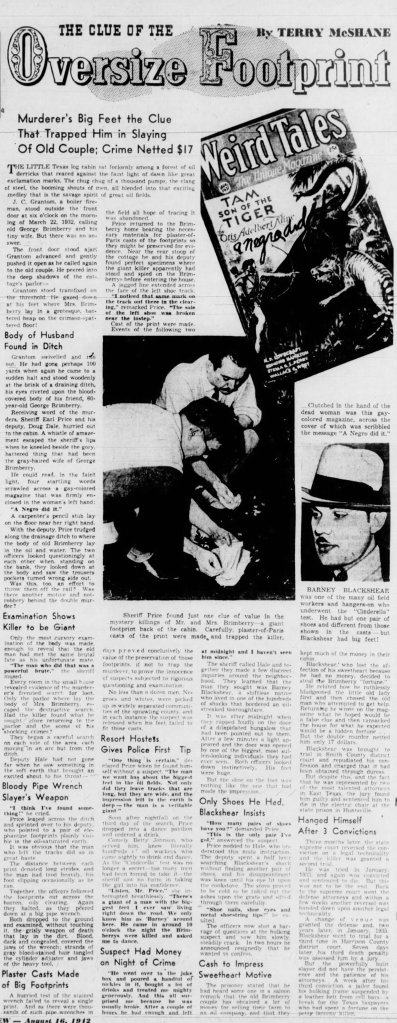
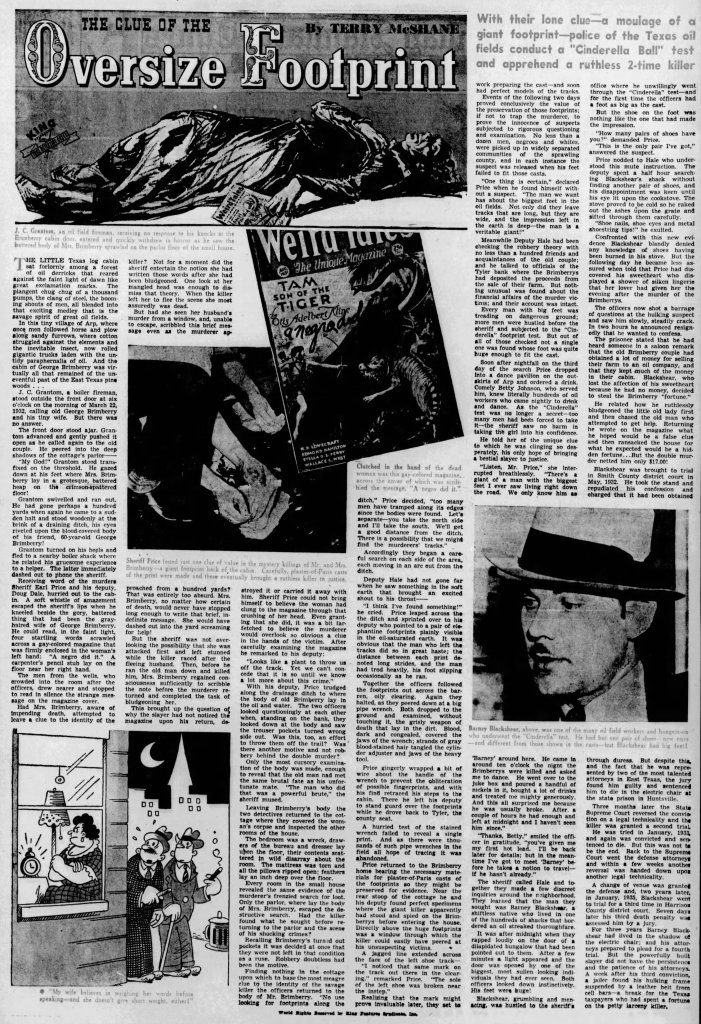
In the Detroit Evening Times for 16 Aug 1942 (and the The Standard-Times in New Bedford, Mass) is a sensational article by journalist Terry McShane: “The Case of the Oversized Footprint.” What caught my eye about the story was one particular clue in the case:
He could read, in the faint light, four startling words scrawled across a gay-colored magazine that was firmly enclosed in the woman’s left hand:
“A Negro did it.”
A carpenter’s pencil stub lay on the floor near her right hand.
The magazine in question appeared to be a copy of Weird Tales Aug 1931. An issue that happened to include H. P. Lovecraft’s “The Whisperer in Darkness.”

However, digging into the history of the case reveals what McShane got right—and wrong—about this case, right down to the pulp magazine in question.
In digging into the case, the major sources available are newspaper archives, a few legal decisions from the case’s appeals that remain available, and a scattering of supporting documents. Not all of the newspaper articles are reliable, often giving inaccurate names and ages, especially the earliest accounts when few facts of the case were known. However, without access to the trial transcript (which may well not have been retained, it being over 90 years since the case was tried), these are what we have to go by.
The first reports came in on 22 March 1932, about a murder that had occurred in the small town of Arp, Texas the night before:
J. L. Grantom, employed as a fireman by the Zion Oil company at an oil well across from the Brimberry shack, went to the two room house at 10:45 and found Mrs. Brimberry’s body. He called Deputy Sheriff Jim Bradford of Alp and together they discovered Brimberry’s body in a ditch about 60 feet from the house. His knuckles were bruised as though he had fought his assailant.
It was believed Brimberry was killed first and his money wallet looted, then the assailant went into the house and killed the woman. A blood covered flatiron was found near her body. She clutched a small pencil in her hand and on a nearby magazine had scrawled “Negro killed me.” Her purse was lying open on the floor, empty.
—”Man and Wife are Murdered with Flatiron,” The Orange Leader, 22 Mar 1932 (1)
The victims were George Thomas Brimberry (18 Apr 1867 – 21 Mar 1932) and his wife Ethel Viola Brimberry (May 1877 – 21 Mar 1932). Newspaper accounts often depict the couple as elderly and German when they were closer to middle-aged; the latter possibly a mistake stemming from the fact that his father was born in Georgia. George Brimberry is described as a well-digger, and this occupation appears on his entry in the 1930 Federal Census. According to contemporary accounts, Viola Brimberry also took in laundry to supplement their income. Deputy Sheriff Jim Bradford of Arp was apparently the first responder. Neighbors and relatives were questioned:
The pair had been married about seven or eight years, the relatives reported. It was the second marriage for both. They had been living near Arp for the last year and the man had been digging wells and the woman taking in laundry for a living.
Possibility that robbery might have been the motive was advanced by neighbors. They said the old man joked about his wife saving money. He was a cheerful person, neighbors averred.
—”Bury Slaying,” Tyler (TX) Morning Telegraph, 24 Mar 1932 (2)
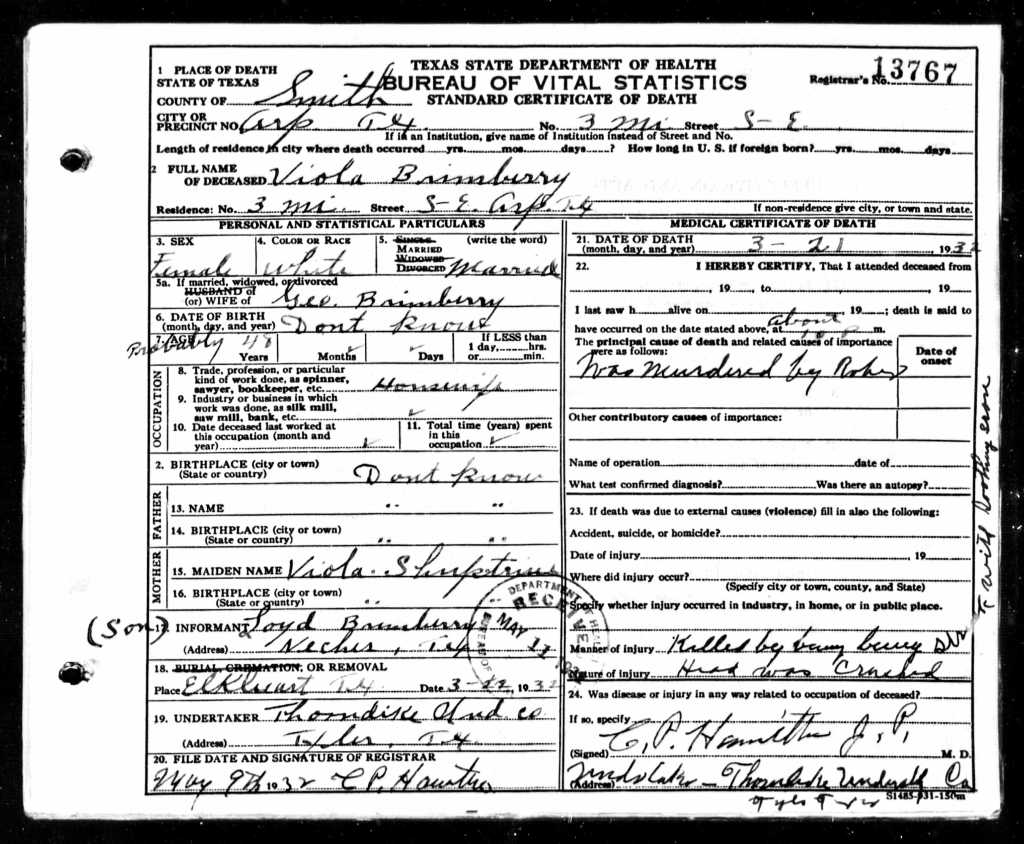
The death certificate for Viola Brimberry reads simply “was murdered by robber.”
The woman’s wounds were so horrible that officers believed the note was false, being an attempt to mislead investigators.
—”Well Digger And Wife Beaten To Death Near Arp,” The Kilgore (TX) News Herald, 22 Mar 1932 (1)
Other officers involved include Constable W. B. Webb (Arp), Deputy Sheriff H. R. Turner (Tyler), and Deputy Sheriff Doug Hale (Tyler). Later sources include Sheriff Earl Price (Tyler), but at the time of the initial murder investigation the sheriff was Tom C. Sikes; Price defeated him in the March 1932 primary, and won the following election, but did not take office until January 1933.
The note on the magazine was a salacious detail that was widely reported, even as the police investigating the murders took it as a red herring. It was not long before the police had a suspect in custody.
The man was arrested late yesterday near the scene of the slaying. Officers said they found a pair of blood-stained trousers, which the suspect admitted he was wearing Monday night. The man’s shoes fitted the tracks leading from the Brimberry cabin, they stated. The clothes were turned over to chemists for a comparison of the blood on them with that of the victims.
—”Man Arrested In Connection Double Murder,” Corsicana (TX) Daily Sun, 23 Mar 1932 (2)
The suspect was Barney Bascum Blackshear (8 Dec 1908 – 19 Nov 1936); the 1930 Federal census gives his occupation as “laborer,” and the newspapers routinely referred to him as an oil field “roustabout,” or itinerant worker. Blackshear had been in the Arp vicinity for about a week. (“Bury Slaying,” Tyler (TX) Morning Telegraph, 24 Mar 1932 (2))
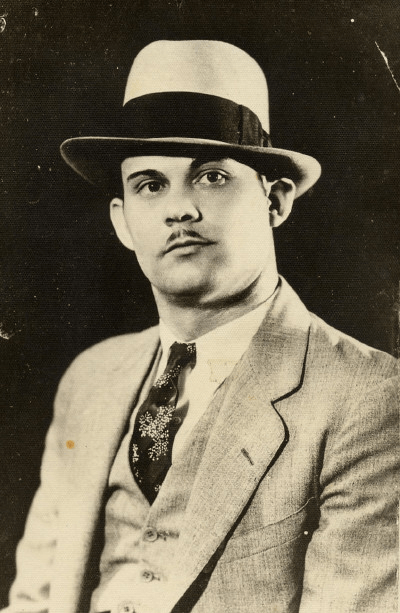
There were no witnesses to the murders; and the newspaper accounts offer few details of the circumstances, e.g.:
A keg, partly filled with beer, was found in the cabin, and glasses showing traces of beer were found, leaving investigators to believe the killer had visited the couple and had been given beer.
—”Killer Ues Flat Iron to Slay Couple Near Arp,” The Tyler (TX) Journal, 25 Mar 1932 (5)
Evidence against Blackshear was apparently circumstantial. McShane mentions plaster casts of footprints, with Blackshear the only man who, Cinderella-like, had feet big enough to fit the tracks. Contemporary newspaper articles mention little else in the way of physical evidence:
Another important development of the day was a discovery of a heavy oil well wrench buried in the field and on a line with the tracks which were discovered there. The heavy tool was clotted with blood and grey hair, leading deputies to the conclusion that it was the weapon used to fell Brimberry.
—”Oil Field Worker of Arp Held in Connection with Brutal Murder There Monday,” The Kilgore (TX) Daily News Herald, 23 Mar 1932 (1)
Meanwhile, questioning of Barney Blackshear, 23, charged with the killing here Wednesday in D. Y. Gaiens’ justice court, had started, according to Deputy Sheriff H. R. Turner, who is heading the invesitgation. Blackshear is in jail without bond. he has denied any connection with the case.
Blackshear was arrested within half a mile of the murder scene late Tuesday by deputy sheriffs from Tyler. A stained pair of trousers, a blodo smeared oil field wrench and flat iron, a pair of badly worn shoes and clothing from the two victims are being held as evidence in the case.
Efforts to gather finger prints from the articles in the curde two room hut where the pair lived were fruitless.
No one, not even relatives of the Brimberrys, has been permitted to view the prisoner in jail here. Efforts of newspaperman to obtain an interview have been unsuccessful.
—”Bury Slaying Victims Today; Quiz Suspect,” Tyler (TX) Morning Telegraph, 24 Mar 1932 (1)
Tyler, TX is the county seat of Smith County, where Arp is, and the location of the courthouse. In hindsight, the isolation of Blackshear seems suspect. It was only about six days after his arrest that Blackshear made a written confession to the murders:
The lengthy statement which Blackshear made and signed yesterday before District Attorney Goens, County Attorney Gentry and Deputies Turner and Bradford recounted, Blackshear’s activities in recent months and up to the time of his arrest.
—”Suspect Tells Story,” Tyler (TX) Morning Telegraph, 29 Mar 1932 (1)
[…] he was in need of funds by reason of unemployment and that he spent Monday with his brother and sister-in-law. After having leaving his relatives the statement declared he went to a negro church a hundred yards north of the Brimberry cabin. There he waited until nightfall and then called on the Brimberrys.
After leaving the Brimberry cabin Blackshear was said to have gone to a Cafe at Arp where he ate a heavy meal, danced and played the piano. Afterwards he went to his brother’s house at Lewiston and spent the night, he was quoted as having said.
Tuesday morning, the statement continued in susbtance, Blackshear and his brother drove to the Brimberry cabin and joined the curious crowd milling around there. They stayed there only a few minutes, Blackshear said.
—”Suspect Tells,” Tyler (TX) Morning Telegraph, 29 Mar 1932 (2)
The “Cafe” was the Ironhead Cafe, a local eatery that was also a speakeasy (this was still during Prohibition). There are a couple of paraphrases of the confession in the papers, not all of which jive exactly with each other, so without the actual written confession, take these as approximate. For example:
In his confession, Blackshear said that he waited near the Brimberry cabin until dark, and then went to the house. On the way there, he picked up an oil well wrencha nd hit it near the door. Later he lured Brimberry outside on the pretext of giving him a drink of liquor. When they passed the spot where the wrench was hidden, he said he picked it up and hit his victim in the forehead. He fell without making a sound, Blackshear said.
He then returned to the cabin where he found Mrs. Brimberry finishing her evening meal. As he went in, he related, he picked up a smoothing iron from the stove and struck her in the back of the head. She fell, the confession continued, and he struck a second blow.
—”Man Admits Killing East Texas Couple,” The Houston (TX) Chronicle, 29 Mar 1932 (1)
According to the confession, Blackshear’s double homicide and robbery netted him $17 (“Confesses Dual Murder,” The Tulsa (OK) Tribune 29 Mar 1932 (3)), of which he had $12 left on him at the time of his arrest (“Suspect Tells,” Tyler (TX) Morning Telegraph, 29 Mar 1932 (2)).
Blackshear would contend that the confession was forced:
Deputy Sheriffs Jim Bradford and H. R. Turner; Day Jailor Charlie Gabriel and Night Jailor Charlie Gabriel, Jr., were questioned at length regarding the confinement of Blackshear in a dark cell and the conversation between the prisoner and officers before the statement was made. […] Jailor Gabriel admitted that Blackshear had been confined in the dark cell for six days because officers had instructed him to keep the prisoner away from other prisoners and that the solitary confinement cell was the only one which was available. Gabreil [sic] said that he fed Blackshear regularly and answered every call he made. He testified that the same bedding and food were served him as other prisoners. […] Deputy Turner denied emphatically that Blackshear was coerced into making his statement and said that he had promised him nothing. he inferred that the statement was made after a three hours’ talk in which Blackshear had been told what evidence had been collected.
—”Sensational,” Tyler (Texas) Morning Telepgraph, 7 May 1932 (2)
As the attorneys prepared to present this evidence to the Grand Jury, they attempted to bolster it by tying the note on the magazine to Blackshear:
Considered as probably the most important clue is the bit of writing on a magazine which was found in the dead woman’s hand. It said: “A negro killed me.” The magazine and a specimen of Blackshear’s handwriting have been sent to experts in Dallas to determine if they were written by the same hand.
—”Suspect Tells,” Tyler (TX) Morning Telegraph, 29 Mar 1932 (2)
The state’s handwriting expert would later testify that it was Blackshear’s handwriting on the magazine:
W. A. Weaver, Dallas, an expert in handwriting, testified he had examined the writing on the magazine, Blackshear’s signature to the statement given officers, and that of a poem entitled “Twenty-One Years,” written by Blackshear, and they were all the handwriting of the same person. Defense counsel objections prevented Weaver from illustrating on a blackboard how he arrived at his conclusions.
—”Sensational,” Tyler (Texas) Morning Telepgraph, 7 May 1932 (2), cf. “Jury Weighs Arp Slaying,” The Times (Shreveport, LA), 8 May 1932 (5)
The prosecutor also called as witness one of Viola’s sons, who testified:
E. L. Denman, son of Mrs. Brimberry by a former marriage, testified that the words, “negro kill me,” scrawled in his mother’s hand were not in the handwriting of his mother. Efforts of the defense in cross-examination to bring from in information concerning whether the Brimberrys lived happily were blocked by objections by the state.
—”Sensational,” Tyler (Texas) Morning Telepgraph, 7 May 1932 (2), cf. “Blackshear,” Tyler (TX) Morning Telegraph, 15 Dec 1933 (8)
Speaking of that annotated magazine—none of the newspaper accounts give the title or date. However, two photos of the incriminating scrawl were included in photos:
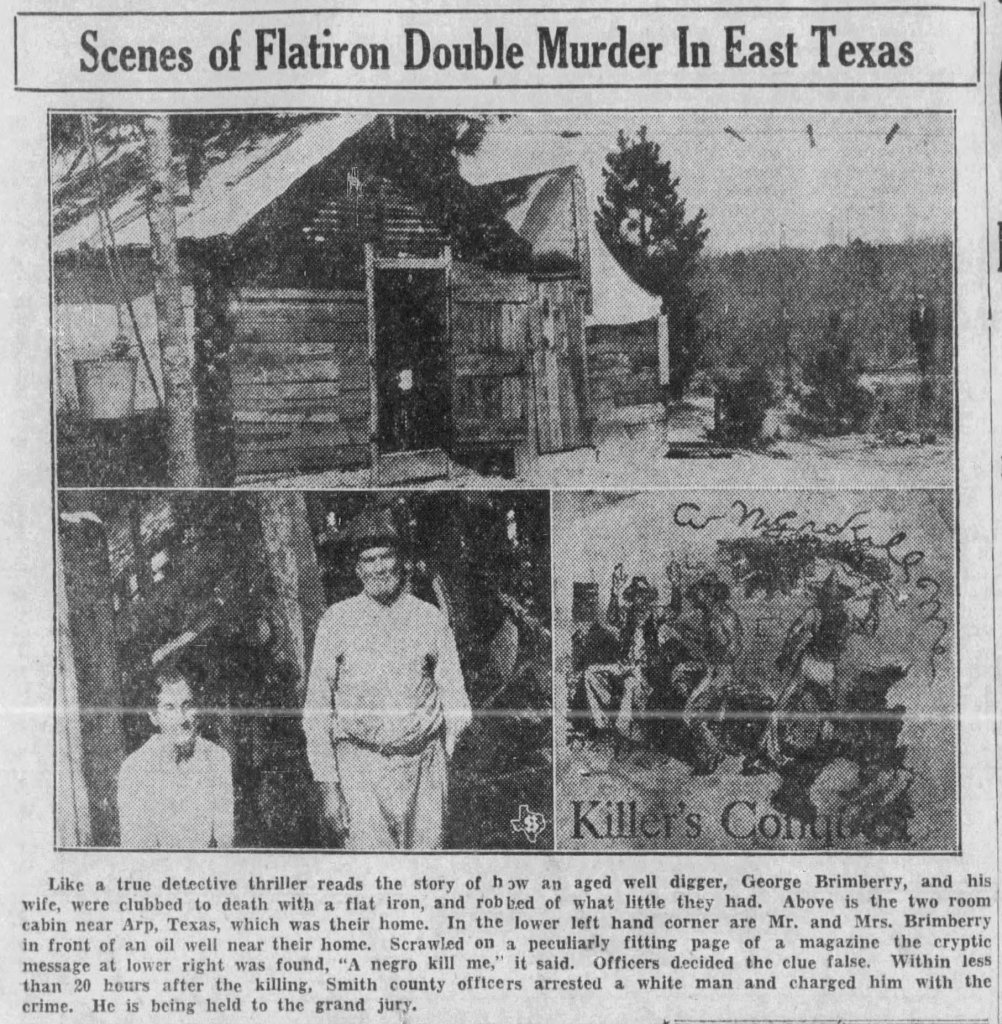
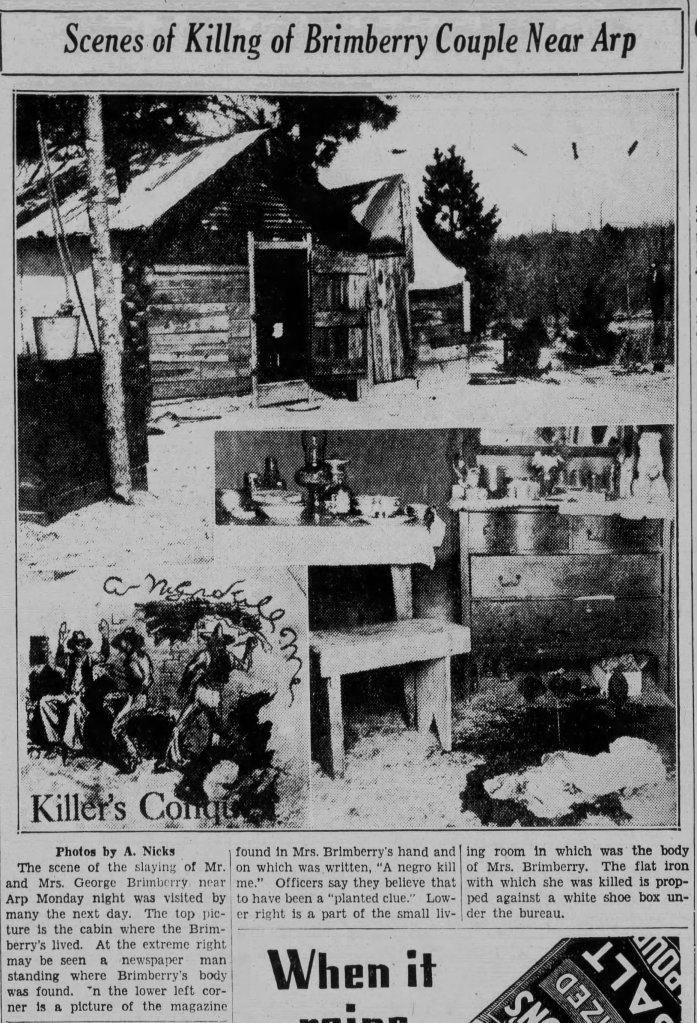
“Killer’s Conquest” was never published in Weird Tales. “Killer’s Conquest” by George Cory Franklin was published in Triple-X Western (Apr 1932). Which perhaps makes more sense than a year-old issue of Weird Tales. What probably happened is that when McShane’s article went to press, there was no image of the incriminating pulp, so someone at the newspaper bought a copy of a magazine from about the correct time and scrawled on it themselves.
So we have a Weird Tales murder mystery without a copy of Weird Tales! Probably.
A special grand jury was called and returned two indictments, one for the murder of George and one for the murder of Viola, in short order; trial date for the murder of Viola was set for the next week, and public defenders appointed for Blackshear’s defense (“Blackshear Trial Date Set,” The Tyler (TX) Tribune, 30 Mar 1932 (1)). Blackshear posed for a few photographs from reporters.
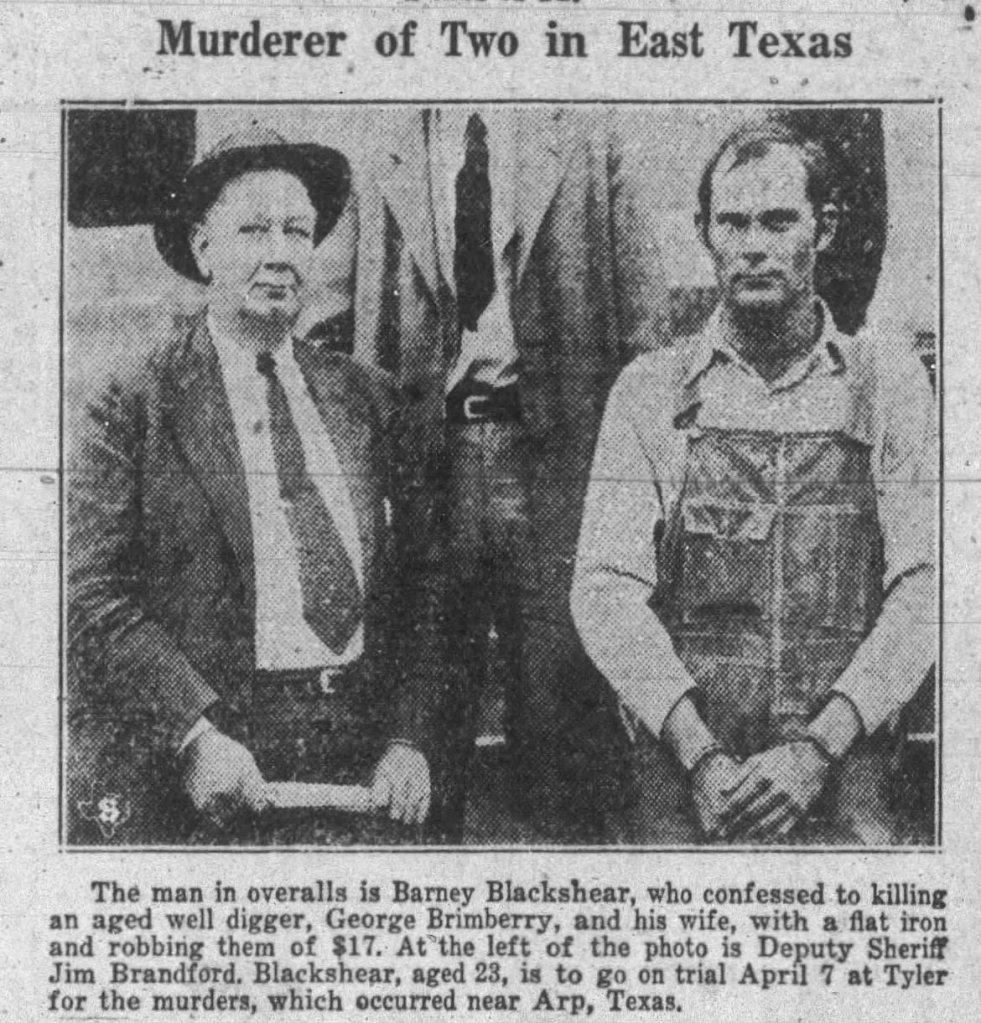
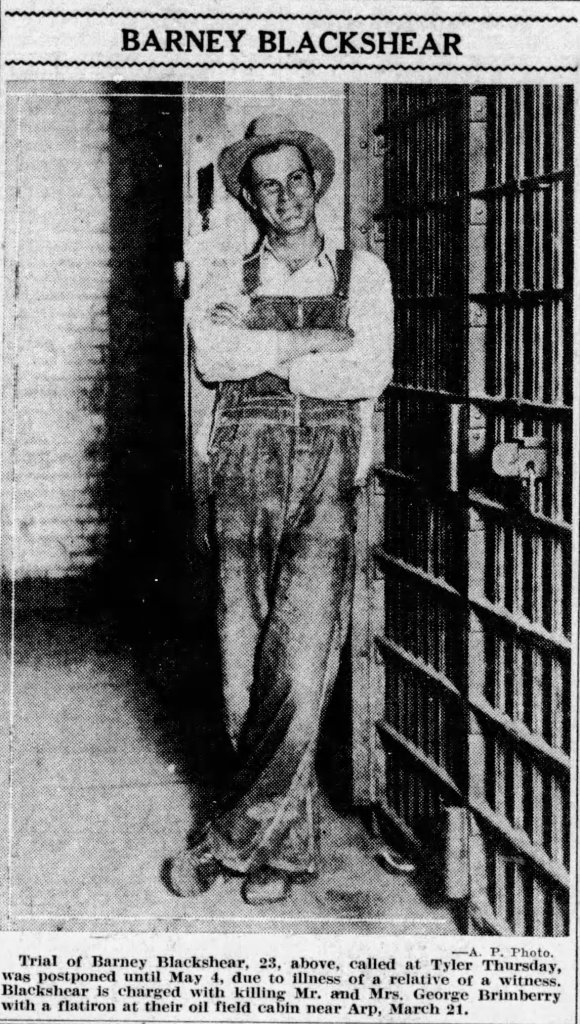
Things were not looking good for Blackshear. Although the physical evidence was circumstantial and there were no witnesses to the crimes, a signed confession is the kind of thing that swings juries. The defense initially called into question whether the court was legally in session, then the venire (panel of prospective jurors) that had been called, claiming irregularities and a faulty indictment; the judge didn’t buy either motion (“Judge Overrules Motion to Quash Murder Indictment,” Corsicana (TX) Daily Sun, 7 Apr 1932 (3)).
The public defenders made an effort to produce a strong defense:
During the examination of prospective jurors references were made to a statement Blackshear is said by the state to have made and signed. The defense by its questions intimated the statement will be challenged and efforts made to prevent its introduction if the state tries to use it, on the ground that it was obtained by coercion and under duress in that Blackshear was ept in a dark cell until he agreed to sign.
[…] Blackshear, clean shaven, entered the courtroom in the custody of Deputy Sheriff Mart Jones and took a seat in a chair alongside the raling, directly facing the jury box. Throughout the morning session he continually smoked one cigarette after another.
He was dressed in a dark suit and from outward appearances was not the same man that was arrested near the murder scene. At that time he was clad in a pair of worn overalls, a blue shirt and badly worn shoes.
—”First Day,” Tyler (TX) Morning Telegraph, 5 May 1932 (5)
Appearances count for much in jury trials, and presenting Blackshear clean-shaven and in a suit was likely designed to produce a positive reaction from the jury, as someone who did not look like a murderer. The fact that they already questioned the confession shows that they were working every angle. But the odds were stacked against them, and the defense then apparently decided on an insanity defense (“Continue Blackshear Trial; May Plead Insanity,” Tyler (TX) Morning Telegraph, 8 Apr 1932 (1)).
This can be seen as a bit of a Hail Mary by the defense; a last-ditch effort to save Blackshear’s life. He was facing the electric chair if convicted, and there was little hope of overcoming a signed confession in open court, but the insane could not be executed. The problem then became one of proving to the jury that Blackshear wasn’t mentally competent. This was accomplished in part by soliciting witness testimony to Blackshear’s mental instability and his history of mental illness:
Mrs. Ruby Whitman of Rowlett, who admitted she had lived with Blackshear, testified that Blackshear was subject to fits of mental derangement and that he had twice attempted to commit suicide.
—”State Produced Arp Confession,” San Antonio (TX) Express-News, 7 May 1932 (4)
Ren Whitman, husband of Ruby Whitman, corroborated testimony of his wife that Blackshear twice had attempted to commit suicide in her presence. […] Dr. W. Howard Bryant testified he believed Blackshear of unsound mind, but refused to say his condition was more than a “border line” case.
—”Youth Tried For Death of Aged Couple,” The Time (Shreveport, LA) 8 May 1932 (1)
Some other things came out during the trial as well:
The state returned Deputy Sheriff Turner to the stand in an effort to impeach the testimony of Harold Dawson, 17, that Blackshear’s nose was bleeding and the defendant wiped his own blood on the clothing which the state contended Blackshear wore on the night of the murder.
—”Jury Weighs Arp Slaying,” The Times (Shreveport, LA), 8 May 1932 (5)
Mrs. Otis Murray, a neighbor of the slain couple, said that Mrs. Brimberry told her within 12 hours of the killing that a “dope head” was making love to her and planned to kill Brimberry and take her for himself. The “dope head” was not named. The witness said the Brimberrys were incompatible and that Mrs. Brimberry planned to leave her huhsband the next day. […] A letter written by Mrs. Brimberry to her son the day of the slaying corroborated Mrs. Murray’s testimony in part. Mrs. Brimberry asked protection from her husband and requested her son to say nothing of her intention to leave him as “she knew what was about to happen to him.”
—”State Produced Arp Confession,” San Antonio (TX) Express-News, 7 May 1932 (4)
J. K. Rivers, named in the state’s injunction suit to padlock the Ironhead Cafe near Arp as the proprietor, was one of the first witnesses. He testified that Brimberry had dug a well for him.
A subsequent witness, Mrs. Otis Murray, testified that Mrs. Brimberry told her on the day of the killing that she had had trouble with her husband over money, but that her husband had been unable to give it to her because he had not received all of his pay—$38—for digging the Ironhead Cafe well. H. R. (Luck) Turner, deputy sheriff, testied as to finding of a cellar, after being tipped off as to its existence by D. M. Maynor, of defense counsel, communicating with the well dug for the cafe by Brimberry. he told of the ingenious manner in which the well served as the entrance to the cellar, while at the same time performing all the functions of a well used for supplying water, how the pipe through which beer flowed from the cellar led to the kitchen sink and how 900 bottles of beer had been found in the cellar, together with electric lights and fans.
—”Deny Blackshear New Trial,” Tyler (TX) Morning Telegraph, 4 Jun 1932 (1-2)
How much of this was true, we have no idea. But it wasn’t enough to convince the jury of Blackshear’s innocence.
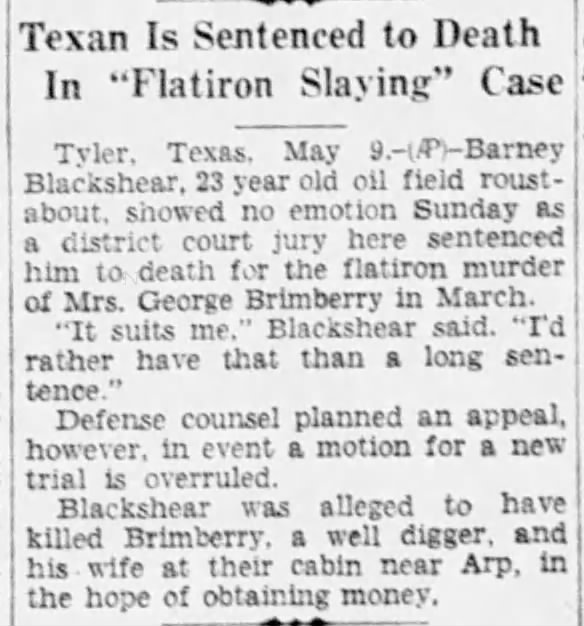
The defense motioned for a new trial on jury misconduct; they were overruled, but appealed (“Overrules New Trial Plea for Blackshear,” Corsicana (TX) Daily Sun, 3 Jun 1932 (15)). The appeal was heard in Feburary 1933, and the Court of Appeals reversed the verdict and remanded the case for a new trial, citing improper handling of evidence involving the handwriting expert:
Considering the bill of exception, it appears therefrom that officers found in one hand of deceased a magazine on which was written the words “A negro kill me.” In the other hand of deceased they found a lead pencil. An official of Smith county went to the jail while appellant was under arrest and in custody, and, without warning appellant, had appellant write several specimens of his signature. There was also introduced in evidence appellant’s written statement, in which he confessed his guilt. The prosecuting attorney had in his possession a poem written in longhand, entitled “Twenty One Years.” This poem was never introduced in evidence and the record is silent as to who wrote it or as to how the state obtained possession of it. The state called and used as a witness one Weaver, a handwriting expert. This witness examined the magazine found in the hand of deceased, the signature to appellant’s written statement, the specimens of handwriting taken from appellant without warning, and the poem entitled “Twenty One Years.” After his examination of these writings, he testified that the same person who wrote the words on the magazine “A negro kill me” signed appellant’s written statement, wrote the poem entitled “Twenty One Years” and signed the specimens of handwriting obtained from appellant while he was in jail. The bill of exception manifests error.
—Blackshear v. State, 58 S.W.2d 105 (Tex. Crim. App. 1933).
The second trial took place in November 1933. In the year and change since he had been in jail, a couple things had changed:
Since Blackshear’s first trial, the state’s star witness, H. R. (Luck) Turner, a deputy sheriff at the time of [t]he killing, has died. Turner headed the investigation. Duncan Maynor, widely known East Texas lawyer who was chief of the defense counsel, also is dead.
—”Second Trial of Blackshear,” Corsicana (TX) Daily Sun, 27 Nov 1933 (2)
A request was made for change of venue, which was denied. Unlike the first trial, in this trial Blackshear took the stand to testify in his own defense. Not much in the way of new details are gained from newspaper accounts, although the position of the Ironhead Cafe becomes a bit clearer:
“Cuter” Rivers operated the Ironhead Cafe where Blackshear, the defendant, said in a written statement, now in evidence in the trial, allegedly went after leaving the Brimberry home. At the Ironhead Cafe, Blackshear drank whiskey, ate some sausages and played a nickel piano, his statement said.
—”Blackshear,” Tyler (TX) Morning Telegraph, 15 Dec 1933 (8)
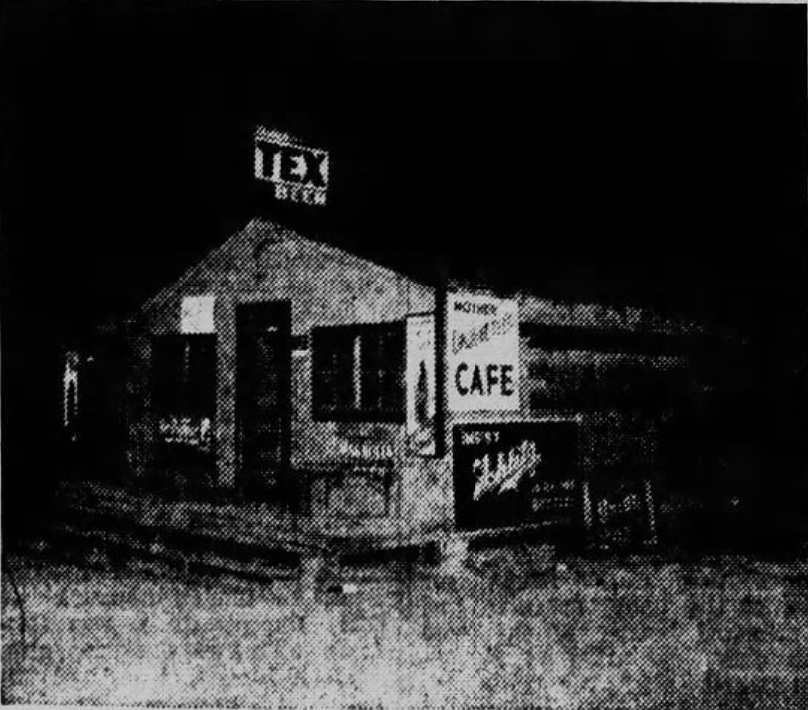
A later article expanded on the Ironhead Cafe as a rough establishment that featured in two additional murders, not counting the ones Blackshear was indicted for, and again reiterated the Brimberrys’ connection to the speakeasy:
During the trial of Barney Blackshear for the murder of Mrs. Brimberry, the defense brought out the fact her husband, who was also murdered, had dug the water well for Rivers which connected with the underground room. There was some trouble about payment, witnesses testified, and Mrs. Brimberry was said to have told neighbors the day of the killing that she and her husband were coming to town the next day to report Rivers for selling liquor.
—”An Old ‘Trouble Spot’ For Officers,” Tyler (TX) Morning Telegraph, 13 Apr 1936 (2)
Additional details were also offered on Blackshear’s previous suicide attempts (involving the use of a straight razor). The defense seems to have relied on largely the same insanity defense as before; this time, when Blackshear took the stand in his own defense, the prosecution grilled him on his affair with Ruby Whitman:
The state scored heavily when it secured an admission from Blackshear that he knew it was wrong to be living with another man’s wife at his (Blackshear’s) brother’s house; and that for that reason he told his brother the woman was his wife.
Defense attorneys had contended through Dr. Bryant that Blackshear did not know right from wrong.
—”Blackshear Takes Stand In His Own Defense,” Tyler (TX) Morning Telegraph, 16 Dec 1933 (1)
Once again, the signed confession was introduced as evidence (“Statement of Oil Worker introduced at 2d Murder Trial,” The News San Antiono (TX), 14 Dec 1933 (18)). And, once again, Barney Blackshear was sentenced to death for the murder of Viola Brimberry (“Blackshear Gets Death Sentence in Arp Slaying,” The Houston (TX) Chronicle, 18 Dec 1933 (1)).
Once again, an appeal was made (“Appeal Second Death Conviction of Barney Blackshear of Tyler,” Tyler (TX) Morning Telegraph, 24 Apr 1934 (2)). The appeal was heard in June 1934, and once again the verdict reversed, and the case remanded for new trial somewhere else:
It appears from the record that the special veniremen were summoned from different sections of the county and that the case had been discussed in every part of the county. We are constrained to hold that the record in its entirety leads us to the conclusion that the appellant’s case had been prejudged to the extent that it was impossible that he could obtain that character of a fair and impartial trial contemplated by the Constitution.
—Blackshear v. State, 72 S.W.2d 601 (Tex. Crim. App. 1934).
Given the fairly extensive newspaper coverage, this isn’t a huge surprise.
The third trial of Barney Blackshear took place in Marshall in Harrison County, TX in January 1935 (“Testimony Being Taken In Slaying,” (The Waxahachie (TX) Daily Light, 22 Jan 1935, (1)). We don’t have many details of the third trial, but apparently, the change of venue didn’t help: on 29 January 1935, Blackshear was sentenced to death for the third time for the murder of Viola Brimberry. Once again, the verdict was appealed, and Blackshear got his due process (“Appeals Court to Hear Argument on Blackshear Case,” The Marshall (TX) News Messenger, 13 Nov 1935 (3)).
Once again, the appeals court reversed and remanded the decision, this time finding particular fault with how the confession was arrived at:
The court sharply criticized methods used by officers in obtaining a purported confession from the defendant. The opinion said it was admitted that Blackshear was incarcerated in a dark cell for approximately six days and nights.
Judge F. L. Hawkins, who wrote the opinion, quoted as follows from an opinion of the court in another case:
“Neither policemen, detectives nor jailers are clothed in this country with inquisitorial powers. It is true that some of the laws of Spain ahve been ingrafted on ours, but not the dungeon, the bludgeon, the burning faggot or any of the concomitant tortures of the inquisition. These belong to the ages of bigotry, intolerance and sueprstition and have no place in our civilization. An attempt to revive them, even in mild form ought to call forth execration of the people and the sverest condemnation of the law.”
—”Blackshear Again Escapes Death as Case Is Reversed,” Denton (TX) Record-Chronicle, 17 Jun 1936 (1) cf. Blackshear v. State, 95 S.W.2d 960, 130 Tex.Cr.R. 557 (Tex. Crim. App. 1936)
“It was so dark that one’s hand could hardly be seen before him” Judge Hawkins wrote in the opinion. “There were no lights, no charis and no bed. Appellant slept on a mattress on the concrete floor. he could not obtain water unless it was brought to him by the jailer.”
“Our conclusion is that there was no issue for the jury as the uncontrovertible evidence conclusively established that the confession was involuntary,” the opinion held.
—”Court Reverses Death Sentence,” San Antiono (TX) Express-News, 18 Jun 1936 (4)
At this point, Barney Blackshear had been in jail over four years. He had suffered through three trials and three death sentences, and was facing a fourth trial for the murder of Viola Brimberry—and was still technically under indictment for the murder of George Brimberry, if the state wanted to press the issue. Perhaps that is why in November 1936, Blackshear used a straight razor to slash his wrists. This third suicide attempt was successful (“Blackshear Ends Long Parade of Murder Trials By Killing Himself,” The Marshall (TX) News Messenger, 20 Nov 1936 (1)).
We will never know what really happened in Apr, TX that night in 1932. That Blackshear was mistreated in jail and forced into a confession is now apparent; that there may have been someone else with reason to murder the Brimberry’s is possible, though unprovable at this chronological distance. To the credit of the Texas Justice system, Blackberry’s right to appeal was heard, repeatedly, and the appeals court sided with him each time. But appeals take time, and innocent or guilty, long years of imprisonment can wear on anyone. Newspapers suggest the suicide may have been inspired by an infatuation with a woman who had been writing him letters that had gone sour, but the true cause was likely complicated and personal (“Blackshear,” Tyler (TX) Morning Telegraph, 20 Nov 1936 (2)).
Misinformation was not uncommon in reporting on the case; especially later, when memories were a bit faded. Later narratives in the 1940s like “Today’s True Detective Story” by Sam D. Cohen (The Pittsburgh Post Gazette, 28 Jul 1941 (18)) mixed fact with fiction; no mention of making a cast of the bootprint, claim that Blackshear hung himself rather than cutting his arms, which is how he actually killed himself. McShane makes the same error, claiming Blackshear hung himself by his belt, which suggests perhaps he was reading some of the same sources Cohen did, only elaborated a little further. Cohen and McShane also emphasized different officers in the case, with Cohen focusing on Deputy Jim Bradfard and McShane on Sherrif Earl Price; neither give much mention to Deputy Turner, who supposedly obtained the confession. This suggests the journalists may have interviewed different men about the case, resulting in some of the confusion surrounding it.
When journalists get so many of the basic facts wrong, the use of an old issue of Weird Tales as a prop seems almost harmless. But it’s emblematic of an emphasis on style and sensationalism over accuracy—and perhaps an example of why it doesn’t do to rely too heavily on a single newspaper account.
Weird Tales sometimes included weird crimes among its pages, though not one where a man was convicted to death and won reprieve, though not release, three times. The case caught my attention because of the tenuous pulp magazine connection, a clue that was widely seen as a red herring, but which the prosecutors attempted to use anyway. There is more to this strange story, no doubt. It may involve bootlegging in Texas, and rural police efforts to force confessions; the value of handwriting experts and what, exactly, that poem was. A fuller story of a pair of brutal murders, which we may never know.
Bobby Derie is the author of Weird Talers: Essays on Robert E. Howard and Others and Sex and the Cthulhu Mythos.
Deep Cuts in a Lovecraftian Vein uses Amazon Associate links. As an Amazon Associate I earn from qualifying purchases.

