Eldritch Fappenings
This review deals with a work of pornography, and the history of erotic art and writing. As part of this review, selected images with cartoon depictions of genitalia and/or sexually explicit contact will be displayed.
As such, please be advised before reading further.
The history of underground comix is necessarily (and often deliberately) vague, but it is a truism that these non-traditional comics often take their inspiration from more traditional peers. The Tijuana bibles (8-pagers, bluesies, etc.) that began to appear in the 1920s or 1930s often took as their subject then-current celebrities or characters from popular comic strips like Popeye, Blondie, and The Phantom. The earliest comic book magazines were nothing more than collections of newspaper strips, although by the end of the 1930s they became original works with their own characters in the recognizable format that still survives today.
Tijuana bibles were explicitly pornographic and often used characters owned by others; as a consequence they were broadly illegal, sold under-the-counter, and the artists and publishers left off dates, names, and other information. As a consequence, dating of many such underground works is often approximate, and in some cases relies on context clues. A Tijuana bible starring The Phantom, for example, could not date before 17 February 1936 when the first daily comic strip starring that character was published; there could be no pornographic depiction of Superman before June 1938 when Action Comics #1 was published, no Batman before Detective Comics #27 (March 1939), no Robin before Detective Comics #38 (April 1940), etc. That still leaves a rather open question as to period of publication, but sometimes the field can be narrowed down further by changes of costume that reflect a given artist’s run.
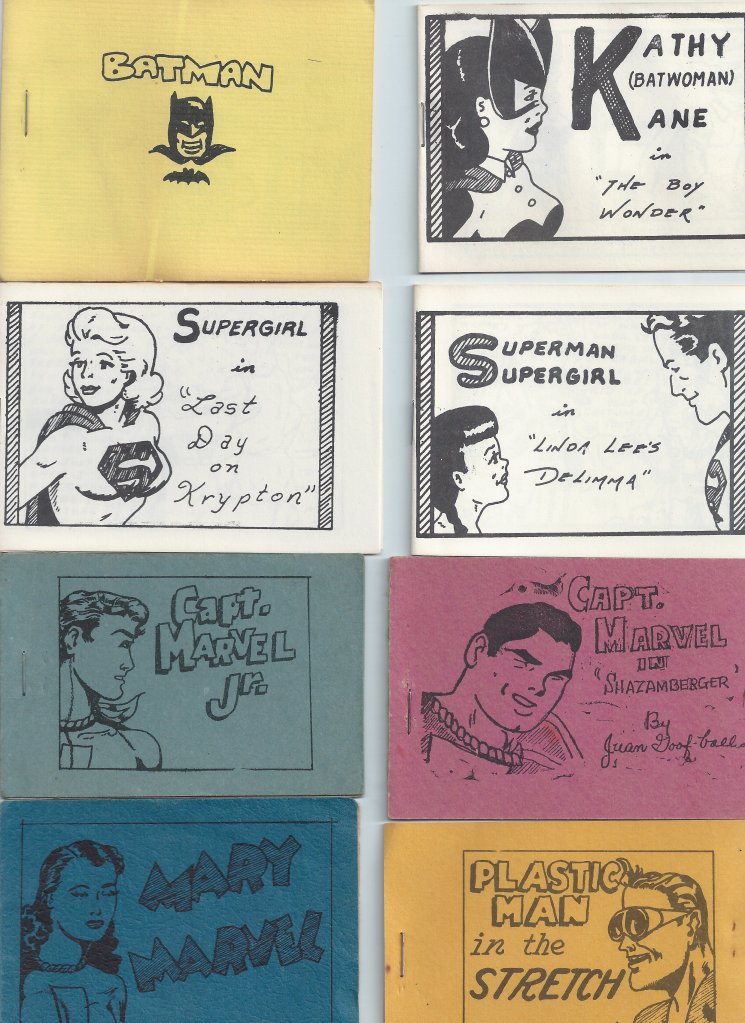
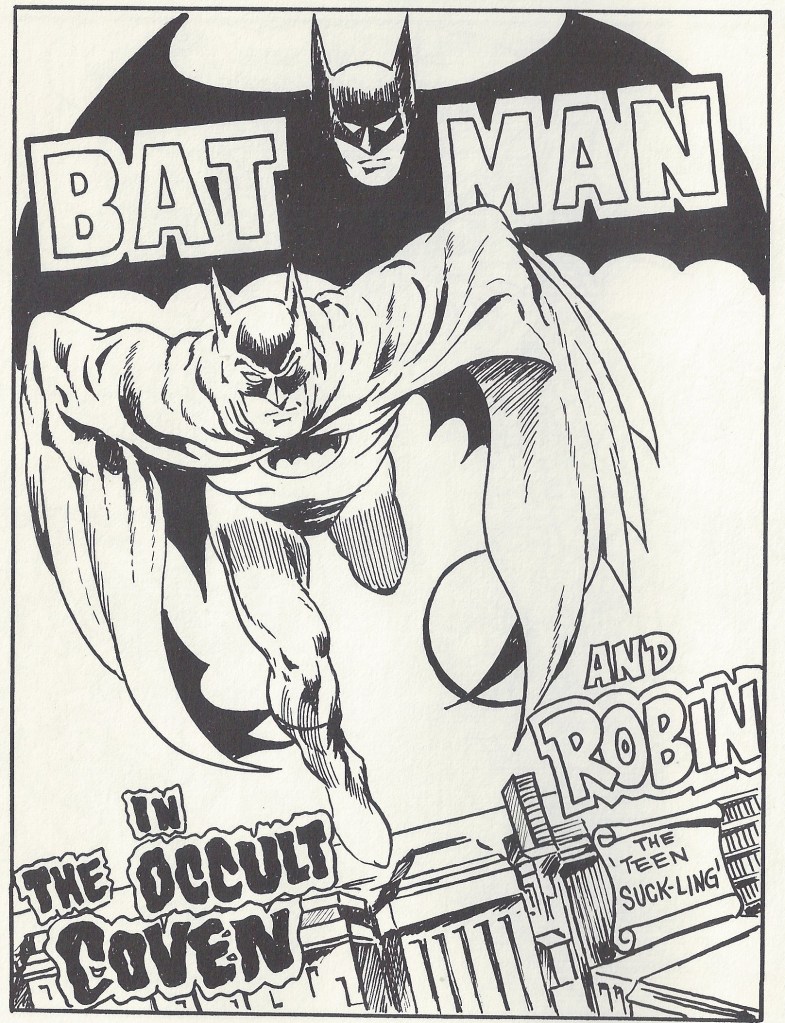
Such is the case with “Batman and Robin in The Occult Coven,” a 8-page story that was published in Filthy Sunday Funnies (no date or publisher given), which is also published in Original Dirty Comics 2. This is not a Tijuana bible in the traditional 8-pager format, although it is a later work in the same vein of pornographic satire and parody; Filthy Sunday Funnies was one of a number of small side-stapled digest-sized collections of adult comics that were around the same price point (mostly $5) and format, indicating a common publisher…other titles including Trash Comics, Jolly Time Fun Book, Original Dirty Comics, Sexotic Comics, Raunchy Tales from the Arabian Nights, and Gwendoline in “Sin Island.” Some of these are reprints of older Tijuana bibles, others are apparently original works by various unnamed artists.
Some of these works can be roughly attributed to various known artists based on style or character. The Gwendoline collection, for example, involves the character created by John Willie; a gender-bending riff on Jekyll & Hyde in Trash Comics has the hallmarks of John Blackburn. At least one comic references the San Francisco Ball, an adult-oriented independent newspaper from the 1970s that included pornographic comics with an emphasis on parody and satire, including comic book superheroes; Filthy Sunday Funnies may reprint material from the pages of that newspaper, but indexing for the San Francisco Ball is basically non-existent.
Among the artists who did comics for the San Francisco Ball was Lee Carvel, who released several collections of adult comics work, including several parodies of 70s comic book characters, titled Lee Carvel’s Dirty Comics. An online entry for Lee Carvel’s Dirty Comics #2 lists “Batman and Robin in the Occult Coven” among the contents, but that entry is almost identical to another, unsigned collection Original Dirty Comics #3—which does contain “The Occult Coven.” However, it’s known that Carvel signed some of his work—such as “Gonad the Horney” (a Conan the Barbarian spoof)—and none of his signed works Best of San Francisco Ball Comics #1 show similarities to “Batman and Robin in the Occult Coven,” though some other unsigned works do.
Part of the complication is that because pornographic comics were illegal to sell and often used copyrighted characters, they were almost never copyrighted, nor could the creator or publisher enforce their copyright without revealing their identity. As a consequence, pirating was rampant. There are already three possible printings of “Batman and Robin in the Occult Coven” and it isn’t clear which was the original (if any of them are), and which are reprints or pirated editions.
Faced with bibliographic confusion and lack of printing dates, we have to rely on internal evidence to date “Batman and Robin in The Occult Coven.” Given cultural references (parodies of Star Trek, The Lone Ranger, and contemporary superheroes, etc.) the other comics in the collection Filthy Sunday Funnies can be roughly dated to anywhere from the 1960s to the 1970s—but for “The Occult Coven” we can go a step further, as the unnamed artist took deliberate inspiration from a particularly recognizable work.
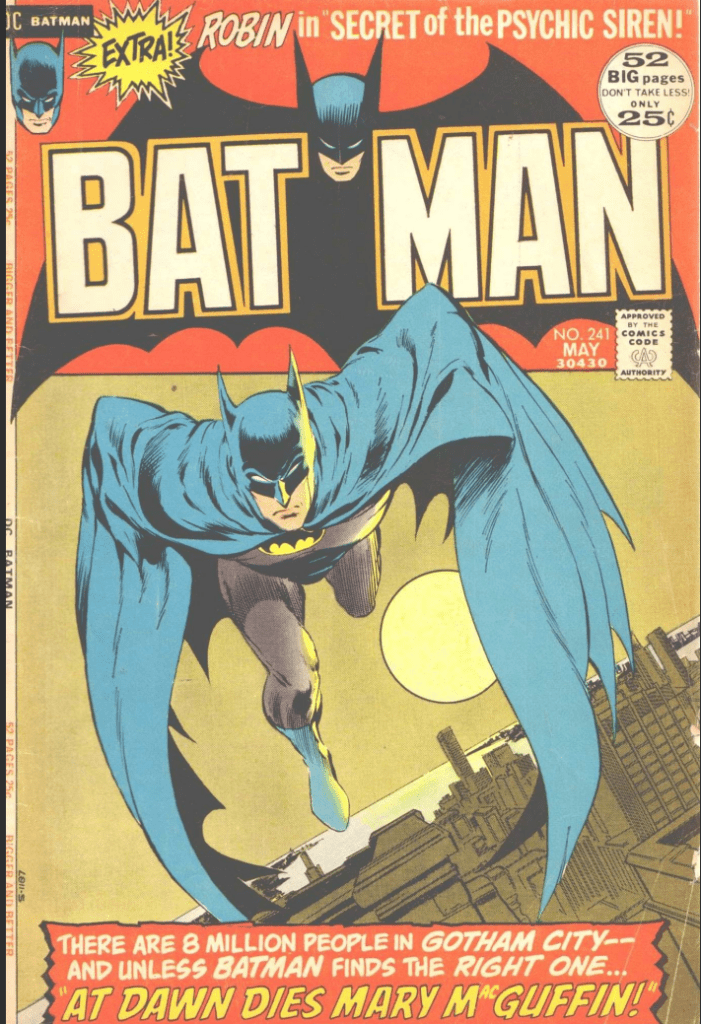
DC Comics’ character Batman had received his own title starting in 1940; by the 1970s it had become a 52-page anthology magazine, often with a lead story, back-up story, and sometimes a reprint. The editor was Julius Schwartz, who as a teenage fan had been an agent for a couple of Lovecraft’s stories to Astounding and published material about him as fanzines, Batman #241 (14 March 1972) features a distinctive cover by Neal Adams (pencils), Bernie Wrightson (inks), and Gaspar Saladino (lettering):
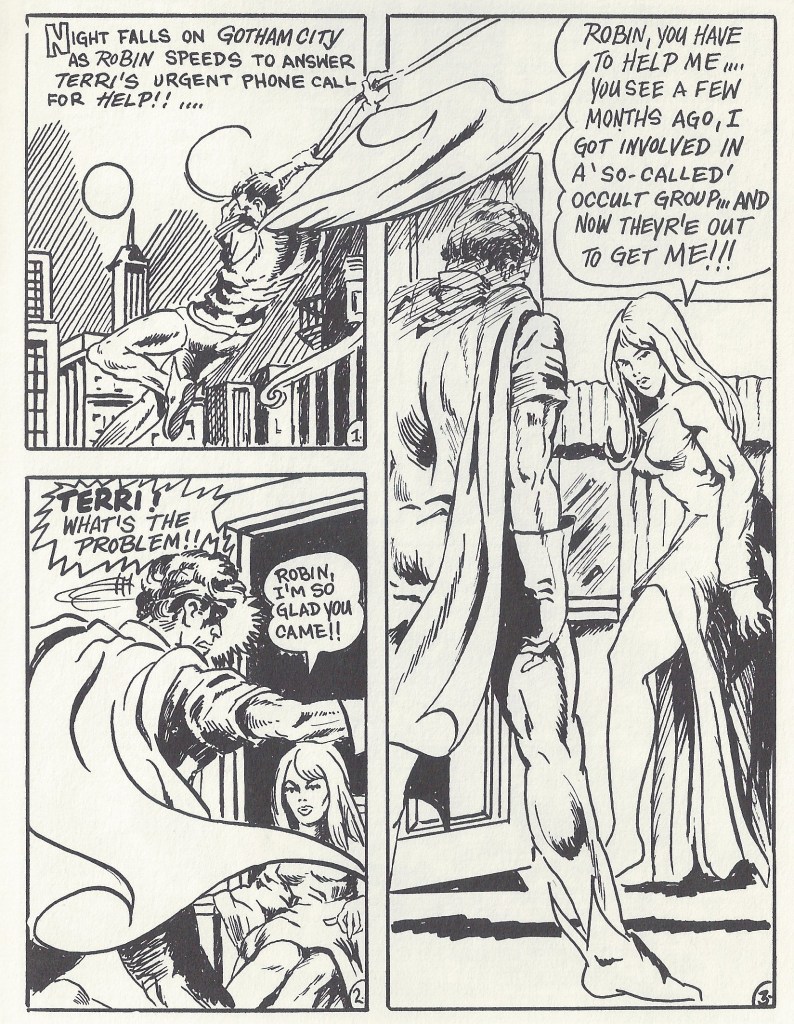
The artist also “swiped” other panels from the same issue and story, for example:
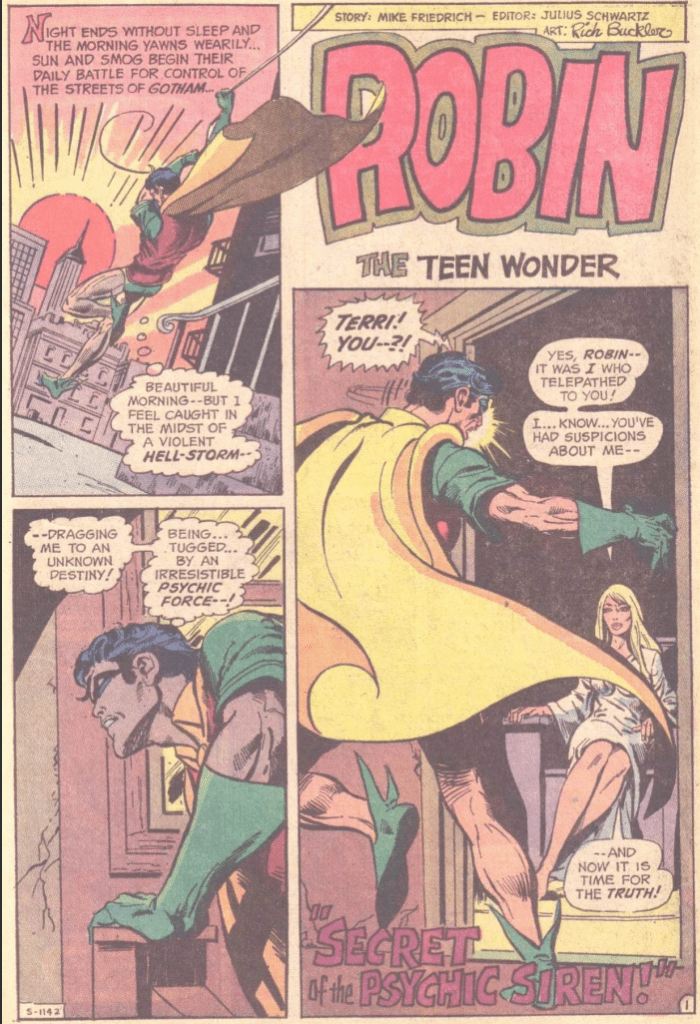
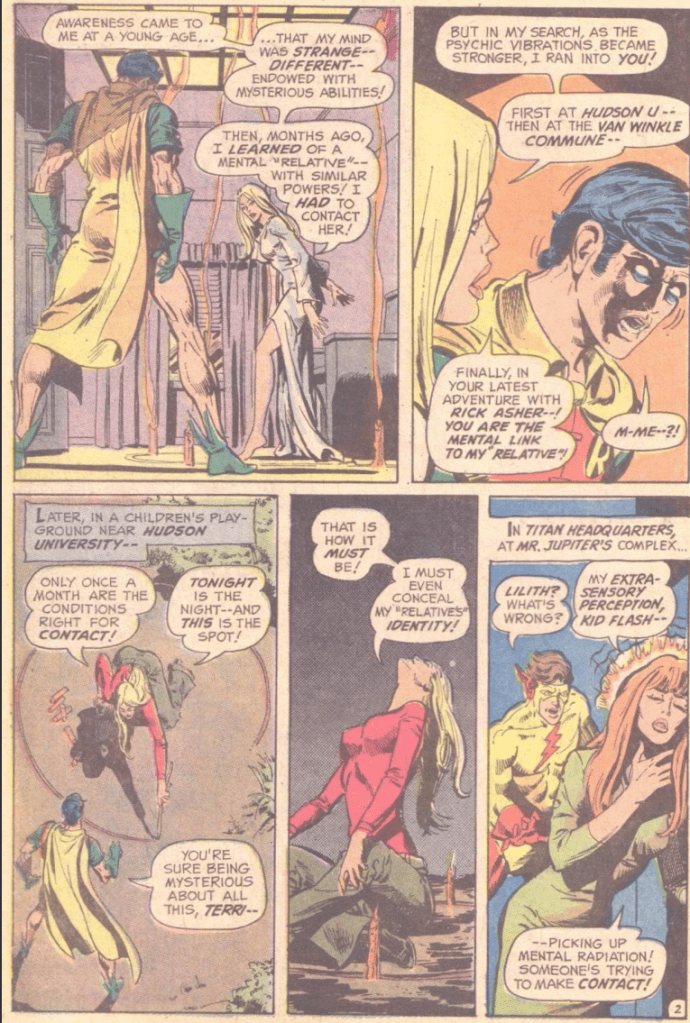
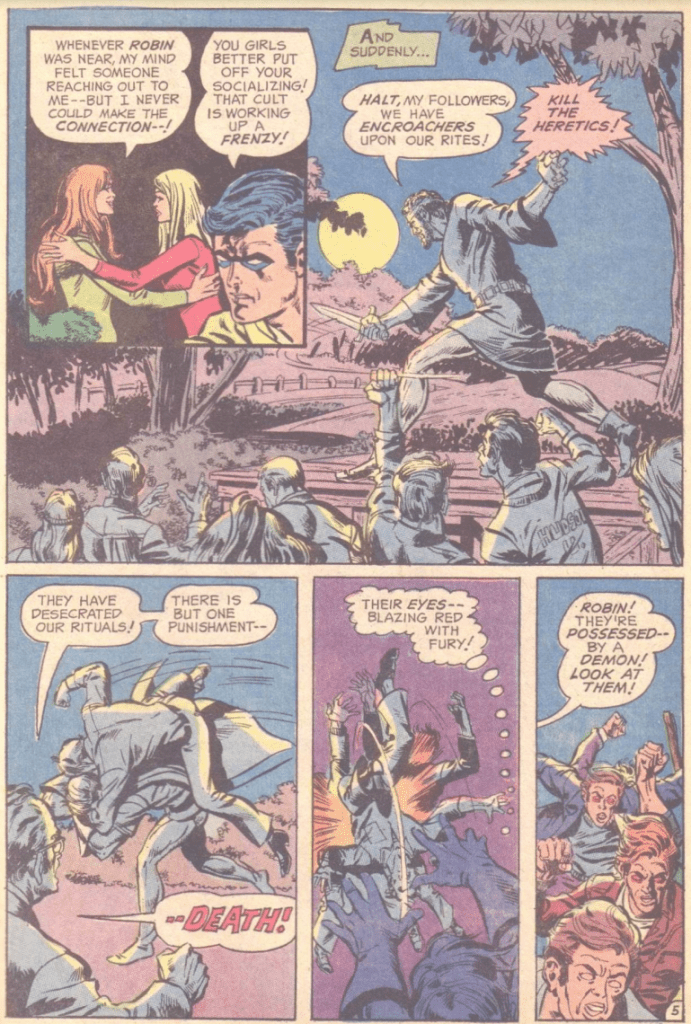
The really interesting part for Mythos fans is the back-up story in Batman #241 is “Secret of the Psychic Siren!” by Mike Freidrich (writer) and Rich Buckler (pencils & inks), where Robin and his telepathic girlfriend Terri Bergstrom run afoul of the cult of Cthulhu. While the Batman comics have long tipped their hat to Lovecraft with Arkham Asylum, this storyline was decades before The Doom That Came To Gotham, a more explicitly Cthulhu Mythos story published starring the Caped Crusader. There are no tentacles waved about, the Necronomicon is mentioned but never appears; the cult-leader is aware that Lovecraft was a pulp writer and might just be insane.
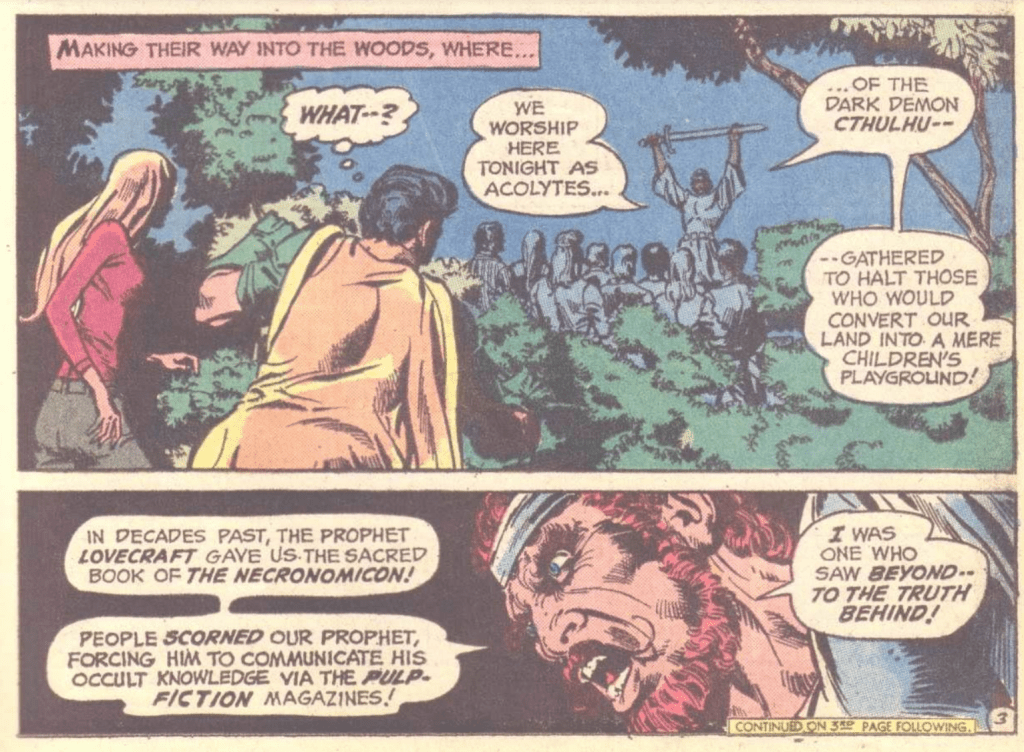
The narrative ends on a cliffhanger; finished up in the story “Death-Point!” next issue (Batman #242, June 1972) by the same creative team, though Dick Giordano inks over Buckler’s pencils. The storyline would mark the last appearance of Terri Bergstrom, and connections to the wider DC universe are pretty much minimal. The Cthulhu cult is little more than an Easter egg tossed out for fans of Lovecraft and the Mythos…but it obviously fired the imagination of at least one would-be pornographer.
“Batman and Robin in The Occult Coven” is a blatant riff off of “Secret of the Psychic Siren!”; the distinctive cover is virtually traced, and there are a number of swipes throughout the 16-page pornographic parody. While the eponymous coven is not explicitly worshipping Cthulhu—they are more focused on sex and murder—it is clearly based on the Cthulhu-worshippers.
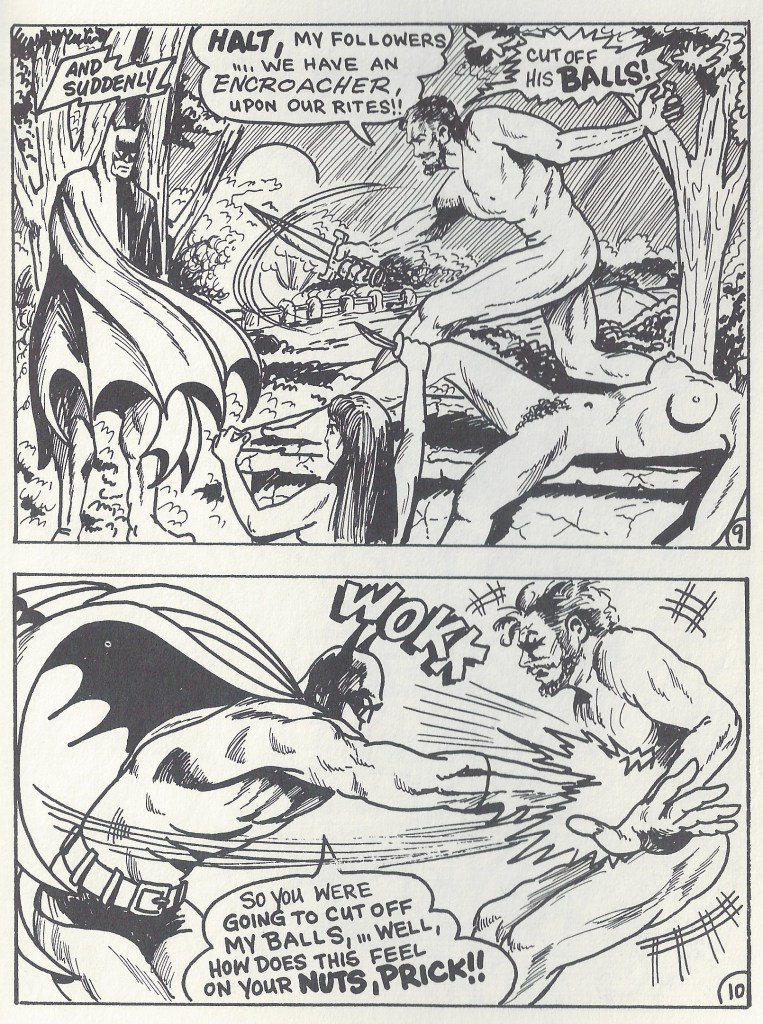
While the sex is explicit, Batman is a little stiffly posed—”Secret of the Psychic Siren!” was a Robin-only story, so the Batman character swipes came from somewhere else. The artist apparently took delight in putting some salty language in Batman’s mouth. The strong influence of Batman #241 on the story makes it clear that “Batman and Robin in The Occult Coven” couldn’t have been produced before 1972, and probably dates to the mid-1970s. That might make this one of the first Lovecraftian pornographic comics, although still a bit later than “Tales of the Leather Nun’s Grandmother” by Jaxon in Tales from the Leather Nun (1972).
There is no easily accessible reprint of “Batman and Robin in The Occult Coven” as far as I can find. However, those who want to read “The Secret of the Psychic Siren!” are in luck, as the story and its sequel were republished in Showcase Presents: Robin the Boy Wonder #1 (2008) and Robin: The Bronze Age Omnibus (2020)
Bobby Derie is the author of Weird Talers: Essays on Robert E. Howard and Others and Sex and the Cthulhu Mythos.
Deep Cuts in a Lovecraftian Vein uses Amazon Associate links. As an Amazon Associate I earn from qualifying purchases.
 Deep Cuts in a Lovecraftian Vein