Greetings—& a thousand thanks for the delightful mortuary relique! It arrived, thanks to the careful packing, in what was probably very much its condition when shipped—the upper part in two large & joinable sections, a third large section, & a sizeable array of smaller fragments. I shall have an interesting time trying to piece the latter together—a sort of picture puzzle de luxe—& wish I had the aid of a clever reconstructive expert like Barlow . . . who last summer completely reassembled & restored a cherished Chinese vase which I broke. This will certainly form a most delightful & appropriate embellishment for my ghoulish lair, & I surely appreciate your thoughtfulness ins dending it. I presume you were assisted by Howard the Baby Ghoul in excavating it—& must congratulate him on his keen scent for good specimens!
Have just finished decorating a Christmas tree.
Season’s best wishes
—E’ch-Pi-El
H. P. Lovecraft to Willis Conover, [24 December] 1936, Letters to Robert Bloch & Others 406
Although he did not darken the door of any church in Providence for midnight mass on Christmas Eve; and would most likely have been happier reading a scary ghost story while huddled near the steam vents, there can be little doubt that H. P. Lovecraft enjoyed Christmas. There was no religious element to this ritual, and probably it owed much to the Christmases of his boyhood years, which were remembered and recounted well into adulthood, when his mother and grandparents were alive, when the whole household (including the servants) would gather to sing songs, and the black kitten would purr as it chased chestnuts from the fire.
Such celebrations stopped with the death of Lovecraft’s grandfather. The household was broken up, and Lovecraft’s Christmases during his teenage years were likely smaller, more intimate affairs, perhaps with only his mother, or gathering together with his aunts for a meal and exchange of presents. As the family resources spread thin, and Lovecraft traveled further afield, even these gatherings might have been briefer and less formal affairs. We know that the family did not always have a tree for Christmas, but when at last his elder aunt Lillian Clark died, financial circumstances forced Lovecraft and his surviving aunt Annie Gamwell to move in together at 66 College Street, for a few Christmases at least they did have a tree.
Such was the case for Lovecraft’s last Christmas in 1936 as well.
Our Christmas here was commendably festive—including a tree, as in ‘34 & ‘35.
H. P. Lovecraft to Richard Ely Morse, 28 Jan 1937, Letters to Hyman Bradofsky & Others 141
As in previous years, Lovecraft sent out a stack of Christmas greetings to friends, and a scattering of cards and gifts must have arrived by post from the far-flung corners of his correspondence. At this late stage in his life, Lovecraft’s correspondence was voluminous, with regular letters to dozens of people, and probably less frequent missives and postcards to dozens more. Writing swiftly as he did and conveying much the same news, Lovecraft often took to copying the same accounts of events nearly verbatim. So we have about a dozen versions of his 1936 Christmas, many almost identical. The following may be taken as exemplary:
Our Yule in general was commendably festive—including a turkey dinner over at Spotty’s house with our hostess meandering among the tables & finally jumping-up on the window-seat for a nap. We had a tree in front of the hearth in my aunt’s living-room—its verdant boughs thickly festooned with a tinsel imitation of Volusia County’s best Spanish moss, & its outlines emphasised by a not ungraceful lighting system. Around its base were ranged the Saturnalian gifts—which (on my side) included a hassock tall enough to let me reach the top shelves of my bookcases, & (on my aunt’s side) a cabinet of odds & ends, not unlike my own filing cabinets, but of more ladylike arrangement & aspect. Of outside gifts—apart from our somnolent household panther—the most disintctive was perhaps that which came quite unexpectedly from young Conover, the editor of the new fan magazine (which is, by the way, about to absorb Leedle Shoolie’s Fantasy) in Cambridge, Maryland . . . down de Eastern Sho’. For lo! when I had removed numberless layers of corrugated paper & excelsior, what should I find before me but the yellowed & crumbling fragments of a long-interred human skull! Verily, a fitting gift from an infant ghoul to one of the hoary elders of the necropolitan clan! The sightlessly staring monument of mortality came from an Indian mound—apparently even more fruitful than those of Cassia & New Sum-myrna—not far from the sender’s home; a place distinguished by many archaeological exploits on the part of the enterprising editor & his young friends. Its condition is such as to make its reassembling a somewhat ticklish task—so that I may reserve it for the ministrations of an expert vase & calendar-stone mender upon the occasion of his next visit! Viewing this shattered yield of the ossuary, the reflective fancy strives to evoke the image of him to whom it once belonged. Was it some feathered chieftain who in his day oft ululated in triumph as he counted the tufted scalps sliced from coppery or colonist foes? Or some crafty shaman who with masque & drum called forth from the Great Abyss those shadowy Things where were better left uncalled? This we may never know—unless perchance some incantationd roned out of the pages of the Necronomicon will have power to draw strange emanations from the lifeles & centuries clay, & raise up amidst the cobwebs of my ancient study a shimmering mist not without power to speak. In such a case, the revelation might be such that no man hearing it could any longer live save as one of those hapless entities ‘who laugh, but smile no more’!
H. P. Lovecraft to R. H. Barlow, 27 Dec 1936, O Fortunate Floridian! 385-386
“Spotty” was Spotty Perkins, a female cat that belonged to the boarding house across the courtyard from where Lovecraft and his aunt stayed, where they sometimes took their meals. Spotty was noted as the mother of several other cats in the neighborhood, including those Lovecraft named Sam and John Perkins, and the “Earl of Minto.” For more on the boarding house and its inhabitants, see Ken Faig Jr.’s excellent book Lovecraftian People and Places.
Willis Conover Jr. (1920-1996) was all of sixteen years old, one of a number of precocious science fiction fans who had written to Lovecraft, and fell into correspondence with the writer when he wrote back. The discovery of Native American remains in the Cambridge, Maryland area is not terribly surprising: the area has been noted for its ossuaries by archaeologists, and contemporary newspaper accounts about looting of Native American burials and monuments are common, e.g.:

The cavalier and disrespectful treatment of indigenous remains by average folk has to be seen as the flip side of the coin to the cavalier and disrespectful treatment of indigenous remains by scientists and museums, who often had little respect for non-white peoples and cultures when it came to the disinterment, removal, and display of remains. Lovecraft would have seen Native American remains before—in museums in New York, Boston, and Washington, D.C., and the newly-excavated gravesite in St. Augustine. Yet Lovecraft never actually broke into any mounds—the ones mentioned in Cassia and New Smyrna, Florida, near where R. H. Barlow lived in DeLand, were apparently shell-middens—nor did he show any inclination to do so.
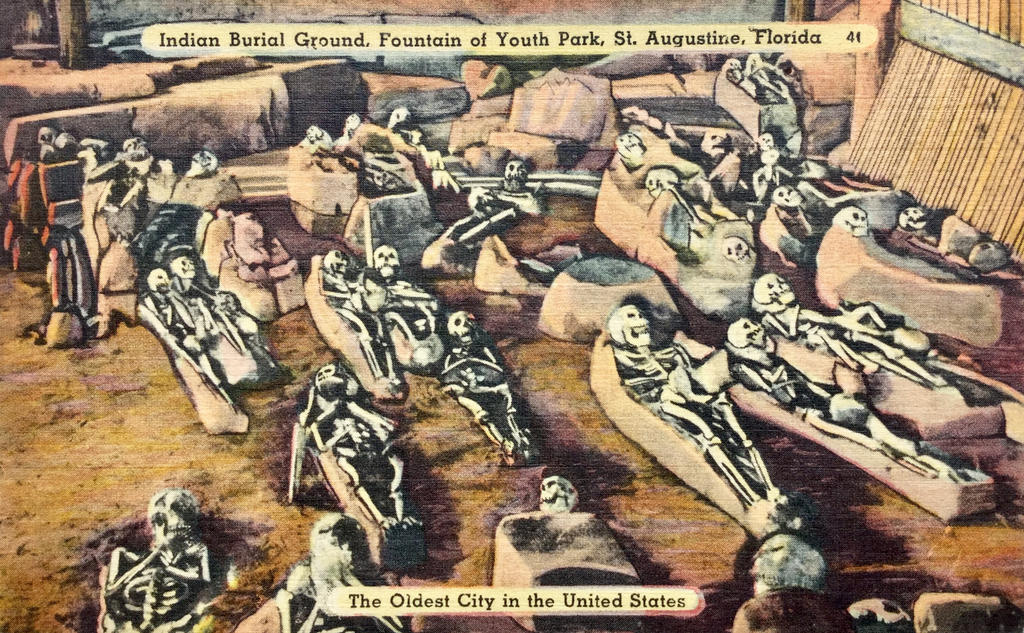

Lovecraft himself would touch on this morbid penchant for display in “Out of the Æons” (1935), and noted in passing the naked commercial trade in indigenous remains that museums engaged in, without respect to the local cultures or the wishes and beliefs of the descendants of the bodies they exhumed and made off with. Many years later, when relaying his side of this incident, Conover would reflect:
For centuries, beyond doubt, the skull and leg-bones had marked time in the ferrous soil of Sandy Hill. If I had been older and more sensible of their origin I should not have removed them. At fifteen, however, I thought of them as no more than stage-properties.
Atop my bookcase now, the transient pieces added rusty-beige to the colors of my magazines.
A few days before Christmas, while addressing prints of a card I had designed, I happened to glance at the bookcase.
On an impulse, I took down the skull, put it in a pasteboard box, and mailed it to HPL.
Willis Conover, Jr., Lovecraft at Last 163
Lovecraft received the memento mori with grace, and wrote back to Conover to thank him for the gift:
Yours of Dec. 26 arrived while I was still admiring, with all the zest of fresh acquisition, the gruesome loot of Howard the Infant Ghoul. Don’t worry about the fractures—I’m sure a little Duco cement will work wonders when the proper skill is applied. Certainly, Chief Thunder-Under-the-Ground isn’t going into any ash-can, by a long shot! As for one of the Chief’s legs—thanks for the idea of sending it, although the dome itself forms a pretty generous quota. If any other logical claimants exist, you might supply them in preference. Otherwise, I’m sure I’d keenly appreciate such a monument of mortality at some time when its sending might prove convenient. I shall keep a careful watch on the Chief’s cranium, & will let you know of any curious agitations occasioned by resentment at the various indignities accorded his disject membra. At the moment, he seems singularly—perhaps deceptively—peaceful. Meanwhile let me thank you afresh for what is certainly my most distinctive Yuletide gift of recent years!
H. P. Lovecraft to Willis Conover, 10 Jan 1937, Letters to Robert Bloch & Others 407
“Chief Thunder-Under-the-Ground” appears to be the name Lovecraft settled on for the skull, as it appears in other letters, e.g:
Haven’t yet tried to piece together Big Chief Thunder-Under-the Ground’s skull—indeed, I guess I’d better wait for your next providential sojourn & let you try your luck. Meanwhile the amiable donor offers me in addition one of the big chief’s legs—the other being promised to a local friend. Apparently quite a bit of the old boy turned up after all his centuries of repose! Alas, poor Yorick! Well—the noble sachem’s dome will always be regard with veneration around here!
H. P. Lovecraft to R. H. Barlow, 3 Jan 1937, O Fortunate Floridian! 392
While this basic account was copied almost verbatim, or briefly abridged, in many letters to Lovecraft’s varied correspondents, it was also his nature to tweak and individualize the contents to their respective recipients. So for example, when it came to Robert Bloch, creator of De Vermis Mysteriis:
[…] This we may never know—unless perchance some incantation droned out of the pages of old Ludvig Prinn’s De Vermis Mysteriis will have power to draw strang emantions from the lifeless & centuried clay, & raise up amidst the cobwebs of my ancient study a shimmering mist not without power to speak. In such a case, the revelation might be such that no man hearing it could any longer live save as one of those hapless entities ‘who laugh, but smile no more’!
H. P. Lovecraft to Robert Bloch, 7 Jan 1937, Letters to Robert Bloch & Others 183-184
And to Clark Ashton Smith, who created The Book of Eibon:
[…] This we may never know—unless perchance some incantation droned out of the Book of Eibon will have power to draw strang emantions from the lifeless & centuried clay, & raise up amidst the cobwebs of my ancient study a shimmering mist not without power to speak. In such a case, the revelation might be such that no man hearing it could any longer live save as one of those hapless entities ‘who laugh, but smile no more’!
H. P. Lovecraft to Clark Ashton Smith, 5 Feb 1937, Dawnward Spire, Lonely Hill 665
And to Richard F. Searight, who created the Eltdown Shards:
[…] This we may never know—unless perchance some incantation droned out of the pages of the Necronomicon, or from the most feared of the Eltdown Shards, will have power to draw strang emantions from the lifeless & centuried clay, & raise up amidst the cobwebs of my ancient study a shimmering mist not without power to speak. In such a case, the revelation might be such that no man hearing it could any longer live save as one of those hapless entities ‘who laugh, but smile no more’!
H. P. Lovecraft to Richard F. Searight, 14 Feb 1937, Letters to E. Hoffmann Price & Richard F. Searight 436
And to August Derleth, with whom Lovecraft had just been discussing the telepathic experiments of J. B. Rhone, who had established the Duke University Parapsychology Laboratory in 1935 for the scientific study of psychic phenomena:
[…] This we may never know—unless perchance some incantation droned out of the pages of the Necronomicon will have power to draw strang emantions from the lifeless & centuried clay, & raise up amidst the cobwebs of my ancient study a shimmering mist not without power to speak . . . or to communicate ideas after the fashion of our friend Prof. Rhine. In such a case, the revelation might be such that no man hearing it could any longer live save as one of those hapless entities ‘who laugh, but smile no more’!
H. P. Lovecraft to August Derleth, 17 Jan 1937, Essential Solitude 2.764
It was a mild winter in Providence, for the most part; and the trip to the boarding-house for a hot meal would not have been far for either Lovecraft or his aged aunt. Neither of them knew it would be their last Christmas feast together—but though his letters were generally cheerful, Lovecraft knew he was not well.
Since Yuletide, my annals are largely the quiet chronicles of infirmity. Despite the general mildness of the winter, I was caught in the cold two or three times in early December—& as a result have had some of my old-time foot & ankle swelling, which occasionally forces me to wear an old pair of cut & stretched shoes. This won’t wholly go until I’ve had a week or two of eighty degree weather to be outdoors & active in.. And on top of this came the pervasive & enervating malady (probably some form of intestinal grippe) which has forced me on a diet & sapped my strength to a minum. My programme, as you may well imagine, has greatly suffered—but so far I haven’t been forced wholly off my feet. Indeed, on warm days I totter forth in the afternoon for air & exercise. Were the winter so cold as to prevent these modest airings, I should be much worse off.
H. P. Lovecraft to James F. Morton, final letter, Letters to James F. Morton 397
The extreme sensitivity to cold which caused swelling in the extremities (edema), and in one case caused him to pass out, was a condition that Lovecraft had dealt with for years; possibly Raynaud syndrome. The digestion issues, however, weren’t a case of stomach flu (grippe), but cancer. Within months, possibly weeks, of writing those words, Lovecraft was dead.
There is no record of what happened to that skull, one of Lovecraft’s last Christmas presents. R. H. Barlow may have taken it with him when, soon after Lovecraft’s death, he arrived to help Annie Gamwell put her nephew’s affairs in order. Or perhaps the shards of bone were swept into a box and passed down to some distant cousin when Annie herself died in 1941. Most likely they were simply discarded, and like most refuse of the era tossed into an incinerator—the “ash can” that Lovecraft had hoped to save it from.
Like many little mysteries about Lovecraft’s life, and the afterlife of his belongings, we don’t know.
When we look at and discuss Lovecraft’s life from a holistic view—even zoomed in close to a single event, like an exchange of presents on Christmas Eve—there is no moral here, no dark and supernatural terror. Lovecraft did not die of cancer in 1937 because he received a looted Native American skull as a gift from a well-meaning if slightly ghoulish teenage fan (who, despite this youthful bit of desecration, would go on to a long and successful life), or because he was an atheist that did not darken the door of a church on the anniversary of Christ’s birth. Lovecraft was not rewarded with this morbid token because he was particularly racist against Native Americans, whom he had rarely met and often regarded more as historical than contemporary figures.
Lovecraft spent the better part of his life looking back at what was, to him, self-evidently better times. A childhood surrounded by family, with the comforts that wealth and affluence could bring. To see his family circle shrink one by one, until only he and his aunt were left. See money and comforts slowly diminish, year after year. Feel the flagging of his strength and the pains in his stomach, and not know what exactly was wrong with him. It is easy, despite his many faults and prejudices, to see Lovecraft as a pitiable figure.
Yet what simple joys there were, Lovecraft did enjoy. To share a holiday and a meal with a loved one, to make an event out of it, to exchange gifts, and to make a few memories. It was in every sense his final Christmas, his final holiday, the last little ritual of tradition that linked him with those Christmases of years past. The few months that were left to him would increasingly be spent in pain and infirmity, with little respite. Not because of any particular evil Lovecraft had done in his life, not because he was a racist or an atheist, but because he was human, and to be human is to die. The one universal truth of human existence.
Before Lovecraft died, he lived. His last Christmas was a celebration of that life, with the aunt he loved, with the friends he wanted to share that with, writing about it in his letters and greeting cards. Their appreciation of Lovecraft is why we still know about his Christmas today, when so many holidays of so many have been lost to time and memory forever.
Bobby Derie is the author of Weird Talers: Essays on Robert E. Howard and Others and Sex and the Cthulhu Mythos.
Deep Cuts in a Lovecraftian Vein uses Amazon Associate links. As an Amazon Associate I earn from qualifying purchases.
 Deep Cuts in a Lovecraftian Vein
I think the Christmas cards which Lovecraft received for the holiday in 1936 were likely a principal source for the list of correspondents in his 1937 Diary. I envision his working on the list in the 1937 Diary in the days after Christmas. Just how rapidly his cancer progressed is not too apparent. As late as Jan. 2, 1937, he took in the film “Winterset” in downtown Providence. The medical notes from the calendar section of the 1937 Diary are only known to survive in summaries made by Barlow in his letter to Derleth dated Mar. 31, 1937 (the same is true for the list of correspondents). If the 1937 Diary does survive, perhaps Lovecraft’s medical notes will one day be published in full. Barlow is known to have had the 1937 Diary with him when he visited New York City following his trip to Providence after Lovecraft’s death. Alas, an item like a small commercial diary might have easily gone astray after Barlow died in 1951. /// The arrival of the Indian skull sent by Conover seems to have prompted Lovecraft to provide quite a few accounts of the same in his correspondence. You make the valid point that death was not in any sense a punishment for Lovecraft but rather his share of our common human lot–mors omnibus communis. /// I have sometimes wondered if any clergyman spoke any words at Lovecraft’s services at the H. B. Knowles Funeral home on Mar. 18, 1937. The author may not have wished any such tribute, but his aunt Annie Gamwell was still a member of the First Baptist Church at the time of her nephew’s death and might have called upon one of its clergy to speak a few words. /// If a “Those Who Called” page from a guest book at Lovecraft’s funeral home service survives, it must be in family hands. Accounts differ as to who accompanied the hearse to Swan Point Cemetery. The cost of the funeral was not paid until Lovecraft’s executor (Albert A. Baker) liquidated the mortgage which Lovecraft had held on the De Magistris quarry in 1957.
LikeLiked by 1 person
Hey Ken! Thanks for weighing in. There are still a lot of unanswered questions about Lovecraft – like what the cryptic cylinder Barlow sent for Xmas ’36 was. Dave Goudsward and I think it was some kind of Florida confection, since it was apparently edible but “unglazed.”
LikeLike