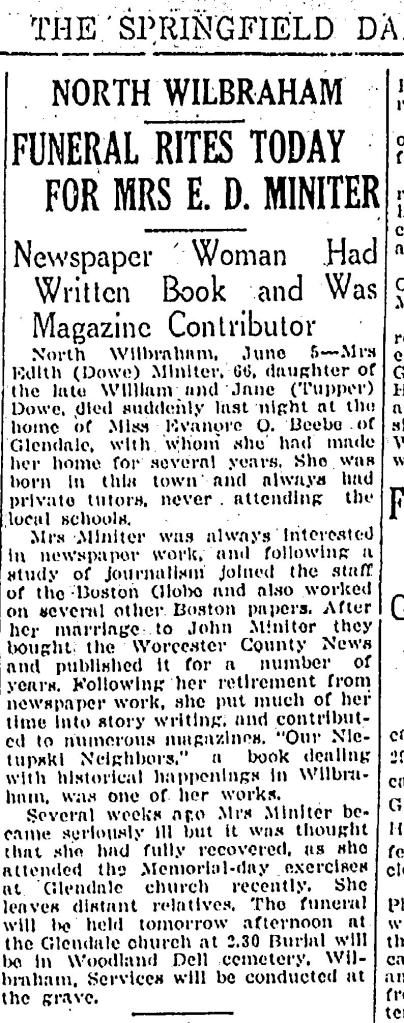
One letter survives among the papers of the John Hay Library from a Mrs. C. H. Calkins to H. P. Lovecraft. From the content of that letter, we can infer that she was a local woman from in or around Wilbraham, Massachusetts, who attended to Evanore Beebe after the death of Edith Miniter on 5 June 1934, and apparently helped settle affairs. While only the one letter survives, there are passing references to her in Lovecraft’s letters to others that suggests other letters have been lost over time.
Exact identification is a little tricky; we can rule out Alice Haile Calkins (1865-3 April 1934), the wife of Cheney Hosmer Calkins (1860-1944), because Alice died before Miniter did (and in the ambiguous world of genealogy, it is nice to occasionally be able to rationally deduce such things with confidence). City directories for Springfield, Massachusetts list a Charles H. Calkins who worked at North Wilbraham and his wife is given as Lena M. Calkins—this would probably by Lena Maria Olds Calkins (1875-1955). Until a better candidate emerges, Lena seems to be the most likely to have written the letter to Lovecraft. As for the others mentioned in the letter, there are too many Farrs and McCarthys to identify them with any certainty from just this letter.
This letter is clearly in answer to one that Lovecraft sent, asking after something that had previously been sent to Mrs. Miniter before her passing—including, apparently, a story manuscript or typescript; it is vaguely possibly that Lovecraft might have sent her a copy of one of his recent stories, such as “The Thing on the Doorstep” (written August 1933), but no letters from Lovecraft include her among the circulation list, so it isn’t clear exactly what was in Mrs. Miniter’s possession at the time of her death.
Dear Sir:
I have looked over all that is left of Mrs. Miniter’s papers & found some of your letters & a story with your name at the top which is probably the one you refer to. We are very busy just now but I will mail them to you as soon as I can.
The last week Mrs. Miniter lived she got lots of letters & papers & looked them over & binned most of them. I could not let anyone go though the house as you spoke of it would not be right. We have to look after Miss Beebe she is not capable of telling what she wants & Mrs. Miniter & letters were all mixed in with Miss B’s. They have been looked over very carefully as we were trying to find a tax receipt. Mrs. Miniter told us & Miss B. did when she was better in her mind that the tax on a piece of property in Hampden was paid last year & Mrs. Farr said she heard them talk about it when we were not there but the bill came with a Demand this Fall. What they did with the money they said they sent to the tax collector no one knows. Mrs. M. was much worse off for a long time than you knew.
Mrs. Farr said she would sit in sort of a stupor all day but if some one came she would spruce up & seem real well. She went to the Memorial Exercises the Wed before she died at the Church[,] she went on grit & nerve.
I will mail the letters & papers as soon as I can get to it. Mr. McCarthy & wife called on their way back from Boston & Miss Beebe asked them if they saw Mrs. Miniter down there. [S]ome of the time she is fairly well in her head & again she thinks there are 3 or 4 small children there.
Yours resp.
Mrs. C. H. Calkins
The correspondence between Mrs. Calkins and Lovecraft went on longer than this; Lovecraft’s letters in the aftermath of Miniter’s death include several details about the confusion of her papers that suggest he was in contact with someone in Wilbraham for at least a few weeks. Mrs. Calkins was apparently Lovecraft’s point of contact; though it is notable that Lovecraft forwarded this letter to fellow amateur-journalist W. Paul Cook, who was a distant cousin of Miniter, so it is possible Cook became involved in that correspondence. Cook’s sister was Cora Charlina Cook Calkins (1883-1981), so it’s even possible that the Mrs. Calkins who wrote this letter was a relation of some sort.
In his correspondence to fellow-amatuer Edward H. Cole, who was also a friend of Edith Miniter, Lovecraft wrote to keep him abreast of developments:
But the purpose of this bulletin is to forward the enclosed epistle from the Wilbraham matron who is winding up the Miniter estate—which Culinarius [W. Paul Cook] has just sent me, & which he wishes me to relay to you. I will send, also, his own communication. The alleged wholesale mailing of Mrs. Miniter’s last days certainly sounds bizarre in the extreme—although a failing of faculties might account for it. Cook, as you see, professes scepticisml but it seems to me that the deliberate invention of such a tale would be even more unlikely than the actual occurrence of the thing. The only object of the survivors in misrepresenting the facts would be to conceal some loss or destruction of valuable papers. An active imagination might connect the matter with the local hostility to the Natupski novel—fancying some plot to destroy the unpublished sequel–but that sounds rather extravagant in the cold light of day. I am suggesting to Cook that he see whether the claim abotu Mrs. M’s failing mind tallies with the letters received from her. If he had lucid & capable-sounding letters during the period allegedly covered by the irresponsible mailing, then one may well suspect unreliability in the present report. Otherwise, the report itself sounds less extravagant than any alternative theory.
It will certainly be tragic & disastrous if nothing remains from the wealth of literary material in Mrs. Miniter’s possession. A complete loss at Wilbraham would be an even greater calamity than the Allston mishap—& would surely suggest the makings of a peculiarly malign fatality! I am suggesting to Cook that he get in touch with the dead-letter office regarding packages with a N. Wilbraham postmark.
H. P. Lovecraft to Edward H. Cole, 11 Oct 1934, Letters to Alfred Galpin & Others 91-92
De re Miniteria—I certainly agree that the account in Mrs. Calkin’s [for such is the name] letter contains no inherent improbabilities, & is (barring evidence whereof we know nothing) far less difficult to credit than any alternative theory could be. The matter is distasteful enough in any event, but it seems to me that an attempt to dispose of MSS. by mail to supposedly sitable persons would be a far from unnatural procedure for one with failing faculties & dark apprehensions, who had in palmier days been so dependent on the posts for contact with congenial colleagues.
H. P. Lovecraft to Edward H. Cole, 17 Oct 1934, Letters to Alfred Galpin & Others 93-94
Well—here’s some more Culinary light on the Miniter matter . . . & rather pessimistic light at that. It appears from Mrs. Calkins’ second letter that Mrs. M. did considerable paper-burning; while, as you see, Cook still thinks that the natives (in the person of the Tupper cousins) disposed of such documents as they thought injurious to them. I had not realised that any work of Mrs. M’s so ruthlessly reproduced the decadent ways of Wilbraham’s insidiously retrograding Yankees. It certainly makes one see red to think of two or three novels—& hads knows how many short stories—as deliberately destroyed . . . . but the situation speaks for itself, take it or leave it! I am again urging Cook to make enquiries at the dead letter office.
H. P. Lovecraft to Edward H. Cole, 24 Oct 1934, Letters to Alfred Galpin & Others 96
The “Natupskis” was a name for neighbors in Wilbraham that provided the raw material for Miniter’s novel Our Natupski Neighbors (1916). Lovecraft’s suspicions of foul play were probably unfounded, and at least some of Miniter’s papers were recovered (although not, as far as it known, the unfinished Natupski sequel), and half of those papers ended up in Lovecraft’s care.
This is the kind of incidental correspondence that crops up because of Lovecraft’s interaction with others; even after her death, Lovecraft’s connection with Edith Miniter was not severed, but became entangled in the threads of her past life and relationships.
Bobby Derie is the author of Weird Talers: Essays on Robert E. Howard and Others and Sex and the Cthulhu Mythos.
Deep Cuts in a Lovecraftian Vein uses Amazon Associate links. As an Amazon Associate I earn from qualifying purchases.
 Deep Cuts in a Lovecraftian Vein