Racist Language
The following article deals explicitly with racism in humor, many examples of which use racial pejoratives. Frank discussion of these matters requires the reproduction of at least some samples of racist pejoratives and ideas in quotes, titles, etc.
As such, please be advised before reading further.
Mr. Snow, I believe these to be Negro eggs.
—The Author, Planetary/The Authority: Ruling the World (2000) by Warren Ellis & Phil Jimenez
Few authors have been as personally identified with their work as H. P. Lovecraft. Even during his own lifetime, Lovecraft’s friends began to incorporate fictional versions of them into his stories—as “Howard” in “The Space-Eaters” (1928) by Frank Belknap Long, Jr.; as the unnamed mystic dreamer in “The Shambler from the Stars” (1935) and Luveh-Keraph, Priest of Bast in “The Suicide in the Study” (1935) by Robert Bloch; and as “the man with the long chin” in The Village Green (192?) by Edith Miniter.
In life, Lovecraft was a self-effacing and ready correspondent who made many contacts with his fans and peers in pulp fiction and amateur journalism; he liked to project the image of himself as older and more reclusive than he actually was. After his death, this personal myth-making took on a life of its own, as his legend developed and spread. There was no absence of humor from the early decades as awareness of Lovecraft and his Mythos grew, with both parody and satire present in works like “At the Mountains of Murkiness, or From Lovecraft to Leacock” (1940) by Arthur C. Clarke.
A notable absence in early humor directed at Lovecraft is any mention of his racism. The biographical facts of Lovecraft’s life were generally slow to emerge, and not always readily available to fans. So while comments on Lovecraft’s racism and antisemitism were made public by the first version of his wife’s memoir in the 1940s (see The Private Life of H. P. Lovecraft (1985) by Sonia H. Davis), and August Derleth felt the need to address the issue in print in Some Notes on H. P. Lovecraft (1959), Lovecraft did not develop a widespread reputation as a racist until the publication of L. Sprague de Camp’s Lovecraft: A Biography (1975). De Camp, who had studied Lovecraft’s published and unpublished letters and other materials, emphasized Lovecraft as neurotic, a flawed human being, a possible homosexual, and especially as a racist—and published the entirety of the poem “On the Creation of Niggers” which is attributed to Lovecraft.
De Camp’s biography came at a time when Lovecraft was beginning to spread to a much larger audience, due to reprint of his work in paperback, films like The Dunwich Horror (1970), and growing influence on music, adaptations in comic books, and other media—and as Lovecraft was gaining more critical awareness and acceptance. The same year as de Camp’s book came out, the first World Fantasy Convention was held in Lovecraft’s hometown of Providence, Rhode Island, with the theme “The Lovecraft Circle,” and the first World Fantasy Awards were given out—in the form of a bust of Lovecraft, carved by noted cartoonist Gahan Wilson. So, just at a time when Lovecraft’s popularity blossomed and more information on his life emerged, de Camp released a highly influential book.
Many Lovecraft scholars criticized de Camp’s approach, presentation, and conclusions—though not the underlying facts: while speculation about Lovecraft’s sexuality or mental health were subjective, Lovecraft’s prejudices were clearly expressed in his letters. The critiques, however, didn’t have the reach of the book itself, and many of de Camp’s misconceptions continue to color perceptions of Lovecraft to the present day. This has been very apparent in various fictional depictions of Lovecraft in various media, which often exaggerate Lovecraft’s characteristics and prejudices for humorous effect.
When the little kitten darted from the door and fled into the hall, the apparition in the darkness shouted out loud. It shouted in the high nasal accent native only to that part of New England once known as Rhode Island and the Providence Plantations. And its words were these:
“Come back!” it cried. “Come back, my pet! Come back, NIGGER-MAN!“
—Gregory Nicoll, “The Man Who Collected Lovecraft,” The Diversifier (May 1977) 68
As a subject of satire and ridicule, Lovecraft might seem to be a particularly strange dead horse to choose to whip. Obviously, Lovecraft is dead and is unaffected by mockery; he can’t regret or reform his reviews, and won’t roll in his grave no matter how hard you make fun of him. Humorous takes on Lovecraft are thus aimed at the living: at fans who are familiar with Lovecraft and his fiction, whether or not they enjoy either. In the case of Lovecraft’s racism in particular, this effectively serves as a kind of damnatio memoriae: unable to condemn a living Lovecraft for his prejudices, they make fun of a dead Lovecraft. These humorous portrayals, with all of their exaggerations, have influenced Lovecraft’s posthumous reputation and image.
Does making fun of a dead man constitutes “punching down?” Certainly, Lovecraft has no ability to defend himself from false accusations or inaccurate claims about his prejudices. On the other hand, he doesn’t really need any such defense. While Lovecraft may have no power to answer now, Lovecraft was racist, and part of the white majority that kept racial and ethnic minorities as second-class citizens during his life. Empathy in cases of historical racism should be on the victims of discrimination, not the perpetrators. Lovecraft may not have been a member of the Ku Klux Klan or participated in any racial violence directly, but he was still part of the majority of U.S. citizens that supported the legalized racism of Jim Crow and the social norms that prevented racial equality.
The occasional depiction of Lovecraft as “Genre’s Racist, Crazy Uncle” has exactly that much truth in it: Lovecraft’s prejudices were largely tolerated during his lifetime, and for some decades beyond that, because they were the same prejudices that millions of other people in the U.S. held. Just because those prejudices were common does not make them universal. Just because other people were racist does not make Lovecraft’s racism okay. The broad cultural background radiation of racism during Lovecraft’s lifetime is an explanation for his views, not an excuse for them.
The fact that Lovecraft is often depicted as much more cartoonishly racist than he was in real life, or than his peers, is in part down to the needs of the writer or artist to make a joke, but also in part due to lack of understanding of what Lovecraft’s prejudices were and how they fit into the historical context. Pretty much no one that mentions “On the Creation of Niggers” in any context wants to read a dissertation on the tradition of racist light verse in English poetry, just as few people who are familiar with the name of Lovecraft’s cat in “The Rats in the Walls” want a lecture on the propensity for naming pets racial epithets around the turn of the 20th century. They care about the current context, when the N-word is a racial epithet of unique power, not a historical context when such usage was more broadly accepted by a more openly racist society.
Many expressions of prejudice that were commonplace in the early 20th century seem egregiously racist now. Plain statements of Lovecraft’s life may seem ludicrously racist by the standards of the present, because many plain statements of racism in the 1930s and 30s are ludicrously racist by today’s metric. It is difficult for today’s readers to get a grasp of what a “normal” amount of racism was in the 20s and 30s when minstrel shows, coon songs, and the African Dodger were still socially acceptable.
In 1897 I was trying for Beethoven—but by 1900 I was whistling the popular coon songs & musical comedies of the day.
—H. P. Lovecraft to J. Vernon Shea, 3 Sep 1931, Letters to J. Vernon Shea et al. 46
As a consequence, when combined with a general ignorance of the actual nature and scope of Lovecraft’s prejudices, the exaggerations of Lovecraft’s bigotry are often much more extreme to get a laugh.
Ah! Look, it’s attempting to communicate. No doubt the savage thing knows language as a house pet knows its reflection in the mirror. The sense is taken in, but the process, the meaning is forever lost.
—H. P. Lovecraft, Atomic Robo and the Shadow From Beyond Time by Brandon Masters
There is a certain irony in that the more that we know of the facts of Lovecraft’s prejudice, the more ridiculous and far from Lovecraft’s actual beliefs that humorous takes on Lovecraft’s racism tend to get. The earliest humor was written by weird fiction fans who were generally aware of who Lovecraft was, his work, and some of the scholarship about his life. Later writers tend to be less familiar with the minutiae of Lovecraftiana and base more of their image of Lovecraft off the memes and stereotypes of Lovecraft and his work, or lean into a particular presentation that relies on such a specific image of Lovecraft as cartoonishly bigoted.
As a case in point:
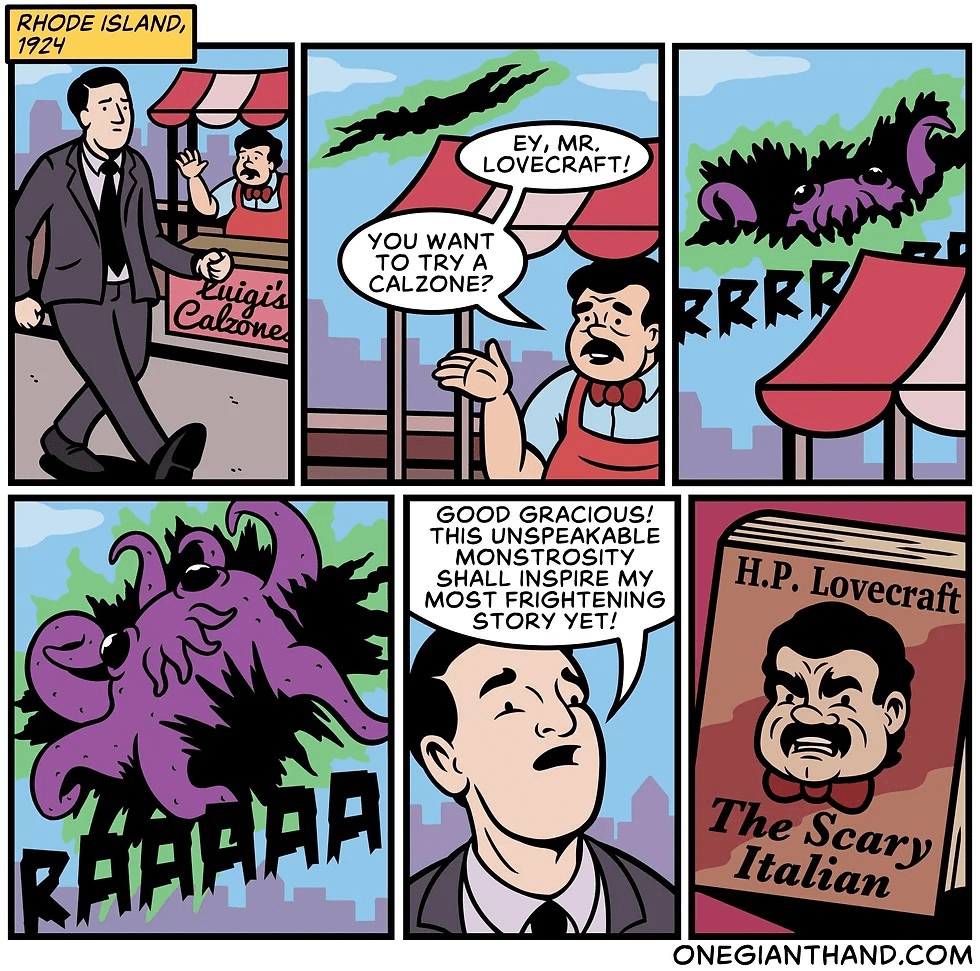
In terms of accuracy, there’s a kernel of truth here: Lovecraft did express some prejudice against Italian immigrants, especially those in the Federal Hill area of his native Providence, RI. Lovecraft had even made mention of Italian immigrants in some of his publications, such as his very first widely-published poem, “Providence in 2000 A.D.”:
In 1912 my first bit of published verse appeared in The Evening Bulletin. It is a 62-line satire in the usual heroic couplet, ridiculing a popular movement on the part of the Italians of the Federal Hill slums to change the name of the main street from “Atwells’ Avenue” to “Columbus Avenue”. I pictured Providence in 2000 A.D., with all the English names changed to foreign appellations. This piece received considerable notice of a minor sort, I am told, though I doubt if it had much effect in silencing the Italians’ clamour. The idea was so foolish that it probably died of its own weakness.
—H. P. Lovecraft to the Kleicomolo, 16 Nov 1916, Letters to Rheinhart Kleiner & Others 76
The humor comes from the juxtaposition of the prosaic (and to contemporary eyes, ridiculous) prejudice against the harmless (if stereotypical) Italian immigrant and the eldritch entity breaking its way through the dimensional barriers. The cartoon also draws on and supports the misconception that Lovecraft’s fiction was largely driven by his personal fears and prejudices.
In real life Lovecraft actually liked Italian food, generally had congenial relationships with Italian immigrants he got to know, and rarely included Italian characters in his fiction. But that is a lot more nuance than can be expected in six panels. The joke doesn’t work if Lovecraft is presented as someone who isn’t triggered by the fact an Italian offered him a calzone, whose cosmic horrors aren’t inspired by more prosaic prejudices.
My taste has become so prodigiously Italianised that I never order anything but spaghetti & minestrone except when those are not to be had—& they really contain an almost ideal balance of active nutritive elements, considering the wheaten base of spaghetti, the abundant vitamines in tomato sauce, the assorted vegetables in minestrone, & the profusion of powdered cheese common to both.
—H. P. Lovecraft to Lillian D. Clark, 18 Sep 1925, Letters to Family & Family Friends 1.402
If there is a problem with the humorous expression of Lovecraft’s racism, it isn’t in the fact of making fun of a dead racist, or of painting racism as ridiculous or illogical. The problem is what it is often wrapped around in: the normalization of negative depictions of someone with mental health issues, and the downplaying of the dangers that contemporary racism represents. While a few scholars and pedants may decry the propagation of misinformation about Lovecraft and his fiction, that is ultimately a minor quibble compared to the bigger issues of propagating negative stereotypes like de Camp’s neurotic picture of Lovecraft, or of ignoring the really scary part about Lovecraft’s prejudices:
Many people held them then, and many people still hold them today.
Racist humor always has the caveat that to a certain audience, it isn’t funny because it’s ridiculous or breaking a taboo, but because it appeals to their own prejudices. Dave Chappelle mentioned in a 2006 interview with Oprah about someone laughing at him, rather than with him. The same thing cannot happen in the same way with Lovecraft because Lovecraft is white, and even prejudicial words like “cracker” and “honky” don’t have the same bite or weight as the N-word. Yet at the same time, making fun of Lovecraft’s prejudices has become a popular excuse for continuing to spread that language—the name of his cat, the poem “On the Creation of Niggers”—many writers find it acceptable to repeat that in a humorous context, as the punchline of the joke.
So might their audience.
The use of nigger by black rappers and comedians has given the term a new currency and enhanced cachet such that many young whites yearn to use the term like the blacks whom they see as heroes or trendsetters.
—Randall Kennedy, Nigger: The Strange Career of a Troublesome Word (2003) 36
The moral problem with the humorous portrayal of Lovecraft’s racism isn’t about making fun of Lovecraft, who is already dead and long past injury. It is that the jokes themselves do little but reiterate and spread prejudice. They don’t teach the audience anything about Lovecraft’s racism, and often only work when predicated on an audience already aware of Lovecraft’s racism in some form.
Is there any hidden moral or germ of insight in these portrayals?
A case in point might be made for the Midnight Pals, which takes as its set-up the idea of famous writers, living and dead, sitting around a campfire and having brief conversations. The nature of the form means that the personalities are exaggerated and deliberately satirical. Lovecraft is often portrayed as neurotic, racist, although often ultimately harmless (as opposed to J. K. Rowling, who also appears.) In most cases, Howard’s portrayal makes him the butt of the joke, and the series is clear in demonstrating that racism is bad and Lovecraft is cringe for his prejudices—though not ostracised. Indeed, despite the differing beliefs presented, the campfire group is specifically accepting, even of members who are wildly far apart in their views on race, sex, etc.
The series doesn’t work without some butt to the jokes. Like Archie Bunker, Lovecraft in the Midnight Pals has become the mostly-lovable racist, whose prejudices are played for laughs rather than evidence of malice.
Humor is only one way of portraying Lovecraft in fiction, and Lovecraft’s racism is often used to make him a figure of ridicule. Yet even to do that, humorists often have to go far beyond Lovecraft’s own recorded words and actions. As racist as Lovecraft was, and with the unusually deep record we have from his letters and essays to give evidence to that racism, many people remain ignorant of what Lovecraft actually wrote and said, and many humorists invent new ways for Lovecraft to be racist—which perpetuates the idea of Lovecraft as racist, but isn’t very useful for refuting his actual beliefs. Lovecraft the racist is more often than not effectively a straw man when it comes to humorous portrayals.
It’s not conclusive, Clark, but it appears this dark-haired woman is your ancestor. Please, take no offense…university rules, you know. I’ll have to ask you to leave the premises.
—Prof. Upsley, Rat God (2015) by Richard Corben
A very rare form of humor when it comes to Lovecraft’s prejudices is irony. In Richard Corben’s Rat God, the very Lovecraftian protagonist discovers that he is less of a WASP than he thought he was—thanks to the late revelation of a long-forgotten Native American great-great-grandmother. The story takes obvious inspiration from Lovecraft’s “Arthur Jermyn” and “The Shadow over Innsmouth,” as well as the prejudices expressed in Lovecraft’s own life and letters. The result is not funny in a ha-ha sense, but a grim irony in that the character who exhibited such terrific prejudice throughout the story has discovered that he himself is now subject to the same prejudice by others.
Corben’s ironic unmasking of Lovecraftian prejudice does something that a lot of riffs on Lovecraft’s prejudices don’t: it moves the plot forward. It has something to say beyond “look at how racist Lovecraft is! Isn’t that funny?” It is a bit more subtle, but it also has a point, and illustrates that prejudice is a doctrine which is, ironically, color-blind to its targets. Who knows who every ancestor of theirs is, after all? Who do you think you are?
It has to be recognized that the depiction—accurate or exaggerated—of Lovecraft’s racism goes far beyond humorous jokes and portrayals. There are quite serious fictional depictions of or references to Lovecraft as a racist, as in Richard Lupoff’s Lovecraft’s Book (1985, later re-released as Marblehead), Alan Moore and Jacen Burrow’s graphic novel Providence, Lovecraft Country (2016) by Matt Ruff, The Ballad of Black Tom (2016) by Victor LaValle, Ring Shout (2020) by P. Djèlí Clark, and The City We Became (2020) by N. K. Jemisin. Accuracy is always a challenge for any historical character incorporated into a fictional work, and each author’s usage of Lovecraft is determined by their own research (or lack thereof) and their understanding—and perhaps especially, by the point they want to make.
In several of the latter novels, the point is specifically to bring attention to Lovecraft’s racism, as part of the point of their narrative is the acknowledgment and refutation of Lovecraft’s prejudices. Where a humorous depiction of Lovecraft’s racism shows prejudice as laughable, the serious depiction shows racism as no laughing matter. Either approach is workable depending on what point or mood the creator is trying to get across, one is not superior to the other, and many of the same observations about humorous depictions of Lovecraft’s racism also applies to non-humorous depictions.
Both humorous and non-humorous depictions of Lovecraft tend to be strongly driven by the myth of Lovecraft, rather than historical reality. The neurotic, cartoonishly racist caricature of a horror writer is often an easier character to work with than the more complex and nuanced historical human being, just as bumbling or villainous Nazis are easier to depict than stalwart German troopers with wives and kids who enlisted in a rush of patriotic spirit or economic need and ended up participating in a genocide. Lovecraft is not alone in being depicted first and foremost as a racist; many characters based on historical persons are essentially caricatures.
Lovecraft stands out in this respect only in that he is a pulp author from the period that humorists and their readers are still familiar with. Would the same jokes work if the subject was Ernest Hemingway or Catherine Lucille Moore? Probably not. Not because such jokes wouldn’t be as accurate (or inaccurate) as applied to Lovecraft, but because readers are less familiar with those writers and their prejudices. Lovecraft’s continued relevance, name recognition, and a vague awareness of his life are the main drivers for his continued humorous portrayals—racist warts and all. These depictions have been shaped by previous characterizations of Lovecraft, and in turn continue to shape his myth.
Real historical people are messy and complicated. Myths are easier to deal with. Yet the more the myth is repeated—the more extremes the depiction of a fantasy Lovecraft’s racism become—the harder it is to see the real historical individual. Many people, if they have the image of an individual as racist, take any correction of that image as an attempt to downplay or deny that racism. It can be very difficult to correct such a reputation once it takes hold.
Bobby Derie is the author of Weird Talers: Essays on Robert E. Howard and Others and Sex and the Cthulhu Mythos.
Deep Cuts in a Lovecraftian Vein uses Amazon Associate links. As an Amazon Associate I earn from qualifying purchases.
 Deep Cuts in a Lovecraftian Vein
Really good article about Lovecraft and his racism and been enjoying your blog as well; I’m really glad to see a takedown on his views that doesnt go for ‘just the time’ apologetics, even if yeah, many people of the era were just as (if not maybe moreso) racist or sympathetic to fascism than Lovecraft.
Like to use other examples of contempoaries who were roughly similar in politics, look at Dennis Wheatley. A much worse horror writer but definitely an influential one, Wheatley was so far-right he wrote a terrorist manifesto at Clement Attlee winning the post-war election and was inserting his politics into his horror fiction even up to the 1960s, where he felt trade unions, Civil Rights, etc were fronts for Satanists. Good thing nobody holds these kind of views in the 2020s…
But actually that gets to another thing, that I don’t know if you wanted to touch on but; the equating of Lovecraft’s horror ideas as being directly the result of his racism feels silly because, frankly, if he wanted to be flat out racist he would have just wrote it in, just like Wheatley did! There’s no shortage of racist tangents in Lovecraft’s own prose, the idea that he would be coy and play with allegory – that the giant space blobs and squids are just immigrants – goes against the bluntness of how bigots wrote at the time
(Reminded similarly of the discussion about orcs in Lord of the Rings and everyone going on about how they are racial allegories or so on, while forgetting that Tolkien also came up with the Haradrim, who are just black people, and serve Sauron. Same with CS Lewis and his Calormen.)
LikeLiked by 1 person
eally good article about Lovecraft and his racism and been enjoying your blog as well; I’m really glad to see a takedown on his views that doesnt go for ‘just the time’ apologetics, even if yeah, many people of the era were just as (if not maybe moreso) racist or sympathetic to fascism than Lovecraft.
Like to use other examples of contempoaries who were roughly similar in politics, look at Dennis Wheatley. A much worse horror writer but definitely an influential one, Wheatley was so far-right he wrote a terrorist manifesto at Clement Attlee winning the post-war election and was inserting his politics into his horror fiction even up to the 1960s, where he felt trade unions, Civil Rights, etc were fronts for Satanists. Good thing nobody holds these kind of views in the 2020s…
But actually that gets to another thing, that I don’t know if you wanted to touch on but; the equating of Lovecraft’s horror ideas as being directly the result of his racism feels silly because, frankly, if he wanted to be flat out racist he would have just wrote it in, just like Wheatley did! There’s no shortage of racist tangents in Lovecraft’s own prose, the idea that he would be coy and play with allegory – that the giant space blobs and squids are just immigrants – goes against the bluntness of how bigots wrote at the time
(Reminded similarly of the discussion about orcs in Lord of the Rings and everyone going on about how they are racial allegories or so on, while forgetting that Tolkien also came up with the Haradrim, who are just black people, and serve Sauron. Same with CS Lewis and his Calormen.)
(sorry for the double post; a mistake happened when I tried to sign in last time)
LikeLike