Historical Racism
Included below are excerpts from period newspapers that contain historical racism and racist language.
As such, please be advised before reading further.
A nervous breakdown and poor attendance prevented H. P. Lovecraft from graduating high school in 1908. A spat in the letter columns of the Argosy led to Lovecraft joining amateur journalism in 1914. The period in between these events are the most mysterious of Lovecraft’s adult life. It is the era when we have the fewest letters to guide us on his daily activities, when he seems to have been the recluse that he later pretended to be.
We know, from Lovecraft’s later letters, that Lovecraft did not find a job or complete his education, although he took some correspondence courses and perhaps night school classes. He lived at home with his mother, read voluminously, and occasionally wrote letters and poems that were published in newspapers and pulp magazines. Yet he seemed to have no close friends during this period, no occupation; it is difficult to form an impression of his mental and physical health. The letters to the editor, and the rare responses such as “Not All Anglo-Saxons” (1911) by Herbert O’Hara Molineux, appear to have been his main social outlet and feedback; at least, those are what we have to go on.
So it is always interesting to run across “new” letters from Lovecraft in this period. The digital archive of the Providence Journal in Rhode Island have revealed three letters from Lovecraft to the paper published in 1909. They provide an insight not only into Lovecraft’s thoughts during his “hermitage,” but provide some continuity with his later conflicts once he joined amateurdom and came into more regular contact with other people. It is easiest to discuss these letters with regard to their subject and context.
H. P. Lovecraft on Robert E. Lee
In January 1909, the outgoing president Theodore Roosevelt wrote a letter to the Robert E. Lee Memorial Association, encouraging them to work on a permanent memorial for the Confederate general. The letter was widely published and reported on in the newspapers, and a succinct notice appeared in the Providence Journal:
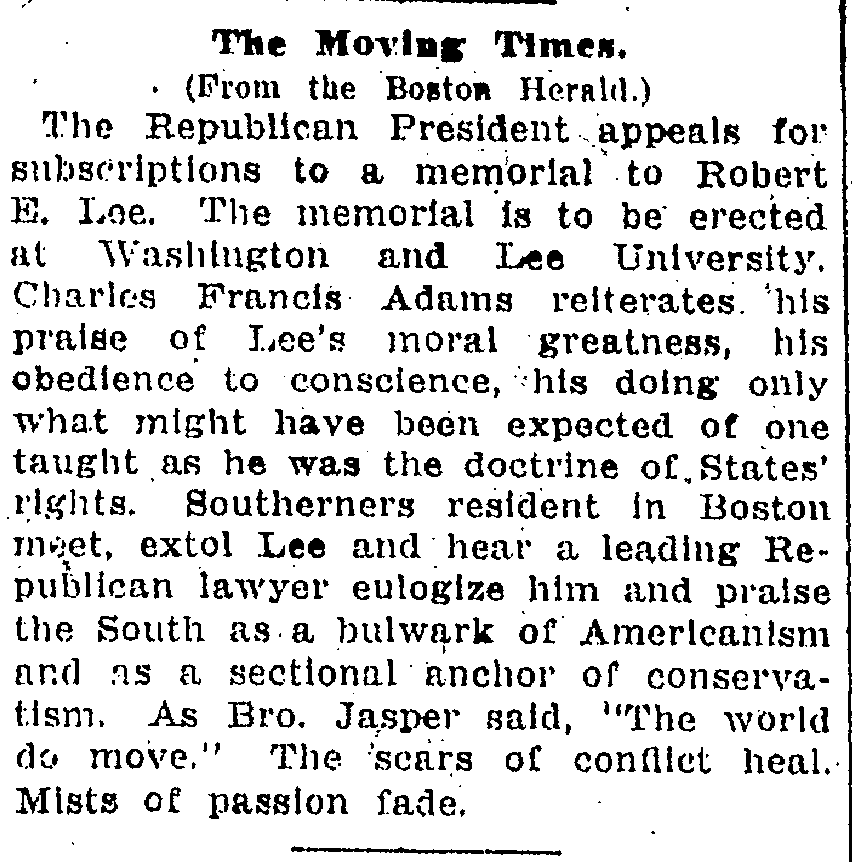
Memorials to Lee were not entirely lacking; Washington College was renamed Washington and Lee after Lee’s many years of service there, and the University Chapel (formerly the Lee Chapel) contains the remains of Robert E. Lee and many of his immediate family. The announcement stirred emotions, since the Confederates were traitors and fought for the cause of slavery. Charles F. Janes wrote a letter to the editor in response.
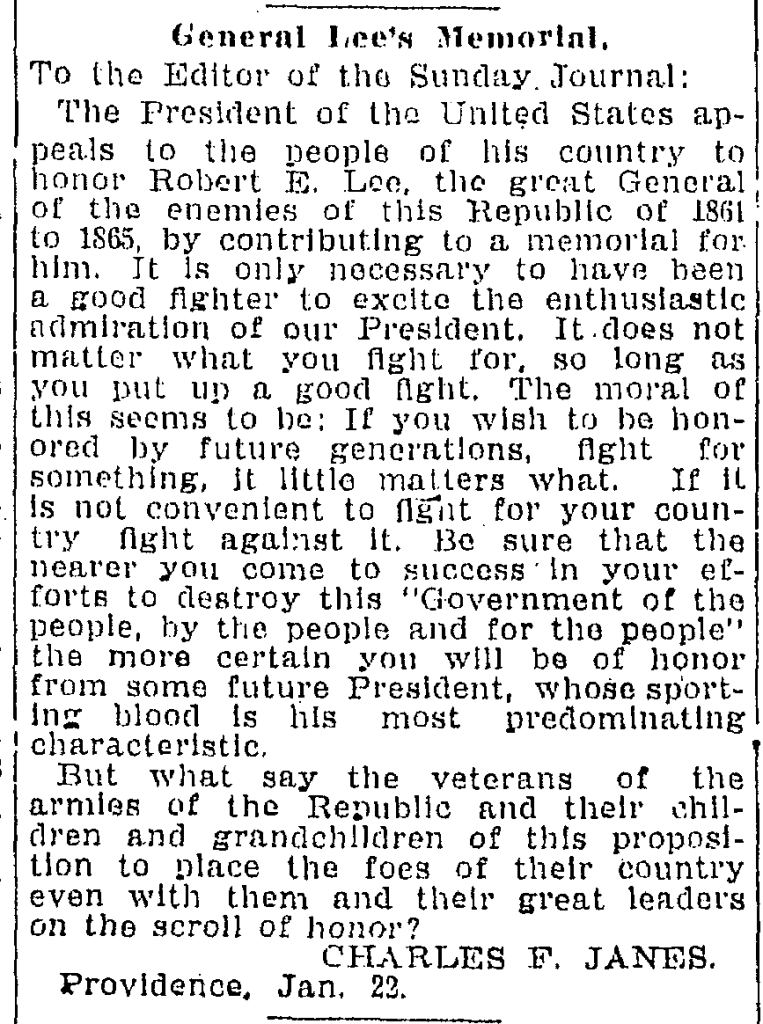
This in turn inspired a lengthy response from one H. P. Lovecraft, which reply was printed in the 31 Jan 1909 edition of the Providence Journal:
Robert E. Lee
To the editor of the Providence Sunday Journal:
In the Journal of Jan. 24 I notice a letter of Charles F. Janes relating to Roosevelt’s proposed memorial to Gen. Robert E. Lee, in which several statements somewhat derogatory to the great Confederate leader’s motives are made. Mr. Janes asserts that our President honors Gen. Lee only because he was an able warrior, insinuating that the cause for which he so valiantly labored and bravely suffered was wrong, indirectly accusing him of attempting to “destroy this Government of the people, by the people and for the people,” and calling him a “foe of the country.” This unjust treatment of Gen. Lee can be construed as nothing more than a survival of the rabid, unreasoning spirit which pervaded the North before, during and immediately after the Civil War. When Robert E. Lee became a General in the Confederate Army, he did so not as an enemy, but as a friend of the Republic. He saw that no peace could come to the Union if Southern affairs were to be managed by Northerners who had no definite ideas of the actual conditions in the South, and who derived their information as to slavery from false and exaggerated reports, or from hystical effusions like “Uncle Tom’s Cabin,” which portrayed the darkest side of the situation. In other worse, he clearly saw that his State had seceded only because the yoke of the Union bore too heavily upon it, and that its secession was within the limits of constitutional right.
It was not without regret that Gen. Lee entered into battle against the flag under which he had once nobly fought; it was not that he loved the Union less, but Virginia more. Believing in the best of faith that he was benefiting the country by separating the two discordant sections, fighting up to the very last for the cause he knew to be right, yet supported only by a pitifully small band of hungry, sick and ragged heroes, Gen. Robert Edward Lee deserves not one word of censure from the American people, but volumes of praise and veneration. As Senator Hill of Georgia once truly said: “He was Caesar without his ambition. He was Cromwell without his bigotry. he was Napoleon without his selfishness. He was Washington without his reward.“
H. P. LOVECRAFT
Providence, Jan. 24
During Lovecraft’s childhood in the 1890s, groups like the United Daughters of the Confederacy and the United Confederate Veterans made concerted efforts to promote the “Lost Cause” mythology of the C.S.A.—painting the Confederate soldiers as heroes fighting against overwhelming odds to preserve Southern white culture. These groups promoted the construction of Confederate military monuments and the censoring of school books that published narratives “unfair to the South.” Lovecraft was at the perfect age to absorb this pro-South, white supremacist message, and he did, characterizing himself and his friends as “Confederate sympathizers” (LRK 70) and composing poems such as “C.S.A. 1861–1865: To the Starry Cross of the SOUTH” around age 12.
In adulthood, Lovecraft continued to view the South through the lens of Lost Cause ideology, and wrote: “The more I learn of the South, the more my Confederate bias is strengthened” (LJM 355)—which attitude is perhaps understandable when most of what Lovecraft absorbed would have likely continued to promote those same slanted views. Lovecraft also showed some admiration for Southern leaders such as Jefferson Davis and Robert E. Lee. One visitor to his room noted small pictures of Robert E. Lee and Jefferson Davis on the wall by his desk (AAV 100). This 1909 letter to the editor exemplifies Lovecraft’s rose-tinted view of the antebellum South.
In his letters, Lovecraft specifically emphasized Lost Cause viewpoints such as emphasizing the legitimacy of secession, the legality of slaveholding, and the evils of Reconstruction by “the diabolical freed blacks and Northern adventurers” (ML 434), “ignorant adventurers and politically exploited blacks” (MF 1.289), and “carpet-baggers and scalawags” (MF 1.476).
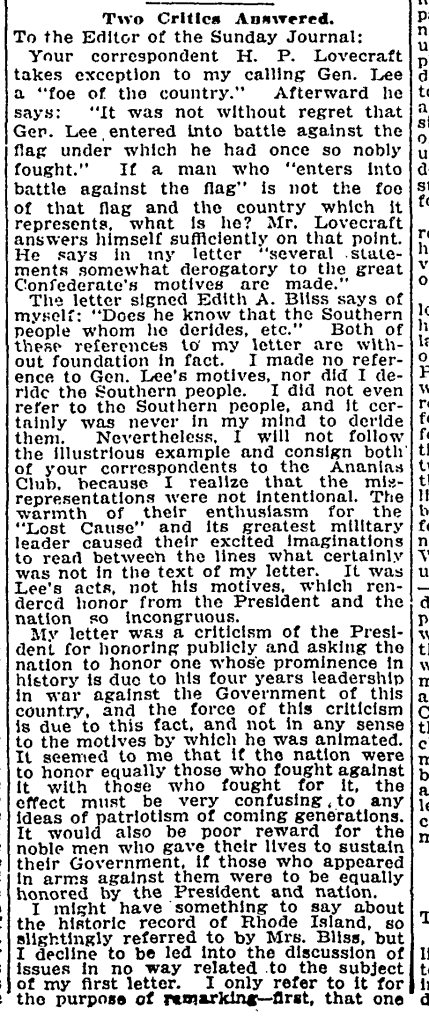
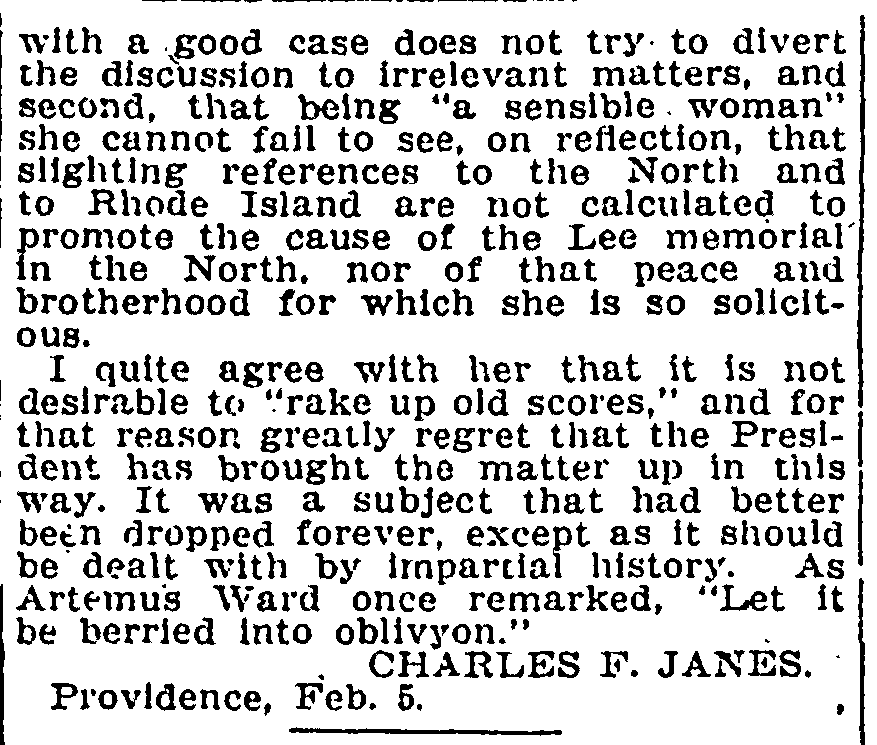
Lovecraft was not alone in his support of Robert E. Lee and the proposed memorial; a Mrs. Bliss also had a letter published in support in the same edition. In the 7 Feb 1909 edition of the Providence Journal, three letters were published that responded to these. While all of them were indirectly addressing Lovecraft’s points, only one, that by Charles F. Janes, named Lovecraft explicitly:
Perhaps to give Lovecraft his due, one final letter was published in response, in the 14 Feb 1909 edition:
General Lee and His Lost Cause.
To the editor of the Sunday Journal:
Of the three letters regarding Gen. Robert E. Lee in the Journal of Feb. 7, each seems to present a different amount of condemnation of the great warrior. The article signed “Prescott” appears to be the most unjust, hence demands first attention. In the course of this letter, it is stated that Lee was “lured on by the ambition, not only of becoming victor in the finals, but the Washington of the South.” That Lee was, in intent, and purpose, the “Washington of the South,” cannot be disputed by any intelligent observer, but to aver that the hope of victory and unswerving principle, the object which spurred him on, is most unfair to a man of such a type as Robert E. Lee represents.
The General was not ambitious; he was, instead, of a character unexcelled by that of any other American, save possibly Washington. Had he been less upright, had he possessed less Virginian honor, or had he felt less sincerity of purpose, he would not have remained loyal to his oppressed and troubled State, but would have accepted the tempting offer of Lincoln to command the Union forces in place of Gen. Winfield Scott. His glorious honor is shown by his words to Gen. Hampton in 1869, when he told the noted cavalry leader that he did nothing but his duty in fighting with the Confederacy, and that he would repeat this course if the same conditions existed. His was the truest patriotism, a rigid devotion to the state, which had been forced into battle by its oppressors.
That the United States Government declined to accept the citizenship of Lee after his surrender is a fact which must always throw a shadow on its reputation for justice and fairness, for after the war, the great commander realized his defeat, recognized the union, and said to his men, “Remember that we are one country now. Do not bring up your children in hostility to the Government of the United States. Bring them up to be Americans.” In the face of such a magnanimous sentiment, is it not rather small and petty to suggest, as does the “Prescott” letter, that the erection of a Lee memorial be left ot those on the Virginia side of the Potomac?
The letter of Charles F. Janes makes as its principal point an attempt to prove Gen. Lee a “foe of the country.” Mr. Jane asserts that in telling how the brave military leader “entered into battle against the flag, under which he had once nobly fought.” I admit that he was a “foe of that flag and the country which it represents.” That he was a very reluctant foe of the American flag is a fact, which no one desires to controvert, but that that, or any one cflag, could truly represent the divided country of 1861, is a point which requires thought. A country is, in the last analysis, essentially composed of nothing but its people, and when these become divided into two sections, who shall say which section is actually the true country, even though one retains the old name and flag?
When the war cloud first menaced America, the Southerners desired to retain the Union banner and simply fight for their rights, but as this would have been rebellion, they decided to adopt a more peaceful course, and secede, which they did, without the intention of war. The war was caused by attempts to force the seceded States back, for which there was no constitutional justification. Horace Greeley, himself a Northerner, said: “We hope never to live in a republic whereof one section is pinned to the residue by bayonets.” Southern States were as much as if not more truly American than their Northern neighbors, hence Gen. Lee in fighting with the Confederacy, did not wage war against his country, but fought with one part of it against another part, for a cause which would have benefited both. That his section did not bear the old name, nor carry the old flag was no fault of his, for he and his men were all Americans, seeking their rights from those who would not grant them willingly.
The letter of Bertha G. Higgins contains an inquiry as to where in the United States Constitution will be found an admission of the right of a State to seced from the Union. The answer is, in articles IX. and X. of the amendments. Article IX. reads: “The enumeration in the Cosntitution of certain rights shall not be construed to deny or disparage others retained byt he people.[“] The text of article X. is: “The powers not delegated to the United States by the Constitution, nor prohibtied by it to the States, are reserved to the States respectively, or to the people.” As there is nothing prohibitory of secession in the Constitution, these articles may be considered as tacit admissions of the rights of States to withdraw from the federation. They are from the first set of amendments, having been proposed in 1789. Without them , it is doubtful if some of the Southern States would have ratified the Constitution and entered the Union in the first place.
The moral right of secession is a different and more weighty matter than the legal right, but an impartial observer cannot fail to see that it was not without great deliberation, long suffering, and patient waiting that the eleven Confederate States exercised their constitutional prerogative and withdrew from the Union. The provocation was great, far greater than the average Northerner can imagine. It was not one act alone, but a series of persecution that forced the Southern States to a choice between withdrawal and ruin. The excessive tariff whereby the North waxed rich at the expense of the South, coupled with the unfair legislation against slavery, was more than enough to give a moral right to secession, even had no legal right existed.
However, the outcome of the war has proved not only the futility of the Constitution, but the practical permanence of the Union, therefore the people of both sections should now be unanimous in attempting to make the Union one in spirit as well as fact, in attempting to dispel those last drops of bitterness against the Government, which linger in so many Southern minds, and that remaining vestige of Northern prejudice which applaud the Union side of the great civil struggle without more than a superficial glance at its causes, events, and effects. What could accomplish such a unification more than a memorial, erected by a reverent and united people, to Robert Edward Lee, the brave Confederate general, who labored so valiantly to benefit his country by division?
H. P. LOVECRAFT
Providence, Feb. 10.
If that reads like a 19-year-old NEET on social media—that’s pretty much what it is. Lovecraft was not a historian or lawyer, and his spurious arguments are those made by an intelligent but enthusiastic layman who has bought completely into the Lost Cause and has never been seriously challenged on his views. Nor would Lovecraft appear to receive any substantial pushback to his views of the Confederacy, the American Civil War, Reconstruction, or the institution of chattel slavery in the antebellum South during his lifetime.
While the argument over Robert E. Lee seems to have ended there, a third letter to the editor later in 1909 highlights another aspect of a young Lovecraft’s beliefs, one which would have a more lasting impact on his life.
H. P. Lovecraft on The Clansman
The Ku Klux Klan was founded after the American Civil War, as an organization to organize and promote racial violence and opposition to Reconstruction. In response, Congress passed a series of Enforcement Acts, including the Ku Klux Klan Act of 1871, to combat these terror tactics and prosecute the organizers. By the end of Reconstruction, the first incarnation of the KKK was largely suppressed, though other groups like the White League and Red Shirts continued.
This band of terrorists was romanticized by Thomas Dixon, Jr. in his trilogy of novels The Leopard’s Spots: A Romance of the White Man’s Burden—1865–1900 (1902), The Clansman: A Historical Romance of the Ku Klux Klan (1905), and The Traitor: A Story of the Fall of the Invisible Empire (1907). Dixon’s The Clansman became a popular play of the same name (1905), which became a massively successful film titled The Birth of a Nation in 1915—which in turn directly inspired the second incarnation of the Ku Klux Klan.
The Clansman play was not met without controversy; the openly racist nature of the content sparked concerned citizens to protest. In some places, the increased racial tensions contributed to violence, as in the 1906 Atlanta race massacre. In Providence, a petition was raised against the holding of the play.
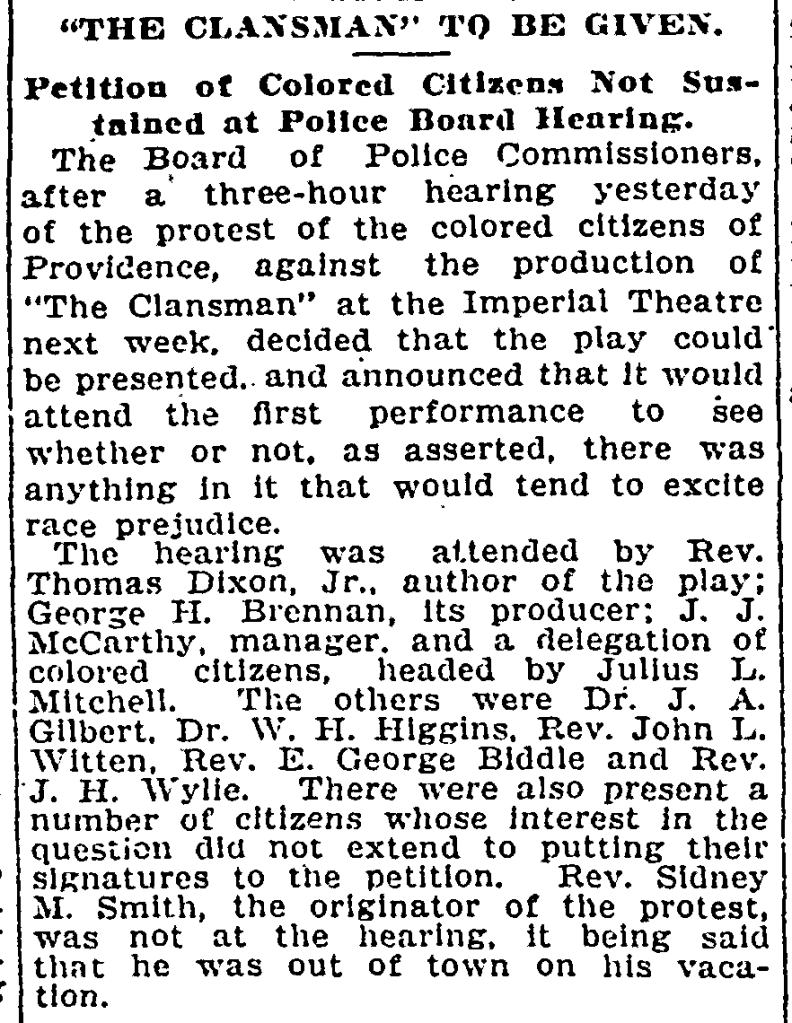
The Clansman was performed in Providence, despite the protests of BIPOC citizens. Lovecraft had read the novel, and saw the play (when exactly we don’t know, but quite possibly during Sep 1909). In a letter to the editor of the Providence Journal, Lovecraft wrote about The Clansman. The letter was published in the 26 Sep 1909 edition:
“The Clansman’s Other Side”.
To the Editor of the Sunday Journal:
The action of the Police Commission and the court in permitting the presentation of the Rev. Thomas Dixon, Jr.’s, drama of reconstruction times, “The Clansman,” during the week of Sept. 13, is a hopeful sign, inasmuch as it is indicative of the fact that, despite the protest of the negroes, the truth may be publicly shown and spoken. “Magna est veritas, et praevalebit.” In the North, where only scattered portions of the black race are found, the play no doubt seems exaggerated, and the depths of African racial character portrayed in it seem almost incredible to those accustomed to the relatively superior negroes of the Northern States, but to condemn this drama as some have lately done is unfair.
“The Clansman” teachs us a lesson of which some are sadly in need, namely, tht we must never, under any circumstances, at any time, or in any place, again allow the negro, with his dark ancestry of innumerable centuries of savagery, to become in any way a political power, or to hold any office whatsoever over persons of the superior Aryan race, and that never must the Ethiopian approach the Caucasian on the plane of absolute equality, lest, as is said by “Stoneman” in the play, the noble Anglo-Saxon population of this country degenerate into a puny brood of mulattoes. “Race prejudice” is often condemned, but is it not an essential instinct for the preservation of the purity and distinction of races, an instinct almost as important as that of self-preservation? To “uplift” the blacks in masses to our level is impossible. Ethnology, even more than history, shows us that the African has still far to progress in the upward trend of natural evolution before he can call the Aryan “brother.” To study the negro in his native savage state is enough to disprove the oft-repeated platitude that slavery is the cause of the inferiority of the race in this country.
Another point of error in some denunciations of “The Clansman” regards the mortal status of the Ku Klux Klan. The Klan was illegal, no one desires to controvert that point. But the “law” that it defied was but a travesty on justice, but a ruinous series of revengeful attacks on the decent people of the South by ignorant and malicious “carpet-baggers,” “scalawags,” and blacks. The Ku Klux Klan was composed of the noblest of young Southrons that the land could afford, an organization of Honor, Chivalry, Humanity, Mercy and Patriotism, to protect the weak, innocent and oppressed from unjust “law,” and the more hideous and unspeakable terrors of the black peril. To deny that such a black peril existed, and would exist again if the negroes once more came into power, is prejudiced folly. As a slave, the average negro was happy, contented and peaceable; free, the innate demon comes uppermost, especially if aided by unscrupulous whites who have interests of their own in the matter. To say that “The Clansman” arouses “hate” against the negro is untrue. “Hate” for a race as a race is unthinkable. The black at his normal level is a part of the perfect scheme of nature, harmonious and unobtrusive. “Hate” is due only to those of our own race who seek to disturb nature and raise the African above, or depress him beow his natural place. The black, according to everything that is right, should not be in America. Two distinct races can never peaceably inhabit the same continent, a fact that should have occurred to the slave traders when they unwittingly planted the seeds of African barbarism on the soil of our fair land. But that evil having been done, the only true way to escape from the difficulty would seem to be continued slavery, together with gradual emancipation, and colonization of large numbers of the black in Africa, the land from which they unwittingly came, and where they normally belong. Negro slavery was a poor system of labor, it is true, to exist in a civilized nation, but it was the only system by which the blacks could be held to their place among a superior race. While in individual cases negroes have risen high, it cannot be denied that the race is utterly unfit in the mass to hold power. Negro crime was unknown in slavery, but after a premature emancipation had loosed upon the South an enormous pack of dusky savages, with but a thin veneer of civilization to offset a world-old heredity of barbarism, led by crafty, evil-minded and grasping “white trash,” who directed their ever-changing and childish minds into channels even more ruinous than those which they themselves would have followed if allowed to drint on alone, is it a wonder that the men of the South banded together in order to secure for themselves and their families the protection tha the United States Government refused them? As was written on the title page of the revised prescript of the Klan: “Damn[a]nt qu[o]d non intelligunt.” Therefore, the Aryan who denounces the Ku Klux Klan, and, incidentally, the play which truly shows its noble activity, shows himself to be no very staunch friend of his race, nor of his country.
H. P. LOVECRAFT
Providence, Sept. 21.
From a scientific and historical viewpoint, nearly everything Lovecraft wrote in that letter is incorrect. What Lovecraft got right was when he wrote “Magna est veritas, et praevalebit.”—”Truth is great, and will prevail.”
Although Lovecraft would not live to see the lies of Thomas Dixon, Jr. overturned, Lovecraft would be alive at the birth of the second incarnation of the Ku Klux Klan in 1915, to see its meteoric rise and its tremendous fall from grace. In time, the reactionary, pseudohistorical image of the American Civil War which emphasized States’ rights and de-emphasized the horrors of slavery would diminish. The Civil Rights Movement would push to complete the work begun during Reconstruction, and though great progress has been made, it has not been without decades of perseverance, violence, and setbacks. Racism is still deeply entrenched in U.S. culture.
An editor read this long letter from a 19-year-old Lovecraft and chose to publish it. Perhaps they agreed with him, perhaps they merely wished to cater to “both sides” in the debate over The Clansman play and book. That sort of thing sells papers. We don’t know; we can only look at what Lovecraft wrote, and see what he wrote—in his period away from the world, with few friends, few opportunities, little outlet for his thoughts and emotions, and no one to tell him he was wrong.
What Lovecraft’s letters to the editor in 1909 tell us is not that Lovecraft was racist—we knew that—but what the context was in which his prejudices took shape and found such early expression. An editor could have tossed these letters; they chose to publish them, without comment, because they were topical to issues of the day. These were issues of race and prejudice that were living, ongoing concerns, and perhaps the publication of these letters gave Lovecraft a little boost in the recognition that he had been heard. They certainly did not prepare him for what was to come.
When Lovecraft quoted “Damnant quod non intelligunt.”—”They condemn what they do not understand,” he himself did not understand his own errors and shortcomings. Lovecraft condemned those who protested against The Clansman because he thought he had the facts—as many intelligent but inexperienced 19-year-old men who post on social media do. While it is tempting to say that “this was Lovecraft when he was young, before he wrote any of his mature fiction,” that’s an explanation, not an excuse. Many of the attitudes expressed in these letters would remain with him throughout his adult life, expressed here and there, rarely changing in any substantial degree. Yet not entirely without challenge.
When Lovecraft finally joined amateur journalism, he was confronted with people different from himself, with their own views—intelligent people he could not immediately dismiss, and who were willing to argue with and denounce his views. It is perhaps unsurprising that in his first major public denunciation, “Concerning the Conservative” (1915) by Charles D. Isaacson, Lovecraft’s views on The Clansman—and its new film adaptation, The Birth of a Nation—were at the heart of the conflict with his peers.
Bobby Derie is the author of Weird Talers: Essays on Robert E. Howard and Others and Sex and the Cthulhu Mythos.
Deep Cuts in a Lovecraftian Vein uses Amazon Associate links. As an Amazon Associate I earn from qualifying purchases.
 Deep Cuts in a Lovecraftian Vein
It may be of interest that E. Hoffman Price originally condemned the KKK (perhaps in his correspondence with Lovecraft?) but ended up in favour of them towards the end of his life.
LikeLiked by 1 person
In 1927, E. Hoffman Price wrote and published a story “The Infidel’s Daughter” which lampooned the KKK – because Price was fairly progressive on issues like interracial marriage, at least with whites and Asian women. When the story was republished in FAR LANDS, OTHER DAYS (1975), Price included an apology to the KKK. That was a reactionary turn against demographic shifts in his part of California; he was an old man and felt less safe in his neighborhood and blamed rising crime on Black people, more or less.
LikeLike