The correspondence of August Derleth with Muriel E. Eddy and her husband C. M. Eddy, Jr.—the two overlap and intertwine so much they have to be taken together, especially as later in life Muriel did the writing or typing for both of them—encompasses about 121 separate letters, postcards, and notes, for a total of approx. 222 pages. The bulk of this is spread out among three folders (5-7) in box 16 of the August Derleth archive at the Wisconsin Historical Society; a single letter is at John Hay Library.
The correspondence ran from 1939 to ~1970. It appears to have begun from their mutual correspondent Hazel Heald, and from the publication of The Outsider and Others (1939) by Arkham House.
My dear Mr. Derleth—
Mrs. Hazel Heald, of Cambridge, Mass, told me that you had published a book of Howard P. Lovecraft’s weird stories—and I am wondering if you would please let me known just how much it is, where shall I send for it, if it contains a photo of our beloved H. P. L. and all about it.
—Muriel E. Eddy & C. M. Eddy, Jr. to August Derleth, 29 Nov 1939
Early correspondence was apparently either sporadic or not retained; there is almost a five-year gap between the 1939 letter and the next, in September 1944. After this, however, correspondence becomes more regular. Being in Providence and with access to the local newspapers, the Eddys kept Derleth apprised of relevant items that appeared in the papers during the critical 1940s period which saw important pieces published including Winfield Townley Scott’s “The Case of Howard Phillips Lovecraft of Providence, R. I.” (1943) and Sonia H. Davis’ “Howard Phillips Lovecraft As His Wife Remembers Him” (1948).
Besides local news, points of conversation included Derleth’s latest publications, Lovecraft’s ex-wife, C. M. Eddy, Jr. and H. P. Lovecraft’s work for Houdini (including The Cancer of Superstition), and some of the Eddy tales that Lovecraft had a hand in: “The Ghost-Eater” (Weird Tales Apr 1924), “The Loved Dead” (Weird Tales May-Jun-Jul 1924), and “Deaf, Dumb and Blind” (Weird Tales Apr 1925). Derleth would ultimately re-publish these stories, as well as a version of The Cancer of Superstition, in the Arkham House books Night’s Yawning Peal (1952), The Dark Brotherhood and Other Pieces (1966), and The Horror in the Museum and Other Revisions (1970), as well as The Arkham Sampler (Summer 1948).
Until the publication of Lovecraft’s own letters, these letters from the Eddys were the primary source of data on the revisions with Lovecraft, and likely influenced Derleth’s presentation of the stories. For instance, with regard to “The Loved Dead” and its putative banning:
The yarn started out to be a little short study in psychology under the tentative title of “The Leaping Heart”—i.e., a heart that leaped from sheer joy whenever in the presence of the dead. H. P. L. discussed it with me and we decided it might do for a W. T. story. One point we were agreed on was that as many of these tales told by a hero now deceased leave leave the reader completely up in the air as to how the story could ever have reached the public eye. H.P.L. calmly informed me that my hero was suffering from a medically-recognized mental ailment, and he couldn’t be blamed for anything he did during the course of the yarn. He even named the malady—a long Latin term which I had never heard before.
Once I had placed my hero in the graveyard, the story wrote itself. I asked H.P.L. to look over the first draft of the completed story, and decided only minor changes need be made.
Off it went to Weird Tales, but they, at first, were afraid to use it. Finally, the powers that be decided to include it in the big Anniversary Issue. They did!
Then the fun started!!
P.T.A. groups and church organizations in several parts of the country protested vigorously—and succeeded in having the issue removed from the newsstands in many cities and towns!
Some have been kind enough to say that this censorship stimulated enough of a demand for W.T. so that it helped save if from extinction! It’s always been my “pet” Weird Tales story!
—C. M. Eddy, Jr. to August Derleth, 12 Feb 1948
Derleth quoted this more-or-less verbatim in The Arkham Sampler (Summer 1948) when he reprinted “The Loved Dead,” Lovecraft had a slightly different recollection:
It may interest you to know that I revised the now-notorious “Loved Dead” myself—practically re-writing the latter half. […] I did not, though, devise the necrophilia portion which so ruffled the tranquility of parents & pedagogues on the banks of the Wabash.
—H. P. Lovecraft to Robert Bloch, [Mar 1935], Letters to Robert Bloch & Others 132
For all their ongoing interest in Lovecraft, which resulted in works like “Message in Stone” (1956) by Muriel E. Eddy and The Gentleman from Angell Street (2001) by Muriel E. Eddy & C. M. Eddy Jr., recollections in the surviving letters are fairly thin on the ground. As with some of Lovecraft’s other friends and correspondents, the Eddys only knew a part of Lovecraft’s life, and had a limited store of stories and insight to share. As an example, a letter dated 25 Sep 1948:
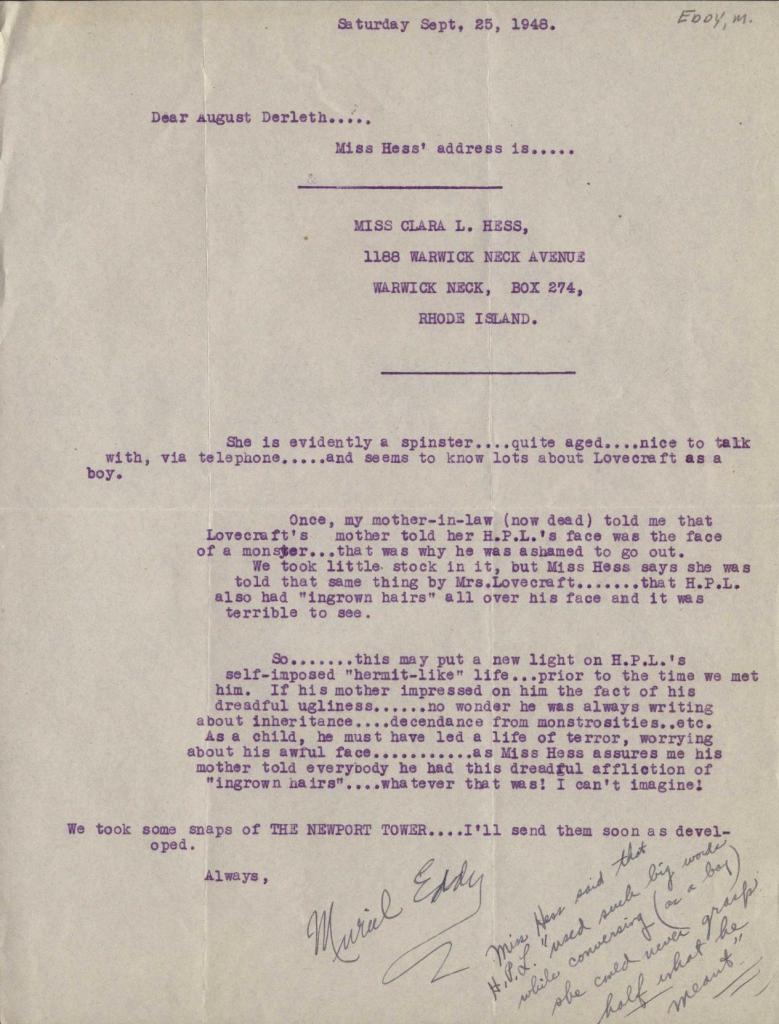
Clara Hess is the primary source for the idea that Lovecraft’s mother Susie Phillips Lovecraft found her son “hideous”; a letter from her was published in the Providence Journal 19 Sep 1948 by Winfield Townley Scott, and letters from Hess to Derleth survive that show Arkham House followed up on the lead for Lovecraftian lore.
For the most part, however, the letters from the Eddys to Derleth verge on the prosaic; for a while, she sent him clippings regarding the Newport Tower, and attempts were made to market some of C. M. Eddy, Jr.’s other weird tales, including “The Red Cap of Mara,” which was eventually published posthumously in The Loved Dead and Other Tales. Over the years, visitors to Providence stopped at the Eddys’, to talk about H. P. Lovecraft with someone that knew him.
Dear August Derleth—
I have erected a little shrine in my house in memory of Howard Phillips Lovecraft. I have so many visitors who are interested in Lovecraft that I decided to have a little corner devoted to “Lovecraftiana”—old “Weird Tales” with his stories, etc.—All I lack is a sutable photo of H. P. L. for the center. I wonder if you have one like that which appeared in one of his published books (published by you)—a picture of his face or profile—or a copy thereof which I might have? I only have the little snapshot of Lovecraft taken in N.Y. and it isn’t a very good picture for a memory-shrine!
—Muriel E. Eddy to August Derleth, 2 Dec 1960
Personal events made it in there as well; Muriel and Cliff would give their condolences on Derleth’s divorce, asked after his children, mourned the deaths of Hazel Heald and Clark Ashton Smith. The Lovecraft circle slowly shrank with the passing years.
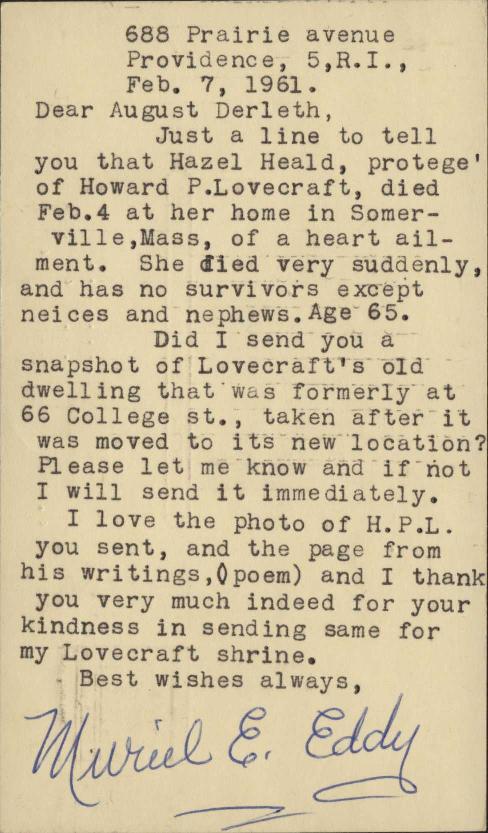
One of the more notable anecdotes from this period involved fans visiting or writing:
Don’t you think, August, that it is amazing how so many young people love H.P.L.’s work? One young negro boy has written me that he has all of the H.P.L. stories and books, and loves them dearly!
—Muriel E. Eddy to August Derleth, 24 Feb 1965
While this happened a decade after the events of Lovecraft Country (2016) by Matt Ruff, it’s nice to think that there was a real-life Atticus Freeman out there enjoying H. P. Lovecraft.
Over the years, the Eddys dug through their accumulated correspondence for more material related to Houdini and Lovecraft, some of which was sold to collectors. C. M. Eddy, Jr. sent Derleth some extensive notes for “The Dark Brotherhood,” one of Derleth’s “posthumous collaborations” with H. P. Lovecraft, based on a dream Lovecraft recounted in one of his letters. The Eddys were getting older, and eventually were forced to retire and live off social security.
In 1964, C. M. Eddy, Jr. conceived the idea of a new story, based on the Dark Swamp incident, to be eventually titled “Black Noon”:
Now that I feel slightly improved as to my state of health I’m trying my hand at writing again. The story I’m working on is a novelette half fact and half fantasy—with the central character a prototype of the late H. P. L. Would you have any suggestion or recommendation as to the best possible market to try it on, as I’ve rather lost track of the fantasy market, during my years of non-writing.
—C. M. Eddy, Jr. to August Derleeth, 4 Jun 1964
While signed as by C. M. Eddy, Jr., the writing is Muriel’s. In truth, his health was on a downward spiral, as chronicled in Muriel’s letters to Derleth. Their daughter Ruth is frequently mentioned as trying to work and care for her aging parents.
Mr. Eddy finds it increasingly difficult to walk; he walks haltingly, with his cane. Since my operation, I find it quite hard to get out, much, but Ruth helps us both, in our dilemma. My operation was a tumor of the stomach—but not malignant! […] Mr. Eddy has not yet finished “Black Noon”, the H.P.L. yarn he has been working on—he seems to need encouragement. maybe you can give him the needed “mental stimulus.”
—Muriel E. Eddy to August Derleth, 27 May 1965
Cliff is on the waiting list to enter a hospital (ie: Doctor’s orders) as his stomach now is acting up.
I am pretty sad as he cannot hold anything; district nurses come now, to wash and dress him, and a “Sunshine lady helper” brought him an electric razor to help keep his face shaven. […] Cliff and I are now on “medicare”…saves money on prescriptions, anyway. […] Pray for Cliff. I hate to say “Goodbye” because we have been married so many years…since Feb. 10…1918.
—Muriel E. Eddy to August Derleth, 2 Nov 1965
Cliff rec’d letter and will send MSS. very soon.
He has written some of it by hand—His hand is shaky, but he may as well submit it “as is”, as his days are numbered.
He sleeps a very great deal—sometimes I can’t wake him easily. I am urging him on, to complete “Black Noon.”
—Muriel E. Eddy to August Derleth, 21 Dec 1965
Cliff needs cheering up, at this point. He is drowning in the sea of depression—I think a few lines from you might do wonders. I hope you will do a little favor for me. It’s “sneaky,” but God will forgive us both, I am sure—would you send Cliff a $5.00 check (made out to him) and I will re-imburse you. He must, however, never know I have re-imbursed you. With the check, you might just say: “This is to buy yourself more paper for ‘Black Noon.’ to which I still look forward, or whatever you need to complete the job!” (or say whatever you are prompted to say.”)
It may encourage him, as he has stopped short; he has H.P.L. almost in the swamp, the cat riding on his shoulder—now he says nobody cares, and he sometimes threatens to tear up the manuscript. […] The doctor says Cliff is depressed because his illness shuts him away from the world.
—Muriel E. Eddy to August Derleth, 19 Nov 1966
The Eddys had never asked Derleth for money before; to his credit, he appears to have acquiesced to this request.
Once more I have to tell you that Cliff is very sick again (complications) and doctor says if he pulls out of it, it will be a miracle. He has lost several pounds, and cannot remember very much of anything. […] Hospitalization is out of the question, because it is considered a chronic condition, incurable. So I am carrying on, with God’s help, hoping I am doing the right thing by him.
He cannot wear his dentures, so he can only eat soft foods, such as soft-cooked cereals, etc. that require no chewing.
He never did finish “Black Noon,” which I deeply regret.
—Muriel E. Eddy to August Derleth, 10 May 1967
C. M. Eddy, Jr. was hospitalized for a time, then spent the last few months of his life in a nursing home. He passed away in his sleep on 21 Nov 1967, at the age of 71. He and Muriel had been married 49 years.
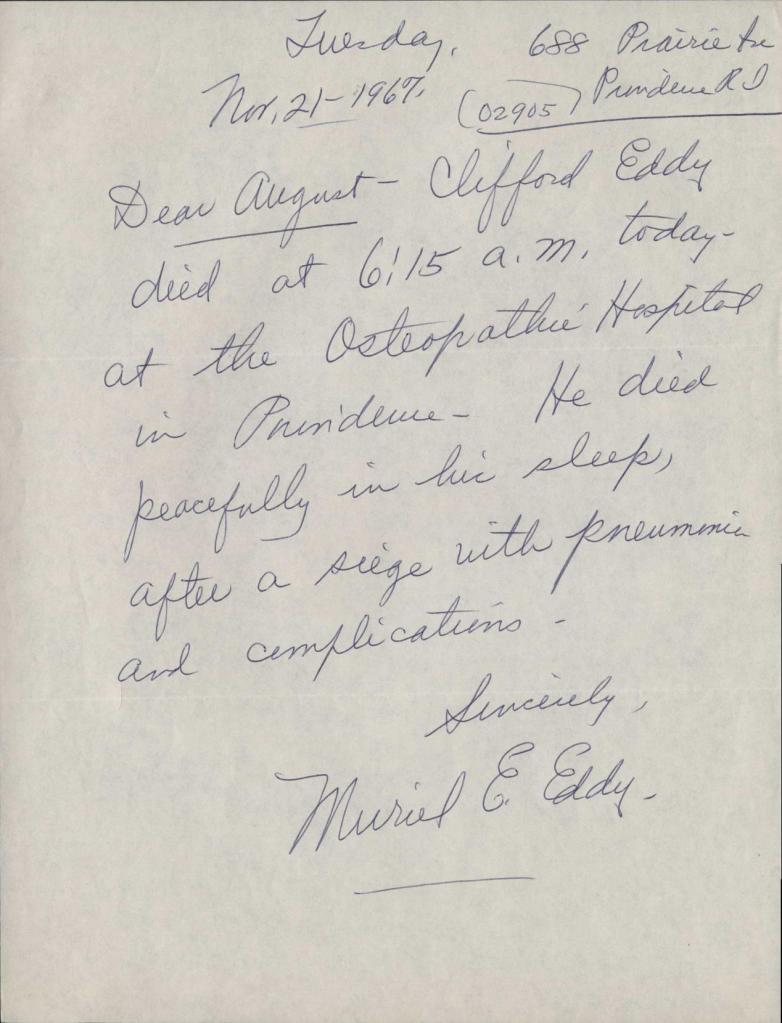
With the death of her husband, Muriel E. Eddy carried on life as best she could. She was still interested in matters Lovecraftian, which formed her main bond with Derleth through the years:
It is terribly depressing to me not to have Cliff here. I got so used to talking with him, during the years of his illness. I still cannot imagine he has gone, beyond recall. So many things I want to talk over with him.
I have been hearing from a young man in California. Sonia (HPL’s ex) was writing to me, but suddenly she stopped. She had somebody in the Nursing Home write me that she was too ill with her heart condition to write, as she was writing the sotry of HPL’s life, or something like that. A thought came to me that it was because of a letter I wrote her mentioning Hazel Heald, for whom HPL used to revise material. I assured her that HPL did not ever speak of marriage to Hazel, but that Hazel (now at rest) DID very much like him. She typed some of his stories fro him to pay him for revising her work. She told me at the time she was going to write you and inquire if you wanted to incorporate it in anything you were writing about HPL, and that she would try to see if you would pay for it. believe me, that was not my idea at all, so if she did write, asking you, please do not blame me, August. Since then, she has not written to me. She just asked her room-mate to write me, letting me know she was financially at a low ebb, and that her health was very poor, and she wanted to reserve all her energy towards whatever she was writing or compiling.
—Muriel E. Eddy to August Derleth, 2 Mar 1968
The “young man” was Randall Allan Kirsch (who later changed his name to R. A. Everts). This was an ongoing headache for Derleth, as Everts made claims regarding Sonia H. Davis as a possible heir to Lovecraft’s estate, since their divorce was never finalized. Derleth kept carbon copies of his few letters to Muriel on the subject of Everts, possibly for safety.
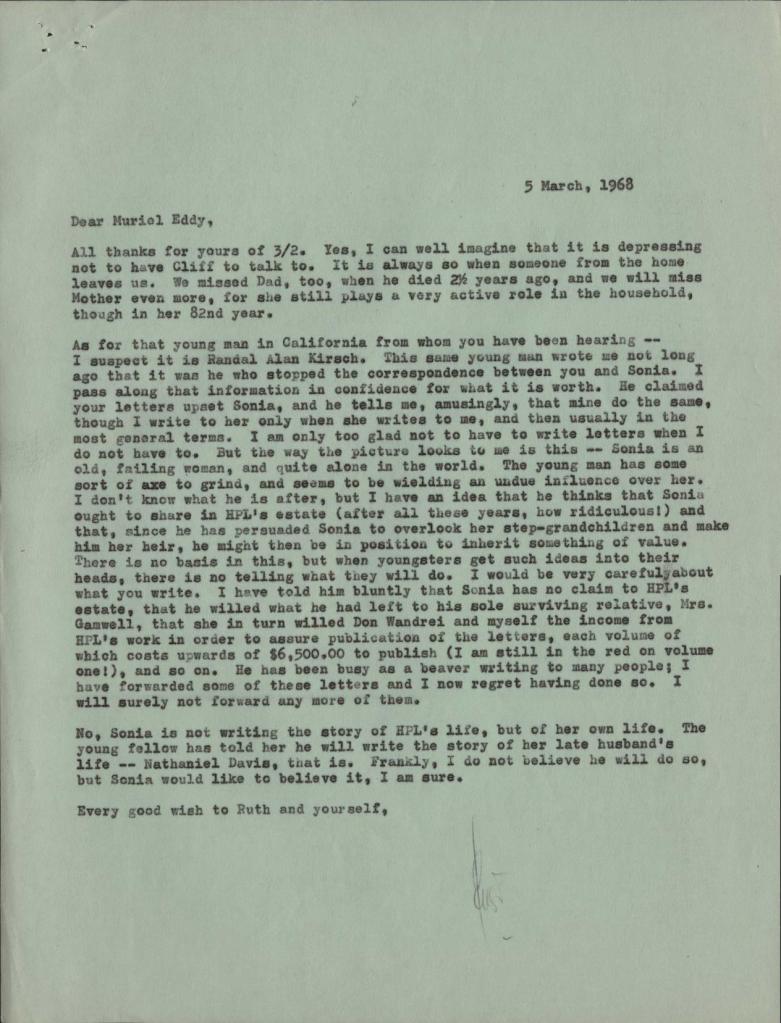
Sonia’s autobiography would eventually be published as Two Hearts That Beat As One (2024) by Sonia H. Davis & Monica Wasserman (ed.).
Another interesting late letter regarded women reading H. P. Lovecraft:
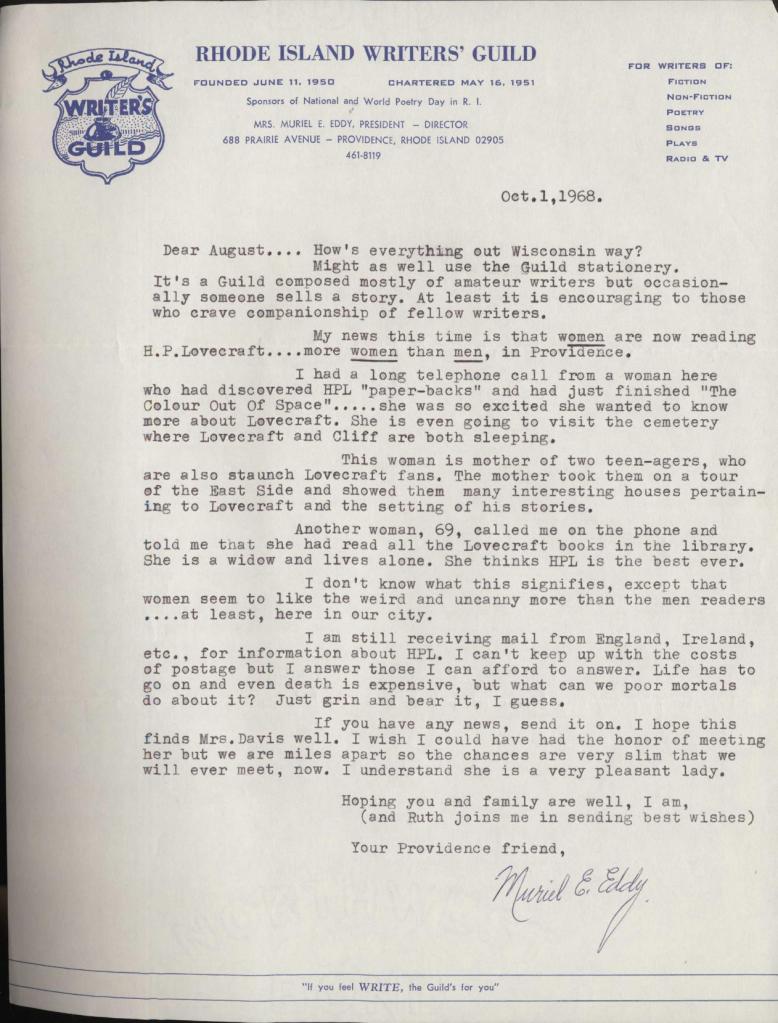
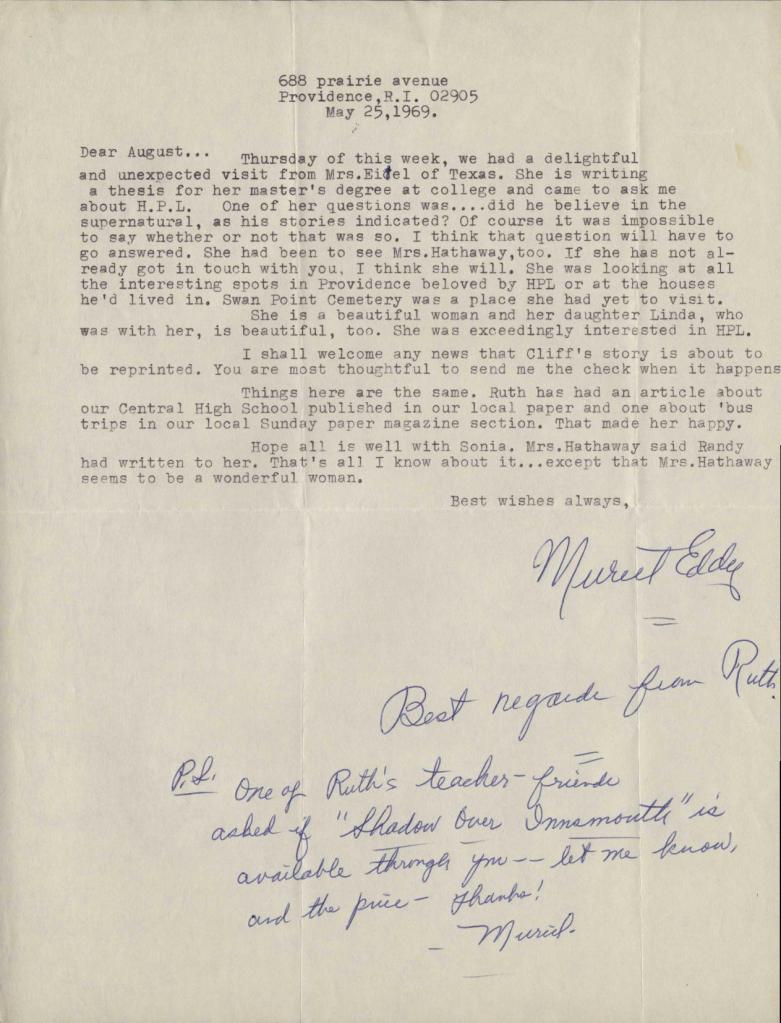
One of the women that Muriel heard from was Elaine Gillum Eitel of Texas, whose master’s thesis was The Sense of Place in H. P. Lovecraft (1970). Muriel E. Eddy had become a torchbearer for Lovecraft’s memory, and her letters with Derleth seemed to be a way for her to share her ongoing enthusiasm on the subject with someone else who could appreciate it.
One of the last items of correspondence in the Eddy folders at the Wisconsin Historical Society is a get-well card, signed by Muriel and Ruth Eddy, which must date to Sep-Nov 1969, when Derleth was hospitalized for 87 days, during which he had four operations. He survived until 1971, when a heart attack killed him and brought a final end to his long friendship with the Eddys. Derleth had set to publish the fragment of “Black Noon,” but those publishing plans died with him; it was eventually published in Exit Into Eternity (1973).
Muriel E. Eddy would live until 1978. It is difficult to summarize a friendship of twenty-odd years in letters in postcards; Derleth and the Eddys shared an interest in Lovecraft, but their correspondence went beyond just that, as they revealed more of their personal Iives to one another. It is difficult to extract Muriel from the men in her life; she wrote little in her letters to Derleth about her own writing and work, though she was a pulp writer and poet in her own right. Since she tended to focus on romance rather than weird fiction, perhaps Derleth had little interest, or perhaps she was simply diffident on the subject.
While some of Muriel’s letters appear gossipy to the extreme, it has to be remembered that Derleth would have been one of her major outlets for all things Lovecraft-related, and probably one of the few social outlets she had while caring for her ailing husband. If Muriel’s memories or deductions about Lovecraft were not always correct, she seemed at the least to never wish to tarnish Lovecraft’s posthumous reputation. The end of her correspondence with Derleth marked the closing in a chapter of the book of history, as one more voice that knew Lovecraft grew silent, never to share her memories again save by what had made it into print.
Bobby Derie is the author of Weird Talers: Essays on Robert E. Howard and Others and Sex and the Cthulhu Mythos.
Deep Cuts in a Lovecraftian Vein uses Amazon Associate links. As an Amazon Associate I earn from qualifying purchases.
 Deep Cuts in a Lovecraftian Vein
I will never understand why Muriel thought it was a great idea to admit to Sonia that another woman desired HPL. So tacky and cruel.
LikeLiked by 1 person
We’ll never know unless the letters show up, but I lean more toward “tacky” than cruel. Hazel Heald’s hypothetical romance with HPL was one of Muriel’s pet ideas.
LikeLiked by 1 person
Maybe “cruel” is a strong word, but I still think it’s mean, even if she didn’t intended it that way. There’s 11 folders of Sonia correspondence, half of which are from others to her, maybe Muriel letters are in the bunch. I need to get a proxy for that job 😅
LikeLike