HELEN HOKE learned her alphabet by setting type for her father’s newspaper in a small Pennsylvania town. Later she wrote articles for the same paper, and after a period of teaching she moved to New York to launch a distinguished career in editing and writing. She is the author of more than seventy books, for both adults and young people, and has been junior-books editor at five different publishing houses.
—Back cover flap, Sinister, Strange and Supernatural (1981)
She was born Helen Jeanne Lamb (1903-1990), in California, Pa.; her father owned the California Sentinel. Helen was the youngest of four children. Much of her early life isn’t clear, though she clearly had some schooling and no doubt practical education involving her father’s newspaper. She married John L. Hoke on 20 May 1923; their son Jack was born in 1925. She did some work as a journalist, and later as a teacher; the 1930 census lists her as a clerk at a mail order company. Around 1929 or 1930, the family seems to have moved to California.
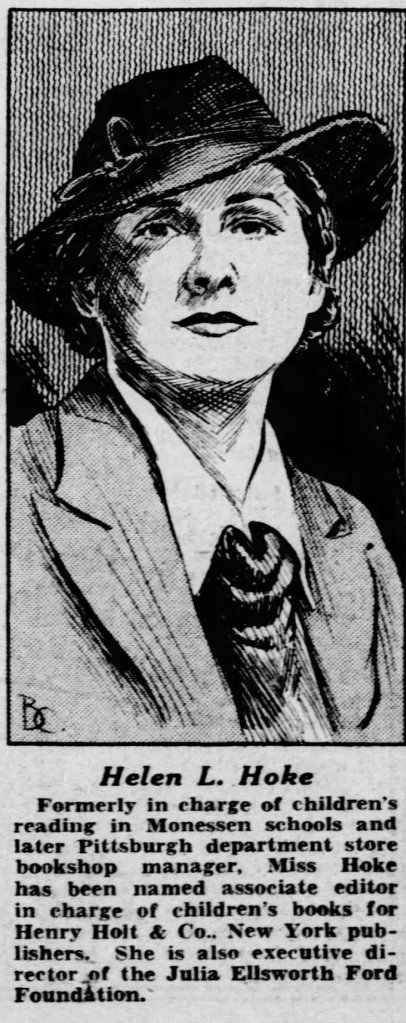
Miss Hoke entered the book trade in 1929, when she opened the book department in a Pittsburgh department store. Susbsequently she became head of the Children’s Book Department at Bullock’s, in Los Angeles, Calif. She became director of the Ford Foundation in 1934.
—New York Company Establishes Children’s Book Department With Helen Hoke As Director, The Daily Herald (Monongahela, Pa), 3 Jan 1945 (3)
The Julia Ellsworth Ford Foundation was established in 1934, and promoted the creation of literature for children. Helen Hoke was very involved with the development of children’s book departments, shaping the literature aimed at the rising market. Her first published children’s book was Mr. Sweeney (1940), the first of dozens. As an editor, she influenced dozens more. Part of her emphasis was on books that appealed to both adults and young readers:
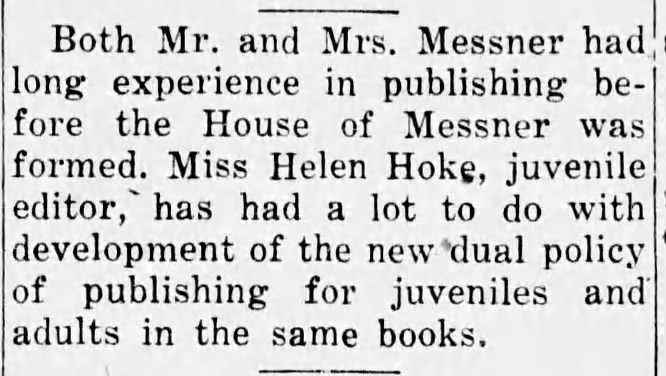
In a 1945 interview, Helen Hoke emphasized:
I look for books that will help young people to understand the time in which they live, the people with whom they have to live, and the world in which they live. Children are people, and should be addressed as people.
A few weeks later, on 31 May 1945, she married Franklin M. Watts, who owned Franklin M. Watts, Inc., publishers, and became vice-president and director of international projects. It was Watts that really launched her career as an anthologist, with books that bore distinctive title patterns like Jokes Jokes Jokes (1954), Puns Puns Puns (1958), Witches Witches Witches (1958), Alaska Alaska Alaska (1960), and Nurses Nurses Nurses (1961). While the titles might not have been super-creative, the repeated emphasis got the point across: these were anthologies that promised and delivered exactly what was in the title—and the contents, while sometimes skewing juvenile, often aimed for both young and adult readers.
Witches Witches Witches (1958) was the first of Hoke’s weird/horror fiction anthologies, of which she edited 29 between 1958 and 1986, not counting reprints. A glance at the contents shows many hallmarks of cheap anthologies: public domain stories, cheap reprints, the occasional bit of folklore. Yet the selection shows taste, and perhaps more surprisingly intermixed are plenty of stories from more contemporary authors, including well-known names like Robert Bloch, Ray Bradbury, Joseph Payne Brennan, Manly Wade Wellman, August Derleth—and H. P. Lovecraft.
Stories and poems from Lovecraft (or posthumous collaborations with August Derleth) appear in almost a third of Hoke’s horror anthologies. Readers both young and old would have thrilled to:
- Weirdies Weirdies Weirdies (1973): “The Nightmare Lake,” “The Ancient Track,” “The Night Crawlers,” “The Howler,” “Hallowe’en in a Suburb,” “Wentworth’s Day” as by August Derleth & H. P. Lovecraft
- Monsters Monsters Monsters (1975): “The Outsider”
- Devils Devils Devils (1976): “Witches’ Hollow” as by H. P. Lovecraft & August Derleth
- Creepies Creepies Creepies (1977): “The Moon-Bog”
- Haunts Haunts Haunts (1977): “The Music of Erich Zann”
- Terrors Terrors Terrors (1979): “The Horror in the Museum” as by Hazel Heald
- More Ghosts, Ghosts, Ghosts (1981): “In the Vault”
- Mysterious, Menacing & Macabre (1981): “The Shuttered Room” as by H. P. Lovecraft
- Sinister, Strange and Supernatural (1981): “Cool Air”
Notably missing are any of Lovecraft’s longer tales; Hoke wasn’t asking anyone from 8 to 80 to sit down and read through At the Mountains of Madness or The Case of Charles Dexter Ward. The focus is on the shorter, punchier, read-in-a-sitting stories that are largely standalone, and utterly unobjectionable in terms of content, aside from a bit of grief and a bit of stereotyping in “Cool Air.”
Like many anthologists aiming at a general market, little of Hoke’s own personality and reasoning for choosing some of these pieces comes through in the brief (sometimes nonexistent) introductions or chapter commentaries, and the occasional back cover or book jacket flap about her, e.g.:
Helen Hoke is well known for her anthologies on children’s humor, but she is also fascinated by the esoteric, the supernatural, and the weird.
—Weirdies Weirdies Weirdies (1973) back cover
As Helen Hoke says, “Terror seems the more potent if it is not too detached from reality.” Some element of realism is necessary to make the improbably, plausible.
—Terrors Terrors Terrors (1979) inside front cover flap
The use of three of Derleth’s posthumous collaborations is a bit of a surprise, especially since these were all published after his death; it would have been interesting to see the correspondence between Helen Hoke Watts and Derleth’s estate. Helen Hoke definitely toed the Arkham House line when it came to Lovecraft:
The Outsider, by H. P. Lovecraft, is one of the most original monster stories ever written. Lovecraft spent his life writing fantastic stories, which were first published in a magazine called Weird Tales. The unusual nature of his stories led to his receiving many letters from strangers, especially aspiring writers. Many authors have expressed their gratitutde to him for his help and generosity; one of them, August Derleth, rescued Lovecraft’s stories from obscurity and published them in book form. Lovecraft died in 1937, leaving a sure place in the literature of the fantastic.
—”About this Book,” Monsters Monsters Monsters (1975) 9
The one collaboration story in these books, “The Horror in the Museum,” is presented as solely the product of Hazel Heald, without any mention of Lovecraft—which is not unusual for the time. Though Lovecraft fans may well have recognized the Mythos elements that emerge in the story.
The Horror in the Museum will particularly disturb those who sense the terrifying potential of waxworks and masks, quite apart from monstrous mutations. Hazel Heald writes with a disquieting plausibility so that it does seem just possible such exhibits may really be seen in London.
—”About this Book,” Terrors Terrors Terrors (1979) 9
As an editor, Helen Hoke did little to inform the readers about the history of the stories or the author; the bits and pieces of editorial drapery are there to whet the appetite of potential readers, and fulfill their function well—but we don’t really get any insight into the process. Based solely on how often she used Lovecraft, she was attracted to either his work or the recognizability of his name (perhaps both).
How much did these nine books add to the recognition of Lovecraft in the 70s and 80s (and longer, as such books can linger on school library shelves for decades)? As with Betty M. Owen & Margaret Ronan, it’s impossible to overstate how critical it can be to get a reader young and hook them in. Helen Hoke’s anthologies weren’t paperbacks on the spinner rack at the local drugstore, these were the kind of books that got reviews in Publisher’s Weekly and the School Library Journal; Hoke was selling these books to librarians as much as to the young men and women that would eventually check them out, and that might explain why the stories are a notch or two above the average horror anthology for kids. Aiming for a more literate audience, with stories that could appeal to both kids and adults, may also be why these books are still very passable horror anthologies for adults today, and collectors pay some fair prices for the scarcer titles in good condition.
Helen Hoke was one of the editors and anthologists who knew horror could be for kids—and not just silly, schlocky, comedy-horror, but serious literary terrors. She was the flip side of the coin, the librarian-approved choice for kids that might glut themselves on Famous Monsters of Filmland and see Frankenstein and Dracula without reading the novels they were based on. More than a few impressionable young minds no doubt found their first introduction to Lovecraft in the pages of Weirdies, Weirdies, Weirdies, or felt that connection to the Outsider in Monsters, Monsters, Monsters. Holt’s anthologies were another route by which the tentacles of Lovecraft and the Mythos spread and disseminated.
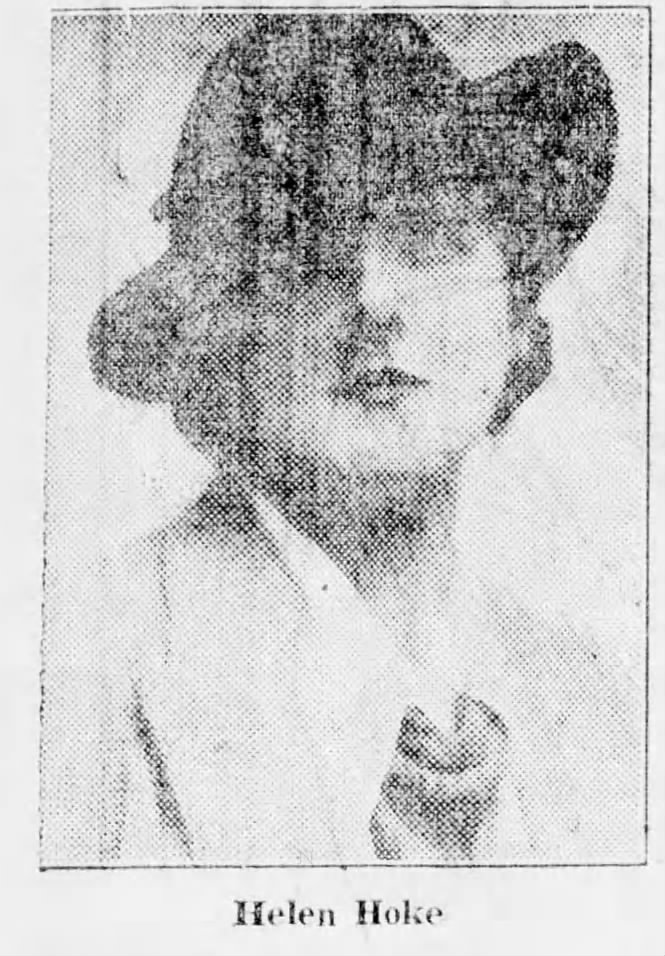
Bobby Derie is the author of Weird Talers: Essays on Robert E. Howard and Others and Sex and the Cthulhu Mythos.
Deep Cuts in a Lovecraftian Vein uses Amazon Associate links. As an Amazon Associate I earn from qualifying purchases.
 Deep Cuts in a Lovecraftian Vein