While Weird Tales found success on the newsstands of the United States, early efforts to publish hardback reprint anthologies stalled out after the first volume. In the United Kingdom, however, editor and literary agent Christine Campbell Thomson managed to launch a successful line of reprint anthologies, the Not at Night series, which drew heavily from Weird Tales—and inspired many imitators. August Derleth’s first story at Weird Tales, “Bat’s Belfry,” made it into the second volume, More Not at Night (1926), and other stories of his made their first hardback appearance in subsequent volumes. Though Derleth did not think highly of the series as a whole, he must have been aware of it as a market.
The file of correspondence at the Derleth Archive of the Wisconsin Historical Society between Thomson and Derleth covers the years 1934-1954, comprising 34 separate letters for a total of 43 pages, all from Thomson. It is not clear from extant correspondence if Derleth had heard directly from Thomson before 1934; presumably, Weird Tales editor Farnsworth Wright or their London agent handled most of the commercial details of reprints. However, on 12 Feb 1934 Wright returned Derleth’s story “The Metronome” again, and Derleth apparently decided to skip the middle man and submit it to Thompson and Not at Night directly.
Dear Mr. Derleth,
Thank you so much for your note. I am most interested in your criticism. The general opinion here in England is that the ninth issue is well ahead of most of its predecessors and equal to any of them. Incidentally, I notice that you choose in every case an American author and not an English one as coming up to standard. Here, the general run of opinion is the other way round. Interesting.
I have read “The Metronome” and like it. I am not making a final selection at the moment, but I want to keep this story by me—which is tantamount to my taking it, but I wait always to get out the agreement until we have got the volume complete. I am afraid Selwyn & Blount won’t let me pay more than £3.3.0 for the book rights over here. Is this possible for you? You retain the English magazine rights, of course.
Yours sincerely,
—Christine Campbell Thomson to August Derleth, 22 Jan 1934
The ninth entry in the Not at Night series was Keep on the Light (1933); it is difficult not to side with Derleth on this one, as the US entries reprinted from Weird Tales include Robert E. Howard’s “Worms of the Earth,” Mary Elizabeth Counselman’s “The House of Shadows,” and Clark Ashton Smith’s “Isle of the Torturers,” while many of the British entries are less well-regarded (and some have never been reprinted). It is possible the opinionated Derleth may have made a comment about “The Black Hare” by Flavia Richardson (a pseudonym of Thomson) or “Golden Lilies” by Oscar Cook (Thomson’s husband), which would not have endeared him to his potential editor. However, Thomson was a businesswoman first.
“The Metronome” was accepted for and published in Terror at Night (1934); Farnsworth Wright also changed his mind and accepted the story for Weird Tales, so it was published in the Feb 1935 issue, and Derleth was paid twice for the story—one of the benefits of foreign markets. Derleth inquired whether Thomson’s agency would work to play his other stories in British markets, rates involved, etc., and Thomson was willing. Most of their short, businesslike correspondence during 1934-1936 concerns issues of what rights to various works that Derleth retained and was willing to let Thomson attempt to market.
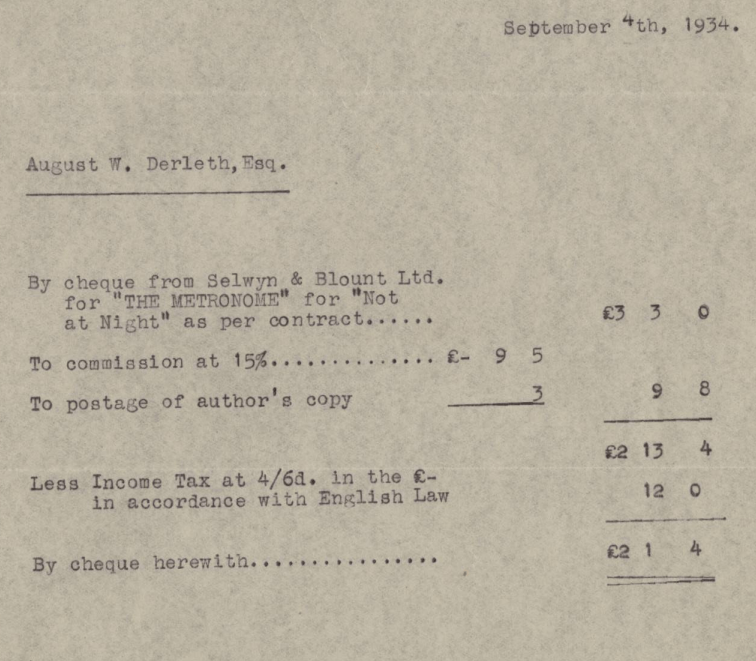
The exchange rate for British pounds (pre-decimal) to U.S. dollars was about 1:4, so Derleth was perhaps a bit unhappy to find that his three guineas came out to only about $10.33 after fees, postage, and taxes. Still, Weird Tales only offered $20, or about half a cent a word, so Derleth didn’t do too bad overall.
Thomson scored a small coup when she sold Derleth’s story “Hawk on the Blue” (based on a story in a letter from Robert E. Howard) for 8 guineas (although after various costs, this came out to a bank draft for $26.94). Other stories were met with various comments; Regarding “Muggridge’s Aunt,” Thomson wrote: “I am not quite certain whether it is horrible enough for Not at Night, the readers of which like their blood laid on with a soupladle” (Thomson to Derleth, 24 Sep 1934). About “Gus Elker and the Fox,” Thomson wrote “we feel that it is too American to place over here” (Thomson to Derleth, 12 Oct 1934).
Through 1936, Thomson continued to act as Derleth’s British agent, generally failing to sell much of anything, though with the occasional success, and often a degree of unctuousness.
Dear Mr. Derleth,
We are going to have a Coronation Omnibus “Not at Night” next Spring and I want to include “THE TENANT”. The fee, being for purely reproduction work, is to be £1 per story, but I know that the money is of less importance to you than the publicity and I would dislike to have an Omnibus compiled from the previous eleven volumes without one tale bearing your name. I am contributing an introduction myself and shall refer to your other work, of course.
Yours sincerely,
—Christine Campbell Thomson to August Derleth, 17 Nov 1936
“The Tenant” did appear in the Not at Night Omnibus (1937), but the brief introduction doesn’t refer to that or any other work by Derleth (to be fair, it doesn’t mention any other author’s work either, and is dated February 1936; such things happen in publishing).
The final letter of the first part of Thompson’s correspondence to Derleth is dated 29 Apr 1937; there is then a gap. With the international postage rates and rather poor returns, it seems likely that Derleth gave up on Thomson as an effective British literary agent. Whatever the case, the correspondence was resurrected in 1941. In the intervening period, H. P. Lovecraft had died (1937), August Derleth and Donald Wandrei had formed Arkham House (1939), and Nazi Germany had invaded Poland, sparking World War II in Europe (1939). Derleth was apparently hoping Thomson might be interested in publishing an anthology he had put together: Someone in the Dark (1941).
You probably don’t know that even before the war I was trying hard to get a publisher to do pretty much what you are doing—a Library of authors of Weird Stories—I got one volume by Edmond Hamilton out but then life got too difficult. I have a collection of H. P. Lovecraft’s tales here, just waiting, and had planned to get in touch with you for a volume in due course. (By the way, I am sorry to see from your jacket flap that H. P. L. is no more. He was indubitably a master of his craft.)
I will go round and see what can be done about an English edition of this volume – though it will be difficult, owing to the paper shortage and the embargo on the importation of sheets. but I will certainly investigate the possibilities.
—Christine Campbell Thomson to August Derleth, 20 Oct 1941
The Edmond Hamilton volume was presumably: The Horror on the Asteroid and Other Tales of Planetary Horror (1936); a year or two later, Thomson divorced Oscar Cook, which seems to have ended the publishing arrangement for the Not at Night series and apparently put the kibosh on further weird publishing plans for a bit. The mention that Thomson had a manuscript collection of Lovecraft stories on hand must have come as a surprise, because in the next letter we read:
I am very much interest in the booklet and also in all that you tell me in your letter of your activities. I got the H. P. Lovecraft stories some years ago (about three or four at least) and my recollection is that I obtained them from Farnsworth Wright. At that time we sold the Edmond Hamilton tales to a small but satisfactory firm called Quality Press (still going) and at that time the Directors wanted to try and do a cheap popular line of horror stories, corresponding to the “Not at Night” series. The scheme fell through owing to the general slump and tightness of money, etc. but I have still got the Lovecraft stories here. There [sic] were all tear sheets. The Hamilton book was called “The Horror on the Asteroid” and I got it originally through David Hampton and subsequent dealings were with Dr. Schwarz, who appeared to be Hamilton’s agent. later on. [sic] I’ll try and get you a copy and send it over but so much stuff has been destroyed by enemy action that I may not be able to lay my hands on one.
—Christine Campbell Thomson to August Derleth, 31 Dec 1941
Farnsworth Wright had contemplated a collection of Lovecraft’s stories from Weird Tales as far back as the 1920s, but the dismal sales on The Moon Terror (1927) shelved any such plans indefinitely. In a later letter, Thomson says she may have gotten the tear sheets from Julius Schwartz, a teenage fan who was acting as Lovecraft’s agent in 1935-1936 and managed to sell At the Mountains of Madness and The Shadow Out of Time to Astounding Stories. In the same letter, she lets him know of her failure to sell Someone in the Dark due to wartime difficulties, and ads in response to Derleth’s dislike of Hamilton’s space opera stories:
I agree with you; I can’t do with interplanetary tales; I get giddy right away and feel that there is quite enough to deal with in and around this planet without bringing in the others. I could never care for the Edgar Rice Burroughes [sic] “Mars” stuff, which had some vogue years ago when I was very young!
—Christine Campbell Thomson to August Derleth, 2 Mar 1942
Never ask an editor her age; Thomson was born in 1897, and would have been in her teens when A Princess of Mars was published in 1912. Still, this might explain some of her choices for the Not at Night series, which tended toward the strictly supernatural, grisly, and earthbound over interplanetary fiction. The last letter of this part of the correspondence concerns the ongoing paper shortage and the war effort:
Dear Mr. Derleth,
We have been going through our stored MSS. and find we have a number of short stories by yourself, all of which I think are just copies. May we destroy these? The have been offered in all likely places without success. We have also the tear-sheets of the H. P. L. stuff; can I send these for the war effort also as they, again, are only copies; we have also tear-sheets of Seabury Quinn, are you looking after his work also and can you give me authority to destroy?
Yours sincerely,
—Christine Campbell Thomson to August Derleth, 11 Mar 1942
Derleth’s answer is unrecorded; though he probably cared little for tear-sheets (or the postage to have them shipped back to the United States) and had no involvement in Seabury Quinn’s affairs at the time. Here again, the correspondence breaks off, since the bid to find a British buyer for Someone in the Dark had failed, and the Lovecraft material Thomson had on hand was only copies of stuff Derleth already had.
The final letter in the file is dated 7 July 1954. The war had ended, the world upended, and Weird Tales would end its 31-year run later that year with the September 1954 issue. After WWII, editor Dorothy McIlwraith had made several attempts for a British edition of Weird Tales to be published, including a 28-issue run by Thorpe & Porter that ran from 1949-1953. Derleth’s Cthulhu Mythos tale “The Black Island” appeared in the January 1952 issue.
Dear Mr. Derleth,
It is many years since we corresponded, and the other day some one left a more or less current copy of ‘Weird Tales’ in the office and I took it out to read over lunch and found your firm still existing and good story by you called ‘The Black Island’. And so I am writing to you and hoping that you have not quite forgotten my name. I still have—and shall never part with—your ‘Place of Hawks’ and ‘Some One at the Door’ and the beautiful collected H. P. Lovecraft which you gave me. Now I am writing for information! I am doing a book on the Western tradition and mystery (chiefly of course the Celtic and the West referring to these islands and not to U.S.A.,) but for this I am doing a lot of reading round the subject and I am wondering you would let me know just how much of the Chtulhu [sic] myths are based on any fact. I am of course a believer in Mu, Atlantis and that sort of stuff; but so little is available about Mu, other than such books as ‘The Children of Mu’, that I wondering just how much of the Lovecraft-Derleth material is purely imagination based on scientific reading and how much is based on what you and I would reasonably call ‘fact’. If there is any of the latter, I shall go through the Lovecraft material again and if possible give a passing reference to his work and yours in the book in the introductory chapter of the sources, etc. of our mystery teaching in the West. If it is all fiction, it must go.
[…]
I would like to send you the best wishes for the Arkham Press and for the high standard of production which you had before the war and hope—and indeed am sure—that it is keeping its level.
Yours sincerely,
—Christine Campbell Thomson to August Derleth, 7 Jul 1954
This was presumably the early stages of what would become The Western Mystery Tradition (1968), published under her married name Christine Hartley. Whether or not Derleth took the time and postage to respond, there is no reference to Lovecraft in the book.
The Thomson-Derleth correspondence is superficially slight, since most of it is impersonal and concerns only the frustrating call-and-response of Derleth’s attempts to sell things to the British and Thomson’s typical replies that she tried and no one would bite. Yet what is interesting about this correspondence is that it gives at least some insight into what Thomson did—and did not—know about weird fiction, some of her attitudes on the kinds of stories she did and did not like, her awareness of the British markets and her general ignorance of what was happening on the other side of the Atlantic. To ask Derleth in 1954 if the Cthulhu Mythos was real shows how far Thomson’s finger was from that particular pulse.
Yet, despite a rocky start, this was apparently a professional and polite relationship, and a rare glimpse into several “what might have beens” in Lovecraft and Arkham House publishing.
Bobby Derie is the author of Weird Talers: Essays on Robert E. Howard and Others and Sex and the Cthulhu Mythos.
Deep Cuts in a Lovecraftian Vein uses Amazon Associate links. As an Amazon Associate I earn from qualifying purchases.
 Deep Cuts in a Lovecraftian Vein
That was quite the rejection when she said, “we feel that it is too American to place over here”. 😅😂
LikeLiked by 1 person