France, 1974. Jean Giraud (Mœbius), Philippe Druillet, Jean-Pierre Dionnet, and Bernard Farkas came together to create Les Humanoïdes Associés, a publisher for a new type of comic magazine: Métal Hurlant (“Howling Metal,” 1974-1987). Initially released as a quarterly and focused on science fiction, Métal Hurlant featured some of the best international comic artists of its time, as well as some of the most daring content, not just featuring sex, drugs, and rock & roll—but humor, horror, gory violence, politics, and philosophy.
The magazine was successful enough to inspire spin-offs in other countries, largely based, at least initially, on material translated from Métal Hurlant. So in the United States and Commonwealth countries, Anglophones could read Heavy Metal (1977-2023), with various special issues, spin-offs, graphic novels, and other projects; in Italy, the localized version of Métal Hurlant lasted only 12 issues (1981-1983), with several standalone Metal Extra issues, though the sister magazine Totem lasted longer (1980-1984). In West Germany, Schwermetall (“Heavy Metal,” 1980-1984) lasted a respectable 57 issues under its first publisher, and eventually ran to issue 219/220 (1998). Spain had their own translation of Métal Hurlant in the 1980s, the Netherlands had Zwaar Metaal (“Heavy Metal”), Denmark had Total Metal, Finland had Kylmä metalli (“Cold Metal”), Sweden had Tung Metal (“Heavy Metal”) and Pulserande Metal (“Pulsing Metal”), Turkey had Heavy Metal Türkiye…most of these international runs didn’t last long, but they spread the stories and art far and wide.
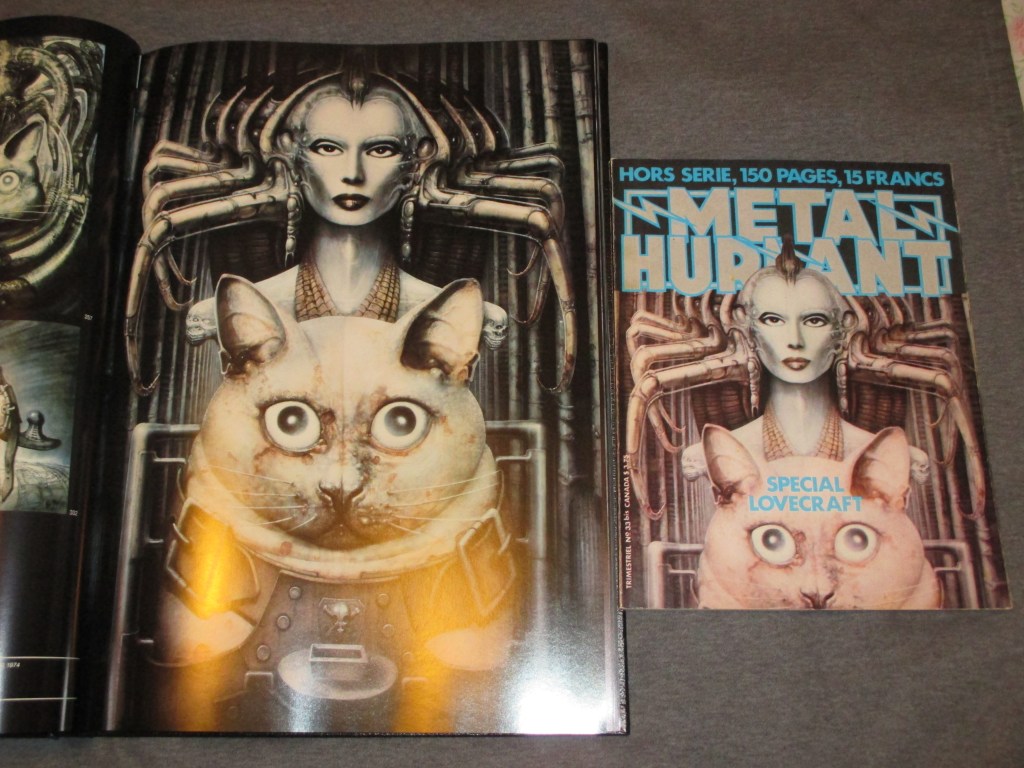
The creation of Métal Hurlant coincided with a number of other trends. H. P. Lovecraft, Robert E. Howard, Clark Ashton Smith, and other early contributors to the Cthulhu Mythos became more widely available thanks to paperback reprints, and with the death of August Derleth, Arkham House lost its grip on the Mythos. New anthologies like The Disciples of Cthulhu (1976) proved that anyone could now play with the shared universe that Lovecraft and his friends had created. Argentinian master Alberto Breccia began and completed a series of Lovecraft adaptations for comics from 1973-1979, many of which first appeared in the Italian magazine Il Mago. Underground comix in the United States like Skull Comix (1970-1972) were giving way to semi-prozines like Star * Reach (1974-1979), and publishers also found they could side-step the Comics Code Authority by publishing magazines like Creepy (1964-1983) and Eerie (1966-1983) instead of standard-size comics, all of which featured material inspired by or adapting Lovecraft. H. R. Giger’s Necronomicon art collection was published in 1977, and quickly inspired the aesthetic for the film Alien (1979).
There was, in other words, a small revolution in Lovecraftian art, comics, and fiction in the 1970s. Not all at once, but from many different angles—and Métal Hurlant, the international crossroads where underground American artists like Richard Corben; French masters like Mœbius, Druillet, and Nicollet; Swiss artists like Giger; and Argentinian masters like Breccia could all come together at once.
That is what happened in September 1978, when Les Humanoïdes Associés published a 150-page special issue of Métal Hurlant dedicated to H. P. Lovecraft. The idea was so attractive that the next year, the English-language Heavy Metal magazine released their own Lovecraft special issue to coincide with Halloween, and when Métal Hurlant was translated in Italy, they released a one-off Metal Extra special issue dedicated to Lovecraft.
All three of these magazines share certain common elements, largely because the English- and Italian-language productions included material translated from the French special Lovecraft issue. Yet they were each different as well…and that’s kind of fascinating in itself, how these three magazines represent three different takes on the material, each tailored for their respective audience.
What follows is a survey: what each Lovecraft special issue contains, and by comparison, what they do not contain. To avoid excessive repetition, each issue and its unique contents are discussed separately, and then a single section discusses all the shared features. Because this is a long, image-heavy post, a table with links is provided to aid navigation:
- Métal Hurlant Special Lovecraft (Sep 1978)
- Heavy Metal H. P. Lovecraft Special Issue (Oct 1979)
- Metal Extra Speciale Lovecraft (Nov 1982)
- Shared Content
- Cultural Impact
Métal Hurlant Special Lovecraft (Sep 1978)
150 pages, counting covers, the table of contents, ads, etc., Métal Hurlant Special #33 bis (“extra”) was one of several themed issues released by Les Humanoïdes Associés, with the other themes including Fin du monde (“the End of the World”, #36), Rock (#39), Guerre (“War”, #42), and Alien (#43). Not every feature in this issue involves Lovecraft or the Mythos, but a majority do. There are errors in the table of contents as printed, so a full list is given here.
Features involving Lovecraft or his creations are marked in bold; color pages are marked [c].
- Front Cover: H. R. Giger
- “La cimetière” (illustration) by Souchu, 2-3
- Advertisement for Heilman by Voss and A l’Est de Karakulac by Daniel Ceppi, 4
- Table of Contents, 5
- Edito triste./Edito gai by Philippe Manœuvre, 6
- “La Chose” by Alain Voss, 7-12
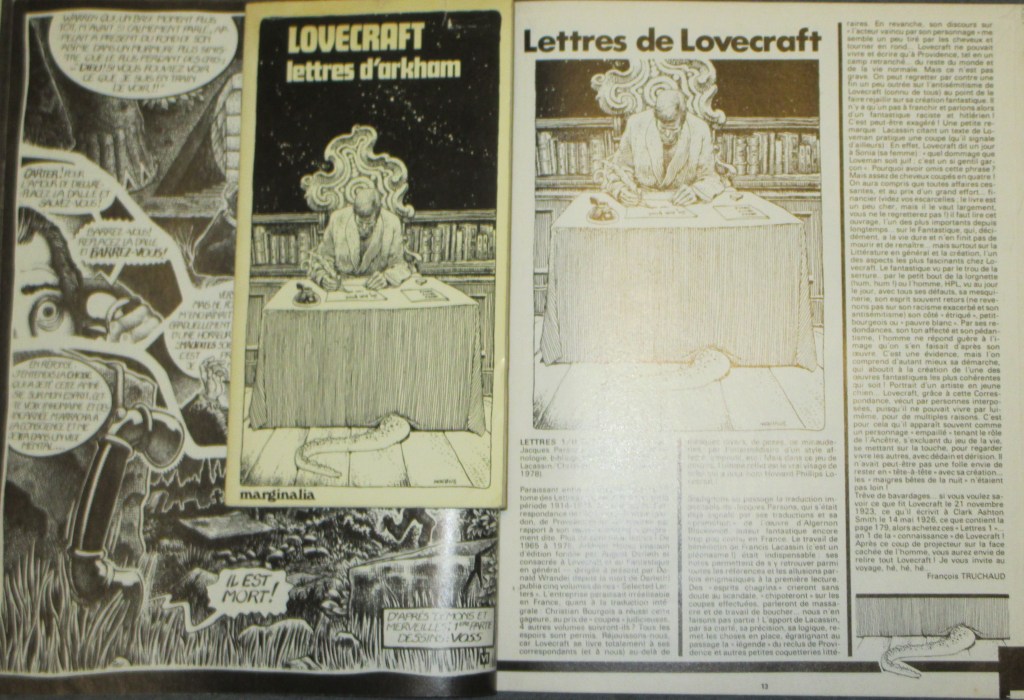
- “Lettres de Lovecraft” by François Truchaud, 13
- “La Retour de Cthulhu” by Alan Charles & Richard Martens, 14-15
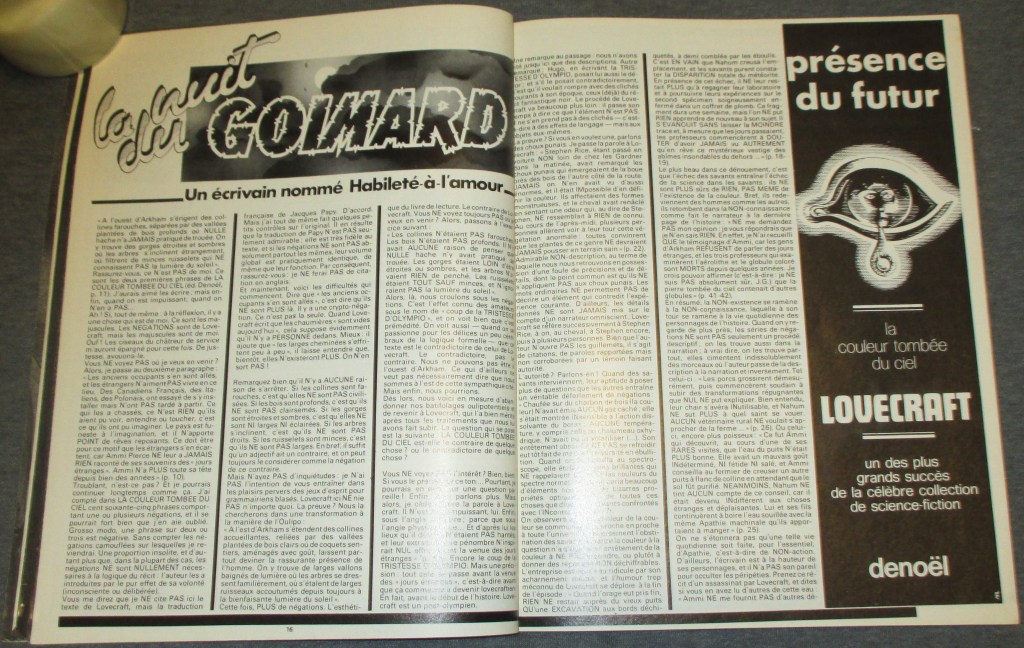
- “La Nuit du Goimard: Un ecrivain nommé Habileté-à-l’amour” by Jacques Goimard, 16-18
- “Le Monstre Sur le Seuil” by Norberto Buscaglia & Alberto Breccia, 19-29
- “Je m’appelle Howard Phillips Lovecraft” by François Truchaud, 30-32
- “L’Homme de Black Hole” by Serge Clerc, 33-36
- “Hommage à HPL…” (uncredited), 37-39
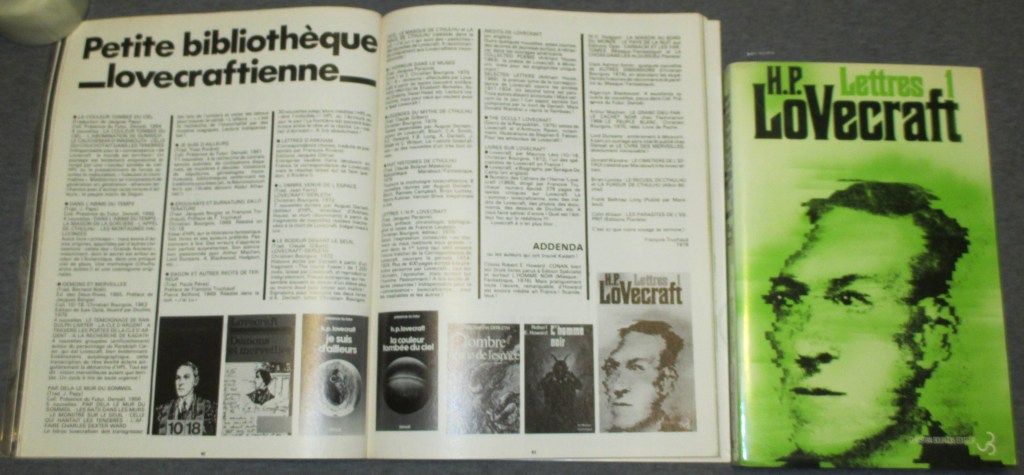
- “Petite bibliothèque lovecraftienne” by François Truchaud, 40-41
- “La Trace Ecarlate” by Jean-Jacques Mendez & Daniel Ceppi, 42-43
- “Excursion Nocturne” by Frank Margein, 44-47
- “Le langage des chats” by Nicole Claveloux, 48-49
- Untitled illustration by Richard Martens, 50
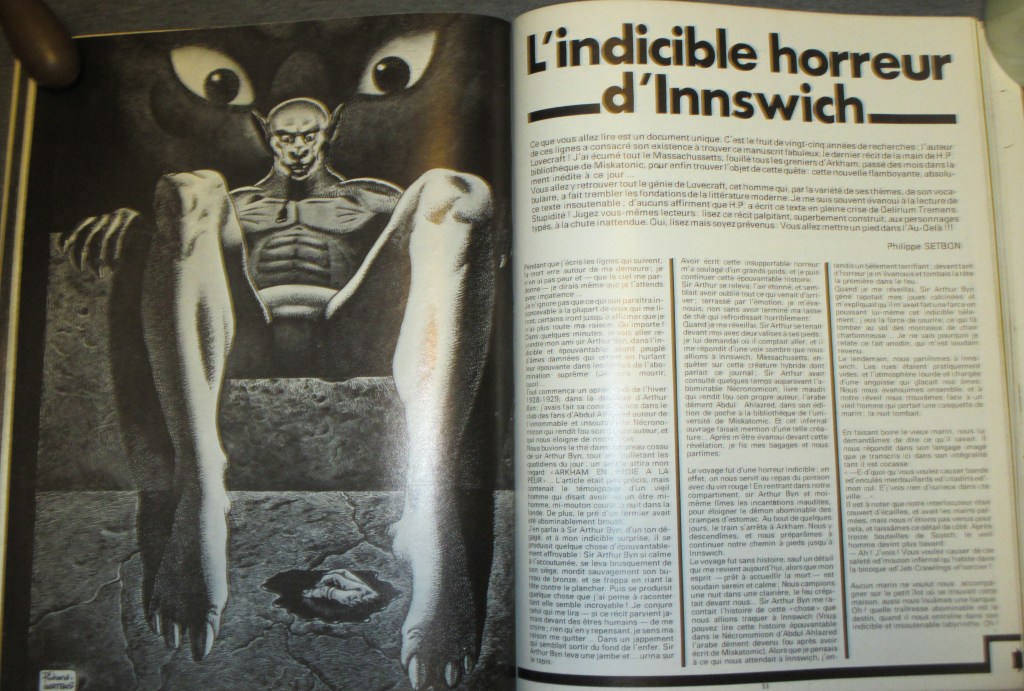
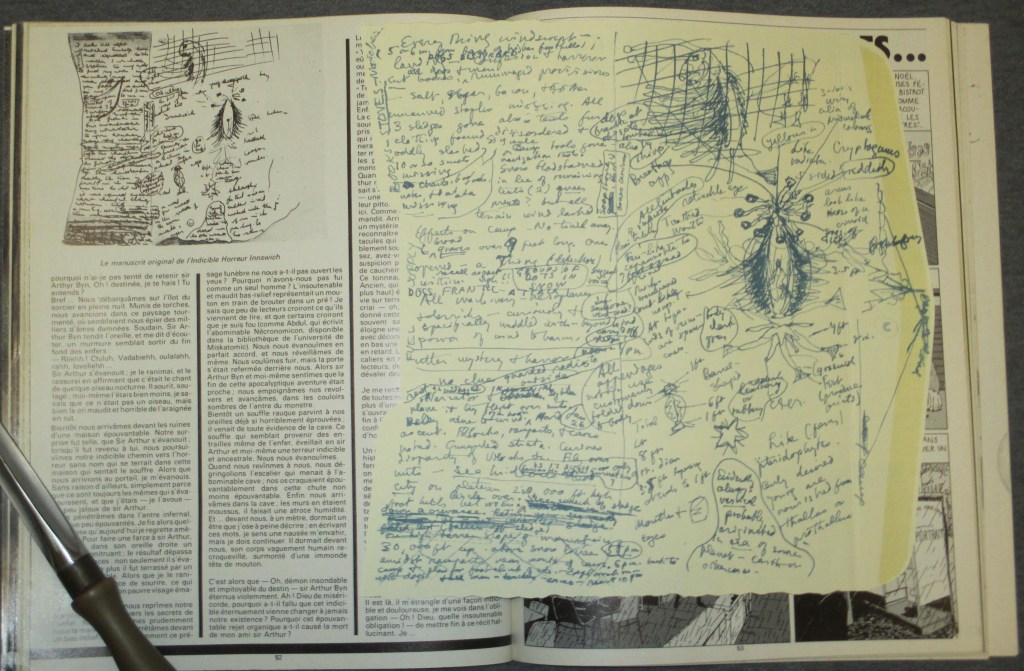
- “L’Indicible Horreur d’Innswich” by Philippe Setbon, 51-52
- “Amitiés Rencontres” by Vepy & Daniel Ceppi, 53-57
- “Barzai le Sage” by Marc Caro, 58-65
- Advertisement for Richard Corben’s Den, 66
- [c] “Le Chef d’Œuvre de Dewsbury” by Yves Chaland & Luc Cornillon, 67-70
- [c] “L’énigme du mystérieux puits secret” by Yves Chaland & Luc Cornillon, 71-74
- “A la Recherche de Kadath” by François Truchaud & M. Perron, 75-78
- “H. P. Lovecraft 1890-1937” by George Kuchar, 79-81
- “Les Bêtes” by Dank, 82-84
- Advertisement for Le Diable by Nicollet and Les Naufragés du Temps by Paul Gillon, 85
- “Le Necronomicon” by Druillet, 86-96
- Advertisment for La Boite Oblungue by Edgar Allan Poe and La Rivier du Hibou by Ambrose Bierce, 97
- Advertismenet for Les Trafiquants d’Armes by Eric Ambler
- “Les 3 Maisons de Seth” by Dominique Hé, 99-101
- “Les 2 Vies de Basil Wolverton” by Yves Chaland, 102-103
- Advertisement for back issues of Métal Hurlant, 104-105
- Advertisement for Métal Hurlant posters, 106
- [c] “H.P.L.” by Jean-Michel Nicollet, 107-109
- [c] “Ktulu” by Mœbius, 110-114
- “Plat du Jour” by Vepy & Daniel Ceppi, 115-117
- “Le Pont Au Dessus de l’Eau” by Luc Cornillon, 118-119
- “Cauchemar” by Alex Niño, 120-129
- “H. P. Lovecraft au cinéma” by Jean-Pierre Bouyxou, 130-131
- “L’Abomination de Dunwich” by Alberto Breccia, 132-146
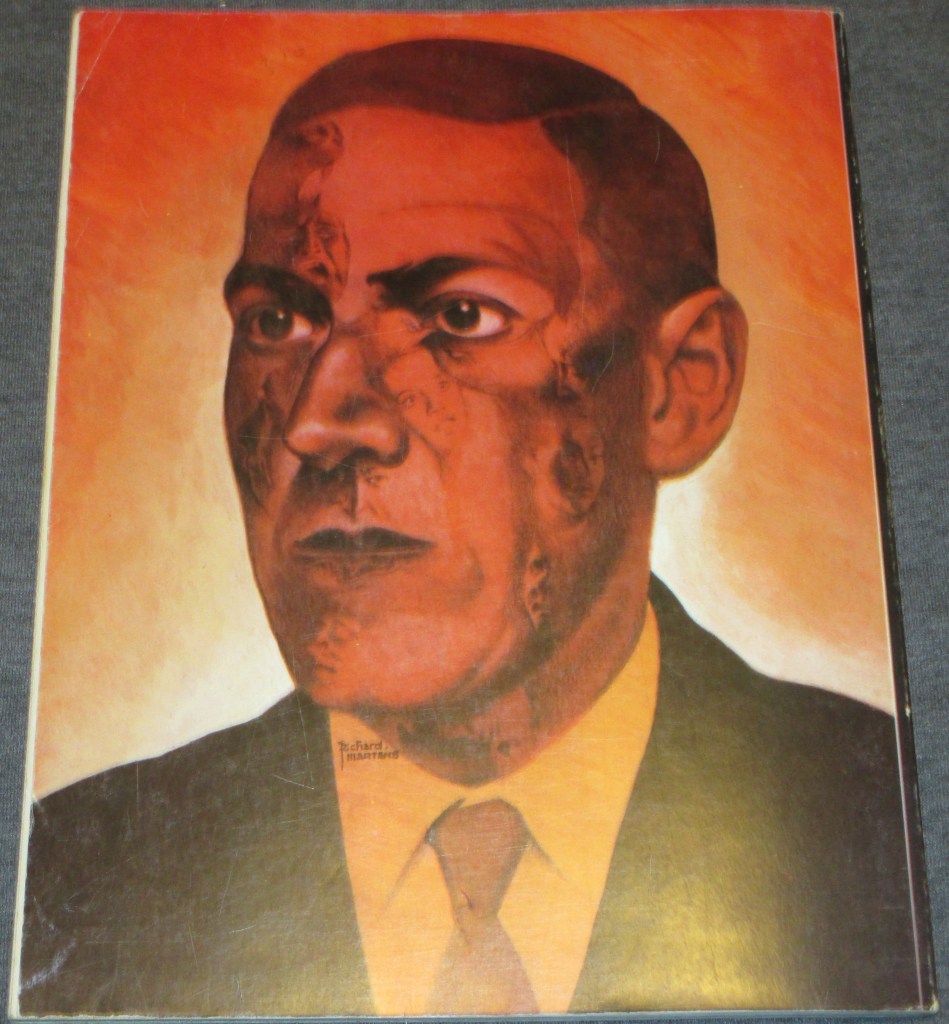
- Back cover by Richard Martens
Unique Content
Front Cover: A plate from H. R. Giger’s Necronomicon (1977).
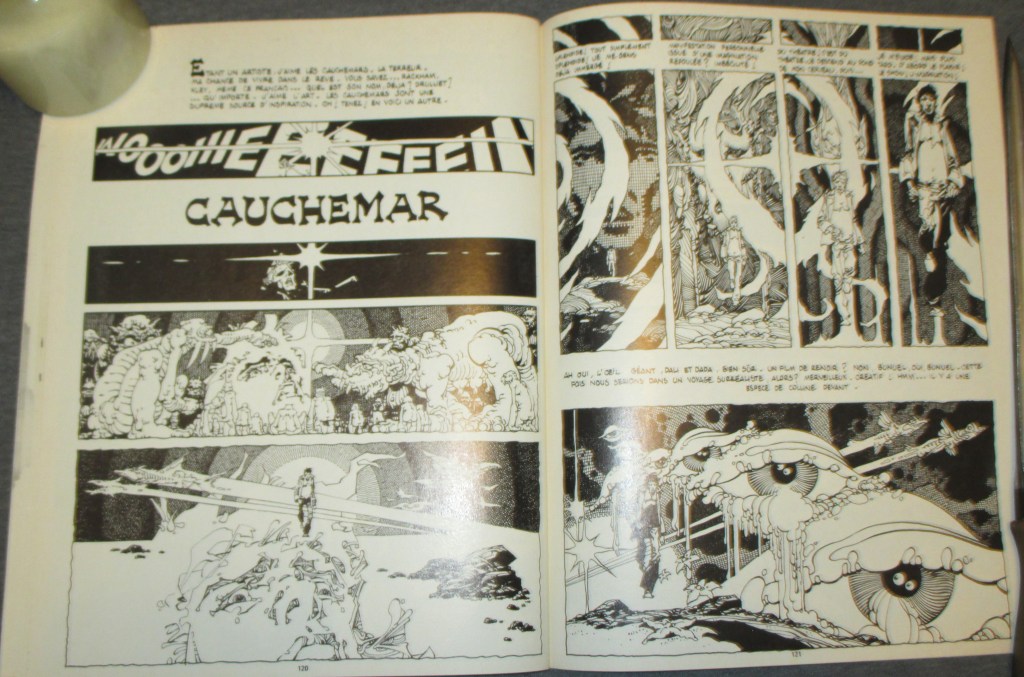
“Cauchemar” (“Nightmare”) by Alex Niño is a 10-page black-and-white comic that showcases a series of nightmares realized in surrealistic and highly detailed form; Niño pays homage to the styles of other artists, naming Heinrich Kley, Arthur Rackham, Phillip Druillet, and Jean Giraud (Mœbius). Not explicitly Lovecraft-related.
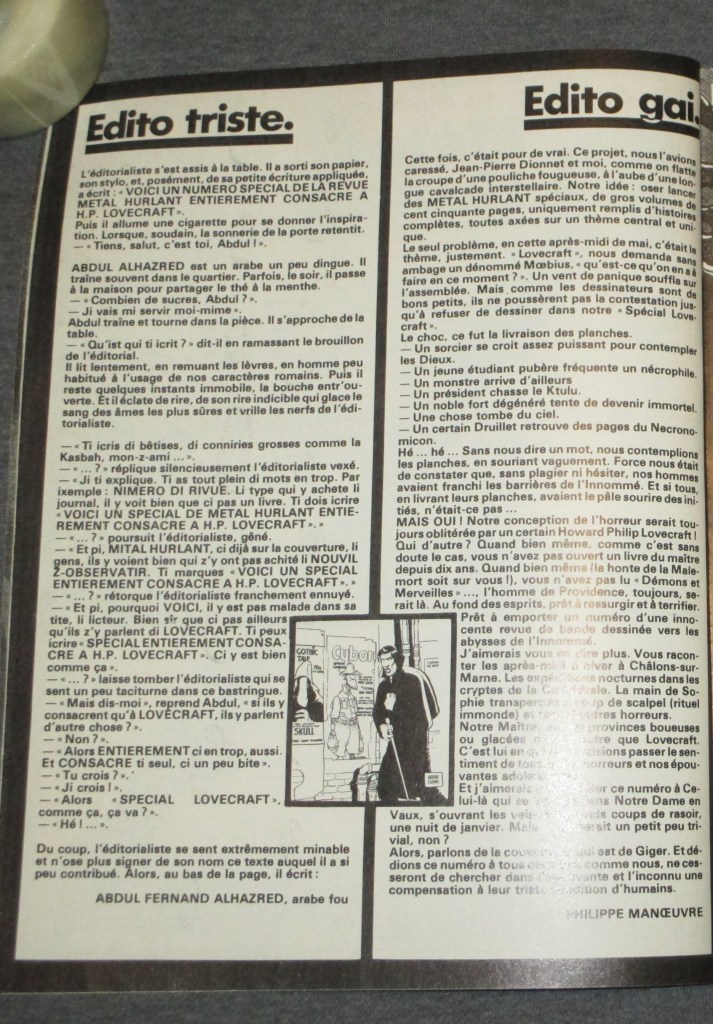
Edito triste./Edito gai (“Sad Editorial/Gay Editorial”); “Edito triste” is written as by “Abdul Fernand Alhazred”, while the “Edito gai” (as in happy, not homosexual) is by Philippe Manœuvre. Both concern how the Métal Hurlant Lovecraft Special came together.
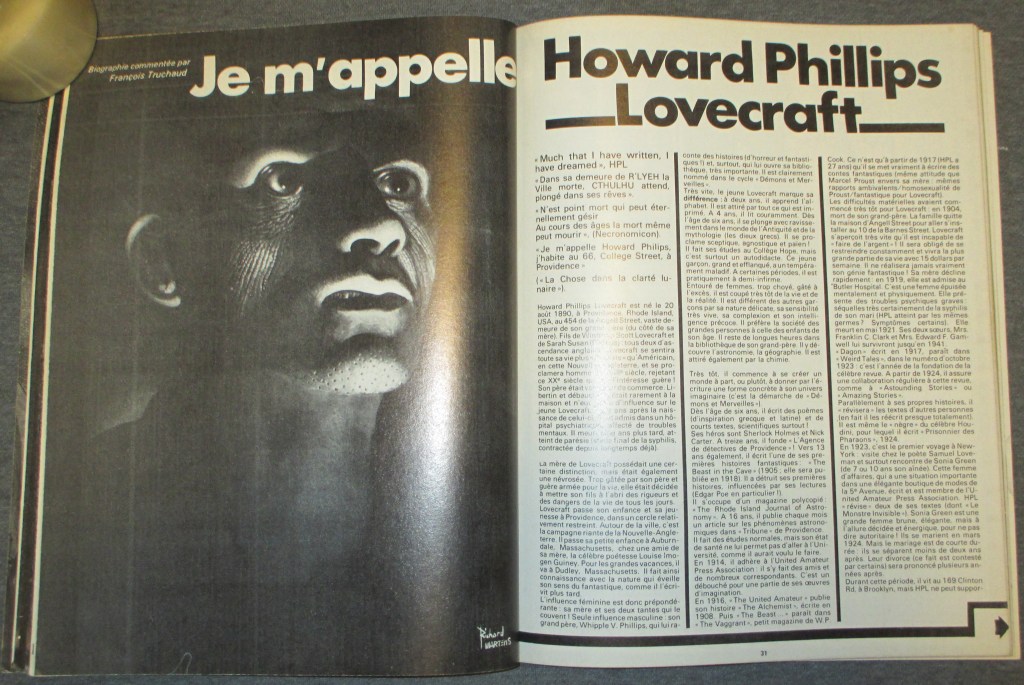
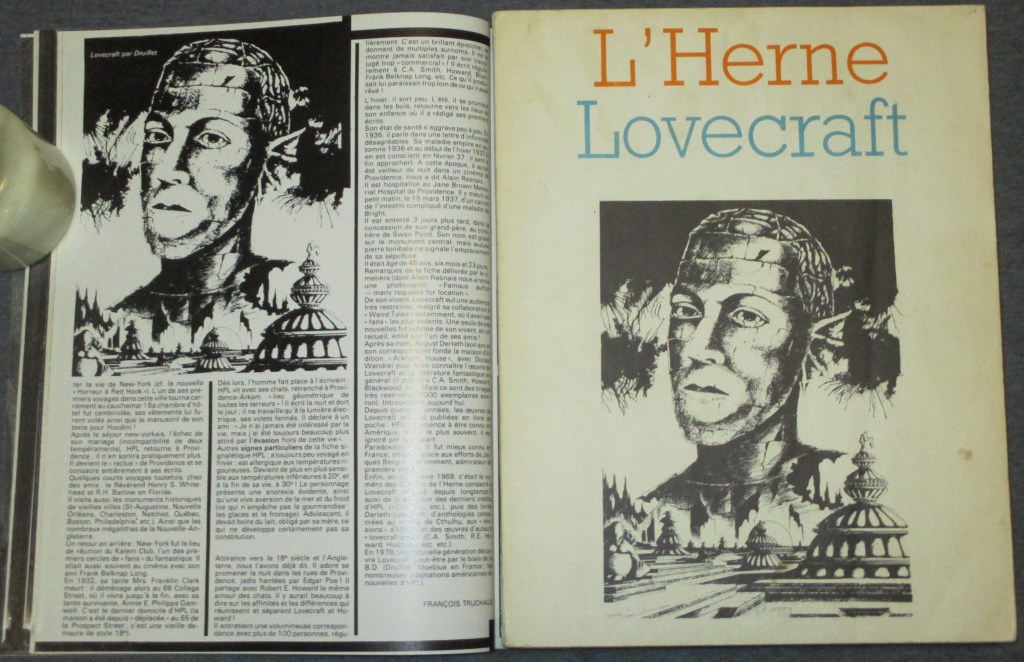
“Je m’appelle Howard Phillips Lovecraft” (“I am called Howard Phillips Lovecraft”) by François Truchaud is a brief biographical sketch of Lovecraft’s life, fairly accurate for the compressed time and space, with illustrations by Richard Martens and Druillet; the Druillet illustration is the same as the cover to the Lovecraft special issue of L’Herne (1969).
“La Nuit du Goimard: Un ecrivain nommé Habileté-à-l’amour” (“The Night of Goimard: A Writer Named Able-to-Love”) by Jacques Goimard is an essay on Lovecraft’s fiction, illustrated by Perry’s silhouette of Lovecraft.
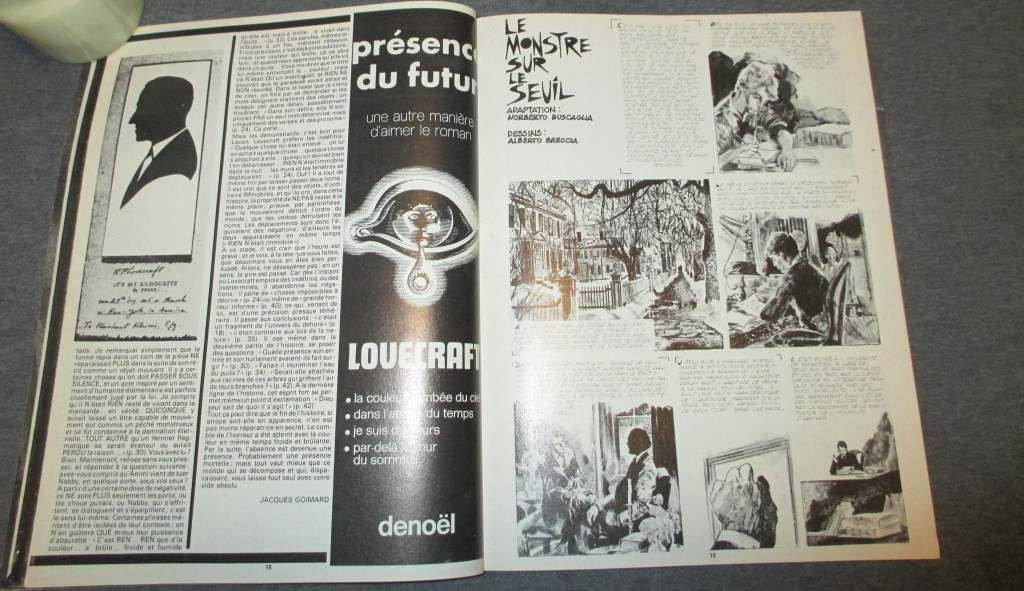
“Le Monstre Sur le Seuil” (“The Monster on the Threshold”) by Norberto Buscaglia & Alberto Breccia is an 11-page black-and-white comic adaptation of Lovecraft’s “The Thing on the Doorstep.” Breccia’s art combines traditional pen-and-ink with collage, which leads a strange, otherworldly aspect to the artwork.
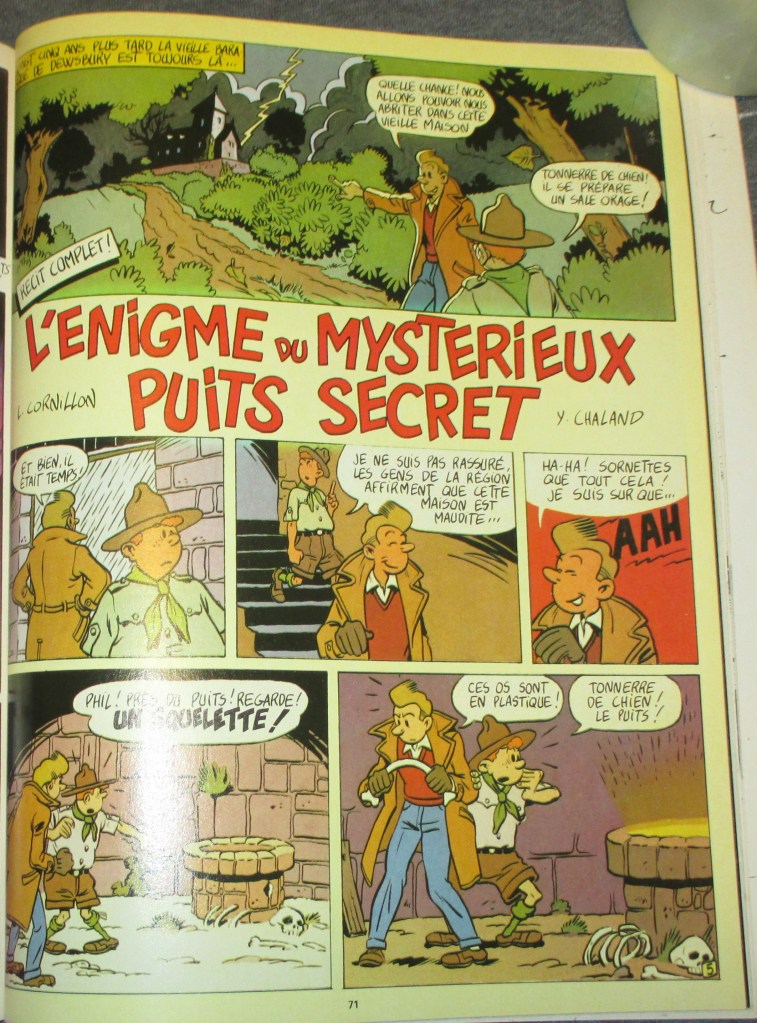
“L’énigme du mystérieux puits secret” (“The Riddle of the Mysterious Secret Well”) by Yves Chaland & Luc Cornillon is a 4-page color comic where an investigative duo investigates a mysterious well and uncovers some counterfeiters; slightly reminiscent in overall style to Hergé’s Tintin. Not explicitly Lovecraft-related.
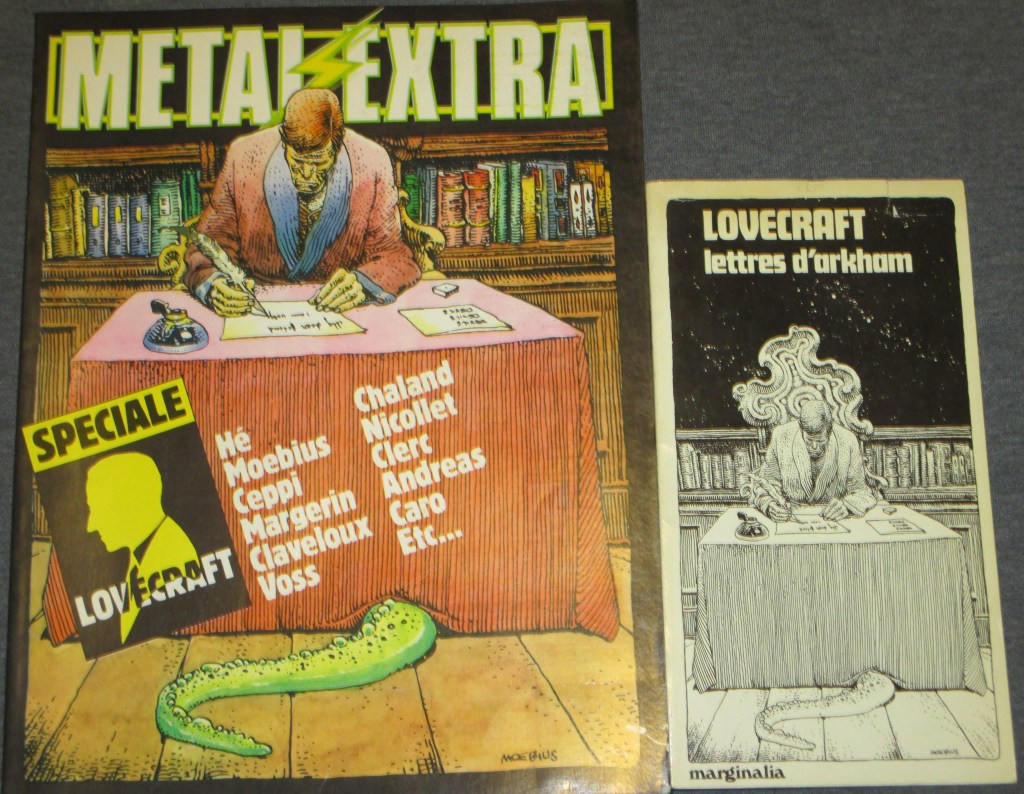
“Lettres de Lovecraft” (“Lovecraft’s Letters”) by François Truchaud is a review of Lettres 1 (1978), the French-language translation of the first volume of Lovecraft’s Selected Letters. Illustrated by Mœbius’ cover for Lettres d’Arkham (1975).
“L’Indicible Horreur d’Innswich” (“The Unspeakable Horror of Innswich”) by Philippe Setbon is a short fiction that purports to be the last story written by H. P. Lovecraft, complete with a mock reproduction of the original manuscript written on an envelope, based on the famous At the Mountains of Madness envelope.
“Petite bibliothèque lovecraftienne” (“Little Lovecraftian Library”) by François Truchaud is a brief survey of Lovecraft-related material available in French publications, as well as some related publications such as The Occult Lovecraft (1975) and H. P. Lovecraft: A Biography (1975) in English.
Back cover by Richard Martens, based on a photo of Lovecraft.
Heavy Metal H. P. Lovecraft Special Issue (Oct 1979)
This material is taken, for the most part, from a bizarre and eldritch tome written in a strange tongue, the “Homage á Lovecraft” issue of Métal Hurlant. We trust it will add just the right touch to your Hallowe’en festivities.
—Sean Kelly, editorial for Heavy Metal vol. III, no. 6
96 pages, counting the ads, table of contents, etc., which makes for a thinner magazine that can still be side-stapled. Heavy Metal magazine vol. III, no. 6 is part of the normal numbering rather than an extra or one-off issue. While it draws much of its material directly from the Métal Hurlant Lovecraft special, the publishers chose not to reproduce all of the Lovecraft material from the French.
What didn’t they translate? The text pieces, the Georges Kuchar reprint, several of the more humorous and less Lovecraft-related comics, a couple pages of Druillet’s Necronomicon, and oddly the Breccia adaptation of “The Thing at the Doorstep.” What remains isn’t exactly entirely dedicated to Lovecraft, either, so that the “Lovecraft” issue has rather less Lovecraft-related material in it than might be expected.
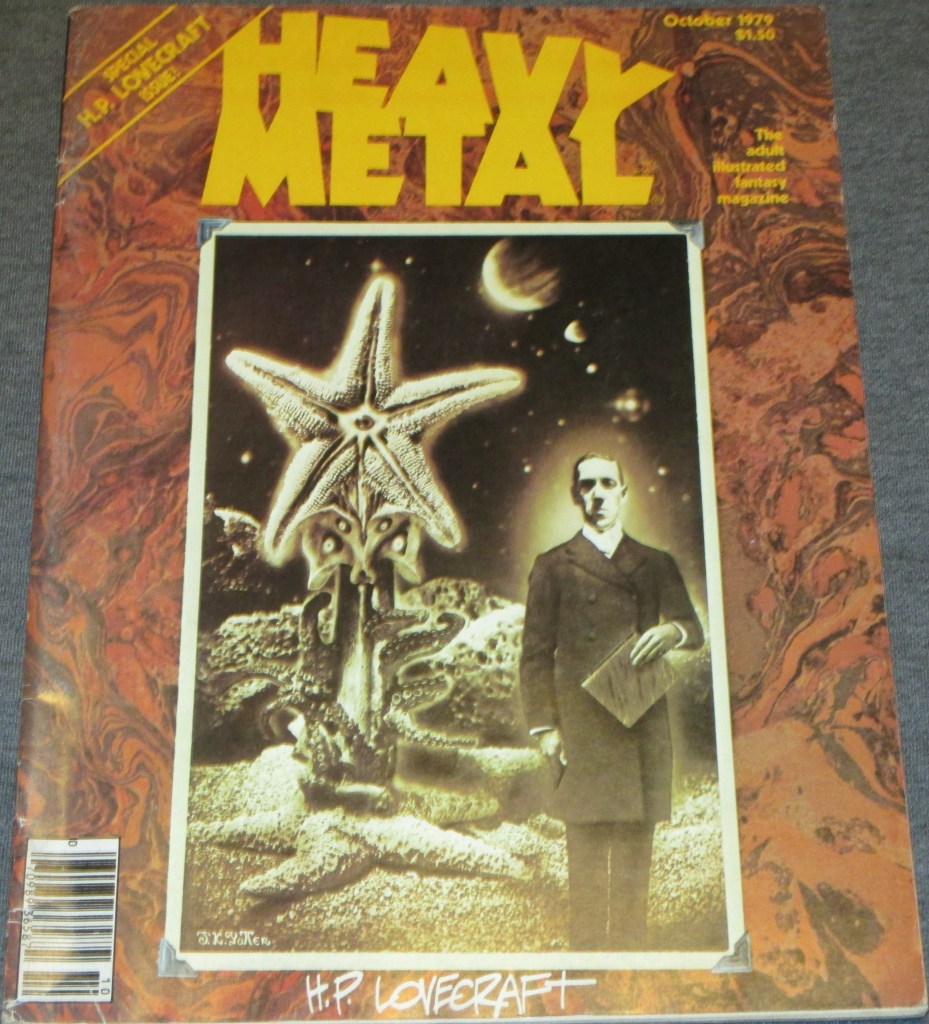
Maybe there was a crunch with time to put the issue together, or some issues with the right. However, they also added a few things that didn’t appear in the Métal Hurlant issue, notably the J. K. Potter cover and “The Devil’s Alchemist,” a work of fiction. Unlike the Métal Hurlant Lovecraft special, the majority of Heavy Metal pages are in color, including colorizing some works that were in black-and-white in Métal Hurlant.
Lovecraftian items are marked in bold; color pages are marked [c]; items from the Métal Hurlant special are marked with an asterisk (*).
- Front cover (“Mr. Lovecraft”) by J.K. Potter
- Advertisement for Strategy & Tactics, 1
- [c] Table of Contents, 2
- [c]Advertisement for Job Cigarette Papers, 3
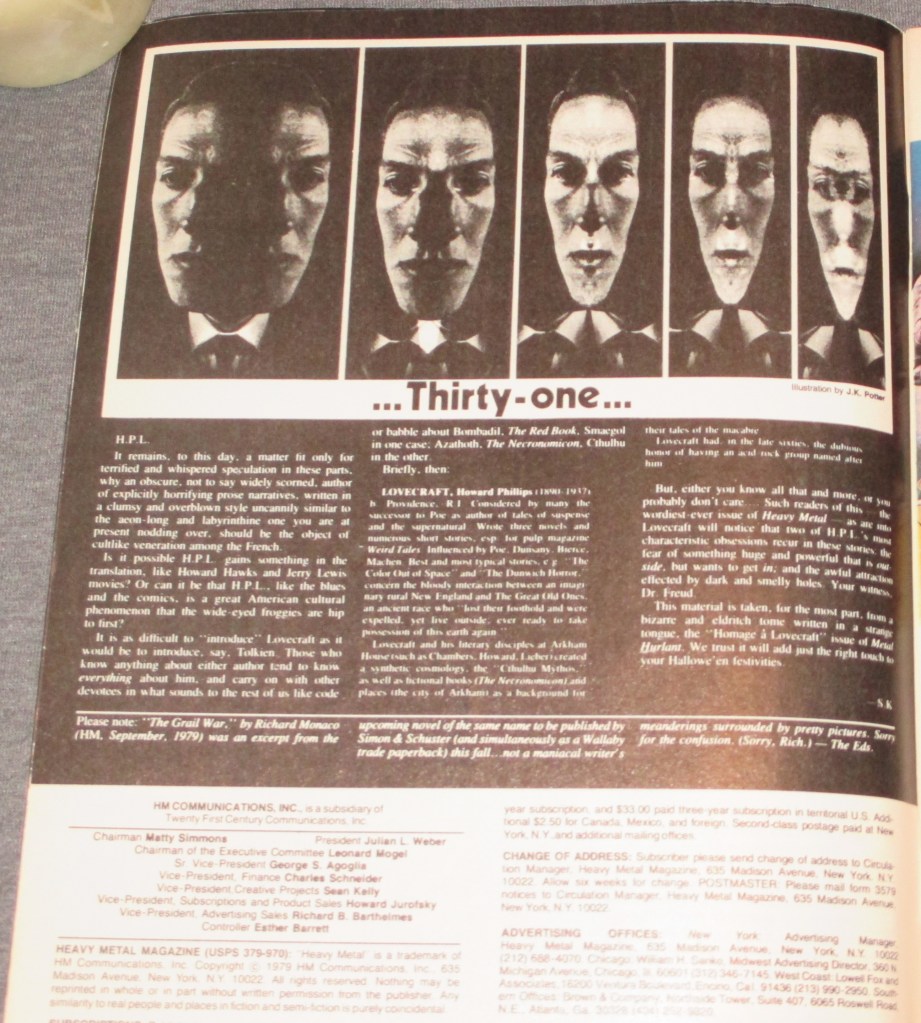
- “…Thirty-one…” (editorial) by Sean Kelly w/ J. K. Potter, 4
- [c] Advertisement for The Encyclopedia of Science Fiction, 5
- [c] “Final Justice” by Chateau, 6-14
- [c] Advertisement for Heavy Metal posters, 15
- [c] Advertisement for Heavy Metal subscriptions, 16
- [*] “The Dunwich Horror” (“L’Abomination de Dunwich”) by Alberto Breccia, 17-25, 74-80
- [c] [*] “Ktulu” by Mœbius, 25-29
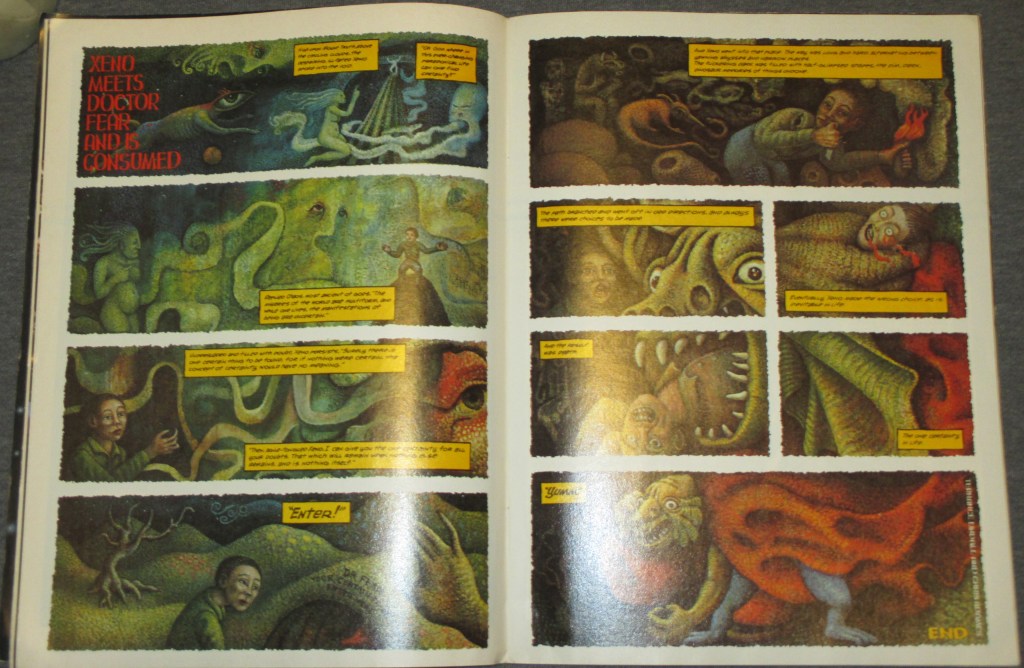
- [c] “Xeno Meets Dr. Fear and Is Consumed” by Terrance Lindall & Chris Adames, 30-31
- [*] “The Thing” (“La Chose”) by Alain Voss, 32-37
- [*] “The Beasts” (“Les Bêtes”) by Dank, 38-40
- [c] [*] “The Man from Blackhole” (“L’Homme de Black Hole”) by Serge Clerc, 41-44
- [c] [*] “H.P.L.” by Jean-Michel Nicollet, 45-47
- [c] “Love’s Craft” by Sean Kelly & Matthew Quayle, 48-49
- [c] [*] “Dewsbury’s Masterpiece” (Le Chef d’Œuvre de Dewsbury) by Yves Chaland & Luc Cornillon, 50-53
- [c] Advertisement for back issues of Heavy Metal, 54-55
- [*] “The Necronomicon” by Druillet, 56-61
- [*] “The Language of Cats” (“Le langage des chats”) by Nicole Claveloux, 62-63
- “Chain Mail” (letters page, but comic by Christopher Browne) 64
- [c] Advertisement for Dragonworld, 65
- [c] “Pat and Vivian” by Frank Margerin, 66-68
- [c] “The Alchemist’s Notebook” by David Hurd & William Baetz, w/Walter Simonson, 69-73
- [“The Dunwich Horror” continued, 74-80]
- [c] Advertisement for The Grailwar by Richard Monaco, 81
- [c] “Bad Breath” by Arthur Sudyam, 82-89
- [c] Advertisement for Heavy Metal books/graphic novels, 90-91
- [*] “The Agony Column” (“Amitiés Rencontres”) by Vepy & Daniel Ceppi, 92-96
- Back cover (“Elizabeth”) by George Smith
Unique Content
Front cover: “Mr. Lovecraft” by J.K. Potter. Before digital image manipulation programs existed, Potter was producing strange, disturbing images with a combination of photographs, airbrush, and traditional pen and ink. The effects, with Potter’s imagination, could be quite stunning. In this instance, he uses it to place Lovecraft in a cosmic scene. Potter would lend his talents to several future Lovecraft-related projects, including the cover for Tales of the Cthulhu Mythos (1990).
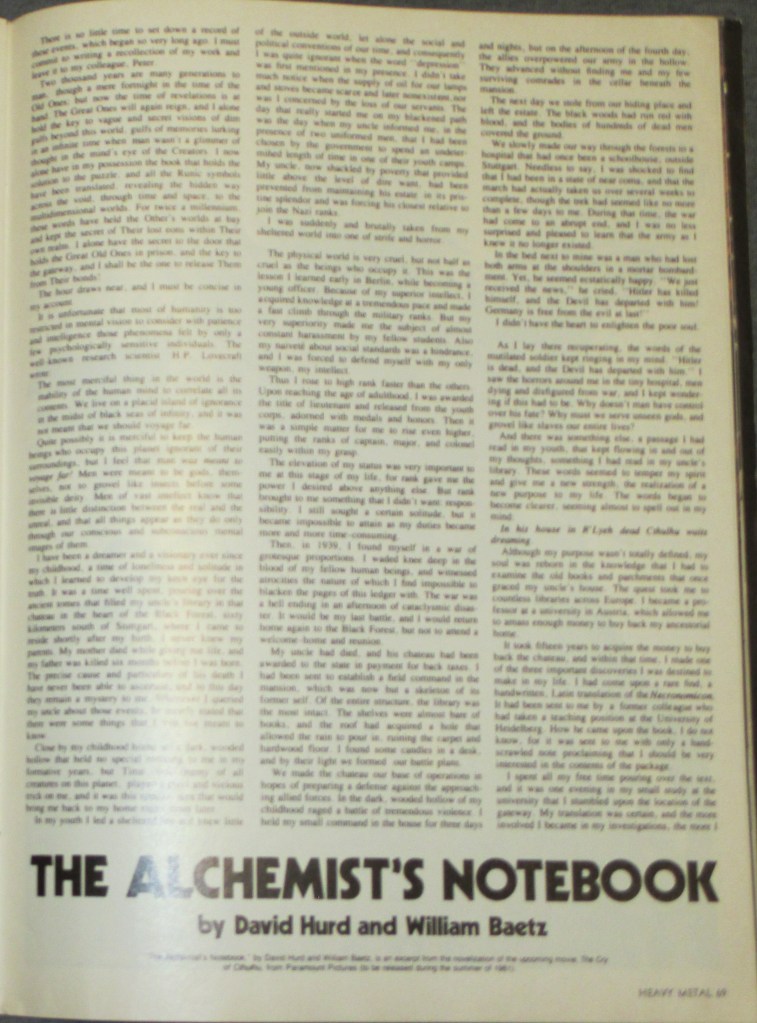
“The Alchemist’s Notebook” by Byron Craft (as by David Hurd & William Baetz) is an original work of Mythos fiction, with illustrations by Walter Simonson. A note on the first page says that this story is “an excerpt from the novelization of the upcoming movie, The Cry of Cthulhu“—but the film never made it past pre-production (Cthulhu Calling: An Interview with Byron Craft). In 2016, Craft published the full version of the novelization as The Alchemist’s Notebook, which was later changed to The Cry of Cthulhu.
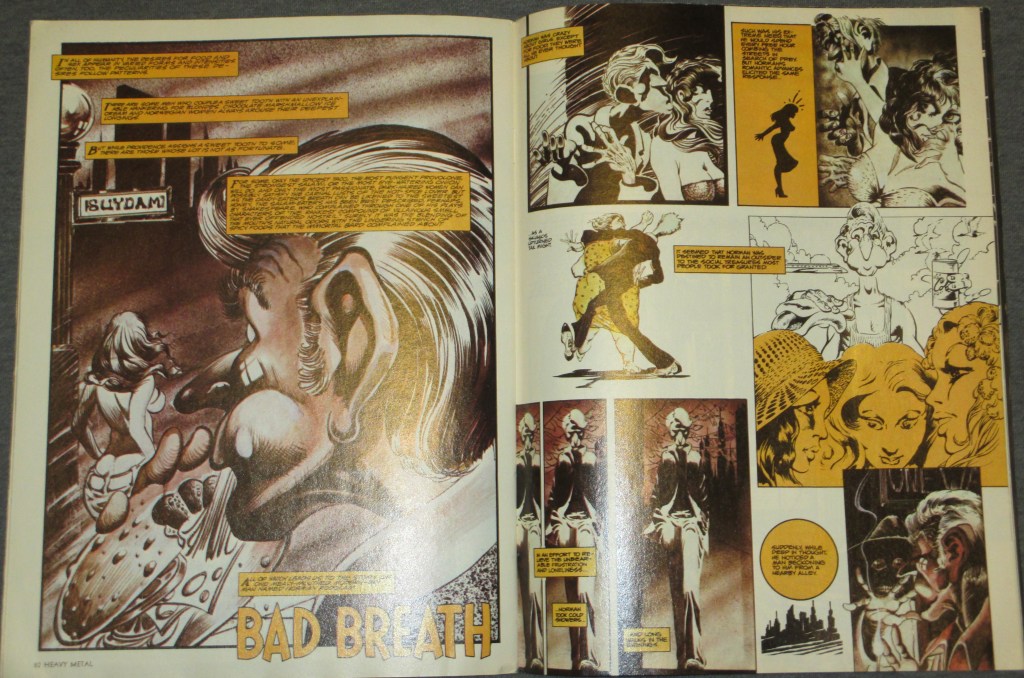
“Bad Breath” by Arthur Sudyam is an 8-page comic that is principally black-and-white with color tints on Selected panels and figures; it follows an amorous young man whose bad breath is impacting his love life, and the solution he attempts has horrific—and amusing—consequences. Not explicitly Lovecraft-related.
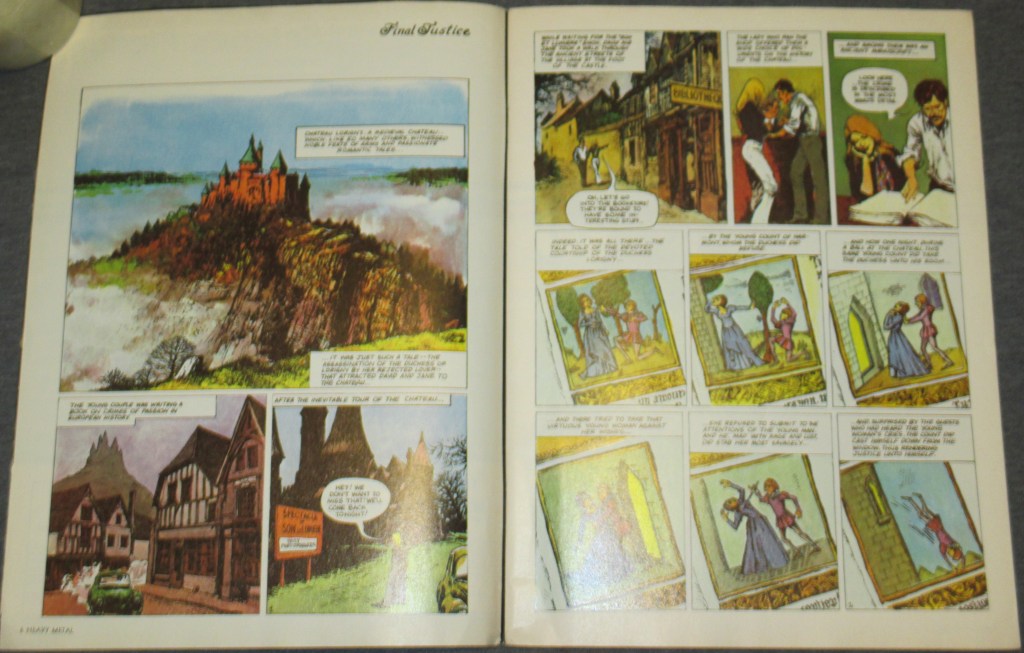
“Final Justice” by Chateau is a 9-page color comic where a couple in Europe to write a book on historical crimes watch the re-enactment of a medieval murder at an ancient chateau. Not explicitly Lovecraft-related.
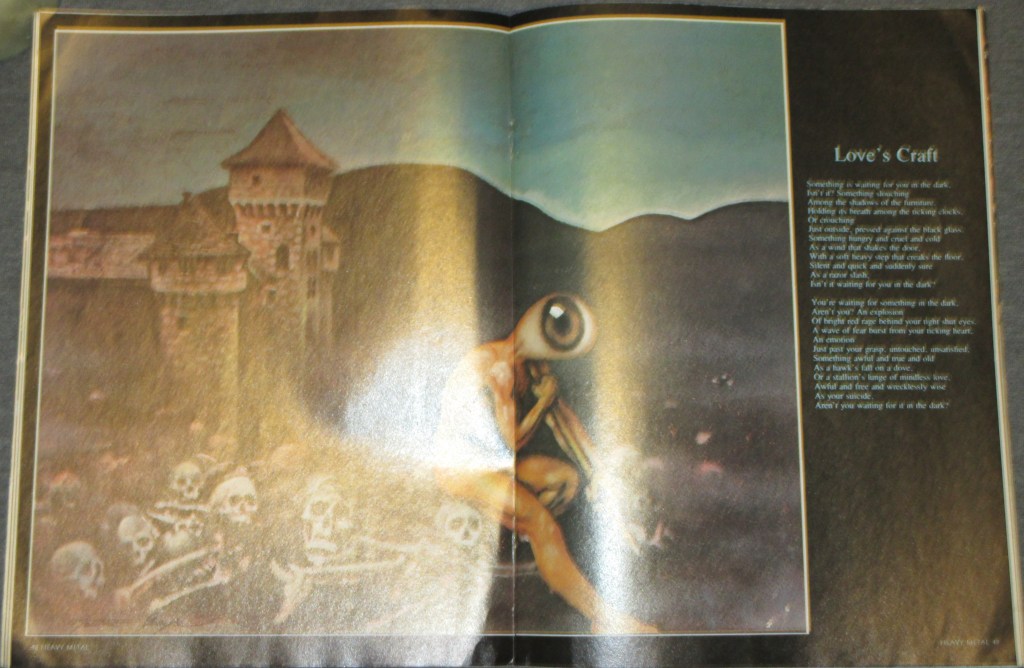
“Love’s Craft” by Sean Kelly is a poem, accompanied by an illustration by Matthew Quayle. Tentatively Lovecraftian based on the title, but with no direct references to Lovecraft or the Mythos.
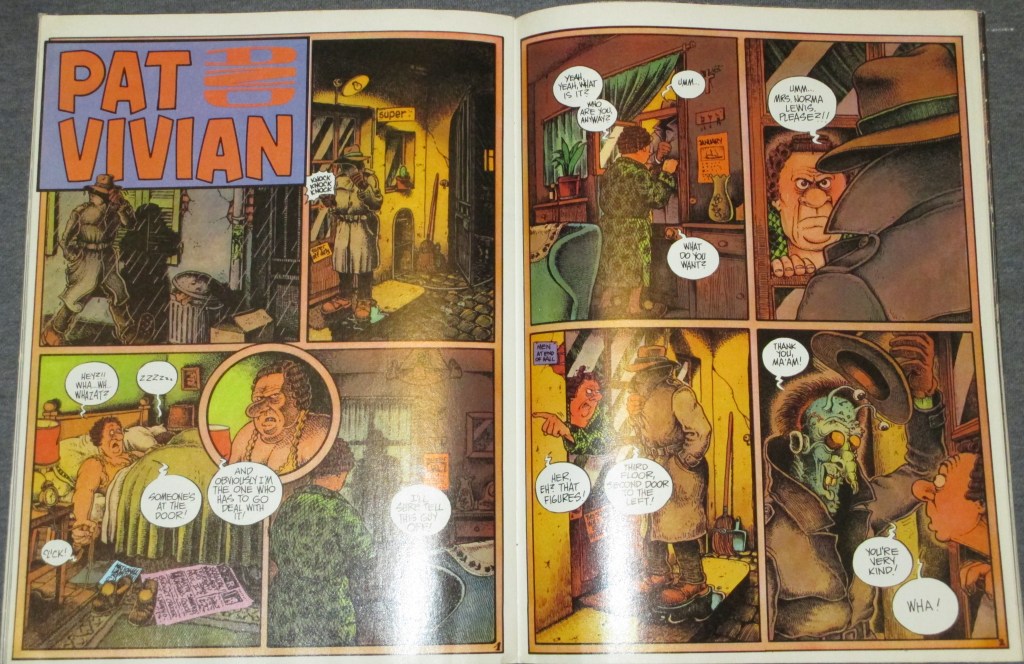
“Pat and Vivian” by Frank Margerin is a 3-page humorous comic about a woman awoken by a strange entity at the door. Not explicitly Lovecraft-related.
“…Thirty-one…” (editorial) by Sean Kelly, discussing Lovecraft in brief. Accompanied by a photo-manipulated image of Lovecraft by J. K. Potter.
“Xeno Meets Dr. Fear and Is Consumed” by Terrance Lindall & Chris Adames is a two-page color fantasy/horror comic with a distinct textured painting style. Young Xeno, asking a fundamental question about certainty, sets off in dreams to find Dr. Fear—and does. Not explicitly Lovecraft-related.
Metal Extra Speciale Lovecraft (Nov 1982)
| Cui, questo numero speciale di Métal Hurlant e un vero e proprio “omaggio” nei limiti è nei termini in cui puo esserlo una realizzazione a fumetti. Essa però dimostra sino a che punto è giunta oggi l’influenza del “solitario di Providence” e del suo mondo di sogni, di miti, di realtà alternative. E’un “ommagio” che ciascun disegnatore o scrittore ha estrinsecato secondo la sua predisposizione, il suo modo di vedere, il suo atteggiaento mentale, culturale, di spirito. E cosi (non ci si meravigli di ciò) vi saranno controbuti (fumetti) “seri” e meno seri o aprtamente ironici, allucinati e satirici. Un autore è amato non soo quando si prende sul serio il suo universo incubico (come ne L’uomo del Buco Nero, Il capolavoro di Dewsbury, ecc.), ma anche quando ci si scherza su, fra il serio e il faceto (Cthulhu), lo si prende aperamente in giro (La traccia scarlatta, Escursione notturna, Il ritorno di Cthulhu e cosi via). | Hence, this special issue of Métal Hurlant is a real “homage” to the extent that a comic book production can be. However, it demonstrates how far the influence of the “solitary of Providence” and his world of dreams, myths, and alternative realities has reached today. It is an “homage” that each artist or writer has expressed according to his predisposition, his way of seeing, his mental, cultural, and spiritual attitude. And so (don’t be surprised by this) there will be “serious” and less serious or overtly ironic, hallucinatory and satirical counterparts (comics). An author is loved not only when his nightmare universe is taken seriously (as in The Man from the Black Hole, Dewsbury’s Masterpiece, etc.), but also when he is joked about, half-jokingly (Cthulhu), and openly made fun of (The Scarlet Trail, Night Excursion, The Return of Cthulhu, and so on). |
| Gianfranco de Turris, Metal Extra Speciale Lovecraft, 5 | English translation |
Instead of trying to publish this as part of their regular series of issues, the editors in Italy essentially excerpted the majority of the Lovecraft comics content from the Métal Hurlant Lovecraft special and squeezed it into a 100-page (counting covers) square-bound Metal Extra issue. They also added some additional materials not in either the Métal Hurlant or Heavy Metal Lovecraft special issues
Lovecraftian items are marked in bold; color pages are marked [c]; items from the Métal Hurlant special are marked with an asterisk [*].
- [*] Front Cover by Mœbius
- Table of Contents, 3
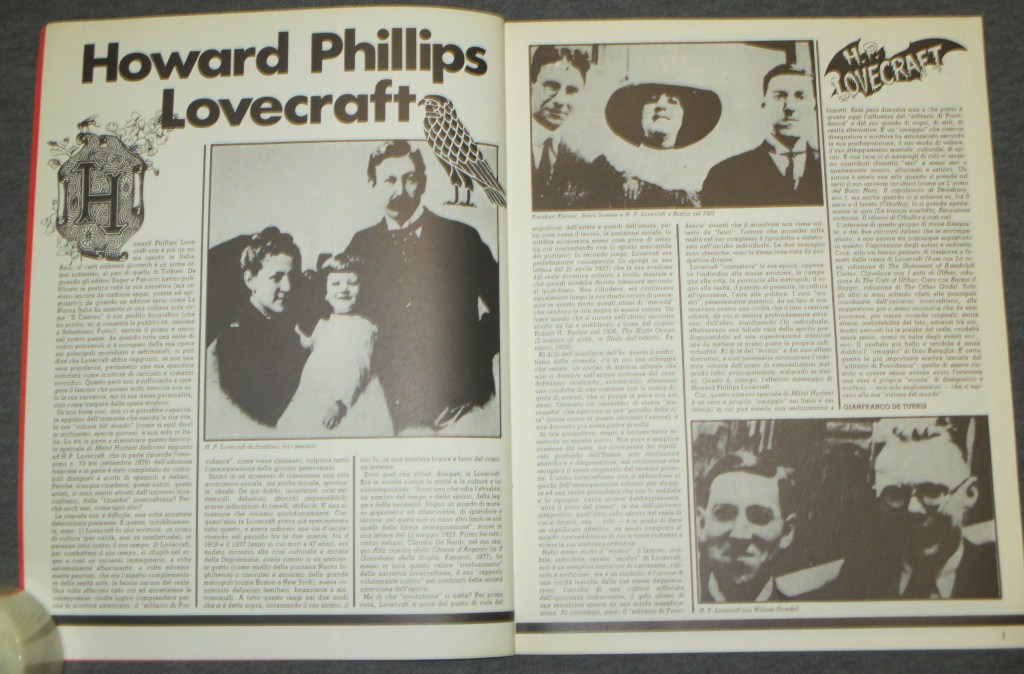
- “Howard Phillips Lovecraft” by Gianfranco de Turris, 4-5
- [*] “Annunci sul Gironale…” (“Amitiés Rencontres”) by Vepy & Daniel Ceppi, 6-10
- [*] “Barzai il Saggio” (“Barzai le Sage”) by Marc Caro, 11-18
- [c] [*] “Ktulu” by Mœbius, 19-25
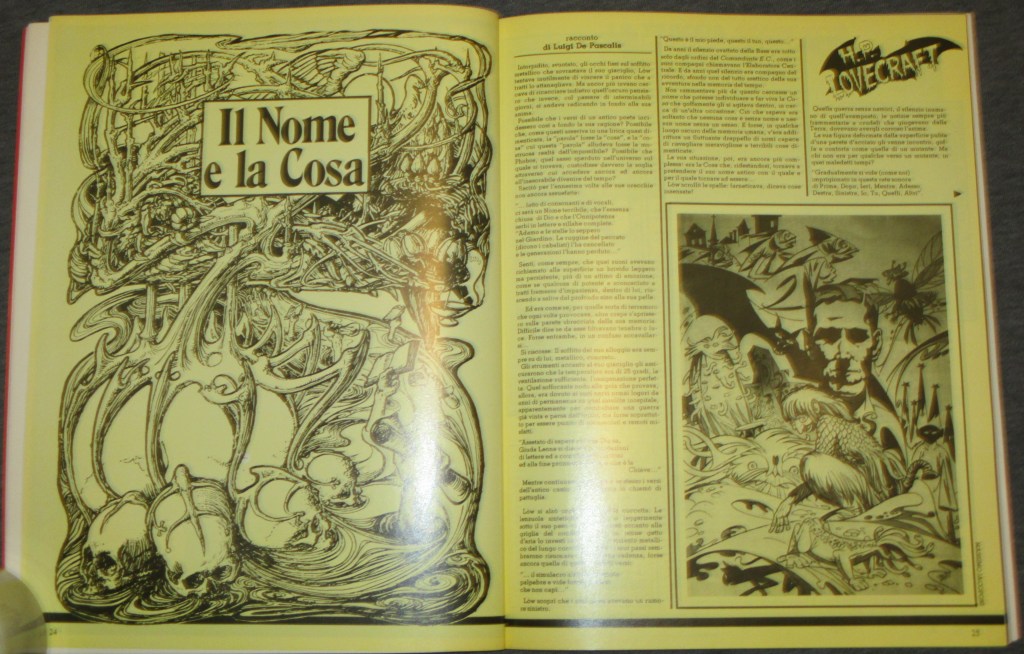
- “Il Nome e la Cosa” by Luigi de Pascalis, 24-26
- [c] [*] “La Traccia Scarlatta” (“La Trace Ecarlate”) by Jean-Jacques Mendez & Daniel Ceppi, 27-28
- [*] “H. P. Lovecraft al Cinema” (“H. P. Lovecraft au cinéma”) by Jean-Pierre Bouyxou [uncredited], 29-30
- [c] [*] “Il Capolavoro di Dewsbury” (Le Chef d’Œuvre de Dewsbury) by Yves Chaland & Luc Cornillon, 31-34
- [*] “Il Ritorno di Cthulhu” (“La Retour de Cthulhu”) by Alan Charles & Richard Martens, 35-36
- [*] “La Cosa” (“La Chose”) by Alain Voss, 37-42
- [*] “Alla Ricerca di Kadath” (“A la Recherche de Kadath”) by François Truchaud & M. Perron, 43-46
- [*] “H. P. Lovecraft 1890-1937” by Georges Kuchar, 47-49
- [*] “Il Linguaggio dei Gatti” (“Le langage des chats”) by Nicole Claveloux, 50-51
- [*] “Il Piatto del Girno” (“Plat du Jour”) by Vepy & Daniel Ceppi, 52-54
- [*] “Escursione Notturna” (“Excursion Nocturne”) by Frank Margerin, 55-58
- “R. H. B.” by Andreas & François Rivière, 59-66
- [*] “H. P. L.” by Jean-Michel Nicollet, 67-69
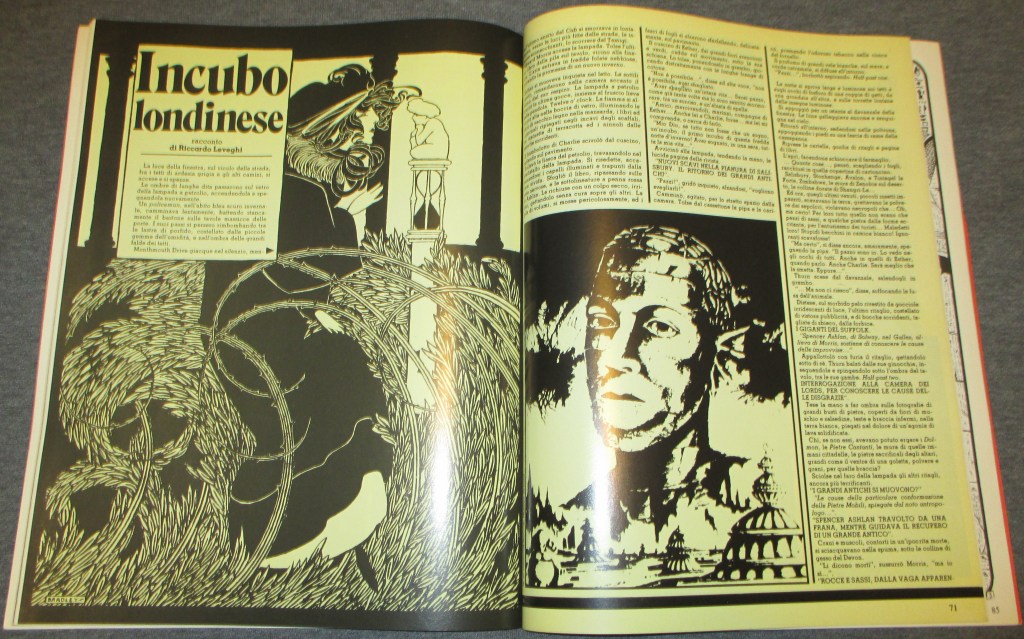
- “Incubo Londinese” by Riccardo Leveghi, 70-72
- [c] [*] “Il Ponte dull’acqua” (“Le Pont Au Dessus de l’Eau”) by Luc Cornillon, 73-74
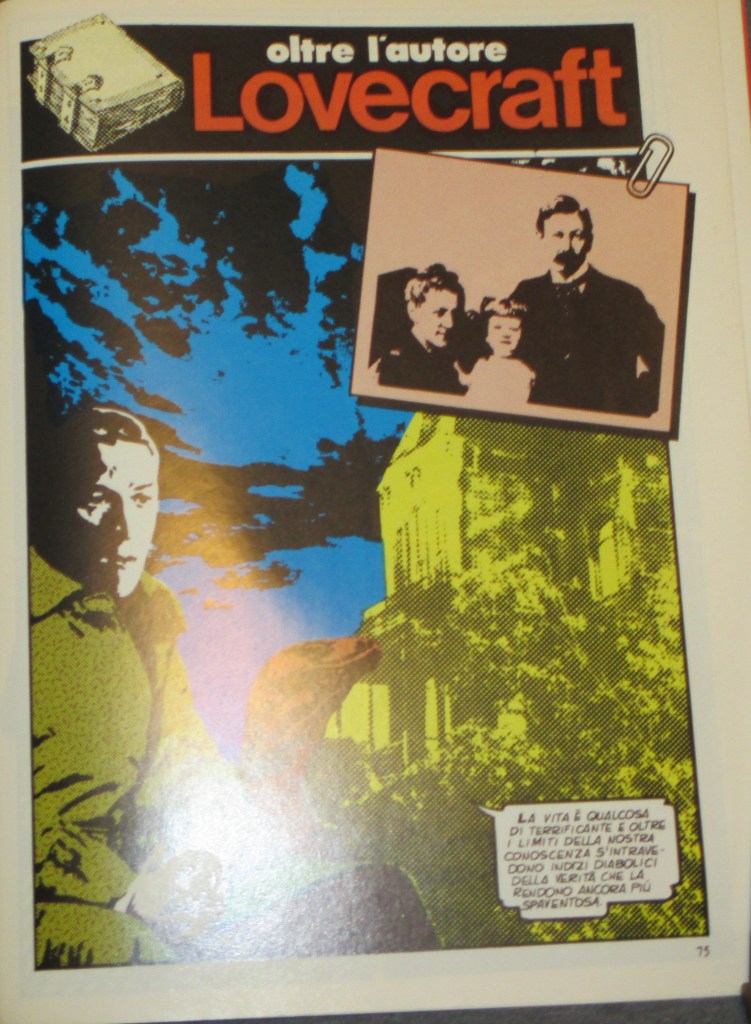
- [c] “Oltre L’autore Lovecraft” by Onomatopeya, 75-82
- [*] “Le 3 Case di Seth” (“Les 3 Maisons de Seth”) by Dominique Hé, 83-85
- [*] “La Bestie” (“Les Bêtes”) by Dank, 86-88
- [*] “L’Uomo di Black Hole” (“L’Homme de Black Hole”) by Serge Clerc, 89-92
- [*] “Le 2 Vite di Basil Wolverton” (“Les 2 Vies de Basil Wolverton”) by Yves Chaland, 93-94
- [*] “Omaggio a H. P. Lovecraft” (“Hommage à HPL…”), 95-97
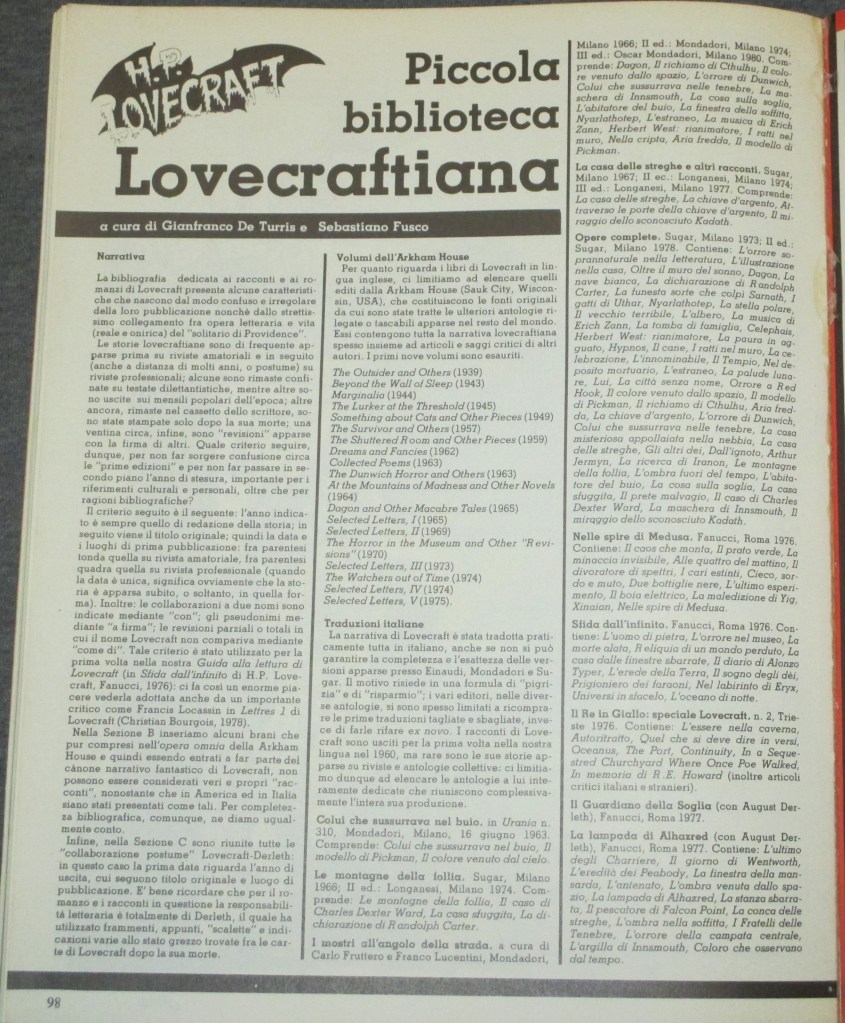
- “Piccola Bibioteca Lovecraftiana” by Gianfranco de Turris & Sebastiano Fusco, 98
Unique Content
Front Cover is a colorized version of Mœbius’ depiction of Lovecraft at his desk from Lettres d’Arkham.
“Howard Phillips Lovecraft” by Gianfranco de Turris is a two-page editorial-cum-introduction to the issue and Lovecraft, illustrated with reproductions of photos of Lovecraft.
“Il Nome e la Cosa” (“The Name and the Thing”) by Luigi de Pascalis is a short work of fiction about the Golem of Prague, accompanied by illustrations by Massimo Jacoponi, a photo of Lovecraft, and Perry’s silhouette of Lovecraft. Other than the illustrations, no explicit Lovecraftian content.
“Incubo Londinese” (“London Nightmare”) by Riccardo Leveghi is a short work of fiction. Illustrated by Bradley, Druillet’s cover art from L’Herne, a photo of Lovecraft, and two images from Lovecraft’s letters. Other than the illustrations, no explicit Lovecraftian content.
“Oltre L’autore Lovecraft” (“Beyond the Author Lovecraft”) by Onomatopeya is an 8-page fotonovela-style comic about Lovecraft’s life and literary afterlife, a montage of photos tinted, textured, and collaged together with speech bubbles and text boxes to provide a humorous but largely accurate narrative.
“Piccola Bibioteca Lovecraftiana” (“Little Lovecraftian Library”) by Gianfranco de Turris & Sebastiano Fusco; while sharing essentially the same title as its counterpart in Métal Hurlant, this is a brief listing of the relevant Arkham House volumes and the Italian translations of Lovecraft and related materials, including August Derleth’s “posthumous collaborations.”
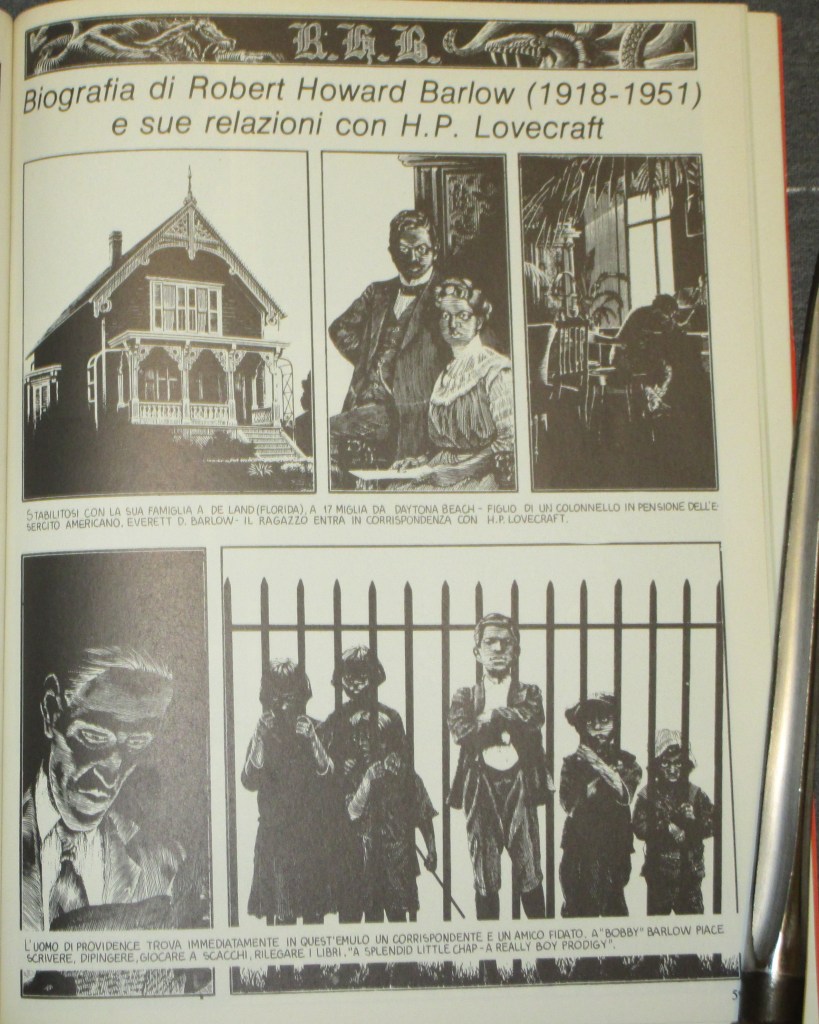
“R. H. B.” by Andreas & François Rivière is an 8-page, black-and-white comic about Lovecraft’s friend R. H. Barlow.
Shared Content
Listed below are the shared features, drawn from the original Métal Hurlant issue and also appearing in either or both of Heavy Metal and Metal Extra, along with notes on differences between the versions and necessary context.
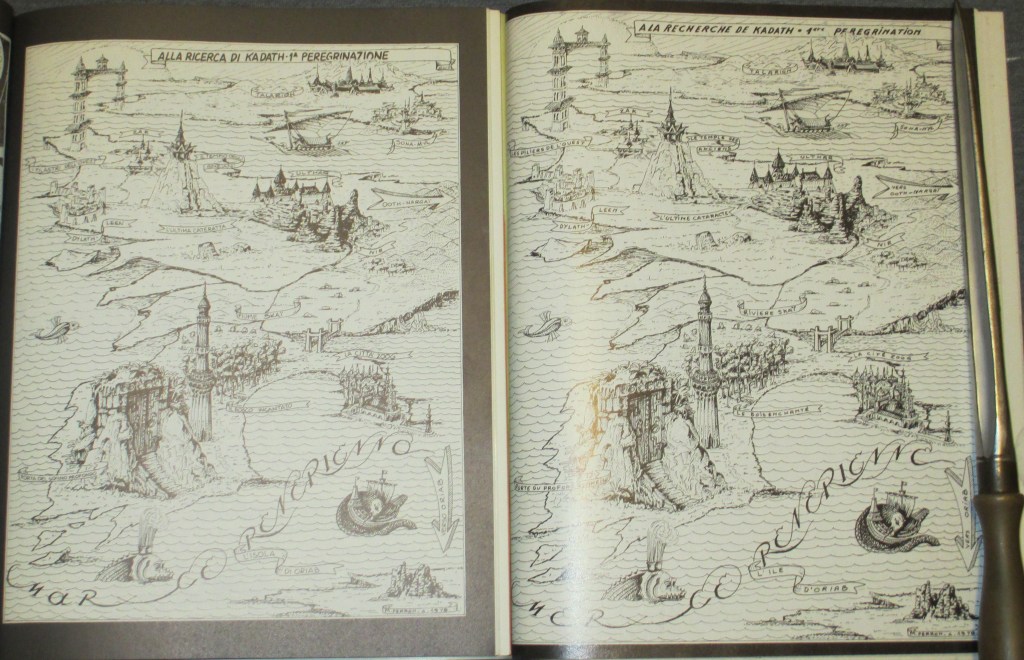
“A la Recherche de Kadath” (“Alla Ricerca di Kadath,” “In Search of Kadath”) by François Truchaud & M. Perron is a 4-page black-and-white fantasy pictorial map of Lovecraft’s Dreamlands in a lavish, detailed style. Appears in Métal Hurlant and slightly smaller in Metal Extra.
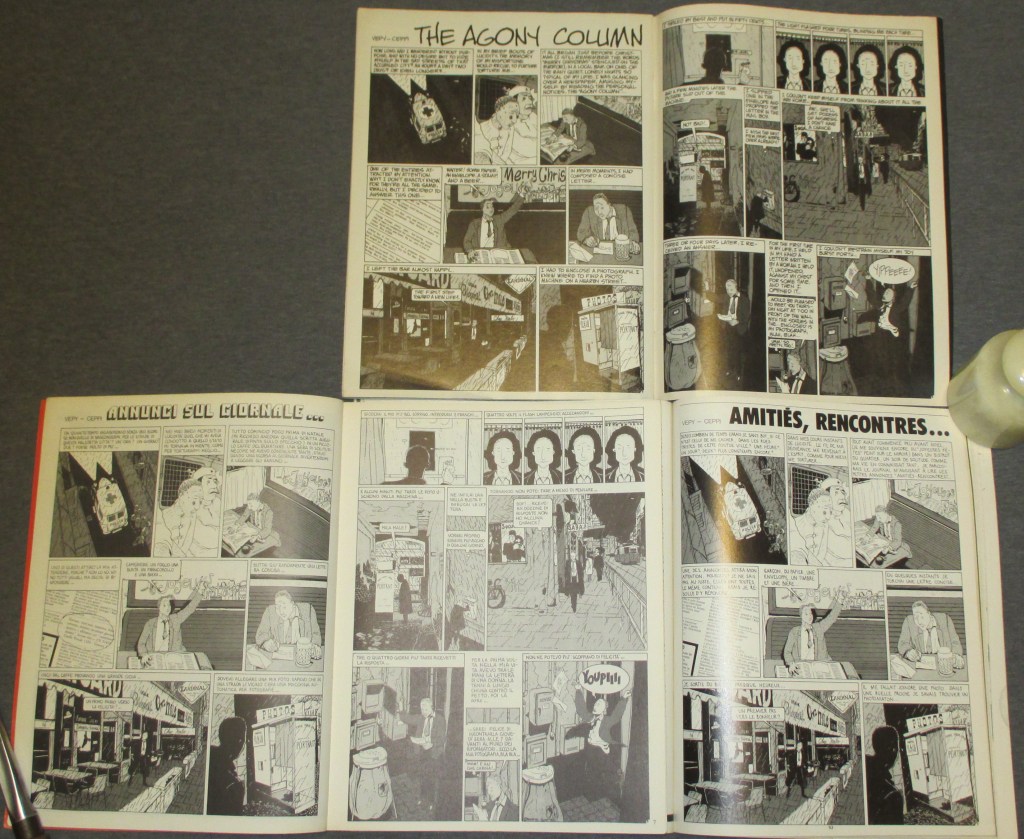
“Amitiés, Rencontres” (“Annunci sul Gironale…,” “The Agony Column”) by Vepy & Daniel Ceppi is a 5-page black-and-white comic. The French title translates literally as “Friendships, Meetings”, and the Italian as “Announcements in the Daily,” but in context it might better be called Personal Ads. The nameless protagonist is in police/medical custody, and flashes back to when he answered a personal ad in the paper, and received a response. When he goes to meet the woman, he is waylaid: the whole setup has been a trap. Not explicitly Lovecraftian. Appeared in Métal Hurlant, Heavy Metal, and Metal Extra.
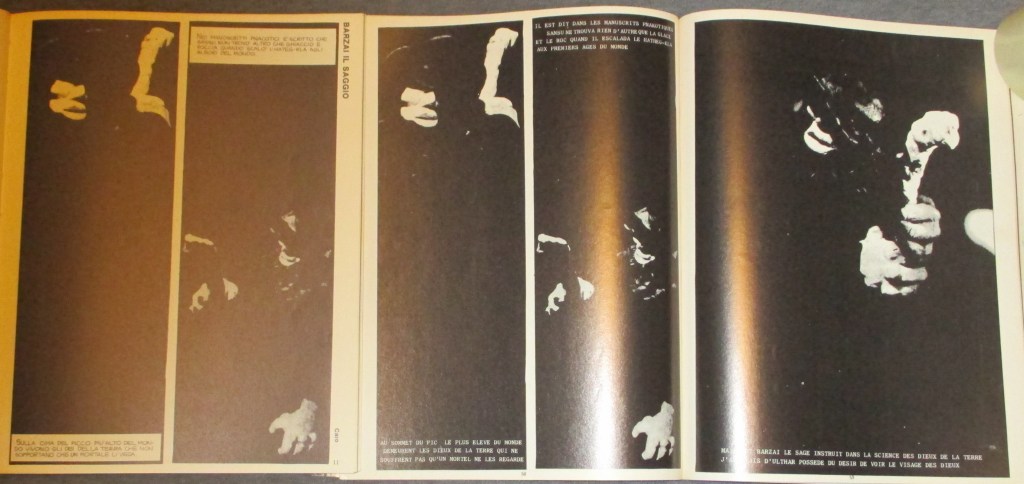
“Barzai le Sage” (“Barzai il Saggio,” “Barzai the Sage”) by Marc Caro is an 8-page comic composed of several extremely dark, heavily-exposed photos of a sculpture of a figure in various poses and backgrounds; the text is derived from Lovecraft’s “The Other Gods.” Appears in Métal Hurlant and in Metal Extra, where text boxes replace the original typed text annotations.
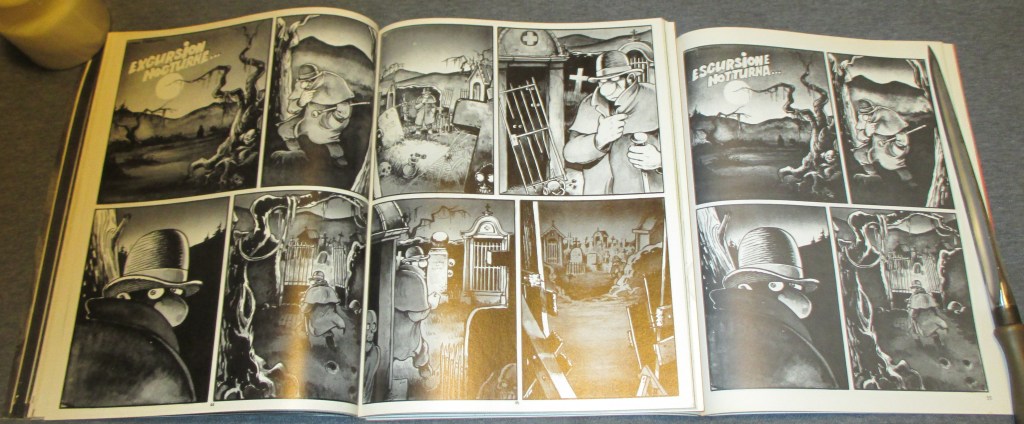
“Excursion Nocturne” (“Escursione Notturna,” “Noctural Excursion”) by Frank Margerin is a 4-page black-and-white comic that is wordless until the final panel; the whole is a careful set-up of horror tropes with a comedic flourish. Not explicitly Lovecraftian. Appeared in Métal Hurlant and Metal Extra.
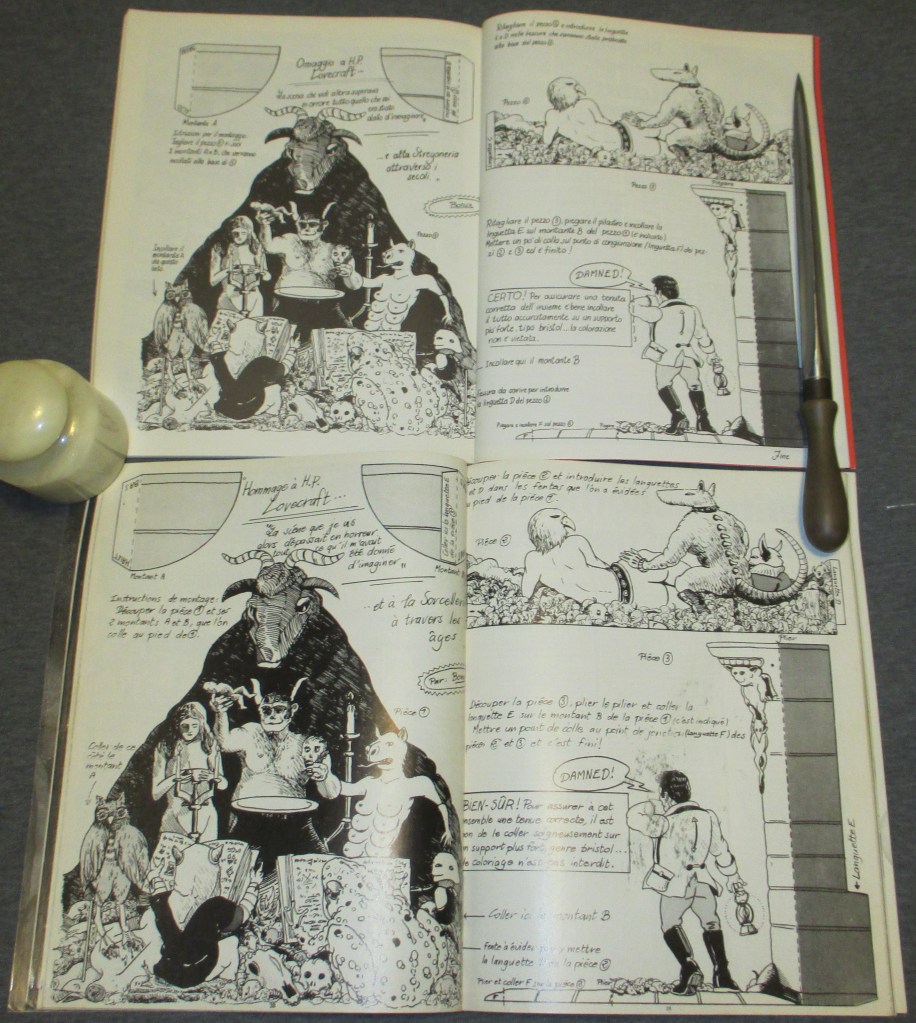
“Hommage à HPL…” (“Omaggio a H. P. Lovecraft,” “Homage to Lovecraft”) by uncredited is nominally a 3-page black-and-white cut-out diorama inspired by Lovecraft; though the content is more descriptive of general witchcraft and I haven’t been able to source any particular Lovecraftian inspiration. Appeared in Métal Hurlant and Metal Extra.
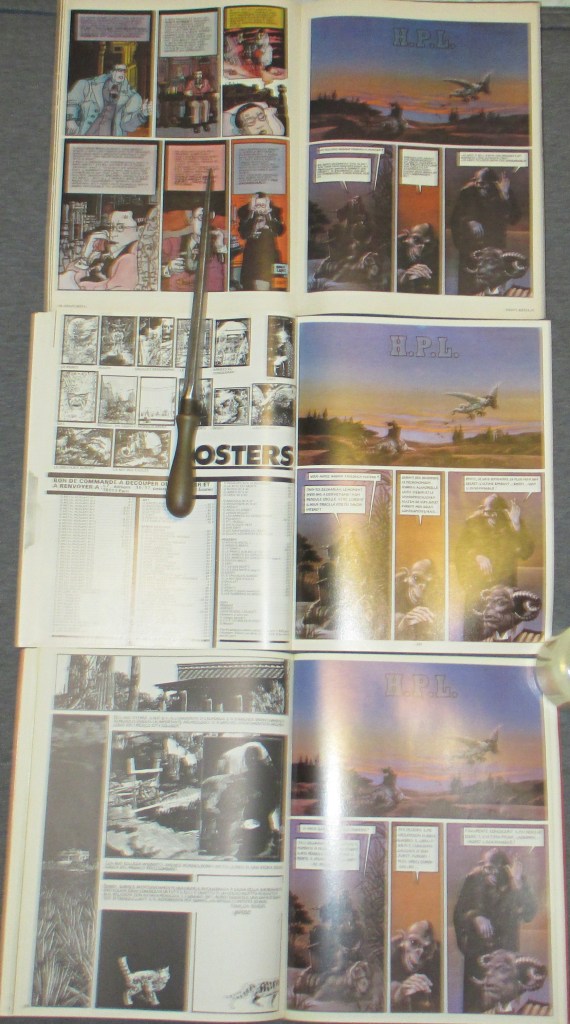
“H. P. L.” by Jean-Michel Nicollet is a 3-page color fantasy painted comic. A pair of fantasy creatures travel through a city to where a suited, winged figure sits on a throne atop a pillar, and asks a sphinx-like riddle. A panel reveals the figure has the face of Lovecraft. While slight in terms of content, and the events play out with a dry humor, the artwork is fantastic. Nicollet would go on to do many painted covers for weird fiction translated into French, including collections of Robert E. Howard, Clark Ashton Smith, etc. The winged, demonic Lovecraft would reappear on the cover of Robert Bloch’s Retour à Arkham (1980). Appeared in Métal Hurlant, Heavy Metal, and Metal Extra.
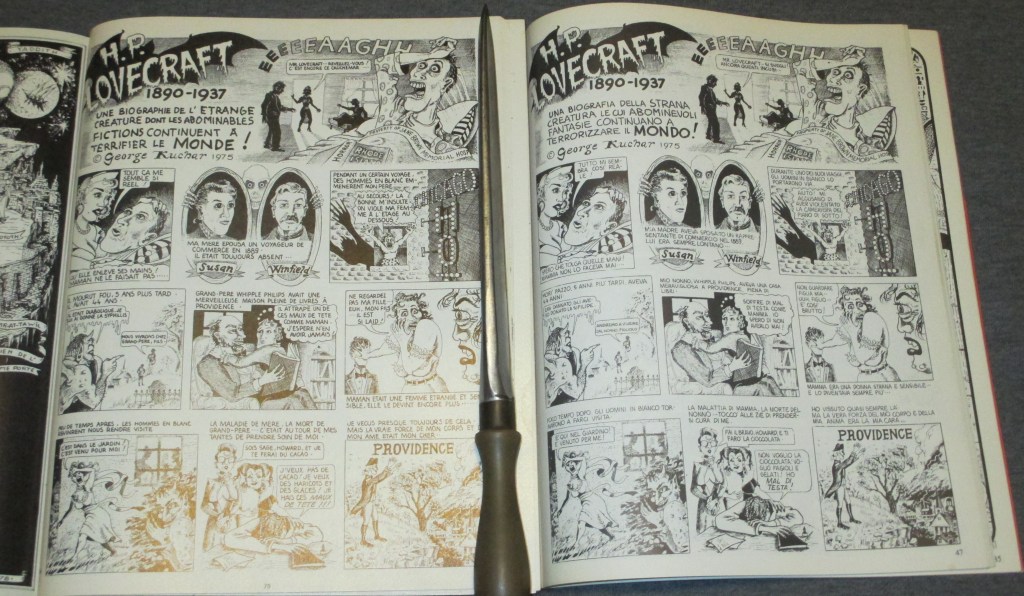
“H. P. Lovecraft 1890-1937” by Georges Kuchar is a 3-page biographical comic of Lovecraft’s life, which first appeared in the U.S. underground comix Arcade #3 (1975). Kuchar exaggerates certain elements of Lovecraft’s life and personality for comedic effect, but largely follows the available scholarship and characterization of H.P.L. in 1975. Appeared in Métal Hurlant and Metal Extra.
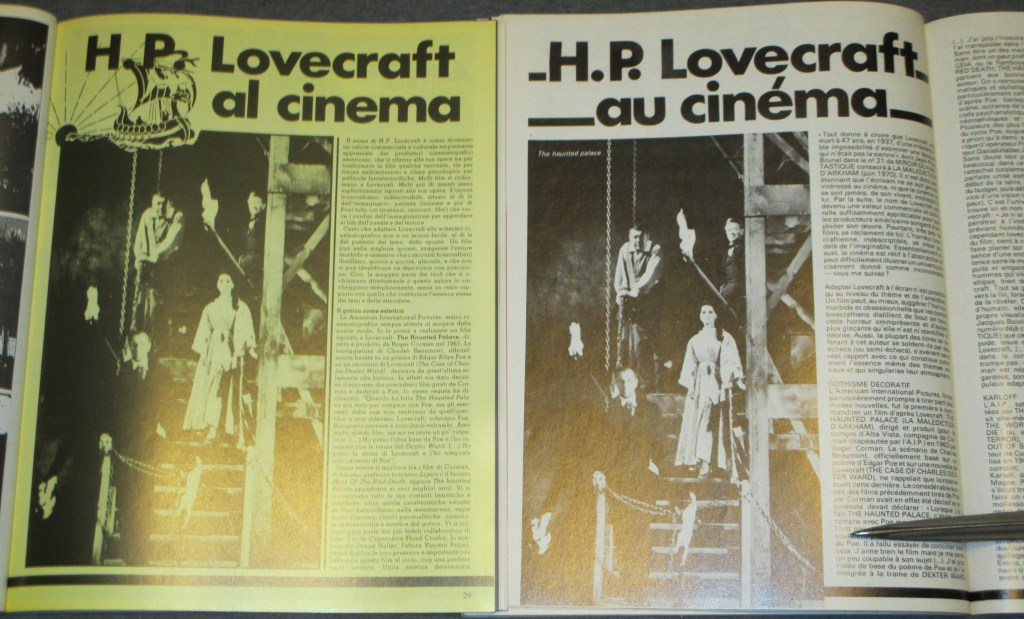
“H. P. Lovecraft au cinéma” (“H. P. Lovecraft al Cinema,” “H. P. Lovecraft at the Cinema”) by Jean-Pierre Bouyxou is an article on cinematic adaptations of Lovecraft up to that point, which was essentially The Haunted Palace (1963), Die, Monster, Die! (1965), The Shuttered Room (1967), Curse of the Crimson Altar (1968), and The Dunwich Horror (1970); although they also mention Necronomicon – Geträumte Sünden (1968) and Equinox (1972). Originally published in Métal Hurlant and translated for Metal Extra. Illustrated with stills from The Haunted Palace.
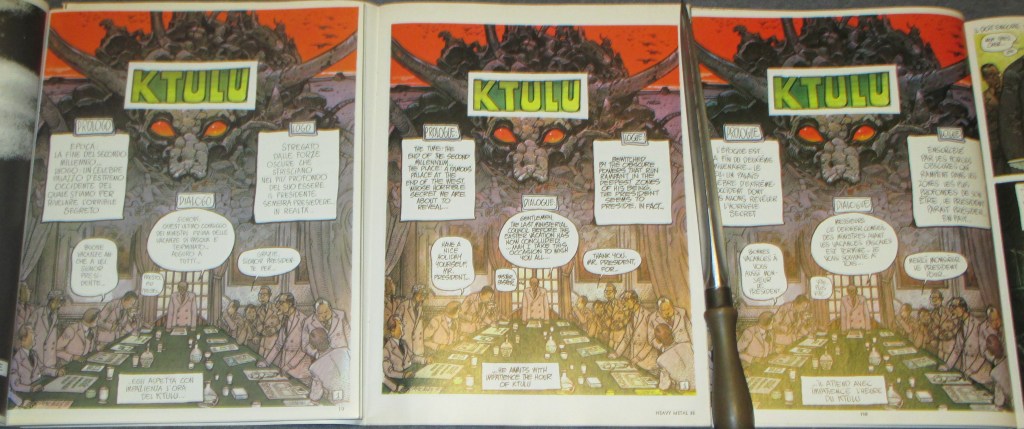
“KTULU” by Mœbius is a 5-page color comic; a group of politicians, finished with a week’s work, descend to a strange place and ask Lovecraft where to find a Ktulu to hunt. A surreal, sardonic work that owes little to the Mythos but echoes Mœbius’ other work of the period, like Le Garage Hermétique; the image of Lovecraft on a high throne oddly echoes Nicollet’s “H.P.L.” Appeared in Métal Hurlant, Heavy Metal, and Metal Extra.
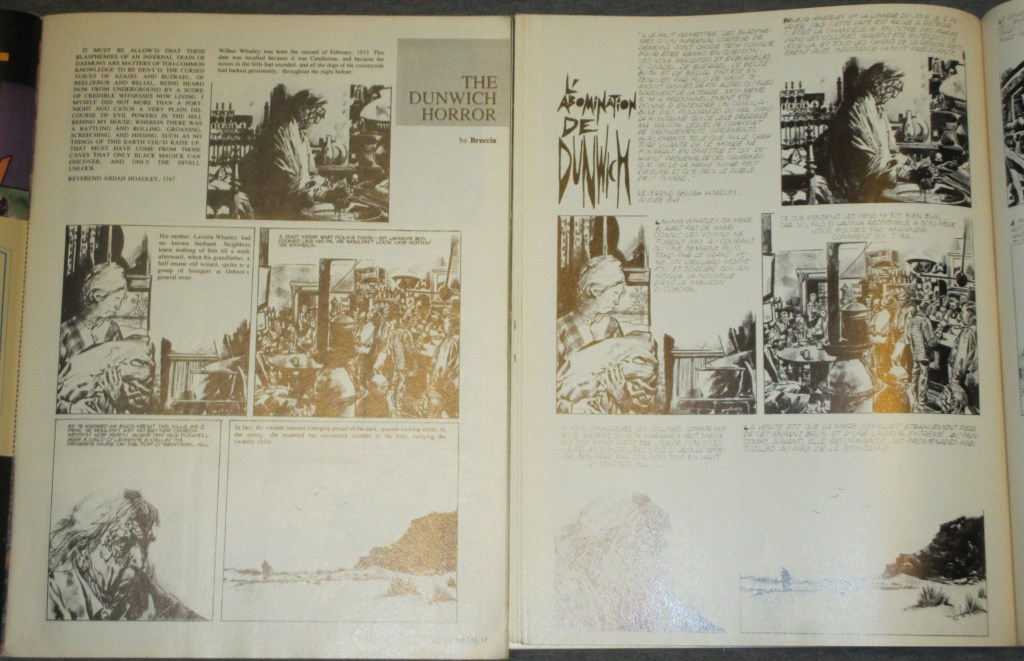
“L’Abomination de Dunwich” (“The Dunwich Horror”) by Alberto Breccia, a 15-page black-and-white adaptation of Lovecraft’s “The Dunwich Horror”—and a fairly faithful and evocative adaptation, with particular care given to Wilbur Whateley and his unnamed twin. Appeared in Métal Hurlant and Heavy Metal; many of Breccia’s adaptations of Lovecraft stories first appeared in Italian in the magazine Il Mago, which may be why Metal Extra chose not to reprint it.
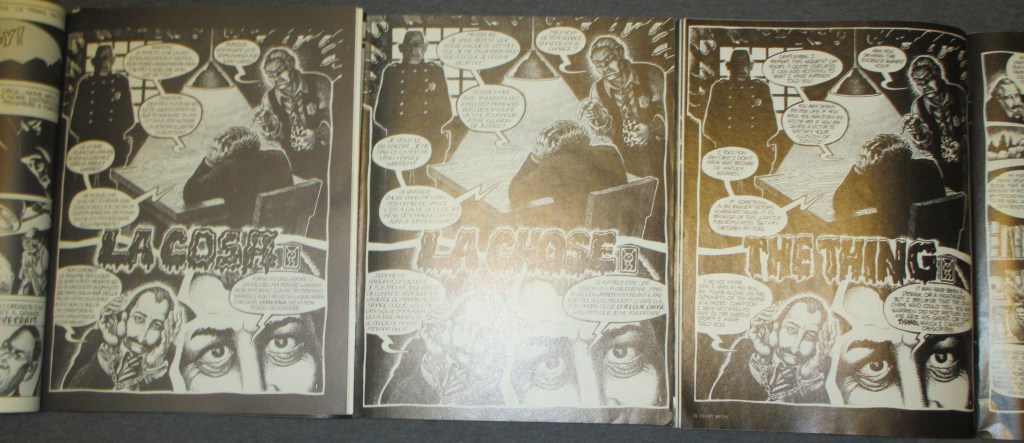
“La Chose” (“La Cosa,” “The Thing”) by Alain Voss is a 6-page black-and-white adaptation of Lovecraft’s “The Statement of Randolph Carter.” Voss elaborates on Lovecraft’s story a bit, making Harley Warren more sinister and flamboyant, and the grave they break into becomes an elaborate sepulchre, but is otherwise very faithful. Appeared in Métal Hurlant, Heavy Metal, and Metal Extra.
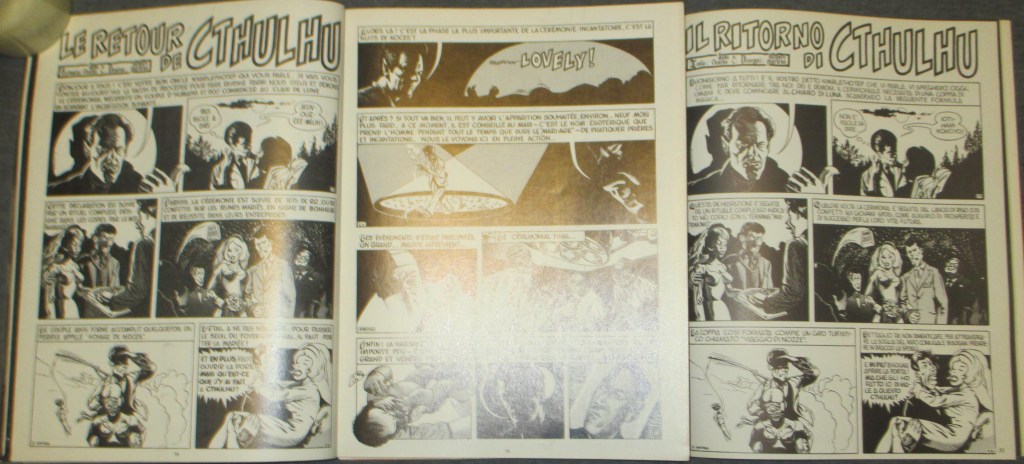
“La Retour de Cthulhu” (“Il Ritorno di Cthulhu,” “The Return of Cthulhu”) by Alan Charles & Richard Martens is a 2 -page black-and-white comic. “Uncle Nyarlathotep” narrates a tongue-in-cheek account of the ritual that results in the reincarnation of H. P. Lovecraft. Appeared in Métal Hurlant and Metal Extra.
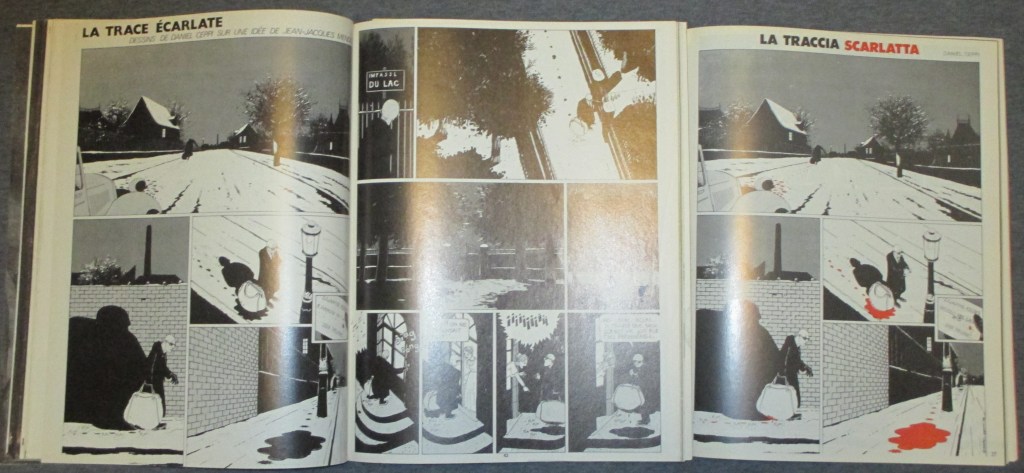
“La Trace Ecarlate” (“La Traccia Scarlatta,” “The Scarlet Track”) by Jean-Jacques Mendez & Daniel Ceppi is a two-page, slightly humorless, mostly wordless spectacle. Métal Hurlant printed the comic in black and white, but Metal Extra added a bit of red to actually illustrate the “scarlet trace,” which works much better.
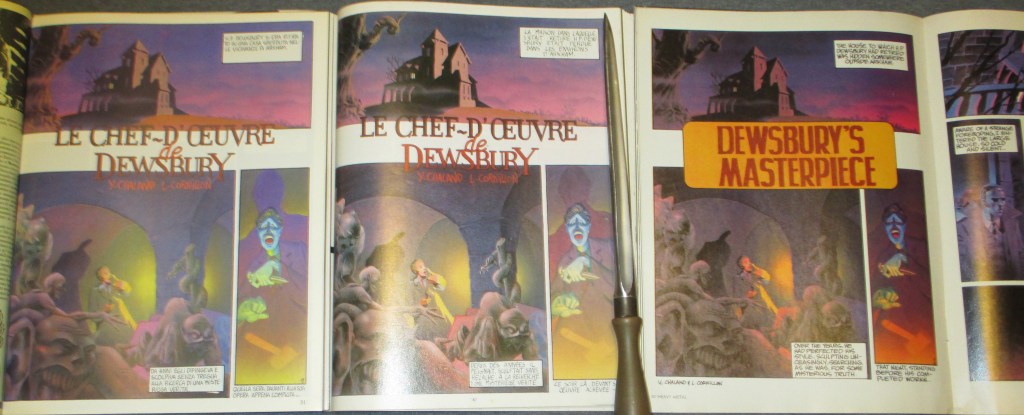
“Le Chef d’Œuvre de Dewsbury” (“Il Capolavoro di Dewsbury,” “Dewsbury’s Masterpiece”) by Yves Chaland & Luc Cornillon is a 4-page color comic that ells an original Lovecraftian story, somewhat in the vein of “Pickman’s Model,” with the mysterious Dewsbury taking the place of Pickman, but truncated and dedicated to not showing the unnamable horror. Appeared in Métal Hurlant, Heavy Metal, and Metal Extra.
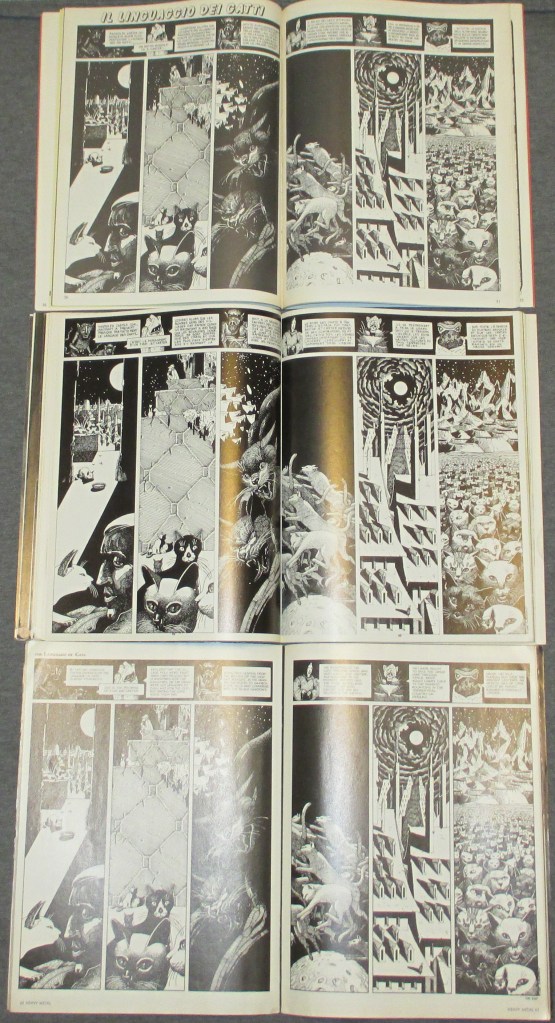
“Le langage des chats” (“Il Linguaggio dei Gatti,” “The Language of Cats” ) by Nicole Claveloux is a 2-page black-and-white comic, and adapts an excerpt from “The Dream-Quest of Unknown Kadath” involving the cats of the Dreamlands. Appeared in Métal Hurlant, Heavy Metal, and Metal Extra.
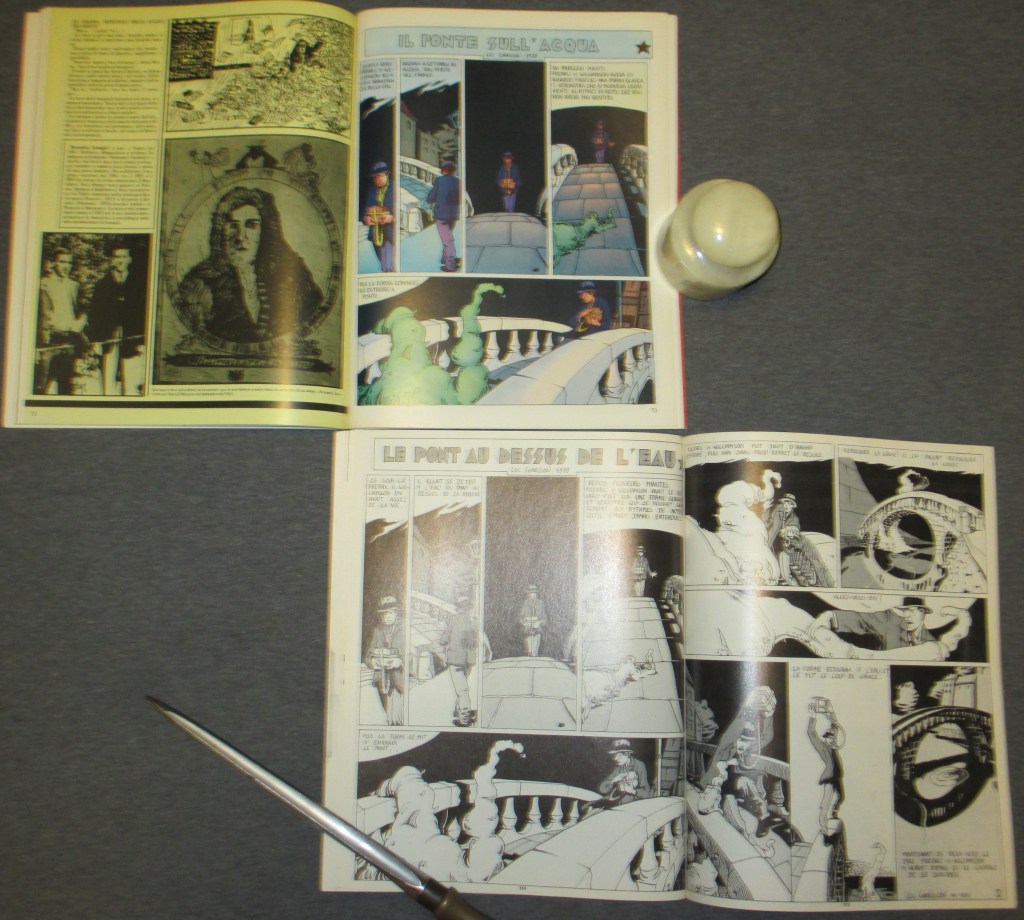
“Le Pont Au Dessus de l’Eau” (“Il Ponte dull’acqua,” “The Bridge over the Water”) by Luc Cornillon is a 2-page comic where a man attempts to commit suicide by leaping from a bridge, and finds himself embattled by a protoplasmic tentacled entity. Not explicitly Lovecraft-related, though some might call it Lovecraftian. Published in black-and-white in Métal Hurlant, and colorized in Metal Extra.
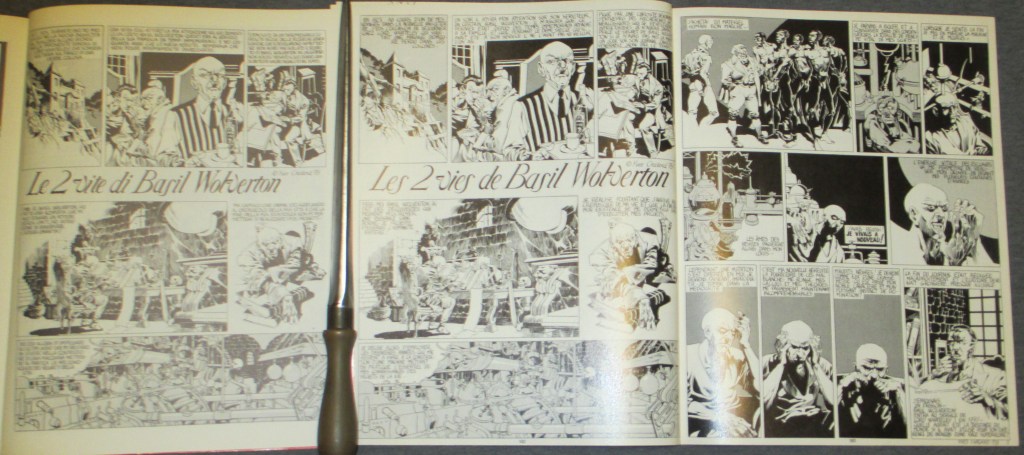
“Les 2 Vies de Basil Wolverton” (“Le 2 Vite di Basil Wolverton,” “The Two Lives of Basil Wolverton”) by Yves Chaland is a 2-page black-and-white comic. In Lord Whateley’s residence is uncovered the diary of an old servant, Basil Wolverton (after the comic artist), who had long served the family. The diary describes how Wolverton was a mad genius who sought to use the life-forces of others to extend his lifespan and rule the world—but he chose as his experimental subjects Black slaves, and found afterward his he fell into idleness and stupidity. The story is effectively a brief echo of the kind of weird racism typical of 1920s and 30s pulp fiction, although the artwork is excellent. Appeared in Métal Hurlant and Metal Extra.
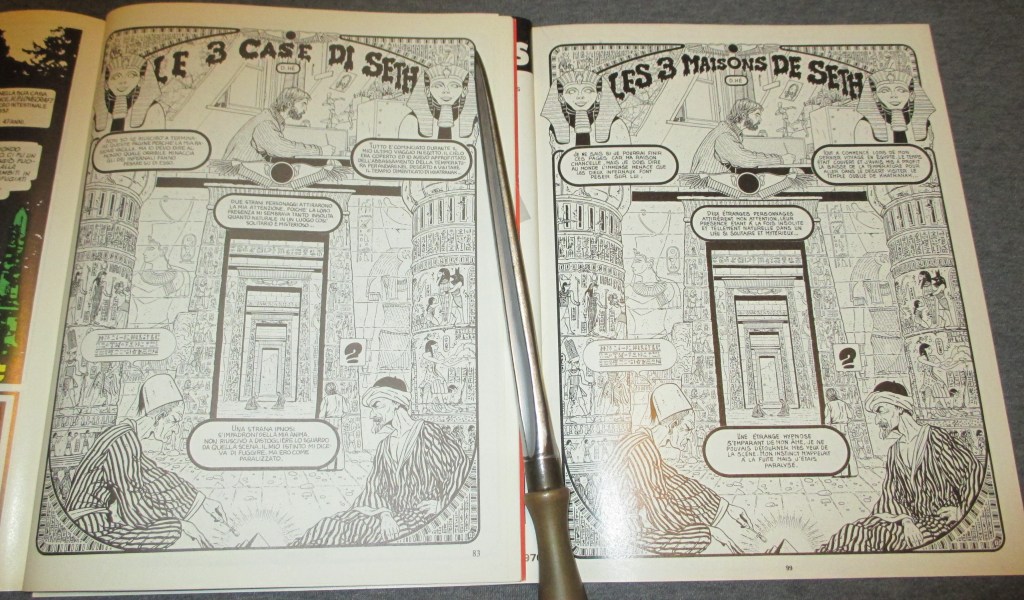
“Les 3 Maisons de Seth” (“Le 3 Case di Seth,” “The 3 Houses of Seth”) by Dominique Hé is a 3-page black-and-white comic in the form of a document about an artist’s visit to an ancient temple in Egypt, where he received a vision of the eldritch entity Suthluhlu. The artistic depiction of Egyptian pyramids, temples, statues, hieroglyphs, etc. is exquisite in its precision, though the Lovecraftian content itself is slight. Appeared in Métal Hurlant and Metal Extra.
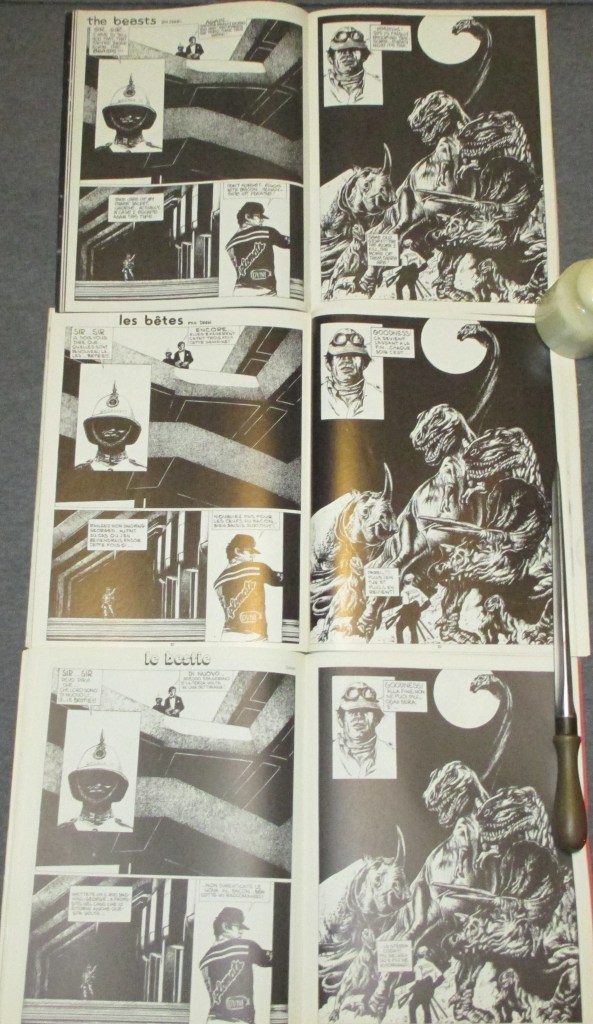
“Les Bêtes” (“La Bestie,” “The Beast”) by Dank is a 3-page black-and-white comic. The narrative is slight, a soldier or servant informs a man that the Beasts are back, which turn out to be a collection of fanged dinosaurs (and, bizarrely, a rhinocerous of unusual size) that are mowed down with guns; the hunter leaves strange three-toed tracks as he leaves after the slaughter. It’s a surreal bit of fluff, striking for its visuals, but deliberately obtuse. Not explicitly Lovecraftian. Appeared in Métal Hurlant, Heavy Metal, and Metal Extra.
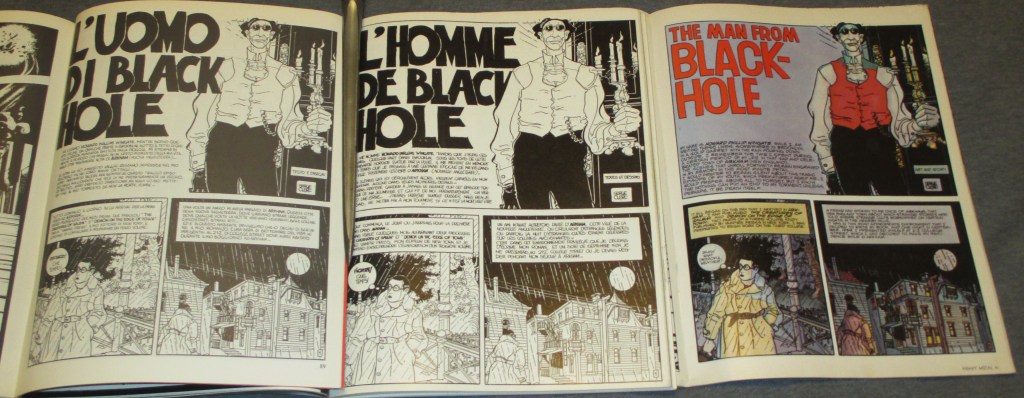
“L’Homme de Black Hole” (“L’Uomo di Black Hole,” “The Man from Blackhole”) by Serge Clerc is a 4-page comic. Howard Phillip Wingate, horror author, recalls a visit to Arkham, where he encounters Nathaniel Jenkins, a retired doctor who lived at Blackhole Cottage, and participates in his experiments. What he sees there causes him to flee, but he hears once more from Jenkins, whose brilliant mind has succumbed… The story is a pure pastiche of Lovecraft, with little visual and written nods scattered throughout. Published in black-and-white in Métal Hurlant and Metal Extra, but in color in Heavy Metal.
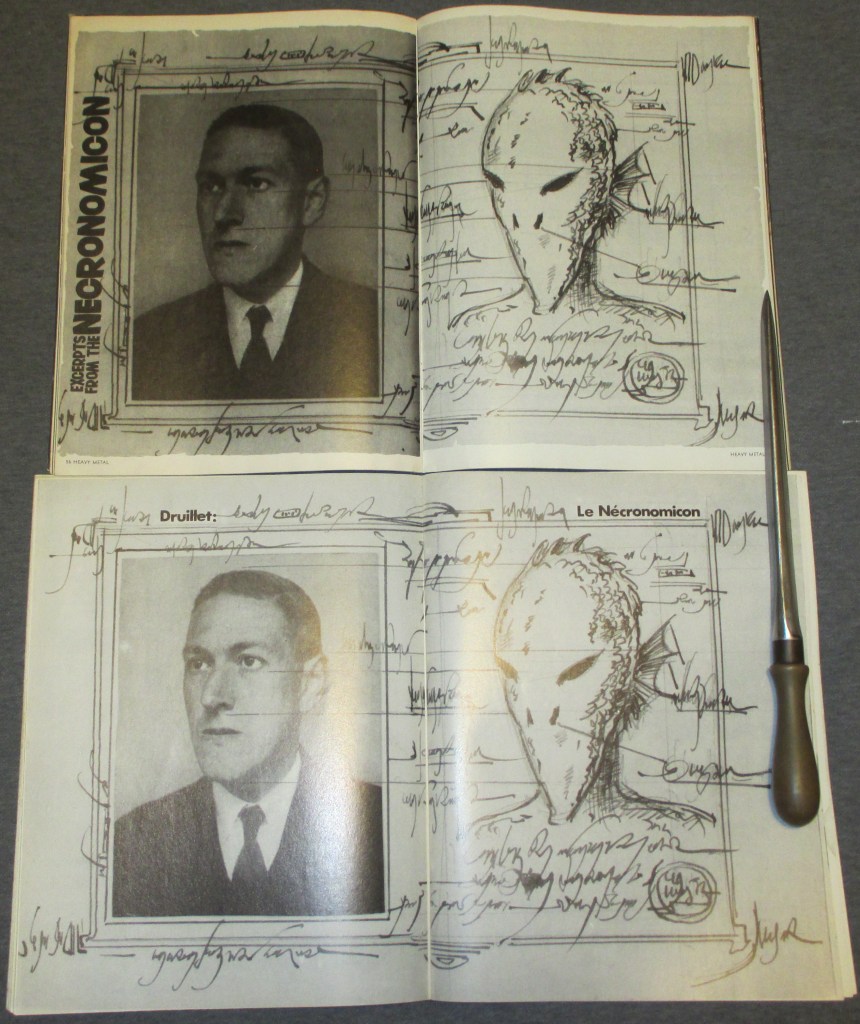
“Le Necronomicon” (“The Necronomicon”) by Druillet is 11 pages of black-and-white pseudo-script and illustrations, laid out as pages from an alien manuscript; a photograph of Lovecraft is included on the frontispiece. Druillet’s recension of the Necronomicon was released near-contemporaneously with Al Azif (1973) by L. Sprague de Camp, the Necronomicon (1977) by Simon, and The Necronomicon: The Book of Dead Names (1978) ed. by George Hay. Yet where the others focused primarily on producing some kind of decipherable content or referenced existing cultures and systems, Druillet deliberately made his pages evocative but untranslateable—and as a result, universal across all languages. Published in Métal Hurlant and Heavy Metal, with some slight differences in presentation.
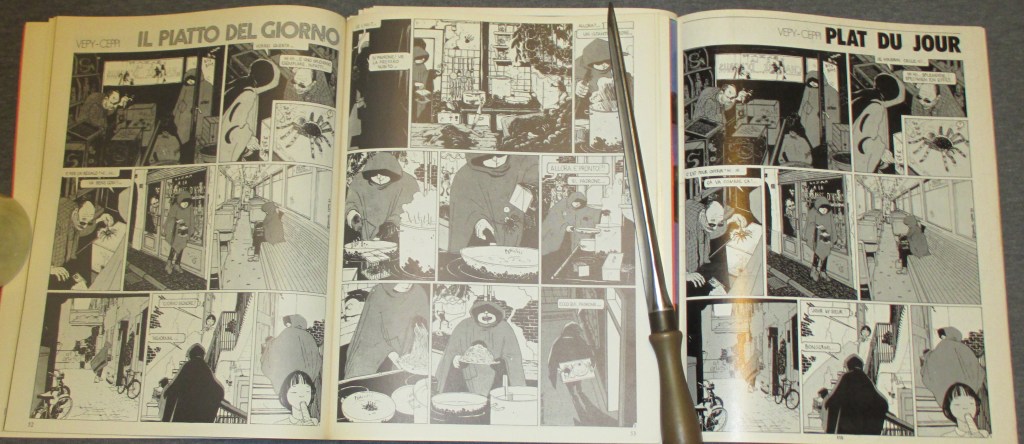
“Plat du Jour” (“Il Piatto del Girno,” “Dish of the Day”) by Vepy & Daniel Ceppi is a 3-page black-and-white comic. A hooded figure buys a spider, takes it home, cooks it up, and serves it to a bed-written individual in a rat costume. The tone is slightly ghastly, but also slice-of-life. Not explicitly Lovecraft-related. Published in Métal Hurlant and Metal Extra.
Cultural Impact
In the decades after the Métal Hurlant Lovecraft Special was published, many of the stories and artwork have been reprinted in various formats and languages. Today, you can find collections of Druillet and Breccia’s Lovecraft comics and art in several languages. What might strike readers, however, is that the bulk of the three issues do not consist of adaptations of Lovecraft’s stories, but also comics, art, fiction, and nonfiction about Lovecraft himself. That issue, and to a degree the English and Italian magazines it inspired, was a nexus of Lovecraftian art and fiction that helped to further the spread of not just Lovecraft’s Mythos, but the myth of Lovecraft and his life, inexplicably entwined with his creations.
For many readers, one of these issues was their first introduction for Lovecraft. For some, it was an example of what Lovecraftian comics and art could be, unfettered by censorship or expectations to conform to commercial standards of what a comic or Lovecraftian work should be like. These works aren’t pornographic or particularly graphic, but they vary from reverent to irreverent, ghoulish to enchanting. Lovecraft and his work are interpreted many different ways by different creators—and that’s okay. There’s room for all those different approaches, and many more.
Métal Hurlant is being published in a new series. Perhaps appropriately, in August 2024 they published a new Lovecraft special—reflecting a new generation of talents to flex their imaginations and showcase their skills. It is a testament to the cultural impact of that first mammoth issue, but also a reflection that these specials are part of an enduring tradition. Creators that are happy not just to read about Lovecraft, his fiction and letters, but to participate in the process and add to the body of art and literature he inspired.
Bobby Derie is the author of Weird Talers: Essays on Robert E. Howard and Others and Sex and the Cthulhu Mythos.
Deep Cuts in a Lovecraftian Vein uses Amazon Associate links. As an Amazon Associate I earn from qualifying purchases.
 Deep Cuts in a Lovecraftian Vein