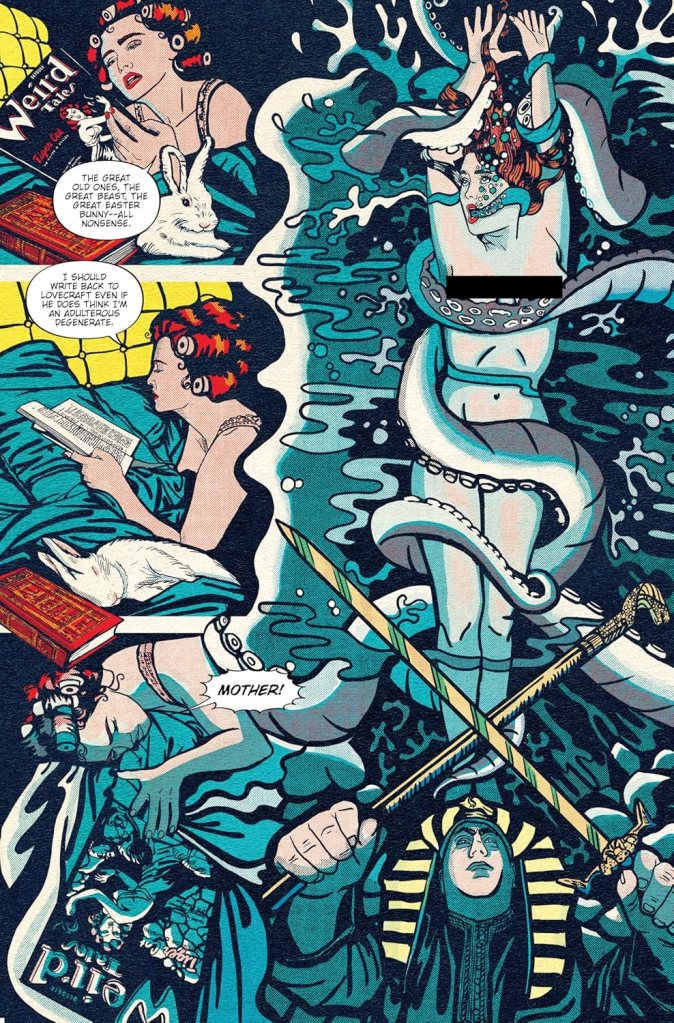
The following review is of a work that contains cartoon nudity, and some images are reproduced. Reader discretion is advised.
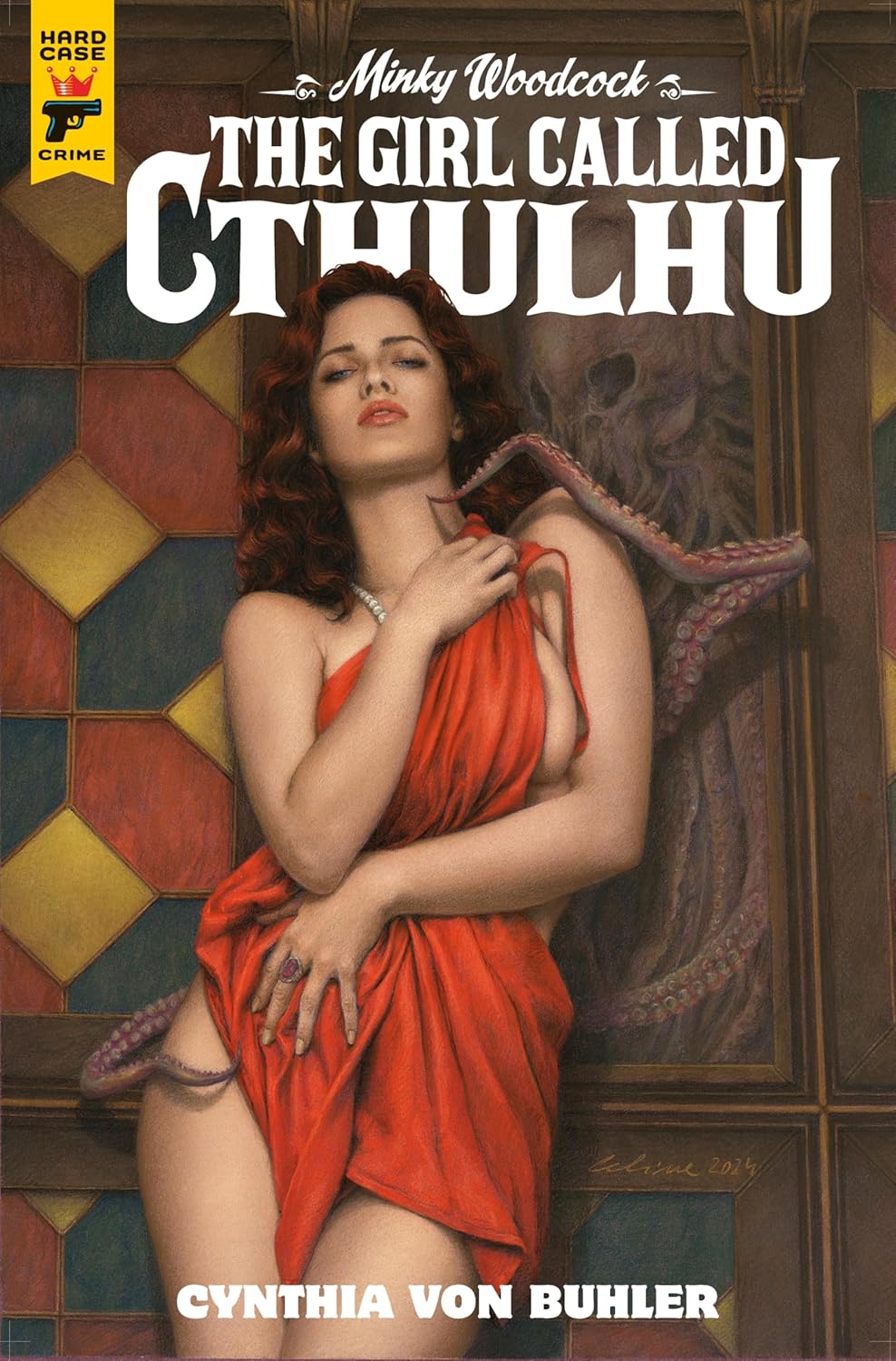
In 2017, writer-artist Cynthia von Buhler introduced the world to Minky Woodcock, private detective, in a 4-issue series The Girl Who Handcuffed Houdini, published under the Hard Case Crime imprint of Titan Comics. The series was a clever mix of hardboiled detective themes with historical characters, with the bisexual and extraordinarily intelligent and adaptable Minky Woodcock often ending up in dangerous situations and/or sans her clothes—but also finding or fighting her way out again. The series was followed up with a sequel, The Girl Who Electrified Tesla (2021), and then The Girl Called Cthulhu(2024), which was lettered by Jim Campbell.
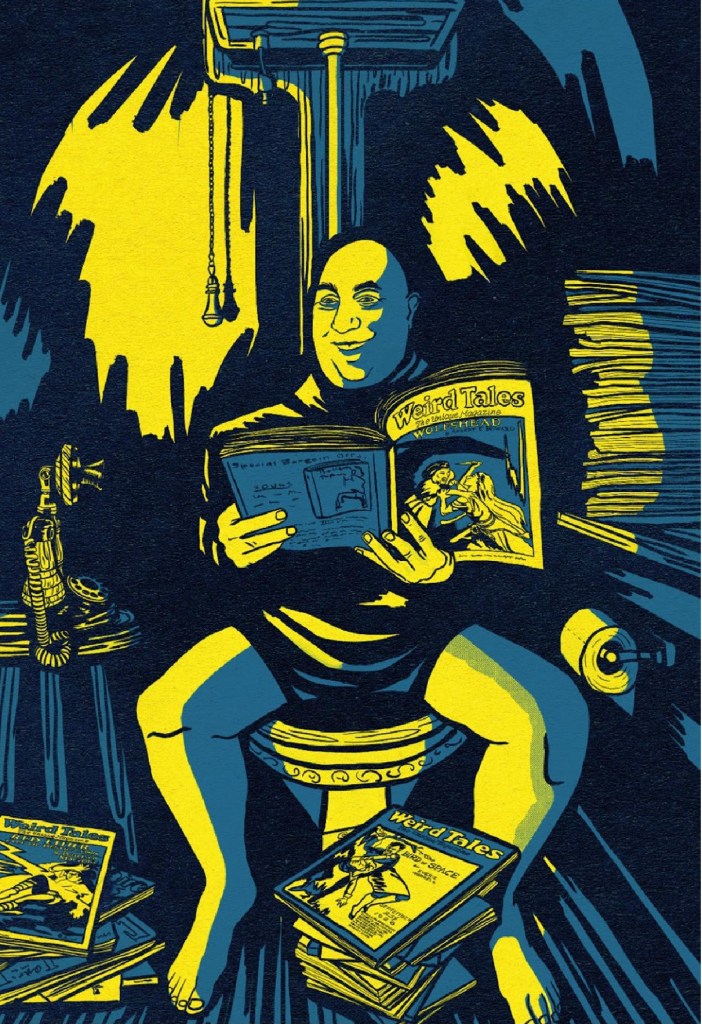
The plot is drawn from history, dealing with Lovecraft’s relationships with Harry Houdini and Aleister Crowley, slightly fictionalized for purposes of the plot, but in general faithful to the timeline—with careful reproductions of Weird Tales covers and effort made to reproduce real people, places, and events. There are a number of fun little Easter eggs for Weird Tales fans in the pages, captured in von Buhler’s own style, who favors a heavy line and stylized coloring that echoes noir and giallo films.
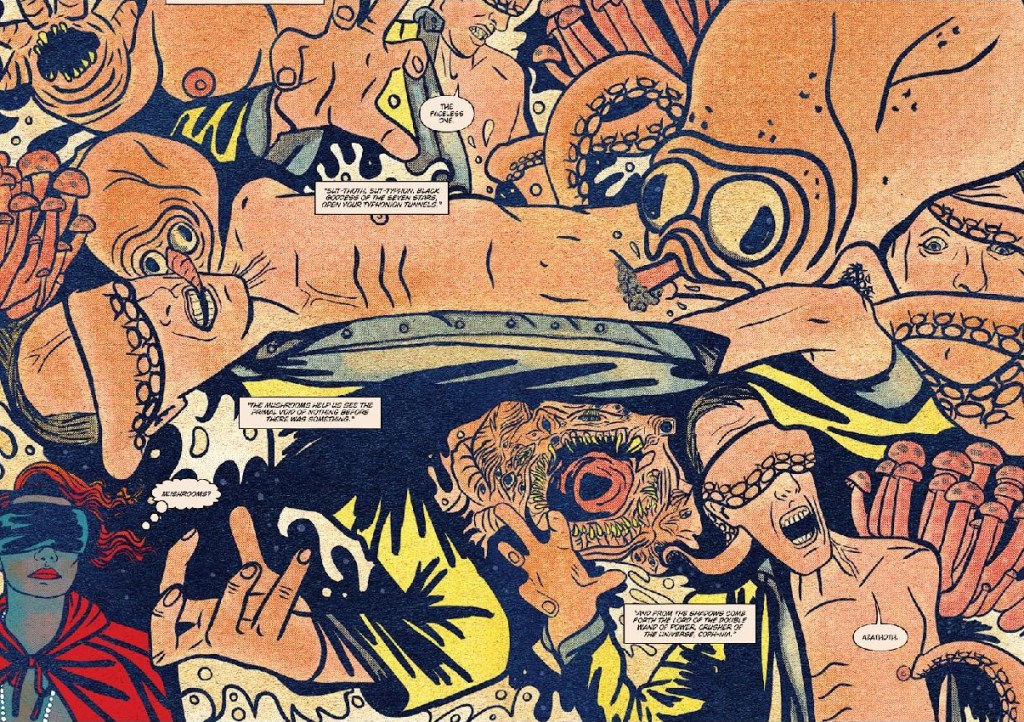
At its heart, Minky Woodcock: The Girl Called Cthulhuis a rather traditional detective/mystery story, tied up in a historical setting and with some added titillation thrown in. The depiction of H. P. Lovecraft and his wife Sonia are synthesized from various sources, notably The Private Life of H. P. Lovecraft (1985) by Sonia H. Davis, but aren’t particularly cruel or inaccurate given the needs of the story. Buhler flaunts her artistic homages, such as Hokusai’s “Diver and Two Octopi,” and is one of the few artists not afraid to depict Howard’s penis. Whether that’s a warning or an enticement to read the book is something I leave up to the readers.
It is a fun book, and plays to both Lovecraft and Crowley’s particular legends. Cynthia von Buhler has obviously done a good bit of research, and she wears it on her sleeve, including a section at the rear of the collected edition (and in the individual issues) explaining some of the details:
The investigations portrayed in the Minky Woodcock series are grounded in fact, the result of my extensive research. I acknowledge that some of the details may seem peculiar leading to numerous questions. Here are my responses to them. – CvB
Is all the research correct? Well, there’s no evidence Sonia H. Greene heard Crowley at the Sunrise Club (though she did attend the club), and no evidence Crowley read Lovecraft. The comparison between Lovecraft’s fiction and Crowley’s magical writing is the stuff of wishful occultists, as shown in the opening of the Simon Necronomicon. But for fictional purposes, these are pedantic niggles, and certainly other authors that have posited Lovecraft/Crowley interactions have gone further and been more ahistorical. A more interesting tidbit is the question of Lovecraft’s prejudices:
Lovecraft was a racist and anti-Semite. Why would you honor him with the title of your book? I highly doubt he would have married a Jewish woman.
Lovecraft was married to Sonia H. (Haft), a successful Jewish milliner and amateur pulp fiction writer, from 1924 to 1937. She tried to educate him as best as she could, and by the end of his life, his views had changed somewhat, but he said some pretty awful things in his day. I make his outrageous beliefs absolutely clear in my book. —Cynthia van Buhler, Minky Woodcock: The Girl Called Cthulhu
While von Buhler doesn’t answer the first question directly, I think the book itself makes the point clear: Lovecraft was weird, and is the connective tissue between Houdini and Crowley, the three together providing a bridge from rationality to occultism and weird fiction. Lovecraft comes across as a bit stiff and surreal, but that’s not unusual for fictional depictions of HPL, and if the effort is made not to hide Lovecraft’s prejudices, neither does she make the effort to depict him as a cartoon caricature of a bigot. Sonia gets less attention, unfortunately, but her part in the proceedings is a minor one.
Ultimately, this isn’t Lovecraft’s story, or Crowley’s, but Minky Woodcock’s. A dame detective who finds herself in strange company and dangerous situations, surviving largely by her ample wits. While not quite as bloody and fierce as Max Collins’ Ms. Tree, there is that same sense of a woman in a primarily male occupation dealing with society’s preconceptions and some quite ruthless characters—and, sometimes by the skin of her teeth, coming out alive if not always on top.
Now from darkness, there springs light Wall of sleep is cool and bright Wall of sleep is lying broken Sun shines in, you have awoken —Black Sabbath, “Behind the Wall of Sleep”
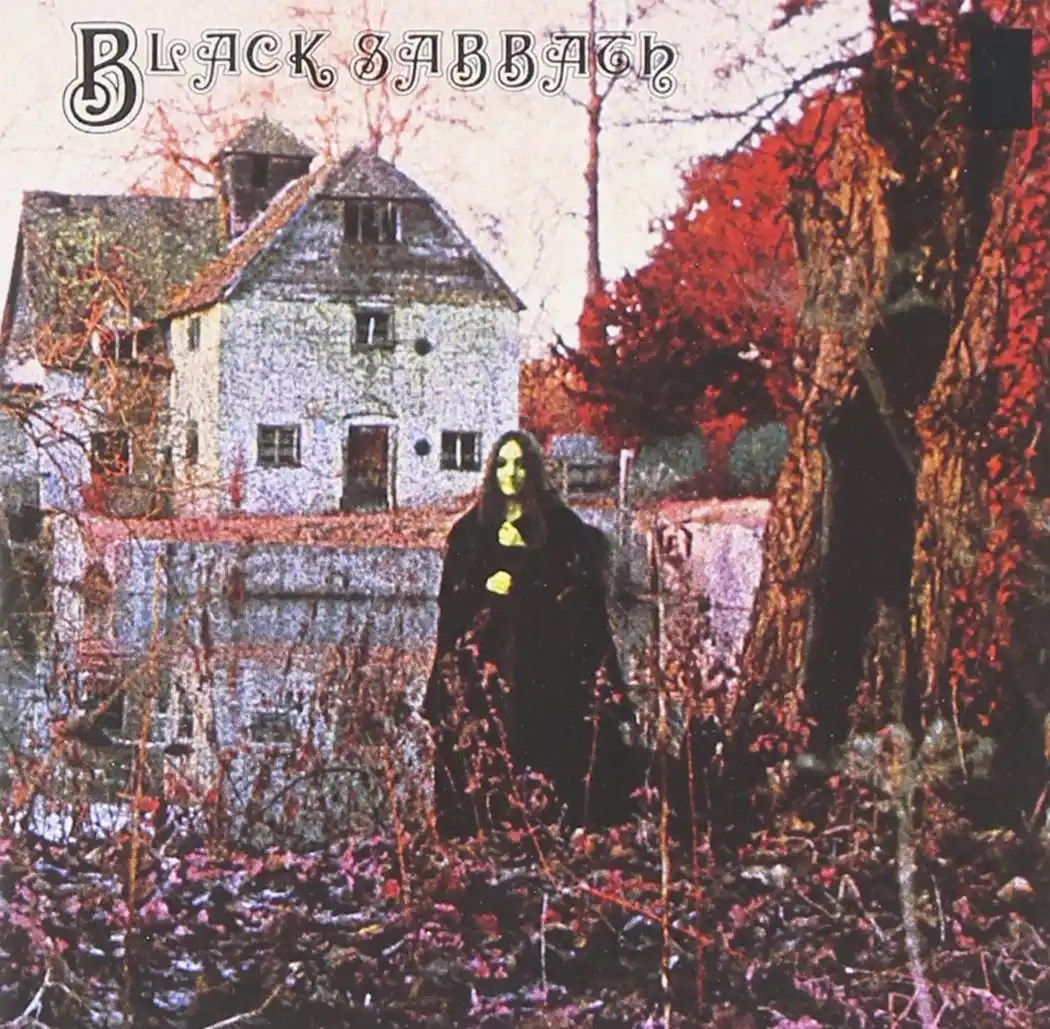
England. August 1969. The cinema across the street was playing the Italian horror anthology film I tre volti della paura (1963, “The Three Faces of Fear”), rendered into English as Black Sabbath. Or maybe it was just a poster of the film. Recollections, years later, differ. That became the title of the band, and the lead song on the album they recorded in November of that year. The basis of the band was blues-based rock & roll, with heavier guitar riffs, less melodic and more distorted. Lyrically, the band borrowed from horror and fantasy as much as they did the grimy street life of drugs; shades of Tolkien in “The Wizard,” Dennis Wheatley in “Black Sabbath” and “N.I.B.,” H. P. Lovecraft in “Behind the Wall of Sleep.”
Guitarist Tony Iommi had lost the tips of two fingers in a workplace accident, and down tuned the guitar to make playing easier, but played aggressively; Geezer Butler, on bass, was used to playing a guitar and followed Iommi’s riffs, but was also the band’s chief lyricist. Bill Ward on drums set the tempo, alternately driving or (in the case of “Black Sabbath”) with dirge-like slowness; Ozzy Osbourne provided lead vocals and harmonica. Iommi, Butler, Ward, and Osbourne all had working-class backgrounds, done stints in factories and abattoirs. They were young, a bit raw, and played and sang hard and fast and loud—and had an interest in horror and fantasy.
The ’60s saw a rise in interest in horror and fantasy fiction, alternative spirituality, and the occult. Wicca gained traction in the United Kingdom and United States; the works of Aleister Crowley were reprinted; the Hobbit and the Lord of the Rings, first released as hardbacks, found new life in paperback. British writer Dennis Wheatley published an entire library of occult fantasies like The Devil Rides Out. Old pulp authors like H. P. Lovecraft likewise found a new generation of enthusiasts for horror and fantasy as Arkham House hardbacks were reprinted as affordable paperbacks, like Dagon and Other Macabre Tales (1969) by British publisher Panther, which contained “Beyond the Wall of Sleep.” When asked about the matter, Geezer Butler responded:
I think I may have borrowed the title “Behind the Wall of Sleep” from “Beyond the Wall of Sleep” (of which I have a first edition), but it’s so long ago, I can’t really remember. The lyrics came from a dream I had, hence the title. Most of my inspiration in those days came from books by Dennis Wheatley, rather than Lovecraft or Poe. —Butler, quoted in Gary Hill’s The Strange Sound of Cthulhu 44
The one-day studio recording session for their eponymous debut album, produced by Rodger Bain (who provided the Jew’s harp on “Sleeping Village”), was almost a live album, with a few effects added to “Black Sabbath” and some double-tracked guitar solos for “N.I.B.” and “Sleeping Village.” No complicated audio engineering, no elaborate orchestration; listeners have noted a jazz-like quality to the rhythm swings, the few chords by the several key changes that give variety to the sound (Experiencing Black Sabbath 4). It is still very clearly based in twelve-bar blues and lyrically draws from the tradition of psychedelic rock, but it is also clear the musicians are trying to get away from that, breaking formulas. The music and the aesthetic came together to make something different than the typical prog-rock offerings.
On 29 November 1969, Black Sabbath’s set for the Top Gear radio show played “Black Sabbath”, “N.I.B.”, “Behind the Wall of Sleep” and “Sleeping Village.” The first time the public heard the new sound. By the time the album was released on Friday the 13th (13 Feb 1970), the marketing was already spinning the band’s darker image, playing up links to Satanism, witchcraft, and the occult, and “Black Sabbath” climbed the charts. On the North American release, “Behind the Wall of Sleep” and “N.I.B” was divvied up as “Wasp / Behind the Wall of Sleep / Bassically / N.I.B.”—probably by the production company for royalty purposes (Experiencing Black Sabbath 4); “Behind the Wall of Sleep” has a jazz waltz-like opening and ends with a bass solo, so you can see where the idea for “Wasp” and “Bassically” came from, even though they are just the opening and closing to “Behind the Wall of Sleep.”
At least some listeners picked up on the Lovecraft reference:
The newest from that far-out band known as Black Sabbath is now available on LP album and both cartridge and cassette tape form. This newest album is appropriately entitled “Black Sabbath” and offers such new goodies from the group as “The Wizard”, “Wicked World” and a title taken from one of the late H. P. Lovecraft’s stories, “Behind the Wall of Sleep.”
The group is in its usual sardonic turn of mind, and of course, their music is a fine example of just what can be done with unusual nad bizarre sound when coupled with some rather weird lyrics.
Lyrically, “Behind the Wall of Sleep” has little to do with Lovecraft’s story. The song is about death, or perhaps a death-like sleep brought about by opium (“Visions cupped within the flower / Deadly petals with strange power”). Butler was likely more inspired by the title than the story itself, though Osbourne makes the lyrics work.
Black Sabbath can be fairly claimed to be the first heavy metal album—and highly formative and influential on many other subgenres, from black metal to stoner rock—and buried in there, the third track on the A-side, was a reference to H. P. Lovecraft. They weren’t the first band to take inspiration from H.P.L.; the U.S. psychedelic/folk rock band H. P. Lovecraft (1967-1969) was earlier. Nor was Lovecraft ever the focus of Black Sabbath. Yet they did get the ball rolling—Lovecraft and metal would meet, again and again, over the decades to come, and many metal bands credited Black Sabbath for their influence, musical and Lovecraftian.
Black Sabbath est à notre connaissance le premier group aujourd’hui classé dans le catégorie « metal » à faire allusion à l’œuvre de Lovecraft. Malheureusement, à l’exception de cette chanson, il n’y a dans la discographie des Anglais de Birmingham aucune trace d’influence lovecraftienne. Aujourd’hei, comme nouse le signalons parfois dans les pages de cet ouvrage, un certain nombre de formations inspirées par le maître de Providence justifient leur emprunt par l’antériorité de Black Sabbath. D’autres se sont meme interéssés à l’écrivain grâce à cette chanson du quautor.
Black Sabbath is, to our knowledge, the first band now classified as “metal” to allude to Lovecraft’s work. Unfortunately, with the exception of this song, there is no trace of Lovecraftian influence in the discography of the English band from Birmingham. Today, as we sometimes point out in the pages of this book, a number of bands inspired by the master of Providence justify their borrowing by the precedent of Black Sabbath. Others have even become interested in the writer thanks to this song by the quartet.
Black Sabbath was a beginning, not an ending. The years after its release would see Black Sabbath develop their style and glamour, inspiring generations of metalheads.
“I cannot speak longer, for the body of Joe Slater grows cold and rigid, and the coarse brains are ceasing to vibrate as I wish. You have been my only friend on this planet—the only soul to sense and seek for me within the repellent form which lies on this couch. We shall meet again—perhaps in the shining mists of Orion’s Sword, perhaps on a bleak plateau in prehistoric Asia, perhaps in unremembered dreams tonight, perhaps in some other form an eon hence, when the solar system shall have been swept away.” —H. P. Lovecraft, “Beyond the Wall of Sleep”
John Michael “Ozzy” Osbourne 3 December 1948 – 22 July 2025 R.I.P.
Weird Tales was not the only pulp that C. L. Moore read, nor the only one she submitted stories to. While it might seem that she was selling everything that she wrote (and Moore would say as much in some later interviews), her letters in 1934 show that Farnsworth Wright, editor at Weird Tales, wasn’t accepting everything that came off of C. L. Moore’s typewriter—and so Moore splashed the science fiction pulps, selling “The Bright Illusion” to Astounding for its October 1934 issue—and that story has an interesting origin:
Yes, I do much more revising that I care about. Have to, tho it simply sickens me, and I hate everybody in sight while laboring away at the disgusting job. A story of mine which I’ve just sold to ASTOUNDING and which will appear in Oct. is really a third of one original N.W.Smith tale. I had that almost finished when I saw that it was two stories, and split it apart. Then the half I got to work on began to show amoeba-like tendencies toward division, and the third attempt resulted in THE BRIGHT ILLUSION, which I’ve sold, to Astounding. The other two nuclei are still simmering gently in the back of my mind, and may emerge some day. —C. L. Moore to R. H. Barlow, 5 Jul 1934, MSS Brown Digital Repository
“The Bright Illusion” starting out as a Northwest Smith story makes sense; the protagonist Dixon is broadly similar to Smith in Moore’s previous stories, although not as well developed. As to the original story, Moore would expand on that:
I wrote a story once, which I don’t believe you ever saw—starting out as my story “Greater Glories” started with a man lost in the interior of a giant body, being swept into its brain-chamber and finding himself in the presence of a god whose people have almost completed their race-goal. The people are of peculiar physical structure which permits their amalgamation into one immense and rather horrid-looking mass, like a great vine budded with individuals who by now have sunk their individuality into the whole, being drawn together by a common race-love which through the millennials [sic] of life has grown out of and taken the place of all other forms of attraction between individuals. The race has become a unit, but incomplete as the god is incomplete, because each lacks the essential attributes of the other. They are reaching their ultimate goal, which is the union of god and united people, into a perfect whole which is to go on, perhaps, as no more than an atom at the bottom of some tremendous scale of unknown evolution—somewhere. I didn’t sell the story, and finally cut it up into “Greater Glories” and “Bright Illusion” and another mass which I haven’t tried to recast. —C. L. Moore to H. P. Lovecraft, 7 Dec 1935, LCM 87-88
Elements of this plot are clearly seen in “The Bright Illusion”: especially the emphasis on love, the god that knows nothing of love, and the way the god absorbs the energy of its worshippers into its flame. Where it differs is the narrower scope: instead of an entire race embodied in an individual, a human and nonhuman, pawns of cosmic deities (or deity and would-be-deity) meet and feel an attraction that is outside the experience of either.
So a smaller story, more personal, and maybe a little less weird, although very much outside the normal product of Astounding, which still tended to more traditional interplanetary stories, gadget fiction, etc. However, in December 1933 editor F. Orlin Tremaine had allowed that he was expanding the magazine to include “thought variant” stories that pursued ideas that maybe weren’t strictly scientific. Perhaps this openness to slightly weirder fare made Astounding a tempting potential market.
What’s most notable at the story for the time is the somewhat unusual emphasis on sex. Dixon, a human, is presented as a representative of a species with two sexes (and, implicitly, genders, although Moore does not make this distinction explicit); the high priestess of IL is from a species that has many more sexes as part of their reproduction, and ignorant of romantic love. They two meet, wreathed in illusion so each sees the other translated as a member of their own species, and attraction is immediate, mutual, and confusing:
And she was not even female!
He narrowed his eyes and strove to pierce the mirage for a moment; to convince himself that here knelt a colored horror of sinuousity and sexlessness. And verything within him cried out protestingly. She was human—she was lovely—she was everything desirable and sweet. And she did not even exist save as a crawling horror upon whom in her normal guise he could never dare to look. —C. L. Moore, “The Bright Illusion”
While this is not a direct address to any LGBTQ+ issues of Moore’s day, there are definite parallels as Dixon and the priestess strive to understand their attraction and overcome their cultural preconceptions:
Could his own new love for her endure the sight of her real self? And what would happen to this strange flowering of an emotion nameless and unknown to her—her love for him? Could it bear the look of his human shape, unmasked? And yet, he asked himself desperately, could a love as deep and sincere as the love he bore her be so transient a thing that he could not endure the sight of her in another guise? —C. L. Moore, “The Bright Illusion”
Compare this internal monologue to The Crying Game (1992); and Dixon’s overcoming of his preconceptions and acceptance of his lover for who she is (Dixon is still filtering his relationship through his human understanding)—and this immediately turns to the rather significant obstacles for them to get together, being biologically incompatible and not even destined for the same afterlife. Even the sexless god IL realizes there are some fundamental issues to their union:
[“]Love is a thing between the two sexes of your own race. This priestess of mine of of another sex than those you understand. There can be no such thing as this love between you.”
“Yet I saw her first in the form of a woman,” said Dixon. “And I love her.”
“You love the image.”
“At first it may be that I did. but now—no; there’s much more of it than that. We may be alien to the very atoms. Our minds may be alien, and all our thoughts, and even our souls. But, after all, alien though we are, that alienage is of superficial things. Stripped down to the barest elemental beginning, we have on kinship—we share life. We are individually alive, animate, free-willed. Somewhere at the very core of our beings is the one vital spark of life, which in the last analysis is self, and with that one spark we love each other.” —C. L. Moore, “The Bright Illusion”
It’s not quite “the love that dare not speak it’s name,” but Moore is definitely trying to find the language and put it into Dixon’s mouth to describe an attraction that goes beyond the physical.
It has to be added that any view of the story that reads LGBTQ+ parallels in the story is a reflection of the prevelance of such issues in contemporary society. It’s notable that in the 1970s, when the magazine Chacal interviewed Moore, they had a different perspective on the story based on the prominent issues of the day:
Chacal: Upon reading “The Bright Illusion,” I got the distinct impression that it was a parable about racial tolerance. Am I correct, or am I reading something into it?
Moore: It just came off my typewriter, but it probably was. Not consciously, but the idea was probably lurking somewhere in my mind.
–“Interview: C. L. Moore Talks To Chacal” in Chacal #1 (1976), 30
Like many pulp stories that emphasize the power of love, such connections are often unrealistically sudden and powerful, which prevents the pace from dragging. So it was in A. Merritt’s “The Conquest of the Moon Pool” (1919) and “The Metal Monster” (1920), which share some elements with “The Bright Illusion,” particularly in “Moon Pool” the ultimately tragic nature of the love. Moore was aware of the pacing issue and not trying to drag the story out too long:
I suppose you know I’ve a story, THE BRIGHT ILLUSION, in the October AS[T]OUNDING. That’s one idea which must surely be absolutely original—or am I flattering myself? Anyhow it’s really a different story, tho I’m rather ashamed of the way it’s written. T[h]e idea needed more space to develop than the plot warranted, if you follow me! You’ll understand when you read it. I had either to make it abrupt or dragged-out and boring, and by the time I’m halfway through with a story I usually hate it anyhow and want to get the whole thing over with. —C. L. Moore to R. H. Barlow, 21 Aug [1934], MSS Brown Digital Repository
Considering “The Bright Illusion” is 17 pages, I think Moore drew the story out as far as the plot would sustain it. Some notes in another letter suggest that the story was otherwise written much like her previous Northwest Smith yarns, taking inspiration as it came to her, and worried that the result was too weird for Astounding.
I am wondering what you thought of my BRIGHT ILLUSION in this month’s ASTOUNDING. Was it bad? I can never tell if they’re going to be masterpieces or utter flops. The drawing was nice, tho. The first I’ve had that really satisfied me—it looked just like that. […] The great god IL in THE BRIGHT ILLUSION was snatched out of the April on the calendar that stared me int he face when I looked round for a good name, and the girl Apri in my new story has the same derivative. […] I did a drawing for THE BRIGHT ILLUSION which was pretty good too, tho was rejected as being too weird and too much of a contrast with ASTOUNDING’s usual type of drawing. The figures were simply heavily outlined a la McClelland Barclay, no background. They were afraid that the story itself was almost too weird for their rag, and thought the drawing would push it over the borderline. I’d like you to see it, tho don’t want to load you up there with my things. —C. L. Moore to R. H. Barlow, 10 Sep-9 Oct 1934, MSS Brown Digital Repository
Irrespective of her worries, Moore retained a fondness for the story, and sent a copy to Barlow, who had proposed publishing a collection of her weird fiction.
Despite your preference, I find I like it better than BLACK GOD’S KISS. It’s so nice and sentimental, and really ingenuous. I think. It took such an awful lot of struggle to figure out some way of solution that I’m very fond of the thing. I’ll send you my illustration for it, and the draft for the JULHI illustration, which is all I have of the drawing now—that is, if I can find it. (Heavens how involved my paragraphs do get.) —C. L. Moore to R. H. Barlow, 31 Dec 1934, MSS Brown Digital Repository
Barlow thought enough of the story to mention it to Lovecraft, who did not usually buy Astounding:
Oct. W.T. about average, on the whole. The Moore item is really very notable—full of intensity & atmospheric suggestion of encroaching dream-worlds which none of the other authors seem able to achieve. I’ll try to look up the item in Astounding, even though it be less free from the hackneyed & conventional. —H. P. Lovecraft to R. H. Barlow, [26 Oct 1934], O Fortunate Floridian 187
Ultimately, Barlow had to send the copy of “The Bright Illusion” to Lovecraft:
Thanks very much for “The Bright Illusion”, which I had not seen before. There is splendid atmosphere in it, & the conception of a whole alien world with a hypnotic false front is really masterful. On the other hand, the mawkish, sticky, 1900-period sentimentality I’d hardly nominate this effusion for use in your select volume—assuming that your plans stops short of complete works. —H. P. Lovecraft to R. H. Barlow, [16 Mar 1935], O Fortunate Floridian 217-218
Lovecraft’s dislike of the “mawkish” bits is typical—he also disliked when Merritt did something similar in “The Conquest of the Moon Pool”—but his praise for her handling of the alien world is genuine, since it was very different from the typical idea of a human landing on an Earth-like world with human-like aliens.
Astounding had its own letters column, called “Brass Tacks,” as with Weird Tales and the “Eyrie,” this was a forum where readers could weigh in on the stories in previous issues, sometimes getting into technical matters of science and mechanics. The story was well-received:
And last, but far from least, there is C. L. Moore. I read five of her stories without being impelled to rave. Good jobs they all were, and done in workmanlike fashion; but nothing calling for repeated reading. Then The Bright Illusion! Man, there is a job of work—adult fare, that; no fooling! I have read it three times so far, and haven’t got it all yet. I have no idea whether Miss (or Mrs.) Moore is a young girl with an unusually powerful mind and a full store of unsullied idealism, or whether she is a woman whose long and eventful life has shown her that real love is man’s supreme dower. But whoever or whatever she may be, I perceive in her Bright Illusion a flame of sublimity brighter, whiter, fiercer, and more intense even than the eternal fire of IL’s great temple. —Edward E. Smith, Astounding Stories Jan 1935
E. E. “Doc” Smith was well-known as the author of the Lensman series, and his occasional letters in the ‘Eyrie’ (and reference to this as her sixth story) showed him to be a regular reader of Weird Tales—and curiously enough, he knew what many WT readers did not, which was that Moore was female. It would seem as if she had landed another successful market.
“The Bright Illusion” was published in the October 1934 issue of Astounding Stories. Scans of this issue are available to download from Pulp and Old Magazines and Words Envisioned.
For readers who want to read more about the origin of “The Bright Illusion” and its origins, Marcos Legaria has a detailed article: “C. L. Moore’s “To What Dim Goal” and Its Progeny” in Penumbra: A Journal of Weird Fiction and Criticism, 2023.
If something more had been made of the kind of harm done by the release of atomic energy, there might be great possibilities for original & unusual development. How about it? What could you imagine as a sufficiently hellish consequence of the conquest of energy? The opening up of another dimension & the submergence of our familiar physical universe by some influence from ‘outside’? The explosion of all the matter in the immediate space-time continuum? The total or partial suspension of physico-chemical laws, or the disastrous ability of users to effect such a suspension locally or universally? Any of these lines—& many others—would be promising. But at any cost get away from the beaten track! —H. P. Lovecraft to Richard F. Searight, 31 Aug 1933, LRS 10
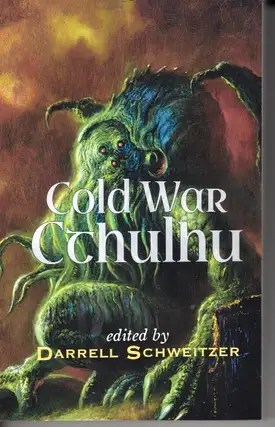
It is difficult for many people today to understand what it was like to live during the Cold War. A period when the world was divided between great superpowers whose direct conflict would lead to mutually assured destruction, and whose proxy wars consumed generations. A war that was won, not ideologically, but by the unsustainability of the conflict itself, the inability of the human government systems to maintain the constantly escalating costs of preparing for a conflict that would destroy them both.
There were people who, for decades, were told that at any moment the world might end and all they could do was hide under a desk and pray to survive the blast wave. People who grew up being told that equitable government distribution of resources was a blacker evil than conscription of troops to fight in a foreign military intervention, or that breadlines and internal passports were the cost of security for the nation as a whole.
It was not a conflict that Lovecraft lived to see.
Such were the ways of the elder gods, of which these engineers had been told nothing, nothing at all. —Susan Shwartz, “Red Star at R’lyeh” in Cold War Cthulhu(2025) 41
The gold standard stories of Cold War Cthulhu Mythos fiction are “The Unthinkable” (1991) by Bruce Sterling and “A Colder War” (2000) by Charles Stross. Both stories capture more than just the chronological era of the Cold War, the trappings of cars, clothing, hairstyles, language, music. They focus on the psychology of the period, the mix of ideology and rapid technological progress, the paranoia and, especially, the sacrifices made in pursuit of victory. Sometimes, the technology and the sacrifices went hand in hand.
“Red Star at R’lyeh” by Susan Shwartz is a Mythos-inflected take on a real Cold War event, the Nedelin Catastrophe. It plays out in the form of a secret history: the Cold War has turned colder as the superpowers, so consumed with their conflict, dabble with eldritch forces beyond their understanding. The unthinkable becomes pragmatic, almost prosaic; a toxic cosmic byproduct repurposed as rocket fuel, the better to lift the U.S.S.R. to the stars. Ultimately, due to human hubris, this leads to disaster.
Shwartz captures the mood. The culture of bad decisions that led to lost lives. Like the victims of nuclear radiation, the victims of the Nedelin Catastrophe were an acceptable human cost in pursuit of technological, economic, and ultimately ideological supremacy over their foe. The question to ask is: does it make a difference if Cthulhu was involved, however peripherally?
Knowing how it turned out in the real world, effectively no. The Cold War was a tragedy on a global scale, and the Nedelin Catastrophe happened without the help of Cthulhu or shoggoths. In terms of the story, however, it hints at darker bargains being struck. Lies and omissions that went beyond Cold War norms. It is one thing to have an industrial accident using dangerous technology, enabled by inadequate safeguards and dangerous pressure for an accelerated schedule. It’s something else to have that and know that the dangerous technology is something that humans know they shouldn’t be playing with, bought at some unknown but likely obscene cost, and placed in the hands of those who were unaware of what dangers they truly faced.
Perhaps that’s what makes it a colder war. The realization that someone, somewhere, knew how dangerous this all was, and decided that the human cost was an acceptable risk. That kind of obscenity isn’t unique to the Cold War, but….it is emblematic of the darker side of the conflict, where both sides were willing to sacrifice their own for whatever advantage they thought it would give them, only to be pawns in a much older, vaster game.
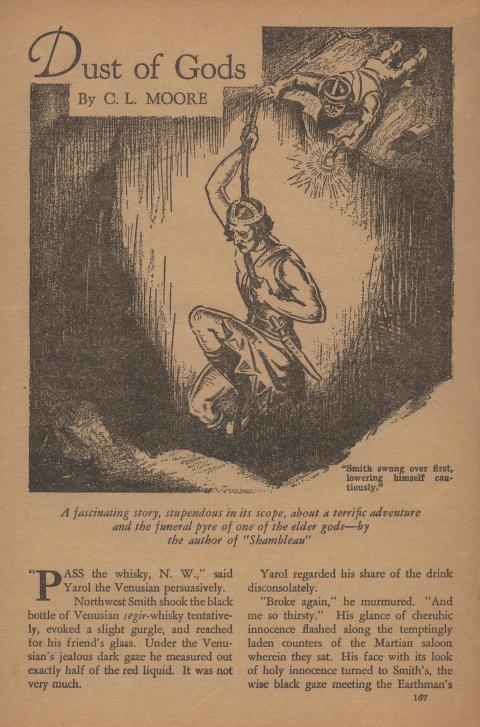
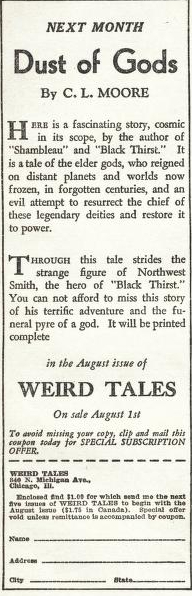
The fan-letters for “Scarlet Dream” were still being run in Weird Tales when the fourth adventure of Northwest Smith was announced, to appear in the August 1934 issue. While it sold readily enough to Farnsworth Wright, Moore herself had misgivings about the story:
An August tale, DUST OF GODS, is pretty poor, I’m sorry to say. —C. L. Moore to R. H. Barlow. n.d. (early Apr 1934), MSS Brown Digital Repository
The young fan Barlow had been in touch with Moore for a few months,
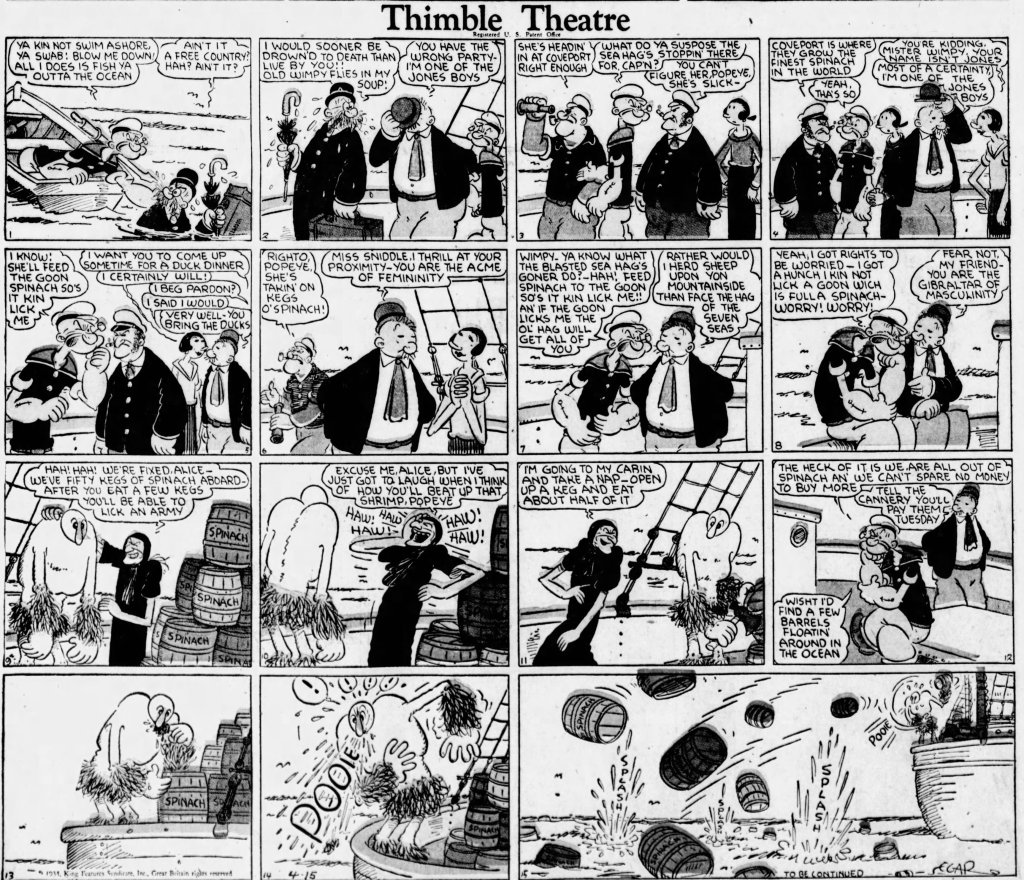
Which brings us round to your query about revamping some of my tales. If you think they’re worth while, and if the necessity arises, I’ll try, tho it’ll be like pulling teeth. The mental sloven again. Yes, the Guardian of the cave in DUST OF GODS was rather unnecessary. You’re not telling me anything about my own defects that I don’t know already. That story was written just at the drag-end of a very blank period, and patched painfully together. Maybe that’s why I hate it so—it was so hard to write. The Guardian, I still think, could have been quite effective if handled more carefully. The idea came from no less a personage than the Sea-Hag’s Goon (I suppose Popeye graces your Floridan funnies?) Did you ever notice that the Goon, even in the darkest night, never seems affected by shadows at all? It’s as if the creature belonged to another state of being so remote from ours that the dark can’t touch it. I don’t believe “Segar” intended that effect, for he doesn’t shade his other characters either, but the Goon’s shadowless state so impressed me that I thought something should be done. You observe the sad result, tho if I’d been in a fresher state of mind I might have been able to write a whole story around such a being. It was a good idea, anyhow, don’t you think? —C. L. Moore to R. H. Barlow, 5 Jul 1934, MSS Brown Digital Repository
C. L. Moore was still working a full-time job, writing stories whenever she could find the time. Like with many of her other stories at this point, she took impromptu inspiration from everyday events:
I think the funniest, tho, was the god Lsa who appeared briefly in DUST OF GODS. When I wrote that story I happened to see an ad for the L. S. Ayres & Company department story of Indpls. in a newspaper, and grabbed at the initials. Dust of Gods itself happened by accident. I was typing “Gold Dust” and accidentally left out the “l”, and it struck me how interesting “god dust” sounded. —C. L. Moore to R. H. Barlow, 10 Sep-9 Oct 1934, MSS Brown Digital Repository
In “Shambleau,”“Black Thirst,” and “Scarlet Dream,” Northwest Smith falls into adventure essentially by random chance. By contrast, “Dust of the Gods” opens up like a hardboiled crime story, as Smith and his partner Yarol look for a job to afford their next bottle of segir-whiskey. They get an offer to find the dead gods of a lost planet, and embark on what in another context would be an epic fantasy quest. One with distinctly Lovecraftian overtones.
So you see the old gods have not died utterly. They can never die as we know death: they come from too far Beyond to know either death or life as we do. —C. L. Moore, “Dust of the Gods”
Northwest Smith has a welcome skepticism and practicality to this revelation. He had, at this point, seen several alien species, had his mind and soul tugged at by different creatures that would have been eldritch entities in a Mythos story, and sought and found adventure on many worlds. Dead gods and fifty thousand dollars (plus expenses) was just another Tuesday.
The story quickly takes on an Indiana Jones-esque twist, with some gorgeous moments:
“I saw it once carved in the rock of an asteroid,” went on Yarol in a whisper. “Just a bare little fragment of dead stone whirling around and around through space. There was one smooth surface on it, and this same sign was cut there. The Lost Planet must really have existed, N. W., and that must have been a part of it once, with the god’s name cut so deep that even the explosion of a world couldn’t wipe it out.” —C. L. Moore, “Dust of the Gods”
Moore plays a little fast and loose with the physics, and much of the story is pure description, speculation, and exposition. Yet it works well enough for its purpose. A small adventure into a fragment of Big Time, to find the fossils of ancient, pre-human gods lost in the wastelands of Mars. It veers from the formula of Moore’s previous stories—no sexy alien women here, to seduce Northwest Smith or fall in love with him—but it gives him more time and repartee with Yarol, to deepen the characterization of their partnership and to expand on the setting, the ancient Mars that was once green, and now is not, where even the most ancient and forbidden god is now little more than a common cussword.
By this point, Moore had established sufficient reputation that H. P. Lovecraft was looking forward to her next story:
I got the new W.T. yesterday, but have not had time even to glance at it. Doubt if it amounts to much except for the Moore & Howard offerings. —H. P. Lovecraft to Robert Bloch, [11 Aug 1934], Letters to Robert Bloch & Others 109
Lovecraft was not disappointed:
Read the Aug. W. T., & fancy it is a trifle above the average. Howard, Moore, & Flagg items all notable from bizarre standpoint. —H. P. Lovecraft to R. H. Barlow, [14 Aug 1934], O Fortunate Floridian 163
I’ve now read the August W T, & would say it stands a little above the average. I’d group the redeeming items in this order: Moore, Howard, Cave, Flagg. Miss Moore certainly is the discovery of the last half-decade—the most distinguished accession to the noble company since Howard appeared in 1925. —H. P. Lovecraft to Richard Ely Morse, 15 Aug 1934, Letters to Hyman Bradofsky 89
Nor was Lovecraft alone:
C. L. Moore certainly must be a genius—I liked her Dust of Gods almost better than any of the tales so far published. My one objection is the omnipresent ray-gun, whose use seemed particularly unnecessary in this tale, since the dust could better have been ignited by some secret device installed aeons agao to protect it from desecration. —Clark Ashton Smith to R. H. Barlow, 10 Sep 1934, To Worlds Unknown 256
Smith was being, perhaps, a little disingenuous here. He had done his share of interplanetary adventures for the pulps, including those set on Mars and dealing with brooding, ancient, alien horrors, such as “The Vaults of Yoh-Vombis” (Weird Tales May 1932), and if he didn’t use a lot of rayguns, he and more were both very much tapping into some of the same atmosphere of interplanetary horror, of a setting on distant worlds that were lived-in and grimy, not perfect and unblemished.
Average fans praised Moore, though “Dust of the Gods” took second place to Robert E. Howard’s “The Devil in Iron” for the best story in the issue. Still, Moore was cognizant of the quiet efforts by R. H. Barlow against falling into pulp conventions and formulaic stories.
Her grandfather scared her, and sometimes did things to her. —Nina Kiriki Hoffman, “A Resonant Darkness” in Cold War Cthulhu (2025) 76
Child protagonists are an interesting choice for horror stories. They are often innocent, ignorant of the way the world works, ignored by grown-ups, relatively powerless against threats they cannot name, prone to fantasy and flights of the imagination, yet credulous to their own senses and the existence of the supernatural. A child in danger tugs at the heartstrings of many, and often readers can sense and understand that a child is in danger before the character realizes it, which helps to build tension.
More than that, perhaps, adult readers know the ways that children are vulnerable to abuse. There is an intersection of real-world fears that underlies every interaction in a story told from a child’s point of view. Not just predation, but the need to grow up too soon, the way their childhood can be taken from them, how easily traumatic events can upend their lives and rob them of safety and security.
Home, where she helped Mom take care of the five younger children. Mom had weird moments where, if one of the babies was crying, she’d curl up in a corner with her hands over her ears. Then Twyla would go in and take the bay out of his or her crib and check and change the diapers and warm up formula and feed the baby, and the baby would relax, and eventually Mom would come out of her weird fit and pretend it never happened. —Nina Kiriki Hoffman, “A Resonant Darkness” in Cold War Cthulhu (2025) 76
Adding a supernatural element to that mix can either be the nudge that turns domestic tragedy into dark fantasy or stark horror. In the hands of a skilled writer, it can sometimes redefine the nature of the seemingly mundane if terrible threat. Recasting child sexual abuse or the early shouldering of responsibilities for a failing parent into…something else, more disquieting.
Preparation, perhaps. Or initiation.
There is a history of Mythos fiction centered around a child protagonist or victim, the most famous stories of which are probably Robert Bloch’s “The Unspeakable Betrothal” (1949) and “Notebook Found in a Deserted House” (1951). Nina Kiriki Hoffman’s “A Resonant Darkness” is alike to these stories in some of the techniques: the child is often isolated; adults are either powerless to help them, or prove complicit in their victimization. Someone wants something from the children, and without any support network, they are left alone to face whatever seeks them.
In terms of plot, “A Resonant Darkness” feels more like a prologue than a complete story. Many questions are left unanswered, and while there is a beginning, middle, and end, the story feels like a beginning—certainly it is for young Twyla. The story earns its place in the anthology Cold War Cthulhu due to its setting: 1958, the World’s Fair in Denmark, where a visit to the U.S.S.R. exhibition to see Sputnik 2 prompts thoughts of the things in the outer darkness and the sacrifices made to them their, animals sent up as astronauts to die in space, far from home. It is a workable setting for the theme, although for plot purposes, the time and place matter less than the relationships and actions involved.
It’s the child in danger that matters, that keeps the reader on their toes, and keeps them reading to the last page.
And speaking of Cabell, wait till you read my May story! I hadn’t realized until I read over the proof-sheets they sent me last week how closely it follows the Cabell-Dunsany phraseology. For instance “—so it might have been no mortal twilight, but some strange and lovely evening in a land where the air was suffused with colored mists, and no winds blew”. It’s almost trite, it’s so Cabellian-Dunsanyesqe. (Heavens! Excuse that! I didn’t mean to coin words so flagrantly.) —C. L. Moore to R. H. Barlow, 28 Apr 1934 MSS Brown Digital Repository
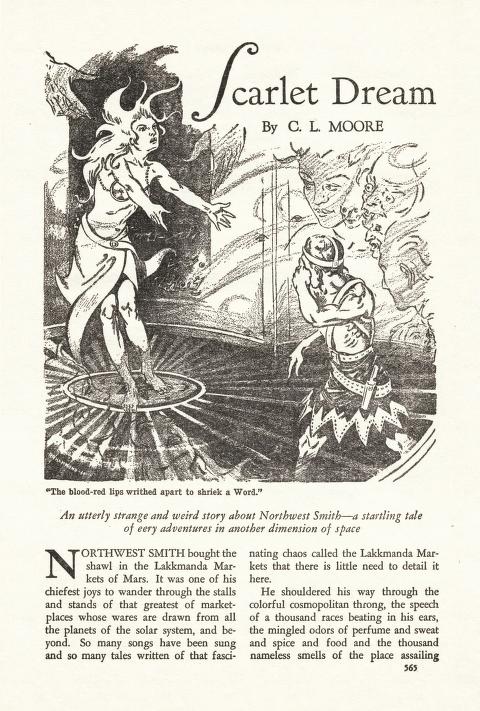
The third tale of Northwest Smith after “Shambleau” (Weird Tales Nov 1933) and “Black Thirst” (WT Apr 1934) followed in the very next issue after the second episode, appearing in the May 1934 issue of Weird Tales. Smith is once again on Mars, though at this point there is no strict chronology in the series, no reference to previous episodes. Each is essentially a standalone story, a separate episode in Smith’s checkered career, much as Robert E. Howard’s characters Conan the Cimmerian and Solomon Kane did not have episodes that followed in any strict chronological order.
In gist, “Scarlet Dream” follows several familiar tropes: an exotic market, a strange purchase, a fabulous dream. Yet the tropes are those of fantasy, adapted to the science fiction setting. There are hints of worldbuilding—a Martian emperor, ivory from Jupiter’s largest moon, a unit of currency called a cris that is more than five dollars—some of which have appeared in previous stories and will appear in future ones, and others which are throwaway details. The idea of a cloth or pattern as a focus of strangeness was nothing new either: “The Yellow Wallpaper” (1892) by Charlotte Perkins Gilman, “The Diary of Mr. Poynter” (1919) by M. R. James, and “The Cloth of Madness” (1920) by Seabury Quinn all being iterations of that idea.
Yet for Northwest Smith, the cloth does not bring madness, but transportation. This was the first of Moore’s stories that would feature the protagonist on a journey to a different world in the sense of another dimension rather than just another planet; a transition fundamentally different from rocketships and standard interplanetary tales fare. However, it is couched in the sort of imagery of Dunsany or Lovecraft’s Dreamlands tales, like “The Silver Key” (1929):
“There are many dream countries,” she said, “many nebulous, unreal half-lands where the souls of sleepers wander, places that have an actual, tenuous existence, if one knows the way. . . . But here—it has happened before, you see—one many not blunder without passing a door that opens one way only. And he who has the key to open it may come through, but he can never find the way into his own waking land again. Tell me—what key opened the door to you?” —C. L. Moore, “Scarlet Dream”
There’s a woman; nameless and beautiful, tragic and doomed. While many fans and critics will point out the women in Howard’s Conan tales, Northwest Smith is seldom at a loss for a beautiful woman, whether human or otherwise, though his relationships tend to be brief and often marked by strangeness, she was not averse to the possibilities of romance that Lovecraft shunned in his own fiction, nor prone to the kind of nudity, bondage, or flagellation that marked the stories of Seabury Quinn and Robert E. Howard when they sought to make the cover of Weird Tales with a particularly enticing scene.
The nameless Thing that stalks the dream-world, preying as it will, recalls in part Robert E. Howard’s “The Slithering Shadow” (WT Sep 1933), where the amorphous Thog preys upon the dreamers of the city of Xuthal. Whether that was direct inspiration or coincidence, Moore never makes clear in any letter. It is interesting to think of this story as a kind of complement to Howard’s tale; as Conan deals with a city of sleepers and the horror that stalks them, Northwest Smith deals with a dreamer and the shadowy predator that hunts them, and both find a way to hurt their foe, and to escape. Yet it would probably be more accurate to say that without deliberately tying her Northwest Smith story to any Mythos of Lovecraft or Howard’s, Moore was drawing on familiar elements in crafting her own unique tale.
The fan-response was, once more, very positive, though there was a slight trend against interplanetary stories—the criticism being aimed more at Edmond Hamilton than C. L. Moore. “Scarlet Dream” was voted the favorite tale of the issue, beating out Robert E. Howard’s Conan tale “Queen of the Black Coast.” Among her writer peers, H. P. Lovecraft noted the story’s excellence in brief:
“Scarlet Dream” is also the real stuff—full of the tension & mystery needed by a weird tale. —H. P. Lovecraft to Clark Ashton Smith, [May/June 1934], Dawnward Spire, Lonely Hill 557
The May W T was much above the average, with “Scarlet Dream”, “Queen of the Black Coast” & “The Tomb Spawn”. —H. P. Lovecraft to Duane W. Rimel, 1 Jun 1934, Letters to F. Lee Baldwin, et al. 180
The plot of “Scarlet Dream” is relatively slight, though evocatively written; if there’s a criticism to be made, then it has to do with the episodic nature of what was now quite clearly a series. All three stories feature broadly the same three-act structure: Northwest Smith is minding his own business; falls into some strange business involving a beautiful woman, has a horrific encounter with some alien entity; and then emerges with the woman dead and Smith strangely affected by an experience beyond normal human ken. Beauty and vampirism are recurring themes. Something that her fellow-Weird Talers noticed:
I can’t get excited over Moore; too feminine stories, for one thing, and the effect rests too much on being outside this earth. — August Derleth to CAS, 22 May [1934], Eccentric, Impractical Devils 221
Personally, I rather like the Moore stories; though I notice that the three already published all have the same recipe of ingredients. The ray-gun stuff is a drawback. What I do like is the hint of unearthliness. After all, very few writers achieve anything that even suggests the possibility of non-terrestrialism; and I admit that I value this particular imaginative quality. — Clark Ashton Smith to August Derleth, 4 Jun 1934, Eccentric, Impractical Devils 222-223
Not that there’s anything wrong with that; far from it. The stories had sold and been well-received by fans. Formula by itself is often misinterpreted as a drawback, which it is when someone tries to define and follow it too rigidly. Moore was taking inspiration from her favorite weird fiction and filtering it through her own imagination. What she was concerned about, however, was growing stale.
I was tremendously pleased at your confidence about Mr. Lovecraft’s flattering opinion of me. So much so that I’m ashamed to have you read the sort of stuff I’m turning out now. Those first three of mine I did think were pretty fair, but I just don’t have ideas like that all the time, and meanwhile have got to eat, you know. I mean that quite literally. —C. L. Moore to R. H. Barlow, 1 Jun 1934, MSS Brown Digital Repository
Farnsworth Wright, editor of Weird Tales, was apparently pleased with what he had read and published so far, and another Moore story would be published just a few months later.
C. L. Moore’s “Scarlet Dream” can be read for free online here.
As reckoned among the race-stocks of the world, the Indian is certainly not inferior. Neither, for that matter, is the Mongolian race as a whole. It is simply our reaction against the alien and the unaccustomed—together with the circumstance that our immigrant specimens are generally of a low type—which causes us to look down on the Chinese and Japanese. Both of these races, as rationally judged by their history, literature, philosophy, and art, are among the superior biological focus of the planet—and no one who is acquainted with their better classes is ever able to retain that feeling of repulsion which the ordinary American, Australian, or New-Zealander usually feels. — H. P. Lovecraft to Robert E. Howard, 7 Nov 1932, A Means to Freedom 1.481-482
The 1853 Perry Expedition forcefully ended Japanese political isolation, and during the 19th and early 20th centuries cultural and technological exchanges with the rest of the world profoundly affected both Japan and the rest of the world. The Tokugawa Shogunate was overthrown, and a new government overtook Japan—one dedicated to rapid industrialization and militarization, which in practice meant increasing Westernization. The successful adoption of Western military technology and tactics became clear during the Russo-Japanese War (1904-1905), in which Japan’s surprise victory over Russia fueled racist fantasies of the Yellow Peril.
While Westerners feared the rising military might and aggressiveness of Japan, many were simultaneously drawn to Japanese art and culture. Japanese woodblock prints (ukiyo-e) covered a vast range of material, from purely ornamental to combinations of image and text that illustrated stories and scenes; from depictions of ordinary life and nature studies to erotica and supernatural creatures. Western interest in these woodblock prints is evident from before the U.S. intervention, but after trade was forcefully opened, the prints became much more accessible and inspired a Japonisme style in European art during the late 19th century, as well as collections and reproductions.
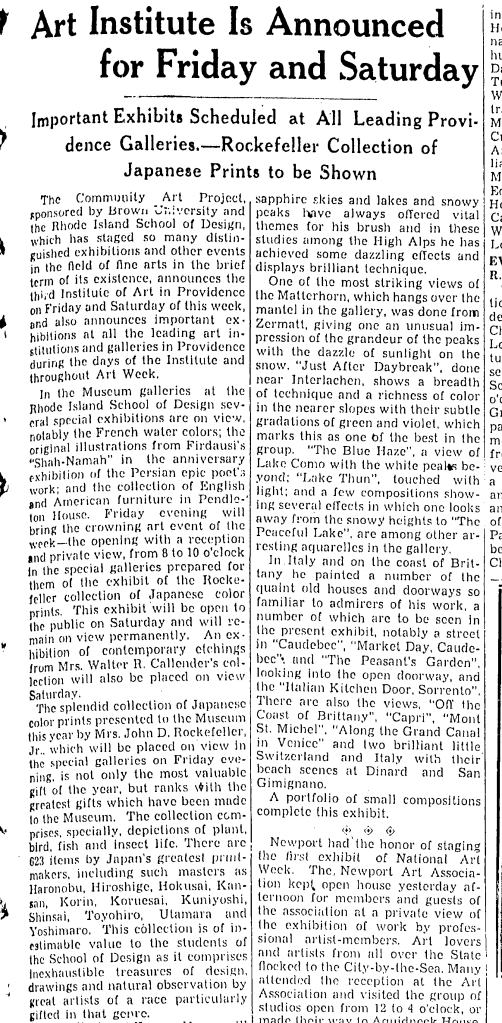
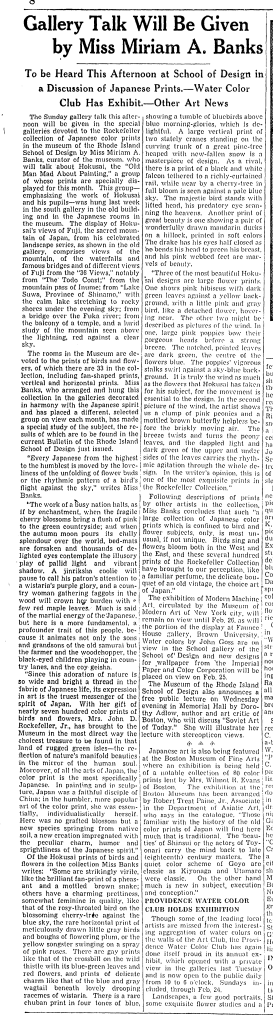
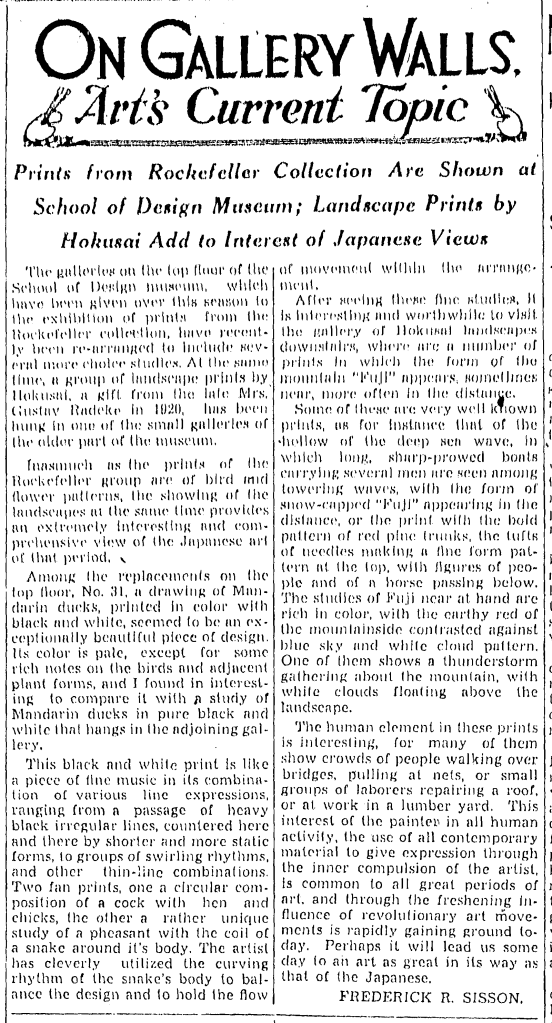
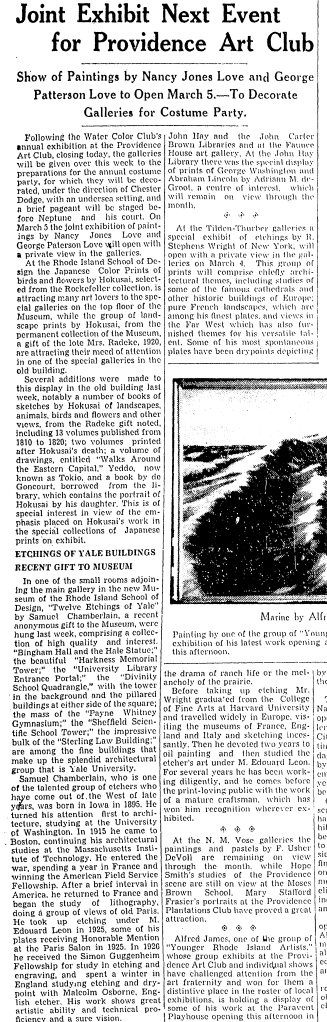
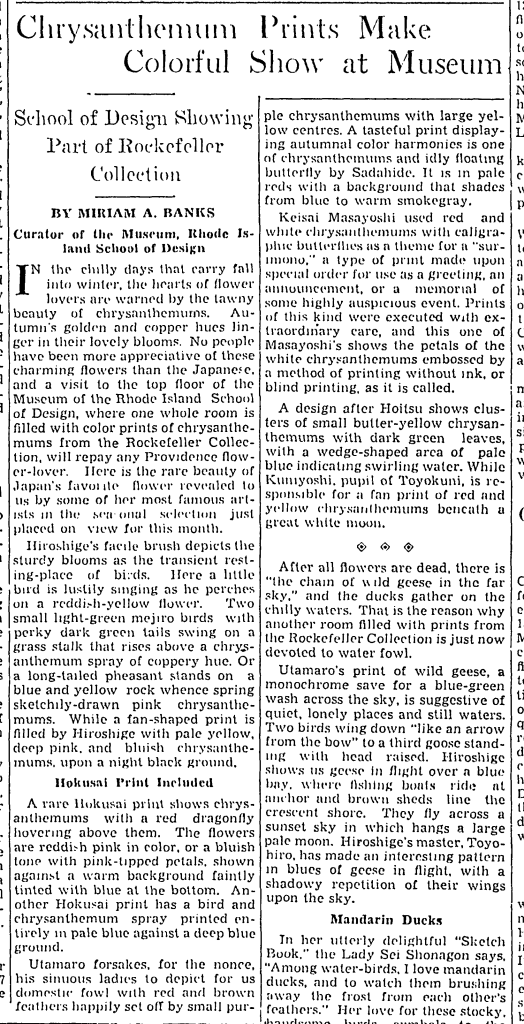
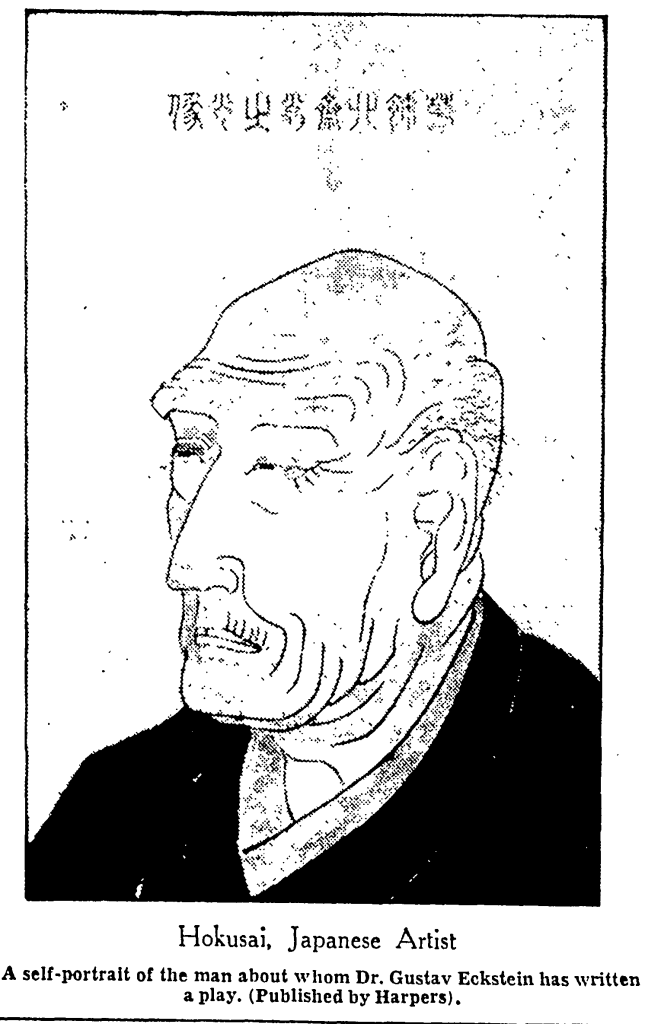
By the 1930s, Japanese prints collections were being displayed in U.S. museums, and the names of popular and notorious artists like Hokusai Katsushika (葛飾 北斎, 1760-1849) and Hiroshige Utagawa (歌川 広重, 1797-1858) were being bandied about by newspapers. In June 1934, Providence native Abby Aldrich Rockefeller (wife of John D. Rockefeller, Jr.) donated her collection of Japanese prints to the Rhode Island School of Design.
Japanese Prints Given by Mrs. Rockefeller, Jr. PROVIDENCE, R.I., June 7—(AP) The Rhode Island School of Design yesterday announced that a rare collection of Japanese prints had been presented by Mrs. John D. Rockefeller, Jr. The 623 prints, devoted chiefly to plant, bird, fish and insect life, are by the country’s greatest masters. L. Earle Row, director of the school museum, said that in accordance with Mrs. Rockefeller’s wishes the collection will be shown in selected groups changed at frequent intervals. —Springfield (MA) Evening Union, 7 Jun 1934, p13
That is where and how H. P. Lovecraft came to be familiar with Japanese prints.
Another event was the display of the choicest of the 717 Japanese prints just acquired by the local art museum. This is a really important accession—placing our museum in competition with Boston’s . . . . which boasts of having the finest Japanese print collection outside of Japan itself. The Providence collection is of the first quality, involving large numbers of items by Hokusai, Hiroshige, & kindred standbys. —H. P. Lovecraft to Richard F. Searight, 22 Dec 1934, LPS 343
Another event was an exhibition of Japanese prints—part of 700 magnificent specimens (Hokusai, Hiroshige, & all the rest) just acquired by the local art museum. This acquisition will bring Providence into competing distance of Boston—whose Museum of Fine Arts boasts the finest collection of Japanese prints outside of Japan itself. —H. P. Lovecraft to August Derleth, 22 Dec 1934, ES 2.671
More or less joined to this “art week” stuff was the first display of a choice array of the 717 Japanese prints just acquired by the local museum. This gave me quite a kick, since I am rather an enthusiast concerning Sino-Japanese art. The prints are of the finest quality, with plenty of Hokusais & Hiroshiges. A couple of weeks ago an expert lectured on the making of Japanese prints, & exhibited some of the delicately carved blocks used in their preparation. —H. P. Lovecraft to E. Hoffmann Price, 30 Dec 1934, LPS 159
It isn’t exactly clear when Lovecraft gained his appreciation of Japanese art, although it seems likely he would have encountered specimens among his visits to art museums in Boston and New York in the 1920s.
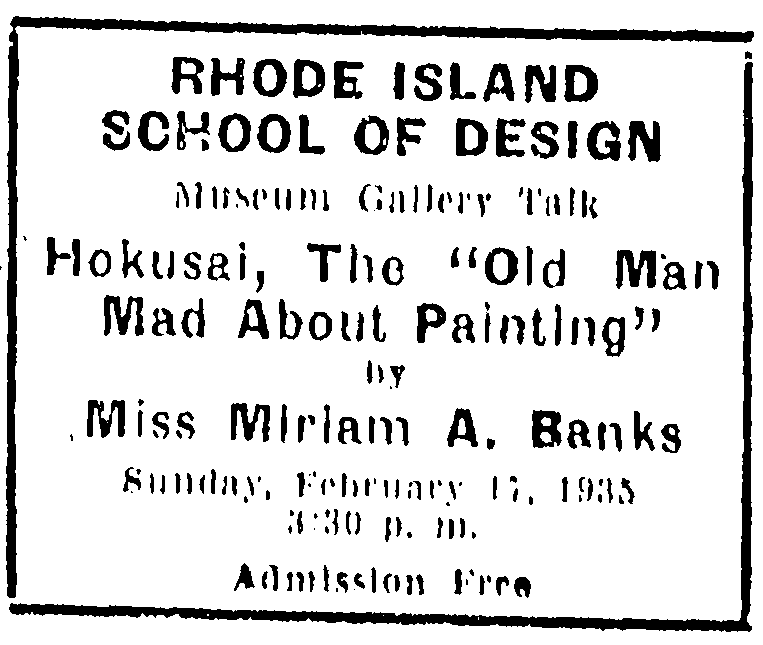
Providence Journal, 16 Feb 1935, p18
The RISD celebrated its recent acquisition with an exhibition of the works and a lectures, open to the public—which Lovecraft attended, as he often took advantage of the free lectures on art and science offered by the local universities.
Saw a fine exhibition of Hokusai’s prints—with explanatory lecture—at the museum yesterday. —H. P. Lovecraft to F. Lee Baldwin, [13 Feb 1935], LFB 123
Saw a splendid exhibition of Hokusai’s prints—with explanatory lecture—at the museum yesterday. —H. P. Lovecraft to J. Vernon Shea, [19 Feb 1935], LJS 254
Some darned good lectures & exhibitions at one of your two local almae matres—the School of Design. Last week they featured Hokusai—& last night there was an illustrated discourse on Soviet art (in Memorial Hall) which would have had Sonny Belknap jumping up & down & piping! —H. P. Lovecraft to Wilfred B. Talman, [19 Feb 1935], LWT 253
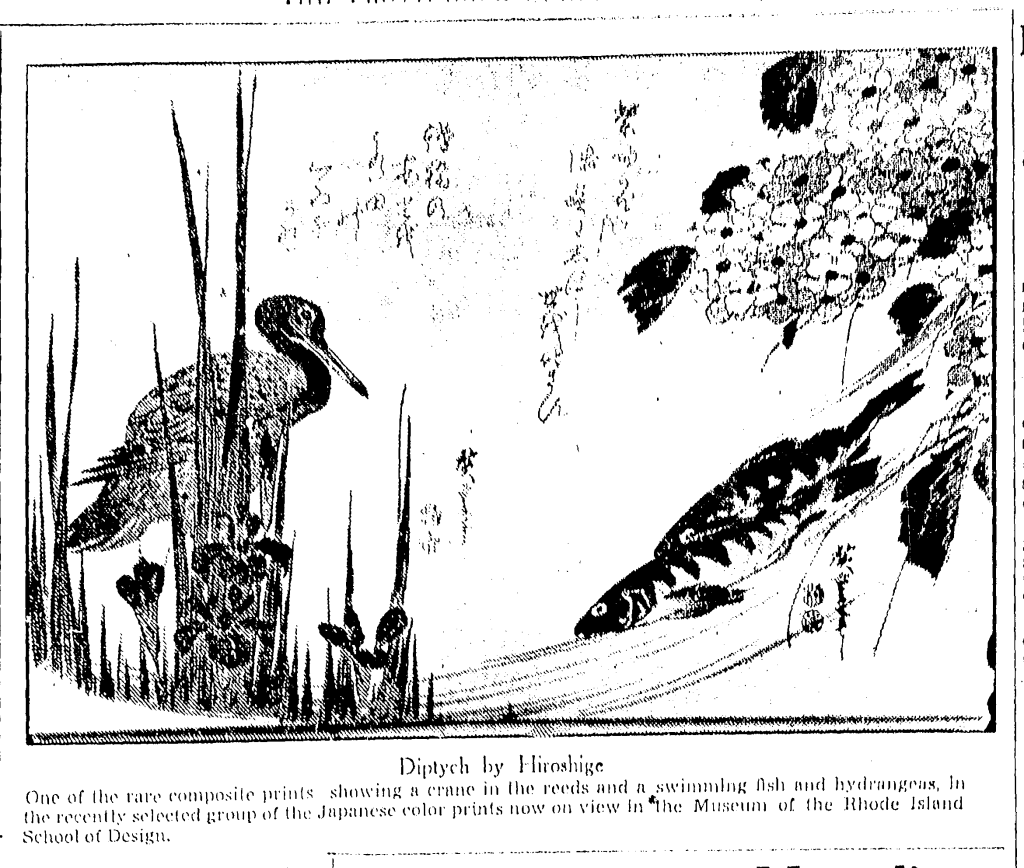
Providence Journal 24 Feb 1935, p55
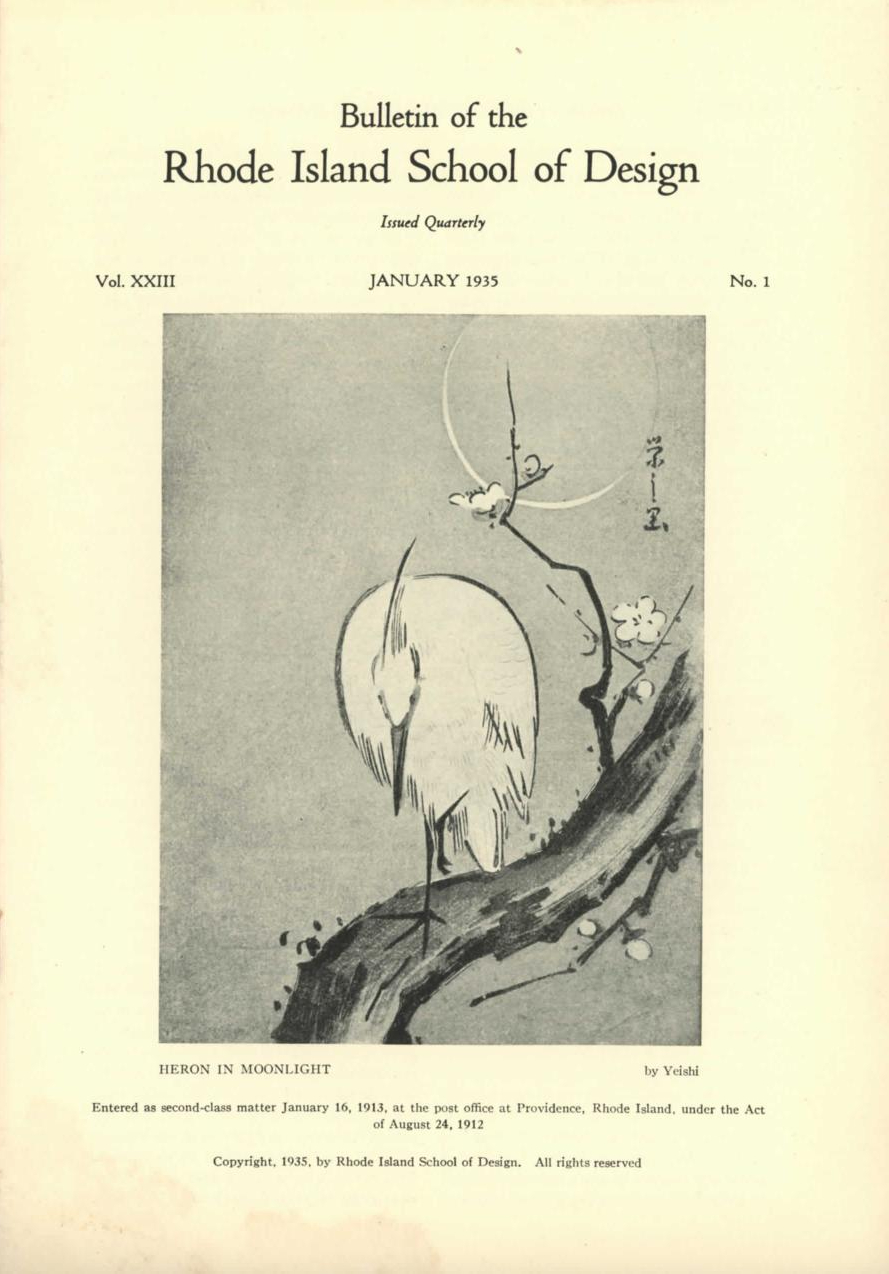
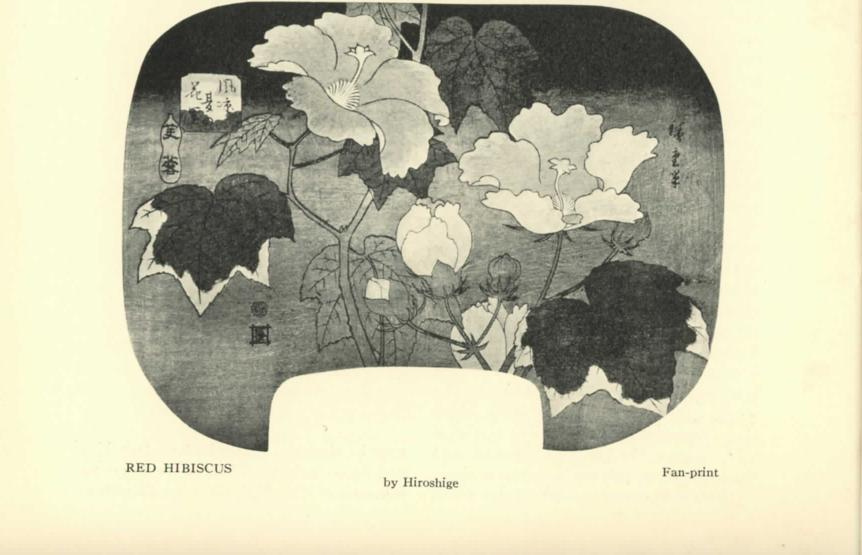
The Bulletin of the Rhode Island School of Design (Jan 1935) was entirely dedicated to the gift of the prints and their subsequent display, as well as providing some background on Japanese art. Lovecraft was so impressed that he couldn’t help but grab a few copies to send to friends.
This month there was a splendid lecture & special exhibition pertaining to my favourite Hokusai, & the entire quarterly bulletin was devoted to the subject of Japanese prints. The article was so fine, & the illustrations so graphic, that I could not resist getting several extra copies to send to especially appreciative persons. Note one mistake—on p. 19, with illus. On p. 22—where a Hokusai fan print of hibiscus flowers is erroneously attributed to Hiroshige. I wouldn’t have spotted this if I had not seen the original prints & their authentic labels in the museum. —H. P. Lovecraft to Elizabeth Toldridge, 27 Feb [1935], LET 298
Later in February I heard an excellent discourse on Hokusai in connexion with an exhibition of his prints at the local art museum. Japanese art certainly appeals to me as few other aesthetic forms succeed in doing. The current museum bulletin was devoted to this subject, & contains so fine an article—together with so many excellent reproductions—that I can’t resist sending you a duplicate under separate cover. —H. P. Lovecraft to R. H. Barlow, [16 Mar 1935], OFF 221-222
Of lectures there may be noted a highly interesting address on Japanese prints in general & good old Hokusai (1760-1849) in particular, held at the local museum in connexion with an exhibition of the prints. Great stuff—I have always been exceedingly fond of the delicacy, tranquility, & exquisite harmony of Sino-Japanese art. Enclosed are some cuttings illustrative of this event—which ably supplements similar events of last December. —H. P. Lovecraft to Helen V. Sully, 5 Mar 1935, LWT 404
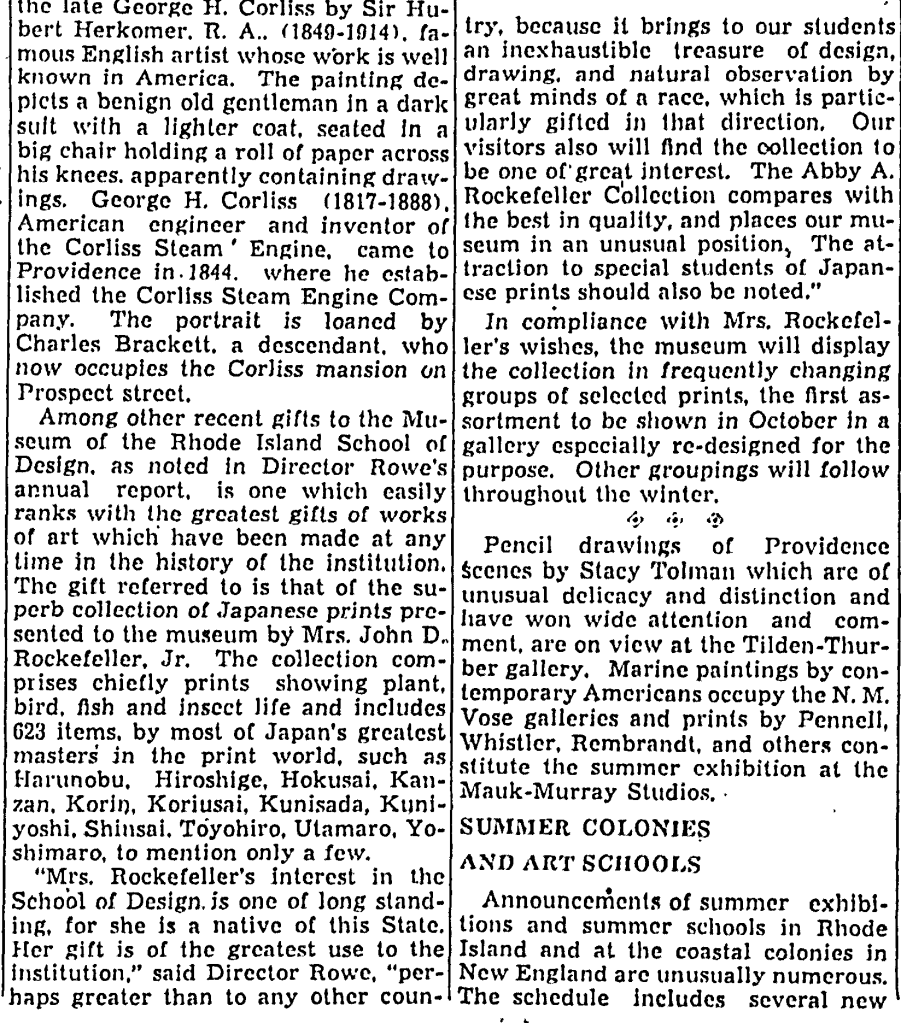
While the clippings don’t survive, several relevant items in the Providence Journal from the period stand out as likely inclusions:
Providence Journal, 1 Jul 1934, p59Providence Journal, 2 Dec 1934, p.47Providence Journal 17 Feb 1935, p.28Providence Journal 20 Feb 1935, p16Providence Journal 24 Feb 1935, p55Providence Journal 1 Sep 1935, p26
Lovecraft makes several other brief references to his trips to see the Hokusai prints to various correspondents throughout 1935:
More recently I heard a fine discourse on Hokusai (an old favourite of mine) at the art museum in connexion with an exhibition of his prints. Sino-Japanese art has always fascinated me extremely, & I wish I could afford a Japanese print collection of my own. —H. P. Lovecraft to Richard F. Searight, 5 Mar 1935, LPS 360
Heard some good lectures recently—a reading by the poet Archibald MacLeish, a discourse on the Japanese artist Hokusai (1760-1849) in connexion with an exhibition of its prints at the art museum, & an account of contemporary Russian soviet art. —H. P. Lovecraft to Duane W. Rimel, 10 Mar 1935, LFB 261-262
Regarding recent events—possibly I told you of the lecture on Hokusai in connexion with an exhibition of his prints. Great stuff—I’ve always been a devotee of Sino-Japanese art. —H. P. Lovecraft to J. Vernon Shea, 13 Mar 1935, LJS 262
Heard some good recent lectures on Hokusai, contemporary Soviet art, & the mosaics of St. Sophia in Constantinople. —H. P. Lovecraft to E. Hoffmann Price, 14 Mar 1935, LPS 173
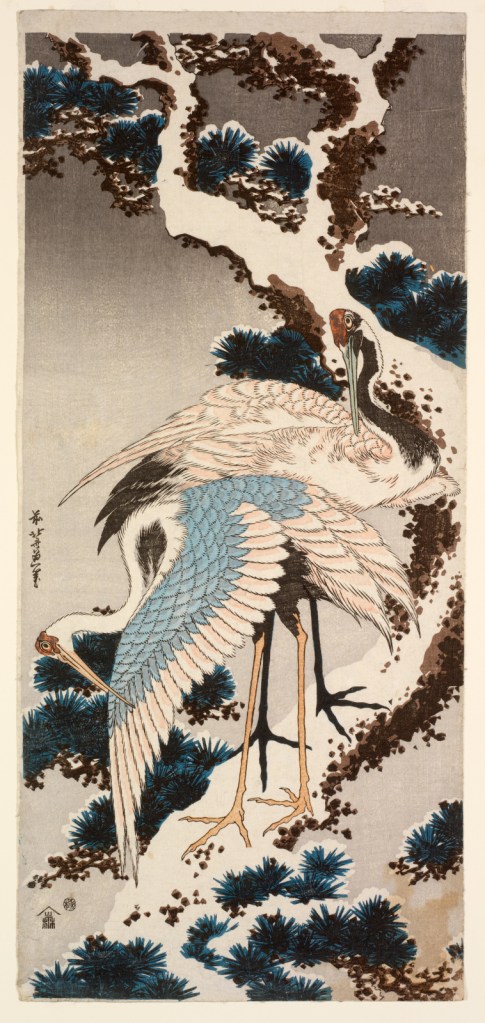
I thought the Japanese print bulletin especially delightful–you may recall that Hokusai’s “Cranes on Snow-Laden Pine” was one of the things I especially liked in the exhibition last December. I was glad to get so good a reproduction of it. Another captivating print is the one of the cat watching the butterflies—which reminds me that the local feline family is now narrowed down to the mother & one coal-black kitten . . . a delectable duplicate of the lamented Sam Perkins. —H. P. Lovecraft to Elizabeth Toldridge, 25 Mar 1935, LET 300
I managed to get out to several lectures—poetry readings by Susanna Valentine Mitchell & the famed Archibald Macleish—author of “Conquistador”—& an excellent discourse on Hokusai at the local museum, in connexion with a notable exhibition of his prints. Japanese art certainly appeals to me as few other aesthetic forms succeed in doing. —H. P. Lovecraft to Clark Ashton Smith, [26 Mar 1935], DS 598
The RISD exhibition seems to have inspired Lovecraft to seek out more of Hokusai’s work, when available. Later in 1935 when traveling in Philadelphia, he stopped in at the Philadelphia Museum of Art, which was also having an exhibition of Japanese prints:
I also visited the art museum, where an especially fine temporary exhibit of Japanese prints (including the entire Fujiyama, bridge, waterfall, & poem series of my favoruite Hokusai) was on display. —H. P. Lovecraft to Helen V. Sully, 23 Sep 1935, LWT 438
Despite Lovecraft’s claims to have always appreciated Sino-Japanese art, the specific interest in the prints of Hokusai seems to have come very late in life, driven by the sudden availability of these materials at a local museum. Lovecraft lamented that he could never own a collection of such prints, and in truth there were relatively few published reprints available in the mid-1930s. Buying originals was a game for collectors, and museums were an invaluable resource for those who wished to experience art that they could never afford.
It is important when reading these brief appreciations to understand how thoroughly Lovecraft had absorbed the Orientalist ideas of his day. Racially, the Japanese were other, yet the stereotypes surrounding them were conflicting, covering both admiration for the exotic culture that seemed keenly tied to nature and their own distinct customs, and repulsion at the looming military threat they posed, and their adoption of Western ways. Lovecraft would remark:
After all, as much as the modernisation of Japan is destroying, it may be that the innate aestheticism of the Japanese mind will manage to salvage more from the past than the western world can. — H. P. Lovecraft to Elizabeth Toldridge, [8 Jan 1930], LET121
Japanese culture will be hybridised with westernism—more & more as Japanese conquest increases the nation’s contacts with the west. It is a pity, because Japanese aesthetic traditions are among the finest in existence. —H. P. Lovecraft to Donald A. Wollheim, 9 Jul 1935, LRB305
The fascination with Hokusai and Japanese prints was one facet of Lovecraft’s fascination with Japanese (and to an extent, Asian cultures) as a whole. It was not an exception to his prejudice, but another aspect of a complex set of views that reflected both the deep cultural fascination with Japan and the Yellow Peril racial fearmongering that informed some of his own fiction. Nor did it begin and end with Hokusai; there is plentiful evidence in Lovecraft’s letters of interest in Japanese art and culture before and after…including Japanese poetry.
Let me endorse the Mocratic recommendation to obtain a free subscription to Travel in Japan. I have done so, & am thoroughly enthusiastic over the charm of the publication—its illustrations of Japanese scenery & architecture, its sidelights on Japanese art & design, & its glimpses of Japanese thought & feeling—musical, poetic bits like the extract cited. Mr. Moe has certainly not overrated the charm of this material—& I am led to wonder whether some English or American translator has prepared the visible text of the various articles & poems from originals in Japanese. In the Spring 1936 issue there is an article on the Japanese spring which well matches the earlier autumnal article. In it is quoted a very fine & typical hokku by the poet Saigyo Hoshi—
“Oh, would that I could Split myself into many, And, missing not a twig, See all the glory of the flowers In all the unnumbered hills.”
—H. P. Lovecraft to the Coryciani, 14 Jul 1936, ML 340
So when we read about Lovecraft and Hokusai, we are reading one thread of a continuing and complex interaction. Lovecraft was not quite a Japanophile, and his knowledge of Japan was imperfect and heavily influenced by the popular culture of his day, which presented views of Japan that were selective and not representative of the whole of Japanese culture. Yet these exposures to other cultures, however imperfect, did spark admiration and interest in Lovecraft—and readers today can see what Lovecraft saw, and perhaps will likewise come away with an appreciation for these Japanese artists and their work.
Rockefeller’s donated Japanese prints are still held by the Rhode Island School of Design, and many of them can be viewed for free online.
Lovecraft & Erotic Japanese Prints
Readers familiar with Hokusai will probably note an absence in the above descriptions of Hokusai’s work: the lack of erotica. The Rockefeller collection consisted primarily of nature studies, animals, plants, etc.; as far as I have been able to determine, none of Hokusai’s erotic works—such as the infamous “Diver with Two Octopi” (蛸と海女), more popularly known as “The Dream of the Fisherman’s Wife”—were included. Very likely, Lovecraft had no idea about this phase of Hokusai’s career, and possibly had no idea of erotic Japanese prints whatsoever.
Which is not to say that Japanese tentacle erotica had no effect on Lovecraft, only that it likely had no direct effect. Japanese erotic prints (shunga) were popular and influential among European artists in the late 19th century, works like Erotic Japonismeby Ricard Bru and Secret Images: Picasso and the Japanese Erotic Printtrace this influence, and in particular how the erotic tentacle motif became established in science fiction art through works like Henrique Alvim-Corrêa’s The Martian Claims a Victim (1906) from his illustrated edition of The War of the Worlds.
Among the many influenced by Japonisme and Japanese print artists such as Hokusai was Aubrey Beardsley, the famous illustrator of the Yellow Book magazine and the first edition of Arthur Machen’s The Great God Pan and The Inmost Light (1894). (For more on which, see Linda Gertner Zatlin’s Beardsley, Japonisme, and the Perversion of the Victorian Ideal (1997).) The image of the tentacle as an alien force spread through the decadent 1890s into the early weird fiction of M. R. James and Arthur Machen as well as the science fiction of H. G. Wells, and by the time of H. P. Lovecraft and his peers the pulp magazines were well-accustomed to this image, and used it in their own work—not generally to penetrate in a sexual manner (that would come later), but as a symbol and motif of corruption and degeneration.
This is the side of Hokusai that Lovecraft very likely never got to see and wasn’t even aware of. The way in which these ideas and images spread and change over time is fascinating and worthy of study.
JE: Did the success of “Shambleau” generate numerous requests for additional stories?
CLM: No, not really. The editor of Weird Tales, Farnsworth Wright, simply told me that he would like to see more of my work. No other editors, at the time, wrote to me requesting additional stories. My success in the science-fiction field came gradually and only after the publication of several other stories. […] I didn’t want it to be known at the bank that I had an extra source of income. I wrote “Shambleau” in the midst of the Depression. The bank was a very paternalistic organization. It was already firing those people whose services weren’t really needed. I had the feeling that they might have fired me had they known that I was earning extra income. So I kept it a deadly secret. Using my initials was simply a means of obscuring my identity. —“C. L. Moore: POET OF FAR-DISTANT FUTURES” by Jeffrey M. Elliot in Pulp Voices(1983) 46-47
“Shambleau” (WT Nov 1933) struck like a lightning bolt—boldly original, and meeting almost universal acclaim. Yet the pages of Weird Tales are littered with one-hit wonders, authors who sold a single story and never made another sale, or who did sell again but could never recapture the power and promise of that first story. With C. L. Moore’s second tale, readers would find out whether “Shambleau” was a lucky accident or not. Within a few months, they found out.
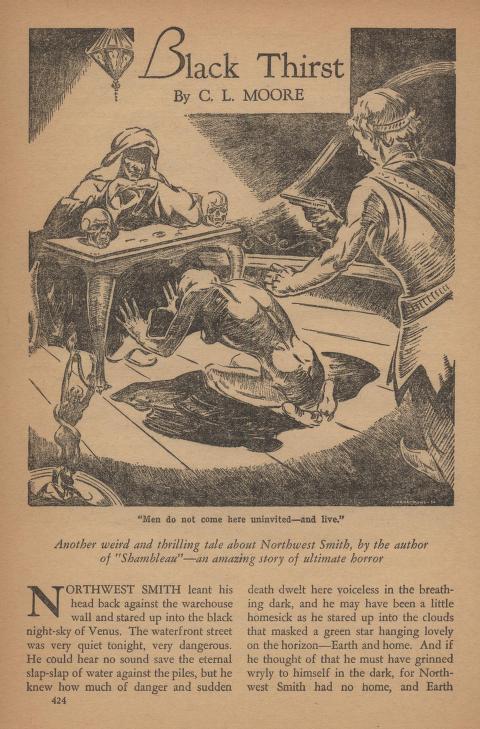
BLACK THIRST by C. L. Moore
Another weird and thrilling tale about Northwest Smith, by the author of “Shambleau”—an astounding story of ultimate horror. —”Coming Next Month,” Weird Tales Mar 1934
Between November 1933 and March 1934, C. L. Moore had not been idle. The Great Depression was still raging, she was still working in her secretarial position in Indianapolis, and she now had a new, unexpected source of income if she could continue to sell stories. According to a 1976 interview with Chacal, her second story, “Werewoman,” was rejected; whether or not this was quite the order of events is unclear as some of her later interviews are contradictory on this matter, but it seems clear that she was emboldened to write several new stories and submit them to Weird Tales; editor Farnsworth Wright bought some of them and relatively quickly brought them to press.
“Black Thirst” appeared in the April 1934 issue of Weird Tales. It is the second published tale of Northwest Smith; the one-off space outlaw was now officially a series character. Set on Venus rather than Mars, with Earth as no more than a green star in the sky, it follows a similar mix of beauty mingled with horror, ray-gun action, and alienation—not repeating the plot of “Shambleau,” but strongly evocative of the elements that had made that story work, somewhat remixed. From some subsequent comments, it is apparent that Moore was at this point more likely to write by the seat of her pants than plot, and take advantage of sudden bursts of inspiration:
You ask for manuscripts. If what you mean is the original draft, all scribbled over, the only one I have now is the medieval-lady opus. I’ll enclose it when I return your magazines. It’s not a very accurate original, tho, for when I typed it for publication I made a good many changes as I went along. And as I remember, I changed my mind in the middle a couple of times, and deflected the course of the story. You see, I never know until I’m half-way through how it’s going to end, and usually have to go back and alter the first a little to hitch up with the last. I was nearly thru with SHAMBLEAU before I had the remotest idea how I was going to rescue Smith from her clutches. And in BLACK THIRST the Alendar’s relapse into primeval ooze was as much of a shock to me as to any of the characters in the sotry. I didn’t know until I had actually begun that scene on the edge of the underground sea how I was going to overcome the Alendar. Smith’s hairbreadth escapes were quite literally harbreadth, for I’m usually breathless with apprehension as I snatch him just in time from the awful dangers that beset him. Tho that’s all past tense now, I suppose. —C. L. Moore to R. H. Barlow, 1 Jun 1934, MSS Brown Digital Repository
By the way, speaking of the Alendar, I wonder how other people find the odd names they want for characters. I usually glance around ind esperation and seize on the first hting I see. Alendar is simply Calendar with the C left off. And N. W.’s friend Yarol is a transpostion of the name on the Royal typewriter I wrote the story on. —C. L. Moore to R. H. Barlow, 10 Sep-9 Oct 1934, MSS Brown Digital Repository
There is also a suggestion that Farnsworth Wright, following his editorial habits (see “Bat’s Belfry” by August Derleth), was revising Moore’s manuscripts as they came in. The exact nature of these revisions is unclear, though typically he asked writers to tighten up overwordy passages or would silently remove references to sex.
I trust your revisions may make Mrs. Moore’s second story as striking and interesting as this one. —H. P. Lovecraft to Farnsworth Wright, 21 Nov 1933, Letters to Woodburn Harris 86
The story is slightly more daring than typical Weird Tales entries. The third paragraph includes a bald reference to “Venusian street-walkers,” and the story deals with human-trafficking and eunuch-guarded harems in a way strongly reminiscent of Yellow Peril stories of white slavery and seraglios, an alien eugenics that treats the breeding of human beings like humans breeds cows or cats, and an almost homosexual element when the Alendar considers Northwest Smith:
“I realized how long it had been since I tasted the beauty of a man. It is rare, so different from female beauty, that I had all but forgotten it existed. And you have it, very subtly, in a raw, harsh way…” —C. L. Moore, “Black Thirst”
More than “Shambleau,” the expanding Interplanetary setting that C. L. Moore sketches echoes fantasy as much or more than science fiction. She speaks of the three planets (Mars, Venus, and Earth), but there are kings, castles, courts, and courtesans; payment is expected in gold coins; and Smith looks for swords and daggers as much as rayguns. If “Shambleau” was drawing heavily on Westerns, then “Black Thirst” seems to draw as much from her quasi-medieval fantasy setting in her pre-pulp writing. If there is a criticism to the story, it might be that it hews a little too close to the plot of “Shambleau.” Once again, Northwest Smith finds himself facing an almost spiritual as well as physical peril from a vampiric alien. While not quite formulaic, readers could definitely see how strongly it echoed some of the notes of Moore’s first tale.
Yet they loved it.
Donald Allgeier, of Springfield, Missouri, writes: “This letter is written primarily because of Black Thirst. I have a thirst (black or not) for more like it. I hope the next story by Moore is as good as this. . . . Who is C. L. Moore, anyway? Surely he’s not a brand-new author—not when he can write as he does. Could he perhaps be a new pseudonym for some famous writer? I thought he had just about reached the ultimate in his first story, but the second proved my mistake. Most authors would carefully avoid description of all those beautiful girls, but Moore handles it beautifully, delicately, and marvelously. The Alendar, too, is a worthy creation. I’d like to see a novel by Moore. —”The Eyrie,” Weird Tales June 1934
There were many more fan-comments in that vein, and Wright had already seen the promise of his new discovery and bought more stories from Moore–and Wright was careful at this point to follow her wishes and not reveal her gender, though that bit of gossip would soon make the rounds in fan-circles. Even her pulp peers were impressed by Moore’s sophomore effort; Lovecraft praised it to many of his friends. Though most of Lovecraft’s comments are brief, a few are fuller:
The present issue, I think, is far above the average—with your tale, the splendid Bruks reprint, the powerful Smith yarn with self-drawn illustration, and the strikingly potent, original, and distinctive “Black Thirst”. —H. P. Lovecraft to Robert E. Howard, 3 Apr 1934, A Means to Freedom 2.727
The recent WT is distinctly above average—“Black Thirst” perhaps leading because of the utter originality of its conception, the vividness of its unfolding, & the ever-brooding air of hidden, transcendent horror just beyond one’s sight. A little less conventionality of the popular-romance setting & mood would increase the power of the tale. —H. P. Lovecraft to R. H. Barlow, 10 Apr 1934, O Fortunate Floridian 129
“Black Thirst” has a lot of conventional stuff, but the atmosphere of utterly unknown evil & menace is extremely distinctive. —H. P. Lovecraft to Clark Ashton Smith, [13 Apr 1934], Dawnward Spire, Lonely Hill 552
In 1935 when R. H. Barlow was thinking of re-printing the story for Moore through his small press, he apparently considered revising the tale—which Lovecraft disagreed with:
As for revision—some of the tales would take careful thought indeed. “Black Thirst” couldn’t be revised except by striking at its very core—cutting out the vapid idea of human-looking beauties on another planet (unless descent from a remote terrestrial source is suggested, &c.), &c. It might be wisest to let some of the tales alone, & hope that later specimens will avoid the flaws which they possess. But all that is for later consideration. —H. P. Lovecraft to R. H. Barlow, [25 Mar 1935], O Fortunate Floridian 229
As a young man, Lovecraft had grown up on adventurous “planetary romances” like Edgar Rice Burrough’s A Princess of Mars, which featured lots of action and improbably human-looking aliens with princesses that could procreate quite readily with Earth-born heroes. Biologically, this is as bunk as Star Wars and Star Trek‘s rubber-forehead aliens, and as an adult Lovecraft was very critical of the idea of Earth-like worlds that evolved Earth-like humanoids, as expressed in Lovecraft’s “Some Notes on Interplanetary Fiction.” So Lovecraft was not strongly drawn to the Burroughs-esque elements that may have appealed to Weird Tales fans; for him, it was the sheer alien weirdness and horror that was the true appeal of Moore’s first couple stories.
There is every indication that Wright knew he had another hit on his hands with “Black Thirst,” because he had already bought other stories that was destined to appear in subsequent issues of Weird Tales. Yet the Unique Magazine brought with it more than acceptances and (eventually) welcome checks; Moore also made new friends, as fan-letters from Weird Tales turned into correspondences with folk like R. H. Barlow.
I hope you will not be too much disappointed in the stories that follow. Perhaps, when you have read those appearing in the April and May issues, you will write again to tell me what you thought of them. —C. L. Moore to R. H. Barlow, 8 Mar 1934, MSS Brown Digital Repository
Through Barlow, Moore would come to correspond with Lovecraft, Robert E. Howard, and Clark Ashton Smith, among others. It connected her to a wider community of writers, whom she would both influence and be influenced by. If “Shambleau” marked C. L. Moore’s arrival on the scene, “Black Thirst” helped her swiftly gain acceptance into the world of weird and science fiction pulp writers.
C. L. Moore’s “Black Thirst” can be read for free online here.
I have given the whole of a cloudy Sabbath to finish my dismembered corpse story—“The Return of Helman Carnby”. I shall enclose the carbon with this; and I hope you will like it. The thing became a sizable yarn, with all the details that I worked out . . . It goes to “Ghost Stories”, then to W. T.,—both of which will doubtless reject it. But I think myself that the tale is a pretty fair literary beginning for the New Year. I like to picture it in the sunny and lightsome pages of the “Ladies’ Home Journal.” —Clark Ashton Smith to H. P. Lovecraft, c. early Jan 1931, Dawnward Spire, Lonely Hill290
Needless to say, I perused the monstrous narrative of Helman Carnby with the most acute & shuddering admiration; &, having made the verbal changes indicated in your supplementary note, have forwarded to Derleth with instructions for return to you through Wandrei. It is certainly a great piece of work, & I am extremely flattered by the prominent part played therein by the Necronomicon. But God! If there is still a copy of the original Arabic version in existence, what safety can we guarantee for this unhappy planet? Is it not true that no copy was found when the police entered the seemingly deserted mansion of Carnby & observed those hideous & inexplicable conditions which the newspapers were not allowed to print? What of that utterly unthinkable foot-mark which seemed to be burned into the floor? But one must not think of such things! Anyway, it’s a great yarn, & the cumulative suspense & malign suggestiveness of the earlier parts are enough to set any outfit of teeth—even false ones on a dentist’s cupboard shelf—chattering! It looks to me quite all right as it is—if there were any way of piling on another shudder, I’d say it would be by veiling the final horror a little more obscurely from actual sight, & trying to hint or imply the blasphemous abnormality which sent the secretary fleeing from that accursed habitation. I certainly hope that the tale will find a typographical haven. —H. P. Lovecraft to Clark Ashton Smith, c. 18 Jan 1931, Dawnward Spire, Lonely Hill293
Ghost Stories did not take “The Return of Helman Carnby,” not even after Smith re-wrote the ending and sent it back for another look; nor was it published by Weird Tales. The story was published in Strange Tales of Mystery and Terror (Sep 1931), under the title “The Return of the Sorcerer.” This is arguably Smith’s most distinctly “Lovecraftian” story, being an explicit extension of Lovecraft’s Mythos rather than involving any of Smith’s own fabulous settings and entities, and one of the first uses of the Necronomicon outside of Lovecraft’s own works (compare “The Were-Snake” (1925) by Frank Belknap Long, Jr. and “The Picture” (1939) by Robert D. Harris).
“The Return of the Sorcerer” was reprinted in Smith’s first Arkham House collection Out of Space and Time (1942), and anthologist August Derleth selected it for inclusion in Sleep No More(1944), which meant it was included in the Armed Services Edition of that book issued to soldiers during World War II. One can just about imagine a marine en route across the Pacific Ocean idling away a sweltering hour reading of the dismembered corpse crawling from the grave. By the 1950s, however, “The Return of the Sorcerer” had been out of print for years—though not forgotten.
Web of Evil was a horror comic published by Quality in the years immediately before the formation of the Comics Code Authority, and which ran 21 issues. The product was typical of the era: often shoddy artwork and simple, quick stories that emphasized grue and taboo, shock and suspense. The stories were often unsigned and the creators weren’t above lifting a plot from an old pulp magazine from time to time.
“The Corpse That Wouldn’t Die!” in Web of Evil #2 (Jan 1953) by artist Jack Cole is very clearly based on “The Return of the Sorcerer.” The names were changed to hide the plagiarism, and the unnamed Necronomicon is in Sanskrit rather than Arabic, but the essentials of the story are clearly recognizable. It may no longer be a Mythos story, but for all that it has a distinct charm for those that recognize that Cole is, at least, lifting from the best.
At six pages, the action moves fast—and in almost every panel, Cole tries to add some dramatic element of lighting or motion to capture the eye or set the tone, which often leads to near-comical exaggeration. Though there is not so much grue as there might have been: after all the corpse of the deceased sorcerer is still intact when it returns from the grave.
Lifting stories from pulp writers was not unusual in the 50s, and “The Corpse That Wouldn’t Die!” sits neatly among the Pre-Code Lovecraftian Horror Comics. The tale has been reprinted a number of times, including a version in Tales of Voodoo vol. 5, no. 2 (Mar 1972), where the art was reworked by Oscar Fraga and the result retitled “The Deadly Corpse” (sample pages below). Fraga’s rework updates the art to match the sensibilities of Eerie Publications in the 70s, but doesn’t add anything new to the story itself.