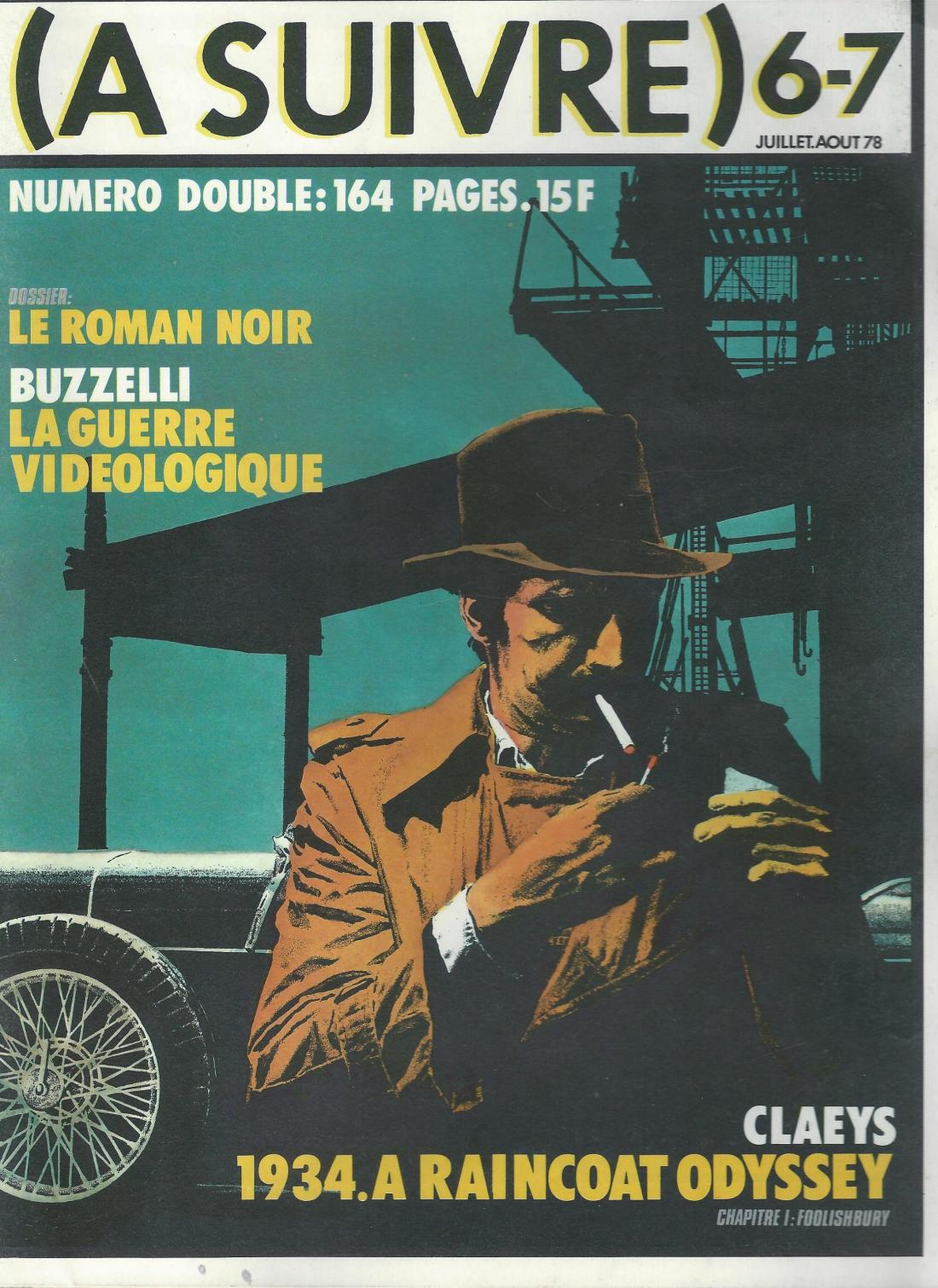
“Under the Keeper of the Key” (2015) by Jaap Boekestein

Eldritch Fappenings

This review deals with a work of erotic content, and the history of erotic art and writing. As part of this review, selected passages with descriptions of genitalia and/or sexually explicit contact will be included.
As such, please be advised before reading further.


I have never read the famous “Justine” of de Sade, or the equally famous “Venus in Furs” of von Masoch. Both are undoubtedly significant in the history of psychology, though perhaps less so as works of art. Probably they can be obtained at any time from dealers in so-called “curiosa” like the Falstaff Press or Esoterika Biblion of New York.
—H. P. Lovecraft to Lee McBride White, 12 Sep 1932, Letters to J. Vernon Shea, &c. 353-354

The term BDSM (Bondage Domination Sadism Masochism) did not exist when Lovecraft was writing his Mythos, though he would have recognized parts of it from his cursory knowledge of psychology and sexology, and would have been familiar with aspects of its depiction in pulp magazines—Weird Tales among other pulps included vivid scenes of men and women being bound, whipped, and tortured, or forced into subservience, sometimes in a sexual manner (though never explicitly). Indeed, Robert E. Howard’s early Mythos fiction such as “The Black Stone” (1931) contain scenes of flagellation (for more on which, check out Charles Hoffmann’s “Elements of Sadomasochism in the Fiction and Poetry of Robert E. Howard”).

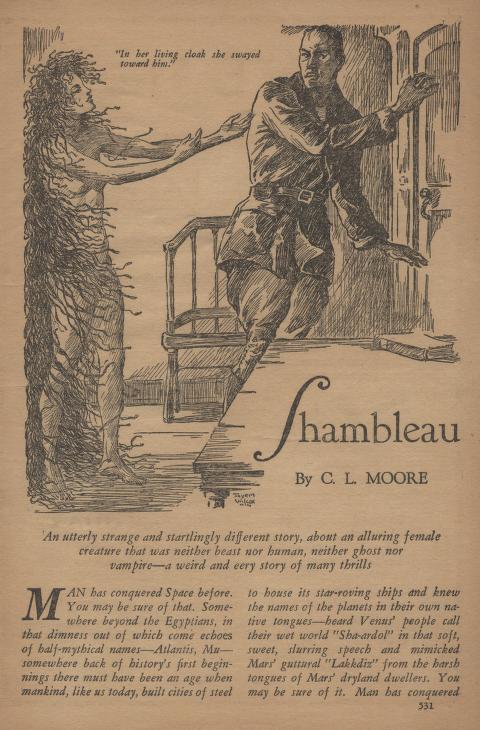
Brundage-WT-Slithering-ShadowThis early influence of BDSM literature on Howard’s Mythos tales is part of a complicated collision of censorship, psychology, and economics. Sadomasochism and physical punishment were commonly understood as psychological deviations rather than sexual kinks, since the acts themselves were adjacent to sex, but didn’t necessarily include intercourse or masturbation. As such, works which presented themselves medical, legal, anthropological, or historical treatises could sometimes pass censors—Robert E. Howard had a small library of such volumes—and more importantly for pulp publishers, meant that they could be more freely advertised in magazines, and that dramatized aspects of these practices could add some sexual titillation to encourage sales. This in turn encouraged some pulp writers to work such elements into their stories; including Weird Tales favorites like Seabury Quinn and Robert E. Howard, who vied for cover art by Margaret Brundage for their stories.

These early BDSM-inflected pulp stories should be understood as fantasy, strongly influenced by erroneous understandings of sexuality, gender, and relationships, not a reflection of real-life practice. This can be clearly seen in, among other things, Robert E. Howard’s complicated depiction of lesbianism in his fiction. The whole stereotype of the “sadistic” villain may not owe itself to the pulps, but the pulps definitely helped build and promote such stereotypes. It would take considerable time for the “scene” to build up, and for knowledge and philosophy of BDSM as a safe, consensual adult activity to become more open, established, and move away from the stark depictions of utter depravity showcased in pulp fiction.

As understanding of sexual kinks has spread and grown in acceptance in society at large, that understanding has rarely fed back into Cthulhu Mythos fiction. While there are occasional characters that engage in obviously sadistic or masochistic practices, and bondage in various forms has never gone out of fashion, BDSM is rarely a key feature of Mythos fiction, especially BDSM of the consensual sexual activity between adults variety. For example, in the Delta Green roleplaying game (an offspring of the Call of Cthulhu Roleplaying Game), the Shan (Insects from Shaggai) that originated in the fiction of Ramsey Campbell display masochistic tendencies when they take a host. Another notable example is “Necrophallus” by Makino Osamu (牧野修), which focuses on the sadistic element and body horror as its primary theme—again, emphasizing the deliberate fantasy rather than consensual bloodplay or body modification play.

Compton_FromBeyondOne of the most interesting overt uses of BDSM themes and imagery in a Lovecraftian work is the film adaptation of From Beyond (1986), which occupies an interesting middle ground between pulp sadism and consensual BDSM practice. BDSM equipment and imagery is used both to show the character’s increasing desire for more intense experiences, and the sado-masochistic depths that the villainous Dr. Pretorius had descended to in the search for some new sensation.

Weird as it might be to think about, erotic Mythos fiction and pornographic materials also rarely broach BDSM territory, especially consensual activity. While it is relatively common to have a sacrifice to Yog-Sothoth or Cthulhu tied up so that the Mythos entity can sexually assault them, it is much rarer to see ropeplay, or the “sacrifice” an elaborate sexual roleplaying scenario featuring consenting adults.

There are several reasons why might we don’t see more a more elaborate BDSM Mythos. For one, it’s kink-stacking; the subset of your audience that enjoys both BDSM and Lovecraftian erotica is likely going to be smaller than the audience that enjoys both separately. For another, the intensely personal relationships between the players in a BDSM scenario—especially a consensual one—can be difficult to square with the often very impersonal nature of Lovecraftian horrors. While Cthulhu might bind you with its mighty tentacles, it’s not clear that Cthulhu is getting off on the act. Yet there are a couple of stories which tread this rare territory and do interesting things with it.

“Sub-space,” said Machteld. “Pain is a key that can open doors. It begins with fear, followed by anger, resistance, resignation, and finally surrender. Deeper and deeper down into the warm red sea until you reach the core Down there are no desires, no thoughts, just the primal void. In that place the universe is waiting, a blank slate, ready to be filled with its latent destiny. And there the worthy will find the answers they seek.”
—Jaap Boekestein, “Under the Keeper of the Key” in Lovecraft after Dark 17

The idea of achieving a different state of consciousness is an old one in magical and religious practice. Some choose to use drugs, and drug-fiction is a staple of early fantasy and weird fiction, including H. P. Lovecraft’s “Ex Oblivione” and Clark Ashton Smith’s “The Hashish Eater.” Other methods might include fasting, chanting, drumming, and dancing; in “The Case of Charles Dexter Ward” Lovecraft wrote:

For the fright and fainting of his mother he expressed the keenest contrition, and explained that the conversation later heard was part of an elaborate symbolism designed to create a certain mental atmosphere.

There are parallels in Lovecraftian occultism too; Donald Tyson in Grimoire of the Necronomicon parrots Aleister Crowley’s rite of eroto-comatose lucidity, where the altered state of consciousness is achieved by excessive sexual activity:

On the day prior to the attempt to open the Gate of the East upon the path to the black throne, the follower of this way should rely on the aid of a partner to sustain his arousal without interruption continuously. This can be done with the aid of caresses, embraces, erotic art, sensual music, incense, sensual baths, and oils for the skin. If necessary, the aspirant may sustain his own arousal, but this is more difficult as it divides concentration. Always the image of Shub-Niggurath should be held in the imagination, but in a form of the goddess that is attractive and seductive to the aspirant for her favor. Female disciples will choose to conceive her in her masculine aspect, unless they favor the love of women. (148)

Richard Gavin in his entry for The Starry Wisdom Library outlined another such procedure:

The method employed to accomplish this was a ritual entitled “Alimenting the Ghul (or Ghoules).” In preparation for this ritual, the aspirant would neither sleep nor consume food for three days, all the while conducting a repetitive series of darkly meditative chants while sitting cross-legged within a “place of death,” presumably a mausoleum, a catacomb, or other large tomb. At the conclusion of the three-day preparation period, the aspirant’s naked body would be rubbed with various salves before he was wrapped in a funerary shroud and buried alive within a coffin made of oak. (127)

Scott R. Jones wrote in When The Stars Are Right: Towards An Authentic R’lyehian Spirituality

The Black Gnosis may be triggered in the moment of orgasm, or at any moment during the sexual act (or indeed at any moment at all, sexual or otherwise) by allowing the Being-Strangeness of the act itself manifest fully in the consciousness. This awareness is brought forth through a meditation on fear. (108)

There are other examples, different paths. Different authors working at different purposes to express similar ideas: that there are different states of consciousness, that can be arrived at through various means (which may resemble magic, or sex), and which unlock…something for the individual. Sometimes a particular occult knowledge, in others a transformation of self. All of which has its clear parallels with BDSM as it is understood in the contemporary consciousness.

You don’t need to build a dungeon, elaborate set-pieces of torture devices, and a wardrobe of latex and leather gear to have a little bondage fun, or to engage in some hearty spanking. Domination is an attitude and game that need not be confined to a bedroom. While we often get fixated on the outward trappings of BDSM play, there is a deeper psychology at work. Sexual submissives in the BDSM scene are not psychologically stunted or damaged individuals who are dominated by more powerful personalities, they are fully conscious human beings who feel the need to submit, and derive something from the act—or ritual—of submission.

Which is not as easy as it sounds. Yet subspace is the essential bridge that Jaap Boekestein uses to connect BDSM to the Cthulhu Mythos. Where Robert E. Howard and the From Beyond film were using the striking imagery of flagellation, and BDSM’s props and costumes to titillate the reader or viewer, Boekestein goes into the psychology of the individual that would willing subject themselves to such rites as Robert E. Howard described in “The Black Stone”—and very specifically, why someone seeking out the Cthulhu Mythos might do this.

The whip hit the exact same spot. A groan escaped his lips, bright flames shot through his leg. Is this an initiation or sadistic torture? What has this to do with the secrets of the ancients?

Whap. Whap.

She kept hitting Without mercy, Machteld thrashed him. He could not see anything but he felt her moving around, hitting his chest, his stomach, his cock. Burning strokes of pain as she hit him everywhere. Nothing was safe. Nothing was sacred.
—Jaap Boekestein, “Under the Keeper of the Key” in Lovecraft after Dark 21

It is a process that the reader themselves goes through with the protagonist. His questions are their questions, but in the end…well, a vicarious flagellation session will never equal the real experience. The result will be familiar to many readers of the Mythos; Lovecraft wrote about another protagonist who achieved the same state, albeit through a different path. Boekestein wrote about this:

What kind of people, I wondered, wouldn’t have much of a problem with the Mythos Universe? People who were different from the norm, was my conclusion. People who perceived reality differently. “Transformation is the key. Transformation of both the body and the mind.” If you live in a non-mundane world, you don’t feel mundane fears. The monsters might even welcome you in as one of their own.
—Jaap Boekestein, “Afterword” in Cyäegha #8 (Spring 2013)

Many of the people that read and write the Cthulhu Mythos identify as outsiders. Weird fiction attracts weird people. Those with an interest or affinity in BDSM are outsiders too. While the communities are separate, there are individuals who have a foot in both worlds…and for those who have such an inclination, maybe they will be happy to know that they too can trace their roots back to the beginnings of the Mythos.

Jaap Boekestein is a Dutch writer who has written several Mythos stories, which have been published in English and Dutch, and editor of Waen Sinne and Wonderwaan. Some of his Mythos fiction appeared under the pseudonym Claudia van Arkel. “Under the Keeper of the Key” appeared in the erotic Cthulhu Mythos anthology Lovecraft after Dark (2015).


Bobby Derie is the author of Weird Talers: Essays on Robert E. Howard & Others (2019) and Sex and the Cthulhu Mythos (2014).
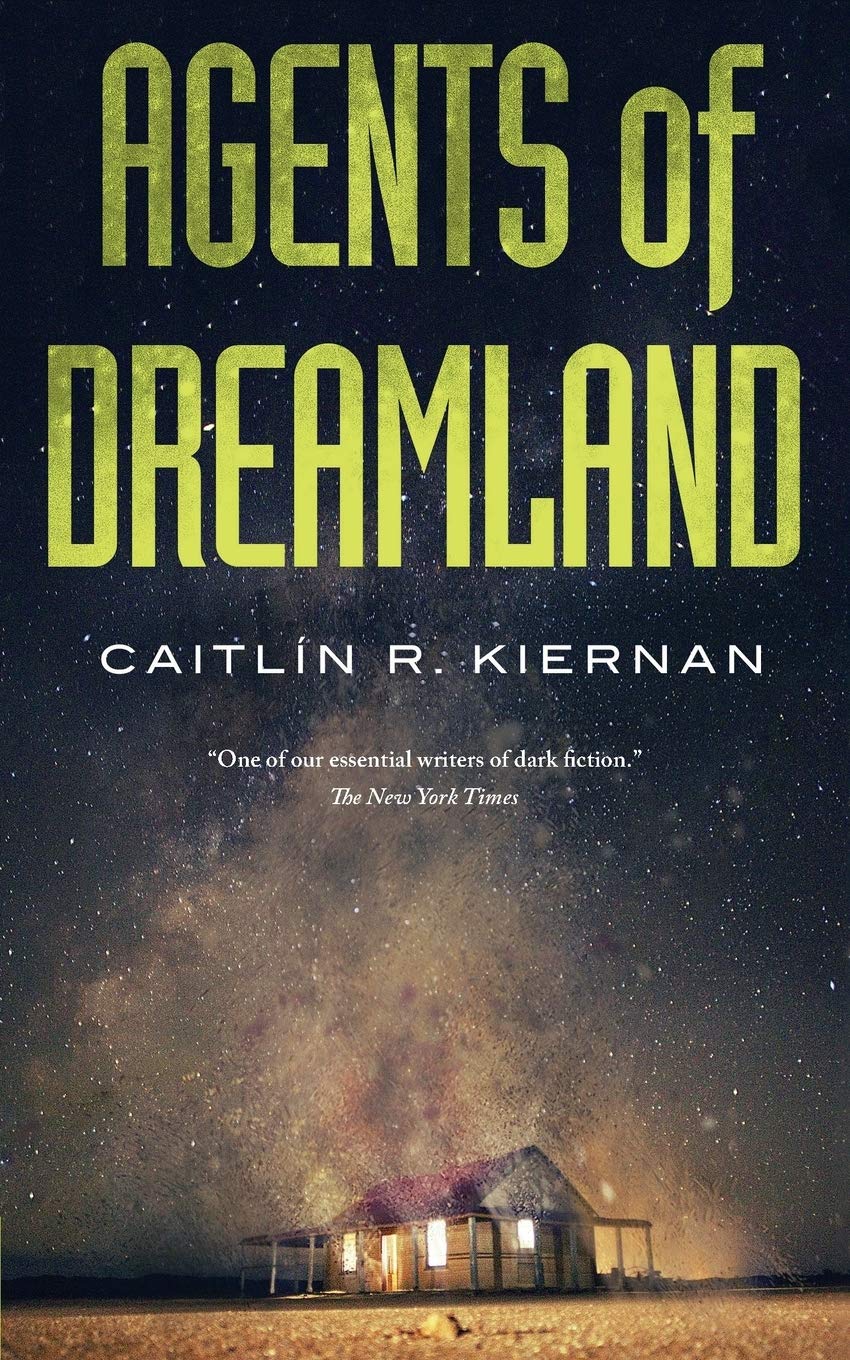
Deeper Cut: Lovecraft in Harlem

Historical Racism

The following article deals explicitly with racism in a historical context. Frank discussion of these matters requires the reproduction of at least some samples of racist speech from historical sources (e.g. Lovecraft’s letters). As such, please be advised before reading further.


Late night in Harlem on a Friday and the streets more full than at rush hour. Tommy Tester cherished the closeness, to his father and to all the bodies on the sidewalks, in their cars, riding buses, perched on stoops. The traffic and human voices merged into a terrific buzzing that seemed to lift Tommy and Otis, a song that accompanied them—carried them—all the way home.

—Victor LaValle, The Ballad of Black Tom 36

Places have character in the fiction of H. P. Lovecraft. Dunwich and Arkham, Kingsport and Innsmouth, these are Lovecraft country and as much a part of the stories as any of the human characters taking part in the narrative. New York City was a character in Lovecraft’s stories too—in “The Horror at Red Hook,” “He,” and “Cool Air”—yet there are parts of the city conspicuous by their absence. There is no Harlem in Lovecraft’s New York tales, scarcely any mention of Harlem in any of his fiction.

Lovecraft’s Mythos is expressly not a mythic white space. People of color exist, and are subject to the common contemporary prejudices that Lovecraft knew. They are supporting characters, often derided and stereotyped. Because there is a New York City in Lovecraft’s stories, we can assume there is a Harlem somewhere in it, and that African-Americans live there. Harlem as the center of the Harlem Renaissance, though; Harlem as the cultural center of African-Americans in New York; that Harlem is not present. Lovecraft never tried to capture the soul of Harlem in his fiction, and nor did many writers that came after him in the Mythos.

2016. Enter Victor LaValle with The Ballad of Black Tom. The novella is a re-working of “The Horror at Red Hook,” but this time Harlem is present. Tommy Tester and his father live there, it is their home, their haven, though even they don’t know all of its secrets. LaValle’s book expressly addresses the systemic racism and discrimination of 1920s New York, tries to tie it in to the fabric of Lovecraft’s stories and the geography of New York.

Even then, LaValle struggles with the portrayal of Harlem. The geography is right, but the descriptions are spare, often less than compelling, and mostly avoids major landmarks or descriptions of street life. “The Horror at Red Hook” takes place mostly in Brooklyn, so for much of The Ballad of Black Tom the main characters are not in Harlem itself, and consequently there is less opportunity to develop the character of the place. It isn’t Harlem as Lovecraft would have seen it—but then, what would that have looked like? What would it be like for a white man, known for his racism and cosmic horror fiction, to visit the Black Mecca of the United States?

Lovecraft in Harlem

At the elevated station at 6th Ave. and 42nd St. I lost my fellow Anglo-Saxon, whose home is far to the north in the semi-African jungles of Harlem […]
—H. P. Lovecraft to Maurice W. Moe, 18 May 1922, Letters to Maurice W. Moe 95

The Great Migration saw thousands of African-Americans move from the rural South to the cities of the North. In Manhattan, the neighborhood of Harlem became a center of black demographics and, as the 1920s wore on, black culture. Harlem became the geographic center of and gave its name to the Harlem Renaissance, a literary, artistic, and intellectual movement that celebrated the best that African-Americans had to offer. Many white people during this time were more interested in Harlem’s nightlife, the cabarets, clubs, speakeasies, and sexual underworld which rose to legendary proportions during Prohibition, as chronicled in Carl Van Vechten’s Nigger Heaven (1926).

H. P. Lovecraft first visited Harlem in 1922. The native of Providence, Rhode Island had been invited to visit New York City by Sonia H. Greene, an amateur journalist who wished to disprove some of Lovecraft’s prejudices by broadening his horizons (Ave Atque Vale 148). The thirty-two-year-old weird writer, who had not yet made his first professional publication, traipsed through much of the city, visiting museums, parks, admiring the remaining old architecture, and visiting with friends such as James F. Morton, a progressive-minded white man who had authored The Curse of Race Prejudice (1906), was a member of the National Association for the Advancement of Colored People, and whose apartment was in Harlem.

Morton and Lovecraft had “met” in 1915, where they ended up on opposite sides of an argument over race and prejudice in the amateur journals In A Minor Key and The Conservative (see “Concerning the Conservative”). Disagreement led eventually to correspondence, and then to friendship—though they never came to agreement on the issue of racial equality, they enjoyed the debate, and had other common interests in amateur journalism and writing.

There is no indication that Lovecraft stayed long or delved deep into Harlem on that first visit, or any subsequent visit to Morton’s, but he would later write to his aunt:

After a period of discussion & repartee, which Mrs. Long said reminded her of the epigrammatic paradoxes of Oscar Wilde & Whistler, the gang adjourned to Morton’s chaotic apartment in Harlem. I had never before seen Morton’s abode, & naturally I was interested. He dwells in a street now overrun by niggers of the cleaner & less offensive sort—decayed, but still retaining the outlines of its former beauty. There are pleasing trees on both sides, & the architecture of the houses is highly prepossessing. No. 211—the Morton mansion—is an old brick single house owned by an elderly eccentric named Edwin C. Walker; a spacious & unkempt edifice, thick with dust, & with half the rooms unused. Morton’s room is on the top floor, reached by dark & winding stairs, & is remarkably neat though atrociously dusty.
—H. P. Lovecraft to Lillian Clark, 13 Sep 1922, Letters to Family and Family Friends 1.64

Walker was a noted freethinker who had founded the interracial Sunrise Club in 1889 and served as its secretary until his death in 1931; he and Morton were both advocates of free love, although it is not clear if this was in any way involved with how Morton came to live in Harlem. Nor did Lovecraft have go to Harlem to be aware of it, on the same trip he visited the Bronx Zoo:

Before the chimpanzee cage; gazing with rapt interest, & unconscious of the time, we noted two huge, jet-black buck niggers; one of them—curiously enough—in army uniform with a very businesslike trench helmet.
—H. P. Lovecraft to Lillian Clark, 29 Sep 1922, Letters to Family and Family Friends 1.79

The United States Army was still segregated in 1922, and most troops were relegated to non-combat roles. An exception was the 369th Infantry Regiment, which gained popular renown during World War I as the Harlem Hellfighters. The unit was demobilized in 1918, but the segregated 15th New York National Guard Regiment from which it was formed continued. It is possible this was a member of that unit.

Lovecraft’s eye was mainly captured by the architecture, although on subsequent visits he would pay more attention to the inhabitants. The sheer numbers of black people living together in New York was amazing to Lovecraft—while Providence was not legally segregated in the sense of the Jim Crow South at that time, Lovecraft had always lived in the predominantly white portions of the city, though he was aware that there were black neighborhoods:

I hardly wonder that my racial ideas seem bigoted to one born & reared in the vicinity of cosmopolitan New York […] Over on the “West Side”, it is very cosmopolitan, but the East Side child might as well be in the heart of Old England so far as racial environment is concerned. Slater Avenue school was near my home, & the only non-Saxons were niggers whose parents work for our families or cart our ashes, & who consequently know their place.
—H. P. Lovecraft to Rheinhart Kleiner, 6 Dec 1915, Letters to Rheinhart Kleiner & Others 47

To put the demographics in perspective, the 1920 census put the total population of Providence at 237,595; in New York City in 1920, the black population alone was 152,467—and by 1930, there would be more African-Americans in New York than there were people of all races combined in Providence (1920 Census, 1930 Census). For a white man who had spent probably his entire life without seeing more than a handful of black people at a time, visiting Harlem would have been an eye-opening experience. He would visit New York, and Harlem, again.

In 1924, Lovecraft would return to New York to marry Sonia H. Greene, and to take up residence in the city. It was a tumultuous time in the writer’s life, as he struggled with domesticity, inability to find work, his wife’s illness, financial struggles, and finally separation as she left to take a job in the Midwest, leaving Lovecraft alone in a Brooklyn apartment. One of Lovecraft’s pleasures during this period were his outings with ‘the Boys,’ or as they became more formally known, the Kalem Club—a loose association of writers who would gather at each other’s houses and apartments to converse on every subject from poetry to politics. Morton held his share of the meetings:

Sonny [Frank Belknap Long, Jr.] and I settled the fate of literature betwixt us and parted early in the evening—with the understanding that The Boys meet up there on Thursday, August 7th, if Mrs. Long is well enough to stand the racket. Otherwise we convene at Morton’s dump in Bantu and barbaric Harlem, our first meeting there, by the way.
—H. P. Lovecraft to Lillian Clark, 1 Aug 1924, Letters to Family and Family Friends 1.145

In the evening The Boys met at Morton’s—up in niggerville—and had a great time despite the African cast of the contiguous terrain.
—H. P. Lovecraft to Lillian Clark, 20 Aug 1924, Letters to Family and Family Friends 1.147

Few accounts of these meetings survive outside of Lovecraft’s letters, although fellow Kalem-club member George C. Kirk once recalled:

August 15. Friday. Went to a party in black belt last night. If Lovecraft is a prince James F. Morton Jr. is a king. (Ave Atque Vale 223)

As time went on, Lovecraft found himself in Harlem again for other purposes than visiting Morton’s. Accounts are generally few and far-between; Lovecraft was a teetotal, against interracial relationships, and disliked jazz, and so appears to have had zero interest in the more “touristy” parts of Harlem that Carl Van Vechten might have showed him.

Saturday was a hectic round of the shops—both Harlem & Brooklyn—on Kirk’s behalf; & in the evening we parted laden with vases, candlesticks, sofa pillows, steins, Japanese panels, & the like—which Kirk bore to his room whilst I returned to 169 [Clinton St.] for slumber.
—H. P. Lovecraft to Lillian Clark, 22 Jan 1925, Letters to Family and Family Friends 1.239

However, for the most part during this period Lovecraft was only aware of Harlem from stops on the subway station at 125th street and Lenox Avenue. These were unsegregated cars, as Lovecraft would attest to an aunt who had experienced Jim Crow conditions in Georgia:

The separation of people & niggers at the stations is an excellent idea—which ought to be practiced on the Harlem subway trains here—& it would please me always to alight at the quaint & picturesque town of WHITE.
—H. P. Lovecraft to Annie Gamwell, 10 Feb 1925, Letters to Family and Family Friends 1.243

Lovecraft’s experience of encountering African-Americans on New York subways is among his more odious anecdotes of living in New York, as evidenced by a trip to Pelham Bay Park:

It took an hour to get there; & since the train was uncrowded, we formed the highest expectations of the rural solitudes we were about to discover. Then came the end of the line—& disillusion. My Pete in Pegāna, but what crowds! And that is not the worst . . . . for upon my most solemn oath, I’ll be shot if three out of every four persons—nay, full nine out of every ten—weren’t flabby, pungent, grinning, chattering niggers! Help! It seems that the direct communication of this park with the ever thickening Harlem black belt has brought its inevitable result, & that a once lovely soundside park is from now on to be given over to Georgia camp-meetings & outings of the African Methodist Episcopal Church. Mah lawdy, but dey was some swell high-yaller spo’ts paradifyin’ roun’ dat afternoon! Wilted by the sight, we did no more than take a side path to the shore & back & reënter the subway for the long homeward ride—waiting to find a train not too reminiscent of the packed hold of one of John Brown’s Providence merchantmen on the middle passage from the Guinea coast to Antigua or the Barbadoes.
—H. P. Lovecraft to Lillian Clark, 6 July 1925, Letters to Family and Family Friends 1.310

It is worth pointing out that Lovecraft was more vocally racist in his letters to his aunts than to pretty much any of his other correspondents; whether this is because they shared his prejudices or that he was simply more relaxed about writing to them is unclear. The tendency to slip into farcical vernacular English and African-American dialect is typical of Lovecraft—he was a student of dialect and did the same thing for many accents, in New England, New York, the South, and elsewhere in his letters, often playing for comedic effect—but even so, the naked prejudice on display shows how far out of his element Lovecraft felt. In large part, the degree of prejudice evidenced in Lovecraft’s few mentions of Harlem is because race is what set Harlem apart, at least in his mind.

The New York adventure ended in 1926. Separated from his wife, still with no job, and having had his apartment broken into and clothes stolen, Lovecraft finally packed his things and left New York to return to Providence. For the rest of his life, Lovecraft would maintain a detestation for the city—with its vast hordes of immigrants, Jews, and African-Americans. The rhetoric of Lovecraft’s prejudice increased during the rising tide of antisemitism that accompanied the rise to power of Adolf Hitler, as can be seen in one of Lovecraft’s more egregious statements:

I’d like to see Hitler wipe Greater New York clean with poison gas—giving masks to the few remaining people of Aryan culture (even if of Semitic ancestry). The place needs fumigation & a fresh start. (If Harlem didn’t get any masks, I’d shed no tears ….. & the same goes for the dago slums!)
—H. P. Lovecraft to James F. Morton, 12 Jun 1933, Letters to James F. Morton 325

Morton had by this point moved from Harlem to New Jersey, so Lovecraft wasn’t literally calling for his death, and the full horrors of Hitler’s policy of genocide were not understood when he came to power in 1933. The callous suggestion for mass murder is hyperbole, a statement about his dislike of New York as a whole. The quote is worse in hindsight, knowing as we do today about the Holocaust and Nazi Germany’s use of poison gas to murder millions. Lovecraft did not know about that—but it speaks to the depths of his antipathy to the multiracial, multicultural melting pot that he had failed to find a place in.

Yet Lovecraft also retained ties to the city in the form of friends like the Longs, and would revisit it several times during his travels. He would also write of the city to his friends. When one young correspondent considered visiting New York, Lovecraft provided a list of places to visit, and included:

Harlem negro district (sinister & fascinating—not a white face for blocks—Lenox Ave. subway to 125th St.—walk N.)
—H. P. Lovecraft to Donald Wandrei, 1 Jul 1927, Letters with Donald and Howard Wandrei 128

The longest and most detailed account that Lovecraft ever gave of Harlem was to another young friend, a jazz pianist and aficionado of Duke Ellington:

Black Harlem—of possible interest to you as a source of sy[n]copated melody—is impressive to the Easterner chiefly on account of its size, since all the eastern towns have large African sections. To many westerners—as, for instance, a friend of mine in Appleton, Wisconsin, who never saw a nigger till he was in college—it would be quite stupefying. I don’t know whether there are any blacks in your part of the world or not—of, if so, how thick they are. In Harlem there must be about as many as there are in all the southern states put together—one realises it unpleasantly in the uptown Broadway subway, one of whose three branchings above 9th St. leads to the black belt. The Bronx trains are bad enough—packed solidly with bulbous-nosed or Mongoloid-faced Jews—but de Lenox Ab’noo trains sho’ ain’t no place fo’ no blond of any kind! Black Harlem itself I know largely from ‘bus windows—the coach lines from Providence passing down Lenox or upper 7th Ave. through the heart of the district. It is the extent which almost stupefies one…block after block after block…outdoing anything that Charleston or Richmond or Savannah or Atlanta or New Orleans can produce. You’d never think there were so many niggers in the world, or that there were so many denizens of New York that aren’t Jews! I’ll bet Senegal & Nigeria look white as compared with that zone from about 150th St. down to 125th & beyond. Africa pushes south all the time—crowding the Jews & impinging on the white Puerto-Ricans (who nosed out the Jews in their region about 1930) of upper 5th Ave. And yet this whole black colony scarcely dates from before 1913, when the blacks of “San Juan Hill” downtown were evicted to make room for the new Pennsylvania station. The dispossessed families found some cheap tenements in upper Harlem (then mainly Nordic-Aryan) & formed a nucleus—quickly spreading as the white families on their borders moved away. How far they will get, no one can tell. The Jews don’t retreat before them as rapidly as the Aryans did, but they begin to go when the blacks get very thick in a block. The northern rim of Central Park will probably check them & turn their spread eastward—where they’ll displace great Greek & Hungarian colonies. The most amusing parts of Harlem are where the rich blacks dwell—these being almost as neat & spruce as Aryan neighbourhoods. The houses include some of the most elegant reliques of the Stanford White period, & the prosperous professional Æethiops keep them spic & span! Amusing in another way are the shop windows of Lenox & 7th Aves. All the drug stores carry rabbit’s-foot luck charms, dream books, anti-kink fluid & pomade for the wool of dusky sheiks & sirens, & (also for the rites of Congolese coiffure) devices called “straightening-irons.” The clothing-stores feature gaudy & eccentric suits & flaming haberdashery. Sharp social distinctions are said to exist among the blacks—for example, West Indian negroes are disliked by the coons of the continental U.S. Some of the West Indians—who speak with a British accent & have an independent arrogance which grates on Southerners—despise the American blacks as much as the latter hate them. Portuguese negroes—so-called “Bravas” from the Cape Verde Islands, unpleasantly common in Providence & other southern New England ports—appear to be absent from nigger Harlem. While the black belt has no well-defined eastern limit, it is checked abruptly on the west by the rocky precipice of St. Nicholas Heights, atop which are the Gothic quadrangles of N.Y. City College (whose student body is almost solidly Jewish) & the streets of a rather passable & fairly Aryan neighbourhood amidst which can be found (overtaken & packed in among modern city blocks) the old country seat (built about 1800) of Alexander Hamilton, out of whose door he walked to his death on that fatal duel morning in 1804.
—H. P. Lovecraft to F. Lee Baldwin, 27 Mar 1934, Letters to F. Lee Baldwin &c. 65-67

There is some excellent detail here—one would not normally look for a random white tourist in Harlem to comment on straightening irons—but it is notable that by 1934 Lovecraft had traveled much more widely, visiting as far south as Key West and as far east as New Orleans. He had seen segregated buses and work gangs down South, visited the Cuban enclave of Ybor City and the Hispanic old city of St. Augustine, and yet he still found Harlem fascinating in its own unique way.

There are a few more scattered references to Harlem in Lovecraft’s letters, but with no friends to visit and not living in the city himself, he does not appear to have visited the city except passing through on bus trips for the rest of his life. The exploitative image of Harlem that Carl Van Vechten and others portrayed of Harlem appear to have largely passed Lovecraft by. Yet that was not quite the end of the connections that Lovecraft had with Harlem.

Lovecraft and the Harlem Renaissance

The published letters and essays of H. P. Lovecraft include few mentions of any African-American writers or artists directly apart of the New Negro Movement or the Harlem Renaissance. This does not mean that Lovecraft was completely ignorant or unaffected by the work of such creatives—we know for example that Lovecraft was gifted a copy of Paul Morand’s Black Magic (1929) in 1931, and that book is illustrated by Harlem Renaissance artist Aaron Douglas. But the main works of that movement appear to have passed Lovecraft by.

This lack is particularly notable in his critical essay “Supernatural Horror in Literature,” first published in 1927. This survey of weird fiction misses contributions to horror fiction by black authors, including Harlem Renaissance writers like Zora Neale Hurston, whose anthropological writings on folklore such as Mules & Men (1935) and Tell My Horse (1938) would expand on subjects such as Haitian voodoo. Such a blind spot is understandable as Lovecraft explains in one letter:

Ordinarily voodoo & Yogi stuff leaves me cold, for I can’t feel enough closeness to savage or other non-Caucasian magic.
—H. P. Lovecraft to J. Vernon Shea, 3 Sep 1931, Letters to J. Vernon Shea 45

Lovecraft was not generally derogatory toward fiction written by African-Americans, and could even praise the efforts of individuals, but he simply had very little interest in the black point of view, and consequently read very little of such works.

By an odd coincidence, however, Lovecraft did have relationships with two individuals who were connected with the Harlem Renaissance. In 1921, Winifred Virginia Jackson and William Stanley Braithwaite established the B. J. Brimmer Company, which published a number of works by Harlem Renaissance artists such as Georgia Douglas Johnson’s Bronze: A Book of Verses (1922). 

Jackson was white, divorced, a poet and writer who sometimes contributed poems to W. E. B. du Bois’ The Crisis. She had met Lovecraft through amateur journalism in 1918, and they had collaborated on two stories together: “The Green Meadow” and “The Crawling Chaos.” R. Alain Everts and George T. Wetzel in Winifred Virginia JacksonLovecraft’s Lost Romance (1977) repeated gossip that Jackson and Lovecraft may have been in a relationship, though there is no evidence of this in Lovecraft’s letters. The same source claimed that Jackson was the mistress of William Stanley Braithwaite, though there is no evidence for that either. Whatever the case, in 1921 Lovecraft met his future wife Sonia H. Greene, and his friendship with Jackson faded.

Braithwaite was mixed-race, but in the United States at that period that made him “colored.” Lovecraft was aware of him as a prominent Boston editor and critic, but did not become aware of his race until 1918, when he read a newspaper account of Braithwaite winning the Spingarn Medal by the NAACP, which occasioned a stunningly racist outburst (LRKO 112). Whatever Lovecraft’s feelings, they did not extend to discourtesy: a letter at the John Hay Library from Lovecraft to Braithwaite survives, dated 7 February 1930, and is formal but cordial, and Lovecraft’s surviving letters to Jackson that mention Braithwaite praise him as a poetry critic.

Harlem in Lovecraft’s Fiction

The match had been between Kid O’Brien—a lubberly and now quaking youth with a most un-Hibernian hooked nose—and Buck Robinson, “The Harlem Smoke”. The negro had been knocked out, and a moment’s examination shewed us that he would permanently remain so.
—H. P. Lovecraft, “Herbert West—Reanimator” (1922)

Buck Robinson as a black boxer echoes Jack Johnson, the African-American heavyweight boxing champion (1908-1915) whose very existence caused white America to clamor for a “Great White Hope” to unseat him—and Lovecraft began writing this story in 1921, before he had gone to New York or seen Harlem. He had that much cultural knowledge of Harlem, as center of black population and black culture, to provide that detail. “The Harlem Smoke” is the only explicit reference to Harlem in Lovecraft’s fiction.

Which is a very weird absence when it is remembered that Lovecraft was writing fiction in New York, and those particular tales he wrote while living there—“The Shunned House,” “The Horror at Red Hook,” “He,” “In the Vault,” and “Cool Air”—were set in or take inspiration from his experiences in the city. The only reference to black people among these stories is a brief mention of “an Arab with a hatefully negroid mouth” and “population is a hopeless tangle and enigma; Syrian, Spanish, Italian, and negro elements impinging upon one another,” in “The Horror at Red Hook,” which is set in Brooklyn.

The conspicuous absence of Harlem from Lovecraft’s fiction is somewhat characteristic. Lovecraft wasn’t shy about including depictions of race prejudice in his fiction, so since Lovecraft basically didn’t write anything about Harlem in his stories means he inadvertently avoided saying anything negative about that place and its inhabitants. There were none of the exaggerated or exploitative material about Harlem that was characteristic of white writers like Carl Van Vechten.

On the other hand, it is also something of a tradition of erasure. Because there is no Harlem in these stories, there are also very few black characters and almost nothing about black culture in the Lovecraft Mythos. So while Lovecraft managed to minimize saying anything explicitly racist about Harlem in his fiction, there is also literally nothing about Harlem for later writers to expand off of. Harlem in the Lovecraft Mythos is effectively a blank slate, on which anyone might write anything.

So they did.

Harlem in the Cthulhu Mythos

Almost all of Lovecraft’s contemporaries at Weird Tales and his correspondents were white; the bulk of those did not live in or near New York City. At the time of his death in 1937, Lovecraft was an obscure author who never achieved widespread or enduring publication; his fanbase was small but loyal and vocal. Two in particular, August Derleth and Donald Wandrei, sought to get Lovecraft’s fiction and letters into hardback publication, and to this end they formed the small publisher Arkham House—and managed through legal wrangling and much self-advertisement to establish a near-monopoly on Mythos fiction until Derleth died in 1971.

Which is to say that it took several decades for Harlem to really make any substantial appearance in the Mythos after Lovecraft’s death, but by the time that it did, the United States was in many ways a different place. Jim Crow and segregation had ended in the 1960s through decisions like Brown v. Board of Education of Topeka (1954) and passage of the Civil Rights Acts of 1964 and 1968. The legal successes of the Civil Rights Movement did not translate into financial or social equality, as African-American science fiction fans, writers, and artists remained in the minority, though increasingly they were given opportunities to make their talents known and voices heard.

This is the context in which The Ballad of Black Tom was written: faced with a mostly blank slate, trying to address a notable gap in Lovecraft’s corpus. Not just the absence of Harlem itself, but the absence of an African-American point of view. While LaValle’s Harlem may not come through as visceral as Lovecraft depicts it in his letters, he does succeed in depicting a Harlemite, and a much-neglected viewpoint.

Victor LaValle was not the only writer in the wider Cthulhu Mythos to attempt and address this gap. The most extensive effort to bring Harlem into the Mythos has been, not in short fiction, but in tabletop roleplaying. Chaosium, Inc. produced the Call of Cthulhu Roleplaying Game in 1981, based on Lovecraft’s fiction and with a primary focus on characters assuming roles in the period in which Lovecraft’s fiction is set (1920s-1930s). Settings for this game include New York with books like Secrets of New York (2005, Chaosium), and entire third-party settings such as Harlem Unbound (2017, Darker Hue Studios). In these works, the focus is much less on Lovecraft’s prejudices and more “filling in the gaps” by addressing both what he did and especially what he did not write about. As editor Chris Spivey put it:

There’s a feeling of possibility in the air, like never before. But even in this land of promise, Harlem’s time is fleeting. While classes, sexuality, and cultures collide, Lovecraftian horrors lurk beneath the streets, creeping through dark alleys and hidden doorways into the Dreamlands. What Great Old One shattered our reality? Can you hold it together and keep the Mythos at bay for one more song? (8)

There are differences between Secrets of New York and Harlem Unbound. The former is a product for a general audience; that is, the players and their characters are not assumed to be of any particular race or ethnicity—while Harlem Unbound focuses in on the black experience in Harlem, and while the players may by of any race, with the assumption that the player characters at least are going to be black Harlemites, like Tommy Tester in The Ballad of Black Tom. In that respect, Harlem Unbound has the heavy lifting to do of trying to show what Harlem was like, during Lovecraft’s life, as well as to find angles with which to connect Harlem with the Mythos.

For writers like Victor LaValle and Chris Spivey, Harlem is unclaimed territory, a blank space on the map where they can imagine and write their own stories. Yet it is not a place without a history; books have been written about Harlem, movies set there, contemporary street maps and photographs are available, and not a few stories left from people that remember what it was like when they were children there—if not during the 20s and 30s, then in later decades. Plenty of colorful detail where a savvy writer can fit in some aspect of the Mythos, either one dreamed up by Lovecraft or a brand new horror that ties into the greater framework.

Which is the promise and possibility of the Cthulhu Mythos and Harlem going forward: having been neglected for so long, we have arrived at a point where people of color can write and publish their own approach to what horrors might lurk in the shadows of Harlem, and how the Harlemites might deal with it. Which may ultimately be the way forward when it comes to Lovecraft’s fiction: to see and go beyond his personal limitations and prejudices, to explore the possibilities that his fiction offers, and to carve a new Mythos that can address the fears and experiences of all people.


Bobby Derie is the author of Weird Talers: Essays on Robert E. Howard & Others (2019) and Sex and the Cthulhu Mythos (2014).
Deeper Cut: William Stanley Braithwaite

Historical Racism

The following article deals explicitly with racism in a historical context. Frank discussion of these matters requires the reproduction of at least some samples of racist speech from historical sources (e.g. Lovecraft’s letters). As such, please be advised before reading further.


Reflections upon the various sorts of unusual verse prevalent in this age, leads me to mention a new bard whose work I have not yet perused, but whose poetry was reviewed by Mr. William Stanley Braithwaite in a recent number of the BOSTON TRANSCRIPT.
—H. P. Lovecraft to the Kleicomolo, Apr 1917, Letters to Rheinhart Kleiner 99

In 1917, William Stanley Braithwaite was 39 years old and had been writing for the Boston Transcript for twelve years; that year he he would publish his fourth annual Anthology of Magazine Verse. Born from mixed-race parents, legal segregation in the United States of America decreed him a “Negro,” and throughout his life Braithwaite would experience discrimination because of his race—but he would also receive praise for his work as a poet, critic, editor, and publisher.

By 1917, H. P. Lovecraft was 27 years old and had finally emerged from his period of seclusion following the tumultuous period that had seen him lose his father, his family home, and fail to graduate highschool or go to college. The catalyst for Lovecraft’s re-emergence was amateur journalism, where he could find expression for his writing, poetry, criticism, and just plain interaction with other human beings, at first through letters and then increasingly in person.

It isn’t clear when Lovecraft first became aware of Braithwaite; the earliest reference in Lovecraft’s letters was in 1916 relating to Braithwaite’s The Poetry Review of America (LRK 43),which folded within a year. Braithwaite seems unlikely to have heard of Lovecraft before 1921-1922, in relation to certain poems that Braithwaite by Winifred Virginia Jackson that he wished to publish from Lovecraft’s amateur journal The Conservative. Lovecraft and Braithwaite are never known to have met in person, but by odd coincidence and due to common acquaintances with Lovecraft’s circle, including Clark Ashton Smith, George Sterling, and Winifred Virginia Jackson, Lovecraft and Braithwaite would briefly exchange letters.

William Stanley Braithwaite would be Lovecraft’s only known African-American correspondent.

Race can be impossible to judge in print; unless it is specifically mentioned, the individual prejudices of the reader have little to focus on. Such appears to be the case with H. P. Lovecraft. For however many years he was aware of Braithwaite as a poetry critic at the Boston Transcript or from other publications, he seems to have assumed that Braithwaite was white. Then in 1918, Lovecraft opened the newspaper and learned that William Stanley Braithwaite had won the Springarn medal—an annual award for African-Americans. Lovecraft’s response was perhaps his single most virulent outburst of racism ever put to paper.

Speaking of poetical reviewers—I have not yet recovered from the shock the newspaper gave me last night! At the First Baptist Church in this city, on Friday evening, there occurred the annual ceremony of the award of the “Spingarn Medal”, which is given to the member of the negro race who achieves the most notable success in ‘any field of elevated or honourable human endeavour’ during the year. At these impressive exercises, Gov. Beeckman of Rhode Island gracefully awarded the badge of African supremacy to the Boston poet, critic, & literary editor—William Stanley Braithwaite!!!!!!!!!!!! Think of it—chew upon it—let it sink into your astonished & outraged consciousness—the great Transcript dictator, the little czar of the Poetry Review, is a nigger—a low-born, mongrel, semi-ape!—Ye gods—I gasp—I can say no more! Aid me, ye benign elves & daemons of anticlimax! So this—this—is the fellow who hath held the destinies of nascent Miltons in his sooty hand; this is the sage who hath set the seal of his approval on vers libre & amylowellism—a miserable mulatto! To think of the years I have taken this nigger seriously, reading his critical dicta as though he were a Bostonian & a white man! I could kick myself! William’s picture is printed in the Bulletin beside the news item, & from the likeness given I can deduce no visible sign of his black blood. A heavy moustache droops down over what may be thick negroid lips. But after all—I suppose he has only a slight taint of the beast. No nigger blacker than a quadroon would be likely to attain the intellectual level he has undoubtedly reached. I am not minimising what the fellow knows, but I think it monstrous bad taste for the Transcript to foist a black upon its literary readers!
—H. P. Lovecraft to Rheinhart Kleiner, 5 May 1918, Letters to Rheinhart Kleiner & Others 112

When August Derleth & Donald Wandrei were compiling the first volume of the Selected Letters, they left this one out. That being said, for all the bald racism in this paragraph, there is reason to think that at least some of Lovecraft’s outrage is hyperbole—the reference to vers libre (free verse, poetry that doesn’t follow conventional rules of rhyme or meter) and “amylowellism” (Amy Lowell was a noted proponent of free verse) reflects Lovecraft’s poetic prejudices rather than his racial prejudices.

The racism on Lovecraft’s part was frank, and frankly enduring. While there are few mentions of Braithwaite in Lovecraft’s correspondence, he felt the need to address him to others casually as “the nigger Bill Braithwaite” (Letters to Family & Family Friends 1.37), “that eminent brunet critick William Stanley Braithwaite” (LFF 1.315), and “nigger Braithwaite” (Letters to Maurice W. Moe & Others 220). It is no comfort to recall that such racist sentiment was shared by others—H. L. Mencken in a 1919 letter to George sterling refers to “The Braithwaite coon” (From Baltimore to Bohemia 55)—and the only “good” thing that can be said about Lovecraft is that he saved such epithets for his closest family and friends on the rare occasion Braithwaite came up in correspondence.

Then there’s the issue of the kitten…

I am glad also of the descriptive Braithwaite—leaflet—William Stanley is certainly at the head of American criticks of poetry, as indeed I realised before from the Transcript reviews. When a tiny coal-black kitten came to visit me in 1918 I called him “William Stanley Braithwaite” and used to let him chew even important papers and feather dusters with the natural destructiveness of a literary reviewer. But this William Stanley deserted me after 1919—he must have found my “poems” unpalatable. I wish I knew what became of him!
—H. P. Lovecraft to Winifred Virginia Jackson, 7 Oct 1921, LRKO 334

There is no reason to doubt that the kitten was real, and that Lovecraft named him “William Stanley Braithwaite.” Lovecraft mentions the cat in a letters to his aunt (LFF 1.37, 376). It is also a matter of record that Lovecraft had a habit of naming black cats after racial pejoratives for black people, beginning with his pet cat, who would later gain a kind of literary immortality in Lovecraft’s story “The Rats in the Walls” (written 1923, published Weird Tales March 1924). A line in a letter from Lovecraft to Edwin Baird reads “I can assure you that Nigger-Man is (or was, alas!) a glorious and purring reality!” (Selected Letters 1.298). However, the tendency is shown to use the similar epithets when referring to any black cat:

When I speak to little Sam I call him all sorts of things—”Little Black Devil”, “Old Nigger Man”, “Spawn of the Shadows”, “Little Piece of the Night”, “Old Black Panther”, “Little Onyx Sphinx”, “Child of Bast”, & so on, & so on ….. Not excluding the succinct & universal “kittie”!
H. P. Lovecraft to Duane W. Rimel, 10 Aug 1934, Letters to F. Lee Baldwin &c. 200-201

Turning to the other end of the chromatic scheme—there are 4 little niggers at the boarding-house across the garden from old 66—brothers or half-brothers of the late & unforgettable Sam Perkins.
H. P. Lovecraft to Duane Rimel, 10 Mar 1935, Letters to F. Lee Baldwin &c. 260

Jason Colavito has pointed out in W. Scott Poole on Lovecraft’s Relationship to Poe and His Racist Cat that as terrible as this seems to contemporary readers, Lovecraft was far from alone in this kind of casual usage of the “N-word” and related terms, even with regard to the names of pets. The N-word was understood as pejorative, it was also in very common colloquial use. The only thing exceptional in this case is that Lovecraft naming a black cat “William Stanley Braithwaite” is making the N-word implicit instead of explicit.

There is also the issue of Lovecraft and Braithwaite’s common interest in Winifred Virginia Jackson. It’s not exactly clear when Braithwaite and Jackson became acquainted. In Winifred Virginia Jackson—Lovecraft’s Lost Romance (1976) by Wetzel & Everts asserted that Jackson was a romantic interest of both men, and that she actually pursued an affair with Braithwaite (who had married in 1903; he and his wife had seven children). While it is clear that Jackson was friends and partners with both men in some sense—she and Lovecraft shared editorial duties and leadership roles in amateur journalism from 1917-1921 or so, and she and Braithwaite were business partners from 1921-1927 at the B. J. Brimmer Company—there is no evidence for a sexual or romantic relationship with either of the two men, nor does Wetzel & Everts present anything except vague anecdotes to support the idea.

What Lovecraft and Braithwaite did share was an appreciation for Jackson as a poet, and both men wrote critical appraisals that lauded her poetry—Lovecraft in amateur journals, and Braithwaite in wider form through his anthologies. Lovecraft called attention to Braithwaite’s praise for her:

The United takes pride in the distinguished recognition just accorded its premier poetess, Winifred Virginia Jackson; recognition of a degree hitherto gained by no other amateur journalist. Four poems of Miss Jackson’s, “Fallen Fences”, “Miss Doane”, “The Farewell”, and “Cross-Currents”, have been selected by the eminent critic and editor, William Stanley Braithwaite, for publication in his 1921 “Anthology of Massachusetts Poets”, whilst another notable group has won the supreme distinction of inclusion in Mr. Braithwaite’s authoritative general “Anthology of Magazine Verse” for 1921, to be published in November. We may appreciate the honour thus reflected upon the United when we consider the exclusive standards and classical reputation of the Braithwaite anthologies, as published by Small, Maynard & Co. of Boston. These anthologies, says the New York Times, are “signs of the times and milestones upon the way”. According to the Atlantic Monthly, they “Show the vigorous state of American poetry”. Of Mr. Braithwaite the late William Dean Howells said: “Mr. Braithwaite is a critic very much to our mind, and is the most intelligent historian of contemporary poetry we can think of.” The United indeed has reason to congratulate its poeticla luminar, and indirectly itself, as the first and continued field of Miss Jackson’s efforts.
H. P. Lovecraft, “New Notes,” United Amateur 21, No. 1 (Sep 1921)
in Collected Essays 1.299, cf. 303, 306, 307

Lovecraft had been intending to publish a new issue of his amateur journal The Conservative containing several poems by Jackson, but the issue was delayed and never eventually published, so that Braithwaite’s anthology ended up referring to a “ghost” issue (LMM 106). Yet by 1922 Lovecraft and Jackson had drifted apart, and Jackson and Braithwaite were focused on their new business, the B. J. Brimmer Company, which aside from publishing Braithwaite’s annuals also published material related to the Harlem Renaissance.

After 1922, references to Braithwaite are scarce in Lovecraft’s writing; usually only when someone noted that one or another of his poet friends had been mentioned in the annual Anthology of Magazine Verse, e.g.:

Your genius is far from unappreciated—indeed, Long tells me you are mentioned in the new Braithwaite anthology, (which I have not seen) an honour not by any means to be despised.
—H. P. Lovecraft to Clark Ashton Smith, 11 Jun 1923, Dawnward Spire, Lonely Hill 52

Smith had related this comment to his mentor George Sterling, who had previously expressed exasperation with and poor opinion of Braithwaite (Shadows of the Unattained 233, those interested should also compare From Baltimore to Bohemia 54-55 and especially “George Sterling’s Letters to William Stanley Braithwaite: the Poet Versus the Editor.” American Book Collector XXIV, Nov-Dec 1973). Which probably explains Smith’s rather lackluster response; Lovecraft in turn added:

As to Braithwaite—I guess he is as intelligent as the average anthologist, though all such characters have such streaks of poor judgment that their selections are occasionally rather unaccountable—both as to omission & inclusion.
—H. P. Lovecraft to Clark Ashton Smith, 30 Jul 1923, Dawnward Spire, Lonely Hill 56

It is one of the oddities of Lovecraft that for all of his racial prejudice, and his early lambasting of Braithwaite for publishing free verse, he really did seem to respect Braithwaite both for his position in American letters, and as a literary editor and a critic. Which is what appears to have brought Lovecraft and Braithwaite into correspondence, however briefly.

All that remains is a single letter dated 7 February 1930, held at the John Hay Library. It is obviously a reply—whether Lovecraft had initially written to Braithwaite or vice versa is not known; nor is there any indication that the correspondence continued beyond this brief exchange. If Lovecraft initiated the correspondence, he would need only have written to the Boston Transcript, but if it was Braithwaite who started it, he would have needed to get Lovecraft’s address somewhere—from whom, we do not know. It begins formally: “Dear Mr. Braithwaite:—”

I am glad that you found merit in Mr. Long’s poem, & wish his work could be better known—for the encouragement of recognition would undoubtedly have the effect of stimulating him to more & more poignant utterance. There are provokingly few poets—just as there are provikingly few prose writers—who fully express that sense of the cosmic & the marvellous which is so potent a reality to many kinds of sensitive people. You would not find Weird Tales a very rich harvesting-ground for poetical material; although it does frequently contain excellent verses by Clark Ashton Smith, whom you have occasionally mentioned in the anthology. If Mr. Smith could only curb a frequent tendency toward extravagance, I think his work would be of even greater importance than it is. He is now entering the prose field to some extent—with exotic phantasies & tales.

The opening paragraph refers to Lovecraft’s friend Frank Belknap Long, Jr. and Weird Tales; Long’s poem “The Horror on Dagoth Wold” had been published in the February 1930 issue of Weird Tales, which would have been on the newsstands in mid-January. Editor Farnsworth Wright had been in the habit of publishing weird verse, and perhaps that attracted Braithwaite’s attention for his annual Anthology of Magazine Verse—although as fate would have it, 1930 would be the last year the series would be published.

The second paragraph speaks to their mutual acquaintance:

It pleases me highly to learn of the continued progress of Miss Jackson, whose work gave such an instant impression of authentic genius a decade ago. I have seen & appreciated later verses of hers here & there, & am interested by the prospect of a novel from her pen. I shall be on the lookout both for this & for the short stories. It seemed certain to me from the first that her work had that sureness of insight & expression which marks genuine art, & the more authoritative confirmation of that judgment is very gratifying.

The in-between-the-lines on this paragraph is that Lovecraft has not been in continued contact with Winifred Virginia Jackson, which might be as expected from the lack of references to her in Lovecraft’s later letters; and, conversely, that Braithwaite has remained in contact with her, even after the bankruptcy of B. J. Brimmer Co. in 1927. When Lovecraft knew Jackson, prose was her weak spothence why Lovecraft did the revision on “The Crawling Chaos” and “The Green Meadow”; one has to wonder if she had intended to include these among the “short stories” mentioned. It is not clear if Jackson ever wrote a novel, although she did keep two scrapbooks full of news-clippings and notes for a projected novel.

Another early judgment of mine, which I hope later developments may confirm, relates not to an actual poet, but to a hierophant of poets—in other words, to a manual or text-book on the subject of poetic appreciation, which I think will be more effective than anything hitherto published in arousing ordinary minds to the beauty of poetry, explaining as much as can be explained of the poet’s appeal, & inculcating standards by which the genuine can be distinguished from the spurious. This book—”Doorways to Poetry”—is by Maurice Winter Moe, a teach of English in the West Division High School, Milwaukee, Wisconsin; & a reading of it in manuscript has aroused my enthusiasm to almost inordinate bounds. It is so perfectly & incisively analytical, yet so appreciatively sympathetic & so free from pedagogical sterility. There is a chance of its acceptance by the Macmillan Co, & in the event of its publication I confidently expect qualified critics to sustain my own instant & unofficial verdict. There is no doubt but that you will receive a copy up its issuance.

The last paragraph concerns a project by Lovecraft’s friend Maurice W. Moe, Doorways to Poetry, which Lovecraft had assisted on but which never saw publication (Letters to Maurice W. Moe & Others 16-20). It is very typical of Lovecraft to promote the work and abilities of his friends, rather than his own. Then the letter ends:

Again expressing my appreciation—
yr oblg’d & obt servt
H. P. Lovecraft

The “again” is the only real hint that this is part of a longer correspondence; it suggests that Lovecraft had written to Braithwaite at least once previously. Perhaps he did; if so, or if Braithwaite ever answered we don’t know.

The tone of the letter is obviously formal, and equally obviously lacks any reference to Braithwaite’s race, or any trace of racism. That too is very typical of Lovecraft; whatever prejudices he held, he was usually at pains to avoid giving offense to any individual in print, especially in later life. A researcher who read this letter without any knowledge of Lovecraft’s previous literary encounters with Braithwaite would probably not find anything exceptional about this very brief, mundane exchange between a pulp writer and a noted journalist and editor.

It would be very interesting to know more of Braithwaite’s own end of things: none of his published letters that I have seen mention Lovecraft, or shed much light on this letter or his relationship with Winifred Virginia Jackson. It would have been interesting if they had hit on some common thread of interest—they were both admirers of the weird fiction of Algernon Blackwood, for example (The William Stanley Braithwaite Reader 301, “Supernatural Horror in Literature”)—but that is in the realm of might-have-been. Perhaps in the future, research into Braithwaite’s letters and papers might lend more insight into their relationship—or perhaps not. It was, after all, only one letter in a life that was filled with letters, for Braithwaite.

What is interesting about H. P. Lovecraft’s relationship with William Stanley Braithwaite is simply how, with all of his prejudices, he could and would deal with a literary African-American. In private, Lovecraft let his prejudices show to his closest family and friends, more circumspect in conversation with other correspondents; in public, including his amateur journalism editorials, he was neutral. In his correspondence with Braithwaite, Lovecraft is unfailing polite. This shift in register is familiar in Lovecraft’s writing; a reflection of the stratified society he found himself in, where Braithwaite was a second-class citizen by dint of his race, but which social decorum required Lovecraft to address with a formal politeness. While we can see something of this shift in registers with a few other correspondents, it is only with Braithwaite that we can really see the full range of this unspoken code—because William Stanley Braithwaite is his only known African-American correspondent.


Bobby Derie is the author of Weird Talers: Essays on Robert E. Howard & Others (2019) and Sex and the Cthulhu Mythos (2014).
Her Letters To Lovecraft: Winifred Virginia Jackson

I see that I need to don armour against a curious fate that concerns itself with bringing loss to me. The loss of Mr. Lovecraft’s letters also touches you.

May the California sunshine restore you to perfect health.

Very sincerely,
—Winifred Virginia Jackson to R. H. Barlow, 11 Nov 1938, MSS. John Hay Library

Winifred Virginia Jackson was born in 1876 (although dates vary), attended county and public schools, and then attended college at the Eastern State Normal School and the Curry School of Expression (now Curry College) in Boston, and was sometimes employed as a librarian. She married her husband Horace Jordan in 1915, so that when she joined amateur journalism shortly after she was known as Winifred Virginia Jordan.

We know that Winifred was recruited to the United Amateur Press Association in 1915 by Lovecraft’s friend and correspondent Anne Tillery Renshaw. Winifred must have written to Howard Phillips Lovecraft in late 1915 or early 1916, because her poem “Song of the North Wind” appears in Lovecraft’s own amateur journal The Conservative in the January 1916 issue. They continued to write to each other until at least 1921 or 1922, when references to her fade from Lovecraft’s correspondence. Yet for that 5-7 years of letter writing, all that remains are six letters from Howard to Winifred dated from 1920 to 1921, near the tail end of their relationship, and we must reconstruct what is left from Lovecraft’s other letters.

As a poet, she was successful in getting published in amateur journals and newspapers. At the United Amateur Press Association convention of 1917, Howard was elected President and Winifred was elected vice-president, so their correspondence for the next few years would have included much official business as well as any personal news. She also held various editorial positions, including the United Women’s Press Club of Massachusetts official organ The Bonnet, and published her own amateur journal Eurus. Some unsigned pieces in The Bonnet are believed to be from Lovecraft, so their letters must have included details about the journals she edited as well.

Around early 1918, Winifred was stricken with influenza—probably the “Spanish Flu” pandemic—and one of Lovecraft’s letters from the period suggests she required a nurse at home to care for her, and that she had to dictate her letters to Lovecraft through the nurse:

Mrs. Jordan’s recovery has not been as rapid as one might wish, but a copy of The London Daily Mail lately came from her, addressed in her own handwriting instead of her nurse’s, hence I assume she is much improved. In the last letter she dictated, she related an amusing recruiting incident.
—H. P. Lovecraft to Rheinhart Kleiner, 5 May 1918, Letters to Rheinhart Kleiner & Others 110

This formed the nucleus of what would become Howard and Winifred’s first collaboration, “The Crawling Chaos” (1921). Around the same period (1918-1919), Howard’s mother Sarah Susan Lovecraft experienced a nervous collapse that in 1919 required her to be committed to Butler Hospital. Lovecraft’s admiration for Jordan as a poet was growing, and includes his appreciative editorial “Winifred Virginia Jordan: Associate Editor” (Silver Clarion 3, No. 1, April 1919).

Also in 1919, Howard shared a dream in a letter; Winifred replied with her own, complete with a map, and suggested he make a story out of it. This became in 1920-1921 their second collaboration, “The Green Meadow” (1927). Both of these collaborations used her pen-name “Elizabeth Berkeley”, which Howard himself used twice himself. Perhaps at this time their correspondence became a touch more intimate; in late 1920 he wrote On Receiving Ye Portraiture of Mrs. Berkeley, Ye Poetess, indicating that she had sent him a photo. At this time, Winifred’s marriage likewise disintegrated, ending in divorce. She retook her maiden name, and in Lovecraft’s letters “Mrs. Jordan” became thereafter “Miss Jackson.” Lovecraft wrote to her:

From your amended, or restored, signature, I assume that your court case hath come to a successful termination; a circumstance which will cause universal rejoicing because of the inevitable suspense & tension from which it doubtless relieves you.
—H. P. Lovecraft to W. V. Jackson, 25 Dec 1920, Letters to Rheinhart Kleiner & Others 329

Rumors of a romantic relationship between Howard and Winifred derive Winifred Virginia JacksonLovecraft’s Lost Romance (1976) by George T. Wetzel & R. Alain Everts, a scarce chapbook which repeats a good deal of decades-old gossipsome of it probably wrong; despite assertions by Wetzel & Everts that Horace Jordan was African-American, his birth certificate and draft card both list him as white. Lovecraft was an ardent Anglophile and supported the British during World War I and the Irish War of Independence, and Jackson supported the Loyal Coalition of Boston in opposition to Sinn Fein:

I first heard of the organisation from Mrs. Jordan, who is so devoted to the cause that she does secretarial work at the offices two or three days every week without remuneration.
—H. P. Lovecraft to the Gallomo, Apr 1920, Letters to Alfred Galpin 85

Howard mentions continuing to see Winifred at various amateur get-togethers, and he even published a critical appreciation: “Winifred Virginia Jackson: A ‘Different’ Poetess” (United Amateur, March 1921). Her appreciation for Lovecraft also appears to have been real; on one visit to her house he noted:

[…] I found my worthless poetical attempts predominating in her old scrap books which date back to a time when their inspection by me was probably never anticipated.
—H. P. Lovecraft to Sarah Susan Lovecraft, 17 Mar 1921, Letters to Family & Family Friends 1.33

Susie Lovecraft died 24 May 1921 at Butler Hospital, after complications from gallbladder surgery. Howard would write:

My dear Miss Jackson:
It may indeed be said with justice that you have lost a friend in my mother, for although you never heard directly from her, she may be reckoned among the earliest and most enthusiastic admirers of your work. As I recall her especial appreciation of your poems, from the very first she saw, I regret the more that you did not know her personally, either by letter or meeting.
—H. P. Lovecraft to W. V. Jackson, 7 June 1921, Letters to Rheinhart Kleiner & Others 330

That July, Howard and Winifred both attended the National Amateur Press Association convention in Boston—where Lovecraft met a new amateur from New York, Sonia Haft Greene. Everts reports that in a 1967 interview Sonia told him “I stole HPL away from Winifred Jackson.” Maybe it was so; references to Sonia increase in Howard’s letters at the same time that references to Winifred decrease—yet the correspondence between HPL and WVJ did not cease immediately. If there was a romantic rivalry, it’s not clear that Lovecraft was even aware of it…and there was another factor.

William Stanley Braithwaite was a prominent African-American poet and editor; Lovecraft was not immediately aware of his race (Braithwaite’s parents were both mixed race) until 1918, when Braithwaite was awarded the Springarn medal, this occasioned one of the most intemperate outbursts of racial prejudice in Lovecraft’s letters (Letters to Rheinhart Kleiner & Others 112). In the Twentieth Anniversary Number (1921 annual of the Bibliophile Society in Boston), Braithwaite wrote an introduction “The Poetry of Winifred Virginia Jackson”—and the two would soon begin a much more substantial collaboration. In 1921 Braithwaite and Jackson would found the B. J. Brimmer publishing company, which published Braithwaite’s annual anthologies of magazine verse and several works associated with the Harlem Renaissance. The latter connection with African-American literature is no doubt why Winifred was mistakenly identified as black in Colored Girls and Boys’ Inspiring United States History: and a Heart to Heart Talk about White Folks (1921). Wetzel & Everts assert that Jackson and Braithwaite were having an extramarital affair, but there is no evidence for this.

Lovecraft by 1921 was certainly aware that there was some association between Jackson and Braithwaite; his last extent letter to Winifred mentions Braithwaite, whom Lovecraft also named a black kitten after (Letters to Rheinhart Kleiner & Others 334); and there are scattered other references in his letters, mostly to Braithwaite writing about Jackson’s poetry or mentioning The Conservative in connection to it (Letters to Family & Family Friends 37, Letters to Maurice W. Moe & Others 106). Whether Lovecraft was aware of them being business partners is unclear; the references to her in his correspondence drop off precipitously in 1921-1922. A single letter from Lovecraft to Braithwaite survives, dated 7 Feb 1930, where HPL is pleased to hear about WVJ, so they must have been out of touch by that date.

Which need not have been anything more elaborate than two friends drifting apart. Winifred Virginia Jackson was spending more time with her new business and less with amateur affairs; H. P. Lovecraft was spending more time with Sonia H. Greene, whom he would marry in 1924. For the lack of their surviving correspondence, Lovecraft gives a clue:

She has a fad for destruction, and wishes all her epistles burnt without exhibition, though they are in truth far less slanderous than the presumably preserved GALLOMO. I usually comply with the wish, though in this case had to save this one sheet for the sake of the story.
—H. P. Lovecraft to the Gallomo, 31 Aug 1921, Letters to Alfred Galpin 109

What did her letters to Lovecraft mean, to Winifred? Certainly he supplied encouragement and enthusiasm for her poetry; they shared dreams and collaborated on two stories; and their period of correspondence was marked by major life events for both of them: disease, divorce, & death. They shared a close professional correspondence as the lead administrators of the United Amateur Press Association…and if there was anything more, we can only guess at it.

The six surviving letters consist of one draft among Lovecraft’s papers, and five letters that R. H. Barlow transcribed and submitted to August Derleth; only an excerpt from the first letter was published in Selected Letters I. Presumably, these were all of the letters that Winifred was able to unearth when Barlow contacted her c. 1938.

All six letters have been published in Letters to Rheinhart Kleiner & Others.


Bobby Derie is the author of Weird Talers: Essays on Robert E. Howard & Others (2019) and Sex and the Cthulhu Mythos (2014).

Illustration Portfolio No. 1 (1925) by The Arthur Wesley Dow Association

There’s no use in my trying to tell you what they were like, because the awful, the blasphemous horror, and the unbelievable loathsomeness and moral foetor came from simple touches quite beyond the power of words to classify. There was none of the exotic technique you see in Sidney Sime, none of the trans-Saturnian landscapes and lunar fungi that Clark Ashton Smith uses to freeze the blood.
—H. P. Lovecraft, “Pickman’s Model”

When fans think of the artwork most associated with the literary works of Lord Dunsany, the first and last name is Sidney H. Sime, whose fantastic illustrations graced The Gods of Pegāna (1905) and most of Dunsany’s other fantasies. Sime also contributed art to illustrate works by Arthur Machen and William Hope Hodgson, and Lovecraft held him up in his fiction and letters as an artistic genius. Today, when fantastic art is so widely available online, and of such a high quality due to the proliferation in books and courses of technique and the availability of tools and materials, readers might lose sight of how rare and precious really good fantasy art was back in Lovecraft’s time…yet even in 1925, when Weird Tales was only a couple of years old and still finding its feet, Lord Dunsany’s fantasies inspired a group of women artists…and found publication.

The Arthur Wesley Dow Association was founded at the University of California, Southern Branch (now UCLA) in 1922. Materials related to this portfolio (presumably the original art or proofs) are still held at the UCLA library. This portfolio appears to have been begun as early as 1923, and was published in 1925. Compiled by Helen C. Chandler, a professor of arts at the University of California.

Dow1

In form, this is ten unbound black-and-white plates—seven plates by five artists illustrate two stories drawn from Lord Dunsany’s collection Time and the Gods (1906). They represent interpretations of Lovecraft’s work. Not copying Sime, but presenting their own interpretations, in their own medium and style.

Dow2

All the gods were sitting in Pegāna, and Their slave, Time, lay idle at Pegāna’s gate with nothing to destroy, when They thought of worlds, worlds large and round and gleaming, and little silver moons. Then (who knoweth when?), as the gods raised Their hands making the sign of the gods, the thoughts of the gods became worlds and silver moons. And the worlds swam by Pegāna’s gate to take their places in the sky, to ride at anchor for ever, each where the gods had bidden. And because they were round and big and gleamed all over the sky, the gods laughed and shouted and all clapped Their hands. Then upon earth the gods played out the game of the gods, the game of life and death, and on the other worlds They did a secret thing, playing a game that is hidden.
—Lord Dunsany, “When the Gods Slept”

Today, artwork like this might be classified by some as “fanart.” The term is often somewhat derogatory, regardless of the skill, imagination, or time put into the piece. The distinction between “art” and “fanart” grew up in the organized science fiction fandom of the 1930s, at the same time when lines were drawn between “fan” and “pro”—those writers and artists who were good enough to graduate from amateur efforts to actually sell their work professionally to magazines. At the time these works were made, the distinction did not exist. There were, certainly, amateur writers and artists in abundance—but the hallmark of the work was its quality, not necessarily who or why it was made.

Dow3

Thus the Yozis became gods, having the power of gods, and they sailed away to the earth, and came to a mountainous island in the sea. There they sat upon the rocks, sitting as the gods sit, with their right hands uplifted, and having the power of gods, only none came to worship. Thither came no ships nigh them, nor ever at evening came the prayers of men, nor smell of incense, nor screams from the sacrifice. Then said the Yozis:

“Of what avails it that we be gods if no one worship us nor give us sacrifice?”

And Ya, Ha, and Snyrg set sail in their silver galleons, and went looming down the sea to come to the shores of men.
—Lord Dunsany, “When the Gods Slept”

It is significant that the artists in this portfolio were women, because women were generally underrepresented as artists in fantasy and weird fiction at this time (and would continue to be for decades after), prominent exceptions like Margaret Brundage not withstanding. Yet the art itself is not distinctly “feminine” any more than it is “fanart.” These are labels that we as readers, trying to fix this art into a familiar framework, might hang on these pieces, but by themselves they are starkly beautiful, with the vast solid expanses of black still vivid after nearly a century, even though the cover of the portfolio has faded and some of the page-edges are soiled and torn.

Dow4

But as the gods slept, there came from beyond the Rim, out of the dark and unknown, three Yozis, spirits of ill, that sailed up the river of Silence in galleons with silver sails. Far away they had seen Yum and Gothum, the stars that stand sentinel over Pegāna‘s gate, blinking and falling asleep, and as they neared Pegāna they found a hush wherein the gods slept heavily. Ya, Ha, and Snyrg were these three Yozis, the lords of evil, madness, and of spite. When they crept from their galleons and stole over Pegāna‘s silent threshold it boded ill for the gods.
—Lord Dunsany, “When the Gods Slept”

In creating his own mythology, moving outside of the established gods and monsters of familiar myth and legend, Dunsany was breaking some of the rules and conventions. He is often very nondescriptive of the entities in his stories, letting the reader fill in the blanks. The Yozis in their different incarnations do not attempt to directly map to any traditional form of stock evil; they are not pitchfork-carrying devils with horns and bifurcated tails in their literary descriptions, nor do the artists attempt to render them as such. Left without much traditional guidance, each artist is forced to imagine and depict them in her own way.

Dow5

And Night spoke of the forest and the stirring of shadows and soft feet pattering and peering eyes, and of the fear that sits behind the trees taking to itself the shape of something crouched to spring.
—Lord Dunsany, “Night and Morning”

Free of restriction to normal conventions of what such fantastic scenes might look like, some of the artists experimented with depictions of scale and contrast. There is an exaggeration of the human form in the crouched figure staring out of the page that recalls Aubrey Beardsley.

Dow6

Look at the trees, how the different artists defined their bark and roots. There’s nothing wrong with the fact that each chose her own means of expression; they were not collaborating on a single narrative, but each offering their own interpretations. If Lord Dunsany wrote the myth, then these artists were each storytellers, presenting the stories in their own way.
 

Dow7

And Night spoke of the forest and the stirring of shadows and soft feet pattering and peering eyes, and of the fear that sits behind the trees taking to itself the shape of something crouched to spring.
Lord Dunsany, “Night and Morning”

Different is good. While many fans such as H. P. Lovecraft sincerely appreciated the combination of Lord Dunsany and S. H. Sime, that is still only one possible combination—other artists, working on their own, might find their own way to express what visions Dunsany’s prose gives to them, and it detracts nothing from Sime to say that some other artist might find something in their own work that lacks from his. They are only different points of view, not in competition.

Dow8

Once in an arbour of the gods above the fields of twilight Night wandering alone came suddenly on Morning. Then Night drew from his face his cloak of dark grey mists and said: “See, I am Night,” and they two sitting in that arbour of the gods, Night told wondrous stories of old mysterious happenings in the dark. And Morning sat and wondered, gazing into the face of Night and at his wreath of stars.
Lord Dunsany, “Night and Morning”

Michi Hashimoto is the only Japanese-American in this portfolio; she had graduated from UCLA in 1924. Her interpretation draws deliberately on both Japanese and Western aesthetics—fitting, given how extensively Dunsany himself drew on traditions of exoticism and Orientalism to lend an air of the exotic to his stories. There is some irony there, almost, in an artist capturing something of the “authentic” exotic to this scene.

Dow9

Compare this scene, with the hero of the Nibelunglied (a Western fantasy if there ever was one), encountering a three-headed dragon that obviously draws on depictions of Chinese dragons. This kind of correspondence and amalgamation  can work—compare with the Monster Girl Encyclopedia II (2016) by Kenkou Cross (健康クロス)—but there is definite juxtaposition of incongruous elements in having the Western hero/knight facing an Eastern dragon in this interpretation.

Dow10

This atypical (per-Marvel Comics, at least!) interpretation of Thor underscores the overall theme of this portfolio: these are myths. Some old, some contemporary, but for all that just stories to be told and retold—and they aren’t set in stone. How we look at a Mythos can change based on the syntax of our lives. There is no one true canon depiction of Thor, or the Yozis, or Cthulhu.

Dow11

Illustration Portfolio No. 1 needs not have any particular moral or lesson. The artists of this volume were producing art, and left no particular comment on how it should be interpreted or understood. Yet by its very existence, and looking at these works, readers might do well to reflect on the nature of art and interpretation in the Mythos. Sometimes, there is no one right answer, no single truth.

There are only many different people working out their vision, in their own styles and with their own influences, and the different combination of art and text can sometimes mean more than either does separately.


Bobby Derie is the author of Weird Talers: Essays on Robert E. Howard & Others (2019) and Sex and the Cthulhu Mythos (2014).
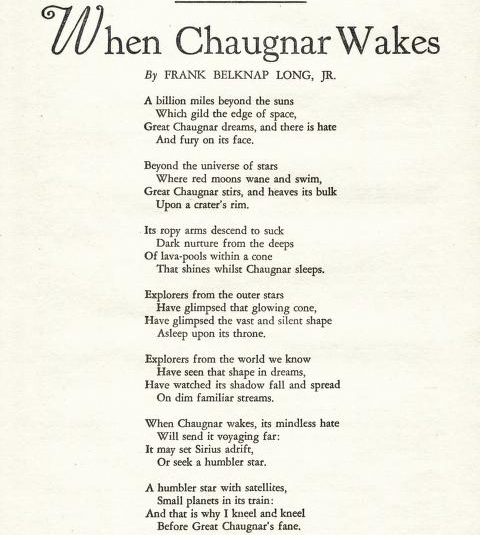
The White People (2015) by Ibrahim R. Ineke

I agree with what you say about suggestion as the highest form of horror-presentation. The basis of all true cosmic horror is violation of the order of nature, and the profoundest violations are always the least concrete and describable. In Machen, the subtlest story—”The White People”—is undoubtedly the greatest, even though it hasn’t the tangible, visible terrors of “The Great God Pan” or “The White Powder”. But the mob—including Farnsworth Wright—can never be made to see this; hence W.T. will always reject work of the finest and most delicate sort.
—H. P. Lovecraft to Robert E. Howard, 4 Oct 1930, A Means to Freedom 1.52

Comics and graphic novels (and increasingly film and television shows) which seek to adapt Lovecraftian concepts onto the page often face an immediate difficulty: not just how to balance the words and pictures, but how much not to show and not to tell. It isn’t just the question of whether the entity should appear, or only be glimpsed in part, or revealed in full. It’s a question of how far do you admit that there is an entity at all, how and when do you bring up the concept. How far can you get the reader’s imagination to run, and in which direction? How do you establish and maintain that horror-mood which pervades such stories as Arthur Machen’s “The White People”?

For Machen, much of the success of his “The White People” was in being very specific in many details, and very circumspect in others. He avoided proper names; gave few physical descriptions; yet the diary entries are detailed, vivid. The discussions around them are weighty and philosophical, the people discussing what has happened see more in what is going on than the individual who purportedly wrote them. There is more going on than it seems…

WhitePeople1

In print, an author might write out “indescribable.” How does an artist actually draw or paint that? Ibrahim R. Ineke in the 48-pages of this graphic novel shifts presentation and technique in a very Machenesque way. Stark blacks give great detail, except where they disappear into shadow; white gives terrific definition, until they became great blank swathes where bright sunlight has blinded the reader to all detail. The chiaroscuro gives way to color, kaleidoscopic in intensity and combination; pen-and-ink linework gives way to xerography. Style and medium both work to conceal many things, while throwing others in sharp relief. Like Machen, Ineke is feeding the reader details, while letting our imagination fill in the blanks, both light and dark.

It is all in service to the story. Not a pleasant story, but a disturbing one, laid out with all the care of a detective story. Ineke’s “The White People” is not a straight adaptation of Machen’s “The White People,” it inspired by, it carries some of the same energy, the same ideas, but it isn’t a retread of any particular story. It stands as a testament to what an artist can do in the medium—something between Bruce Jones and Berni Wrightson’s “Jenifer” and Jeffrey Jones’ Idyl I’m Age, and comparing very favorably to Black Stars Above (2019) by Lonnie Nadler & Jenna Cha.

Yet what makes Ineke’s “The White People” really effective is that like with Machen’s “The White People” it is essentially a kids story. Not a story for kids by any means (due to some graphic nudity), but about kids. Innocent, playful, not knowing what horrors are out there. That’s the essence of “The White People” as Machen wrote it, and it is in essence what Lovecraftian horror is like for all readers. To look where you shouldn’t, and have a bit of innocence stripped away.

Wherever there is horror, secrets are revealed. Ineke states this most directly when he writes “It’s always the woods, isn’t it?” Despite our continuous advances in science and reason, education and culture, the woods remain an untamable place—a site that is the very definition of nature, yet which continuously unleashes “unnatural” evidences. Despite Machen’s warnings, Ineke has found it necessary to re-enter this territory and present his findings to us.
—Amelia Ishmael, introduction to The White People (2015)

Ibrahim R. Ineke’s The White People (2015) was published in regular hardcover and deluxe hardcover editions by Sherpa. A preview of the contents can be seen on Issuu.


Bobby Derie is the author of Weird Talers: Essays on Robert E. Howard & Others (2019) and Sex and the Cthulhu Mythos (2014).
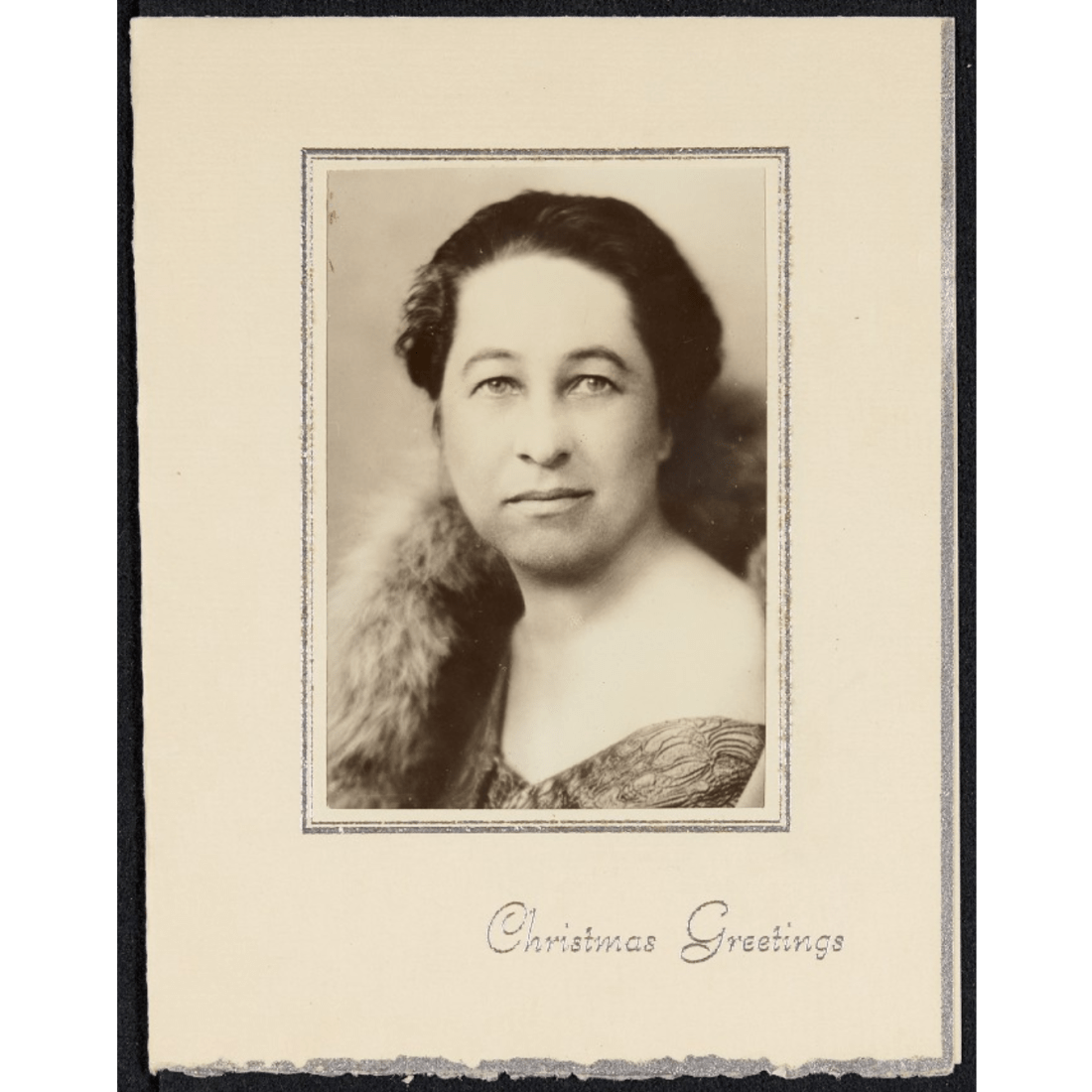
Helen’s Story (2013) by Rosanne Rabinowitz

Helen Vaughan did well to bind the cord about her neck and die, though the death was horrible. The blackened face, the hideous form upon the bed, changing and melting before your eyes from woman to man, from man to beast, and from beast to worse than beast, all the strange horror that you witness, surprises me but little. What you say the doctor whom you sent for saw and shuddered at I noticed long ago; I knew what I had done the moment the child was born, and when it was scarcely five years old I surprised it, not once or twice but several times with a playmate, you may guess of what kind. It was for me a constant, an incarnate horror, and after a few years I felt I could bear it no more, and I sent Helen Vaughan away. You know now what frightened the boy in the wood. The rest of the strange story, and all else that you tell me, as discovered by your friend, I have contrived to learn from time to time, almost to the last chapter. And now Helen is with her companions…
—Arthur Machen, “The Great God Pan” (1890)

There had been an unfounded report of my own death many years ago. However, I continue to survive and thrive. I’ve gone by other names—Herbert, Raymond and Beaumont among them. Now there’s no reason I can’t call myself Helen Vaughan again.
—Rosanne Rabinowitz, Helen’s Story (2013) 11

“The Great God Pan” was first published in The Whirlwind in 1890. This was the beginning of the Yellow Nineties; the Decadent movement was gaining ground in literature and art, and to the Victorians of the day, the serialized story was condemned. Many years later, Arthur Machen would collect some of his favorite unfavorable reviews in a volume title Precious Balms (1924), and some of the critiques will be familiar to fans of Lovecraftian literature:

His art has been hampered by the limitations imposed upon it through his having to leave his ingenious horror “indescribable” and “unutterable” from first to last. (2)

There are nameless horrors hinted at in every other page, which make other people turn green and sick, but it is beyond the power of the most susceptible reader to shudder at the shudders of these fictional people. (3-4)

If we may believe Mr Machen, those doings are of the most horrible character; but as he omits to tell us what they are, and leaves us merely with the impression that she is “a bold, bad woman” of a very ordinary description, we are compelled to take her special horrors upon trust. (5)

But note the sex-mania in it all. It is an incoherent nightmare of sex and the supposed horrible mysteries behind it, such as might conceivably possess a man who was given to a morbid brooding over these matters, but which would soon lead to insanity if unrestrained. (10)

So on and so forth. Time has been kinder to Machen’s weird fiction than to his critics, in no small part because “The Great God Pan” was reprinted and anthologized, and provided inspiration for both H. P. Lovecraft’s “The Dunwich Horror” and Clark Ashton Smith’s “The Nameless Offspring.” Mary became the archetype for Lavinia Whateley, and all the Lavinias that followed her; Helen Vaughan the model for Wilbur Whateley, and Hester Sawyer of “The Devil’s Hop Yard” (1978).

It took a century and change for Helen Vaughan’s side of the story to be told.

Though she appears on the page in “The Great God Pan” only briefly, Machen’s story is focused on Helen Vaughan, her whole life from conception in sin to taking her own life. Read as a serial, we can only imagine what the turn-of-the-century Victorians took of the many unspoken horrors at play…because the supernatural in the story is very implicit, until the end. It’s not a story to titillate, exactly. Helen’s mother Mary is an orphan with a too-intimate relationship with the scientist who “adopted her.” There are direct parallels to the conception of Christ, with a diabolic turn. As a child her features are “of a somewhat foreign character,” and plays strange games. Then as an adult Helen Vaughan is the femme fatale, the model for the mad artist, the wife that ruins her husband. All in one Helen Vaughan is layer on layer all these Victorian taboos, and is at last realized as a sexual woman who is not fixed in class, who exists outside the control of any male family member or husband.

…then she dies. Which is the probably the weakest part of the plot:

“No. I shall offer a choice, and leave Helen Vaughan alone with this cord in a locked room for fifteen minutes. If when we go in it is not done, I shall call the nearest policeman. That is all.”
—Arthur Machen, “The Great God Pan” (1890)

It is a very weird build-up to the final climax of the novel because throughout the story, Machen has given no indication that Helen Vaughan is bound by conventional Victorian ideas of morality and propriety and reputation. Why should she fear the police? Why would she commit suicide?

Well, in Rosanne Rabinowitz’ Helen’s Story, she doesn’t. While Rabinowitz keeps most of the essential plot details of Machen’s tale, she also doesn’t attempt to copy his prose. Machen was borrowing the style of Robert Louis Stevenson, with Dr. Raymond made in the mold of Dr. Henry Jekyll of “Strange Case of Dr Jekyll and Mr Hyde” (1886). The chain of evidence style works for the atmosphere that Machen was building, the moralities and assumptions that he was building to. Yet Helen Vaughan in Rabinowitz’ depiction is the embodiment of that Victorian horror of the independent, sexually confident woman. It’s her story, told in her words, and told in later days. It shouldn’t be told in as a Machen pastiche, so it isn’t.

Which is really part of what makes the story work so well. Helen Vaughan becomes something beyond the Victorian imagination’s ability to classify; she doesn’t fit into the roles assigned for her as monster, succubus, or slut. Helen’s Story is that of an artist, an outsider that looks for family, that tries to achieve a particular effect through her work. The kind of individual whose spirituality cannot be contained by any church, whose morality is too fluid for any system of law, who flits in between the systems of the world. Which is very much in the spirit of what Machen sought to convey to his Victorian readers, but done in a way which Machen because of the conventions of the time could not, except through hint and intimation (cf. “Unseen” (2020) by Claire Leslie).

“Ah, mother, mother, why did you let me go to the forest with Helen?” Mrs. M. was astonished at so strange a question, and proceeded to make inquiries. Rachel told her a wild story. She said—
—Arthur Machen, “The Great God Pan” (1890)

Of course I got into trouble. After Rachel left, there was an almighty row in the village.
—Rosanne Rabinowitz, Helen’s Story (2013) 11

There is a lot to be said for how women are often depicted (or not depicted) in both fiction and real life. In some cases, they can give their own accounts, set the record straight. In Lovecraft studies we remember The Private Life of H. P. Lovecraft (1985) by Sonia H. Davis and One Who Walked Alone (1986) by Novalyne Price Ellis; readers of wider literature might recognize a precursor to Helen’s Story in Wicked: The Life and Times of the Wicked Witch of the West (1995) by Gregory Maguire. In all these cases, the accounts of the women have to be taken together with and against that of the other narrative which they are responding to. They tell their stories, but in telling those stories they are instinctively or intentionally shaping them around the stories that are already out there.

Which raises the question: how reliable is Helen Vaughan as a narrator?

The mere existence of Helen’s Story sheds a bit of doubt on Machen’s “The Great God Pan.” If you accept the narrative conceit that Helen Vaughan is alive and well, then the ending at least is a fabrication. That calls into question the events of the rest of Machen’s story: how much of this “really happened” versus being a narrative construction by the people telling the story—Clarke and Raymond. How much is Helen being honest, in painting herself as this misunderstood woman, raised by an uncaring scientist and constantly discriminated against for being different?

This is the kind of textual complexity which is shared by H. P. Lovecraft’s “The Shadow over Innsmouth” and “The Litany of Earth” (2014) by Ruthanna Emrys. The conflicts and correlations between the stories force the reader out of the passive role of just absorbing information; now with two conflicting narratives to keep track of, the reader has to decide for themselves how much of each is “true” or accurate. The real story is neither the one or the other, but somewhere in between. The effect is not unlike a historian dealing with different accounts of a battle, or a Bible scholar who has to evaluate a canonical gospel and a newly-uncovered apocryphal gospel.

It’s the kind of approach that the Cthulhu Mythos is built on. Stories written not just as sequels, but as commentary and expansion, to correct old ideas and add new ones. In the case of Helen’s Story, the effect is especially appropriate as Helen’s narrative in Machen’s “The Great God Pan” is always told in someone else’s words. It’s the kind of historical narrative that is built around scraps of evidence and hearsay, and represents the prejudices of the man who compiled and presented the facts of the story to the audience, who were also presumed to be mainly men and to share the same prejudices. Helen’s Story is like a female scholar came along a century later, dug up an account of the woman herself that all the other scholars had overlooked, and presented it to explode the orthodoxy.

The combination of re-examining the essential gender bias in Machen’s “The Great God Pan” and the textual questions that can be raised by this kind of narrative is great. Rabinowitz knocks it out of the park in how she interweaves flashbacks that reflect on the narrative of events in “The Great God Pan” (and another Machen story, “The White People”) with the continuing narrative of what Helen Vaughan is doing in the present day. However, in basing Helen’s Story on “The Great God Pan” in this way, Rabinowitz does inherent a particular narrative necessity: how to end it.

Helen’s Story starts off by negating the ending of “The Great God Pan,” that means that this story has to provide a new conclusion. The ending which Arthur Machen wrote contains the only blatant supernatural elements in the entire story; there are hints and intimations, but nothing like the sudden appearance of “a mountain walked, or stumbled” in “The Call of Cthulhu.” Readers up until that point could have considered that Dr. Raymond had molested Mary, that Helen Vaughan was his child, that “seeing the Great God Pan” was cover for the terrible failure of his experiment that lobotomized his adopted-daughter-in-all-but-name. So without that ending…Rosanne Rabinowitz not only needs to find a fitting conclusion, but a fitting revelation.

What is the Great God Pan in Helen’s Story?

The final sentiment, the last revelation, the apotheosis or ipsissimus that Helen experiences…is utterly apt. It is both an homage to ending in “The Great God Pan” and a negation of it; because it is not an ending at all but a beginning. The crux of possibilities that bridges dream and reality in works like Arthur Machen’s The Hill of Dreams (1907), Lord Dunsany’s “Idle Days on the Yann” (1910), and H. P. Lovecraft’s “The Silver Key” (1929). Sex without guilt, art without compromise, love without jealousy, freedom without boundaries…but with still those roads back to the old fields we know.

Helen’s Story by Rosanne Rabinowitz was first published as a hardback by PS Publishing in 2013, and reprinted as a paperback by Aqueduct Press in 2017, it is also available as an ebook.


Bobby Derie is the author of Weird Talers: Essays on Robert E. Howard & Others (2019) and Sex and the Cthulhu Mythos (2014).
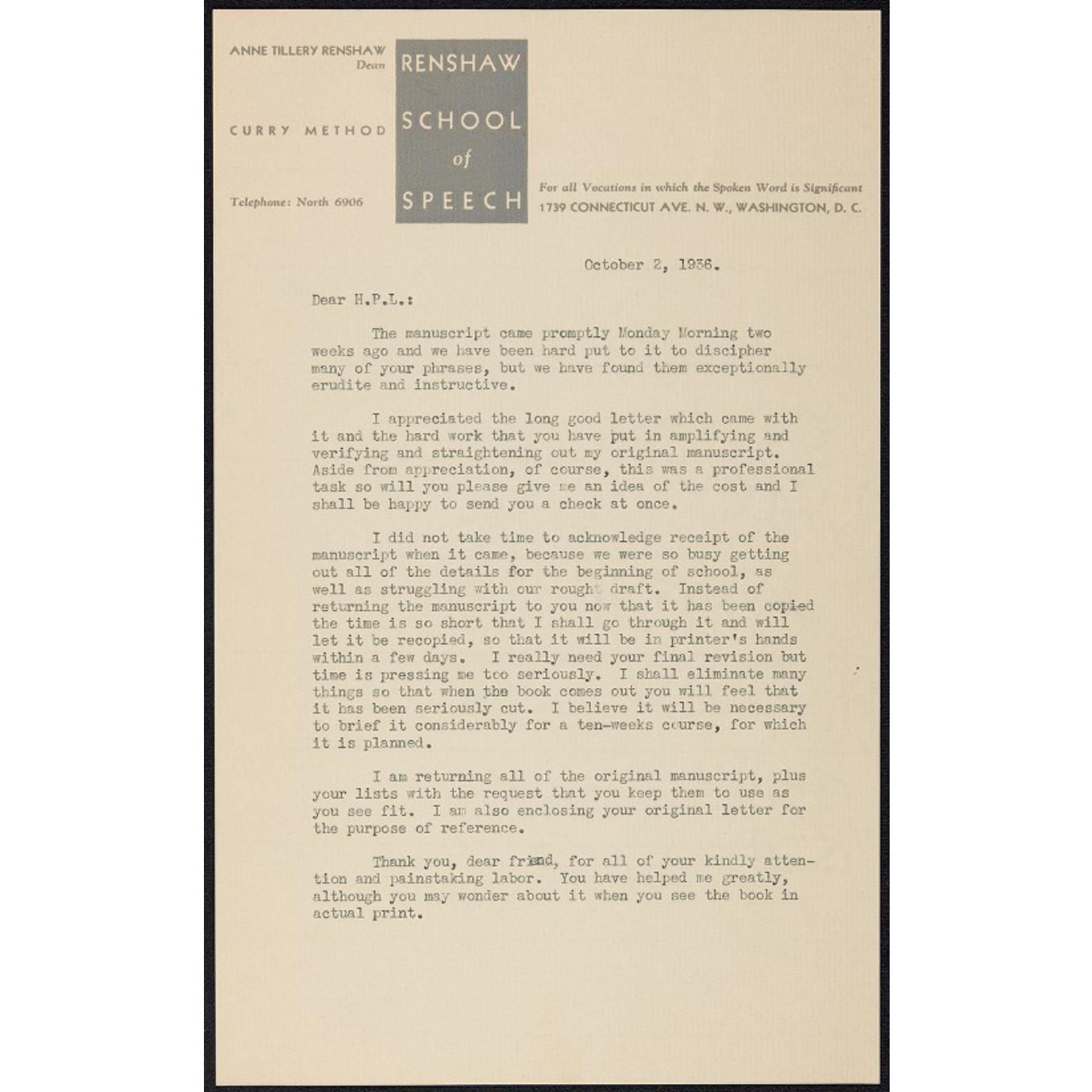
“Lord Dunsany’s Teapot” (2011) by Naomi Novik

In September [1917] I went to the 7th 8th Battalion of the Inniskilling Fusiliers. we used to be in front of Croisilles, when we were in the line, and in a sunken road through the village itself when we were in reserve. When we were out of the line we lived at a place that had been Ervillers, four miles back, where the bombing planes used to call us every morning, but never hit us. That was in the desert of the Somme.  We never saw any animals there except mice, and an army horse or two; and, when the rooks flew over at evening, they passed out of our sight before they could find trees. There was something melancholy in watching this flight over a land that for centuries had been fertile: it was pleasanter to look at our aeroplanes returning at about the same hour, like adventurous mountaineers descending cloud-mountains. Sometimes we met American soldiers there, who for some while had been arriving in large numbers, men with red healthy faces.
—Lord Dunsany, Patches of Sunlight (1938) 296

The success of The Thackery T. Lambshead Pocket Guide to Eccentric & Discredited Diseases (2003) led to a sequel: The Thackery T. Lambshead Cabinet of Curiosities (2011). The first book is essentially a standalone volume similar to The Starry Wisdom Library (2014): a collection of short fictional works done in the style of a reference guide, with all the fantastic, science fiction, weird, and supernatural ailments and symptoms pretending to co-exist in the same setting. The Cabinet of Curiosities is nominally framed along the same lines, as items in the fictional Thackery T. Lambshead’s eccentric collection, but the guidelines on what constitutes an “entry” are less rigid…so what it really turns out to be is a collection of disconnected pieces of various lengths and styles. Some resemble actual write-ups like one might find in a good SCP wiki entry, and others are simply short stories with, perhaps, a note at the end that explains how it got to be part of Lambshead’s collection. Some of them don’t even have that.

The trench had scarcely been dug. Dirt shook loose down upon then, until they might have been part of the earth, and when the all-clear sounded at last out of long silence, they stood up still equals under a coat of mud, until Russel bent down and picked up the shovel, discarded, and they were again officer and man.

But this came too late: Edward trudged back with him, side by side, to the more populated regions of the labyrinth, still talking, and when they had reached Russell’s bivouac, he looked at Edward and said, “Would you have a cup of tea?”
—Naomi Novik, “Lord Dunsany’s Teapot” in The Thackery T. Lambshead Cabinet of Curiosities 118

Edward John Moreton Drax Plunkett, 18th Baron of Dunsany, was one a writer’s writer. Never a bestseller, he was still highly esteemed by many as one of the greatest fantasists to ever live, and one of the most influential. His stories of “beyond the fields we know,” written briefly around the turn of the century, would provide the inspiration for H. P. Lovecraft’s Dreamlands and for “The Call of Cthulhu.” During his service in the British Army during World War I, the 39-year old Anglo-Irish peer was appointed a Captain in the Royal Inniskilling Fusilliers, and spent time in the trenches in France, where this story is set.

After the war was over, Lord Dunsany would travel on a tour of the United States. In Boston in 1919, a 29-year old H. P. Lovecraft would be too self-conscious to ask his idol for an autograph.

You come to the trenches out of strangely wasted lands, you come perhaps to a wood in an agony of contortions, black, branchless, sepulchral trees, and then no more trees at all. The country after that is still called Picardy or Belgium, still has its old name on the map as though it smiled there yet, sheltering cities and hamlet and radiant with orchards and gardens, but the country named Belgium—or whatever it be—is all gone away, and there stretches for miles instead one of the world’s great deserts, a thing to take its place no longer with smiling lands, but with Sahara, Gobi, Kalahari, and the Karoo; not to be thought of as Picardy, but more suitably to be named the Desert of Wilhelm. Through these sad lands one goes to come to the trenches. Overhead floats until it is chased away an aëroplane with little black crosses, that you can scarcely see at his respectful height, peering to see what more harm may be done in the desolation and ruin. Little flashes sparkle near him, white puffs spread out round the flashes: and he goes, and our airmen go away after him; black puffs break out round our airmen. Up in the sky you hear a faint tap-tapping. They have got their machine guns working.
—Lord Dunsany, “A Walk to the Trenches” in Tales of War (1918)

For all that Dunsany’s fiction has been lauded by the likes of Lovecraft & co., the writer himself never quite developed the same mythology about him. There are fewer stories about Dunsany the man than there are about Lovecraft. This may in part be due to the fact that Lord Dunsany himself was around for quite a bit longer: his writing career of 50+ years was longer than Lovecraft himself was alive, and Dunsany produced several volumes of autobiography…much of which, perhaps strangely, failed to touch on his inner life. He had been a sportsman, who hunted game big and small all over the world; chessmaster; heir to an old title in the British peerage; a soldier, a husband and father, a writer of poetry, fiction, wartime propaganda, plays…he corresponded with a young Arthur C. Clarke, and if her didn’t invent the club story with his Jorkins tales, he may well have perfected it.

There’s been quite a bit written about Dunsany, and he himself wrote quite a bit, but he failed to really make that leap into myth that had others write about him in the same way as Lovecraft. Which is one of the things that makes Naomi Novik’s story stand out in the second Lambshead anthology. That rare story that touches on Dunsany the myth.

He lifted off the lid and showed Edward: a lump fixed to the bottom of the post, smooth, white, glimmering like a pearl, irregular yet beautiful, even with the swollen tea-leaves like kelp strewn over and around it.
—Naomi Novik, “Lord Dunsany’s Teapot” in The Thackery T. Lambshead Cabinet of Curiosities 122

The magic of the teapot to me is more that it offers dreams, fantastical ones, and for both of them, in the midst of that dreadful war, to be able to dream and for a little while escape the reality of the grinding machinery of death, that was what brought them both peace.
—Naomi Novik, Year’s Best 2012: Naomi Novik on “Lord Dunsany’s Teapot” (Erin Stocks)

Ironically, if there is a problem with “Lord Dunsany’s Teapot” as a story, it’s not nit-picks about army life or the state of the Somme in the fall and winter of 1917, or any other fact of the real world or Dunsany’s life. It’s the implications of the teapot itself. As totemic artifacts go, 1917 is a bit late in Dunsany’s career to come into possession of the thing. Lord Dunsany had written nearly all of his fantasy fiction before his service in World War I, and relatively rarely ventured back there afterwards. If it had come to him during the Second Boer War (1899-1902), before he wrote The Gods of Pegāna (1905), it would be more fitting to explain his fantasy output.

Of course Novik never suggests that the teapot at all inspired Dunsany’s fantasies—his writing is never actually mentioned in the story itself—and that’s kind of its own little oddity too. It definitely feels like a story where the reader is expected to shoulder a good bit of the narrative heavy lifting: and that is sort of characteristic with many of H. P. Lovecraft’s fictional appearances—Lovecraft works as a character because of the familiarity of his image with fans. Lord Dunsany doesn’t quite have that much exposure. Readers are presumably supposed to recognize the name in the title (Lord Dunsany) and then know or intuit that Edward is Edward Plunkett, Lord Dunsany. Anything beyond that is presumably getting into the weeds.

Then again, the real hardcore Lord Dunsany fan knows that it should probably have been not a teapot, but a hat:

He cannot explain a flight of fancy, save to call it what it is, and thus can’t tell the “source” for Pegāna, which is probably just as well. But he does put forth a wealth of information about his writing methods,* his artistic credo, his early experiences in the theatre, and his interests in literature.

* One, which he doesn’t bother to mention, but which Lady Dunsany related to Sprague de Camp, was that he always sat on a crumpled old hat while composing his tales. Perhaps it had magical properties; but, alas, some visitor to Dunsany Castle made off with it, so we’ll never know.
—Darrell Schweitzer, Pathways to Elfland: The Writings of Lord Dunsany 139

This is one of those anecdotes that is almost impossible to source, but L. Sprague de Camp does mention his friendly relationship and correspondence with Lord Dunsany’s wife (and later widow) Beatrice, Lady Dunsany, so there’s no reason to discount it out of hand. Like Tolkien’s ashtray, it’s one of those odd real-life artifacts about which the speculation is probably much more fun and interesting than the reality.

“Lord Dunsany’s Teapot” is illustrated with a single picture, which bares a curious caption:

Yishan Li’s depiction of Lurd Dunsany’s Teaport, from the forthcoming Novik-Li graphic novel “Ten Days to Glory: Demon Tea and Lord Dunsany.”
The Thackery T. Lambshead Cabinet of Curiosities 119

Said graphic novel never came out, although Naomi Novik and Yishan Li did collaborate on another graphic novel, Will Supervillains Be On The Final? (2011). Publishing projects fall apart all the time, but despite the nitpicks above, it’s unfortunate that this didn’t happen. At longer length, with such a talented artist, “Lord Dunsany’s Teapot” could have been a really interesting work—and if there is a paucity of good stories about Lord Dunsany as a fictional character, he and his works are hardly ever adapted to comics or graphic novels.

“Lord Dunsany’s Teapot” was first published in The Thackery T. Lambshead Cabinet of Curiosities (2011) and was reprinted in The Year’s Best Dark Fantasy and Horror: 2012 Edition (2012).


Bobby Derie is the author of Weird Talers: Essays on Robert E. Howard & Others (2019) and Sex and the Cthulhu Mythos (2014).
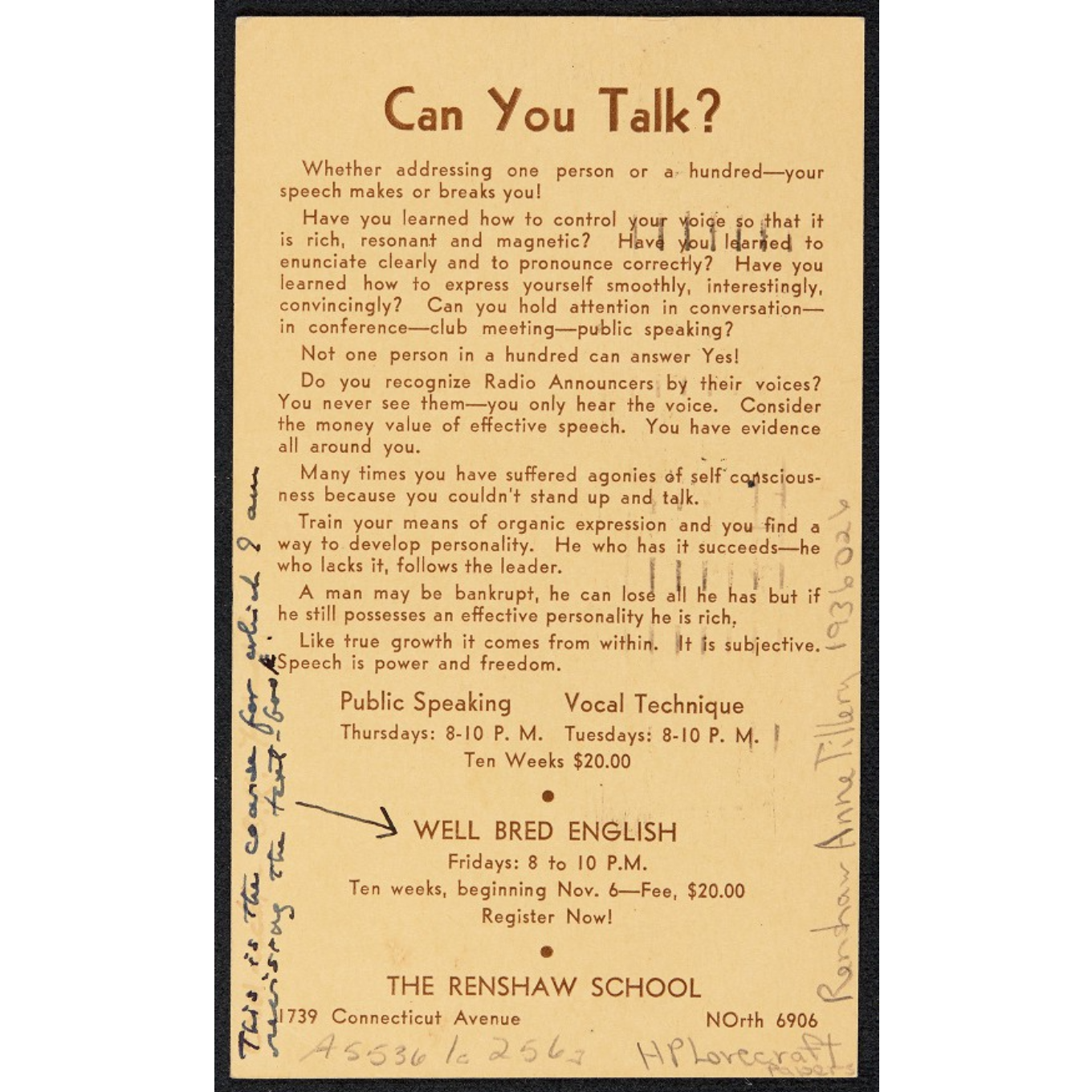
HPL 1920 (2020) by Nick O’Gorman & Tales from the Cthulhuverse #1 (2020) by Zee Romero & Luca Cicognola

I repeat to you, gentlemen, that your inquisition is fruitless. Detain me here forever if you will; confine or execute me if you must have a victim to propitiate the illusion you call justice; but I can say no more than I have said already. Everything that I can remember, I have told with perfect candour. Nothing has been distorted or concealed, and if anything remains vague, it is only because of the dark cloud which has come over my mind—that cloud and the nebulous nature of the horrors which brought it upon me.
—H. P. Lovecraft, “The Statement of Randolph Carter” (1920)

The Lovecraft Mythos was written in a particular cultural syntax. H. P. Lovecraft never tells the reader, for example, that the characters in “The Statement of Randolph Carter” are white. Caucasian heterosexual male was the default state for pulp fiction, and for much of the popular fiction of the 20th century. Once a writer or artist realizes that this is the framework in which the Mythos was set during the time of Lovecraft and his contemporaries, it is easier to imagine how those same stories might look differently within a different context. So it is that adaptation can often remain relatively faithful to the original story in term of plot, characters, narrative, and dialogue, and yet add to the story by providing a different context which changes how the story is read and understood.

In comic books, two examples of this kind of adaptation are Nick O’Gorman’s HPL 1920 (2020) and Tales of the Cthulhuverse #1-3 (2020, Mythx Media). Both are indie horror comics that adapt three stories from H. P. Lovecraft—O’Gorman was specifically adapting stories from 1920, to be published on their centenary, while Tales of the Cthulhuverse aimed for more of an update on the classic Lovecraft tales by setting them in the 21st century. In both cases, the authors remained very faithful overall to the original story—but in both cases simple, subtle changes to presentation can drastically affect how the story is read and understood.

HPL1920 - 1

HPL 1920 adapts “The Statement of Randolph Carter”—except now Randolph Carter isn’t an older white male, he’s an African-American teenager. This puts an entirely different perspective on talking with the police in any contemporary American context, and yet it doesn’t require any substantial change to how the story works—two people, searchers after horror, go into a graveyard and one descends while the other waits behind. The basic idea of “The Statement of Randolph Carter” is not particular to any particular race or culture; curiosity and breaking taboos are universal human traits. What changes the story is how we receive it when the person relating it is someone other than “the default”—African-American teenagers are subject to systemic bias by the justice system in the United States, which adds a layer of tension to the story…and O’Gorman plays with that, at least a little bit:

HPL1920 - 2

Does a white male Randolph Carter in this exact same situation affect the reader in the same way—or is there a part of the story unspoken here, just in these two panels, because people of today can fill in the unwritten details? How would this scene have played out differently if it wasn’t two white cops? We can ask these questions because we’ve stepped outside of the cultural syntax which Lovecraft was writing in…and there are more possibilities to explore the Lovecraft Mythos than just changing up race.

It is true that I have sent six bullets through the head of my best friend, and yet I hope to shew by this statement that I am not his murderer. At first I shall be called a madman—madder than the man I shot in his cell at the Arkham Sanitarium.
—H. P. Lovecraft, “The Thing on the Doorstep”

Cthulhuverse - 1

Where HPL 1920 changes the race of the principal characters, Tales of the Cthulhuverse #1 changes the gender. Daniel Upton becomes Danielle, Edward Derby becomes Eve, Asenath Waite becomes Asa—there are a few other changes, since the setting is now contemporary Massachusetts (2020s) and the Danielle & Eve are college roommates of a similar age and unmarried; the plot is condensed down considerably—but the main change is simply a what if scenario:

How would “The Thing on the Doorstep” have changed if the genders had been reversed?

As with “The Statement of Randolph Carter” and HPL 1920, the initial response would be: not by much. Lovecraft’s original story already involves gender change due to body-swapping; in a literary shell game, it is largely irrelevant what the writer uses for shells, as long as the same relationships are in place. So it is in Tales of the Cthulhuverse #1, where much the same events as Lovecraft’s story play out despite changing the genders of the main characters. If that was all there was too it, the adaptation would be boring.

Cthulhuverse - 2

Lovecraft’s frame for “The Thing on the Doorstep” is minimal: it’s a statement, but unlike “The Statement of Randolph Carter” it’s not to any particular party. Daniel Upton isn’t explicitly talking to the police; Danielle Upton in Tales of the Cthulhuverse #1 is. So like HPL 1920, there’s a specific dynamic of interaction being invoked—the police procedural dynamic, only this time a little more sympathetic. After all, Danielle Upton is a white woman…and so was Eve Derby.

Cthulhuverse - 3

Domestic violence is not usually the first thing that springs to mind when reading Lovecraft’s “The Thing on the Doorstep”—not because men aren’t subject to domestic violence and abuse, but because the audience is generally not used to thinking about his marriage in that context. Because Daniel Upton wasn’t talking to the police, they weren’t trying to fit two dead bodies and a bad romantic relationship into a context they understood in Lovecraft’s narrative. Change the genders, though, and suddenly this becomes a much more logical leap for the cops to make…and maybe another one.

Daniel Upton has a weird angle in Lovecraft’s “The Thing on the Doorstep.” He is Edward Derby’s closest male friend, and Derby then marries Asenath, so Derby is caught between Daniel and Asenath. It isn’t explicitly a lover’s triangle because there are no indications that Daniel is homosexual (and if he is, being married and with a son indicates he’s at least in the closet), but the close relationships between men in some of Lovecraft’s stories have inspired homosexual interpretations of those stories (as explored in depth in Sex and the Cthulhu Mythos).

The exact same dynamic still applies in the Tales of the Cthulhuverse adaptation, and Zee Romero plays it as straight as can be (no pun intended)—there’s no explicit idea given that Danielle Upton is a lesbian or in love with Eve Derby in any kind of romantic sense. The story can be read as a perfectly platonic tale of shooting the bastard that stole the body of your best friend. That said, there’s also definitely enough subtext here to read it as a genuine lover’s triangle too—unlike Lovecraft, who gave Daniel a wife and baby to at least imply a heterosexual relationship, Romero doesn’t give Danielle any romantic interests at all. It is definitely an interesting way to re-imagine Lovecraft’s story…and that’s before the final revelations come out.

Ultimately, HPL 1920 and Tales of the Cthulhuverse are two parallel approaches with the same aim: contemporary writers and artists seeking to remain faithful to the core of Lovecraft’s narratives while also finding new things to say about those narratives in the way they present them. By and large they both succeed. If there’s a flaw in these comics, it’s not the approach, but sometimes the execution. Indie comics can’t always afford the most polished art, and it shows—the production values aren’t bad on either of these, but for Tales of the Cthulhuverse in particular the lack of detail in the gore and nudity feels like a misstep, or at least a missed opportunity. O’Gorman and Cicognola definitely know their material, because there are little allusions to the Gate sigil from the Simon Necronomicon and August Derleth’s version of the Elder Sign as popularized by the Call of Cthulhu Roleplaying Game, but a lot more could have been done with these same scripts if Jacen Burrows, Kelly Jones, or Laci had been handling the material.

HPL 1920 was written, drawn, and colored by Nick O’Gorman, and funded through Kickstarter. Copies of the comic are available through his Etsy shop.

Tales of the Cthulhuverse #1 was written by Zee Romero, pencils and inks by Luca Cicognola, colored by Sean Burres, with a cover by Jeff Chapman, and published by Mythx Media. They are currently available for purchase on Comixology.


Bobby Derie is the author of Weird Talers: Essays on Robert E. Howard & Others (2019) and Sex and the Cthulhu Mythos (2014).
Black Stars Above (2019) by Lonnie Nadler & Jenna Cha

At length we observed a total change in their demeanour. From absolute stupor they appeared to be, all at once, aroused to the highest pitch of excitement, and rushed wildly about, going to and from a certain point on the beach, with the strangest expressions of mingled horror, rage, and intense curiosity depicted on their countenances, and shouting, at the top of their voices, Tekeli-li! Tekeli-li!
—Edgar Allan Poe, The Narrative of Arthur Gordon Pym of Nantucket (1838)

Of course common reading is what prepared us both to make the interpretation, though Danforth has hinted at queer notions about unsuspected and forbidden sources to which Poe may have had access when writing his Arthur Gordon Pym a century ago. It will be remembered that in that fantastic tale there is a word of unknown but terrible and prodigious significance connected with the antarctic and screamed eternally by the gigantic, spectrally snowy birds of that malign region’s core. “Tekeli-li! Tekeli-li!” That, I may admit, is exactly what we thought we heard conveyed by that sudden sound behind the advancing white mist—that insidious musical piping over a singularly wide range.
—H. P. Lovecraft, At the Mountains of Madness (1936)

RCO032_1576717890

Black Stars Above was published as a five-issue series from Vault Comics in 2019-2020, and collected in a trade paperback in 2020. The creative team was Lonnie Nadler (writer), Jenna Cha (artist), Brad Simpson (colorist), and Hassan Ostmane-Elhaou (letterer).

They tread rare territory.

Canada, 1887. Eulalie Dubois, a young Métis woman living on the edge of things with her family, trading moccasins and skinning muskrats. Yet at night she reads The Narrative of Arthur Gordon Pym, and hopes one day to escape this life. There’s fascinating intersectionality there—youth and gender and race, all mixed up and coming together. Then it gets weird.

There were Canadian pulp magazines. Not just the Canadian edition of Weird Tales, but home-grown pulps by Canadian artists, writers, and publishers, set in Canada. Where the United States had Westerns, there was also a market for Northerns, pulp stories and novels set in Canada’s Northwest Territories, often investigated by Mounties as in Tales of the North-West Mounted Police (Sep 1933). Like the Westerns, the Northerns were concerned with Canada’s frontier—the extremes of climate and survival that comprised man vs. nature, the stress on human relationships that added frisson to man vs. man, and out at the edge of the known world…sometimes things slip over into man vs. supernature.

There are a few “Weird Westerns” out there. Not so many “Weird Northerns.”

Contrast Jack London’s “To Build A Fire” (1902), which is a straight survival story with shades of psychological horror, and Algernon Blackwood’s “The Wendigo” (1910), where the extremes of the environment is only the beginning of the horror, the prelude to things. There are stranger things in the Northern woods, and plenty of mundane horrors—Nadler and Cha give us a taste of that in the opening chapter. A grandfather whose leg was cut off by Mounties. A mother discriminated against for being First Nations. A daughter sold into marriage, as long as she passes for white…

One of the key aspects of frontier fiction—Western, Northern, Sword & Planet, etc.—is the primary motivation for going into that frontier. Sometimes it is altruistic: Star Trek went on a mission to explore and investigate, to scribble in the borders of the map. Often, it’s meaner: people want to exploit the resources and indigenous peoples, make their fortune, and get out, as in H. P. Lovecraft and Kenneth Sterling’s “In the Walls of Eryx” (1939).

Black Stars Above plays with motivations very strongly and with great intent. Not just Eulalie Dubois in her mission, but everyone else in the story has some reason to be there, some hope or need or order that drove them beyond where they should have gone. Which drives them still, far past where they should have turned back. That is part of what makes the story work, above and beyond the weirdness that is very Lovecraftian but which does not make any attempt to tie in explicitly to the Cthulhu Mythos or any other; despite the reference to “black stars” and the obvious influence of Robert W. Chambers’ The King in Yellow there’s no other direct connection to the Yellow Mythos as with “Slick Black Bones and Soft Black Stars” (2012) by Gemma Files or “While The Black Stars Burn” (2015) by Lucy A. Snyder. It borrows the weird cry from The Narrative of Arthur Gordon Pym, but that is exactly all that it is: the cry of the weird. Out beyond the unknown, signifying something that can’t be deciphered.

There are great and terrible hints, but this is a narrative that does some of its best work by choosing to show rather than tell. Jenna Na’s art works well because when things are real, the panels are sharp and defined, close and intimate; and when she pulls back for the wider shots…when the gutters fade away…the dreamlike quality is stark and beautiful but somehow more epic in perspective.

RCO030_1576717890

Brad Simpson’s colors add depth to the artwork. It would have been easy to leave this black-and-white, let the chiaroscuro hit the reader between the eyes, but the colors make the “real” portion of the story seem more real, and the “unreal” portions more strongly bizarre by contrast. There are a lot more shadows of darkness that can be shown with blues and reds than just white and black.

With the handwritten journal pages and Lovecraftian focus, it’s tempting to compare Black Stars Above with Alan Moore and Jacen Burrow’s Providence (2015-2017), and Lonnie Nadler does acknowledge the influence:

And just in terms of trying to do similar things, Alan Moore’s Providence. It’s definitely an influence on Black Stars Above, but I think it does different things, and more powerful things with responding to Lovecraft, in that it’s a direct response to Lovecraft and only to Lovecraft. (Well, I guess Chambers, too). I love that book. It doesn’t get enough credit in Alan Moore’s body of work. He said what he was trying to do was what Watchmen did with superheroes, Providence was trying to do for Lovecraft. And I think he very much accomplished that. And anyone who is a fan of Lovecraft, I think should read it, because it’s, it’s densely intelligent and rich. And I might like it more than Watchmen. And I say this, like, as someone whose favorite comic is Watchmen. I don’t know why, but people didn’t seem to latch on to that one like they do some of his other work. Maybe because Neonomicon was so off-putting to people.
—Robert Secundus, “Lonnie Nadler Part II: On ‘Black Stars Above,’ Margaret Atwood and why trains are weird” (28 Jul 2020)

Black Stars Above does do different things than Providence. For one, Eulalie Dupois does not follow Robert Black in suicide after the final revelations. Both of them faced the choices of simply going with the flow, to continue to exist without making waves. Neither of them could face that. Simply existing on the edge of things is not winning, even if the heart is beating and blood is pumping. Settling for a life of quite desperation on the end of everything, trapped in a life you don’t want…

For so many characters in such narratives, death is the only escape from the frozen hell.


Bobby Derie is the author of Weird Talers: Essays on Robert E. Howard & Others (2019) and Sex and the Cthulhu Mythos (2014).