Deeper Cut: The Short Fiction of Novalyne Price Ellis

The last two or three years, we’ve dated steadily, not because we’re in love; but because we like each other and like to talk about books and writing stories. Both of us try to write; he has sold a few things, and I’m still trying.
—Novalyne Price Ellis, One Who Walked Alone 19

Writing was one of the interests Novalyne Price and Robert E. Howard had in common, and it drew them together. According to Novalyne’s memoir, Howard put her in touch with his agent Otis Adelbert Kline, who agreed to read one of her stories, and sent it back with comment—at the time, literary agents normally charged a reading fee, but Kline likely did this as a favor to Bob. Unfortunately for Novalyne, her story (and Kline’s letters) were accidentally burned (ibid. 227). Sadly, Novalyne did not appear to break into print during her time in Cross Plains, Texas.

However, in later letters, Novalyne says she was published:

Eventually, I sold a few short stories and the radio script about Bob’s look-alike or double.
—Novalyne Price Ellis to L. Sprague de Camp, 20 Aug 1977,
Selected Letters of Novalyne Price Ellis 19

Although I had to keep teaching because I was afraid I wouldn’t be able to meet my monthly bills, I did sell a few stories and articles over the years.
—Novalyne Price Ellis to Thomas W. Collins, 10 Nov 1988, ibid. 51

While I sold a few stories during the 1940s and 50s, I know so little about writing and what I am trying to do for Bob.
—Novalyne Price Ellis to Glenn Lord, 27 Aug 1979,
Selected Letters of Novalyne Price Ellis Vol. II, 15

But I was very lucky with the sixteen to eighteen stories, articles, radio scripts, and things that I sold. My first story had two paragraphs cut. One other story had a title change, and the radio script had a title change and the first line changed—(which was a mistake.)
—Novalyne Price Ellis to Glenn Lord, 8 Dec 1980, ibid. 50-51

Glenn, the first story I sold was the result of the editor’s making a couple of suggestions about cutting it. After that I sold another group of stories because I knew more than I had a[t] first. Kline was handling my material then, too, and he made some worthwhile suggestions about individual stories.
—Novalyne Price Ellis to Glenn Lord, 10 Nov 1981, ibid. 75

All my life, I wanted to write but teaching was so exciting and I put so much effort into it, I didn’t have time to devote to writing. However, the fact that I managed somehow to write and sell about 18 stories and articles encourages me to believe that I can write salable material.
—Novalyne Price Ellis to Donald Grant, 19 Nov 1981, ibid. 79

I have read and re-read the stories of mine that sold, and I’ve tried for the same spontaneity of ease. It’s been hard.
—Novalyne Price Ellis to Glenn Lord, 3 Sep 1986, ibid. 151

Some of this material jives with known information. The radio play, for instance, is “The Day of the Stranger” (1947) by Novalyne Price Ellis. Articles like “Lafayette Teacher Terms Public Speaking Training Vital Necessity in School System” (The Lafayette Progress 29 Aug 1959) are fairly well known. However, the assertion that she wrote and published a number of fiction stories in the 1940s and 50s, and even published them through Kline’s agency, is new. It suggests an ongoing business relationship with Kline, possibly until his death in 1946.

The real question is: where were Novalyne’s stories published? Her name is absent from the major pulp databases. She might have used a pen name, which was common enough during the period, and difficult to track. So too, she might have been writing primarily in the romance pulps, which are poorly attested, or in non-pulp magazines, which are likewise not well indexed. As it happens, at least two of her stories were published (or republished) in newspapers and are available through online archives, while at least two more were published in non-pulp magazines, one of which is available online.

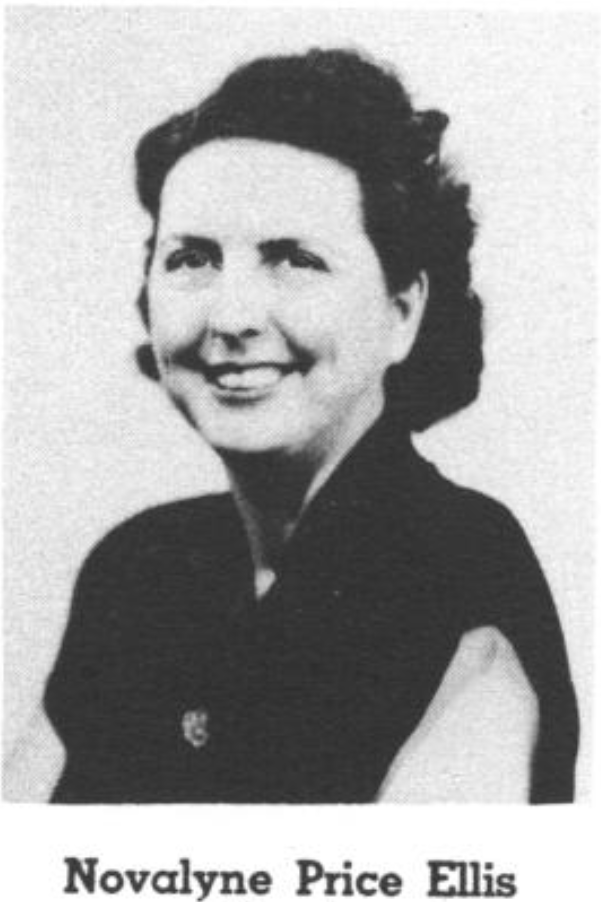
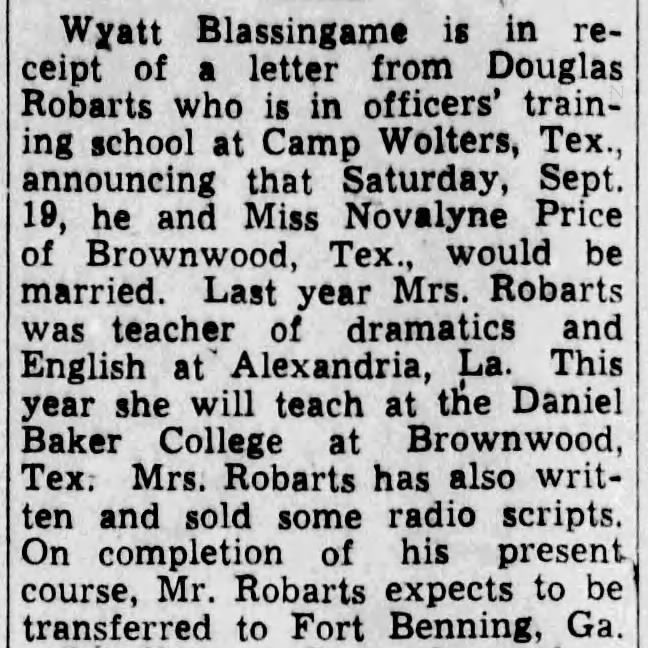
Part of the difficulty in finding these stories is that the first three (all published in 1945) were published under the name Novalyne Price Robarts (she was briefly married to Douglas Robarts from 1942 to c.1946; she married William Ellis in 1947), and appeared in Canadian newspapers and/or magazines. Kline was known for placing his client’s work internationally, and while World War II put a serious crimp in such sales, Canada seems to have been a ready market for Novalyne’s romantic fiction.

So we have a glimpse of at least some of Novalyne’s published fiction—and we can get a glimpse of her style and themes, and a better understanding of the stories she may have shared with Robert E. Howard, Tevis Clyde Smith, Otis Adelbert Kline, and others.

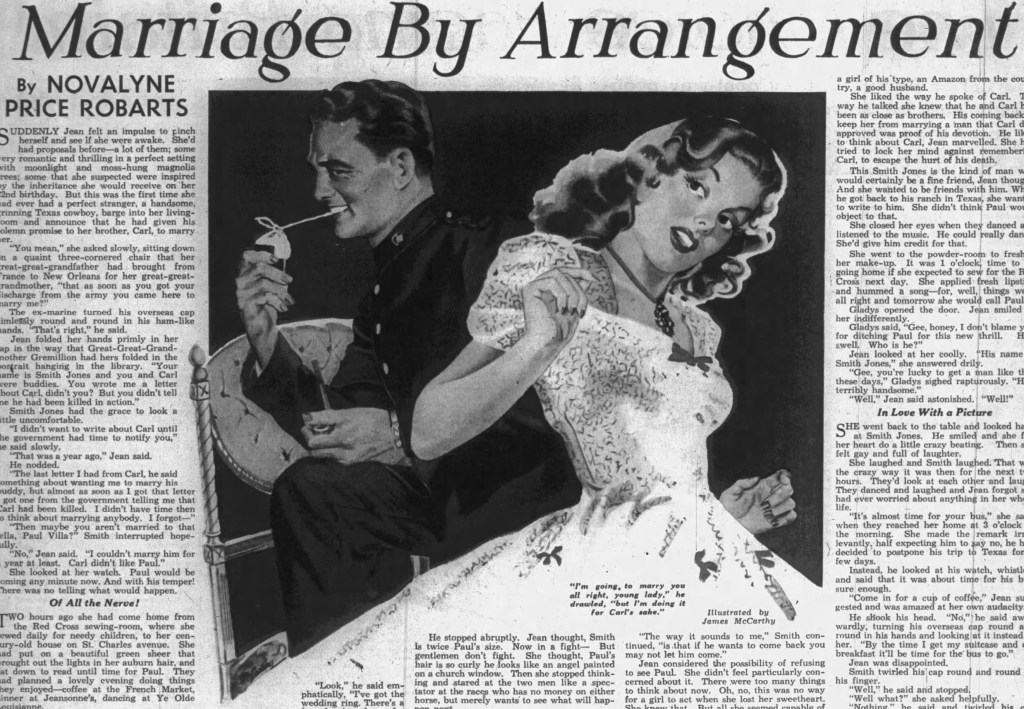
“Marriage by Arrangement” (23 Jun 1945)

This short story was published in the Toronto (Ontario, Canada) Star Weekly newspaper, under the name Novalyne Price Robarts.

Jean receives a proposal from Smith Jones, the Marine buddy of her brother Carl, who was killed in action. This makes a small difficulty, as she’s expected to receive a proposal from Paul Villa, and doesn’t like being told who she will or will not marry. Initial upset at the unexpected proposal gives way, by degrees, to attraction and regret for hardheadedness.

By 5 o’clock that afternoon, she felt so sorry for Smith Jones she even cried a little. She spent most of the afternoon trying to write him a letter. But she didn’t know his address. She could run an ad. in the personal column of the newspaper.

This is not one of Novalyne’s relationships recast in fictional form; but there is a bit of an echo of One Who Walked Alone in the vacillation, the feminine independence versus the attraction. It’s a wish-fulfillment story aimed for women, an ideal romantic fantasy where the main conflict is a woman struggling with the question of what—and who—she really wants. Fortunately, in this case, Jones comes back, hat literally in hand.

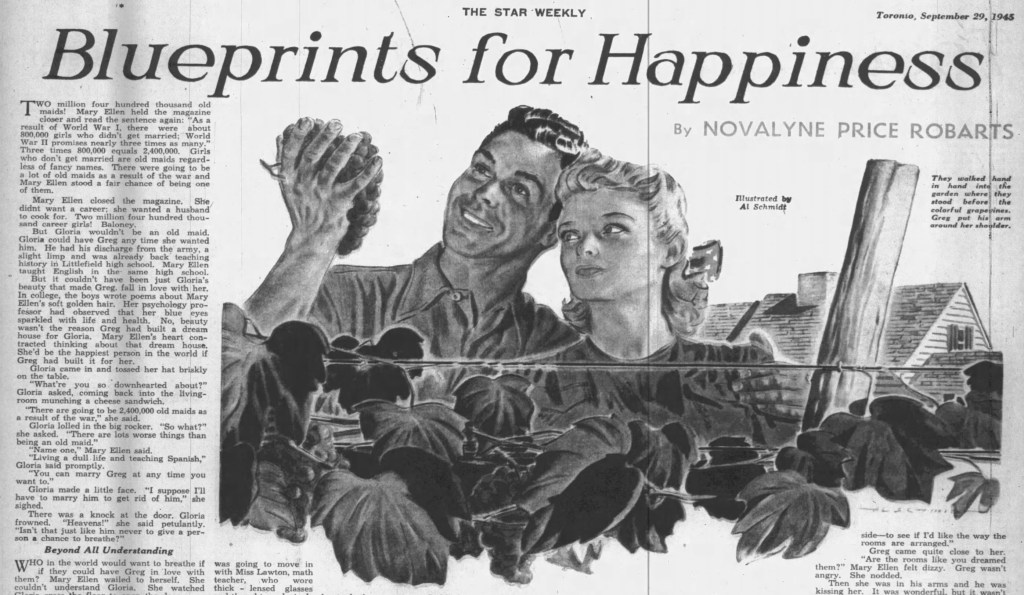
“Blueprint for Happiness” (29 Sep 1945)

This short story was published in the Toronto (Ontario, Canada) Star Weekly newspaper, under the name Novalyne Price Robarts.

Mary Ellen Carter, schoolteacher, doesn’t want to be an old maid. She wants to be a wife and mother. Handsome Greg, war vet, was in love with Gloria and building her the kind of house that Mary Ellen wanted to live in. Fat Mr. Wilkes proposes to Mary Ellen. It is a swift and perfunctory love quadrangle that ends with Mary Ellen resigning to become a housewife.

“Blueprint for Happiness” is not in any sense a progressive love story, nor does it reflect Novalyne’s own path in life—she managed to balance marriage, motherhood, and teaching—though her schoolteacher background undoubtedly inspired things. These were real considerations at the time; women were torn between the practicality of career vs. traditional homemaker expectations. The story is a kind of wish-fulfillment, a swift and happy ending to a potentially complex and knotty social quandary.

Toronto (Ontario, Canada) Star Weekly, 29 Sep 1945 (14)

“A Date with the Moon” (Sep 1945)

An advertisement for the September 1945 issue of the Canadian Home Journal includes a listing for this story, as by Novalyne Price Robarts. I have not yet been able to obtain a copy or scan of this issue to confirm the contents.

“A Fellow Has To Fight” (May 1951)

This short story was published in The Country Guide (May 1951) magazine, under the name Novalyne Price Ellis.

This is a fairly treacle-sweet story of an accomplished young man named Jimmy Jones at high school who feels restrained by his mother’s attitude and expectations he refrain from fighting or sports, and eager to make time with beautiful Betty Myers—but the local bully starts accusing him of being a “mamma’s boy” and a “sissy.” Jones gets into one little fight and Betty starts dating other people…

“I don’t care to discuss it further,” she stormed. “And furthermore. I’ll give you to understand that I can have a date with anybody I want to. Just because I’ve had a few dates with you is no sign that you own me.”

“Well, ye gods!” I mumbled. (75)

That isn’t anything ripped straight from Novalyne and Bob’s relationship, but there might be an echo of it. Certainly, Novalyne went on dates with other men before, after, and during the time she dated Robert E. Howard, and didn’t feel guilty about it as there was no agreement of being exclusive with each other. Unfortunately, a few pages are missing from the scan, so we don’t see how the story ends.


The stories—two complete, one incomplete, one only a title—have some commonalities. They are mostly told from a woman’s point of view; they are concerned with romance, but also social pressures and expectations; and they are relatively light fantasies with happy endings. All of them have Novalyne’s particular style; readers familiar with her letters and One Who Walked Alone will recognize the occasional turn of phrase, certain ways of thinking. While these stories are all written probably pretty much to order for newspapers looking to publish fluffy stories that make readers feel good, they also capture echoes Novalyne’s own thoughts and conflicts.

While the stories don’t tell us much about Novalyne’s own romantic relationships, they do tell us more about Novalyne as a writer. These are passable stories. These are salable stories. Not exceptional, not groundbreakingly original, but neither are they incompetent or completely stale. They’re stories which show an understanding of the form of romance, but don’t have enough space to really develop the conflicts very far before resolution. The kind of short stories that a busy schoolteacher might churn out between grading themes and coaching kids after class.

Are these the kind of stories she might have shown to Robert E. Howard? Hard to say. The plots she describes in One Who Walked Alone include more mature elements, like a woman with an illegitimate child. Not the kind of thing that would play in your average newspaper. The sense of place is also somewhat vague; except for “Marriage by Arrangement,” which is explicitly set in New Orleans and involves a Texas suitor, the others are generic Anytown USA (or, in this case, Anytown, CAN) locales.

It will be interesting to see what other stories from Novalyne Price Ellis’ typewriter turn up, in old magazines and newspapers or online databases.


Bobby Derie is the author of Weird Talers: Essays on Robert E. Howard and Others and Sex and the Cthulhu Mythos.

Deep Cuts in a Lovecraftian Vein uses Amazon Associate links. As an Amazon Associate I earn from qualifying purchases.
Deeper Cut: C. L. Moore Early Career Retrospective

The writing life of Catherine Lucille Moore (24 Jan 1911 – 4 Apr 1987) can be roughly divided into five periods, dominated by major life events:

  • C. L. Moore Before The Pulps (1911-1930): Her juvenilia and early amateur work that ran from her childhood through her second year at Indiana University, when she had to withdraw and begin working to support her family.
  • Early Career (1933-1940): C. L. Moore’s first professional publication, from her first appearance in Weird Tales through her marriage with Henry Kuttner in 1940.
  • Professional Writer (1940-1958): C. L. Moore and Kuttner as a prolific writing team, for pulps, novels, fanzines, and television, all through World War II and afterward into Kuttner’s teaching career, only ending with his death in 1958.
  • Late Career (1958-1963): C. L. Moore’s late career was dominated by scriptwriting for television. It ended with her marriage to Thomas Reggie in 1963.
  • Twilight years (1963-1987): With C. L. Moore’s second marriage and her early onset of Alzheimer’s disease, output practically ceased. The period saw the consolidation and republication of her work, as well as interviews and biographical materials. It ended with her death.

Of all the periods of Moore’s work, her early career gets the most attention. It is dominated by her output at Weird Tales, and to a lesser extent at Astounding, and follows her transition from weird fiction to the characteristic fantasy and science fiction that marked Unknown in the 1940s. This retrospective takes a look at what C. L. Moore was writing and publishing, and why and how the events of that period shaped the writer she was—and would become.

1933

[…] it was a rainy afternoon in the middle of the Depression, I had nothing to do—but I really should’ve looked busy because jobs were hard to get! I didn’t want to appear that I wasn’t earning my daily keep! To take up time, I was practicing things on the typewriter to improve my speed—things like ‘the quick brown fox jumped over the lazy dog.” That got boring, so I began to write bits of poetry I remembered from my college courses…in particular, I was quoting a poem called “The Haystack in the Flood.” […] The poem was about a woman in 13th century France who is being pursued by enemies of some kind…she was running across a field and these men were after her. I had misquoted a line in my mind, as well as on the typewriter, and referred to a “Red, running figure.” […] At the time I thought, “Ha! A red, running figure! Why is she running? Who is she running from and where is she running to? What’s going to happen to her? Strangely enough, I just swung from that line of poetry into the opening of “Shambleau.”
⁠—Interview: C. L. Moore Talks To Chacal in Chacal #1 (1976), 26

The Great Depression had ended C. L. Moore’s attempt at college, and with it her opportunities to publish her stories. She worked as a secretary at the Fletcher Trust Company in Indianapolis, where her fiancé also worked as a teller. Her spare dimes and quarters went to issues of Amazing Stories, Wonder Stories, Astounding, and Weird Tales, and at last she mustered up the courage to submit a story unlike anything else on the stands. The effect on the fans was electric, the effect of the check for the story no less so on C. L. Moore—it was her first professional sale and publication. By the time “Shambleau” hit stands, there are indications she was already writing sequels:

I trust your revisions may make Mrs. Moore’s second story as striking and interesting as this one.
—H. P. Lovecraft to Farnsworth Wright, 21 Nov 1933, Letters to Woodburn Harris 86

Moore would, from her reading, be aware of the possibilities of a series character like Northwest Smith. Farnsworth Wright, editor of Weird Tales, was willing to work with new writers. So it is not surprising that following stories followed Smith’s adventures, with little continuity but often featuring the same vivid imagery and ideas that marked “Shambleau.”

1934

I hope you will not be too much disappointed in the stories that follow. Perhaps, when you have read those appearing in the April and May issues, you will write again to tell me what you thought of them.
—C. L. Moore to R. H. Barlow, 8 Mar 1934, MSS. Brown Digital Repository

Both Farnsworth Wright and the fans of Weird Tales were pleased with Moore’s work, and 1934 became a busy year, with three further adventures of Northwest Smith appearing in quick succession ( “Black Thirst,” “Scarlet Dream,” and “Dust of the Gods”). Through Weird Tales, Moore also came in touch with pulp fans like R. H. Barlow and Forrest J. Ackerman. Her “secret” identity was swiftly revealed in the May 1934 issue of The Fantasy Fan, though many pulp readers would not learn this for years.

Yes, I do much more revising that I care about. Have to, tho it simply sickens me, and I hate everybody in sight while laboring away at the disgusting job. A story of mine which I’ve just sold to ASTOUNDING and which will appear in Oct. is really a third of one original N.W.Smith tale. I had that almost finished when I saw that it was two stories, and split it apart. Then the half I got to work on began to show amoeba-like tendencies toward division, and the third attempt resulted in THE BRIGHT ILLUSION, which I’ve sold, to Astounding. The other two nuclei are still simmering gently in the back of my mind, and may emerge some day.
—C. L. Moore to R. H. Barlow, 5 Jul 1934, MSS Brown Digital Repository

While it may have looked like Moore was selling everything she could write to Weird Tales, the truth was more complicated. Some stories didn’t work out, and Farnsworth Wright apparently rejected some stories and sent others back for revision. This was the unglamorous work of pulp writing, and Moore was learning the ropes of the trade, including rewriting stories to send to other magazines, which is how she splashed Astounding.

Near the end of the year, feeling that the Northwest Smith stories were growing stale, Moore tried another character on Farnsworth Wright: Jirel of Joiry. The character arose from some of Moore’s pre-pulp world-building, given a new life in Weird Tales:

Long, long ago I had thoughts of a belligerent dame who must have been her progenitor, and went so far as to begin a story which went something like this: “The noise of battle beating up around the walls of Arazon castle rang sweetly in the ears of Arazon’s warrior lady.” And I think it went no farther. So far as I know she stands ther eyet listening to the tumult of an eternal battle. Back to her Jirel of Joiry no doubt traces her ancestry.
—C. L. Moore, “An Autobiographical Sketch of C. L. Moore,” Echoes of Valor 2, 37-38

As with Northwest Smith, the fan response was extremely positive. More swiftly followed up “Black God’s Kiss” with a direct sequel, “Black God’s Shadow,” that was published before the end of the year.

1935

Now a fairly well-established author at Weird Tales, Moore began correspondence with other authors, including E. Hoffmann Price, Robert E. Howard, and H. P. Lovecraft. From the surviving correspondence, we can see that all of these individuals had their influence on Moore’s writing practice: Lovecraft’s considered criticism, Price’s practical pulp-writing advice, and Howard’s encouragement and sharing of his own swordswoman stories all entered into consideration.

From a publication viewpoint, 1935 was probably a letdown, Moore only sold and saw published four professional tales: two Northwest Smith yarns (“Julhi,” “The Cold Gray God”), including one with an illustration by Moore, and a Jirel story (“Jirel Meets Magic”) to Weird Tales, and another “thought-variant” story for Astounding (“Greater Glories”). Reading between the lines, the implication is that Wright was getting more selective about what he bought from Moore. For her own part, Moore’s interest in fandom and the pulp community was increasing, as marked by a collaboration with arch-fan Forrest J Ackerman (“Nymph of Darkness”) and taking part in a round-robin tale with A. Merritt, H. P. Lovecraft, Robert E. Howard, and Frank Belknap Long (“The Challenge from Beyond”) for Fantasy Magazine.

These were Moore’s first collaborations with other writers since childhood, and were, perhaps, important lessons in what worked and what didn’t. In “The Challenge from Beyond,” it was clear how each writer was working the parts on their own, often with drastic shifts in style and tone, not making a cohesive whole. With “Nymph of Darkness,” Moore was working from Ackerman’s ideasbut even if they shared the brainstorming, she was clearly doing all the actual work of writing.

1936

Glad you liked “The Dark Land”. I made the drawing a long time ago, and wrote the story so I could bring it in, with the addition of a cadaverous head and a swirl of vagueness.
C. L. Moore to H. P. Lovecraft, 30 Jan 1936, Letters to C. L. Moore 108

The year started out wellthe new issue of Weird Tales was on the stands with a Jirel story (“The Dark Land”), with a drawing by C. L. Moore to boot. The next month would see another Ackerman collaboration on a Northwest Smith tale (“Yvala”), and two more would be published by the end of the year (“Lost Paradise”, “Tree of Life”). Tragedy, however, would quickly mar the year.

On 13 February 1936, Moore’s fiancé (Herbert) Ernest Lewis died from a self-inflicted gunshot wound to the head; the newspapers presented it as an accident while cleaning his rifle, which was stored in the bank vault, Lewis being part of a shooting club that used a nearby range. Moore was desolate and took some weeks off work to mourn, traveling by bus with her mother to Florida. Lovecraft kept up a steady stream of letters to keep her mind occupied during the period of mourning. Only a few months later, on 11 June 1936, her friend Robert E. Howard took his own life with a self-inflicted gunshot wound to the head. Moore spread the news to Lovecraft, who spread it to others.

At this time, Moore was in contact with the literary agent Otis Adelbert Kline (former agent for Howard and Price), and was trying to expand her writing markets, but neither was quite to her tastes and apparently came to nothing.

My recent writings seem to have bogged down completely. In the last five months I have produced one trashy horror which Kline ages ago asked me to rewrite, thinking he could sell it in a revised form and which I haven’t touched since, and a drippy love-story which languished away and ceased half-finished some six weeks ago. The weather is partly responsible, but I must admit a sort of mental vacuum which shows no promise of change. I devote seven and a half hours daily to my secretarial duties and spend the rest of the time sewing desultorily, knitting a very handsome afg[h]an, attending about three movies weekly, induling in endless gossip with friends. How long this cloistered and nun-like seclusion will continue I wish I knew. I suspect that if my brain were functioning I would find myself bored to a horrible death, and rather dread the awakening. A few non-commercial attempts which I mentioned I should be very happy to have you read if I could ever get them finished to my satisfaction. I am writing and rewriting them over and over, in moments of comparative consciousness, and am far from satisfied even yet. However, to quote Mr. Penner once again, There’ll come a day.
—C. L. Moore to H. P. Lovecraft, 24 Jun 1936, Letters to C. L. Moore 143

She did manage a sale to Astounding (“Tryst in Time”), which may have begun as a rejected Northwest Smith yarn, Wright apparently still being more critical about which stories he would accept.

1937

Glad to hear that you & C L M are collaborating on a dual masterpiece. The result certainly ought to be powerful enough! Staging a meeting betwixt the mediaeval Jirel & the future Northwest Smith will call for some of your most adroit time-juggling—but with two keen imaginations at work no obstacle is likely to be unsurmountable. Good luck to both of you aesthetically & financially!
—H. P. Lovecraft to Henry Kuttner, 8 Feb 1937, Letters to C. L. Moore 262

In May 1936, Lovecraft had introduced Moore and Kuttner through mail. Their correspondence developed, and eventually led to collaboration. At this point, one of our best sources on C. L. Moore (her letters with Lovecraft) dries up, due to Lovecraft’s death on 15 March 1937. So too, Moore’s publications in the pulps dry up. She was, very probably, busy with work, caring for her family, and managing a burgeoning romance with Kuttner.

It was in 1937 that Moore made her first trip to Los Angeles, California, where she and a friend met Kuttner in person—and another Kuttner collaborator, Robert Bloch (Fanscient #8).

CA: You met Mr. Kuttner, then, through your writing?

MOORE: Yes. We corresponded for a while, and then I came out with a friend for my first visit to California and we met. He moved to New York shortly after that. Then He made several trips to Indianapolis, where I was living, and eventually he persuaded me that it would be a good idea to get married. He was perfectly right. We had a fine marriage.
Interview with C. L. Moore in Contemporary Authors vol. 104, 326

1938

No, I haven’t yet beaten my typewriter into knitting needlesI have beaten it much more lucratively in the process of hammering out a tale for Astounding in my usual vein, to be known as GREATER THAN GODS and to be publishedsometime. They just accepted it the other day. And a new story about a maidenwell, a femalenamed Jirel of Joiry has just gone off to Wright in the hope that he realizes as well as I do how badly he needs it.

[…] I look forward to LEAVES, not for Werewoman’s sake but for the pleasure I expect to derive from reading it.
C. L. Moore to R. H. Barlow, 13 Jul 1938

Moore appears to have done little writing in 1938; or at least, nothing that was published. “Werewoman” was an early, rejected Northwest Smith story. It was published, finally, in her friend R. H. Barlow’s amateur journal Leaves. E. Hoffmann Price’s memoir Book of the Dead also recalls Moore traveled to California in 1938 (262).

We can presume that she hadn’t given up writing, but was probably still busy with her job, Henry Kuttner, and possibly her mother’s growing illness.

1939

Farnsworth Wright was not yet out as editor at Weird Tales, but the magazine had been sold and relocated to New York. Moore’s last contributions to the Unique Magazine appeared in 1939: her final Jirel of Joiry tale (“Hellsgarde”), and an expurgated version of a Northwest Smith tale previously published in a fanzine (“Nymph of Darkness”).

If Moore’s relationship with Weird Tales was coming to an end, however, she was pursuing new opportunities with other magazines (“Miracle in Three Dimensions,” “Greater Than Gods”). These stories mark a definite shift in style, possibly due to unspoken collaboration with Henry Kuttneror at least, from his influence. She was moving into the lighter style of science fiction that would become a hallmark of their work in the 1940s.

Maude Moore, mother of Catherine, died of colon cancer on 8 Oct 1939.

1940

Moore’s job at the Fletcher Trust Company was implicitly dependent on her remaining single; in the sexist environment at the time, married women were expected to be supported by their husbands. In 1940, Moore took a tremendous plungeshe left her job, left Indianapolis, and moved to New York City, where on 7 June 1940 she married Henry Kuttner. It was the start of a new chapter in her life and her professional career, one where the “C. L. Moore” byline largely disappeared, as she and her husband wrote almost everything together, but published largely under his name or shared pseudonyms.

The final Northwest Smith tale (“Song in a Minor Key”) appeared in the fanzines Scienti-Snaps; Farnsworth Wright was no longer editor of Weird Tales, and would soon be dead, and the new editor Dorothy McIlwraith had no relationship with Moore and was moving the magazine in a different direction from interplanetary stories or sword & sorcery. Instead, Moore and Kuttner turned their attention to a new fantasy magazine, Unknown, which pointed the way to the future (“All Is Illusion,” “Fruit of Knowledge”).


The hallmarks of Moore’s early career were stories that straddled genres. Northwest Smith’s tales have an interplanetary setting, but he often faces alien gods, sorcerers, and psychic vampires of various stripes. The Jirel of Joiry stories are nominally sword & sorcery, but there is little swordplay and many of the strange worlds she encounters are better seen as other dimensions. Her early protagonists regularly face experiences that pass beyond the normal sensory experience, dealing with beings and sensations that strain their minds and senses to their hiltyet the characters themselves have an almost hardboiled aspect to them, adventurers and outlaws.

Over the course of those seven years, Moore received feedback from editors, agents, fans, and fellow writers. Some of them, like Lovecraft and Barlow, encouraged Moore’s artistic creativity; others like E. Hoffmann Price emphasized the practical necessities of pulp fiction. Moore absorbed all of this influence, and when the initial spate of her stories falters in 1936 after the tragedies of her fiancé and Robert E. Howard’s death, one gets the sense that Moore had realized her own limitations. Even her non-series stories in Astounding were, ultimately, developed from initial ideas intended for Northwest Smith.

The lack of published work in 1937 and 1938 should not be taken as evidence that Moore wasn’t writing. More likely, she had ceased selling. When she does emerge back into professional publication in 1939 and 1940, her work shows a definite maturity in plotting and characterizationher last tales of Jirel of Joiry and Northwest Smith are some of her best of the series.

The end of Moore’s early career dovetails into her next period. The collaboration with Kuttner that began with “Quest of the Starstone” did not lead immediately to a slew of new stories, but Kuttner’s influence on her style and thinking are obvious in the 1940 stories, and while not often quite as recognized, some of Moore’s style is evident in a few of Kuttner’s stories from the same period. Their marriage may have formalized their writing partnership, but it seems clear that Moore and Kuttner were working together, unofficially at least, during 1937-1940and perhaps some of the stories normally attributed to Kuttner alone are possibly collaborations as well.

The seven years of Moore’s early career mark her journeyman period. She had emerged from writing just for herself and stepped into the professional arena, where she learned both discipline and disappointment; she had to suffer rejection and revision; made friends and lost them; worried over her creativity and received tremendous encouragement from people she admired and respected. Hard financial necessities and the social mores that bound single women in society shaped some of her decisions, but the voice she found was her owneven if, as desires and circumstances dictated, her own byline was largely lost as she focused on collaboration with Kuttner.

C. L. Moore was not just another pulpsmith, churning out endless variations on the same storythough she definitely ran her own themes through several variations as she learned the business of pulp fiction writing. Her early attempts at series characters, Northwest Smith and Jirel of Joiry, were incredibly well received by fans, but the series were not really written as a series of connected episodes, and that may be why Moore ultimately abandoned her early creations to focus on new characters and different stories. Others might have given up; Moore embraced the changes she needed to make. First, for the sake of her family and financial well-being, and then for love and the chance at a new life.

It was Moore’s early career that laid the groundwork for acclaimed stories like “The Twonky” (1942), “Mimsy Were the Borogroves” (1943), “No Woman Born” (1944), “Vintage Season” (1946), “Daemon” (1946), “Two-Handed Engine” (1955), and novels like Judgment Night (1952).


Bobby Derie is the author of Weird Talers: Essays on Robert E. Howard and Others and Sex and the Cthulhu Mythos.

Deep Cuts in a Lovecraftian Vein uses Amazon Associate links. As an Amazon Associate I earn from qualifying purchases.
Deeper Cut: Muriel E. Eddy’s Selected Letters to the Editor

Muriel E. Eddy was a writer, poet, the wife of pulp writer C. M. Eddy, Jr., a mother of three, and a correspondent with H. P. Lovecraft. Today, she is most remembered for her several memoirs written about Lovecraft, including “The Gentleman from Angell Street” (1961), “Howard Phillips Lovecraft” in Rhode Island on Lovecraft (1945), “Message in Stone” in Fate Magazine (Oct 1956), “Memories of H. P. L.” in The Magazine of Horror (Winter 1965-1966), “Lovecraft’s Marriage and Divorce” in Haunted (Jun 1968), and H. P. L. “The Man and the Image” (1969) (also partially reprinted as “Lovecraft: Among the Demons”). The most recent publication of the Eddys’ memoirs of Lovecraft is The Gentleman from Angell Street: Memories of H.P. Lovecraft (2025) from Helios House.

Less well-known is that Muriel E. Eddy was an inveterate letter writer, often writing in to newspapers and pulp magazines, and having her missives published quite a few times. Many of these letters are of marginal interest for Lovecraft fans, since she wrote many letters about other subjects, often simply praising a magazine or giving advice, for example, her letter published in the Jan. 1926 issue of Weird Tales:

Muriel E. Eddy, of Providence, Rhode Island, writes: “Lukundoo, by Edward Lucas White, in your November issue, receives my vote, as it is by far the most noteworthy, really thrilling and chilling tale you have yet published. It calls to my mind a story I read years ago (by a titled Englishman), entitled The Hand of Fate, wherein the unfortunate hero was fatally marked by an Egyptian magician, before his birth, by a snake. The snake began its growth from the birth of the hero, slowly, bit by bit, out of his side, causing his death. In that story no one dared destroy the hideous monster growing from the man’s side, as to have done so (some thought) would have caused him to bleed to death.”

However, that does leave a collection of letters from Muriel E. Eddy to the editors that do deal with Lovecraft and related matters. Most of these are individually brief and necessarily repetitive. As an addendum to her body of memoirs about Lovecraft, however, they have interest and value, giving greater context to how she constructed and presented the narrative of her friendship with Lovecraft over the years.

  1. Providence Journal, 2 Jan 1944
  2. Thrilling Wonder Stories, Feb 1948
  3. Thrilling Wonder Stories, Jun 1948
  4. Famous Fantastic Mysteries, Aug 1948
  5. The Atlanta Constitution, 8 Aug 1948
  6. Providence Journal, 26 Aug 1948
  7. Providence Journal, 19 Sep 1948
  8. Fantastic Adventures, Oct 1948
  9. Fantastic Adventures, Dec 1948
  10. Startling Stories, Mar 1949
  11. The Boston Globe, 29 Apr 1962
  12. Fantastic, May 1962
  13. Magazine of Horror, Jan 1965
  14. Providence Journal, 8 Jan 1966
  15. Magazine of Horror, Summer 1966
  16. Fantastic, May 1966
  17. Worlds of If, Oct 1966
  18. Providence Journal, 19 Feb 1968
  19. Magazine of Horror, Jul 1968

[1] Providence Journal, 2 Jan 1944

H. P. LOVECRAFT

Editor:

I enjoyed the article about Howard Phillips Lovecraft in the Sunday Journal of Dec. 26, by W. T. Scott, inasmuch as the late Mr. Lovecraft was well known to our family. It was my husband’s uncle, Arthur Eddy, who owned the bookshop on Weybosset street where H. P. Lovecraft loved to browse. Incidentally, there was one great love of Mr. Lovecraft’s life, perhaps unknown, and therefore overlooked, by most of the public. H. P. Lovecraft adored black cats, and would never pass by a stray black feline on the street without stopping to pat it. Mr. Lovecraft often brought his manuscripts to our house to read aloud to us before submitting them to publishers. He was an excellent reader, as well as writer, of weird and macabre tales, calculated to send cold shivers up and down one’s spine He was a gentleman and a scholar, indeed, as Mr. Scott has said in his most interesting article.

H. P. Lovecraft’s wife, whose name Mr. Scott did not know, was Sonia Greene, who lived in Brooklyn, New York.

We are pleased and honored to have been intimate friends of this gifted author. I am convinced that, some day, in the not too distant future, Providence will be proud of having produced such a prolific writer of weird, uncanny yarns that are already known throughout the world.

MRS. CLIFFORD M. EDDY

Notes: Written in response to “The Case of Howard Phillips Lovecraft of Providence, R.I.” by Winfield Townley Scott in the Providence Journal of 26 Dec 1943.

[2] Thrilling Wonder Stories, Feb 1948

LOVECRAFTIANA

Dear Sir: In the OCTOBER issue of “Thrilling Wonder Stories” I was intrigued by a letter from B. De Revere, in which he (or she?) mentioned liking H. P. Lovecraft’s horror tales. As my husband and I knew H. P. L. personally, (he lived in Providence all of his life) I want to publicly thank B. De Revere for all the nice things said re: Lovecraft.

If you, dear editor, had known the man as we did . . . of his passionate love for cats, his dislike of all fish, and his hatred of daylight, you perhaps would realize that anything he wrote in the “weird” or fantastic line, he really “lived” . . . and I used the word “live” advisedly . . . even when he lay dying in the hospital, he asked the nurse for a pencil and paper and vividly recorded (for the doctor’s benefit) exactly how he felt while dying.

Lovecraft was a tall, spare man. His skin was the color of tallow. His handclasp was firm but his hands were always ice-cold. He despised sunshine, and adored utter darkness. He wrote his best horror tales after midnight. His favorite food was sweet chocolate . . . he consumed pounds of it, and cheese and fruit. He loved coffee smothered with sugar . . . as strong as love and as black as sin!

Lovecraft’s marriage was short-lived and his divorce was conducted quietly and without press notices. We sympathized with him in his every mood, because we knew him intimately and well—we often visit his unamrked grave in beautiful Swan Point cemetery in Providence, where a huge shaft in the center of the burial plot proclaims that his parents sleep there. His grave was somewhat sunken, last time we visited it, and covered with creeping green myrtle vines. His very spirit seemed hovering over his grave as we stood there in silent prayer for a man whose genius shall ever life, after his boens have crumbled into dust.

During his lifetime, we used to tell him that his stories rivalled those of Edgar Allan Poe. He “pooh-poohed” the very notion! He considered his work nothing at all, and never displayed any vanity. He wrote simply because he HAD to write . . . from an inner urger that would not let him sleep. May he rest in peace!

—125 Pearl Street, Providence 7, Rhode Island.

Notes: While Lovecraft was very much a night-owl by preference, he was not opposed to sunlight and often walked and wrote outdoors during the daylight hours. Lovecraft noted his own appreciation for coffee, chocolate, and cheese, but he rarely ate fresh fruit. Lovecraft’s death diary existed and has been partially published in various formats, most recently in Collected Essays 5. There was a brief press notice about Lovecraft’s divorce in the Providence Journal 26 Mar 1929.

Link to Thrilling Wonder Stories, Feb 1948.

[3] Thrilling Wonder Stories, Jun 1948

H. P. LOVECRAFT, GENTLEMAN

by Mrs. Muriel E. Eddy

Editor: I’ve been besieged with requests for more information about Howard Phillips Lovecraft, the late Providence writer of weird yarns—so here goes! Lovecraft used to come over to our house and read his manuscripts night after night. Once, he gave my husband a new kind of hair-cutter and advised him to learn how to cut his own hair. It would, he averred, save many a barber’s bill. He assured us he always cut his own hair and shaved himself.

Lovecraft was the soul of neatness, and always looked like the old-fashioned gentleman of culture he preferred to call himself! He once visited the oldest church in Rhode Island with Mr. Eddy and, while there, signed his name in the register—”H. P. Lovecraft, Esquire, Gentleman.”

My hubby’s uncle (now dead) owned and operated a huge second-hand bookstore on Webosset street in Providence. His name was Arthur Eddy. Lovecraft spent hours at night, talking to our ancient uncle and poring over many volumes in the basement. He never appeared in daylight—but always turned up around the Witching Hour of twelve. Uncle liked H.P.L. and stayed open until the wee sma’ hours of morning, to humor this then embryo writer. He once predicted that, with the years, Lovecraft’s fame would mount. How right he was!

Lovecraft asked us to do much of his typing. He used an old, old machine on which he occasionally typed a story—one of the “invisible type” variety, no longer made. It is to be regretted that this typewriter was sold to a second-hand man when some disinterested outsider was cleaning his apartment after his death. I’m sure it would have been a collector’s item, had it not been sold to this unknown person, to whom the name “Lovecraft” meant nothing!

I have pictures of H. P. Lovecraft as a small child, and also pictures of his mother and father. Last summer we ascertained where his grandfather had lived during his boyhood and took interesting snapshots of the yard in which H.P.L. used to play—when he was not ill, for he was not a rugged child. I have a photo of his grandfather (who had brilliant dark eyes, a Lovecraft characteristic) and of his birthplace as well as of the grave in which he is buried (his body was placed in the ground, not in a vault).

I feel that memories of this man are precious indeed—and I even have a letter he wrote to us, congratulating our cat when she presented us with several kittens—written just as one would write to a human mother—because Lovecraft was noted for his great devotion to felines!

By the way, my favorite story in FEBRUARY TWS is “THE SHAPE OF THINGS” by Rad Bradbury. It is written in such a manner that one wonders if—MAYBE—it couldn’t be true! Fantastic but truly fsacinating stuff to ponder over! I enjoyed all the stories and I loved the monstrous hairy spider (?) on the cover! I’ll keep reading TWS!

—125 Pearl Street, Providence 7, Rhode Island.

Notes: The reference to the “disinterested outsider” might be an aside on R. H. Barlow, Lovecraft’s literary executor, who helped deposit Lovecraft’s papers at Brown University, and some of Lovecraft’s books. The remainder of Lovecraft’s possessions were disposed of by his surviving aunt, Annie Gamwell; it’s possible she sold or gave away the typewriter along with other items she did not wish or could not afford to keep. Several of the photographs mentioned appeared in Rhode Island on Lovecraft (1945).

Link to Thrilling Wonder Stories, Jun 1948.

[4] Famous Fantastic Mysteries, Aug 1948

ABOUT H. P. LOVECRAFT

Dear Editor:

My hubby picked up a copy of April 1948 Famous Fantastic Mysteries on the newsstand, and brought it home to me; he was fascinated by the cover . . . somehow, the pointing finger of the old genii with the red eyes and blue face and hair, popping out of the magic beanpot (at least, it looks like a tiny red-brown beanpot, to me!) intrigued him endlessly. He read it on the trolley coming home, and had all the other strap-hangers gaping, open-mouthed, and wondering, no doubt, what it was all about.

As usual, I turned to the letter deparment, first of all . . . somehow, when a magazine conducts such a department, it seems a safer magazine to read, proving that it is not afraid to publish readers’ frank comments . . . and what did my eyes discover there? Mention of Howard P. Lovecraft, Providence, R. I.’s own native son and favorite author of weird stories, in a letter signed Donald L. Fox, of Bicknell, Ind.

This letter praised a sketch of Lovecraft that appeared in the August 1947 issue on page 113 which I , most unfortunately, missed. In fact, this April issue is, believe it or not, the first one we’ve seen. Lay the blame on other lovers of uncanny yarns here in our city . . . no doubt copies of Famous Fantastic Mysteries sell so rapidly that no newsdealer can keep them stocked sufficiently for their customers.

If any kind reader happens to have this issue, if they’ll loan me their copy, I’ll guarantee its safe return, once I’ve glimpsed the drawing of Lovecraft.

You see, my husband and I were literary buddies of H.P.L., as we always called this now famous writer. he used to bring his manuscripts over to our house, for criticism, though Heaven knows they were always letter-perfect in our opinions. Just the same, Lovecraft would read them aloud, munching on bars of sweet chocolate between paragraphs, for he loved this confection. H.P.L. hated cold weather with an intense hatred. He was a man of many idiosyncrasies, but withal a wonderful pal and a staunceh friend. He always made himself perfectly at home with us, loved to pet our cats, and hated fish—in fact, any kind of sea-food was hateful to this master of the macabre.

When H.P.L. died, it broke our hearts. He was buried in historic old Swan Point Cemetery, here in Providence, and we often visit his grave. Sometimes it seems he is very near, as we read over cards he sent us on his various travels.

As for the magazine: “City of the Dead” is a great story . . . kept us interested throughout. We enjoyed Robert W. Chambers’ novelette, “The Messenger”, and the sketch of Algernon Blackwood was wonderfully executed. But best of all I enjoyed the wonderful “Readers’ Viewpoint” with letters from readers everywhere! From now on, I’m taking no chances. I’m ordering my copies of F.F.M. in advance.

Glad to see a letter from August Derleth . . . We know him, too. We met him last summer during his hurried trip to Providence.

Mrs. Muriel E. Eddy
125 Pearl St.
Providence 7, Rhode Island.

Notes: Muriel E. Eddy also corresponded with August Derleth.

Link to Famous Fantastic Mysteries, Aug 1948.

[5] The Atlanta Constitution, 8 Aug 1948

I am pleased to see Joe Lee’s article on Houdini . . . whose real name was Erich Weiss. My husband, Cliff Eddy, was “ghost writer” for Houdini for many years. He also assisted Houdini in exposing fake mediums. I am proud to say that Houdini and his wife Beatrice (now dead) were personal friends of mine. They were remarkable people . . . I often wondered what happened to their pet parrot, Laura, after she flew out an open window in Hollywood (after Houdini’s death) and was last seen heading for the foothills.

Laura always accompanied her mistress on tour and I remember the pretty green bird with the red head perched on her mistress’ shoulder as we walked up a busy street in a sudden downpour of rain.

Laura seemed to enjoy the rain and laughed delightedly and when we entered the lobby of the hotel where we were staying, the bedraggled parrot was still laughing. But when folks started to laugh at her she hid her head under a wing and cried like a baby.

Mrs. Houdini ordered half a melon for the parrot as a special treat, but Laura much preferred sipping tea from a spoon.

Mrs. Muriel E. Eddy,

Providence, R. I.

Notes: Written in reply to “I Knew Houdini” by Joe Lee, Houdini’s former publicity director, published in The American Weekly magazine section of the Chicago Herald-American for the week of 20 Jun 1948. While not directly related to Lovecraft, this letter is relevant for its insight into the Eddy/Houdini relationship, which in turn was connected with Lovecraft’s relationship with Harry Houdini and his wife, Bess Houdini. This letter was published simultaneously in multiple papers, also appearing in at least the Pittsburgh Sun-Telegraph, 8 Aug 1948 and the San Francisco Examiner, 8 Aug 1948.

Link to the Atlanta Constitution, 8 Aug 1948.
Link to the Pittsburgh Sun-Telegraph, 8 Aug 1948.

[6] Providence Journal, 26 Aug 1948

Writer of the Uncanny

Editor:

I read the Sonia H. Davis article on H. P. Lovecraft on the book page of the Aug. 22 Sunday Journal. I thank Mrs. Davis for giving us her impressions of one of the finest writers Providence has ever produced. My husband and I knew Lovecraft so well that we often visit his grave at Swan Point Cemetery in memory of a very dear friend and a gentleman of the “old school.”

Often, we typed Lovecraft’s manuscripts, finding it a joy to assist this prolific writer of the weird and uncanny. Lovecraft lived in a world of his own making, a sort of “dream world” where night became day. Most of his writings were accomplished at night. Providence was Lovecraft’s first, last and only real love in my opinion. He derived his inspiration from Providence’s little-known alleys, back streets and ancient burying grounds. We knew Lovecraft I really believe, better than anyone else (outside of his two aunts), and no finer gentleman ever lived, I feel safe in saying, than this man who just could not reconcile himself to married life, perhaps because his writing meant his entire life to him.

MRS. MURIEL E. EDDY
Providence.

Notes: In response to “Howard Phillips Lovecraft as His Wife Remembers Him” by Sonia H. Davis in The Providence Journal, 22 Aug 1948.

Link to letter in Providence Journal, 26 Aug 1948.

[7] Providence Journal, 19 Sep 1948

First, from a letter from Lovecraft’s friend Mrs. Clifford Eddy:

“I was deeply impressed . . . but one thing I think the charming Sonia overlooked entirely. Writing was H.P.L.’s entire life . . . Lovecraft often used to ssay: ‘I never was young; I was born old!’ But thanks to Sonia for giving us even the vaguest insight into married life with this extraordinary man.

“Sonia perhaps was unaware that after the divorce H. P. L. traveled several times ‘Boston-ward’ to visit a very fine young lady, and to assist her in literary work. The visits were sources of pleasure to the young lady, for she wrote me of visits to museums with H. P. L., of candle-lit suppers on cheese sandwiches and chocolate cake, and of his gentlemanliness and courtesy. It was purely a platonic friendship, but it proves that at heart H. P. L. was surely not a recluse entirely! He was human, but always his literary work came first, last and foremost!”

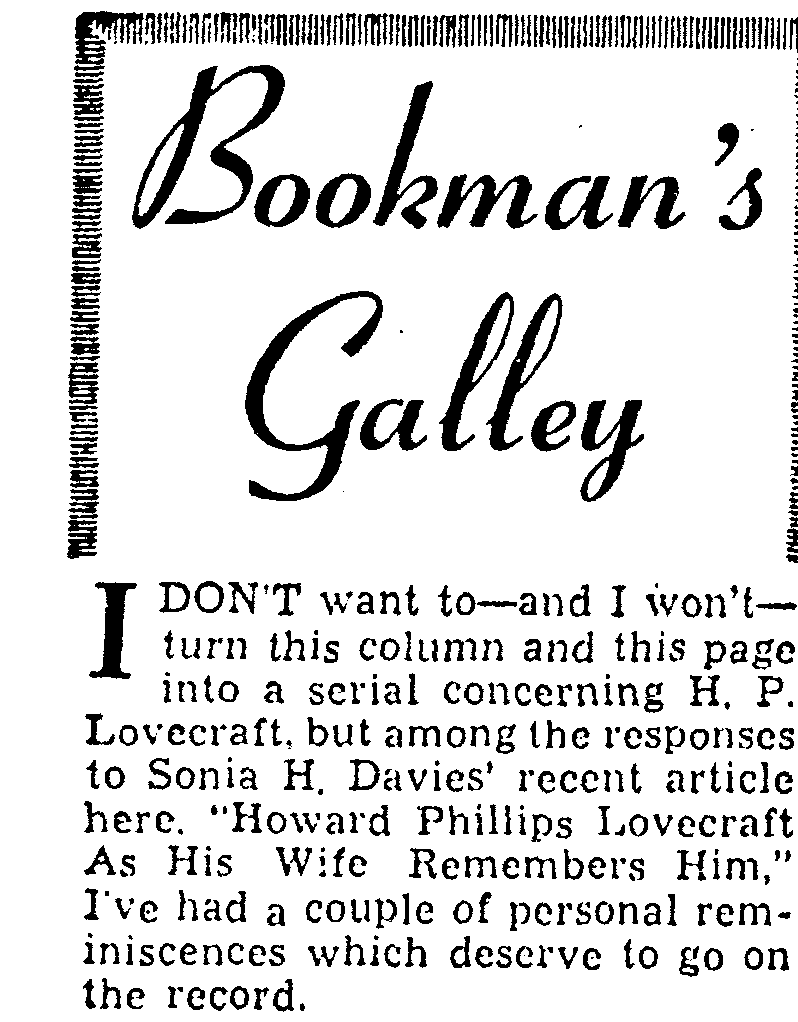
Notes: This excerpt ran in Winfield Townley Scott’s column, “Bookman’s Gallery,” in the Providence Journal, and was a further response to Sonia H. Davis’ article. The entire letter is available at the Brown Digital Repository. The “young lady” referred to was almost certainly Hazel Heald, a revision client that Lovecraft got in touch with trough Muriel E. Eddy, who had a somewhat romantic and rose-tinted view of their potential relationship.

[8] Fantastic Adventures, Oct 1948

SHAVER AND LOVECRAFT

Sirs:

The May issue of FA was a pip! It bubbled with good reading! “Forgotten Worlds” by Lawrence Chandler was wonderfully illustrated and it held my attention all the way.

I agree with Milton Papayianis of Barstow, California, regarding Richard S. Shaver and H. P. Lovecraft. Lovecraft, a close friend of the family for years, loved red roses, sweet chocolate ice-cream, and soft dreamy music. My husband has composed music for years, and H.P.L. lovecraft to watch him at work.

To those of you who love the weird things in life, I’m sure you love weird music too, as much as the late master of the weird did. My hubby often talked with H.P.L. about setting some of his weird poems to music, but unfortunately H.P.L.’s untimely death prevented this.

Muriel E. Eddy
125 Pearl St.
Providence 7, R.I.

Notes: In the 1940s, some fans drew connections between Lovecraft and the Shaver Mystery; Richard Shaver’s stories and many letters about them were published in the pages of Fantastic Adventures. I have been unable to find independent confirmation that Lovecraft particularly enjoyed roses or “soft dreamy music”; in his letters, Lovecraft indicated his musical tastes tended toward the popular music of his youth. C. M. Eddy, Jr. did write and publish songs, although it isn’t clear he ever approached Lovecraft about such an adaptation; composer Harold Farnese, however, did set some of Lovecraft’s weird poetry to music, so the idea isn’t too far-fetched.

Link to Fantastic Adventures, Oct 1948.

[9] Fantastic Adventures, Dec 1948

LOVECRAFT’S WIFE

Sirs:

Since my letter appeared in the October FA I have been deluged by letters asking me whether or not HPL, the great weird master, was ever married. The answer is, emphatically, yes.

He had a beautiful wife, and she has just written an article pertaining to her married life with him, which appeared, with her photo, in our local paper. HPL was her second husband. They divorced, and she remarried. Her third husband has since passed on. She stated in her article that Lovecraft loved cheese souffle for breakfast, cared very little for foreigners, and that he really loved his native Rhode Isalnd. The article was very interesting, and Sonia H. Greene Lovecraft Davis is really a fascinating woman. Perhaps she’ll read this and write into FA herself!

The October issue of FA was wonderful, from “kiver to kiver.”

Muriel E. Eddy
125 Pearl St.
Providence 7, R.I.

Notes: While they never met, Muriel Eddy and Sonia H. Davis did develop a correspondence after Sonia’s memoir on Lovecraft appeared in the Providence Journal.

Link to Fantastic Adventures, Dec 1948.

[10] Startling Stories, Mar 1949

MORE LOVECRAFTIANA
by Mrs. Muriel E. Eddy

Editor Startling Stories: I’ve been so interested in the many letters re: Lovecraft. Here in Providence, R.I., folks call me an authority on Howard Phillips Lovecraft, because my husband and I knew him intimately for many years. We were aware of his many idiosyncrasies and we loved him!

We know he was allergic to fish—so we never served him fish or any sea food! We knew he enjoyed the white baked meat of chicken—and cheese. He loved chocolates and when he married Sonia Greene in 1924 his two aunts gave our children over 100 empty chocolate boxes to play with! (In fact, a bathtub full!) We used an old gas-plate Lovecraft formerly brewed his coffee on, for a long time.

We remember how dearly this famous author of the weird and uncanny loved coffee with many spoonfuls of sugar! Many a night we listened to Lovecraft reading his original manuscripts—and enjoyed the facial expressions that played over his unusually mobile features as he read aloud with many a theatric gesture!

I’d be glad to furnish readers with any information on Lovecraft I am able to—and in the meantime I’ll just say I do enjoy “STARTLING STORIES” and the November issue was EXCEPTIONALLY fine! I LOVE your illustrations and covers!

—125 Pearl Street, Providence 7, Rhode Island.

Notes: When Lovecraft moved to New York City in March 1924 and married Sonia, he instructed his aunts to send much of his furniture and belongings to him in New York, and some of the other items ended up with the Eddys, who at the time were in a straitened financial situtation. With regards to chicken, Lovecraft’s letters and other memoirs confirm he did enjoy it, and his friend Harry Brobst, when interviewed by Will Murray, claimed that Lovecraft especially liked white meat and disliked dark meat (Ave Atque Vale 313).

Link to Startling Stories, Mar 1949.

[11] The Boston Globe, 29 Apr 1962

They Remember Howard Lovecraft

To the Editor—The year 1962 marks the 25th anniversary of the death of one of New England’s most prolific writers of the weird and uncanny in literature . . . the late Howard Phillips Lovecraft, who was born Aug. 20, 1890, and who died Mar. 15, 1937, in Providence.

My husband and I were personal friends of H.P.L. (as he is known to many of his readers) and we read many of his yarns, which are now published all over the world in many different languages. We spent many hours with this genius, talking over his stories and criticizing them in the rough spots.

Here at 588 Prairie av., Providence, we have many mementoes of this talented writer, who some say rivalled Edgar All[a]n Poe with his weird ideas. My husband, Clifford Eddy, was a frequent pal on the long midnight walks Lovecraft used to take to get story ideas.

MRS. MURIEL E. EDDY
Providence

Notes: According to a 2 Dec 1960 letter to August Derleth, the Eddys had established a Lovecraft “shrine” in a corner of their home for visitors, including photographs of HPL.

Link to The Boston Globe, 29 Apr 1962 letter.

[12] Fantastic, May 1962

Dear Editor:

I was greatly interested in Feb. FANTASTIC because of the story “The Shadow Out of Space,” by H. P. Lovecraft and August Derleth. My husband and I were close personal friends of the late H. P. Lovecraft. This year makes the 25th anniversary of Lovecraft’s death, which occurred March 15, 1937. He is interred in beautiful Swan Point Cemetery, Providence’s finest, most exclusive burying-ground. We often visit the grave of this unusually gifted author of the macabre.

I would be pleased to hear personally from any Lovecraft fans. I have plenty of time and will answer all letters if a stamp is enclosed.

Mrs. Muriel E. Eddy
688 Prairie Ave.
Providence 5, R.I.

Notes: “The Shadow Out of Space” was one of August Derleth’s “posthumous collaborations,” with H. P. Lovecraft, though in fact Derleth wrote them all, often based on some inspiration from Lovecraft or some prose fragment or portion of a letter.

Link to Fantastic, May 1962.

[13] Magazine of Horror, Jan 1965

Mrs. Muriel E. Eddy of 688 Prairie Avenue, Providence, RI, 02905, writes, “Having known Howard Phillips Lovecraft very well, from 1923 to the year of his death, 1937, I would like to share my memories of “HPL” with any of your readers who would care to write to me.

“HPL was a constant nocturnal caller at our home during those years. We discussed manuscripts constantly with him. We knew his aunts, too, and we often visit his grave, here in Providence, R. I.”

Notes: The Magazine of Horror had published some Lovecraft-related material in previous issues, which may have inspired this letter, and this offer probably led to Muriel E. Eddy’s “Memories of H. P. L.” being published in Magazine of Horror (Winter 1965-1966).

Link to Magazine of Horror, Jan 1965.

[14] Providence Journal, 8 Jan 1966

A Tribute to Howard P. Lovecraft

During our many years of close association with the late Providence-born author of weird, uncanny and bizarre tales, Howard Phillips Lovecraft, who died on March 15, 1937, we learned much about this wonderful writer that is not too widely known to those who read his stories and shiver, loving every word of them, or the students who are writing theses on this now famous Providence author of the macabre.

Born August 20, 1890, he was the only child of Sarah Susan (Phillips) Lovecraft and Winfield Scott Lovecraft. As a young boy, H. P. L. (as he was affectionately known to us) became interested in the weird. he was a devotee of Edgar All[a]n Poe, Ambrose Bierce, Arthur Machen, and others in that category.

Knowing Lovecraft made us appreciate the wonderful city we live in. he loved the fan-shaped designs over ancient doorways, and he loved to explore old cemeteries such as St. John’s Churchyard. Many of his stories were inspired by his ramblings in ancient cemeteries.

On March 15, 1966, this now famous writer, born and brought up in our fair city, will have been gone from our midst 29 long years, yet his fame is spreading like wildfire. 

His work is now internationally known. During the past seeral years we have had callers from England and Sweden who wanted to discuss H. P. L. and his writings with us and to see his last resting-place in beautiful Swan Point Cemetery. It is considered a rare privilege by my husband and me to realize that we knew this wonderful man personally.

Long may his memory live!

Muriel E. Eddy
Providence

Notes: In 1959, the Swedish editor and radioman Torsten Jungstedt visited the Eddys at their home in Providence, R.I., as recounted in letters to August Derleth.

[15] Magazine of Horror, Summer 1966

“Thanks for publishing my brief Memoirs of HPL,” writes Mrs. Muriel E. Eddy of 688 Prairie Avenue, Providence, Rhode Island 02905, “in the Winter 1965/66 issue, and thanks to readers who’ve written me how much they liked it. As my husband (Clifford Eddy) and I knew this master of weird fiction so well, I had some photos of HPL copied, so that I can send them (as mementos) to sincere Lovecraft fans. To those who care to send me a self-addressed, stamped envelope, regular size, I’ll send a picture. . . . Call on me, if you wish. We even had a caller from Sweden and two from England, wishing information on HPL, which we gave to them gladly. We still remember how HPL loved ice-cream and hated fish! I still have a chair HPL’s aunt (now gone) gave to me when HPL left Providence to marry Sonia Greene in New York. I used to own the folding bed HPL slept in (his aunt also gave it to me) until one night it collapsed on me! His aunt gave me many souvenirs of HPL which I cherish—those I have left—after all these years. Memories of HPL will never cease!

“Glad to see so many fine stories in the Winter issue. I believe that Master Nicholas, by Seabury Quinn, was my favorite. The Faceless God, but Robert Bloch, was a close second.”

Notes: The aunt was Annie Gamwell.

Link to Magazine of Horror, Summer 1966.

[16] Fantastic, May 1966

Dear Editor:

In the January, 1966 issue of Fantastic the story which held the most appeal for me was Robert Sheckley’s “What a Man Believes.” It really “rang the bell” for me!

Being an “old-timer” when it comes to reading odd, strange and different stories, I feel I am qualified to judge a story pretty well . . . and having read thousands of manuscripts during my lifetime (I’m heard of the R.I. Writers’ Guild here in Providence, R.I., and I’m almost 70 years old!), I don’t mind adding a few more “unbelievable tales” while I’m still alive! Robert Sheckley truly made an “unbelievable” tale BELIEVABLE!

My husband and I were bosom friends of the late weird writer, Howard Phillips Lovecraft, who died March 15, 1937, in our city, and who lies sleeping in beautiful Swan Point Cemetery. One night, after reading an especially weird manuscript aloud to us, he remarked that he believed the human brain was practically indestructible. . .that (who [k]new?), the brain MIGHT keep on functioning even after death. . .at least, it was a subject worth thinking about!

His remark has haunted me for years. Every time we visit Lovecraft’s grave, I think about it, and I wonder if, after death, it is ever a possibility that the human brain MIGHT keep right on functioning. . .whether the heart stops or not. . . .Sheer fantasy, I’m sure. . .or. . . is it?

To get off the subject. . .ALL of the stories in the January, 1966, issue are well worth reading. . .and of course Virgil Finlay’s weird illustration of “Six and Ten Are Johnny” is great. By the way, Virgil has also illustrated many Lovecraft stories. . .he’s my favorite illustrator!

Many times I regret that H.P. Lovecraft died so young. . . he was only 47 at his demise. He’d be 75 if he’d lived. We cherish his memory and invite correspondence referring to H.P.L. and all weird, uncanny subjects! KEEP UP THE GOOD WORK and I’ll continue to be a FANTASTIC FAN!

Mrs. Muriel E. Eddy
Pres. R. I. Writers’ Guild
688 Prairie Avenue
Providence, R.I. 02905

Notes: The anecdote about a brain still living evolved over time, derived from “Thoughts and Feelings of a Head Cut Off,” a story ghostwritten for Harry Houdini, possibly by C. M. Eddy, Jr. The identification of the idea with Lovecraft appeared notably in “Message in Stone” (1956) by Muriel E. Eddy. The idea of an indestructible brain doesn’t sound very much like the materialist H. P. Lovecraft, but it is possible he contributed the idea at some point during a brainstorming session and the years transformed the incident in Muriel E. Eddy’s mind.

Letter to Fantastic, May 1966.

[17] Worlds of If, Oct 1966

Dear Editor:

Toys for Debbie by David A. Kyle rang the bell for me. What a story! And what toys! ALL the stories were well worth reading—the illustrations were wonderful—your “letters” department was fine!

If I sound extra enthusiastic it’s because I AM! I’m a lover of “different” stories from way back. I’m pushing 70 now. My birthday is January 19, hubby’s is January 18—do we have any “birthday twins” among your readers?

My hubby and I have one entire room lined with weird and fantastic books and magazines. We were intimate friends of the late author of the weird and uncanny, H. P. Lovecraft. We spent many pleasant nighttime hours with this fantastic man, listening to him read his manuscripts aloud under flickering gaslight. This was in the early ’20s, when everybody didn’t have electricity in their homes! Nights seemed darker, then . . . and as H. P. L. loved darkness, we three reveled in it, as we pictured monsters, hobgoblins, shapeless creatures of his own imagination and witches steeped in witchcraft, while Lovecraft nibbled on a chicken leg and enjoyed our hospitality!

I could ramble on and on about our association with this master of the weird. We visit his grave often, and we have many pictures of H. P. L. and even one of his parents! We revere his memory and in his honor we peruse all “different” publications on the newsstands. Yours wins top honors with us! Also your cover appealed greatly to me, and it illustrated your feature story, a corker—The Moon Is a Harsh Mistress, by Robert A. Heinlein—beautifully. You’ve got yourself a steady If reader! 

—Mrs. Muriel  E. Eddy, President, R. I. Writers’ Guild, 688 Prairie Avenue, Providence, Rhode Island 02905.

Notes: Link to Worlds of If, Oct 1966.

[18] Providence Journal, 19 Feb 1968

In Memoriam: Howard Phillips Lovecraft

March 15 of this year will mark the 31st anniversary of the death of the new famous Providence author, Howard Phillips Lovecraft. Mr. Lovecraft’s many books of weird literature may be found in many public libraries now throughout the land, and his works have been translated into many foreign languages.

My late husband, Clifford martin Eddy, and I, knew Mr. Lovecraft very well. He was a constant visitor at our home, and as he preferred nighttime to day, we called him “The Man Who Came at Midnight.”

He used to love to read us his original manuscripts before submitting them to an editor. he was not conceited; in fact, he thought but little about his talent for conceiving weird and uncanny plots. I think the story that caused the most shivers when Lovecraft read it aloud, many years ago, was his now famous: “The Rats in the Walls” . . . truly a macabre yarn, a real weird classic in literature.

Born on the East Side, (Angell street, to be exact) Mr. Lovecraft loved Providence dearly. Many of his stories have a Providence-inspired background. One recognizes Benefit Street and Federal Hill in at least two of his weird tales!

All honor to the memory of Howard Phillips Lovecraft, now sleeping the eternal sleep in historic old Swan Point Cemetery. When I visit my husband’s grave, I always pay tribute also at the last resting-place of a truly great Providence author, recognized all over the world since his untimely death, (he died at only 47 years of age) the unforgettable Howard Phillips Lovecraft!

Mrs. Muriel E. Eddy
Providence

Notes: Ruth M. Eddy’s memoir of Lovecraft was “The Man Who Came at Midnight” (1949), recalling her childhood in the 20s when he came to visit.

[19] Magazine of Horror, Jul 1968

Mrs. Muriel E. Eddy writes from 688 Prairie Avenue, Providence, Rhode Island, 02905: “I am deeply sorry to tell you and interested readers of your esteemed magazine (which has always been a welcome visitor to our home) that my dear husband, author of several stories published in the now defunct WEIRD TALES, etc, such as The Loved Dead, Deaf, Dumb and Blind, etc., passed away on Tuesday, November 21, 1967, at the Osteopathic Hospital in Providence, R.I., after a long and painful illness. Death came to him as he slept. The doctor attending him telephoned me at quarter past six a. m., saying my husband had expired at about six a. m. Death came peacefully, after months of suffering.

“My husband, Clifford Martin Eddy, was a bosom pal of the late Howard Phillips Lovecraft, as so many people know, as since a letter of mine appeared in these columns a year or so ago, I received and answered much mail concerning our friendship with the late master of the macabre in fiction. Now my dear one lies sleeping in the same cemetery in which Howard P. Lovecraft sleeps, beautiful Swan Point Burial Ground, here on Blackstone Blvd., in Providence, R.I., where both Lovecraft and Eddy were born.

“Memories of HPL filled Mr. Eddy’s life, and we talked much about the happy times when Lovecraft came to visit us at our humble abode. Now that Mr. Eddy has left this earth I shall always recall those precious moments. To alleviate the loneliness incurred by my dear husband’s demise I shall be glad to answer any letters regarding HPL or my husband’s writings. Mr. Eddy and Mr. Lovecraft often discussed plots of their stories before writing them, and I was always an interested listener, although at times I, too, have tried my hand at weird stories. But these two men (I think you will agree) were tops in their field! August Derleth of Sauk City, Wisconsin, has re-published a few of my husband’s stories in anthologies, and I hope some of your readers remember the name ‘Eddy’ as well as that of Lovecraft! My husband was not as prolific a writer as was HPL, but what he did write was bloodcurdlingly readable! He was 71 at his death, and on February 10, 1968 we would have observed our Golden Wedding . . . but God saw fit to take him . . . and who we are to question God? Nevertheless, I miss him . . . sorely. Letters will help assuage my loneliness! I visit his grave (and Lovecraft’s) very often.”

Notes: Link to Magazine of Horror, Jul 1968.


Bobby Derie is the author of  Weird Talers: Essays on Robert E. Howard and Others  and  Sex and the Cthulhu Mythos .

Deep Cuts in a Lovecraftian Vein uses Amazon Associate links. As an Amazon Associate I earn from qualifying purchases.
Deeper Cut: The Letters of Clara Lovrien Hess

When Providence, R.I. journalist Winfield Townley Scott published his first biographical essay on H. P. Lovecraft in the Providence Journal in 1943, it was with the caveat that he had not been able to contact Lovecraft’s wife, Sonia H. Davis. After publication, they got in touch, and through Scott’s efforts Sonia’s memoir of her marriage to Lovecraft was published in the 28 August 1948 edition of the Providence Journal as “Howard Phillips Lovecraft As His Wife Remembers Him.”

Providence Journal 19 Sep 1948 (95)

The publication of Sonia’s memoir drew immediate responses from those who knew Lovecraft, some of which Scott published in his regular column in the 19 Sep 1948 issue of the Providence Journal. Letters had come in from Muriel Eddy, Hazel Heald, and seven long paragraphs from Clara L. Hess about her childhood with Lovecraft and his family.

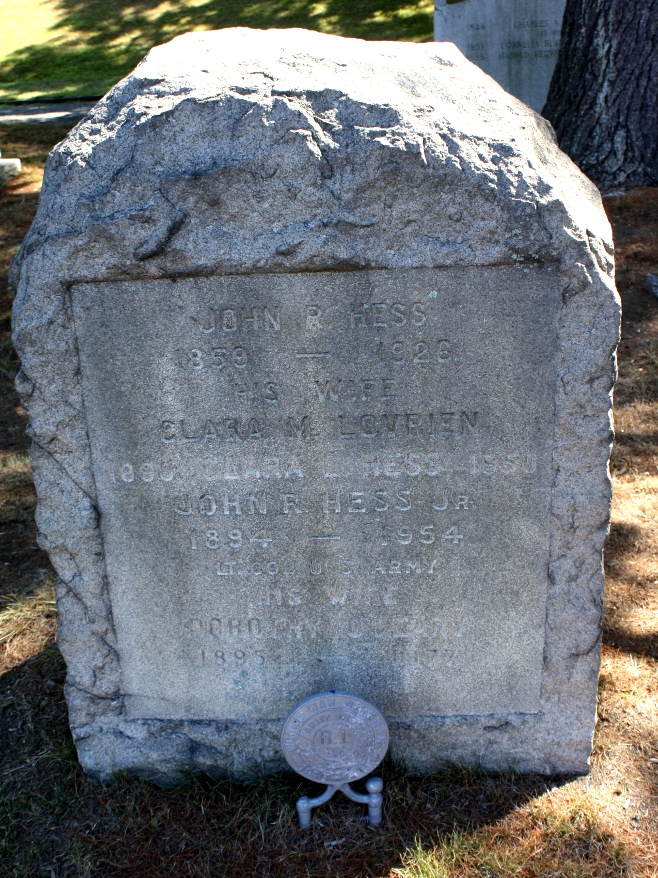
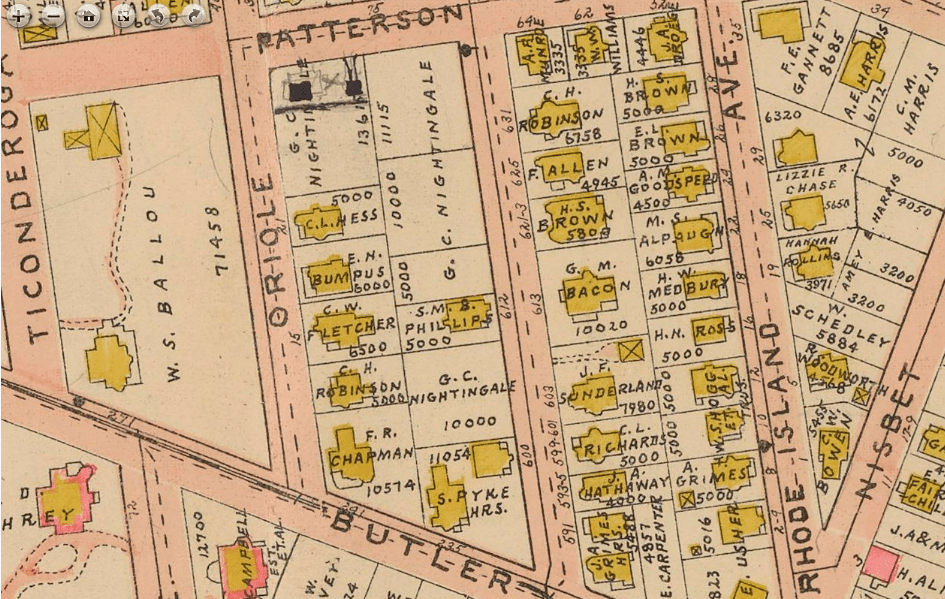
Clara Lovrien Hess (2 Jun 1889 – 5 Apr 1950) was the eldest child of John R. Hess, a newspaper editor for the Providence Journal, and Clara Maud Lovrien Hess, a housewife. Her family lived in the same neighborhood at the same time as H. P. Lovecraft did; Federal censuses from 1900-1920 place her family on Oriole Avenue, one street over from Angell St. where Lovecraft lived until 1924. None of Lovecraft’s letters mention Clara Hess, although this is not unusual, as very few of his letters mention any of the children in the neighborhood he grew up in, and when they do it is the boys. Lovecraft does mention her younger brother Jack Hess (John R. Hess Jr., 28 Apr 1894 – 7 Jan 1954) in Letters to J. Vernon Shea et al. 193 and Letters to Family & Family Friends 1.35.

According to Federal census data, after graduating from school Hess became a schoolteacher; and according to newspaper accounts, remained active in various clubs. She never married or had any children.

1908 Map showing the Hess home on Oriole Ave. The Phillips house of Lovecraft’s cousin is on Angell St. nearby.

In 1928, Clara L. Hess moved to Warwick Neck, R.I.; she was there when Sonia’s memoir of Lovecraft was published, and was inspired to write a letter about her own experiences that ended up on Winfield Townley Scott’s desk, who subsequently published a part of it. This in turn caught the eyes of others; a letter survives from Margaret M. Wallace to Winfield Towley Scott, 24 Sep 1948, where she wrote:

I liked Clara Hess’s letter about Mr. Lovecraft. I didn’t live as near as she did to him, but I remember seeing him on the streets, and I thought he had a very disagreeable face. One should know that he would write the kind of books he did. Did Miss Hess know that you were going to quote her?

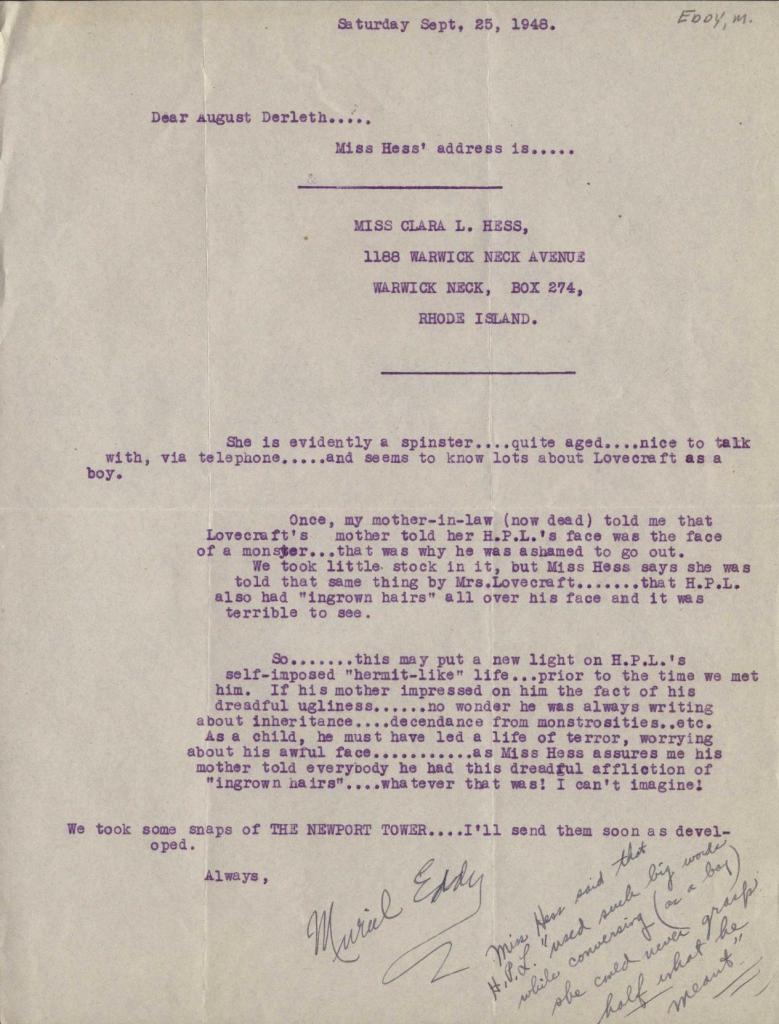
August Derleth apparently wrote to Muriel E. Eddy about Hess, who provided an address:

For the remaining 18 months or so of her life, Clara L. Hess and August Derleth conducted an intermittent correspondence, mostly focused on Lovecraft, his mother, and Derleth’s writing. Derleth quotes from Hess’ letters in his essay “Lovecraft’s Sensitivity” was that was published in Something About Cats (1949). The original letters themselves, however, have never been published in full, and are split between the John Hay Library at Brown University in Providence and the August Derleth archive at the Wisconsin Historical Society. The small cache of 9 letters is in many cases our only source for certain details on Lovecraft’s childhood, and his mother’s illness.

Larger memorial image loading...
Pawtucket Times, 6 Apr 1950 (2)

[0] Clara Hess to the Providence Journal (n.d.)

It was with great interest that I read the story of Howard Phillips Lovecraft as written by Sonia Davis for the Sunday Journal.

Howard Lovecraft and I grew up in the same “old time” East Side neighborhood in Providence when there was often fields covered with butterflies and daisies in the Butler Avenue—Angell Street-Orchard Avenue area. Although of a younger generation, I knew Howard’s mother better than I knew Howard who even as a young boy was strange and rather a recluse, who kept by himself and hid from other children because, as his mother said, he could not bear to have people look upon his awful face. She would talk of his looks (it seemed to be an obsession with her) which would not have attracted any particular attention if he had been normal as were the other children in the community who because of the strangeness of his personality kept aloof and had little to say to him.

I first remember meeting Mrs. Lovecraft when I was a very little girl at the home of the late Mr. and Mrs. Theodore Phillips on Angell Street where I visited often.[1] At that time Mrs. Lovecraft was living in the corner of Angell Street and Elmgrove Avenues.[2] She was very pretty and attractive, with a beautiful and unusually white complexion which it was said she obtained by eating arsenic, although whether there was anything to this story I do not know. She was an intensely nervous person.

Later when she moved into the little downstairs flat in the house on Angell Street [3] around from Butler Avenue I met her often on the Butler Avenue cars, and one day after many urgent invitations I went in to call upon her although she was considered as becoming rather odd. My call was pleasant enough but the house had a strange and shut up air and the atmosphere seemed weird and Mrs. Lovecraft talked continuously of her unfortunate son who was so hideous that he hid from everyone and did not like to walk upon the streets where people could gaze at him.[4] When I protested that she was exaggerating and that he should not feel that way she looked at me with a rather pitiful look as though I did not understand about it. I remember that I was glad to get out into the fresh air and sunshine and that I did not repeat my visit! Surely it was an environment suited for the writing of horror stories but an unfortunate one for a growing youth who in a more wholesome environment might have grown to be a more normal citizen.

Howard used to go out into the fields in back of my home to study the stars. [5] One early fall evening several of the children in the vicinity assembled to watch him from a distance. Feeling sorry for his loneliness I went up to him and asked him about his telescope and was permitted to look through it. But his language was so technical that I could not understand it and I returned to my group and left him to his lonely study of the heavens.

After a time one did not meet Mrs. Lovecraft very often. There was a mail box at the corner of Butler Avenue and Angell Street. (probably still is) Sometimes when going around the corner to mail a letter on an early summer evening one would see a dark figure fluttering about the shrubbery of her home and I discovered that it was Mrs. Lovecraft.

Sometimes I would see Howard when walking up Angell Street but he would not speak and would stare ahead of him with his coat collar turned up and his chin down.

After awhile I heard that Mrs. Lovecraft was ill and was away and that the aunts had taken over. [6] I knew nothing more about them until I heard of Howard’s marriage [7] which was wondered at by some of those who had known him.

c. l. h.

Notes: Sent before 19 Sep 1948, when selections were published in the Providence Journal. Available at the Brown Digital Repository.

[1] Theodore Winthrop Phillips (24 Jun 1836 – 26 Jun 1904) and his wife, Sarah Marsh Phillips (16 Feb 1835 – 4 Mar 1904) lived at 612 Angell St., the lot almost directly behind Clara L. Hess’ childhood home on Oriole Ave. Theodore Phillips was the son of Whipple Phillips, the great-great-uncle of H. P. Lovecraft.

[2] 454 Angell St., the Phillips family home where Lovecraft was born in 1890.

[3] 598 Angell St. After the death of Lovecraft’s grandfather Whipple Van Buren Phillips, Lovecraft and his mother were forced to move into smaller quarters.

[4] Many of Hess’ memories cannot be verified against other sources. R. Alain Everts in “Howard Phillips Lovecraft and Sex: or The Sex Life of a Gentleman” apparently asked Lovecraft’s ex-wife Sonia about these assertions and took her comments as confirmation; however, it must be remembered that Sonia only began courting Lovecraft after his mother’s death, so her memories may have been influenced by Clara Hess’ published accounts.

[5] Hess never gives any dates, but the 1908 map of Providence shows what appears to be open fields in that section, which would have been better for stargazing. Howard’s appreciation of astronomy from a young age is well known, so this could presumably have been any period from ~1900-1907.

[6] Sarah Susan Phillips Lovecraft (17 October 1857 – 24 May 1921) was admitted to Butler Hospital on 13 Mar 1919, after an apparent nervous breakdown. She died there two years later, following surgery to remove her gallbladder.

[7] H. P. Lovecraft left Providence, R.I. and married Sonia Haft Greene in New York City on  3 March 1924.

[1] Clara Hess to August Derleth, 9 Oct 1948

Warwick Neck,
Rhode Island,
October 9th, 1948.

My dear Mr. Derleth:—

Of course, you may quote from my letter to the Sunday Journal about Howard Lovecraft and his mother. I feel greatly honored.

I do not know that Mrs. Lovecraft ever spoke to her son directly about his “ugliness” but I think he must have known how she regarded him. Howard resembled his mother. She had a peculiarly shaped nose which rather fascinated me as it gave her a very inquiring expression. Howard looked very much like her.

In looking back I cannot ever remember to have seen Mrs. Lovecraft and her son together. I never heard one to the other. It probably just happened that way but it does seem rather strange as we were neighbors for a considerable period of time.

I remember the aunts who came to the little house on Angell Street often, as I recollect, quiet, determined, little New England women, quite different from Mrs. Lovecraft, although Mrs. Lovecraft was a very determined person.

I remember that Mrs. Lovecraft spoke to me about weird and fantastic creatures that rushed out from behind buildings and from corners at dark and that she shivered and looked about apprehensively as she told her story. She asked me what I thought it and I told her it wasn’t so!

The last time I saw Mrs. Lovecraft we were both going “down street” on the Butler Avenue car. She was excited and apparently did not know where she was. She attracted the attention of everyone one. One old gentleman acted as if he were going to jump out of the car every minute. I was greatly embarrassed as I was the object of all of her attention.

Mr. Ronald K. Upham, 51 Adelphi Avenue, Providence might be able to throw some light upon the tragic Lovecraft story. [1] I believe that at one time he used to visit Howard at the little Angell Street flat.

I have not read you biography of Howard Lovecraft [2] but intend to do so and I am now looking forward to the publication of the Selected Letters.

Also, I am looking forward to reading your book “Sac Prairie People”. [3] I have never been west and Wisconsin, I know, is a very beautiful state.

If I come across any additional information about the Lovecraft family I’ll be glad to send it on to you.

To you
Sincerely,
Clara L. Hess

Notes: Available at the Brown Digital Repository.

[1] Ronald Kingsley Upham (4 Aug 1892 – 30 Jan 1958), one of Lovecraft’s boyhood friends. See also Letters to Rheinhart Kleiner & Others 192, Letters to J. Vernon Shea et al. 193, Miscellaneous Letters 111, Essential Solitude 1.323, Letters to Family & Family Friends 1.42, 113, 378

[2] H. P. L.: A Memoir (1945).

[3] Sac Prairie People (1948), a collection of short stories, part of Derleth’s Sac Prairie Saga about his native region of Sauk City and Prairie-du-Sac, Wisconsin.

[2] Clara Hess to August Derleth, 18 Oct 1948

Warwick Neck,
Rhode Island,
October 18th, 1948.

Mr dear Mr. Derleth:—

Your letter of October 12th has been received—Certainly, you may quote from anything I may write to you. It won’t be necessary for you to send me copy to read although of course, I would like very much to see it. If I do not find the published biography I’ll let you know.

I was much interested in what you wrote about Mrs. Gamwell [1] and it was very nice that you were able to help her in placing some of Howard’s work after his death. [2] I did not know that she was in straitened circumstances although I realize that fortunes often have a way of disappearing. [3]

I do not remember how Howard obtained his education. He had a cultured background. His people were old fashioned gentlefolk which meant considerable in the old aristocratic Providence East Side neighborhood prior to World War I. He was a real student and a great reader. I thought of him as a genius and believed that he would make a name for himself as an astronomer.

I hope that you will hear from Ronald Upham as I think he will have some information to give about Howard.

The Lovecraft story is an intensely interesting story and I am glad that I have been able to be of some help to  you. If I can be of any further assistance let me know. I’ll be glad to help in any way that I can.

Sincerely,
Clara L. Hess

Notes: Available at the Brown Digital Repository.

[1] Anne Emeline Phillips Gamwell (10 Jul 1866–29 Jan 1941), H. P. Lovecraft’s younger aunt, who survived him.

[2] After Lovecraft’s death, Derleth acted as agent with Weird Tales to publish some of his fiction, sending the monies to Annie Gamwell.

[3] After the death of Whipple Van Buren Phillips, none of the Phillips women worked or had living husbands to support them, and H. P. Lovecraft was unable to hold a regular job, so they lived off of the savings with meager income until the family entered a state of genteel poverty.

[3] Clara Hess to August Derleth, 31 Jan 1949

Warwick Neck
Rhode Island
January 31st, 1949

My dear Mr. Derleth:—

For several weeks I have been intending to write you that I obtained a copy of your book about Howard Lovecraft at the Providence Public Library, also a collection of Howard’s stories and a copy of “Village Daybook” [1]—I was not able to obtain your Book of the Month club story [2]—

Of course, I was greatly interested in your account of H.P.L.—It was very beautifully written and I am looking forward to your coming publication about Howard—the collection of stories—but by special permission with a possible charge of 10 cents a day (if kept too long) I did not find too satisfactory of the print was so fine that I could only read it with the aid of a magnifying glass! And so was not able to read very much of it.

I am still reading “Village Daybook” which is quite delightful and unusual, we have many birds, rabbits, fox and an occasional deer here at Warwick Neck. But we do not have wild strawberries. [3] Some years ago I was in Connecticut for a summer and one day came across a large meadow almost completely covered with them. I spent many hours gathering the berries and made most of them into jam to take home for the family food shelf. But sad to relate, a school chum of my brother came by to visit and when he discovered my jam he refused to eat anything but bread and butter and strawberry jam all through his visit (although we had very good meals) and when the jam was all eaten up he decided to go home—I had not thought of Elliot for some years until I read your account of Wisconsin berries but I suddenly remember his visit at Putnam Heights—the last I heard of  him he had become very successful in the journalistic field down in Washington.

I believe that your coming book about Howard Lovecraft will be of great interest in Rhode Island—All at once everyone is talking about Howard—the stories about him in the Sunday Journal Book page have excited a great deal of interest.

Please be sure to let me know the date of publication of your book as, of course, I am looking forward to it.

Sincerely,
Clara L. Hess

Notes: Available at the Wisconsin Historical Society.

[1] The “Lovecraft collection” is probably Best Supernatural Stories of H. P. Lovecraft (1945); Village Daybook: A Sac Prairie Journal (1947) by August Derleth, a Sac Prairie Book.

[2] Sac Prairie People (1948) was recommended by the Book-of-the-Month Club in 1948.

[3] “Another new experience was picking strawberries—& in late August. I had never before seen these well-known commodities in the process of growth.” —H. P. Lovecraft to Annie E. P. Gamwell, 27 Aug 1921, LFF1.45

[4] Clara Hess to August Derleth, 24 Feb 1949

Warwick Neck,
Rhode Island,
February 24th, 1949

My Dear Mr. Derleth:—

Your gift of the autographed copy of “Village Year” and the collection of Howard Lovecraft’s Supernatural Stories came as a very welcome surprise. They are quite the nicest gift I have received for a long time and I very much appreciate your thought in sending them to me.

Your foreword about Howard was kindly and beautifully written. I have not as yet read all of Howard’s stories the collection but “The Outsider” made a great impression upon me. It is one of the most remarkable stories I have ever read. I have re-read it several times and I am going to read it again. of course, Howard knew nothing of our Atom Bomb and the more recent frightful inventions of man. Yet all I could think of was the Atom Bomb when reading “Colour Out of Space”.

The day that your books came I heard from the librarian at our Warwick Neck Library—the Old Warwick League Library—that your Book of the Month Club book which the book committee had ordered at my request had finally come in and that she had saved it for me but that someone had gotten off with it after all. So people in this vicinity are becoming acquainted with Sac Prairie People in Wisconsin. Mrs. Jerrett—our librarian—said there was evidently some difficulty in obtaining your book as it took so long to come through.

I’ll have to admit that I turned with relief from Howard’s dark and sombre tales to your book of village and country life. I’m enjoying reading it very much. You wrote that you consider it better than its successor—I like them both—they are books that are good to own and to have to re-read. Your story of the Dragonflies—(“Glowing Needles”)—The seeing of fireflies legs together—I was told as a child here in Rhode Island and I believed it for sometime! But my father who told the story came from Erie, Penn. so settlers not in Pennsylvania evidently knew that old saying, too.

Again thanking you for your gifts of two such unusual books—one dark and fantastic—the other, real and beautiful—I am

Sincerely, Clara L. Hess

Notes: Available at the Wisconsin Historical Society.

[5] Clara Hess to August Derleth, 27 Mar 1949

Warwick Neck,
Rhode Island,
March 27th, 1949

My dear Mr. Derleth:—

I am looking forward to reading your copy—I know that anything I have written about Howard will be all right to quote—I am glad that I have been of some assistance and feel quite proud to have your quote from my letter. [1]

The book “Sac Prairie People” I have gotten from our little library and I like your short stories very much. I especially like “Expedition to the North”, “Moonlight in the Apple Tree”, “Now the Time for All Good Men” and “The Night Light at Vorden’s”—(There are many women like Bianca—I have known several—One wonders how they happen to become like that.) It’s a sad and tragic tale and very beautifully written.

I made the mistake about the Book of the Month Club Book—But why wasn’t it—I made the error when reading the folder which I have to our librarian for our book committee. Now I am going to read some of your novels. My robins disappeared after a late blizzard but I think they are with other song birds in the brush in the swampy land below me. I did not know we had killdeer her but I am told that there are a few around although I have to see one.

Last evening I heard frogs piping in chorus so I know that spring has really come to Warwick Neck— I hope that spring has arrived on time in Sac Prairie, Too.

Sincerely,
Clara L. Hess

Notes: Available at the Wisconsin Historical Society.

[1] Regarding “Lovecraft’s Sensitivity” by August Derleth in Something About Cats (1949), which quotes from Hess.

[6] Clara Hess to August Derleth, 6 Apr 1949

Warwick Neck,
Rhode Island,
April 6, 1949

My dear Mr. Derleth:—

I had just finished reading “The Thing on the Doorstep”–a story as powerful and disturbing as Howard’s own powerful and disturbing personality—when your letter and draft of the paper, Lovecraft’s Sensitivity came. It was all intensely interesting to me and it makes me feel very important. Mrs. Wright (Virginia Williams) a younger neighbor—I knew well and I was impressed by her recollections of Howard. [1] I met her a short time ago (after some years) at a Sunshine Society auction in our little Warwick Neck library and immediately we began to visit about old times and about H. P. L. Unlike Virginia I never was afraid of Howard but to young children he must have appeared a dark spectre when rushing through the dusk—a weird figure in the quiet New England setting of that period.

I wonder what Howard would think of the old fashioned New England neighborhood now with stores and apartment houses and newer homes built close together—there are many people of Jewish extraction in the Providence old  East Side to-day. I felt sorry that H.P.L.’s former wife wrote of his racial prejudice, especially at this time when there is so much made of racial prejudice—a thing as cruel as it is unjust. But in the environment of Howard’s youth (and of mine) it would have been impossible To escape the teachings of the time and it is quite understandable that youth of a naturally kind and gentle disposition should have absorbed the ideas of the older generation about him.

I had a friend who grew up in the vicinity who continued to live in her family homestead after an almost all Jewish settlement sprang up around her. She would watch the children going by to school and noticed one child who was shoved about and pushed into the gutter time after time. Finally she went out and indignantly asked why that little boy was being treated in such fashion and the answer was, “Oh, we can’t walk with him, he isn’t a Jew”So there can be two sides to a story after all.

You asked me to comment on your chapter about H. P. L.’s Sensitivity. I have re read it very carefully several times and it all seems very right to me—I repeat that I am very glad to have been of help in your study of Howard’s life and that I am looking forward to the publication of your book.

We are having a wild Southeast storm here this morning but the birds are singing in the rain. I heard a minister speaking over the radio Sunday morning who stated that if a man could become a bird and teach the birds how to live and take care of themselves how wonderful it would be for the birds. I thought of the story ( whose I do not remember but you probably know) “Who is the greatest of all God’s creatures?”—The answer, “man”—the question, “Who says so?” and the answer, “man”—

Wishing you continued success with your writing I am

Sincerely
Clara L. Hess

Are all the characters in your stories real people or do you just make them all seem real—

Notes: Available at the Wisconsin Historical Society.

[1] Virginia Williams Wright (30 Dec 1901 – 9 Oct 1993), born on Paterson St. in Providence, R.I., was a neighbor of H. P. Lovecraft’s. She sent a letter from Wright to Winfield Townley Scott which survives at the Brown Digital Repository, dated 23 Sep [1948]; Scott published an excerpt from it in the Providence Journal for 3 Oct 1938:

As a little girl I was scared to death of him for he used to walk rapidly up & down Angell St. at night just as a group of us were playing “Hare & Hounds” at the corner of Angell & Paterson Strs. His appearance always frightened me. he was certainly the neighborhood mystery—He never would speak to me or any of us but kept right on with his head down. Once in a while I would pass him in the daytime but never could get him to say hello.

[7] Clara Hess to August Derleth, 17 May 1949

Warwick Neck,
Rhode Island,
May 17th, 1949.

My dear Mr. Derleth:—

Inclosed [sic] is a story about H. P. L. which was forwarded to me by a friend who knew that I am interested in the study of the life of H. P. L.—you may have it—anyway, I thought it might possibly be of some interest to you–

Sincerely,

Clara L. Hess

Notes: Available at the Wisconsin Historical Society. No enclosure in the file, so unclear who or what this was.

[8] Clara Hess to August Derleth, 7 Jan 1950

1188 Warwick Neck Avenue,
Warwick Neck,
Rhode Island,

January 7th, 1950.

My dear Mr. Derleth:—

“Something About Cats and Other Pieces” I am reading with great interest and I am learning much about Howard Lovecraft that I did not know before—you have given a great deal of time and thought in assembling so much interesting material and the result is certainly most satisfactory. You must feel very much pleased with the result of all of your work.

The volume came on Monday December 26th as I was leaving to have a second Christmas dinner with friends in Warwick Neck who have a New York City background and who did not know Howard. I took my book with me—my host spent a good half of the evening reading about Howard and in telling us about his visit in New Orleans—then he insisted upon keeping my book. But I went over for it several days later and I have asked our Warwick Neck librarian to obtain a copy for our library as I know there are many people here who will want to read it. Also it will be of value for the library to own.

Again may I repeat that I am honored to be in such distinguished company and that I am glad to have been able to contribute something of interest about Howard and his family. With all good wishes to you for the year 1950 I am

Sincerely Clara L. Hess

Notes: Available at the Wisconsin Historical Society.

How reliable are Clara L. Hess’ recollections of Lovecraft and his mother? We can confirm from census data that she was in the right place at the right time, so there is little doubt that she was a neighbor of H. P. Lovecraft and Susie Lovecraft as a child, teenager, and adult. Some of her observations agree with other accounts of the Lovecraft’s life—such as H. P. L.’s interest in astronomy, and the move from 454 to 598 Angell St.—for all that she was looking back 40+ years, the material we can verify show Hess’ recollections appear to be fairly accurate.

Several of Hess’ personal anecdotes cannot be verified, including her various encounters with Susie Lovecraft. How accurate is the image that Hess paints of a mentally unstable woman rumored to take arsenic, hallucinating, and who finds her son’s appearance disturbing? At this point (1948), the most that had been written of Susie Lovecraft was by Winfield Townley Scott, who painted her as a “weak sister,” and Lovecraft as a “mama’s boy.” Hess’ comments did not help Susie Lovecraft’s image, and most subsequent portrayals of Lovecraft’s mother in biography and fiction are based on that image that Hess and Scott had presented, and which Derleth helped codify in “Lovecraft’s Sensitivity” (1949).

Probably the most revealing section of Hess’ letters that did not make it into print is her comment on racial prejudice. The anecdote reveals more about Hess than it does Lovecraft; the impulsive desire to push back against accusation of racial prejudice by saying “Hey, these Jews can be racist too!” speaks more to the pervasiveness of antisemitism among Lovecraft’s environment than a counter to Sonia H. Davis’ allegations about her ex-husband.

While we lack Derleth’s letters to Hess—it is not clear what happened to her papers after she died—it doesn’t appear that he pressed her closely on details regarding dates, etc., though he was careful to get permission for what he quoted from her. Read in context, we can perhaps better appreciate how near the end of her life, Clara L. Hess cast her mind back to younger days in the old neighborhood, and the strange kid who stood out from among the others.

Thanks to Donovan Loucks for his help.


Bobby Derie is the author of Weird Talers: Essays on Robert E. Howard and Others and Sex and the Cthulhu Mythos.

Deep Cuts in a Lovecraftian Vein uses Amazon Associate links. As an Amazon Associate I earn from qualifying purchases.

Deeper Cut: Lovecraft & Hokusai

As reckoned among the race-stocks of the world, the Indian is certainly not inferior. Neither, for that matter, is the Mongolian race as a whole. It is simply our reaction against the alien and the unaccustomed—together with the circumstance that our immigrant specimens are generally of a low type—which causes us to look down on the Chinese and Japanese. Both of these races, as rationally judged by their history, literature, philosophy, and art, are among the superior biological focus of the planet—and no one who is acquainted with their better classes is ever able to retain that feeling of repulsion which the ordinary American, Australian, or New-Zealander usually feels.
— H. P. Lovecraft to Robert E. Howard, 7 Nov 1932, A Means to Freedom 1.481-482

The 1853 Perry Expedition forcefully ended Japanese political isolation, and during the 19th and early 20th centuries cultural and technological exchanges with the rest of the world profoundly affected both Japan and the rest of the world. The Tokugawa Shogunate was overthrown, and a new government overtook Japan—one dedicated to rapid industrialization and militarization, which in practice meant increasing Westernization. The successful adoption of Western military technology and tactics became clear during the Russo-Japanese War (1904-1905), in which Japan’s surprise victory over Russia fueled racist fantasies of the Yellow Peril.

While Westerners feared the rising military might and aggressiveness of Japan, many were simultaneously drawn to Japanese art and culture. Japanese woodblock prints (ukiyo-e) covered a vast range of material, from purely ornamental to combinations of image and text that illustrated stories and scenes; from depictions of ordinary life and nature studies to erotica and supernatural creatures. Western interest in these woodblock prints is evident from before the U.S. intervention, but after trade was forcefully opened, the prints became much more accessible and inspired a Japonisme style in European art during the late 19th century, as well as collections and reproductions.

By the 1930s, Japanese prints collections were being displayed in U.S. museums, and the names of popular and notorious artists like Hokusai Katsushika (葛飾 北斎, 1760-1849) and Hiroshige Utagawa (歌川 広重, 1797-1858) were being bandied about by newspapers. In June 1934, Providence native Abby Aldrich Rockefeller (wife of John D. Rockefeller, Jr.) donated her collection of Japanese prints to the Rhode Island School of Design.

Japanese Prints Given by Mrs. Rockefeller, Jr.
PROVIDENCE, R.I., June 7—(AP) The Rhode Island School of Design yesterday announced that a rare collection of Japanese prints had been presented by Mrs. John D. Rockefeller, Jr. The 623 prints, devoted chiefly to plant, bird, fish and insect life, are by the country’s greatest masters. L. Earle Row, director of the school museum, said that in accordance with Mrs. Rockefeller’s wishes the collection will be shown in selected groups changed at frequent intervals.
Springfield (MA) Evening Union, 7 Jun 1934, p13

That is where and how H. P. Lovecraft came to be familiar with Japanese prints.

Another event was the display of the choicest of the 717 Japanese prints just acquired by the local art museum. This is a really important accession—placing our museum in competition with Boston’s . . . . which boasts of having the finest Japanese print collection outside of Japan itself. The Providence collection is of the first quality, involving large numbers of items by Hokusai, Hiroshige, & kindred standbys.
—H. P. Lovecraft to Richard F. Searight, 22 Dec 1934, LPS 343

Another event was an exhibition of Japanese prints—part of 700 magnificent specimens (Hokusai, Hiroshige, & all the rest) just acquired by the local art museum. This acquisition will bring Providence into competing distance of Boston—whose Museum of Fine Arts boasts the finest collection of Japanese prints outside of Japan itself.
—H. P. Lovecraft to August Derleth, 22 Dec 1934, ES 2.671

More or less joined to this “art week” stuff was the first display of a choice array of the 717 Japanese prints just acquired by the local museum. This gave me quite a kick, since I am rather an enthusiast concerning Sino-Japanese art. The prints are of the finest quality, with plenty of Hokusais & Hiroshiges. A couple of weeks ago an expert lectured on the making of Japanese prints, & exhibited some of the delicately carved blocks used in their preparation.
—H. P. Lovecraft to E. Hoffmann Price, 30 Dec 1934, LPS 159

It isn’t exactly clear when Lovecraft gained his appreciation of Japanese art, although it seems likely he would have encountered specimens among his visits to art museums in Boston and New York in the 1920s.

Providence Journal, 16 Feb 1935, p18

The RISD celebrated its recent acquisition with an exhibition of the works and a lectures, open to the public—which Lovecraft attended, as he often took advantage of the free lectures on art and science offered by the local universities.

Saw a fine exhibition of Hokusai’s prints—with explanatory lecture—at the museum yesterday.
—H. P. Lovecraft to F. Lee Baldwin, [13 Feb 1935], LFB 123

Saw a splendid exhibition of Hokusai’s prints—with explanatory lecture—at the museum yesterday.
—H. P. Lovecraft to J. Vernon Shea, [19 Feb 1935], LJS 254

Some darned good lectures & exhibitions at one of your two local almae matres—the School of Design. Last week they featured Hokusai—& last night there was an illustrated discourse on Soviet art (in Memorial Hall) which would have had Sonny Belknap jumping up & down & piping!
—H. P. Lovecraft to Wilfred B. Talman, [19 Feb 1935], LWT 253

Providence Journal 24 Feb 1935, p55

The Bulletin of the Rhode Island School of Design (Jan 1935) was entirely dedicated to the gift of the prints and their subsequent display, as well as providing some background on Japanese art. Lovecraft was so impressed that he couldn’t help but grab a few copies to send to friends.

This month there was a splendid lecture & special exhibition pertaining to my favourite Hokusai, & the entire quarterly bulletin was devoted to the subject of Japanese prints. The article was so fine, & the illustrations so graphic, that I could not resist getting several extra copies to send to especially appreciative persons. Note one mistake—on p. 19, with illus. On p. 22—where a Hokusai fan print of hibiscus flowers is erroneously attributed to Hiroshige. I wouldn’t have spotted this if I had not seen the original prints & their authentic labels in the museum.
—H. P. Lovecraft to Elizabeth Toldridge, 27 Feb [1935], LET 298

Later in February I heard an excellent discourse on Hokusai in connexion with an exhibition of his prints at the local art museum. Japanese art certainly appeals to me as few other aesthetic forms succeed in doing. The current museum bulletin was devoted to this subject, & contains so fine an article—together with so many excellent reproductions—that I can’t resist sending you a duplicate under separate cover.
—H. P. Lovecraft to R. H. Barlow, [16 Mar 1935], OFF 221-222

Of lectures there may be noted a highly interesting address on Japanese prints in general & good old Hokusai (1760-1849) in particular, held at the local museum in connexion with an exhibition of the prints. Great stuff—I have always been exceedingly fond of the delicacy, tranquility, & exquisite harmony of Sino-Japanese art. Enclosed are some cuttings illustrative of this event—which ably supplements similar events of last December.
—H. P. Lovecraft to Helen V. Sully, 5 Mar 1935, LWT 404

While the clippings don’t survive, several relevant items in the Providence Journal from the period stand out as likely inclusions:

Lovecraft makes several other brief references to his trips to see the Hokusai prints to various correspondents throughout 1935:

More recently I heard a fine discourse on Hokusai (an old favourite of mine) at the art museum in connexion with an exhibition of his prints. Sino-Japanese art has always fascinated me extremely, & I wish I could afford a Japanese print collection of my own.
—H. P. Lovecraft to Richard F. Searight, 5 Mar 1935, LPS 360

Heard some good lectures recently—a reading by the poet Archibald MacLeish, a discourse on the Japanese artist Hokusai (1760-1849) in connexion with an exhibition of its prints at the art museum, & an account of contemporary Russian soviet art.
—H. P. Lovecraft to Duane W. Rimel, 10 Mar 1935, LFB 261-262

Regarding recent events—possibly I told you of the lecture on Hokusai in connexion with an exhibition of his prints. Great stuff—I’ve always been a devotee of Sino-Japanese art.
—H. P. Lovecraft to J. Vernon Shea, 13 Mar 1935, LJS 262

Heard some good recent lectures on Hokusai, contemporary Soviet art, & the mosaics of St. Sophia in Constantinople.
—H. P. Lovecraft to E. Hoffmann Price, 14 Mar 1935, LPS 173

I thought the Japanese print bulletin especially delightful–you may recall that Hokusai’s “Cranes on Snow-Laden Pine” was one of the things I especially liked in the exhibition last December. I was glad to get so good a reproduction of it. Another captivating print is the one of the cat watching the butterflies—which reminds me that the local feline family is now narrowed down to the mother & one coal-black kitten . . .  a delectable duplicate of the lamented Sam Perkins.
—H. P. Lovecraft to Elizabeth Toldridge, 25 Mar 1935, LET 300

I managed to get out to several lectures—poetry readings by Susanna Valentine Mitchell & the famed Archibald Macleish—author of “Conquistador”—& an excellent discourse on Hokusai at the local museum, in connexion with a notable exhibition of his prints. Japanese art certainly appeals to me as few other aesthetic forms succeed in doing.
—H. P. Lovecraft to Clark Ashton Smith, [26 Mar 1935], DS 598

The RISD exhibition seems to have inspired Lovecraft to seek out more of Hokusai’s work, when available. Later in 1935 when traveling in Philadelphia, he stopped in at the Philadelphia Museum of Art, which was also having an exhibition of Japanese prints:

I also visited the art museum, where an especially fine temporary exhibit of Japanese prints (including the entire Fujiyama, bridge, waterfall, & poem series of my favoruite Hokusai) was on display.
—H. P. Lovecraft to Helen V. Sully, 23 Sep 1935, LWT 438

Despite Lovecraft’s claims to have always appreciated Sino-Japanese art, the specific interest in the prints of Hokusai seems to have come very late in life, driven by the sudden availability of these materials at a local museum. Lovecraft lamented that he could never own a collection of such prints, and in truth there were relatively few published reprints available in the mid-1930s. Buying originals was a game for collectors, and museums were an invaluable resource for those who wished to experience art that they could never afford.

It is important when reading these brief appreciations to understand how thoroughly Lovecraft had absorbed the Orientalist ideas of his day. Racially, the Japanese were other, yet the stereotypes surrounding them were conflicting, covering both admiration for the exotic culture that seemed keenly tied to nature and their own distinct customs, and repulsion at the looming military threat they posed, and their adoption of Western ways. Lovecraft would remark:

After all, as much as the modernisation of Japan is destroying, it may be that the innate aestheticism of the Japanese mind will manage to salvage more from the past than the western world can.
— H. P. Lovecraft to Elizabeth Toldridge, [8 Jan 1930], LET 121

Japanese culture will be hybridised with westernism—more & more as Japanese conquest increases the nation’s contacts with the west. It is a pity, because Japanese aesthetic traditions are among the finest in existence.
—H. P. Lovecraft to Donald A. Wollheim, 9 Jul 1935, LRB 305

The fascination with Hokusai and Japanese prints was one facet of Lovecraft’s fascination with Japanese (and to an extent, Asian cultures) as a whole. It was not an exception to his prejudice, but another aspect of a complex set of views that reflected both the deep cultural fascination with Japan and the Yellow Peril racial fearmongering that informed some of his own fiction. Nor did it begin and end with Hokusai; there is plentiful evidence in Lovecraft’s letters of interest in Japanese art and culture before and after…including Japanese poetry.

Let me endorse the Mocratic recommendation to obtain a free subscription to Travel in Japan. I have done so, & am thoroughly enthusiastic over the charm of the publication—its illustrations of Japanese scenery & architecture, its sidelights on Japanese art & design, & its glimpses of Japanese thought & feeling—musical, poetic bits like the extract cited. Mr. Moe has certainly not overrated the charm of this material—& I am led to wonder whether some English or American translator has prepared the visible text of the various articles & poems from originals in Japanese. In the Spring 1936 issue there is an article on the Japanese spring which well matches the earlier autumnal article. In it is quoted a very fine & typical hokku by the poet Saigyo Hoshi—

“Oh, would that I could
Split myself into many,
And, missing not a twig,
See all the glory of the flowers
In all the unnumbered hills.”

—H. P. Lovecraft to the Coryciani, 14 Jul 1936, ML 340

So when we read about Lovecraft and Hokusai, we are reading one thread of a continuing and complex interaction. Lovecraft was not quite a Japanophile, and his knowledge of Japan was imperfect and heavily influenced by the popular culture of his day, which presented views of Japan that were selective and not representative of the whole of Japanese culture. Yet these exposures to other cultures, however imperfect, did spark admiration and interest in Lovecraft—and readers today can see what Lovecraft saw, and perhaps will likewise come away with an appreciation for these Japanese artists and their work.

Rockefeller’s donated Japanese prints are still held by the Rhode Island School of Design, and many of them can be viewed for free online.

Lovecraft & Erotic Japanese Prints

Readers familiar with Hokusai will probably note an absence in the above descriptions of Hokusai’s work: the lack of erotica. The Rockefeller collection consisted primarily of nature studies, animals, plants, etc.; as far as I have been able to determine, none of Hokusai’s erotic works—such as the infamous “Diver with Two Octopi” (蛸と海女), more popularly known as “The Dream of the Fisherman’s Wife”—were included. Very likely, Lovecraft had no idea about this phase of Hokusai’s career, and possibly had no idea of erotic Japanese prints whatsoever.

Which is not to say that Japanese tentacle erotica had no effect on Lovecraft, only that it likely had no direct effect. Japanese erotic prints (shunga) were popular and influential among European artists in the late 19th century, works like Erotic Japonisme by Ricard Bru and Secret Images: Picasso and the Japanese Erotic Print trace this influence, and in particular how the erotic tentacle motif became established in science fiction art through works like Henrique Alvim-Corrêa’s The Martian Claims a Victim (1906) from his illustrated edition of The War of the Worlds.

Among the many influenced by Japonisme and Japanese print artists such as Hokusai was Aubrey Beardsley, the famous illustrator of the Yellow Book magazine and the first edition of Arthur Machen’s The Great God Pan and The Inmost Light (1894). (For more on which, see Linda Gertner Zatlin’s Beardsley, Japonisme, and the Perversion of the Victorian Ideal (1997).) The image of the tentacle as an alien force spread through the decadent 1890s into the early weird fiction of M. R. James and Arthur Machen as well as the science fiction of H. G. Wells, and by the time of H. P. Lovecraft and his peers the pulp magazines were well-accustomed to this image, and used it in their own work—not generally to penetrate in a sexual manner (that would come later), but as a symbol and motif of corruption and degeneration.

This is the side of Hokusai that Lovecraft very likely never got to see and wasn’t even aware of. The way in which these ideas and images spread and change over time is fascinating and worthy of study.

Providence Journal, 3 Nov 1935, p70

Bobby Derie is the author of Weird Talers: Essays on Robert E. Howard and Others and Sex and the Cthulhu Mythos.

Deep Cuts in a Lovecraftian Vein uses Amazon Associate links. As an Amazon Associate I earn from qualifying purchases.

Deeper Cut: Alberto Breccia & the Cthulhu Mythos

Alberto Breccia (1919-1993) was an Argentine comic artist, acknowledged as a master of the form. He began working professionally in 1939, working on comic magazines like Tit-Bits, and providing illustrations for Narraciones terrorificas, a Spanish-language horror fiction magazine which reprinted (in unofficial translation) stories from the U.S. Weird Tales.

Saturain: Ce qui t’a pousse a creer Captura, outre le fait de gagner des sous, c’etait ton interet pour le genre, evidemment. Et la litterature d’epouvante, tu l’as toujours aimee ou ca t’est venu apres?

Breccia: Avant. J’ai commence ave la collection Narraciones terrorificas des editions Molino. J’ai dessine des couvertures [pour cette collection], Albistur aussi Ce’etait dans les annees 1930, en gros, j’etais encoure celibatair. Ca a dure quelques annees. C’est la que j’ai commence a acheter et lire des recits d’epouvante. Jusqu’alors, je connaissais seulement Poe, qui est plus ou moins un auteur d’epouvante. Ou Conan Doyle et Sax Rhomer avec Fu Manchu, mais ce ne sont pas des auteurs de genre a proprement parler.

Saturnin: Ils combinent l’aventure, les feuilleton et l’epouvante.

Breccia: Oui, et le policier. Mais avec Narraciones terrorificas, je me suis plonge dans le genre, en y decouvrant Bloch, Lovecraft tous ceux dont j’ignorais alors jusqu’au nom.

Sasturain: Et tu commences a les lire pour de bon.

Breccia: Tout a fait, et je ne savais pas que la revue etait une replique de cette celebre revue americaine (Weird Tales), tu vois? Je m’en suis rendu compte longtemps apres. C’est la-dedans que j’ai lu Lovecraft, entre autres. Je possedais surement tous les Mythes de Cthulhu, et j’ai du tout vendre. Parce que j’avais cette idee fixe d’etre un lecteur cultive. Alors j’ai commence a vendre ce qui me paraissait inutile pour m’acheter a la place des livres ennuyeux a mourir Les pensees d’un tel, les maximes de La Rochefoucauld et toutes ces conneries qui ne m’ont absolument servi a rien. Maintenant, j’ai un mal de chien a reuperer ces tresors, que je tretouve mais abimes, manges aux mites. Tu sais, Lovecraft, je pense l’avoir lu bien avant. J’imaginais l’avoir decouvert lors de mon voyage en Europe, mais je l’avais probablement lu tout gamin, sans le savoir.

Sasturain: Quend tu lis de l’histoire, des romans, etc., quelle epoque preferes-tu?

Breccia: J’aime le dix-neuvieme siecele des romans de Dickens, tu vois? Cette epoque me plait: les auberges, les diligences. Mais davantage la litterature europeenne qu’americaine. J’aime les recits dont l’action se situe vers la moitie du siecle dernier, voire avants. Jusqu’en 1915, 1920.
Saturain: What pushed you to create Captura, besides earning money, was your interest in the genre, obviously. And horror literature, have you always liked it or did it come to you later?

Breccia: Before. I started with the collection Narraciones terrorificas from Molino publishing. I designed covers [for this collection], Albistur too. It was in the 1930s, basically, I was still single. It lasted a few years. That’s when I started buying and reading horror stories. Until then, I only knew Poe, who is more or less a horror author. Or Conan Doyle and Sax Rhomer with Fu Manchu, but they are not genre authors strictly speaking.

Saturnin: They combine adventure, soap opera and horror.

Breccia: Yes, and the detective story. But with Narraciones terrorificas, I immersed myself in the genre, discovering Bloch, Lovecraft, all those whose names I didn’t even know at the time.

Sasturain: And you start reading them for real.

Breccia: Exactly, and I didn’t know that the magazine was a replica of this famous American magazine (Weird Tales), you see? I realized it a long time later. It’s in there that I read Lovecraft, among others. I probably had all the Cthulhu Mythos, and I had to sell everything. Because I had this fixed idea of ​​being a cultured reader. So I started selling what seemed useless to me in order to buy instead the boring books The Thoughts of So-and-So, the Maxims of La Rochefoucauld and all that crap that was absolutely useless to me. Now, I have a hell of a time finding these treasures, which I find but damaged, moth-eaten. You know, Lovecraft, I think I read him long before. I imagined I had discovered it during my trip to Europe, but I probably read it as a kid, without knowing it.

Sasturain: When you read history, novels, etc., what era do you prefer?

Breccia: I like the nineteenth century of Dickens’ novels, you see? I like that era: the inns, the stagecoaches. But more European literature than American. I like stories whose action takes place around the middle of the last century, or even before. Up to 1915, 1920.
Breccia: Conversations avec Juan Sasturain 349-350
(This interview was conducted in Spanish by Breccia’s collaborator Juan Sasturain and first published in that language, but I only had access to a French translation.)
English translation

Breccia continued working for local publishers for twenty years before he made his first trip to Europe in 1959, and began working with European publishers. It was then that Breccia became more thoroughly acquainted with the works of H. P. Lovecraft. In the 1970s, Breccia would create adaptations of several of Lovecraft’s stories, not for any specific publisher, but on his own, and using that as an opportunity to experiment artistically with the form:

Sasturain: C’etait un systeme de pensee tres profondement ancre en toi, non?

Breccia: C’es la que ‘ai pris conscience que je devais creer pour moi. C’est la que j’ai commence a dessiner Les Mythes de Cthulhu sans avoir un editeur precis en vue. Je me rendais compte que ce marche s’ouvrait a moi, alors je me suis mis a travailler pour ce marche.

Sasturain: Tu dis toujours que Les Mythes, cette idee de dessiner due Lovecraft, est nee bien avant. Qu’un jour, bien des annees plus tot, tu t’etais achete un petit livre de lui et que tu l’avais lu…

Breccia: Je l’avais achete en 1959, au cours de mon premier voyage.

Sasturain: Et quel a ete le detonateur pour te lancer la-dedans dix ans apres?

Breccia: A l’epoque, j’avais rassemble tous les Mythes, je les avais tudies a fond, et je me sentais capable de m’y attaquer. D’ailleurs, j’avais plaisieurs versions du premier, Le Ceremonial, toutes ratees – j’ai tout jete.

Sasturain: Le Ceremonial est le premier.

Breccia: Le premier que j’adapte. Je ne me souviens plus dans quel order, mais j’ai fait La Ceremonial, Le Cauchemar d’Innsmouth, Le Monstre sur le seuil, et an 1973 j’ai decide d’aller montrer tout ca.

Sasturain: Tu pars avec plusieurs episodes termines. Les autres, tu les as faits a ton retour. Je crois que le dernier date de 1975.

Breccia: Je crois que c’est Celui qui chuchotait dans les tenebres.

Sasturain: Tu es parti en Europe avec ces nouvelles planches.

Breccia: Oui, just celles-la.
[179]
Sasturain: C’etait la premier fois que tu produisais quelque chose sans savoir qui allait le publier.

Breccia: Exactement, avec amour, en prenant mon temps. C’est tout un horizon qui s’ouvre a moi, je ne suis plus un salarie un professionniel qui y consacre le temps necessair. Je commence a jouir du dessin d’une autre manier. Enfin bref, h’ai du mal a expliquer ce que j’ai ressenti.
Sasturain: It was a very deeply rooted system of thought in you, wasn’t it?

Breccia: That’s when I realized that I had to create for myself. That’s when I started drawing The Myths of Cthulhu without having a specific publisher in mind. I realized that this market was opening up to me, so I started working for this market.

Sasturain: You always say that The Myths, this idea of ​​drawing by Lovecraft, was born well before. That one day, many years earlier, you had bought a little book by him and that you had read it…

Breccia: I bought it in 1959, during my first trip.

Sasturain: And what was the trigger that got you into this ten years later?

Breccia: At the time, I had collected all the Myths, I had studied them thoroughly, and I felt able to tackle them. Besides, I had several versions of the first one, The Festival, all failed – I threw them all away.

Sasturain: The Festival is the first.

Breccia: The first one I adapted. I don’t remember in what order, but I did The Festival, The Innsmouth Nightmare, The Monster on the Doorstep, and in 1973 I decided to go and show all that.

Sasturain: You leave with several episodes finished. The others, you did them when you returned. I think the last one dates from 1975.

Breccia: I think it’s The Whisperer in Darkness.

Sasturain: You left for Europe with these new boards.

Breccia: Yes, just those.
[179]
Sasturain: It was the first time you produced something without knowing who was going to publish it.

Breccia: Exactly, with love, taking my time. It’s a whole horizon that opens up to me, I’m no longer an employee, a professional who devotes the necessary time to it. I’m starting to enjoy drawing in a different way. Anyway, I have a hard time explaining what I felt.
Breccia: Conversations avec Juan Sasturain 177, 179English translation.

Breccia would complete ten adaptations of Lovecraft’s stories, the majority of them between 1972-1974, six of them from scripts developed by his collaborator Norberto Buscaglia. The first six stories were published in the Italian comic magazine Il Mago, but were translated and reprinted in other languages, such as the Métal Hurlant/Heavy Metal/Metal Extra Lovecraft Special. Multiple collections of these comic stories have been published over the decades, although ironically, few of Breccia’s influential Lovecraft adaptations have been published in English. While the first nine are relatively well-known and widely republished, after Breccia’s death a new collection of adaptations was published, Sueños Pesados (2003, “Heavy Dreams”). These are painted, in color, and contain one additional Lovecraft adaptation.

It is difficult to overstate how influential Breccia’s Lovecraft adaptations were, from their first publication in the 1970s right up until today, when they are still being reproduced. These are experimental comics, playing with the form, the medium, often combining elements of collage, photography, paint, and watercolors in addition to traditional pen and ink. Breccia’s assistant Horacia Lalia would go on to produce his own highly-regarded series of adaptations of Lovecraft stories, and his son Enrique Breccia provided the artwork for the graphic novel Lovecraft (2004), with Hans Rodinoff and Keith Griffen.

While it wouldn’t be accurate to say that Breccia was the first to adapt Lovecraft to comics, he single-handedly raised the bar for the quality of Lovecraft adaptations. So it is only fitting to take a look at each in turn.

These works were not published strictly in order of completion, although there is considerable stylistic variation between the earliest stories and the last (“El Que Susurraba en Las TInieblas”), and the exact publishing history is a little hazy (since they were all first published in non-English periodicals and collections), so this is a roughly chronological order of publication.


“La Sombra Sobre Innsmouth” (1973)

17 pages. Script by Norberto Buscaglia, art by Alberto Breccia. First published in Il Mago (Nov 1973). This adaptation of “The Shadow over Innsmouth” is verbose, selective in its imagery, evocative and often ambiguous in terms of landscape but with detailed faces and figures that give evidence of “the Innsmouth Look.”

“La Cosa en el Umbral” (1973)

11 pages. Script by Norberto Buscaglia, art by Alberto Breccia. First published in the album Il piacere della paura (Oct 1973), and then in Il Mago (Jan 1974). This adaptation of “The Thing on the Doorstep” begins very sedately, with a heavier emphasis on traditional line work, Breccia’s other techniques mainly adding texture. However, that texture soon comes to grow and dominate as it reflects Edward Pickman Derby’s relationship with Asenath Waite; the depiction of “the Innsmouth Look” is very consistent with Breccia’s adaptation of “The Shadow over Innsmouth.”

“El Ceremonial” (1974)

9 pages. Written and illustrated by Alberto Breccia. Signed “Breccia ’72,” this is the first adaptation of Lovecraft that Breccia completed, but wasn’t published until Il Mago (Mar 1974). Breccia makes the most of the chiaroscuro possibilities, with the white space sometimes doubling for snow, sometimes for light, or simply negative space. The combination of the surreal painting and collage with the ultra-realistic photographs and sketches that bookend the story add to the dreamlike nature of the narrative.

“La Ciudad sin Nombre” (1974)

6 pages. Script by Norberto Buscaglia, art by Alberto Breccia. First published in Il Mago (Sep 1974). The shortest of the adaptations, and dominated by photographs of sandy deserts and rock outcroppings, which are collaged with sketched figures in a way suggestive of alien vistas that pure pen and ink could not capture alone.

“El Llamado de Cthulhu” (1974)

11 pages. Script by Norberto Buscaglia, art by Alberto Breccia. First published in Il Mago (Dec 1974). At 11 pages, this is a very truncated version of Lovecraft’s story “The Call of Cthulhu,” though it captures all the essential plot points, it also abbreviates the complicated narrative story-within-story structure. What is really striking about this brief adaptation is how well Breccia restrains himself from revealing Cthulhu, even in the image in clay, until the moment that title entity appears on the page, at which point he presents something so truly outlandish that readers almost don’t notice the miniscule human figures that give it scale.

“El Horror de Dunwich” (1975)

15 pages. Script by Norberto Buscaglia, art by Alberto Breccia. First published in Il Mago (Nov 1975). Arguably, this adaptation of “The Dunwich Horror” is the most famous and widely-republished of Breccia’s adaptations, because of its including in the Métal Hurlant Lovecraft Special, and the works that followed from that. Possibly some of Breccia’s finest figure and face work went into the goatish countenance of Wilbur Whateley. Like most of Breccia’s adaptations, the backgrounds and setting details are relatively spare but evocative.

Sasturain: Ce qui explique peut-etre que, pour la creature extraterrestre de <<Tres ojos>>, dans Sherlock TIme, tu n’as pas dessine un monstre. Dans L’Eternaute, tu les as desintegres. Les monstres sont intangibles: tu as dessine la sensation que genere l’epouvante chex les gens, pas l’object qui la prodout. Et tu as fait pareil pour Lovecraft.

Breccia: Je n’aime ni voir ni dessiner des monsters. Ca ne m’interesse pas.
Sasturain: Which may explain why, for the extraterrestrial creature of <<Three Eyes>>, in Sherlock Time, you didn’t draw a monster. In L’Eternaute, you disintegrated them. Monsters are intangible: you drew the sensation that generates terror in people, not the object that produces it. And you did the same for Lovecraft.

Breccia: I don’t like to see or draw monsters. I’m not interested.
Breccia: Conversations avec Juan Sasturain 355English translation

Despite Breccia’s comment, when the time came at the end of the story to reveal Wilbur’s unnamed twin, he pulled out all the stops.

“El Color que Cayó del Cielo” (1975)

13 pages. Written and illustrated by Alberto Breccia. This adaptation of “The Colour Out of Space” first appeared in his album Los mitos de Cthulhu (1975), which contained all but one of his Lovecraft adaptations (the last not being published until years later). Compared to the previous stories, this one is much more experimental in style, bolder in its use of collage, stark blacks and blinding whites.

“El Morador de las Tinieblas” (1975)

15 pages. Written and illustrated by Alberto Breccia. This adaptation of “The Haunter of the Dark” first appeared in his album Los mitos de Cthulhu (1975). Again, Breccia pushes the envelope of his experimental style, his pen-and-ink illustrations taking on the more exaggerated style characteristic of his work in the 80s like Drácula, but still playing with texture, shape, and strong contrasts.

According to a note by Latino Imperato in later collections, many of the original pages for this story have been lost, and subsequent reproductions were made from the first Italian printing.

“El Que Susurraba En las Tinieblas” (1979)

15 pages. Script by Norberto Buscaglia, art by Alberto Breccia. First published in the Argentine magazine El Pendulo (Sep 1979). This adaptation of “The Whisperer in Darkness” was the last of Breccia’s Lovecraft adaptations to be published, and the last to be collected. It is in many ways the apex of the artistic experiments and strongly points to some of Breccia’s stylistic choices in subsequent works during the 1980s like Perramus. For the most part, however, it is the most deliberately choppy and nightmarish of Breccia’s adaptations.

“El anciano terrible” (2003)

7 pages. Painted, in color, as are the other works in Sueños Pesados. The last page is dated “Breccia ’81.” Here, Breccia takes more liberties with the text than usual, eschewing much of Lovecraft’s exposition and description to give the characters a bit of dialogue, letting the art do most of the talking. The art is characteristic of this period, with vibrant colors, rich textures, but muddier faces, deliberately stylized and evocative.


Bobby Derie is the author of Weird Talers: Essays on Robert E. Howard and Others and Sex and the Cthulhu Mythos.

Deep Cuts in a Lovecraftian Vein uses Amazon Associate links. As an Amazon Associate I earn from qualifying purchases.

Harsh Sentences: H. P. Lovecraft v. Ernest Hemingway

It is just possible that Ernest Hemingway knew the name H. P. Lovecraft. Though they moved in very different literary circles and Hemingway was not known to have ever picked up a copy of Weird Tales. Yet they both earned three-star ratings in Edward J. O’Brien’s The Best Short Stories of 1928, Hemingway for “Hills Like White Elephants,” Lovecraft for “The Color Out of Space.” They both made The Best Short Stories of 1929, too. For Hemingway, that was the likely the beginning and end of their association; there are no mentions of the master of the weird tale in Hemingway’s letters. It was easy, in the 1920s and 30s, to know nothing about Lovecraft.

For H. P. Lovecraft, missing Hemingway would have been much more difficult—nor did he. Though they were very different in their fictional focus, output, and success, Lovecraft and Hemingway were still contemporaries, and there are a number of references to Hemingway and his works in Lovecraft’s letters. These mentions of Ernest Hemingway, who had not yet become “Papa” of later years, reflect more on Lovecraft than on Hemingway himself, but show Lovecraft both coming to grips with a Modern writer of very different style and interests and how Hemingway’s influence spread.

Trends come from deeper sources than what is written on the surface of literature, and the average domestic adjustments of 1980 or 2030 will not depend on the question of whether Ernest Hemingway is suppressed or encouraged in 1930.
—H. P. Lovecraft to Maurice W. Moe, June 1930?, LMM 267

The date on this letter is approximate, but the reference appears to be to the ban of the June 1929 issue of Scribner’s Magazine in Boston, which contained the second installment of Hemingway’s A Farewell to Arms. Lovecraft did not normally read Scribner’s, but his aunt did (ES1.141), and he sometimes read it at the library (ES2.670). This was likely where Lovecraft first encountered Hemingway’s prose. Hemingway came up again in Lovecraft’s ongoing correspondence with Moe circa 1931:

It does not take a microscope to perceive that Ernest Hemingway and John V. A. Weaver have a much greater intellectual command of their material than would the kind of people they depict! But they are right in stripping down to vulgate essentials when they wish to say what they have to say. Life could not possibly be interpreted without this intelligent adaptation of medium to subject matter ….. Indeed, the blank record of the nineteenth century in saying anything of real significance or reality is sufficient proof of the validity of the assumption. […] To suppose a man with the aesthetick and philosophic vision of Hemingway could say anything in the French pastry jargon of Thornton Wilder, or that a sensitive perceiver like Marcel Proust (the one real novelist of the last decade or two) could get anything at all over in the stereotyped phrases and attitudes of the “great tradition”, is to miss the whole point of the purpose and mode of functioning of language. What any guy has to say, is what’s in him–and every fresh combination of a guy and wot he’s got on his chest calls for a distinctly individual use of language. […] Honest depiction of life must be based on realism, no matter how much that realism may be suffused with imaginative overtones derived from subjective attitudes toward reality and dream.
—H. P. Lovecraft to Maurice W. Moe, March 1931?, LMM 285-286

John Van Alstyne Weaver, like Hemingway, worked with American vernacular English; Thornton Wilder was the author of the acclaimed novel The Bridge of San Luis Rey (1927), which is set in the 18th century and whose language is full of decorative frills—very different from Hemingway’s usual laconic approach. Hemingway himself would call the book “a well hung together collection of short stories” (LEH 4.152) and elsewhere wrote:

Writing whether you want it or not is competitive—Most of the time you compete against time and dead men—sometimes you get something from a living (contemporary competitor) that is so good it jars you—as the story of Esteban in Thornton’s last book. But as you read them dead or living you unconsciously compete—I would give 6 mos. of life to have written it.
—Ernest Hemingway to Maxwell Perkins, Sep 1928, LEH 3.434

Was Lovecraft in unconscious competition with Hemingway? If so, it never showed in his work. Yet Hemingway was not wrong. Both writers focused on realism as a key aspect of their writing. Hemingway wanted to write about real things; Lovecraft used realism as the basis for his weird tales, and wrote about one of his dead competitors:

Poe’s spectres thus acquired a convincing malignity possessed by none of their predecessors, and established a new standard of realism in the annals of literary horror. The impersonal and artistic intent, moreover, was aided by a scientific attitude not often found before; whereby Poe studied the human mind rather than the usages of Gothic fiction, and worked with an analytical knowledge of terror’s true sources which doubled the force of his narratives and emancipated him from all the absurdities inherent in merely conventional shudder-coining. This example having been set, later authors were naturally forced to conform to it in order to compete at all; so that in this way a definite change began to affect the main stream of macabre writing.
—H. P. Lovecraft, “Supernatural Horror in Literature”

A couple of months after his letter to Moe, Lovecraft would be unknowingly stepping onto Hemingway’s own turf—his southern travels in 1931 carrying him down to Florida, to Miami, and then by motor coach and ferry to Key West itself.

Ernest Hemingway and his second wife Pauline had first come to Key West in 1928. They left and returned again sporadically for the next few years, with an eye toward permanent settlement, and on 29 April 1931 they purchased (with the aid of Pauline’s uncle Augustus Pfeiffer) the large but dilapidated French Colonial-style house on 907 Whitehead Street. They did not, however, move in right away; by May the Hemingway family was on their way to Europe, so that when Lovecraft arrived in Key West on June 10th, the chance of even an accidental meeting was nonexistent. Lovecraft had hoped to make the crossing to Cuba, but he was traveling on a tight budget and could not afford it. What he could afford were expansive letters, describing Key West as he—and perhaps Hemingway—might have seen it:

As utterly isolated from the populous part of the world as Block Island or Nantucket, Key West has retained an unique provincial character differing vastly from that of any other place. It is simple & village-like, & extremely frugal & primitive in all things. Spanish influence is everywhere observable—Cubans being about as thick as French-Canadians in Fall River or Jews in New York. One of the two cinema theatres (both owned by a Spaniard) has its films in the Spanish language. There is, however, no Spanish newspaper. Vegetation is thick, splendid, & tropical—including great trees & surpassing that of any of the other keys. There is, however, no Spanish moss so far as I can see. Under cultivation, the greenery assumes an unbelievable luxuriance in gardens. Coconut palms are frequent.

Unlike Dunedin & Miami, this is an old town with a natural growth; & it is certainly refreshing to be back in such a place. The town was founded under the Spanish regime—though not, I think, till the early 1800’s. The original name is Caya Huesco, (Bone Key) which American usage soon corrupted into the present title of Key West. Early in the American regime it became an army post, & it has always since remained a military & naval station of importance; because of its strategic control of the entrance to the Gulf of Mexico. In the Civil War it pursued the anomalous course of supporting the Federal side despite the secession of Florida as a state. In the Spanish war it was a great naval base & hospital centre. The harbour is of exceptional depth & convenience, & many steamship lines—to Tampa, New Orleans, Havana, &c—converge here. The principal industry—employing most of the Spanish population—is the manufacture of cigars. Next come fishing, sponge-fishing, ship supplies, & fruit growing—the latter accomplished largely on the adjacent keys.

Houses are largely small wooden cottages set in fenced-in gardens, recalling the old America of the 1840’s. Tropic balconies are frequent on both residences & shops, & the latest buildings (though not many new ones are built) have them as well as the old ones. Some shops have folding doors of many sections, which can be so opened as to throw the entire front open to the street—forming a sort of open-air bazaar, as it were. This is especially true of drug stores & soda fountains. In the residences, most front doors have auxiliary doors with shutters like those of blinds—a fashion which also existed in New England during the late Georgian period, & which is well exemplified by fine hillside colonial house at the corner of Angell & Congdon. Some of the houses have window blinds hinged at the top, which open outward like awnings & are propped with sticks. A distinct Latin touch pervades everything. Chimneys are very rare, & roofs tend to come to a central point or ridge like those of most far-southern towns. It is a relief to be in a really old & naturally developed town once again. Miami & all it represents seems in another world—for Key West is one with Charleston & Providence & Salem as a representation of pre-machine-age America. The city has a population (1930) of 12,613; being therefore about the size of Bristol, & somewhat larger than Athol or N. Attleboro. Its size is almost identical with that of my favourite village of Hempstead, Long Island. It is the seat of Monroe County, which includes all the keys. Up to 1911 or 1912 its isolation from the world was even more profound than at present; but at that time the Florida East Coast Railway completed its causeways & opened service from the mainland. Lack of highway access continued to keep it semi-isolated, but in 1928 the present motor route (interrupted by two 2-hour ferry trips) was opened. But for the business depression, these ferries would have been eliminated by this time—but lacking money, the state has not been able to construct the desired causeways. This delay is probably all that saves Key West from tourist invasion, standardisation, & self-conscious showmanship. As things are, the town is absolutely natural & unspoiled; a perfect bit of old-time simplicity which is truly quaint because it does not know that it is quaint. There is only one luxurious winter hotel, & one first-class city hostelry like our Biltmore. I am stopping at the latter—because the poor business season has caused them to quote fine single rooms with hot & cold water at only $1.50. It is the Key West Colonial—owned by the same chain which owns Charleston’s palatial Ft. Sumter Hotel on the Battery. There is a widely advertised roof garden with a magnificent view of the whole city & surrounding keys & ocean, which I intend to investigate tomorrow morning. But my own room has a fine enough view.

The coach drew into Key West at sunset, when the whole tropic scene bore an aspect of ineffable glamour. This approach was along a wide seaside boulevard; & betwixt the observer & the mystical westward gulf there rose a low, picturesque line of old-fashioned roofs & steeples which even the tall skeleton masts of the wireless station could not spoil. On the farther side one could note great ships tied up at the docks—messengers from Caribbean realms of still more enchanting glamour. In reaching the hotel—which is also the bus station—the coach passed through a large part of the town; so that I formed an excellent general impression at the very outset. With the coming of daylight, I shall do further exploration on foot—as well as consulting books in the local library. So far I have studied only the few Chamber of Commerce leaflets procurable at the hotel desk. The local Cubans are very picturesque—& not even nearly as squalid as our Federal Hill Italians. They are addicted to sporty clothes of a flamboyant striped pattern. Most of the younger ones, locally educated, speak fluent English.
—H. P. Lovecraft to Lillian D. Clark, 11-12 Jun 1931, LFF 2.909-910

The Key West Colonial was formerly La Concha; and the locals still called it that, as did Hemingway (LEH 3.510). Hemingway’s own description of the town in his letters was much more laconic; two examples highlight some of the differences between the two men:

Tonight is a big night (Saturday) although not so cheerful because another cigar factory has closed down. This is a splendid place. Population formerly 26,000—now around ten thousand[.] There was a pencilled ins[c]ription derogatory to our fair city in the toilet at the station and somebody had written under it—’if you don’t like this town get out and stay out.’ Somebody else had written under that ‘Everybody has.’
—Ernest Hemingway to Maxwell Perkins, 21 Apr 1928, LEH 3.382-383

That was was where I went best when I was writing it—Swim all winter—Everybody talks Spanish—The old Gulf stream just seven miles out and all the uninhabited keys to sail to. Good Spanish wine from Cuba on every boat—Whiskey $5.00 a quart—Bacardi 4.00—Fundador 4.50—We’ll get a house and two niggers—[…] The fishing is as exciting as war only you can go home nights. Grand people.
—Ernest Hemingway to Archibald MacLeish, c.9-13 Sep 1928, LEH 3.436-437

Lovecraft was a teetotal and not a sportsman; but both men found charm in the small town, though only one of them was destined to ever return and stay there. Some months after his return to Providence, Rhode Island, the subject of Hemingway came up again:

I like Cather and Hemingway . . . . Hemingway is the sort of guy I intensely admire without any great impulse to imitate him. His prosaic objectivity is a very high form of art—which I wish I could parallel—but I can’t get used to the rhythm of his short, harsh sentences.
—H. P. Lovecraft to J. Vernon Shea, 18 Sep 1931, LJS 56

Willa Cather won the Pulitzer Prize in 1923 for her novel One of Ours (1922); a thematic companion to Hemingway’s A Farewell to Arms (1929), which still seems to have been the only prose of Hemingway’s that Lovecraft had read. Hemingway’s prose style would be marked by Lovecraft in further discussions:

Of course, one oughtn’t to strike a cloying sing-song like Thrift’s pale-Hubbardesque iambicks in the Lucky Dog, or like some of my own “and”-balanc’d periods of yesteryear; but just the same, there’s no excuse for barking out an Hemingway machine-gun fire when one could weave prose which can be read aloud without sore throat or hiccoughs. […] The best prose is vigorous, direct, unadorn’d, and closely related (as is the best verse) to the language of actual discourse; but it has its natural rhythms and smoothness just as good oral speech has.
—H. P. Lovecraft to Maurice W. Moe, 26 Mar 1932, LMM 322-323

Tim Thrift was an amateur journalist whose publication was The Lucky Dog; A Magazinelet of
Uniqueness
. The reference is likely to the sometimes long, terse dialogues in A Farewell to
Arms
, where an entire conversation could be had in a couple dozen words. Dialogue was not
Lovecraft’s forte, as he himself admitted. As for the content:

As for Mr. Hemingway—opinions may well differ on the exact amount of sanguinary virility best fitted for daily life, but these extremist dicta are well worth recording for correlation with the effeminate pacificism & supineness of other extreme schools of thought.
—H. P. Lovecraft to J. Vernon Shea, 12 Jan 1933, LJS 309

It’s worth pointing out that Lovecraft had been corresponding with Robert E. Howard for some years at this point, and would make a similar statement on the Texas pulpster who specialized in lusty and bloody adventure:

About the Conan tales—I don’t know that they contain any more sex than is necessary in a delineation of the life of a lusty bygone age. Good old Two-Gun didn’t seem to me to overstress eroticism nearly as much as other cash-seeking pulpists—even if he did now & then feel in duty bound to play up to a Brundage cover-design.
—H. P. Lovecraft to Willis Conover, 14 Aug 1936, LRBO 382-383

While they did not share the same experience of war—Lovecraft’s effort to enlist in the Great War came to naught, and he did not seek to drive an ambulance as Hemingway did—they were neither of them pacifists, and each had their own concerns about masculinity and masculine behavior.

Hemingway’s star was on the rise; A Farewell to Arms was adapted to film and released in 1932. Lovecraft saw it, though he wrote almost nothing about what he thought of it; “about as you say” (LJS 122) would be more helpful if we knew what Lovecraft’s correspondent had said about it. In 1933 Esquire began publishing a series of short essays from Hemingway. One of these, “Monologue to the Maestro” (Esquire Oct 1935), between Hemingway (Y.C.) and a young fan (Mice) appears to have been the subject of discussion:

Mice: Well what books are necessary?

Y.C.: He should have read WAR AND PEACE and ANNA KARENINA, by Tolstoi, MIDSHIPMAN EASY, FRANK MILDAMAY AND PETER SIMPLE by Captain Marryat, MADAME BOVARY and LʼEDUCATION SENTIMENTALE by Flaubert, BUDDENBROOKS by Thomas Mann, Joyceʼs DUBLINERS, PORTRAIT OF THE ARTIST and ULYSSES, TOM JONES and JOSEPH ANDREWS by Fielding, LE ROUGE ET LE NOIR and LA CHARTREUSE DE PARME by Stendhal, THE BROTHERS KARAMAZOV and any two other Dostoevskis, HUCKLEBERRY FINN by Mark Twain, THE OPEN BOAT and THE BLUE HOTEL by Stephen Crane, HAIL AND FAREWELL by George Moore, Yeats AUTOBIOGRAPHIES, all the good De Maupassant, all the good Kipling, all of Turgenev, FAR AWAY AND LONG AGO by W.H. Hudson, Henry Jamesʼ short stories, especially MADAME DE MAUVES and THE TURN OF THE SCREW, THE PORTRAIT OF A LADY, THE AMERICAN—

Mice: I canʼt write them down that fast. How many more are there?

Y.C.: Iʼll give you the rest another day. There are about three times that many.
—Ernest Hemingway, “Monologue to the Maestro”

Hemingway’s list of classics is a curious one—but perhaps typical of a disjointed transitional age.
—H. P. Lovecraft to J. Vernon Shea, 5 Dec 1935, LJS 275

As it happened, Lovecraft himself was creating a list of suggested books for readers as part of the revisions for a textbook titled Well-Bred Speech. They had several titles in common, including Madame Bovary, War and Peace, The Brothers Karamazov, Anna Karenina, and Joyce’s Ulysses. But Lovecraft felt it necessary to add: “Ernest Hemingway (A Farewell to Arms)” (CE 2.190).

While vastly different in style, that both men shared an appreciation for some of the same authors and works, or at least recognized their importance, should not be surprising. They were only nine years apart in age, both white men raised in America, voracious readers who loved literature. One notable fantasy writer that they both appreciated was Lord Dunsany, who was a major influence on Lovecraft:

Often a wonderful moon and the guy’s would have me read Lord Dunsany’s Wonder Tales out loud. He’s great.
—Ernest Hemingway to Grace Quinlan, 8 Aug 1920, LEH 1.237

Fantasy would be the subject of the final comment from Lovecraft on Hemingway, written only a month before HPL’s death:

I am, incidentally, amused by the definition of fantasy which you quote from Hemingway. The trouble with our literary toreador is, of course, that he tries to draw a parallel betwixt two utterly different and irreconcilable types of aesthetic emotion, each with an antipodal set of goals and origins. Fantaisistes and realists resemble each other only in the accidental circumstance that both usually employ paper and ink. Aside from that, they have no aims or wishes in common.
—H. P. Lovecraft to J. Vernon Shea, 5 Feb 1937, LJS 294

The phrase “literary toreador” shows that Lovecraft was at least aware of Death in the Afternoon (1932), Hemingway’s treatise on bull-fighting. It is not exactly clear which statement of Hemingway’s Lovecraft is discussing here, although there is another passage in “Monologue to the Maestro” which may fit:

Your correspondent: Good writing is true writing. If a man is making a story up it will be true in proportion to the amount of knowledge of life that he has and how conscientious he is; so that when he makes something up it is as it would truly be. If he doesnʼt know how many people work in their minds and actions his luck may save him for a while, or he may write fantasy. But if he continues to write about what he does not know about he will find himself faking. After he fakes a few times he cannot write honestly any more.

Mice: Then what about imagination?

Y.C.: Nobody knows a damned thing about it except that it is what we get for nothing. It may be a racial experience. I think that is quite possible. It is the one thing beside honesty that a good writer must have. The more he learns from experience the more truly he can imagine. If he gets so he can imagine truly enough people will think that the things he relates all really happened and that he is just reporting.
—Ernest Hemingway, “Monologue to the Maestro”

There is at once a convergence and divergence here between Hemingway and Lovecraft. Both emphasize the necessity of realism in writing; both differ as to the approach. Hemingway’s laconic “just reporting” works for his style of fiction, but as for Lovecraft:

One cannot, except in immature pulp charlatan-fiction, present an account of impossible, improbable, or inconceivable phenomena as a commonplace narrative of objective acts and conventional emotions. Inconceivable events and conditions have a special handicap to overcome, and this can be accomplished only through the maintenance of a careful realism in every phase of the story except that touching on the one given marvel. The marvel must be treated very impressively and deliberately—with a careful emotional “build-up”—else it will seem flat and unconvincing. Being the principal thing in the story, its mere existence should overshadow the characters and events. But the characters and events must be consistent and natural except where they touch the single marvel. In relation to the central wonder, the characters should shew the same overwhelming emotion which similar characters would shew toward such a wonder in real life. Never have a wonder taken for granted. Even when the characters are supposed to be accustomed to the wonder I try to weave an air of aw and impressiveness corresponding to what the reader should feel. A casual style ruins any serious fantasy.
—H. P. Lovecraft, “Notes on Writing Weird Fiction” (CE 2.177)

Hemingway and Lovecraft, though they never met in person or by letter, were both products of the same era, read some of the same books, wrestled with some of the same issues both in their life and their writing. Both might be seen as modernists; both at least acknowledged the necessity for realism in their fiction, though their approaches to achieving that differed markedly. Each had their harsh sentences in life, and served it ‘til the end.


Bobby Derie is the author of Weird Talers: Essays on Robert E. Howard and Others and Sex and the Cthulhu Mythos.

Deep Cuts in a Lovecraftian Vein uses Amazon Associate links. As an Amazon Associate I earn from qualifying purchases.
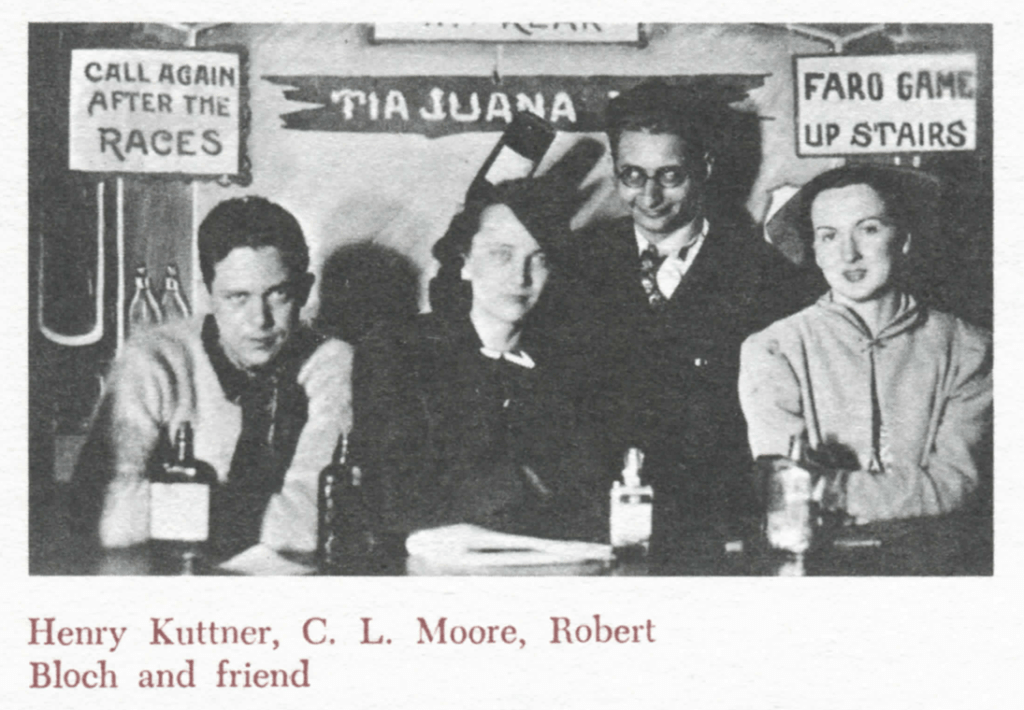
Deeper Cut: The Dutch Mythos

I got hooked on Lovecraft when I was just starting to read English, which I taught myself so I could buy and read horror and SF, which was practically unavailable in my own language (Flemish, which is another version of Dutch typical for Belgium, at last for the Flemish-speaking part, since French is our national second language). […] During January-April 1963 I wrote a novelette, titled “De Poort in het duister” (A Way into Darkness”), which was “published” in 6 copies in a carbon-typed fanzine I was “publishing with a friend.” […] I mentioned “A Way into Darkness” several times to correspondents, and it was noted down in one of the Reader’s Guides to the Cthulhu Mythos.
—Eddy C. Bertin, “Darkness: Your Name Is A Story” 63

I was very ill at the start of 1963, and for three weeks I suffered from a high fever and horrible nightmares. I had just discovered the work of H. P. Lovecraft, and in those nightmares I was constantly involved in a very surrealistic battle between immense inhuman forces, who took the form of geometrical patterns, which were fighting a war in a world outside of our space and time. It was around this time that I wrote “De poort in het duister” aka “The Way into Darkness” […] (Boekestein 2014, 7)

It is difficult to say when Lovecraft first came to the Low Countries. Belgian writer Jean Ray appeared in Weird Tales in the 1930s, under the pseudonym John Flanders. Kalju Kirde talks about running across copies of Weird Tales in Estonia during the late 1930s or early 1940s, possibly copies of the British edition of Weird Tales which appeared in the 1940s (Kirde 121). It is not unfeasible that some American pulps or copies of the British Not at Night series containing Lovecraft’s stories appeared in Belgium or the Netherlands at this time. But for the most part Lovecraft appears to have been a stranger to the Dutch and Flemish readers, at least in their native language.

After the death of H. P. Lovecraft in 1937, Arkham House was founded to publish his work and oversee his literary legacy, and began publishing his work in hardcover editions in 1939. Arkham House exercised de facto control of the Lovecraft copyrights, including foreign translations and a proprietary interest in who published Cthulhu Mythos fiction in the United States. During World War II, translations of Lovecraft’s work to non-English markets were largely unfeasible, but after the war the small publisher began to find some success.

French translation collections of Lovecraft’s work began to appear in the 1950s, beginning with La Couleur tombée du ciel (1954, Editions Donoël), and German in the 1960s with 12 grusel Stories (1965, Wilhelm Heyne Verlag), but it would be years before a Lovecraft collection was translated for the Dutch language market. During the 1950s, science fiction and fantasy fandom in Belgium and the Netherlands was largely disorganized, but groups began to coalesce and fan-publications proliferated in the 1960s. (Boekestein 2000; Dautzenberg 174)

Enterprising fans like Eddy C. Bertin would learn English and import British and American editions, and his story “De Poort in het duister” (“The Gate into Darkness,” also published as “A Way into Darkness”) is the first known Cthulhu Mythos story in Dutch, published in the fanzine Nachtmerrie (vol. 4, no. 4, May 1963)…“published” in an edition of only six copies. As Bertin recalls:

I knew Lovecraft from two stories, “The Rats in the Walls” and “the Thing on the Doorstep” (published in two now very rare Dutch horror anthologies), neither of which I really liked. […] There were however very few books of horror available in Dutch, but the English and American paperbacks found in the supermarkets and bookshops contained a much larger variety of it. So I started teaching myself to read english, with a dictionary at hand. […] one of those books I tackled was Best Supernatural Stories of H. P. Lovecraft in a cheap hardcover from Tower Books. I found his language and style very hard reading (for a beginner) but his ideas and images hooked me for life. I started hunting for his other books, discovering the “collaborations” with August Derleth, Arkham House, and later the works of others who had expanded and changed his Mythos, such as J. Ramsey Campbell, Brian Lumley, and so on. (Bertin, “My European Mythos”3)

The first Dutch translation of Lovecraft I’ve found is “Het Ding op de Drempel” (“The Thing in the Doorstep”) in Voor en na Middernacht: Zijnde Vijfendertig Spook en Griezelverhalen Alsmede Andere Fantastische Vertellingen (1949, Elsevier, trans. A. Verhoef; a different edition was also released in 1954); “Ratten” (“The Rats in the Walls”) was published in Griezelverhalen (1959, Het Spectrum, trans. W. Wielek-Berg), and it may be other single stories were translated and published in anthologies or magazines from 1940 to the 1960s, when the first Dutch language collection of Lovecraft would appear.

Macabere Verhalen (1967, Uitgeverij Contact), translated by Jean A. Schalekamp, and began a small boom in Dutch translations of the American horrorist’s work. This was quickly followed by Het gefluister in de duisternis: Greizelverhalen (1968, A. W. Bruna & Zoon, trans. R. Germeraad), and Heksensabbat: Griezelverhalen (1969, A. W. Bruna, trans. C. A. G. van der Broek). The Dutch translation “Heksensabbat” (“The Dreams in the Witch House”) in the latter volume may have inspired Julien C. Raasveld to write “The House of Keziah Mason,” which first appeared (in English) in his ’zine Parallax #0 (March 1971), and was itself later translated as La Mansion de Keziah Mason (Las Mejoras Historias de Fantasmas, 1973); this is the second known Cthulhu Mythos work by a Flemish author.

The Bruna editions also contained the essay “De ‘verboden’ boeken van H. P. Lovecraft” by Aart C. Prins, one of the earliest Dutch critical works examining Lovecraft’s themes. Prins also edited Het Monster in de Lift an andere griezelverhalen (1967, Bruna) which contained the Hazel Heald/Lovecraft collaboration “The Horror in the Museum”, and De Bewoner van het Meer (1968, A. W. Bruna & Zoon), which contained translations of non-Lovecraft Mythos stories by Clark Ashton Smith, Ramsey Campbell, Robert E. Howard, August Derleth, and Robert Bloch. Also in 1968 was published Wie Kan-ik Zeggen Dat er is? (Bruna, trans. J. J. van Olffen), which included several of Derleth’s “posthumous collaborations” with H. P. Lovecraft.

The 1970s saw more of Lovecraft’s work published in Dutch. A. W. Bruna & Zoon began the Bruna Fantasy en Horror series with De droomwereld van Kadath (1972, trans. Pé Hawinkels), and further volumes included De bergen van de waanzin (1973, trans. Heleen ten Holt), and De zaak Charles Dexter Ward (1974, trans. J. F. Niessen-Hossele); their last Lovecraft volume was Het huis in de nevel (1976, trans. Pon Ruiter). The number of different translators who had worked on bringing Lovecraft into the Dutch language at this point likely added to an uneven quality to the fiction—yet it did capture the public imagination, and avid fans became a part of the worldwide network of Mythos fiction writers.

Miscellaneous Lovecraft stories were also translated in various anthologies. One editor used the pseudonym “E. L. de Marigny” (from a character in Lovecraft’s “Through the Gates of the Silver Key” and “Out of the Aeons”) in publishing Fata Morgana (Maulenhoff, 1980) and Griezel-omnibus: Het verschrikkelijke geheim (1982, Elsevier), both of which contained Lovecraft translations. Other anthologies featuring Lovecraft translations include: Vampier! (1972, De Arbeiderspers), 50 beroemde griezelverhalen (1974, Elsevier), Kleine Griezelomnibus 1 (1976, A. W. Bruna & Sons), Land van de Griezel (1976, D.A.P.Reinaert Uitgaven), Van Edgar Allan Poe tot Roald Dahl, De 50 Beste Griezelverhalen (1980, Borsbeek & Loeb), Van Jules Verne tot Isaac Asimov: De 50 Beste Science Fiction-Verhalen (1981, Publioboek/Bart), De Beste Griezelverhalen (1982, K-Tel), De Beste Science-Fiction Verhalen  (1982, K-Tel), Duistere Machent (1982, Loeb), and In de Geest van Tolkien (2003, Uitgeverij M). Some stories have been translated more than once, which combined with reprints has led to a little confusion at times.

The Dutch fantasy fan scene was also developing at this time; a notable publication was Drab, “eerste nederlandse tijdschrift voor Horror & Fantasy” (“first Dutch magazine for Horror & Fantasy”). Beginning in 1973 and running irregularly through 1980, it published sixteen issues in four volumes. Roeland de Vust provided three original translations for the magazine: the short story “Yule Ritus” (“The Festival”) Drab 1, No. 3 (1975), the R. H. Barlow collaboration “En de zee was niet meer” (“Till A’ the Seas”) Drab 3, No.2 (1976), and the poem “Waar eens Poe wandelde” (“In a Sequester’d Providence Churchyard Where Once Poe Walk’d”) Drab 4, No. 3 (1978); which issue also included Temme Tams’ translation “Van wat daarbuiten is” (“From Beyond”). In addition to this, de Vust provided a review of L. Sprague de Camp’s biography of Lovecraft in Drab 3, No. 2. Regarding the translations, Roeland de Vust wrote:

For me, translating was a challenge, trying to maintain in Dutch the “ancient” literary style of H.P.L.

A sentiment many of Lovecraft’s translators no doubt agree with.

Sometime in the ‘60s or ‘70s Eddy C. Bertin conceived a project for a booklet of five horror stories, to be published in Dutch, two of them involving the Mythos. One would have been “He Who Feeds on Thoughts,” which would be an adaptation of his science fiction story “De Gedachteneter” (“The Thought Eater,” published in De Achtjaarlijkse God, 1971, Bruna), and the second “The Sound of Silver Rain.” However, the project failed to attract subscribers and was scrapped (Bertin 2008a, 4).

Bertin and Julien C. Raasveld’s contributions to the Mythos were both duly recorded by Robert Weinberg and Edward P. Berglund in the Reader’s Guide to the Cthulhu Mythos (1973). It was through these fan-connections that the next phase of Dutch Mythos work was published—in English! With the death of August Derleth in 1971, the Cthulhu Mythos became free of his more restrictive attempts to control the publication of new Mythos material. Berglund noticed while compiling the Reader’s Guide that there were enough stories by professional authors for an anthology, and at Donald Wollheim’s suggestion solicited Bertin for stories with the idea of proposing the anthology to Arkham House. (Berglund x; Bertin 2008a, 4) Bertin sent him “Hingoo” (“All-Eye”) by Bob van Laerhoven “which I just changed slightly to fit better in the Mythos” Bertin 63) and Bertin’s rewrote “Darkness, My Name Is,” Arkham House turned the anthology down, but Berglund later published it as Disciples of Cthulhu (1976, DAW).

These early works of Dutch Mythos fiction were fairly typical of the time; Bertin’s “Darkness, My Name Is,” Raasveld’s “House of Keziah Mason,” and van Laerhoven’s “All-Eye” are pastiches of various degrees of creativity and skill, and went little beyond what Lovecraft and Derleth had written. “Darkness, My Name Is” however saw Bertin take a step beyond and begin to craft his own original Mythos, introducing his own tome (Von denen Verdammten by Edith Brendall—an occasional pseudonym for Bertin), his own Mythos entity Cyäegha, and an isolated geographic setting akin to Lovecraft’s Miskatonic Valley and Campbell’s Severn Valley. As Bertin put it:

It was never really my intention to develop a series of stories and novelettes dealing with Lovecraftian creatures, but set in Europe—it just happened along the way. Just as Lovecraft himself wrote his Mythos stories loosely, without really trying to put them into a rationalised fictional universe, then so did I. […] (Bertin 2008a, 3)

Bertin quoted from Von denen Verdammten as poems, in German, English, and Dutch. Some of these were published in collections of weird verse for younger readers: “De Weg in het Duister” (“The Way into Darkness”), “De Brandende Kat” (“The Burning Cat”), and “Dunwich Droomt, Dunwich Gilt” (“Dunwich Dreams, Dunwich Screams”) in Griezelverzen 1 (1998, Het Griezelgenootschap). Griezelverzen 2 (1999, Het Griezelgenootschap) included “De trap bij Maanlicht” (“The Stairway by Moonlight”) (Bertin 2008a, 5).

Disciples was successful enough to get French (Las adorateurs de Cthulhu, 1978) and German (Cthulhu’s Kinder, 1980) translations. Fandom was not exclusive by language, so in Belgium, for example, you had publications such as H. P. Lovecraft Inedit: Fantastique et Mythologies Modernes (1978) by Jacques van Herp, published in French, closely following the French translations of Lovecraft and his letters, but adds:

Quant à la quatrième génération elle s’annonce avec Brennan, Walter C. de Bill Jr, Bob Van Laerhoven, Eddy C. Bertin, et compte désormais des européens continentaux. […] On peut espérer plus de la voie ouverte par Eddy C. Bertin. Une nouvelle région maléfique apparait, un lieu maudit en Allemagne. Et l’on se dit que l’Europe offre un vaste champ d’implantation avec ses vieilles cités gothiques, et ces villes mortes. Bertin nous apprend que Ludvig Prinn vécut à Gand et à Bruges avant de monter sur le bûcher à Bruxelles. Il presente Liyuhh, une trduction allemande des Textes de Brendal, se nom Von denen Verdammten, eine Verhandlung über die unheimlichen Kulten des Alten. Et l’on retrouve le climat et la mesure de Lovecraft.As for the fourth generation, it is announced with Brennan, Walter C. de Bill Jr, Bob Van Laerhoven, Eddy C. Bertin, and now has continental Europeans. […] One can hope for more from the path opened up by Eddy C. Bertin. A new evil region appears, a cursed place in Germany. And we say that Europe offers a vast field of settlement with its old Gothic cities, and these dead cities. Bertin tells us that Ludvig Prinn lived in Ghent and Bruges before going to the stake in Brussels. He presents Liyuhh, a German translation of the Brendal Texts, called Von denen Verdammten, eine Verhandlung über dieunheimlichen Kulten des Alten. And we find the climate and the measure of Lovecraft.

Bertin then translated the English story into Dutch, where it was published by Robert Zielshot in the semi-prozine Essef No. 4 (Feb 1978); he later re-wrote the Dutch version into a two-part novel and sold it to the Belgian gentleman’s magazine Hoho where it appeared in issues 313 and 315 (Feb & Mar 1978) as “De Vallei der Nachtmerries” (“The Valley of Nightmares”) and “De Berg van de Demon” (“The Mountain of the Demon”), adding sex and gore, changing the setting the Mexico, and publishing it under the pseudonym Juan Fernandez Sonando. Bertin would end up re-writing the novel once again and titling it Cyäegha, My Name Is Darkness in 1983, but this longer version was apparently never published (Bertin 1985, 64; Bertin 2008, 5).

The continued publication of Lovecraft and other Mythos fiction (Robert E. Howard was also notable for having many stories translated into Dutch in the 1970s) was having an effect: other Dutch writers began to write their own stories, including Mark J. Ruyffelaert, who published “Het boek Tegrath” (2e Land van de Griezel, ed. Albert van Hageland, D.A.P. Reinaert, 1978) and “Il Vit!” (Tussen Tijd en Schaduw, ed. Danny De Laet, Walter Soethoudt, 1978), where they appeared alongside non-Mythos works by Bertin, Raasveld, and others. Ruyffelaert’s “boek Tegrath” (inspired probably by Jean Ray’s “Le Grande Nocturne” (1942)) and would become part of his own personal Mythos, reappearing in stories such as the “Brieven aan Randolph Carter” (“Letters to Randolph Carter”) series; Marcel Orie would use it as well.

While still writing Lovecraftian pastiche, Ruyffelaert’s fiction draws more influence from some of the later writers, notably by the development of Bubastis (a Dreamlands city, not the ghoulish goddess as conceived by Robert Bloch in “The Brood of Bubastis”) in a series of tales: “Nocturne” in Vierde Ragnarok (1998), “De Droomwereld van Mahal” (“The Dreamworld of Mahal,” 2005), “Paradise Regained” (2008), “Sedlec, Bubastis” (2009), “De beul van Molsheim” (“The Executioner of Molsheim,” 2010), “De ondergang van Bubastis” (“The Demise of Bubastis,” 2014), “Een feestmaal voor kraaien” (“A Feast for Crows,” 2016), and “De vierde ruiter – de Dood” (“The Fourth Horseman – Death,” 2018). Ruyffelaert describes his relation with Lovecraft:

Reading Lovecraft was for a long time a great spiritual comfort to me: my belief in reaching the true haven of inner peace I owe to him. As a 14 year “old” I was confronted with the horror behind the horror and it provided me with an additional career. Lovecraft understood how to make enjoyable art out of his own fears, and then opened up his dream-world to many talented visitors. […] My intention: a salute to that fantasy giant who taught me how to dream. (Ruyffelaert)

In the early 1980s, many of the previous translations and some new ones were collected into an omnibus edition and a new collection: Griezelverhalen (Loeb, 1982) and Het gefluister in de duisternis: Griezelverhalen (Loeb, 1984), the former included the essay “Het fenomeen Lovecraft” by editor Erik Lankester, and the latter a translation of Robert Bloch’s essay “Heritage of Horror”—unfortunately, most of Lovecraft’s letters and biographies and critical studies have yet to see translation into Dutch, leaving the audience with relatively less insight into the man and his work in that language, although Michel Houellebecq’s flawed but popular monograph on Lovecraft was included in De koude revolutie: confrontaties en bespiegelingen, translated by Martin de Haan and published by Uitgeverij De Arbeiderspers in 2012.

The 1980s saw a few more efforts from Dutch Mythos authors. First among these was Eddy C. Bertin, who produced two notable Lovecraftian publications. Eyurid: A Lovecraftian Portfolio with Tais Teng (pseudonym of Thijs van Ebbenhorst Tengbergen) was originally published in issues 21-25 of Bertin’s magazine SF-Gids (1976-1978), SF-Gids also published numerous book reviews of Lovecraft and related works published in English and in translation; issues 119 and 120 were devoted to various versions of the Necronomicon. Bertin, following in the footsteps of August Derleth, couldn’t help referencing his own additions to Mythos-lorekeeping in his story “The Piercing of Priscilla Petersen”:

Research in the archives and in Fandata by Jan Meeuwesen and Jos Lexmond, a bibliography of fantastic literature published in Dutch, showed that in the Netherlands alone at least fifteen short story collections by Lovecraft had been issued by various different publishers. Contact, Bruna, Loeb, Bakker, Meulenhoff. Not bad for a writer who’d never even had a single collection published under his name during his own lifetime. Further investigation yielded a rather sloppily produced fanzine, SF-Gods, which was published in Gentbrugge in 1989, nos. 199 and 120 when taken together formed a double issue on the famous Necronomicon. (Bertin 2013, 23)

Eyurid was later published as a standalone loose-leaf portfolio in 1980 by Dunwich House—Bertin’s own small press. (Bertin 2008c, 3) The other was Dunwich Dreams, which ran for eight issues from 1982 to 1984 in the Esoteric Order of Dagon amateur press association, and featured Lovecraftian illustrations by Bertin, editorials, the Mythos story “Concerto for a Satin Vampire” (vol. 1, no. 1), the essays “A Chronological Bibliography of the Fiction of H. P. Lovecraft Translated in Dutch Language, and Published in the Netherlands (Holland) and Belgium from 1949 up to March 1983” (vol. 1, no. 3) and “Addenda to HPL Bibliography in Dutch Language” (vol. 1, no. 4). Bertin also placed Mythos stories in the American ‘zine Crypt of Cthulhu, with “The Waiting Dark” in vol. 4, no. 4 (Candlemas 1984), and “The Gibbering Walls” in vol. 8, no. 6 (St. John’s Eve 1989), which were rewritten versions of stories originally written and published in Dutch in the 1970s (Bertin 2008a, 8-9).

This was a very typical practice of Bertin, who remarked:

I don’t translate into English, I just rewrite it and then compare it with the original to see if I missed anything. Most of the stories in Dutch are not Mythos, the Mythos ones are all the rewritten versions and thus are completely different from the originals. “Darkness, My Name Is”, and “Waiting in the Dark”, were rewritten in Dutch from the English originals, and so are the same. (Bertin 2008b, 18-19)

Bertin’s fiction during this period still tended toward pastiche, expanding on Lovecraft’s creations, but he was also expanding on his own corner of the Mythos—“The Gibbering Walls” tying into his previous stories “A Way into Darkness” and “Darkness, My Name Is,” while remaining a standalone tale. Many of the stories involve similar themes, dealing with internal struggles that become externalized in monstrous fashion. In an interview, Bertin wrote:

A recurring theme is the fact that monsters are not born but created by society, just as the monster of Frankenstein turns into a killer because society doesn’t accept him. […] transformation of man into something else is the main theme of all my shorter Mythos fiction. (Bertin 2008b, 18)

Bertin also dabbled in verse, including the poem “Meeting a strange guy, called Lovecraft, close to the cemetery of Providence” which was published in the Dutch magazine Rakis #1 (Oct 1989). Bertin was also an organizer of the “Dunwich Experience,” a multimedia installation that toured Flanders in the early 1980s (Van de Wiele).

A notable problem that Bertin had as a Belgian writer in getting published was dealing with issues of language and dialect:

Publishers and compilers of anthologies often complained about the many dialect words that Bertin used in his texts. Julien Raasveld once told me that the editors of De schaduw van de raaf [The Shadow of the Raven, Bertin’s 1983 collection] went through the text first and erroneously deleted all of the occurrences of the words ‘gans’ and ‘doorheen’ and only then did they actually begin reading it. Why this act of stubbornness? Because it wasn’t literary enough. Apparently the man who expressed himself at conventions in a broad Ghent accent was no different in this respect to the writer in the attic. (Moragie 4)

Many horror writers face discrimination for using colloquial language to better address their audience, so at least Bertin was in good company, but it is a particularly Dutch problem to deal with issues of linguistic determination because of small dialectal differences between the Netherlands and Belgium.

Another Dutch writer who began pursuing the same general path at this point was Jan Bee Landman, who published “The Flood” in Alpha Adventures (Jan 1985) and “The Canals of Delft” in Etchings & Odysseys #7 (1985). The latter story is one of the first by a Dutch writer to use a Dutch setting (Raasveld’s “The House of Keziah Mason” was set in Antwerp), and the description of that old city is as loving as any that Lovecraft bestowed on New England:

By the close of the 20th century it still retained much of its old glory, despite the sacrilegious presence of motorcars, electric lights and parking meters. To the casual tourist it was just another attractive landmark, but to a more sensitive soul it breathed a different atmosphere. In the dark water of the canals, that lay as still and inscrutable as it had in remote ages, he could still see the cruel grave of 16th century heretics and the home of the great little sailing ships that roamed the oceans pugnaciously ins search of exotic goods and slaves. A small light behind some attic window in the depth of night would recall the times when Dutch alchemists worked their silent evils in secret. No number of swarming cars on the market square, between the dizzying tower of the big church and the stolid medieval town hall, could silence the echoes of howling witches that had once smouldered there at the stake. (Landman 71)

Jan J. B. Kuipers also wrote around this time, their story “Het teken van de Geit” (“The Sign of the Goat”) appeared in Brieven aan Satan: de beste griezelverhalen (1990, Meisner, Stichting Fantastische Vertellingen). Kuipers did not write extensively in the Mythos, though some of his stories take influence from or refer to Lovecraft or the King in Yellow, including “Rondom Hygelac” (“About Hygelac,” 2014), “Offa’s bruid” (“Offa’s Bride,” 2016), “Een man van zijn woord” (“A Man of his Word,” 2018), and “De Jutterstoren” (“The Beachcomber’s Tower,” 2019). Much of Kuiper’s Mythos fiction focuses on historical settings; one recurring aspect is Saint Muirgen, a mermaid (descended from Father Dagon and Mother Hydra) which the early church adopted as a saint.

One of the major hindrances for prospective Dutch Mythos writers appears to have been the lack of a Dutch-language market for new Mythos fiction—as opposed to Mythos fiction in translation, which continued sporadically in anthologies. Peripheral works were also translated into Dutch and filtered slowly into the pop culture of Belgium and the Netherlands. For example, the popular Flemish graphic novel series De Rode Ridder, published book 124 Necronomicon in 1987. The book and amulet in that comic derive from the Simon Necronomicon (first published in English in 1977 by Schlangekraft), although it is otherwise a sword & sorcery tale. Roleplaying games also provided an introduction to the Mythos for many, with the Call of Cthulhu Roleplaying Game from Chaosium being a gateway to Lovecraft’s fiction:

My love for H. P. Lovecraft started with a board game. For evenings on end, my friends and I attempted to save the world from slumbering Evil, while trying to maintain our sanity. Nine times out of ten, we succeeded, by clever planning and by careful division of our resources. This was all well and good, until I actually started reading the stories and I realised that ‘winning’ was in fact the exception. (den Heijer 41)

The influence of roleplaying games can be seen in stories like Johan Klein Haneveld’s “Spelavond” (“Game Night”) in Lovecraft in de polder, which explicitly references Call of Cthulhu.

In 1988, Dagon Press published Het Onnoembare: Fantastische Griezelliteratuur In De Traditie Van Weird Tales, Arkham House En De Cthulhu Mythologie: Inleiding, Catalogus En Bibliografie by Dennis Schouten, a comprehensive overview of the Mythos, Arkham House, and Weird Tales for a Dutch audience.

By the 1980s, individual collections by Dutch and Belgian authors were being published that contained their original Mythos fiction. Notably, Eddy C. Bertin’s collections De Griezeligste Verhalen van Eddy Bertin (1984, Loeb) and Krijsende Muren (1998, Babel), and Mark J. Ruyffelaert’s Nocturne (2007, Verschijinsel) collected some of their Mythos works for the first time and made them available to a wider audience. However, there is a discontinuity in the late 1980s: as Bertin put it “the bottom fell out of the market,” and there was very little Dutch science fiction, fantasy, or horror fiction being published (Boekestein 2014, 4).

Because of this, Bertin transitioned to writing and selling horror fiction for a younger audience in the 1990s, focusing on the horror-obssessed Anton and the teenage witch Valentina. Both series began to incorporate elements of his Mythos fiction. The Von denen Verdammten appears in Overal Vuur (1996, Elzenga), Dorstige Schaduwen (1997, Elzenga), Duivelse Dromen (1999, Elzenga), Kille Dromen (2001, Elzenga), and Valentina’s Schaduwboek (2004, Leopold). The Valentina books were translated and published in both German and Swedish (Bertin 2008a, 6-8).

The Dutch magazine/anthology Waen Sinne premiered in 2002, with stories by Martijn Adelmund (as by Maarten Krohn), Jaap Boekestein, Dirk Bontes, Eddy C. Bertin, and Remco van Straten. Jaap Boekestein was also one of the editors, and his story was “Connectie Den Haag” (“The Hague Connection”), which makes reference to the Necronomicon and Von Denen Verdammten and adds Boekestein’s own contributions: the Liber Buccesteynus and Die Unaussprechliche Kosmologieën, which would be used by later authors. About the story, Boekestein later confessed:

At the time that we decided to do a Mythos Waen Sinne, I’d never actually written a Mythos story. I wasn’t even that well versed on the Mythos itself. […] All I basically knew was that Cthulhu was still sleeping, and that every self respecting Mythos author who’d ever lived had, at one time or another, had a go at inventing his own forbidden book or Mythos entity. I didn’t really feel comfortable about trying to invent a new Old One, but creating some evil tome was definitely doable. (Boekestein 2013b, 18)

Waen Sinne lasted two more issues; the second was devoted to Sword & Sorcery, and included Jan Mara’s “Verzengende Angst” (“Flaming Terror”), which references the Mythos. The third was devoted to classical monsters and contained no Mythos content.

Jaap Boekestein’s next two Mythos stories appeared under the pseudonym Claudia van Arkel, “Schepper van dood en leven” (“Creator of Death and Life”) in Pure Fantasy 8 (June 2007), and quickly followed that up with “Drie laatste nachten” (“Three Last Nights,” published in English as “The Devil-God of Captain Underwood”) in Zwarte zielen 2 (Verschijnsel, October 2007). His next story was under his own name, and in another of his zines, Wonderwaan: “Shhh shhh Cth… Shhh shhh Cth…” (Wonderwaan 6, June 2008). “Warme Rode Zee” (“Warm Red Sea”),  Wonderwaan 23 (September 2012) and an English story, “Under the Keeper of the Key” which appeared in the erotic anthology Lovecraft After Dark (James Ward Kirk Publishing, 2015), both deal with a combination of the Mythos and BDSM. This reflects his approach to the material:

What kind of people, I wondered, wouldn’t have much of a problem with the Mythos Universe? People who were different from the norm, was my conclusion. People who perceived reality differently. “Transformation is the key. Transformation of both the body and the mind.” If you live in a non-mundane world, you don’t feel mundane fears. The monsters might even welcome you in as one of their own. (Boekestein 2013a, 47)

Boekestein collaborated with Tais Teng on the English-language “Dancing for Azathoth” in The Worlds of Science Fiction, Fantasy and Horror Vol. 2, (CreateSpace 2017), then back to Dutch for “Het dorp der Engelen” (“The Village of Angels”) in Wonderwaan 41 (Spring 2017). His Mythos story, “Van de Ouden” (“From the Ancients”) appeared in Lovecraft in de polder (2018); it was translated into English and published as “The Allure of the Old Ones” in Cyäegha 21 (Winter 2019). Hallmarks of Boekestein’s Mythos fiction are the use of the Netherlands and especially the Hague as a setting.

Computercode Cthulhu (2005, ebook 2018) by Paul Harland is an original Dutch-language Mythos novel with illustrations by Tais Teng. “Stoor niet Cthulhu’s slaap!” (“Do not disturb Cthulhu’s sleep!”) became an appropriate tagline for Harland’s novel, as the 2000s inaugurated the most active period of Dutch-language original Mythos fiction—likely buoyed in part by the greater ease and lower cost of desktop publishing and print-on-demand works, but also a reflection of a burgeoning market for weird fiction and Dutch and Flemish writers eager to write and publish their own Mythos fiction.

Frank Roger’s Mythos story “Duisternis, duisternis, verzwelg mij” (“Darkness, Darkness, devour me”) appeared in his collection De Trein naar Nergens en Andere Verhalen (2005, Free Musketeers). This is a story of a writer’s search for isolation, sudden inspiration and slow degradation, calling back to Lovecraft’s Gothic roots. 

Later that year, Eddy C. Bertin’s “Dunwich Dreams, Dunwich Screams” appeared in Tales Out of Dunwich (Hippocampus Press), a successor volume to editor Robert M. Price’s anthology The Dunwich Cycle (1995, Chaosium), and concerns his latest addition to the Mythos library: Von denen Verdammten, a relatively recent (1907) German text which deals with unspeakable cults—a counterpart to such tomes as Ludwig Prinn’s Vermis Mysteriis or von Junzt’s Unausprechlichen Kulten (created by Robert Bloch and Robert E. Howard, respectively). The story would bring Dagon and the Deep Ones to Dunwich, England, which was the probable inspiration for Lovecraft’s Dunwich, Massachusetts. Bertin would write of the story:

This story is based on my own visit to Dunwich, and my research there. It continues my “European” cycle of Mythos stories, began with “Darkness, My Name Is” and others. I always wanted to write a story about the real dunwich, England, incorporating its weird history into the Mythos. […] Well, I did it now, as my tribute to HPL. (Price 302; cf. Bertin 2008a, 10)

Bertin’s next contribution was “De piercing van Priscilla Petersen” in Horrorarium (2006, Suspense Publishing). As with many Bertin stories, this was not originally a Mythos tale, but became so during its many rewrites. While not strictly a Mythos tale, Bertin also considers “Rose Nere” (“Black Roses”) in Phantoms of Venice (2001, Shadow Publishing) to belong to his conception of the Mythos (Bertin 2008a, 10-11).

The Dutch fantasy magazine Wonderwaan premiered in 2007, the publication of the NCSF (Nederlands Contactcentrum voor Science Fiction/Dutch Science Fiction Society). As the editors Jaap Boekestein and Marcel Orie put it:

We both grew up reading about the Lovecraft Circle and “pulps” like Weird Tales and Wonder Stories, always wishing that there were still magazines like these out there, to which we could pitch our own attempts at writing weird fiction. In a way Wonderwaan is a homage to these pulps. Wonderwaan (an invented word which combines the Dutch words for “wonder” and “delusion” aims to collect the best fantastic stories from Holland and Belgium. We select well-known themes and clichés from the pulp era, and challenge our authors to put new and strange spins on them. (Boekestein & Orie 3)

 Since then, a number of issues of Wonderwaan have been dedicated to Mythos fiction, including issues 6 (June 2008, “Cthulhu Fhtagn!”), 8 (December 2008, “Iä Yog-Sothoth!”), 23 (September 2012, “Iä Shub-Niggurath!), 24 (December 2012, “Azathoth!”), 36 (December 2015, dedicated to Ruyffelaert’s Brievan aan Randolph Carter series), and 41 (Spring 2017, “Dromen vanuit R’lyeh”). In addition, individual stories are scattered among regular issues. The contributors included a number of familiar names such as Eddy C. Bertin, Mark J. Ruyffelaert, Jaap Boekestein, Jan J. B. Kuipers, Tais Teng (“Lovecraft, My Love”), and Mike Jansen, one of the editors of Lovecraft in de polder, who contributed to Wonderwaan with “Opdracht in Amlwch” (“Assigned to Amlwch”).

The magazine also introduced several new writers to the Dutch Mythos, most notably Marcel Orie with “Ansichtkaarten uit Carcosa” (“Postcards from Carcosa”) in Wonderwaan 6 (June 2008), followed by “Een handleiding voor later, voor na de apocalypse” (“A Manual for Later, for After the Apocalypse”) in Wonderwaan 24 (December 2012), “Keizer der waanzin” (“The Emperor of Madness”) in Wonderwaan 33 (March 2015), “Dode mannen dromen niet” (“Dead Men Don’t Dream”) in Wonderwaan 37 (Spring 2016), and “Het feestmaal onder de catacomben” (“The Feast Under the Catacombs”) in Wonderwaan 48 (Winter 2018). Marcel Orie’s “De poppen van dr. Edelweiss” (“The Dolls of Dr. Edelweiss”) also appeared in 2015 in both Ganymedes 15 and Cyäegha 14. Orie’s work is characterized by a conscious effort to expand the Mythos, tying into the work of Lovecraft, Ruyffelaert, Thomas Ligotti, and others. Their major invention was the Wurmwater, a kind of limbo or hell populated by the ghosts of pirates and criminals—including the Marshes of Innsmouth.

Other writers whose Mythos and Lovecraftian fiction appeared in Wonderwaan include Cornelis Alderlieste with “Fantoompijn” (“Phantom Pain”), Frank Daman with “Trô d’diâle” (a nonsense title, possibly means “The Devil’s Pit”), Auke Pols with “De ademer van de wateren” (“The Breather of Waters”) and “Overleef jij het maan-beest?” (“Can You Survive the Moon-beast?”), Jos Lexmond with “Weg…wachter” (“Gone…watchman,” translated as “The Watcher of the Way,” reprinted from Spaciale Aanbieding‘s 153-157, June 2009-April 2010), Nieske den Heijer with “Het doek” (“The Canvas”), Chantal Noordeloos with “De hongerende diepten” (“The Starving Depths”), Martijn Adelmund with “Schipperskind” (“Skipper’s Child”), Richard Meijer with “Vakantie Bali” (“Bali Holiday”), Jack Schlimazlnik with “Van oude goden, de dingen die niet voorbij gaan” (“Of Old Gods, The Things That Don’t Pass Away,” a play on the Dutch classic “Van oude menschen, de dingen die voorbijgaan” by Louis Couperus (1906)), and Tom Thys with “De Lijkenkrabber” (“The Corpse Scraper”).

The importance of Wonderwaan in the development of Dutch Mythos fiction has been to both recognize the fanbase for Mythos fiction among readers and to provide a market for new writers. Much as Weird Tales provided a receptive forum for writers and fans of weird fiction, Wonderwaan has served as a locus for the development of the Dutch Mythos, the special issues helping to emphasize the different voices and takes on the Mythos setting.

Outside of Wonderwaan, a few other stories found a home too. Tais Teng’s “De Tempel van Cthulhu” appeared in the ebook Met Gebroken Oog en Botte Klauw (2011, Verschijnsel), and the humorous short-short “Growing up in the Cthulhu Home for Deserving Orphans” was posted to DeviantArt in 2019. Eddy C. Bertin’s “My Fingers are Eating Me” appeared in The Whispering Horror (2013, Shadow Publishing). The latter story has a typically Bertinian convoluted history of rewriting and publishing (Bertin 2008a, 9-10).

Another important ‘zine has been Graeme Phillips’ Cyäegha. From the very first issue in 2008, which includes an Eddy C. Bertin interview and article “My European Mythos,” the zine has worked to bring the Dutch-language Mythos to a wider English-speaking audience, often featuring the first English translations of Dutch Mythos fiction and insights and commentary from the most prolific and important Dutch and Flemish authors of Mythos fiction. This is especially the case in the nine “Dutch/Flemish Special Issues,” which have brought the majority of Dutch Mythos work into English translation. In 2015, Phillips also began publishing the ‘zine Forbidden Knowledge, which includes translations of the introduction to Wonderwaan’s Mythos special issues.

Lovecraft in de Polder (2018, EdgeZero), edited by Laura Scheepers & Mike Jansen, is the first book-anthology of Dutch-language Mythos fiction. The list of authors includes both newcomers and old familiar names: Boukje Balder, Jaap Boekestein, Anaïd Haen, Johan Klein Haneveld, Abram Hertroys, Mike Jansen, Peter Kaptein, Jan J.B. Kuipers, Roderick Leeuwenhart, Django Mathijsen, Mark J. Ruyffelaert, Jack Schlimazlnik, Tais Teng, Dack van de Bij, and Adriaan van Garde. In discussing the impetus for the anthology, editor Mike Jansen noted of Dutch Mythos fiction:

My own experience, from compiling four Ragnarok anthologies for Babel Publications, judging four years of the Millennium Prize and three years of the EdgeZero competition, is that perhaps one story in fifty submitted falls within this category. So from almost 4000 stories (King Kong Award, Millennium Prize, Paul harland Prize, Harland Awards, Fantastels and Trek Sagae) written by nearly 1500 Dutch and Belgian writers, since the King Kong Award first began in 1977, we are talking about maybe eight stories Compared to the English-language production this is a mere drop in the ocean.

However, in general, the production of genre stories has dramatically increased over the past two decades, and a quick count of all of the stories submitted to these competitions shows that more than half of them were written in the last ten years. This means that there have been so many new Lovecraftian stories added in such a relatively short period of time that an anthology of these stories written by the top Dutch writers has become an increasingly enticing prospect. (Jansen 2)

Reception was mixed, however; Tom Thys in reviewing the book noted the speed in which the anthology was assembled:

Unfortunately, this has resulted in a somewhat lopsided collection as some of the stories fail to rise above mere pale imitations of the various rituals and creatures of the Lovecraftian pantheon. I really have to be strict here: the authors should have been given more time and the editors should have taken more time to select and streamline this collection. (Thys 4)

Also in 2018, Eddy C. Bertin died. The Dutch science fiction and horror community mourned the loss of one of their earliest and most prominent voices. Yet he left behind a legacy that continues to grow, as more writers use Cyäegha and Von Denen Verdammten. As he put it:

From the very beginning I’ve always tried to create my own version of the mythos, and in my own modest way, I think I’ve succeeded. (Boekestein 2014, 7)

Those who recall that South Africa featured as the setting of “Winged Death,” ghostwritten by H. P. Lovecraft for Hazel Heald and published in Weird Tales (March 1934) may wonder if any Lovecraftian fiction has been published in Afrikaans. As in the Netherlands, South Africa has a rather small market for science fiction, which was dominated by English-language imports from the United States and the United Kingdom (Byrne 522). Letters from South Africa were published in Weird Tales in the 1930s and 40s, and addresses published in WT show members of the Weird Tales Club in South Africa during Dorothy McIlwraith’s editorship. Unfortunately, I have been unable to verify any information on an Afrikaans translation of Lovecraft, or any Mythos works published in Afrikaans.

Works Cited

Berglund, Edward P., ed. (1996). The Disciples of Cthulhu Second Revised Edition. Oakland, CA: Chaosium.

Bertin, Eddy C. (1985). “Darkness: Your Name Is A Story: On The Writing Of ‘Darkness, My Name Is’” in Etchings & Odysseys #6, 63-64. Madison, WI: The Strange Company.

__________ (2008a). “My European Mythos” in Cyäegha #1 (Spring 2008). UK: Graeme Phillips.

__________ (2008b). “Interview: A Conversation with Eddy C. Bertin” (trans. Graeme Phillips) in Cyäegha #1 (Spring 2008). UK: Graeme Phillips.

__________ (2008c). “The Creation of ‘Eyurid’” in Cyäegha #2 (Winter 2008). UK: Graeme Phillips.

__________ (2013). “The Piercing of Priscilla Petersen” in Cyäegha #8 (Spring 2013). UK: Graeme Phillips.

Boekestein, Japp (2000). “Dutch and Flemish fandom, fifties and sixties”

__________ (2013a). “Afterword” (trans. Graeme Phillips) in Cyäegha #8 (Spring 2013). UK: Graeme Phillips.

__________ (2013b). “Afterword” (trans. Graeme Phillips) in Cyäegha #10 (Winter 2013). UK: Graeme Phillips.

__________ (2014). “Dissecting Eddy C. Bertin in Nine Questions” in Ghosts of a Different Dream. UK: Graeme Phillips.

Boekestein, Japp and Marcel Orie (2012). “Weird Dreams from Wonderwaan” in Cyäegha #6 (Spring 2012). UK: Graeme Phillips.

Byrne, Deirdre C. (2004). “Science Fiction in South Africa” in PMLA, Vol. 119, No. 3, Special Topic: Science Fiction and Literary Studies: The Next Millennium (May, 2004).

Dautzenberg, J. A. (1981). “A Survey of Dutch and Flemish Science Fiction (Panorama des SF néerlandaises)” in Science Fiction Studies, Vol. 8, No. 2 (Jul., 1981).

den Heijer, Nieske (2013). “Afterword” (trans. Graeme Phillips) in Cyäegha #9 (Summer 2013). UK: Graeme Phillips.

Jansen, Mike (2018). “Introduction: Foreward to Lovecraft in de Polder” (trans. Graeme Phillips) in Cyäegha #21 (Summer 2019). UK: Graeme Phillips.

Kirde, Kalju (1989). “Recognition of Lovecraft in Germany” in Books at Brown XXXVIII-XXXIX. Providence, RI: The Friends of the Library of Brown University.

Landman, Jan Bee (1985). “The Canals of Delft” in Etchings & Oddyseys #7, 71-81. Madison, WI: The Strange Company.

Moragie, Max (2019). “The Ghent Night-Writer: ECB” (trans. Graeme Phillips) in Cyäegha #22 (Autumn 2019). UK: Graeme Phillips.

Price, Robert M. (ed.) (2005). Tales Out of Dunwich. New York: Hippocampus Press.

Ruyffelaert, Mark (2013). “Afterword” (trans. Graeme Phillips) in Cyäegha #8 (Spring 2013). UK: Graeme Phillips.

Thys, Tom (2019). “Lovecraft in de polder” in Cyäegha #21 (Summer 2019). UK: Graeme Phillips. First published at hebban.nl

Van de Wiele, Patrick (2018). “Vaarwel Eddy, Mijn Vriend”.

van Herp, Jacques (1978). H. P. Lovecraft Inedit: Fantastique et Mythologies Modernes. Special edition of “Ides… et autres.” Belgium.

Note: With thanks and appreciation for the help of Roel Konijnendijk, Roeland de Vust, Graeme Phillips, and Ben Joosten. Any mistakes in the above are my fault, not theirs.


Bobby Derie is the author of Weird Talers: Essays on Robert E. Howard and Others and Sex and the Cthulhu Mythos.

Deep Cuts in a Lovecraftian Vein uses Amazon Associate links. As an Amazon Associate I earn from qualifying purchases.
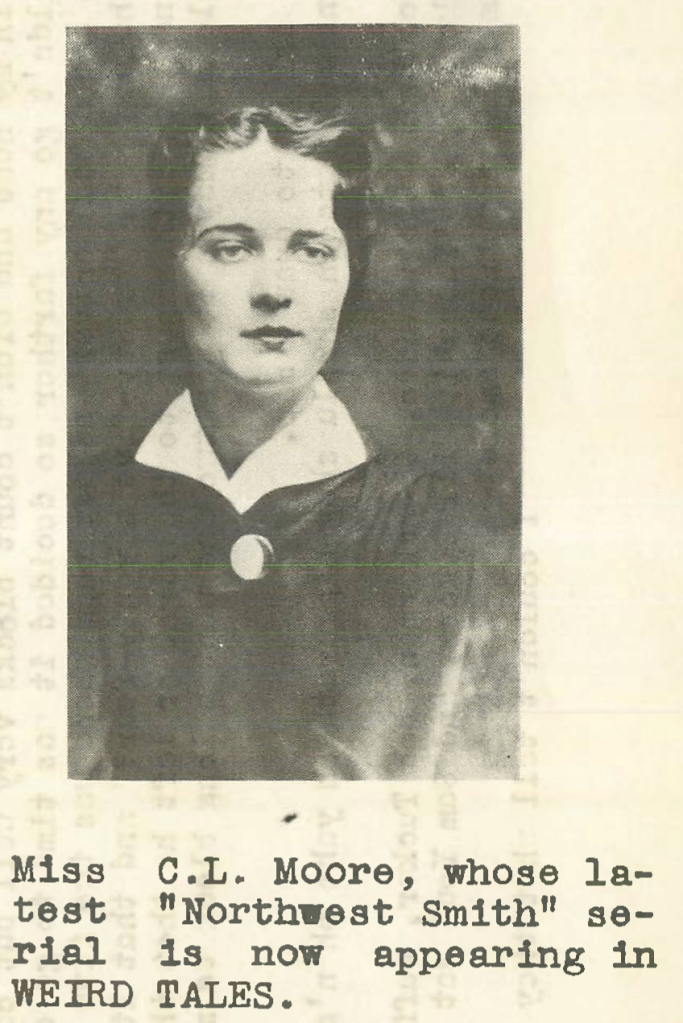
Deeper Cut: C. L. Moore Before The Pulps

Well. . . when I was in my early adolescence, I had a series of fairly serious illnesses and I had to be taken out of school. I spent a great deal o f time in bed, entertaining myself by reading everything 1 could get my hands on. It’s strange, but I don’t know how I ever got my hands on Weird Tales because it was strictly frowned on in my family—it was trash! But somehow, I did and I was thoroughly delighted with them. They were a brand new marvelous world. I’m sure I must have been thinking about those things for some years after I recovered. . . after I had finally gone through school and college. I had to stop college after three semesters and was very fortunate in finding a job. Still, I hadn’t done a lot of writing in this field, although I had written a bit for my own amusement at various times-melodramatic stuff, very adolescent and fun to do.
—C. L. Moore, “Interview: C. L. Moore Talks To Chacal” in Chacal #1 (26)

Catherine Lucille Moore’s first professional publication in pulp magazines was “Shambleau” (1933), in the pages of Weird Tales. The immense acclaim of her initial spate of stories from 1933-1940, when she married Henry Kuttner, has become part of the legendry of pulp fiction. Yet while C. L. Moore seems to have emerged full-grown like Aphrodite upon the waves, what this really means is that a great deal of what she wrote before she began her professional pulp career has sadly been lost—either never published, or published and largely forgotten.

The earliest such work is technically juvenilia, though it extended into adulthood:

Ever since we were about nine a friend and I have been evolving a romantic island kingdom and populating it with a race which, inevitably, is a remnant of Atlanteans. We’ve a very detailed theology and mythology, maps all water-colored and scroll-bordered and everything, a ruling house whose geneology and family tree and so forth has been worked out in tbales and charts from the year minus—oh, just about everything that two imaginative girls could think of over the space of fifteen years. (Heavens, has it been that long?) We have songs and long sagas of heroes, and a literature full of tradition and legends, and we even made and colored a series of paper dolls to illustrate the different types and their costumes, and then there were wars and plans of battle, and we have the maps of all our favorite cities, and we’ve written a good deal of history. And that history is what I take seriously.

We centered on a favorite period, around 1200-1250, and the history gradually became the biography of the outstanding man of that generation, and for the past ten years at least I have been writing, off and on, about this rather picaresque hero and his adventures. If I think of it I’ll send you a sample or two. It mostly comes in short snatches, just as the mood seized me. And of course a lot of it is romantically school-girlish, and a lot full of undergraduate tragics, because it’s grown up with me and has a long way to grow yet.

Odear, now you have me started—I hadn’t thought of this for nearly a year, since my friend moved out of town and I took up the fantasy writing. Gee, it was fun. The hero’s name was Dalmar j’Penyra, and he had red hair and black eyes and was a priate and a duke and a mighty lover and quite invincible in anything he chose to undertake. How we used to thrill over his escapades. He died in 1256, at the age of 35 (that seemed to use the absolute ultimate at which a man might remain even remotely interesting) and we almost wept whenever we thought of it. Bless him, he does seem awfully real. We used to make sad little songs about it—The girls who died for Dalmar, tonight they sleep a chill—the honey lips are dust now, the throbbing throats are still, and peace is on the high hearts that beat for him so warm, and peace is on the black heads that lay on Dalmar’s arm. Their hearts have ceased from sorrowing, their tears no longer fall—the narrow bed, the cold bed, the grave enfolds them all. Oh, girls who died for Dalmar, and lie tonight so low—
—C. L. Moore to R. H. Barlow, 10 Sep 1934, MSS. Brown Digital Repository

In a later interview, Moore specified this friend was her cousin:

What happened was that I had a cousin with whom I was very close, and we used to make up romantic tales of mythical kingdoms. We would take, long, long walks in the neighborhood under the trees—it was a lovely time in the world to be alive—and we each worked out or own fantasy kingdom with dashing young heroes and lots of swashbuckling adventure. Then we began separately to write it out. It was not anything that either of us considered offering for publication; it never occurred to us. I found some of it not too long ago, some writing from back in my early teens. The writing style has not changed very much except for one thing: I never said anything once when I could say it five times. It was intolerably dull to read. The writing is all right, but the repetition is hideous!

[…]

I think my cousin with whom I developed the mythical kingdom and I would have gone on in that Vein if she hadn’t had to move away and if I hadn’t had the job. But it was there, and it would have to have come out one way or another.
—”CA Interview,” Contemporary Authors vol. 104 (1982), 326-327

Bits and pieces of these poems about Dalmar j’Penyra are included in some of Moore’s letters to R. H. Barlow and H. P. Lovecraft in the period, and those fragments to Lovecraft in Letters to C. L. Moore and Others are the only ones published. Moore did not publish much poetry during her pulp career, but like many other Weird Talers she had a knack for it. One poem believed to have come from Moore’s typewriter made it into newsprint:

The Spirit of St. Louis with pilot Charles Lindbergh had completed the first nonstop transatlantic flight in 1927; pilots could be heroes in the 1920s, and there is more than a hint of fantasy in this verse.

At age 18, C. L. Moore enrolled at the local Indiana University and took classes for three semesters (Fall 1929, Spring 1930, and Fall 1930). However, Black Tuesday struck in October 1929, signalling the beginning of the Great Depression, and her family’s finances required her to leave school and gain employment, which she did. While associated with the university, however, Moore contributed to its school magazine The Vagabond, publishing three short stories: “Happily Ever After” (The Vagabond Nov 1930), “Semira” (The Vagabond Mar 1931), and “Two Fantasies” (The Vagabond Apr 1931). The University has since made these public domain materials available online.

In 2013, these three stories saw print commercially in the Galaxy’s Edge magazine, issues #2 (May 2013, “Happily Ever After”), #3 (July 2013, “Two Fantasies”), and #6 (January 2014, “Semira”), as well as best-of and omnibus editions.

None of these fragments and short works—the Dalmar stories, “The Spirit of St. Louis” poem, or the three amateur fantasies during her brief university period—have any obvious direct connection with C. L. Moore’s pulp fiction. That is, Northwest Smith does not appear to be Dalmar j’Penyra with a raygun, and if there was a prototype of the flame-haired Jirel of Joiry, she isn’t obvious. (There are certain interesting parallels between Dalmar and Henry Kuttner’s Elak of Atlantis, but Moore is not known to have had a hand in those stories and the parallels might well be coincidental.) Yet what these works make clear is that before C. L. Moore made her pulp debut she had already done years of prep work, reading and writing fantasy and adventure stories, developing her poetic sense, crafting the skills that would serve her well in her pulp career.

Such insight into developing writers is rare; readers today might be a bit spoiled with how much of the early and private work, even the juvenilia, of pulp writers like H. P. Lovecraft, Robert E. Howard, and Clark Ashton Smith is available for the right price. Most pulpsters, however, are blanks before their professional debut. We are fortunate to have these early examples of C. L. Moore’s work, which give us a glimpse at her process and development. For while she would polish her prose and improve her style and speed during her legendary career, it is evident that she was building on a foundation that went right back to childhood fantasy worlds, drawing on her love of fantasy, mythology, and adventure until—at last—she took the chance to submit something for publication.


Bobby Derie is the author of Weird Talers: Essays on Robert E. Howard and Others and Sex and the Cthulhu Mythos.

Deep Cuts in a Lovecraftian Vein uses Amazon Associate links. As an Amazon Associate I earn from qualifying purchases.
Deeper Cut: Métal Hurlant/Heavy Metal/Metal Extra Lovecraft Special

France, 1974. Jean Giraud (Mœbius), Philippe Druillet, Jean-Pierre Dionnet, and Bernard Farkas came together to create Les Humanoïdes Associés, a publisher for a new type of comic magazine: Métal Hurlant (“Howling Metal,” 1974-1987). Initially released as a quarterly and focused on science fiction, Métal Hurlant featured some of the best international comic artists of its time, as well as some of the most daring content, not just featuring sex, drugs, and rock & roll—but humor, horror, gory violence, politics, and philosophy.

The magazine was successful enough to inspire spin-offs in other countries, largely based, at least initially, on material translated from Métal Hurlant. So in the United States and Commonwealth countries, Anglophones could read Heavy Metal (1977-2023), with various special issues, spin-offs, graphic novels, and other projects; in Italy, the localized version of Métal Hurlant lasted only 12 issues (1981-1983), with several standalone Metal Extra issues, though the sister magazine Totem lasted longer (1980-1984). In West Germany, Schwermetall (“Heavy Metal,” 1980-1984) lasted a respectable 57 issues under its first publisher, and eventually ran to issue 219/220 (1998). Spain had their own translation of Métal Hurlant in the 1980s, the Netherlands had Zwaar Metaal (“Heavy Metal”), Denmark had Total Metal, Finland had Kylmä metalli (“Cold Metal”), Sweden had Tung Metal (“Heavy Metal”) and Pulserande Metal (“Pulsing Metal”), Turkey had Heavy Metal Türkiye…most of these international runs didn’t last long, but they spread the stories and art far and wide.

The creation of Métal Hurlant coincided with a number of other trends. H. P. Lovecraft, Robert E. Howard, Clark Ashton Smith, and other early contributors to the Cthulhu Mythos became more widely available thanks to paperback reprints, and with the death of August Derleth, Arkham House lost its grip on the Mythos. New anthologies like The Disciples of Cthulhu (1976) proved that anyone could now play with the shared universe that Lovecraft and his friends had created. Argentinian master Alberto Breccia began and completed a series of Lovecraft adaptations for comics from 1973-1979, many of which first appeared in the Italian magazine Il Mago. Underground comix in the United States like Skull Comix (1970-1972) were giving way to semi-prozines like Star * Reach (1974-1979), and publishers also found they could side-step the Comics Code Authority by publishing magazines like Creepy (1964-1983) and Eerie (1966-1983) instead of standard-size comics, all of which featured material inspired by or adapting Lovecraft. H. R. Giger’s Necronomicon art collection was published in 1977, and quickly inspired the aesthetic for the film Alien (1979).

There was, in other words, a small revolution in Lovecraftian art, comics, and fiction in the 1970s. Not all at once, but from many different angles—and Métal Hurlant, the international crossroads where underground American artists like Richard Corben; French masters like Mœbius, Druillet, and Nicollet; Swiss artists like Giger; and Argentinian masters like Breccia could all come together at once.

That is what happened in September 1978, when Les Humanoïdes Associés published a 150-page special issue of Métal Hurlant dedicated to H. P. Lovecraft. The idea was so attractive that the next year, the English-language Heavy Metal magazine released their own Lovecraft special issue to coincide with Halloween, and when Métal Hurlant was translated in Italy, they released a one-off Metal Extra special issue dedicated to Lovecraft.

All three of these magazines share certain common elements, largely because the English- and Italian-language productions included material translated from the French special Lovecraft issue. Yet they were each different as well…and that’s kind of fascinating in itself, how these three magazines represent three different takes on the material, each tailored for their respective audience.

What follows is a survey: what each Lovecraft special issue contains, and by comparison, what they do not contain. To avoid excessive repetition, each issue and its unique contents are discussed separately, and then a single section discusses all the shared features. Because this is a long, image-heavy post, a table with links is provided to aid navigation:

Métal Hurlant Special Lovecraft (Sep 1978)

150 pages, counting covers, the table of contents, ads, etc., Métal Hurlant Special #33 bis (“extra”) was one of several themed issues released by Les Humanoïdes Associés, with the other themes including Fin du monde (“the End of the World”, #36), Rock (#39), Guerre (“War”, #42), and Alien (#43). Not every feature in this issue involves Lovecraft or the Mythos, but a majority do. There are errors in the table of contents as printed, so a full list is given here.

Features involving Lovecraft or his creations are marked in bold; color pages are marked [c].

  • Front Cover: H. R. Giger
  • “La cimetière” (illustration) by Souchu, 2-3
  • Advertisement for Heilman by Voss and A l’Est de Karakulac by Daniel Ceppi, 4
  • Table of Contents, 5
  • Edito triste./Edito gai by Philippe Manœuvre, 6
  • “La Chose” by Alain Voss, 7-12
  • “Lettres de Lovecraft” by François Truchaud, 13
  • “La Retour de Cthulhu” by Alan Charles & Richard Martens, 14-15
  • “La Nuit du Goimard: Un ecrivain nommé Habileté-à-l’amour” by Jacques Goimard, 16-18
  • “Le Monstre Sur le Seuil” by Norberto Buscaglia & Alberto Breccia, 19-29
  • Je m’appelle Howard Phillips Lovecraft” by François Truchaud, 30-32
  • “L’Homme de Black Hole” by Serge Clerc, 33-36
  • “Hommage à HPL…” (uncredited), 37-39
  • “Petite bibliothèque lovecraftienne” by François Truchaud, 40-41
  • “La Trace Ecarlate” by Jean-Jacques Mendez & Daniel Ceppi, 42-43
  • “Excursion Nocturne” by Frank Margein, 44-47
  • “Le langage des chats” by Nicole Claveloux, 48-49
  • Untitled illustration by Richard Martens, 50
  • “L’Indicible Horreur d’Innswich” by Philippe Setbon, 51-52
  • “Amitiés Rencontres” by Vepy & Daniel Ceppi, 53-57
  • “Barzai le Sage” by Marc Caro, 58-65
  • Advertisement for Richard Corben’s Den, 66
  • [c] “Le Chef d’Œuvre de Dewsbury” by Yves Chaland & Luc Cornillon, 67-70
  • [c] “L’énigme du mystérieux puits secret” by Yves Chaland & Luc Cornillon, 71-74
  • “A la Recherche de Kadath” by François Truchaud & M. Perron, 75-78
  • “H. P. Lovecraft 1890-1937” by George Kuchar, 79-81
  • “Les Bêtes” by Dank, 82-84
  • Advertisement for Le Diable by Nicollet and Les Naufragés du Temps by Paul Gillon, 85
  • “Le Necronomicon” by Druillet, 86-96
  • Advertisment for La Boite Oblungue by Edgar Allan Poe and La Rivier du Hibou by Ambrose Bierce, 97
  • Advertismenet for Les Trafiquants d’Armes by Eric Ambler
  • “Les 3 Maisons de Seth” by Dominique Hé, 99-101
  • “Les 2 Vies de Basil Wolverton” by Yves Chaland, 102-103
  • Advertisement for back issues of Métal Hurlant, 104-105
  • Advertisement for Métal Hurlant posters, 106
  • [c] “H.P.L.” by Jean-Michel Nicollet, 107-109
  • [c] “Ktulu” by Mœbius, 110-114
  • “Plat du Jour” by Vepy & Daniel Ceppi, 115-117
  • “Le Pont Au Dessus de l’Eau” by Luc Cornillon, 118-119
  • “Cauchemar” by Alex Niño, 120-129
  • H. P. Lovecraft au cinéma” by Jean-Pierre Bouyxou, 130-131
  • “L’Abomination de Dunwich” by Alberto Breccia, 132-146
  • Back cover by Richard Martens

Unique Content

Front Cover: A plate from H. R. Giger’s Necronomicon (1977).

“Cauchemar” (“Nightmare”) by Alex Niño is a 10-page black-and-white comic that showcases a series of nightmares realized in surrealistic and highly detailed form; Niño pays homage to the styles of other artists, naming Heinrich Kley, Arthur Rackham, Phillip Druillet, and Jean Giraud (Mœbius). Not explicitly Lovecraft-related.

Edito triste./Edito gai (“Sad Editorial/Gay Editorial”); “Edito triste” is written as by “Abdul Fernand Alhazred”, while the “Edito gai” (as in happy, not homosexual) is by Philippe Manœuvre. Both concern how the Métal Hurlant Lovecraft Special came together.

“Je m’appelle Howard Phillips Lovecraft” (“I am called Howard Phillips Lovecraft”) by François Truchaud is a brief biographical sketch of Lovecraft’s life, fairly accurate for the compressed time and space, with illustrations by Richard Martens and Druillet; the Druillet illustration is the same as the cover to the Lovecraft special issue of L’Herne (1969).

“La Nuit du Goimard: Un ecrivain nommé Habileté-à-l’amour” (“The Night of Goimard: A Writer Named Able-to-Love”) by Jacques Goimard is an essay on Lovecraft’s fiction, illustrated by Perry’s silhouette of Lovecraft.

“Le Monstre Sur le Seuil” (“The Monster on the Threshold”) by Norberto Buscaglia & Alberto Breccia is an 11-page black-and-white comic adaptation of Lovecraft’s “The Thing on the Doorstep.” Breccia’s art combines traditional pen-and-ink with collage, which leads a strange, otherworldly aspect to the artwork.

“L’énigme du mystérieux puits secret” (“The Riddle of the Mysterious Secret Well”) by Yves Chaland & Luc Cornillon is a 4-page color comic where an investigative duo investigates a mysterious well and uncovers some counterfeiters; slightly reminiscent in overall style to Hergé’s Tintin. Not explicitly Lovecraft-related.

“Lettres de Lovecraft” (“Lovecraft’s Letters”) by François Truchaud is a review of Lettres 1 (1978), the French-language translation of the first volume of Lovecraft’s Selected Letters. Illustrated by Mœbius’ cover for Lettres d’Arkham (1975).
“L’Indicible Horreur d’Innswich” (“The Unspeakable Horror of Innswich”) by Philippe Setbon is a short fiction that purports to be the last story written by H. P. Lovecraft, complete with a mock reproduction of the original manuscript written on an envelope, based on the famous At the Mountains of Madness envelope.

“Petite bibliothèque lovecraftienne” (“Little Lovecraftian Library”) by François Truchaud is a brief survey of Lovecraft-related material available in French publications, as well as some related publications such as The Occult Lovecraft (1975) and H. P. Lovecraft: A Biography (1975) in English.

Back cover by Richard Martens, based on a photo of Lovecraft.


Heavy Metal H. P. Lovecraft Special Issue (Oct 1979)

This material is taken, for the most part, from a bizarre and eldritch tome written in a strange tongue, the “Homage á Lovecraft” issue of Métal Hurlant. We trust it will add just the right touch to your Hallowe’en festivities.
—Sean Kelly, editorial for Heavy Metal vol. III, no. 6

96 pages, counting the ads, table of contents, etc., which makes for a thinner magazine that can still be side-stapled. Heavy Metal magazine vol. III, no. 6 is part of the normal numbering rather than an extra or one-off issue. While it draws much of its material directly from the Métal Hurlant Lovecraft special, the publishers chose not to reproduce all of the Lovecraft material from the French.

What didn’t they translate? The text pieces, the Georges Kuchar reprint, several of the more humorous and less Lovecraft-related comics, a couple pages of Druillet’s Necronomicon, and oddly the Breccia adaptation of “The Thing at the Doorstep.” What remains isn’t exactly entirely dedicated to Lovecraft, either, so that the “Lovecraft” issue has rather less Lovecraft-related material in it than might be expected.

Maybe there was a crunch with time to put the issue together, or some issues with the right. However, they also added a few things that didn’t appear in the Métal Hurlant issue, notably the J. K. Potter cover and “The Devil’s Alchemist,” a work of fiction. Unlike the Métal Hurlant Lovecraft special, the majority of Heavy Metal pages are in color, including colorizing some works that were in black-and-white in Métal Hurlant.

Lovecraftian items are marked in bold; color pages are marked [c]; items from the Métal Hurlant special are marked with an asterisk (*).

  • Front cover (“Mr. Lovecraft”) by J.K. Potter
  • Advertisement for Strategy & Tactics, 1
  • [c] Table of Contents, 2
  • [c]Advertisement for Job Cigarette Papers, 3
  • “…Thirty-one…” (editorial) by Sean Kelly w/ J. K. Potter, 4
  • [c] Advertisement for The Encyclopedia of Science Fiction, 5
  • [c] “Final Justice” by Chateau, 6-14
  • [c] Advertisement for Heavy Metal posters, 15
  • [c] Advertisement for Heavy Metal subscriptions, 16
  • [*] “The Dunwich Horror” (“L’Abomination de Dunwich”) by Alberto Breccia, 17-25, 74-80
  • [c] [*] “Ktulu” by Mœbius, 25-29
  • [c] “Xeno Meets Dr. Fear and Is Consumed” by Terrance Lindall & Chris Adames, 30-31
  • [*] “The Thing” (“La Chose”) by Alain Voss, 32-37
  • [*] “The Beasts” (“Les Bêtes”) by Dank, 38-40
  • [c] [*] “The Man from Blackhole” (“L’Homme de Black Hole”) by Serge Clerc, 41-44
  • [c] [*] “H.P.L.” by Jean-Michel Nicollet, 45-47
  • [c] “Love’s Craft” by Sean Kelly & Matthew Quayle, 48-49
  • [c] [*] “Dewsbury’s Masterpiece” (Le Chef d’Œuvre de Dewsbury) by Yves Chaland & Luc Cornillon, 50-53
  • [c] Advertisement for back issues of Heavy Metal, 54-55
  • [*] “The Necronomicon” by Druillet, 56-61
  • [*] “The Language of Cats” (“Le langage des chats”) by Nicole Claveloux, 62-63
  • “Chain Mail” (letters page, but comic by Christopher Browne) 64
  • [c] Advertisement for Dragonworld, 65
  • [c] “Pat and Vivian” by Frank Margerin, 66-68
  • [c] “The Alchemist’s Notebook” by David Hurd & William Baetz, w/Walter Simonson, 69-73
  • [“The Dunwich Horror” continued, 74-80]
  • [c] Advertisement for The Grailwar by Richard Monaco, 81
  • [c] “Bad Breath” by Arthur Sudyam, 82-89
  • [c] Advertisement for Heavy Metal books/graphic novels, 90-91
  • [*] “The Agony Column” (“Amitiés Rencontres”) by Vepy & Daniel Ceppi, 92-96
  • Back cover (“Elizabeth”) by George Smith

Unique Content

Front cover: “Mr. Lovecraft” by J.K. Potter. Before digital image manipulation programs existed, Potter was producing strange, disturbing images with a combination of photographs, airbrush, and traditional pen and ink. The effects, with Potter’s imagination, could be quite stunning. In this instance, he uses it to place Lovecraft in a cosmic scene. Potter would lend his talents to several future Lovecraft-related projects, including the cover for Tales of the Cthulhu Mythos (1990).

“The Alchemist’s Notebook” by Byron Craft (as by David Hurd & William Baetz) is an original work of Mythos fiction, with illustrations by Walter Simonson. A note on the first page says that this story is “an excerpt from the novelization of the upcoming movie, The Cry of Cthulhu“—but the film never made it past pre-production (Cthulhu Calling: An Interview with Byron Craft). In 2016, Craft published the full version of the novelization as The Alchemist’s Notebook, which was later changed to The Cry of Cthulhu.

“Bad Breath” by Arthur Sudyam is an 8-page comic that is principally black-and-white with color tints on Selected panels and figures; it follows an amorous young man whose bad breath is impacting his love life, and the solution he attempts has horrific—and amusing—consequences. Not explicitly Lovecraft-related.

“Final Justice” by Chateau is a 9-page color comic where a couple in Europe to write a book on historical crimes watch the re-enactment of a medieval murder at an ancient chateau. Not explicitly Lovecraft-related.

“Love’s Craft” by Sean Kelly is a poem, accompanied by an illustration by Matthew Quayle. Tentatively Lovecraftian based on the title, but with no direct references to Lovecraft or the Mythos.

“Pat and Vivian” by Frank Margerin is a 3-page humorous comic about a woman awoken by a strange entity at the door. Not explicitly Lovecraft-related.

“…Thirty-one…” (editorial) by Sean Kelly, discussing Lovecraft in brief. Accompanied by a photo-manipulated image of Lovecraft by J. K. Potter.

“Xeno Meets Dr. Fear and Is Consumed” by Terrance Lindall & Chris Adames is a two-page color fantasy/horror comic with a distinct textured painting style. Young Xeno, asking a fundamental question about certainty, sets off in dreams to find Dr. Fear—and does. Not explicitly Lovecraft-related.


Metal Extra Speciale Lovecraft (Nov 1982)

Cui, questo numero speciale di Métal Hurlant e un vero e proprio “omaggio” nei limiti è nei termini in cui puo esserlo una realizzazione a fumetti. Essa però dimostra sino a che punto è giunta oggi l’influenza del “solitario di Providence” e del suo mondo di sogni, di miti, di realtà alternative. E’un “ommagio” che ciascun disegnatore o scrittore ha estrinsecato secondo la sua predisposizione, il suo modo di vedere, il suo atteggiaento mentale, culturale, di spirito. E cosi (non ci si meravigli di ciò) vi saranno controbuti (fumetti) “seri” e meno seri o aprtamente ironici, allucinati e satirici. Un autore è amato non soo quando si prende sul serio il suo universo incubico (come ne L’uomo del Buco Nero, Il capolavoro di Dewsbury, ecc.), ma anche quando ci si scherza su, fra il serio e il faceto (Cthulhu), lo si prende aperamente in giro (La traccia scarlatta, Escursione notturna, Il ritorno di Cthulhu e cosi via).Hence, this special issue of Métal Hurlant is a real “homage” to the extent that a comic book production can be. However, it demonstrates how far the influence of the “solitary of Providence” and his world of dreams, myths, and alternative realities has reached today. It is an “homage” that each artist or writer has expressed according to his predisposition, his way of seeing, his mental, cultural, and spiritual attitude. And so (don’t be surprised by this) there will be “serious” and less serious or overtly ironic, hallucinatory and satirical counterparts (comics). An author is loved not only when his nightmare universe is taken seriously (as in The Man from the Black Hole, Dewsbury’s Masterpiece, etc.), but also when he is joked about, half-jokingly (Cthulhu), and openly made fun of (The Scarlet Trail, Night Excursion, The Return of Cthulhu, and so on).
Gianfranco de Turris, Metal Extra Speciale Lovecraft, 5English translation

Instead of trying to publish this as part of their regular series of issues, the editors in Italy essentially excerpted the majority of the Lovecraft comics content from the Métal Hurlant Lovecraft special and squeezed it into a 100-page (counting covers) square-bound Metal Extra issue. They also added some additional materials not in either the Métal Hurlant or Heavy Metal Lovecraft special issues

Lovecraftian items are marked in bold; color pages are marked [c]; items from the Métal Hurlant special are marked with an asterisk [*].

  • [*] Front Cover by Mœbius
  • Table of Contents, 3
  • “Howard Phillips Lovecraft” by Gianfranco de Turris, 4-5
  • [*] “Annunci sul Gironale…” (“Amitiés Rencontres”) by Vepy & Daniel Ceppi, 6-10
  • [*] “Barzai il Saggio” (“Barzai le Sage”) by Marc Caro, 11-18
  • [c] [*] “Ktulu” by Mœbius, 19-25
  • “Il Nome e la Cosa” by Luigi de Pascalis, 24-26
  • [c] [*] “La Traccia Scarlatta” (“La Trace Ecarlate”) by Jean-Jacques Mendez & Daniel Ceppi, 27-28
  • [*] “H. P. Lovecraft al Cinema” (“H. P. Lovecraft au cinéma”) by Jean-Pierre Bouyxou [uncredited], 29-30
  • [c] [*] “Il Capolavoro di Dewsbury” (Le Chef d’Œuvre de Dewsbury) by Yves Chaland & Luc Cornillon, 31-34
  • [*] “Il Ritorno di Cthulhu” (“La Retour de Cthulhu”) by Alan Charles & Richard Martens, 35-36
  • [*] “La Cosa” (“La Chose”) by Alain Voss, 37-42
  • [*] “Alla Ricerca di Kadath” (“A la Recherche de Kadath”) by François Truchaud & M. Perron, 43-46
  • [*] “H. P. Lovecraft 1890-1937” by Georges Kuchar, 47-49
  • [*] “Il Linguaggio dei Gatti” (“Le langage des chats”) by Nicole Claveloux, 50-51
  • [*] “Il Piatto del Girno” (“Plat du Jour”) by Vepy & Daniel Ceppi, 52-54
  • [*] “Escursione Notturna” (“Excursion Nocturne”) by Frank Margerin, 55-58
  • “R. H. B.” by Andreas & François Rivière, 59-66
  • [*] “H. P. L.” by Jean-Michel Nicollet, 67-69
  • “Incubo Londinese” by Riccardo Leveghi, 70-72
  • [c] [*] “Il Ponte dull’acqua” (“Le Pont Au Dessus de l’Eau”) by Luc Cornillon, 73-74
  • [c] “Oltre L’autore Lovecraft” by Onomatopeya, 75-82
  • [*] “Le 3 Case di Seth” (“Les 3 Maisons de Seth”) by Dominique Hé, 83-85
  • [*] “La Bestie” (“Les Bêtes”) by Dank, 86-88
  • [*] “L’Uomo di Black Hole” (“L’Homme de Black Hole”) by Serge Clerc, 89-92
  • [*] “Le 2 Vite di Basil Wolverton” (“Les 2 Vies de Basil Wolverton”) by Yves Chaland, 93-94
  • [*] “Omaggio a H. P. Lovecraft” (“Hommage à HPL…”), 95-97
  • “Piccola Bibioteca Lovecraftiana” by Gianfranco de Turris & Sebastiano Fusco, 98

Unique Content

Front Cover is a colorized version of Mœbius’ depiction of Lovecraft at his desk from Lettres d’Arkham.

“Howard Phillips Lovecraft” by Gianfranco de Turris is a two-page editorial-cum-introduction to the issue and Lovecraft, illustrated with reproductions of photos of Lovecraft.

“Il Nome e la Cosa” (“The Name and the Thing”) by Luigi de Pascalis is a short work of fiction about the Golem of Prague, accompanied by illustrations by Massimo Jacoponi, a photo of Lovecraft, and Perry’s silhouette of Lovecraft. Other than the illustrations, no explicit Lovecraftian content.

“Incubo Londinese” (“London Nightmare”) by Riccardo Leveghi is a short work of fiction. Illustrated by Bradley, Druillet’s cover art from L’Herne, a photo of Lovecraft, and two images from Lovecraft’s letters. Other than the illustrations, no explicit Lovecraftian content.

“Oltre L’autore Lovecraft” (“Beyond the Author Lovecraft”) by Onomatopeya is an 8-page fotonovela-style comic about Lovecraft’s life and literary afterlife, a montage of photos tinted, textured, and collaged together with speech bubbles and text boxes to provide a humorous but largely accurate narrative.

“Piccola Bibioteca Lovecraftiana” (“Little Lovecraftian Library”) by Gianfranco de Turris & Sebastiano Fusco; while sharing essentially the same title as its counterpart in Métal Hurlant, this is a brief listing of the relevant Arkham House volumes and the Italian translations of Lovecraft and related materials, including August Derleth’s “posthumous collaborations.”

“R. H. B.” by Andreas & François Rivière is an 8-page, black-and-white comic about Lovecraft’s friend R. H. Barlow.


Shared Content

Listed below are the shared features, drawn from the original Métal Hurlant issue and also appearing in either or both of Heavy Metal and Metal Extra, along with notes on differences between the versions and necessary context.

“A la Recherche de Kadath” (“Alla Ricerca di Kadath,” “In Search of Kadath”) by François Truchaud & M. Perron is a 4-page black-and-white fantasy pictorial map of Lovecraft’s Dreamlands in a lavish, detailed style. Appears in Métal Hurlant and slightly smaller in Metal Extra.

“Amitiés, Rencontres” (“Annunci sul Gironale…,” “The Agony Column”) by Vepy & Daniel Ceppi is a 5-page black-and-white comic. The French title translates literally as “Friendships, Meetings”, and the Italian as “Announcements in the Daily,” but in context it might better be called Personal Ads. The nameless protagonist is in police/medical custody, and flashes back to when he answered a personal ad in the paper, and received a response. When he goes to meet the woman, he is waylaid: the whole setup has been a trap. Not explicitly Lovecraftian. Appeared in Métal Hurlant, Heavy Metal, and Metal Extra.

“Barzai le Sage” (“Barzai il Saggio,” “Barzai the Sage”) by Marc Caro is an 8-page comic composed of several extremely dark, heavily-exposed photos of a sculpture of a figure in various poses and backgrounds; the text is derived from Lovecraft’s “The Other Gods.” Appears in Métal Hurlant and in Metal Extra, where text boxes replace the original typed text annotations.

“Excursion Nocturne” (“Escursione Notturna,” “Noctural Excursion”) by Frank Margerin is a 4-page black-and-white comic that is wordless until the final panel; the whole is a careful set-up of horror tropes with a comedic flourish. Not explicitly Lovecraftian. Appeared in Métal Hurlant and Metal Extra.

“Hommage à HPL…” (“Omaggio a H. P. Lovecraft,” “Homage to Lovecraft”) by uncredited is nominally a 3-page black-and-white cut-out diorama inspired by Lovecraft; though the content is more descriptive of general witchcraft and I haven’t been able to source any particular Lovecraftian inspiration. Appeared in Métal Hurlant and Metal Extra.

“H. P. L.” by Jean-Michel Nicollet is a 3-page color fantasy painted comic. A pair of fantasy creatures travel through a city to where a suited, winged figure sits on a throne atop a pillar, and asks a sphinx-like riddle. A panel reveals the figure has the face of Lovecraft. While slight in terms of content, and the events play out with a dry humor, the artwork is fantastic. Nicollet would go on to do many painted covers for weird fiction translated into French, including collections of Robert E. Howard, Clark Ashton Smith, etc. The winged, demonic Lovecraft would reappear on the cover of Robert Bloch’s Retour à Arkham (1980). Appeared in Métal Hurlant, Heavy Metal, and Metal Extra.

“H. P. Lovecraft 1890-1937” by Georges Kuchar is a 3-page biographical comic of Lovecraft’s life, which first appeared in the U.S. underground comix Arcade #3 (1975). Kuchar exaggerates certain elements of Lovecraft’s life and personality for comedic effect, but largely follows the available scholarship and characterization of H.P.L. in 1975. Appeared in Métal Hurlant and Metal Extra.

“H. P. Lovecraft au cinéma” (“H. P. Lovecraft al Cinema,” “H. P. Lovecraft at the Cinema”) by Jean-Pierre Bouyxou is an article on cinematic adaptations of Lovecraft up to that point, which was essentially The Haunted Palace (1963), Die, Monster, Die! (1965), The Shuttered Room (1967), Curse of the Crimson Altar (1968), and The Dunwich Horror (1970); although they also mention Necronomicon – Geträumte Sünden (1968) and Equinox (1972). Originally published in Métal Hurlant and translated for Metal Extra. Illustrated with stills from The Haunted Palace.

“KTULU” by Mœbius is a 5-page color comic; a group of politicians, finished with a week’s work, descend to a strange place and ask Lovecraft where to find a Ktulu to hunt. A surreal, sardonic work that owes little to the Mythos but echoes Mœbius’ other work of the period, like Le Garage Hermétique; the image of Lovecraft on a high throne oddly echoes Nicollet’s “H.P.L.” Appeared in Métal Hurlant, Heavy Metal, and Metal Extra.

“L’Abomination de Dunwich” (“The Dunwich Horror”) by Alberto Breccia, a 15-page black-and-white adaptation of Lovecraft’s “The Dunwich Horror”—and a fairly faithful and evocative adaptation, with particular care given to Wilbur Whateley and his unnamed twin. Appeared in Métal Hurlant and Heavy Metal; many of Breccia’s adaptations of Lovecraft stories first appeared in Italian in the magazine Il Mago, which may be why Metal Extra chose not to reprint it.

“La Chose” (“La Cosa,” “The Thing”) by Alain Voss is a 6-page black-and-white adaptation of Lovecraft’s “The Statement of Randolph Carter.” Voss elaborates on Lovecraft’s story a bit, making Harley Warren more sinister and flamboyant, and the grave they break into becomes an elaborate sepulchre, but is otherwise very faithful. Appeared in Métal Hurlant, Heavy Metal, and Metal Extra.

“La Retour de Cthulhu” (“Il Ritorno di Cthulhu,” “The Return of Cthulhu”) by Alan Charles & Richard Martens is a 2 -page black-and-white comic. “Uncle Nyarlathotep” narrates a tongue-in-cheek account of the ritual that results in the reincarnation of H. P. Lovecraft. Appeared in Métal Hurlant and Metal Extra.

“La Trace Ecarlate” (“La Traccia Scarlatta,” “The Scarlet Track”) by Jean-Jacques Mendez & Daniel Ceppi is a two-page, slightly humorless, mostly wordless spectacle. Métal Hurlant printed the comic in black and white, but Metal Extra added a bit of red to actually illustrate the “scarlet trace,” which works much better.

“Le Chef d’Œuvre de Dewsbury” (“Il Capolavoro di Dewsbury,” “Dewsbury’s Masterpiece”) by Yves Chaland & Luc Cornillon is a 4-page color comic that ells an original Lovecraftian story, somewhat in the vein of “Pickman’s Model,” with the mysterious Dewsbury taking the place of Pickman, but truncated and dedicated to not showing the unnamable horror. Appeared in Métal Hurlant, Heavy Metal, and Metal Extra.

“Le langage des chats” (“Il Linguaggio dei Gatti,” “The Language of Cats” ) by Nicole Claveloux is a 2-page black-and-white comic, and adapts an excerpt from “The Dream-Quest of Unknown Kadath” involving the cats of the Dreamlands. Appeared in Métal Hurlant, Heavy Metal, and Metal Extra.

“Le Pont Au Dessus de l’Eau” (“Il Ponte dull’acqua,” “The Bridge over the Water”) by Luc Cornillon is a 2-page comic where a man attempts to commit suicide by leaping from a bridge, and finds himself embattled by a protoplasmic tentacled entity. Not explicitly Lovecraft-related, though some might call it Lovecraftian. Published in black-and-white in Métal Hurlant, and colorized in Metal Extra.

“Les 2 Vies de Basil Wolverton” (“Le 2 Vite di Basil Wolverton,” “The Two Lives of Basil Wolverton”) by Yves Chaland is a 2-page black-and-white comic. In Lord Whateley’s residence is uncovered the diary of an old servant, Basil Wolverton (after the comic artist), who had long served the family. The diary describes how Wolverton was a mad genius who sought to use the life-forces of others to extend his lifespan and rule the world—but he chose as his experimental subjects Black slaves, and found afterward his he fell into idleness and stupidity. The story is effectively a brief echo of the kind of weird racism typical of 1920s and 30s pulp fiction, although the artwork is excellent. Appeared in Métal Hurlant and Metal Extra.

“Les 3 Maisons de Seth” (“Le 3 Case di Seth,” “The 3 Houses of Seth”) by Dominique Hé is a 3-page black-and-white comic in the form of a document about an artist’s visit to an ancient temple in Egypt, where he received a vision of the eldritch entity Suthluhlu. The artistic depiction of Egyptian pyramids, temples, statues, hieroglyphs, etc. is exquisite in its precision, though the Lovecraftian content itself is slight. Appeared in Métal Hurlant and Metal Extra.

“Les Bêtes” (“La Bestie,” “The Beast”) by Dank is a 3-page black-and-white comic. The narrative is slight, a soldier or servant informs a man that the Beasts are back, which turn out to be a collection of fanged dinosaurs (and, bizarrely, a rhinocerous of unusual size) that are mowed down with guns; the hunter leaves strange three-toed tracks as he leaves after the slaughter. It’s a surreal bit of fluff, striking for its visuals, but deliberately obtuse. Not explicitly Lovecraftian. Appeared in Métal Hurlant, Heavy Metal, and Metal Extra.

“L’Homme de Black Hole” (“L’Uomo di Black Hole,” “The Man from Blackhole”) by Serge Clerc is a 4-page comic. Howard Phillip Wingate, horror author, recalls a visit to Arkham, where he encounters Nathaniel Jenkins, a retired doctor who lived at Blackhole Cottage, and participates in his experiments. What he sees there causes him to flee, but he hears once more from Jenkins, whose brilliant mind has succumbed… The story is a pure pastiche of Lovecraft, with little visual and written nods scattered throughout. Published in black-and-white in Métal Hurlant and Metal Extra, but in color in Heavy Metal.

“Le Necronomicon” (“The Necronomicon”) by Druillet is 11 pages of black-and-white pseudo-script and illustrations, laid out as pages from an alien manuscript; a photograph of Lovecraft is included on the frontispiece. Druillet’s recension of the Necronomicon was released near-contemporaneously with Al Azif (1973) by L. Sprague de Camp, the Necronomicon (1977) by Simon, and The Necronomicon: The Book of Dead Names (1978) ed. by George Hay. Yet where the others focused primarily on producing some kind of decipherable content or referenced existing cultures and systems, Druillet deliberately made his pages evocative but untranslateable—and as a result, universal across all languages. Published in Métal Hurlant and Heavy Metal, with some slight differences in presentation.

“Plat du Jour” (“Il Piatto del Girno,” “Dish of the Day”) by Vepy & Daniel Ceppi is a 3-page black-and-white comic. A hooded figure buys a spider, takes it home, cooks it up, and serves it to a bed-written individual in a rat costume. The tone is slightly ghastly, but also slice-of-life. Not explicitly Lovecraft-related. Published in Métal Hurlant and Metal Extra.


Cultural Impact

In the decades after the Métal Hurlant Lovecraft Special was published, many of the stories and artwork have been reprinted in various formats and languages. Today, you can find collections of Druillet and Breccia’s Lovecraft comics and art in several languages. What might strike readers, however, is that the bulk of the three issues do not consist of adaptations of Lovecraft’s stories, but also comics, art, fiction, and nonfiction about Lovecraft himself. That issue, and to a degree the English and Italian magazines it inspired, was a nexus of Lovecraftian art and fiction that helped to further the spread of not just Lovecraft’s Mythos, but the myth of Lovecraft and his life, inexplicably entwined with his creations.

For many readers, one of these issues was their first introduction for Lovecraft. For some, it was an example of what Lovecraftian comics and art could be, unfettered by censorship or expectations to conform to commercial standards of what a comic or Lovecraftian work should be like. These works aren’t pornographic or particularly graphic, but they vary from reverent to irreverent, ghoulish to enchanting. Lovecraft and his work are interpreted many different ways by different creators—and that’s okay. There’s room for all those different approaches, and many more.

Métal Hurlant is being published in a new series. Perhaps appropriately, in August 2024 they published a new Lovecraft special—reflecting a new generation of talents to flex their imaginations and showcase their skills. It is a testament to the cultural impact of that first mammoth issue, but also a reflection that these specials are part of an enduring tradition. Creators that are happy not just to read about Lovecraft, his fiction and letters, but to participate in the process and add to the body of art and literature he inspired.


Bobby Derie is the author of Weird Talers: Essays on Robert E. Howard and Others and Sex and the Cthulhu Mythos.

Deep Cuts in a Lovecraftian Vein uses Amazon Associate links. As an Amazon Associate I earn from qualifying purchases.