Editor Spotlight: Helen Hoke

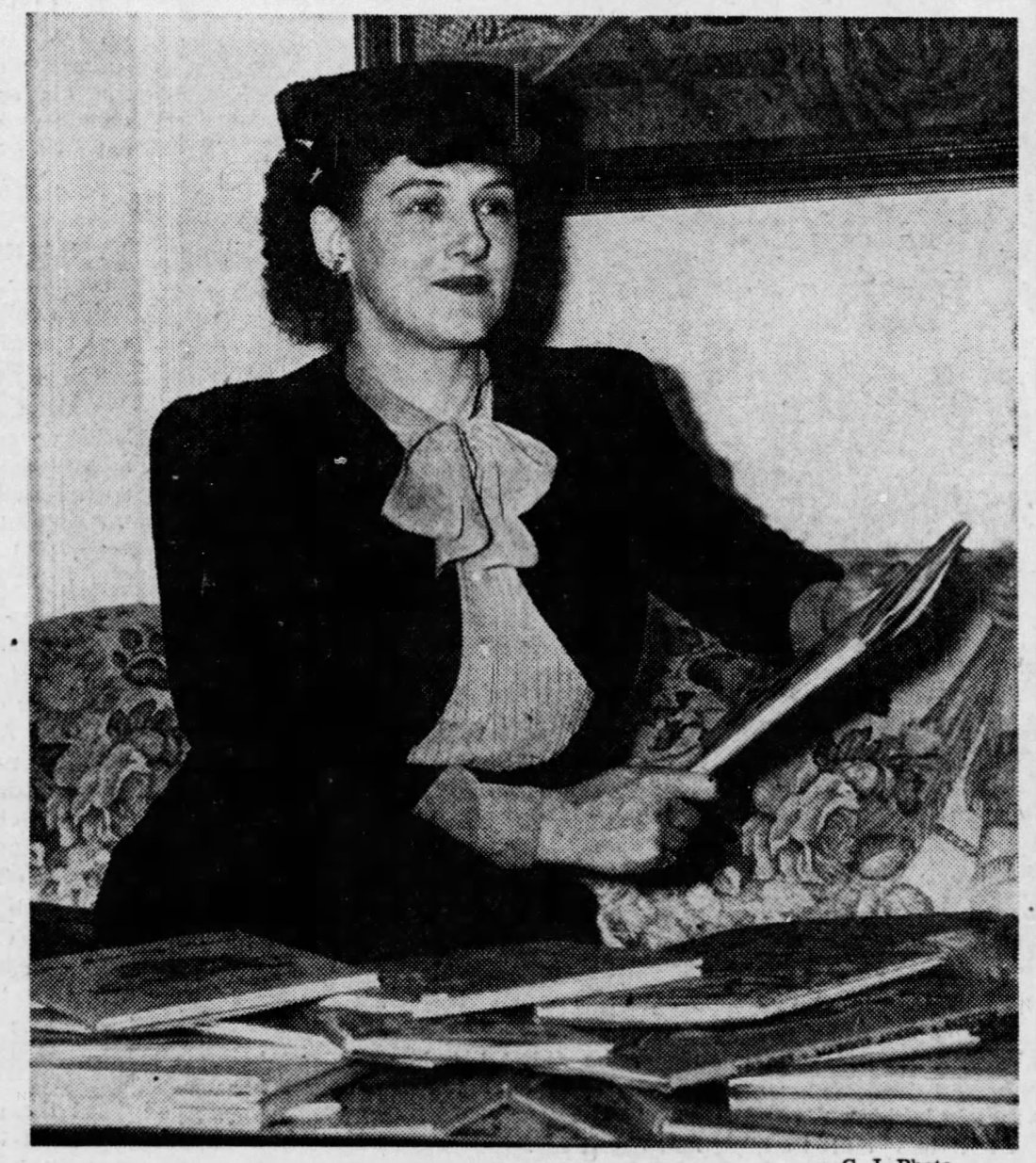
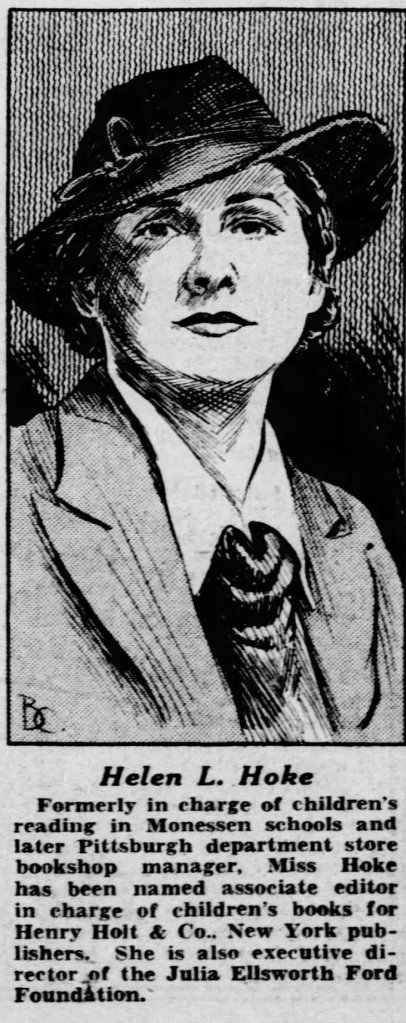
HELEN HOKE learned her alphabet by setting type for her father’s newspaper in a small Pennsylvania town. Later she wrote articles for the same paper, and after a period of teaching she moved to New York to launch a distinguished career in editing and writing. She is the author of more than seventy books, for both adults and young people, and has been junior-books editor at five different publishing houses.
—Back cover flap, Sinister, Strange and Supernatural (1981)

She was born Helen Jeanne Lamb (1903-1990), in California, Pa.; her father owned the California Sentinel. Helen was the youngest of four children. Much of her early life isn’t clear, though she clearly had some schooling and no doubt practical education involving her father’s newspaper. She married John L. Hoke on 20 May 1923; their son Jack was born in 1925. She did some work as a journalist, and later as a teacher; the 1930 census lists her as a clerk at a mail order company. Around 1929 or 1930, the family seems to have moved to California.

Miss Hoke entered the book trade in 1929, when she opened the book department in a Pittsburgh department store. Susbsequently she became head of the Children’s Book Department at Bullock’s, in Los Angeles, Calif. She became director of the Ford Foundation in 1934.
New York Company Establishes Children’s Book Department With Helen Hoke As Director, The Daily Herald (Monongahela, Pa), 3 Jan 1945 (3)

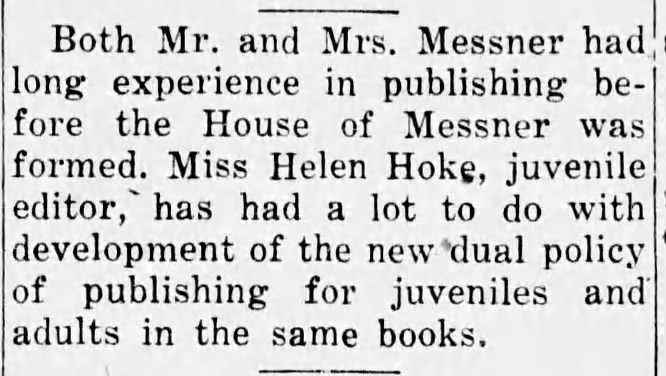
The Julia Ellsworth Ford Foundation was established in 1934, and promoted the creation of literature for children. Helen Hoke was very involved with the development of children’s book departments, shaping the literature aimed at the rising market. Her first published children’s book was Mr. Sweeney (1940), the first of dozens. As an editor, she influenced dozens more. Part of her emphasis was on books that appealed to both adults and young readers:

In a 1945 interview, Helen Hoke emphasized:

I look for books that will help young people to understand the time in which they live, the people with whom they have to live, and the world in which they live. Children are people, and should be addressed as people.

A few weeks later, on 31 May 1945, she married Franklin M. Watts, who owned Franklin M. Watts, Inc., publishers, and became vice-president and director of international projects. It was Watts that really launched her career as an anthologist, with books that bore distinctive title patterns like Jokes Jokes Jokes (1954), Puns Puns Puns (1958), Witches Witches Witches (1958), Alaska Alaska Alaska (1960), and Nurses Nurses Nurses (1961). While the titles might not have been super-creative, the repeated emphasis got the point across: these were anthologies that promised and delivered exactly what was in the title—and the contents, while sometimes skewing juvenile, often aimed for both young and adult readers.

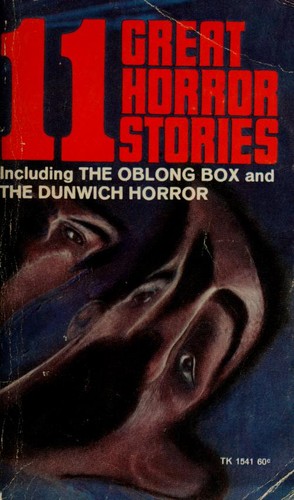
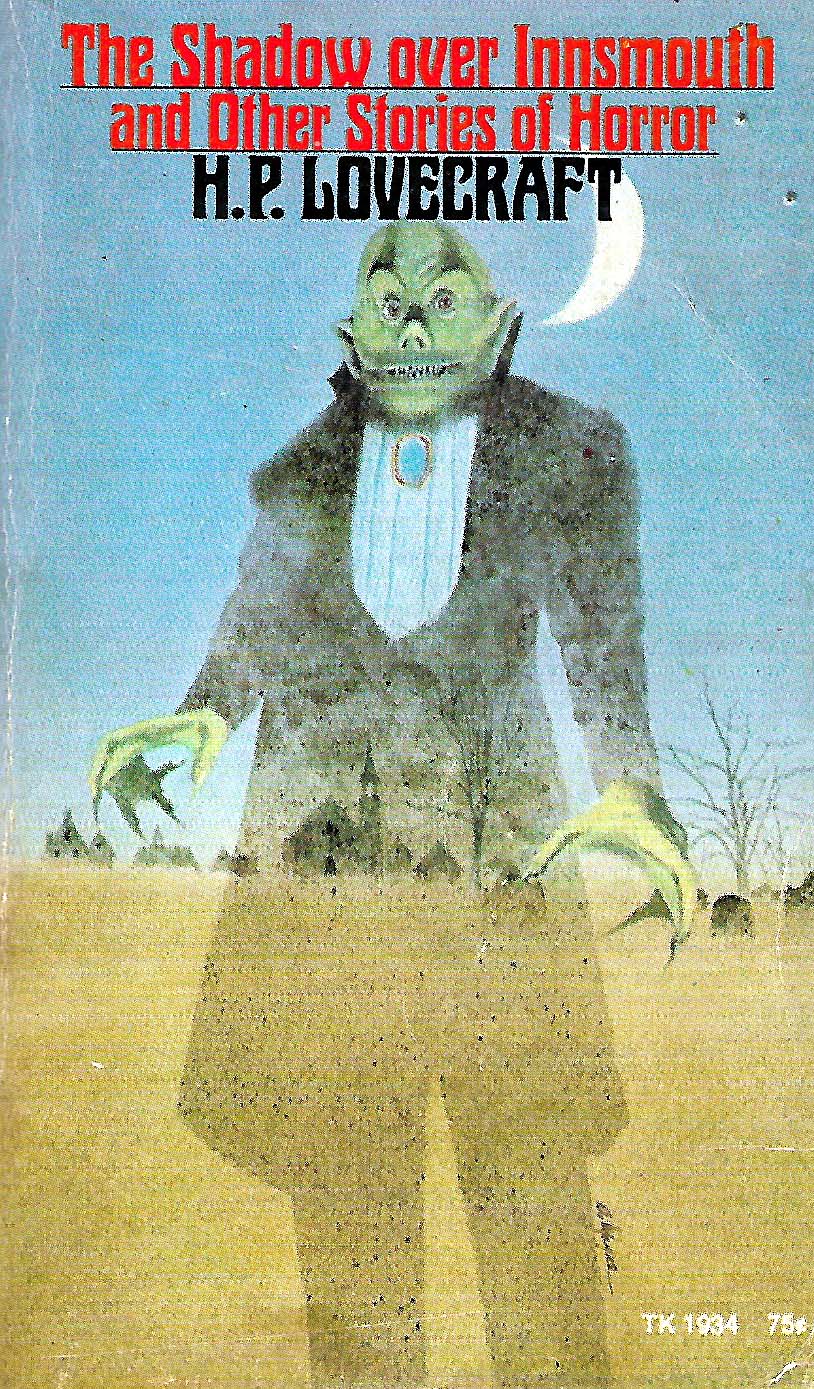
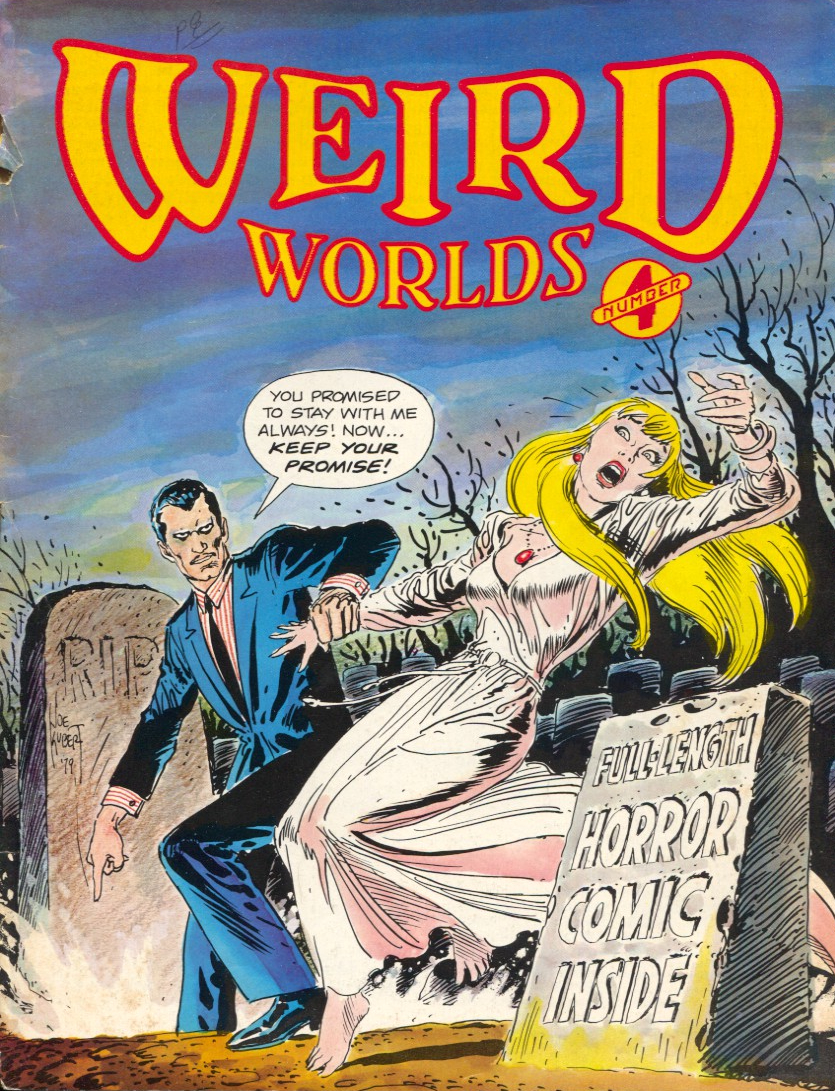
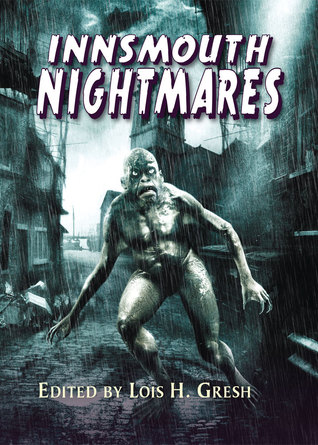
Witches Witches Witches (1958) was the first of Hoke’s weird/horror fiction anthologies, of which she edited 29 between 1958 and 1986, not counting reprints. A glance at the contents shows many hallmarks of cheap anthologies: public domain stories, cheap reprints, the occasional bit of folklore. Yet the selection shows taste, and perhaps more surprisingly intermixed are plenty of stories from more contemporary authors, including well-known names like Robert Bloch, Ray Bradbury, Joseph Payne Brennan, Manly Wade Wellman, August Derleth—and H. P. Lovecraft.

Stories and poems from Lovecraft (or posthumous collaborations with August Derleth) appear in almost a third of Hoke’s horror anthologies. Readers both young and old would have thrilled to:

Notably missing are any of Lovecraft’s longer tales; Hoke wasn’t asking anyone from 8 to 80 to sit down and read through At the Mountains of Madness or The Case of Charles Dexter Ward. The focus is on the shorter, punchier, read-in-a-sitting stories that are largely standalone, and utterly unobjectionable in terms of content, aside from a bit of grief and a bit of stereotyping in “Cool Air.”

Like many anthologists aiming at a general market, little of Hoke’s own personality and reasoning for choosing some of these pieces comes through in the brief (sometimes nonexistent) introductions or chapter commentaries, and the occasional back cover or book jacket flap about her, e.g.:

Helen Hoke is well known for her anthologies on children’s humor, but she is also fascinated by the esoteric, the supernatural, and the weird.
Weirdies Weirdies Weirdies (1973) back cover

As Helen Hoke says, “Terror seems the more potent if it is not too detached from reality.” Some element of realism is necessary to make the improbably, plausible.
Terrors Terrors Terrors (1979) inside front cover flap

The use of three of Derleth’s posthumous collaborations is a bit of a surprise, especially since these were all published after his death; it would have been interesting to see the correspondence between Helen Hoke Watts and Derleth’s estate. Helen Hoke definitely toed the Arkham House line when it came to Lovecraft:

The Outsider, by H. P. Lovecraft, is one of the most original monster stories ever written. Lovecraft spent his life writing fantastic stories, which were first published in a magazine called Weird Tales. The unusual nature of his stories led to his receiving many letters from strangers, especially aspiring writers. Many authors have expressed their gratitutde to him for his help and generosity; one of them, August Derleth, rescued Lovecraft’s stories from obscurity and published them in book form. Lovecraft died in 1937, leaving a sure place in the literature of the fantastic.
—”About this Book,” Monsters Monsters Monsters (1975) 9

The one collaboration story in these books, “The Horror in the Museum,” is presented as solely the product of Hazel Heald, without any mention of Lovecraft—which is not unusual for the time. Though Lovecraft fans may well have recognized the Mythos elements that emerge in the story.

The Horror in the Museum will particularly disturb those who sense the terrifying potential of waxworks and masks, quite apart from monstrous mutations. Hazel Heald writes with a disquieting plausibility so that it does seem just possible such exhibits may really be seen in London.
—”About this Book,” Terrors Terrors Terrors (1979) 9

As an editor, Helen Hoke did little to inform the readers about the history of the stories or the author; the bits and pieces of editorial drapery are there to whet the appetite of potential readers, and fulfill their function well—but we don’t really get any insight into the process. Based solely on how often she used Lovecraft, she was attracted to either his work or the recognizability of his name (perhaps both).

How much did these nine books add to the recognition of Lovecraft in the 70s and 80s (and longer, as such books can linger on school library shelves for decades)? As with Betty M. Owen & Margaret Ronan, it’s impossible to overstate how critical it can be to get a reader young and hook them in. Helen Hoke’s anthologies weren’t paperbacks on the spinner rack at the local drugstore, these were the kind of books that got reviews in Publisher’s Weekly and the School Library Journal; Hoke was selling these books to librarians as much as to the young men and women that would eventually check them out, and that might explain why the stories are a notch or two above the average horror anthology for kids. Aiming for a more literate audience, with stories that could appeal to both kids and adults, may also be why these books are still very passable horror anthologies for adults today, and collectors pay some fair prices for the scarcer titles in good condition.

Helen Hoke was one of the editors and anthologists who knew horror could be for kids—and not just silly, schlocky, comedy-horror, but serious literary terrors. She was the flip side of the coin, the librarian-approved choice for kids that might glut themselves on Famous Monsters of Filmland and see Frankenstein and Dracula without reading the novels they were based on. More than a few impressionable young minds no doubt found their first introduction to Lovecraft in the pages of Weirdies, Weirdies, Weirdies, or felt that connection to the Outsider in Monsters, Monsters, Monsters. Holt’s anthologies were another route by which the tentacles of Lovecraft and the Mythos spread and disseminated.


Bobby Derie is the author of Weird Talers: Essays on Robert E. Howard and Others and Sex and the Cthulhu Mythos.

Deep Cuts in a Lovecraftian Vein uses Amazon Associate links. As an Amazon Associate I earn from qualifying purchases.

Editor Spotlight: Interview with Wendy N. Wagner

“Horror is for everyone.”
—Wendy N. Wagner

The publishing game has changed a great deal since the days of C. L. Moore and H. P. Lovecraft. Pulp magazines have increasingly given way to digital-and-print magazines, crowdfunded anthologies, ebooks, and patreons. Traditional publishing isn’t dead, but like moths and butterflies, it is undergoing a painful transition from the way things used to be done to how they will be done.

One thing remains: the world still needs editors. There still needs to be someone in the editorial trenches, reading submissions, answering queries, pitching ideas, working with authors to polish a story, push the envelope of what can be done. Their work is what enables writers’ voices to be heard, and even the most scintillant and brilliant bleeding edge of cosmic horror will go unread, if an editor can’t get a story to where people can actually read it.

Wendy N. Wagner is the editor-in-chief of Nightmare magazine and the managing/senior editor of Lightspeed; she was also involved with the { } Destroy { } series, including editorial duties on Women Destroy Science Fiction! (2014), Women Destroy Fantasy! (2014), Women Destroy Horror! (2014), and Queers Destroy Horror! (2015), among others. They were kind enough to answer some of our questions on editing, cosmic horror, and Lovecraft.

How did you get into Lovecraft and cosmic horror?

Wendy N. Wagner: As a kid, I read a ton of Dean Koontz, Stephen King, Edgar Allan Poe, and Anne Rice. I loved Halloween and anything with a gothic vibe. But I got busy with school and other interests, and horror fell by the wayside until my mid-twenties, when I started writing seriously. At that time, I wrote a couple of fantasy novels and realized that the parts of my work I loved best felt like horror, so I decided I was going to focus on writing horror short stories to improve my craft. I got a book by Mort Castle about horror writing, which included a list of the greatest horror writers and their work, and of course H.P. Lovecraft was on there. I had never read anything by him, but as someone living in Portland, Oregon, the birthplace of the H.P. Lovecraft Film Festival, I recognized the name.

I checked out a collection from the library—I think it was the one edited by Joyce Carol Oates—and I was instantly in love. Every story filled me with the feelings I used to get reading horror as a kid. It was all so goth, so over the top, so deliciously dark. I felt like I had come home.

I started going to the H.P. Lovecraft Film Festival, which includes a literary track, where I met a number of Lovecraftian and cosmic horror writers, and through them I started getting invited to write work for Lovecraftian anthologies. So I just kept reading and writing and watching Lovecraftian work, spiraling deeper and deeper into that weird and wonderful world. It really feels like home now.

As a speculative fiction writer and editor you have worked in the trenches of weird fiction and nonfiction for years. Have you faced discrimination for your gender or sexuality in that context?

WNW: Not that I know of? But I can’t know about what I’m not invited to because of my identity or my associations.

Your first editing project was Queers Destroy Horror!, a special issue of Nightmare Magazine. How did you get involved with that?

WNW: After I sold a short story to editor John Joseph Adams in 2010, I became fast friends with him and his partner, the editor Christie Yant. I started doing volunteer work for some of JJA’s projects, including working as an editorial assistant for three anthologies and then serving for a year as the assistant editor of Fantasy Magazine. When John closed Fantasy, I took an editing hiatus because I was writing tie-in fiction for the Pathfinder role-playing game while at the same time holding down a day job.

But in late 2013, I lost my job and started looking for a way to make a living as a full-time freelancer. Luckily for me, John Joseph Adams had just reached a point where he found running both Lightspeed and Nightmare magazines a little much on top of his anthology work. He hired me to manage the day-to-day operations of the magazines as well as handling the bulk of the line editing. He had also decided to oversee a Kickstarter campaign for a special issue of Lightspeed with a focus on women writers, to be edited by Christie Yant, and he asked me to assist some of the content production for that Kickstarter campaign.

The Kickstarter for Women Destroy Science Fiction! was an enormous success, and when it surpassed its fundraising goals, the three of us had a meeting to decide what to do next. We decided to expand the concept into Women Destroy Horror! and Women Destroy Fantasy! and brought on a crew of fabulous women to edit those works. I served as the managing editor of all these projects, on top of my regular managing editor duties. (Luckily, WDSF replaced the June 2014 issue at Lightspeed and WDH replaced the October 2014 issue of Nightmare.)

Because these issues were so well-received, we decided to repeat the project in 2015 with an emphasis on LGBTQIA creators. Because of my identity, my previous editorial experience, and of course my love of horror, Christie Yant suggested I serve as the editor-in-chief of Queers Destroy Horror!, and JJA thought it was a great idea. 

You were also the nonfiction editor for Women Destroy Science Fiction! and Women Destroy Fantasy! What was that experience like?

WNW: It was an absolute blast overseeing the nonfiction for those projects! And easy, too, because we got so much email from so many people who wanted to be involved with it—there were so many women who had so many exciting ideas, and it was a joy to offer them a place to share them.

I think the best part of the Destroy projects were the micro-essays about people’s personal experiences which ran in the Kickstarter campaigns and in the Destroy Science Fiction! editions. I got to wrangle the ones for Women Destroy and for Queers Destroy, and it was amazing to read them. Over and over again, people spoke of the incredible importance of representation, the way seeing someone like themself on a screen or on a page unlocked the world for them. 

It really changed something inside of me. I never set out to be an editor or a gatekeeper of any kind, but after working on the Destroy projects, I understood how important it was to make sure the world was getting a chance to read more diverse voices. I felt it in my bones: this work matters.

You joined Nightmare Magazine as managing/associate editor in 2014 and worked your way up to editor-in-chief. How has that experience been?

WNW: I’ve had so much fun at Nightmare! I was originally brought on to oversee the staff and all the production details, as well as handling the line-by-line editing of stories and articles, but I very quickly volunteered to take over the nonfiction side of things, and John didn’t mind. I’m such a giant horror fan that it was a lot more fun for me than it was for him! To this day, I think our H Word essay column is my favorite part of the magazine. We feature a different writer every month, and after all these years, I think the column is an amazing repository of thoughts on how the horror genre works and what it means to people. I am so proud of it!

In mid-2020, John asked me if I’d be interested in taking over as editor-in-chief, and it was such an overwhelmingly wonderful moment. My first issue was our 101st, and I had the cover printed up as a huge poster to hang in my office. When I got it up on the wall, I cried with happiness.

It’s been really exciting to select stories and share them with the world. My goal for the magazine is to explore the broadest possible spectrum of horror fiction, ranging from the bizarro to the cozy, from the psychological to the supernatural, to publish work that’s barely horror and to publish work that’s in the dead, scary center. I always say that our motto is “Horror is for everyone,” and I dream that the magazine’s archives contain some kind of horror that’s accessible for every kind of reader. Not because I think I can make everyone happy, but because I think horror is good for everyone, and too many people have been turned off from horror because they have this very blinkered vision of the genre. I want to help take off those blinkers. It’s basically my life mission!

In your editorial for Nightmare Magazine #132 (September 2023), you stated that “Lovecraftian” was a lazy adjective. Can you expand on that?

WNW: First because H.P. Lovecraft wrote in so many different genres and subgenres! He wrote stories of the supernatural. He wrote stories that are extremely science fictional. He wrote dark fantasy. He wrote psychological horror. I think the submissions guidelines for the H.P. Lovecraft Film Festival do a great job explaining how broad and wide “Lovecraftian” work can be (I have never made a Lovecraftian film, but last year I took home the Best Screenplay award from the HPLFF, so I’ve definitely studied those guidelines very closely).

However, I think most people use the word “Lovecraftian” to refer to the realm of weird and cosmic horror, the subgenres Lovecraft is probably best known for. So why not just use the term “weird and cosmic horror”? There are a lot of other creators who have done just as much for the field as HPL has. I think about Robert W. Chambers, whose novel The King in Yellow was published when Lovecraft was five years old. Or Algernon Blackwood’s “The Willows,” published when HPL was seven. William Hope Hodgson’s The House on the Borderland was issued when Lovecraft was eight. Those three works are three of my very favorite works of cosmic horror, and were huge influences on Lovecraft’s writing. 

I suppose “Chambersian” doesn’t sound nearly as cool as “Lovecraftian,” alas.

Did you get any pushback for that editorial, or the statements you’ve made about Lovecraft in general?

WNW: I had to laugh a little at this question, because I usually feel like nobody reads the editorials! I’ve never heard a peep about any of them, at any rate.

You’re also managing/senior editor and nonfiction editor of Lightspeed. What is the difference between editing science fiction versus editing horror?

WNW: As an editor, my job is to try to put myself in the writer’s head and to strive to understand why they’ve made the craft choices they made. I’m always trying to figure out what emotions the writer is attempting to manipulate, what senses they’re hoping to stimulate, what ideas they’re trying to knit together in order to sculpt the landscape of the story. I think the two different genres tend to target different emotions, senses, and conceptual landscapes, but the job remains the same. I’m just there to make sure my writers are totally happy with their work!

Besides being an editor, you’ve written a good bit of Lovecraft-inspired and cosmic horror fiction yourself. What draws you to write it?

WNW: I grew up in a very small community in Oregon’s coast range. To get to the nearest town, we had to drive twenty-five miles on a very narrow, winding road that skirted a deep canyon and a very wide river. It rained nine months of the year, and in the summer, there was heavy fog almost every day. It might have been the West Coast, but I couldn’t have lived any closer to Innsmouth without putting a houseboat on Devil’s Reef.

I guess you could say it’s in my blood!

Do you feel that being you (female, queer) has shaped your understanding of Lovecraft and approach to body horror and cosmic horror?

WNW: When I was a young teenager, there were several ballot measures in my state that tried to limit or eliminate gay rights, and homophobia saturated the airwaves. My own father once told me he thought gay people shouldn’t even exist. I think when you grow up knowing you are hated for simply being yourself, it makes you understand horror in a whole different way. 

As for body horror, I do think people with uteruses have easy access a lot of source material! Bodies, man. They can be magically disgusting.

Has writing Lovecraft-inspired fiction changed how you relate to Lovecraft and his fiction?

WNW: When Lovecraft is your job, you definitely read more of his work. I probably wouldn’t have made it through The Dream-Quest of Unknown Kadath if it hadn’t been required reading!

Reading some of your fiction like “Curvature of the Witch House,” I’m reminded of when W. H. Pugmire wrote “Instead of writing formula stories, we can use Lovecraftian themes as a foundation on which to try to build our own unique fiction.” Do you feel that describes your own approach?

WNW: Oh, Pugmire, you wonderful soul. Of course Pugmire would put it so perfectly! 

Those words really resonate with me now after writing two novels (Girl in the Creek, forthcoming 2025 from Tor Nightfire, and a still-to-be-homed novel finished earlier this year) that are definitely cosmic horror novels. I think there are elements in both books that will really resonate with anyone who reads Lovecraft, but at the same time, those elements are totally spun out of my own obsessions. I didn’t set out to ape anything by the master, but I think I’ve spent so much time thinking about his work (and the work of related authors, especially Robert W. Chambers) that the way I approach story naturally shapes it into the realm of the cosmic and weird.

Has being an editor shaped your views of Lovecraft in your own fiction?

WNW: I think being an editor has made me see how important the cosmic and the weird are to all people. That’s one of the reasons why I object to the using the term “Lovecraftian” to mean “cosmic and/or weird.” The weird belongs to everyone! I think we’re only going to see more personal and even weirder takes on cosmic horror.

From an editorial perspective, how do you handle issues of prejudice & discrimination in the submissions you receive?

WNW: As a human, I think my most important value is of ahimsa, the Hindu and Buddhist principle non-harm or nonviolence (I’m not a Buddhist, but I think that term is the best to explain my moral stance). As an editor, I think my primary job is to put stories out into the world that don’t harm people, and my next biggest job is to make sure that the writers who send me work aren’t harmed by their interactions with me. That means I don’t publish stories that encourage discrimination, and I try to publish work from a diverse population of writers. I also try to communicate with authors in a kind way. But there is always room for improvement.

The best way to fight my own prejudices and preconceptions about literature is to read widely and to think critically about my understanding of craft and language. Last year I spent a great couple of months attending a workshop presented by the Willamette Writers about the way writing workshops can be damaging for writers from marginalized communities and identities. It was very thought-provoking, and I look forward to learning more. I’m always looking for ways to expand my horizons and to be a better advocate for diversity in our genre.

How do you encourage diversity as an editor?

WNW: I’m very inspired by our publisher, John Joseph Adams, and his editorial work, particularly Lightspeed. Lightspeed has a stellar record for publishing writers from around the globe and for celebrating marginalized voices. From the very beginning of the magazine, he made sure every issue showcased an even number of male and female writers, and he’s also been hugely supportive of nonbinary and trans authors. John is my absolute hero, and he sets very high standards for all his publications. As for my own measures, I try to invite a diverse population of writers to work with me on nonfiction, an area where Nightmare has always shone, as well as soliciting fiction from marginalized voices (last year we had two themed issues, one exploring “Lovecraftian” themes and one focused on dark fantasy, whose fiction and poetry was entirely commissioned from writers of color). I’ve also experimented with having open submissions periods strictly for people of color. Some people complain about these kinds of submissions periods, but for me, they seem helpful. I like to take more care reading these submissions, which often draw from literary styles and craft techniques that are outside of my own training (I studied literature in ’90s, and it was heavily biased toward British and upper-class American writing). I know I’m still learning a lot about how to evaluate work that doesn’t jibe with the classic European canon of fiction—sometimes I feel like I have an easier time loving poetry from other cultures than I do fiction, simply because I’ve been trained to appreciate more experimental approaches to craft in that genre. But I like to think I’m learning!

What do you see as the future of Lovecraft-inspired fiction and cosmic horror?

WNW: It’s only going to get wilder and more exciting. Our culture has changed radically since Lovecraft was writing fiction, and science has transformed our understanding of both what might lie outside our terrestrial bubble and what the very nature of reality might be. Lovecraft’s Elder Gods no longer feel terrifying in the way they did in the early 20th century because we have begun to suspect the cosmos is far stranger than Lovecraft and his contemporaries ever imagined. 

But one of the central tenets of Lovecraft’s work was always that the cosmos are weirder than our simple primate brains are ready to understand. The weirder we get, the more we prove him right. In that regard, Lovecraft will always be relevant, even if his biases aren’t. 

Today’s writers stand on the shoulders of weird giants, straining toward the stars. I hope the writers of tomorrow stand on my shoulders, ready to gibber in horror at whatever is up there.

“Horror is for everyone.” Four words to carve into your heart. Thank you Wendy for taking the time to answer these questions. Looking forward to seeing more from you in the future.

For more on Wendy N. Wagner, check out their Linktree.


Bobby Derie is the author of Weird Talers: Essays on Robert E. Howard & Others (2019) and Sex and the Cthulhu Mythos (2014).
Deep Cuts in a Lovecraftian Vein uses Amazon Associate links. As an Amazon Associate I earn from qualifying purchases.

Editor Spotlight: Cynthia Asquith & Dorothy L. Sayers

Weird Tales was not far from the sole source of weird and fantasy fiction available to readers in the 1920s and 30s. In many ways, weird pulp fiction—and reprints of the same like Christine Campbell Thomson’s Not at Night series—were seen as the lower end of popular fiction publishing. Yet there were anthologies that were often considered of a higher standard. It is notable that two of the leading editors for this sort of anthology were women, Cynthia Asquith (1887-1960) and Dorothy L. Sayers (1893-1957).

H. P. Lovecraft and his contemporaries, aficionados of weird fiction that they were and on the hunt for top-class fiction, read several of Asquith’s and Sayers’ anthologies and commented on them in their letters. These were not the most detailed reviews, and that sort of reflects the spirit of the anthologies and how they were received. The idea of a collection of weird stories wasn’t new, but neither Asquith nor Sayers had set out to try and define or redefine a theory of weird fiction. These were editors who were obviously intimately familiar with the genre, but by and large were content to let their selections speak for them—with the notable exception of Sayers’ introduction to The Omnibus of Crime (1929), which may be read as a detective-fiction parallel to Lovecraft’s “Supernatural Horror in Literature”—especially the section on “Tales of Mystery and Horror,” within which she lumps many works that Lovecraft recognizes as weird fiction.

Cynthia Asquith and Dorothy L. Sayers were creating anthologies with staying power, the influential building blocks of many libraries of weird fiction, far beyond whatever influence they had on Lovecraft and his contemporaries; that influence should not be overlooked or forgotten. These women editors helped define the weird fiction landscape during the heyday of Weird Tales and beyond.

Cynthia Asquith

My next addition to my library is to be Niccolo Machiavelli’s THE PRINCE. After that follows THE GHOST BOOK (Machen, Blackwood, Bierce, de la Mare, and others) edited by M. Asquith.

August Derleth to H. P.. Lovecraft, 22 Jan 1927, Essential Solitude 1.66

British aristocrat Cynthia Asquith was educated, erudite, creative, and connected. When she compiled The Ghost Book in 1926, she brought together what might arguably be called the cream of the crop for contemporary British weird fiction, including Algernon Blackwood, Oliver Onions, Arthur Machen, Walter de la Mare, and L. P. Hartley—and perhaps reflecting the prominence of women ghost story writers or her own tastes, has a higher-than-average number of women contributors—including one of her own stories, “The Corner Shop,” published under the pseudonym C. L. Ray.

“The Ghost Book” sounds alluring—are the stories very new, or do they contain any familiar ones? Of course the well-known names argue semi-classics. Which of De la Mare’s is represented?

H. P. Lovecraft to August Derleth, 2 May 1927, Essential Solitude 1.73

The Ghost Book provided all-new stories by “name” authors, not reprints from pulp magazines by virtual unknowns—and perhaps because of that, it charged more for the higher quality. At a time when More Not at Night (1926) was retailing for 2/- (two shillings, pre-decimalization, or about 50¢ in 1926 US dollars), The Ghost Book went for 7/6 (seven shillings, six pence; about US$1.82).

I’m on the Asquith anthology of ghost tales now—the best things in it so far being Blackwood’s “Chemical”, L. P. Hartley’s “Visitor from Down Under”, Walpole’s “Mrs. Lunt”, & De la Mare’s “A Recluse”.

H. P. Lovecraft to August Derleth, 6 Sep 1928, Essential Solitude 1.156

All of these stories were included in Lovecraft’s list “Books to mention in the new edition of weird article” (CE 5.234), and worked into “Supernatural Horror in Literature.”

Lovecraft appears to have missed Asquith’s next editorial effort The Black Cap: New Stories of Murder and Mystery (1927), though it contains stories by Walpole, Hartley, D. H. Lawrence, and Marie Belloc Lowndes, who had stories in The Ghost Book. In 1929, however, Asquith returned with another premier collection of supernatural fiction: Shudders: A Collection of New Nightmare Tales, published by Hutchinson.

That new Hutchinson anthology sounds good—wonder if the firm is going to specialise in the weird?

 H. P. Lovecraft to August Derleth, 26 Sep 1929, Essential Solitude 1.216

We can only wonder if Lovecraft’s idle comment inspired Derleth a decade later to co-found Arkham House, as a publisher specializing in weird fiction. There are no other references to Shudders in Lovecraft’s letters, so it isn’t clear if he managed to read that anthology. However, it’s clear that Lovecraft and Derleth were excited when Asquith’s third effort at a purely weird anthology, When Churchyards Yawn (1931):

By the way, before I forget it, Lady Cynthia Asquith has just brought out WHEN CHURCHYARDS YAWN, a new anthology of new ghost and weird stoies, by Walpole, Maugham, Onions, Chesterton, and the usual group, excepting only, I think, M. R. James. I have it on order, will let you know how it is as soon as I get it. It is not yet printed in the U.S.

August Derleth to H. P. Lovecraft, 2 Nov 1931, Essential Solitude 1.402-403

I’ll be glad to hear your report on “When Churchyards Yawn”. These anthologies come thick & fast, & some of them are excellent.

H. P. Lovecraft to August Derleth, 6 Nov 1931, Essential Solitude 1.404

The point about When Churchyards Yawn is that all the tales are new, haven’t even seen magazine printing before, and all by masters of writing. I order such a book posthaste without any further notice.

August Derleth to H. P. Lovecraft, 9 Nov 1931, Essential Solitude 1.407

Keep in mind that unless a book was picked up by a US publisher and issued in a local edition, the cost of the importation would be added to the cover cost, which with an already higher-than-average book could become expensive. This is likely one of the reasons Lovecraft didn’t read more of Asquith’s anthologies.

I sent today for When Churchyards Yawn, the anthology of brand new tales by Asquith, which has just reached Chicago from England. I will let you have the report on this as soon as it reached me and I have read it through.

August Derleth to H. P. lovecraft, 17 Nov 1931, Essential Solitude 1.412

I shall welcome your report on “When Churchyards Yawn”. The first Asquith anthology had some good stuff in it.

 H. P. Lovecraft to August Derleth, 20 Nov 1931, Essential Solitude 1.416

Derleth’s report does not survive, but in Lovecraft’s next letter we read that Derleth was less than impressed:

Sorry the new Asquith anthology doesn’t equal the first—but would give a good deal to see that new Machen tale!

H. P. Lovecraft to August Derleth, 25 Nov 1931, Essential Solitude 1.418

Perhaps because of Derleth’s report, or lack of cash, or simply lack of opportunity to pick up the book, Lovecraft didn’t read When Churchyards Yawn until 1934, when a friend lent him a copy:

Had an interesting shipment of loaned books from Koenig during my absence—before he learned I was in his town. Baring-Gould’s werewolf volume (which I’ve always wanted to see), the second & latest Asquith anthology “When Churchyards Yawn”, & a small book of short tales by Francis C. Prevot entitled “Ghosties & Ghoulies”. Hope I can get at reading them before long—though at present I am utterly submerged in the mass of accumulated work & correspondence which I found on my return. The Asquith book contains Machen & Blackwood tales which I’ve never read–though they may be old.

H. P. Lovecraft to Clark Ashton Smith, 11 Jan 1934, Dawnward Spire, Lonely Hill 516

H. C. Koenig was a fan who opened his library to Lovecraft for borrowing, including the works of William Hope Hodgson. Lovecraft’s assessment of the new book was muted:

The Asquith anthology was fair—Blackwood’s contribution being the best.

H. P. Lovecraft to Clark Ashton Smith, 11 Feb 1934, Dawnward Spire, Lonely Hill 525

Lovecraft also wrote of his intention to borrow Shudders from Koenig, but there is no evidence that he did so. Lady Cynthia Asquith edited no more anthologies during Lovecraft’s lifetime (he did read My Grimmest Nightmare, 1935, which is commonly though erroneously credited to Asquith), but she did not cease, following up The Ghost Book (1926) with The Second Ghost Book (1952) and The Third Ghost Book (1955). While the British Not at Night and Creeps series would be remembered as cheap, garish, and as close as one could get to pulp between hard covers (which, to be fair, is what they were), Asquith’s collections were as respectable as weird fiction could get in the 1920s and 1930s, and would be reprinted many times in various editions, ensuring a large influence on subsequent decades.

Dorothy L. Sayers

In nothing is individual fancy so varied and capricious as in its perception of the horrible.

Dorothy L. Sayers, “Introduction” in The Omnibus of Crime (1929), 45

In the 1920s, the distinction between crime, mystery, horror, and supernatural fiction was murky. While pulp magazines did a great deal to differentiate genres in popular literature, carving out sometimes incredibly narrow niches as evidence by pulps like Range Romances and Zeppelin Stories. Yet the roots of weird fiction, going back at least to Edgar Allan Poe and his detective C. Auguste Dupin, are tied up in mystery and detective fiction; through the 1930s there would be considerable overlap between detective fiction, weird crime, supernatural fantasy, and horror fiction—and it was that ambiguity and versatility of approach that defined Weird Tales and his primary contributors, including H. P. Lovecraft.

Dorothy L. Sayers was British, well-educated, and had practical experience as a novelist and copywriter, and specialized in detective fiction. In 1928, Sayers edited Great Short Stories of Detection, Mystery and Horror. This was a massive book (1,229 pages), prefaced by a long and thorough introductory essay, designed to take the reader through the whole history of detective and mystery fiction up to this point. Nor did Sayers neglect the supernatural horror side of the field, M. R. James, Oliver Onions, Sax Rhomer, Arthur Machen, Ambrose Bierce, Robert Louis Stevenson, Majorie Bowen, May Sinclair, A. M. Burrage, Walter de la Mare, and H. G. Well, among many others. If Sayers was influenced by gender or fame, it isn’t immediately obvious; while there are many famous names among the contents, there are also stories that are rarely commented on today, like Bram Stoker’s “The Squaw” and “Proof” by Naomi Royde-Smith.

In 1929, US publishers Harcourt, Brace, & Co. brought out an American edition titled The Omnibus of Crime.

This “Omnibus of Crime” volume sounds rather good, & I find I have no read half of the items listed. I shall surely try to get hold of it. Thanks exceedingly for quoting the contents.

H. P. Lovecraft to August Derleth, 20 Aug 1929, Essential Solitude 1.208

There is some excellent weird stuff—standard material reprinted—in the second half of the anthology called “The Omnibus of Crime”, which has lately been reprinted in a dollar edition. But perhaps you are already familiar with this.

H. P. Lovecraft to R. H. Barlow, 4 Nov 1931, O Fortunate Floridian 13

I intend to get “The Omnibus of Crime” (whose second half you described to me) now that it is issued for a dollar.

H. P. Lovecraft to August Derleth, 6 Nov 1931, Essential Solitude 1.404

I have not found a dollar edition of The Omnibus of Crime (whose normal list price was $3.00); it may be that this was a marked-down remainder price, as other writers like Clark Ashton Smith write of buying the book at a steep discount (EID 91). Lovecraft did finally get the loan of a copy of the book from his friend, W. Paul Cook:

I at last have the “Omnibus”, & have read “Green Tea.” It is certainly better than anything else of Le Fanu’s that I have ever seen, though I’d hardly put it in the Poe-Blackwood-Machen class. There are many other items in the book that I am particularly glad to have on hand—indeed, it is really one of the best of all recent anthologies.

 H. P. Lovecraft to Clark Ashton Smith, 16 Jan 1932, Dawnward Spire, Lonely Hill 342

“Green Tea” was one of Lovecraft’s unicorns; when he wrote “Supernatural Horror in Literature,” the story was out-of-print and relatively scarce. Lovecraft noted to a friend:

I now have the first one, & have read “Green Tea.” The latter isn’t at all bad, & I would probably have spoken less lightly about Le Fanu had I previously read it.

H. P. Lovecraft to J. Vernon Shea, 5 Feb 1932, Letters to J. Vernon Shea et al. 90

Ironically, Weird Tales would publish it as part of its weird fiction classics reprint series in the July 1933 issue.

Smith himself was more critical than Lovecraft in his assessment of the anthology:

I’ve been reading The Omnibus of Crime, which has some excellent weird stories in the latter section (I can’t read detective tales, to which the major part of the book is given.) Le Fanu’s Green Tea, Hichens’ How Love Came to Professor Guildea, The Novel of the Black Seal, Metcalf’s Bad Lands, White’s Lukundoo, and one or two others were enough to give me my money’s worth and more. I can’t see though why Bierce and M. R. James were so weretchedly represented in this collection. Moxon’s Master by the former is so obviously mediocre in comparison to real stuff such as The Death of Halpin Frayser; and almost anything of James that I remember reading would have been preferable to the somewhat tedious Martin’s Close. But I suppose my criticism proves nothing–except that Dorothy Sayers and I have different taste.

Clark Ashton Smith to August Derleth, 31 Dec 1931, Eccentric, Impractical Devils 92-93

Dorothy L. Sayers did not rest on her laurels. Great Short Stories of Detection, Mystery and Horror (1928) was followed up by Great Short Stories of Detection, Mystery and Horror, Second Series (1931).

I have greatly enjoyed the “Omnibus”, & hope the second one (just announced by booksellers) is of comparable quality. Like you, though, I don’t care especially for the first or “deteckatiff” half of the book.

H. P. Lovecraft to Clark Ashton Smith, 28 Jan 1932, Dawnward Spire, Lonely Hill 344

This second selection lacked the introductory material of the first, and when it was released in the United States as The Second Omnibus of Crime (1932), some of the weird contents were cut out of the American edition (the page count went down from 1,147 in the UK edition to 855 in the US edition, and that’s not because they printed it in a smaller font!) Unfortunately, it doesn’t appear that Lovecraft read The Second Omnibus of Crime, although others in his correspondence did. Derleth judgment was fierce:

I’ve just finished the new Omnibus of Crime; Sayer[s]’s weird tale choice is abominable.

August Derleth to Clark Ashton Smith, 20 May 1932, Eccentric, Impractical Devils 118

The Second Omnibus of Crime gave way to a third in 1935, though there is no reference to it in Lovecraft’s letters. As with the second omnibus, the contents of the US edition are cut down from the British, although the US publishers added A. Merritt’s “The People of the Pit” and “The Head” by Manuel Komroff. Whether Lovecraft missed hearing about this book, or simply lacked the cash to pick up a copy or the time to read it, we don’t know. Given the relatively high price, the lack of interest in the non-weird material in each anthology, and considering that some of those weird stories were reprinted from author collections Lovecraft & Co. already had or read…it wouldn’t be hard to see why The Third Omnibus of Crime failed to gather significant attention.

The major importance of Sayers’ anthologies to Lovecraft & Co. was as a common touchstone; that is what omnibus editions are ideal for, providing a single book reprinting enough tales to serve as a common reference point for other authors. Yet more important perhaps was what these books represented to Weird Tales authors: a proof of the commercial viability of their work:

If there were only one or two more editors in the market for that sort of thing, I believe I could sell nearly all my weirds: Individual taste differs more in regard to horror and fantasy, as Dorothy Sayers observes, than in regard to anything else.

Clark Ashton Smith to H. P. Lovecraft, early Mar 1932, Dawnward Spire, Lonely Hill 352

In this, Smith was unknowingly predicting the future of speculative fiction, as anthologies would eventually overtake magazines as the primary market for weird fiction. Yet the time for cheap mass-market paperback anthologies wasn’t yet; weird anthologies were a growing field, but still predominantly hardback, expensive, and dominated by reprints rather than the first appearance of stories.


Looking at Lady Cynthia Asquith and Dorothy L. Sayers in the context of their time, outside of the particular comments and concerns of Lovecraft and his circle of correspondents, these anthologies, as well as those edited by Christine Campbell Thomson and others, showed there was a potential market for weird fiction in anthology form. Each of these women was very much experimenting with the form, and in the Americanized versions probably dealing with local publisher interference, but there was a definite inching toward the kind of anthology that editors like Ellen Datlow and Silvia Moreno-Garcia and Paula R. Stiles would be able to put together: thematically focused, expressive of the editor’s own attitudes to define the scope of the anthology as well as its contents. To make something more than the sum of its parts by giving their work a unified aesthetic or historical context.

For Lovecraft and Co., they were reading these books both as average consumers (with all their own opinions on what was fit to print or re-print), and as writers of weird fiction who were beginning to be conscious of the fact that “Hey, if there were more of these things, I bet I could sell stories to them…” Alas, it didn’t quite work out that way for Lovecraft, though he did see some of his stories reprinted in anthologies; the market just wasn’t there yet. One day, it would be; and it may be that August Derleth, who became an anthologist of note, took a few lessons from what he saw Asquith and Sayers do and not do in their books.


Bobby Derie is the author of Weird Talers: Essays on Robert E. Howard and Others and Sex and the Cthulhu Mythos.

Deep Cuts in a Lovecraftian Vein uses Amazon Associate links. As an Amazon Associate I earn from qualifying purchases.

Editor Spotlight: Elinore Blaisdell

In literature, as in life, there are two motifs: love and death. Everything else is an offshoot of one or the other; and, Oscar Wilde to the contrary, death is surely stranger than love. All over the world the vampire legend—the sotry of the dead who will not die—is found, varied in setting and circumstances, but basically the same. This book is comprised, with a few exceptions, of tales of the dead who return, animated by an unnatural and unhallowed life. No mere apparition can chill in quite the same fashion as the very corpse itself, now an alien and a stranger, but continuing in its old habit, clinging to its old existence.

There are one or two vampires included herein not as yet of the undead. Montague Summers notes cases of the living vampire, and Hans Ewers writes of a vampire suffering from a disease of the blood whereby the victim is forced to seek living blood to sustain herself. One of these stories is, possibly, of such a case. There is included, also, a plant vampire. Other stories are of the dead who return with a definite purpose, a wrong to avenge, or a mission to fulfill.

Most of these stories satisfy the M. R. James condition that the apparition should be “purely malevolent and odious.”

Good night! Pleasant dreams!

Elinore Blaisdell, preface in Tales of the Undead: Vampires and Visitants (1947)

Elinore Blaisdell is not well-remembered today, and when she is recalled it is often as an artist and a poet. Douglas A. Anderson has put together a sketch of her life from genealogical sources, and there is little to add to the basic facts. Her apparent sole venture as an anthology editor is Tales of the Undead: Vampires and Visitants (1947), which at a glance appears to be a somewhat unremarkable theme anthology—but context is important.

Weird Tales had bad luck with anthologies. Their initial effort, The Moon Terror and Other Stories (1927), compiled by editor Farnsworth Wright from the execrable first years of the magazine, failed to sell and even now reading copies can be had quite affordably. The British firm of Selwyn & Blount began publishing the Not at Night series under editor Christine Campbell Thomson in 1925, with the contents largely culled from Weird Tales. The last volume (an omnibus) published in 1937, further volumes apparently cut off by World War II, though it inspired many imitators.

Weird Tales writers E. Hoffmann Price and W. Kirk Mashburn enlisted the aid of H. P. Lovecraft, Robert E. Howard, Clark Ashton Smith, August Derleth, Frank Belknap Long, and Henry S. Whitehead to pitch their own Weird Tales reprint anthology in the early 1930s, but this effort too came to naught. Arkham House began publishing collections and anthologies drawn from Weird Tales in 1939, and co-founder August Derleth found a niche as an anthologist of weird and science fiction as well, with collections like Sleep No More (1944), Who Knocks? (1946), Dark of the Moon (1947), The Night Side (1947), and The Sleeping and the Dead: Thirty Uncanny Tales (1947). Those anthologies have been printed and reprinted, often re-issued in affordable paperback editions, which themselves have become collectible.

By contrast, Tales of the Undead is a one-off. It came from nowhere, had a single edition, and apparently was never resurrected in paperback or in any cheap reprint edition. More than that, it was an early example of the themed anthology; Blaisdell’s preface is clear that she had chosen stories that were about vampires or vampirism in some fashion—and that is a different approach than either Thompson or Derleth, who may have been looking for creepiness or excellence, but were not trying to put together a book of just werewolf stories or the like. The closest one could get to that would be rather dry “non-fiction” books like Montague Summer’s The Vampire, His Kith and Kin (1928).

Contemporary readers noted the difference:

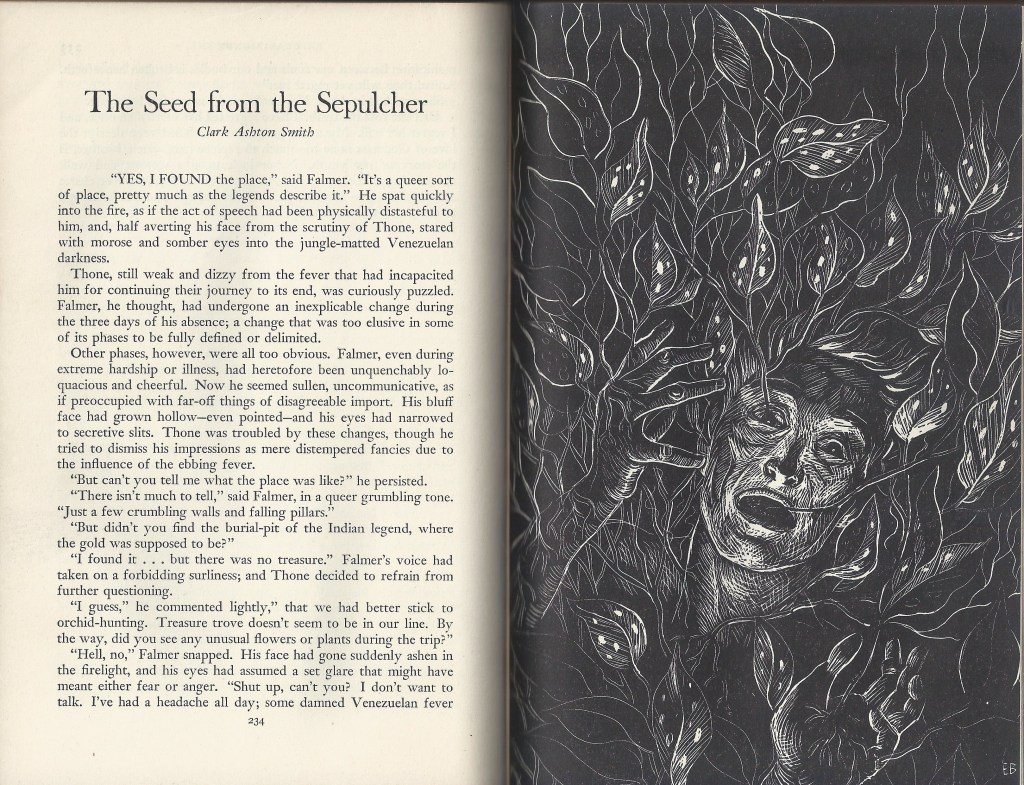
Her book features a special brand of supernatural horror, the vampire and the undead. Count Dracula might well be pleased at the advances his tribe has made in a few decades; for there are no less than 20 short stories, two longer tales, and one novelette on this single macabre theme. But the reader need not fear plot-limitations. Some striking variants have been made on the gruesome motif, and it is not every vampire that stalks the streets at night in a long black cape. For example, there is a tale of a vampire plant, Clark Ashton Smith’s “Seed from the Sepulchre,” which will cause more than one uneasy ripple up and down the spine, and others of rare additions to an unholy brotherhood we pray must always be confined to the realm of fiction.

Arthur F. Hillman, “A Volume of Vampires” in Fantasy Review #6 (1947)

Not everybody understood the advantages of a themed anthology. One contemporary newspaper account complained:

Miss Blaisdell has limited her subject too much. In doing this she has omitted the best horror stories of all. “The Monkey’s Paw,” by W. W. Jacobs belongs in a collection of this kind. Surprisingly enough, there is nothing by Poe or Hawthorne here, nor are there any contributions by the Romantic Gothic novelists, notably Mary Shelley and Mrs. Radcliffe.

Charles F. Feidelson, “The World of Books” in The Birmingham News, 28 Jun 1947

That the reviewer was probably not up to date on their weird anthologies is pretty clear; he was expecting a collection of old familiar horrors, not a themed selection.

Hillman also noted that there were “many gems from Weird Tales,” and this is true. Of the 23 tales in the book, 10 originally appeared in Weird Tales. A few others such as Washington Irving’s “The Adventure of the German Student” (1824) and “Amour Dure” (1887) by Vernon Lee were in the public domain and free to use without permission, so really more than half of the more recent tales in the book come directly from the pages of the Unique Magazine. Which is no doubt why in the acknowledgments Blaisdell added:

The editor wishes to thank Dorothy McIlwraith and Lamont Buchanan of Weird Tales for their gracious cooperation.

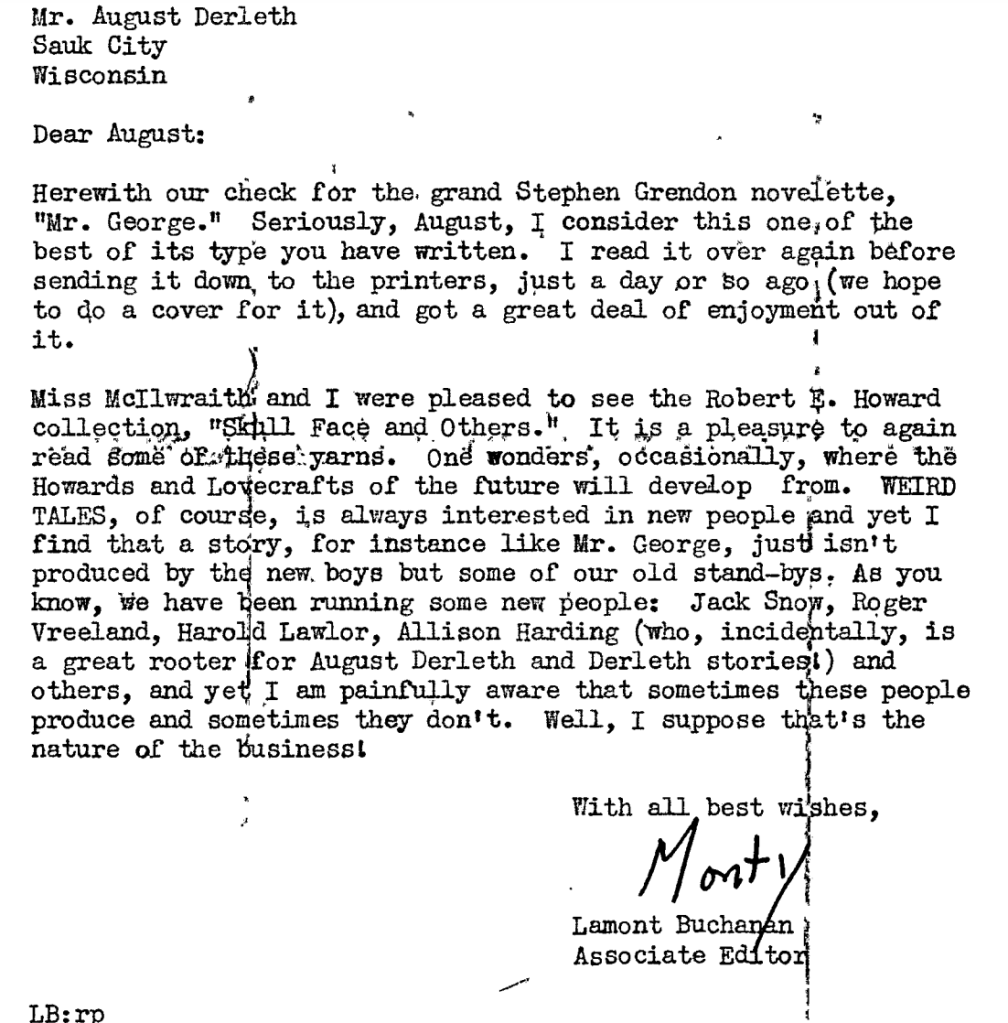
McIlwraith took over as editor of Weird Tales in 1940. Buchanan was associate editor under her. It’s worth considering whether either of those two had any influence on the story selection, but a glance at the table of contents notes that none of the stories were published in Weird Tales under McIlwraith. In truth, there was a bit of a changing of the guard at Weird Tales with the death of Robert E. Howard (1936), Lovecraft (1937), and then Farnsworth Wright (1940), and Weird Tales had difficulty attracting talent. In one letter dated 30 August 1946, Buchanan wrote to August Derleth:

Blaisdell must have dealt with August Derleth too, since several of the stories were reprinted by permission of Arkham House; unfortunately, those letters don’t appear to survive. Still, it goes to show the lengths that Blaisdell went to get good stories for her collection, including both prominent authors of an older generation (J. Sheridan LeFanu, Vernon Lee, Washington Irving, Theophile Gautier, Lafcadio Hearn, etc.) and masters of the early 20th century weird tale (M. R. James, Edith Wharton, H. R. Wakefield, E. F. Benson, H. P. Lovecraft, F. Marion Crawford, Clark Ashton Smith, Frank Belknap Long, Robert Bloch, Seabury Quinn, August Derleth, Manly Wade Wellman, etc.). Some of them, like Robert Bloch, have gone on to enduring fame, while others like Chandler W. Whipple have languished in relative obscurity.

Despite having a relatively formidable roster of authors and getting several newspaper reviews, I suspect that Tales of the Undead sank out of sight largely because the field of the hardbacked horror anthology was already getting crowded—three of Derleth’s anthologies were also published in 1947—and Tales was an all-reprint anthology, and at that not always the most notable reprints. While Blaisdell displayed excellent taste, it has to be wondered if picking some of the more prominent and popular vampire stories from Weird Tales like Edmond Hamilton’s “The Vampire Master” might have led to greater popularity. Then again, perhaps not.

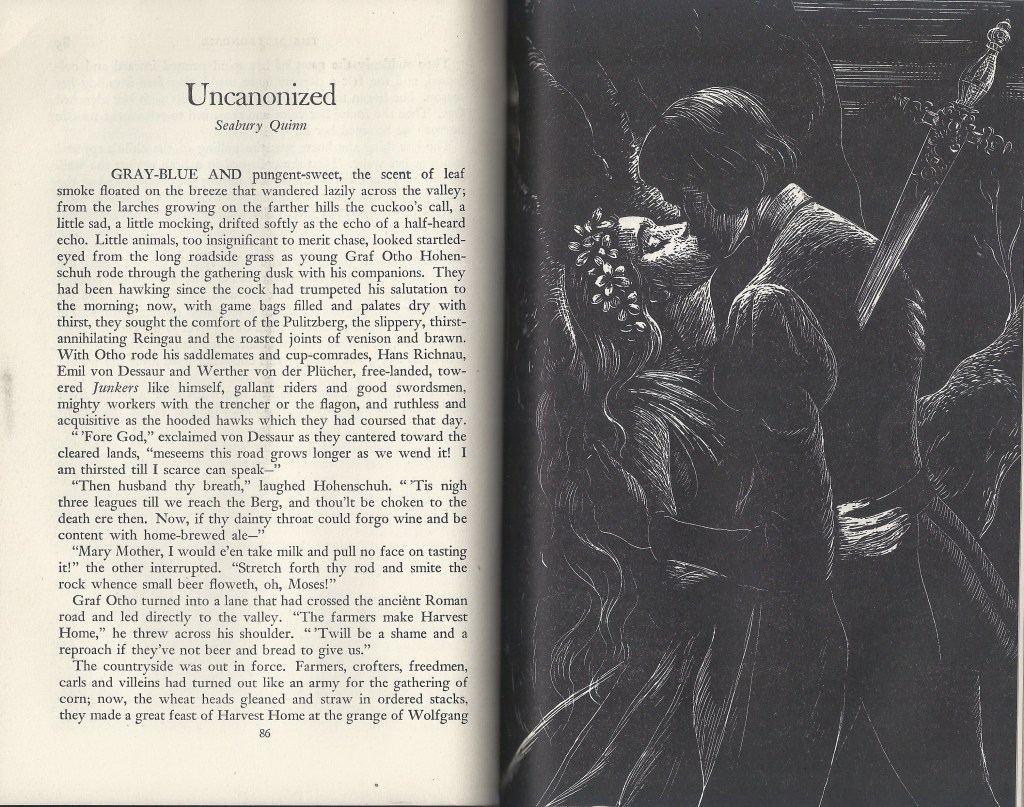
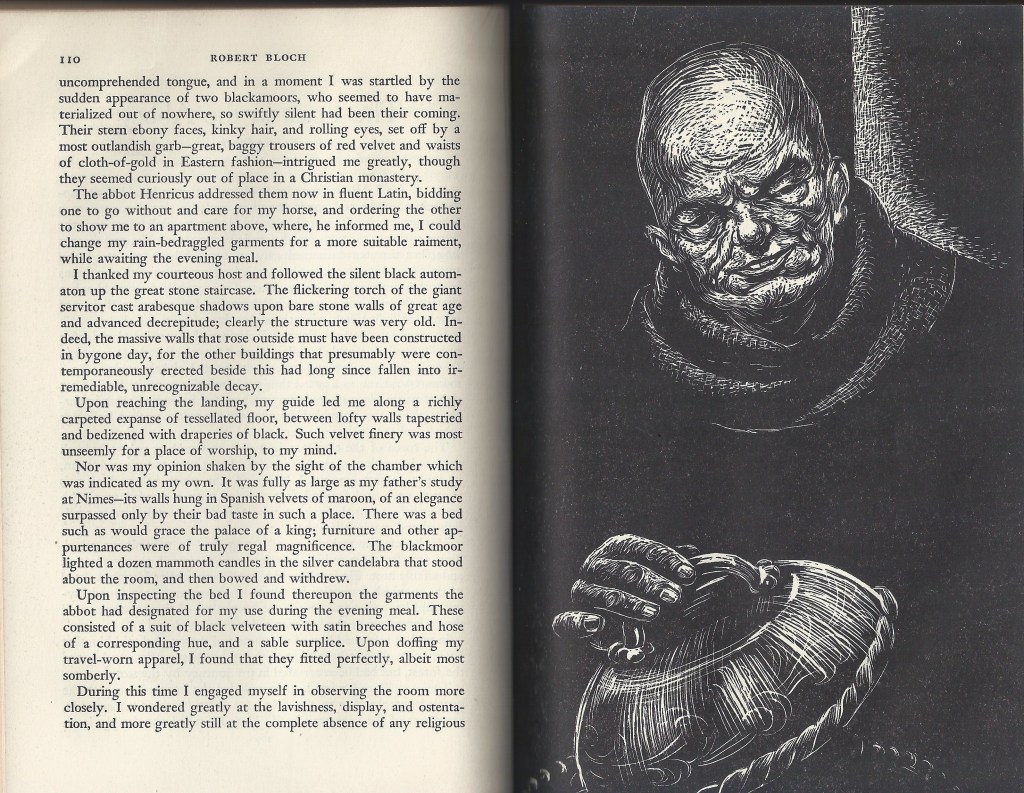
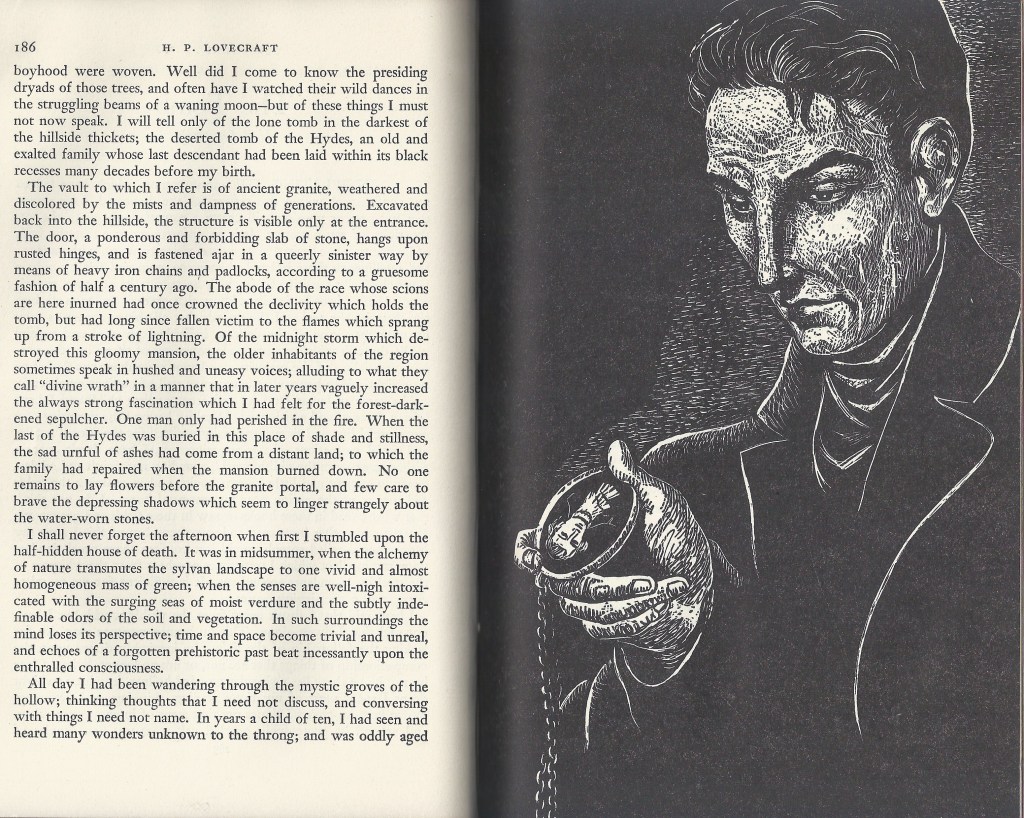
The final thing that sets Blaisdell’s anthology apart is that she illustrated it herself—and many of these scratchboard illustrations are absolutely gorgeous, stark and detailed, similar in some ways to Lynd Ward’s illustrations for The Haunted Omnibus (1937) or Illustration Portfolio No. 1 (1925) by The Arthur Wesley Dow Association, and worth in many ways the price of Tales of the Undead. A few of these, just to give just a taste:

Tales of the Undead is ultimately a monument to both Elinore Blaisdell’s good taste in weird fiction, and her artistic skill and sensibility. She stepped away from the idea of a weird fiction collection as a kind of horrific miscellany and attempted to show the variety and depths of a particular theme—decades before we would get collections like Rivals of Dracula: A Century of Vampire Fiction (1978) or Weird Vampire Tales: 30 Blood-Chilling Stories From The Weird Fiction Puklps (1992). In an era when an avid reader could fill shelves with anthologies specifically about vampires or other specific flavors of the undead, it is important to recognize one of the innovators among the anthologists of her day.


Bobby Derie is the author of Weird Talers: Essays on Robert E. Howard and Others and Sex and the Cthulhu Mythos.

Deep Cuts in a Lovecraftian Vein uses Amazon Associate links. As an Amazon Associate I earn from qualifying purchases.

Editor Spotlight: Interview with Lor Gislason

Content Warning
The story that follows may contain graphic violence and gore.
Please go to the very back of the book for more detailed content warnings.
Beware of spoilers.

Content warning for Lor Gislason’s Inside Out (2022)

While H. P. Lovecraft is most often associated with cosmic horror, and famously declared in his essay “Supernatural Horror in Literature” that weird fiction is more than the “literature of mere physical fear and the mundanely gruesome,” he has also left his slimy, gore-stained fingerprints in the annals of body horror. What is the terror of “Facts Concerning the Late Arthur Jermyn and his Family” and “The Shadow over Innsmouth” except the slow recognition of a biological inheritance that cannot be escaped? Or the hideous degradation and transformation that overcomes the Gardner family in “The Colour Out of Space”?

Yet Lovecraft never embraced body horror as we know it today. That is the product of later generations, a new and different breed. Mutation, infection, decay, surgery, puberty, transition—there are untold variations on how flesh may change, and the question is often not so much who or what the individuals were but what are they becoming—what is the experience like—and how do these stories change as our own understanding of biology and medicine continue to advance? 

Lor Gislason is the editor of Bound in Flesh: An Anthology of Trans Body Horror (2023), and author of works like the body horror novella Inside Out (2022). They were kind enough to answer some of our questions on body horror, cosmic horror, and Lovecraft.

How did you get into body horror?

Lor Gislason: I think in a way it’s always been part of my life; I can remember watching Dragon Ball and seeing Goku transform into a giant monkey when I was around 5. I don’t think I had the words for it, or knew of the genre, until my teens and my first viewing of Hellraiser (1987).

Has writing body horror changed how you relate to it?

LG: If anything it’s made me relate to it more, through research and understanding how the body works. Going through a health crisis (and subsequently using it in my writing) also helped me process the experience.

How did you get into Lovecraft and cosmic horror?

LG: I rented a lot of movies as a teen and one of them was Necronomicon (1993), which is not a particularly great movie, but spurred me to look into Lovecraft’s work and other adaptations. I’m a big fan of cosmic horror video games like Dead Space and Bloodborne.

Do you feel that being you (nonbinary, autistic) has shaped your understanding of Lovecraft and approach to body horror and cosmic horror?

LG: Definitely. There are times I feel hyper-aware of my body, and others where I feel completely disconnected from it and while this can be hard to describe it’s been a running theme throughout my writing. My novella Inside Out is not just about becoming a giant pile of flesh (although that does happen) it’s also about how we struggle to connect with other people, especially physically. 

Joe Koch wrote that “body horror and cosmic horror stand at two opposite ends of a spectrum”—would you agree?

LG: If we consider how cosmic horror uses the mind as a weapon, a prison, an area of change, then it’s the other side of the coin to body horror. There’s a lot of room to play with those concepts. As Joe put it: “The monster is the body. The hero is the mind” in Lovecraft’s stories, often moving beyond flesh and blood to achieve some higher goal—but our mind is a part of our body, isn’t it? Often they’re seen as separate things. I’m sure it’s just a matter of perspective.

Some of your works like The God Carcass seem to try and bridge the aesthetic between body horror and cosmic horror—what were you going for?

LG: I often go into rabbit holes and one of them that led to The God Carcass was whale falls and how an entire ecosystem, and even organisms that exclusively live off whale carcasses exist, just this massive amount of creation and life exploding from something dead. So what if a entity from another plane fell into the ocean? How would that work? I tried to make it a bit fantastical and dreamlike, it’s a bit different from my usual writing but I’m quite happy with it and to be a part of the Ooze anthology.

Tell us about Cosmic Dyke Patrol.

CDP is my current project, which I pitched as a sort of cosmic ghostbusters novella. It follows a lesbian couple named Harriett and Marcy who investigate entities and accidentally invite a particularly aggressive bear-like creature into our world. It’s a bit silly, very queer and hopefully encapsulates the “fun horror” I love so much.

Do you think there is a future for more stories that try to combine Lovecraft or the Mythos with body horror?

LG: Absolutely. There are a lot of Elder Gods (created by HPL or by others) that use body horror to its full extent. The idea of a being that’s so beyond our comprehension, physically or otherwise, is such a fascinating idea. You could do literally anything with that!

You’ve noted a love for 80s horror movies—does that include Lovecraftian films like Re-Animator (1985)?

LG: Yes! Although I might be a bit more attached to From Beyond (1986), if I’m honest. I’m sure many people know how much I love the colour pink! Underwater (2020) was also great, honestly a bit overlooked when it came out. 

How did Bound in Flesh come to be?

LG: This is my favourite story to retell, it’s very “peak internet,” haha. I tweeted something like, oh wouldn’t it be cool if an anthology like this existed? And Max Booth III of Ghoulish Books sent me a DM, saying basically “okay but what if that did exist, would you want to work on it?” It was a joy to work on, and I still feel extremely lucky to have been given the opportunity.

Do you feel that transgender characters are often depicted poorly or negatively in horror fiction?

LG: This is interesting because while some would consider many trans characters in horror as bad representation, or portrayed negatively, many others take pride and strength from those depictions, reclaiming it as part of our history. Like Angela from Sleepaway Camp (1983) is iconic and was meant to be this horrifying reveal, but I know many people who love and relate to her. Likewise, queer-coded villains have been a trope for ages, and embracing these messy, imperfect characters can be really empowering.

In the introduction to Bound in Flesh, you describe these as stories of “transformation, acceptance, growth, and gore”—would you characterize these stories as transpositive tales of horror?

LG: Even though many of the stories have what you’d consider “unhappy endings,” I think they are positive. It’s the writers speaking their truths, as corny as that sounds. Pushing through to the other side, no matter what that brings, it’s very hopeful in my mind. I originally planned this super long introduction, with a lot of reflection on gender and body horror but it felt unnatural in the end, like the book said all it needed to without me rambling on top of it. 

Do you feel there is a lot of diversity in the folks writing and reading horror fiction these days?

LG: In some ways, yes, and others, it’s still very much a boys club. I think for a lot of people they just don’t know where to start looking for books by trans authors, or neurodiverse authors, and other marginalised groups. So by having anthologies like Bound In Flesh the hope is we can get the word out there that this does exist and that there is a place for everyone in horror.

What do you see as the future of body horror and cosmic horror?

LG: I think right now there’s a great trend of small, narrative experiences in video games using cosmic/body horror, something that feels very specific to that medium and I hope to see it continue. Developing games is a lot more accessible now too, so the amount and variety of storytellers is expanding. I’d love to work on a game someday.

Thank you Lor for answering all of these questions, and for a chance to pick your brains about body horror and cosmic horror! Looking forward to seeing more from you in the future.

For more on Lor Gislason, check out their Linktree

Bound in Flesh (2023) is available from Ghoulish Books.


Bobby Derie is the author of Weird Talers: Essays on Robert E. Howard & Others (2019) and Sex and the Cthulhu Mythos (2014).
Deep Cuts in a Lovecraftian Vein uses Amazon Associate links. As an Amazon Associate I earn from qualifying purchases.

Editor Spotlight: Interview with Lisa Morton

We were there from the start. […] Like all Lovecraftians, I’m interested in the past. In traditions. Women have their own literary tradition to reclaim in the Mythos, and I hope to see more of us doing so in future anthologies and collections.

Ann K. Schwader, “Reclaiming the Tradition,” Strange Shadows & Alien Stars vii-viii

Women have always been a part of the weird fiction tradition, a fact recognized by Lovecraft and his contemporaries, yet many of the authors of supernatural fiction of the 19th and early 20th century have been overlooked by anthologists and collectors. Two works that go a fair way to addressing that gap are Weird Women: Classic Supernatural Fiction by Groundbreaking Female Writers: 1852-1923 (2021) and its sequel Weird Women: Volume 2: 1840-1925 (2022), edited by Lisa Morton and Leslie Klinger. Together, these two volumes reprint works by women authors both popular and obscure—and represent the kind of weird works by women that Lovecraft and his contemporaries would have read.

Author and editor Lisa Morton has been good enough to answer a few questions regarding these books, how they came to be, and her thoughts of co-editing two volumes of Weird Women:

How did Weird Women come to be?

Lisa Morton: My editing partner Les Klinger and I had done one book together (Ghost Stories: Classic Tales of Horror and Suspense, published by Pegasus Books in 2019), and we were looking for a next book together. Les was traveling back east and met up with a friend who had recently curated a library exhibition called “Weird Women”, so he brought up the idea of us doing a book of that title. Needless to say, I was on board with that instantly!

What was the reaction to Weird Women? Was there any pushback about publishing an anthology of weird fiction by women?

LM: Thankfully, no. Our publisher (Pegasus again) loved the idea, and the reviews were wonderfully gratifying. It came out a short time after Lisa Kröger and Melanie R. Anderson’s Monster, She Wrote: The Women Who Pioneered Horror and Speculative Fiction, so it seemed like the time was ripe for readers to explore these authors who had been unjustly shoved to the back of the literary shelves.

In the introduction to the first volume of Weird Women, you noted that you could only publish “less than half of those we loved”—did the other half make it into the second volume, or was there a different selection process for the second volume?

LM: Yes, many of them did make it into that second volume! We continued to read for Volume 2, though, so I think there were a few that still didn’t make the cut as we found things we liked more. One we ended up not using after considering it for both volumes was “The Weird of the Walfords” by Louisa Baldwin; instead, we put it on our book’s website so we could still share it, with the caveat that it does indeed depend upon some…ahem…rather purple prose. It can be found here: https://lisamorton.com/blog/the-weird-of-the-walfords-by-louisa-baldwin/

Most of the selections for Weird Women and its sequel are from before 1923—which is when Weird Tales began publication. Was it a deliberate choice to exclude women pulp authors from consideration, or did they just not make the cut?

LM: Actually neither. It was instead a purely business/legal reason: we had no budget to pay for stories, so we used only works that we knew were in the public domain. However, Les—who is an attorney by profession and is knowledgeable about copyright issues—started researching the status of stories used in Weird Tales, and ended up finding out that many had fallen out of copyright. That revelation came too late for us to use any of those works in either of the Weird Women volumes, but we did use “The Laughing Thing” by G. G. Pendarves to close out our last book, Haunted Tales: Classic Stories of Ghosts and the Supernatural (which just came out in August of this year). 

When making selections for Weird Women, did you make a deliberate choice to avoid more popular stories? I notice “The Giant Wistaria” by Charlotte Perkins Gilman was selected rather than “The Yellow Wallpaper,” for instance.

LM: Yes. For all of our books, we have occasionally ruled out stories that we thought have been widely available in a variety of forms. “The Yellow Wallpaper” has really never gone out of print, and is widely taught in schools, so we thought many readers would already know it…but how many would know that the author wrote other works of horror as well? 

“Spunk” by Zora Neale Hurston is the only story by a woman of color in the two volumes; how do you feel race and gender intersect when it came to publishing weird fiction in the past?

LM: Les and I have often talked about how we would love to do an anthology gathering early weird fiction by diverse authors, but…it’s just simply not there. An argument could be made for some of the women we included in our books being LGBTQ+—the immensely popular Marie Corelli, for instance, spent most of her life living with a female companion who she even dedicated some of her books to—but of course very few LGBTQ+ persons were open about their sexuality back then, so we can’t even know for sure in those cases. We tried to find nineteenth-century Black writers of weird/supernatural work, and, although perhaps some wrote under pseudonyms, we just couldn’t come up with any. It’s not until the early twentieth century (“Spunk” was first published in 1925) that we start to see authors of color openly producing works of weird short fiction. 

In the introduction to the first volume of Weird Women, you mention Lovecraft’s “Supernatural Horror in Literature”—do you think his essay has strongly influenced how women weird fiction writers were read and received?

LM: It’s an undeniably influential piece on the genre as a whole. Although it wasn’t technically the first study of the genre, it’s the one that’s been reprinted the most and has led many readers to discover the works of the authors he discusses. I remember first reading it when I was a teenager, and I recall immediately seeking out a few of the authors (especially M. R. James) that Lovecraft writes about.

You partnered with Leslie Klinger to edit the two volumes of Weird Women. How would you describe your working relationship? What did you both bring to the task?

LM: Les and I have been friends for a long time—we both live in the Los Angeles area and we’ve both done a lot of work with the Horror Writers Association. We are also big fans of each other’s work. After I’d written my non-fiction book Ghosts: A Haunted History, we were having lunch or something one day when Les almost off-handedly brought up the idea that we should do an anthology of classic ghost stories together, and that was an easy “yes!” from me. We have a great deal of fun putting together these books; we both read like crazy and make lists of things we like and then talk them over. We occasionally go back and forth on which stories to include, but our tastes are similar enough that we usually come to an agreement quickly. I write the first draft of the main introduction, Les tends to write the first draft of a lot of the individual story introductions, we both take a pass on the annotations, and then we trade off and do our own passes on each other’s work. 

A few of the stories in Weird Women have Lovecraftian connections—Lovecraft had read and commented on “The Were-Wolf” by Clemence Housman and “The Wind in the Rose-Bush” by Mary E. Wilkins Freeman. Was this deliberate, or just coincidence?

LM: I think we found “The Were-Wolf” via Lovecraft, but otherwise it was coincidence. We actually read a number of stories by Mary E. Wilkins Freeman before deciding on “The Wind in the Rose-Bush.” I should perhaps mention another interesting connection Freeman has to Lovecraft: his first book publisher, Arkham House, also kept interest in Freeman’s work alive with their 1974 collection of her Collected Ghost Stories.

“They were writing tales of cosmic horror half a century before Lovecraft ever put pen to paper”—do you think Lovecraft’s prominence in weird fiction discourse has disguised the role women have played in the field?

LM: I suspect there are other reasons these women got lost. My own theory is that very few of the women authors of the nineteenth century wrote only in the supernatural/weird genre; back then genre wasn’t the marketing tool that it is now, and most authors wrote in a wide array of genres. What that means is that when these authors brought out collections, there might be one ghost story and a dozen non-horror pieces; compare that to, say, M. R. James, who could produce an entire collection of just ghost stories. We remember James in large part because of his seminal collection Ghost Stories of an Antiquary; but we’re less likely to know Dinah Mulock’s collection Nothing New, because it contains only one ghost story (“M. Anastasius”).

What is your opinion of women occultists who also wrote fiction like Dion Fortune and Helena Blavatsky?

LM: I confess to being not a huge fan of Blavatsky’s fiction. Fortune we never considered because her fiction is likely still under copyright (although I do enjoy her work). We did use fiction by a few Spiritualists—Marie Corelli and Florence Marryat come to mind immediately.

While not all of the stories in Weird Women have female protagonists, do you think these stories as a whole reflect women’s contemporary interests and concerns?

LM: Many absolutely do. One of my favorite stories in either volume is “The Dream Baby” by Olivia Howard Dunbar, which is about two women living together who end up centering their lives around a non-existent baby one of them dreams about nightly. The story, which dates to 1904, not only describes the pressures that single women experienced in those days, it also tells us how difficult other parts of life were then—it comes to a head during a heat wave, which of course in those days was a catastrophic event that led to many deaths. Many of the stories, in fact, deal with children in some way, because certainly children were a key part of the lives of women, whether they were mothers, nannies, or women who were defying society’s expectations of them. It’s also interesting how many of these stories show women in the role of domestic servant, something you don’t find often in weird fiction by men; being a domestic was one of the few occupations available to poorer, unmarried women in the nineteenth-century, after all. 

In the introduction to the second volume, it is noted “parts of these stories may be difficult for modern readers to swallow” because of depictions of prejudice, class consciousness, Colonialism, and misogyny—do you think a “warts and all” approach to historical fiction is necessary?

LM: Yes, I absolutely do. For one thing, reading the attitudes that we now consider ugly in these stories help us to understand the history that leads to where we are now. I don’t believe in censorship so I would never edit those uncomfortable parts out, but we can certainly annotate or comment on them in the text. 

There have been several other reprint anthologies lately focusing on women authors of weird fiction, including Women’s Weird (2019) and The Women of Weird Tales (2020)—do you think there’s an impetus now to rediscover women’s role in the history of weird fiction?

LM: I think there’s an impetus to discover the roles of all kinds of authors who were marginalized in the past, and that’s fantastic! 

Besides being an editor, you’ve written a good bit of Lovecraftian fiction yourself. What draws you to write it?

LM: I discovered Lovecraft as a teenager, and the best of his work was very influential on me. I loved not just the Mythos stories, but those odd little sketches like “The Picture in the House” and “The Outsider.” I think sometimes his skills for things like creating characters get lost in the analysis of his use of cosmic horror. He also crafted a very distinct version of New England that probably taught me a little about how to transform your home area into horror (I’ve used my native Southern California in many of my stories). 

In terms of me writing Lovecraftian fiction, I owe a considerable chunk of that to editor Stephen Jones, who invited me to contribute to the three “mosaic” novels in his series The Lovecraft Squad. I really enjoyed writing for that series, which forced me to study Lovecraft’s works and re-imagine them within the context of Steve’s series (which, for those who don’t know, proposed that Lovecraft was actually writing non-fiction and a secret division of the FBI was set up to monitor the activities of the Elder Gods). 

Has writing Lovecraftian fiction changed how you relate to Lovecraft and his fiction?

LM: It probably made me examine some of his techniques more closely, although I was already fairly knowledgeable about all that.

From your experience, do women who write weird fiction today face the same prejudices and difficulties as they have in the past?

LM: Welllll…first, I’ll offer up what might be a shocking opinion: women writers of the nineteenth century actually had one major advantage over contemporary writers in that they could make a living from writing just short stories. When we were putting Weird Women together and researching these writers, I was astonished to discover how many had turned to writing as a reasonable way to make a living, usually after a father or spouse had died and they had to support themselves and perhaps a family. I’m sure, of course, that there were plenty of women who tried writing as a vocation and did not succeed, but even so…can you imagine today suddenly being forced to support yourself and saying, “I’ll write short stories”? That also speaks to the fact that works by women back then were welcomed by most editors.

Compare that to when I first started writing fiction in the early 1990s; it wasn’t at all uncommon to see anthologies and magazines come out without a single female contributor, and that had been the case for a while. In the 1980s there some remarkable women authors who came into the horror field and led the way for the rest of us—Nancy Collins, Nancy Holder, Roberta Lannes, Elizabeth Massie, and of course Anne Rice all come immediately to mind. Now, since the 2000s arrived, it’s thankfully become that rare book that offers little or no work by women writers. 

And of course it would be disingenuous of me not to note that contemporary women writers certainly do have some obvious advantages over their peers of the past: they don’t have to add a “Mrs.” before their byline, for example, or publish anonymously…although I know many writers now who still prefer to employ gender-free initials for their name.

While editors don’t play favorites—what’s your favorite story from Weird Women and why?

LM: Oh my goodness…there are so many that I love for different reasons, whether it’s Harriet Beecher Stowe’s delicious use of folklore in “The Ghost in the Mill” or the rich southwestern desert setting of Mary Austin’s “The Pocket-Hunter’s Story” or the beautiful melancholy of the afore-mentioned “The Dream Baby” by Olivia Howard Dunbar…but in the end I think I have to go with Mary Elizabeth Braddon’s “Good Lady Ducayne.” I’ve become a real fan of Braddon’s work; her dialogue is often peppered with enough sass to make her characters easily relatable, and I really love all the interpersonal relationships in “Good Lady Ducayne,” especially that between the young heroine and the elderly woman she’s hired as a companion to. It also has a wonderful sense of building dread as the heroine begins to suffer a mysterious decline. 

Here’s a funny story about its appearance in Weird Women 2: we’d actually wanted to use it in the first volume, but it’s really a novella and was too long to fit. When we got the deal to do Volume 2, I think the first thing I said to Les was, “We’re using ‘Good Lady Ducayne’!”

Thank you Lisa Morton for answering these questions, and I hope we see more from you in the future.

To find more of her work, check out https://lisamorton.com/ and Lisa Morton’s author page on Amazon: https://www.amazon.com/Lisa-Morton/e/B001JRZ8NC


Bobby Derie is the author of Weird Talers: Essays on Robert E. Howard and Others and Sex and the Cthulhu Mythos.

Deep Cuts in a Lovecraftian Vein uses Amazon Associate links. As an Amazon Associate I earn from qualifying purchases.

Editor Spotlight: Interview with Oliver Brackenbury of New Edge Sword and Sorcery Magazine

New Edge Sword & Sorcery is an upcoming magazine which hopes to showcase not just the sword & sorcery fiction of yesteryear, but what sword & sorcery can be. Editor Oliver Brackenbury has been kind enough to answer a few questions for us about what New Edge is, the new magazine, and their approach to editing. One note before we begin:

Oliver Brackenbury: Up front I want to stress that when I’m discussing my attitudes and methods in this interview, discussing them is all I’m doing. I’ve been reminded lately how easily this can come off as a critique of others, or my suggesting there is only one correct attitude and approach. If people take something valuable from what I say, great, but I’m not being prescriptive here.

What is the one-sentence pitch for New Edge Sword & Sorcery Magazine?

OB: New Edge Sword & Sorcery magazine will feature brand new sword & sorcery short stories as well as intriguing non-fiction related to the genre’s past, present, and future!”

If I can be cheeky and slip in a second sentence, this is our definition of the idea of New Edge Sword & Sorcery, which informs everything done within the magazine:

“New Edge Sword & Sorcery takes the genre’s virtues of its outsider protagonists, thrilling energy, wondrous weirdness, and a large body of classic tales, then alloys inclusivity, mutual creator support, a positive fan community, and enthusiastic promotion of new works into the mix.”

What are your favorite classic Sword & Sorcery stories and why?

OB: Ah, that’s a tough one! I’ll limit myself to three tales, with the caveat that on any given day I might slot one out and slot another in.

Going back to the big man himself, “People of the Black Circle” is my favorite Conan tale.While I suspect Howard had stage plays in mind, if any other storytelling medium, this is hands down the most cinematic of his tales—that pacing!—and as a screenwriter I appreciate that. Nobody in the story is without compelling motivation or some kind of arc, not even Conan’s “mad Afghulis” who lack individual names but are given great purpose and entertaining turns as their loyalty to Conan understandably wavers. The way Conan and Devi Yasmina part on terms of mutual respect, admiration, and competition is a moment I am absolutely chasing in my own writing, I enjoy it so much, and the strong thematic backbone to the tale, the classic “personal desire vs responsibility to others”, is explored with great skill.

C.L. Moore’s “Black God’s Kiss” deserves its excellent reputation, and it deserves to be more broadly known. Moore’s dreamland of an underworld is gripping, as is the emotional throughline of Jirel’s seeking revenge for that forced “kiss”, and the imagery—oh that imagery! The Ace Fantasy edition’s cover, by Stephen Hickman, with the blind horses galloping, fleeing, flowing around Jirel is the only one for me.

My third choice is “Ring of Black Stone” by Pat McIntosh—and really all five Thula tales in total. Bloody shame they haven’t been collected yet, you can only read them one at a time across the first five of Carter’s The Year’s Best Fantasy Stories anthologies. McIntosh’s war-maid protagonist, Thula, reminds me a little of Russ’s Alyx the pick-lock, both seemingly straightforward characters who reveal intriguing depths while inferring even greater ones, with seemingly simple motivations which you often realize are different than what they’re telling everyone, and who show a great deal more evolution in a few short tales than some S&S protagonists do in their whole careers, yet are still sufficiently recognizable as the person you started with—maybe she hasn’t really changed at all, maybe you’ve just gotten to know Thula better! I find myself thinking back on these stories often, Ring in particular for its touching tale about finding new family through tragedy, and the riot of feelings that entails.

Finally, I’ll give an honorable mention for Leiber’s “Lean Times in Lankhmar,” whose climax got the biggest laugh out of me S&S has managed so far.

In your guest post on Scott Oden’s blog discussing New Edge as a mode or evolution of Sword & Sorcery fiction, you emphasize “inclusivity.” What does that mean in the context of the stories and writers you’re looking to publish?

OB: What inclusivity means to me is making sure that people outside my own demographic—white, cishet, neurotypical, able-bodied males, or just “white guys” as, for the sake of brevity, I’ll use going forward—can see themselves in both the stories and the authors creating them, ideally making them feel welcome within the community. This is key for expanding the audience of our beloved fantasy sub-genre, as well as its pool of authors.

I’ve gained firsthand experience with this in my six years volunteering with a group dedicated to promoting the western Hemisphere’s largest publicly accessible speculative fiction genre archive—The Merril Collection. Through no malice of anyone involved, in the time I’ve been with them, our group has been made up almost or entirely of white people. Our selling old paperbacks to help raise funds would often combine with 20th century publishing trends to create the scene of a couple of white people sitting behind event tables coated in covers featuring white characters written by white authors, trying to encourage the full breadth of humanity to spend a few dollars in support of the collection, while hearing our pitch for it.

All that sameness was a significant obstacle to achieving our goals, as more than one non-white individual made clear when—quite reasonably—saying “I only see white faces here.” or “I don’t see myself in what you are doing.”

Even coming back to myself, I don’t hate my fellow white guys any more than I hate IPAs, but I get frustrated when the vast majority of shelf space is filled with the same thing, whether it’s beer or writerly perspectives. All of this has informed the approach I’m taking with the stories and authors I’m looking to publish.

Would you characterize New Edge as a reaction to the real or perceived lack of diversity in Sword & Sorcery fiction written by Robert E. Howard and others?

OB: In part, absolutely yes. Keeping in mind I can only speak for myself and the magazine I run, not the nascent “movement” which roared to life back in the spring of this year, I would say that is a significant part of the appeal, as well as its reason for being.

This does not mean burning down all that came before. Again, I’ve been a volunteer promoting a speculative fiction archive for six years! “We still study the art of Ancient Greece, yet we have ceased to wipe our behinds with small stones,” is my glib way of stating how I feel about studying the art that came before us, for all the old or objectionable attitudes which it may contain.

But whether looking through the canon or glancing around at the contemporary fan & creator community, I mostly see faces like my own. I think changing this not through exclusion, but through greater inclusion, is vital to increasing the popularity & longevity of sword & sorcery.

What do you think of Howard’s women warriors in his Sword & Sorcery tales such as Valeria of the Red Brotherhood (“Red Nails”) and Bêlit (“The Queen of the Black Coast”)?

OB: Dig’em both, including the stories. Like many others—judging by the number of additional adventures she’s had in various comics over the decades—I wish Bêlit had gotten to do more before dying in service of Conan’s story. I feel similarly with Valeria, an overall badass character who didn’t die but did end up chained to an altar so Conan could rescue her. It’s little surprise others have gone on to write more stories with her as well.

Clearly Howard succeeded in creating highly compelling women warrior characters, and I’ve enjoyed all the tales containing them. However, understandably for the period, they are often crafted as a kind of novelty—it’s right there in the title of “Sword Woman”—and one of the ways we can build on what Howard accomplished is by creating proactive, highly capable female characters for whom their gender is not a defining feature, or—as in the case with the 1970’s version of Red Sonja—requiring some kind of supernatural explanation for their skill & toughness. I think this is pretty much the norm these days, but it’s worth keeping in mind.

You specifically mention “Carbon Copy Conans”—do you think that it was authors who followed Howard in creating new Conan stories perpetuated some of the stereotypes of race, sex, and gender in Sword & Sorcery?

OB: Not all of them, but going by what I’ve seen of them so far, yeah, absolutely. Whether authoring direct Conan pastiche or writing a Conan-by-another-name, some of those works are very much surface reproductions of what Howard did, focusing on whatever the author was attracted to—and I think some of those second wave S&S guys writing this stuff in the 70’s, 80’s and even 90’s were attracted to the old fashioned attitudes of the 30’s.

This treatment also served to perpetuate the idea that there were no deeper notions behind Howard’s work. Not as damaging as focusing on and magnifying bigoted attitudes, but also a shame.

Much of Sword & Sorcery takes place within a quasi-medieval European setting; do you think that is essential to what makes Sword & Sorcery distinct from, say, Sword & Planet or historical fantasy fiction?

OB: Thanks to there being some pretty consistent storytelling conventions within sword & sorcery, excellently laid out by Brian Murphy in his book Flame & Crimson: A History of Sword & Sorcery, I feel safe saying that a quasi-medieval European setting isn’t strictly necessary. Certainly the “European” part isn’t mandatory, as authors like Saunders and Dariel Quiogue have demonstrated with great skill.

In terms of the era, I think once you’re past the point of flintlock showing up you’ve kind of hit your limits—it’s hardly sword & sorcery if nobody uses swords anymore. That said, part of my great love of the genre is that it can be oh so many things, and still be clearly recognizable as sword & sorcery. We may enjoy sub-sub-headings like Sword & Planet, Sword & Soul, Sword & Silk…but it’s all part of one big happy family, to me.

You mentioned Dungeons & Dragons as well. How does tabletop roleplaying gaming (TTRPG) influence New Edge?

OB: Well I do love me some TTRPG action, in particular Dungeon Crawl Classics and the Call of Cthulhu spin-off setting, Delta Green. That said, RPGs don’t influence NESS a whole lot beyond my having aggressively dug through Gygax’s increasingly well-known Appendix N Reading List, and finding myself mostly preferring the less highly codified fantasy which came before D&D blew up in the early 80’s.

It seems since then that while variations often occur, at the end of the day most fantasy authors—certainly those rooting their work in Western myth & folklore—like to play with the same demihuman races and creatures you’ll find in one monster manual or another. Outside of a game with its need for rules & definitions, why would you ever standardize the fantastic? It feels counter-intuitive to me, thus my love of the far less predictable, weird and wonderful fantastic elements you’ll find in sword & sorcery, past and present.

It’s fair to say this attitude influences my developmental editing when working with authors writing for the magazine, and will continue to do so moving forward. If there’s a classic fantasy creature in a story I publish, it’s likely because the author made an incredible case for it in their story, and/or it works because of how it deviates from what the creature’s name makes you expect. So yeah, I’d say that’s the main influence of D&D on the magazine thus far.

The field has changed a good deal from the Sword & Sorcery boom of the 1980s and 1990s. If Karl Wagner was alive and sent you a Kane story, or Jessica Amanda Salmonson sent you a Tomoe Gozen or Amazon story, would those have a place in New Edge?

OB: I confess I’ve not read Salmonson’s Gozen or Amazon tales yet, though they are high on my TBR list. That said, I imagine I’d review them the same as I have, say, Bryn Hammond’s tale in NESS #0 and decide accordingly. I gather Salmonson was something of a scholar on medieval Japan but, as I say, I need to read more by and regarding her.

Luckily I have read all the Kane novels and several of the stories. While I can see my own personal taste causing me to request any explicit descriptions of sexual violence be minimized,  I’d still potentially publish a story like “Cold Light,” where such violence illustrates character, while—as I recall—not being designed to titilate. Maybe I’d put a content warning on the first page, I confess I’m still deciding where I sit on such things.

But yes, despicable, villainous characters such as Kane absolutely have a home in New Edge Sword & Sorcery. Including challenging topics doesn’t equal endorsing them, and one of the purposes of literature is to explore difficult themes & ideas. As ever, skill and thoughtfulness make all the difference.

Women have written Sword & Sorcery too, from C. L. Moore’s Jirel of Joiry to Joanna Russ’ Alyx; how do these authors and their creations fit into your conception of New Edge?

OB: My opinion is that they are to be enthusiastically studied and promoted. I shan’t be ignoring the men of the genre’s history, however I can’t see myself rushing to publish profiles on the most frequently discussed fellas, like Howard or Leiber. Cora Buhlert is contributing a great profile of C.L. Moore to issue #0, which I hope will serve as a useful introduction to both the author and her most well-known creation. Joanna Russ, Pat McIntosh, and Jessica Amanda Salmonson are on my wish list for future profiles, as well as editors like Cele Goldsmith Lalli, who saved Fafhrd and Gray Mouser from oblivion, discovered Roger Zelazny, and published S&S when no one else did.

Another evolution of Sword & Sorcery that is aimed at greater diversity is Sword & Soul, as exemplified by Charles Saunders’ Imaro and Milton Davis’ Griots stories. How does New Edge relate to Sword & Soul? 

OB: It actively celebrates and promotes it! Issue #0 features a sword & soul tale by J.M. Clarke, I’ve already reached out to Milton Davis about his writing an author profile on Charles Saunders for a future issue, and have been in touch with a second sword & soul author about contributing a story to either issue #1 or 2, should our crowdfunding campaign for more issues succeed.

This also brings me to an important point, since sword & soul clearly predates New Edge S&S—whether the idea or the magazine of the same name, New Edge Swordy & Sorcery isn’t claiming to have invented the idea of diversity/equity/inclusion in S&S. What it does is add to diversity, equity, & inclusion in S&S, purposefully and with great vigor, while providing a rallying banner the various scattered parties already engaged in this work can choose to unite behind.

“What about [this person] who’s already doing [this thing related to more diverse S&S]?” I’ve heard one or two people say, and my response is always “They’re great, I dig what they’ve been doing, and maybe we’ll work together one day.” It’s not a zero sum game, or any other kind of competition, it’s a collective endeavor.

Many speculative fiction magazines in the past have had an issue with lack of diversity among the authors; it wasn’t unusual even well into the 90s for every author to be white, male, and heterosexual, and the contents of those magazines tended to reflect that. How do you as an editor plan to ensure the diversity of your magazine?

OB: Hell, you still see it today, now and then, or perhaps you see a ToC that’s all white guys but for one or two white women tacked on. Let’s be wary of thinking these issues are done and dusted.

My current plan to ensure diversity in the magazine is by being intentional about the authors whose work I solicit. I’m not doing subs, yet, and I suppose when I get there I’ll have to think about how to handle that. For now I’m limiting the number of white guys I publish in any given issue to one or two, out of six authors total.

Why the limit? Why not just focus on good stories?

Because if you are trying to effect positive change to the current status quo of homogeneity, as I am, then simply focusing on good stories isn’t enough. It ain’t shabby, there are far worse approaches, but it won’t do the trick.

This is because even if you request submissions without names on them, you are only being mindful of things on your end. The world in which your magazine exists, from which those stories are submitted, is not a meritocracy. It is a wildly uneven place where issues of race, gender, class, etc all affect who can even get to a place where they can tell good stories, and who feel welcome participating in any given literary scene. 

The latter is not necessarily because you personally have done anything to make them feel unwelcome, but because the scene as a whole looks extremely white guy-centric and doesn’t seem to be putting off enough signals like “Hey, come on over, you’re welcome here”.  Therefore, regardless of how pure your motives, as an editor you will likely, unintentionally replicate the demographic homogeneity of the scene in your ToC if you aren’t at least somewhat intentional about trying to compensate for this wildly uneven world we all live in, by making a point of spreading around the love, so to speak.

So diversity is a substitute for good stories then?

No. Good stories are assumed. If you’re in the magazine, it’s because I thought you told a good story. This can be a master of their craft, or it can be an emerging talent with promise that I want to support through publication/promotion/payment, but either way nothing has been substituted for a good story. Inclusion is a parallel concern of mine. Beware false choices, folks!

Along similar lines, I’m choosing to have a very clear, concise inclusion statement in the magazine. If the magazine is a restaurant then the inclusion statement isn’t the big neon sign on the roof that says “Burgers!” that brings you in off the highway, that’s the original fiction, non-fiction, and art. The inclusion statement is the wee sticker in the window, near the door, letting you know the appropriate government agency has made sure there isn’t any vermin in the kitchen.

Clearly stating “NOT WELCOME: People who think some humans are less than human because of what kind of human they are,” you know, no hate and no harassment please, has value. This is because for people other than white guys, the risks of entering or participating in the wrong fan community are higher, whether it’s tripping over posts laden with racial slurs & dog whistles, or being harassed for being a woman, and so on. 

Unambiguously letting people know that sort of thing isn’t welcome—and demonstrating as such through your actions—helps expand the pool of people who’ll submit to the magazine, read the magazine, engage with our social media community, and participate in the sword & sorcery scene in general.

One of the criticisms of Sword & Sorcery fiction is cultural appropriation and the misuse and misrepresentation of BIPOC by white authors. Is New Edge Sword & Sorcery Magazine looking for sensitivity readers to guard against that, or how do you plan to handle such issues if they come up?

OB: In regards to appropriation, the first thing I like to do is look at the author’s knowledge base. For example, Bryn Hammond will have a story in issue #0 that is in part based on historical / medieval Tangut culture specifically, and edge-of-steppe/steppe culture in general. Bryn is a white Australian woman, by no means of these cultures.

However she is an accomplished scholar of the steppe, published and well-reviewed, who has written a few blog posts about racism towards steppe cultures in SF and other popular media, as well as in popular and academic history books, and someone I know well enough to feel comfortable judging a considerate, thoughtful person. As I reviewed her story I saw only a deep respect and love for her real life historical inspiration, nary a whiff of “Look at this weird shit! How exotic.” And thus, I not only feel comfortable publishing her tale, I’m excited to see what people think of it.

I can see sensitivity readers being a tool I turn to, however indie publishing isn’t known for being highly lucrative, so I’ll have to see what I can accomplish within budgetary limits.

If, despite my best efforts, readers bring up issues of appropriation, then my plan is simple – I will listen, perhaps cross-reference with others more knowledgeable than myself, and adjust my methods for future issues accordingly.

Charles Saunders in his essay “Die Black Dog! A Look At Racism In Fantasy Literature” emphasized his dislike of tokenism in fantasy (“Who needs black hobbits?”)—do you agree with that?

OB: Well, as young Saunders said in that section of the essay “…it is better to be ignored than maligned.” , and I can also see why in 2011, looking back, Saunders said “…I was, perhaps simply venting my anger and frustration…”, though certainly young Saunders had plenty to be angry about, for good reason.

But yes, “maligned”. Tokenism is to malign others through the practice of making only a perfunctory or symbolic effort at inclusion. So to me it sounds more like Saunders was wary of having white writers include black characters because when they did, they were racist caricatures, and he’d rather they just be left out altogether. Fair!

Do I agree? As a white guy, I don’t think it’s really up for me to agree or disagree as it doesn’t affect me much, if at all. In terms of the magazine, certainly I will be doing my best to avoid tokenism in the stories I publish.

You’re working on a New Edge novel yourself. How do you as a writer work to put your ideas on inclusivity into practice?

OB: Being mindful as I can (ex. “Am I describing all the female characters in this chapter by how attractive they are?”), doing research, and, when it feels necessary, reaching out. “Necessary” being kind of a gut feeling based on how far I’m wandering from portraying someone like myself or a secondary world culture rooted in Western European history. 

For example, there’s an important character present for a good chunk of the novel that is bigender. There’s a great deal more to who they are, and making sure characters are never just “The [X] character” is another thing I’m doing, but that’s the relevant aspect for what we’re talking about here.

I’ve never felt any doubts about my gender identity, nor have I ever felt it fluctuate or like it’s on a gradient, so this was going far off from where I stand, demographically. I figured I should do more than read the Wikipedia article, you know?

So I decided to reach out to an online community, over at r/bigender, by explaining who I am, what I’m doing, the context of the character, and so forth, while also making it clear I was interested in hearing from as many people as were comfortable answering my questions. It was an immensely useful experience, both for my writing the character and just for better understanding my fellow humans.

I offered a little compensation for bigender members of the forum who provided me with useful advice, and was touched that none of the advice-givers felt that was necessary. Still, I’m glad I offered, as I strongly believe authors need to be mindful when asking for what amounts to unpaid research labour, especially when it relates to something as personal as identity.

Down the road I may seek a bigender sensitivity reader for the stories featuring that character. We’ll have to see what I can do within the limits of budget and opportunity. In terms of beta readers in general I’ll also try to make sure they aren’t all white guys, since that will help potentially catch issues that I’d not even think to look for.

Which brings me to an always salient point—doing this kind of stuff isn’t just about being thoughtful regarding the experience of your potential readers, it makes your work better.

As an editor, you must have a pretty decent grasp of the field. What writers would you recommend for readers who want to read new Sword & Sorcery fiction, and why?

OB: I always make people nervous when I ask for reading recommendations during my interviews hosting Unknown Worlds of the Merril Collection…and now I’m finally put in the hotseat! With the caveat that of course I can’t list everyone here who I’d like to, I’d recommend…

  • The Red Man and Others by Angeline B. Adams and Remco Van Straten
    I read this book, then bought two extra copies to give to friends. Early in my path through the genre, this book made me feel hope that sword & sorcery has a future beyond rehashes of its past, that it can expand and grow while still being recognizable. For more detail, here’s my Goodreads’ review.
  • Swords of the Four Winds: Tales of Swords and Sorcery in an Ancient East That Never Was by Dariel Quiogue
    Dariel has his own voice, no doubt, however it’s plain to me that he has truly studied the works of Robert E. Howard and REH’s great influence, Howard Lamb, before applying what he learned to his own tales. Outside of being centered on Asian characters, rooted in the history of Asian cultures, while being written by an Asian author, these tales are traditional sword & sorcery in the best possible sense—bold, fast-paced, and gilded with stunning surprises.
  • The Return of the Sorceress by Silvia Moreno-Garcia
    A novella-length tale pulling the unusual-for-S&S move of featuring a sorcerer protagonist, The Return accomplishes many things beyond the baseline of telling a compelling tale—including putting you in the head of the titular sorceress while walking the tightrope between telling enough of how magic works to follow her concerns & goals without going against the genre by demystifying the fantastic with a highly codified magic system.

Full disclosure, I’ve had the good fortune to interview the authors of the first and second books, and would love to interview the third, however that would not be sufficient cause for me to recommend their works. The stories do have to be good, ya know!

Last but not least, can you tell us about where readers can read New Edge Sword & Sorcery and what they can expect? 

OB: Issue #0 of New Edge Sword & Sorcery is due out for some point in September 2022. “Some point” because I’d rather get it right than rush for a Sept 1st launch date. At www.newedgeswordandsorcery.com you can learn more, as well as sign up for our mailing list that will alert members to the release of new issues, and crowdfunding campaigns to fund future issues. That’s all, it’s very low impact on your inbox.

Issue #0 will feature an original painted cover by Gilead, and each of our all-new stories will feature original B&W illustrations, to say nothing of the reprinted pieces kindly lent to us by their artists to enhance our non-fiction essays, book review, and long-form interview.

The magazine will be available in ePub, softcover, and hardcover via Amazon POD. Exclusive to issue #0, the ePub will be free, while the physical copies will be sold quite cheaply, exactly at the cost of production. This first issue is a passion project for all participants, who hope for it to take off like a rocket, that we might crowdfund issues #1&2. From those issues onward I will be paying people, and paying them as much as I can since the stretch goals for the campaign will be almost exclusively pay bumps for writers and artists.

And hey, if I’m being as thoughtful and intentional about inclusion in the magazine, then imagine how carefully I’m considering all the other aspects! The stories, art, and articles will be high quality, and shall only improve if we get to successfully crowdfund further issues.

Thank you Oliver for answering all of these questions, and best of luck to New Edge Sword & Sorcery!


Bobby Derie is the author of Weird Talers: Essays on Robert E. Howard & Others (2019) and Sex and the Cthulhu Mythos (2014).
Editor Spotlight: Betty M. Owen & Margaret Ronan

How young is too young to read H. P. Lovecraft?

Fear and horror are universal. No matter how old—or young—the audience may be. Yet weird fiction and supernatural horror have not always been universally available. From the 1920s to the 1950s, copies of Weird Tales might expect an audience of both teens and adults. Expensive hardcopy Arkham House editions were no doubt beyond the range of most teens; and the Armed Forces Editions no doubt weren’t read by anyone below recruitment age. In the 1960s and 1970s, paperback editions of H. P. Lovecraft’s fiction were beginning to be available in bookstores, but these were mostly marketed toward a grown-up audience: Lin Carter included two Lovecraft collections among the Ballantine Adult Fantasy series.

Yet there was a younger audience for horror fiction. Not necessarily the more sexually explicit or gruesome horrors of the shudder pulps, or the sophisticated psychological horrors like Robert Bloch’s Psycho, but there was certainly a market for spooky stories—and not stories bowdlerized or dumbed down for a younger audience either.

Enter Scholastic Book Services.

Scholastic started out in the 1920s publishing educational magazines aimed at a younger audience; as the company grew and diversified, they moved into book publishing as well, aiming affordable cheap paperbacks at a school-age audience, through book clubs and mail-order catalogs. By the mid-to-late 1960s, Scholastic began to offer original anthologies of supernatural horror fiction, mostly reprints of older material, and the number of reprint editions of individual titles suggests that they found some success.

Screenshot 2021-12-14 3.31.48 PM

Betty M. Owen was a Scholastic editor whose credits include Stories of the Supernatural (1967), Nine Strange Stories (1974), Teenspell (1974), The Ghostmasters: Weird Stories by Famous Writers (1976), and StarSreak: Stories of Space (1979).

11 Great Horror Stories was the first Scholastic anthology to include a Lovecraft story, and “The Dunwich Horror” is featured prominently. Probably the first introduction to Lovecraft for many young readers.

Owen as an editor has a light touch; while she selected and arranged the contents, she had no introduction or opening remarks for the stories, so her reasoning is opaque to us. However, Lovecraft is not in bad company, front of a queue that includes Edgar Allan Poe, Bram Stoker, John Collier, and L. P. Hartley. Considering Owen would got permission from Arkham House to use “The Dunwich Horror,” and how prominent it is on the cover, we can assume that someone at Scholastic thought it was the real selling point of the book.

Among Scholastic’s associate editors was Margaret Ronan—who, before she married and took her husband’s name in 1940, was Margaret Sylvester, a teenage correspondents of H. P. Lovecraft. Ronan was a prolific editor and writer for Scholastic, first in their magazine Practical English and later especially prominent for her film reviews. Her work for Scholastic would include a combination of fiction anthologies and nonfiction works on macabre subjects, with titles like Astrology and Other Occult Games (1974), Hunt the Witch Down: Twelve Real Life Stories of Witches and Witchcraft (1976), Death Around the World: Strange Rites & Weird Customs (1978), House of Evil and Other Unsolved Mysteries (1978), The Dynamite Monster Hall of Fame (1978), Master of the Dead (1979), Curse of the Vampires (1979), The Dynamite Book of Ghosts and Haunted Houses (1980), and Dark and Haunted Places (1982). Yet the book Margaret Ronan is most remembered for is The Shadow over Innsmouth and Other Stories of Horror (1971).

Shadows1

Ronan centers her editing on her personal experience with Lovecraft, drawing forth an anecdote from his letters to her. The portrait she paints of Lovecraft is an informed one—the reference to Fritz Leiber, Lovecraft’s Selected Letters, and the repetition of the “black magic” quote suggest that Ronan was fairly current on Arkham House releases, which was the focal point of Lovecraft studies at the time—yet it is also a sympathetic, affectionate portrait:

He looked like a writer of weird sories. He was tall and gaunt, with a bony face that could have been a composite of the faces of actors Boris Karloff and Max von Sydow. But although the face might at first seem forbidding, the eyes gave away the real man inside. They were warm and friendly, interested in everything and everybody.

The choice of stories in this book is odd. “The Shadow over Innsmouth” is one of Lovecraft’s most iconic stories, but also a fairly long novella; “The Festival” is a classic alternative to the Christmas ghost story, and “The Colour Out of Space” and “The Outsider” are among Lovecraft’s best work. “Imprisoned with the Pharaohs” is an odd choice, but Ronan highlights Lovecraft’s connection with Houdini in her brief foreword to the story. “In the Walls of Eryx,” co-written with Kenneth Sterling, is very outside the norm—and “The Transition of Juan Romero” is far from Lovecraft at his best, with Ronan herself noting that it is “Short, and to the point!”

We don’t know what constraints Ronan operated under in selecting these stories, or what criteria she went by; budget for licensing the stories from Arkham House or limits on pagecount are both probable. Yet for the intended audience, this isn’t a terrible selection, and at a cost of only 75¢ was very affordable: Ballantine’s The Doom That Came to Sarnath (1971) was 95¢ for 208 pages. Any kid that got a copy was getting a good deal.

WW4Scholastic continued to publish magazines, even as they continued to expand their book sales beyond book clubs and mail-order catalogues into book fairs at schools. One of their odder offerings was Weird Worlds, a pop-culture/comic magazine edited by R. L. Stine (as Bob and Jane Stine).

Weird Worlds #4 (1980) includes among its features a reprint of “The Outsider.” Ronan is present with articles on The Omen (1976) and UFOs; whether she had any hand in getting Lovecraft into one more Scholastic publication or not is unclear…but it would have been one more chance to give a younger audience that first taste of the Old Gent.

Children’s literature, like pulp fiction, tends to be ephemeral. Kids grow out of it, childish things are put aside. Scholastic books, generally unavailable in stores, cheaply printed and bound, and hard-used by the young readers, survive only because they were sold in such vast numbers that many still turn up at garage sales and thrift shops, and are often overlooked. These books are not, for the most part, expensive collectibles…but they did play their part in spreading Lovecraft’s legacy to a new generation.

Toward these pen friends he was unfailingingly generous—not only with what little money he had, but with his time and his encouragement. Without this encouragement, many of us would never have gone on hoping and trying to be writers.
—Margaret Ronan, The Shadow over Innsmouth and Other Stories of Horror


Bobby Derie is the author of Weird Talers: Essays on Robert E. Howard and Others and Sex and the Cthulhu Mythos.

Deep Cuts in a Lovecraftian Vein uses Amazon Associate links. As an Amazon Associate I earn from qualifying purchases.

Editor Spotlight: Interview with Erica Ciko Campbell and Desmond Rhae Harris of Starward Shadows Quarterly

We’re interested in exploring the wicked, strange places that walk the line between reality and nightmare—the alien, the absurd, and above all else, the weird.—Starward Shadows Quarterly Submissions page

In order for more diverse voices in cosmic horror, weird fiction, and Lovecraftian fiction to be published, there needs to be venues to publish those new voices. Starward Shadows Quarterly published their first issue in Fall 2021. Editor-in-Chief Erica Ciko Campbell and Associate Editor/Designer & Illustrator Desmond Rhae Harris have brought their own aesthetic and appreciation for weird fiction, sword & sorcery, fantasy, & science fiction to their endeavor, and have been kind enough to answer a few questions.

How did you get into H. P. Lovecraft and cosmic horror?

Erica Ciko Campbell: I actually started writing what I would consider very “soft” cosmic horror all the way back when I was 12 with other kids on roleplay forums online. I didn’t even realize it fell into the genre at the time, but I gravitated towards themes of the insignificance of mankind in a vast and chaotic multiverse, and my characters were almost always aliens. Since I felt like an outsider all my life, it may sound cliché, but I was really just writing about what I felt like inside—but on a cosmic scale.

As far as my introduction the immortal master of cosmic horror himself: In 10th grade, I was “loaned” a copy of The Call of Cthulhu and Other Weird Stories, a collection of many of Lovecraft’s greatest stories such as “The Whisperer in Darkness” and “The Haunter of the Dark.” From the moment I opened it for the very first time, I was awestruck. For the first time in my life, I’d encountered someone who wrote stuff that touched on the same themes I was interested in. I’m pretty sure I read the entire thing in a couple of afternoons, in those little storage cubbies beneath the desks so the teachers wouldn’t catch me during class. From then on, I always said that Lovecraft was my favorite author of all time and space.

Desmond Rhae Harris: I actually first heard of H. P. Lovecraft when I was a teenager and saw him referenced in a “Necronomicon” that somehow made its way into the occult section in a bookstore. I cracked it open and the descriptions of Nyarlathotep sparked a strong interest in the real stories from Lovecraft himself.

…And, since my earliest memories, I stared up into the black nighttime shadows at the treeline and lost myself in the sight of the starry sky or the moon anytime I got the chance. The pale taste of space that you can get from Earth filled my guts with a deep hollowness at the uncertainty of what was out there and where everything I knew stood in comparison to the rest of the universe. It terrified me at times, so the later discovery of cosmic horror as experienced by others was extremely cathartic and held a very strong draw.

Do you feel that your gender and sexuality have shaped your understanding of Lovecraft and your approach to Lovecraftian fiction?

DRH: I do feel that way: my confusion about my sexuality and identity when I was younger made me notice how narrow of a range of demographics appeared in works from authors like Lovecraft. This struggle to find an ideal character to identify with led me to seek out more representation in literature later on.

There are so many people at all age ranges who might be more able to accept themselves for who they are if they can see demonstrations of people like them finding their place in the world. So, while I still read and enjoy H. P. Lovecraft’s work, I am acutely aware of which demographics he pays attention to (or doesn’t) and how he portrays them. And, I look for opportunities to be more inclusive while still preserving the essence of cosmic horror that Lovecraft gave us—after all, the broader the lens through which we view cosmic horror, the more complex and astonishing it can be.

ECC: When I write, I usually don’t put major emphasis on gender, orientation, etc. unless it’s a key point in the story. So I end up with a lot of Lovecraftian stories/cosmic horror with LGBTQ+ and BIPOC characters, but I wouldn’t say I make any special effort to do this: I just enjoy writing these types of characters and feel that I (and also, inadvertently, my audience) can identify with them more.

I can’t help but feel a bit excited to live in a time when every single character no longer reads as the exact same thirty-something white guy. Even as a kid I was kind of critical of this element of Lovecraft’s stories and noticed the lack of diversity: and this was before it was a hot button issue on the internet. To be blunt, I find it boring. So I would say that as an editor, I’m especially excited to see Lovecraftian submissions from female/LGBTQ/BIPOC authors, featuring characters that fall into these demographics as well (If you want a great example, you should check out The Book of Fthagn by Jamie Lackey in our first issue.) That’s not to say that I’ll pass over a story just because the author doesn’t fall into one of these demographics, of course.

What made you want to create your own ezine for cosmic horror?

ECC: I’ve always been a “lone wolf” and liked doing my own thing. If I don’t like the way other people do things, I start my own project instead. There aren’t many magazines out there publishing the same type of stuff that we intend to: New Weird, S&S, and Cyberpunk don’t often cross paths in the same publication, at least as far as I’ve seen. I wanted to create a magazine that contains the exact mix of stories that I’ve always wanted to read, because there weren’t any.

Also, I spent so much time submitting stories to magazines over the past few years that I started to wonder what it felt like to run one. I think it’s really easy for authors to put a lot of pressure on editors and to judge them (I know I’m guilty of it myself)—so I figured the best way to get a true understanding of what goes on “on the inside” was to start my own magazine and see with my own eyes.

I worked for two other magazines before starting SSQ, but I’ve never been good at taking instructions from others. I quit Novel Noctule because of this. I still read for Cosmic Roots and Eldritch Shores sometimes, but I’m not involved in the internal workings of the editorial process at all, so it’s a totally different experience.

DRH: The most concise way that I can put it is: inspiration. Whenever I look at other ezines, I enjoy them for what they are but they also spark all kinds of ideas. What I could do differently, what I could explore next, what doors I could open, what unseen groups I could highlight. In the end, I can only tolerate so much inspiration before I have to make something out of it.

What do you want to achieve with Starward Shadows Quarterly?

ECC: This one is actually pretty simple: I want to create a place where readers can go for a while where they don’t really have to think about the problems of Earth, and where they can feel free to explore hidden worlds and fantastical ideas they wouldn’t have otherwise thought of. I guess you could call it a sanctuary for all true lovers of darkness, where they don’t need to feel choked by the chains of society, and both dreams and delusions have new meaning. That’s not to say that we’ll be avoiding Earth-based stories entirely. With ones like Angel Teeth, you can’t help but stare the ugliness of our human reality dead in the eyes and smile at it.

DRH: I want people of all types to feel welcomed by every issue that we publish. I want to seek out diamonds in the rough that might otherwise have gone unpublished because of either a lack of credentials or a “touchy” demographic, because I know how it feels to be glossed over.

Aside from Lovecraft, other thematic inspirations cited for Starward Shadows Quarterly include J. R. R. Tolkien and Robert E. Howard. How do you handle the historical racism and colonialist tropes inherent in fantasy and sword & sorcery?

DRH: This is a tricky topic. The best I can explain it is that we always look for ways to bring fresh, modern insight on those topics, and we deliberately seek out authors who provide that. If a story doesn’t have a new, enlightened viewpoint that shatters racism and colonialism and instead falls back on addressing those grief-ridden topics in the same, tired, old ways, then we simply won’t publish the story—no matter how good it is otherwise. It isn’t enough for something to be “not that problematic.” It needs to actively counteract the social impact that previous authors have had in these difficult areas in order for us to accept it.

ECC: Like Desmond said, this is a tricky question. Personally, I believe it’s possible to write stories in both these genres that avoid these tropes entirely. In these genres there’s always going to be “the oppressed,” and then you’re going to have “the oppressors”, or you wouldn’t have much of a story: But in my opinion, the old archetypes don’t have to be carved in stone. Stories can be written from different perspectives that were unheard of back in the old days. The background characters of the past can become the heroes (or, if I’m writing it, the anti-heroes) of the future. Even if you tear down the metaphorical statues built by the founders that are tainted with archaic viewpoints and toxic worldviews, you’re left with some pretty good building blocks. It’s up to us to decide what to do with them.

Do you feel writers like Lovecraft, Tolkien, & Howard still resonate with contemporary audiences?

ECC: Oh yes, definitely. In certain corners of the internet, it seems like there’s a subset of people that latch onto one of these authors and worship them almost religiously. Everything they write seems to be an emulation. I think that thanks to mass-printed paperbacks and the unprecedented ability of the internet to spread weird fiction far and wide, these guys have more fans than ever. And many of them don’t even know or care about what the authors were like as people, and get swept away by “fandoms.”

For example, there are tons of people who aren’t aware of Lovecraft’s problematic outlook/history at all. Kind of hard to miss, if you paid attention to the stories… But perhaps they haven’t read them all. Either that, or they choose to ignore them because A) they don’t care or B) they feel the art is the only thing that matters.

On a purely thematic basis, all controversy aside: fads may come and go in the literary world, and the favor of society may shift, but the true masters will reign forever. And even if their names were erased from history, they inspired so many countless authors that they’re burned into the literary world for as long as it exists.

DRH: Absolutely! Classics are classics, after all. And, while our values as a society might have shifted over the course of time, I see no reason to throw the baby out with the bathwater, so to speak: I feel that we should always look for areas where we could do better, but always maintain respect for those who paved the way for us and continue to harvest inspiration from their skills so that we can give new values a timeless voice.

In fact, it’s imperative that we bridge the gap between “old and new” speculative fiction by blending modern insights with creativity and intricacy that has already withstood the test of time. By doing so, we might bridge the gap between different readers as well, and help them understand each other better.

Do you think it is important for weird fiction and fantasy to escape the shadow of Lovecraft & Tolkien? Do you think that is even possible?

DRH: One could argue that, by standing on the shoulders of giants, they might leap to a new mountain entirely—but they’re still highly unlikely to forget the giants that helped them get there. As I’m sure you gathered from my previous responses, I’m not personally concerned with escaping the shadows of previous masters or reinventing the wheel: I just want each new take on speculative fiction to bring in something fresh enough to require a good deal of active, analytical thought to trace it back to Lovecraft and Tolkien—because that means that it took a lot of active thought and creativity for the author to write the piece in the first place.

By the same coin, I think pieces that directly reference previous icons in a tongue-in-cheek manner have their own merits by playing off of something familiar and almost “breaking the fourth wall” in a sense. It’s not quite satire, but it’s not mere fanfiction either. There’s a delicate balance to be struck there, and a few people do it just right.

Another inspiration you cite is Tamsyn Muir. Are there other women/LGBTQ+ authors whose weird work you find inspirational? Any favorites?

ECC: When I was a child, I absolutely adored A Wrinkle in Time by Madeleine L’Engle, along with all its sequels. I think these were actually my first real foray into true, far-out science fiction. I had a little Evangelion notebook where I wrote down all the poems from one of the sequel books… The one about the mitochondria. I can’t even remember the name anymore. [A Wind in the Door (1973)] Sadly, aside from Ursula K. Le Guin, no one else is really popping out in my mind. I’m not sure if this speaks to the lack of diversity in the genre, or my lack of adventurism as a reader!

DRH: I personally really like the work of C. S. Friedman, particularly Black Sun Rising.

Besides specific authors, are there any specific anthologies, ezines, magazines, or films that have inspired Starward Shadows Quarterly?

ECC: Films have actually been a massive inspiration for me over the years, arguably moreso than literature. Growing up, I was absolutely obsessed with A Clockwork Orange, Pink Floyd: The Wall, and Natural Born Killers, just to name a few. I was also a huge anime fan in my youth, and I can practically recite the entire Neon Genesis Evangelion series by heart at this point. On the Science Fiction end of things, Outlaw Star was also one of my greatest inspirations of all time and space.

Video games have been another massive inspiration for me over the years. While we were in the process of creating the magazine, I was (and still am) obsessively playing through the entire Dark Souls series. I’m awestruck with what a wonderful job the developers did at creating a bleak and sorrowful world that still somehow manages to inspire the slightest bit of hope in the end. One thing that absolutely captivates me about Dark Souls is what a great metaphor it is for depression and other mental illnesses. No matter how many times you lose and get beaten to a pulp, eventually you overcome it, and life (or undeath, in this case, I suppose) goes on.

As far as other magazines, I really admire the design and setup of both Vastarien and Cosmic Horror Monthly. I also worked for a New Weird magazine called Novel Noctule for a time, and admittedly, what I learned there inspired our “behind the scenes” processes a great deal.

DRH: You’ll never guess this, but Lord of the Rings… I think I speak for both of us when I say that we also take a huge amount of inspiration from music in genres such as dungeon synth and dark ambient. I also really enjoy the atmosphere in games like Morrowind and Oblivion, so that tends to creep in as well.

While Starward Shadows Quarterly wears its literary inspirations on its sleeve, who are the artistic inspirations?

DRH: Oh wow, well, I could go on for more hours than anyone wants about this, so I’ll just give you a list of highlights: Michael Whelan, Philippe Caza, Lady Frieda Harris, H. R. Giger, Zdzisław Beksiński, Austin Osman Spare, Vincent Van Gogh, Alphonse Mucha, Bruce Pennington, and Frank Frazetta.

ECC: I really like the art of Michael Whelan, the guy who did the covers for the Elric series, along with countless others. Zdzisław Beksiński also immediately came to mind. Once upon a time, a former member of one of the most legendary proto-black metal bands of all time told me that my own artwork reminded him of Austin Osman Spare, so I suppose he makes the list as well.

Your submissions guidelines specifically call for works by neurodivergent and disabled authors. Do you feel weird fiction in general does a poor job of representing such voices?

ECC: Actually, yes. I feel that too often, the neurodivergence ends up being the “horror” or the punchline of the story. The same goes for disability. I feel there are too many stories about neurodivergent/disabled people and not enough by them, if that makes sense—and it should come as no surprise that most of these aforementioned stories are written by neurotypical people who see a life of disability as the ultimate horror.

DRH: I do feel that speculative and weird fiction do tend to follow the troughs previously dug for them by cisgendered male authors. Obviously, that’s not to say that there aren’t plenty of authors within that demographic that fully deserve the pedestal that they’ve been given. But I’ve always felt a burning desire to raise equal pedestals for other demographics: Pedestals reserved for others who match previous and current authors in skill, not in demographic.

Just a side note: I’m afraid that, sometimes, the label of “weird” sometimes also causes a lot of the very authors we seek to slink back and hide a bit: not everyone is comfortable wearing an alternative or underrepresented label like a shroud. Not everyone wants to feel like a “freak who joined the circus” thanks to a lot of the stigma that still clings to the idea of being different. So, hopefully, I’m not creating a catch-22. However, I do feel that speculative/weird fiction as a whole tends to passively allow neurodivergent and disabled voices to go unheard, and I want to actively call those voices to a place where they’ll feel welcome, whether it be as authors or as readers.

Based on your submissions, do you feel there is a lot of diversity in the folks writing weird fiction these days?

ECC: Unfortunately—and it’s hard to tell from a single submissions period, but I’ll try my best—it still in some ways seems to be an “old boys club.” I can say with confidence that we received more submissions from cis guys than any other demographic. Now I want to stress there’s nothing wrong with this. We’ve published several of them, in fact, and will continue to welcome them with open arms along with everyone else. But even though we specifically called for disabled and neurodivergent authors, we didn’t get submissions from a ton of them.

One genre that’s especially lacking in diversity, I’ve noticed, is Sword and Sorcery. Finding a good Sword and Planet story by a female author honestly felt like fishing out a single pearl in a sea of marbles. We barely received any S&S/S&P from anyone but cis guys, which I hope in the future will change.

Another trend I noticed was that guys lean towards “harder” SF stuff and body horror, while women seemed more likely to send fantasy or psychological stuff. Of course, there were a few awesome ladies that sent hardcore body horror that made everything else in the inbox seem pale—but unfortunately that’s not exactly the type of thing we’re going for with the magazine, as cool as it is.

I must say, I feel that the published Weird Fiction sphere feels very “curated” after digging through our inbox. The subs were definitely not in line with what I see out there in the world published. I think editors are doing a careful job selecting work by underrepresented groups, and making sure not to gloss them over like they might have in the past.

DRH: …I wish I had a different answer to give you, but: not so much. There’s more diversity than there used to be, certainly, and that’s wonderful. However, I do still have to put in a deliberate effort to find authors from underrepresented demographics within the ocean of slush. (If you fall under a marginalized demographic, take this as an active call! I’d love to read what you have to say.)

From an editorial perspective, how do you handle issues of prejudice & discrimination in the submissions you receive?

DRH: At the risk of seeming blunt or harsh: If a submission contains enough content that I don’t even feel comfortable reading, let alone publishing, I simply auto-reject. I tend to ramble (in case anyone missed that) so I can’t afford the time to give personal feedback if something surpasses a certain threshold of “not at all what I’m looking for.” It’s too overwhelming.

But if a piece is creative and promising enough to maintain its “spark” despite any discriminatory/prejudiced language or themes, I’m happy to reach out to the author and discuss the matter with them. I’ll point out how it could be interpreted, ask if that’s how they meant for it to come off, and offer them the opportunity for an R&R. After all, if someone is open to the idea of learning and growing as a modern author, I’m thrilled to play a part in helping them to do that.

ECC: There were a few situations where we received a story where it genuinely seemed like the author didn’t realize what they were writing could be perceived as offensive. In these cases, if I felt they were well-intentioned but naïve, I gently explained why we couldn’t publish it. However, if something was written on purpose with the intent to shock or come across as offensive, we usually just sent them a form rejection. Right out of the gate I decided I wasn’t going to engage with trolls—especially the ones who know exactly what they’re doing. Why give them the sick satisfaction?

As speculative fiction writers, artists, and editors, you have both worked in the trenches of weird fiction websites and ezines for a few years. Have you faced discrimination for your gender or sexuality in that context?

ECC: Recently, I had a really weird experience where I submitted a story to a certain venue, and it was quickly accepted with much enthusiasm. However, somehow, the editor seemed to have missed the fact that the main character was trans. (It certainly wasn’t the focal point of the story, so I guess it makes sense it went over his head: I always try to present characters as just “people” so maybe this time I did too good of a job, ha). But anyways, as soon as he found out, he started acting kind of weird, and basically tried to delicately tiptoe out of the contract.

All discrimination aside, the same guy was also incredibly hurtful and rude to me during the prolonged illness of a family member after approaching me for some totally unrelated writing event, so he may have just been a jerk.

But all-in-all, my experiences haven’t been so bad. Overall people have been pretty courteous, honestly. I can’t really comment definitively on whether or not my gender has worked for or against me, because if I’ve been rejected on that basis, it’s been kept behind the scenes.

DRH: Unfortunately, yes, I have. There has been more than one seemingly-promising opportunity that went dark after my LGBTQ+ status came to light, and I’ll admit that it can be very disheartening. There was even a situation where I was asked/welcomed to volunteer my voice as a marginalized demographic, only to have the project fall through after the creator moved on and found more “convenient” replacements. Things like that suck. They always have, and they always will—but, at the end of the day, they only reinforce the conviction that I’m doing the right thing by working on a publication that actively seeks to welcome and elevate authors who may have experienced similar things.

As a medium, how do you think ezines like Starward Shadows Quarterly compare with older media like Weird Tales? What are the advantages and disadvantages?

ECC: Weird Tales has an old, dedicated audience who might not even be that tech savvy. People are always going to follow it just for the name, and the fact that Lovecraft was published in it back in the day. It could be owned by a team of purple canaries and certain people would still rave about Weird Tales. Also, it’s basically impossible to get into this thing without already being established. I remember following their submissions a year or two ago, and they took a grand total of one unsolicited submission from a pool of 500 to 1,000 authors. So basically it’s an invite-only old boys club that, in my opinion, isn’t really offering anything revolutionary or even new.

This probably sounds like a stab, but I don’t mean it that way: I feel the same way about plenty of other big-name magazines that invite the same big-name authors again and again. For lack of a better word, it’s boring. At Starward Shadows, we promise to give new voices a chance instead of creating an echo chamber for the same old ones. (Not like we could afford the big names anyway! Ha!)

But at the end of the day, I think this makes us a lot more relatable. The average up-and-coming author stands about as much of a chance at getting into Weird Tales as a street urchin does at becoming the Emperor of the Galaxy, so hopefully they’ll dream of getting into Starward Shadows instead.

DRH: I don’t really have much to say about this other than that we hope to bring in all kinds of fresh content that Weird Tales doesn’t offer.

The tagline for Starward Shadows Quarterly is “The Speculative Fiction Ezine Where The Stars Are Always Right.” Do you think that the stars have always been right for diverse cosmic horror fiction? Or has something changed?

DRH: Oh boy, this is a loaded question. Erica and I actually banter back and forth on a very regular basis over whether the stars are “right” for something or not. I say that the stars are ever changing, and that the constant chaos and change of the universe mean that there’s a point of opportunity for just about anything. In fact, one could say that the stars have always been right for diversity since it’s always been present—humanity’s social confines have been the problem.

I would, however, say that the “cultural stars” are now more favorable towards diversity within cosmic horror fiction than they used to be during, say, Lovecraft’s day. I do think that society has shifted towards a place of greater awareness of marginalized demographics—I shudder to think of the life of secrecy and fear that I’d have had to live mere decades ago. And hopefully, with future issues, we can continue to make the stars even better for those who can relate to a statement like that.

ECC: Oh, they never are. It’s an inside joke, really. If you sit around waiting for the stars to be right, your life and the entire world will pass you by. Whether the stars are right or not, this is the time you were born in, so it’s the only chance you’ll ever have to write cosmic horror.

All jokes aside, I think we can all agree on one thing: In the past, the stars definitely weren’t aligned for anybody that didn’t fit the mold. But this isn’t a problem unique to cosmic horror. And sadly, to this day, things haven’t changed as much as they should have. We can’t fix the world, but we can promise to give you a chance that others wouldn’t if you send us your greatest cosmic horror piece, no matter who you are or where you come from.

What do you see as the future of Lovecraftian fiction and cosmic horror?

ECC: I think the universe, and the future of cosmic horror, is a circle. In other words, everything old is new again. The past and the present will slowly integrate in a way that Lovecraft himself probably never would have imagined. New authors will continue to be inspired by his work, but slowly, the trickle of new material flowing into the Mythos will become a waterfall: So the authors of the future will have a lot more to work with than we do in this generation. If we do a good job, that is.

I wonder what he’d think about it, really. Maybe if the universe really is a circle, the stars will finally be right someday in the far future of the distant past, and I can ask him.

DRH: Oh, everything. As social dynamics and culture have changed to become more accepting, and as scientific discoveries have progressed, so many doors have been opened. In online spaces you find people exchanging incredible, inspiring, and horrifying ideas at a rate that never used to be possible. I think that all these things will contribute to cosmic horror becoming more intricate and well known than ever before—perhaps too well known…

Thank you Erica and Desmond for answering these questions, and for a chance to pick your brains about the state of weird fiction, and a look at the inner workings of Starward Shadows Quarterly.

Starward Shadows Quartery can be found online at https://starwardshadows.com/ and you can follow them on twitter at https://twitter.com/StarwardShadows.


Bobby Derie is the author of Weird Talers: Essays on Robert E. Howard & Others (2019) and Sex and the Cthulhu Mythos (2014).
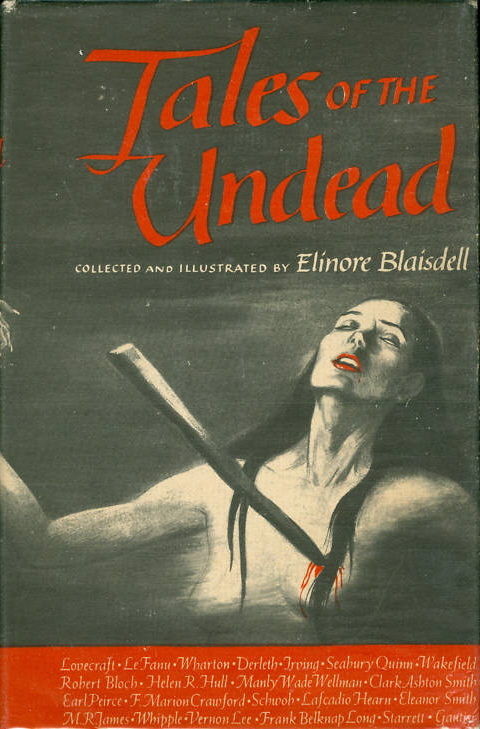
Editor Spotlight: Lois H. Gresh

I started writing weird SF as a child because I wanted to read stories featuring female protagonists, and I couldn’t find anything. I grew up on a diet of my father’s classic hard SF novels and my mother’s thrillers. The women in the classic SF novels were cardboard characters who served coffee and spooned nutrient broth over blobs in fish tanks, and the thriller heroes were always men.

Modern weird fiction, including the mythos subgenre, must expand to include viewpoints beyond the classic stereotypes. If it doesn’t expand, it will die.

Innsmouth Nightmares is incredibly strong. A lot of the stories are some of the best I’ve read in the field. New twists, new perspectives, and yes, stories with female points of view.

In general, weird fiction has blossomed into a more literary realm. It’s a beautiful field for experimentation, not only in terms of style and structure, but also for exploring concepts such as pain, suffering, kindness, fear, empathy (or lack of it), greed, arrogance, etc., and one of my favorites, the anthropomorphic absurdities we cast on the world around us.
—Lois H. Gresh, Interview: Lois H. Gresh by Lisa Morton (Nov 2019)

There have been many anthologies centered around Innsmouth, the dilapidated colony of outsiders perched on the edge of Massachusetts, where the Manuxet River pours into the Atlantic Ocean, and where the natives swim out to Devil’s Reef on moonlit nights. Over the decades, dozens of authors have expanded off Lovecraft’s story “The Shadow over Innsmouth,” and a handful of editors have sought to collect them.

Lois H. Gresh is the first woman to edit an Innsmouth anthology. She had the experience, being a Mythos writer strongly familiar with the existing body of Innsmouth lore, and she had the vision:

This is the book of my dreams. I’ve always been fond of Innsmouth. Directly over my desk, a painting of Innsmouth hangs on an old hook left by the former inhabitants of my house. I spend most of my life at this desk, so Innsmouth is always with me. There’s something very appealing about the tottering village and its shambling denizens, the cults, the dreariness, the turbulence of the sea, and Devil Reef.

When I proposed this anthology to Pete Crowther at PS Publishing, I told him that I wanted to produce a book brimming with extraordinary Innsmouth stories. I wanted to produce a book that I would never grow tired of reading, a book that I would read every now and then for the rest of my life. I think I succeeded.

I requested stories from all the top writers in the weird genre. I desperately wanted Ramsey Campbell, but alas, Pete had Ramsey squirreled away writing a trilogy of Lovecraftian novels, so Ramsey was a bit tanked out to pen a short Innsmouth tale. Almost everyone else in this book—all the writers of weird fiction that readers go ape over. Given my obsession with Innsmouth, I was sorely tempted to add a story, but in the end, decided it would be poor form to write a story for an anthology of which I’m editor.
—Lois H. Gresh, Introduction in Innsmouth Nightmares vii

Innsmouth Nightmares (2015, PS Publishing) contains a solid mix of authors, and perhaps more importantly, a solid mix of stories. In assessing any Innsmouth anthology, it’s difficult not to compare it with every other Innsmouth anthology, from Robert M. Price’s The Innsmouth Cycle (1998) and Tales Out of Innsmouth (1999); Stephen Jones’ Shadows Over Innsmouth (1994), Weird Shadows Over Innsmouth (2005), and Weirder Shadows Over Innsmouth (2013); Ran Cartwright’s Innsmouth Tales (2015)…and other, more obscure collections.

The vision of the editor influences a collection, what they choose to print isn’t decided just by what the writers turn in or what they can get the rights to (hopefully), but what the editor hoped to achieve. Price’s anthology The Innsmouth Cycle, for example, is unsurprisingly backwards-looking. The purpose of the Chaosium Call of Cthulhu Fiction line was in large part to reprint Mythos material that had been out of print like “Shadow Over Innsmouth” (1942) by Virginia Anderson, to draw aside the curtain a little and look at where the Mythos had come from, rather than push the edges of what it might be or where it might go.

Most Innsmouth anthologies, however, don’t have any focus other than Innsmouth itself. Editors don’t go out of their way to collect bad stories, or to exclude women authors, but there’s usually very little distinction between the individual volumes. If you took the cover of Weird Shadows Over Innsmouth and slipped it on a copy of Tales Out of Innsmouth, few readers would be able to distinguish any difference in terms of content. There’s never been an Innsmouth anthology that focused on the diaspora after the 1928 raid; there’s never been an all-women or feminist Innsmouth anthology, or a global Innsmouth anthology that looks at different Deep One colonies around the world. It’s amazing that one story has spawned over half a dozen anthologies (not to mention full-blown novels), but it’s hard to say if there’s been many really good Innsmouth anthologies.

In that respect, Lois H. Gresh and Innsmouth Nightmares stands apart from the rest in part because of a specific aim for a greater diversity among the writers—and this isn’t some token effort. With Caitlín R. Kiernan, Nancy Kilpatrick, Lisa Morton, and Nancy Morton women make up a full 20% of the book, which is above average for a Mythos anthology. W. H. Pugmire is represented to good effect, as is Lavie Tidhar. Beyond that, many of the writers are stretching Innsmouth stories in new styles, new directions, far and away from the pastiches which normally fill so many Innsmouth anthologies. While I wouldn’t go so far as to call it “Deeppunk” or make up any other silly name for it, Gresh’s editorial voice is full of enthusiasm. Optimism. These are Innsmouth stories which, by and large, look to the future of what Innsmouth fiction could be, more than what it was and has been.

I hope you enjoy reading this book as much as I enjoyed editing it. If you like tales about Innsmouth, you’re in for a real treat.
—Lois H. Gresh, Introduction in Innsmouth Nightmares x

Was the market ready for future? It’s hard to say. The hardback and paperbacks for Innsmouth Nightmares are long sold out; I can’t even find the ebook for sale. Several of the stories have been reprinted in anthologies, author’s collections, and other places, but it seems likely that this particular anthology is a black pearl, and readers will have to dive into the deep waters of the secondhand and collectors markets if they want a copy.

Innsmouth Nightmares is Lois H. Gresh’s most notable Lovecraftian credit as an editor, but she also edited Dark Fusions: Where Monsters Lurk! (2013, PS Publishing), which is not a Mythos anthology per se, but several of the stories therein contain Mythos monsters.


Bobby Derie is the author of Weird Talers: Essays on Robert E. Howard & Others (2019) and Sex and the Cthulhu Mythos (2014).