Her Letters To Lovecraft: Edna “Vondy” Hyde McDonald

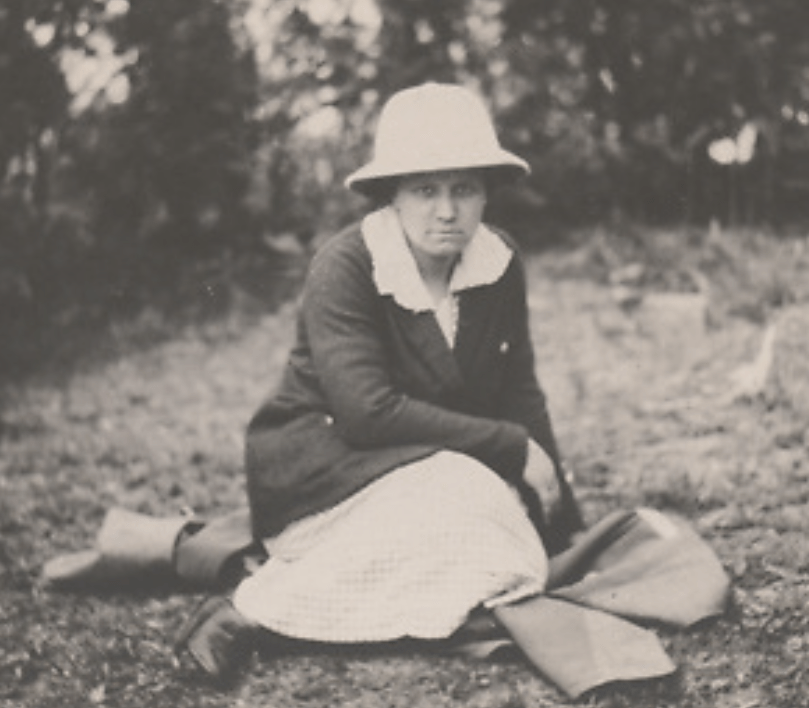
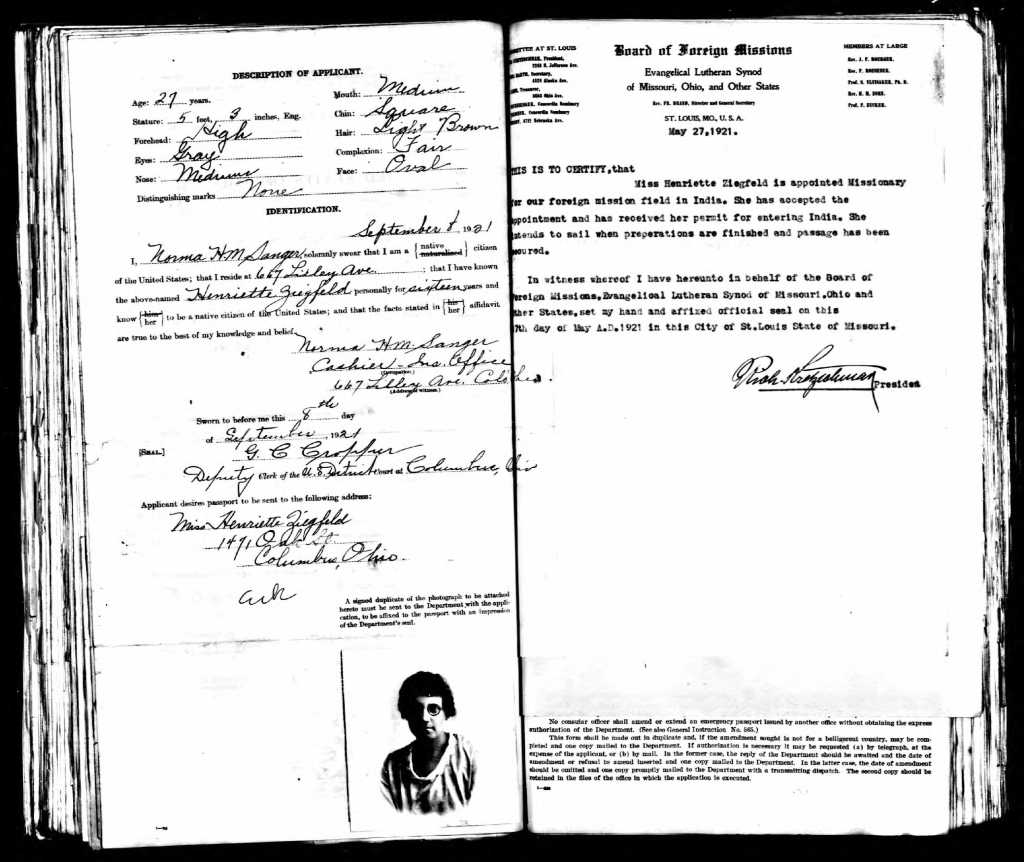
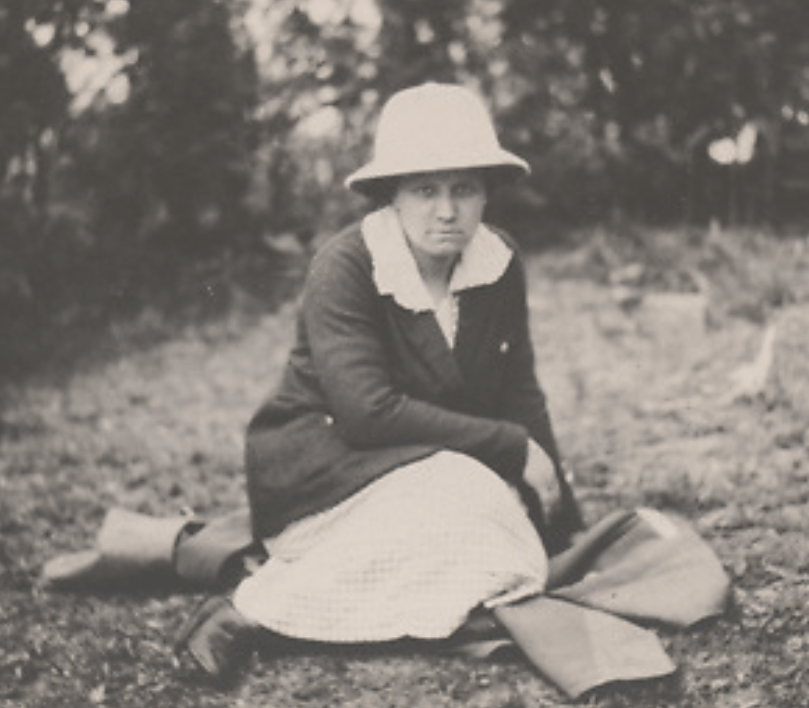
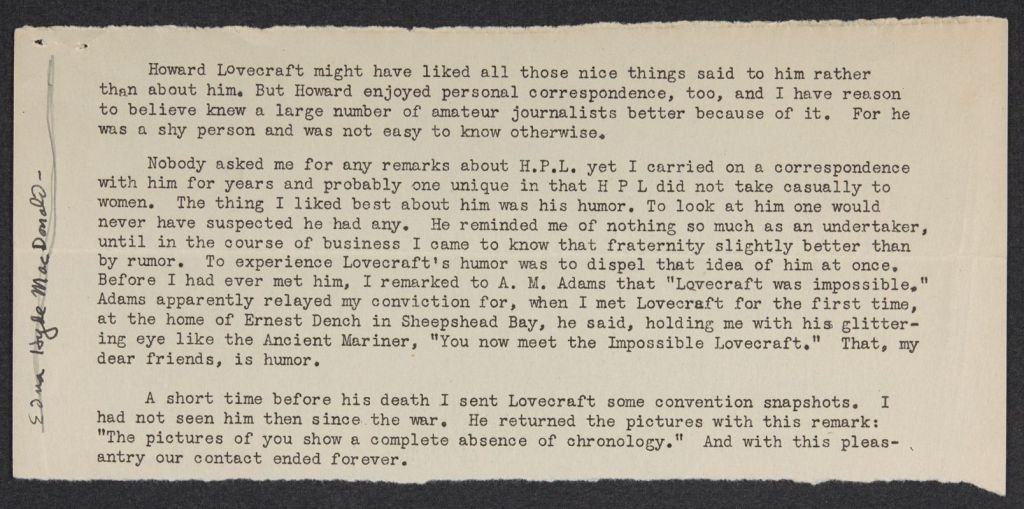
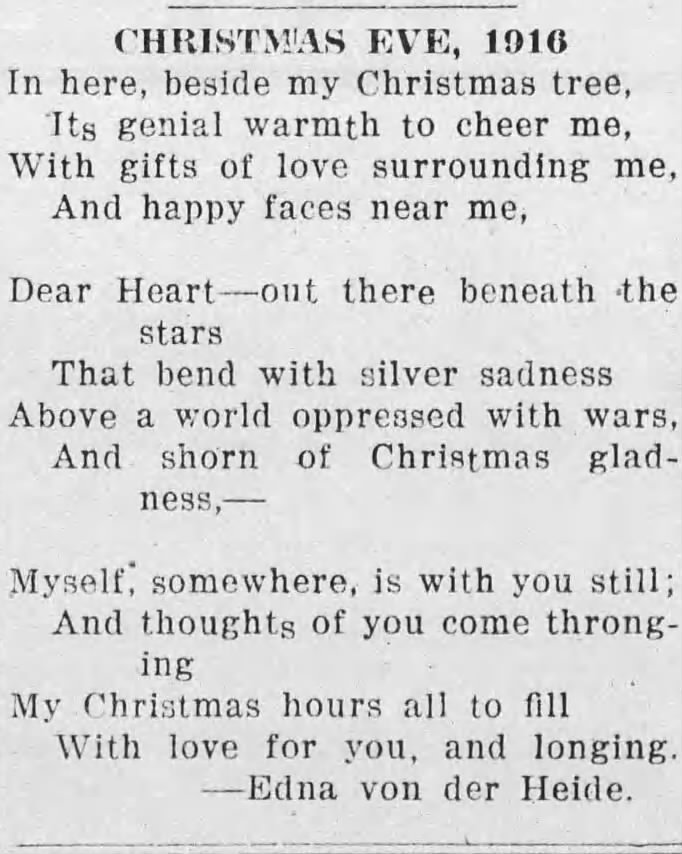
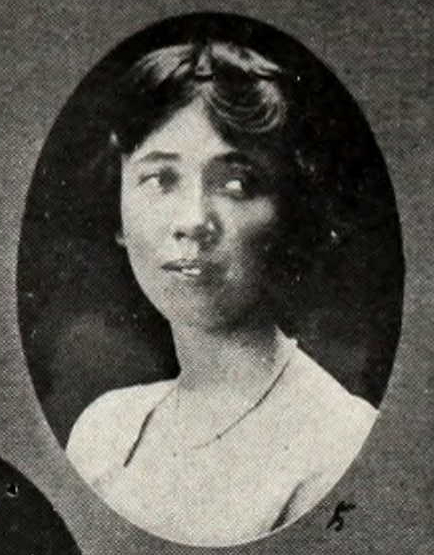
She was born Edna Freida von der Heide in Manhattan on 15 September 1891, to Edward and Freida (Schler) von der Heide; her sister Eleanor came along two years later. By the time of the 1900 Federal census, her father was dead. By 1910, the small family had moved in with their uncle and aunt, William and Caroline Sprouls. It is not clear if Edna completed high school (later census records indicate only three years of high school), and at 18 she was already working as a “typewriter” (later census records gave her profession as typographer or stenographer) and she began what would be a decades-long career as an amateur journalist, publishing her own amateur journals such as Inspiration.

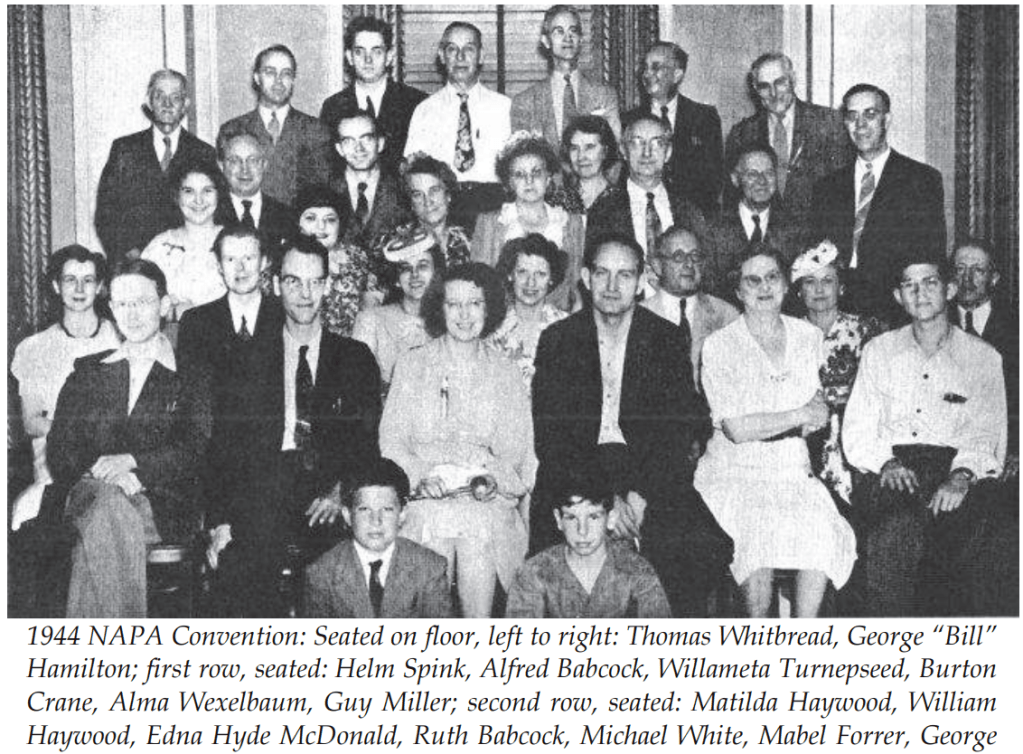
Edna von der Heide could write. She appears to have been recruited for amateur journalism in 1909, and for the next five decades won a bouquet of laureateships and held most of the offices at the National Amateur Press Association. In 1914 she was appointed as Official Editor for NAPA, only the third woman to hold that office, and was elected to that office in 1915; although she resigned almost immediately, details unclear as to why—amateur politics tend to be opaque from a distance of years.

In 1917, the United States declared war against Germany; a wave of anti-German sentiment swept the United States. Perhaps prudently, Edna and Eleanor changed their names from von der Heide to a more English-sounding “Hyde.” Friends in amateur journalism, however, continued to refer to Edna affectionately as “Vondy” until the end of her days.

By the way–I haven’t any feud with her, as you seem to have gathered. Whatever strafing there is, is all on her side—she cherishes a subtle dislike based on antipathetical temperament. I ceased hostilities when political expediency forced her to apologise for the nasty digs in Giddy Gazette & Inspiration. Her verse is, as you say, very good—though it isn’t the sort that interests me.

H. P. Lovecraft to Samuel Loveman, 29 Apr 1923, Letters to Maurice W. Moe and Others 497

In 1921, Edna Hyde ran for President of the National Amateur Press Association against Elsie Dorothy Grant, Lovecraft’s preferred candidate; Edna and her faction lost. To Lovecraft, Edna was his “literary enemy” (LFF 1.139), but in all of his mentions of Vondy in his letters or editorials in amateur journals, there tended to be a great deal more respect than there was animosity.

Incidentally—the work of “Vondy” is of vastly greater merit; many of the lyrics in her book being as close to poetry as anything published in amateurdom. The trouble with her in old amateur days was that she published so much casual & mediocre verse in addition to the solid body of poignant specimens. Many critics—including myself—saw so much of these trivial items that they tended to underestimate her general output.

H. P. Lovecraft to Helm C. Spink, 19 Aug 1930, Letters to Hyman Bradofsky and Others 171-172

Miss Hyde’s reputation as a poet has caused her few stories to receive less attention than they deserve. In point of fact, they are among the best in the amateur press—the supply never being abundant. In this particular story the realism is the salient thing.

H. P. Lovecraft, “The Vivisector” in Wolverine #9 (March 1921), Collected Essays 1.275

On Hallowe’en 1924, Edna married fellow amateur Philip B. McDonald, and was known thereafter as Edna Hyde McDonald. They lived in the Bronx, at first on their own, and then later Eleanor joined them. Lovecraft and his wife Sonia may have seen them socially during the brief few years that they lived in New York together, at amateur gatherings or Blue Pencil Club meetings, but the evidence is a bit scanty.

In fact, there is relatively little information about Lovecraft and Vondy corresponding directly with one another, though we know they must have, either in public capacity when each held offices at NAPA, or conducting private amateur business like arranging memorial issues for fallen amateur journalists. However, there are two bits of data that support there was a correspondence.

The first is a quote from a letter from Lovecraft to Edna Hyde, undated but probably circa 1924:

Albert [Sandusky] has taken the trouble to dig out Lovecraft. And he has made me jealous of his findings. And to have Howard Lovecraft write me and say ‘Bless the child. He wields a curious influence over me, for who else could have taught me to chant with jocose abandon, the contemporary shortage of the noble banana’, is to have an admission of the feat that Albert has achieved with natural-selfness, what the rest of us have never taken trouble to attempt.

Miscellaneous Letters 497

Lovecraft was referring to the popular song “Yes! We Have No Bananas” (1922), which he famously tried to play on the pipe organ at the First Baptist Church of America in Providence. So that is one instance where Vondy claimed Lovecraft wrote to her, but later on she would add that they carried on an entire correspondence.

Brown Digital Repository

This was one of several notes from the amateur journal Belette, where Vondy quipped and ruminated on memorials for her dead frenemy. This and much more on Vondy’s life, as well as some of her laureate-winning poetry and fiction, can be read in The Fossil #333, a special issue dedicated to her memory and with considerable research by Ken Faig, Jr. into her life and work. You can really see why Lovecraft was taken by some of her work, even if her poetry wasn’t always in his line.

That is, unfortunately, “it” as far as the Lovecraft-Vondy correspondence is concerned. No actual letters between the two are known to survive, there are almost no direct references to letters to Edna in Lovecraft’s published letters, and her address is not listed in Lovecraft’s 1937 diary. So we are left with Vondy’s own insistence that they did write to one another…and there’s not really any reason to doubt her word on the matter. As much as we may wish it, Lovecraft didn’t keep every scrap of paper that came his way, and rarely spoke of his correspondence with amateurs to his pulp friends, and vice versa, except in the rare instances when someone showed an interest. Edna herself fell into that category once…

I duly received the envelope which you forwarded from Mrs. McDonald, & which contained a cutting from the N. Y. World  in which teh celebrated William Bolitho, discussing the cheap “pulp” magazines, chanced to allude to my W.T. effusions in not too patronising a manner. It was kind of Mrs. M. to send the thing—but I can’t resist enclosing the note which accompanied it, & which wound up with the perfect Hydeian touch of brooding hostility!

H. P. Lovecraft to James F. Morton, 14 Jan 1930, Letters to James F. Morton 218-219

The piece was “Pulp Magazines” in the New York World (4 January 1930); Edna had recognized Lovecraft’s name and forwarded it on through Morton because she lacked Lovecraft’s address in Providence, but apparently couldn’t resist a witty note to go along with it. This might encapsulate the nature of their correspondence as it probably was: intermittent over the years, a combination of mutual respect and good-natured ribbing. Whatever else she was in her life, Edna was one of Lovecraft’s peers in amateur journalism—and they both knew it.

Addendum: Sean Donnelly, with access to Edna’s surviving correspondence, has uncovered more about her correspondence and relationship with Lovecraft: Edna Hyde McDonald: Her last letter to Lovecraft.


Bobby Derie is the author of Weird Talers: Essays on Robert E. Howard and Others and Sex and the Cthulhu Mythos.

Deep Cuts in a Lovecraftian Vein uses Amazon Associate links. As an Amazon Associate I earn from qualifying purchases.
Her Letters to Lovecraft: Alice M. Hamlet

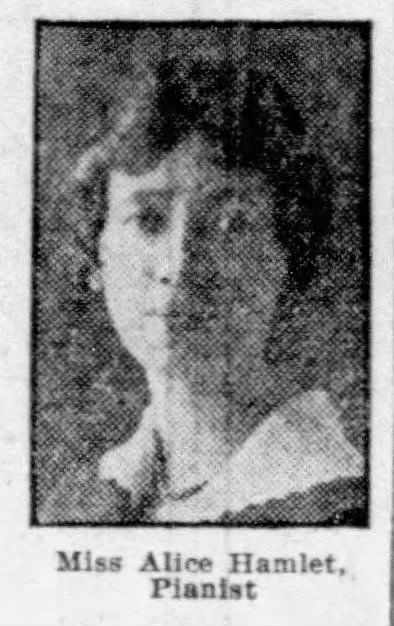
Alice Marion Hamlet was born 24 April 1897, the only child of Lanna and Grace Hamlet, in Boston, Massachusetts, where she would live most of her life. Most of her life was devoted to music; she was a graduate of the New England Conservatory of Music, where she also did advanced studies. U.S. Federal census records for 1930, 1940, and 1950 list her profession as “music teacher” or “piano teacher,” and the newspapers in Massachusetts, New York, and New Hampshire are dotted with notices for her students’ recitals and other notices. Her obituary showed she worked as a music teacher for some 60 years, and never married or had children.

What the census and newspaper data does not show is the other side of Alice M. Hamlet. The literary side of her which found expression in amateur journalism, the reader of fantasy who became a critical influence on H. P. Lovecraft, with whom she corresponded for some years. Exact details of this side of Alice Hamlet are sketchy; none of her letters to Lovecraft or from Lovecraft to her are known to survive, so we are left with a very incomplete picture of their relationship. Yet what we can piece together, through references in Lovecraft’s correspondence and essays, paints a picture of two people who found common interests and enthusiasms.

The first notice we have of Alice M. Hamlet in Lovecraft’s works is a note in the United Amateur for March 1917:

“Pioneers of New England”, an article by Alice M. Hamlet, gives much interesting information concerning the sturdy settlers of New Hampshire and Vermont. In the unyielding struggles of these unsung heroes against the sting of hardship and the asperity of primeval Nature, we may discern more than a trace of that divine fire of conquest which has made the Anglo-Saxon the empire builder of all the ages. […]

[145] “To a Friend”, by Alice M. Hamlet, is particularly pleasing through the hint of the old school technique which its well-ordered phrases convey. The one weak point is the employment of thy, a singular expression, in connexion with several objects; namely, “paper, pen, and ready hand”. Your should have been used. The metre is excellent throughout, and the whole piece displays a gratifying skill on its author’s part.

H. P. Lovecraft, “Department of Public Criticism” in United Amateur 16, No. 7 (Mar 1917), Collected Essays 1.141, 145

Lovecraft had been elected president of the United Amateur Press Association in 1917; based on these comments Alice M. Hamlet was already a member of the United, although David Whittier later claimed to have recruited her in 1919 (see Lovecraft and Lord Dunsany). The comments on her poetry are typical for Lovecraft of the period; he was a stickler for metrical regularity and language, but less expressive of the content of poetry. Perhaps this notice started their correspondence, perhaps that came later.

It interests me to hear of your first perusal of “A Dreamer’s Tales.” Mine was in the fall of 1919, when I had never read anything of Dunsany’s, though knowing of him by reputation. The book had been recommended to me by one whose judgment I did not highly esteem, & it was with some dubiousness that I began reading “Poltarnees—Beholder of Ocean.” The first paragraph arrests me as with an electric shock, & I had not read two pages before I became a Dunsany devotee for life.

H. P. Lovecraft to Clark Ashton Smith, 14 Apr 1929, Dawnward Spire, Lonely Hill 172

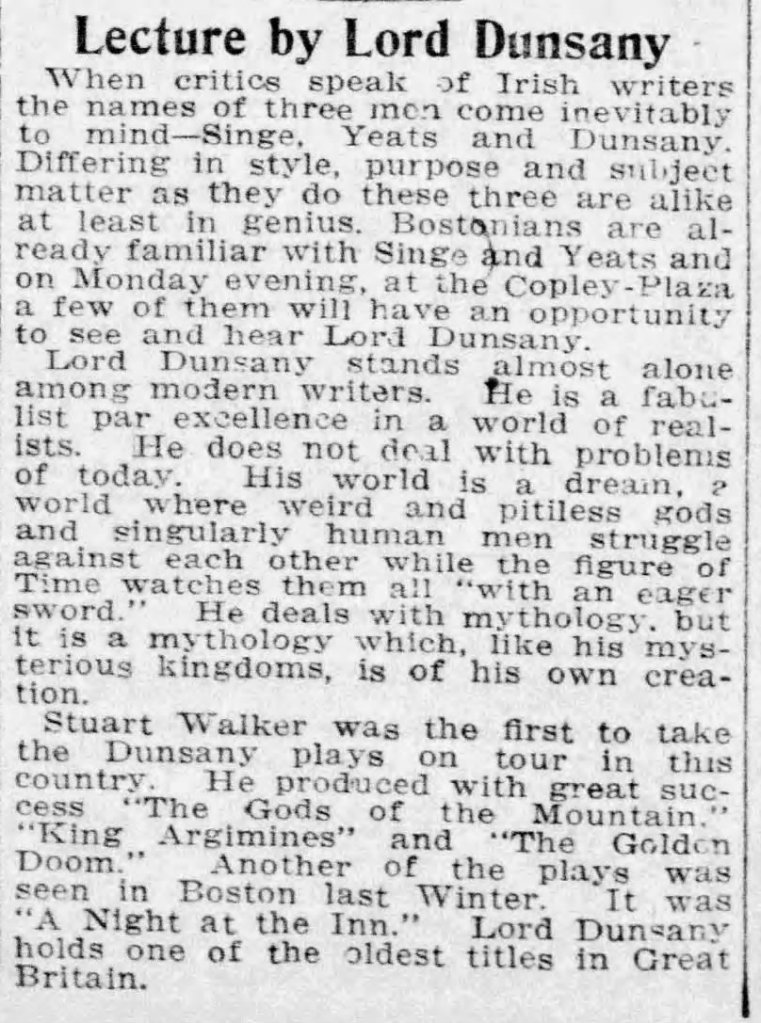
By the fall of 1919, Hamlet and Lovecraft were apparently corresponding and such good friends that she began to recommend or lend books to him. An envelope from Hamlet to Lovecraft postmarked 12 October 1919 survives, which attests to the correspondence. Perhaps it was that letter when she informed him that Lord Dunsany was coming to Boston, and invited Lovecraft to come hear him speak.

Lovecraft would recount the adventure in some detail in a letter:

At 7:00 a party consisting of Miss H., her aunt, young Lee, & L. Theobald set out for the great event. Arriving early at the Copley-Plaza, we obtained front seats; so that during the address I sat directly opposite the speaker, not ten feet from him. Dunsany entered late, accompanied & introduced by Prof. George Baker of Harvard. […]

[146] Egged on by her aunt, Miss Hamlet almost mustered up courage enough to ask for an autograph, but weakened at the last moment. Of this more anon. For mine own part, I did not seek a signature; for I detest fawning upon the great. […] Of course, I could have taken the Prov. train at the adjacent Back Bay, but I hate that bleak barn, & wished to get in the train as soon as it was made up; enhancing myself in a seat & beginning to read Dunsany’s “The Gods of Pegãna”, which Miss H. had kindly lent me. The H.’s invited me to stay all night, but I am a home-seeking soul & the hour was not late. […]

[147] The one sequel to the lecture does not concern me, but deserves narration (an unconsciously egotistical sentence!). Mss H. could not quite give up the idea of an autograph, so on the following day wrote a letter to Dunsany, enclosing several tokens of esteem for him & for his wife; the greatest of which was a genuine autograph letter of Abraham Lincoln. Soon afterward she received a most courteous reply from His Lordship, written personally with his celebrated quill, & containing a pleasant enclosed note from Lady Dunsany! Of this letters from so great an author, Miss H. is justly proud in the extreme; & she will doubtless retain it as a treasure of priceless worth. I will here present a verbatim transcription!

“My dear Miss Hamlet:—

Thank you very much for your kind letter & present, & for the charming little presents to my wife. I had not seen the Lincoln letter before, & I am very glad to have it. It is a stately letter, & above all, it is full of human kindness; & I doubt if any of us by any means can achieve anything better than that.

With many thanks,
Yours very sincerely,
Dunsany

P. S. I’ll write plenty more for you.”

H. P. Lovecraft to Rheinhart Kleiner, 9 Nov 1919, Letters to Rheinhart Kleiner and Others 145, 146, 147

The aunt was Eva Thompson, who lived with Alice and her parents in Dorchester; “young Lee” is unidentified; and “L. Theobald” was one of Lovecraft’s pseudonyms. As well as the Lincoln letter, Alice M. Hamlet had sent Dunsany a copy of the Tryout (Nov 1919) that contained Lovecraft’s poem “To Edward John Moreton Drax Plunkett, 18th Baron Dunsany.” Dunsany replied graciously to this poetic dedication with a letter that was published in the Tryout (Dec 1919). The episode also produced an unexpected sequel:

Well, I got news this trip, fellas! EDWARD JOHN MORETON DRAX PLUNKETT, 18th BARON DUNSANY, is the 1920 Laureate Judge of Poetry for the United Amaeur Press Association! Yep—’s true! I thought of the thing a month or two ago, but did not dare write Ed. THen I decided that he might prove kind if he letter came from one with whom he had previously corresponded, so I asked Miss Hamlet to write him, which she did ℅ the J. B. Pond Lyceum Bureau. For a long time no answer came, and we gave him up for lost. Miss Durr asked asked me to find another judge, and I wrote a Capt. Fielding-Reid of Baltimore, one of the Bookfellows. But Friday Miss Hamlet received a telegram from Ed accepting the post!!!

H. P. Lovecraft to the Gallomo, Apr 1920, Miscellaneous Letters 101

Miss Durr is Mary Faye Durr, president of the UAPA for the 1919-1920 term. Alice Hamlet later gave her impressions of Lovecraft and the Dunsany lecture:

From then on I was one of the “amateurs”. Eventually I put out a little mimeographed paper in conjunction with a John Smith of Orondo, Washington. It was probably through that little literary effort that Mr. Lovecraft became interested in my work. He was very helpful and friendly in his criticisms and suggestions and I greatly appreciated it. But on to Mr. Lovecraft himself: As I remember him he was tall and large-boned—with a long jaw—or perhaps I should say chin—from the lower lip downward. He was rather dark complexioned and was extremely pale. Evidently he was not in very good health. He had severe headaches and never was known to go far from his home—except to hear Lord Dunsany at my invitation. Mr. Lovecraft’s style of writing was highly imaginative as was Dunsany’s and I thought Mr. Lovecraft would greatly enjoy hearing the Irish poet. There was this difference between the writers’ literary output—Lovecraft resembled Edgar Allan Poe, with his stark and wild imaginings: Dunsany wrote in almost Biblical style, with prose that was almost poetry. Mr. Lovecraft’s vocabulary was very extensive, at times Johnsonian, and his letters were long and examples of a skilled writer who knew what he wanted to say and how to say it. The attendance at the Dunsany lecture was surely a milestone in his life—and a great inspiration to me and one of my treasured memories. The young man who went with us was Ed Lee. He was not “literary” and probably Mr. Lovecraft and I were both a sort of gentle amusement to him!

As far as I can remember, he (Lovecraft) went back to Providence the night of the Dunsany lecture. He was immensely impressed and I can well imagine the occasion was a spur to his writing professionally. I never considered Mr. Lovecraft handsome and I am sure he was never interested in me as a girl! We merely had similar tastes which made for a congenial acquaintance. He was always courteous—“the old school gentleman”—although he must have been in the early thirties (his age) when I knew him.

quoted from “Lovecraft and Lord Dunsany”

This lecture and its aftermath were not the end of Lovecraft and Hamlet’s association, which continued through their mutual involvement in the United. Hamlet herself was one of the manuscript managers for the association, along with Olga Zeeb. When Lovecraft addressed a recruit to the amateur organization, he wrote:

I trust you will call upon our MS. Managers, Misses Hamlet & Zeeb, whenever you need copy.

H. P. Lovecraft to Arthur Harris, 16 May 1920, Letters to Rheinhart Kleiner and Others 242

Alice M. Hamlet would enter United politics herself, being elected 2nd Vice President in 1920, when Lovecraft served as Official Editor. They seemed to still be on good terms, as he apparently gifted her a copy of Oscar Wilde’s Fairy Tales and Poems in Prose (1918), along with a poem “With a Copy of Wilde’s Fairy Tales.”

The culmination of their growing friendship occurred 4-5 July 1920, when Lovecraft came to Boston to attend a gathering of amateurs who could not attend that year’s national convention in Cleveland. It was the first time since 1901 that he had slept under someone else’s roof away from home (LWH 49-50)—as a guest of Alice M. Hamlet (chaperoned by her aunt); Edith Miniter amusingly referred to the arrangement in her coverage of the get-together:

I was tucked up in my crib hours before the house was still. Mrs. THompson and her niece, Miss Hamlet, took Mr. Lovecraf with them to Dorchester, ’cause he said he’d just go[t] to have a “quiet room to himself,” and there’s no such thing here, though there’s 18 rooms and 6 halls in this establishment.

Edith Miniter, “Epgephi Maisuings” in Epgephi (Sep 1920)

Perhaps the book was a gift on this occasion, or soon after as thanks for her hospitality. By the end of the year, Lovecraft noted:

Our new Second Vice-President, Miss Alice M. Hamlet, is taking a post-graduate course at the New England Conservatory of Music, and bids fair to become one of Boston’s most accomplished musical instructors.

H. P. Lovecraft, “News Notes” in United Amateur 20, No. 2 (November 1920), Collected Essays 1.264

Despite her studies, Hamlet was apparently still active in amateur journalism, and even worked to recruit new members such as Myrta Alice Little, who would also become one of Lovecraft’s correspondents.

For securing Miss Little as a member, credit is due to our energetic Second Vice-President, Alice M. Hamlet.

H. P. Lovecraft, “News Notes” in United Amateur 20, No. 3 (January 1921), Collected Essays 1.268

On 17 August 1921, Lovecraft made another trip to Boston to visit his amateur friends. At this point, political divisions between the United and National Amateur Press Associations had risen (and within the United itself), which made for a bit of awkwardness when visiting. Lovecraft wrote of the trip:

The Hub Club meeting was yesterday, but on account of the increasing political gap betwen the (Nationalite) Hub element & the United, she set Wednesday as the day for conferring at length with the United element—W. V. Jackson, Miss Hamlet, Mrs. McMullen, &c. Naturally, the United Day was my day! The conference was to be held at 3 p.m. at the Curry School of Expression on Huntington Ave. near the village square—just across the street from Mr. Copley Plaza’s boarding house where I heard Dunsany lecture in 1919. This hour would have been very convenient for me; but Miss Hamlet, who had also been notified, asked me to precede the event with a Dorchester call—since she did not care to attend the session for fear of meeting some of the National members whom she detests so thoroughly. Alas for the complexity of local feuds! […]

Reaching Back Bay at 1:44, I proceeded to Dorchester for a brief call of courtesy—when lo! I found that my tardiness had set awry a disconcerting amount of preparation which had been made, all unknown to me, in my honour. It seems that the Hamlets had arranged a flying motor trip to Quincy to see poor Mrs. Bell the impoverished invalid, & that they had waited for me until just six minutes before my belated arrival; finally departing lest they disappoint their aged hostess. As a matter of prosaic fact, my loss of this trip caused me no very profound grief; but the Dorcastrians seemed amazingly disappointed. The aunt, Mrs. Thompson, insisted on calling up Miss H. at the Quincy City Home, & Miss H. appeared to view the exploded schedule as little short of calamitious. Considering my insignificance, such concern was of course flattering—but I could not politely leave the telephone & proceed to Copley Square till I had consumed to make another Boston trip before Labour Day, for which the Hamlets wish to prepare some picnic or special event to make up for the present fiasco. Such super-hospitality is very pleasingvbut it does not pay any railway fares! Incidentally—Miss H. has taken upon herself the humane task of trying to rescue Mrs Bell from the institution which so humiliates her. She is trying to look up Bell relatives—the family is old & prominent—& to interest the Uniterian church to which Mrs. B. belongs. A worthy task, though possibly a futile one.

H. P. Lovecraft to Annie E. P. Gamwell, 19 Aug 1921, Letters to Family & Family Friends 1.38

Lovecraft did manage to visit the Hamlets later on the trip:

And speaking of bores—as I puffed out of Haverhill the Hamlet call still lay ahead of me. I had given a forewarning that I might be “unavoidably” delayed till evening, and hoped my prospective hosts would not do anything elaborate—but Gawd ‘elp us! When I finally reached there via B. & M., elevated, and surface car, I found that they had a near-conventions tagged for me! There was an ambitious dinner of lamb and sundry fixings, and many reproaches at my “unavoidable” tardiness. As a local delegate Miss Hamlet had unearthed a literary proteged of hers—the Mildred LaVoie whose name has lingered inactively on our lists since 1916, and who is a young person of undistinguished aspect and ancestry; not uncomely, but more suggestive of the artless nymph than of the fictional titan. This quiet and unassuming individual writes stories, but is afraid to send them anywhere—even to TRYOUT—for publication; hence has remained an amateur nonentity for five years despite the efforts of Miss Hamlet to bring her genius to the world’s notice. I was not vey enthusiastic about the process of LaVoian assimilation till after the maid in question had departed, and Miss H. produced a story of hers which she had secured surreptitiously. Then I perceived that the work was not half bad in its way—shewing at least clear observation, command of detail, and a keener picture of the subject matter than mere words. It is surely with printing, and I shall accommodate Miss Hamlet by placing it somewhere where its appearance will duly surprise its over-modest creator—Lawson’s WOLVERINE ought to stand for it. But after all, I was paid for my politeness in making the Dorcastrian detour. Just before I beat it for the 11:45 I was given the loan of a new book which I am told is the msot horrible collection of short stories recently issued! It is called “The Song of the Sirens” [1919], and is by one Edward Lucas White, who claims he dreamed all the ghoulish things described.

H. P. Lovecraft to the Gallomo, 31 Aug 1921, Miscellaneous Letters 116

No overnight stay this time around—and this was effectively the final direct reference to Alice M. Hamlet in Lovecraft’s letters, though there are a few oblique references to her having introduced him to the works of Lord Dunsany. Why their friendship seems to peter out at this point is uncertain, although it has to be pointed out that Lovecraft met his future wife Sonia H. Greene at an amateur convention in Boston in 1921, and the rise of that relationship seemed to spell the dwindling of Lovecraft’s connections with women amateur journalists such as Winifred Virginia Jackson.

Rumors have connected Lovecraft romantically to nearly every female amateur journalist of approximately his own age he ever interacted with, but Alice M. Hamlet’s connections with him have been too vague to suggest anything concrete in that direction. They must, at the least, have appreciated one another, as the exchange of books showed a remarkable taste for fantasy and weird fiction, rare enough in amateur circles. Whether the friendship continued in letters for a while, or drifted apart as their lives took different directions, we just don’t know.

It is difficult to overstate the impact Hamlet had on Lovecraft, however unintentionally: Lord Dunsany was a powerful and formative influence on his fiction, one which Lovecraft would emulate, and then work diligently to not emulate and find his own voice, throughout his life. She helped draw him further out of his reclusive shell that he had fallen into after his failure to attend college or find a job as an adult. Amateur journalism put him in touch with people he had never met, exposed him to ideas he had never heard of, challenged his views in many ways—and Alice M. Hamlet was a part of that. With that experience, with that encouragement, Lovecraft would ultimately travel further, experience more, think harder, and write better than he ever had before.

Alas, there is too little to say much more about their friendship. The letters are lost to us.


Bobby Derie is the author of Weird Talers: Essays on Robert E. Howard and Others and Sex and the Cthulhu Mythos.

Deep Cuts in a Lovecraftian Vein uses Amazon Associate links. As an Amazon Associate I earn from qualifying purchases.
Her Letters To Lovecraft: Eola Willis

Have met the author of the standard history of the XVIII Cent. Charleston stage, & will this afternoon inspect the interior of one of the typical old (1734) mansions.

H. P. Lovecraft to Richard Ely Morse, 29 Apr 1934, Letters to Hyman Bradofsky and Others 75

According to the 1860 census, Eola Willis was born in 1859 in South Carolina; the oldest of what would be six children. The year after she was born, South Carolina seceded from the Union, setting the stage for the American Civil War. Like many Southern men, her father would join the Confederate Army and he would be associated with running the blockade the Union established around Southern ports and coast. During her earliest childhood, the war was fought and lost; and young Eola would come to adulthood under Reconstruction, until that too came to an end.

Eola Willis distinguished herself as an artist, historian, antiquarian, and author, with an especial interest in the history of Charleston, S.C. Among her publications was The Charleston Stage in the XCIII Century, with Social Settings of the Time (1924). When she met H. P. Lovecraft in 1934, Eola Willis was 74 years old.

You certainly must see old Charleston some day. What a town! I’ve met one of the leading local antiquarians—an old lady named Willis, author of the standard history of the Charleston Stage in the 18th century—& picked up a good deal more of the regional traditions than I ever knew before.

H. P. Lovecraft to R. H. Barlow, 30 Apr 1934, O Fortunate Floridian 138

Lovecraft first visited Charleston, S.C. in 1930, as part of his gradually expanding series of travels to see more and more of the world. That visit resulted in a lengthy travelogue, “An Account of Charleston,” where he exults in the atmosphere of the Southern metropolis. While Lovecraft had long bought into the rose-colored vision of the antebellum South described by the United Daughters of the Confederacy and other Lost Cause supporters, actually traveling to the South let Lovecraft appreciate the architecture and ways of the South in an entirely new way—from the elegant old houses to Jim Crow. In his letters, Lovecraft even suggested he would like to move there, someday…though that day never came…and on his subsequent trips down South, made a point of spending at least some time in Charleston.

On this visit I have met a highly interesting & erudite local antiquarian—an ancient gentlewoman named Miss Willis, author of the standard history of the 18th century Charleston stage. This venerable scholar, descended from the oldest Charleston stock & still inhabiting her well-preserved hereditary mansion (built 1730-34) in Tradd St., has furnished many side-lights on Charleston tradition with which I was previously unfamiliar. Her book is a genuine masterpiece of its kind, & ought to interest you because of its full account of the famous Sully family from which Thomas the artist (his artist-nephew who was Poe’s playmate in Richmond) sprang.

H. P. Lovecraft to Helen V. Sully, 30 Apr 1934, Letters to Wilfred B. Talman et al. 348-349

For Lovecraft, Eola Willis no doubt reminded him of his own aunts, who were both active in society, loved old things, and were painters of some skill. We can only speculate on how exactly they met, but it was undoubtedly a meeting of the minds. Lovecraft’s genuine enthusiasm for Charleston and its history were no doubt matched by Willis’ own affection for her city. From his letters, it seems she even invited him on a tour of her historic home at 72 Tradd St.

An interesting person whom I did meet in Charleston was Miss Eola Willis, Chairman of the local Art Commission & author of the standard history of the 18th century Charleston stage—a gentlewoman of ancient Carolina stock, aged about 70, who is not only an erudite historian & antiquarian, but a water-colour artist of great power, whose views of Carolina scenery are vivid & beautiful.

H. P. Lovecraft to Elizabeth Toldridge, 22 May 1934, Letters to Elizabeth Toldridge & Anne Tillery Renshaw 270-271

Many of Eola Willis’ paintings survive, such as those in the Johnson Collection. Papers and correspondence from her life are archived at the South Carolina Historical Society. Newspaper archives preserve her obituary and articles about her doings. These institutions preserve her legacy for future generations.

Her association with H. P. Lovecraft, however, has proven to be more ephemeral.

Did I mention meeting, in Charleston, an extremely gifted gentlewoman who is chairman of the Charleston Art Commission & author of the standard history of the Eighteenth century Charleston stage? A Miss Eola Willis, who dewells in her centuries hereditary mansion in Tradd street. Her book & anecdotes confirm my belief that the culture of Charleston is the finest that ever flowered in North America.

H. P. Lovecraft to James F. Morton, 19 Jul 1934, Letters to James F. Morton 355

This handful of quotes in Lovecraft’s letters from 1934 is essentially the sum total of his mentions of Eola Willis by name. No letters from Lovecraft to Willis or Eola to Howard have yet come to light. Yet in his 1937 diary, among the list of addresses of his correspondents, Lovecraft includes Eola Willis (Lovecraft Annual 6.176). This opens up at least the possibility that they were correspondents for a time. We can only speculate what they might have discussed, although their common antiquarian interests suggest that might have formed a possible basis for a few letters.

The correspondence between Eola Willis and H. P. Lovecraft must therefore be considered hypothetical, at least until some more definitive evidence emerges.


Bobby Derie is the author of Weird Talers: Essays on Robert E. Howard and Others and Sex and the Cthulhu Mythos.

Deep Cuts in a Lovecraftian Vein uses Amazon Associate links. As an Amazon Associate I earn from qualifying purchases.
Her Letters To Lovecraft: Florence Riley Radcliffe

Those Virginia pictures probably came from some member of that Poetry Circle branch in Washington–whose personnel persistently & rather insanely address me as “Judge” because I judged a poetry contest of theirs six years ago.

H. P. Lovecraft to Lillian D. Clark, 20-21 May 1930, Letters to Family & Family Friends 2.841

According to census data, Florence Riley Radcliffe was born in January 1870, the first surviving child of Dr. Samuel J. Radcliffe and his wife Florence C. Radcliffe. She was joined by a little sister, Mary L., about four years later. We get only the barest outline of a life from the census data—Florence R. Radcliffe never married, her formal schooling stopped with the 8th grade, she lived all her life in Washington, D.C. with her parents and her sister, having never married. The 1900 census lists her occupation as “Author”; 1910 working in accounting for some government office; 1920 a telephone operator at a bank; by 1930 the 60-year-old Florence is listed as a “nail cutter.”

Beyond the census data, we know one thing for certain: Florence R. Radcliffe was a poet. She was a member of the American and British Poetry Societies, and the American Poetry Circle. Her first encounter with H. P. Lovecraft came in 1924, when Lovecraft served as judge for a poetry contest held by the League of American Penwomen. Four years after that contest, Lovecraft received a letter from one of the participants, Elizabeth Toldridge of Washington, D.C., sparking a correspondence that would last the rest of his life. In 1929, we get the first mention of Toldridge’s fellow Washingtonian and American Poetry Circle member Florence R. Radcliffe:

Incidentally, I trust that Miss Radcliffe will persevere in her idea of having a book, & that she will entrust its publishing to the able & conscientious W. Paul Cook. You might shew her the two Recluse Press products sent under separate cover—fair specimens (except for one hideous misprint in the Loveman book, due to an 11th hour text change & not really Cook’s fault) of Athol typography & workmanship. As to my ‘not being interested in her poetry’—I’m sure here’s nothing in the two printed specimens I ahve seen to warrant such a prophecy. I would be glad to see more, if you have any easily transmissible copies; though as I have previously pointed out, I am no authority whose verdict can be considered of any ultimate value.

H. P. Lovecraft to Elizabeth Toldridge, 21 Feb 1929, Letters to Elizabeth Toldridge 34-35

At the time, W. Paul Cook of Athol, Mass. published a few small works through his Recluse Press, including The Hermaphrodite (1926) by Samuel Loveman; Cook was also busy with a small edition of Lovecraft’s The Shunned House, but this particular endeavor would end in disarray—not that Lovecraft knew that at the time. He was simply trying to promote his friend’s printing business.

In the beginning, neither Lovecraft nor Radcliffe wrote to one another directly, so their first correspondence happened through the medium of his letters to Toldridge. We can get a sense of their correspondence during this period through passages like this one:

Oh, yes—& you need not hesitate to send specimens of Miſs Radcliffe’s work when you have some on hand; although as always, I must not be regarded as any supreme authority or final arbiter of merit. If suggestions will assist, well & good—but I can’t guarantee the insight & acumen of my suggestions! Incidentally, I am sure that Miss R’s recent depreciation of all her work is based on modesty rather than on impersonal analysis. In the matter of the last line of “Love”, she is entirely in the right; for so far as I can see, the editor’s substitution produced a wholly false, & unintended, & peculiarly meaningless implication—i.e., an implication that the answer to life is the fact that he who love knows that answer! Puzzle—find the sense! In the original, the idea is clear—that love provides an answer to life because the process of loving provides a sense of the adequacy of living. In other words, the editor’s unwarranted liberty placed the substance of the last line in the position of being the answer referred to in the line preceding; whereas the poet’s intention was obviously to have it form the reason for the condition referred to in that preceding line. So much hinges on one apparently insignificant conjunction! But I have known errors in mere punctuation to produce almost equally great distortions of meaning.

H. P. Lovecraft to Elizabeth Toldridge, 8 Mar 1929, Letters to Elizabeth Toldridge 44-45

The connection seems to have finally been made in 1929, when Radcliffe sent Lovecraft some of her poetry for review and comments. Very little of this correspondence survives; there are two letters from Radcliffe to Lovecraft and a handful of her poems listed in the inventory at Brown University in Providence. Lacking Lovecraft’s side of the correspondence, we have to rely on his letters to Toldridge with their small asides about her friend. For example:

I appreciated yours of the 27th with enclosures, & am glad you found the “Brick Row” lines worth reading. If the thing appears in print* I’ll send a pair of copeis for you & Miſs Radcliffe.

* It has appeared–this morning. Copies enclosed.

H. P. Lovecraft to Elizabeth Toldridge, 8 Jan 1930, Letters to Elizabeth Toldridge 120

This was “The East India Brick Row,” a poem Lovecraft composed on the demolition of several old brick warehouses in Providence, which was published in the local paper. It was probably this poem which caused Radcliffe to write back:

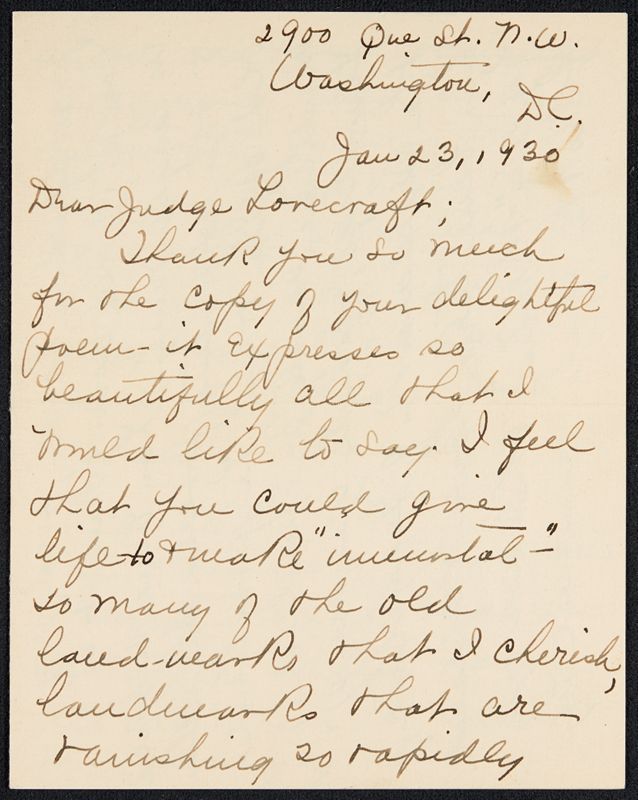
Dear Judge Lovecraft;

Thank you so much for the copy of your delightful poem – it expresses so beautifully all that I would like to say.

Florence Radcliffe to H. P. Lovecraft, 23 Jan 1930, MSS. Brown University Library

A follow-up to this exchange on the demise of old landmarks in the name of progress is recorded in Lovecraft’s letters to Toldridge:

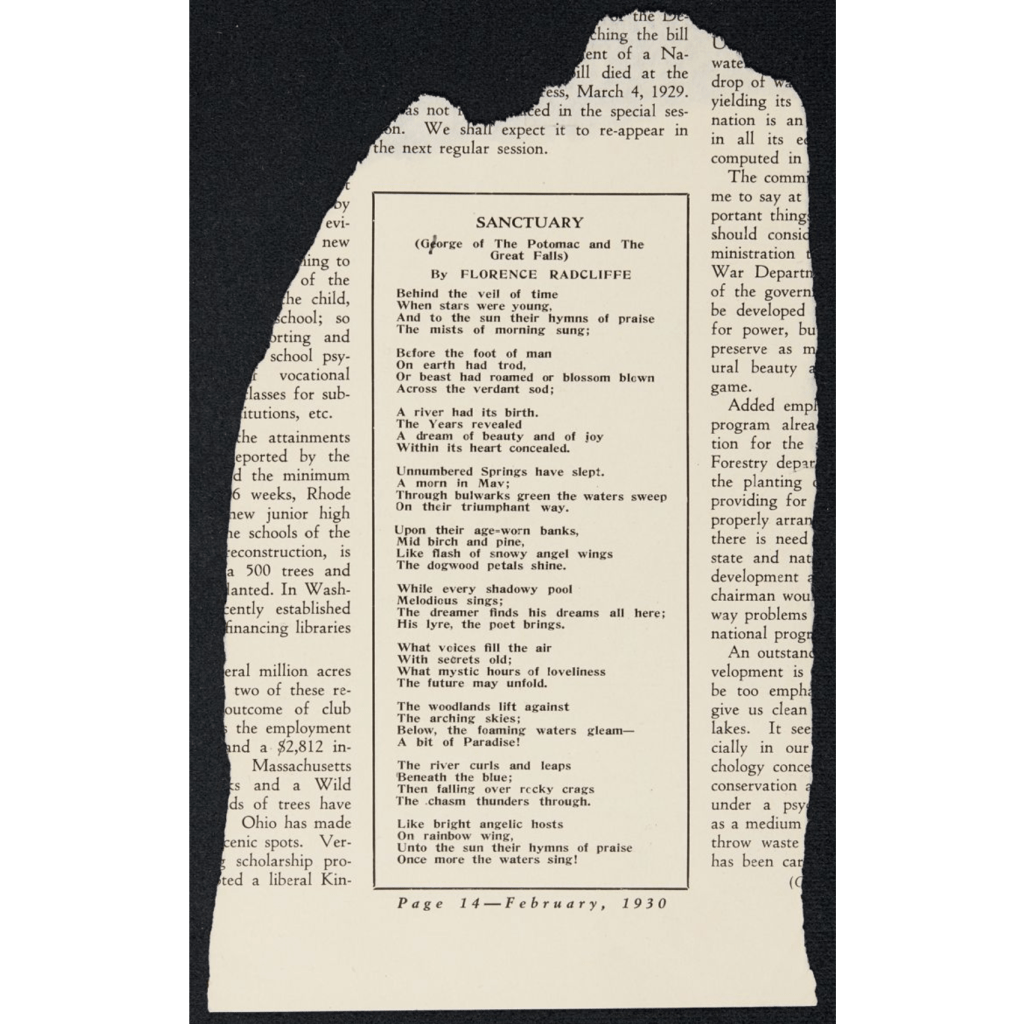
Not long ago I received from her a magazine with a very appealing poem about the Great Falls of the Potomac, which I believe are imperilled by some miserable mechanical water-power project.

H. P. Lovecraft to Elizabeth Toldridge, mid-Mar 1930, Letters to Elizabeth Toldridge 137

A series of dams had been proposed along the Potomac River to generate hydroelectric power and for flood control; they never came to pass, and both Radcliffe and Lovecraft would likely be happy to know that the natural features were eventually protected as part of Great Falls National Park. Radcliffe wrote a poem “Sanctuary” on the beauty of the Great Falls, which was included in her letter dated 6 Apr 1930.

Brown Digital Repository

Florence Radcliffe was 60 years old in 1930, and had been working in some form for her entire adult life. Reading between the lines a little, by now she was probably on the verge of retirement, if not from lack of work opportunities than from ill-health:

I’m sorry, likewise, to learn that Miss Radcliffe’s health continues to be so unsatisfactory.

H. P. Lovecraft to Elizabeth Toldridge, Aug 1930, Letters to Elizabeth Toldridge 155

The nature of the illness is undisclosed in Lovecraft’s letters, and the possibilities are too numerous to invite speculation. She was unwell, and Lovecraft gave his sympathy and continued to correspond with her, as he did with many older people. The primary topic, besides her health, seemed to be her ongoing desire to publish a book of her poetry. Lovecraft tried to help as best he could:

I am sorry likewise to hear of Miss Radcliffe’s continued indisposition, & hope that rest & interesting activities may bring about a decided improvement. In time I am sure that you & she can issue your respective collected verse, even though a resumption of Cook’s enterprises seems unfortunately unlikely. When in Vermont I shall inquire further into the conditions & prices of the Stepehn Daye Press—Orton’s venture, which I think I mentioned to both you & Miss R. Last week I returned Miss Radcliffe’s book of manuscripts for safety’s sake; since my room is likely to be upheaved by a wholesale cleaning during my absence, & I don’t want any important items to be lost or mislaid.

H. P. Lovecraft to Elizabeth Toldridge, 29 Apr 1931, Letters to Elizabeth Toldridge 182

Vrest Orton was a friend of Lovecraft’s in Vermont. Ultimately, however, it appears none of Lovecraft’s suggestions for printers panned out in the end. The references to Radcliffe get fewer in his letters to Toldridge, so there is little data to go on. They must have still been in touch as late as 1934, because Radcliffe is listed among those correspondents to whom Lovecraft sent postcards on his trip to Nantucket (Collected Essays 5.267), and the final reference to her in his letters to Toldridge is in 1936.

In many ways, Florence Radcliffe’s letters to H. P. Lovecraft were the shadow of Elizabeth Toldridge’s own correspondence. While we can’t but guess at the true extant, she found in Lovecraft someone who encouraged and praised her poetry, who shared her appreciation for old landmarks, a sympathetic ear for her pains and praise for her small victories when a poem was placed or an honorable mention awarded. A small friendship via letters, but perhaps a light in the waning days of life.


Bobby Derie is the author of Weird Talers: Essays on Robert E. Howard and Others and Sex and the Cthulhu Mythos.

Deep Cuts in a Lovecraftian Vein uses Amazon Associate links. As an Amazon Associate I earn from qualifying purchases.
Her Letters To Lovecraft: Bertha Rausch

Bertha M. Rausch 1935 Rhode Island Census Card

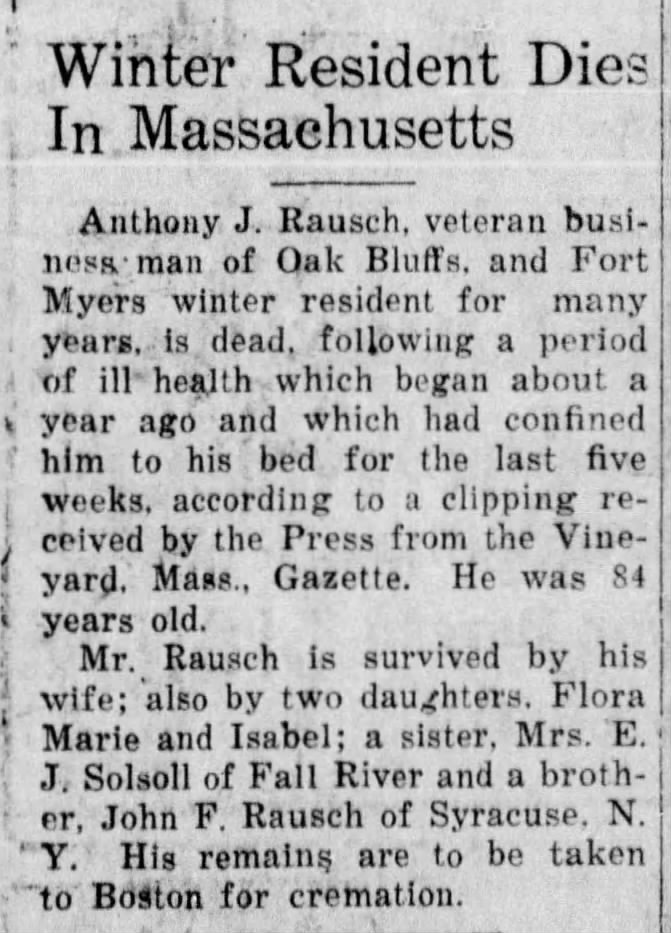
Bertha was born c. 1863 in the Kingdom of Hungary, and her native tongue was Magyar. In 1882 she emigrated to the United States, and in 1883 she married Anthony Rausch, another Hungarian immigrant who was about 11-12 years her senior and had immigrated in 1875. The 1900 census data lists Anthony Rausch as a confectioner, living in Providence, Rhode Island with his wife and two daughters, Flora Marie (b. 1888) and Isabella (b. 1900). The decades of census data and the occasional newspaper article trace the broad strokes of their lives: in 1910 they were in New York; in 1920, Fort Meyers, Florida, now sans children. Then in 1926:

In 1930, the widowed Bertha M. Rausch was living a retired life in Providence, Rhode Island, alone in a rooming house; her daughters were grown, her husband was dead. No doubt she took some comfort with her friends and neighbors, such as Annie E. P. Gamwell—and when in early 1936 Annie fell ill and had to be hospitalized, Bertha came a-calling:

Awakened 9 a.m. by bell—Mrs. Rausch calling. She was tremendously sorry to hear you are ill. Is moving back to #67.

H. P. Lovecraft, diary for Monday, March 30, 1936, Letters to Family & Family Friends 2.992

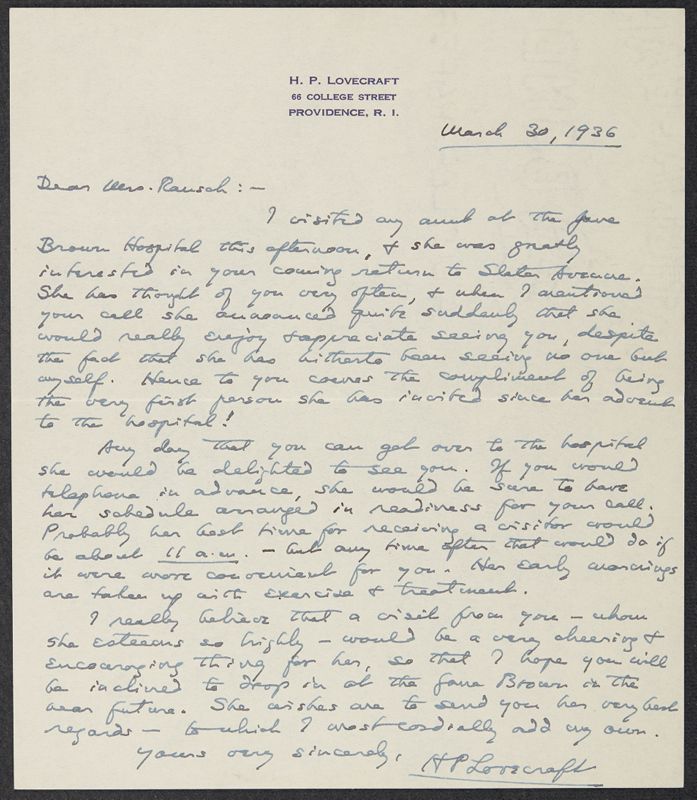
Presumably, Lovecraft had at least heard of Mrs. Rausch of old from his aunt, if they had not met before. #67 refers to a house on Slater Avenue, where she and Annie had once been neighbors. It isn’t clear how Bertha learned of Annie’s illness—perhaps they still met on occasion, or kept in touch, or had friends in common that passed on the news—but after her visit, it would only be polite of Lovecraft to write her a letter. So he did.

Then wrote Rausch & Sisson notes & mailed them. Then dinner.

H. P. Lovecraft, diary for Monday, March 30, 1936, Letters to Family & Family Friends 2.992

Charles Peck Sisson and his wife Margaret A. Sisson were members of the Providence Art Club, as was Annie; Lovecraft’s letter to (presumably) Margaret Sisson is not known to survive, but the full letter to Bertha M. Rausch is preserved at the John Hay Library in Providence:

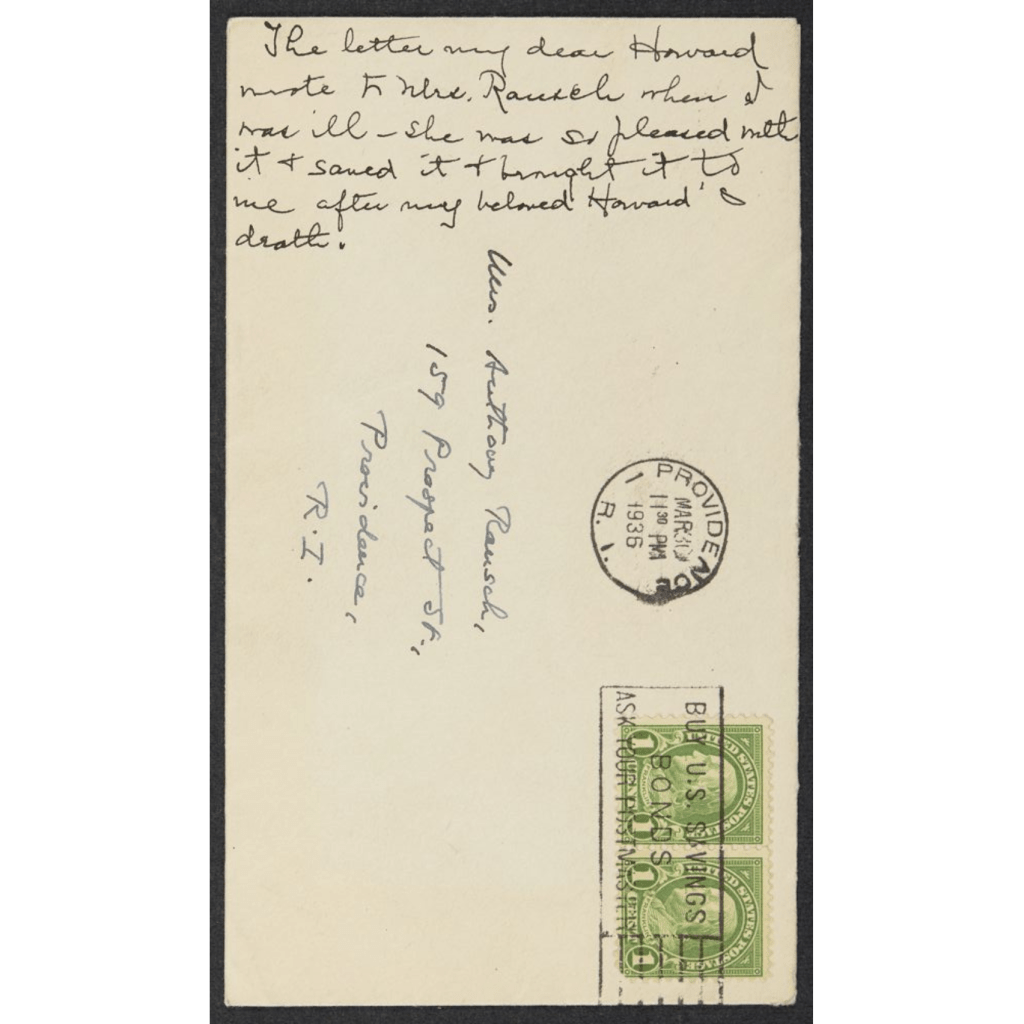
As might be expected, the letter is principally concerned with Lovecraft’s aunt and an invitation for Mrs. Rausch to visit her friend at the hospital, whenever it is convenient. Whether or not she did, we do not know—but we know that Bertha kept in touch with Annie, and scarcely a year later when Howard himself was dead, she returned the letter to her friend. On the envelope, Annie wrote:

The letter my dear Howard wrote to Mrs. Rausch when I was ill—She was so pleased with it & savied it & brought it to me after my beloved Howard’s death.

If this correspondence seems unusually brief, well, so it was: Bertha was Annie’s friend, and Lovecraft as the conscientious nephew was serving as his aunt’s secretary and factotum during the period of her hospitalization and convalescence, all while managing his own correspondence and writing. We are fortunate at least that Bertha and Annie both thought so well of Howard’s letter that it was preserved, and was finally kept along with his other papers as an eloquent testament to the care he devoted to his aunt during Annie’s presumed battle with breast cancer and recovery.

An abridged version of this letter was first published in Arkham House’s Selected Letters V; the full text of the letter was published by Hippocampus Press in Letters to Family and Family Friends.


Bobby Derie is the author of Weird Talers: Essays on Robert E. Howard and Others and Sex and the Cthulhu Mythos.

Deep Cuts in a Lovecraftian Vein uses Amazon Associate links. As an Amazon Associate I earn from qualifying purchases.
Her Letters To Lovecraft: Jennie K. Plaisier

Further versified contributions are those of Mrs. Jennie M. Kendall and Dr. O. M. Blood. Mrs. Kendall’s ballad is marked by attractive animation and commendable correctness, but Dr. Blood should exercise more care in his use of rhyme and metre.

H. P. Lovecraft, “Department of Public Criticism,” United Amateur Sep 1918 in Collected Essays 1.205

She was born Jane Irene Maloney in 1882 (according to her grave marker)—but she was better known throughout her life as Jennie. The daughter of Irish immigrants and raised in Chicago, Jennie was listed as a student in the 1900 Federal census, and the 1910 census gives her profession as a stenographer. Yet beyond her professional duties, Jennie Maloney was a noted amateur journalist involved with the National Amateur Press Association. She was elected as Corresponding Secretary of NAPA in 1905, and in 1908 she served as Historian under Official Editor Frank A. Kendall. In 1911, Jennie and Frank married; they both continued in amateurdom, and the union produced a daughter Betty.

In 1913, Frank Kendall was elected as President of NAPA. Unfortunately, on 23 November 1913, only four months into his term, he died from meningitis. Jennie Kendall was elected to fulfill the remainder of her late husband’s term, incidentally becoming the second female president of NAPA. By the time H. P. Lovecraft joined amateur journalism in 1914, her term would have ended. While raising her child as a single mother, Jennie would continue as an amateur journalist, and that is apparently how Lovecraft first knew her—as Mrs. Jennie Kendall. (See A History of the National Amateur Press Association.)

It is not exactly clear when Lovecraft and Jennie fell into correspondence, though it may have been as early as the 1920s. The Rainbow Vol. II, No. 2 (May 1922) by Sonia H. Greene (ed.) includes a poem “The Distant Forest” by 9-year-old Betty Jane Kendall, and precocious as that young amateur journalist might have been, it was probably her mother that stamped and mailed the poem in when Lovecraft & Greene needed material. No doubt Jennie and Lovecraft read of each other in amateur journals, but if they had any correspondence during this time, it has not come down to us.

In 1920, Jennie remarried to John Plaisier, a schoolteacher, and she took his name, becoming Jennie K. Plaisier. In 1935, Jennie, Lovecraft, and amateur Vincent B. Haggerty were elected to serve as a panel of judges for the awarding of the NAPA laureateships for 1935-1936…and there they ran into the bane of every small organization’s existence: petty politics.

My letter to Mrs. Plaisier was sent to Haggerty for reading & forwarding on Nov. 2; but he seems to have been slow in attending to the matter, since I’ve just had a note from Mrs. P. dated Nov. 6 & containing no sign of his having received my commiseration. Fortunately I had an extra carbon of my letter, which I’ve now sent her. […] Smith’s position is an extremely destructive one. A liberal attitude toward red tape regulations is all that has kept the National—or any organisation—a living institution—indeed, if this quibbling ultra-constitutionalism were retroactive, it would illegalise half our existing laureate awards & wipe out of technical existence the administration of some of our most useful & counterfeit officers! Rigidity is death to progress. I have fought legalism in amateur journalism for 20 years, & certainly don’t want to see it employed today for the gratification of a private grudge!

H. P. Lovecraft to Edward H. Cole, 19 Nov 1935, Letters to Alfred Galpin & Others 133

Two works in Ralph W. Babcock, Jr.’s amateur journal the Red Rooster (May 1935) were up for a laureateship, but he had made an enemy of fellow-amateur Edwin Hadley Smith. The quarrel was personal, but it played out in amateurdom: Smith brought up an obscure and unused rule in the NAPA constitution in an effort to show that Babcock’s publication with the items in question did not meet the legal definition of an amateur paper, and so were ineligible for any award. Smith wrote to Lovecraft to declare the works invalid; Lovecraft demurred. As Lovecraft put it:

I think I may have a fight on my hands—with our dear old pal Hadley. he has challenged the story & history laureate awards on the ground that they did not appear in a properly published paper—all of this of course being an effort to give Babcock a jolt, since the May Red Rooster is the paper in question. I disapprove of the use of virtually obsolete legal technicalities as adjuncts to private vengeance, hence as Exec. Judge will not give a decision until I have had proof that the original spring edition of the Rooster lacked the normal matter & circulation which would make it a paper. Smith is pretty well riled up about this, & would like to force my resignation if he could. Mrs. Plaisier is on his side, & Haggerty won’t vote because he was laureate judge of history.

H. P. Lovecraft to R. H. Barlow, 13 Dec 1935, O Fortunate Floridian 305

Old Hadley is trying to bulldoze me into giving an early decision in his favour—for it appears that my vote would be decisive. In response, I urbanely tell him to go to hell. Mrs. Plaisier—the chairman of the judges—seems to be in his favour, while Haggerty refuses to act because he was laureate judge of the disputed history entry.

H. P. Lovecraft to Duane W. Rimel, 15 Dec 1935, Letters to F. Lee Baldwin et al. 304

Whether Lovecraft told Edwin Hadley Smith to go to hell or not, his letters to Jennie Plaisier were no doubt much more formal and cordial, as untangling the truth of the matter and negotiating the dispute with his fellow judges required an exchange of more than a few letters between Lovecraft, Plaisier, and Haggerty. Eventually, a compromise was reached: Babcock declined the history laureateships, while the other went to Richard Foster for his piece in the Red Rooster.

The final verdict was released in a joint letter by Lovecraft, Plaisier, and Haggerty titled “Report of the Executive Judges” and dated 25 Apr 1936, along with various other bits of business. It was, to put it simply, a busy year, and must have generated a fair bit of correspondence between Lovecraft and Plaisier. Most of this, however, has not come to light. The “Reporter of the Executive Judges” has been reprinted in the Collected Essays volume 1 and the volume of Miscellaneous Letters, but only a part of a single letter from Lovecraft to Plaisier has seen print.

This letter fragment is dated 8 Jul 1936, and deals exclusively with Lovecraft’s politics…and his shift in politics over the course of his life:

Dear J. K. P.:—

[…]

Regarding extra-associational politicsI can sympathize very strongly with you in your state of isolatoin, since my own position is very similar. The background surrounding me (despite some wavering on my aunt’s part in response to my repeated arguments) is solidly old-guard Republican, whereas I myself have been increasingly a left-winger ever since the advent of the depression began to force me into real thought on the subject of economic and political trends.

I used to be a hide-bound Tory simply for traditional and antiquarian reasons—and because I had never done any real thinking on civics and industry and the future. The depression—and its concomitant publicisation of industrial, financial, and governmental problems—jolted me out of my lethargy and led me to reëxamine the facts of history in the light of unsentimental scientific analysis; and it was not long before I realised what an ass I had been. The liberals at whom I used to laugh were the ones who were right—for they were living in the present while I had been living in the past. They had been using science whilst I had been using romantic antiquarianism. At last I began to recognise something of the way in which capitalism works—always piling up concentrated wealth and impoverishing the bulk of the population until the strain becomes so intolerable as to force artificial reform. Sparta before Agis and Cleomenes. Rome before the Gracchi and Ceasar. Always the same story. And now accelerated a thousandfold through the unprecedented conditions of mechanised industry. Well—I was converted at last, and in the spring of 1931 took the left-wing side of social and political arguments for the first time in a long life. Nor has there been any retreat. Instead, I have gone even farther toward the left—although totally rejecting the special dogmatisms of pure Marxism, which are certainly founded on definite scientific and philosophical fallacies. I am all for continuous development and revolutions—and it seems to me that the nations with a naturally orderly and liberal tradition have a very fair chance of developing in the proper direction without any cataclysmic upheavals. Great Britain and the Scandinavian countries are far ahead of the United States, but even the latter is coming along despite its ingrained tradition of harsh acquistiveness. So today I am a New Dealer—perfectly conscious of the waste and bungling necessarily connected with experimentation, but convinced that open-minded experiment with all its faults is vastly better than efficient and economical progress toward the wrong goal.

The entire basic philosophy upon which old-time Republicanism is founded is at best a barbarous one, and at present an obsolete and unworkable fallacy. it leads only to increasing stress and ultimate explosion. Laissez-faire economics under present conditions means the permanent displacement of more and more persons from the industrial fabric. it is time that the state adopted general public welfare, rather than the protection of heavy individual profits, as its guiding policy and aim.

It may possibly interest you to see the general formulation of my new position which I prepared in the earlier days of my conversionhence I am sending a couple of documents which you needn’t read through if they promise boredom. Some of their phases may seem rather out-of-date in 1936, but the general picture of my philosphical orientation still holds good. Pardon the illegible condition of the 1934 newspaper lettera rough draught of something that was never printed! it is sometimes amusing to show these things to people who knew me in my Tory days, and who still have not kept track of my evolution. Poor George W. Macauleystill a stubborn reactionarywas almost paralysed by the horrible transformation which had come over the old gentleman! No need to hurry about returning the stuffand no need to read it if it looks excessively dull.

Yrs. most sincerely,
H. P. L.

H. P. Lovecraft to Jennie K. Plaisier, 8 Jul 1936, Letters to Hyman Bradofsky & Others 389-390

These views track with the development of Lovecraft’s politics over the course of his life; whether the subject came up as a result of the dispute of amateur constitutionalism or arose separately—other amateurs had noted the same shift in Lovecraft’s politics, which were very different in the mid-1930s than they had been during his days publishing his amateur journal The Conservative. Whatever the case, it seems clear that their correspondence continued for a little while after their mutual service on the Executive Judgeship was completed. They may have continued writing to one another as late as 1937, for Jennie K. Plaisier’s address is listed in Lovecraft’s 1937 diary (see Lovecraft Annual #6.171).

After Lovecraft’s death, Jennie wrote of their friendship:

I mourn him very much, as we had become very fond of each other during the Executive Judgeship days that you caused us so many gray hairs. I shall miss his letters and his helpfulness a great deal. I have quite a bit of his work on hand that he had sent to me and it may be valuable material. We shared the same political outlook. He was won over to my “modern revolution” theor from an old rock-bottom republicanism and during the last campaign had quite a time with his relatives and friends because of his attitude to the “new Deal.” These are not idle words when I say his passing is a great loss for A.J.

Jennie K. Plaisier to Edwin Hadley Smith, 26 Mar 1937, MSS. Brown University Library

The 1936 letter fragment was first published in Selected Letters 5.279-280, an expanded version with more of the letter was published in Letters to Hyman Bradofsky & Others 389-390.


Bobby Derie is the author of Weird Talers: Essays on Robert E. Howard & Others (2019) and Sex and the Cthulhu Mythos (2014).

Deep Cuts in a Lovecraftian Vein uses Amazon Associate links. As an Amazon Associate I earn from qualifying purchases.
Her Letters To Lovecraft: Myrta Alice Little

A new recruit likely to be of great prominence is Miss Myrta Alice Little (Colby A. B., Radcliffe A.M.) of Hampstead (Westville P. O.), N. H. Miss Little is, like our leader Mr. Moe, a high-school English teacher; and she is in addition a professional author of increasing success. She is pursuing a systematic course in short story construction, and will probably be numbered among the successful writers of the future.

H. P. Lovecraft, “News Notes” (Nov 1920), in Collected Essays 1.265

Myrta Alice Little was 32 years old when she joined Lovecraft’s branch of the United Amateur Press Association in 1920, and began publishing in amateur journalism with a piece in The Tryout in Nov 1920, published by Charles “Tryout” Smith. Whether their association and correspondence began then or dates back earlier is difficult to say. Likewise, we have no idea when the correspondence ended, or even if it did end. The trace of their friendship is fairly thin—one letter from Lovecraft to Little survives, an envelope for a letter from Lovecraft to Little postmarked 1927 sold at auction, an entry for “Davies” (her married name) is included in a list of postcard recipients for Lovecraft’s 1934 southern vacation, and her address was still in Lovecraft’s 1937 address-book. In Lovecraft’s letters, references to Little are scarce, mostly focused on two trips that he took to visit her in New Hampshire in 1921, during a time when she was Historian of the U.A.P.A.

The surviving letter, some ten handwritten pages and covering a fair bit of discussion of both their lives and literary interests, predates the first trip and shows an easy familiarity that suggests the correspondence had been ongoing for some time:

Dear Miſs Little:—

Pray accept my sympathy regarding the process of domestic upheaval, & the hope that your chain of symbolic icons may by this time boast complete colouration! That there exists in the task some redeeming spark of pleasure fo ryou, is indeed fortunate. I abhor all manual labour, & am unutterably bored by the necessity of taking care of my own quarters. Many a night have I slept in a dressing-gown on the top of my bed to avoid making it the next day—in fact, I believe I am the most basically & constitutually indolent person on this terraqueous globe.

H. P. Lovecraft to Myrta Alice Little, 17 May 1921, Miscellaneous Letters 145

Myrta Little had just recently moved back to New Hampshire from California, and was getting re-settled in the family home. This may have been what prompted her invitation for Lovecraft to visit, as the rail network in New England made such travel relatively easy. A good portion of the letter involves the date and time for the visit, e.g.:

I note your correction regarding your literary encampment, which I shall view with interest & pleasure if the Parcae permit my Arctic expedition next month. And regarding said expedition—surely Junius is better than Maius, & I am not sure but that Quintilis would be better still. Heat is my breath of life—I never really live till the mercury reaches 90°. As to duration; the fatigue I felt on the second day both times I stayed overnight in Boston, warns me that it were well not to extended my absences too abruptly. Wherefor I fancy I had better plan for the single night only, at the same time extending sincerest thanks for the ampler invitation.

H. P. Lovecraft to Myrta Alice Little, 17 May 1921, Miscellaneous Letters 145

It should be remembered at this time that Lovecraft had been largely Providence-bound (if not actually homebound) for about a decade. In 1904 the death of Lovecraft’s grandfather Whipple V. Phillips had seen the breakup of the family home and the decline of the family fortunes; Lovecraft and his mother moved into a smaller, rented place on the same street. Lovecraft attended public high school, but it was sporadic, and he did not graduate at the appointed time. Failing to matriculate to college, Lovecraft also failed to find a job or any other real occupation; this may or may not have been due in part to ill health or depression. He began to break out of his shell in 1914 when he joined amateur journalism; and it was those friends and contacts which brought him finally to meet fellow amateurs, both at his home in Providence and then traveling to Boston.

At the time Lovecraft wrote this letter, his mother was confined at Butler Hospital in Providence; she had just had an operation to remove her gallbladder the day before, and would die four days after the letter was handwritten on 21 May 1921. With his mother’s death, Lovecraft was less tied to Providence, and traveled further and more frequently. Lovecraft’s aunts assumed large control of the family finances and their nephew’s welfare during this period, perhaps being the “Parcae” mentioned above, if Lovecraft wasn’t just using Classical allusion for its own sake.

In any event: Susan Lovecraft died, and the next month Lovecraft made his first visit to the Littles from 8-9 June 1921. The trip was touched on in several letters, including this one:

As I continued to stagnate in dressing-gown & slippers—increasingly active with the pen, but inert physically–my aunts endeavoured to arouse me to some variation of the indoor monotony, & insisted that I respond to an invitation which I had received a month before, to visit an exceedingly learned & brilliant new United Member—Miss M. A . Little, A. B., A. M., a former college professor now starting as a professional author—in Hampstead, N. H., near Haverhill, Mass. This I finally did, as you already know from the postcard mailed at the latter place.

On Thursday came the Smith call. I had intended to stop there alone on my return trip, but Miss Little was so interested in the genial Grovelandite as revealed in his paper that she wished to go also. We found him in his little Tryout office behind the house, cordial & hospitable, & eagerly awaiting the visit which my card had heralded. […] He was sorry we could not stay longer, & made both Miss L. & me promise to visit him sometime when we could stay all day & eat a dinner of his cooking—he prides himself on his skill as an amateur chef. […] He gave me a vast pile of old Tryouts for recruiting work, & gave Miss Little as complete a file of back numbers as he could. She is going to bake him a loaf of gingerbread as a reward—he dilated at length upon the excellencies of one which good Mrs. K. Keyson Brown baked & sent him recently.

H. P. Lovecraft to Rheinhart Kleiner, 12 Jun 1921, Letters to Rheinhart Kleiner and Others 181-182

However, these letters shed little real light on Lovecraft’s friendship with Little, or even descriptions of Little herself. Whether this represents a reticence on Lovecraft’s part or an unhappy gap in the correspondence isn’t clear. We know there must have been more letters back and forth, because Lovecraft visited them again a little over a month later:

On the following Friday I received still another invitation, as Galba already knows. This time Hampstead and Haverhill again, by request of the super-hospitable Littles, who so delightfully approximate the state of England’s rural gentry. It was for a longer time than the other visit, but I compromised on two nights, and arranged to use the final evening on my homeward trip to discharge the debt of courtesy by calling at the Hamlet Castle. Leaving Providence Thursday morning at 11:00, I arrived in Haverhill at 2:15, and was met with a horseless carriage containing Miss Little, her mother, and a bearded and pleasant uncle whom I had not seen previously but whom I liked at once. In describing these rural magnates I am happily able to discard that tone of sarcasm with which I describe certain more urban amateurs; for verily, they are of the wholesome Saxon gentry that needs no apology or allowances. In a word, they are all right; of one’s own sort, as it were.

H. P. Lovecraft to the Gallomo, 31 Aug 1921, Miscellaneous Letters 113

This was the same trip in which Lovecraft helped entertain his hosts by dressing in drag:

After dinner the family again demanded that Grandpa amuse them with some of his theatrical impersonations—and believe us, you’d never know the old man in some of the things they made him put on! In my acting days I went in for the heavy villainous stuff; but the Hampsteaders seem partial to the Julian Eltinge stuff, and could not be satisfied till they had Grandpa laced into a hoop-skirt outfit with bonnet and parasol to match! Though it was hard to think of dialogue for such a makeup, they seemed satisfied with my improvisations; and compensated by prolonged applause for the injury inflicted upon my patriarchal dignity.

H. P. Lovecraft to the Gallomo, 31 Aug 1921, Miscellaneous Letters 115

There was not the last that Lovecraft and Little would see of each other, although references in Lovecraft’s surviving letters are few. It is not unusual for Lovecraft to fail to disclose much about his friends in other letters; after 1921 Myrta Little’s active involvement in amateurdom appears to have faded, perhaps because she wished to focus on professional writing, perhaps because she wished to focus on…someone else. Dave Goudsward, who has written about Little in The Fossil #383 and in his book Lovecraft in the Merrimack Valley covers both trips in detail suggests that Myrta Little’s invitation and cordiality to Lovecraft was more than just friendly; that she was in fact romantically interested in him. They were after all nearly the same age (Lovecraft was two years younger), and Lovecraft appears to have supported her literary interests.

Whether the romance actually existed, and if it did how one-sided it was on Little’s part, is open for speculation. What is known is that three days after their final meeting in 1923, Myrta Alice Little married Arthur Davies, a Methodist minister. Lovecraft does not mention the marriage in his letters, and references to Myrta Davies largely cease, although the inclusion of a “Davies” in his postcard list shows their correspondence may have continued, if sporadically.

What was Myrta Alice Little to Lovecraft, and what was he to her? Were they simply friends and fellow amateurs whose interests blossomed for a season, before their lives drew them back apart again? Were there deeper feelings for a time? We can only guess. Certainly, Little was one of many women in amateur journalism that Lovecraft corresponded with, and his letter does not appear any more intimate, at this point, than any other to, say, Elizabeth Toldridge or Winifred Virginia Jackson—but then, neither are the letters to Lovecraft’s future wife, the amateur Sonia H. Greene, particularly intimate either. It may be he simply refused to commit such sentiments to paper; or perhaps simply that the relationship had not progressed to that point.

Perhaps they were nothing more than friends, as it might appear on the surface they were.


Bobby Derie is the author of Weird Talers: Essays on Robert E. Howard & Others (2019) and Sex and the Cthulhu Mythos (2014).

Deep Cuts in a Lovecraftian Vein uses Amazon Associate links. As an Amazon Associate I earn from qualifying purchases.
Her Letters To Lovecraft: Lillian M. Galpin

Here’s some news that can’t wait for a letter. Alfredus—Grandpa’s little Galpinius-child—is married! The event occurred last June, but The Boy kept it a secret for a while—perhaps waiting to see whether or not it would turn out well.

H. P. Lovecraft to Lillian D. Clark, 27 Aug 1924, Letters to Family & Family Friends 1.154

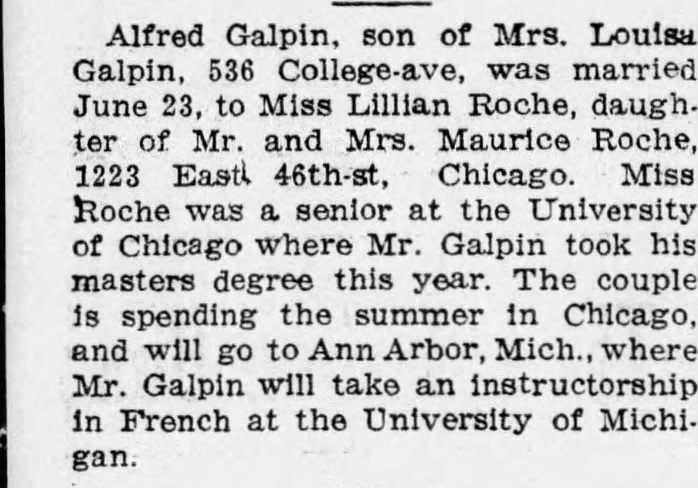
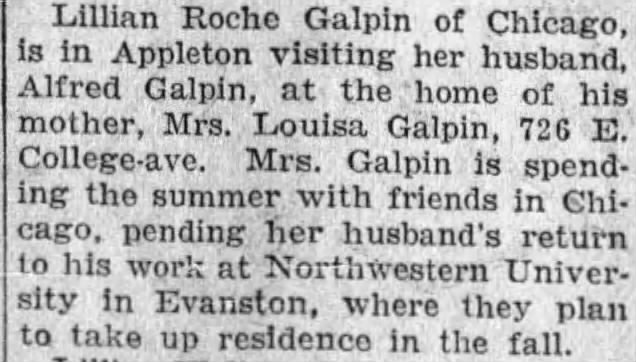
According to census data, birth records, and her gravestone, Lillian Mary Roche was born on 16 Nov 1903 in Lowell, Massachusetts, one of six children of Irish immigrants Maurice and Elizabeth Roche. Her family was living in Chicago, IL in the 1920s, and Lillian was attending the University of Chicago and in the final year of her undergraduate degree when she married Alfred Galpin, then finishing his master’s degree at the same university. The marriage occurred on 23 June 1924, and initial prospects did not appear to be poor—Alfred was fluent in French and had a position as an instructor in that language at the Univeristy of Michigan secured. It would end with Lillian’s death in 1954…and as far as public records go, there is little to add to that. The Galpins had no children, and if Lillian left any record, it has not been published.

Yet things were not all right with the marriage…and that would lead to one of the oddest and briefest (one might say, tangential) correspondences in Lovecraft’s life. The story is not one that Lovecraft or anyone else has told directly, but has to be pieced together from different records, references in Lovecraft’s correspondence, and other odds and ends.

AUGUST 27, Wednesday. Did I mention that Alfred Galpin, Madisonian, friend of Lord and L (whatshisname) and myself, incidentally, went and got married some time ago? Hully gosh! He, Howard! Next I suppose CAS, SL, RK, and even JFM and perhaps even GK will join ranks.

George Kirk, Lovecraft’s New York Circle 28

H. P. Lovecraft came in contact with Alfred Galpin around 1918, when Galpin was still in high school, through their mutual associate Maurice W. Moe. They shared an interest and involvement in amateur journalism, and developed a robust correspondence. Lovecraft predicted great things for Galpin, but neither man shared everything with the other. When Lovecraft eloped in March 1924 to marry Sonia H. Greene, he didn’t inform Galpin (or anyone else) until after the fact; when Galpin married Lillian Roche a few months later, he didn’t inform Lovecraft right away either.

Ex-President Alfred Galpin, having been married in June, 1924, last autumn accepted a post as Instructor in French at the Rice Institute, Houston, Texas, perhaps the leading university of the Lone Star State. His interests are veering more and more away from literature toward music, and after suitable years of study he hopes to be recognised as a pianist and composer.

H. P. Lovecraft, “News Notes,” United Amateur 24, No. 1 (Jul 1925) in Collected Essays 1.356

For young, untenured university professors, going where the jobs are isn’t unusual, then or now. Yet the Galpins did not end up going to Paris. Instead, about a year after their marriage, Alfred and Lillian went to Paris:

The little rascal sailed from New Orleans (3d class) on the 14th of last month, & has since been imbibing true Parisian accent & colour whilst his wife studies at the Sorbonne. They inhabit a rather costly hotel in the Rue Madame, & Galpinius does not seem to be disappointed in the least—as yet—with the storied city of his dreams.

H. P. Lovecraft to Lillian D. Clark, 13 Jul 1925, Letters to Family & Family Friends 1.313

Most of Lovecraft’s surviving correspondence mentions Lillian indirectly; they were not apparently correspondents at this time, and if they exchanged letters after 1925 there is no evidence of it. She was, for the most part, mentioned only indirectly as Lovecraft related news about Alfred Galpin to his various correspondents. It is somewhat ironic, given how nebulous and tangential the bulk of these passing references are, that it is only through Lovecraft’s letters that we get a picture of Lillian Galpin.

The story unfolds in his letters:

Speaking of Galpin—he is now in Paris studying, having gone thither in June with his wife. The latter is returning ahead of him on the Majestic—arriving, as coincidence would have it, this very day—& Loveman & I expect to see her & ply her with questions anent her brilliant spouse & his Gallic sojourn.

H. P. Lovecraft to Clark Ashton Smith, 18 Aug 1925, Dawnward Spire, Lonely Hill 77

Arrival documents confirm that Lillian Galpin arrived, without her husband, in New York City on 18 Aug 1925. Why she left Paris is not clear, although in other letters Lovecraft notes that Alfred Galpin was experiencing financial difficulties (his father, who died in 1924, had left the bulk of his estate to a nephew also named Alfred Galpin). This is the first real hint of trouble in the marriage, although Lovecraft goes into no details—and Lovecraft himself was at the time semi-separated from his wife, living in Mrs. Burn’s boarding house at 169 Clinton Street in Brooklyn while Sonia was working in Cleveland to help support them both, visiting New York at intervals.

Alfred Galpin wrote to Lovecraft ahead of time to greet his wife at the pier and help her out; Sonia was in town at the time, although due to leave for Cleveland in a few days. Lovecraft, not sure how best to handle the situation, wrote Lillian a letter which was to be delivered to her when she came ashore, giving his phone number and enclosing photographs of himself and Samuel Loveman, so she could recognize them when they came to assist with her luggage.

Dear Mrs. Galpin:—

Your gifted husband having informed our local circle of easthetic dilettanti of your impending arrival on the S.S> Majestic, & having delegated to use the agreeable responsibility of showing you such sights & salient points of interest as you may care to inspect hre, I herewith take it upon myself to facilitate your location & identification of the circle in question. Mr. Galpin tells me that you will call me up by telephone, but it occurs to me that I may not have given him the number of this haven of remunerative guests; in which case you will look in vain through the book for a telephone in my name. Let me, therefore, here state that the correct number is MAIN 1401, at the Brooklynward end of which a proper sentry will be posted during the day of your arrival as estimated byt he White Star offices—Tuesday, Aug. 18.

H. P. Lovecraft to Lillian M. Galpin, 16 Aug 1925, Letters to Alfred Galpin & Others 261-262, MSS. John Hay Library

What followed was one of those comedies of errors that in another century could have been solved with a ten-minute call on a cellphone.

The next day—Tuesday the 18th—we were up early & on the watch for Mrs. Galpin’s telephone call. S H had to go out, but arranged to leave the numbers of the places she visited, so that I might reach her when Mrs. G. communicated. Meanwhile I busied myself with reading & correspondence—& framed an inquiry for the Post Office concerning an important envelope from Clark Ashton Smith, containing a letter, a story, & several poems, which was mailed to me last March & failed to reach its destination. Thus the day passed—when at three o’clock the Burns boy brought up the card of Mrs. Alfred Galpin! The steamship letter had failed to reach her; & after a five-hour search including inquiries at police stations, public libraries, & heaven knows what else, she had come upon the place through a vague remembrance that it was in Clinton Street, & that its number had three figures beginning with 1 & ending with 9. Beginning at 199, she had worked along the street northward, trying 189 & 179, & finally stumbling on the correct spot at 169.

H. P. Lovecraft to Lillian D. Clark, 19-20 Aug 1925, Letters to Family & Family Friends 1.353-354

Lovecraft’s 1925 diary entry for 18-20 Aug 1925 covers the essentials of Lillian Galpin’s visit (Collected Essays 5.165-166), while his letter to his aunt has a much more detailed, expanded account of events. One has to imagine Lillian Galpin, after a six-day crossing of the Atlantic, arriving in a strange city and randomly knocking on doors until she finds her husband’s friends. It was here that Lovecraft gave his description of her to his aunt:

Mrs. G. was undecided about the duration of her stay; though waning finance dictated a very brief sojourn,whilst her trunk had already been scheduled for through transportation to her parents in Chicago. Three days seemed a logical period, though she would like to obtain a local position & settle semi-permanently till the American return of The Boy. At length she decided to plan on leaving Thursday night, on a late train. Mrs. Galpin is a small person of no especial beauty, strongly resembling the portrait of Mrs. McMullen (Lillian Middleton) which you will find in the second (green-covered) issue of The Rainbow. She is descended from the most ancient Norman nobility domiciled in Ireland—the de Roches—& Alredus is strongly thinking of changing his name to hers, because of its greater aristocratic significance. Some of the kin of this family, the Burke-Roches, are of international social pormienncel whilst Mrs. G’s own father would be the 21st Earl of Fermoy if he would renounce his American citizenship. A proper family for the reception of Grandpa’s Boy—I can see him as Alfred de Roche, in a panlled coach with his new coat-of-arms on the door! Mrs. G. was, like Alfredus, an infant prodigy; & is a graduate of the University of Chicago. Her literary background is ample & profound, & appears to be united to an excellent taste & keen intelligence; in short, the match seems in very way a suitable one for The Child, whose genius deserves a kindred environment. Alfredus himself, I learn, is developing into a typical Parisian character. He wears his hair long—longer, in literal truth, than his wife’s—& even tried to grow a beard till he found it impossible. His scornful repudiation of literature is complete; & he not only laughs at his wife for reading, but refrained from telling her that he had ever followed letters himself—so that the Galpinian essays & critiques which I shewed her came as a complete surprise!

H. P. Lovecraft to Lillian D. Clark, 19-20 Aug 1925, Letters to Family & Family Friends 1.354-355

There is a Baron Fermoy in the peerage of Ireland, and the Burke Roche family do hold it, but someone got the other details wrong. More compelling is the idea that Alfred Galpin didn’t see fit to tell his wife anything of his amateur journalism career, despite the fact that he had once been president of the United Amateur Press Association in 1920-1921 term. That Lillian was resolved to be separated from Galpin until his return to the United States the following year, and looking for work to support herself, speaks somewhat to their marital difficulties—and one has to wonder if the Lovecrafts saw the parallels with their own situation.

After the play we took a taxicab to the Erie ferry near the White Star dock, & fetched Mrs. Galpin’s hand luggage to 169, where she took a room on the ground floor. En route we took refreshments at the Scotch Bakery. Finally, we dispersed for slumber; Ms. Galpin deciding to devote the morrow to job-hunting, & indicating her intention of rising early, perhaps before the rest of the household—returning some time in the afternoon, & attending the meeting of The Boys at Kirk’s ex-partner’s—where S H also planned to attend. […] I last spoke of Wednesday the 19th, on which date I rose early & wrote letters till mid-afternoon, when Mrs. Galpin returned from her fruitless industrial quest. Upon her arrival she spoke of the night before–which, thanks to the negligence of busy Mrs. BUrns–had not been one of rest. It seems that the downstairs room has not been kept as immaculate as some others herabouts, & that its couch has an undesirable population of invertebrate organisms which resent the intrusion of mere mortals to a highly vindictive extent! Accordingly Mrs. G. was far from harassed, & in the morning held an interesting conversation with Mrs. Burns—who apoligised profoundly & let her have the room at a reduced rate.

H. P. Lovecraft to Lillian D. Clark, 19-20 Aug 1925, Letters to Family & Family Friends 1.355-356

Fresh across the Atlantic, without her husband, in a strange city, and then faced with bedbugs. Lillian Galpin’s New York adventure was not shaping up to be a good one. Lovecraft himself had long been discouraged with job-seeking, and was not surprised by her lack of success. They went out to dinner, and then an evening with the Kalem Club. When they returned to 169 Clinton, the exhausted Lillian must have realized she was facing another night with bedbugs.

The residual trio proceeded to 169; where Mrs. Galpin, after inspecting her room, decided she could not rest. Accordingly—& with many apologies for having delivered a guest unwittingly into an arena of sanguinary monsters—S H & I decided that Mrs. G. had better stop at some haven of undisputed immaculeteness & desirability; hence I assisted in the transfer of her effects to the celebrated & dignified Hotel Bossert in Montague Street, where she obtained an excellent seventh-floor room for four dollars.

H. P. Lovecraft to Lillian D. Clark, 19-20 Aug 1925, Letters to Family & Family Friends 1.356

This was, however, not the last injury that Lillian suffered at Burn’s boarding house:

On this occasion I proceeded home, where I found Mrs. G. already arrived after a last & unavailing early morning interview ith a possible employer, & a last & earnest conversation with Mrs. Burns anent a fresh case of robbery in this delectable retreat! It seems that when packing in haste the previous evening she had left heind a somewhat valuable silk nightgown—which was now missing, & which has not been heard from since. Which of the sundry transient inhabitants to accuse one cannot say—but fortunately Mrs. G. is a philosopher, & able to dismiss life’s casual losses with a shrug & a sigh. We now endeavoured to set out upon that course of sightseeing which malign circumstance had thus far delayed—but again the Fates interposed, & the entire morning was wasted at the Erie & white Star piers in a fruitless attempt to locate Mrs. G’s trunk, for which she had failed to obtain a receipt, but which probably went through to Chicago. We did, however, recover the missing letter with its pictorial encloserues, which latter I wished to preserve.

H. P. Lovecraft to Lillian D. Clark, 19-20 Aug 1925, Letters to Family & Family Friends 1.357

They did retrieve the letter, which is why it is not preserved in Letters to Alfred Galpin & Others. Sonia was due back in Cleveland by an earlier train, to which city she invited Lillian to visit; they then helped Lillian see what she would of New York in her few remaining hours.

Since all museums close at five, it was now too late to see more than one; & this was chose without difficulty, snce Mrs. G’s chief wish in N.Y. was to inspect the American Wing of the Metropolitan Museum. Arriving in good season, & prviouslt surveying the French rooms (as you & I did) we proceeded to cover the colonial exhibits in detail; & Mrs. G. displayed a genuine interest & acute knowledge in remarking upon the objects displayed. She purchased the dollar handbook of the oclleciton, & means to become something of an authority on Georgian America whilst her effulgent lord & master absorbs the antique charm of mediaeval Paris.  […]

Mrs. Galpin, being exceedingly fatigued by continuous exertion, sent her regrets & went to her hotel to rest; but I went down & saw S H safely aboard the Cleveland train—incidentally carrying her a letter from A E P G which had just arrived. […] Now proceeding to the Bossert, I met Mrs. G. & transferred her values once more to 169, for later transportation to the train. She obtained some light refreshments—cheese crackers, orange marmalade, chocolate, & fruit, & served these whilst I began a letter to The Boy. In due time she added her section, & under separate cover we added the postcards obtained during the afternoon, as a supreme inducement for The Child to stop off in New York next June upon his return to the United States.

H. P. Lovecraft to Lillian D. Clark, 19-20 Aug 1925, Letters to Family & Family Friends 1.357-358

It was typical of Lovecraft to write joint letters with such friends were available; there would be nothing more suitable than for Lillian Galpin to include a brief note to the letter Lovecraft was writing to her husband. Regrettably, Alfred Galpin destroyed much of his early correspondence with Lovecraft c.1930, including their joint letter. This is why Lillian Galpin might be considered a “tangential” correspondent—the one letter Lovecraft wrote to her she didn’t receive, and the one letter they wrote together doesn’t survive.

After completing her section, Mrs. G. rested on the couch & slept soundly whilst I finished the epistle at length. At 11:00 I fared forth to secure a taxicab, which I found only with great difficult & alarming loss of time. Returning with it, I awakened Mrs. G. with as much gradualness & as little violence as possible, after which the expedition hastened in the cab across Brooklyn Bridge & through the town to the Erie ferry, just in time to miss the 11:50 boat which had been mentioned as the one connecting with the Cleveland-Chicago train! For a moment, dramatic despair supervened; but in another instant a clerk had cleared the skies by mentioning tht according to Daylight-Saving Time we were a full hour early, the real boat being the 12:50 by the local clocks. Saved! We now proceeded to a neighbouring cafeteria, had coffee & read books at a table which commanded a view of the clock, & in due time returned to the ferry & sailed thereon. Reaching the other side, I assisted the luggage to the 1:25 train, & bade Mrs. Galpin convey my regards to S H upon meeting her, & to Alfredus upon writing him.

H. P. Lovecraft to Lillian D. Clark, 19-20 Aug 1925, Letters to Family & Family Friends 1.358

That was the last time that H. P. Lovecraft and Lillian Galpin met, though he would continue to hear from her. In fact, rather shortly he would get an urgent letter from his wife regarding Lillian.

Had a letter from S H yesterday, saying that Mrs. Galpin didn’t shew up in Cleveland at all! She’s quite worried, imagining all sorts of kidnappings, wrecks, & such like; but I fancy Mrs. G. was merely too tired out to relish the Youngstown change of cars, so went straight home to Chicago.

H. P. Lovecraft to Lillian D. Clark, 19-20 Aug 1925, Letters to Family & Family Friends 1.367

Lovecraft was probably correct; after the trials and hectic travel of the last few days, Lillian was probably happy to be home…although again, this was back in Chicago, without her husband. How she spent the next year is not clear; Alfred Galpin was desperate for money to continue his music studies in Paris, even asking Lovecraft for a loan, and Lovecraft reported that his wife prevailed on Galpin’s mother to send a $250 cheque to cover his needs (Letters to Family & Family Friends 1.451-452). In 1926, she passed through New York again to take ship to bring him back to the States:

MAY 4 […] Met, the other day, Galpin’s wife: she went back to Paris on the Leviathan, and expects to bring him back ere long….

SEPTEMBER 9 […] Guess old Galpin isn’t coming from Paris either, as I hear his wife is going back and they’re to say another year. There’s bedlam for you.

George Kirk, Lovecraft’s New York Circle 87, 98

By this time, Lovecraft had left New York and so missed a reunion with Lillian; while Alfred Galpin may have wished to stay in France, they did apparently return to the United States in 1926, with Alfred taking a position at Northwestern University in Evanston ( a suburb of Chicago) teaching French and Italian. The 1930 Census shows Lillian employed as a clerk and living with Alfred in Chicago, but likely he would return home to Appleton, Wisconsin in between terms. Lillian did not apparently accompany him.

In 1930 Alfred finished his M.A. at Northwestern, and spent another year (1931-1932) in France; whether Lillian accompanied him is not clear, although a 1932 news article shows she was applying for jobs in Appleton. When Alfred returned to the United States, he took a position at Lawrence College (now Lawrence University) in Appleton. It is in these letters from Lovecraft to Alfred Galpin after the second trip to France that we get more hints of discontent in the Galpin household:

As for your present perturbations—I think a year or so will find you much less agitated, since all amorous attractions are essentially transient. And of course, if you’d get outside yourself, take an objective & panoramic survey, & give some really serious thought to the fortuitous meaninglessness of all emotion, you would be greatly helped in the cooling-off proces. That’s the only process worth cultivating unless the other victim gets ashamed of accepting luxury from a deceived partner & coöperates toward putting the whole matter on an open & straight-forward basis. Meanwhile one may only advise that you “coast” as inconspicuously & indecisively as you can—with eyes open as to possible exits & solutions. Let us hope that your wife will have time in Chicago to think on the value of the prize that is slipping away, & that a renewed affection on her part may assist in toning down the new & capricious hormone-storm. But time & common sense will doubtless bring their own adjustments.

H. P. Lovecraft to Alfred Galpin, 20 Jan 1933, Letters to Alfred Galpin & Others 283-284

Which sounds a great deal as if Lillian left Alfred, and that there was some issue that caused the separation—the hints “amorous attractions” and “deceived partner” sound an awful lot like an extramarital affair, or perhaps the preliminary stages of one. It’s speculative all around—someone that Alfred met in Paris? A female student at Lawrence College (notable as one of the first co-educational colleges)? The “possible exits & solutions” may have been a gentle hint at divorce, as Lovecraft’s own separation had led to. Suffice to say, Lovecraft was not himself a font of good advice on marital difficulties, although he tried to say positive and encouraging things:

I am glad your domestick affairs maintain a certain quiescence, if not ideal adjustment, & trust that time may do its own salutary & imperceptible modelling toward a stabler & sounder equilibrium.

H. P. Lovecraft to Alfred Galpin, 24 Jun 1933, Letters to Alfred Galpin & Others 292

It is gratifying to learn—even tho’ it implies no great change in your basick philosophy—that you have extinguish’d the altars of Astarte in favour of those of Urania & Hymenaeus. In your easy recovery from the aberration you might well read a confirmation fo what I previously told you regarding the wholly capricious, cosmically un-grounded, & therefore essentially trivial nature of such seizures. They are simply temporary biological-psychological surface twists—& when one thoroughly realises the trivialmechanical character of such emotional phaenomena, he ought to be able to analyse them out of existence whenever they interfere with the well-harmoised & appropriate course of his life, or with the practice of that fairness, honest, & open, aboveboard conduct which distinguishes artistic living from sloppy, messy living.

H. P. Lovecraft to Alfred Galpin, 5 Oct 1933, Letters to Alfred Galpin & Others 296

Astarte is the Hellenized version of the Near Eastern goddess Ishtar, associated with love; Aphrodite Urania was the aspect of spiritual love, and Hymenaeus the god of marriage. Which suggests that whatever affair was being pursued was broken off, and that Alfred Galpin was endeavoring to mend fences with Lillian. Part of this involved a trip to Chicago, implying they were still separated:

Glad you had a good Chicago trip, but sorry you picked up a cold. […] As for the philosophy & aestheticks of domestick organisation—I still don’t agree with your essentially cloudy & ill-defined system of standards. The common emotions connected with primary instincts, & not extensively linked with imaginative associations & a sense of pattern, are undeniably largely mechanical matters which, while powerful in the sense that a rap on the head or a siege of typhoid is mechanically powerful in its effect on the system, are certainly not important in the artistic experience of complex conscious living.  Assuredly, they are not important enough to justify their easy interference with the fulfilment of other emotions whose richness & coördination give them a really pivotal place in an harmonious life of widely-realised possibilities. I feel confident that the current fashionable endorsement of messy living will vastly diminish whenever a reacquired cultural stability gives our most active minds a renew’d chance for mature & leisurely reflection.

H. P. Lovecraft to Alfred Galpin, 25 Oct 1933, Letters to Alfred Galpin & Others 300

Some sort of peace was apparently brokered between husband and wife:

Glad that the household matters are recrystalising favourably, & hope the dual Appleton-Chicago arrangement may ensure you an ideal summer.

H. P. Lovecraft to Alfred Galpin, 6 Jun 1934, Letters to Alfred Galpin & Others 308

Again, speculation rears its head: if Lillian was living and working in Chicago, she probably was either living with family or had a lease on an apartment, and Alfred was probably in much the same situation in Appleton, although probably staying at the family home; perhaps Alfred would live with or visit Lillian in Chicago between terms until her lease was up, as they sought a more permanent solution.

Too bad that discord developed in Mme. Hasting’s work, but trust that her retirement to domesticity will not be any grave financial blow.

H. P. Lovecraft to Alfred Galpin, 24 Sep 1934, Letters to Alfred Galpin & Others 322

Where Lillian was when she lost her job (and what it was, and why she lost it) are entirely unknown. It was the Great Depression, and she was a married woman; sexism and economics are equally likely culprits. Lovecraft mentions her being disappointed in not getting a position in October 1934 (Letters to Alfred Galpin & Others 323), so she hadn’t given up looking just yet, and a little later he wrote:

Always glad to hear of old-time children turning out well—which reminds me that Little Alfie’s pa’s estate is getting settled at last, so that Master Consult Hasting may get 2000 bucks a year froma trust fund. Hot stuff! He’s fixing up the old home (726 E. College Ave.—formerly numbered 536 College Ave) in good style, & his ma is turning out the boarders as far as she can—& his wife is giving up her job in Chi.

H. P. Lovecraft to Maurice W. Moe, 29 Nov 1934, Letters to Maurice W. Moe 364

“Consul Hastings” was Alfred Galpin’s pseudonym in amateur journalism days. After this, presumably Lillian had moved to Appleton to be with her husband. The 1940 Census entry does not list any employment, and the 1950 lists only “Keeping house.” References to Lillian Galpin are few in Lovecraft’s remaining letters; his last mention of their marraige reads:

Descending to merely human matters—I trust that financial asperities will soon be smoothed out, & that domestic life in general will be clarified by a resigned realisation of the irreconcilability of romantic glamour with middle age.

H. P. Lovecraft to Alfred Galpin, 17 Jan 1936, Letters to Alfred Galpin & Others 325

We have to depend on Lovecraft’s description of Lillian Galpin because Alfred Galpin does not provide one. In his memoir about his friendship with Lovecraft,  “Memories of a Friendship” (1959), Alfred Galpin leaves out all mention of his wife or the time Lovecraft met and helped her those few days in New York in 1925. By 1959, of course, Lillian was dead (she passed away in 1954) and Alfred had remarried (to Isabella Panzini; when the marriage took place is unclear, but she entered the United States in 1957 as Mrs. Galpin). A letter from Galpin clarifies his reasons for cutting Lillian out of the narrative a little:

You will note that I remained as anonymous as feasible and in particular, since ISabella has brought me the only real happiness I have known, I don’t like any reference to “first wife” or such when they can be avoided.

In 1925, Lee got “fed up” with my high-brow and penny-pinching attitude toward Paris and announced her intention to go home; giving this the usual “the hell with you, go along then” treatment, I was surprised to find her show up one day with the return ticket, so off she went. That is why most of my 14-15 months in Paris in 1925-1926 were spent alone (not most as she ultimately came back to fetch me. . . .) and it was while I was alone there that I wrote such reams of correspondence to HPL and also to her—the file which I mention as having later destroyed, as I never had any fondness for lingering on what is dead in the past. Well, here is where HPL comes in—I wanted you, in strict confidence between us, to get the general picture.

When Lee actually left it was without any harshness between us, on the sound theory that I could profit best on our $$ by remaining alone. One of the things we were anxious for her to do on her return was to see HPL who had married just a few months earlier than me (March and June 1924) and who was then in Brooklyn. Still a “babe in the woods” as my music teacher called us both when we went abroad in June 1925, Lee stopped off in New York and then started looking for Howard on foot in Brooklyn after having lost the address!! Believe it or not, she actually found some one who gave her the address and spent a brief visit with them, but very brief for the reason to be indicated and which I have no reason to doubt, since the much less credible part of the story, just told, is confirmed by other sources.

Alfred Galpin to August Derleth, 25 Jun N.D. [1959?], MSS. John Hay LIbrary

Galpin then mentions the bedbugs, which no doubt stood out in any account Lillian must have given her husband of the trip.

Marriages are difficult, always have been; this was true for the Lovecrafts and it was true, apparently, for the Galpins. Sometimes they work out, sometimes they do not. It is unfortunate to us that Alfred Galpin destroyed all the letters from his wife…and Lovecraft…during that year in Paris. As it is, we have only a very limited view of Lillian Mary Roche Galpin…as Lovecraft saw and described her, through the lens of his own relationship with her husband.


Bobby Derie is the author of Weird Talers: Essays on Robert E. Howard & Others (2019) and Sex and the Cthulhu Mythos (2014).

Deep Cuts in a Lovecraftian Vein uses Amazon Associate links. As an Amazon Associate I earn from qualifying purchases.
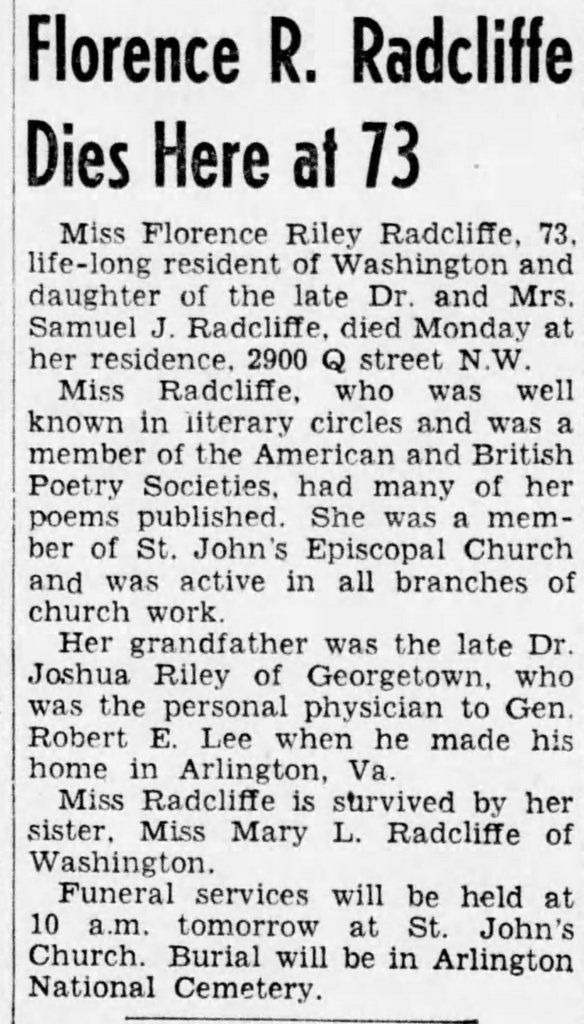
Her Letters To Lovecraft: Kathleen Compere Hughes

Kathleen Compere was born in Dublin, Texas on 20 June 1904, a middle daughter in large family headed by Baptist minister Edward L. Compere. She graduated high school; newspaper accounts say she attended the College of Industrial Arts in Denton, TX, and graduated from Baylor College. In 1927, Kathleen married Herald Hall Hughes, becoming Mrs. H. H. Hughes—the name by which she would sign herself in letters to Weird Tales and to Lovecraft. By 1936, the Hughes were living in Lawton, Oklahoma, with their sons Harold (age 8) and William (“Billy,” age 4). Somewhere during that bare sketch of a life, she had gained an appreciation for weird fiction:

Weird Tales Sep 1936

Weird Tales has been reprinting “classics” of weird fiction and stories from earlier issues since 1928, a practice sometimes clamored for by fans who had no access to earlier issues, and sometimes derided by fans who wanted new material, not just reprints. Farnsworth Wright was no doubt glad to have a fan asking for such reprints. Presumably, it was Wright that put Kathleen Compere Hughes in touch with H. P. Lovecraft, probably forwarding a letter as he did with other fans wanting to get in touch with him.

We have scanty evidence for the actual correspondence between the two of them, one abridged letter tentatively dated c. October 1936 was copied into the Arkham House Transcripts, though the physical letter it was copied from was presumably returned and is not known to be extant. A second letter, dated 6 April 1937, survives among his papers at the Brown University Library. Sent after Lovecraft’s death and addressed “Dear Friend,” it isn’t clear if this is a letter to Lovecraft at all, although circumstantial evidence within the letter itself suggests it may be.

Taking all these facts together suggests that the correspondence of Kathleen Hughes and H. P. Lovecraft was notably brief and rather self-contained. There are no references to Mrs. Hughes by name in any of Lovecraft’s other published letters, nor is her address included in the list of his correspondents in his 1937 diary. This would not be unusual for a relatively new and minor correspondent for which there might be long gaps between letters.

Lovecraft’s letter to Hughes is published in Miscellaneous Letters, and begins much like some of his other letters to fans disabusing them of certain popular notions:

About these books on Atlantis, Lemuria, and Mu—I regret to say that they all belong in the domain of charlatanry, semi-charlatanry, and self-delusion. There is absolutely no basis in fact for any of the assumptions they purvey—while on the other hand there is overhwelming evidence that none of the favulous “Vanished contiennts” ever existed since the appearance of mankind on the earth.

H. P. Lovecraft to Mrs. H. H. Hughes, c. Oct 1936, Miscellaneous Letters 369

In very typical Lovecraftian fact, this turns into a kind of mini-essay taking a materialist stance against lost continents and pre-human civilizations. Switching gears, Lovecraft then discusses travel, especially in Massachusetts (“Cape Cod is a bit overdone by tourists, and has always seemed to me somewhat overrated.” ibid 370-371), apparently in answer to a desire Hughes expressed to visit Newburyport, one of Lovecraft’s favorite towns (and, he mentions, an inspiration for “The Shadow over Innsmouth”) to which she had some family connection. He then does the typical explanation of the unreality of the Mythos:

As for the “hellish and forbidden volumes” mentioned by various Mu writers—the monstrous Necronomicon of the mad Arab Abdul Alhazred, the portentous Book of Eibon, the shocking Unaussprechlichen Kulten of von Junzt, the Comte d’Erlette’s Cultes des Goules, Ludvig Prinn’s De Vermiss Mysteriis, the Pnakotic Manuscripts, the Eltdown Shards, the unmentionable Ghorl Nigral, etc. etc.—they are all purely imaginary, like some of the “terrible tomes” mentioned in Poe, Bierce, Machen, Blackwood, Hodgson, etc.

H. P. Lovecraft to Mrs. H. H. Hughes, c. Oct 1936, Miscellaneous Letters 372

A typical answer to a typical fan question. The most interesting part of the letter is the last paragraph, however, which ends:

Incidentally I’m enclosing something about my writing methods which I prepared at the request of one of the young “fan magazine” editors. Please return it some time—for I’m not sure when the printed version will appear. About those snaps of “the gang”—I’ll lend them as soon as Finlay returns them. I don’t like to hurry him up, since he’s been ill.

H. P. Lovecraft to Mrs. H. H. Hughes, c. Oct 1936, Miscellaneous Letters 373

The reference to Weird Tales artist Virgil Finlay helps date the letter to Hughes; in his letters to Clark Ashton Smith, Lovecraft mentions getting a letter from Finlay in September 1936 (DS 651), and in a letter to Willis Conover, Jr. dated 31 Jan 1937 is a reference to Finlay returning pictures (LRB 416). That helps give a period in which Lovecraft must have sent Hughes this letter. The reference to an enclosure is interesting because it ties in with the April 1937 letter from Hughes:

While there’s no direct evidence that this was a letter from Hughes to Lovecraft, returning manuscripts jives with Lovecraft’s known generosity in lending out copies of his stories. Elsewhere in the same letter she asks for details on books on the continent of Mu, echoing the opening passages of Lovecraft’s letter.

Without more evidence, it’s impossible to say for sure. If she did send this letter to Lovecraft or to someone else within the Lovecraft circle like R. H. Barlow. If Lovecraft was the intended recipient, she would not have heard of his death on 15 March 1937, which wasn’t announced in Weird Tales until the June 1937 issue. Such a gap might not be unusual if their correspondence was broken up, with a month or months between letters…and one can imagine Lovecraft’s aunt, opening the mail that came in after her nephew’s death, having to pen a brief note regarding his death. Or perhaps Kathleen Hughes saw the notice in Weird Tales first, and realized then she would no longer receive any letters from 66 College Street in Providence.


Bobby Derie is the author of Weird Talers: Essays on Robert E. Howard & Others (2019) and Sex and the Cthulhu Mythos (2014).

Deep Cuts in a Lovecraftian Vein uses Amazon Associate links. As an Amazon Associate I earn from qualifying purchases.
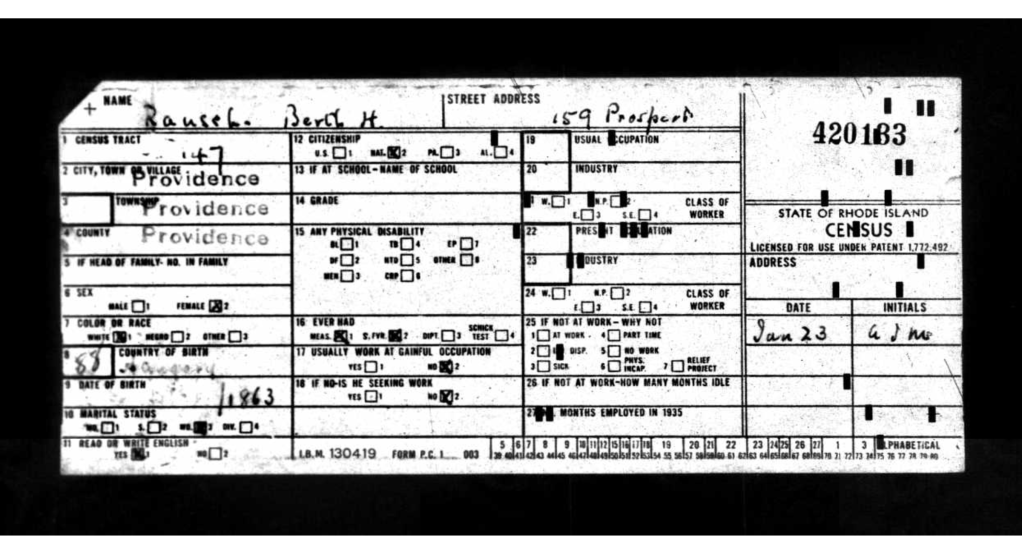
Her Letters To Lovecraft: Henriette Ziegfeld

“The Blind Prince,” by Henriette Ziegfeld, is an excellent juvenile tale involving a fairy story. The only serious objection is the undercurrent of adult comment which flows through the narrative. Particularly cynical is the closing sentence: “‘And here’s Mother,’ finished poor Auntie with a sigh of relief.” The ordinary fairy stories told to children are bits of actual Teutonic mythology, and should be related with a grave, absolute simplicity and naivete. However, as a psychological study of the typical childish auditor, the sketch as a whole is highly meritorious. We are inclined to wonder at the possible meaning of the strange word “alright,” which appears more than once in Miss Ziegfeld’s tale. It is certainly no part of our language, and if it be a corruption of “all right,” we must say that we fail to perceive why the correct expression could not have been used.

“Department of Public Criticism,” The United Amateur 15, no. 2 (Sep 1915), in Collected Essays 1.72

This was, as far as can be determined, Lovecraft’s first notice of the existence of Henriette Ziegfeld (1894-1976), an amateur journalist from Columbus, Ohio. According to census data, Henriette was the child of immigrant parents, her father Dutch and mother German, and one of 11 children that survived to be recorded. “The Blind Prince” was published in The Woodbee, the amateur journal of the Woodbee Press Club of Columbus, which was associated with the faction of the United Amateur Press Association that H. P. Lovecraft had joined the previous year.

Amateur journalism appears to have been something of a family affair for the Zeigfelds. Lovecraft’s editorials and a letter mention her brothers Arthur (1901-1971; CE 1.267, 302, 307-8) and Florenz (1888-1951; CE 1.88, 124; LRKO 87); a 1920 convention report also lists as voting members their siblings Emelie (Emily), Hilda, Alma, Oscar, and Mrs. Ziegfeld—presumably their mother, Pauline Ziegfeld (1859-1929). A 1921 accounting of officers of the Woodbees lists Arthur F. Ziegfeld as President and his sister Henriette as the Secretary and Treasurer (CE 1.267).

By coincidence, Florenz Ziegfeld shared his name with the impresario Florenz Ziegfeld, Jr. (1869-1932), who staged the famous revue Ziegfeld’s Follies (1906-1930s), which featured dozens of elaborately costumed showgirls (popularly called “Ziegfeld Girls”) in an elaborate musical and visual tableau. Inspired by the coincidence, in 1921 Arthur F. Ziegfeld began producing his own amateur journal titled Ziegfeld’s Follies.

The only surviving correspondence between the two is a single letter dated 6 Nov 1920 from Lovecraft to Ziegfeld, thanking the Woodbee Club for the generous donation of $25 toward the United Amateur Press Association’s fund for the publication of The United Amateur. Presumably, Henriette was acting as treasurer and had sent the money and an accompanying letter or note, so this was Lovecraft’s official thank-you. He also included an official notice in The United Amateur, which contains another relevant detail:

The Woodbee Club, now doubly prominent in amateurdom through its possession of both the Presidency and the Secretary-Treasurership, continues to be the most active of local bodies. On Labour Day, September 5, a successful corn roast was held on the Frazier Farm, whilst on September 24 the third annual rummage sale took place. Of the proceeds of the latter, $25.00 will be very generously donated to the Official Organ Fund in five-dollar instalments. The latest event is a farewell party to Miss Henriette Ziegfeld on the eve of her departure for India.

“News Notes,” The United Amateur 21, no. 1 (Sep 1921) in Collected Essays 1.300

Whether she replied is unknown; but possible—someone had to have informed Lovecraft that Henriette was leaving for a teaching mission in India, and in subsequent issues Lovecraft offered brief updates of her progress, so someone was keeping him appraised:

Miss Henriette Ziegfeld of the Woodbee Club on November 12 sailed for India, where she will be engaged in missionary work at Nagercoil, Travancore, in the southernmost part of the peninsula.

“News Notes,” The United Amateur 21, no. 2 (Nov 1921) in Collected Essays 1.303

On December 24th the Club received the pleasing news that Miss Henriette Ziegfeld had safely reached her destination in India, despite two threatened onslaughts of mal de mer during the voyage; onslaughts which were cleverly defeated by means of judicious pedestrianism.

“News Notes,” The United Amateur 21, no. 3 (Jan 1922) in Collected Essays 1.308
Henriette Ziegfeld’s 1921 passport photo
Henriette Ziegfeld in India, 1923, Concordia Historical Institute

That is the last word in Lovecraft’s amateur journalism essays or letters on Henriette Zeigfeld. No doubt a good example of many brief correspondences with women in various positions of amateur journalism, most of which do not survive.

The letter from Lovecraft to Henriette Ziegfeld has been published in Miscellaneous Letters (2022). While the date given on the letter is 1920, the notice of the $25 donation occurred in 1921—either the Woodbee Club made two such donations, or the letter is from 1921 and was misdated or mistranscribed.


Bobby Derie is the author of Weird Talers: Essays on Robert E. Howard and Others and Sex and the Cthulhu Mythos.

Deep Cuts in a Lovecraftian Vein uses Amazon Associate links. As an Amazon Associate I earn from qualifying purchases.