Most science fiction writers were once fans. There’s a habit they have, not of paying back, but of paying forward; I know of no other branch of literature where the established “names” so keenly encourage wannabe writers to become their competitors. —Terry Pratchett, “Paperback Writer” (2003) in A Slip of the Keyboard18
The development of organized science fiction/fantasy fandom in the United States during the 1930s was essential for the culture of writing that exists today. Fandom is older than those first fanzines, but the marriage of genre fiction and the amateur journalism organizational framework resulted in a movement that engaged people of all ages across a relatively narrow common interest, and encouraged recruitment, participation, and publication. Professional writers and fans didn’t just connect, they encouraged each other.
While not every fan was part of organized fandom, nearly every science fiction writer was a fan—and the extent of fandom networks in the United States, especially in the 1940s-1980s, is often remarkable. Big name fans and big name authors past, present, and future rubbed shoulders at conventions, corresponded, contributed to the same fanzines. Before the internet, social media consisted of the letters-columns of fanzines which might be read by as few as a handful or as many as dozens of people. It was smaller, more intimate, with all of its feuds and silliness that comes from people just being people, developing their own lingo and sharing an interest—which might include fiction, poetry, comics, radio, film, television—any media that existed, science fiction and media had touched, and so was fair game.
Over the past decade or so, efforts have been made to preserve and digitize some of these fanzines; to capture these communications (however poorly and cheaply printed) for future generations. While many pages have about as much interest as your average forum thread from the 1990s, there is gold dust among the spill, if you’re willing to sluice it out.
One nugget that emerged from the depths of the Fan History Project (fanac.org) is Lighthouse #15 (1967), which includes “The Invaders vs. The Milford Mafia” by Joanna Russ. For readers used to Russ’ professionally published fiction, stories like “I Had Vacantly Crumpled It into My Pocket … But By God, Eliot, It Was a Photograph from Life!” (1964) and “My Boat” (1976), this is something different. Fanfiction in the oldest sense of the word, not a story based on some fandom, but a story written by a fan, for fans. The title alone might clue savvy readers at the time what they’re in for: The Invaders (1967-1968) was a vaguely Hitchcokian science fiction thriller television series that ran for two seasons on the ABC network, a melodramatic cash-in on the UFO craze with perhaps a more than generous dollop of Red Scare paranoia thrown in.
Of course, alien invasion plots were standard fare for science fiction fans in the 60s and 70s—which is where the Milford Mafia comes in.
The Milford Science Fiction Writer’s Conference in 1956 was formed by three of Futurians: Damon Knight, James Blish, and Judith Merrill. Then as now, science fiction and fantasy fandom had a tendency toward cliquedom, and the Milford conference in particular addressed the literary quality of science fiction. Just as, thirty years before, H. P. Lovecraft had striven to raise the general literary level of amateur journalism, so too did the Milford attendees seek to raise the literary standards of science fiction, which eventually led to the formation of professional writers associations like the Science Fiction Writers of America. Those put out at the high-minded literary standards referred to attendees (or those pushing higher standards) as “the Milford Mafia”—and Russ would be using the term in a jocular fashion, counterpoising the rehashed plots of The Invaders episodes against the higher standards that some folks in science fiction were pushing for.
It’s a fun piece, silly and light-hearted, and in keeping with that spirit, Russ slipped in a little joke about Lovecraft:
Anyhow, here’s this poor slob of an architect, David Vincent, who alone knows that They are invading—though how he could find out, or why on earth he should be an architect, I can’t imagine, unless the Aliens have begun their plan to insidiously warp the human psyche by distorting the lines and angles of our better known architectural monuments like, for example, Grand Central Station. (Something of the sort happens in a Lovecraft story called The Call of Cthulhu, which I offer you free of charge, especially since it isn’t mine.)
Which is poking fun at a familiar element of Lovecraft’s story:
Without knowing what futurism is like, Johansen achieved something very close to it when he spoke of the city; for instead of describing any definite structure or building, he dwells only on broad impressions of vast angles and stone surfaces—surfaces too great to belong to any thing right or proper for this earth, and impious with horrible images and hieroglyphs. I mention his talk about angles because it suggests something Wilcox had told me of his awful dreams. He had said that the geometry of the dream-place he saw was abnormal, non-Euclidean, and loathsomely redolent of spheres and dimensions apart from ours.
For readers who are familiar with Joanna Russ only for her fiction or her writings about fiction, this is an example of the fannish side of her: more playful, with all the in-jokes one would expect of someone that’s been part of the scene for a while. A good-natured piece of fluff that jokes about how bad television writing could be…and, perhaps, how bad science fiction could be, if writers didn’t strive harder.
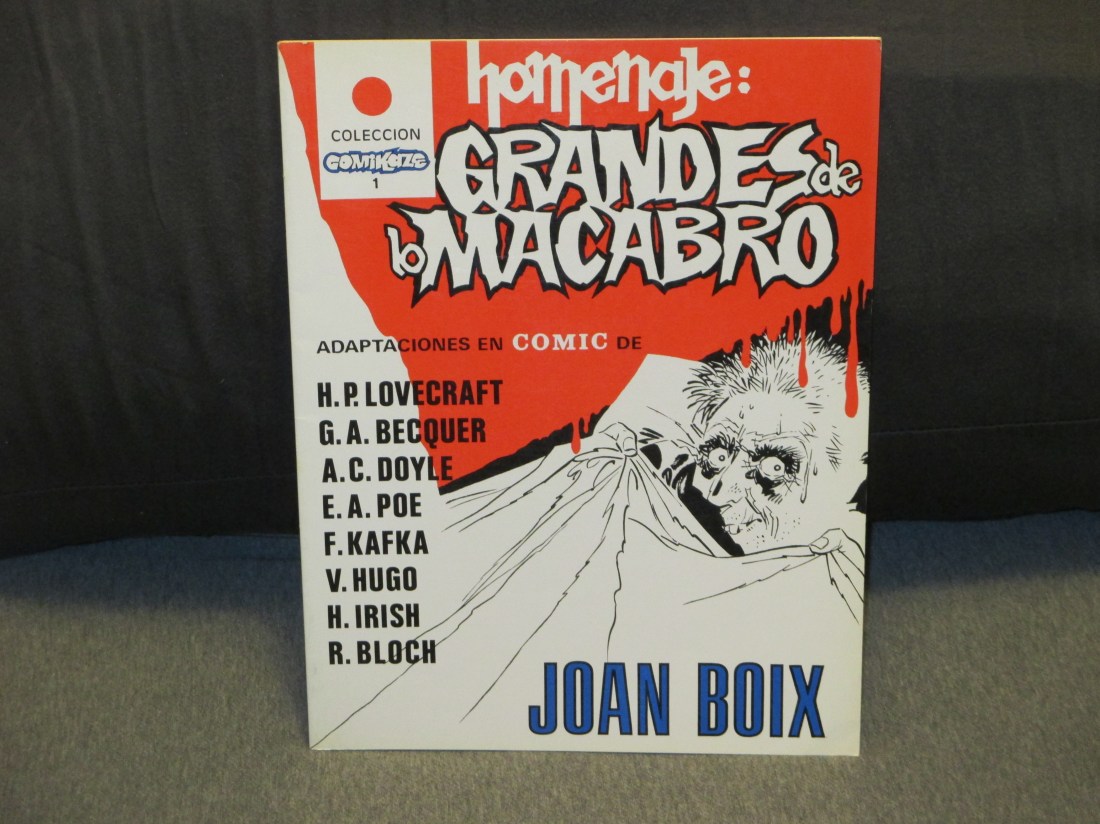
Hay quienes consideran el género de TERROR como un subproductio. Es cierto que, como en todo, a veces domina una calidad ínfirma, pero no sólo en los Comics. También en cinema, televisión, literature…
Tal vez porque el tema se ha explotado a fondo con abusos commerciales aprovechando que a la gente le gustan las emociones fuertes y muchos, sin saberlo, las utilizan para liberarse de sus propios miedos. Pero también es cierto que otros se han servido de sus miedos para expresar sus sentimientos y emociones segun su condición psicológica dando lugar a las mejores obras del género. Tal as el caso de POE, LOVECRAFT, KAFKA, y muchos más.
El experto en la materia no dejará nunca de reconocer que el TERROR es un tema de gran interés que además nos revela la personalidad más intrínseca de sus autores. Por eso, repito, el TERROR no se debe subestimar a la ligera sin un previo análisis.
Conociendo lo suficiente (presumo) sobre la vida atormentada y la obra de Los maestros del terror, he seleccionado una serie de relations pasándolos al Comic, Bien adaptando fielmente algunos, Bien dando mi toque personal a otros.
Y aquí está el resultado: Este libro con el que deseo rendir homenaje a los «GRANDES DE LO MACABRO».
Espero que lo pasen de miedo.
There are those who consider the TERROR genre as a by-product. It is true that, as in everything, sometimes a low quality dominates, but not only in Comics. Also in cinema, television, literature…
Perhaps because the topic has been thoroughly exploited with commercial abuse, taking advantage of the fact that people like strong emotions and many, without knowing it, use them to free themselves from their own fears. But it is also true that others have used their fears to express their feelings and emotions according to their psychological condition, giving rise to the best works of the genre. Such is the case of POE, LOVECRAFT, KAFKA, and many more.
The expert on the subject will never fail to recognize that TERROR is a topic of great interest that also reveals the most intrinsic personality of its authors. Therefore, I repeat, TERROR should not be underestimated lightly without prior analysis.
Knowing enough (I presume) about the tormented life and work of The Masters of Terror, I have selected a series of relations, transferring them to the Comic, either faithfully adapting some, or giving my personal touch to others.
And here is the result: This book with which I wish to pay tribute to the “GREAT OF THE MACABRE.”
I hope you have a scary time.
Introduction to Homenaje: Grandes de Los Macabro (1985)
English translation
Joan Boix (born Juan Boix Sola Segales in Badalona, Spain) is not well-known to English-reading audiences, although he has had a long career both in Spain and internationally, able to turn his hand from everything from romance comics in the 1960s to being one of the artists that drew The Phantom comic strip in the 1990s. Yet for those who appreciate horror comics, Joan Boix holds a special place for his work in that field. Even there, in English his work is a bit of a footnote: a story in Marvel’s Monsters Unleashed #5 (1974), which was reprinted in the Monsters Unleashed Annual (1975). Yet his Spanish-language work, never translated into English, is his best. And in 1985 he published a collection of adaptations of classic horror fiction: Homenaje: Grandes de Los Macabro (Tribute: Greats of the Macabre).
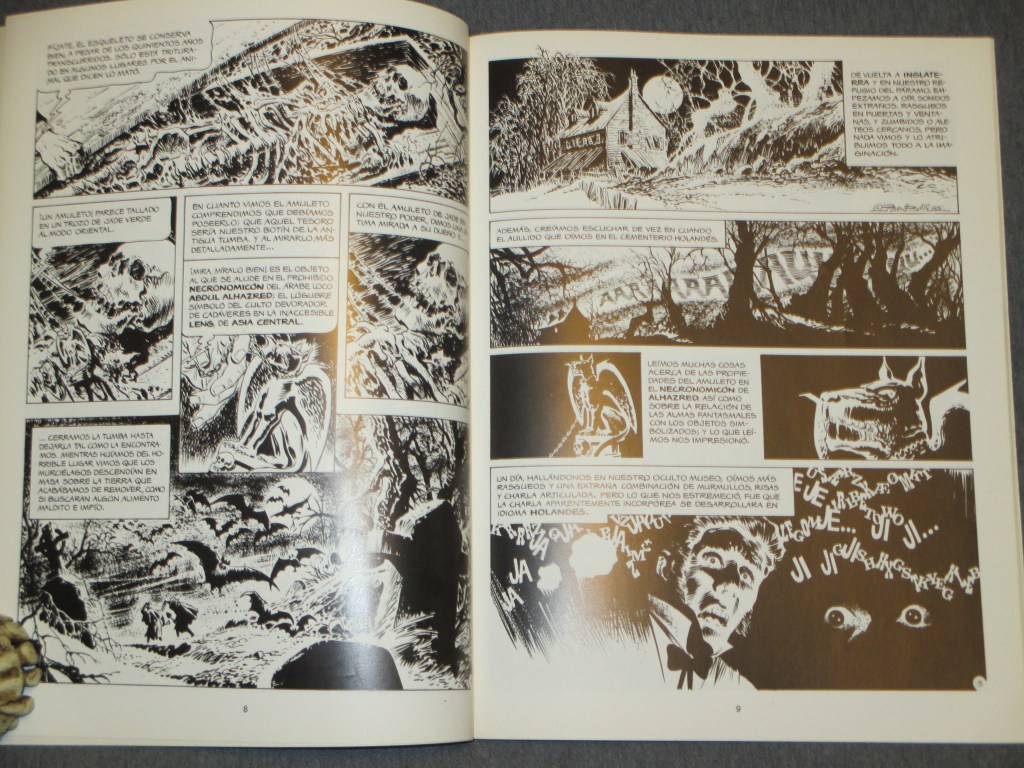
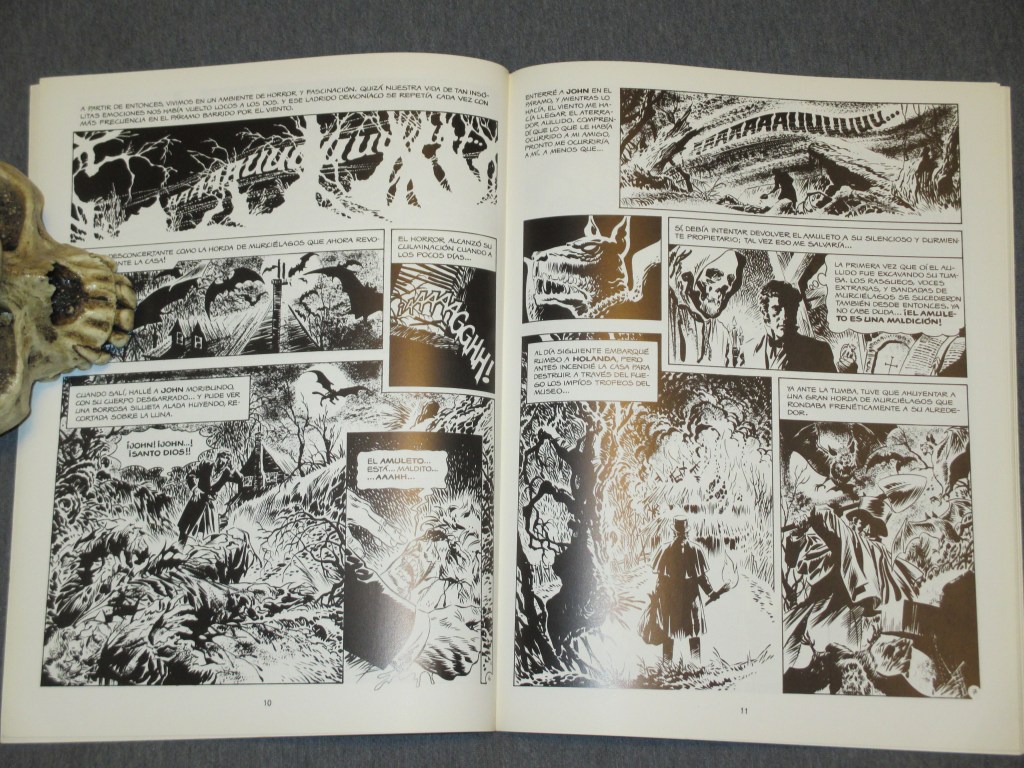
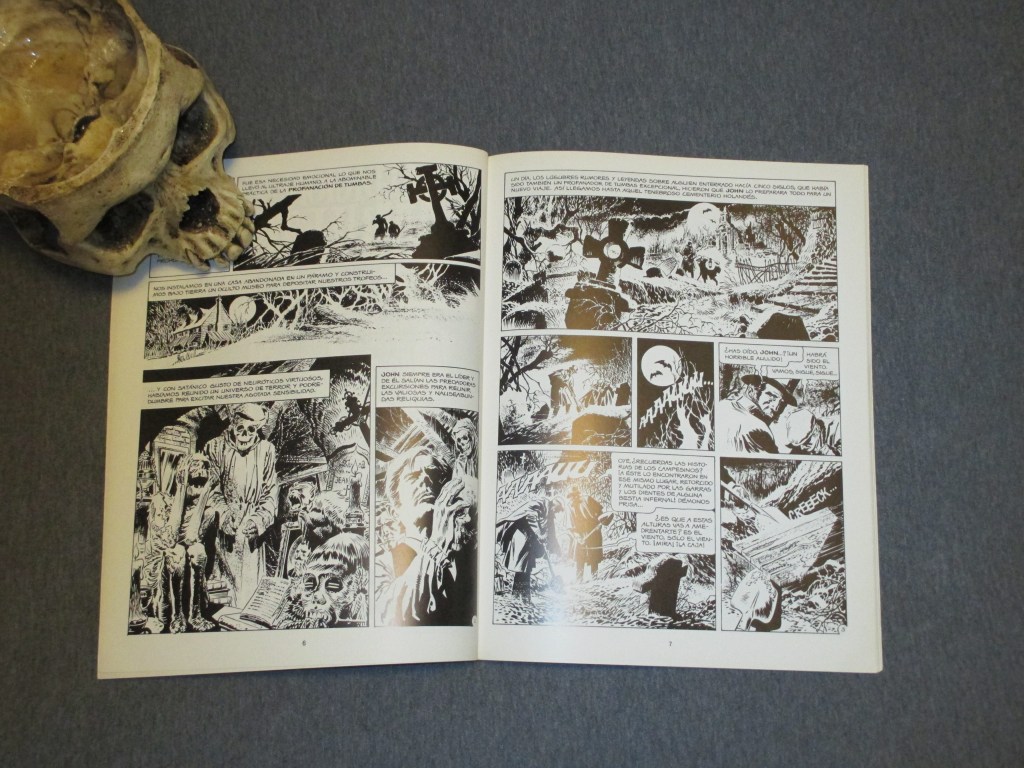
“La Maldicion del Amuleto” is an adaption of H. P. Lovecraft’s “The Hound.” In Spanish, the story is typically translated as “El Sabueso,” and while there are many words for dog in Spanish (perro, can or canino, cacharro (“puppy”), chandoso, etc.) “sabueso” has the specific meaning of a hunting dog; we might even say “bloodhound” in English. Which is a nice shade of meaning, given the context.
Boix’s tastes in terms of illustration are gloriously Gothic, redolent of an 18th-century macabre that recalls the horror films of Hammer Films in Britain and Profilmes in Spain. There’s that sense that Peter Cushing, Christopher Lee, or Paul Naschy could step onto the panel at any time, and be right at home.
The starkness of the black-and-white works to Boix’s advantage; there are single panels that could be glorious two-page spreads, with a lot of detail that might have been muddied by a careless colorist. The chiaroscuro effect is glorious, the kind of deep shadows that drink in the light which would inspire the likes of Mike Mignola’s signature aesthetic.
For sheer joie de morte, however, Boix’s tendency to revel in a single panel is hard to top. It’s a world where the moon is always full and glaring like the eye of some forgotten God, where every tombstone is encrusted with grave-mould, and the collection of the pair of necrophiles would put Hammer’s prop department into giddy ecstasies of macabre delight.
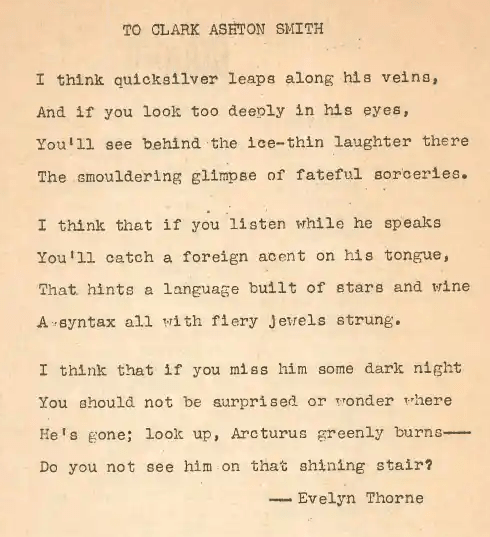
I think quicksilver leaps along his veins, And if you look too deeply in his eyes, You’ll see behind the ice-thin laughter there The smouldering glimpse of fateful sorceries.
I think that if you listen while he speaks You’ll catch a foreign ac[c]ent on his tongue, That hints a language built of stars and wine A syntax all with fiery jewels strung.
I think that if you miss him some dark night You should not be surprised or wonder where He’s gone; look up, Arcturus greenly burns— Do you not see him on that shining stair? —Evelyn Thorne
The second issue of Alan H. Pestetsky and Michael DeAngelis’ fanzine Asmodeus (Fall 1951) was devoted primarily to Clark Ashton Smith. Lovecraft had been receiving accolades in The Acolyte in the 1940s, so it was only fair. The issue republished a poetic tribute by Lovecraft to his friend, as well as “The Cup-Bearer” (1951) by Lilith Lorraine, and buried among other works was the above dedication by Eveyln Thorne.
While she is mostly forgotten now, in the 1950s Evelyn Aixa Thorne was actively involved with science fiction fandom, not necessarily a Big Name Fan, but not insignificant either. A brief biographical essay in Poets in the South says she was born in Nebraska in 1898, educated in the College of Puget Sound and the University of Arizona, and lived all over the country “working as an interior decorator, an X-ray txnician, and a botancial illustrator” (78). She married William Richmond Tullos in 1946, they divorced in 1952, remarried in 1954, and remained married until his death in 1974.
Thorne is probably best-remembered as co-publisher/co-editor of the New Athenaeum Press with Will Tullos, which published Epos: A Quarterly of Poetry, from 1949 until 1975, which published three of Clark Ashton Smith’s poems. She was also associate-editor of Challenge (1950-1951) under Lilith Lorraine, who also published some of Thorne’s poetry elsewhere. Her books of poetry were Design in a Web (1955), Ways of Listening (1969), and Of Bones and Stars (1982); she also published anthologies of poetry from Epos.
There is a certain incestuous quality to fantastic poetry in the 1950s, an intersection between the “little magazine” movement and science fiction/fantasy fanzines which echos the intersection between amateur journalism and science fiction fandom in the 1930s. That Evelyn Thorne knew and appreciated Clark Ashton Smith as a poet is clear. The reference to “Arcturus” in particular is curious; Smith refered to Arcturus in three poems first published in The Star-Treader and Other Poems (1912): “To the Sun,”“The Song of a Comet,” and “Saturn”—all cosmic poems that echoed or were influenced by Smith’s mentor George Sterling’s “The Testimony of the Suns” (1903).
A detail Smith no doubt appreciated, when he read that tribute.
This review deals with a work of art that includes nudity. As part of this review, selected images with nudity will be displayed. As such, please be advised before reading further.
It was many and many a year ago, In a kingdom by the sea, That a maiden there lived whom you may know By the name of Annabel Lee; And this maiden she lived with no other thought Than to love and be loved by me. —Edgar Allan Poe, “Annabel Lee” (1849)
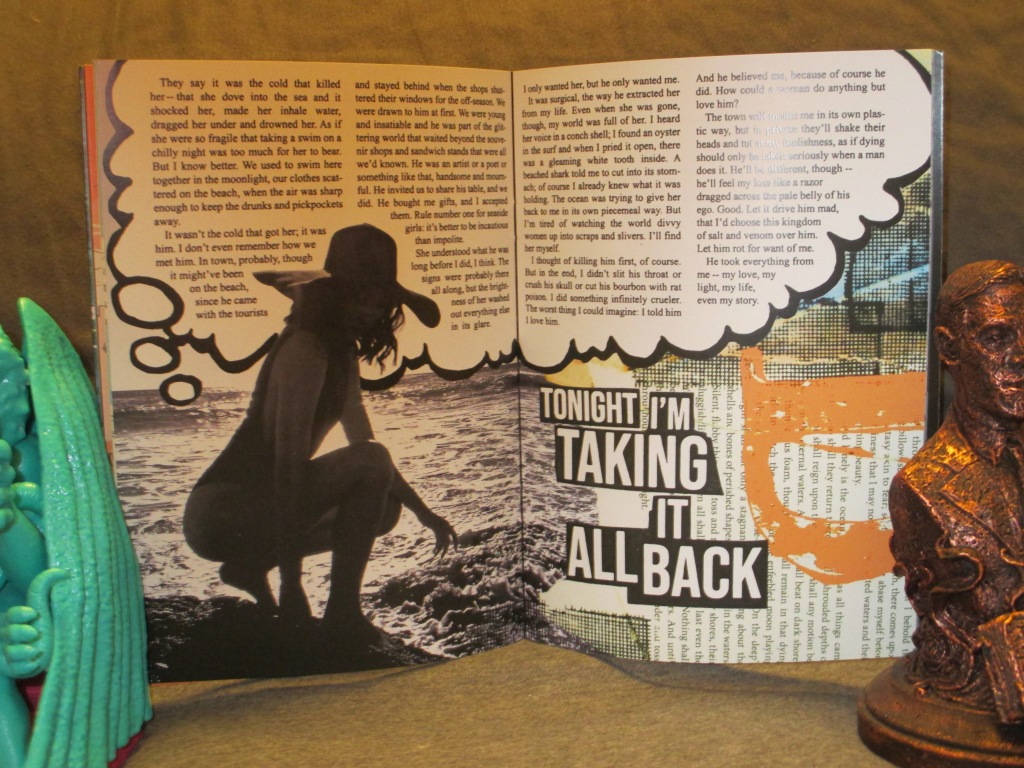
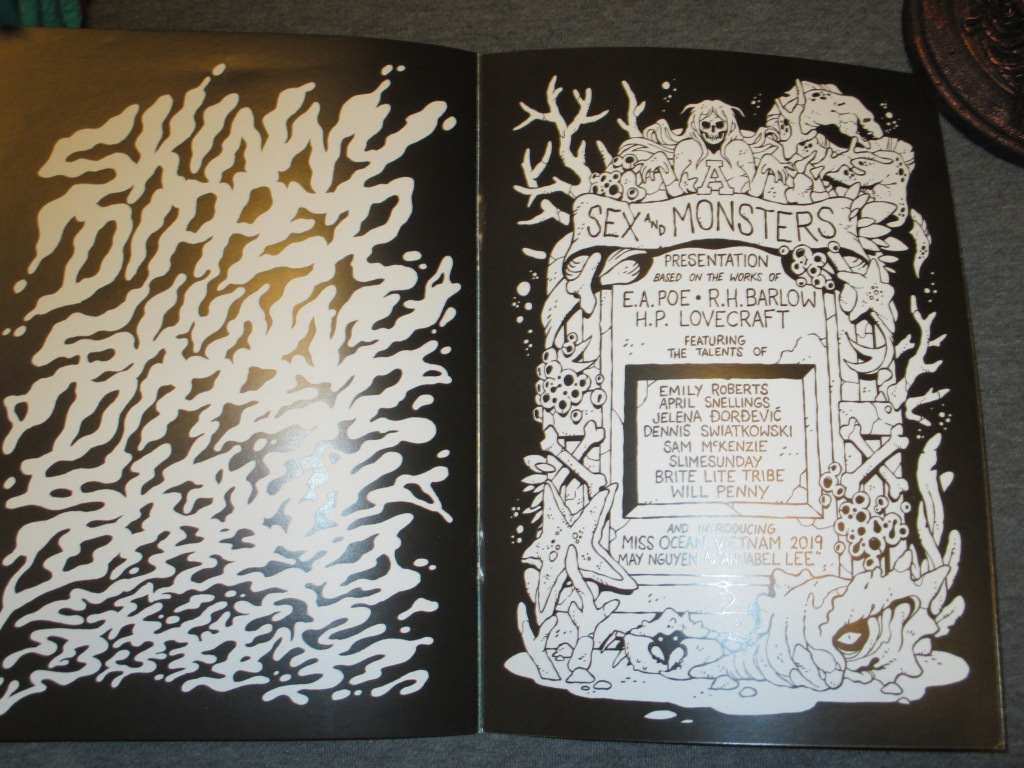
Skinny Dipper was a successfully crowdfunded multimedia project by Sex and Monsters, who are best known for their retro chic combinations of horror, pulp fiction, and tiki culture to produce works like the comic/cocktail booklet Tiki Surf Witches Want Blood.
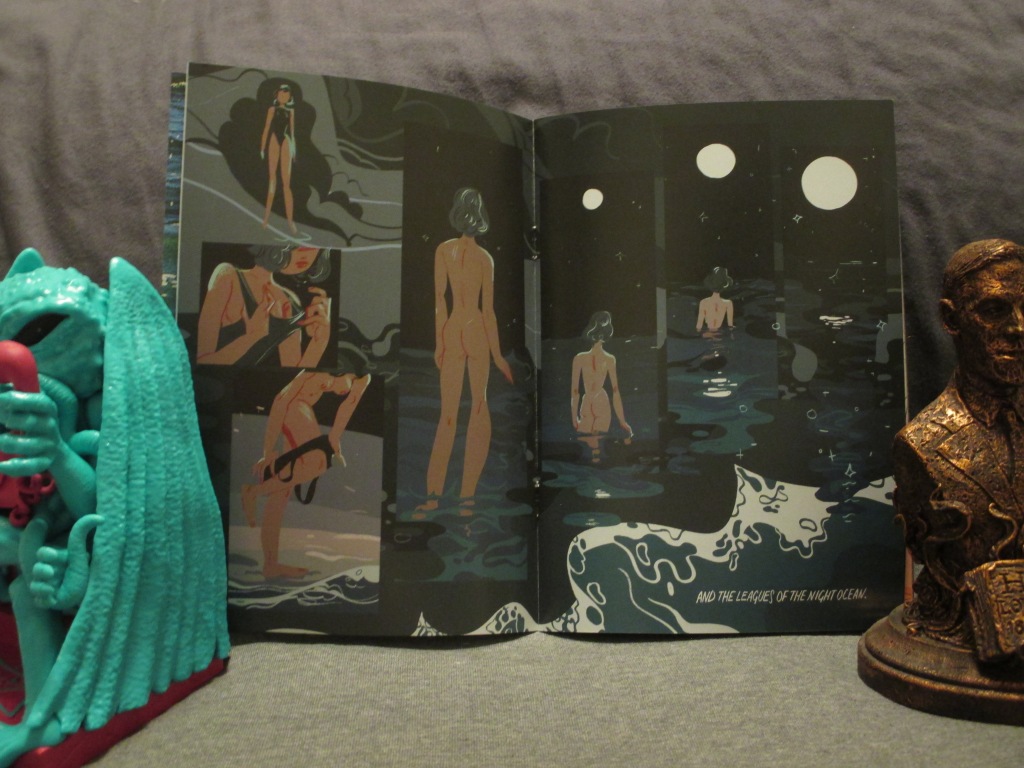
The form of this particular project is a 32-page mixed-media comic ‘zine that remixes Poe’s “Annabel Lee” and “The Night Ocean” (1936) by R. H. Barlow with H. P. Lovecraft, re-imagining them against a palette of mixed comic and photographic work by Emily Roberts, April Snellings, Jelena Đorđević, May Nguyen, Dennis Swiatkowski, Sam McKenzie, Slime Sunday, Brite Lite Tribe, and Will Penny; and a 7″ vinyl record by Nite Jewel that contains a soundtrack to accompany the piece. Various Kickstarter bonuses to the campaign add decals, instant film shots of May Nguyen, and other goodies.
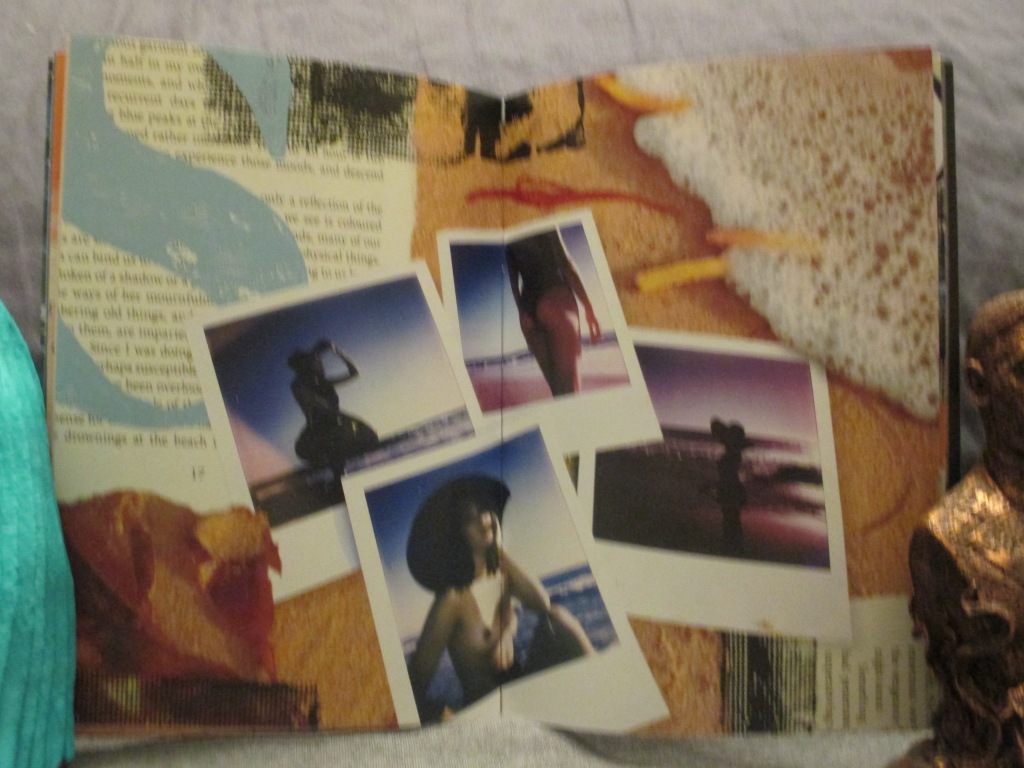
The crux of the re-imagining is model May Nguyen, who appears both in photographs and as the character model for the character of Annabel Lee in the story. Told in sparse, evocative images, Annabel Lee shifts from the bright and crowded daylit beach to a lonely moonlit scene, to go skinny dipping alone in the night ocean.
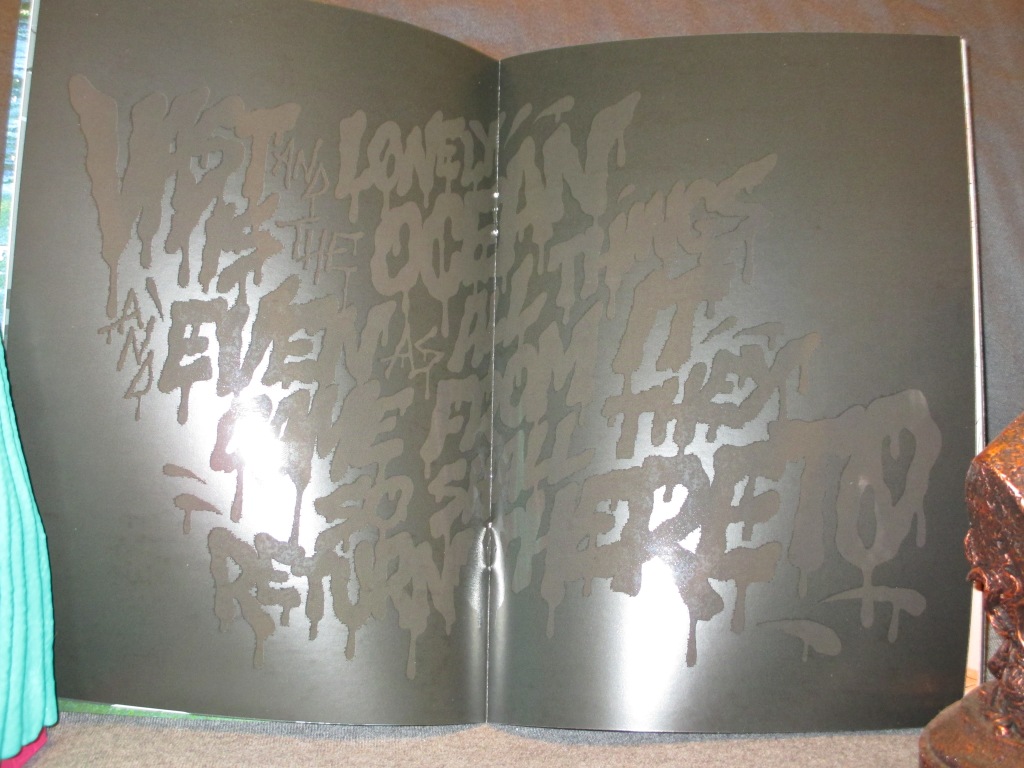
Chunks of Poe’s and Barlow and Lovecraft’s texts are taken out of context and reframed as poetry. The artists are each distinctive in their style and approach to the material; the center black-lettering on black-pages at the center of the story is incredibly evocative of the dark abysses hinted at in poem and short story, here rendered visually—and the combination of Poe’s verse and select snippets from Barlow and Lovecraft work well together with the visuals, terribly suggestive of far more than appears on the page.
Kitsch is a dirty word, but in this case the artists are trying to recapture specific moods and art styles, from the Charles Atlas bully-kicks-sand-in-your-face comics of the 50s to 80s glossy magazine photo spreads that are terribly suggestive of exotic vacations, where the sea foom can lap at your feet as you read and relax on holiday. It is a deliberate effort to reproduce an aesthetic that existed, even if that exact place never did.
One thing that both “Annabel Lee” and “The Night Ocean” capture is a sense of loneliness and longing; that may be why giving Annabel in Skinny Dipper such a distinctive face adds something to the text. May Nguyen provides a sense of reality that might have been missing if this a more traditionally-made comic book; there’s a fotonovella-style sense that these could be stills to some ancient straight-to-video movie that graced the shelves of mom & pop video stories.
It is not horror in any strict sense; not int he bloody bones and a shark coughing up a limb. It’s closer to a vacation where all the time away reminds you that the one thing ou can’t get a vacation from is yourself, can’t get out of your own head. That loneliness and the endless, ageless warm waters of the ocean might swallow you up forever, given half a chance.
Nite Jewel’s Skinny Dipper single is a soundtrack to the story; I’d call it synthwave or retrowave, while the tags for the album on call it chillwave and hypnogogic pop. Combined with the stylistic flourishes of the comic, it grounds the reader in that almost-never-when promised in a thousand 80s and early 90s magazines, comics, films, and music videos. The idea of the beach as this place of escape, the music a poppy invitation that’s a bit more upbeat than tiki exotica, but holds many of the same audio cues, just for a later generation.
At this time of writing, the album is the only thing available for direct purchase, although many stills and videos associated with the project are located on Sex and Monsters’ Facebook page.
Skinny Dipper is an interesting collaboration, one that showcases the abilities and visions of the individual artists that went into it. Copies are still available through the Kickstarter store (click “Order Now”), and will hopefully receive a wider release in the near future.
Absence of much conversation is probably a permanent feature of my style, because the tales I write concern phenomena much more than they concern people. —H. P. Lovecraft to Natalie H. Wooley, 24 Oct 1933, LRBO 193
“The Colour Out of Space” is one of Lovecraft’s most evocative and best-loved stories. It has been interpreted by different folks as an environmental horror, as a rural Gothic, a precognitive flash of the dangers of nuclear radiation. It was not set in the far ago and the long away; H. P. Lovecraft set most of his horrors in his here and now. In the 1920s and 30s, close to home in Rhode Island, Massachusetts, and New York. They were horrors of the moment, and while he largely eschewed flappers and rumrunners, they took on the syntax of the time and place.
Which makes them interesting to update. How many horror stories would be different, if they took place after the invention of cell phones, or the advent of the internet, birth control pills, the Civil Rights Movement? How might that change the story? Not the phenomenon itself, but the people’s response to the phenomenon. Their perspective and understanding of it.
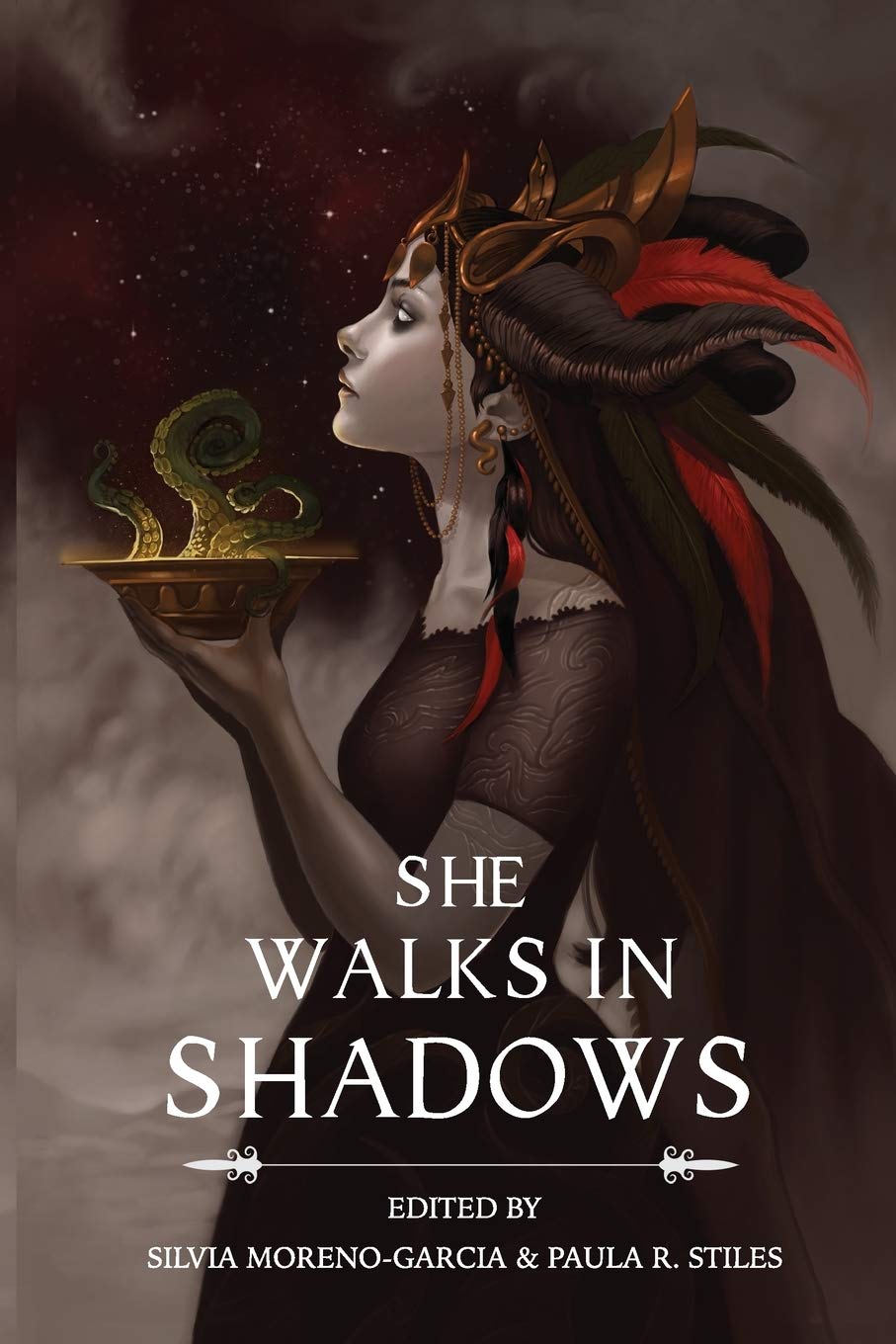
As is appropriate for a story that’s a reworking of H.P. Lovecraft’s “The Colour Out of Space,” “Violet is the Color of Your Energy” is named after two songs centered on color: 311’s laidback, beachy “Amber,” and Hole’s angry, feminist “Violet.” I doubt that MRA types would like this story. In my defense, though, “The Colour Out of Space” practically demanded a feminist revision. It’s fundamentally a story about a cranky farmer who keeps his family increasingly isolated, then imprisoned, resulting in the deaths of all. There’s a neighbor who seems to check in a lot. Oh yeah, and something’s off about the water and the crops. And the woman locked in the attic is the crazy one? —Nadia Bulkin, “Violet is the Color of Your Energy” [The Playlist]
Nadia Bulkin’s “Violet is the Color of Your Energy” is, in effect, a contemporary re-telling of “The Colour Out of Space.” One that leaves out Arkham, and shifts the point of view focus to Abigail Gardner (née Cuzak), who followed her college-educated husband to Cripple Creek to try and make a go of an old-fashioned family farm. The shift in time and space and perspective skews the story from the phenomenon (Lovecraft’s interest) to the individual. Zeroes in from the impersonal observation of everything going on to the very personal look at how this phenomenon affects Abby and her relationship with her husband and children.
“Are you sleeping with him?”
“What?” her voice broke. “Nate, the boys are right . . . .”
His shout punched down like a hammer of God. “Answer me, Abby! Was this some whore’s bargain? Said you’d jump into bed if he’d just cut your poor idiot husband a break?” —Nadia Bulkin, “Violet is the Color of Your Energy” in She Walks In Shadows39
The result is something like Christina’s World by Andrew Wyeth in prose. Things said and unsaid. A woman trapped by the decisions she’s made, the man she trusted, until she has no decisions left at all; yet this is not a morality play about a woman who made the wrong decision. Something is happening, something he won’t tell her about. This isn’t just a tale of spousal abuse, or stress turned to paranoia. Something happened, in the opening paragraph, reverberating throughout the short story. Something that works, unseen, on the corn, the animals, the water, her husband…and her.
If you haven’t read “The Colour Out of Space,” the ending might be confusing. A Shirley Jackson-esque non sequitur, like a needle skipping across a record, jumping straight to the last track. It is like a variant telling of an old and familiar myth, reminiscent of “His Mouth Will Taste Of Wormwood” (1990) by Poppy Z. Brite in that sense. Not a replacement for Lovecraft’s story, but a complement to it; an old campfire tale told to a new generation of campers, a riff on the old motif, recycled and made new again.
Boys and dogs alike asked for things—food, drink—and eventually, after the sun began to set, Teddy put down his American History book and asked for an explanation of Croatoan. —Nadia Bulkin, “Violet is the Color of Your Energy” in She Walks In Shadows39
There is a certain synchronicity between “Violet is the Color of Your Energy” and the 2019 film The Color Out of Space; both seek to update and adapt Lovecraft’s text, both keep the story small, centered on what a small family farm looks like in the 2010s, the breakdown that occurs as something happens beyond their control or capability to understand. The beats are not the same, but they’re working in a similar groove with a sense of isolation and desperation. Of things that have suddenly and inexplicably gone wrong, and the added stress has cracked the facade of normality, to show that maybe, things weren’t right this entire time.
Conan the Cimmerian first appeared in “The Phoenix on the Sword” by Robert E. Howard in Weird Tales (Dec 1932); his immediate literary antecedents were Conan the Irish Reaver in “The People of the Dark” (Strange Tales of Mystery and Terror Jun 1932), and the Atlantean barbarian Kull, who last appeared in “Kings of the Night” (Weird Tales Nov 1930). Like most of Howard’s heroes, Conan was male, and the gender politics of the Hyborian Age tended to be a combination of 1930s Texas and various historical periods and cultures as Howard understood them. There were warrior-women in Howard’s stories: Bêlit, the Queen of the Black Coast; the Valeria of the Red Brotherhood; Red Sonya of Rogatino; and Dark Agnes de Chastillon—but savage as they might be with sword or pistol, these were not barbarians per se, and they were always exceptions in male-dominated settings.
Howard wasn’t alone in producing warrior-women for his fantasy and weird adventure stories, with C. L. Moore’s Jirel of Joiry (who first appeared in “Black God’s Kiss” (1934)) being a notable peer to Conan in the pages of Weird Tales. Yet the Cimmerian’s popularity won out, and influenced generations of later media, from pastiche stories and novels to comics, beginning with Marvel’s Conan the Barbarian in 1970, and film, with Conan the Barbarian starring Arnold Schwarzenegger in 1982.
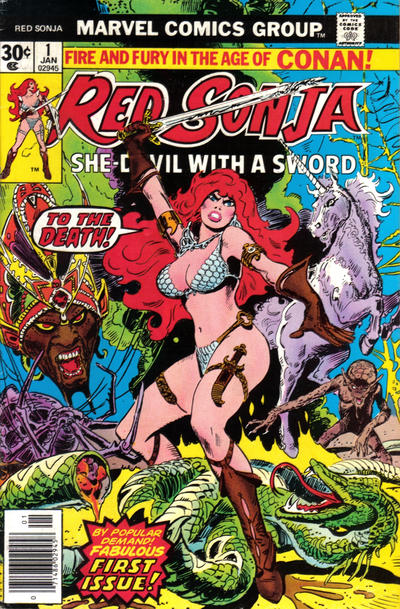
Many of these adaptations included warrior-women as well. Red Sonja was created by Roy Thomas and Barry Windsor-Smith as a foil for the Cimmerian in the pages of Conan the Barbarian, and went on to an extensive career of her own. Valeria (played by Sandahl Bergman) in the 1982 film served as Conan’s ally and later lover. Later sword & sorcery works sometimes focused on female barbarians, such as Hundra (1983), Red Sonja (1985), Barbarian Queen (1985), Amazons (1986), Stormquest (1988), and Barbarian Queen II: The Empress Strikes Back (1990), but these were mostly poor pastiches that often captured the fur-bikini aesthetic but little to nothing of the character or power of Howard’s warriors, men or women.
So when French director Bertrand Mandico set out to make a film that took the popular conception of the ultramasculine figure of Conan and turned it on its head by making the barbarian female, that was an interesting premise. The resulting film is Conann, released to English audiences as She Is Conann, is a 2023 French-language film written and directed by Mandico.
However, the key aspect of this film is less Howard’s hero, and more Mandico’s definition of barbarism:
I wanted to make a film about barbarism, and tell what is for me the height of barbarism, it’s old age killing youth. So, in the figurative sense, physically, but at the same time, symbolically, by betraying convictions, etc. So I started with this idea and I invoked Conan, the character from Howard’s novels. I even went back to the source that inspired Howard. It’s a character from Celtic mythology named Conan with two n’s who was surrounded by dog-headed demons. I started from this mythology to traverse time, eras and to make a sort of survey of barbarism. All of this carried by a choir of actresses. —Bertrand Mandico, interview with Sara Bradbury
In a purely factual sense, Mandico has erred here. The mythological Conann and the Cynocephali (Dog-Headed People) he refers to appears to be a reference to The Voyage to the Other World Island in Early Irish Literature by Christa Maria Loffler or equivalent source. In that work, Conann (or Conainn) is one of the Tuatha de Danann, and the Cynocephali are another name for the Fomorians whom the Tuatha de Danann overthrew in the conquest of Ireland, as recorded in works like the Book of Invasions. Howard was certainly familiar with some of the content of the latter, because he discusses it in letters to Lovecraft, but it isn’t clear that Howard ever read the Book of Invasions himself, and makes no reference to dog-headed people (or even Fomorians) in his stories of Conan.
Still, the point of this film is not pastiche of Howard, or even of the 1982 Conan the Barbarian film; it is a film concerned entirely with Mandico’s concept of the barbarian, which is radically different from Howard’s, and starring a largely female cast. The film stars Elina Löwensohn as Rainer; Julia Riedler as Sanja; and six actors that play the eponymous Conann at various ages: Claire Duburcq (15), Christa Théret (25), Sandra Parfait (35), Agata Buzek (45), Nathalie Richard (55), and Françoise Brion (Queen Conann and dead Conann).
The film “Conan the Barbarian” was the symbol of virilism, of virility. And I found it really interesting to take the complete opposite of this character. With “The Wild Boys” [“Les garçons sauvages”], I had already wondered about the masculine-feminine shift with fairly aggressive characters. And there, I wanted to work on this barbarity and make it feminine. Then also bring a great breath of romanticism. Because barbarism, in itself, does not interest me. What interests me is the contrast between barbarism and romanticism. —Bertrand Mandico, Sur le tournage de Conan de Déviante, de Bertrand Mandico cf. Le réalisateur Bertrand Mandico féminise « Conan le Barbare »
The Nanterre National Drama Center, well known for its hybrid and avant-garde exhibitions, will welcome the filmmaker from January to February 2021, for a theatrical performance on the border of living theater and cinema which “will also give birth to a film shot in film” , and “will invite the public to settle in the middle of its various paintings and stories, in a circus-hell of rocks studded with bursts of tears and blood” —Bertrand Mandico adapte « Conan le Barbare » pour le théâtre des Amandiers
While production details are a bit hazy, French media reports from 2020-2021 or so indicate that what would become Conann started out as much more focused on the 1982 film for inspiration, which can perhaps be seen in the first act with the 15-year-old Conann, which partially seems a response to the opening of the 1982 Conan the barbarian where Conan’s mother is killed and he is enslaved. The earlier version of what would be Conann seems to have been much more of a multimedia/performance space, which may have suffered delays or transformations due to COVID-19. Yet the final film(s) that resulted seem fairly true to Mandico’s original vision as expressed in interviews and press releases.
I feel like a barbarian-adventurer myself in the way I built this project. As for Howard’s original novels, I have kept the esoteric impulse, the memory of an adaptation by Corben “Bloodstar,” but I especially see Conan as a pop figure, a war cry. In my project, Conan is girl(s) and woman(s), and they will evolve in a feminine world. I decided to offer actresses of all ages and all origins unusual characters and situations . There will be six Conans, as many as there are periods in his life. Each new Conan will come and kill the previous one because, for me, the height of barbarity is to kill one’s youth. —Bertrand Mandico, « Conan la barbare » : Bertrand Mandico nous présente sa prochaine œuvre monstre
Mandico references Richard Corben’s novel Bloodstar, which is an adaptation of Robert E. Howard’s “The Valley of the Worm.” Understanding that Conannis not in any strict or even broadly metaphorical sense related to Howard’s Conan as put on paper is important, because viewers who go in hoping for something like an adaptation of Red Nails where a female Conan and Valeria might kiss are going to be disappointed.
Mandico’s approach to filmmaking is very much surrealist, gritty, and avant garde compared to Conan the Barbarian and its sequel and pastiches. Director Jim Jarmusch’s Dead Man (1995) has been described as an Acid Western, and Mandico’s Conann might be described as Acid Sword & Sorcery. It has that punk aesthetic, not just in the sets, the wardrobe, the props where swords look forged out of scavenged bits of rebar, but in the attitude of the characters, which is often nihilistic, focused on the moment, and ultimately self-destructive—just as the darkest part of punk has always been a disenfranchised generation preying on itself.
But is it any good?
I realized, almost while making this film, that it concludes a trilogy. A trilogy that began with “Les garçons sauvages” [The Wild Boys], and continued with “After Blue” [Paradise Sale/Dirty Paradise]. So “Les garçons sauvages” would be paradise, “After Blue” the purgatory, and “Conann” hell. So there’s hell in my paradise, but there’s also a romantic dimension in my hell. —Bertrand Mandico, interview with Sara Bradbury
If you like Mandico’s other films, you’ll probably like Conann. If you haven’t seen his other films, it’s important to go into Conann with an open mind. There is a deliberate sense of theatricality: according to an interview, the sets were built inside a big warehouse in Luxembourg, and there’s a conscious sense that these are sets, not location shots. The camera moves, but it stays close, there’s no peeking around corners, and the narrative structure plays to that sense of place.
From the standpoint of pure cinematography, there are some beautifully shots, even when the subject is ugly; Mandico shot on film instead of digital camera, and that reality comes through in almost every frame. The contrast between the black-and-white and color segments works well. The practical effects come across very well, much like an 80’s horror film, and the visceral presence of the gore effects often blends with the rather surreal nature of the narrative. Costume and makeup deserve all due praise; the dog-like face mask of Ranier in particular is an effect that seems fundamentally simple but effective, as in the Twilight Zone episode The Masks. By contrast, the action sequences are not the best-choreographed; while there is plenty of bloodletting and bladework, the tone of the film and the shape of the narrative doesn’t build up much tension.
If there’s a major turn-off for audiences expecting something more akin to the nearly-dialogue-free first twenty minutes of Conan the Barbarian (1982), it is the script. There’s a lot of dialogue, a lot of philosophy, and a lot of narration, to the point where sometimes the best parts of the film are those rare moments when the characters stop talking and do something. Yet the philosophy is in a large sense why Mandico is here; the story is being told because this is how he puts barbarism—or at least his conception of it, the self-destructive Ouroboros that eats its own tail—on display. You either appreciate the film for what it is, or you don’t.
I want to adapt Conan the barbarian on stage. With only women. Several generations of women, who kill each other, fuck, betray each other, embrace, and love one another in a world doomed to disappear. —”Rainer, A Vicious Dog in Skull Valley”
Filmed alongside Conann and featured on the BluRay as bonus features are “L’Emission a déjà commencé” (“The Show Has Already Started”), an introductory segment to three short experimental/surrealist/metafictional films: “Rainer, A Vicious Dog in Skull Valley”; “Nous le Barbares” (“We Barbarians”), and “The Last Cartoon -Nonsense, Optimistic, Pessimistic.” These are much more in the deliberately arthaus vibe, but can be seen as meta-commentary and interactive with Conann as a film. By their nature, they tend to showcase different aspects of the film and its lead actors’ performances. If you like Conann, it’s worth watching these short films too.
“Rainer, A Vicious Dog in Skull Valley,” for example, is a meta-commentary on the difficulties of filming during the COVID-19 pandemic. A director reading Lips and Conan (a fictional paperback) wants to produce a play and makes a deal with the dog-faced demon Ranier to produce Conann. “The show must go on. At all costs.” The short film can say outright things that the film itself cannot say without breaking character.
Conann is very consciously a queer narrative. The eponymous Conann, in all of her incarnations, is primarily sexually interested in women, but their sexuality is fluid, especially in the short films, with relationships marked by violence, death, and betrayal. While the majority of the cast are women, some of the cast is deliberately more ambiguous: Christophe Bier is presented in drag throughout; Elina Löwensohn’s Ranier is consistently described as male, and all of them have a sexuality, implicit or explicit.
The nudity in the film isn’t particularly egregious as far as Sword & Sorcery cinema goes, but unlike those films the titillation doesn’t seem to be solely targeted for the male gaze. Women aren’t stripped to show vulnerability, but to tease titillation with violence: a recurring image is a breast with a vicious spike growing from the nipple. Sex and violence are often combined, but not in the sense of rape, but more in a BDSM-inflected sense of pain as an enhancement or counterpart of pleasure. Mandico plays with certain fetishistic images, but steers clear of anything to explicit; whatever else Conann may be, it is not sexploitation.
Of all the weird cinema with some strand of Robert E. Howard in their literary DNA, Conann and its bevy of short films are probably the strangest to yet see widespread release—and it can be very difficult, if you haven’t gone back through the interviews and press-releases, to see how Bertrand Mandico got from Conan to Conann. Yet if you are willing to watch it with an open mind, and appreciate the spectacle and the craft, the performances and the ideas on display, then Conann is at least an interesting film, far more than just another Sword & Sorcery pastiche.
This review deals with a work of pornography, and the history of erotic art and writing. As part of this review, selected images with cartoon depictions of genitalia and/or sexually explicit contact will be displayed. As such, please be advised before reading further.
It was a woman, dressed as von Kalmbach had not seen even the dandies of France dressed. She was tall, splendidly shaped, but lithe. From under a steel cap escaped rebellious tresses that rippled red gold in the sun over her compact shoulders. High boots of Cordovan leather came to her mid-thighs, which were cased in baggy breeches. She wore a shirt of fine Turkish mesh-mail tucked into her breeches. Her supple waist was confined by a flowing sash of green silk, into which were thrust a brace of pistols and a dagger, and from which depended a long Hungarian saber. Over all was carelessly thrown a scarlet cloak. —Robert E. Howard, “The Shadow of the Vulture” (The Magic Carpet Magazine Jan 1934)
In his stories, Robert E. Howard had written a number of warrior-women. Bêlit, the eponymous Queen of the Black Coast; Valeria, the pirate; Dark Agnes de Chastillon, who rejected the role of woman in medieval France to take up the blade; and Red Sonya of Rogatino, a fiery-tempered mercenary in the wars against the Ottoman Empire.
In February 1973, Marvel Comics’ Conan the Barbarian was coming close to the end of its second year. Writer Roy Thomas had freely adapted some of Howard’s Conan stories, and written some original stories of his own, generally following the outline of Conan’s career. Now, with issue #23, Thomas and artist Barry Windsor Smith (inked by Sal Buscema, John Adkins, and Chic Stone, adapted one of Howard’s non-Conan tales—”The Shadow of the Vulture” as a Conan tale, following the example provided by L. Sprague de Camp. Where “The Shadow of the Vulture” was set during the Siege of Vienna in 1529, Thomas borrowed from Howard’s references to Turan in stories like “The People of the Black Circle” and set it during a series of Turanian wars.
So Red Sonya of Rogatino was re-envisaged as Red Sonja of Hyrkania.
Conan the Barbarian #23 (1972)
Only a couple of pages later, Red Sonja turned up—dressed in a mailshirt and something which can only be described as red “hot pants,” a type of skimpy garment worn briefly (in every sense of the word) by young women in the early 1970s. This wasn’t the way I had seen Red Sonja in my mind, but Barry was the artist, and I didn’t feel like second-guessing him. Besides, he was a good enough artist to pull it off. —Roy Thomas, Barbarian Life: A Literary Biography of Conan the Barbarian, Vol. 1 (2018) 134
The new character elicited interest, with issue #24 titled “The Song of Red Sonja.” Then, she and Conan parted. She would not reappear until 1974, in the first issue of The Savage Sword of Conan, a full-sized comic magazine—where she played a prominent role. The cover features Conan and Red Sonja by Boris Vallejo; the first story “The Curse of the Undead-Man” was adapted by Roy Thomas from Robert E. Howard’s “The Mistress of Death” (a Dark Agnes fragment), with art by John Buscema, inked by Pablo Marcos, featured Sonja as a supporting character, and later on Red Sonja appeared in her first solo adventure “Red Sonja” written by Roy Thomas, and illustrated by Esteban Maroto, with inks by Neil Adams and Ernie Chau (often credited as Ernie Chan). Only this time, Red Sonja’s outfit had changed:
John BuscemaEsteban Maroto
Maroto had never done any work for Marvel (he would later contribute to Vampire Tales #s 3 and 4), but he clearly admired its books and had seen the two issues of Conan the Barbarian in which Sonja had made her debut. maroto was fond of drawing fantasy women in revealing outfits and decided to send an illustration of Sonja, rendered in this fashion, to the Marvel offices. The response was huge, and Thomas saw no reason why Sonja couldn’t wear a chainmail bikini if Conan paraded around in a lioncloth. In terms of the practicality of it, Thomas “came up with a mildly twisted rationale for her wearing clothing that deliberately tempted men when of course she’d cut off their fingers if they tried to go touchy-feely on her” (“A Fond Look Back at Big Red”). […]
So Red Sonja traded her mail-shirt and hot-pants for what would become an iconic chainmail bikini. She also gained a vow:
Savage Sword of Conan #1
Sonja would continue to reappear periodically in the pages of Conan the Barbarian, Savage Sword of Conan, and the short-lived Kull and the Barbarians both as a recurring character with Conan and in solo stories like “Episode” in Conan the Barbarian #48 (script by Roy Thomas, art by John Buscema, inked by Dick Giordino) but while she had received a great deal of character definition—an iconic outfit, and non-romantic foil to Conan who could fight as well as he could but didn’t let him or anyone else manhandle her—she hadn’t developed much backstory or lore. Like Jirel of Joiry, Red Sonja’s adventures were fantastic and at the same time disjointed. Any fan could pick up any comic with a Red Sonja story and need not have read any of the others. Yet between the cheesecake outfit and serious attitude, Red Sonja developed a fanbase.
So it was that in Marvel Feature #1 (1975), “Red Sonja” by Thomas and Maroto was reprinted in color, with a new story “The Temple of Abomination” written by Roy Thomas with art by Dick Giordino (backgrounds inked by Terry Austin, colors by Michele Wolfman) to fill out the issue. These were still random episodes from an adventurous life, and most of the rest of the stories in Marvel Feature, which despite the title was essentially a soft-launch of a Red Sonja solo comic, are the same: random sword & sorcery adventures with little connective tissue to each other or the wider Hyborian world—except when Conan makes a guest-appearance in her comic for a change!
Yet in Kull in the Barbarians #3, Red Sonja got an origin story in “The Day of the Sword,” with a plot by Roy Thomas, script by Doug Moench, and art by Howard Chaykin. It’s not a pretty story: Sonja’s family is murdered, she’s raped, and then a goddess grants her the power for revenge…at a price. She cannot know the love of man unless defeated in battle. The origin of the vow mentioned back in Savage Sword of Conan #1.
Much ink has been spilled over this decision over the years. The rape-revenge origin was probably only possible because Kull and the Barbarians was a magazine and not a comic book, and so didn’t need to go through the Comics Code Authority; the divine vision is reminiscent of Joan d’Arc, the heroine of France, and there’s a touch of Dark Agnes in Sonja’s early desire to not be treated just like any other woman. The vow of chastity probably seemed like a good idea at the time, but it is needless to say the men writing and drawing Red Sonja probably didn’t ask any women what they thought of the idea.
In the years and decades to follow, Red Sonja’s origin—like her outfit—would be both iconic and problematic, and subject to redesign and reinterpretation from generations of creators, including Gail Simone, Nancy Collins, and Christopher Hastings. Through different series, Sonja has been both sexually active and celibate, worn the iconic chainmail bikini and exchanged it for different outfits, been saved by a goddess and saved herself without any divine help. Fans have alternately applauded Red Sonja’s strength and independence and lamented the focus on her sexuality, and the explicit idea that the only way to have sex with her was through violence.
The second issue of Marvel Feature (1976) was much of the same as the first, with a new Red Sonja story titled “Blood of the Hunter,” scripted by Bruce Jones with all art by Frank Thorne. As the series went on, Thorne would write as well as illustrate most of the Red Sonja stories for the remainder of Marvel Feature‘s 7-issue run. When the character got her own ongoing series Red Sonja in January 1977, it was Thorne who drew her—and would continue to do so through issue #11, when he left the series.
Thorne’s run on Red Sonja is notable for not using much of what was established in “The Day of the Sword,” and for his strong involvement with the Red Sonja fanbase, dressing up as a wizard at conventions and judging cosplay contests. Thorne’s Sonja doesn’t dwell over much on her origin or her oath, and continues on fighting monsters and more human villains, kicking ass and looking good while doing it. Thorne’s artistic take on Sonja was marked by eyes that seemed rimmed with kohl, and a warrior who was both vicious and voluptuous, but with a flirtatious sense of humor.
His last feature was “The Wizard and Red Sonja” in Savage Sword of Conan #29 (1978), a rather bizarre out-of-continuity story where a wizard (modeled on Thorne himself) accidentally summons several different versions of Red Sonja.
Savage Sword of Conan #29
This is, in part, meta-commentary, noting the many different ways that Red Sonja had been written and drawn at this point. She had been conceived without a real character arc, without even a comic of her own, and while she was popular, Red Sonja’s stories outside of her interactions with Conan had little continuity. Random fantasy adventures, often wildly different in tone and style.
Red Sonja #11 was Frank Thorne’s final issue; he left the series, and worked on others for which he had more creative control and artistic license…including Ghita of Alizarr, a fantasy swordswoman who was in many ways Red Sonja without the oath of celibacy and with graphic sexuality.
1984 issue 7
If Ghita of Alizarr was an X-rated Thorne’s Red Sonja with the copyrighted and trademarked serial numbers filed off, well…he wasn’t the only one thinking along those lines.
THORNE: One of the prouder moments is when some guy advertised an eight-page Tijuana bible of Red Sonja in The Buyer’s Guide. [Groth laughs]. I ordered a dozen! [Laughs.]
The title: Red Sonja and Conan, Hot and Dry.
GROTH: [Laughs.] That’s great.
THORNE: I keep, in the first of my really big scrapbooks. I’m just finishing filling up the fourth. These scrapbooks are like two by three feet and two inches thick. Sonja got a ton of media attention.
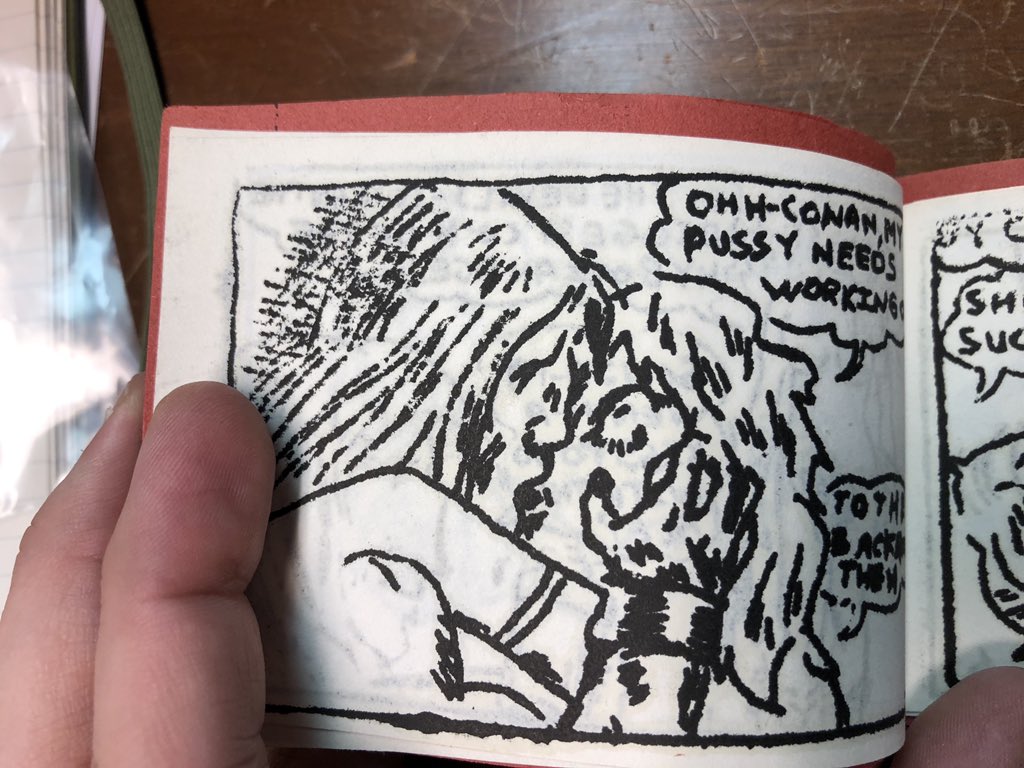
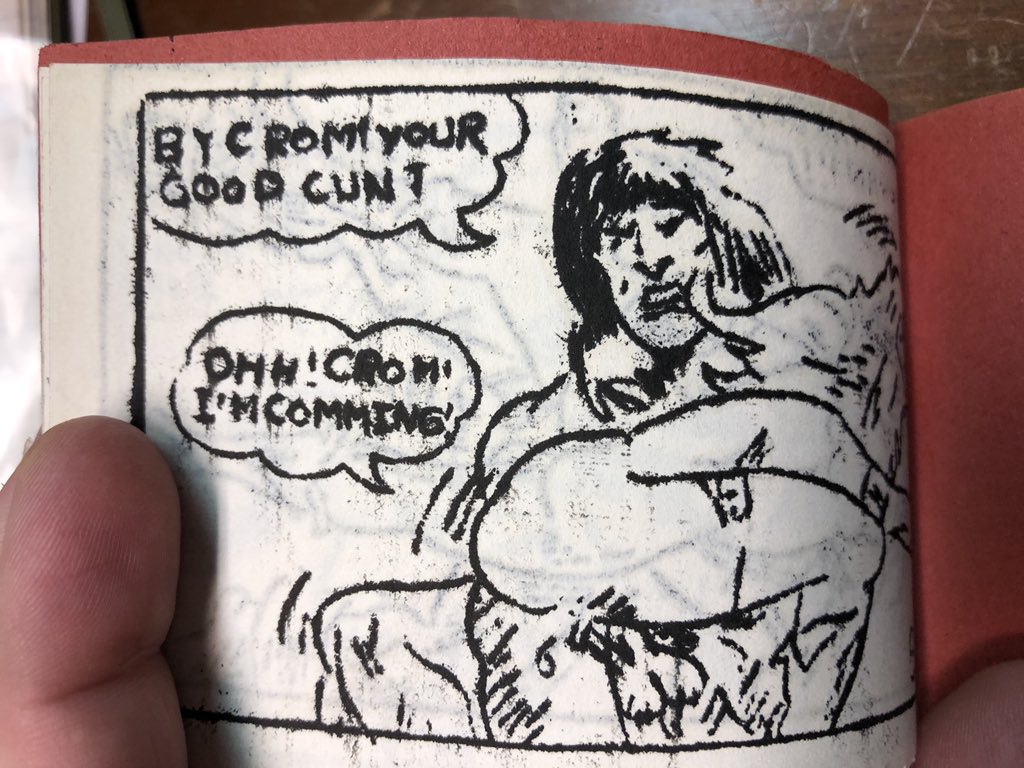
Red Sonja and Conan: Hot and Dry was an 8-pager (also called a Tijuana bible or bluesie) put together by Randy Crawford, who released a number of other parody sex comics in 1977 including Star Trek: Spock in Heat and a Plastic Man 8-pager. Tijuana bibles had first emerged in the 1930s, often crudely written, drawn, printed, and bound together with a staple or two—but these sexually explicit comics were incredibly popular. They often featured the unlicensed use of existing comic strip characters, popular athletes, Hollywood stars, and politicians, and even early comic book superheroes like Superman, Batman, and the Captain Marvel family.
Interest and production waned during the 1940s and 50s, but still carried on sporadically; the later Tijuana bibles published after the institution of the Comics Code Authority often seem to have crossover with underground comix, and might feature established characters such as Captain Ameria, Jacqueline Kennedy Onassis, and the Archie gang, but publication and distribution were shifting. Within a year or so of Marvel publishing Conan the Barbarian in 1970, the first pornographic parody “Gonad the Barbarian” appeared in the San Francisco Ball, an adult-oriented underground newspaper in mocking parody of the San Francisco Call.
Red Sonja took a little longer. It’s clear from the cover image that Randy Crawford was looking at the Marvel Feature/Red Sonja (vol 1.) Frank Thorne-era Red Sonja for inspiration, with the straps, armlets, gloves, and pauldrons which would gradually be dropped from her wardrobe. There’s no mention of her origin, oath, goddess, or need to battle before the action begins.
Red Sonja #1 (1977)
Conan is an even rougher figure, although clearly John Buscema’s take on the character. Something of the notched nose and posture recalls Conan’s second meeting with Red Sonja.
Savage Sword of Conan #1
Readers can judge for themselves. Sorry for the roughness of these photos, these are the only ones I could get.
The inside rear cover includes a reprint of the cover for Crawford’s Plastic Man 8-pager
Erotica tends to be ephemeral: only 1,250 copies of Red Sonja and Conan: Hot and Dry were published, and they very rarely come onto the second-hand marketplace. Many have no doubt been lost or discarded, or damaged because of their fragile construction. Yet the crude content and art are the point. While today with the internet readers can find dozens of pornographic comics featuring Red Sonja, some lovingly rendered by digital artists, in the 1970s this kind of erotic fan-product was not just illegal (copyright violation, and possibly deemed obscene depending on the jurisdiction), it was representative of a seriously fringe commercial activity.
How the hell do you advertise a Red Sonja/Conan Tijuana bible? Without getting caught?
Randy Crawford apparently published an ad in the Comic Buyer’s Guide, but this was the sort of thing that would probably have been sold under the table at conventions, or by mail-order in severely plain envelopes. It was illicit fare for the true post-pubescent comic nerds to geek out over. It represents almost the opposite of Frank Thorne’s approach with Ghita of Alizarr—none of the characterization, the beautiful artwork, the erotic atmosphere—just a gonzo narrative, straight to sex and ending with a climax.
Frank Thorne, no doubt, got a good laugh out of it. Yet he was an artist; he may have wanted to see his favorite flame-haired swordswoman in flagrante delicto…but he also wanted to do right by her as a character. Nothing quite illustrates the difference between an avid fan’s pornographic fantasy and a dedicated artist’s erotic epic than to look at something like this, and see how crude the work could be, tossed out quick and printed on the cheap to make a few bucks.
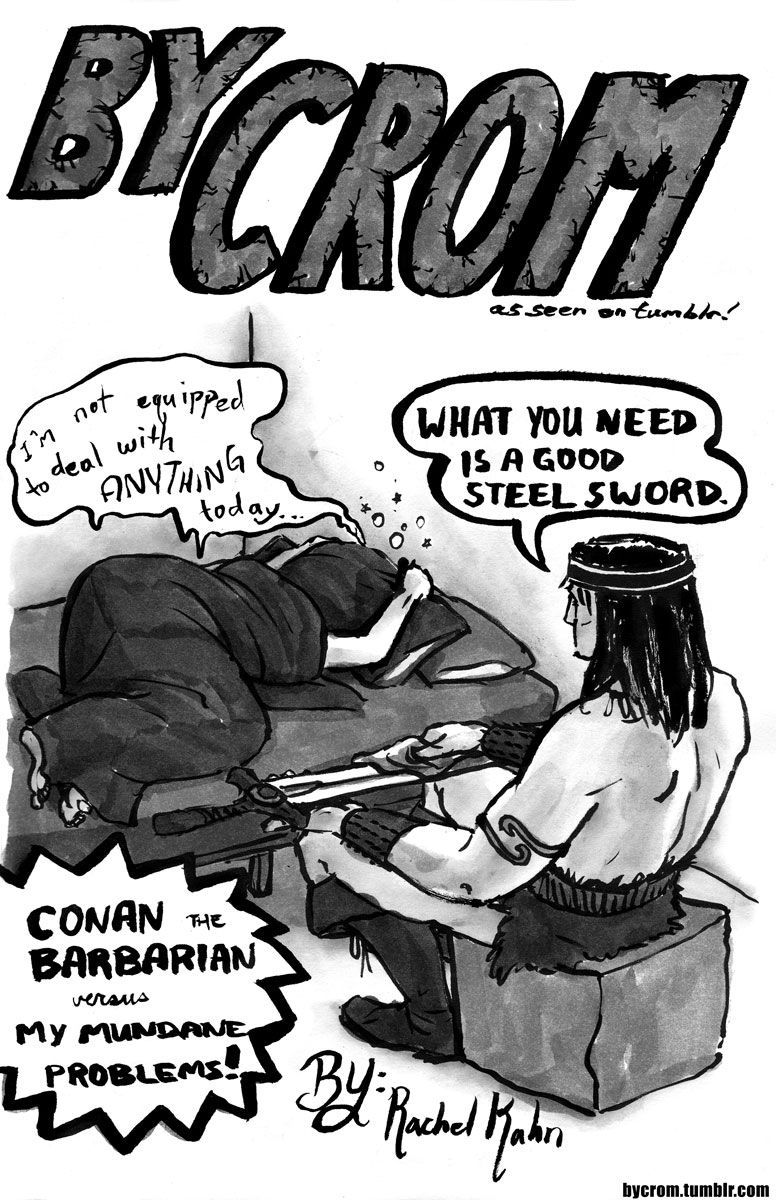
I am not entirely sure how to frame an introduction to a comic book that I hope, very strongly, will speak for itself. So I’m just going to extend the thank yous from the previous page to everyone else who gets these jokes. To everyone who finds my comic accessible, regardless of gender or race or age or level of Conan loremastery, thank you for proving an old artistic tenet true: the personal, made public, can transcend its source. I am completely convinced that a little magic is needed for such an act, and that magic, for me, comes in the form of a fictional character whose worldview has been a wonderful new frame through which to view my own life.
That anyone else is interested in these jokes means two wonderful things are true: I am not the only one who loves Conan this way; and I am not the only one who evaluates her fancy clothing by how fast it would allow her to run away from crap. —Rachel Kahn, Conan the Barbarian Is My Spirit Guide, By Crom! (2013), 1
In 1936, Robert E. Howard took his own life. A friend, Thurston Torbett of Marlin, Texas, wrote of the sad event to a mutual friend, the pulp writer C. L. Moore in Indianapolis, Indiana. Moore immediately dashed off a postcard to H. P. Lovecraft in Providence, Rhode Island—and Lovecraft, it seems, wrote to nearly everyone. Dozens of letters to people across the country, written in haste, his eulogy building with each one so that we can almost trace when a letter was written by how much he has added in his grief for his Texas friend, who he had never met but had exchanged letters with for six eventful years.
In trying to sum up what made “Two-Gun Bob” Howard special, Lovecraft settled on:
It is hard to say just what made Two-Gun’s yarns stand out so, but the real secret is that he was in every one of them. Even when he made outward concessions to the Mammon-guided editors & commercial critics he had an inner force & sincerity which broke through the surface & put the imprint of his personality on everything he wrote. —H. P. Lovecraft to August Derleth, 20 June 1936, Essential Solitude 2.737
Yet there is another side to this. It is not just the words that Howard wrote on the page, in his small room in Cross Plains, Texas. It is the people who read them whose imaginations complete the characters. When Conan the Cimmerian, or Kull of Atlantis, or Solomon Kane, Bran Mak Morn, Sailor Steve Costigan, Breckinridge Elkins, El Borak, etc. —when these characters speak to a reader, it is because some of Robert E. Howard speaks to a reader, and the reader responds to that.
One reader might see Conan the Cimmerian as a masculine ideal; another might see him as an archetype of toxic masculinity. One reader might see him as an escapist fantasy on Howard’s part, another might see one of the many clones of Edgar Rice Burroughs’ Tarzan, cynically manufactured for pulp magazine consumption. Readers often look at Conan through the lens of their own lives and desires, influenced by the stories they have read, what they know of the life of Robert E. Howard, the history of pulp magazines, etc.
While everyone reads the same words, the understanding they come away with of the character and the story can vary as widely as the readers themselves do.
Howard, we can be fairly sure from his letters, did not set out to write Conan the Cimmerian or any of his characters as ideals to be followed; he wrote pulp fiction, not theology or philosophy—although having said that, Howard invested a great deal of bloody philosophy and world-weary wisdom into his characters, whose triumphs are often matched by tragedies, and whose tales are often set against the grinding movement of time which will eventually crush and subsume all things. There are veins of cynicism that sometimes give way to wonder, black rage and pity, catlike jests, and dour moods no drink can drown.
In 2012, Rachel Kahn (Shel Kahn) began a series of autobiographical webcomics, originally on Tumblr, and later collected as a ‘zine and a short series of books: Conan the Barbarian Is My Spirit Guide, By Crom! (2013), Full Colour Cromulence: Book 2 of By Crom! (2014), and a crowdfunded full collection titled simply By Crom! (2016).
What lessons can a fictional Cimmerian hold for a Canadian artist in the 2010s? At first glance, the reactions of a wandering barbarian thief, warrior, pirate, and later king might not have much relevance. This is, in part, the initial charm of the comic: the juxtaposition of this forthright, sometimes violent adventurer when faced with a young woman who often faces the trials and tribulations of everyday life, such as anxiety and medical issues.
The Conan that plays foil to Rachel Kahn’s alter ego in these strips is derivative of Howard’s Conan the Cimmerian, not the musclebound superhero of the comics or the films starring Arnold Schwarzenegger. Yet it is very obviously a Conan that partakes of Kahn herself as much as Howard. In asking herself, essentially, “What Would Conan Do?” the Cimmerian dispenses advice that often affirms the kind of positive, active attitude she struggles with. Conan, whatever and whoever else he is, makes no pretense and suffers no moment of self-doubt or crisis of identity; in By Crom! he embodies the kind of easy self-confidence, self-awareness, and self-acceptance that many struggle with.
In a personal essay at the rear of By Crom! (2016), Kahn elaborated on her inspiration to start the comic, how she fell into Robert E. Howard and other pulp writers, the death of her father, and her ongoing struggles to live and work as an artist with all the stress that entails. And she wrote:
And through this all, this whole time when I felt I was waging war against the whole world alone, carrying all this pain that left me isolated in my own mind, I had Conan. I had comics Conan, novel Conan, even Arnie’s cinematic Conan, who speaks less and succeeds less than any other Conan but still will not give up his quest. Conan managed, so I managed. Conan took risks, so I took risks. Conan pursued his goals despite incredible opposition, so I pushed harder at what I wanted every day. Conan followed his own moral code, so I tried to remember mine more often as well.
Lovecraft wrote that Howard’s secret was that he put himself in every story. It is appropriate that Rachel Kahn followed in his footsteps and put so much of herself into By Crom!, and her depiction of Conan shows the mingled influence. Her Conan does not strip quotes from Howard’s stories in pursuit of some dogmatic canon; she expresses the heart of who Conan was and is to her. In an interview with Jenna Lindford, Kahn wrote:
I think one of the fantasies I can obsess over as someone living with mental illness is the dream of being emotionally invincible, or perhaps, invincible to my own emotions. The futility of that, the reality that I was not a hugely resilient and self sufficient person, was either going to crush me or become something I could laugh about and thus accept, and drawing the comic really helped me choose laughter. In the end no real person can achieve the kind of simple purity of intention that Conan has, and by juxtaposing it with my own experiences I think it shows some of the absurdity of both approaches.
In terms of the fine line, well, while I made myself the butt of most of the jokes, I hope that the honest expression of my frustrations and struggles and concerns communicated a sort of self-acceptance. If I can write and draw a comic about a rage-tinted panic attack in a bra shop, I have to be able to accept myself as someone who lived that. I hope that while the comic has a sense of humour about these anxieties, anyone else who is familiar with living with them senses the acceptance and fellow-feeling, and does not feel like the butt of the joke. However, when you make something like this you have to accept that your intentions don’t dictate the results, so I don’t pretend to think the comic is invincible to other perceptions.
The reader always completes a story; a writer can control the words, but not how someone responds to those words. Robert E. Howard, typing away at his writing table in Cross Plains, Texas in 1936 could never have guessed that in 2012 what he wrote would find new manifestation with a freelance artist in Canada in 2012…yet, that happened, and Rachel Kahn’s Conan is recognizably Conan, as recognizable in his own was as any Frank Frazetta cover.
Physical copies of the By Crom! collections appear to be sold out, but for those who are interested in the additional commentary, essays, and pin-ups, PDFs are still available via the Gumroad store.
How can I wear the harness of toil And sweat at the daily round, While in my soul forever The drums of Pictdom sound? —Robert E. Howard, “The Drums of Pictdom,” Collected Poetry 2.72
Today, historians and archaeologists tell us that real-life Picts were a people in what is now Scotland during the early Middle Ages, who in time merged with or were subsumed by the other peoples in the region. When a 13-year-old Robert E. Howard ran across the mention of them in a New Orleans library in 1913, however, the Picts were a mysterious race. Pseudohistories like the Pictish Chronicle mingled with scientific racialism, and the early archaeological and anthropological theories of the British Isles to made the Picts a race apart from Gaelic peoples like the Irish and Welsh; Germanic invaders like the Angles, Saxons, and Jutes; Nordic raiders a-viking from Scandinavia; or more southernly European invaders like the Romans. The underdogs of the ancient world, the last hold-outs as waves of invaders washed over the British Isles, driven at last to one distant corner…and at last, snuffed out, to leave only a few enigmatic stone monuments behind.
Howard, with a penchant for underdogs, was enamored from the first.
Picts are one of the near-constants of Robert E. Howard’s imagination. They feature in nearly every era of his fantastic fiction, from the tales of Brule the Spear-Slayer and other Picts who aided King Kull in Valusia, to the howling tribespeople in the Pictish wilderness across the Black River in the age of Conan the Cimmerian, they play a major part in the history of the Hyborian Age, to Bran Mak Morn who fought the invasion of the Romans in the British Isles, to the time of Brian Boru when Turlough Dubh O’Brien encountered them among the small islands to the north of Britain, and into the modern day when a rumor of a surviving cult of Bran Mak Morn came in “The Children of the Night.”
Over the course of his writing career, Howard’s conception of the Picts changed and evolved. His initial depictions of them drew comparisons with the Little People, the elves and fairies of British folklore, but when he began a correspondence with H. P. Lovecraft in 1930, Howard began to differentiate the two concepts (see “Conan and the Little People: Robert E. Howard and Lovecraft’s Theory”), which eventually led to one of Howard’s most powerful stories: “Worms of the Earth,” which mingles references to Lovecraft’s Mythos with Howard’s Pictish lore (Lovecraft would return the favor by including the cult of Bran Mak Morn among others in his story “The Whisperer in Darkness.”)
While Picts are an important part of Robert E. Howard’s work, they do not tend to fare so well in adaptation and in the writing of others. Henry Kuttner, not long after Howard’s dead, began the Elak of Atlantis stories in Weird Tales, which included an antagonistic people called “Pikhts.” The success of the Conan the Barbarian comics, and by-blows like Kull the Conqueror, have seen many Pictish characters in the Hyborian and Thurian Ages, but these depictions tend to borrow from Native American imagery (which to be fair, Howard did himself in “Beyond the Black River”—see John Bullard’s article “‘Beyond the Black River’: Is It Really ‘Beyond The Brazos River?'”) Bran Mak Morn, Howard’s most singularly developed Pictish character, has had notable adaptations in the comics as well, especially two adaptations scripted by Roy Thomas: “Worms of the Earth” (art by Tim Conrad), and “Kings in the Night” (art by David Wenzel), and in prose was the subject of three notable pastiches: Legion from the Shadows(1976) by Karl Edward Wagner, For the Witch of Mists(1981) by David C. Smith & Richard Tierney, and Bran Mak Morn: Red Waves of Slaughter(2024) by Steven L. Shrewsbury.
For all that might sound like a lot, given the hundreds of Conan comics and dozens of novels, and even the dozens of Kull and Solomon Kane comics, the Picts might fair be said to have often been overlooked. Because Howard’s themes for the Picts evolved over time—covering so many disparate periods, and often involving stories not published until after his death—there isn’t really a cohesive Pictish Mythos in fiction, despite the fact that they are more of the connective tissue of Howard’s fantasy fiction than nearly anything else.
This is all a very long way to say that it’s nice to see some other creators take an interest.
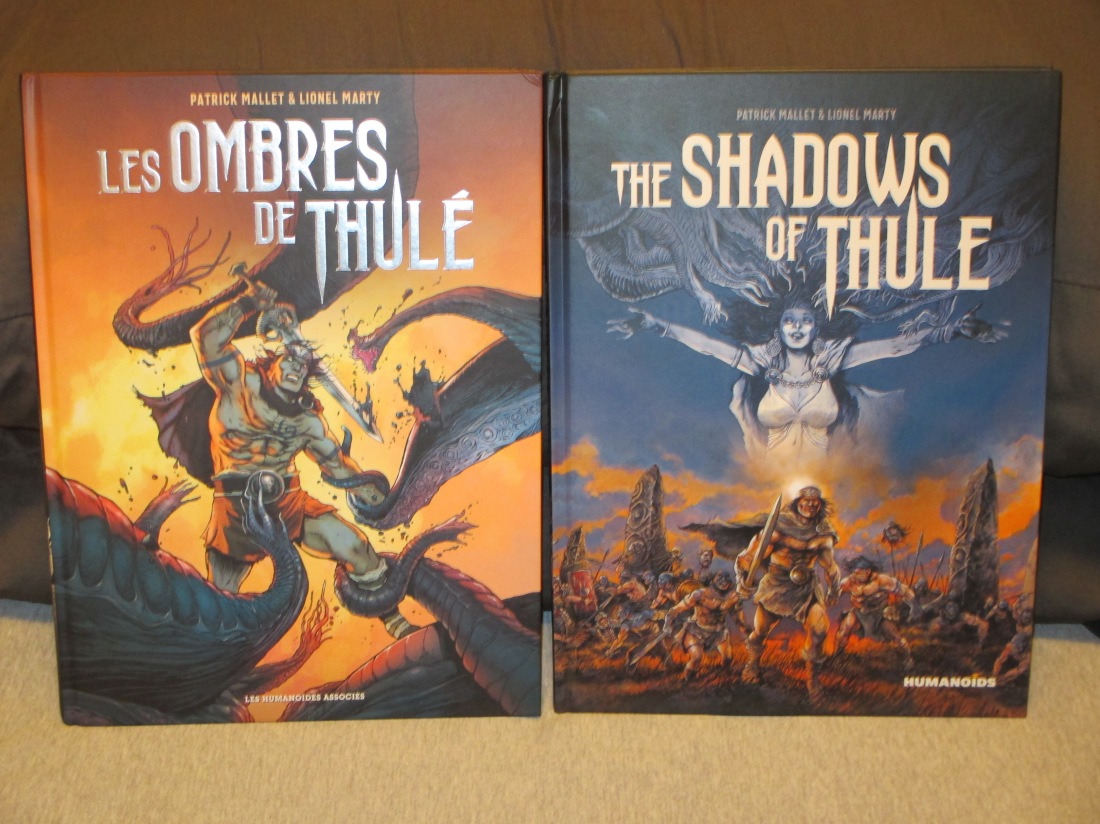
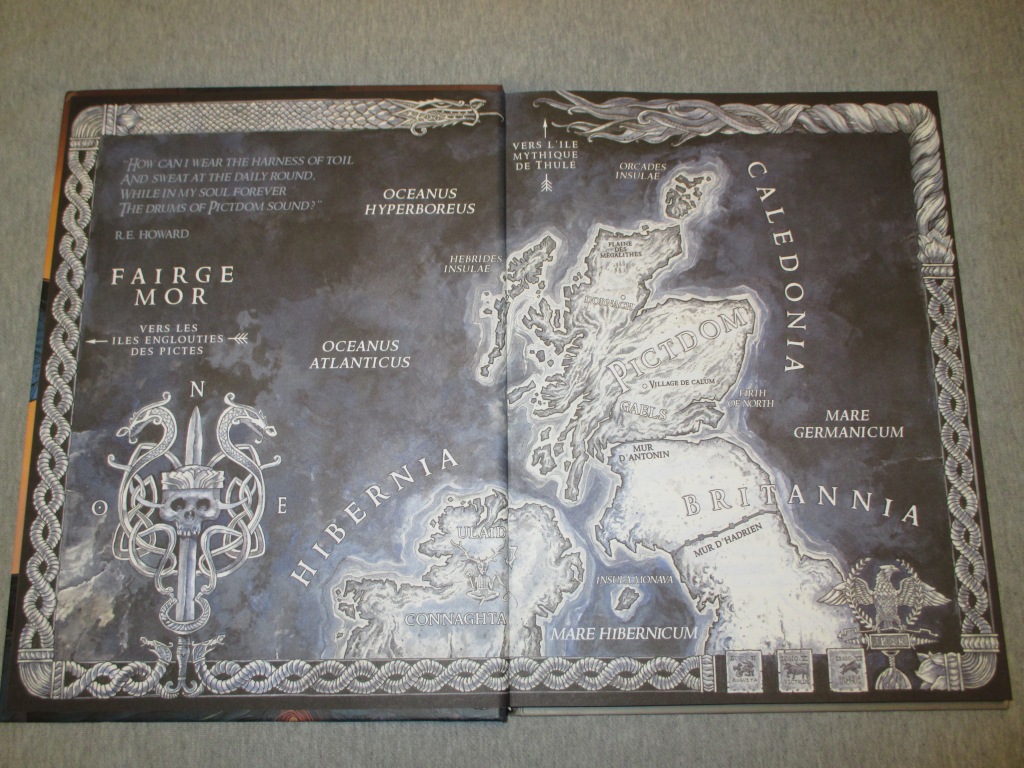
Les Ombres de Thulé (2023) by Patrick Mallet (script), Lionel Marty (art), & Axel Conzalbo (colors) is a French-language bande dessinée; there is also an English-language translation available, The Shadows of Thule, released the same year, translated by Montana Kane. The story is not an adaptation of any Howard tale, nor is it specifically tied to Howard’s setting or chronology, but it is clear that Mallet & Marty took inspiration from Howard and Lovecraft, and the tale contains many Echoes of “Worms of the Earth,” “Kings of the Night,” and “The Dunwich Horror.”
The Romans have pushed deep into Britain, and they’re here to stay. The Picts are a fading people, ancient, barbarous, and wise with magic, but more desperate every year. A Roman general is manipulated by a necromancer into releasing an ancient Lovecraftian horror that had been sealed away long ago…and it might take all the swords and sorcery of the King of the Picts to deal with this old enemy.
Map on the inner pages of the French edition; not included in the English translation.
If it sounds familiar, it is because it is. his is not quite as dark and brooding as Howard’s tales of Bran Mak Morn, and the scale of the action and magic owes more to the popular depictions of contemporary fantasy than to some of the more realistic or restrained proportions of older works. Readers today expect glowing eyes, towering tentacled terrors, and headlopping…and Les Ombres de Thulé delivers on all three.
Conzalbo uses color to heighten the distinction between the old man’s vision and the real-world scenes.
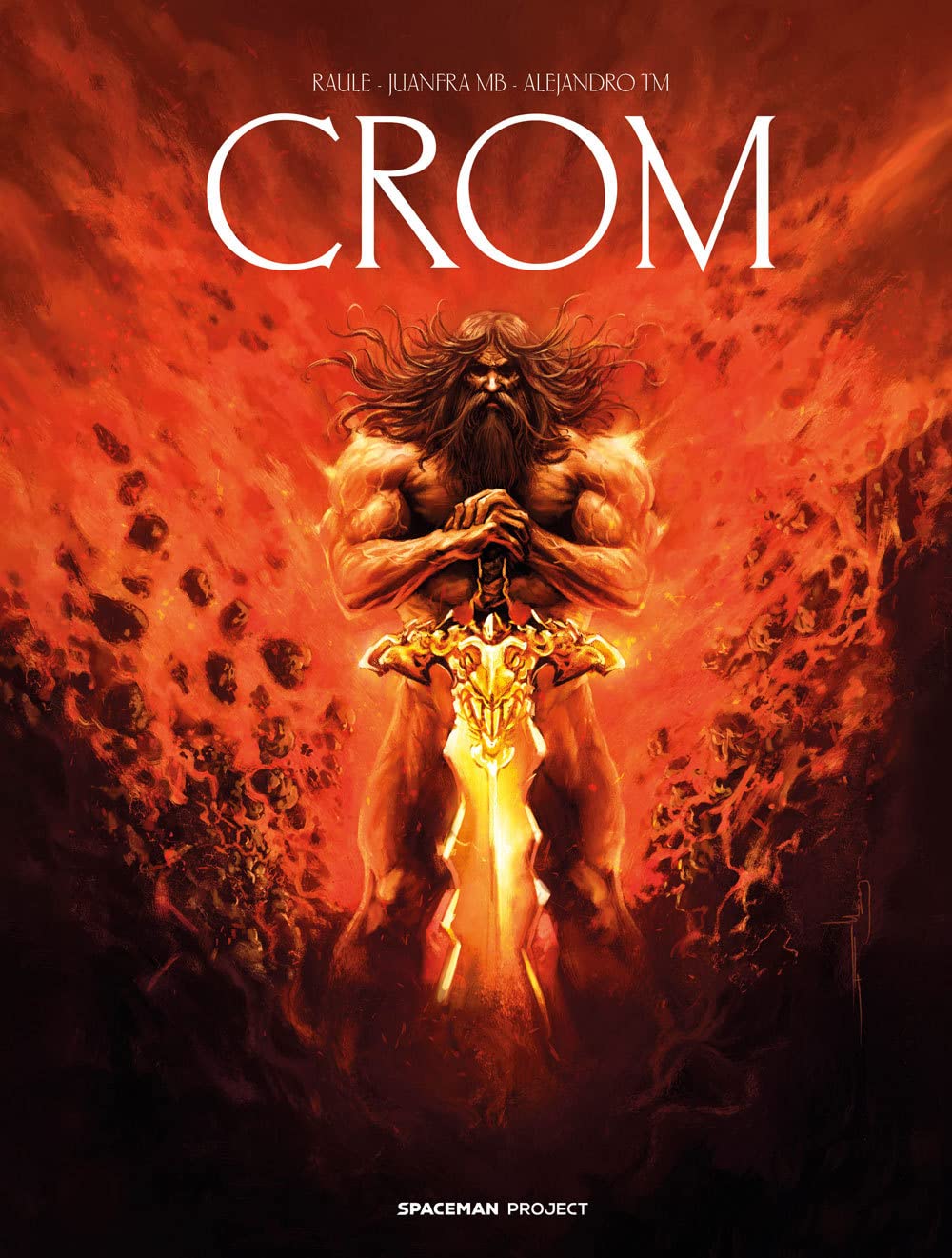
Like other bandes desinees such as Orcs et Gobelins T11: Kronan (2021) by Jean-Luc Istin, Sébastien Grenier, and J. Nanjan and Crom (2022) by Raule, Jaunfra MB, & Alejandro TM, there is a certain aesthetic that pervades this book. Digital coloring adds a certain studied muddiness to some of the artwork that looks better than plain, flat colors but doesn’t quite replicate the texture of real paint. Minor nudity is taken for granted, as are splashes of gore. While some of the pages may seem crowded with panels, there are often huge splash pages that give moments to admire the detail that larger page sizes allow.
Mallet and Marty wear their influences on their sleeves. This is a love-letter to Howard and Lovecraft as much as anything else. An original story, but also a remix that combines some of the highlights from their favorite weird fiction. If it dips into a bit more of Celtic myth (there are some definite overtones of Michael Moorcock’s Corum Jhaelen Irsei tales), or some Dungeons & Dragons-style mucking about with eldritch blasts and healing spells than Howard or Lovecraft would have had it, that speaks to how the fantasy aesthetic has changed in the hundred years since Weird Tales began publication.
Back covers of the French (left) and English (right) editions.
Les Ombres de Thulé / The Shadows of Thule is a fun experience, in French or English. Kane’s translation appears faithful to the original text and in keeping with the spirit of the work, not always an easy balance to achieve. It is nice to see creators who take inspiration from Howard and Lovecraft’s work without necessarily being slavishly devoted to a long and convoluted Mythos.
Depuis la nuit des temps, alors que tout n’était que téneberes et silence, les hommes osaient à peine pronouncer son nom, tant il leur inspirait de crainte. Maisie ils ignorant que Crom était né mortel, empli de rage et de haine, avide de connaître son destin dans un monde à l’agonie. Ses yeux aussi noirs que le corbeau portaient en eux le présage d’une pluie de sang éternelle et de rafales de vent tranchantes comme l’acier, semper la vengeance et la mort, anéantir Des civilisations entiéres sur son passage, peu lui important. Il aspiration à devenir le dieu Des dieux et à régner sur toute créature et toute chose. Voici son histoire.
Since the dawn of time, when all was darkness and silence, men have scarcely dared to speak his name, so great was their fear of him. But little did they know that Crom was born mortal, filled with rage and hatred, eager to know his fate in a dying world. His raven-black eyes carried the omen of an eternal rain of blood and of steel-sharp winds, sowing vengeance and death, annihilating entire civilizations in his path, mattered little to him. He aspires to become the god of gods and rule over all creatures and all things. This is his story.
Crom(2022) is a French-language bande dessinée in homage of Robert E. Howard and his creation Conan of Cimmeria, who swore by Crom. The script was written by Raule, drawn by Jaunfra MB, and colored by Alejandro TM. It is implicitly set long before the age of Conan, and tells what might be a pretty stereotypical blood-soaked, high-octane fantasy story, with some images that could have been ripped straight from a heavy metal album cover.
Chekov’s volcano: if a volcano appears at the start of a fantasy graphic novel, it must erupt by the end.
Men and monsters are killed, there’s very little dialogue and most of the story is told in pithy snippets that try not to get in the way of the artwork.
But who is Crom, really?
“They have no hope here or hereafter,” answered Conan. “Their gods are Crom and his dark race, who rule over a sunless place of everlasting mist, which is the world of the dead. Mitra! The ways of the Aesir were more to my liking.” —Robert E. Howard, “The Phoenix on the Sword”
“What of your own gods? I have never heard you call on them.”
“Their chief is Crom. He dwells on a great mountain. What use to call on him? Little he cares if men live or die. Better to be silent than to call his attention to you; he will send you dooms, not fortune! He is grim and loveless, but at birth he breathes power to strive and slay into a man’s soul. What else shall men ask of the gods?” —Robert E. Howard, “The Queen of the Black Coast”
His gods were simple and understandable; Crom was their chief, and he lived on a great mountain, whence he sent forth dooms and death. It was useless to call on Crom, because he was a gloomy, savage god, and he hated weaklings. But he gave a man courage at birth, and the will and might to kill his enemies, which, in the Cimmerian’s mind, was all any god should be expected to do. —Robert E. Howard, “The Tower of the Elephant”
“Such is not the custom of my people,” Conan growled, “nor of Natala’s either. The Hyborians do not sacrifice humans to their god, Mitra, and as for my people—by Crom, I’d like to see a priest try to drag a Cimmerian to the altar! There’d be blood spilt, but not as the priest intended.” —Robert E. Howard, “Xuthal of the Dust”
Crom, the name of the god of the Cimmerians in Robert E. Howard’s Hyborian Age adventures of Conan the Cimmerian, is invoked or named in nearly every episode, but very little is said about him. We get an idea of Crom as a sort of patron deity of Cimmerians; powerful, dark, dour, and concerned with fate, but generally uncaring. Howard does not expand on this explicitly in any of his letters, but it’s worth noting that before Conan the Cimmerian called on Crom, Conan the Reaver did:
I had clambered the cliffs—no, by the thunder of Crom, I was still in the cavern! I reached for my sword— —Robert E. Howard, “The People of the Dark”
“The People of the Dark” (Strange Tales of Mystery and Terror June 1932), features a familiar plot device of Howard’s: a contemporary individual receives a blow to the head and is thrown back into re-living an episode of a past life, in this case the Irish reaver Conan—Conan being a relatively common Gaelic name (e.g. Arthur Conan Doyle, Conan O’Brien, etc.) Howard identified as Irish-American and many of his heroes were Irish or Irish-American too—he later noted in the Hyborian Age essay that in his fanciful history of the world, the Cimmerians were the ancestors of the Celts, and thus the Irish too.
One of Howard’s major conceptual leaps in writing the adventures of Conan the Cimmerian was not just to set the stories before recorded history, but to remove the whole element of past life regression. There is no James Allison to recall his past life as Conan the Cimmerian, Conan’s adventures appear directly on the page, without any framing narrative set in the present day. However, Howard still drew on elements of real world mythology and history in crafting his Hyborian Age.
The Crom that Conan the Reaver swears by is probably intended to be Crom Cruach, a pagan deity of pre-Christian Ireland that Howard may have run across in his studies of Irish history and folklore. This Crom is only known through post-Christian legends, which paint it as an ancient figure of worship that accepted human sacrifice, until the cult-image was destroyed by St. Patrick. The fantasy Crom of Cimmeria is not quite as malevolent (no human sacrifice), and both figuratively and physically more distant, residing atop an unnamed mountain. Howard was free to fudge the details; after all, who was going to correct him?
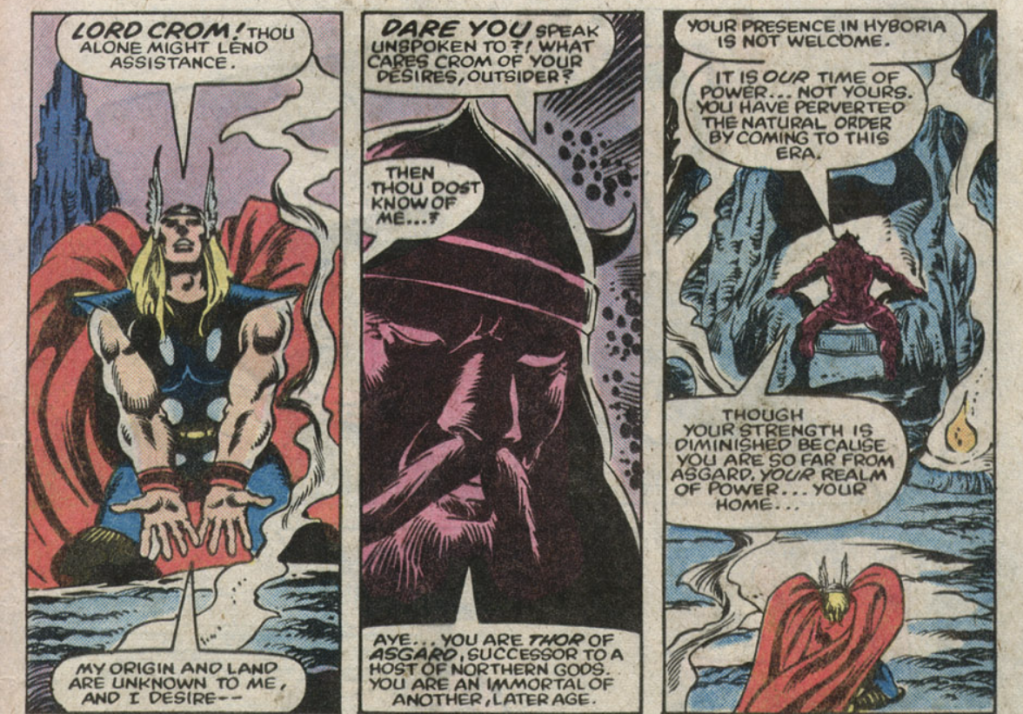
This image of Crom as essentially distant and dour has persisted through various adaptations; the 1982 Conan the Barbarian movie added a war with giants, a riddle of steel, and a Nordic Valhalla. Various comic adaptations from Marvel and Dark Horse have made Crom a more-or-less humanoid figure who appears only in rare circumstances. For example, in What if? #39, when Thor is sent back to the Hyborian Age, he climbs Crom’s mountain and actually meets with the (literally) dark and vaguely Nordic chief of the Cimmerian pantheon:
What if? #39 (June 1983). Alan Zelenetz (script), Ron Wilson (pencils), Danny Bulanadi (inks), Janice Chiang (letters), George Roussos (color)
A notable exception is Crom the Barbarian, a Conan pastiche character created by Gardner F. Fox in the 1950s for a few comic strips; this character borrows the name, but nothing else. Like Marvel’s Thor, he even appears blond.
None of these works have really tackled Crom’s origin or expanded much on his mythology; while Conan the Cimmerian might frequently swear by or at his god (or any of the others he’s adopted along the way), there’s been very little written about Crom’s worship or past—and that mostly in roleplaying games.
This is a long way to say that Raule had a free hand when it came to the script, and Jaunfra MB and Alejandro TM could exercise their imagination however they pleased when envisaging Crom and his apotheosis. What they ended up going with was a somewhat stereotypical quest narrative: Crom goes hunting for four artifacts of power, from the ruin of the first city, long sunken to the lairs of various monsters.
With a superhuman physique and strength, Crom slaughters…everyone. Entire armies. Depicted in loving detail, sometimes. Which is really sort of what sets this book off from Conan the CImmerian as Howard first conceived him, and as he is often written.
While many people comment on the artistic portrayals of Conan as this hulking musclebound figure, more brawn than brain, capable of superhuman feats of strength, speed, stamina, and swordplay…the original Conan as Howard first conceived him is very human, very mortal. Strong, but not inhumanly so; tough, but in the way a boxer is tough, able to roll with the punches and soak up punishment, and he does. Conan in “The Phoenix in the Sword” suffers terrible wounds, and only his leonine strength, speed, and skill save him from the assassins out for his hide.
From a meta-perspective, is isn’t likely that the lead character in a successful series is going to die in every fight, and readers might well expect Conan to overcome the odds—he is the hero after all—but generally Conan is in mortal danger for at least part of the story, and tends to overcome the odds with skill and bravery more than any exercise of superhuman power (a notable exception being “A Witch Shall Be Born,” where Conan is crucified…and after he gets his hands free, pulls out the remaining nails himself!)
By contrast, Crom in Cromis nearly superhuman from the get-go, facing major foes but few major injuries, obstacles, or setbacks. This isn’t a grounded, hardboiled tale of sword & sorcery—this is a legend. So when Crom runs out of mortal foes, he faces off against the four ancestral gods.
As an adult, having read many fantasy books and comics, the idea of collecting the four themed artifacts and defeating the four elemental-themed gods may seem a bit basic. If I was a twelve-year-old pouring over the pages of Heavy Metal/Metal Hurlant, however, I’d probably be breathless in awe at how metal this all is. I think everyone involved in the creation of this book understood what they needed to do, and they weren’t going to try and squeeze a lot of metaphysical complications or complex narrative twists into this story. There’s no comedic foil, no love interest, no moral dilemmas.
Sometimes the gods have to die.
In overall style and aesthetic, there are similarities between Crom and Orcs et Gobelins T11: Kronan (2021) by Jean-Luc Istin, Sébastien Grenier, and J. Nanjan. These are artists working within a fantasy milieu where the iconic bodybuilder physique and penchant for big swords has been exaggerated almost to the point of parody; the colors are vivid, but also tend to highlight and oversaturate the atmosphere of the artwork, sometimes adding a lot of emphasis that might have been missing from the original, sparse backgrounds; sometimes muddying the line work a bit.
The real Crom may be only a broken stone figure in Ireland; the Crom of Robert E. Howard’s stories was a distant pagan figure, undefined and possibly better left that way. This is not Robert E. Howard’s Crom.
For what it is trying to be, however—an homage to the concept of Crom, and the superheroic barbarian of comics, film, games, and pastiche—Crom achieves exactly what it set out to be. This incarnation of Crom seems to be almost an over-the-top parody of the comic-book Conan the Barbarian specifically because the Conan of the comics is so often already an exaggerated superheroic figure. Crom needs to be a character that takes all the essence of the Cimmerian and makes the legendary hero into something greater.

















 Deep Cuts in a Lovecraftian Vein