H. P. Lovecraft’s mother is part of the myth. Like Igraine, who bore the boy that would grow up to be King Arthur, she plays her essential role—but there are relatively few stories of her. Unlike Lovecraft’s thousands of letters, little of Sarah Susan Phillips Lovecraft survives, and she was not treated kindly by biographers. Art and fiction have seldom been more beneficent.
The Mythos has permeated H. P. Lovecraft’s biography to such an extent that in fiction it bleeds out into everything else. His conception, birth, upbringing, adolescence, and early adulthood—all aspects of his life that Susie played an active part in—have been re-cast by authors as supernatural terrors that cast a long shadow on the impressionable young lad, and inspired what he wrote. As if a writer of horror could not simply put their imagination to work. That there had to be some reality behind it.
Susie’s part in these little reality plays is often unpleasant. When they re-tell the story of the hallucinations her husband Winfield S. Lovecraft supposedly suffered before he was put away in a sanitarium, such as “Recognition” by Alan Moore, her fictional alter-ego is raped. She may go mad and die insane in the same sanitarium after reading the Necronomicon, as in Lovecraft by Hans Rodionoff, Keith Griffen, and Enrique Breccia. What little facts we have tend to mingle with the distorted ideas of biographies, and then fantasy makes of Susie Lovecraft a caricature, more false face than real.
There is, often enough, very little sympathy for a single mother left alone to raise her son. Even before the shoggoths are brought into the business.
So when a reader turns the page and begins to read Penelope Love’s “Turn Out The Light,” the thing that jumps off the page immediately is empathy. It is not the most accurate, or even the most sympathetic, portrayal of Susie Lovecraft to be published. There is nothing in the limited biographical information we have to suggest that Susie did or thought some of the things that Love suggests she may have, in this story. For example:
In her traveling salesman husband’s absence—philanderer, snob, spineless, whore—her father had spoiled his grandson, told him stories, given the boy the black cat, then given it such a vulgar name.
She had never liked that cat. The one blessing out of all that loss was that the rooming house would not let them keep it. She arranged for it to be drowned, although she told her son it ran off.
This is pure invention. We don’t know what Susie actually thought of Lovecraft’s pet cat with the unfortunate name, there’s no indication she was behind it’s disappearance. Yet that is rather the point: in the absence of hard data, Penelope Love has tried to get inside Susie’s head, to provide a point of view for her. It may not be entirely accurate (her brother Edwin Phillips and sister Annie Gamwell are not mentioned at all), but it isn’t just regurgitating the same old stories either.
Even so, there are parallels between “Turn Out The Light” and works like “Night-Gaunts” (2017) by Joyce Carol Oates. Natural parallels because they are, in a real sense, both working from the same material in similar lines of thought. Retreading the grounds of Lovecraft’s childhood, his fiction; drawing lines and linkages between later works and earlier events and persons. Creating variations on the same myth, like villages in Greece that each have slightly different stories of Herakles. Love’s version of events is a little more subtle, a little less overtly fantastic, and her depiction of Susie Lovecraft a bit more real, though nowhere as sympathetic as “Wife to Mr. Lovecraft” (2017) by Lucy Sussex.
Yet Susie Lovecraft could use a little empathy. She may have born H. P. Lovecraft into the world, but she died just as he began to flower with his stories of the Dreamlands and Randolph Carter, but before Weird Tales came into being. “Turn Out The Light” captures some of the tragedy that is often unspoken about Susie’s relationship with her son. The reason why he did not visit her at the hospital during her last illness is one of those mysteries that will never be revealed, as Lovecraft did not write of such a personal matter, yet it evokes pathos when she begs him not to let them turn out the light…and there is one more thing.
“If I should die, please mark the symbols on the front steps here as you did for your grandfather—and the cat. I know it is nonsense. Just do this for me, please. I would like to think that I could follow the straight line between the stars and come back.”
Some people find immortality of a sorts through their children. Others, through their works. Their name and memory is kept alive. Susie Lovecraft is remembered today through her son, and a tenuous, ghostly, and distorted as that memory may be through the lens of biographers and the liberties of writers and artists—H. P. Lovecraft has secured at least that much for her. With her paintings lost, and no heirs to her body, works like this are the only offerings likely to be made to her memory, to keep it evergreen and safe from final oblivion.
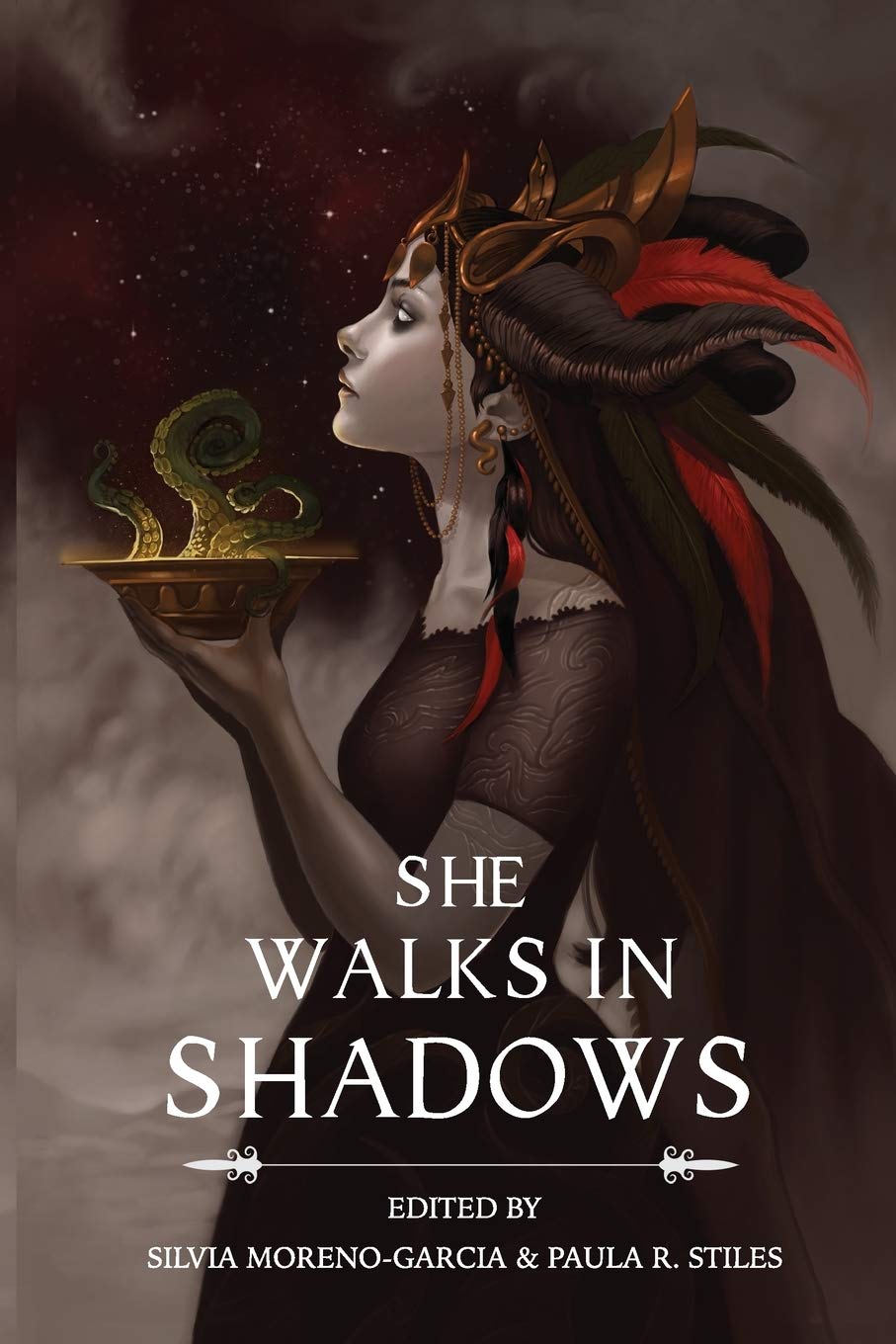
“Turn Out The Light” by Penelope Love was first published in She Walks In Shadows (2015). It has not been republished, except in the paperback editions of that book.
This is the second story in this collection that takes place in Boulder; it is also the second appearance of Ann’s Great Old One Ammutseba. The first was in the poem “The Coming of Ammutseba”, which will be published in the forthcoming anthology From Kadath to Carcosa, by Mythos Books. Ann describes Ammutseba as “a very dark version/perversion of the Egyptian skygoddess Nut.” She also blames Joseph Pulber for encouraging her to create her own Mythos “book and beastie”. Her tome is included in this story as well: The Gate of All Lost Stars, the quotes from which are Ann’s own corruption of The Book of the Dead. Ann further informs me that the Obscura Gallery in the story is based on a real establishment, though it doesn’t have quite the same name, and it isn’t located in Boulder. She also did a great deal of research for this story, much of which came from Stanley C. Sargent, whose knowledge of Egyptology is simply phenomenal.
Ammutseba is one of only a handful of female Mythos deities. Most are simply mentioned; only five others have actually appeared in stories: Shub-Niggurath, Yidhra, Cthylla, Hydra, and Coatlicue. This may be due, at least in part, to the unspoken chauvinism that has pervaded the Mythos; it may also be due in part to the patriarchal nature of the existing pantheon. Whatever the reasons, however, Ammutseba is a most welcome addition (what am I saying?!) and I personally would like to see more of her.
Taken together, we might call “Lost Stars,” “The Coming of Ammutseba,” and “Ammutseba Rising” as the Ammutseba Cycle, or possibly the Devourer of Stars Mythos. Relatively late additions to the wider body of Lovecraftian fiction, plagued by publishing delays, and currently not collected together—but such small details have hardly mattered.
Ammutseba exists…and in the days of the internet, has proliferated in odd ways. David Conyers refers to Ammutseba in the Call of Cthulhu roleplaying book Secrets of Kenya (2007); a Finnish metal guitarist has adopted her name, and so did a Maltese metal band (they later changed their name to Nokturnal Void), while there is an Amnutseba in France; J. Nathaniel Corres borrowed the name for an independently published space opera/Mythos novel, Elder Offensive: The Ammutseba Protocol (2018), Ed Russo borrows Ammutseba for his novel The Nameless Monster(2019). DeviantArt and other online galleries include plentiful fanart, some of it not even algorithmically generated.
In the spirit of the game that Mythos authors play, most of these later borrowings are at best impolite. Ammutseba is not in the public domain, as is the case of Lovecraft, whose Cthulhu and Necronomicon and whatnot are acknowledged as communal property. Back when most Mythos authors knew each other, it would be expected that at least some sort of permission would be asked and given first. This probably isn’t the case for most of the above. It is the nature of the internet that it makes it very easy to share information, but also very easy to steal ideas, intentionally or not.
It is easy to lose sight of Ammutseba as Schwader first depicted her—in part because there is no single consolidated source, no Bullfinch’s Mythology for these territories. In large part, this is because the Mythos is still living, growing, and evolving. Physical encyclopedias go out of date, online wikis and websites succumb to too many hands, or web rot as sites are abandoned, not backed up, and finally lost. Such things have happened before.
The eldritch entity Rhogog supposedly first appeared in the story “Sacristans of Rhogog” by Michael Saint-Paul. Call of Cthulhu roleplaying game writer Scott David Aniolowski liked the idea so much he worked it into a scenario, and from there Rhogog has proliferated. Unfortunately, that original story only appeared on a blog in the 1990s, never in print, and the blog long ago disappeared. As of this writing, no one has been able to find the original story or its author.
There is something terribly appropriate in having “Ammutseba Rising” open She Walks in Shadows. The idea of a goddess who bucks the patriarchy of cultists and eldritch entities, whose cosmic horrors can also connect, so very intimately, with the horror and experiences so unique to women, as Schwader demonstrated in “Lost Stars.” A Mythos entity that does not deserve to be forgotten, or misremembered.
“Ammutseba Rising” by Ann K. Schwader was first published in She Walks in Shadows (2015) and reprinted in Schwader’s collection Dark Energies(2015).
In November 1930, Fawcett Publications released a new pulp: Mystic Magazine. This lavishly illustrated, large-size pulp covered all manner of mystical phenomena, from seances to mediumship, palmistry to graphology, astrology to vampirism. In content, Mystic Magazine was a mix of nonfiction articles and the occasional story, written in the confessional style of Ghost Stories. In tone, the pulp seemed to cater more toward women—there was a kind of spiritualist lonely hearts column, regular features about what numerology or astrology said about your husband or love prospects, and the stories tended to have a romantic bent.
The pulp ran for four issues. With the fifth issue, Fawcett changed the title and approach; it became True Mystic Crimes (April 1931), adding in sensationalist material about Chinese tongs in San Francisco, murders caused by cults or solved by dreams or clairvoyance, zombies in Haiti, and all that sort of thing. Complete as the change was, the pulp still failed to find an audience among the crowded newsstands. The pulp ended there, to be no more than a rare collectible for pulp aficionados.
August Derleth earned his Bachelor of Arts from the University of Wisconsin in 1930. Derleth’s earliest letters from Clark Ashton Smith, addressed to him in Milwaukee in November 1930, occasionally touch on Mystic Magazine. Despite not being listed on the masthead, Derleth was an associate editor for the magazine, and published at least three stories and articles in Mystic under the byline “Tally Mason.” Still, the writing for the pulp was on the wall:
Dear Smith. In view of the fact the Fawcetts have discontinued Mystic together with its editor, my address after 17 February will be Sauk City, Wisconsin.
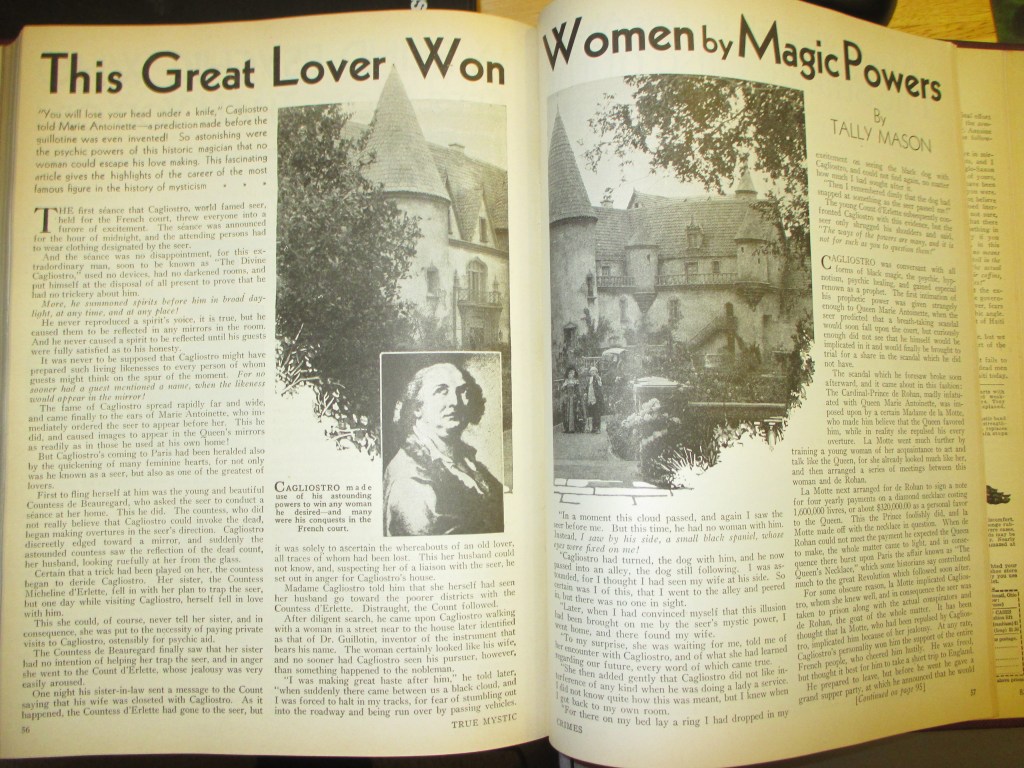
Back in his native Sauk City, August Derleth would begin writing for a pulp magazine titled Weird Tales. The date of his departure suggests the Fawcetts might have let him go before the transition to True Mystic Crimes—but that issue still contained two pieces from “Tally Mason,” whose manuscripts still survive among Derleth’s papers at the Wisconsin Historical Society. Both pieces were nominally nonfiction articles; “Your Picture Can Be Your Death Warrant” was about how images could contain a mystical link to their original subject, citing The Portrait of Dorian Gray as one example; the second, “This Great Lover Won Women by Magic Powers” was about the 18th-century occultist Alessandro Cagliostro, whose reputation and infamy has, over the centuries, become the stuff of legend and a great deal of fiction.
Yet “This Great Lover Won Women by Magic Powers” is interesting because of one particular thread that Derleth wove into the mix of facts and fiction:
But Cagliostro’s coming to Paris had been heralded also by the quickening of many feminine hearts, for not only was he known as a seer, but also as one of the greatest of lovers.
First to fling herself at him was the young and beautiful Countess de Beauregard, who asked the seer to conduct a séance at her home. This he did. The countess, who did not really believe that Cagliostro could invoke the dead, began making overtures in the seer’s direction. Cagliostro discreetly edged toward a mirror, and suddenly the astounded Countess saw the reflection of the dead count, her husband, looking ruefully at her from the glass.
Certain that a trick had been played on her, the countess began to deride Cagliostro. Her sister, the countess Micheline D’erlette, fell in with her plan to trap the seer, but one day while visiting Cagliostro, herself fell in love with him.
This she could, of course, never tell her sister, and in consequence, she was put to the necessity of paying private visits to Cagliostro, ostensibly for psychic aid.
The Countess de Beauregard finally saw that her sister had no intention of helping her trap the seer, and in anger she went to the Count d’Erlette, whose jealousy was very easily aroused.
One night his sister-in-law sent a message to the Count saying that his wife was closeted with Cagliostro. As it happened, the Countess d’Erlette had gone to the seer, but it was solely to ascertain the whereabouts of an old lover, all traces of whom had been lost. This her husband could not know, and, suspecting her of a liason with the seer, he set out in anger for Cagliostro’s house.
Madame Cagliostro told him that she herself had seen her husband go toward the poorer districts with the Countess d’Erlette. Distraught, the Count followed.
After diligent search, he came upon Cagliostro walking with a woman in a street near to the house later identified as that of Dr. Guillotin, inventor of the instrument that bears his name. The woman certainly looked like his wife, and no sooner had Cagliostro seen his pursuer, however, than something happened to the nobleman.
“I was making great haste after him,” he told later, “when suddenly there came between us a black cloud, and I was forced to halt in my tracks, for fear of stumbling out into the roadway and being run over by passing vehicles.
“In a moment this cloud passed, and again I saw the seer before me. but this time, he had no woman with him. Instead, I saw by his side, a small black spaniel, whose eyes were fixed on me!
“Cagliostro had turned, the dog with him, and he now passed into an alley, the dog still following. I was astounded, for I thought I had seen my wife at his side. So certain was I of this, that I went to the alley and peered in, but there was no one in sight.
“Later, when I had convinced myself that this illusion had been brought on me by the seer’s mystic power, I went home, and there found my wife.
“To my surprise, she was waiting for me, told me of her encounter with Cagliostro, and of what she had learned regarding our future, every word of which came true.
“She then added gently that Cagliostro did not like interference of any kind when he was doing a lady a service. I did not know quite how this was meant, but I knew when I got back to my own room.
“For there on my bed lay a ring I had dropped in my excitement on seeing the black dog with Cagliostro, and could not find again, no matter how much I had sought after it.
“Then I remembered dimly that the dog had snapped at something as the seer passed me!”
The young Count d’Erlette subsequently confronted Cagliostro with this evidence, but the seer only shrugged his shoulders and said, “The ways of the powers are many, and it is not for such as you to question them!“
A sequel to this episode quickly followed, on the occasion of Cagliostro giving a dinner-party after the Affair of the Diamond Necklace, just before leaving France for England. Once again, the Count d’Erlette featured prominently:
[Cagliostro] followed this prediction with that of the fall of the great French prison, the Bastille, and the creation of July 14 as National Day.
At this point, the Count d’Erlette asked rather scoffingly whether Cagliostro could see into his future and tell him what would become of the house of Erlette in the Revolution.
Cagliostro nodded and replied, “First, I see your father dead in this bed of heart failure at the same time that the mob is clamoring at the gates of your house in Paris.
“Then, I see the lovely Countess, your wife, killed by order of the provisionary government.”
“And me?” Asked the Count jovially. “What is to become of me?”
“You will flee with your son, Michel, but not before you have seen your younger brother, Auguste, killed by the mob. You will go to the German countries; I see you in Bavaria. Only for a short time will you be there. Your son will wed, and in turn have a son named Michel. Both you and your son will return to Paris during the time of Napoleon, but your grandson will remain in Bavaria.
“The House of Erlette will come to being once more during a decade many years from now, but the line that you represent will never again return to Paris. Your grandson, Michel, will go to America, and his sons will Iive there for all time. I see your grandson buried near the great American river called ‘Father of the Waters!'”
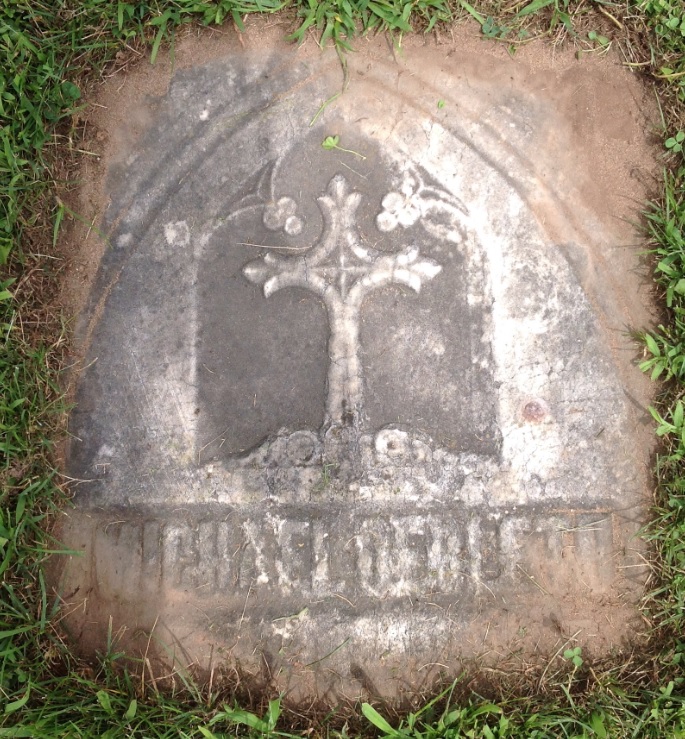
This Count d’Erlette ridiculed word for word, but every pronouncement came to pass, and even to this day the grave of Michel, the grandson, may be seen in a small town in southern Wisconsin.
For readers familiar with Mythos fiction, the name “d’Erlette” might ring a bell.
Only a wizard would possess those mouldering, maggoty volumes of monstrous and fantastic lore; only a thaumaturgical adept would date the darker mysteries of the Necronomicon, Ludvig Prinn’s Mysteries of the Worm, the Black Rites of Luveh-Keraph, priest of Bast, or Comte d’Erlette’s ghastly Cultes des Goules.
Lovecraft would shed some light on this little mystery in a letter:
Comte d’Erlette’s Cultes des Goules? An invention of Bloch’s. The name Comte d’Erlette, however, represents an actual (& harmless) ancestor of August W. Derleth’s, who was a royalist emigré from France in 1792 & became naturalized in Germany under the slightly Teutonised name of Derleth. His son, emigrating to Wisconsin in 1835, was the founder of the Derleth line in America.
The letter in which August Derleth revealed this heritage to Lovecraft does not appear to survive, but in their correspondence, Lovecraft begins to refer to him as “Auguste-Guillaume, Comte d’Erlette” (ES 2.455) in February 1932, so the subject probably came up in early 1932 or late 1931. Lovecraft would refer to Derleth as the “Comte d’Erlette” in his letters occasionally from then on, and the Cultes des Goules was added to the shelf of eldritch tomes that appear in his stories, and that of their contemporaries and literary heirs, though Bloch’s choice of attributing the volume to d’Erlette sometimes led to some confusion as to who actually invented it.
Derleth himself never chose to expand on his fictional ancestor in any of his Mythos fiction, though in his Solar Pons story “The Adventure of the Six Silver Spiders” (1950), the premise of the story is a Mythos red herring involving the sale of the private library of Paul Guillaume, the Comte d’Erlette, which reads in part:
I glanced at several of the other titles listed—d’Erlette, Paul Henri, Comte de: Cultes des Goules, Rouen, 1737; Prinn, Ludvig: De Vermis Mysteriis, Prague, 1807; Liber Ivonis (Author Unknown), Rome, 1662;—all manifestly occult literature.
August Derleth, “The Adventure of the Six Silver Spiders,” The Solar Pons Omnibus 2.848
Solar Pons is quick to point out to his companion Parker that the whole catalogue is a hoax.
“But the Count d’Erlette?”
“Erlette is a provincial name in France. The family existed in some numbers before the Revolution, but the last member to carry a title died in 1919.[“]
August Derleth, “The Adventure of the Six Silver Spiders,” The Solar Pons Omnibus 2.849
Derleth was not the only one to have a bit of fun with his fictitious ancestor, as many subsequent writers did write about the author of Cultes des Goules and his family.
It is not too much to say that “Tally Mason’s” article on Cagliostro is part of the secret history of the Mythos—not a direct part of the web of interconnecting stories that Lovecraft & Co. wrote, but a precursor and bit of background. One has to wonder if Derleth ever showed the piece to Lovecraft.
I’ve always loved horror, particularly eldritch horror. Despite the deeply racist and misogynistic roots of these works, primarily the violent xenophobia of its creators, there’s an existential understanding of what it feels like to be powerless. While these men grappled with the horror of an uncaring universe, marginalized individuals grapple with the horror of a system specifically designed not to care about us. We are born into something larger, something malevolent, something we have no power to stop. Similarly, in The King in Yellow itself, there is no reason why our unfortunate narrators are chosen.
On 15 December 1973, the American Psychological Association removed homosexuality from its list of mental illnesses. This reversed a course of accepted practice that had run through the 19th and 20th centuries, including during the lives of H. P. Lovecraft, Robert E. Howard, Robert W. Chambers, and other formative voices in what has come to be known as eldritch or cosmic horror. Popular understanding of mental illness and sexuality would take a few decades to catch up; some roleplaying games in the 1980s still listed homosexuality among the mental illnesses a character could have.
To say that Lovecraft et al. were products of their time is not an excuse for their bigotries and prejudices, yet it must be at least an explanation for some of the attributes of their lives and fiction. Lovecraft lived and died in an era when combat-related trauma was categorized as shell shock; the term Post Traumatic Stress Disorder wasn’t coined until 1980. It would be inaccurate to fault Lovecraft and company for working within the limits of knowledge of their own time—and even then, Mythos fiction often treats mental health with more of a Gothic, Victorian, or pulp sensibility. Lovecraft speaks of alienists more often than psychologists, and those who experience breaks from reality or accepted behavior (such as Nathan Peaslee in The Shadow Out of Time, or Delapore in “The Rats in the Walls”), or simple physical or mental abnormality (the errant cousin in “The Shadow over Innsmouth”) are more likely to be institutionalized than diagnosed and treated.
Sanity often seems a fragile, precarious state to many of these characters.
Despite the prevalence of talk of mental health in the works of Lovecraft and co., relatively few of the stories experience sharp breaks with reality—the infamous snap of the last thread that sends them from rationality into incoherence. The sight of Cthulhu in “The Call of Cthulhu” is a terrible shock, but very few characters in the works of Lovecraft or his contemporaries go mad just from the sight of an eldritch entity. More than a few characters who read from the Necronomicon do not lose touch with reality from the revelations therein. Even in Robert W. Chambers’ The King in Yellow, the eponymous play acts more as a catalyst for mental illness than a source of it.
Which is a long way to get to the point: as our cultural and scientific understanding of mental health changes, so too must the literature of horror shift to reflex that new syntax. What Lovecraft and Chambers wrote made sense within their context, but today we look on mental health very differently. This doesn’t invalidate the older stories, but it does open up vast new realms of possibility for new ones. With new understanding comes new ways to think about the Mythos.
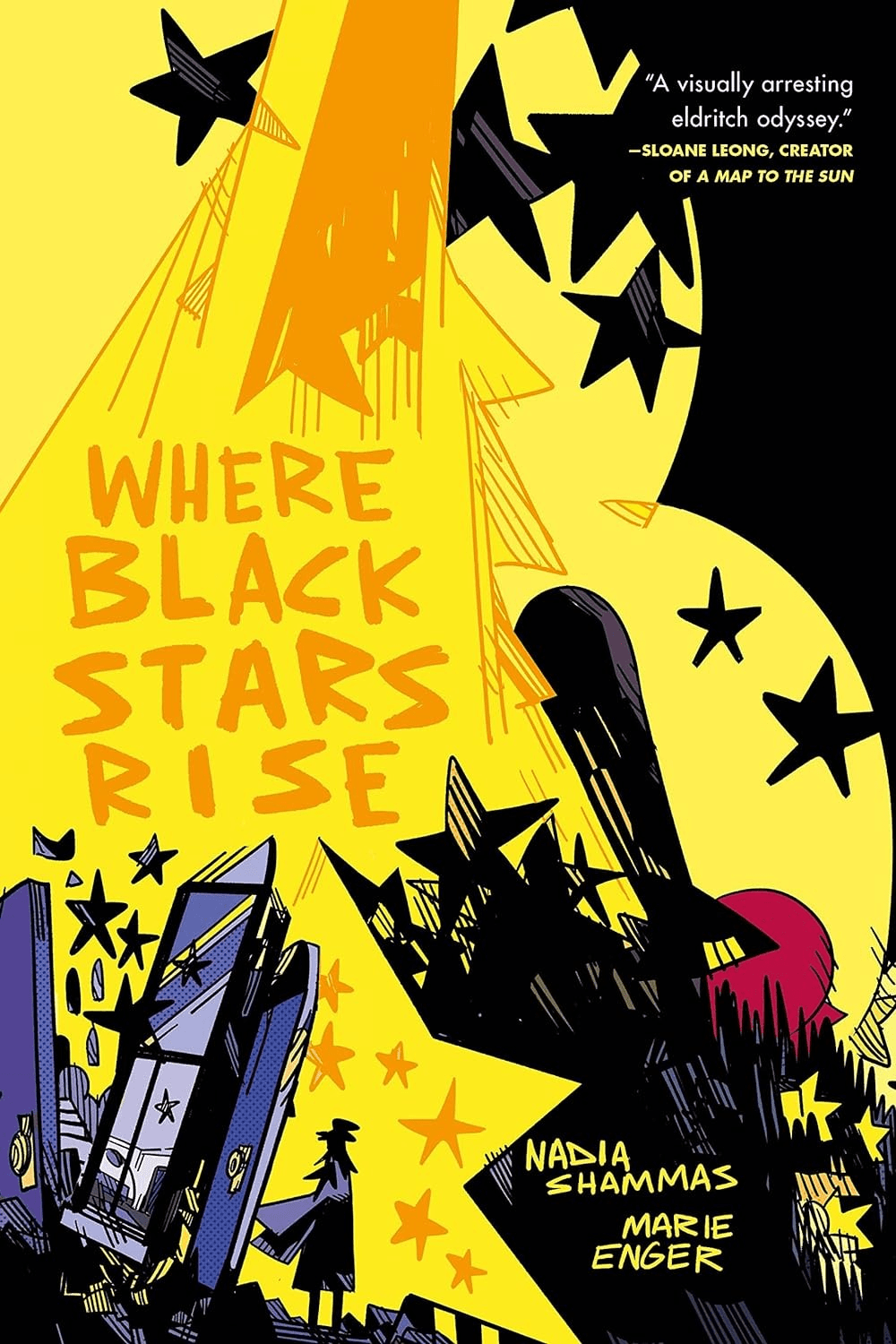
Where Black Stars Rise (2022) by Nadia Shammas (script) and Marie Enger (art) is a graphic novel focused on mental health and the King in Yellow, the eponymous play that acts as a metatextual touchstone for the first half of Robert W. Chambers’ 1895 collection of the same name. In the course of dealing with her own life issues and mental health, therapist Amal Robardin loses a patient—and goes to find her. The journey takes her over the metatextual threshold to Carcosa itself, led by a changeling psychopomp that alternately takes on aspects of Ambrose Bierce, Robert W. Chambers, and H. P. Lovecraft (August Derleth and D. J. Tyrer, perhaps fortunately, didn’t make the cut).
If there’s a point of criticism, it might be in casting those three as the closest thing the story has to a villain—Lovecraft barely used The King in Yellow or its mythos in his work, and Bierce’s original creation bears little resemblance to what Chambers made of it—but having a straw man psychopomp is barely a speed bump in the enjoyment of a dream quest re-cast in terms of therapy.
…you’re wrong
I’m deserving of love. I’m capable of love without fear, and of doing better.
I am capable of more than this. I’m not a monster, and I’m no lost cause.
One of the benefits of eldritch horror is that, very often, there is an external force involved in whatever the characters are dealing with. Dealing with mental health is often a long and involved process, and individuals are rarely “cured” in the sense that a broken bone heals or an infection runs its course. Nor can people overcome trauma or brain chemistry issues simply by lying on the couch and talking about their dreams. You might not be able to punch Cthulhu in his stupid face, but at least you know Cthulhu exists and isn’t just a figment of your imagination. Flip Cthulhu off if it makes you feel better.
There is a moment, after the visual climax, when it looks like Where Black Stars Rise is going to go the full John Milton (“The mind is its own place, and in it self Can make a Heav’n of Hell, a Hell of Heav’n.”) It is to the credit of the creators that the story steps away from this, to something sadder, perhaps more horrific, yet ultimately more real, more in line with “The Book of Fhtagn” (2021) by Jamie Lackey. Happily ever afters are for fairy tales; in the real world, not everyone can be saved, or wants to be. Sometimes you have to respect that.
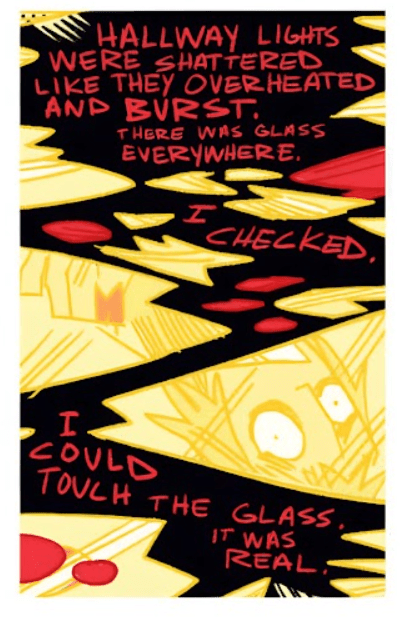
For this graphic novel, Marie Enger presents a somewhat grungy, Mike Mignola-esque style. Stark shadows and bright yellows, stipple give more of the texture than hatching; there’s a lovely clutter to some scenes, and others where the curtain is dropped for effect; and the lettering and framing both fit the mood. Like the eponymous play, the graphic narrative is split into two acts, the first relatively normal and almost banal, while the second act is where things go fantastic and metaphysical.
Shammas and Enger’s work makes for an interesting contrast with I. N. J. Culbard’s graphic adaptation of The King in Yellow. Culbard is at pains to be accurate to Chambers’ original story, but as with his Lovecraft graphic adaptations, his restrained style and dedication to the original often misses the opportunity to do something extraordinary, to go beyond the text. That’s not meant as a knock on Culbard, who is meticulous with regard to authenticity, but it illustrates some of the possibilities of reworking old ideas in a new context, of offering up details the original authors had not given, of going beyond traditional interpretations and lore.
The graphic realization of Shammas’ story is a true collaboration, Enger’s art complements and expands on the text, and vice versa. Without the words, Where Black Stars Rise would still work, like Masreel or Lynd Ward’s novels in woodcuts; without art, Shammas’ script would still be a good story. Together, the result is a gem of a graphic novel, reminiscent of Black Stars Above (2019) by Lonnie Nadler & Jenna Cha but representing a distinct and novel approach to the material.
A look at the King in Yellow and its themes from a very different perspective. Not that of a white, heterosexual Anglo-American who grapple with an uncaring universe with outmoded ideas of sanity and madness; but from marginalized folks for whom an uncaring universe is something they deal with on a daily basis.
Where Black Stars Rise by Nadia Shammas and Marie Enger was published in 2022 by Tom Doherty Associates, and won the Ignyte Award for best comics team.
The following article deals explicitly with antisemitism in a historical context. Frank discussion of these matters requires the reproduction of at least some samples of antisemitic speech from historical sources (e.g. Lovecraft’s letters). As such, please be advised before reading further.
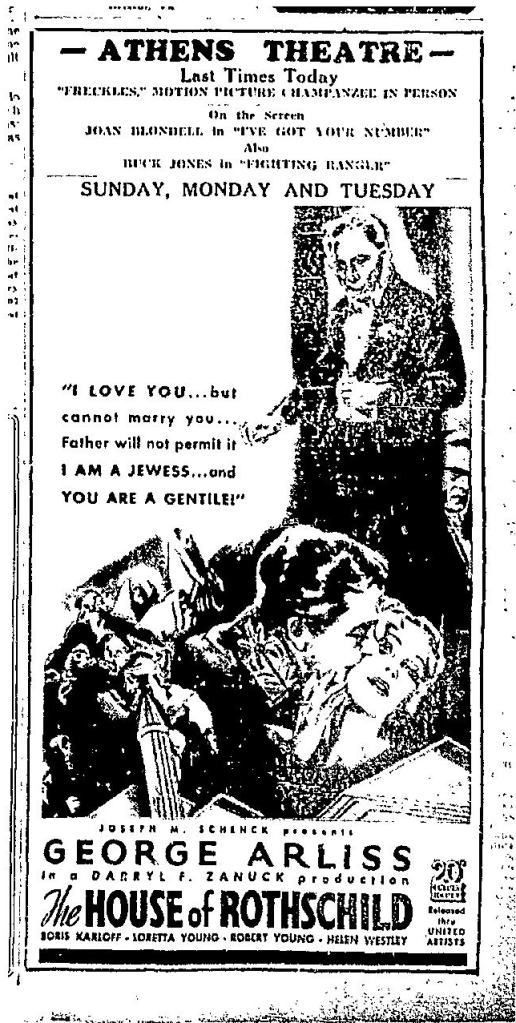
In early May of 1934, H. P. Lovecraft was in DeLand, Florida, soaking up the sunshine. His young friend and correspondent R. H. Barlow had invited Lovecraft to stay with his family for a few weeks—and after Lovecraft had overcome his shock at finding out that Barlow was only a teenager, he had enjoyed the generous hospitality of the host family. One day, Lovecraft and Barlow were driven into town and took in a new film playing at the Athens Theatre: The House of Rothschild.
Advertisement in the DeLand News, 5 May 1934
Adolf Hitler had come to power in Germany in 1933 and immediately moved to put his antisemitic rhetoric into effect. Hollywood’s response was slow; antisemitism was rife in the United States as well, and any film dealing with Jewish subjects risked censure from the Anti-Defamation League on one hand, and feeding fuel to bigots on the other. It was in this atmosphere that The House of Rothschild began production. For more details on the background of the film, check out The American Jewish Story Through Cinema.
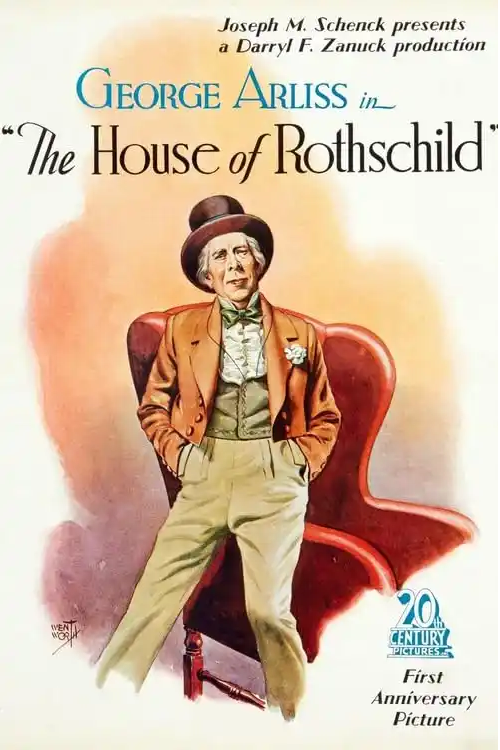
Screenwriter Nunnally Johnson adopted George Hembert Westley’s play of the same name, interjecting the Prussian Count Ledrantz (played by Boris Karloff) into the picture to give a face to the antisemitic bigotry that the Rothschilds would contend with. George Arliss, in the lead roles of Mayer Rothschild and Nathan Rothschild, had already played prominent Jewish characters such as Benjamin Disraeli in the play Disraeli and the 1921 silent film of the same name. The result was that the 1934 film, while definitely cinema, had a strong theatricality to the staging, shooting, and performances. In 1935, looking back at the films he had seen over the last year, Lovecraft noted:
I saw the Rothschild film—which was smooth, but obviously theatrical.
Lovecraft had a noted fondness for historical dramas, and while he did not address the issue in his letters, likely appreciated the attention to detail in historical costumes and settings. Likewise, Lovecraft did not comment on one of the technical achievements of the film: while most of it is shot in black-and-white, the final scenes were shot in Technicolor, rendering a vibrant finish to culminate with the Rothschild’s triumph over adversity.
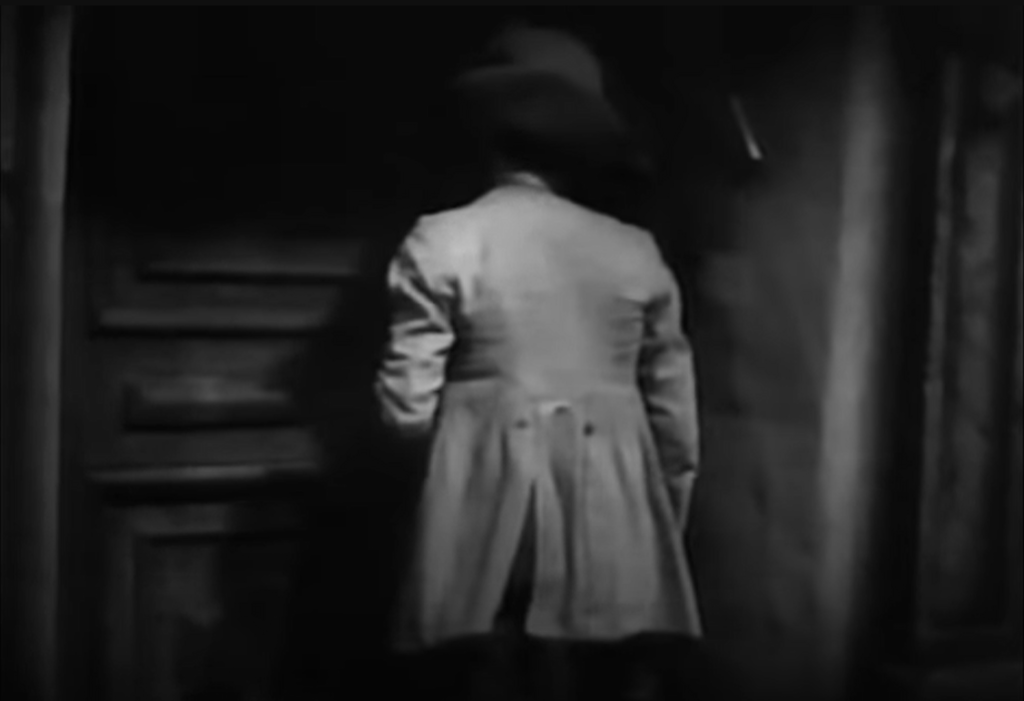
One detail that Lovecraft did notice was an odd emblem mounted on the wall outside the door of the Rothschild house, which each member would touch as they come in or leave throughout the film. Neither he nor Barlow knew what this was, but back in Providence Lovecraft’s aunt took it upon herself to find out, and so Lovecraft wrote back to his young friend:
Also—to be returned—an echo from the recent past in the form of an explanation of that queer door-post thing that the Jews kissed in the Rothschild cinema. My aunt saw the film & was as curious as we were—& at her request a friend connected with the public library looked it up (& had a helluva time finding it!) & made a transcript of the information for her. So here you have it all at your finger-tips…mezuzah….sounds like a name out of Klakaksh-Ton!
The mezuzah is a parchment with verses from the Torah, affixed to the doorposts of homes in Rabbinical Judaism. One can imagine a rather confused Providence librarian, working only from a description of something half-glimpsed on screen, consulting the 12-volume Jewish Encyclopedia or equivalent source and copying out the relevant article.
The House of Rothschild (1934); the mezuzah is first seen a little over five minutes into the film.
The film was a commercial and critical success. While it did not shake the stereotype of “the Greedy Jew,” it was generally received as a positive portrayal with an emphasis on the discrimination that the Rothschilds and other Jews in the film had suffered. It emphasized that even relatively wealthy and successful Jews were, at best, pariah capitalists whose wealth could be taken away because of prejudicial laws, and emphasized the threat of violence that all Jews lived under. A timely message considering Nazi Germany’s enactment of antisemitic laws, pushing Jews out of various occupations, stripping them of rights and citizenship, and finally coming for their lives and property, had just begun.
The ambiguity of The House of Rothschild—the way it both plays to the stereotypes of Jewish greed and financial influence and to the real discrimination that Jews faced in Europe—and its critical and commercial success left it open to exploitation. Director Fritz Hippler and Nazi propaganda minister Josef Goebbels pirated two scenes from The House of Rothschild in the antisemitic Nazi propaganda film Der ewige Jude (“The Eternal Jew,” 1940), co-opting the same imagery presented in The House of Rothschild to deliver the entirely opposite message. The Nazis also made their own, openly antisemitic version of the story as Die Rothschilds (“The Rothschilds,” 1940).
By the time The Eternal Jew came out, Lovecraft was long dead, so it cannot be said whether he would have recognized the scenes that the Nazis stole from The House of Rothschild. It can be said with some certainty that Lovecraft would have recognized the stereotypes of Jewish prejudice that the Nazis presented. This can be said because Lovecraft’s letters give a fairly detailed account of his own antisemitic prejudices and how they changed over time; he even recorded encounters with Jewish media such as The Dybbuk (1925) by S. Ansky and Jewish characters and themes in fiction such as The Golem (1928) by Gustav Meyrink.
What Lovecraft’s letters do not show, perhaps surprisingly, is any specific prejudice against the Rothschild family, or any general belief in Jewish conspiracy theories. The fabricated text of The Protocols of the Elders of Zion(1903) and related conspiratorial works find no mention in Lovecraft’s letters, even during those letters where Lovecraft wanders into the idea of Jewish control of newspapers in New York City, e.g.:
I didn’t say that Jews own all the papers, but merely that they control their policies through economic channels. The one great lever, of course, is advertising. Virtually all the great department stores of New York (except Wanamaker’s) are solidly Jewish even when they deceptively retain the names of earlier Aryan owners; & a clear majority of the large shops of other sorts are, as well. These Semitic merchants are clannish & touchy to the very limit, & will arrange to withdraw all their advertising at once whenever a newspaper displeases them. And, as Mencken has pointed out, their grounds of displeasure are limitless. They even resent the frequent use of the word “Jew” in the news, so that papers speak of “East Side agitators”, “Bronx merchants”, “Russian immigrants” &c. Let any N. Y. paper try to refer to these people in the frank, impartial, objective way a Providence or Pittsburgh or Richmond paper would, & the whole pack of synagogue-hounds is after it—calling down the vengeance of heaven, withdrawing advertising, & cancelling subscriptions—the latter a big item in a town where 1/3 of the population is Semitic in origin & feelings. The result is, that not a paper in New York dares to call its soul its own in dealing with the Jews & with social & political questions affecting them. The whole press is absolutely enslaved in that direction, so that on the whole length & breadth of the city it is impossible to secure any public American utterance—any frank expression of the typical mind & opinions of the actual American people—on a fairly wide & potentially important range of topics. [(in margin:) P.S. Better not quote any of this to Bloch (who I discover is of Jewish extraction). While of course this question does not involve any aspersion on the Jewish heritage as a whole, it nevertheless makes embarrassing reading for anybody having more than an academic connexion with Semitism. One would handle it differently with a Jewish correspondent.] Only by reading the outside press & the national magazines can New Yorkers get any idea of how Americans feel regarding such things as Nazism, the Palestine question (in which, by every decent standard, the Arabs are dead right & both England & the Jews intolerably wrong), the American immigration policy, & so on. This is what I mean by Jewish control, & I’m damned if it doesn’t make me see red—in a city which was once a part of the real American fabric, & which still exerts a disproportionately large influence on that fabric through its psychologically impressive size & its dominance both in finance & in various opinion-forming channels (drama, publishing, criticism &c.). Gawd knows I have no wish to injure any race under the sun, but I do think that something ought to be done to free American expression from the control of any element which seeks to curtail it, distort it, or remodel it in any direction other than its natural course. As a matter of fact, I don’t blame the Jews at all. Hell, what can we expect after letting them in & telling them they can do as they please? It is perfectly natural for them to make everything as favourable for themselves as they can, & to feel as they do.
This is about as close as Lovecraft gets to outright Jewish conspiracy theories in his letters. Lovecraft’s particular prejudice in this instance is colored by his antipathy toward New York City in general, which he had left seven years prior, to return to his native Providence.
The sticky question: is this absence of evidence or evidence of absence? It is entirely possible that in some lost letter that has not come down to us, Lovecraft went all-in on some antisemitic tirade that recapitulated Nazi propaganda wholesale. When Robert E. Howard made a few dog whistles about “international capital” causing wars for profit (MF 2.819), we don’t know what Lovecraft’s response was because his next letter is non-extant. On the other hand, there are hundreds of letters where, even when airing his worst antisemitic prejudices, Lovecraft never brings up the issue. Hugo Gernsback, for instance, is never depicted as part of a conspiracy. So it is not entirely clear if Lovecraft had heard of these conspiracy theories and did not credit them, or if he did credit them but we simply don’t have those letters anymore.
Since we know that Lovecraft saw The House of Rothschild (1934), we can definitely say that Lovecraft was at least introduced to the idea of the influence of Jewish bankers and financiers, and their influence on European conflicts. We also know that in the limited context of New York newspapers, Lovecraft felt Jewish economic influence amounted to suppression of speech on certain topics. Yet for all that, Lovecraft’s prejudices do not seem to have extended so far as to believe wholesale in conspiracy theories about Jews. Even considering how much Nazi propaganda Lovecraft did swallow, several points of Nazi antisemitism went too far even for Lovecraft:
It is amusing to think of the thoroughly Aryan people who would be placed outside as aliens if the strict Nazi test were made worldwide. Palgrave, compiler of the Gold Treasury (whose sire was born Cohen), the present Lord Rosebery (whose mother was a Rothschild), the aristocratic Belmont family of America (whose forebear change his name from Schönberg), the Hamiltons of Philadelphia (Andrew Hamilton, the lawyer famous in the Zenger freedom-of-the-press case of 1735 & the designer of Independence Hall, married a Jewess named Franks) & so on! Indeed—since the Nazi ban is not merely on Jews but on all non-Aryans, it would come down heavily upon all who bear a trace of Indian blood—such as the descendants of Pocahontas, famous throughout Virginia & including men as eminent as John Randolph of Roanoke! Plainly, then, the present attitude of the Nazis on this point is an extreme & unscientific one….. although, as I have said, I certainly believe that actual members of the Jewish culture-group ought to be kept from securing a grip on the legal, educational, artistic, & intellectual life of any Aryan nation. They had gone too far in Germany, & they have gone too far in America—where so much literary & critical material is either of Semitic origin or (through Jew-owned publishing houses) Semitic selection. It is certainly time that the Aryan people everywhere made sure that they are not being led by fundamentally antipathetic aliens, & that they are not permitting such aliens to serve as their mouthpieces of opinion.
Prejudice has to be seen as a spectrum of ignorance and discrimination; while it is common to label historical figures as antisemitic or not, the truth tends to be more nuanced. Antisemitic stereotypes were common in the United States in the 1930s, but it does not follow that every antisemite believed exactly the same things, or even agreed with one another on the exact details of their prejudices.
How much of the message of The House of Rothschild did Lovecraft actually take in? Films are both a product of their time and actors in it; they present ideas that already exist and they also shape them. It does not seem likely that Lovecraft’s beliefs in Jewish conspiracies were strengthened by watching George Aldiss on screen say: “Money is the only weapon that the Jew has to defend himself with.” Yet we have to wonder if he was at all moved by the sentiment: “To trade with dignity, to live with dignity, to walk the world with dignity.”
Again, we have no evidence either way. Certainly, Lovecraft was not often driven by sentiment in his arguments. It cannot be said with any certainty that Lovecraft’s slow turn against the Nazis in his letters was driven, at least in small part, by popular media that depicted the historical persecutions of Jews. Yet we cannot say that didn’t play its part either. On the balance, we are left only with Lovecraft’s two neutral comments on the film, and an awareness of the social and historical context in which he watched it. Lovecraft and Barlow sat in that darkened theater and saw on screen the naked prejudice which was being enacted half a world away in Nazi Germany…and came out, no doubt, blinking in the Florida sunlight, with some questions about what they saw.
Beyond that, we can only reflect on what The House of Rothschild means for us today, as a piece of cinematic history. It is worth watching.
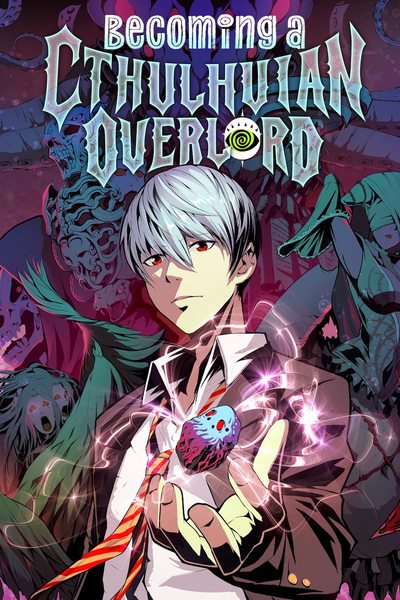
Becoming a Cthulhuian Overlord (成为克苏鲁神主) began as a novel by Yi Jian San Lian (一键三连) published on China Literature, which was then adapted in 2020 into a manhua by An Zhu (渚谙, writing) and Na Ti Maeo (拿铁猫, illustration), produced by Kaite Dongman(凯特动漫, Cat Comics), which has been translated into English by Sangria and is now being serialized online at Tapas.
This serial work falls into the genre of isekai: a very broad and currently popular genre in many media that involves an individual who becomes displaced from the real world to another world. The nature of the displacement and the other world are major flavors for the genre; the protagonist might die, for example, and be reincarnated into a fantasy world that follows rules like a tabletop roleplaying game such as Dungeons & Dragons or an equivalent video game like World of Warcraft. Or they might fall through a portal and be lost in the distant past, transported to an alien world, etc.
If this sounds a bit overbroad, it’s because isekai is a term for a mode of fantasy fiction that existed long before the term itself existed. In A Connecticut Yankee in King Arthur’s Court (1889), a blow to the head sends the Boss back to the Dark Ages Europe; in A Princess of Mars(1912) former Confederate soldier John Carter is transported bodily to a fantastic version of Mars. Lovecraft, Robert E. Howard, and others were familiar with the basic idea; one might consider The Dream-Quest of Unknown Kadatha kind of isekai, and in “The Challenge from Beyond” George Campbell is transposed into the body of an alien worm—and decides to conquer the alien planet, which is a very appropriate approach for a typical isekai protagonist. These portal fantasies bridge a gap between low fantasy (fantasy fiction set in the mundane world or realistic setting) and high fantasy (fantasy fiction set in a world separate from the real world).
Which is all meat for argument for those who like to argue labels. In Becoming a Cthulhuian Overlord, the premise is that the unnamed protagonist dies in a car accident with his pregnant wife, and has a mysterious supernatural encounter with a certain messenger…
…and reincarnates as Qi Su, an orphaned high school student in Lua City, which superficially looks much like the mundane world. Except now he can see a variety of shadowy and horrific phantoms that he has to pretend not to see, or else they’ll eat him.
If that doesn’t sound very Lovecraftian—it is not, at least at first. Serialized graphic fiction are often paced relatively slowly at first, and this has all the hallmarks of a slow-burn comic. There isn’t a lot of exposition to begin with, and a great deal of the storytelling takes place through the art, which takes advantage of the format to do long-scrolling dynamic shots in odd perspectives. Some of the art is quite effective, even if it obviously draws inspiration from works like Parasyte.
The odd tentacled entity aside, the first few chapters of Becoming a Cthulhuian Overlord are very by-the-numbers stuff, drawing strongly on the basic ideas of Yu Yu Hakusho and similar works, riffing off of Buddhism and traditional exorcism practices, with a few twists and turns. Our protagonist is back in high school, dealing with supernatural threats, teenage romances, etc. However, Qi Su doesn’t know the rules of this new world, and that ignorance helps to build a bit of tension as he learns the ropes.
Readers expecting something more overtly Lovecraftian from the title should pause and reconsider their assumptions. Just as many American and European writers attempt to assimilate the Cthulhu Mythos into a fundamentally Christian worldview, associating Cthulhu and co. with Satanism, non-Western cultures tend to fold the Mythos into their own mythopoetic framework. So for Ultraman Tiga, Ghatanathoa is interpreted as a kaiju of great power; for Soul Eater, the Great Old Ones are extremely powerful beings of madness with great spiritual powers. Becoming a Cthulhuian Overlord, working as it does within a very broadly Buddhist and Chinese folk religion framework, is centered around ghosts and exorcism, with the ghosts tending to have a particular Lovecraftian flavor…but it also develops its own unique metaphysics on top of that, tossing in pop culture borrowings to create a kind of a la carte occultism.
For example, in chapter 13 Qi Su gets Gordon Freeman‘s crowbar.
Which is a long way to say: don’t get too hung up on how Lovecraft wrote things. Different creators incorporate or reference his material differently, and sometimes in minimal or unexpected ways.
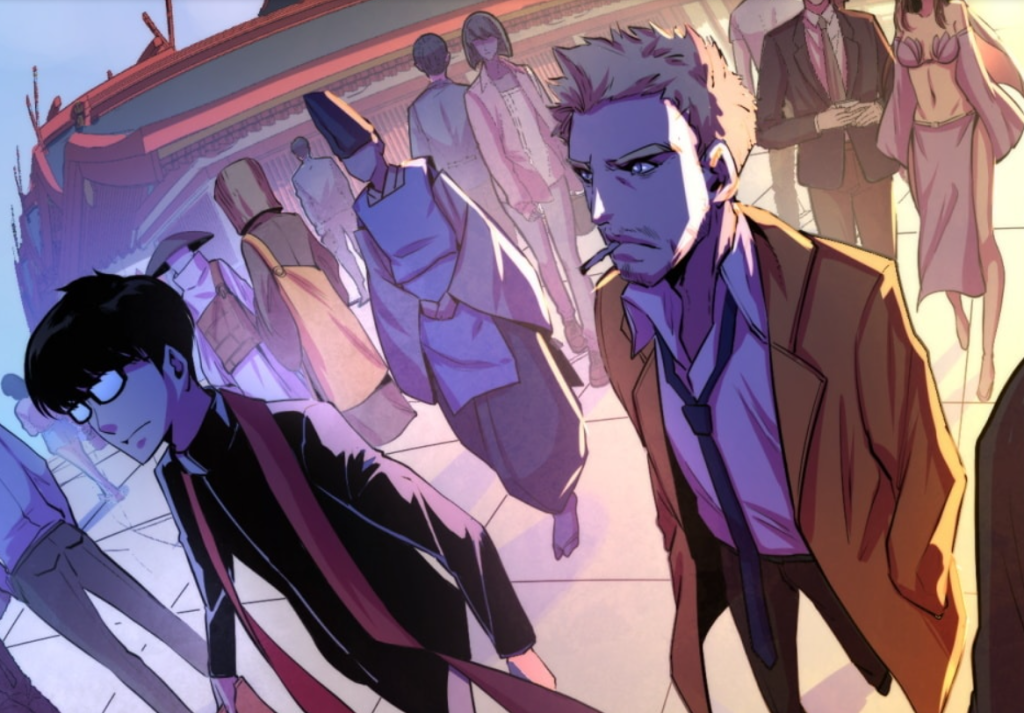
John Constantine makes an unofficial cameo in Episode 12!
As of the time of this writing, the whole manhua (over 200 episodes) has not yet been translated and released in English, so it continues to be a very slow burn, building up its world, introducing new characters, etc. Hopefully, the translation will actually be completed; some translations of serial works tend to stop before the end if the interest isn’t there for it, leaving the work incomplete, as happened with Apocalypse Zero.
For readers interested, the first chapters are free to read on Tapas, with updates every Monday.
The novel The Cthulhu Helix (2023) by Umehara Katsufumi (梅原克文) was originally published in Japanese in 1993 as 二重螺旋の悪魔 (“Double Helix Devil”); it has been translated into English by Jim Hubbert and published by Kurodahan Press, whose other publications include the Lairs of the Hidden Gods series of Japanese Cthulhu Mythos short fiction translated into English and West of Innsmouth: A Cthulhu Western (2021) by Kikuchi Hideyuki (菊地 秀行).
When H. P. Lovecraft wrote weird fiction in the 1920s and 1930s, the walls between science fiction and fantasy were practically non-existent. While a few arch-fans like Forrest J. Ackermann argued the point, in practice the supernatural and super-science were, from a narrative perspective, utterly interchangeable and compatible. C. L. Moore’s Northwest Smith fought alien gods on Mars; Robert E. Howard’s Conan wandered through ancient cities lit by radium-lamps; and H. P. Lovecraft’s Fungi from Yuggoth raised their buzzing voices in worship to Shub-Niggurath and the Black Goat of the Woods. There is no hard delineation between Lovecraft’s fantasy and science fiction stories.
If viewed through the lens of pulp fiction of his day, the science fiction elements in Lovecraft’s stories are exactly in tune with the kinds of pulp sci fi that showed up in Weird Tales. “From Beyond” is ultimately a gadget story and a gland story, brain-stealing crustacean aliens featured in Edmond Hamilton’s “The Shot from Saturn” (WT October 1931) not long after Lovecraft’s own “The Whisperer in Darkness” (WT August 1931) introduced the Mi-Go and their brain canisters. What differed with Lovecraft was his approach—Hamilton leaned into the adventurous interpretation of an alien invasion from another planet, but Lovecraft’s extraterrestrials were profoundly weirder, less explicable, not exactly less hostile but less prone to the even-then hackneyed tropes which H. G. Wells had covered so well with The War of the Worlds (1898).
Post-Lovecraft, science fiction and fantasy continued to grow and diversify, sometimes locking themselves into genre cages and sometimes breaking out. The early ideas of science fiction as gadget stories and space opera—The Gernsback Continuum as William Gibson put it—gave way over time to different ideas. Science-fantasies like the Star Wars and Star Trek novels and the Man-Kzin Wars anthologies played with psychic powers in far futures and galaxies far away where space travel was the norm and multiple intelligent species and cultures interacted in an intergalactic community; others focused on sociological changes, dystopic futures, future wars. The science may have been hard or soft, but the emphasis generally shifted from bright shiny new tech and worn old plots to more human stories on the effects of technology on people, the social impact and implications of new ways to communicate and interact, the question of what it was to be human.
Which, in the late 80s, gelled into Cyberpunk—the ultimate forebear of all the dizzying array of “-punk” suffixes which would be affixed to many speculative fictions to come. Broadly, cyberpunk was high tech and low life, continuing many of the same fundamental speculative technologies and advancements that came out of previous science fiction, but seen through the lens of contemporary societal issues—megacorporations, pollution, the alienation that came with technology and greater bureaucratic control of life, global computer networks, personal augmentation with cyberware raising the question of what it meant to be human, etc.
H. P. Lovecraft had written about what might, in hindsight, be called a megacorp in “In the Walls of Eryx” with Kenneth Sterling, but there was no down-and-out protagonist, no career criminals, no street to find its own uses for things. The Mi-Go perfected putting a brain in a canister, but there was no global Matrix to plug those brains into, to play out the games of the Matrix films. The ingredients for cyberpunk fiction using elements of the Mythos were there from the start—but it took a while for Cthulhupunk to manifest itself.
The Cthulhu Helix is one of the first Cthulhu Mythos biopunk novels (The Queen of K’n-yan (2008) by Asamatsu Ken (朝松健) was published around the same time in Japan, but made it into English translation first). It is very much a 90s product: fast-paced, set in a near future where corporate greed overcomes moral considerations, with a strong militaristic sci-fi undercurrent, and media-savvy some otaku-grade Easter eggs in reference to popular culture:
Things got weird. The monkey started ripping the cage apart. There was s ound of metal tearing. The Star of the show uttered a strange cry. His hairy body was channeling the spirit of Hercules.
“What the hell did you do to him?”
“That lead in the back of his skull is an on/off switch. The main players are micro-robots implanted in his hypothalamus. NCS-131 microbots.” She pointed to the macaque. “His name is Son Goku.”
Umehara Katsufumi (梅原克文), trans. Jim Hubbard, The Cthulhu Helix (2023) 125
The media-savviness is at the heart of the novel. While the aesthetic is something like Resident Evil (1996) or anime like Lily C.A.T. (1987), the Lovecraftian flavor is consciously a metaphor for the horror that’s been uncovered lurking in human DNA. There are no Necronomicons for these territories, just an awareness of the tropes as they are being applied:
Until now we’d been using C—for Cthulhu—as a basket term for all of these monsters. But we’d been getting flak about the single letter, so they’d decided to switch to what everyone else was using: Great Old Ones. GO1 for short. Bureau C was still Bureau C. C for clean, as we told people who didn’t have clearance.
There was another new term for the Cthulhu mythos, for a new entity: the Elder God. Lovecraft’s Elder Gods have been the lords of the Great Old Ones. They had imprisoned the Great Old Ones in this and other dimensions after they rebelled against their masters.
Lovecraft’s characters were not what we were facing. The Cthulhu Mythos was fiction, and any resemblance between it and the creatures we were battling was coincidence. No one knew anything about DNA or the intron regions in Lovecraft’s day. Still, he would’ve been astonished if he had known how close to reality his stories had come.
Umehara Katsufumi (梅原克文), trans. Jim Hubbard, The Cthulhu Helix (2023) 112-113
Using Lovecraft’s terminology and ideas without making his stories canon opened up a world of possibilities to reimagine and rework Lovecraft’s ideas into a contemporary syntax. In his day, Lovecraft had government agents raid Innsmouth, but 70+ years later the government response needed to shift to meet the needs and expectations of a new generation. Bureau C parallels the development of Delta Green for the Call of Cthulhu Roleplaying Game, the Laundry from Charles Stross’ The Laundry Files, and the Agency in Agents of Dreamland (2017) by Caitlín R. Kiernan and the rest of her Tinfoil Dossier series.
Which is why The Cthulhu Helix works as a Lovecraftian novel. The characters are all conscious of Lovecraft’s legacy, but for them it’s all shorthand and metaphor, a way to frame and discuss these complex ideas and relationships without getting bogged down in Elder Signs and other minutiae. The particular approach Umehara took is fairly Derlethian, but that’s not surprising considering when and where it was published.
A word on the translation: Jim Hubbert has done great service here in rendering very smoothly-flowing prose. It’s not always easy to keep a narrative comprehensible and moving in translation, but this reads very well, especially considering the occasional breaks in format and the potential for alphabet soup. Kudos on a job well done.
I meant to write Howard, but got interrupted, as happens. When I came back ‘How’ looked just fine on the page. it summed us up. Like: How did we ever get married? Blame the words, what we said and wrote to each other, the only thing we had in common. How did we ever think we would work it out? Those words again, mixed with pure blind optimism. How did we part? Without pain, as it should be.
I meant to write you before my news, but time just runs away sometimes. You did file the divorce papers? [crossed through]. I am now Mrs Doctor Nathaniel Davis.
She was born Sonia Haft Shafirkin to a Jewish couple in 1883 in the Russian Empire, modern-day Ukraine. At the age of 7, she immigrated to the United States of America. At age 16, she married another immigrant, Samuel Seckendorff, who changed his last name to Greene. By 1920 she was divorced, her first husband dead; she had given birth to a daughter and a son, the latter who died in infancy. Skill and hard work brought her success in her business, and amateur journalism had become a hobby and a way to improve her mind. In 1921, Sonia H. Greene met H. P. Lovecraft at an amateur journalist convention in Boston. Contact sparked correspondence, further meetings, collaboration on stories and amateur journals, and then, in 1924, she married again.
The Lovecrafts’ marriage did not last long, and only Sonia gives a full account of their relationship. They separated, and finally filed for divorce…though Howard did not sign the papers in the end, either out of ignorance or some other unguessed reason, so that when Sonia married for a third time, to Dr. Nathaniel Davis in 1936, she thought she was free to do so.
Sonia’s marriage to H. P. Lovecraft has become part of his myth. It was during a brief but incredibly formative and important part of his life, and he spoke so little of her afterward that knowledge of his marriage was scanty among many of his correspondents. Details about their married life, and the mysterious Mrs. Lovecraft, did not begin to emerge into the public consciousness until many years after his death, when journalist Winfield Townley Scott finally made contact with her after publishing a lengthy biographical piece on Lovecraft.
The life story of Sonia H. Davis neither began nor ended with H. P. Lovecraft; and her full life story is given in her own words in her forthcoming autobiography Two Hearts That Beat As One, edited by Monica Wasserman. Yet the relative lack of information on her, the focus on her marriage with Lovecraft, and the way biographers like L. Sprague de Camp have presented Sonia in their works on Lovecraft have strongly skewed the image of who Sonia was as a person.
Arcade #3 (Fall 1975) – George Kuchar
In Arcade #3 (Fall 1975) for example, George Kuchar’s biographical comic on Sonia drew heavily on L. Sprague de Camp’s Lovecraft: A Biography (19750. Sonia’s portrayal shows her as sexually aggressive compared to the timid Lovecraft, obsessed with money, a brief whirlwind romance in the life a neurotic and impractical horror-writer. While Kuchar is conscientious to reproduce some of Lovecraft’s words and feelings, with Sonia he takes more liberties, putting words and ideas into her mouth she never uttered.
Very few writers think to present matters from Sonia’s point of view.
In this tradition, “Wife of Mr. Lovecraft” by Lucy Essex is a bit different than most. The short story takes the form of a series of postcards Sonia sent to her ex-husband while on a cruise (no dates are given, but we can assume this was meant to be a honeymoon trip to the South Pacific that never happened in real life). Told from Sonia’s perspective, it shows more than a modicum of research, even with the occasional touch of invention and the odd omission or two. The story is more wistful than weird, although it flirts with weirdness.
It had tentacles, or stubs of limbs, and one staring gold eye, with a slot of a pupil, like a goat’s. […] There was something weirdly cute about it, like you get with kittens or pups. When I thought that, I remembered our baby, that story we wrote together, about horror on Martin’s Beach. I said: “Throw it back, it’s a juvenile.”
Many writers and artists have portrayed Sonia in one form or another. Nearly every biographical comic of Lovecraft includes her at some point, and some biographical stories written after her memoir of their marriage came out, like Lovecraft’s Book (1985) by Richard Lupoff, include her as a character. Yet rarely is Sonia fleshed out. Relateable. There’s something refreshing about the portrayal of Sonia as someone…human.
Not a stereotype of a Jewish emigre or domineering wife, nor a fantastic succubus out to drain Lovecraft dry. Not someone defined by Lovecraft at all. Sonia had her own life, before and after Lovecraft, and she lived that life. The tide of their lives drew them together, and eventually bore them apart. Sussex seeks a kind of closure here which we mere readers never really got. After Sonia returned from Europe, the references in Lovecraft’s letters just peter out…and Sonia’s own account of events after that has long been unpublished. The publication of Sonia’s autobiography will, hopefully, go a long way to rectify that oversight.
“Wife to Mr. Lovecraft” by Lucy Sussex was published in Cthulhu Deep Down Under Vol. 1 (2017). It has not yet been reprinted.
Jewish characters were rare in Weird Tales. While there were some stories with Jewish characters, such as “The Devil’s Pool” (1932) by Greye La Spina, that is the exception rather than the rule. Whether this was a reflection of the stories submitted or editorial fiat is impossible to determine; we know Jean Ray’s stories in Weird Taleshad the antisemitism removed before they were published in the magazine, and that might have been part of an unofficial policy…or just good business. After all many readers, writers, artists, and publishers in the pulp field were Jewish. No need to antagonize folks, even during an era when antisemitism was rife in the United States.
If Jewish characters were rare, Jewish culture was rarer. H. P. Lovecraft was dimly aware that Judaism was not a monolithic religion or heterogenous ethnic group, that there were sectarian differences and distinctions between populations, even if he was ignorant of the exact nature of those differences. For many folks reading Weird Tales, however, the ignorance would have been more profound. White, Anglo-American, Protestant Christian would have been the default cultural syntax for most, and the vast majority of weird fiction from the early 20th century was written from, and read in, that context.
So it isn’t terribly surprising that Lovecraft didn’t include many Jewish characters in his fiction—really, only a bookseller in “The Descendent”—and most of his contemporaries likewise didn’t do much with them (though see Conan and the Shemites: Robert E. Howard and Antisemitism). Thus, the first generation of Mythos fiction was both largely devoid of Jewish representation and of Jewish stereotypes and antisemitism. This absence tended to repeat itself in later generations: there are relatively few stories that are distinctly Mythos and also prominently feature Jewish characters or cultures. There are a number of Jewish authors of Cthulhu Mythos and Lovecraftian fiction, but almost no Jewish Cthulhu Mythos stories to speak of.
(Although I would be remiss if I failed to mention Edward M. Ederlac’s Merkabah Rider series, where an Hasidic gunslinger deals with Mythos threats in the Old West. Those are just plain fun.)
[“]They said if I took another oath, I would be able to understand all that gibbering, but I didn’t.”
“Jew aren’t supposed to take oaths,” I told him. “They’re too powerful. Always say, ‘Maybe, maybe, maybe.'”
So what would happen if a Jew came to Innsmouth? And not just any Jew, but an Orthodox Hasidic Jew of the Chabad movement—a traditionalist bringing Judaism to other Jewish people, a young rabbi dedicated to cultural outreach? It is an interesting setup, because Jewish religion and culture is such an absolute lacuna in Lovecraft’s “The Shadow over Innsmouth.” The Esoteric Order of Dagon has an absolute Old Testament flavor (“Dagon an’ Ashtoreth—Belial an’ Beëlzebub—Golden Caff an’ the idols o’ Canaan an’ the Philistines—Babylonish abominations—Mene, mene, tekel, upharsin—”), but in Lovecraft’s Innsmouth before the coming of the Deep Ones there was only a Baptist church, a Methodist church, a Congregationalist church, and a group of Freemasons; no Catholic church, no African-American Methodist-Episcopalian church, no synogogue. The Deep Ones moved in on the prototypical WASP space, but with no real indication of how or why they might interact with Jews or anyone else.
Which means that Marsha Morman had pretty much a blank slate when writing “The Chabad of Innsmouth.” Return to Innsmouth stories tend to be a bit frayed and outworn, like a familiar shirt worn until threadbare—if the reader has read Lovecraft’s original, they know most of the things that the protagonist is about to discover—and there’s certainly a good bit of that shmatte feeling here. The Cthulhu Mythos aspects of it in particular are so utterly familiar that they’re almost hackneyed; not really much innovation on Lovecraft’s original in that sense.
What works is the novel approach itself. Innsmouth, eighty-odd years after the event’s of Lovecraft’s story, has a new rabbi, trying to serve a small community, and…it’s nice to see that different perspective.
It was unwholesome to find someone so visually repellant. I was taught to look to the neshama—soul—of every person instead of their outsides. I was very ashamed as we hurried back to the car, Pavel’s smelly set of keys in hand.
Judaism and the Esoteric Order of Dagon are so alien to one another that there isn’t a lot of real interaction. The rabbi and his charges, ironically, can only really categorize the cult through the lens of Christian saints, Satanic cults, and finally the stories of the old Philistine god from the tanakh. We never get the Dagonite perspective on the Chabad house at all, except as outsiders intruding into business they don’t understand. The cultural clash and failure of understanding on both sides is a bit fascinating, and it would have been nice to see more details on that…but that might have killed the pacing. The darker elements of the plot are reminicent of “Mail Order Bride” (1999) by Ann K. Schwader, and “The Chabad of Innsmouth” slides surprisingly well into the broader cycle of Innsmouth stories.
Not everything works. The ending feels more than a bit rushed, and the geography is also a bit ludicrous; Lovecraft put Innsmouth in Essex County, north of Boston, while Morman puts it south of Boston, somewhere around Cape Cod, but that’s a quibble. A few entries from the perspective of the protagonist’s wife, the shalucha, detailing her experience of Innsmouth, might have gone a long way to develop the atmosphere. It’s not really a horror story, or at least the rabbi doesn’t know they’ve stumbled into a horror story, until near the very end, so there is less tension built up before the climax than maybe there should be.
Overall, however, Marsha Morman definitely fulfilled the premise. Readers get something that they rarely, if ever, get anywhere else; the Mythos expands a little, takes on a new dimension, and maybe a new perspective gets placed on an old story. Most intruiging of all, this is ultimately the story about new beginnings, not endings. The chabad house in Innsmouth is still standing at the end, the small community is still there…and the door is open for more stories.
“The Chabad of Innsmouth” by Martha Morman was published in King David and the Spiders from Mars (2014, Dybbuk Press). It has not yet been reprinted.
Have you ever heard of the Necronomicon? No? That’s probably because you’ve led a normal life…a life in which that dreaded encyclopedia of evil has never entered…
1953. The war was over. On the magazine racks, brightly-colored comic books, eager to catch the eye and earn the dimes of children and adults alike. Romances, westerns, a scattering of super-heroes, crime, science fiction, and horror. The pulp magazines are dying, fewer of them on the stands every month, but the comic books are lurid and varied, each outfit competing with the other.
Charlton Comics was a latecomer to the field of horror comics. Their most notable entry was The Thing, a horror anthology comic consciously modeled on EC’s Tales from the Crypt, launched in February 1952 and lasted 17 issues, ending in November 1954; today most notable for the artistic talents of a young Steve Ditko in the later issues. Under the editorship of Al Fago, The Thing sought to distinguish itself in a crowded field with low page rates and relatively lax editorial oversight, with the hope this artistic freedom would provide solid stories and provocative artwork—and unfortunately for them, they succeeded in drawing attention to themselves, though not the kind they wanted. (The Charlton Companion48, 52-4)
In The Thing #11, released in November 1953. “Beyond the Past” was a short comic in the middle of the issue, only 4 pages. Artist Lou Morales signed the first page, but the writer, letterer, etc. are uncredited, which was typical. Comics in the 50s were often churned out swiftly, in workshop fashion, and individual creators were not always credited. The other stories in the issue (and many issues before and after) were written by Carl Memling, and he may be responsible for the script on “Beyond the Past” as well.
The story itself is relatively direct and minor: an old professor studies the Necronomicon, mumbles an incantation (“Xnapantha..xnapnatha..Chrtlu..xmondii…”), and accidentally calls up that which he cannot put down. Lovecraft had many fans among the early horror comics, as evidenced by “Baby… It’s Cold Inside!” in Vault of Horror #17 (1951), and “Portrait of Death” (1952) in Weird Terror #1 (1952). For the most part, this would be classed as forgettable filler, but for two things.
For one, “Beyond the Past” is an early appearance of the Necronomicon in a comic book. For two, it caught the attention of Fredric Wertham, and became a footnote in the moral panic that led, ultimately, to the institution of the Comics Code Authority and the vanishing of horror comics from the shelves in the United States and other countries.
The Thing, No. 11. Two young people cook and eat an old woman. . . a man hears his own limbs being wrenched from his body by a 30ft. octopus . . a creature called a Necronomicon drinks a man’s blood and devours his flesh.
Keith Waterhouse focused on imported American horror comics and described a handful of issues in a sensationalist style. Never mind the issues he rants about had likely been off the stands (in the United States, at least) for months; and that he could hardly have read them very carefully if he mistook the Necronomicon for the blood-thirsty monster Xnapantha the professor had summoned. No one was likely to fact-check him.
Someone in the United States, however, also read Waterhouse’s article.
Do you know what a necronomicon is? Probably not. But for thousands of children this is part of their education. They know that a necronomicon is a creature that, of course, drinks people’s blood and eats their flesh.
By 1955, Wertham had won. In April 1954 his book Seduction of the Innocent had stirred a moral panic in the United States and abroad to the highest level, he testified before the Senate Subcommittee on Juvenile Delinquency in April and June, and in September the collective comic book publishers in the United States formed the Comics Code Authority, censoring themselves to stave off government interference. Crime and horror comics vanished from the newsstands, and would have a ripple effect around the world, starting similar moral panics in the United Kingdom and other countries.
Yet Wertham continued to campaign against the deleterious influence of comic books on the youth. Thanks to the research of Carol Tilley, we now know that Wertham faked his research, distorted facts and figures to match his narrative. What most folks don’t acknowledge is that Wertham didn’t stop. He certainly wasn’t above reusing Waterhouse’s garbled idea of what a Necronomicon was to his own benefit.
Wertham used the leading question about the Necronomicon more than once; a 1954 article titled “The curse of the comic books” appeared in the journal Religious Education Vol. 49, No. 6 a few months prior with essentially the same opening, and Wertham may have reused it elsewhere.
There is no surprise in this case that Wertham got the details wrong; there are numerous examples in Seduction of the Innocent where his apparent encyclopedic knowledge of comic characters and plots is shown to be superficial at best. What’s surprising is how he got ahold of a British newspaper article—possibly through a clipping service—and how swiftly and avidly he seized on the word Necronomicon, apparently in complete ignorance of its provenance.
Like a weird game of telephone, the misconception about the Necronomicon, now totally separated from its source material, continued to promulgate through the web of concerned citizens.
Dear Parents: “Do you know what a necronomicon is? Probably not.[“]
Buckley depended on Wertham’s integrity as a scholar; she took his article as fact as she clutched her metaphorical pearls and told parents to worry about what their kids might pick up down at the corner drug store or newspaper stand. Wertham depended on Waterhouse’s journalistic integrity, that the reporter had gotten his facts correct. Neither of them bothered to investigate for themselves, any more than Lou Morales picked up an Arkham House book to confirm whether it was supposed to be “Chrtlu” or “Cthulhu” in the incantation.
“Beyond the Past,” like many of the stories from The Thing, has relished in relative obscurity. Now in the public domain, it was finally reprinted in Haunted Horror #25 (2016, IDW), and in rougher form in The Giant Readers Thing (2019, Gwandanaland Comics), but the whole story can be read for free at Comic Book Plus.
Addendum: A sharp-eyed reader pointed out that while this might be one of the earliest comic appearances of the Necronomicon by name, the story “Dr. Styx” in Treasure Comics #2 (Aug 1945) includes the writings of the mad Arab Abdul Alhazred. Read G. W. Thomas’ article on the story here. The Necronomicon also featured in “The Black Arts” in Weird Fantasy #14 (Jul-Aug 1950).