Picture for a moment what it might look like if you could visualize the spiderweb connections of the Cthulhu Mythos, with each story a node, each line a connective thread. “The Shadow over Innsmouth,” “The Dunwich Horror,” and “The Call of Cthulhu” would be dense starbursts, referenced by dozens of successive stories…and further out from the “core” of Lovecraft’s Mythos tales would be the less popular tales, the revision and ghostwritten stories which contributed little to the collective mythology…or were simply less popular with fans and authors. Far out on the periphery, barely connected to anything else, is “Medusa’s Coil” (1939) by Zealia Bishop & H. P. Lovecraft.
In 2015, Gemma Files added a few lines, a new nodal point: “Hairwork” is one of the very, very few works which dared to do anything with Marceline Bedard and “Medusa’s Coil.”
“Redbone,” he says. “She a fine gal, that’s for sure. Thick, sweet. And look at that hair.”
“‘Redbone?’ I don’t know this term.”
“Pale, ma’am, like cream, lightish-complected—you know, high yaller? Same as me.”
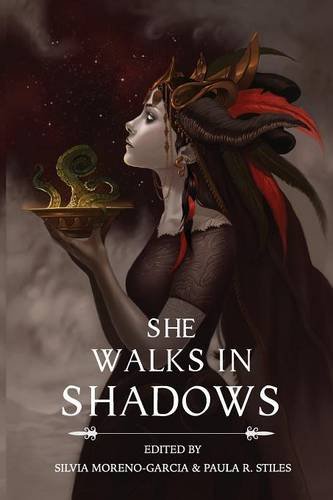
She Walks in Shadows is a collection of stories that revisits Lovecraft’s Mythos from the view of the often-ignored and neglected women characters. Marceline Bedard is arguably one of the most prominent and interesting of these, if only because so rarely did Lovecraft ever write a woman of color into his stories, much less give her a prominent role. There are many possible reasons for this: the story is only incidentally connected to the wider Mythos, for instance. Most important, though, is the failure of Lovecraft to develop anything of the internal life and motivations of Marceline. She is presented as a kind of femme fatale, an occultist, but why she does anything in the story is utterly absent. If she has any deeper plan beyond marrying Denis de Russy and posing nude for a portrait, it is never revealed. Likewise, her backstory and that of her great hair are left utterly mysterious.
From the perspective in which the story seed was first presented to Lovecraft, and the perspectives with which he told it—white man telling the tale to another white man—the absence of Marceline’s side of the story is perhaps understandable. Yet the absence is still present; the reader only gets one side of the tale.
So Gemma Files fills in the gap, providing something of Marceline’s side of the story, her motivations and background, and perhaps more importantly, what happens next.
In comparison with those works, it has to be said that Gemma Files’ “Hairwork” stands up well. She does not directly work to contradict Lovecraft’s story, but works around the facts by providing a motivation and tying it into the background she supplies, one that works very well. References to the wider Mythos are still fairly thin: Lovecraft didn’t leave much to work with, and unlike Victor LaValle in “The Ballad of Black Tom” (2016) who chose to re-center the story around the Cthulhu-cult, Files appears content to have left it on the periphery of the Mythos.
The most substantial change is the vague suggestion that painter Frank Marsh may have familiar connections with the Marshes of Innsmouth—and who knows but that someone may pick up that thread someday? And probably the most radical change in the story is the suggestion of what the hair itself might be:
And then there’s the tradition of Orthodox Jewish women, Observants, Lubavitchers in particular—they cover their hair with a wig, too, a sheitel, so no one but their husband gets to see it. Now, Marceline was in no way Observant, but I can see perhaps an added benefit to her courtesenerie from allowing no one who was not un amant, her intimate, to see her uncovered. The wig’s hair might look much the same as her own, only longer; it would save her having to … relax it? Ça ira?
“Yeah, back then, they’d’ve used lye, I guess. Nasty. Burn you, you leave it on too long.”
Black hair is tied up in so many aspects of history, culture, fashion, and racial discrimination that it is a difficult to know where to start. The focus on hair as a defining trait of Marceline Bedard, given her biracial or multiracial heritage, is something that is rarely examined by critics and scholars. Lovecraft was vaguely aware of some of the efforts that went into hair straightening from his time in Harlem, but like a lot of aspects of Marceline’s life, he doesn’t focus on it. A blank spot on the canvas for some worthy writer like Files to fill in.
In keeping with the overall plot of “Medusa’s Coil,” “Hairwork” gives Marceline Bedard means, motive, and depth—but she is still the villain of the story if not necessarily the antagonist. Lovecraft’s tale casts Marceline as a victim, essentially blameless except for the one-drop rule, but Files gives her animus, and the deliberation in what she does makes her something other than an unfortunate woman trapped between two men. In many ways, that makes her both more terrible and more interesting than Lovecraft’s original portrait of the Paris priestess.
Meanwhile let me wish you all success with the realistic novel or character study—”No Right to Pity”. Material which ‘must be written out of one’s system’ has a very excellent chance of being genuine art—no less so when it comes hard than when it comes easy. And semeblance to a ‘chronicle of actuality’ is not to be deplored unless all dramatic modulation & implied interpretation be absent. Don’t hurry with the work—but let it unfold itself at whatever rate makes for maximum effectiveness. A subjective or quasi-autobiographical novel is often a stepping-stone to work of wider scope. Certainly, many books of the kind have received the highest honours in recent years.
By early Summer 1936, Robert Hayward Barlow’s focus had turned to prose, poetry, and publication—the amateur journals The Dragon-Fly that Barlow managed to print using the press in the small shack (which Lovecraft had helped with during his last visit) were well-received by many. Barlow’s original fiction efforts ranged from fantasies like the “Annals of the Jinns” to post-apocalyptic vignettes like “The Root-Gatherers.” They showed promise, and Lovecraft was keen to encourage his young friend’s literary efforts.
Yet all was not quite well with R. H. Barlow’s home life.
Col. Everett D. Barlow suffered from what today is called post-traumatic stress disorder. From the hints and suggestions in R. H. Barlow and Lovecraft’s letters, it appears that the colonel was irascible, with periods of depression. Retired from the army and spending most of his time with his wife and youngest son at their homestead in DeLand, Florida, the old man was probably difficult to escape, for both R. H. Barlow and his mother, Bernice. The strain in the marriage would eventually lead to separation and divorce, but for Bobby Barlow, there were few opportunities to escape…
…which is what, essentially, R. H. Barlow’s sudden trip to Providence, Rhode Island to visit Lovecraft was.
It isn’t clear from R. H. Barlow’s autobiographical writing as to when exactly he came to realize he was gay, but there is evidence that around 1936 he was grappling with issues of sexuality and sexual identity. While it isn’t clear if he ever broached these matters with Lovecraft directly, there are hints elsewhere:
Don’t allow yourself to be influenced in any way by Cities of the Plain. This remarkable study in sexual perversion is sui generis.
August Derleth to R. H. Barlow, 8 Jul 1936, MSS. Wisconsin Historical Society
Cities of the Plain was the 1927 translation of Marcel Proust’s Sodome et Gomorrhe (1921/1922), a novel which deals with homosexuality and jealousy. By itself, this isn’t necessarily telling; Derleth was notably relatively open on reading about and discussion of sexuality (there are claims that he was bisexual, see Derleth: Hawk…and Dove (1997) by Dorothy M. Grobe Litersky), and perhaps Barlow felt more comfortable bringing up the book with Derleth than Lovecraft. Yet it could be a sign of Barlow’s growing interest and awareness of gay issues, especially as related to himself.
R. H. Barlow visited H. P. Lovecraft in Providence from 28 July to 1 September 1936, Since they were seeing each other every day, there was no need to write letters, so the surviving accounts of the trip come from Lovecraft’s letters to his other correspondents. One thread from such an exchange with Derleth stands out:
Speaking of impromptus—enclosed are a triad of modernistic character sketches which Barlow wrote the other day without any effort or premeditation whatsoever. He pretends to despise them, but I rather think he’d like to see them in one of the little magazines which you so kindly listed for Pabody. What do you think of them? Would you encourage R H B to revise & submit them, & to pursue further endeavours along the same line? He could grind out this stuff endlessly if there were any demand for it. It seems rather in the Story line.
I read Barlow’s stuff with a good deal of interest, but must regretfully report that while it has the promise it is as yet pretty unformed, and not likely to see publication. Also, it is extremely difficult to read, owing to the fact that RHB is not up on paragraphing, etc. Structurally, the pieces are pretty bad. I Hate Queers has the most promise, but before the really chief characters are introduced, we get 4 pages of tripe about people who do not concern the leads at all. Nobody would take a story like that, though the best bet for Barlow’s emergence into little magazine print would be Manuscrupt, 17 West Washington, Athenos, Ohio. I have made a few marks here and there in one or two of the stories, though I did not contribute the usual amount of marginal notes owing to close typing. […] The use of long-winded, platitudinous expressions annoys, but despite all this I should think there is hope that RHB may make something out of such material as this. Let him drop at once any air of sophistication he may have. Affectations may serve a purpose to one’s self, but not in print. […]
No, RHB’s tales are far from the Story line: Story’s are crisp and clear, Barlow’s are jumbled. I Hate Queers might be revised to some good end, but much of it would have to be cut, and some staple point-of-view maintained throughout. He shifts point-of-view constantly, which is very confusing and not good creation. Frankly, the stuff shows sloppy writing: I can easily believe that he just dashed it off.
Barlow appreciated your criticisms immensely, & will doubtless be guided by them in future attempts. He is now, of course, in a purely experimental stage—scarcely knowing what he wants to write, or whether he wnts to write at all…as distinguished from painting, printing, bookbinding, &c. My own opinion is that writing best suits him—but I think he does better in fantasy than in realism. A recent atmospheric sketch of his—“The Night Ocean”—is quite Blackwoodian in its power of dark suggestion. However—it’s just as well to let the kid work the realism out of his system. At the moment he seems to think that the daily lives & amusements of cheap and twisted characters form the worthiest field for his genius. Plainness in style will develop with maturity.
This is the first and last mention of R. H. Barlow’s “I Hate Queers”—a piece that is not known to survive and has never been published. In another letter around this time, Lovecraft briefly mentions the plot of one of Barlow’s stories in comparison with The Last Puritan(1935) by George Santayana, though whether this is “I Hate Queers” or another piece is unclear:
As for your parallel betwixt Oliver’s admiration of the coarse Lord Jim & your artist’s anomalous devotion to a cheap prize-fighter—I can’t see that it holds. Lord Jim—a character vital & engaging personality despite his feet of clay—was a symbol to young Oliver. He was a symbol of the unrestraint for which one side of Oliver—because of his one-sided education & conventional antecedents—subconsciously longed. Meeting him in extreme youth at a time of suddenly enlarged horizons, Oliver always associated Jim with the abstract quality of liberation & expansion—the associative image persisting even after the basic commonness of the concrete Jim became manifest. Nothing of this sort is apparent in the case in your story. There is not the slightest reason in the world why any sane & mature artist would wish to see or talk with a cheap & undistinguished prize fighter. And I’d some tragic disease or malformation gave the artist an abnormal interest, he would naturally spend all his time in Fi ghting & eradicating the disease—not in displaying or encouraging it as a lower-grade character might. —H. P. Lovecraft to R. H. Barlow, 30 Sep 1936, O Fortunate Floridian365-366
Most likely, like much juvenalia it ended up in the ash bucket, never to see the light of day. Yet it is impossible to read that title, and the surrounding comments on the work, without delving into some speculation. The suggestion of autobiographical elements and the need to write something out of his system recalls Barlow’s later, very much explicit “Autobiography,” which was written as an extension of the psychoanalytic therapy he underwent in his twenties. One can easily imagine a literate young man attempting a quasi-autobiographical story; Robert E. Howard had done much the same thing with Post Oaks & Sand Roughs, and Arthur Machen with The Hill of Dreams, so Barlow was in good company.
The title itself is plainly homophobic, yet Barlow himself was homosexual, even if he hadn’t had his first experience with another man yet. Barlow’s “Autobiography” opens in 1938 at age 18 as he roomed with the Beck family in California, with his attraction to the male form already fully developed, at least if such passages as this are any to go by:
I could not decide which if the Beck boys to fall in love with and vacillated continually. Claire had a mania for bathing, and I saw him once or twice quite naked. he had a nice prick, uncircumcised. At other times he found excuses to go downstairs from the bath to the living room, dressed only in skin-tight drawers, which also showed him off to advantage.
Keep in mind that this was Barlow in 1944 looking back at himself in 1938, so he could have been impressing his then-current comfort level with his sexuality on his past self—but if it is accurate to his teenage feelings, this may suggest that Barlow had passed through any phase of doubt or confusion before this point—and perhaps he was still in that period of self-discovery in 1936 when he dashed off this short story.
This is important because the title “I Hate Queers” is very provocative, designed to establish and evoke an emotional response from the reader. After all, in the very homophobic 1930s, who would publicly disagree? Who would stand up and say they don’t hate queers? This suggests that the expressed prejudice of the title might be performative: the closeted gay character who emphasizes their homophobia to deflect suspicion about their own sexuality…or, perhaps, a heterosexual character who is preoccupied with being mistaken for gay because they know what discrimination that will bring.
It is fun to speculate; certainly Barlow would not have been able to be open about his burgeoning sexuality with his family, and perhaps not even with his few friends like Lovecraft and Derleth. Even discussing Proust or showing them “I Hate Queers” might have represented a risk, albeit a considered one, with any hint of personal interest disguised as literary interest or effort…and there was reason for Barlow to be concerned. Derleth was upfront about it:
Barlow is for sure a homo; from what I have heard, so was the late minister-weird taler Henry S. Whitehead. Any anybody with a mandarin moustache is vulnerable to the kind of flattery, larding I can do very well.
August Derleth to Donald Wandrei, 21 March [1937]
“I Hate Queers” stands out in Lovecraft’s correspondence as one of those fascinating possibilities which have been lost to time. We’ll never really know what the story was, unless an archive of Barlow’s teenage stories shows up at some point. It was a different world then, for LGBTQ+ folks, and it took decades of hard work and legislation to begin to win them recognition and equal rights with heterosexuals…rights and recognition which, sadly, have continually faced opponents dedicated to restrict, redefine, and rescind them. To turn back the clock to when gay men like R. H. Barlow struggled to express themselves even to their closest friends and relatives for fear of imprisonment and fines, censorship and blacklisting; and faced blackmail and violence simply for appearing to be different.
Barlow’s title is expressive of an age and attitude I had hoped was dead and buried, but there are still bigots today who would say it proudly…and that, perhaps, is a more subtle horror than the realism which Barlow had tried to express. For it is still as real today as it was in that earlier century.
Weird Racism Historical racism can take some strange turns when expressed through fantasy, horror, and science fiction, and the result can be more disturbing or offensive to some readers than “normal” racism. As such, please be advised before reading further.
Whitehead—to whose other distinctions I find that of Reverend or ex-Reverend added—has just started a tale from an idea of mine which he is suggesting that I finish as a collaborated work—but I may pass it up because of inability to do justice to the West Indian locale he has seen fit to choose. I am the sworn enemy of armchair exoticism, & believe in writing about things one personally knows—except of course in the case of Dunsanian phantasy or cosmic infinity.
The Reverend Henry S. Whitehead was an Episcopal priest and pulp writer who contributed to magazines such as Weird Tales and Strange Tales of Mystery and Terror. Before retiring to Florida, Whitehead had spent summers down in the U. S. Virgin Islands, soaking up the local atmosphere, culture, and folklore, and set many of his tales in this milieu, often in stories involving his character Gerald Canevin. H. P. Lovecraft had fallen into correspondence with Whitehead, and the two formed a convivial bond.
Lovecraft kept a commonplace book with ideas and plot germs, some of which he used and many of which never materialized but were borrowed or developed by others. The plot seed that inspired Whitehead was apparently this one:
[133] Man has miniature shapeless Siamese twin—exhib. in circus—twin surgically detached—disappears—does hideous things with malign life of his own.
Collected Essays 5.227
The entry is dated 1925, and R. H. Barlow, who was Lovecraft’s literary executor, added the notation “HSW—Cassius” to this entry. Whitehead took Lovecraft’s basic idea and applied it to his West Indian milieu to craft another Canevin tale. While Whitehead urged collaboration, however, Lovecraft begged off:
Whether I do anything with that Whitehead tale depends on how eager he is about it—for I hate being churlish & uncivil. He says he has it all started, & that he has prepared some guiding notes on the chosen West-Indian background.
H. P. Lovecraft to August Derleth, 17 Feb 1931, Essential Solitude 1.321-322
As for collaboration—though I’ve done it in scores of ghost-writing cases, I think I’ll dispose of the Whitehead case by keeping things in the air till he writes the whole thing himself.
Which is ultimately what Whitehead did. The story that developed, “Cassius” is essentially pure Whitehead in terms of plot and development, and aside from being set in the West Indies and starring his series character Canevin, also continues certain themes that he had developed in earlier tales.
For example, the tale “The Lips” (Weird Tales Sep 1929), a Black woman on a slave ship to the West Indies curses one of her white captors so that black mouths grow from his flesh, whispering the word “L’kundu”—this was a riff off Edward Lucas White’s story “Lukundoo” (1925), where a white man in colonial Africa wrongs an indigenous woman and is cursed to Lukundoo, where miniature, chattering Black heads grow from his flesh. In another tale, “Passing of a God” (Weird Tales Jan 1931), a white man with a large growth in his abdomen goes to the West Indies and falls in with voodoo; the growth is surgically removed and revealed to have been a parasitic twin that the cultists believed to be an incarnate god.
As those brief synopses indicate, there is a strong racial component to these stories; while the Virgin Islands was much less racially segregated than the mainland United States, Whitehead’s perspective—and his audience—was very much of the white mainland majority, and the characterization of BIPOC characters in his West Indies stories, while rarely mean-spirited, tend to be expressions of particular stereotypes and prejudices. So it is in “Cassius,” where a light-skinned biracial man named Brutus Hellman.
Brutus, it appeared, had need of a minor operation, and, Negro-like, the two of them, talking the matter over between themselves, had decided to ask me, their present patron, to arrange it.
The operation had been the removal of a growth from Brutus’ groin or side—a parasitic twin which would go on to hunt and haunt Brutus Hellman in revenge. Except that the miniature human being thus freed is darker-skinned than Brutus, and possesses a kind of ancestral memory, reproduced African hut and spear in miniature as it carries out its campaign of terror. Whitehead offers a pseudoscientific explanation:
The well-established ethnic rule,the biological certainty in cases of miscegenation between Caucasians or quasi-Caucasians and the Negro or negroid tpes is tha the offspring is never darker than the darker of the two parents. The ‘black-baby’ tradition, as a ‘throw-back’ being produced by mulatto or nearly Caucasian parents is a bugaboo, Canevin, sheer bosh! It doesn’t happen that way. It cannot happen. it is a biological impossibility, my dear man. […] since Brutus is very ‘clear-colored,’ as the Negroes would say, that one of his parents was black; the other very considerably lighter, perhaps even a pure Caucasian. […] The mother—she was, undoubtedly, the black parent—proud of her ‘clear child’, would favor it,nurse it first.
Even in 1931, this “scientific” explanation wouldn’t hold water, but the point was to try and give an explanation for why Cassius was both darker-skinned that Brutus, and why the miniature stereotype was running around stabbing lighter-skinned Black people with spears made from knives, building “African” style huts out of discarded pencils, and the like. Totally aside from the explicit and implicit racism (scientific and otherwise) in “Cassius,” the story ends rather anticlimactically, and even Lovecraft wasn’t very impressed with the result:
About “Cassius”—It is hard for me to give an unbiased judgment, since the development is so antithetical to that which I had in mind when offering the central idea. To me it seems that a vast number of atmospheric & other horror-possibilities have been left unrealised, & that the typically bland, urbane, & almost unctuous style (the stereotyped Kipling tradition) wrecks the sort of hideous tensity really needed. Yet on the other hand I can see where Whitehead has used a fertile cleverness in incident-devising that I could never have approached. The chief scientific objection is, of course, the part played by “hereditary memory”—a thing wholly repudiated by responsible biologists, though still favoured by weird writers. I’d call “Cassius” a typical anthology item—for “sophisticated” professionals love that unctuous urbanity which to me is so markedly unsatisfying.
Whitehead and Lovecraft did eventually meet in Florida, and would collaborate on another Canevin tale, “The Trap.” Yet in a later letter, Lovecraft would reveal a little more about the origin of the tale:
I gave H S W the idea for “Cassius”—at first he wanted me to collaborate, but our styles & approaches were so different that I couldn’t. It all came from a freak I saw in a dime museum—an Italian with a rudimentary twin growing out of his abdomen. Some time I’ll tell you how I had meant to develop the theme—I may do it yet.
In a sense, Lovecraft had already played with the twin theme in at least two tales: “The Dunwich Horror” (Weird Tales Apr 1929) and The Case of Charles Dexter Ward (written early 1927, unpublished during Lovecraft’s lifetime). Ward with its near-identical ancestor-descendent pair recalls one of Lovecraft’s earliest recorded stories, now lost:
One long-destroyed tale was of twin brothers—one murders the other, but conceals the body, & tries to live the life of both—appearing in one place as himself, & elsewhere as his victim. (Resemblance had been remarkable.) He meets sudden death (lightning) when posing as the dead man—is identified by a scar, & the secret finally revealed by his diary. This, I think, antedates my 11th year.
Lovecraft would refer to this idea in commenting on a similar story, “The Man Who Was Two Men” by A. W. Bernal in Weird Tales Apr 1935 (Letters to Robert Bloch and Others 233). Yet neither of these stories really involves a parasitic twin, and the idea that Lovecraft got the idea from a real performer he saw at a human oddity exhibition is intriguing. We know from Lovecraft’s letters, for example, that in 1925 (from when the entry in the Common Place book is dated), Lovecraft and his wife visited such an attraction in Coney Island.
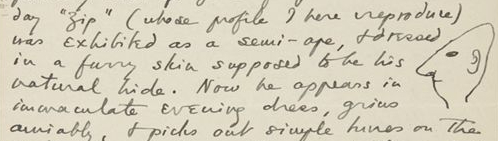
We then called in for a fitting of the suit, & took an open car for an evening ride to Coney Island. We had not intended to get off at all; but finding the resort phenomenally uncrowded, we did—incidentally patronising some of the assorted freak shows. In one of them there still survives P. T. Barnum’s original “Zip, the What-is-It”—now probably over 90 years of age. In Barnum’s day “Zip” (whose profile I here reproduce) was exhibited as a semi-ape, & dressed in a furry skin supposed to be his natural hide. Now he appears in immaculate evening dress, grins amiably, & picks out simple tunes on the violin & xylophone. The age is too sophisticated for Barnum’s charlatanry, & “Zip” chiefly interests people as having been part of the great showman’s entourage. This creature is really a semi-idiotic Andaman Islander—one of a dwarf Malay stock inhabiting the East Indies. He was picked up as a boy by a seaman long before the Civil War, & has since vegetated in one freak show after another. Living feebly & lightly, he does not show his years; & will probably excite the smiles of still another generation.
Lovecraft is credulously repeating the popular billing; “Zip the Pinhead” was William Henry Johnson, born to a Black family in New Jersey, and was in his late 60s when Lovecraft saw him, though he would die the following year.
It is not clear if the performer who inspired Lovecraft’s commonplace book entry was seen during this excursion or another, but Lovecraft went into great detail about the idea and its potential development; for ease of reading, this long section of a letter has been broken up into several sections:
About the twin—I was divided between two plans of development. One would have had the monster escape as Whitehead had it—but would have had it much more terrible & much less human. I would have had it grow in size, & frighten people much more terribly than “Cassius” did. Indeed, I would have tried to convey the implication that some Outside force or daemon had taken possession of the brainless, twisted body—impelling it to strange acts of apparently deliberate but plainly non-human motivation. The climax would have consisted of some dramatic & unmistakable revelation of this Outside tenancy—probably connected with the spectacular destruction of the thing in one way or another. My story would have had none of the lightness, sauvity, & humour of Whitehead’s, but would have been grim & terrible all through. So much for one plot.
This is the development that most closely resembles the unnamed twin in “The Dunwich Horror”—and perhaps too closely resembles the parasitic twin in Whitehead’s “Passing of a God.” Assuming that Whitehead wrote that story before he received Lovecraft’s plot germ—and perhaps it is what prompted Lovecraft’s sharing of his own vaguely similar idea—he might have felt inclined to develop the parasitic twin idea in a different way in “Cassius” so as to avoid repeating himself. The other plot idea was far less cosmic and, like Whitehead’s, more science fiction:
The other plot I had in mind was much more human—not supernatural at all, in fact. The idea was to have the connexion of the man & his miniature twin much more complex & obscure than any doctor had suspected. The operation of separation is performed—but lo! An unforseen horror & tragedy results. For it seems that the brain of the twin-burdened man lay in the miniature twin alone . . . . so that the operation has produced a hideous monster only a foot tall, with the keen brain of a man, & a handsome manlike shell with the undeveloped brain of a total idiot. From this situation I planned to develop an appropriate plot, although—from the magnitude of the task—I had not progressed very far. I had an idea of having the midget monster assume the guardianship of his handsome, brainless twin & endeavour to hypnotise it in such a way that it could do his talking for him & act as his substitute in the outside world. I meant to have him succeed, so that after about a year there appears in society a handsome, brilliant man who always carries a satchel, & who displays vast alarm when there is any danger of his being separated from it. This, of course, is the brainless twin—who now serves as the mouthpiece & exterior facade of the intelligent monster, who rules him by hypnotism from the shelter of the satchel. From then on I had decided nothing. One idea was to have an accident destroy the satchel, causing the idiot to collapse helplessly & perhaps die. Another was to have the man gain fame—but finally to have the idiot body die in such a way that the death can hardly be concealed. The intelligent twin still lives—but how can he now keep his secret? He may be able to hide bodily, but how can he continue the work which brought him fame (say as a writer or painter or scholar) when the famous man is supposed to be dead? I had not progressed to the point of solving that problem—or even deciding whether I’d have such a problem—when Whitehead began urging the collaboration & I finally gave him the plot to develop in his own way. Hence “Cassius”.
This “double life” plot is obviously a continuation of Lovecraft’s earliest twin theme story idea; yet the idea of a miniature parasitic twin with its own independent intelligence is clearly what inspired Whitehead’s “Cassius.” Yet the whole process of thinking over the plot germ led Lovecraft in a third direction:
Now—after years—another alternative occurs to me. I might have the death of the handsome idiot-body concealed, & have the intelligent monster embalm it & display it seated in a chair—ostensibly still alive but paralysed. he would have it appear to speak—in a feeble, alien voice supposedly due to the paralysis—through the clever practice of ventriloquism. Then some awful climax of revelation could occur—any one of a dozen hideous sorts. The embalming could be imperfect, so that the supposedly living man would display signs of decomposition. Or notice could be attracted by its failure to age through the passing years. In writing such a story, I’d probably begin near the end—that is, have the bulk of the action concern the final phase, when the supposed paralytic begins to arouse suspicion. The antecedent history—the operation &c—would be subtly worked in as backflashes. I would make the revelation very gradual & suspense-filled—& at the last might leave the reader in some doubt of what the truth really was. Whether I shall ever do this or not remains to be seen. It certainly wouldn’t be duplicating “Cassius”—for the whole spirit & emphasis of my conception is antipodally alien to Whitehead’s. Whitehead urged me to go ahead & try—but I thought some time had better elapse in any case.
While Lovecraft would never develop this explicit idea, the image of the ventriloquist act would be used in “The Whisperer in Darkness” (Weird Tales Aug 1931). The narrative development of beginning at the end and then working back to how this came to pass is a familiar part of Lovecraft’s style. Yet as for where Lovecraft got the idea in the first place:
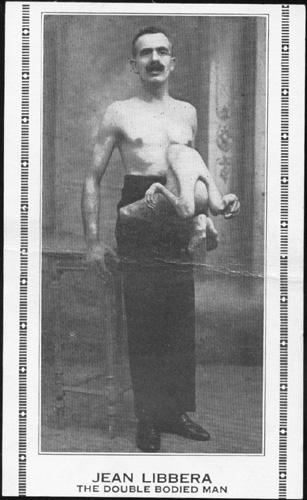
I believe I mentioned that my idea came from seeing an actual case of the undeveloped-twin anomaly in a freak shew (Hubert’s Museum in W. 42nd St.) in New York. The man in question–an intelligent Italian who for some reason billed himself under the French name of “Jean Libera”—had a little anthropoid excrescence growing out of his abdomen which looked hellishly gruesome when uncovered. Cothed, he looked merely like a somewhat “pot-bellied” individual. So far as I know, he is still living & on exhibition. He looked so essentially refined & high0gade that I wondered at this willingness to be exploited as a freak, & speculated as to what he would do if a stroke of luck removed him from the need of such an ignominious occupation. The first thing he would do, I argued, would be to have the excrescence cut off—& then & there the idea of the story came. This was in 1924 or 1925. Now the odd & amusing thing is this. Years afterward—after I had given the idea to Whitehead & was awaiting the appearance of “Cassius”—I chanced to mention the matter to my old friend Arthur Leeds of New York, who has had extensive dealings with freaks & other amusement enterprises. Fancy my surprise when he told me that he knows Libera well—that the man’s real name is Giovanni Libera, that he is an Italian of great intelligence, that he is interested in everything weird, & that (believe this or not—it’s actual truth!) he is especially fond of my work in W.T.!!!! Talk about coincidence! Leeds was going to tell him about “Cassius”, but I told him not to, since he might feel some delicacy (despite his occupation) about being used in that way. At the time (1930) Leeds was going to introduce me to Liebra; but something prevented, so the meeting never came off. It certainly would have seemed odd to meet one of my plot-germs in the flesh . . . . the flesh of two bodies, or a body & a half, at that!
Giovanni Libbera was an Italian performer who toured the United States, sometimes billed as Jean or Jean and Jacques Libbera. Lovecraft’s 1924 and 1925 letters do no mention Hubert’s Dime Museum or Libbera by name, and trying to figure out exactly where Libbera was under contract during that period is difficult, but there are newspaper advertisements that show Libbera was employed at Hubert’s during some periods. J.-M. Rajala in “Locked Dimensions Out of Reach: The Lost Stories of H. P. Lovecraft” (Lovecraft Annual #5, 2011) suggests it may have been during a 15 July walk to Times Square recorded in Lovecraft’s 1925 diary.
Which is the long and rather weird root to how a chance encounter with a human oddity led to a story in Weird Tales…and, perhaps, sheds some light on Lovecraft’s plotting and development of story ideas, and how that differed from his colleagues. It is notable, for instance, that Lovecraft’s original plot-germ and all of its developments is totally agnostic in terms of race. The plot has nothing to do with the twins being white, Black, or anything else, while Whitehead in transferring the plot to the West Indies makes it entirely about race, or at least about certain preconceptions about race. This makes fair sense when it is considered that Whitehead’s stories frequently dealt with BIPOC characters in a setting where they predominated, while Lovecraft stuck mostly with familiar New England settings with relatively fewer BIPOC folk.
No—I shan’t let your gargoyle tale cut mine off . . . . any more than I shall let Whitehead’s “Cassius” suppress my future tale of the amputated Siamese twin.
The legacy of “Cassius” is a bit harder to track. While no one has, to the best of my knowledge, written a direct sequel, however there are two stories by members of Lovecraft’s circle of correspondents that might continue some of the themes and ideas.
“The Mannikin” (Weird Tales Apr 1937) by Robert Bloch is about a man with a parasitic twin growing from the left shoulder that is both intelligent and has a distinct interest in Mythos lore; as in Lovecraft’s second plot development, the parasite manages to gain control of its brothers body for a time.
“It Will Grow On You” (Esquire Apr 1942) by Donald Wandrei is a kind of spiritual sequel that combines elements of “Cassius,” “The Lips,” and “Lukundoo.” A white man among the islands gets a native woman pregnant, and when he threatens to leave she curses him. A small female form then grows from his thigh. A surgeon attempts to remove the growth, but the curse transfers to the surgeon.
In all of these stories that have been discussed, there is a fascination with both bodily deformity—many of the stories are effectively early examples of what today would be termed body horror—and with the idea of a kind of twisted morality play. Giovanni Libbera did nothing wrong, committed no crime or sin, he was simply born the way he was. Individuals in stories like “Lukundoo,” “The Lips,” and “It Will Grow On You” all receive their horrific transformations from some terrible crime, and like a rapist who catches an STD, have to live with the consequences. In “Passing of a God,” “Cassius,” and “The Mannikin” it is the parasite that is evil…something to be cut from the body if possible, endured if not.
None of the characters seek to capitalize on their odd status as Libbera did; these are not stories about the practical difficulties of the life of a performer making the best of an unusual physical condition, like David Lynch’s The Elephant Man (1980). There is a very distinct prudishness and shame regarding their physical bodies which is reflected in Lovecraft’s emphasis on Libbera’s “ignominious occupation.” Yet that was a mentality that went far beyond just Lovecraft himself, and found expression in many authors during the period. Sideshows and dime museums may have come and gone, yet the repulsion at that which is different—and the fascination with the same—remains.
Weird Racism Historical racism can take some strange turns when expressed through fantasy, horror, and science fiction, and the result can be more disturbing or offensive to some readers than “normal” racism. As such, please be advised before reading further.
But by the time I was twenty-one I realized how insurmountable a barrier lay between me and the fulfilment of my dreams. I was a Negro. No matter what respect I might command from white men because of my intelligence and abilities, no matter to what heights I might rise, the wall of race reared between. It drove me fantic. I wanted to meet other great men on a common level, to be one of them. And I could not.
Racial discrimination is based on the fallacy that race is a definable, fixed constant; a physical and cultural reality that is consistent and unalterable. The reality of this discrimination—the eponymous color line in the United States—has been a source of tension within the population since the first African slaves were brought to the nascent Colonies in 1619. Sometimes the definition and discrimination based on race was encoded in law, such as during the Jim Crow era when Lovecraft and his contemporaries wrote for Weird Tales, and more often—even today—the discrimination was largely informal, social, a reflection of white supremacy and the paranoia and violence used to enforce that self-image.
Yet race is not so clear-cut or fixed. This is part of what gave rise to the white horror of passing, a light-skinned person of color being able to successfully pass themselves off as “white,” as happened in Mark Twain’s Puddn’head Wilson (1894) and “Medusa’s Coil” (1939) by Zealia Bishop & H. P. Lovecraft. Supernatural and science fiction, however, allows much more fantastic possibilities. What if you could drink some magic potion, or apply some chemical agent to the skin, and change its color? On the surface, this seems silly; albinism exists regardless of ethnicity, and there is much more to ethnic identities than just skin, eye, and hair color. However, when so much cultural tension is wrapped up in issues of skin color, the idea of racebending becomes a thought experiment—a narrative what-if explored in stories like Harry Roselenko’s Black Is A Man (1960) or Lord Dunsany’s “Across the Colour Bar” (2002), and many other works, sometimes for social commentary, or comedy, or horror.
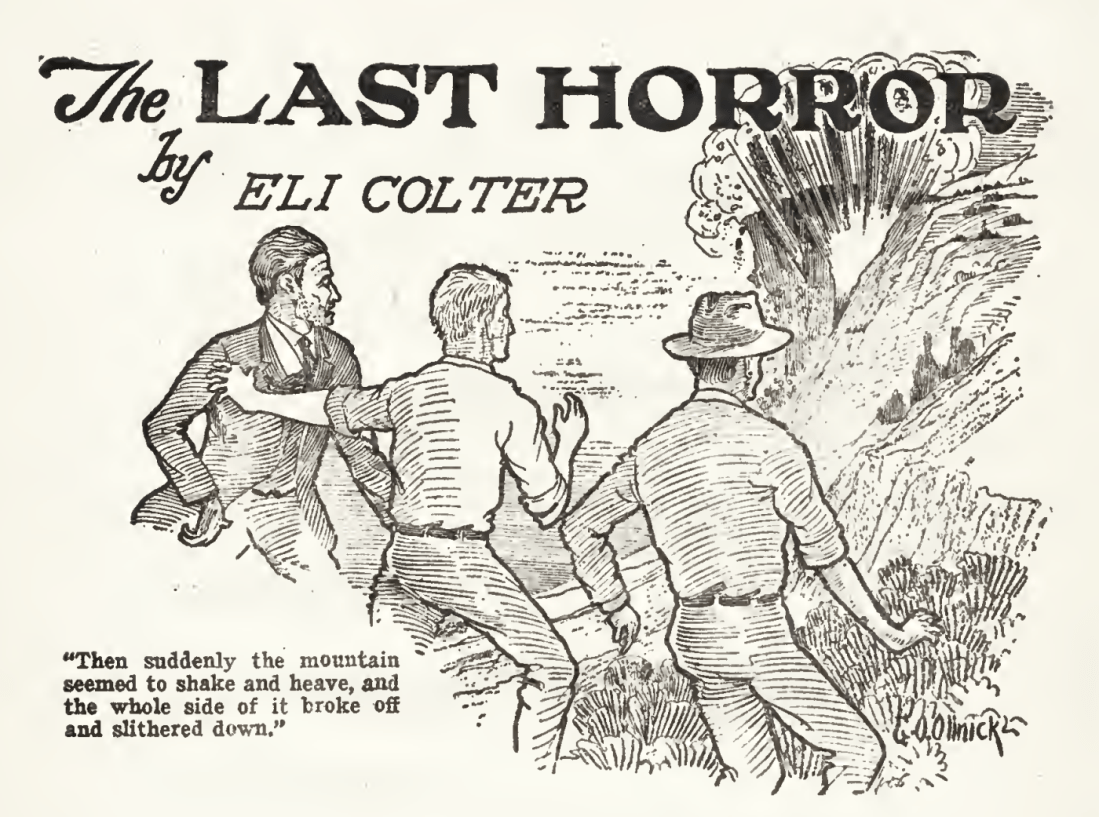
“The Last Horror” by Eli Colter is an example of such a racebending weird tale—a rare story that directly addresses the issues of racial discrimination, and yet the plot is irreparably snarled.
In form, the story is essentially science fiction: a Black millionaire with white hands (attributed to maternal impression, but possibly inspired by vitiligo) receives a skin graft from a white friend and conceives the idea of grafting white skin onto his entire body and passing himself as a white man. This is accomplished with the aid of a rogue surgeon and a carefully planned campaign of kidnapping, bribery, and murder to obtain the white skin. Yet the focus of the story is less on the details of the surgery, the possibilities of tissue rejection, or the possibility of failure—the antagonist, Ballymair, has planned too well. What the narrative focuses on are the racial dynamics of the story.
When Ballymair goes to the Congo to participate in a hunt, the African-American meets indigenous Africans, and expresses his prejudices:
I compared myself to those negroids over there. Cannibals! Living in crude rectangular houses, tattooed in weird designs with scars, carrying bows with cane strings and packing wooden shields, wearing bark-cloth—or nothing—believing in their fetishism and witchcraft, chipping their teeth and letting the women do all the work. Was I like them? Was I of that race? Only in color! Outside I was black, but inside I was as purely Caucasian as either the captain or Dr. Straub.
Except…are these really his prejudices? Because the words put into the character’s mouth are white stereotypes, the kind of thing expressed in a hundred pulp stories or Black Magic (1929) by Paul Morand. These are the words put in the mouth of an African-American character when the author wants to express self-hatred, to define that spark of madness that would lead to this murderous plot. These are a white person’s prejudices, put in the mouth of a non-white character, and for the specific purpose so that at the climax of the story a white character can give the ultimate rebuttal when the operation is complete and Ballymair shows off his white skin.
White? Where? You may change your skin, Ballymair, but you can’t change your heart. You’re quite right. The skin does not matter. One of the best friends I have is a Negro—a man with a clear brain and a fine soul, satisfied to hold his place in the world.
While this might not be the earliest example of a white person dragging out a token Black friend as an effort to appear inclusive. Yet that Black man is only the white man’s friend so long as he is “satisfied to hold his place in the world.” The whole of the reason-you-suck speech is such a bizarre mishmash of backhanded compliments towards Black people and hellacious stereotypes about Black people that the ideas run into each other.
While the overall moral of the story would appear to be self-acceptance, it is couched in such a web of white supremacist language and ideas that it’s difficult to read this as well-meaning. This is a story written by a white person who, regardless of what moral they were trying to express, fundamentally doesn’t understand and cannot portray the Black experience in the 1920s, and it shows at nearly every turn. All we are left with at the end is a morally indignant white person essentially proving their ideas of white superiority by shaming Ballymair to suicide by explaining race and racism to him.
You may be white from the second skin out, but your blood runs true to form. Whatever pigment lies in the cells of that first skin to make the Negro black still flows in your veins! Go ahead and marry! Find out how white you are. Look—there you are! A white man, having taken his place in the world, wealthy; perhaps respected for his brain and his polish, in social intercourse with his seeming kind—with black children around his knees.
It’s not a stupid argument to point out that the skin graft is a change literally only skin deep, but the idea that this is a showstopper for someone who has already conducted multiple murders to pull off the fraud is making a hell of an assumption. The problem isn’t the genetics so much as the suppositions that go behind these statements. For example, the assumption is that Ballymair will marry a white woman and that biracial children would give him away or prove a social handicap. A moment’s thought might bring up adoption, interracial marriage, or any other option if Ballymair desires children.
Yet the superficial nature of the argument is a reflection of the literally superficial plot. “The Last Horror” is not some deep introspective philosophical work on the nature of racism and racial identity; it’s an almost hokey science fiction story with a laughable surmise that’s played for horror to an audience of white readers. The argument that “passing” doesn’t make Ballymair white is a reaffirmation of scientific racialism and white supremacist talking points, even when an effort is made to couch it in such a way as to shame Ballymair for not embracing his own Black identity. If a Black character had made this argument, it would have seemed an appeal to Black pride; from a white character, it is literally nothing more than “know your place.”
Given the absolute mess of the race dynamics in this story, it is perhaps not surprising that “The Last Horror” hasn’t had much of a cultural impact or seen much reprinting. The story was well-received at Weird Tales, and reprinted in the British Not At Night anthology You’ll Need A Night Light (1927) edited by Christine Campbell Thomson and in the Feb 1939 issue of Weird Tales, but “The Last Horror” has been passed over for anthologies and collections ever since, except for facsimile reprints of Weird Tales. No doubt it is too much an artifact of the Jim Crow era, and of sentiments whose time is long past.
Yet there is a final aspect of “The Last Horror” which is rarely acknowledged: the synchronicity with H. P. Lovecraft. In that same issue of Weird Tales where “The Last Horror” was first published, Lovecraft’s “The Horror at Red Hook” also first saw print. When Thomson selected “The Last Horror” for You’ll Need A Night Light, she picked “The Horror at Red Hook” too. And while Lovecraft rarely discusses many of the early stories of Weird Tales, he did make a point to mention this one:
The only decent thing in the issue, aside from such shorter features as your tale, is “The Last Horror”—which is truly clever, though more quasi-scientific than weird. I have long planned something of that sort myself, though of psychic rather than physical cast—an attempt on the part of an educated negro to project his personality & secure the tenancy of a white man’s body through the arts of voodoo.
Lovecraft wasn’t kidding. His Commonplace Book where he recorded story ideas and images for later use includes two entries along these lines from 1923:
108: “Educated mulatto seeks to displace personality of white man & occupy his body”
109: “Ancient negro voodoo wizard in cabin in swamp—possesses white man.”
Like “A Million Years After” (1930) by Katharine Metcalf Roof, Lovecraft was sort of beaten to the punch. Perhaps that is why, ultimately, Lovecraft would not write either of these stories, though the whole idea of personality displacement or possession would appear in stories like “The Thing on the Doorstep” and “The Shadow Out of Time.” Nor does voodoo make much of an appearance in Lovecraft’s fiction (see “Mother of Serpents” (1936) by Robert Bloch for details). Later generations who mined Lovecraft’s Commonplace Book for ideas have also generally left those ideas inviolate. We can only imagine how Lovecraft might have conceived and written a story based on this kind of premise—whether he could bend his view to get inside the mind of a Black character, or whether like Colter it would have been simply a confirmation of white supremacism.
Which is understandable. Lovecraft and Colter both expressed an interest in the same idea at roughly the same time because racial segregation and white supremacy were current and ongoing issues in the United States, and passing had real legal, social, and economic benefits when compared to the ongoing discrimination that nearly all people of color faced. Discrimination which Lovecraft and Colter were both aware of, but did not face themselves.
As for Eli Colter’s “Golden Whistle”—not having my W T file with me, I couldn’t say what issue it appeared in. Nor do I know anything about Colter himself. I never liked his tales overly well, since to me they seemed to contain just a touch of the mawkish.
Eli Colter was one of the pseudonyms of May Eliza Frost (see her entry on Tellers of Weird Tales blog), a white woman from Oregon, which had long-lasting Black exclusion laws. She and Lovecraft were of an age, and it is not surprising that they addressed some of the same themes, in their own style and from their different perspective. Yet they were both white people, and benefitted from their place in the racial hierarchy of the United States, despite their personal hardships…and they were writing to an audience that was presumably also white, who would be expected to share those same experiences and possibly the same prejudices, spoken and unspoken, that inform works like “The Horror at Red Hook” and “The Last Horror.”
Yet while Lovecraft’s “The Horror at Red Hook” has been reprinted dozens of times, studied and dissected, critiqued, pastiched, parodied, and revisited (see “The Ballad of Black Tom” (2016) by Victor LaValle), “The Last Horror” has largely sunk into obscurity—and the obscurity of this story, and other contemporary stories like it, is part of the reason why Lovecraft’s own prejudices tend to loom larger in his reputation. When folks claim that Lovecraft’s racism was particularly virulent or notorious even when compared to his peers, it is worth remembering “The Last Horror” and that Lovecraft’s prejudices were not unique. This should not be taken as absolving or downplaying the prejudices expressed in either Colter or Lovecraft’s fiction, but only as an understanding that these works were not created in a vacuum, but express something of the historical context of their times and experiences.
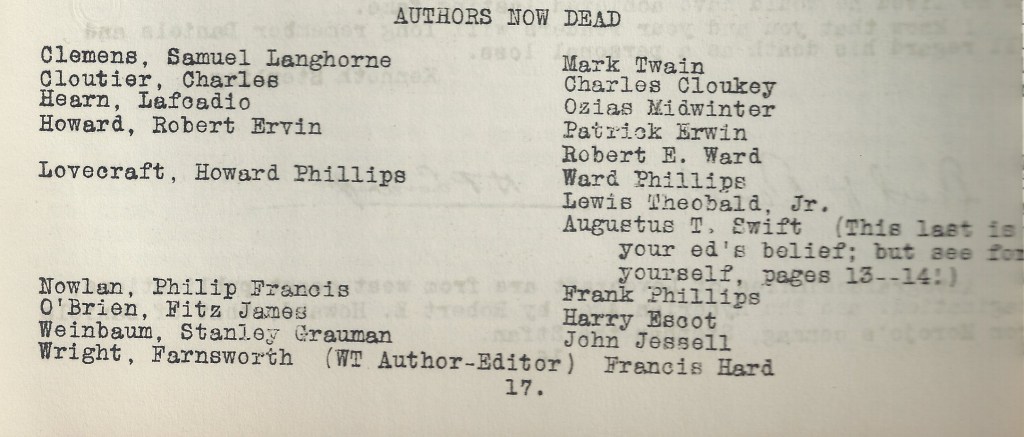
In the 1940 issue of The Golden Atom fanzine, editor Litterio B. Farsaci (who later changed his name to Larry Farsace) published an article “Science Fiction Pseudonyms” that claimed that “Augustus T. Swift” was a pseudonym of H. P. Lovecraft; as proof of this, elsewhere in the same issue Farasci reprinted two letters from Swift that had appeared in Argosy pulp magazine for 15 Nov 1919 and 22 May 1920. The Swift letters were given as being from Providence, Rhode Island, and Lovecraft was known to have used a number of pseudonyms, and to have written fan-letters to the Argosy (some of which were reprinted in the same issue of The Golden Atom).
The letters were notable in no small part because Swift praised the writing of Francis Stevens (a pseudonym of Gertrude Barrows Bennett), whose fantasy stories ran in the All-Story Weekly, Argosy, People’s Favorite Magazine, Thrill Book, and Weird Tales. To give a taste of Swift comments’, consider his praise for Stevens’ “The Citadel of Fear,” serialised in Argosy from 14 Sep to 19 Oct 1918:
But one story tops them all, “Citadel of Fear.” If written by Sir Walter Scott or Ibañez, that wonderful and tragic allegory would have been praised to the skies. While reading it I often wondred if Francis Stevens had in mind the slimy and diabolic spirit of evil which has so many years dominated the German rulers, until finally the whole nation became prostituted by the devil and his imps. Underlying its amazing and thrilling scenes was the sad but indisputable lesson that once a man gives himself up to evil and to evil deeds only, resulting from selfish greed, that man’s soul is lost. I find also in it a very strong suggestion that real evil does not lie in the so-called personal pecadilloes, but rather in black treachery toward one’s own kith and kin and country, an unmoral endeavor to harm all those who stand in the path of selfish purpose, and a general and studied ambition to spread animalism and degeneration among the human race. Pan-Germanism, class creed, Bolshevism are the present illustrations of the sliminess and abysmal hell portrayed by Francis Stevens.
I feel so much interested in the motif of that curious tale that I should like very much to have my curioisty gratified by the author himself. I believe many of your readers would like a sketch of the life of Mr. Stevens, and particularly the source and development of his motif in the “Citadel of Fear.” That story would make one amazing moving-picture drama, if taken up by the right moving-picture managers.
Augustus T. Swift to The Argosy, published 15 Nov 1919, in H. P. Lovecraft in The Argosy 32
However, Farsace was incorrect: Augustus T. Swift was not a pseudonym of H. P. Lovecraft, but a real person. Nevertheless, the name entered the general store of Lovecraftian lore being compiled in the 1940s; the claim was reprinted in “Pseudonyms of H.P.L.” in The Lovecraft Collector #1 (1949) by Ray H. Zorn, and continued to promulgate in articles and books apparently without question for decades. L. Sprague de Camp’s 1975 H. P. Lovecraft: A Biography repeats the claim, as do many other works. S. T. Joshi took “Augustus T. Swift” seriously as a Lovecraft pseudonym as late as “The Rationale of Lovecraft’s Pseudonyms” (Crypt of Cthulhu #80, 1992). The error was not finally revealed until 1994’s H. P. Lovecraft in The Argosy (Necronomicon Press), where Joshi wrote:
A very simple examination of the Providence city directory for 1919-1920 establishes that there was a real individual named Augustus . Swift living at 122 Rochambeau Avenue in Providence. It is manifestly clear that these two letters are not by Lovecraft at all; they are accordingly reprinted here in an appendix, purely for the historical record. […]
Some further conseqeuences follow upon the supriousness of these letters. ALthough Lovecraft admits to reading A. Merritt’s “The Moon Pool” in All-Story for 22 June 1918,there is now no evidence that he read Argosy at all after 1914, or that he read and enjoyed the work of Francis Stevens (praised in the Augustus T. Swift letters), although it is conceivable that he might have. Stevens’ novels The Citadel of Fear and Claimed have been reprinted in paperback, with blurbs from the Augustus T. Swift letters attributed to Lovecraft! One hopes this sort of thing will not occur again.
S. T. Joshi, “Introduction” in H. P. Lovecraft in The Argosy 6-7
Unfortunately, that has occurred again. And again. A lot of times, including the 2022 edition of The Citadel of Fear by Flame Tree Press. Fifty years of Lovecraft scholarship had been published noting Swift as a Lovecraft pseudonym and that Lovecraft praised Stevens, and the false fact was promulgated in many reprints of Francis Stevens’ work and in works of criticism and genre scholarship, as Terence E. Hanley noted in his Tellers of Weird Tales blog posts for Francis Stevens and Augustus T. Swift. It seems depressingly unlikely that publishers trawling the public domain for works to reprint will make the extra effort to research such claims—and even if they did, the false myth has spread so widely, odds are that they might honestly come across several sources that appear to support the claim, rather than those that accurately debunk it.
As Joshi points out, without the Swift letters there is no evidence that Lovecraft read most of the magazines where Francis Stevens’ work appeared; nor are there any mentions of Francis Stevens (or Barrett’s other pseudonyms) in Lovecraft’s published letters or essays such as “Supernatural Horror in Literature.” She appears to have formed a blind spot in his reading—and that’s not unusual; Lovecraft couldn’t read everything, even in the field of contemporary weird fiction.
Yet there is one story by Francis Stevens that did appear in a pulp magazine that Lovecraft was reading.
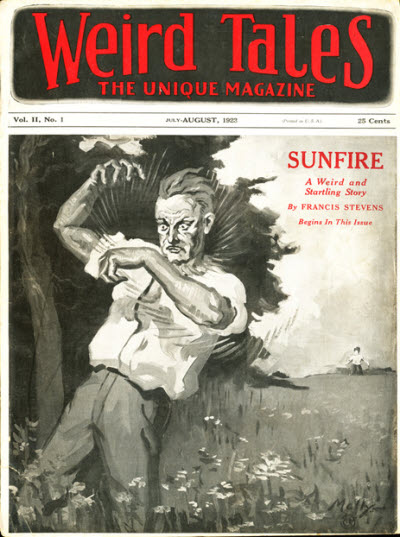
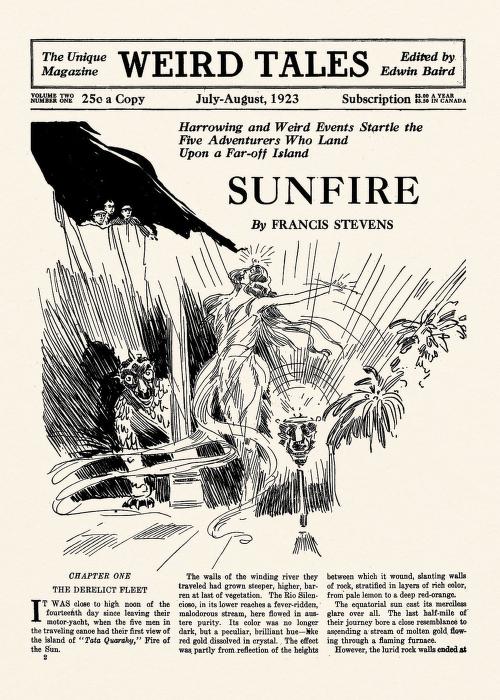
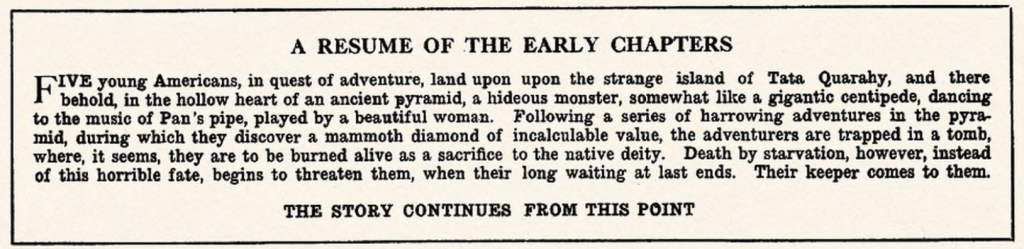
“Sunfire” by Francis Stevens was serialized in two parts in Weird Tales (Jul-Aug & Sep 1923). Lovecraft’s letters do not mention this tale, but neither does Lovecraft report on most of the contents of these early issues of Weird Tales in his early letters. Regardless, it is likely that Lovecraft did read this story, especially since it was the cover story for the Jul-Aug 1923 issue.
Unfortunately, this final effort is not Francis Stevens’ best work, lacking the imagination and subtlety of stories like “Unseen—Unfeared” (People’s Favorite Magazine, 10 Feb 1919), “Serapion” (Argosy, 19 Jun-10 Jul 1920), or “Claimed” (Argosy, 6-20 Mar 1920), the stories which are the most “Lovecraftian” in theme and mood. Instead, “Sunfire” is a rather typical lost world/lost race novella which Stevens has attempted to tell in a brisk style that contrasts humor and horror—light, zippy dialogue fights with efforts to express fantastic visions or dangers. The characters are only lightly sketched, and there is a Keystone Cops element to their portrayal, the five protagonists almost tripping over themselves at the sight of a pretty young blonde, lampshaded by their own self-awareness of what utter boobs they’re being. It would almost qualify as a parody of the genre.
It was part of a genre. The massive expansion and consolidation of European colonial empires in the 19th century had been an age of exploration and conquest, and in the early 20th century the romantic notion of the white man’s expedition was swiftly running out of unknown regions with uncontacted indigenous peoples to exploit. H. Rider Haggard’s Allan Quartermain novels were only one starting point that typically involved white men penetrating some exotic region, encountering indigenous peoples, and often contacting lost white tribes, ancient cities and ruins, and quite possibly unfeasibly sized jewels and monsters, natural or supernatural. “Sunfire” may in this respect be compared and contrasted with stories like Henry S. Whitehead’s “The People of Pan” (Weird Tales Mar 1929) and “The Great Circle” (Strange Tales of Mystery and Terror Jun 1932), Robert E. Howard’s “The Gods of Bal-Sagoth” (Weird Tales Oct 1931) and “The Valley of he Worm” (Weird Tales Feb 1934), A. Merritt’s “The Moon Pool” and “The Metal Monster”…and dozens of other stories that ran in the pulps. Even Lovecraft’s At the Mountains of Madness follows the form of an expedition story…but there, the similarities with “Sunfire” largely end.
Francis Stevens obviously cracked a book or two researching this story; the first couple of chapters include a number of details relating to Brazilian culture that are more or less accurate (caboclos, farina, chiheh, assai wine, giant centipedes, etc.). The depictions aren’t perfect (how the indigenous guides died of beri beri in a week is beyond me), but it’s obvious that she put at least a minimum of effort into actually centering the story when and where it should be. So too, while finding a beautiful blonde white woman in a place where it was believed no white person had gone before is straight out of the lost world story playbook, the actual descriptions of some of the weird phenomena and architecture show that Stevens was very capable of fantastic prose:
Then all paused uncertainly. The abruptness of a tropical sunset had ended the last of the day. Great stars throbbed out in a blue-black sky. The breeze had increased to a chill wind. All the pyramid was a mass of darkness about them, save that about the flat peak there seemed again to hover a faint, pale luminescence.
These clear, evocative bits of prose are, however, sandwiched in between a lot of zippy dialogue by a group of racist, sexist, and relatively horny and violent white men. This is very much of a piece with the other elements of lost world fiction; the kind of casual racism and sexism expressed in lines like:
She is of white blood, but she disgraces it. Any Indian woman, feeling as she pretends to feel, would dare the wrath of her people on earth and the gods beyond and be true to the humane instinct.
Is very much in keeping with the colonialist ideals and ethics that inform this piece. The casual assumption of white supremacy and feminine nature were a part of the language of such fiction. They didn’t have to be, but it was nearly universal to such pulp fiction, and while those elements haven’t aged well, they should also be seen as explicitly part of the trope-driven nature of this particular narrative. The light tone and humor contrast with the inherent horror of the piece, and the dialogue has aged about as well as the racism and sexism, coming across as stilted and unrealistic, though in the context of the 1920s it definitely captures the tone and language of that now-alien vernacular of the 1920s.
Some of Stevens’ fiction shares elements with Lovecraft’s own fiction, like the dark sea-god intimated in “Claimed” or the unseen presence in “Unseen—Unfeared,” illustrating that Lovecraft was himself working inside a kind of weird tradition, playing with many of the same concepts as other contemporary weird writers. Unfortunately, her story “Sunfire” shares almost nothing with Lovecraft’s fiction in theme or style. At one point she uses the word “Cyclopean” to refer to the pyramid, but aside from that bit of vocabulary, there isn’t much there that can be pointed to as potentially influential on Lovecraft.
However, Francis Stevens’ fiction should not be read from the perspective of “what did Lovecraft take from his?” It should be enjoyed in its own right. “Sunfire” isn’t a story I would recommend as an introduction to her fiction, or to anyone except diehard completionists of lost world fiction, but as an example of that mode of fiction, it stands up okay. Not some lost classic to be rediscovered, but a competent working of the familiar tropes and elements. Her other fiction, however, is worth reading. Not because Lovecraft read it (he probably didn’t), but as an example of what other people who weren’t Lovecraft were writing and publishing in Weird Tales at the time.
Francis Stevens might not have been an influence on Lovecraft, but she was a contemporary, and reading her fiction gives readers more insight into the literary traditions in which Lovecraft himself was working. In her own way and in her own style, she touched on some of the same elements completely independent of Lovecraft—because the pulp fiction tradition, and the weird fiction tradition, is bigger than Lovecraft and his contemporaries, bigger than the Mythos and cosmic horror, and many elements of what we now often call “Lovecraftian horror” were far from exclusive to Lovecraft himself.
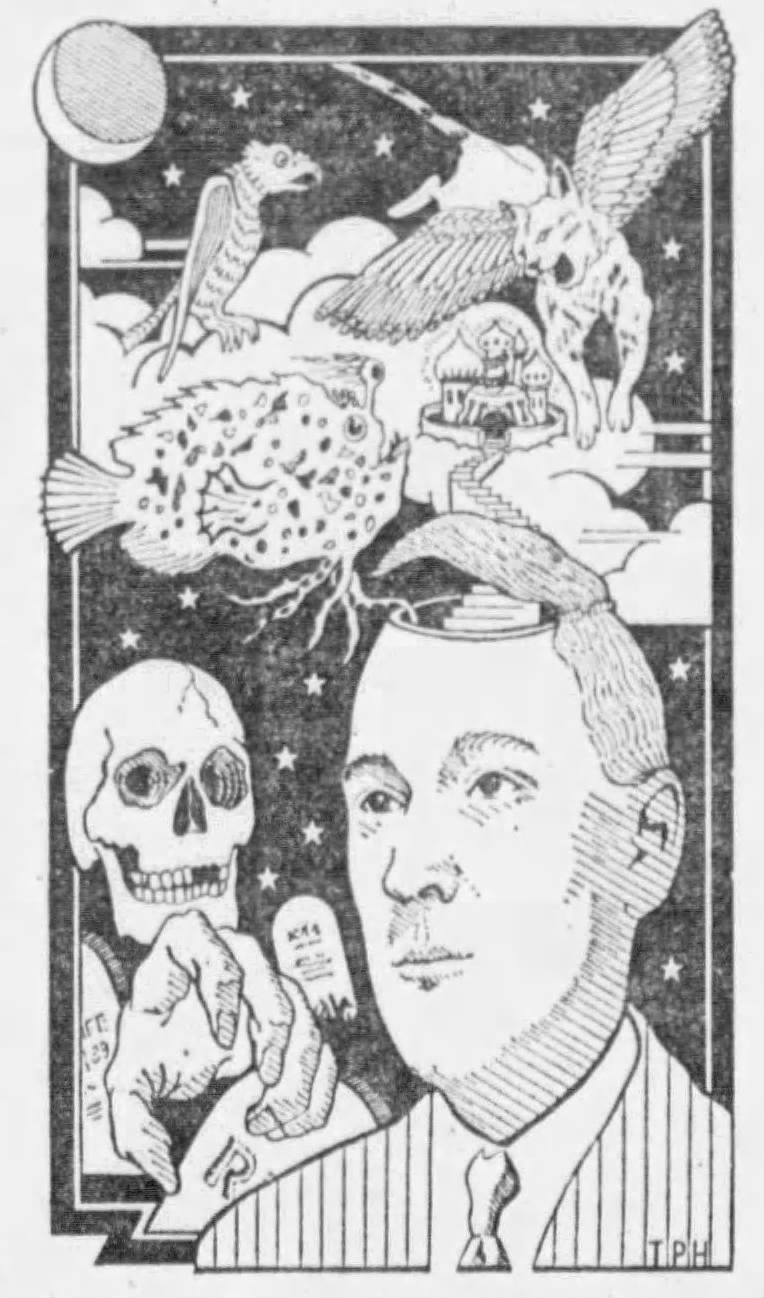
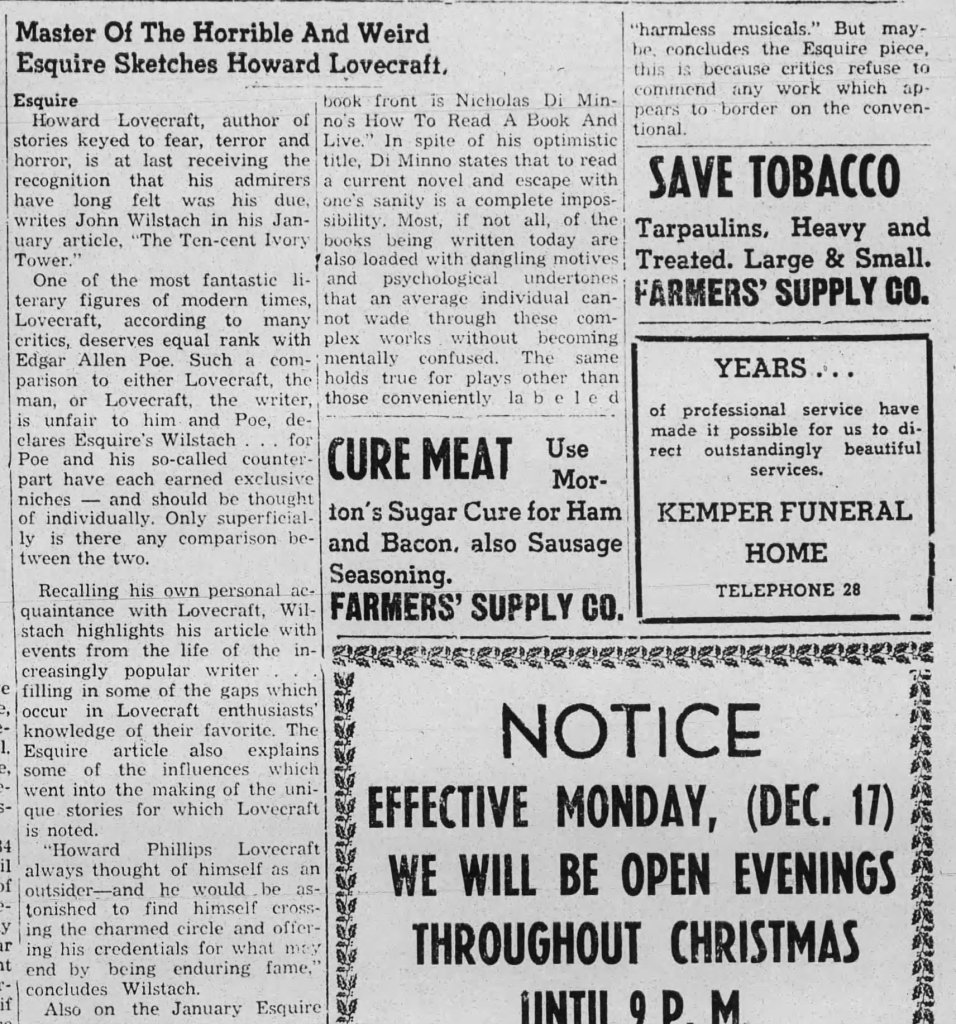
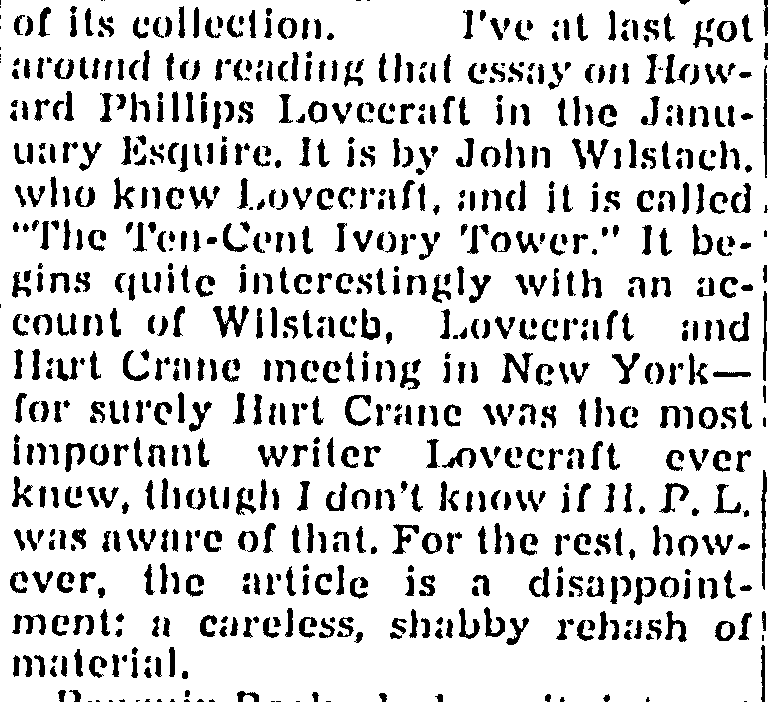
[…] I happen to have published, as long ago as in the January, 1946, issue of Esquire, the first article about Lovecraft to appear in a general magazine. It was by John Wilstach, called “The Ten-Cent Ivory Tower,” and this is how it began:
“Enthusiasts for the work of Howard Phillips Lovecraft have become a literary cult. Highbrow critics pay tribute to him as a writer of horror tales. His devotees insist that his place is in a niche beside that of Edgar Allan Poe. Collectors scramble for his first editions. Yet, to one who has known literary booms and their nourishing, it is amazing that nothing has been done to acquaint the public with the personality of a man who was one of the most fantastic literary figures of modern times.”
Arnold Gingrich, “The greatest character H. P. Lovecraft ever created” in the Chicago Times, 2 Feb 1975
How do we know what we think we know about H. P. Lovecraft? Over the decades since Lovecraft’s death, many works have been published about Lovecraft—memoirs, recollections, biographies—and a great deal of his personal correspondence, autobiographical essays, and photographs. Diligent researchers have scoured archives for marriage certificates, wills, draft cards, city directories, and brief mentions in newspapers and amateur journals. The mass of data can be intimidating, difficult to sift through, and perhaps most especially interrogate.
When it comes to memoirs of Lovecraft, it can be especially difficult to sort out the veracity of various claims. Memories are tricky things, and can be skewed by age, distance, and emotion. Many of the recollections of Lovecraft contain matter which seems to be erroneous; not so much deliberately misleading as incomplete. Dates don’t line up, incidents don’t quite match with other accounts, and misunderstandings abound. These are typical problems in evaluating historical evidence…but there is an added wrinkle.
From the beginning, Lovecraft memoirs and biographies have been referential. So when W. Paul Cook wrote “In Memoriam: Howard Phillips Lovecraft—Recollections, Appreciations, Estimates”(1941), he included quotes from an amateur journalism piece on Lovecraft from 1919; when Winfield Townley Scott wrote the biographical essay “His Own Most Fantastic Creation” (1944), he drew material from Cook’s “In Memoriam”; when Sonia H. Davis wrote The Private Life of H. P. Lovecraft, she specifically spoke to several points in Cook’s memoir—and that’s one chain of references where the later author acknowledges drawing on the former. There are many works that borrow from other essays and memoirs on Lovecraft without acknowledgment so that you can have a number of works that have a superficial agreement—but might all be repeating the same legends and false information.
So how do you pick out fact from fiction in a Lovecraft memoir? Generally, the first task is to cross-reference the persons and events in the memoir with Lovecraft’s letters and, if possible, other sources to fix the dates and verify the contents as much as possible. There is a bit of a contradiction involved in this: if a memoir agreed 100% with all existing sources without any disagreement, it would be very easy to verify—but it wouldn’t be very useful, as there would be no information in there that wasn’t in other sources. What readers and scholars both like is new information, new data, some unique insight into Lovecraft’s life to add to our store of knowledge.
From this standpoint, “The Ten-Cent Ivory Tower” (1946) by John Wilstach seems at first promising: while Wilstach makes a number of errors about Lovecraft’s life and work (not uncommon in the memoirs), many details ring at least somewhat true (or at least familiar), and it contains some material not included anywhere else, including details of a meeting with Lovecraft and the gay poet Hart Crane in New York c.1925.
As background: John H. Wilstach (1890-1951) was a novelist and fairly prolific pulp-writer. He had some association with amateur journalism, publishing material in Driftwind and The Ghost, but he was mostly published in the Argosy, Top-Notch, and associated pulp magazines. His article “The Ten-Cent Ivory Tower” in Esquire was a very rare appearance in a “slick” magazine.
The first problem comes when trying to cross-reference dates and persons. Lovecraft and Crane did meet a couple of times, first in Cleveland in 1922 and later in New York City in 1924 and 1925. However, in no published letter does Lovecraft ever mention John Wilstach, nor is such a meeting with Crane and an unnamed third individual mentioned in Lovecraft’s diary for the period. For that matter, the published letters of Hart Crane, with their brief references to Lovecraft, don’t mention John Wilstach either. This individual, who claimed to be Lovecraft’s friend and to have met him several times in New York and Providence, RI, would appear to have fallen completely through the gaps in Lovecraft and Crane’s correspondence.
By itself, that might not be suspicious; Lovecraft’s correspondence for the New York period is not complete, and his meetings with Crane are not all well-recorded from either side. It is not inconceivable that there could be a meeting between Lovecraft, Crane, and a third man that both Lovecraft and Crane failed to record. In point of fact, there is another memoir that includes just such a meeting: Frank Belknap Long, Jr.’s “Some Random Memories of H. P. L.” published in Marginalia (1944), less than two years before Wilstach’s article. This brings us to the next problem.
Long’s memoir recounts a meeting between Lovecraft, Crane, Samuel Loveman, and himself on the street in New York in “the second year of [Lovecraft’s] New York phase”—Lovecraft had come to New York and married Sonia H. Greene at the beginning of March 1924, so the meeting would be post-March 1925. Long wrote:
Howard had never seemed more depressed—he was writing such lines as these: “My coming to New York had been a mistake; for whereas I had looked for poignant wonder and inspiration I found only a sense of horror and oppression. Instead of the poems I had hoped for there came only a shuddering blankness and ineffable loneliness.”
Frank Belknap Long, Jr., “Some Random Memories of H. P. L.” in Marginalia 335
The lines are part of the opening of Lovecraft’s story “He,” which was begun in August 1925, in general agreement with when Long says the meeting took place. In “The Ten-Cent Ivory Tower,” Wilstach wrote:
“Hart drew a battered manuscript from his pocket and I began reading:
“My coming to New York had been a mistake; for whereas I had looked for poignant wonder and inspiration in the teeming labyrinths of ancient streets…in the Cyclopean modern towers and pinnacles that rise blackly Babylonian under waning moons, I had found instead only a sense of horror and oppression which threatened to master, paralyze and annihilate me. . . .”
“Kinda turgid prose,” I waved my hand to stop him.
John Wilstach, “The Ten-Cent Ivory Tower” in Esquire Jan 1946, 83
What are the odds that Lovecraft and Hart Crane had not one but two otherwise unrecorded encounters, and that both of them would quote from the opening paragraphs to “He?” At this point, a scholar might be suspicious. Testing those suspicions would require comparing the content of “The Ten-Cent Ivory Tower” against the other sources available in 1946 when the piece was published. For the most part, this would mean Cook’s essay “In Memoriam” (1941), the first three Arkham House books regarding Lovecraft (The Outsider and Others (1939), Beyond the Wall of Sleep (1943), and Marginialia (1945)), the slim chapbook Rhode Island on Lovecraft (1945), August Derleth’s H. P. L.: A Memoir (1945), and some scattered essays, critical reviews, and articles, some of which were collected in Marginalia, such as the early version of Winfield Townley Scott’s biographical essay “His Own Most Fantastic Creation.” Crane’s letters mentioning Lovecraft would not be published until some years later.
As it turns out, most of the content in “The Ten-Cent Ivory Tower” could have been sourced directly from these existing sources; a copy of “In Memoriam” and Marginalia would have supplied nearly every “fact” (and much of the speculation) in Wilstach’s piece. Cook had not mentioned Hart Crane, but like Long he quoted from “He” to illustrate Lovecraft’s despair at the city he had come to detest. Wilstach acknowledged Cook in a way when he wrote:
W. Paul Cook tells me that Lovecraft made three poetry reputations with his rewrite method.
Unlike many Lovecraft enthusiasts, Cook insisted that, though his friend was a genius, one stout volume of stories, and another of letters, will provide his lasting work.
“Lovecraft has been compared to all the great masters of the macabre from Poet to James,” says Cook. “Only in spots can be found basis for comparison. A hint here and there of Poe—perhaps. A sign of Dunsany—possibly. Lovecraft identified his own influences as Dunsany, Poe, Arthur Machen, and Algernon Blackwood, rather than to Montague Rhode James. If we mention Machen and Blackwood we have about exhausted any color he may have unconsciously acquired from others. Since his advent, weird fiction has owed more to Lovecraft than Lovecraft owed to all the body of preceding writers.
“A friend once suggested the he stimulate dreams by means of drugs. Lovecraft exclaimed that if drugs would give him any worse dreams than he experienced without them, he would go mad. His dreams were his own It is unfair to call him equal to Poe, greater than Poe, or lacking in certain Poe qualities. Better, consider him as standing alone.”
That standing alone, for our friend, sounds very fair. And to judge him at all one must judge him as a writer, since he never was anything else. He never held any kind of a job, nor had the slightest inclination for any sport.
John Wilstach, “The Ten-Cent Ivory Tower” in Esquire Jan 1946, 160, 162
There is a bit of disingenuousness to this: while Wilstach is portraying this as something Cook told him personally, he is actually quoting directly from “In Memoriam” in the two middle paragraphs, and paraphrasing from there elsewhere. However, Cook and Wilstach were actually acquainted: Wilstach has an article in Cook’s amateur journals The Ghost #3 (May 1945) and #5 (Jul 1947). While neither article is about Lovecraft, their very presence confirms that the two men must have shared at least a correspondence. It’s not too much of a stretch to imagine that Cook himself was the source of the copy of “In Memoriam” that Wilstach must have had when writing “The Ten-Cent Ivory Tower.”
If a reader were to subtract from Wilstach’s memoir all the material that was directly attributable to Cook or a copy of Marginalia, the remaining details are few and rather weak. For example:
I learned that he had worked and roamed all night, slept since dawn, and had just breakfasted upon an orange.
John Wilstach, “The Ten-Cent Ivory Tower” in Esquire Jan 1946, 83
Lovecraft walking the streets of New York late at night, returning early in the morning, and sleeping late into the day are all believable; many letters support this behavior, and Cook and others commented on it. However, Lovecraft breaking his fast on an orange is unusual. While there are references to him consuming grapefruit when in Florida, citrus does not appear to have been a regular part of Lovecraft’s diet. One letter from his New York period shows how rare a treat fruit was to him:
[Sonia H. Lovecraft] left a lot of provisions here last week, including a lemon—so tonight I have been emulating W. V. Phillips in his vespertine glass of the citrick beverage.
Other little details face similar scrutiny. The errors become more glaring. The words Wilstach attributes to Lovecraft become less and less believable, even granting that twenty years had passed since they were set down. For example, during the apocryphal meeting with Crane, Wilstach wrote:
Crane muttered that I might tell something about the market.
“What have you been aiming at?” I asked him.
“I don’t know. Hart thinks my scripts should be typewritten.”
Well, it was unbelievable–he was actually, in person, the amateur who brought a manuscript rolled up, in handwriting, and tied with a string–and called back to find it still tied with the same string. Of course he had sought out the offices of Harper’s, Century, Scribner’s, while any tyro would know that his own chances were at the Munsey or Street & Smith’s fiction chains.
John Wilstach, “The Ten-Cent Ivory Tower” in Esquire Jan 1946, 83
It is unbelievable—because we know that while Lovecraft hated typing, he had learned after his first submissions of longhand manuscripts to editor Edwin Baird of Weird Tales that manuscripts had to be typed. Sonia H. Davis in her memoir of their marriage recalls how their honeymoon was spent in part with her reading out his manuscript for “Imprisoned with the Pharaohs” as Lovecraft laboriously typed it out on a rented machine. Wilstach’s repeated claim that Lovecraft never typed is patently not true—but is it the case of bad information, misremembering, or something worse?
Many magazines were published in the month before the cover date; newspaper journalists appeared to accept Wilstach’s piece at face value. Contemporary fans too appear to largely accept Wilstach’s article as accurate, with one writing:
In the few pages of the article he paints a very good word picture of Lovecraft as he knew him.
Jay Edwards, “Lovecraftiana” in Lethe #9 (Sep 1948)
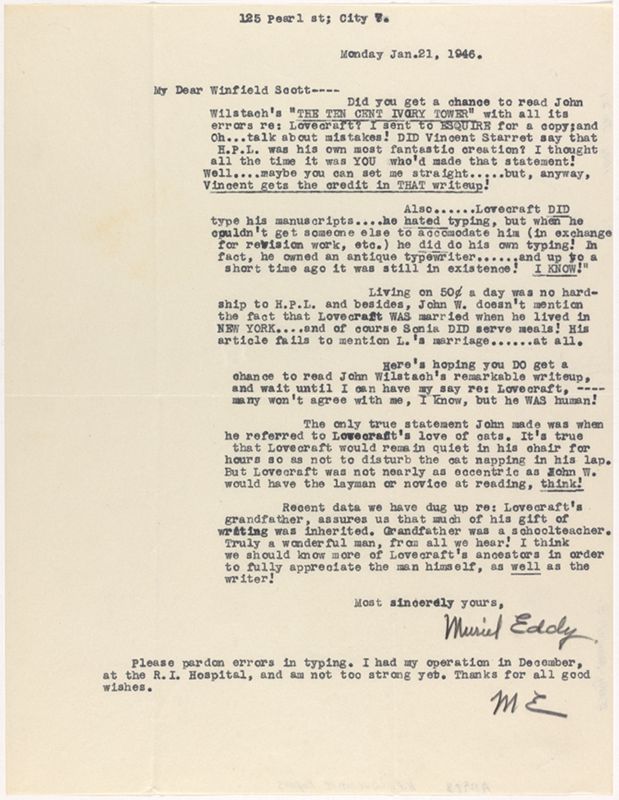
J. C. Henneberger wrote to Esquire saying the piece was flawed, and his letter was published in the March 1946 issue; Wilstach responded with a rebuttal in the June 1946 issue, which failed to correct any issues but cited W. Paul Cook’s piece on Lovecraft in The Ghost.
Time, no doubt, exposed more of the obvious flaws in Wilstach’s Esquire article to fans and would-be scholars alike. Lovecraft’s friend Robert Bloch would write:
My friend, the late John Wilstach, may or may not have met H.P.L. in the flesh; for the purposes of auctorial authority he laid claim to having done so in New York, during the Twenties, and penned an article for Esquire magazine, some years after H.P.L.’s death, entitled The Ten-Cent Ivory Tower.
I corresponded with Wilstach for some time before his own passing, and I can attest that his personal admiration for Lovecraft was unbounded. Nevertheless, he knowingly added his bit to the growing accumulation of Lovecraftiana which emphasizes only the legendary aspect, the “fantastic creation” rather than the whole man.
S. T. Joshi in H. P. Lovecraft: A Comprehensive Bibliography minces no words and simply calls Wilstach’s “The Ten-Cent Ivory Tower” fictitious. This makes a certain amount of sense: unlike “The Day He Met Lovecraft” (1972) by Lew Shaw, Wilstach was presumably paid for the article, and Esquire was a prominent enough market that publishing in it could raise a writer’s profile. There was a potential incentive for Wilstach to invent meetings and a friendship that maybe never took place.
When taken all together—the obvious errors, the borrowing from Cook, the absence of Wilstach from Lovecraft and Crane’s letters, the bits that just don’t line up—”The Ten-Cent Ivory Tower” is ultimately a poor source. Too much doesn’t fit with other facts from Lovecraft’s life, too much feels like a fictional narrative. Not useful to Lovecraft scholars or particularly interesting for fans today. The value of “The Ten-Cent Ivory Tower,” if any, is largely historiographical: this was a step toward a deeper understanding of and wider interest in Lovecraft and his work. While it might be a false step, how many thousands of readers encountered Lovecraft through this article in Esquire? Read about it in newspapers and fanzines? How many lives did Wilstach touch with this one piece?
Even though a memoir may sink out of sight and out of mind, in its passage it has left a mark on the world.
In the 1920s and 30s in the United States of America, erotica was technically illegal—groups like the New York Society for the Suppression of Vice worked hand in glove with the police and the government censors of the United States Post Office to crack down on anything that smacked of smut, from James Joyce’s Ulysses (1922) and Henry Miller’s Tropic of Cancer (1934) to Tijuana bibles, nudist magazines, or explicit works on birth control.
This did not stop the production or distribution of erotic works, but it drove it largely underground. Ambitious but shady individuals placed ads big and small in pulp magazines like Weird Tales, coding their books as works of medical or anthropological interest to skirt the laws. Pulp magazines with sex interest like Spicy Mystery and its sisters skated a thin line between being permissible or being deemed obscene and taken off newsstands and sometimes crossed it.
It took decades for the legal standards to loosen. Landmark cases like United States v. One Book Called Ulysses, 5 F. Supp. 182 (SDNY 1933) and Grove Press, Inc. v. Christenberry, 175 F. Supp. 488 (SDNY 1959) opened the door for people in the United States to publish and possess such works as Fanny Hill (1748) without fear of the books being seized and burned, and the publishers fined and imprisoned. With the new legalization of erotic literature came availability, as old classics were reprinted openly to meet a curious demand.
The artificial restrictions on publication had helped to create a kind of erotic canon; works like The Golden Assof Apuleius, Giovanni Boccaccio’s Decameron, Leopold von Sader-Masoch’s Venus in Furs (1870), and the anonymous The Way Of A Man With A Maid(1908) weren’t necessarily the most transgressive or well-written erotic works, but in the grey market of erotic books, certain titles had by dint of age, popularity, or literary quality stood out above the rest and became a part of the culture.
It is this loose canon that many writers continue to call back to. Pluto in Furs (2019) and Pluto in Furs 2(2022), anthologies of weird explicit fiction, is a deliberate reference to Venus in Furs. Peter H. Cannon’s jocular short story “Asceticism and Lust: The Greatest Lovecraft Revision” (1988) imagines a collaboration between Lovecraft and Henry Miller that results in “Tropic of Cthulhu”—a tongue-firmly-in-cheek reference to Miller’s censored novels Tropic of Cancer and Tropic of Capricorn (1939). Lovecraftian erotica, by the way, took a few decades to really get going in no small part because of the legal restrictions outlined above. The freedom to read Ulysses also brought with it the freedom to appreciate all the further extrapolations of sex and the Cthulhu Mythos.
So when a reader picks up the Nookienomicon and leafing through those austere pages reads the title of one story is “Lady Chatterly’s Blowhole” by Beth W. Patterson, there is a certain expectation that they will get the reference, even if they haven’t read the book. Like Mark Twain’s Huckleberry Finn or Shakespeare’s plays, a certain amount of cultural osmosis is assumed to have occurred.
The world is supposed to be full of possibilities, but they narrow down to pretty few in most personal experience. There’s lots of good fish in the sea…maybe…but the vast masses seem to be mackerel or herring, and if you’re not mackerel or herring yourself you are likely to find very few good fish in the sea.
D. H. Lawrence, Lady Chatterly’s Lover (1928)
The intention of “Lady Chatterly’s Blowhole,” however, is not to be a pornographic episode along the lines of “The Flower of Innsmouth” (2011) by Monique Poirier or an erotic paranormal romance novel like Tide of Desire (1983) by Sheena Clayton. The Nookienomicon promises “Bawdy Tales of the Cthulhu Mythos,” and Patterson delivers in a double-entendre-laden comedy that is more sizzle than steak. Working in the tradition of the period works that often had to couch any eroticism in euphemism to get past the censors, this honeymoon in Innsmouth tiptoes the fine line between discussing marital relations—and Innsmouth lore—openly and hinting at it as strongly as possible.
The tone is deliberately light, and Patterson manages to hit a certain comedic line that marks the spoof rather than the farce, although it’s damn close. This is a story that could sit fairly next to “At the Mountains of Murkiness, or From Lovecraft to Leacock” (1940) by Arthur C. Clarke or the Innsmouth episode from Mark E. Rogers’ The Adventures of Samurai Cat(1984). The puns come fast, furious, and often in an unrelenting stream. To give just the barest flavor of the narrative:
[“]Such is the way of people touched by the Old Ones.”
“Touched by the Old Ones?” Fannly looked delightedly aghast. “In what way? Can you show me on a doll?”
Beth W. Patterson, “Lady Chatterly’s Blowhole” in the Nookienomicon71
To spoof something properly, you have to love it, and there’s a lot of love on display here. Patterson doesn’t just make the obvious jokes (although the stream of sexual innuendos and nautical euphemisms is relentless), and does more than just tease eldritch revelations.
“Is it normal for men to have five of those?”
“Not human men,” replied her husband. “His trousers must fit him like a glove…darling, are you disappointed?”
Beth W. Patterson, “Lady Chatterly’s Blowhole” in the Nookienomicon 68
Aficionados of the Cthulhu Mythos will have read any number of escapes, successful or attempted, from Innsmouth that have been published over the decades, but I can fairly guarantee that they haven’t read one quite like “Lady Chatterly’s Blowhole.”
Eldritch Fappenings This review deals with works of erotica, and the history of erotic art and writing. As part of this review, selected passages involving sexually explicit activites will be included. As such, please be advised before reading further.
The nature of the said delights was a mystery that was sealed off with a picture of a nude, big-breasted woman lying prone on a greenish stone slab, her butt lifted up by an imposing figure in shadows, who seemed to be wearing some kind of costume and a cape that spread out like wings. A themed orgy? It had intrigued her to no end, the goblet of her unmet desires begging to be filled with a wine she had never tasted.
Lovecraftian erotica is the fiction of transgression. Folks generally don’t write about the perfectly normal sex life of Edward Pickman Derby and Asenath Waite, or the raunchy but otherwise unremarkable wet dreams of Walter Gilman and the coeds he spied in the shower. When Innsmouth and R’lyeh come into play, people expect—not unfairly—for things to get properly weird. What qualifies as “weird” depends on your starting point. How much pornography and erotic fiction have you already consumed, how many sexual encounters have you had? What exactly is left that will shock you? What boundaries do you have left to transgress?
In that respect, the quest for greater titillation parallels and can overlap the quest for knowledge that marks much of Lovecraftian fiction. Protagonists draw closer to the central mystery, led there by an insatiable curiosity. Libido sciendi, the desire to know. Jaded seekers of the ultimate thrill who stumble onto the Mythos are an entire mode of Lovecraftian erotica. In that respect, “In the Name of Cavities” is part of a literary tradition with Robert M. Price’s “A Thousand Young” (1989). Except instead of a jaded libertine seeking greater carnal desires, it’s a bored housewife answering an internet advertisement for some excitement in a sexless marriage.
Any road up, as the saying goes. Rajeev Singh’s premise and characterization work in large part because they do start out very much with the starting point of utter mundanity: the neglected housewife decides to cheat. Yet this isn’t a morality play on the consequences of adultery; by chance, Anaïs has stumbled onto something more than the Eyes Wide Shut-style party she’d maybe hoped for.
Which is an aspect of the story that Singh doesn’t dwell upon: how much contemporary media has shaped our idea of what transgressive erotica really is. When we see the BDSM playroom in From Beyond and Barbara Crampton dawns her leather apparel, the audience is supposed to recognize that as a corruption of the character, or at least an awakening of darker sexual desires than missionary position with the lights off. Real bondage play, and the communities that develop around those desires, are strange and alien by comparison to those depicted in works like Fifty Shades of Grey, dealing as they do with issues of consent, safety, and roleplay.
So how much of what Anaïs saw should she have recognized? How much should the readers have recognized? When you read a passage like:
At first, she couldn’t say for sure but yes, the business end of each arm or tentacle did resemble a hard penis. And they weren’t just showpieces, those erections. Many of the feelers were busy plunging in and out of cavities all over a woman’s body as she lay flat on a green stone slab, similiar to what Anaïs had seen on the internet, only butt-downward.
Anaïs does not make the immediate connection to Japanese hentai, works like La Blue Girl or Urotsukidoji. Naughty tentacles have become a trope in some circles for so long that the shock value has largely worn off…but the idea still has legs. Readers already familiar with works like Booty Call of Cthulhu (2012) by Dalia Daudelin and “The Flower of Innsmouth” (2011) by Monique Poirier probably won’t be shocked, but they might still be appreciative of the execution. Jaded sensibilities mean there are very few erotic impossibilities that haven’t shown up somewhere, in some media, and that is reflected in the frustrated Lovecraftian sex-quest.
It is very difficult to come up with something completely new and original.
To take another example from the story, Singh’s use of “cavities” is strongly reminiscent of Graham Masterton’s short story “Sex Object” (originally published in Hottest Blood, and then adapted to comics in Verotika #7), or even of the comic series Stranger Kisses. It’s hard to point out these works as inspirations, many writers stumble upon the same ideas completely independently of one another.
As a work of Lovecraftian fiction, “In the Name of Cavities” lives in a little universe of its own, relatively self-contained…but that’s okay because the last few pages take that idea and run with it, projecting the lusty present out into a post-apocalyptic future. That extension of the idea far beyond the length of the encounter, the duration of a climax, is a pleasant surprise…and a possibility that works within a Lovecraftian premise better than it does with most other erotic works.
Eldritch Fappenings This review deals with works of erotica, and the history of erotic art and writing. As part of this review, selected passages involving sexually explicit activites will be included. As such, please be advised before reading further.
Joanne Lagrasse is a newly graduated college student living the life. Well, if the life is sitting in your apartment all day trying to research monsters for a novel. The strange book her favorite professor gave her is full of ramblings by what must be a mad man, which makes for uneasy reading and a loner lifestyle.
She pushes herself to go out to the beach, though the takes the tome with her. When she decides to not heed her professor’s warning and reads a chant out loud, she finds herself faced with a giant monster and its lewd tentacles, each one eager to fill her holes.
Before the internet, erotic literature often left a literal paper trail. It wasn’t enough to write a story or book, if you wanted to sell it you had to advertise—small ads in appropriate adult newspapers or magazines (or, for erotic fanfiction, fanzines), mail-order catalogs or lists of other publications in the backs of books, and for particularly notable works perhaps even a published review in some suitable medium. By the early 2010s, the game had fundamentally changed: the cheap adult paperbacks of previous decades had largely fallen off with the rise of more readily-available pornography, and self-publishing became feasible thanks to print-on-demand publishing and ebooks. The internet was a great leveler, doing away with much of the traditional advertising—and with it, much of the traditional paper trail which historians and smuthounds alike relied on.
Now, scholars have to rely on search engines and internet archives, hoping for social media posts, blogposts, and the occasional interview:
ED: I see you write tentacle erotica, which has a soft spot in my heart as an anime geek. How did you get into that sub-genre?
DD: I love H. P. Lovecraft! I’ve been a member of 4chan’s /x/ for, well, probably 6 years now. That’s their paranormal board. Horror and tentacles are both very fun to write, especially when you can make them sexy.
Booty Call of Cthulhu by Dalia Daudelin is a good example of the works of the period. Originally released as a Kindle ebook under the nom de plume Roxy Feurouge in 2012 (and as by Mia Lust on Barnes & Noble’s website), then as a thin print-on-demand softcover in 2013 (still available), the story is straightforward and geared toward specific, clearly indicated kinks: monsters, tentacles, dubious consent—and it delivers on all counts.
My jaw went slack. My mouth opened just enough for the tentacle to slide in. It went from a wool texture to something more slimy, a bit like another tongue.
Readers hoping for an erotic re-telling of “The Call of Cthulhu” or a Cthulhu Mythos pastiche with a bit more explicit sex than usual will be sorely disappointed. While not quite Porn Without Plot, most of the twelve print pages are devoted to a detailed array of sexual acts, most involving tentacles. Comparisons with tentacle-themed Japanese adult animation like La Blue Girlfall a bit short: while the sex scenes cover much of the same material (penetrations anal, oral, and vaginal, etc.), there is quite a bit more story and character development in the Japanese manga and its anime adaptation. Booty Call of Cthulhu is written like a typical pornographic feature film, with the brief non-sexual interludes providing the set-up for the next carnal scene, with an abrupt finish after the final climax.
Short, sweet, and to the point—and when compared to similar works of the period like I Was Impregnated by Cthulhu! (2012) by Penny P. Zahn, The Tentacles of the Elder Gods (2012) by Lindsey Purl, Cthulhu’s Carresses(2013) by Amy Morrel, Uhluhtc’s Sacrifice(2013) by Grace Vilmont, I Fucked Cthulhu!(2013) by Deliah Fawkes, Cuckolded by Cthulhu (2013) by Lillian Jacobs, and Cthulhu Comes (2014) by Sandy Laws—Booty Call of Cthulhu isn’t particularly poorly written. If there’s a real criticism to be made, it’s that it is no more than it set out to be, and a much more engaging erotic narrative could have come from the same premise.
What differentiates Booty Call of Cthulhu from most of its contemporaries is that it was either popular enough or sufficiently tickled the imagination to elicit two sequels: Booty Call of Cthulhu 2 and Booty Call of Cthulhu 3 by Wren Winter—and neither of which is currently available (Wren has also written My Night With Cthulhu, which is not either of those two books under a new title).
Whether this is a licensing issue or Amazon removed the ebooks for violating one of their policies is unclear, and probably will remain so…because as with internet fanfiction, the internet’s archive is imperfect and there is no paper trail. Neither 2 or 3 ever received a hardcopy printing, at far as I’ve been able to determine, and unless you were fortunate enough to buy them during the window of opportunity they were available, those texts are essentially impossible to obtain. Should the files be corrupted or Amazon stop supporting them, they may well be lost forever.
Several of Booty Call’s contemporaries, including I Was Impregnated by Cthulhu! and Cuckolded by Cthulhu have already suffered the same fate. It’s not just that these works exist only on a handful of Kindle accounts, but unless you were aware they existed already it is exceedingly difficult to find out they ever existed. Posting an ebook to Amazon and letting the search engine handle discovery for a public apparently starved for sexually explicit Mythos-flavored content was often enough to sell a few copies…and then, for one reason or another, the ebooks were no longer sold, and there might not even be a page to point at to show where it had been for sale.
Given the ephemeral nature of pornography and the quality of the writing, few folks will lament this as a great loss to our shared cultural heritage—most erotica is treated as eminently disposable, to be enjoyed in the moment but not necessarily saved for posterity as with so many other books. Yet works like Booty Call of Cthulhu certainly represent a certain moment in time, and a literary trend which, in its perennial reflowering, means critics and fans of Lovecraft and the Cthulhu Mythos need to acknowledge two truths:
Some people want to read about having sex with Cthulhu, and a body of work has grown up to meet that demand.
The question that remains to be seen is how, if at all, these works might be preserved. It is fair to say that Booty Call of Cthulhu was not the first and will not be the last sexually explicit story about an amorous eldritch entity, but it is disturbing how easily such works can effectively fall off the face of the internet, perhaps never to be read again. Because it has a print edition, Booty Call of Cthulhu will probably linger on longer than most—and it is weird to think that in generations to come, a furtive Mythos fan may enter into a dusty bookshop and find among the dross of the 2010s an ancient example of Lovecraftian smut…
I entered, charmed, and from a cobwebbed heap Took up the nearest tome and thumbed it through, Trembling at curious words that seemed to keep Some secret, monstrous if one only knew. Then, looking for some seller old in craft, I could find nothing but a voice that laughed.
Sir: As if it were yesterday, I remember meeting H. P. Lovecraft on the corner of Benefit Street and College Hill about noon on a very warm, sunny day.
College Hill is a rather steep climb, but on that day, a friend of mine and I, both attending Classical High at the time, were climbng up it oward the campus. At the base of College Hill on Canal Street, a new courthouse had been built. By taking the elevators to the fifth floor, we could have emerged on Benefit Street and eliminated the climb. However, despite the warm day, we walked.
As we got to Benefit Street, my friend greeted a passerby and introduced me to him. It was H. P. Lovecraft.
Memoirs and anecdotes of H. P. Lovecraft tend to come from familiar names: his correspondents, friends like Clifford & Muriel Eddy (The Gentleman from Angell Street), and his wife Sonia H. Greene (The Private Life of H. P. Lovecraft) most prominent among them. Even the few unfamiliar names like Dorothy Tilden Spoerl (“Cosmic Horror”) prove to have some connection to Lovecraft with a little digging. The very few memoirs that don’t have any provable connection to Lovecraft are thus a little suspect; they are extraordinary, and extraordinary claims demand extraordinary evidence to prove them.
The geography of Providence is real, and while Lovecraft often kept late hours, he was also more active during the warmer months and went out of doors to write in the sunlight. So at least some of the details given are plausible. Yet the most interesting part of Shaw’s account is the least believable:
On that sunny afternoon, H. P. Lovecraft told us the strange story he wrote about a hotel on Benefit Street, a building which stands there no longer.
Lovecraft had written a story about a true incident. At one time there was a young woman, a chambermaid in the hotel on Benefit Street, who left and married into wealth. Sometime afterward, she returned to visit the hotel as a guest. When she found herself discourteously treated and snubbed, she departed but put a “curse” on the hotel, on all those who had humiliated her, and on everything concerned with the hotel. In short order, ill luck apparently befell all and the hotel itself burned down. Furthermore, it had never been possible, somehow, for anyone to rebuild on the site. Even on the day H. P. Lovecraft told us the story, the place where the hotel had stood was still a vacant lot.
Lovecraft had finished the story and, without making his usual carbon copy, made only one draft, which he then mailed to the publisher. His story never appeared in print. It was lost in the mails.
Lovecraft is not known to have written any story about a cursed hotel, nor is there a mention of a Lew Shaw in his voluminous published letters. Scholars might be suspicious—an account of a lost Lovecraft story by an unfamiliar name, decades after Lovecraft’s death, during the early 70s when paperback publication was raising Lovecraft’s public profile? It sounds a bit too good to be true. S. T. Joshi certainly was not convinced:
There is much reason to suspect this entire account. In the first place, the story sounds like nothing Lovecraft would have written—the idea is hackneyed, and the protagonist would uncharacteristically have been a woman. Secondly, it is inconceivable that Lovecraft would have prepared a story without his usual two carbons. In the case of his essay on Roman architecture in late 1934, he wrote the piece by hand and sent it to Moe without typing it at all. Lew Shaw claims to have actually met Lovecraft on the street, in the company of a friend “who was interested in science-fiction” and knew Lovecraft; this might conceivably have been Kenneth Sterling, but Sterling never mentions this matter in either of his two memoirs. Shaw also claims to be of the Brown Class of 1941; but there is no one of that name in that class listed in the Brown University alumni directory. There is a Lewis A. Shaw in the Class of 1948, and a Lew Shaw who received a Ph.D. in 1975, but that is all. My feeling is that Lew Shaw (probably a pseudonym) is perpetrating a hoax.
Joshi’s arguments are well-reasoned—but there are a few counter-arguments. While none of Lovecraft’s surviving letters mention a cursed hotel story, the account does not mention when the story was written or sent out; so it could conceivably fall into a gap in the correspondence, especially if the story was an early one or written for a revision client. A story set in Providence on Benefit St. isn’t out of the question either, “The Shunned House” was based on a real-life house (the Stephen Harris House, 135 Benefit Street). Likewise, while it would be uncharacteristic for Lovecraft to write a story with a woman protagonist, it was not unknown: “The Man of Stone” (1932) for Hazel Heald and “The Curse of Yig” (1929) for Zealia Bishop are primarily focused on female characters, or told in part from their perspectives, so it isn’t entirely out of the question. The postal service has lost many manuscripts and typescripts, so that by itself isn’t unbelievable either. The most obvious evidence of a hoax appears to be the absence of Lew Shaw himself…
Lewis Irwin Schwartz attended Classical High School in Providence, RI and graduated from Brown University in the class of 1941 (listed on page 72 of the Liber Brunensis for 1941). “Lew Shaw” was his stage name (“He Crashed The ‘Crewcuts’,” Brown Alumni Monthly Jan 1962). So, Joshi was correct that there was no “Lew Shaw” among the names in the Class of 1941, and that the name was a pseudonym—but didn’t have access to the bits of the puzzle that would show that Lew Shaw really did exist; those parts of the narrative at least match what we know of his background.
Joshi was also likely correct in identifying Shaw’s unnamed friend interested in science fiction as Kenneth Sterling. In Providence, Sterling attended Classical High School. They were both born in 1920, but Shaw was born in November, so he would probably have been a year behind Sterling. That gives us time as well: Sterling met Lovecraft in March 1935, and in the autumn of 1936 began attending Harvard, so the encounter with Lovecraft could only have happened in the summer of 1935 or 1936. Lovecraft doesn’t mention Shaw/Schwartz in the surviving letters to Kenneth Sterling, but on the other hand, those surviving passages are all excerpts, not complete letters, and there are gaps of months in the correspondence.
Kenneth Sterling wrote two memoirs about Lovecraft: “Lovecraft and Science” (1944) and “Caverns Measureless to Man” (1975). The first is slight, and doesn’t go into detail about how they met; the second is substantial, and more personal and biographical, going into considerable detail. Some of these jive with Shaw’s account:
During the academic year, excepting Christmas and spring recesses, the Science Club met weekly. That meant I had a schedule of one scientist a week—all, with two exceptions, from the Brown University faculty—and every time I walked up College Hill toward the Brown campus I visited Lovecraft for several hours. The total number of hours I conversed with him was huge.
Kenneth Sterling, “Caverns Measureless to Man” in Ave Atque Vale406-407
This would have been the path Shaw describes. Sterling doesn’t mention the cursed hotel story; the one anecdote Sterling tells about bringing a friend to meet Lovecraft doesn’t jive either, since it was at a gathering in New York City. Again, this doesn’t immediately rule out Shaw’s story, but it doesn’t fully confirm it either. Shaw’s account is shifted from obvious hoax to doubtful…and there’s one final bit of evidence to consider: was there a hotel, cursed or not?
Newport Mercury, 21 Feb 1920
The Hotel Lorraine was on 18-28 Aborn Street, on the other side of the Providence River from Benefit Street, a geographic detail that Lovecraft would not have missed, but I’ve yet to find a notable hotel fire on Benefit St. during Lovecraft’s lifetime—and the 18 Aborn St. lot was still vacant according to the 1935 Providence City Directory, which does jive with Shaw’s story. No mention of a curse has turned up yet, but a lot of century-old folklore probably wasn’t written down, much yet made it onto the internet, where searches about cursed hotels in Providence point toward the Biltmore (now The Graduate).
The question then becomes: is this an error with Shaw’s memory, or did he fabricate the whole anecdote? The former might be understandable: a couple of decades can erode the details of many memories, or add details that weren’t there before. If the latter, why? As far as is known, Shaw never attempted to pass the anecdote off to a paying magazine or publisher or profit from the supposed association. It was of the nature of a brief letter to the editor to a college alumni journal about a local writer with ties to the college whose posthumous star had lately been on the rise and who had ties to Brown (Lovecraft’s papers are archived at the university library). In the Feb 1972 issue of Brown Alumni Monthly there had been an article on “Lovecraftmania at Brown” which probably suggested the letter.
Without any further evidence in Lovecraft’s letters to support the idea that the meeting actually took place, “The Day He Met Lovecraft” will have to remain classified as somewhere between doubtful and apocryphal. We have no absolute evidence that Shaw/Schwartz actually met Lovecraft, as there are no details in the incident that can be independently corroborated with sources that weren’t already published at the time. As Joshi noted, the plot sounds fairly hackneyed and un-Lovecraftian; not something he would write for himself, even with the local angle.
However, we also cannot entirely rule out that Shaw did not meet Lovecraft; we know Sterling had brought at least one friend to meet Lovecraft according to his later memoir. The plot of the apocryphal tale sounds un-Lovecraftian, but Lovecraft was willing to bend his artistic scruples a bit for revision clients. Is a lost revision story plausible? There’s evidence to suggest Lovecraft revised more stories than saw print, such as “In the Gulf of N’Logh” (193?) and “Lair of Fungous Death” (193?) by Hazel Heald, and his letters to Zealia Brown Reed Bishop. By 1935, Lovecraft had largely stopped revising fiction, but it is possible he was talking about an earlier story—Lovecraft didn’t discuss much of his revised fiction that didn’t get published.
While Lovecraft’s life is extraordinarily well documented by his letters, there are still little gaps in which things happened for which we have no record…and, perhaps, in which a clever fiction might be woven. Shaw’s account cannot be entirely ruled out, but neither can it be proved, unless more information comes to light.
Thanks and appreciation to Dave Goudsward for all of his help and assistance.