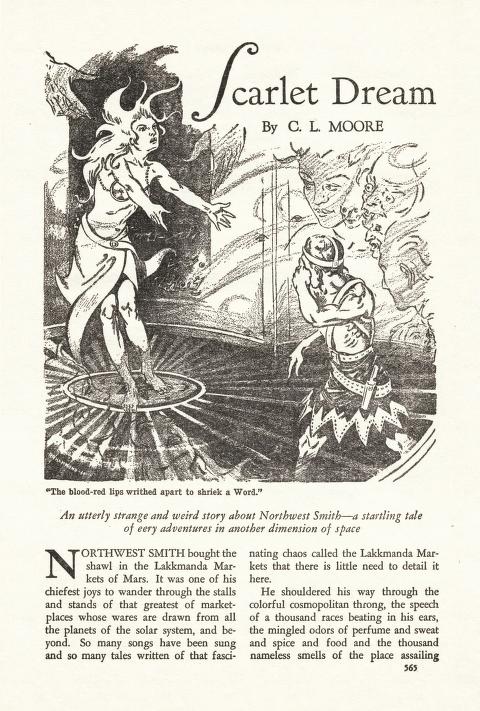
“Black Thirst” (1934) by C. L. Moore

JE: Did the success of “Shambleau” generate numerous requests for additional stories?

CLM: No, not really. The editor of Weird Tales, Farnsworth Wright, simply told me that he would like to see more of my work. No other editors, at the time, wrote to me requesting additional stories. My success in the science-fiction field came gradually and only after the publication of several other stories. […] I didn’t want it to be known at the bank that I had an extra source of income. I wrote “Shambleau” in the midst of the Depression. The bank was a very paternalistic organization. It was already firing those people whose services weren’t really needed. I had the feeling that they might have fired me had they known that I was earning extra income. So I kept it a deadly secret. Using my initials was simply a means of obscuring my identity.
—“C. L. Moore: POET OF FAR-DISTANT FUTURES” by Jeffrey M. Elliot in Pulp Voices (1983) 46-47

“Shambleau” (WT Nov 1933) struck like a lightning bolt—boldly original, and meeting almost universal acclaim. Yet the pages of Weird Tales are littered with one-hit wonders, authors who sold a single story and never made another sale, or who did sell again but could never recapture the power and promise of that first story. With C. L. Moore’s second tale, readers would find out whether “Shambleau” was a lucky accident or not. Within a few months, they found out.

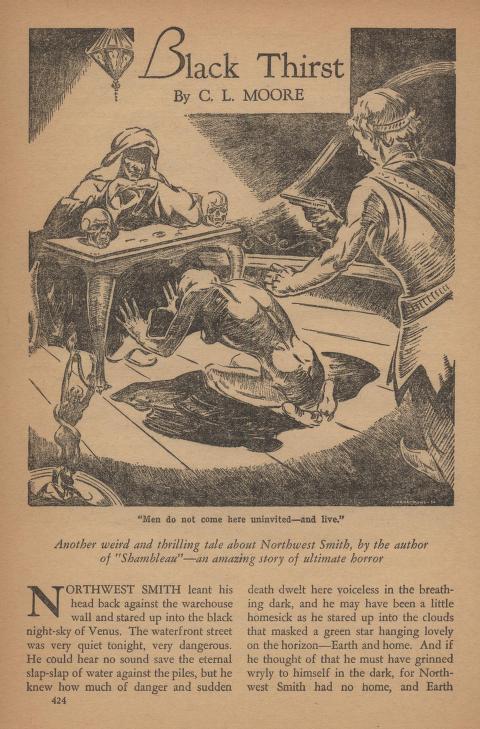
BLACK THIRST
by C. L. Moore

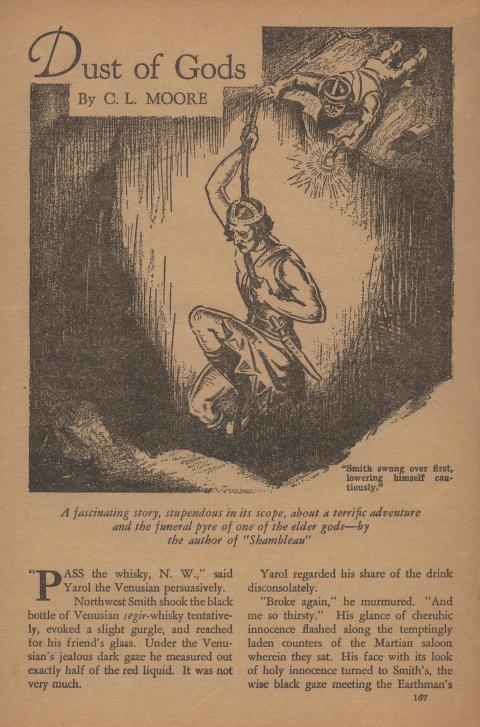
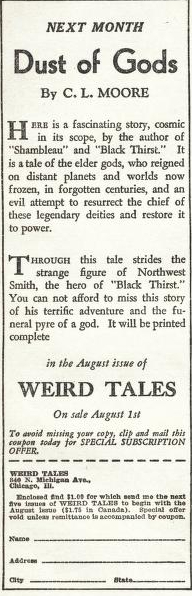
Another weird and thrilling tale about Northwest Smith, by the author of “Shambleau”—an astounding story of ultimate horror.
—”Coming Next Month,” Weird Tales Mar 1934

Between November 1933 and March 1934, C. L. Moore had not been idle. The Great Depression was still raging, she was still working in her secretarial position in Indianapolis, and she now had a new, unexpected source of income if she could continue to sell stories. According to a 1976 interview with Chacal, her second story, “Werewoman,” was rejected; whether or not this was quite the order of events is unclear as some of her later interviews are contradictory on this matter, but it seems clear that she was emboldened to write several new stories and submit them to Weird Tales; editor Farnsworth Wright bought some of them and relatively quickly brought them to press.

“Black Thirst” appeared in the April 1934 issue of Weird Tales. It is the second published tale of Northwest Smith; the one-off space outlaw was now officially a series character. Set on Venus rather than Mars, with Earth as no more than a green star in the sky, it follows a similar mix of beauty mingled with horror, ray-gun action, and alienation—not repeating the plot of “Shambleau,” but strongly evocative of the elements that had made that story work, somewhat remixed. From some subsequent comments, it is apparent that Moore was at this point more likely to write by the seat of her pants than plot, and take advantage of sudden bursts of inspiration:

You ask for manuscripts. If what you mean is the original draft, all scribbled over, the only one I have now is the medieval-lady opus. I’ll enclose it when I return your magazines. It’s not a very accurate original, tho, for when I typed it for publication I made a good many changes as I went along. And as I remember, I changed my mind in the middle a couple of times, and deflected the course of the story. You see, I never know until I’m half-way through how it’s going to end, and usually have to go back and alter the first a little to hitch up with the last. I was nearly thru with SHAMBLEAU before I had the remotest idea how I was going to rescue Smith from her clutches. And in BLACK THIRST the Alendar’s relapse into primeval ooze was as much of a shock to me as to any of the characters in the sotry. I didn’t know until I had actually begun that scene on the edge of the underground sea how I was going to overcome the Alendar. Smith’s hairbreadth escapes were quite literally harbreadth, for I’m usually breathless with apprehension as I snatch him just in time from the awful dangers that beset him. Tho that’s all past tense now, I suppose.
—C. L. Moore to R. H. Barlow, 1 Jun 1934, MSS Brown Digital Repository

By the way, speaking of the Alendar, I wonder how other people find the odd names they want for characters. I usually glance around ind esperation and seize on the first hting I see. Alendar is simply Calendar with the C left off. And N. W.’s friend Yarol is a transpostion of the name on the Royal typewriter I wrote the story on.
—C. L. Moore to R. H. Barlow, 10 Sep-9 Oct 1934, MSS Brown Digital Repository

There is also a suggestion that Farnsworth Wright, following his editorial habits (see “Bat’s Belfry” by August Derleth), was revising Moore’s manuscripts as they came in. The exact nature of these revisions is unclear, though typically he asked writers to tighten up overwordy passages or would silently remove references to sex.

I trust your revisions may make Mrs. Moore’s second story as striking and interesting as this one.
—H. P. Lovecraft to Farnsworth Wright, 21 Nov 1933, Letters to Woodburn Harris 86

The story is slightly more daring than typical Weird Tales entries. The third paragraph includes a bald reference to “Venusian street-walkers,” and the story deals with human-trafficking and eunuch-guarded harems in a way strongly reminiscent of Yellow Peril stories of white slavery and seraglios, an alien eugenics that treats the breeding of human beings like humans breeds cows or cats, and an almost homosexual element when the Alendar considers Northwest Smith:

“I realized how long it had been since I tasted the beauty of a man. It is rare, so different from female beauty, that I had all but forgotten it existed. And you have it, very subtly, in a raw, harsh way…”
—C. L. Moore, “Black Thirst”

More than “Shambleau,” the expanding Interplanetary setting that C. L. Moore sketches echoes fantasy as much or more than science fiction. She speaks of the three planets (Mars, Venus, and Earth), but there are kings, castles, courts, and courtesans; payment is expected in gold coins; and Smith looks for swords and daggers as much as rayguns. If “Shambleau” was drawing heavily on Westerns, then “Black Thirst” seems to draw as much from her quasi-medieval fantasy setting in her pre-pulp writing. If there is a criticism to the story, it might be that it hews a little too close to the plot of “Shambleau.” Once again, Northwest Smith finds himself facing an almost spiritual as well as physical peril from a vampiric alien. While not quite formulaic, readers could definitely see how strongly it echoed some of the notes of Moore’s first tale.

Yet they loved it.

Donald Allgeier, of Springfield, Missouri, writes: “This letter is written primarily because of Black Thirst. I have a thirst (black or not) for more like it. I hope the next story by Moore is as good as this. . . . Who is C. L. Moore, anyway? Surely he’s not a brand-new author—not when he can write as he does. Could he perhaps be a new pseudonym for some famous writer? I thought he had just about reached the ultimate in his first story, but the second proved my mistake. Most authors would carefully avoid description of all those beautiful girls, but Moore handles it beautifully, delicately, and marvelously. The Alendar, too, is a worthy creation. I’d like to see a novel by Moore.
—”The Eyrie,” Weird Tales June 1934

There were many more fan-comments in that vein, and Wright had already seen the promise of his new discovery and bought more stories from Moore–and Wright was careful at this point to follow her wishes and not reveal her gender, though that bit of gossip would soon make the rounds in fan-circles. Even her pulp peers were impressed by Moore’s sophomore effort; Lovecraft praised it to many of his friends. Though most of Lovecraft’s comments are brief, a few are fuller:

The present issue, I think, is far above the average—with your tale, the splendid Bruks reprint, the powerful Smith yarn with self-drawn illustration, and the strikingly potent, original, and distinctive “Black Thirst”.
—H. P. Lovecraft to Robert E. Howard, 3 Apr 1934, A Means to Freedom 2.727

The recent WT is distinctly above average—“Black Thirst” perhaps leading because of the utter originality of its conception, the vividness of its unfolding, & the ever-brooding air of hidden, transcendent horror just beyond one’s sight. A little less conventionality of the popular-romance setting & mood would increase the power of the tale.
—H. P. Lovecraft to R. H. Barlow, 10 Apr 1934, O Fortunate Floridian 129

“Black Thirst” has a lot of conventional stuff, but the atmosphere of utterly unknown evil & menace is extremely distinctive.
—H. P. Lovecraft to Clark Ashton Smith, [13 Apr 1934], Dawnward Spire, Lonely Hill 552

In 1935 when R. H. Barlow was thinking of re-printing the story for Moore through his small press, he apparently considered revising the tale—which Lovecraft disagreed with:

As for revision—some of the tales would take careful thought indeed. “Black Thirst” couldn’t be revised except by striking at its very core—cutting out the vapid idea of human-looking beauties on another planet (unless descent from a remote terrestrial source is suggested, &c.), &c. It might be wisest to let some of the tales alone, & hope that later specimens will avoid the flaws which they possess. But all that is for later consideration.
—H. P. Lovecraft to R. H. Barlow, [25 Mar 1935], O Fortunate Floridian 229

As a young man, Lovecraft had grown up on adventurous “planetary romances” like Edgar Rice Burrough’s A Princess of Mars, which featured lots of action and improbably human-looking aliens with princesses that could procreate quite readily with Earth-born heroes. Biologically, this is as bunk as Star Wars and Star Trek‘s rubber-forehead aliens, and as an adult Lovecraft was very critical of the idea of Earth-like worlds that evolved Earth-like humanoids, as expressed in Lovecraft’s “Some Notes on Interplanetary Fiction.” So Lovecraft was not strongly drawn to the Burroughs-esque elements that may have appealed to Weird Tales fans; for him, it was the sheer alien weirdness and horror that was the true appeal of Moore’s first couple stories.

There is every indication that Wright knew he had another hit on his hands with “Black Thirst,” because he had already bought other stories that was destined to appear in subsequent issues of Weird Tales. Yet the Unique Magazine brought with it more than acceptances and (eventually) welcome checks; Moore also made new friends, as fan-letters from Weird Tales turned into correspondences with folk like R. H. Barlow.

I hope you will not be too much disappointed in the stories that follow. Perhaps, when you have read those appearing in the April and May issues, you will write again to tell me what you thought of them.
—C. L. Moore to R. H. Barlow, 8 Mar 1934, MSS Brown Digital Repository

Through Barlow, Moore would come to correspond with Lovecraft, Robert E. Howard, and Clark Ashton Smith, among others. It connected her to a wider community of writers, whom she would both influence and be influenced by. If “Shambleau” marked C. L. Moore’s arrival on the scene, “Black Thirst” helped her swiftly gain acceptance into the world of weird and science fiction pulp writers.

C. L. Moore’s “Black Thirst” can be read for free online here.


Bobby Derie is the author of Weird Talers: Essays on Robert E. Howard and Others and Sex and the Cthulhu Mythos.

Deep Cuts in a Lovecraftian Vein uses Amazon Associate links. As an Amazon Associate I earn from qualifying purchases.

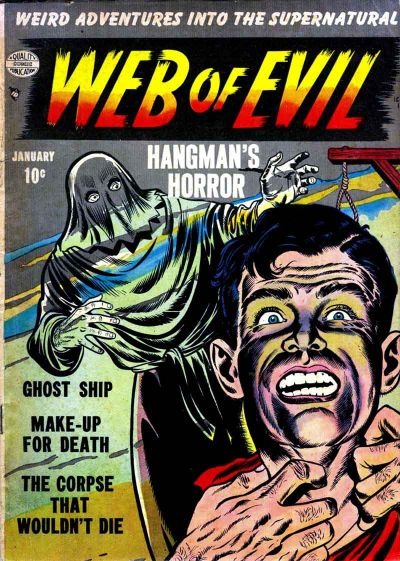
“The Corpse That Wouldn’t Die!” (1953) by Jack Cole

I have given the whole of a cloudy Sabbath to finish my dismembered corpse story—“The Return of Helman Carnby”. I shall enclose the carbon with this; and I hope you will like it. The thing became a sizable yarn, with all the details that I worked out . . . It goes to “Ghost Stories”, then to W. T.,—both of which will doubtless reject it. But I think myself that the tale is a pretty fair literary beginning for the New Year. I like to picture it in the sunny and lightsome pages of the “Ladies’ Home Journal.”
—Clark Ashton Smith to H. P. Lovecraft, c. early Jan 1931, Dawnward Spire, Lonely Hill 290

Needless to say, I perused the monstrous narrative of Helman Carnby with the most acute & shuddering admiration; &, having made the verbal changes indicated in your supplementary note, have forwarded to Derleth with instructions for return to you through Wandrei. It is certainly a great piece of work, & I am extremely flattered by the prominent part played therein by the Necronomicon. But God! If there is still a copy of the original Arabic version in existence, what safety can we guarantee for this unhappy planet? Is it not true that no copy was found when the police entered the seemingly deserted mansion of Carnby & observed those hideous & inexplicable conditions which the newspapers were not allowed to print? What of that utterly unthinkable foot-mark which seemed to be burned into the floor? But one must not think of such things! Anyway, it’s a great yarn, & the cumulative suspense & malign suggestiveness of the earlier parts are enough to set any outfit of teeth—even false ones on a dentist’s cupboard shelf—chattering! It looks to me quite all right as it is—if there were any way of piling on another shudder, I’d say it would be by veiling the final horror a little more obscurely from actual sight, & trying to hint or imply the blasphemous abnormality which sent the secretary fleeing from that accursed habitation. I certainly hope that the tale will find a typographical haven.
—H. P. Lovecraft to Clark Ashton Smith, c. 18 Jan 1931, Dawnward Spire, Lonely Hill 293

Ghost Stories did not take “The Return of Helman Carnby,” not even after Smith re-wrote the ending and sent it back for another look; nor was it published by Weird Tales. The story was published in Strange Tales of Mystery and Terror (Sep 1931), under the title “The Return of the Sorcerer.” This is arguably Smith’s most distinctly “Lovecraftian” story, being an explicit extension of Lovecraft’s Mythos rather than involving any of Smith’s own fabulous settings and entities, and one of the first uses of the Necronomicon outside of Lovecraft’s own works (compare “The Were-Snake” (1925) by Frank Belknap Long, Jr. and “The Picture” (1939) by Robert D. Harris).

“The Return of the Sorcerer” was reprinted in Smith’s first Arkham House collection Out of Space and Time (1942), and anthologist August Derleth selected it for inclusion in Sleep No More (1944), which meant it was included in the Armed Services Edition of that book issued to soldiers during World War II. One can just about imagine a marine en route across the Pacific Ocean idling away a sweltering hour reading of the dismembered corpse crawling from the grave. By the 1950s, however, “The Return of the Sorcerer” had been out of print for years—though not forgotten.

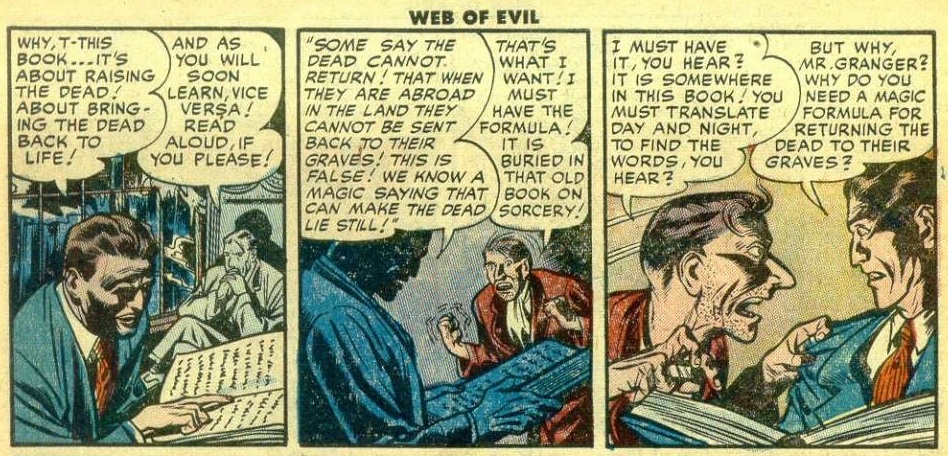
Web of Evil was a horror comic published by Quality in the years immediately before the formation of the Comics Code Authority, and which ran 21 issues. The product was typical of the era: often shoddy artwork and simple, quick stories that emphasized grue and taboo, shock and suspense. The stories were often unsigned and the creators weren’t above lifting a plot from an old pulp magazine from time to time.

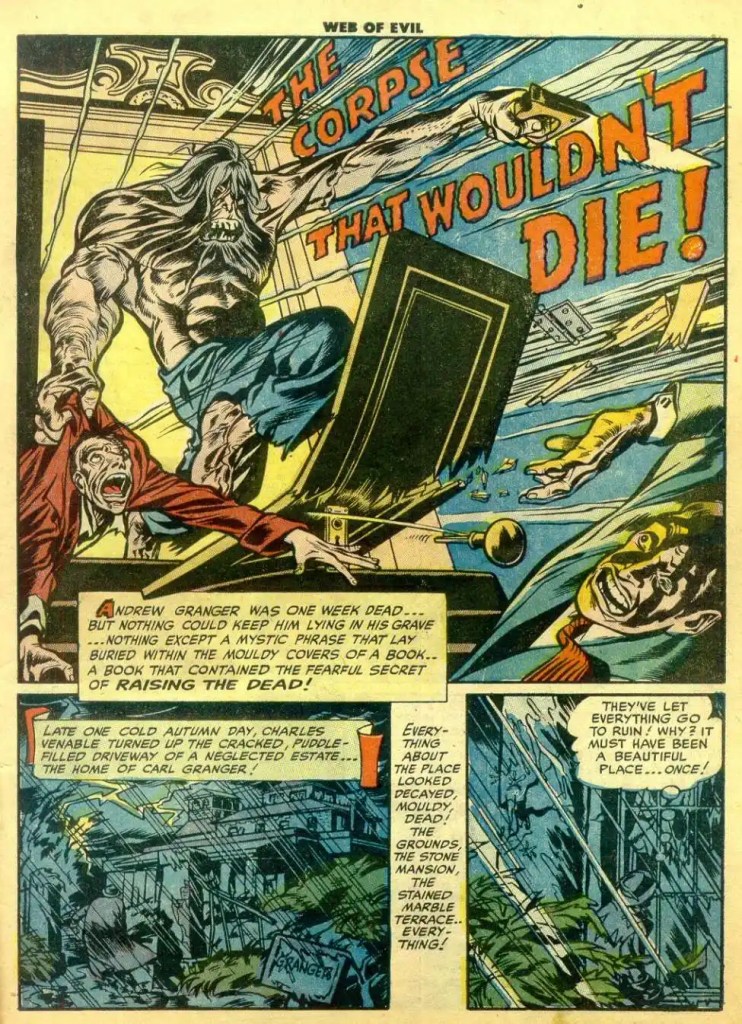
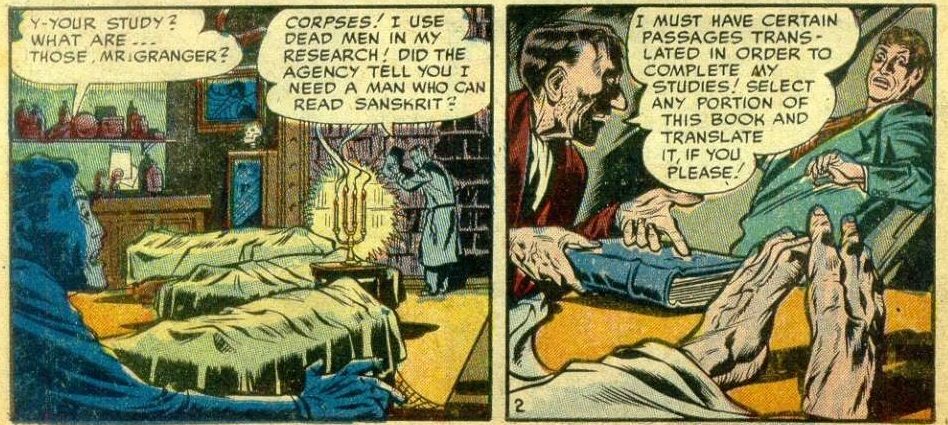
“The Corpse That Wouldn’t Die!” in Web of Evil #2 (Jan 1953) by artist Jack Cole is very clearly based on “The Return of the Sorcerer.” The names were changed to hide the plagiarism, and the unnamed Necronomicon is in Sanskrit rather than Arabic, but the essentials of the story are clearly recognizable. It may no longer be a Mythos story, but for all that it has a distinct charm for those that recognize that Cole is, at least, lifting from the best.

At six pages, the action moves fast—and in almost every panel, Cole tries to add some dramatic element of lighting or motion to capture the eye or set the tone, which often leads to near-comical exaggeration. Though there is not so much grue as there might have been: after all the corpse of the deceased sorcerer is still intact when it returns from the grave.

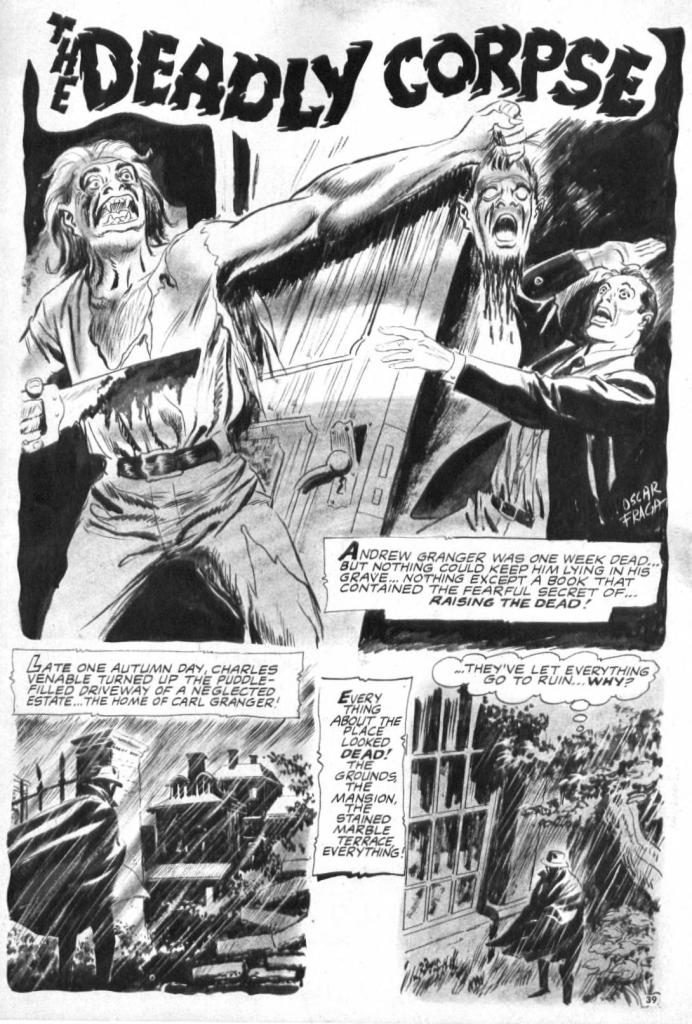
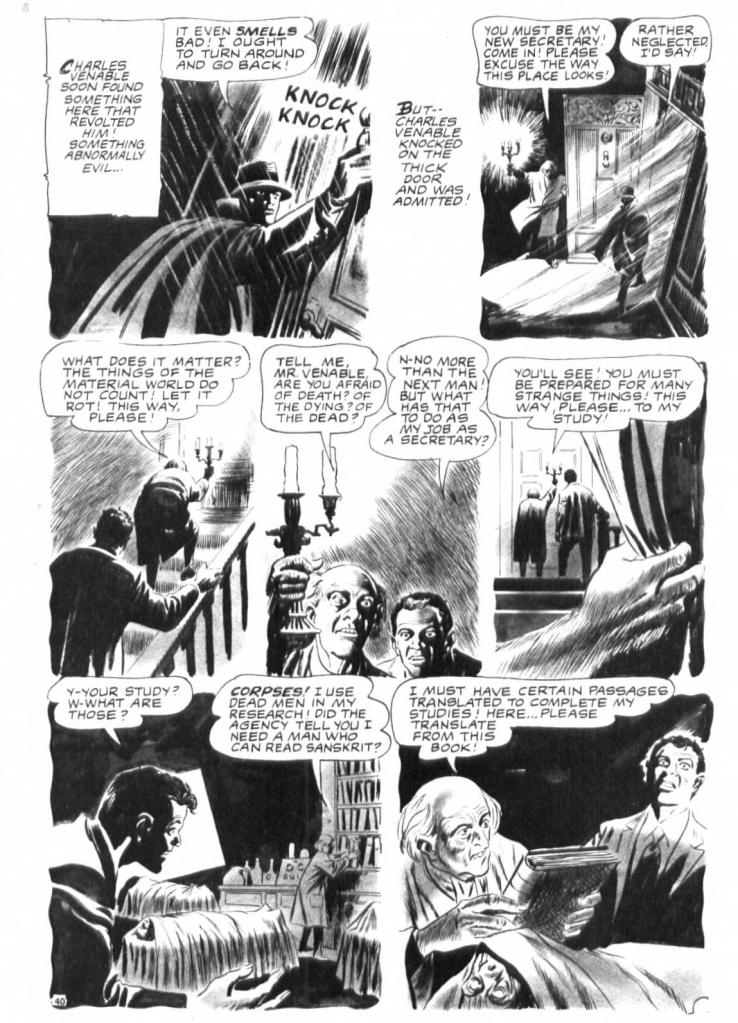
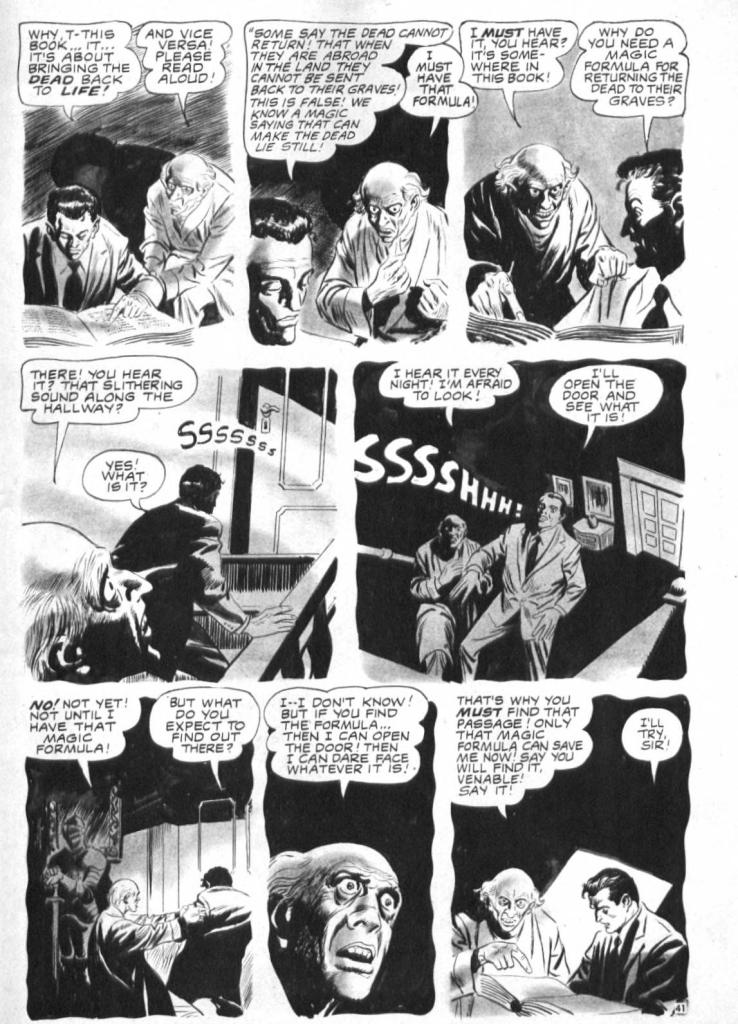
Lifting stories from pulp writers was not unusual in the 50s, and “The Corpse That Wouldn’t Die!” sits neatly among the Pre-Code Lovecraftian Horror Comics. The tale has been reprinted a number of times, including a version in Tales of Voodoo vol. 5, no. 2 (Mar 1972), where the art was reworked by Oscar Fraga and the result retitled “The Deadly Corpse” (sample pages below). Fraga’s rework updates the art to match the sensibilities of Eerie Publications in the 70s, but doesn’t add anything new to the story itself.

The original Web of Evil version can be read for free at Comic Book Plus.


Bobby Derie is the author of Weird Talers: Essays on Robert E. Howard and Others and Sex and the Cthulhu Mythos.

Deep Cuts in a Lovecraftian Vein uses Amazon Associate links. As an Amazon Associate I earn from qualifying purchases.
“Lockbox” (2015) by E. Catherine Tobler

There are not a vast number of women mentioned in H. P. Lovecraft’s “The Rats in the Walls.” However, two stand out:

The worst characters, apparently, were the barons and their direct heirs; at least, most was whispered about these. If of healthier inclinations, it was said, an heir would early and mysteriously die to make way for another more typical scion. There seemed to be an inner cult in the family, presided over by the head of the house, and sometimes closed except to a few members. Temperament rather than ancestry was evidently the basis of this cult, for it was entered by several who married into the family. Lady Margaret Trevor from Cornwall, wife of Godfrey, the second son of the fifth baron, became a favourite bane of children all over the countryside, and the daemon heroine of a particularly horrible old ballad not yet extinct near the Welsh border. Preserved in balladry, too, though not illustrating the same point, is the hideous tale of Lady Mary de la Poer, who shortly after her marriage to the Earl of Shrewsfield was killed by him and his mother, both of the slayers being absolved and blessed by the priest to whom they confessed what they dared not repeat to the world.
—H. P. Lovecraft, “The Rats in the Walls”

While it wouldn’t be quite accurate to say that Lovecraft scholarship has ignored these women, it would be accurate to say that the picklocks of literary critics and historians haven’t turned up any particular connections or likely historical or literary inspirations for Margaret Trevor and Mary de la Poer. While we know Lovecraft drew inspiration for this tale from Sabine Bearing-Gould’s “S. Patrick’s Purgatory” in Curious Myths of the Middle Ages, and while there is no lack of mysterious ladies therein, one stands out as a possible inspiration:

It is worthy of remark that the myth of S. Patrick’s Purgatory originated among the Kelts, and the reason is not far to seek. In ancient Keltic Mythology the nether world was divided into three circles corresponding with Purgatory, Hell, and Heaven ; and over Hell was cast a bridge, very narrow, which souls were obliged to traverse if they hoped to reach the mansions of light. This was—

“The Brig o’ Dread, na brader than a thread.”

And the Purgatory under consideration is a reflex of old Druidic teaching. Thus in an ancient Breton ballad Tina passes through the lake of pain, on which float the dead, white robed, in little boats. She then wades through valleys of blood. (248-249)

This is speculative; Lovecraft borrows some of the imagery for “The Rats in the Walls,” and it includes a woman recalled in a ballad associated with pain and blood, which may have been the seed from which Margaret Trevor and Mary de la Poer (and their respective ballads) grew. One might also wonder if the legend of Elizabeth Bathory worked on Lovecraft’s imagination, or any of the prospective cultists included in Margaret Murray’s The Witch-Cult in Western Europe, and these are certainly possible. The image is, in both cases, of women of the line who do not shrink away from the family cult, but become active participants.

Trish Thawer in The Witches of BlackBrook (2015) famously wrote: “We are the daughters of the witches you weren’t able to burn.” While that may not be historically true (convicted witches during the Salem Witch hysteria were hung, not burned at the stake), there is a sentiment that applies to readers and writers in Lovecraft’s Mythos: who are the daughters and granddaughters of Lovecraft’s women cultists, who had such a bad reputation that they haunted the ballads of the country for centuries thereafter?

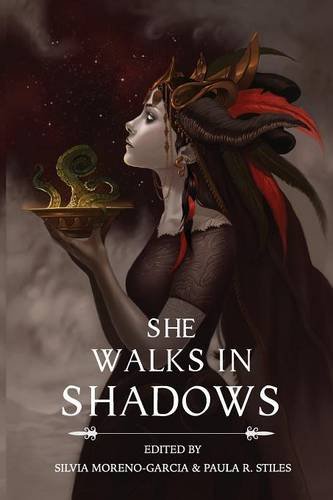
Which is the theme that E. Catherine Tobler assays in “Lockbox,” one of the stories in She Walks in Shadows. The brief story is a return to Exham Priory by a female descendant of the de la Poer (or Shrewsfield) line and her not-quite-trustworthy lover…and the thing that makes the story work is that it is her story, her reconnection with this ancestor and all the mystery and horror that Margaret Trevor of Cornwall represents, not as a member of the cult she was marrying into, but as a black saint in her own right:

The worst thing was, despite the horrors around her, Margaret Trevor was something to be worshipped, a glory even in the blood and ruin that streaked her. The stories said that she loved the old cults well, but had taken a passive role beside her husband. But here, in the horrible cellar with the collapsing girders, she was a gold-and-silver goddess while her husband cowered.
—E. Catherine Tobler, “Lockbox” in She Walks in Shadows 94-95

The story is told with many footnotes, many caveats, things that cannot be said and perhaps dare not be remembered. It gives the suggestion of a maddening experience that has snapped a thread of sanity and memory, but the title is the crux of the story, because it is a mystery and a memory that the narrator can choose to recall whenever she wishes—whenever she is ready to leave her placid isle of ignorance and remember what really happened down there, in the buried ruins of Exham Priory.

“Lockbox” by E. Catherine Tobler was first published in She Walks in Shadows (2015) and its reprints, and was also reprinted in Wilde Stories 2016: The Year’s Best Gay Speculative Fiction.


Bobby Derie is the author of Weird Talers: Essays on Robert E. Howard and Others and Sex and the Cthulhu Mythos.

Deep Cuts in a Lovecraftian Vein uses Amazon Associate links. As an Amazon Associate I earn from qualifying purchases.
The Long Shalom (2023) by Zachary Rosenberg

People have such queer ideas about private detectives.
—Raymond Chandler, The Long Goodbye (1953)

Hardboiled detective fiction has never ignored the existence of ethnic minority, BIPOC, and LGBTQ+ characters. The representation often wasn’t great; prejudices were common, and sometimes a plot point. Genre-blending mixes with hardboiled fiction tend to follow similar lines. In the made-for-tv movie Catch A Deadly Spell (1991), for example, a key plot point is that the man who stole the Necronomicon is in a relationship with a transwoman.

There has been a trend in contemporary works, however, to swing the other way. Instead of token diversification or showcasing prejudices while fixing on a white cisgender heterosexual viewpoint, there are stories that focus on minority viewpoints, and in particular on intersectional experiences. Winter Tide (2017) by Ruthanna Emrys has as a protagonist an Innsmouth woman during the 1950s, but her group includes two gay men, a brother and his Black girlfriend, and a Japanese-American woman; Ring Shout (2020) by P. Djèlí Clark focuses on a group of Black women, one of whom is gender-nonconforming and homosexual, another mixed-race; The City We Became (2020) by N. K. Jemisin has a group as cosmopolitan as New York itself.

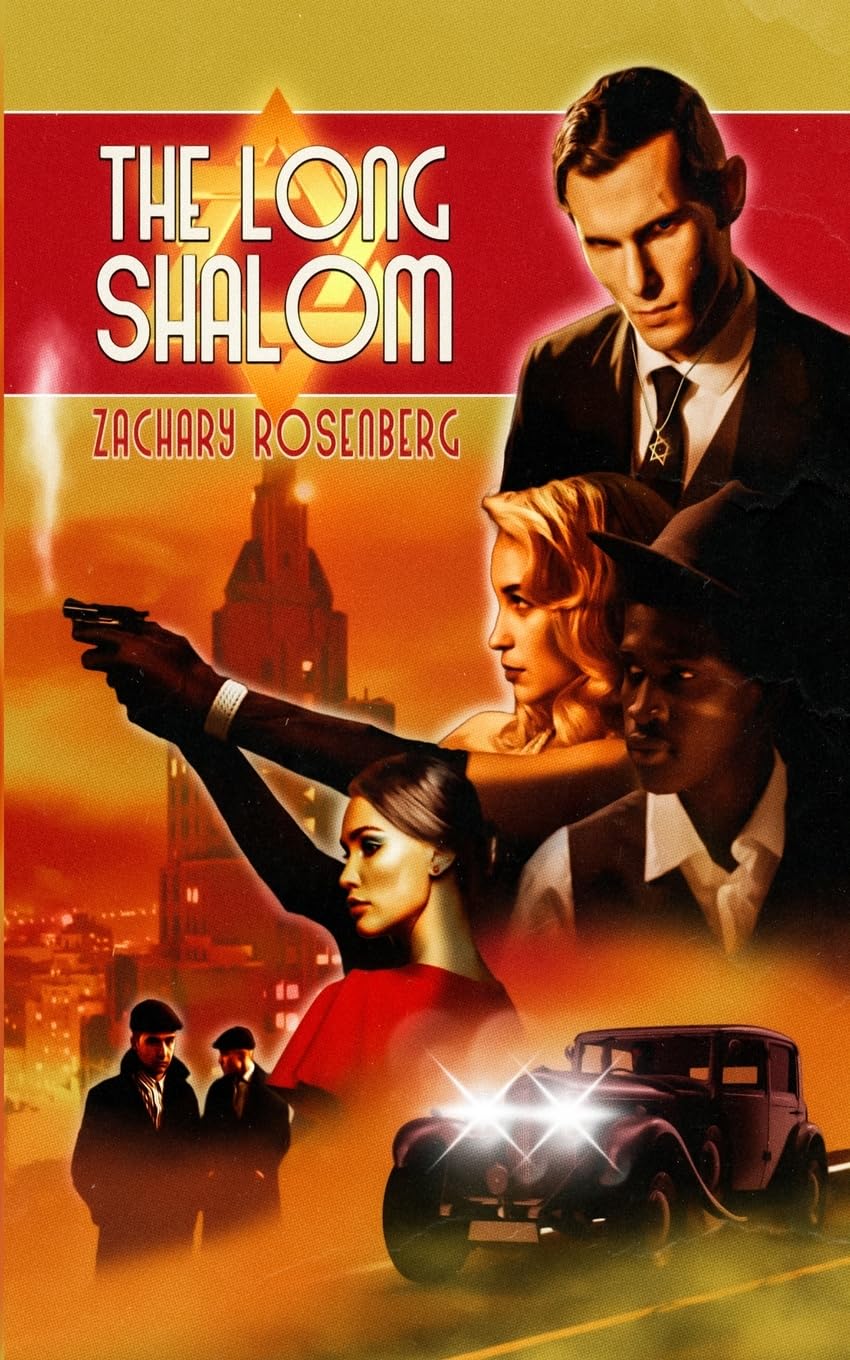
The Long Shalom by Zachary Rosenberg is another entry in that mode—I asked a few folks for a pithy descriptive term, and they suggested “wokepunk” and “diversifiction”—focused on protagonist Alan Aldenberg, a bisexual Jewish WW1 veteran and ex-mob gunsel, now wise-cracking private detective, who ends up dealing with a Lovecraftian supernatural threat. Aldenberg teams up with his half-Japanese/half-Jewish bisexual ex-girlfriend and two fellow WW1 veterans: an African-American man and a transwoman.

Yet the most important thing about The Long Shalom isn’t the cast of characters; it’s how the story is fundamentally based on their experiences and the discrimination they face. As in Ring Shout, the racial, ethnic, and gender discrimination they face becomes embodied as both traditional and supernatural threats. These individuals, who each have to deal with intersectional discrimination for their particular identities, also now have bigoted cosmic horrors to deal with.

Which leads to a certain aspect of the protagonists taking these new horrors in stride. There is more to the complex interplay of identity as Alan, long non-practicing, returns to the Jewish neighborhood and finds himself an outcast among outcasts, than there is to him confronting an ancient horror that seems immune to bullets. As the fantasy aspects increase—thanks to ancient scrolls and some very Innsmouthian-flavored Jewish women in a remote seaside community—the impression becomes closer to a retelling of a game of Harlem Unbound (2017), albeit with more of a Jewish than Black focus, and the mundane antagonists become almost cartoonish in their bigotry.

Yet that is kind of the point: as much as some of these characters feel like a caricature, the real thing, whether they were police uniforms or Klan robes, was if anything more explicit and violent. Racism and prejudice is seldom nuanced or interesting at base; it’s dull, ugly, and stupid, a combination of ignorance and stereotypes, hot points of emotions that can flash into bursts of unbelievable violence over almost nothing.

Alan clenched his teeth, fighting for something inspiring to say and coming up emptier than a wine bottle after Purim.
—Zachary Rosenberg, The Long Shalom 90

While the novel is short and the fantastic elements get away a bit from the more grounded characterizations, Rosenberg does have a certain style and authentic understanding of the characters and their cultures, which is appealing. Like Ring Shout, the threat is Lovecraftian without being based explicitly on Lovecraft’s Mythos; this is fundamentally an effort to write a Jewish horror story, with a hardboiled setting and more than a taste of pulp action—and it succeeds at that.


Bobby Derie is the author of Weird Talers: Essays on Robert E. Howard and Others and Sex and the Cthulhu Mythos.

Deep Cuts in a Lovecraftian Vein uses Amazon Associate links. As an Amazon Associate I earn from qualifying purchases.
Conan de Cimmeria (2021) by Ángel Gª Nieto, Julio Rod, & Esteban Navarro

Derivative works all share a connection with the parent work. Every story with Cthulhu derives, directly or indirectly, from Lovecraft’s “The Call of Cthulhu.” Every story with Conan the Cimmerian derives from the original stories written by Robert E. Howard. From the humble pages of Weird Tales have spun out thousands of creative works in a dizzying array of media—short stories, novels, comics (strips, books, magazines, and graphic novels), cartoons, live-action and animated films, music, paintings, sculptures, toys, video games—and one of the key thing to remember about these works is that they aren’t being created in a vacuum, but in communication with one another.

The Atlantean sword in the film Conan the Barbarian (1982) owes nothing to anything in the stories of Robert E. Howard; the closest the Texas pulpster managed to a special weapon was in the first Conan tale, “The Phoenix on the Sword,” and that sword was broken in the course of the story. Some of the pastiche tales and comic book stories that followed included magic weapons, but none of them served as the immediate inspiration for the Atlantean sword in the film either. Nevertheless, the sword featured extensively in the poster and marketing materials for both Conan the Barbarian and its sequel Conan the Destroyer (1984)—and, unsurprisingly, was represented fairly faithfully in the Marvel Comic adaptations of the films.

Art by Bob Camp

For many years, outside the movie continuities, the Atlantean sword was not a key feature of most Conan media. While it continued to have lingering appeal because of the tie to the film—including multiple weapon makers providing official or bootleg versions of the sword for fans and collectors—publishers like Marvel and Dark Horse did not lean into that aspect of the film iconography.

More recently, however, the iconic Atlantean sword has seen increased placement in both official and unofficial Conan media. The latest Conan comics published by Titan have deliberately leaned into a melding of the iconic looks of previous incarnations of the Cimmerian, drawing both from the John Buscema/Ernie Chan era of Marvel Comics as well as the 1982 film. It’s little surprise that when Conan does actually go to Atlantis in Conan the Barbarian #11, the Atlantean sword—or at least a good facsimile—makes an appearance.

Art by Roberto de la Torre, Color by Diego Rodriguez

Outside of the official comics, works produced in areas where the Conan the Cimmerian stories by Robert E. Howard have fallen into the official domain have had fewer qualms about borrowing the iconic imagery of the Atlantean sword. Such is the case for Sangre Bárbara (2021) by El Torres, Joe Bocardo, & Manoli Martínez, and such is also the case for Conan de Cimmeria (2021) by the creative team of Ángel Gª Nieto (writer), Julio Rod (artist), & Esteban Navarro (colorist).

Hace mucho tiempo, en una era no soñada, caminó Conan, el Cimmerio, que a lo largo de su turbulent existential vivió multiud de fastuosas adventuras.

Dejadme que os cuente cual cronista de un tiempo olvidado sus grandes y magníficas hazañas, que lo convertieron en Leyenda.
Long ago, in an age undreamed of, walked Conan the Cimmerian, who throughout his turbulent life lived a multitude of magnificent adventures.

Let me tell you like a chronicler of a forgotten time his great and magnificent exploits, which made him a Legend.
Conan de Cimmeria, Back cover copyEnglish translation

Conan de Cimmeria is a standalone Spanish-language graphic novel that tells three original stories based on the Conan character created by Robert E. Howard, each one telling a brief adventure of the Cimmerian at a different point in his career. It is essentially identical in general form and intent to the majority of comics produced officially by the owners of the Conan trademarks, just produced independently. The prominent usage of the Atlantean sword in the first story, “La Forja del Destino” (“The Forge of Destiny”), is perhaps the most notable artistic callback to other Conan-related works, but the book also appears to draw inspiration from the classic Marvel comics, while still taking the opportunity to present an original—if recognizable—version of the barbarian.

The stories are a bit more violent and bloody than the classic Marvel Comics, but not so gore-filled as to detract from what are essentially pulpy adventure tales; there is one scene with the topless corpse of a woman, but other than that, there is no nudity or sex. It is the kind of Conan comics that could please everyone from 13 to 93 in terms of being exactly what it sets out to be: the kind of broad-appeal Conan comic that is reminiscent and evocative of what has come before, but which is distinctly original, an addition to the Conan cycle that is respectful of the source material.

In an era when properties falling into the public domain often leads to a splurge of derivative trash that pays little to no respect for the original, it’s nice to find examples of works where the creators basically want to use the stories to create new tales of character they like, int he style in which they’d like to read them.


Bobby Derie is the author of Weird Talers: Essays on Robert E. Howard and Others and Sex and the Cthulhu Mythos.

Deep Cuts in a Lovecraftian Vein uses Amazon Associate links. As an Amazon Associate I earn from qualifying purchases.
“The Ballad of Conan” (1983) by Anne Braude

Tune: “When I Was A Lad” (H. M. S. Pinafore)
—Anne Braude, “The Ballad of Conan” in Niekas #31 (1983), 41

The first fandom of Robert E. Howard’s Conan of Cimmeria arose in the 1930s, when the adventures of the barbarian were published in the pages of Weird Tales. Some fans, including R. H. Barlow, Emil Petaja, Charles B. Hornig, Alvin Earl Perry, and P. Schuyller Miller wrote to Howard—and the Texas pulpster wrote back, answering questions, sometimes gifting manuscripts of his stories, subscribing to fan publications like The Fantasy Fan, and providing unpublished stories and poetry for fanzines like The Phantagraph to publish as well.

This early interaction with fandom endeared Howard to his fans, and helped provide the basis for the first fan-publications, like Miller & Clark’s “A Probable Outline of Conan’s Career” in The Hyborian Age (1938), a one-shot zine published after Howard’s death by eager fans and containing Howard’s worldbuilding-essay of the same name. However, early desires to publish a collection of Howard’s Conan stories came to naught in the 30s; while the Texan had fans, he lacked anyone with the entrepreneurial spirit to start their own publishing business like August Derleth and Donald Wandrei did when they established Arkham House in 1939 to print the work of H. P. Lovecraft, who died the year after Howard passed away.

Following Howard’s death in 1936, his works passed to his father, Dr. I. M. Howard, who survived his son; Dr. Howard largely entrusted his son’s literary legacy to his agents, the Otis Adelbert Kline Agency, and several previously unpublished works appeared in the pages of Weird Tales, which continued to pay Dr. Howard the monies they owed his son. Still, within a few years publications dwindled, and no new Conan material was forthcoming in the 1930s. One by one, the first caretakers of Howard’s legacy passed: Farnsworth Wright, editor of Weird Tales, died in 1940; Dr. Howard joined his wife and son in 1944; Otis Adelbert Kline passed away in 1946. Dr. Howard willed the rights to his son’s material to his friends the Kuykendalls, and Kline’s agency was taken up by his associated Oscar Friend. Slowly, new published opportunities emerged.

In 1946, Arkham House published the collection Skull-Face and Others, and in 1950 Gnome Press published Conan the Conqueror, the first in a series of Conan titles. These collections in hardcovers weren’t just found new fans—and a more organized fandom. The first fanzine devoted to Howard’s creation was Amra, which began publication in 1956, and fan Glenn Lord got the ball rolling on Howard scholarship with The Howard Collector, founded in 1961. In the late 1960s and 70s, paperback reprints of these books exploded in popularity, part of the rise in paperback fantasy that included the Hobbit and The Lord of the Rings by J. R. R. Tolkien, and the Ballantine Adult Fantasy series that began in 1969.

In 1970, Marvel Comics published the first Conan the Barbarian comic, adapting and expanding his adventures into a new medium. The series and its sister magazine title Savage Sword of Conan would run for decades, drawing comic fans to read the stories as much as they drew fans of Howard’s fiction to buy the comics. In 1982 when the film Conan the Barbarian starring Arnold Schwarzenegger in the title role appeared on screens, it was swiftly followed by a tie-in comic from Marvel’s Conan creative team.

All of this increased fan activity, such as the Hyborian Legion and the Robert E. Howard United Press Association (founded in 1972). Conan was no longer an obscure hero from the pages of Weird Tales; the Cimmerian had become a staple of science fiction and fantasy, an archetype of barbarians, fighters, and rogues, a multi-media figure well-known and established in fandom—and the serious critical study of Robert E. Howard’s life and fiction were picking up, echoing the scholarly interest that Lovecraft had attracted a decade earlier.

Which is where things stood when fan Anne Braude wrote the jocular (but largely accurate) “Ballad of Conan” for the Conan-heavy issue of the fanzine Niekas in 1983. Drawing on the canonical Conan tales then widely available in paperback, rather than the comics adventures or the recent film. Unlike “I Remember Conan” (1960) by Grace A. Warren, this is tongue very much in cheek, showing someone familiar with the material but decidedly irreverent. All in good fun.


Bobby Derie is the author of Weird Talers: Essays on Robert E. Howard and Others and Sex and the Cthulhu Mythos.

Deep Cuts in a Lovecraftian Vein uses Amazon Associate links. As an Amazon Associate I earn from qualifying purchases.
“U.S. Fish and Wildlife Services Inspection Report No. IF-32651” (2024) by Sarah Hans

Have any of these yokels even seen a Black woman before?
—Sarah Hans, “U.S. Fish and Wildlife Services Inspection Report No. IF-32651” in Arkham Institutions (2024) 137

“The Shadow over Innsmouth” is one of Lovecraft’s most quintessential tales, not just in the sense that it has become one of the core stories for his artificial mythology, but because when you strip down the story to its fundamentals it is one of the quintessential stories of its type: a civilized intruder tale. Someone from wider civilization travels to a liminal community, someplace that is, whether or not it is physically far away, somehow isolated culturally from the wider network of the world we know, and there’s something wrong there.

What is wrong and who does the intruding vary. In The Wicker Man (1973), a police officer finds a neo-pagan religion up to no good. In Midsommar (2019), tourists go to a remote Swedish village and find a pagan survival group up to no good. The essential framework is supremely adaptable, and most importantly, it leaves a great deal of room for novelty and reinvention. When Lovecraft used the idea in “The Shadow over Innsmouth,” the idea wasn’t new; he was riffing off stories like Herbert Gorman’s “The Place Called Dagon” (1927) and Algernon Blackwood’s “Ancient Sorceries” (1908). What Lovecraft added was the twist: that the intruder was not really an intruder at all, but was akin to the horrors.

Innumerable versions of this basic idea have played out through the Cthulhu Mythos, sometimes revisiting and recapitulating “The Shadow over Innsmouth,” sometimes with other locations. Stories like “Satan’s Servants” (1949) by Robert Bloch and “The Moon Lens” (1964) and “The Horror Under Warrendown” (1997) by Ramsey Campbell all riff on the basic concept, while La Planète aux Cauchemars (2019) by Mathieu Sapin & Patrick Pion, “The Chabad of Innsmouth” (2014) by Marsha Morman, and now with “U.S. Fish and Wildlife Services Inspection Report No. IF-32651” (2024) by Sarah Hans are examples of revisiting and updating the Innsmouth story itself.

With a few changes.

Before I exit the truck, I get my gun out of the glovebox. I do have a permit for it, but I’m not supposed to carry one while I’m on official duties. I can’t risk being caught in the middle of nowhere unarmed, though. I work alone most of the time and sundown towns don’t exactly advertise themselves
—Sarah Hans, “U.S. Fish and Wildlife Services Inspection Report No. IF-32651” in Arkham Institutions (2024) 138

The pitch for Arkham Institutions is “to explore how the people who run these towns and their institutions deal with the eldritch abominations of Lovecraftian terror” (back cover text). Which is as good a reason why a Fish & Wildlife Service agent will pop into Innsmouth for an inspection of the Innsmouth Fisheries as any other reason why someone might intrude on this liminal community.

Hans’ Innsmouth isn’t exactly Lovecraft’s, and the story doesn’t try to recapitulate the whole narrative. It is a contemporary setting, there’s no mention of the government raid of 1927, no reference to the Marsh Refinery. The business of the town is fishing, and Agent Cherise Brown has no ancestral links to the inbred locals. What plays out is a very different story that takes inspiration from Lovecraft—and probably wouldn’t be very comprehensible unless you’re familiar with that story—but tries to do something original with the idea.

The central idea is one I can dig: no liminal community can remain unvisited forever. Innsmouth was always going to receive some outside visitor who would cause problems. The question was not a matter of if it would happen, but who would intrude and when, and how the community would respond to that intrusion. It is an idea that suggests different possibilities—when would Innsmouth be no longer able to hide? As timeless as the locale seems in Lovecraft’s tale, in the context of how the world has developed after his death, it is easy to see how fragile Innsmouth’s isolation really was.


Bobby Derie is the author of Weird Talers: Essays on Robert E. Howard and Others and Sex and the Cthulhu Mythos.

Deep Cuts in a Lovecraftian Vein uses Amazon Associate links. As an Amazon Associate I earn from qualifying purchases.
Innsmouth (2015)

インスマスを覆う影 (Innsumasu o Oou Kage, 1994). Return to Innsmouth (1999). Dagon (2001). Innsmouth Legacy (2004). Cthulhu (2007). Innsmouth (2015). H. P. Lovecraft’s The Deep Ones (2020). The Innsmouth School for Girls (2023). H. P. Lovecraft’s The Shadow over Innsmouth (2024).

Those titles don’t even cover the entire cinematic legacy of H. P. Lovecraft’s “The Shadow over Innsmouth,” which includes a number of short films, television episodes, and a broad thematic influence that crops up in a number of films. Innsmouth, with its relatively accessible settings, modicum of action, near-human creatures that are fairly easy to depict with make-up and prosthetics, and a combination of folk, cosmic, and body horror vibes is one of the most popular and identifiable works for filmmakers to either adapt, riff on, or incorporate into their own original works.

Each film is unique, each faces its own limitations and creative choices, which makes the variations on the familiar theme interesting for comparison with the others. So what sets Innsmouth (2015) apart from its fellows?

Innsmouth (2015) is an 11-minute short film, directed by Izzy Lee, written by Izzy Lee and Francesco Massaccesi based on the novella by H. P. Lovecraft, and starring Diana Porter and Tristan Risk. Cinematographer was Bryan McKay, and they even used the exterior of the Wentworth Coolidge Mansion, which Lovecraft actually visited (Horror Guide to Northern New England 211).

The story is a highly abbreviated adaptation of “The Shadow over Innsmouth” crossed with a police procedural: Detective Olmstead travels to Innsmouth to solve a murder, and finds some unexpected genealogical (and gynecological) revelations. As Izzy Lee put it:

Innsmouth was created to make [Lovecraft] roll over in his grave a little by having the cast 98% female and switching the gender roles. […] there’s also a ton of light being shed on how film excludes central female characters. I wanted to create a film where women call the shots onscreen, in nearly every role.
—quoted in Joe Yanick’s “Izzy Lee puts a New Spin on Lovecraft with Short INNSMOUTH” (Diabolique, 8 Mar 2016)

The result is, like most shorts with hard budget limitations, a bit bare-bones. One of those works that promise something a bit more than can be delivered in the running time. It would have been nice to have seen this premise stretched out to feature length, more atmosphere, and characters and plot given more time to develop. Yet within the constraints, Lee seems to have achieved her directorial goals.

Most of the cast is women, and that results in a shift in focus away from the normally patriarchal stories of Innsmouth. In The Deep Ones (2020), the point is made explicit that this is a story about fish men impregnating human women; in Cthulhu (2007), the prodigal son is not exactly welcomed home, but is expected to get busy fairly immediately with breeding the next generation of Deep One hybrids. The male characters in these stories rarely come out sympathetic, and the women characters are often fairly eager to accommodate.

KATHERINE 
Asses are made to bear, and so are you.

PETRUCHIO 
Women are made to bear, and so are you.
—Shakespeare, The Taming of the Shrew, Act II, Scene 1

Lee and Massaccesi’s script doesn’t ignore the Deep One colonization project angle, but they do but their own twist on it, which is aided by some relatively simple but very effective props/makeup effects. Picture Innsmouth as more matriarchal and more fishlike in their reproduction and you get the gist.

Detective Diana Olmstead (Diana Porter) arrives on the scene of a bizarre death: a body with a strange bite wound and a mysterious egg sac on her back. A clue leads her to Innsmouth, where she meets a seductive and horrific fate in the form of Alice Marsh (Tristan Risk: American Mary, The Editor, ABCs of Death 2). Innsmouth explores the “monstrous feminine” with an all-female cast and two male extras. This is notable because Lovecraft’s universe is traditionally male-dominated.

You can expect nudity, blood, egg sacs, gills, teeth, claws, and a soon-to-be notorious scene with Tristan Risk.
—”Innsmouth” at H. P. Lovecraft Film Festival website

Part of the short film’s fame comes from one scene that it would be unfair to spoil. It is enough to say that of all the films that have tried to capture something of the sexual and body horror that Lovecraft implied in his story but could never put on the page, Izzy Lee’s “Innsmouth” may be the most daring in trying to depict it. Kudos to Tristan Risk for her work in bringing that to the screen. In the hands of a less conscientious director, the camera might have lingered too long and crossed the line into exploitation, but I think the brief glimpse into the eye of madness was the mingled shock and titillation needed to set this short film apart.

As with many short films, the length ultimately works against it. This film whets the appetite for a more daring, less traditional reimagination of Lovecraft’s story that treats the subject seriously and isn’t afraid to break a few taboos if it gives the final product some punch, but doesn’t completely satisfy. Lovecraftian film fans who appreciate more mature fare should watch this at least once; filmmakers tackling Innsmouth should challenge themselves to see what works here.

After its initial run on the film festival circuit, Innsmouth (2015) was available for a time on DVD from Nihil Noctem films, though it is now out of print. As of this writing, the film is available for streaming on Shudder.


Bobby Derie is the author of Weird Talers: Essays on Robert E. Howard and Others and Sex and the Cthulhu Mythos.

Deep Cuts in a Lovecraftian Vein uses Amazon Associate links. As an Amazon Associate I earn from qualifying purchases.
“Of Gold and Sawdust” (1975) by Samuel Loveman

Antisemitism

The following article deals explicitly with antisemitism in a historical context. Frank discussion of these matters requires the reproduction of at least some samples of antisemitic speech from historical sources (e.g. Lovecraft’s letters). As such, please be advised before reading further.


“American literature has produced three great writers of terror fiction: Edgar Allan Poe, Ambrose Bierce and Howard Phillips Lovecraft. It has been my good fortune—certainly, no inconsiderable one—to have been on intimate terms with tow of these: Ambrose Bierce and Howard Phillips Lovecraft.
—Samuel Loveman, “Howard Phillips Lovecraft” in The Arkham Sampler (Summer 1948)

For a matter of three years and more I was actually in daily association with him—years of plenitude and literary activity; years of happiness. I can safely assert that Lovecraft’s conversation takes its place among the masters of that brilliant but difficult art.
—Samuel Loveman, “Lovecraft as a Conversationalist” in the Howard Phillips Lovecraft Memorial Symposium (1958)

During that period I believed Howard was a saint. Of course, he wasn’t. What I did not realize (or know) was that he was an arrant anti-Semite who concealed his smouldering hatred of me because of my taint of Jewish ancestry. It would be impossible for me to describe the smug, cloaked hypocrisy of H.P.L.
—Samuel Loveman, “Of Gold and Sawdust” in The Occult Lovecraft (1975), 22

H. P. Lovecraft came into contact with Samuel Loveman (1887-1976) in 1917; the two shared a love of poetry and Classical themes, and with their correspondence, Loveman was drawn back into amateur journalism.

Loveman has become reinstated in the United through me. Jew or not, I am rather proud to be his sponsor for the second advent to the Association. His poetical gifts are of the highest order, & I doubt if the amateur world can boast his superior.
—H. P. Lovecraft to Rheinhart Kleiner, 8 Nov 1917, LRK 93

Lovecraft’s antisemitism, so adamant when speaking about the faceless, anonymous mass of Jews as a people, often broke down at the individual level. Loveman and Lovecraft became close friends, and their acquaintence brought Lovecraft into contact with the poet Hart Crane and his circle. In her memoir, Sonia H. Greene claimed that when she wished to prove to Lovecraft that his antisemitic prejudices were bunk, she invited both HPL and Loveman to New York. During the period of Lovecraft’s marriage and inhabitation of New York (1924-1926), the two were closely associated, sometimes seeing one another on a daily business, and for a time were neighbors at 169 Clinton Street. When thieves broke into Lovecraft’s apartment and stole his clothes and his wife’s suitcase, they also stole an expensive radio set that Loveman had secured with HPL.

Loveman and Lovecraft did not always move in exactly the same circles, however. For one, Loveman was a working bookman, always either employed or operating as a bookseller on his own account, while Lovecraft perpetually failed to find gainful employment. For two, Loveman was gay, a fact that Lovecraft never directly alludes to (and possibly was ignorant of); Loveman’s homosexual affairs are absent in Lovecraft’s letters, and largely only became more widely written about in later decades. After Lovecraft left New York, their lives drew apart, though they seem to have remained in correspondence until Lovecraft’s death.

For the next few decades, Loveman was a bookman. He developed a somewhat infamous reputation for his fanciful catalogues and a few inept attempts at forgery. As Lovecraft’s posthumous star waxed, Loveman produced three memoirs of his friend: the largely laudatory “Howard Phillips Lovecraft” (1948) that barely mentions Lovecraft’s xenophobia in New York, the anecdotal “Lovecraft as a Conversationalist” (1958), and the much more barebones and critical “Gold and Sawdust” (1975), written near the end of his life and addressing, for essentially the first time in print, his reaction to Lovecraft’s antisemitism.

So what changed Loveman’s attitude?

During Lovecraft’s lifetime, he had several Jewish correspondents, including Sonia H. Greene, Adolphe de Castro, Robert Bloch, Julius Schwartz, and Kenneth Sterling. While Lovecraft was an antisemite, these people were still his friends and loved ones; as such, his letters to them are notably absent of anti-Jewish sentiments. Even when Lovecraft was discussing the Nazis with a teenaged Robert Bloch in late 1933, HPL was careful to talk around certain issues, never once mentioning Jews or the Nazis’ antisemitic policies directly, e.g.:

Regarding the defeat of disproportionate cultural & standard-building influence by sharply-differentiated minority-groups—here again we have a sound principle misinterpreted & made a basis for ignorant, cruel, & fatuous action. There is of course no possible defence of the policy of wholesale confiscation, de-industrailisation, & (in effect) expulsion pursued toward groups of citizens on grounds of ancestral origin. Not only is it barbaric in the hardship it inflicts, but it involves a faulty application of ethnology & anthropology. However—this does not obscure the fact that there is always a peril of the concentration of disproportionate power & articulateness in the hands of non-representative & alien-minded minorities—whether or not of alien birth or blood. Cases are very numerous where small groups of especially active & powerful thinkers have tacitly & gradually secured a “corner” on expression & value-definition in nations widely different from themselves in natural instincts, outlook, & aspirations.
—H. P. Lovecraft to Robert Bloch, [late October 1933], LRB 82-83

Lovecraft’s surviving letters to Loveman are few and end in 1927, so we don’t know exactly how or if HPL discussed the Nazis with his other Jewish friend, but based on his letters to Bloch et al., it seems reasonable to assume that HPL was careful to never give his friend offence on account of his Jewish ethnicity. It is quite possible that at the time of Lovecraft’s death in 1937, Loveman had no idea of Lovecraft’s real thoughts about the Nazis during Hitler’s rise to power, or the discussions he had with others as the antisemitic policies began to go into effect. If Loveman did have any idea about Lovecraft’s antisemitism, it likely came from his friendship with Sonia H. Davis, Lovecraft’s ex-wife.

In the mid-1940s, as WW2 was coming to a close, Loveman was contacted by early Lovecraft biographer Winfield Townley Scott, who was looking for data. Loveman pointed Scott at Sonia, and between Scott’s article and Sonia’s memoir, she seems to have come into correspondence with Loveman again; at least, there are some letters between the two dated 1947. Sonia had been in correspondence with August Derleth, who attacked her memoir and claims of Lovecraft’s prejudice, keeping in mind that this was in the immediate aftermath of the Holocaust. Sonia vented her spleen a little to Loveman:

In his Marginalia he is all wrong in stating how much older I am than HP, also that our divorce was the result of HP’s inability to write for money or his lack of desire to write for money. None of this is true. I carried a handsome salary at the time and provided many things for him. I did not leave him on account of non-providence, but chiefly on account of his harping hatred of J__s.
—Sonia Davis to Samuel Loveman, 4 Jan 1948, JHL

This is likely why Loveman wrote:

Her treatment by H.P. L. was, whether consciously or unconsciously, cruel. His anti-Semitism formed the basis for their eventual divorce. Howard’s monomania about race was about as close to insanity as anything I can think of.
—Samuel Loveman, “Of Gold and Sawdust” in The Occult Lovecraft (1975), 22

Elsewhere, Sonia wrote:

But I told him this very soon after we met; especially when he remarked that it was too bad that Samuel Loveman was a Jew.
—Sonia Davis to Winfield Townley Scott, 24 Sep 1948, JHL

This is presumably the source for when Loveman wrote:

Lovecraft had a hypocritical streak to him that few were able to recognize. Sonia, his wife, was indubitably his innocent victim. her love for him blinded her to many things. Among the things he said to her was, “Too bad Loveman’s a Jew; he’s such a nice guy.”
—Samuel Loveman, “Of Gold and Sawdust” in The Occult Lovecraft (1975), 22

This kind of context was important because Loveman had relatively little save his own memories of Lovecraft to go by when he wrote his first memoir of Lovecraft, published in 1948. He wrote to Derleth:

I look forward to the publication of the letters [of Lovecraft] with a great deal of eagerness. I have practically nothing at all, or I would have tend[er]ed them to you. All my material was either destroyed or confiscated when I left Cleveland for New York.
—Samuel Loveman to August Derleth, 1 Dec 1949,
quoted in Letters to Maurice W. Moe & Others 29

How Loveman lost most of his letters from Lovecraft isn’t clear, but in the 1940s Loveman purchased several hundred pages of letters that Frank Belknap Long, Jr. had received from Lovecraft; HPL’s letters were already becoming collectors’ items. When Loveman wrote his second memoir of Lovecraft in 1958, this material was presumably available, but perhaps Loveman had not taken the time to read through several hundred pages of his friend’s infamous handwriting when approached for a brief memoir.

So what happened between 1958 and 1975 that caused Loveman to write:

The one last letter of his I have fills the bill, and a hundredfold more! It advocates the extinction of the Jews and their exclusion from colleges. The letter was written to a partner of W. Paul Cook, who published my books, “The Sphinx” and “The Hermaphrodite.”
—Samuel Loveman, “Of Gold and Sawdust” in The Occult Lovecraft (1975), 22

The unnamed “partner” would be Walter J. Coates, an amateur journalist and small press publisher during the 30s; Coates’ letters from Lovecraft had apparently also passed through Loveman’s hands. Several of Lovecraft’s letters to Coates appear to be in private hands or lost, so the exact statements that Loveman found so damnable are not widely available. However, a letter from Lovecraft to Coates contains several of these sentiments:

Undeniably—all apart from the effects of natural change and altered philosophic-scientific-psychological perspective—the world of American taste & opinion is distinctly & lamentably Jew-ridden as a result of the control of publicity media by New York Semitic groups. Some of this influence certainly seeps into Anglo-Saxon critical & creative writing to an unfortunate extent; so that we have a real problem of literary & aesthetic fumigation on our hands. The causes are many—but I think the worst factor is a sheer callous indifference which holds the native mind down to mere commercialism & size & speed worship, allowing the restless & ambitious alien to claim the centre of the intellectual stage by default In a commercialized civilization publicity & fame are determined by economic causes alone—& there is where the special talents of Messrs. Cohen & Levi count. Before we can put them in their place, we must de-commercialise the culture—& that, alas, is a full-sized man’s job! Some progress could be made, though, if all the universities could get together & insist on strictly Aryan standards of taste. They could do much, in a quiet & subtle way, by cutting down the Semite percentage in faculty & student body alike.
—H. P. Lovecraft to Walter John Coates, [mid-October? 1929], LWH 121

The date is uncertain, but the sentiments are in keeping with some of Lovecraft’s other letters. It followed Lovecraft’s time in New York, when he was most vociferous about the city and its Jewish population. The idea that Jews exerted an outsized influence on national media was one that Lovecraft apparently picked up in New York and retained in follow years, and unfortunately dovetailed with Nazi propaganda. Similar-though-not-identical statements appear in some of Lovecraft’s letters from 1933 and ’34, though this is the most explicit instance where Lovecraft suggests censorship of Jews from universities and academia.

The title of Loveman’s final essay, “Of Gold and Sawdust,” echoes a famous statement from W. Paul Cook’s “In Memoriam: Howard Phillips Lovecraft” (1941), on Lovecraft’s return to Providence after his stint in New York—a frustrating period which had seen Lovecraft married, separated, failed to find employment, robbed, and utterly miserable by the end of it, but had matured somewhat as a writer with his best work ahead of him, still to be written—”He had been tried in the fire and came out pure gold.”

These were happy days when I believed H.P.L. was pure gold—not sawdust!
—Samuel Loveman, “Of Gold and Sawdust” in The Occult Lovecraft (1975), 21

What Loveman’s final essay—really, his final word—on Lovecraft captures is the sense of betrayal. These were two men who had been intimate friends, through thick and thin, who had dedicated poems to each other (cf. “To Mr. Theobald” (1926) by Samuel Loveman), who were, if far from agreeing on every subject, at the least open and accepting of differences of opinion. In the 1920s and 30s, when antisemitism was so rife in the United States and rising abroad, there was likely a bit of trust there, that at least Lovecraft was different. Maybe (we don’t know, unless Loveman’s letters to Sonia surface), he even doubted Sonia’s initial claims regarding Lovecraft’s antisemitism, since they didn’t match his own memories.

Then the letters came into his hands that gave undeniable proof.

There is a broader context that Loveman missed, having not lived long enough to see the publication of more of Lovecraft’s correspondence than the first volumes of the Selected Letters from Arkham House. He did not see where Lovecraft’s antisemitism began or where it ended, did not see how and why Lovecraft’s prejudices changed over time and in response to personal and world events. Would it have made any difference? “Of Gold and Sawdust” is the cry of a wounded soul, of memories forever poisoned by the thought that in his heart, Lovecraft had hated Loveman just because he was a Jew.

Lovecraft’s letters do not speak of hatred for his friend Sam Loveman. Imperfect as Lovecraft was, he was loyal in his appreciation for Loveman as a friend and poet. That makes “Of Gold and Sawdust” especially bittersweet; there is no reply that Lovecraft could make, no apology, no way to mend the hurt he had inadvertently caused. While Lovecraft’s friends are all dead, it is a feeling that echoes in the lives of many fans who, wanting to learn more about this Lovecraft person and their stories, finds out about his prejudices. It is something we all have to come to terms with, each in our own way.

“Of Gold and Sawdust” was published in The Occult Lovecraft (1975). It has not been reprinted.


Bobby Derie is the author of Weird Talers: Essays on Robert E. Howard and Others and Sex and the Cthulhu Mythos.

Deep Cuts in a Lovecraftian Vein uses Amazon Associate links. As an Amazon Associate I earn from qualifying purchases.
Saga de Xam (1967) by Jean Rollin & Nicolas Devil

Eldritch Fappenings

This review deals with a work of erotic content. As part of this review, selected art displaying cartoon nudity will be included.
As such, please be advised before reading further.


En Parcourant l’Univers . . .

L’Élue a toujours affronté avec sérénité les plus grands dangers—ainsi on raconte . . . . qu ‘une fois, elle a combattu deux périodese fois . . . Elle aurait m pour délivrer ajejona, prisonniére d’un cyclone stellaire éperoument amoureux, de son . . . amie . . .

Une autre fois . . . Elle aurait mème . . . oui … Elle aurait vaincu Yog-Sothoth l;abominable!! . . .

Oui . . tout celà est vrai . . . MAIS … en verité, je vous Le ois . . ce que ne connaître pas l’élue c’est . . . . L’HOMME !!

L’Homme le champion de toutes Les abominations de l’univers—! . . . et Les affres Les plus atroces de l’angoisse . . . . Elle Les subira devant Le hideux spectacle de nos haines . . . .

Le grand vaisseau de lumiére SE place en orbite author de la terre . . .

Et amorle Le processus de descente . . . celle qui arrive de l’entremonde observe Le globe nébuleux envahir ses écrans . . .

L’aventure … commence pour toi . . Saga de Xam!
Traveling the Universe . . .

The Chosen One has always faced the greatest dangers with serenity—thus it is said . . . . that once, she fought twice . . . She would have to free Ajejona, prisoner of a stellar cyclone, desperately in love, from her . . . friend . . .

Another time… She would have even… yes… She would have defeated the abominable Yog-Sothoth!!…

Yes… all this is true… BUT… truly, I tell you… what not knowing the chosen one is… MAN!!

Man, the champion of all the abominations of the universe—! . . . and the most atrocious pangs of anguish . . . . She will endure them before the hideous spectacle of our hatreds . . . .

The great ship of light places itself in orbit above the earth . . .

And begins the process of descent . . . she who arrives from the in-between world observes the nebulous globe invade her screens . . .

The adventure… begins for you . . Saga of Xam!
Saga de Xam (1967), chapter 1English translation

In 1967, French director Jean Rollin had not yet made his mark on cinema. While he had directed a few films, his moody, unconventional erotic horror/fantasies like Le viol du vampire (1968, “The Rape of the Vampire”), La vampire nue (1970, “The Nude Vampire”), and Le Frisson des Vampires (1971, “The Shiver of the Vampires”) all lay in the future. However, he was in contact with Éric Losfeld, a French publisher of literary and artistic works that challenged the sensibilities of the day, including fantasy, science fiction, and erotic comics like Barbarella by Jean-Claude Forest, Lone Sloane: Mystère des Abîmes by Phillipe Druillet, and Phoebe Zeit-Geist by Guy Peellaert, as well as Nicolas Devil (Nicolas Deville), who served as art director for Rollin’s short Les pays loin (1965, “The Far Countries”).

Together, they produced Saga de Xam. Rollin’s scenario had been intended for a science-fiction film that never materialized. Nicolas Devil took that script and realized it artistically. The blue-skinned woman Saga from the planet Xam is on a mission to Earth, and moves through a series of surreal adventures that expose her to the best and worst of humanity in a blend fantasy, science fiction, and eroticism for six chapters, plus a seventh chapter that is largely splash pages. Barbara Girard, Merri, Nicolas Kapnist, and Phillipe Druillet all lend their talents, and actor Jim Tiroff provides a poem in English, “Grease and Oil Myth.” While Devil is the primary creator, the final chapter uses the Exquisite Corpse approach, with creators building on each other’s work.

Credits page
The creative team.

Saga de Xam was released as a single large hardbound album by Éric Losfeld in 1967. Because it was drawn on large boards and reduced to fit the page size, some of Devil’s hand-lettered text is very difficult to read without a magnifying glass, but the overall production quality was high, with excellent print quality and vibrant colors. It was in every sense of the word an avant-garde production, a psychedelic graphic novel that played with all manner of artistic styles, techniques, layout, coloring, and storytelling. Published in an edition of 5000 copies that quickly sold out, the book was somewhat legendary until relatively recently: there were reprints in 1980 and 2022, and an English translation is due for release in 2025.

Lovecraft’s Mythos are subtly but consciously present in the text, woven into the storyline at different points. At one point, for instance, Saga encounters Abdul Alhazred; in another, a poem by “Klarkash-Ton” is quoted:

Klarkash-Ton avait tout dit, etc Le passage:

Pour que vive le diable
Le bruit du silence
Laisse toute éspérance.
Les rivages de la nuit,
De flamme et d’ombre
Dans un manteau de brume
Le marque du démon
Klarkash-Ton has said it all, and the passage:

Long live the devil
The sound of silence
Leaves all hope.
The shores of the night,
Of flame and shadow
In a cloak of mist
The demonic mark
Saga de Xam (1967), chapter 4English translation

While such blank verse isn’t a translation of any poem of Clark Ashton Smith’s that I could find, it is a nice homage to the master of Averoigne. There are several other references scattered throughout the book, not necessarily playing a large part in the proceedings but adding to the charm for fans of the Mythos. Among Fruillet’s pages in chapter 7 is one ripped straight from the Necronomicon, or at least definitely in keeping with the pages that would be published in the Métal Hurlant/Heavy Metal/Metal Extra Lovecraft Special a few years later. It’s tempting to speculate that all the Mythos elements in the book might come from Druillet’s contributions, but it is impossible to tell on such a collaborative work.

Abdul Alhazred name-drops Y’ha-nthlei from “The Shadow over Innsmouth”
Abdul Alhazred consults the Pnakotic Manuscripts

The visual style and politics are both very ensconced in the 60s counterculture; Saga is often nude but rarely powerless, violently rejecting rapists, leading women to free themselves, and developing love affairs with other women. There is a certain quirky mid-century aspect to the depictions, for example. Chapter 5 is specifically set in China, and the color tone literally renders the Asian women yellow, just as Saga is depicted as blue.

The ending is also a bit stark; when the hideous and violent Troggs invade, rather than destroying them Saga chooses to make love, not war—literally, by conceiving a hybrid child with the Grand Trogg. In an era dominated by the Vietnam War, the idea of finding a peaceful means of coexistence had its appeal.

That, then, is the story of Saga of Xam: to learn that love and sex should be given freely, not taken by force.

Back cover of the first edition.

Nicolas Devil had another major graphic novel, Orejona ou Saga Generation (1974), in the form of an enormous softcover with soft paper. Despite the name, there is no direct connection to Saga de Xam except philosophically, continuing the countercultural vibe. Stylistically, it is another masterpiece of the moment, a collage of American underground comix, newsprint, original art, photographs, occult designs, and even some H. R. Giger thrown in for good measure, but there is no explicit Mythos material that I can see.

While the original Saga de Xam and its 1980 reprint remain scarce, the 2022 French reprint and the 2025 English translation remain available, and hopefully this book will continue to find an appreciative audience as something more than a scarce collector’s item.


Bobby Derie is the author of Weird Talers: Essays on Robert E. Howard and Others and Sex and the Cthulhu Mythos.

Deep Cuts in a Lovecraftian Vein uses Amazon Associate links. As an Amazon Associate I earn from qualifying purchases.