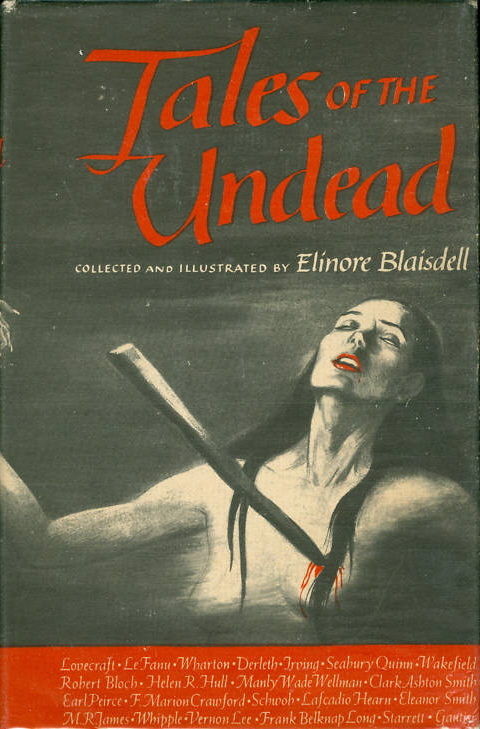
In literature, as in life, there are two motifs: love and death. Everything else is an offshoot of one or the other; and, Oscar Wilde to the contrary, death is surely stranger than love. All over the world the vampire legend—the sotry of the dead who will not die—is found, varied in setting and circumstances, but basically the same. This book is comprised, with a few exceptions, of tales of the dead who return, animated by an unnatural and unhallowed life. No mere apparition can chill in quite the same fashion as the very corpse itself, now an alien and a stranger, but continuing in its old habit, clinging to its old existence.
There are one or two vampires included herein not as yet of the undead. Montague Summers notes cases of the living vampire, and Hans Ewers writes of a vampire suffering from a disease of the blood whereby the victim is forced to seek living blood to sustain herself. One of these stories is, possibly, of such a case. There is included, also, a plant vampire. Other stories are of the dead who return with a definite purpose, a wrong to avenge, or a mission to fulfill.
Most of these stories satisfy the M. R. James condition that the apparition should be “purely malevolent and odious.”
Good night! Pleasant dreams!
Elinore Blaisdell, preface in Tales of the Undead: Vampires and Visitants (1947)

Elinore Blaisdell is not well-remembered today, and when she is recalled it is often as an artist and a poet. Douglas A. Anderson has put together a sketch of her life from genealogical sources, and there is little to add to the basic facts. Her apparent sole venture as an anthology editor is Tales of the Undead: Vampires and Visitants (1947), which at a glance appears to be a somewhat unremarkable theme anthology—but context is important.
Weird Tales had bad luck with anthologies. Their initial effort, The Moon Terror and Other Stories (1927), compiled by editor Farnsworth Wright from the execrable first years of the magazine, failed to sell and even now reading copies can be had quite affordably. The British firm of Selwyn & Blount began publishing the Not at Night series under editor Christine Campbell Thomson in 1925, with the contents largely culled from Weird Tales. The last volume (an omnibus) published in 1937, further volumes apparently cut off by World War II, though it inspired many imitators.
Weird Tales writers E. Hoffmann Price and W. Kirk Mashburn enlisted the aid of H. P. Lovecraft, Robert E. Howard, Clark Ashton Smith, August Derleth, Frank Belknap Long, and Henry S. Whitehead to pitch their own Weird Tales reprint anthology in the early 1930s, but this effort too came to naught. Arkham House began publishing collections and anthologies drawn from Weird Tales in 1939, and co-founder August Derleth found a niche as an anthologist of weird and science fiction as well, with collections like Sleep No More (1944), Who Knocks? (1946), Dark of the Moon (1947), The Night Side (1947), and The Sleeping and the Dead: Thirty Uncanny Tales (1947). Those anthologies have been printed and reprinted, often re-issued in affordable paperback editions, which themselves have become collectible.
By contrast, Tales of the Undead is a one-off. It came from nowhere, had a single edition, and apparently was never resurrected in paperback or in any cheap reprint edition. More than that, it was an early example of the themed anthology; Blaisdell’s preface is clear that she had chosen stories that were about vampires or vampirism in some fashion—and that is a different approach than either Thompson or Derleth, who may have been looking for creepiness or excellence, but were not trying to put together a book of just werewolf stories or the like. The closest one could get to that would be rather dry “non-fiction” books like Montague Summer’s The Vampire, His Kith and Kin (1928).
Contemporary readers noted the difference:
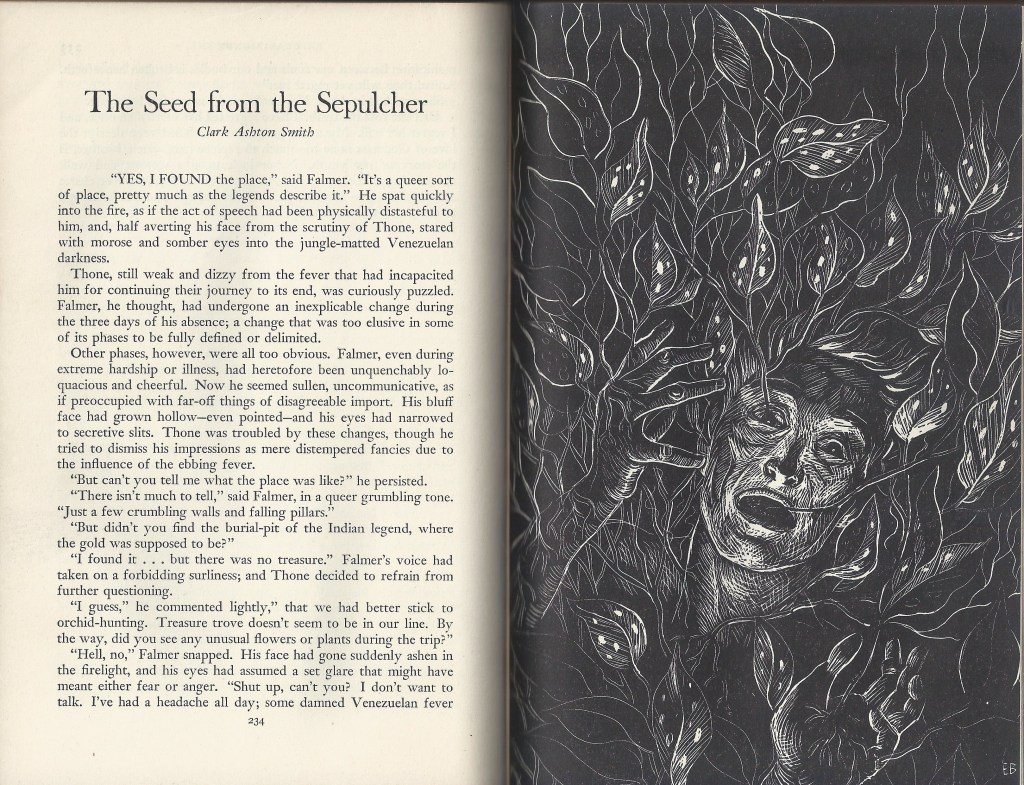
Her book features a special brand of supernatural horror, the vampire and the undead. Count Dracula might well be pleased at the advances his tribe has made in a few decades; for there are no less than 20 short stories, two longer tales, and one novelette on this single macabre theme. But the reader need not fear plot-limitations. Some striking variants have been made on the gruesome motif, and it is not every vampire that stalks the streets at night in a long black cape. For example, there is a tale of a vampire plant, Clark Ashton Smith’s “Seed from the Sepulchre,” which will cause more than one uneasy ripple up and down the spine, and others of rare additions to an unholy brotherhood we pray must always be confined to the realm of fiction.
Arthur F. Hillman, “A Volume of Vampires” in Fantasy Review #6 (1947)
Not everybody understood the advantages of a themed anthology. One contemporary newspaper account complained:
Miss Blaisdell has limited her subject too much. In doing this she has omitted the best horror stories of all. “The Monkey’s Paw,” by W. W. Jacobs belongs in a collection of this kind. Surprisingly enough, there is nothing by Poe or Hawthorne here, nor are there any contributions by the Romantic Gothic novelists, notably Mary Shelley and Mrs. Radcliffe.
Charles F. Feidelson, “The World of Books” in The Birmingham News, 28 Jun 1947
That the reviewer was probably not up to date on their weird anthologies is pretty clear; he was expecting a collection of old familiar horrors, not a themed selection.
Hillman also noted that there were “many gems from Weird Tales,” and this is true. Of the 23 tales in the book, 10 originally appeared in Weird Tales. A few others such as Washington Irving’s “The Adventure of the German Student” (1824) and “Amour Dure” (1887) by Vernon Lee were in the public domain and free to use without permission, so really more than half of the more recent tales in the book come directly from the pages of the Unique Magazine. Which is no doubt why in the acknowledgments Blaisdell added:
The editor wishes to thank Dorothy McIlwraith and Lamont Buchanan of Weird Tales for their gracious cooperation.
McIlwraith took over as editor of Weird Tales in 1940. Buchanan was associate editor under her. It’s worth considering whether either of those two had any influence on the story selection, but a glance at the table of contents notes that none of the stories were published in Weird Tales under McIlwraith. In truth, there was a bit of a changing of the guard at Weird Tales with the death of Robert E. Howard (1936), Lovecraft (1937), and then Farnsworth Wright (1940), and Weird Tales had difficulty attracting talent. In one letter dated 30 August 1946, Buchanan wrote to August Derleth:
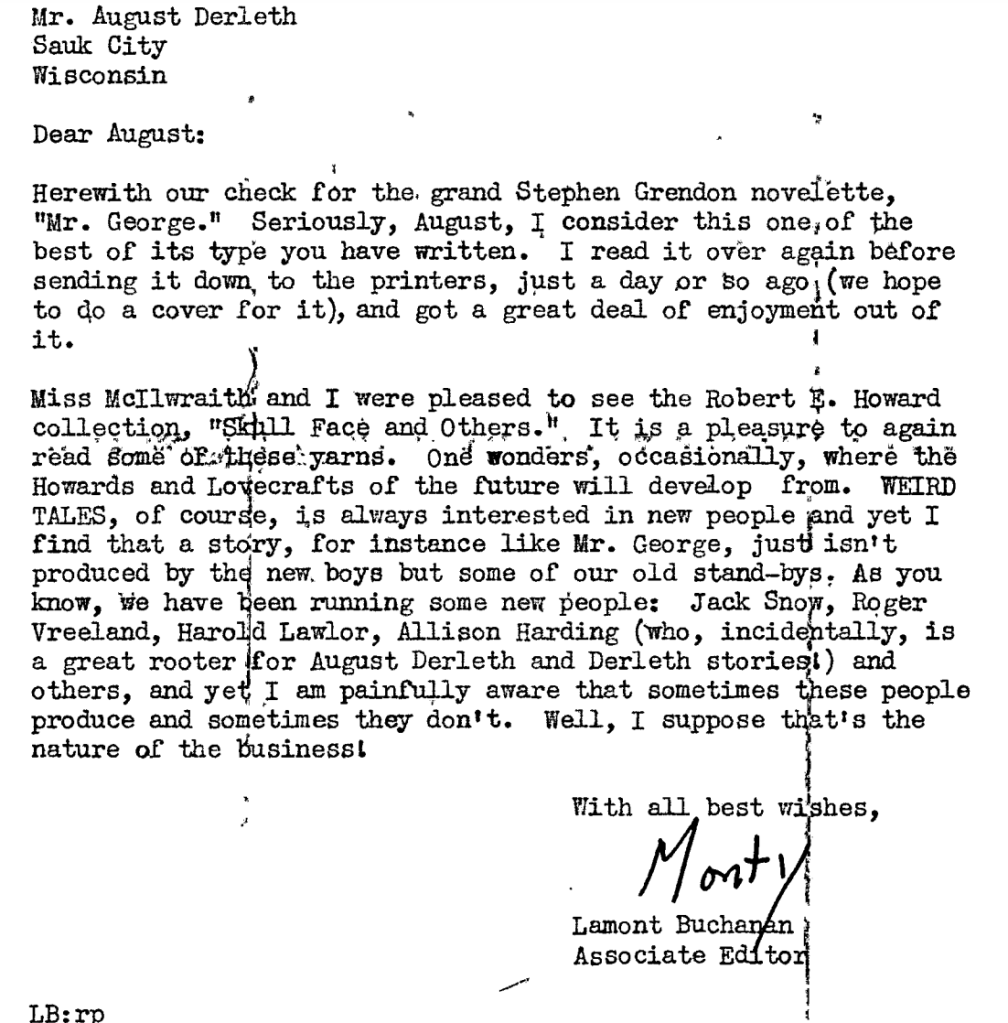
Blaisdell must have dealt with August Derleth too, since several of the stories were reprinted by permission of Arkham House; unfortunately, those letters don’t appear to survive. Still, it goes to show the lengths that Blaisdell went to get good stories for her collection, including both prominent authors of an older generation (J. Sheridan LeFanu, Vernon Lee, Washington Irving, Theophile Gautier, Lafcadio Hearn, etc.) and masters of the early 20th century weird tale (M. R. James, Edith Wharton, H. R. Wakefield, E. F. Benson, H. P. Lovecraft, F. Marion Crawford, Clark Ashton Smith, Frank Belknap Long, Robert Bloch, Seabury Quinn, August Derleth, Manly Wade Wellman, etc.). Some of them, like Robert Bloch, have gone on to enduring fame, while others like Chandler W. Whipple have languished in relative obscurity.
Despite having a relatively formidable roster of authors and getting several newspaper reviews, I suspect that Tales of the Undead sank out of sight largely because the field of the hardbacked horror anthology was already getting crowded—three of Derleth’s anthologies were also published in 1947—and Tales was an all-reprint anthology, and at that not always the most notable reprints. While Blaisdell displayed excellent taste, it has to be wondered if picking some of the more prominent and popular vampire stories from Weird Tales like Edmond Hamilton’s “The Vampire Master” might have led to greater popularity. Then again, perhaps not.
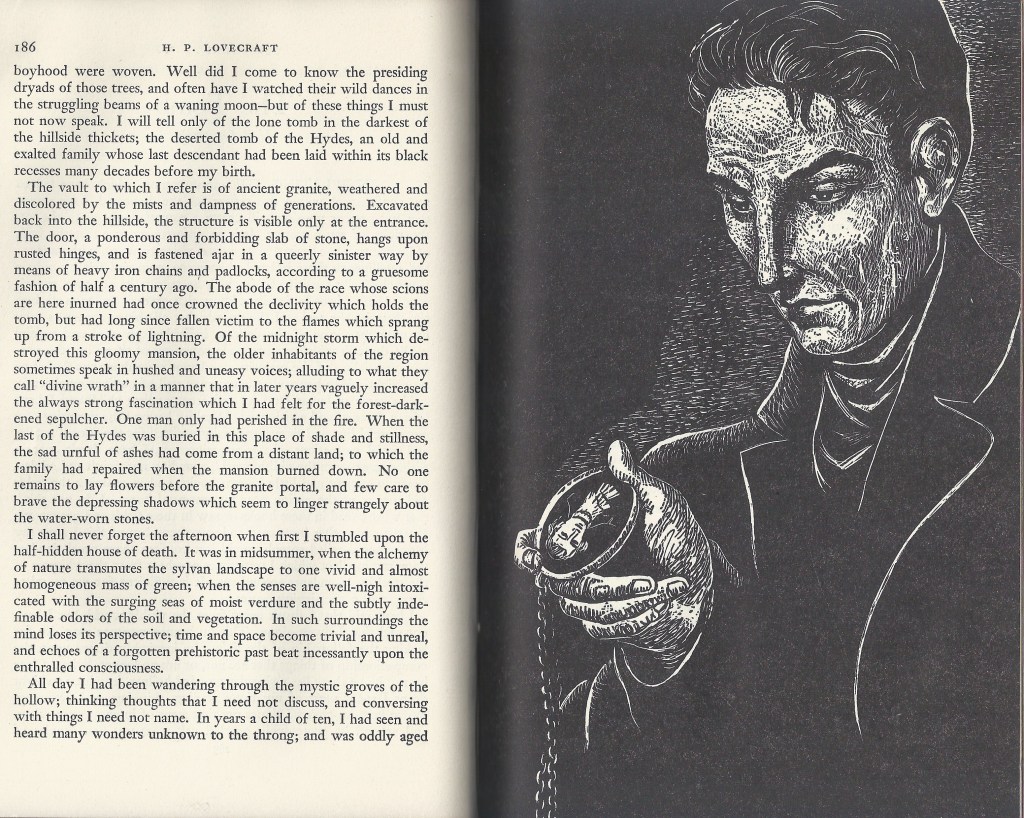
The final thing that sets Blaisdell’s anthology apart is that she illustrated it herself—and many of these scratchboard illustrations are absolutely gorgeous, stark and detailed, similar in some ways to Lynd Ward’s illustrations for The Haunted Omnibus (1937) or Illustration Portfolio No. 1 (1925) by The Arthur Wesley Dow Association, and worth in many ways the price of Tales of the Undead. A few of these, just to give just a taste:
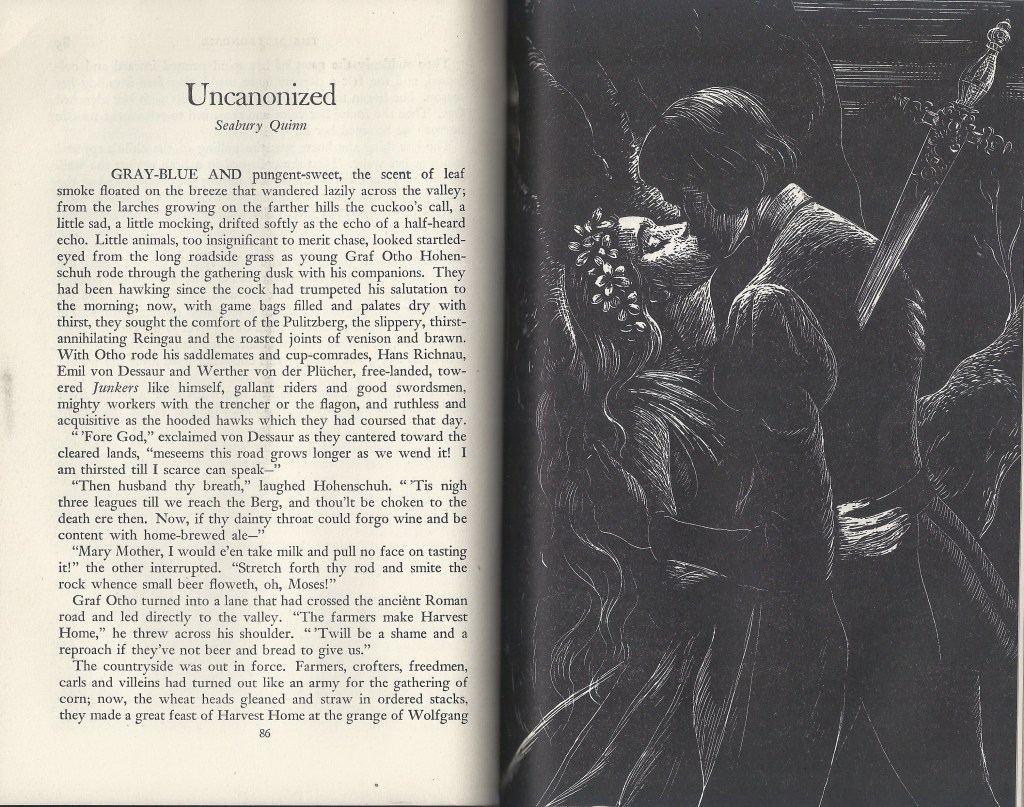
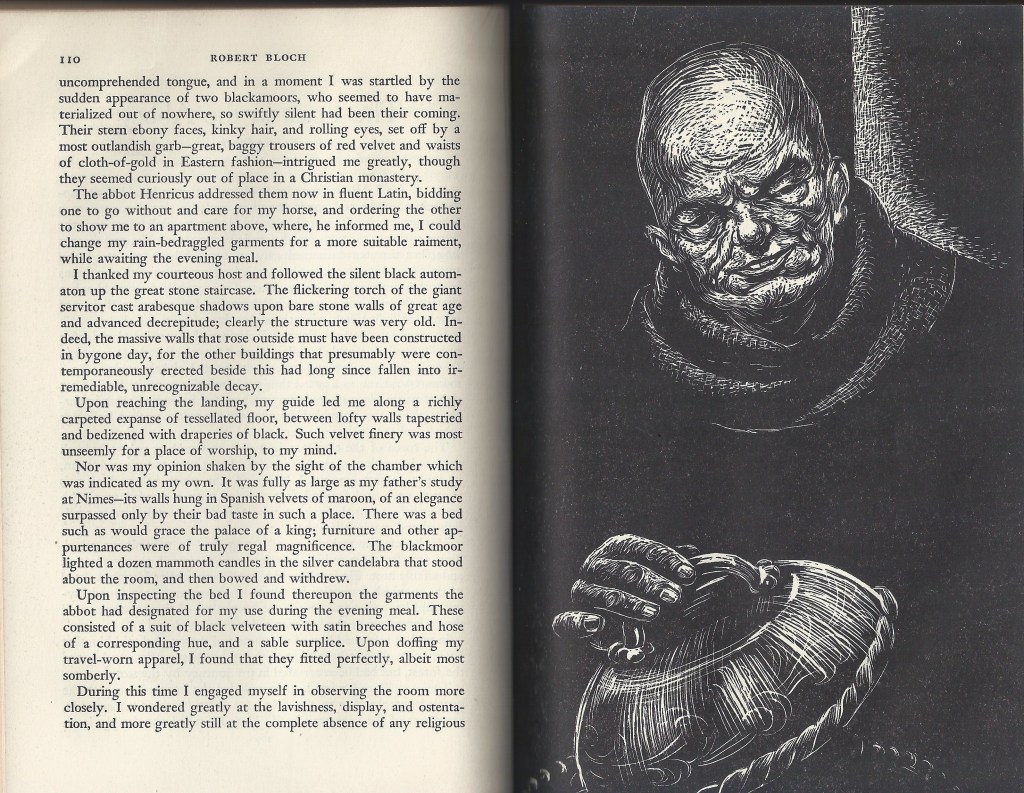
Tales of the Undead is ultimately a monument to both Elinore Blaisdell’s good taste in weird fiction, and her artistic skill and sensibility. She stepped away from the idea of a weird fiction collection as a kind of horrific miscellany and attempted to show the variety and depths of a particular theme—decades before we would get collections like Rivals of Dracula: A Century of Vampire Fiction (1978) or Weird Vampire Tales: 30 Blood-Chilling Stories From The Weird Fiction Puklps (1992). In an era when an avid reader could fill shelves with anthologies specifically about vampires or other specific flavors of the undead, it is important to recognize one of the innovators among the anthologists of her day.
Bobby Derie is the author of Weird Talers: Essays on Robert E. Howard and Others and Sex and the Cthulhu Mythos.
Deep Cuts in a Lovecraftian Vein uses Amazon Associate links. As an Amazon Associate I earn from qualifying purchases.
 Deep Cuts in a Lovecraftian Vein