Everil Worrell (1893-1969) and August Derleth (1909-1971) were peers at Weird Tales, familiar names whose stories appeared in issues under both editors Farnsworth Wright and Dorothy McIlwraith. However, Worrell was never a member of Lovecraft’s circle of correspondents, never a player in the literary game that gave birth to the Cthulhu Mythos. As a consequence, it isn’t surprising that their correspondence seems to have been relatively sparse, and primarily involved business rather than personal matters.
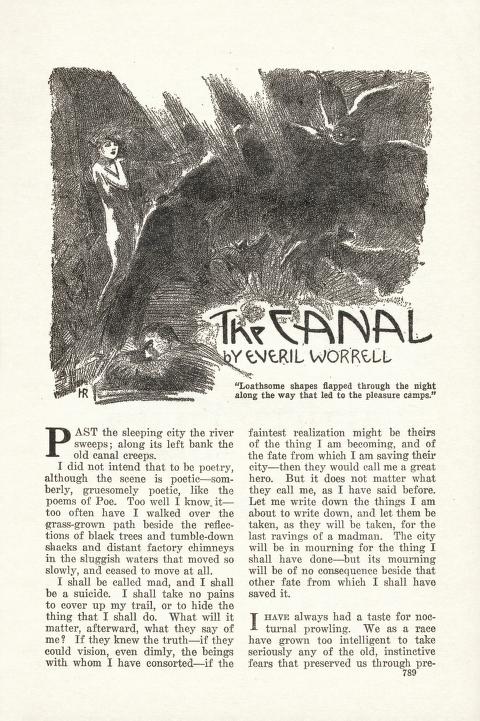
The extant correspondence at the Derleth Archive in the Wisconsin Historical Society is relatively brief and incomplete: 8 letters, for a total of 15 pages, spread across two folders (Box 36, Folder 2 under her married name Everil Worrell Murphy; and Box 62, Folder 5 as simply Everil Worrell), covering the years 1947-1969, and all letters from Worrell. The sole 1947 letter concerns her story “The Canal,” which appeared in the Derleth-edited anthology The Sleeping and the Dead: Thirty Uncanny Tales (1947):
Dear Mr. Derleth:
Thank you for your most prompt reply. Of course I shouldn’t dream of reselling THE CANAL until after your stipulated period, since you are using it. The fact is that I thought maybe it had just gotten indefinitely pushed aside and you might not have any plans for it and might yourself be glad to resell it if I could not.
Thanks for the tip on cleaing with W.T., in case. Miss MacIlwraith’s manner both of acceptance and rejection is so extremely warm, that I imagine she will lean over backward to accommodate me in a small matter like that, should it come to that. Still on the other hand, since she and I are not in very close communion, she probably wouldn’t care what I did with it.
Of course, I am much more pleased to have THE CANAL come out in your anthology than in a paperback, and look forward to seeing it with the deepest pleasure. | By the way, the old girl I once spoke of as having porbably put in an oar vs. The Canal with Farrar & Rinehart (with which she claims the closest and tenderest ties, I’m told) is named Lillian McM. Meyer—believe it or not. I referred to her as Agnes Meyer, thus confusing her with a fine woman columnist here. Mrs. Lillian tells her name so frequently and with so much stress that one forgets what it is.
I must insist, however, that some of our Washington writers’ clubs are rather nice institutions. The Society of Free Lance Writers, of which I have been president these last two years, gets its members some pretty nice contacts—including for me some nice collaboration on my second try at a novel. Mr. Seabury Quinn gave us a very fine talk last week. I wish you were ever in Washington at a time when I could impose on your good nature; if ever you are and feel willing to be a martyr to a good cause, do please let me know.
Sincerely and cordially—
Everil Worrell Murphy
—Everil Murphy to August Derleth, 4 Mar 1947,
Worrell’s praise for the Society of Free Lance Writers is understandable; she was the president for some years.
There is a question about the first anthology appearance of “The Canal,” as the ending was substantially changed and abridged in The Sleeping and the Dead versus the original 1927 publication—and the 1927 text was also used in the 1935 reprint in Weird Tales, the 1948 Avon Fantasy Reader reprint, and most others that I’ve been able to lay hand or eye on. In The Weird Tales Collector #1 (1977), Robert Weinberg said that “August Derleth asked for a rewrite of the ending of ‘The Canal'” (14); the surviving letters do not mention a rewrite, but possibly some correspondence has been lost or was filed elsewhere. Derleth had a reputation for sometimes altering stories in some of his collections and anthologies; and suspicion has fallen on him for the severe abridgment. However, there are no answers in this or any other letter in the Worrell/Derleth correspondence, scanty as it is.
One more mystery.
The next chronological letter from Worrell to Derleth is dated 18 Feb 1963. The timing makes sense for a renewed correspondence; The Sleeping and the Dead: Thirty Uncanny Tales (1947) was split into two paperback reprint volumes: The Sleeping and the Dead: 15 Uncanny Tales (1963) and The Unquiet Grave: 15 More Uncanny Tales of Terror (1964), which included a reprint of “The Canal” (in its abridged form).
Several of the letters are Worrell submitting short fiction, novellas, or poetry, presumably for Derleth’s anthologies. Some of these works (“Last Return,” “The Jungle” (a poem), “The Liger,” “Believe in Tangibles,” “Woman from Peak Town,” “Hell is Murky,” “Magic Casements,” and “Night Should be Black”). None of these works are known to be published; it isn’t clear if any of the manuscripts survive, although the full text of “The Jungle” is included in one letter. Some of the synopses she provides are interesting, however:
- Believe in Tangibles.
About 7-8,000 words (similar length to Canal). It has no vampire, but a demon doctor who is betrayed by his shadow on the wall, just in time to save the hero from a lobotomy because he has contacted extraterrestrial anti-demonic entities.- Woman from Peak Town.
About 20,000 words I have this labeled, but it is a straight story line uncomplicated enough to cut drastically at cost of “atomosphere” and mood stuff. This is a straight (and gruesome) vampire story, narrated by an observant slightly elderly doctor.- Hell is Murky.
20,000 words. I seem to have sent this to Fawcett’s Gold Medal Books, God knows why, becauseI have this comment which I enclose for info.
This has a vampire (male) at the core of a Hellish Empire in a worn out part of the Capital of our Nation in which gangsters, voodoo worshippers, et al, cooperate.—There is so much cooperation it would not cut.- Magic Casements.
20,000 words, but could be much cut (not so much as Woman from Peak Town)—at same cost of atmospehre and mood. The story line would stand it.
Spaceways Mag wanted to publish this but failed, and returned it. Said if he reopened would ask for it back, but didn’t ever reopen—to my knowledge at least.
The scientist hero of Casements married a mysterious lady who turned out to be from Venus. On Venus, higher forms of life retain some of the fluid protean quality of our lowest forms of life. Sandra wears sari-like cover-all garments; she turns out to have a slight problem of tiger fur on her body. In Earth’s malefic magnetic field, she has only three months before going killer-tiger. This causes Horror to raise its ugly head, and calls for drastic measurs. Actually, a were-tiger with our Earth serving here as the full moon serves to change the were-man to were-wolf.- Night Should be Black.
20,000 words. Could be cut—some—but it might cut out the author’s heart.
Gwen, nine years old, is left in a select boarding home when her mother is off to Europe to write a column for her paper. The lady proprietress is a witch. The visiting doctor is head of the coven. Two servants are cannibals from new Guinea (tribe of Mundogumors). They transfuse blood both in and out of the kids and have cannibal feasts, and select a few for training for witchcraft, and Gwen is one of the chosen lucky ones. The murdered mother of a boy of her age works a little white magic, and Gwen is a smart little girl and a nice child at heart, and she and the boy escape. (But the menace is still loose in the world.) There is a touch of medieavalism in this story.—Everil Worrell to August Derleth, 1 Mar 1963
Given how relatively little we have from Worrell on her writing and unpublished works (a few letters published in Weird Tales and a short biographical essay written by her daughter Eileen), the letters to Derleth are an invaluable insight into what else she wrote.
There is another gap; after 1963 the letters jump to 1967. These letters seem a bit more personal, or at least conversational. In one, she describes a meeting of the League of American Pen Women, which concludes:
At the end of this meeting, I found myself trying to give them a slight glimpse into the Cult of Chulthu [sic]! Although I was never much more than a “Square” observer on the C of C, I did my best—since there seemed to be a “Need to Know.” I’m more at ease with ordinary witchcraft, vampirism and demonology—perhaps. But, leave us all hang together. (And now I’m one of the Old Ones myself, chronologically speaking.)
N’Gai ? ?
—Everil Worrell to August Derleth, 12 Mar 1967
Another letter that same year consoled Derleth on his divorce and having to raise his two children as a single parent (“a note of sympathy and understanding, on this deal of being father and mother both”), the death of her husband after only a few years of marriage (“Only 8 years later […] did I learn that he might have been murdered. The theory was it had to do with foreign cartel patents.”), her bad luck with magazines and publishing after Weird Tales ended in 1954 (“I’m sure I brought the curse on them. I even folded an English publishing house which was going to bring out the first of my two novels”), and memories of happier days:
When I think of things “gone with the wind,” we had in our NY apartment, all over the walls those sketches for the WT covers when you had the cover story, which F.W. let me have. When we brought the baby home we took them down—not wanting to over-weirdize her infantile sub-conscious.
—Everil Worrell to August Derleth, 17 May 1967
Farnsworth Wright, editor of Weird Tales, apparently often gave authors the cover painting or sketch, according to Seabury Quinn and others. She also recalled a less happy case of impersonation:
It was only an anti-climax when a man who had written for WT told a lot of people here that he had written all my stories anyway and, wanting a pen name for variety had begun using “Everil Worrell” when I was just a little girl, to give me a childish thrill.
—Everil Worrell to August Derleth, 17 May 1967
I haven’t been able to pinpoint this impostor in any period fanzines or convention reports; there was some speculation that O.M. Cabral was one of Worrell’s pseudonyms, which appeared in a couple of places, and this might have contributed to a general misconception. Terence E. Hanley touches on this in his excellent overview of her career at Weird Tales at the Tellers of Weird Tales blog.
Everill Worrell’s final letter to August Derleth is undated, little more than a note scrawled on a printed copy of “The Jungle,” a poem that is spiritually a successor to Lovecraft’s “Providence in 2000 A. D.” and depicts a Washington, D.C. overrun with Black people. A note in brackets says “[1969],” and Worrell’s note includes the phrase “Black is beautiful” (though she does not agree with the sentiment), which suggests she may have been reacting against the Civil Rights Act of 1968 that removed segregation in housing.
A sour note on which to end, but it must be remembered that such prejudices were all too common, and for all that we laud the progress achieved by the decades-long struggle of the Civil Rights movement, every legislative victory faced a reactionary backlash.
During the later part of her life, she became increasingly lame, the result of a fall when she was 17. When she reached the point where she needed two canes to walk, she left office work and settled down to full retirement. She missed Weird Tales very much then because she had plenty of time to write but no one to write for. She was always an enthusiastic reader and had become interested in the suspense story. At the time of her death, she was just getting into her third novel.
—Jeanne Eileen Murphy, “Everil Worrell” in The Weird Tales Collector #1 (1977), 14
Everil Worrell’s correspondence with August Derleth ended with her death on 27 November 1969. While she was one of the most prominent women in Weird Tales during its heyday, her difficulty placing later stories shows how difficult it was to catch and hold the zeitgeist, or perhaps how little relative name recognition she had outside of Weird Tales during the period. The synopses of her stories sound a bit old-fashioned by the standards of the 1960s, very pulpish plots—but also surprisingly dark and lurid. Who knows what lost diamonds in the rough readers might have missed, since they were never published?
These letters to Derleth, in the ultimately vain hope of further publication, show Everil Worrell as she was, warts and all—and with the resurgence of interest in her life and fiction, they should form a part of the understanding of her life and work.
Bobby Derie is the author of Weird Talers: Essays on Robert E. Howard and Others and Sex and the Cthulhu Mythos.
Deep Cuts in a Lovecraftian Vein uses Amazon Associate links. As an Amazon Associate I earn from qualifying purchases.
 Deep Cuts in a Lovecraftian Vein