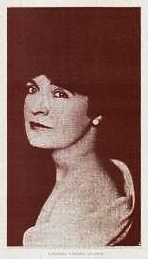
Or had Lovecraft been casting sheep’s eyes upon some young woman whom he lacked the nerve to approach openly? Could it have been his fellow-amateur and ghosting client Winifred Virginia Jackson, with whom he had quite—for him—a close friendship?
—L. Sprague de Camp, H. P. Lovecraft: A Biography (1975) 123
In 1943, Arkham House published Beyond the Wall of Sleep, the second collection of Lovecraft’s fiction. It was the first book publication of “The Crawling Chaos” (1921) and “The Green Meadow” (1927), two stories co-written by H. P. Lovecraft and Winifred V. Jackson—there credited as “Elizabeth Berkeley.” Fans deciphered the pseudonym; George T. Wetzel correctly identified Winifred Virginia Jackson as one of Lovecraft’s collaborators in The Lovecraft Collector’s Library, vol. VII (1955). Details about Lovecraft’s collaborators, however, were thin on the ground. Aside from a few references in the first volumes of Lovecraft’s Selected Letters and a brief bit of speculation by de Camp, there was nothing available on their relationship or the stories they wrote together.
In 1976, you had to be an exceptional Lovecraft fan to know much about Winifred Virginia Jackson.
R. Alain Everts and George T. Wetzel were two exceptional Lovecraft fans. Everts had interviewed many surviving friends and associates of Lovecraft, including developing a friendship with the former Mrs. Lovecraft, Sonia H. Davis, and written such essays as “Mrs. Howard Phillips Lovecraft” (1973) and “Howard Phillips Lovecraft and Sex” (1974). In the process, Everts had also alienated many people (see The Curse of Cthulhu [PDF]). Wetzel likewise distinguished himself as a fan-scholar and publisher; the seven volumes of his Lovecraft Collector’s Library were a starting point, collecting many of Lovecraft’s early amateur writings and writings about Lovecraft (which Everts would later publish the collected edition through his imprint The Strange Company in 1979), along with several other articles and miscellaneous publications. Wetzel was also considered a bigot by fellow fans, and accused of writing poison pen letters (“In Memoriam: George Wetzel” in Ibid 45 [PDF]).
Winifred Virginia Jackson—Lovecraft’s Lost Romance (1976) combined Everts’ and Wetzel’s respective skills, interests, and prejudices. Counting the covers, it is a small 8.5″ x 11″ stapled pamphlet of 11 sheets (which technically makes 18 pages, although some of those are blank), which includes a mix of biographical essay, black-and-white reproductions of photographs, and photostatic copies of some of Jackson’s poetry from amateur journals. A fairly typical fan-product of the period, a touch more scholarly and influential than most, if only because information on Jackson would remain scarce for decades, until the greater availability of digital records and the digitization of books, newspapers, and ‘zines made it possible to obtain greater information and accuracy about her life…with some caveats.
To give an idea of what this means, here is a quick sketch of WVJ’s life based on readily available documents just on ancestry.com:
- Born 1878, died 1959. (Findagrave)
- Daughter of King Jackson and Myra E. Jackson; older brother Ralph Jackson (1880 Federal Census)
- 1900, working as a stenographer, living in a boarding house in Northfield, MA. (1900 Federal Census)
- 21 Mar 1902, married Frank M. Le Monn in Ann Arbor, Michigan (Michigan marriage records)
- 1910, living with her mother in Boston, still married. (1910 Federal Census)
- 3 Jul 1913, death of Kingsbury Jackson (New Hampshire death records)
- 14 Aug 1913, marriage to Horace Wheeler Jordan in Boston, MA. (Massachusetts marriage records) [Presumably divorced between 1910 and 1913]
- 1920, living with her mother in Boston, now single but still listed as Winifred Jordan, working as a stenographer in a law office (1920 Federal Census)
- 1930, living with her mother in Boston, occupation listed as writer/book writer (1930 Federal Census)
- 1938, death of Myra Jackson (Massachusetts death index)
- 1950, living with Eugene Holmes in Boston, marital status “widowed” (1950 Federal Census)
- 20 Apr 1959, death of Winifred Virginia Jackson (obituary)
While this seems like a lot of specific information, there’s a lot that isn’t shown here: where she went to school and college; her career in amateur journalism; the books she wrote, edited, and published; her work as co-founder and then owner of the B. J. Brimmer Company with William Stanley Braithwaite; etc. The records we do have are rife with inaccuracies: the 1880 Federal Census lists her as “son” rather than daughter; the ages given in later census records are always incorrect, which led one researcher, Charles Trombee, to conclude she habitually lied about her age (Lovecraft Collaborator–Winifred Virginia Jackson), and even Ancestry.com and Findagrave disagree on her exact birth date. Certain records are missing, possibly lost or never digitized—so we know she divorced her husbands, but don’t necessarily know when exactly.
So keep that in mind: Everts and Wetzel were working with incomplete data. While reporting what they had discovered, not all of what they report would be accurate, and not all of their speculations would be accurate either. Even today, a biographer would have a lot of work to do to fill in the gaps of Winifred Virginia Jackson’s life.
Some of what was reported was, frankly, gossip. For example, the idea that Lovecraft and WVJ shared any romantic interest arises from Wetzel’s correspondence with amateur journalist Willametta Keffer:
Mrs. Keffer wrote to Wetzel on 23 January 1956 stating that everybody in Amateur Journalism thought Lovecraft would marry Winifred Jordan. She added: “Now don’t you go encoraching on my territory here, this is an aspect that hasn’t been touched and I’m working it up […] A long time member of NAPA who knew and met both HPL and Winifred Virginia told me of the ‘romance’.”
Writing to Wetzel again, twenty years later:
She also added that Mrs. Jordan was “supposed to have had a torrid affair with an editor and I found some substantiation in a Year Book of the Bibliotheque Society of Boston.”
Taking this gossip as gospel, and combined with less-than-complete biographical information, Everts and Wetzel made a couple of deductive leaps which, in hindsight, are unfortunate:
Her marriage was brief and ended in divorce about early 1919. Her husband Horace Jordan was a Negro – in fact Winifred Virginia Jackson had always been a champion of the Negro – today at least one of her descendants is also married to a Black. By the time she had met Lovecraft, her marriage was over and she was the msitress of the celebrated Negro author William Stanley Braithwaite. His marriage prevented him from marrying Winifred, but for ma[n]y years she remained his mistress. However, this affair did not prevent Winifred Jackson from becoming very attracted to the single HPL. […] It is doubtful if Lovecraft himself knw of her former husband and her liaison (although Lovecraft did enjoy gossip) with Braithwiate [sic], – but even if he had he might not have cared anyway. […] What is known as fact is that many older Ajays have told Everts that they were surprised that Lovecraft had not married Winifred Jackson. It is a fact that Lovecraft took a snapshot of Winifred Jackson at the seaside, and it is known that she and HPL were romantically linked by the 1921 Boston National Amateur Press Ass[o]ciation convention. In the words of Sonia Lovecraft to Everts in 1967, “I stole HPL away from Winifred Jackson.”
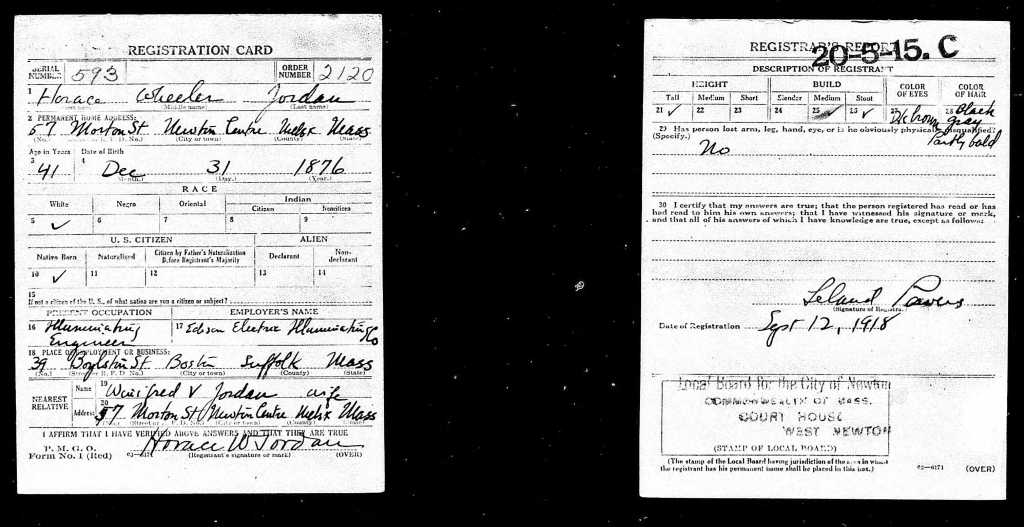
There is a lot to unpack there. Let’s start at the beginning: Horace Wheeler Jordan was, according to census records and his WWI draft card, white:
Was Winifred Virginia Jackson a champion of Black rights and culture, despite being white? Probably. Trombee notes that she had poems published in The Brownie Book (aimed at Black children) and The Crisis, a Black literary magazine, and was mistakenly listed among Black poets in Colored girls and boys’ inspiring United States history, and a heart to heart talk about white folks (1921) by William Henry Harrison, Jr. and Negro Poets and their Poems (1923) by Robert Thomas Kerlin. Winifred Virginia Jackson co-founded the B. J. Brimmer Company with mixed-race poet, author, and editor William Stanley Braithwaite, which company published various works by Black authors, including Sidelights on Negro Soldiers (1923) by Charles H. Williams. She does not appear to have had any children, so it’s not clear who her “descendants” were in this specific case; probably the children of her surviving cousins.
The accusation that Winifred Virginia Jackson carried out an extramarital affair with William Stanley Braithwaite is, so far as I have been able to determine, unsubstantiated. If Wetzel is to be trusted, the rumor began in amateur journalism, but it first hit print with Winifred Virginia Jackson—Lovecraft’s Lost Romance. No private letter from Jackson or Braithwaite has emerged that hints at any kind of sexual relationship between the two (although given that Braithwaite was married and that interracial relationships were taboo in the 1920s, this may not be so unusual). Scholarly works like The William Stanley Braithwaite Reader (1972) make no mention of such an affair, nor was it mentioned in any of Braithwaite’s autobiographical essays (although again, this isn’t surprising).
Of their friendship (and Braithwaite’s admiration of Jackson as a poet) we can be fairly certain. Braithwaite’s Anthology of Magazine Verse for 1921 devotes a chunk of space to Jackson; Braithwaite wrote an introduction to her book Backroads: Maine Narratives—with Lyrics (1922); and in the Twentieth Anniversary Number (1921 annual of the Bibliophile Society in Boston), Braithwaite wrote an introduction, “The Poetry of Winifred Virginia Jackson,” to give three examples. Perhaps it was the latter that Keffer was thinking of when she said the “Year Book of the Bibliotheque Society of Boston,” since the Bibliophile Society of Boston did issue an annual, often titled a Year Book. Yet there is nothing in that introduction the least scandalous or suggestive of a romantic or sexual relationship. Nor did Keffer ever produce the tell-all article she hoped to.
Everts’ comment on “stealing” Lovecraft from Jackson is more interesting; as discussed in “Howard Phillips Lovecraft and Sex” (1974) by R. A. Everts, we don’t have any way to really prove or disprove this, as Everts is reporting a private communication that was is only ever published here and nowhere else. We are dependent on his memory and his trustworthiness as a source. Still, the idea that the bachelor Lovecraft might be hypothetically paired with various single women in amateur journalism, especially those he worked closely with, such as Jackson, isn’t far-fetched. After all, when Lovecraft did eventually marry, it was to an eligible single woman in amateur journalism with whom he worked closely, Sonia H. Greene.
There is a little more in Winifred Virginia Jackson—Lovecraft’s Lost Romance, such as a reproduction of the photo Lovecraft took of Jackson, but not much else of real consequence. Everts and Wetzel based their idea of a romance (real, potential, or imagined) on the 30-40-year-old memories of gossiping amateur journalists. Some of the facts about Winifred Virginia Jackson they got right, others wrong; the sources being what they are, this isn’t surprising or even a substantial criticism. Mistakes happen all the time in genealogical and biographical research, and the misidentification of a single individual in an error-filled record can lead even the most well-meaning researcher off into a chain of fantasy. The affair with Braithwaite remains unproven, though perhaps some love letter will surface one day to give it substance. The uncritical repetition of the claim decade after decade shows the dangers that can come from relying on a single unreliable source.
Bobby Derie is the author of Weird Talers: Essays on Robert E. Howard and Others and Sex and the Cthulhu Mythos.
Deep Cuts in a Lovecraftian Vein uses Amazon Associate links. As an Amazon Associate I earn from qualifying purchases.

