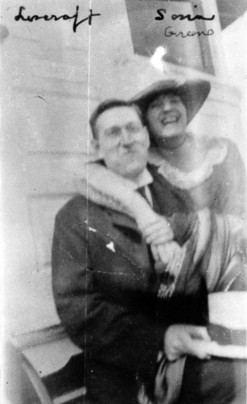
Immediately after “Sonia & H. P. L.” by L. Sprague de Camp in The Normal Lovecraft (1973) is an essay by Gerry de la Ree titled “When Sonia Sizzled” that also takes as its subject Sonia H. Davis, the former wife of H. P. Lovecraft. De la Ree was a noted collector who managed to procure an enviable number of original letters and artwork connected with pulp writers of the 1930s, including original art from Clark Ashton Smith, and he used part of this collection as the basis for a series of publications, of which The Normal Lovecraft was one example.
“When Sonia Sizzled” is one of several essays and articles that he wrote on pulp matters. Like much of The Normal Lovecraft, it has never been reprinted. The essay begins, thus:
Except for a repeated general distaste for life in New York City, H P. Lovecraft in general restricted commentary on his two years of married life with Sonia Shifirkin Greene. His brief autobiographical sketch, published in 1963 by Arkham Hosue and written some 30 years earlier, makes no mention of this period.
Likewise, in “Ec’h-Pi-El Speaks”, an autobiographical sketch written in 1929 and published by this writer last year, H. P. L. again skipped over the period of his marriage as if it had never existed.
Lovecraft’s closest associates have often testified to his apparent lack of interest in the opposite sex, and both his fiction and his countless letters seem to bear out this contention.
—Gerry de la Ree, “When Sonia Sizzled” in The Normal Lovecraft 28
In context, by 1973 Arkham House had published the first three volumes of Lovecraft’s Selected Letters, which covered a period up to 1931—the entirety of his New York period (1924-1926) and marriage leading up to the divorce decree (1924-1929). August Derleth and Donald Wandrei, editors of those volumes, had selected, excerpted, and in places edited Lovecraft’s letters to emphasize information value and points of interest. Sonis is mentioned in ~45 pages of Selected Letters I and ~14 pages of Selected Letters II, mostly in letters to his aunts or to mutual friends and amateur journalists. But it is a paltry account of the marriage; whether the editors did this deliberately or it fell out like that as they prioritized Lovecraft’s fiction isn’t clear.
Today, with so many of Lovecraft’s unabridged letters published thanks to Hippocampus Press, we have a better sense for how often Lovecraft mentioned Sonia in his letters, and to whom. In fact, he did mention her much more frequently and in greater detail in letters to his aunts than anyone else, and to some correspondents—especially later ones—he does not mention his marriage at all. There was nothing particularly nefarious in this omission; Lovecraft was under no obligation to bare his soul to everyone he wrote a letter to, and the failure of his marriage must have been a source of personal disappointment and embarrassment.
However, it does mean that when scholars in the 1970s were trying to reconstruct Lovecraft’s marriage and find out more about his wife, they hit a wall. Sonia’s memoir was available in some formats, and small articles like “Lovecraft’s Marriage and Divorce” (1968) by Muriel E. Eddy, Memories of Lovecraft (1969) by Sonia H. Davis, and “Mrs. Howard Phillips Lovecraft” (1973) by R. Alain Everts were available, but that was pretty much it, except for sporadic mentions in Lovecraft’s letters and in a few memoirs by friends who had known both Sonia and Howard.
Gerry de la Ree knew this. And with diligence and no doubt money, he bought Sonia’s letters to Samuel Loveman from the 1940s. “When Sonia Sizzled” consists mostly of excerpts from these letters, which date from after Sonia had been informed of Lovecraft’s death and when she had come into contact with Derleth, but before she published her memoir. In one letter, Sonia enclosed a letter she had received from August Derleth dated 21 November 1947, to get Loveman’s opinion on it. De la Ree quotes an excerpt:
I have so far had no reply to my letter of 18 September. Meanwhile, I hope you are not going ahead regardless of our stipulations to arrange for publication of anything containing Writings of any kind, letters or otherwise, of H. P. Lovecraft, thus making it necessary for us to enjoin publication and ale, and to bring suit, which we will certainly do if any manuscript containing works of Lovecraft does not pass through our office for the executor’s permission.
You will be interested to know that we know have in Lovecraft’s own letters to his aunts a complete and detailed account of how things went during his entire married life.
—Quoted in The Normal Lovecraft 29
Derleth was not the executor of Lovecraft’s estate. He was not even the literary executor; that was R. H. Barlow, who died in 1951. Arkham House had an agreement with Lovecraft’s surviving aunt Annie Gamwell to publish HPL’s writings before her death in 1941, and on this basis Derleth often pretended to complete authority over Lovecraft’s copyrighted work, and occasionally threatened legal action against those who published or republished anything by Lovecraft without Arkham House’s blessing. In hindsight, this can be seen as a deliberate bluff, a means for Derleth to concentrate and maintain control of the Lovecraft material, if not an actual monopoly.
However, at the time, this would not have been easy to discern; if Derleth had ever sued and been forced to go through discovery by someone calling his bluff, things might have gone very differently for Arkham House and Lovecraft’s legacy. Sonia’s follow-up to this was a letter to Loveman dated 1 Jan 1948; it mostly continues repeats assertions that appeared in her memoir, particularly that she financially supported Lovecraft during the New York period, which Derleth had flatly denied.
Readers in 1973 might have appreciated the peek behind the scenes, which led to the publication of Sonia’s memoir in 1948; although there was much more drama to it than these few letter excerpts state. The actual details of how much financial assistance Lovecraft received from his wife and aunts during that period is interesting for those who would like to reconstruct Lovecraft’s parsimonious budget; it was obviously sufficient to live on, but not thrive, or else he wouldn’t have left.
The third and final letter snippet de la Ree quotes from is dated 16 Nov 1949, after the publication of Something About Cats and Other Pieces by Arkham House, which contains a version of Sonia’s memoir, “The Horror at Martin’s Beach” (1923), and “Four O’Clock” (1949). By this point, Sonia and Derleth had achieved détente, which would grow into amicability in later years. De la Ree quotes her as writing to Loveman:
Yes, Derleth sent me a copy of “Cats”. He paid me a modicum for the H. P. L. story as well as for the two revisions, and while not much, it helped last year when I wasn’t earning anything while I was sick.
—Quoted in The Normal Lovecraft 31
None of these letters has ever been published in full, and aren’t likely to be anytime soon. If they still survive, it is in someone’s private collection. When read in conjunction with letters from Sonia and Derleth that survive at the John Hay Library and Wisconsin Historical Society, we can get a fuller picture of the tumultuous period in the late 1940s when Sonia stumbled into the complicated literary legacy of her deceased husband, and had to contend with one of the biggest fish in that small pond that was Lovecraft publishing.
Still, this was when Sonia was hot—or as de la Ree put it, when she sizzled—when her memoir was the hottest thing to hit Lovecraft fans since Arkham House had begun publishing in 1939. We know now, because of access to Derleth’s letters, that he was more concerned with Sonia’s portrayal of Lovecraft as antisemitic than with how much money she gave to Lovecraft to live on in New York, and his efforts to discredit and downplay her memoir probably reflect Derleth’s own interests in Lovecraft’s legacy as much as his friendship with the late HPL.
In 1973, “When Sonia Sizzled” was a peek behind the curtain of Lovecraft publishing in the 1940s, and was probably safe to publish because both Sonia and Derleth were safely deceased. Searchers after more data on Sonia herself were no doubt disappointed, but even if this isn’t the most substantial piece, it is still a piece of the puzzle that was her life, both with and after her marriage to H. P. Lovecraft. It wasn’t the whole story, nor did it pretend to be, but it added a bit of context to how Sonia came to publish her memoir. Today, with more of the pieces of the puzzle, we have a better picture of what happened.
Bobby Derie is the author of Weird Talers: Essays on Robert E. Howard and Others and Sex and the Cthulhu Mythos.
Deep Cuts in a Lovecraftian Vein uses Amazon Associate links. As an Amazon Associate I earn from qualifying purchases.
 Deep Cuts in a Lovecraftian Vein