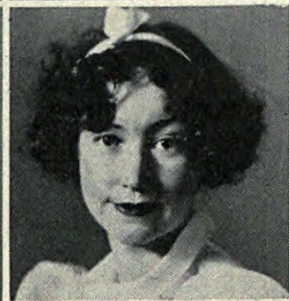
Friendships kept converging and, through letters, kept broadening. Bob began writing also to my sister, Lenore, who was winning poetry prizes at the University of Texas, and to Booth Mooney, a Lone Scout and son of an old grassroots Baptist rebel in the Bible-tamed cowtown of Decatur. […] He published verse—probably some of his best—in a little type-written journal of one copy passed through the mails, and called The Junto after Benjamin Franklin’s coterie in Philadelphia. Booth Mooney initiated the publication after a session of us two on a cold rainy day in Decatur. Lenore afterwards inherited it from Booth.
—Harold Preece, “The Last Celt” in The Last Celt: A Bio-Bibliography of Robert E. Howard 96
Honey Lenore Llewellyn Preece (17 Jan 1912 – 7 Dec 1998), more generally known simply as Lenore Preece, was one of the younger sisters of Harold Preece (16 Jan 1906 – 24 Nov 1992). The Preeces were Texans who lived in Austin, had literary interests, writing short stories and poetry, some of which were submitted to contests or competitions.
Harold Preece was a Lone Scout, an offshoot of scouting that was popular in Texas, where scattered settlements might not support a traditional Boy Scout troop. Scouting would be carried out largely via mail, and this lent itself to amateur journalism, with some Lone Scouts publishing “tribe papers,” small self-published ‘zines with news, essays, poetry, etc. Some Lone Scouts then pivoted toward other forms of amateur journalism, reaching beyond the Lone Scout organization in their literary and publishing interests. So it was that former Lone Scouts like Booth Mooney made connections with like-minded friends and drew them into an amateur press publication called the Junto, whose contributors included Robert E. Howard, Truett Vinson, Harold Preece, and his sisters Lenore, Katherine, and Louise.
In Robert E. Howard’s surviving correspondence, letters to Harold Preece begin to appear in 1928, roughly when the Junto began publication. No letters from Howard to Lenore Preece survive, but it seems reasonable that they were introduced through the Junto, as his first comments mentioning her are in relation to the amateur newsletter.
I hope to hell Mooney puts some of yours and Truett’s work in the next Junto. Most of the last was a lot of hokum, though Harold and Lenore did good work.
—Robert E. Howard to Tevis Clyde Smith, c. Nov 1928, Collected Letters 1.241
In 1928, Lenore Preece was 16 years old, still in high school. Robert E. Howard, who was a few years old (born 1906, so the same age as her brother Harold), had graduated from high school and begun landing stories and poems in the pulps. Despite her age, Lenore was intelligent and must have had some force of character; when Preece was no longer able to continue editing and publishing the Junto in late 1929, she took over editing and publishing. The first issue she published was lost, but later issues made the rounds, and she kept the Junto afloat for another year—at which point no doubt cost, her graduation from high school and acceptance at the University of Texas in Austin, and her job at a local hospital (according to the 1930 Federal census) likely impacted her time and ability to continue.
The Junto became a casualty of the depression and of Lenore’s heavy college schedule. Nor did a proposed gathering of Junto readers ever materialize.
—Harold Preece to Glenn Lord, 11 Jan 1966, The Howard Collector 240
Lenore and Robert’s earliest contact would have been through the shared medium of the Junto, but at some point they also clearly began a separate correspondence, just as Harold and Robert did. When this flow of letters started and how heavy it was, we have no clear indication, since Howard rarely spoke of his other correspondents in his letters. They were definitely in at least occasional contact in 1930, when the next reference to his correspondence with Lenore is made in Howard’s letters:
I got the copy of the Longhorn though I was a long time in acknowledging receiving it to Lenore. I enjoyed her poems very much. They stood out from the muck and drivel which characterizes all college magazines.
—Robert E. Howard to Harold Preece, 4 Jan 1930, Collected Letters 2.3
The Longhorn was the literary magazine of the University of Texas at Austin. Howard had some experience with college magazines from his time in Brownwood, TX, and his association with friends who encouraged his contribution to magazines like Daniel Baker Collegian and the Howard Payne Yellow Jacket. Howard’s letters to her brother Harold contain occasional comments about Lenore, but are insufficient to say how well she and Bob kept in touch:
Speaking of poets, thanks very much for the poem you sent me — the one by Lenore. That is a truly splendid piece of work, as indeed, all of your sister’s work is. I have no hesitation in declaring that she will be some day — and that soon — recognized as one of the foremost poets of the world. She should make an attempt to bring out her work in book form. To my mind she is far superior to Edna St. Vincent Millay right now.
—Robert E. Howard to Harold Preece, c. Oct or Nov 1930, Collected Letters 2.90I imagine that Lenore finds anthropology a very interesting subject; it is one I would like to explore myself, but I’ll never have a chance, I reckon. I certainly hope she gets the scholarship she is working for, and feel confident of her ability to do so. However, I see no reason why her scientific studies should affect her poetry. It should merely widen her poetic horizons; there is no richer field for the poet than the study of man from the primitive slime to the ultimate and unredeemable slime of civilized sophistication.
—Robert E. Howard to Harold Preece, 24 Nov 1930, Collected Letters 2.112
Still, they shared an avid interest in not just writing poetry, but seeing it published. The final echo of the Junto saga was a proposal by Juntite Alvin P. Bradford to self-publish a small collection of their poetry, under the proposed title Virgin Towers. Howard, Lenore Preece, and others sent Bradford copies of their poems, but ultimately nothing came of the endeavor. In 1932, Lenore Preece, Clyde Smith, and Robert E. Howard approached Christopher House in Boston to publish a collection of poems to be titled Images Out of the Sky, but the venture fell apart when the publishers asked for money for the printing (So Far the Poet… xxvi).
Howard’s letters regarding this affair suggest he was not in regular contact with Lenore:
I guess you’re right about the Virgin Towers business. I’ll send Bradford the fish and a half, but not till I write him and ask him what the Hell. I have an idea the Juntites wouldn’t kick in with the required dough. I hope to Hell you and I can bring out a volume of verse soon. I got one of those sterotypes from Lenore, by the way of Mooney, myself, and I reckon everybody connected with the Junto got one or more.
—Robert E. Howard to Tevis Clyde Smith, week of 18 May 1931, Collected Letters 2.163I’ve been patiently waiting for the return of my verse from Bradford, and I don’t know why in Hell he hasn’t sent it, or at least written me. I’m getting fed up on this sort of treatment. If he doesn’t send them pretty damned soon, I’m going to San Antonio after them. Have you heard anything from him, or from Lenore?
–Robert E. Howard to Tevis Clyde Smith, c. Sep 1931, Collected Letters 2.205
What Bob and Lenore might have written about, besides the Junto, poetry, and the possible publication of a volume of poems to which both contributed, is purely speculative. More than likely, their correspondence was sporadic, driven by events (Christmas cards and the like) more often than a free flow of ideas and keeping in touch as were Bob’s letters with her brother Harold. The one thing we may say for certain is that Howard held Lenore Preece’s poetry in high regard:
But if a discerning critic like Lovecraft likes my stuff, then the world will certainly be enriched by our book, because both your poems and Lenore’s are superior to mine. (I say this not in mock humility, but because it’s true.)
—Robert E. Howard to Tevis Clyde Smith, c.Mar 1932, Collected Letters 2.259You know, the finest poets the Southwest has ever produced are absolutely unknown, and are not even listed in the Texas Almanac. (Neither am I, for that matter, though it lists dozens of youngsters who never sold a line for cash in their life.) They are my very good friend Tevis Clyde Smith Jr., of Brownwood, and the sister of another friend, Lenore Preece of Austin. […] The other poet — or poetess — I mentioned, Lenore Preece, I have never seen, but we used to correspond, and to my mind she is superior to any other woman-poet America has yet produced. As I said before, I do not consider myself an art critic; but I do believe that most critics would admit that Lenore and Clyde are real poets.
—Robert E. Howard to H. P. Lovecraft, 6 Mar 1933, Collected Letters 3.30
After the poetry book fizzled, Lenore Preece is seldom mentioned in Howard’s letters, and likely the two drifted apart. Lenore’s college yearbook for 1934, the year she graduated, suggest how busy she was. Howard for his part was writing full time, traveling when he could, caring for his mother, and dating Novalyne Price. It would not be surprising if one or the other let things trail off as life got full of other things.
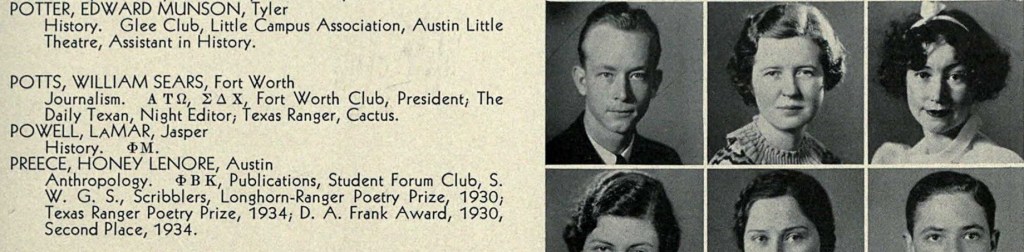
No letters from Lenore to Bob or vice versa are known to survive. We might be thankful that in later years, when Howard scholarship was rooting out old friends, Lenore was able to find copies of the Junto and assist her brother Harold in locating some of his old letters from Robert E. Howard, which have expanded immeasurably on our store of information about Bob during these crucial years when he was finding his footing as a pulp author, but still kept a toehold in the amateur writing and writing community that encouraged his literary pursuits.
Note: Credit must be given to Rob Roehm, who has done so much work on the Junto and its contributors, and in editing Howard’s letters. Without his scholarship, far less information on the Junto and Lenore Preece’s contributions would be available.
Bobby Derie is the author of Weird Talers: Essays on Robert E. Howard and Others and Sex and the Cthulhu Mythos.
Deep Cuts in a Lovecraftian Vein uses Amazon Associate links. As an Amazon Associate I earn from qualifying purchases.
 Deep Cuts in a Lovecraftian Vein