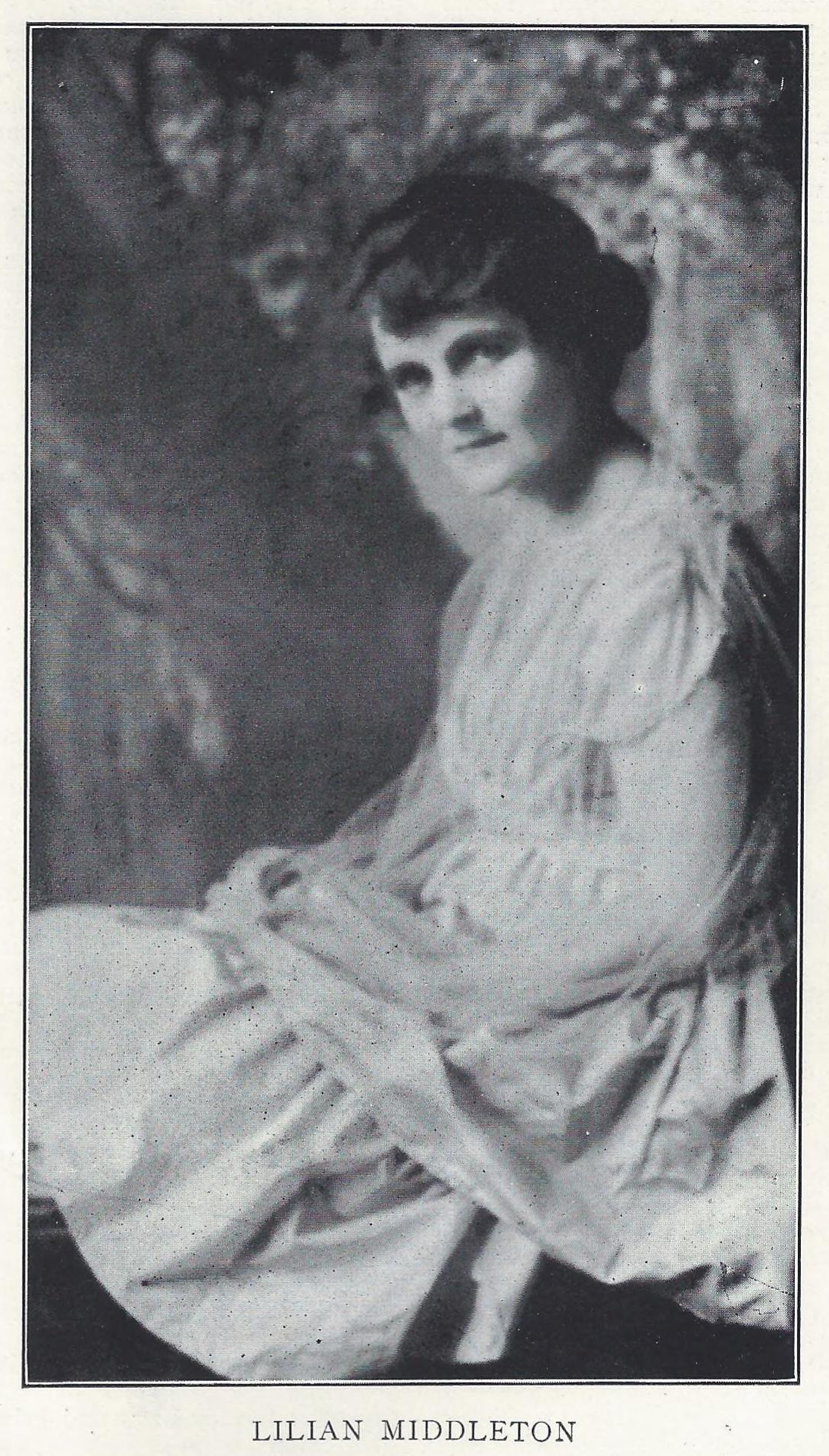
S. Lilian Middleton-McMullen, whose works are now distinguished by publication in poetry magazines all over the country, is a discovery of Winifred V. Jackson’s, and an added plume in the cap of that noted poetess. She is a native of Ireland, of a loyal British Unionist family, and inherits a trace of French blood through a great-grandmother. In her heredity there is a definitely artistic element, as shewn by the fact that both her mother and sister are poets of no mean skill.
Mrs. McMullen was educated in English private schools, and originally specialised in music; being a violoncellist and pianiste of great ability, and to some degree a composer. At an early age she was given to the writing of verse, but these older specimens are notable only for grace and correctness. Amateurdom has seen two of them—“Late Autumn” in The Tryout, and “The ‘Cellist” in The United Co-operative. They are, quite obviously, juvenalia; though of unusual merit for such work.
—H. P. Lovecraft, “The Poetry of Lilian Middleton” dated 14 January 1922, Collected Essays 2.51-52
Susan Lilian Smith was born in Ireland on 18 February 1886. According to the 1910 Federal census, she emigrated to the United States in 1909; as did Michael J. McMullen (b. 1883). The Massachusetts Marriage Index records a wedding in 1910 in Somerville; their first child, Kenneth Barry McMullen, was born on 16 March 1910. The young family are recorded in the Bronx, New York City, with Michael J. McMullen listed as overseer of a drug warehouse. A second son, Edwin Robinson “Robin” McMullen, followed on 10 July 1913.
By the time of the 1920 Federal census, the family was situated in Newton, Massachusetts, about 7 miles from downtown Boston, in their own home on Morton Street; Michael J. McMullen is listed as a broker. By this time, Susan Lilian McMullen and her sister had already been recruited for amateur journalism, and H. P. Lovecraft took notice of her.
The Silver Clarion for February is of ample size and ample merit. Opening the issue is an excellent poem in heroic couplets by Mrs. Stella L. Tully of Mountmellick, Ireland, a new member of the United. Mrs. Tully, whose best work is in a lyric and religious vein, is one endowed with heriditary or family genius; as the Association no doubt appreciated when reading the poetry of her gifted sister, Mrs. S. Lilian McMullen of Newton Centre, in the preceding issue of The United Amateur.
—H. P. Lovecraft, “Department of Public Criticism” (Mar 1919), United Amateur, Collected Essays 1.225
One of the editors of The Silver Clarion was Winifred Virginia Jackson, and Mrs. McMullen and Mrs. Tully were apparently two of her recruits for the United Amateur Press Association. Lovecraft mentions her poetry a few times in his editorials, and it was generally positive. At this stage in his life, Lovecraft was getting out and meeting amateurs more often with occasional trips to Boston, and it was on one such trip he met S. Lilian McMullen in the flesh:
Mrs. McMullen was present, & prepared to argue over a criticism I had recently applied to one of her verses; but I quickly ended the argument by calling in as my ally the omniscient James Ferdinand [Morton], from whose decisions there is no appeal. (The question had to do with the use of “mirror” as an intransitive verb. Such usage is incorrect.)[…]The best feature was Mrs. McMullen’s pathetic poem “Desiree Logier”, which is to appear in the July United Amateur. (I tried to get that poem on the front page, but Mrs. Renshaw overruled me.)
—H. P. Lovecraft to Rheinhart Kleiner, 10 Sep 1920, Letters to Rheinhart Kleiner 172
While a full record of her amateur and on-amateur writing isn’t available, it seems at some point between 1920 and 1921 she began to sometimes use the pseudonym Lilian Middleton. Her interests ran strongly to poetry and music, and she wrote both; Lovecraft noted:
The United takes pride in the new laurels of its scintillant and versatile members, Mrs. S. Lilian McMullen (Lilian Middleton), who is now writing songs for professional publication with the music of Ernest Harry Adams. The latest of these to appear is “The Bumble Fairy”, a dreamily exquisite piece already sung by several vocalists of note. […]
The Boston Amateur Conference of February 22, held at the Quincy House, was successful from every point of view […] A musical programme featuring Mrs. McMullen’s “Bumble Fairy” proved a delightful interlude.
—H. P. Lovecraft, “News Notes” (Jan 1921), United Amateur, Collected Essays 1.269
Lovecraft would write at rather more length about the conference in a letter to his mother, which reads in part:
Samuel Loveman’s paper was very poetic—he had asked me to read it, but Mrs. Miniter (in charge of the programme) thought she had better assign it to Mrs. McMullen, who had not felt equal to preparing a paper of her own. Mrs. McM. read it with great success—but not without having to ask me beforehand how to pronounce the name of the neo-Platonic philosopher Plotinus! […] Following this, a musical programme was rendered with great success, the chief ingredient being the McMullen-Adams song, “The Bumble Fairy”, which you played the other day. Mrs. McM was reluctant to sing it, not possessing a voice quite up to her own standard of excellence; but her scruples were entirely unnecessary, since the rendition proved phenomenally pleasing. I was immensely glad to hear the piece played properly, and found that in my own crude picking out I had not correctly interpreted the time. This Ernest H. Adams is certainly a composer of the greatest possible ability, and I think Mrs. McM is singularly fortunate in her opportunity to write words for his airs. Neither suffers by comparison with the other—it is an ideal “team.”
[27] Mrs. McMullen was very glad to hear that you liked “The Bumble Fairy”, and bade me thank you for your favourable opinion. It appears to me that she is destined for professional prominence at an early date—sooner perhaps than many amateurs of even greater genius, such as Winifred V. Jackson and Samuel Loveman. […] The overwhelming majority were adherents of the rival on National Association (which is, of course, now friendly with the United), but the Jackson–McMullen–Theobald group formed a compact minority of purely United enthusiasts.
—H. P. Lovecraft to Sarah Susan Lovecraft, 24 Feb 1921, Letters to Family and Family Friends 1.26, 27
Lovecraft and McMullen were, despite any disagreement over metrical regularities, apparently on friendly terms. It is difficult to say when exactly they began to correspond, what prompted the correspondence, how extensive it was or what subjects they covered. None of their letters survive, and we have fewer hints in Lovecraft’s essays and correspondence than usual. We know that Lovecraft included her among his Christmas greetings, and we know that her poem “The Crock of Gold” appeared in his own amateur journal The Conservative (Mar 1921), which suggests she mailed it to him, unless she handed it to him in person at one of the amateur gatherings.
Yet the relationship was probably cordial, not close.
In August 1921, Lovecraft attended an amateur gathering in Boston at the McMullen’s house on Morton St.; McMullen had won the poetry laureateship for 1921:
The Hub Club meeting was yesterday, but on account of the increasing political gap between the (Nationalite) Hub element & the United, [Edith Miniter] set Wednesday as the day for conferring at length with the United element—W. V. Jackson, Miss Hamlet, Mrs. McMullen, &c. […]
[39] After a short argument at this temporary halting-place, the expedition proceeded to 53 Morton St., which I have of course seen before. Here I met Mrs. McMullen, & had the honour of breaking to her the pleasing news that she has won the United’s 1921 Poet-Laureateship. […] After this non-esssential digression the evening assumed more of the aspect of an ordinary amateur gathering, the company being augmented by the arrival of W. V. J., Miss Crist, Mrs. Wurtz, & a neighbour of Mrs. McMullen’s whose name has slipped my memory but who ought to be remembered for the menagerie which she brought with her—two large collie dogs, & the most exquisite kitten I have beheld in aeons. Mrs. McMullen averred that the latter small gentleman was brought especially in my honour, my liking for the feline species being well known in amateurdom. […] Mrs. McMullen played & sang her “Bumble Fairy”, & Mrs. Renshaw sang two songs (of which she wrote the words) in an excellent contralto, with Miss Crist as accompanist. I inflexibly refused all requests for song, & categorically denied the accusation of W. V. J., Mrs. Miniter, & Mrs. McMullen that I could sing. […] So I let mesdames Renshaw & McMullen bear off all the honours. […] Pure literature, grammar, technique, ancient balladry, & the Irish situation (the McMullens are loyal British subjects & Protestants from Ireland) all received attention; & even D. V. Bush & remunerative endeavour were discussed.
—H. P. Lovecraft to Annie Gamwell, 19 Aug 1921, Letters to Family and Family Friends 1.38, 39, 40
The Irish War of Independence (1919-1921) was a point of contention for Lovecraft, who was a lifelong Anglophile and was in favor of the British in the conflict. This put him at odds with anti-British, pro-independence amateur journalists like the Irish immigrant John Dunn, and exacerbated anti-Irish (and in a general sense, anti-Celtic/Gaelic) and anti-Catholic sentiments in Lovecraft. That the McMullens were both loyalists and protestants were both definite points in their favor as far as Lovecraft (and presumably his aunts) were concerned.
A few more notes on S. Lilian McMullen/Lilian Middleton appear in Lovecraft’s editorials. Later in 1921 he noted:
The continued successes of our Poet-Laureate, Mrs. S. Lilian McMullen (Lilian Middleton), cast additional lustre on the United as amateurdom’s chief source of authentic creative artists. Poetry by Mrs. McMullen appeared on the editorial page of the New York Times for October 15; a distinction which can be appreciated by those familiar with the standards of that celebrated publication. […303] Honours come rapidly to our poets. On November 5 The Literary Digest reprinted a poem of Mrs. McMullens’ from the New York Times […]
—H. P. Lovecraft, “News Notes,” Nov 1921, United Amateur, Collected Essays 1.302-303
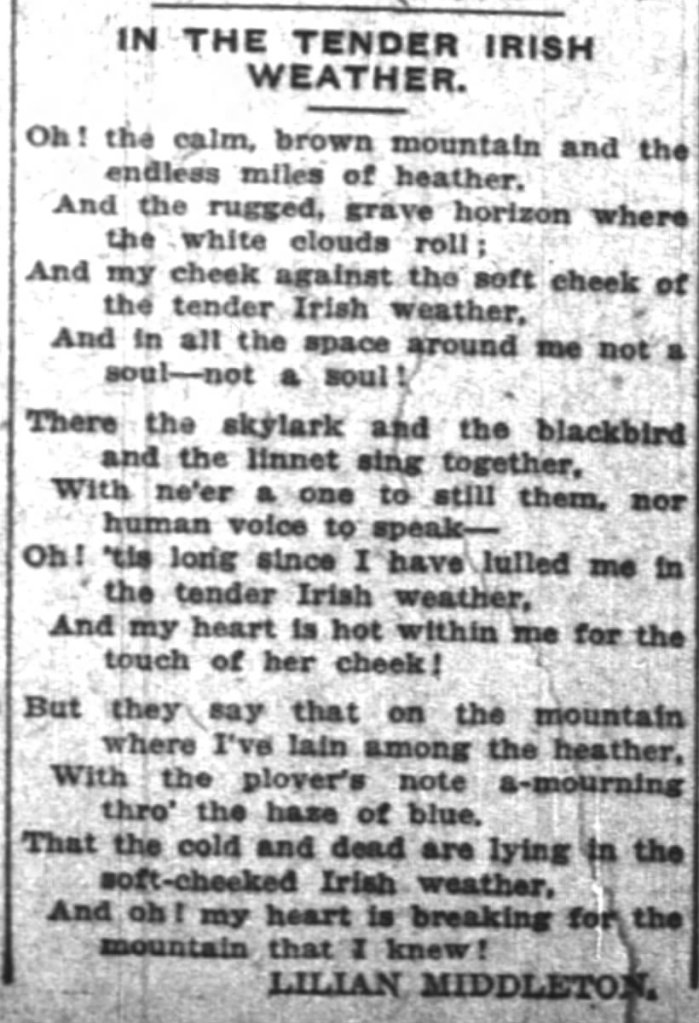
The poem was reprinted in the Literary Digest and several other newspapers.
In late 1921 or early 1922, Lovecraft wrote “The Poetry of Lilian Middleton”, the draft is dated 14 Jan 1922. It is not clear where this was intended to be published, but an abbreviated version of it was published in “The Vivisector” column in March 1922 (CE 1.315-316). How much contact Lovecraft had with S. Lilian McMullen after that is doubtful, one of his last words on her from this period was:
A special word is due the excellent portraits of eminent amateurs, among which is the first likeness of our poet-laureate, Mrs. S. Lilian McMullen (Lilian Middleton) ever published in Amateur Journalism.
—H. P. Lovecraft, “News Notes” (May 1922), United Amateur, CE 1.317
This was in reference to The Rainbow Vol. II, No. 2 (May 1922), which was edited by Sonia H. Greene, and is the only photo of S. Lilian McMullen I’ve found. Readers who turn to read Lovecraft’s “Celephaïs” in that issue may have wondered who that woman was, whose portrait and poem graced the page immediately proceeding Lovecraft’s. Now they do. Her work in that journal suggests that she and Lovecraft may have been in contact at least briefly in early 1922…but after that their relationship seems to break off, or at least the references in editorial and letters dwindle to nothing.
We can only speculate as to the reasons. It seems likely that McMullen and Lovecraft’s friendship was largely based on their common friendship with Winifred Virginia Jackson, and his relationship with Jackson cooled off after Lovecraft met Sonia H. Greene (his future wife) at that August convention in 1921. So too, the McMullens may have experienced difficulties of their own that limited S Lilian McMullen’s further participation in amateur journalism.
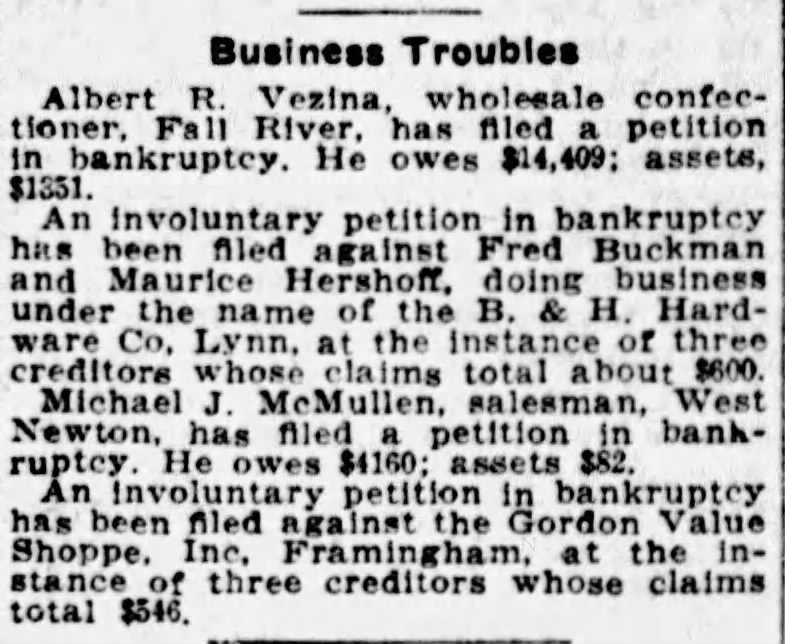

Taken together, these two snippets paint a picture of strained finances, and perhaps a strained marriage. Michael J. McMullen’s business either failed or his debts grew too much; the wife and children were sent out of the country while he tried to settle affairs, which probably included the selling of or foreclosure on the house at 53 Morton St. What happened to Michael J. McMullen between 1925 and 1930 is unknown; in the 1930 Federal census, S. Lilian McMullen is listed as “widowed,” and she and her sons were renting at Crafts St. in Newton.
Despite this hardship, S. Lilian McMullen persevered. She was naturalized a citizen of the United States of America on 5 April 1954, and according to her obituary finally passed away in 1981 at the age of 95, with 4 grandchildren and 8 great-grandchildren, and interred in Chatham, Mass (Findagrave).
Who was H. P. Lovecraft to S. Lilian McMullen? Like so many women who interacted with Lovecraft, there is no record in their own words to guide us. Their paths crossed just a few times in the early 1920s, and she made enough of an impression that he wrote in praise of her poetry and songs. We have, for the most part, only Lovecraft’s own sparse comments to guide us. Their legacies are different: Lovecraft’s legacy was literary, and his heirs are his readers; hers was her children, and grandchildren, and their children and grandchildren. It would be interesting to know if any of her family were aware of her connection with Lovecraft…or if they still have any or her songs and poetry to remember her by.
Bobby Derie is the author of Weird Talers: Essays on Robert E. Howard and Others and Sex and the Cthulhu Mythos .
Deep Cuts in a Lovecraftian Vein uses Amazon Associate links. As an Amazon Associate I earn from qualifying purchases.
 Deep Cuts in a Lovecraftian Vein