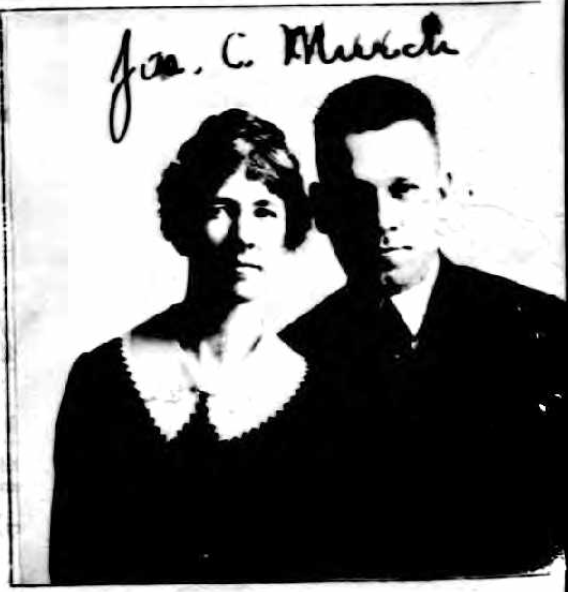
Verna McGeoch was born on 25 May 1885 to Alexander and Ella A. (Bain) McGeoch of New York; her older sister Jennie E. McGeoch had been born in 1878. Information on Verna’s early life is scanty. The 1900 federal census lists her sister Jennie as employed as a school teacher, and Verna as attending school. By the 1910 federal census, Jennie had married (to Alexander Horton Barbur, 1868-1928), given birth to a child (Marion Jennie Barbur), and died (Marion’s date of birth is listed as 15 October 1909, and Jennie’s death is listed as 19 December 1909). The subsequent censuses list Marion living with her aunt and grandparents.
If Verna McGeoch attended college or held any employment, it is not reflected in the census data. Nor do we have extensive written records from McGeoch on any part of her life. Yet we know that at least by 1915, Verna McGeoch had joined the United Amateur Press Association, and come to the attention of H. P. Lovecraft, who had joined amateur journalism in 1914:
Misses Kline and McGeoch both exhibit marked poetical tendancies in prose, the latter writer having something of Mr. Fritter’s facility in the use of metaphor.
H. P. Lovecraft, “Department of Public Criticism,” Jan 1915, Collected Essays 1.21
McGeoch features rarely in Lovecraft’s articles and editorials in the United Amateur, but outline a rising profile in amateur journalism:
Mr. Hoag’s introduction to the United Amateur Press Association came through his gifted friend and fellow-resident of Greenwich, Miss Verna McGeoch, and through our indefatigable Second Vice-President, Mrs. Renshaw.
H. P. Lovecraft, “Among the Newcomers,” May 1916, Collected Essays 1.110
Jonathan Hoag was a prolific poet, and soon to be a good friend of H. P. Lovecraft, who would write an introduction to (and quietly edit) The Poetical Works of Jonathan E. Hoag (1923), which was Lovecraft’s first work published in hardcover.
Excelsior for March is in many respects the most notable of the season’s amateur magazines. Edited by our brilliant Laureate Recorder, Miss Verna McGeoch, it contains a surprisingly ample and impressive collection of prose and verse by our best writers; including the delectable lryicist Perrin Holmes Lowrey, whose work has hitherto been unrepresetened in the press of the United.
H. P. lovecraft, “Department of Public Criticism,” May 1917, Collected Essays 1.149
Lovecraft’s rising star in amateur journalism led him to be elected President of the United Amateur Press Association in 1917—and Verna McGeoch was elected the Official Editor of the United Amateur. The two would, for the next two have to work hand-in-hand with respect to the management of the UAPA in their respective duties.
The election of Miss Verna McGeoch to the Official Editorship, perhaps the most important of our offices, forecasts the publication of The United Amateur on a very high plane; qualitatively if not quantitatively.
H. P. Lovecraft, “President’s Message,” Sep 1917, Collected Essays 1.172
There must have been letters between them, at least on official business, but very little of it survives. We know that Lovecraft wrote Christmas Greetings to Verna, and we know that Verna wrote to Lovecraft because one page of a letter survives among Lovecraft’s papers:
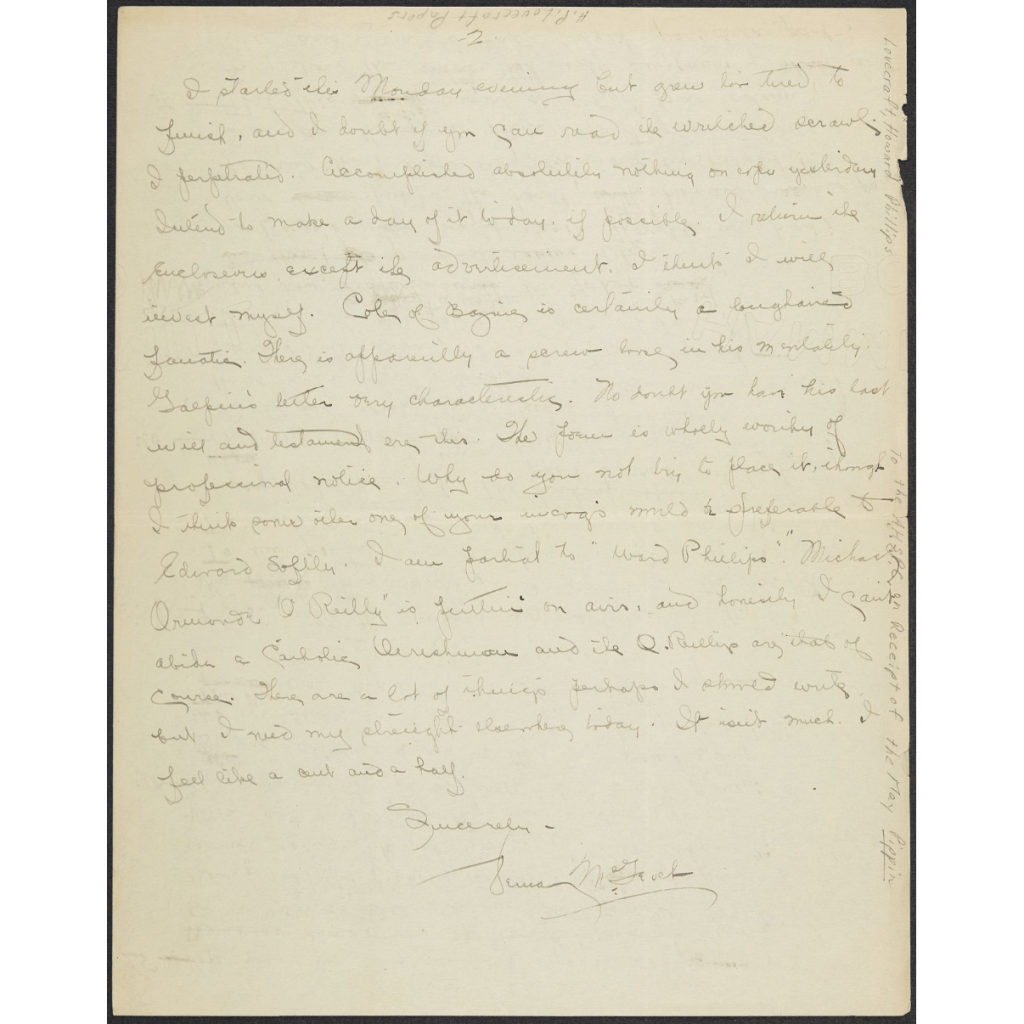
I started this Mondey evening but grew too tired to finish, and I doubt if you can read the wretched scrawl I perpetrated. Accomplished absolutely nothing on cop[y] yesterday. Intend to make a day of it to-day, if possible. I received the enclosures, excerpt & advertisement. I think I will reward myself. Cole of Bazine is certainly a longhaired fanatic. There is apparently a screw loose in his mentality. Galpineus’ letter very characteristic. No doubt you have his last will and testament ere this. His power is wholly worthy of professional notice. Why do you not try to place it, though I think some other one of your incogs would be preferable to Edward Softly. I am partial to “Ward Philips.” “Michael Ormond O’Reilly” is puttin’ on airs, and honestly, I can’t abide a Catholic Irishman and the O.Reillys are that of course. There are a lot of things perhaps I should write, but I need my strength elsewhere today. It isn’t much. I feel like a cent and a half.
Sincerely,
Verna McGeoch
“Cole of Bazine” is fellow amateur Ira Cole, who a 1916 UAPA membership list gives as living in Bazine, KS. “Galpineus” is Alfred Galpin, Lovecraft’s good friend. Edward Softly, Ward Phillips, and Michael Ormond O’Reilly were all pseudonyms that Lovecraft adopted for publishing various pieces in amateur journals between 1918 and 1923. Verna McGeoch, as Official Editor, was in on the joke, and wrote a fictional biography of one of Lovecraft’s pseudonyms, Lewis Theobald, Jr., which was published in 1918. Which all suggests that this was probably written c. 1918.
Lovecraft’s presidential announcements and unsigned editorials over the course of his presidency have nothing but praise for McGeoch:
The November Official Organ deserves praise of the highest sort and will remain as a lasting monument to the editorial ability of Miss McGeoch and the mechanical good taste of Mr. Cook. It has set a standard beneath which it should not fall, but to maintain which a well-supplied Official Organ Fund is absolutely necessary. If each member of the Association would send a dollar, or even less, to Custodian McGeoch, this Fund might be certain of continuance at a level which would ensure a large and regularly published United Amateur. […]
[175] A final word of commendation should be given to those more than generous teachers, professors, and scholars who are making “The Reading Table” so pleasing and successful a feature of the United’s literary life. The idea, originated by Miss McGeoch, has been ably developed by Messrs. Moe and Lowrey, and is likely to redeem many of the promises of real progress which have pervaded the Association during the past few years.
H. P. Lovecraft, “President’s Message,” Jan 1918, Collected Essays 1.174, 175
“The Reading Table,” an educational course introduced by Official Editor McGeoch, ia this month graced by a valuable contribution from Mauice Winter Moe. […]
[182] Miss McGeoch’s editorial is the most sensible summary yet made of the relations between the Untied and the National Associations. We believe, with her, that each has its own peculiar place, and that neither need attack or encorach upon the other. In the interests of harmony, belligents on either side should be promptly silenced.
H. P. Lovecraft, “Department of Public Criticism,” Jan 1918, Collected Essays 1.181-182
“An Appreciation”, by Verna McGeoch, is a prose-poetical tribute to Mr. Hoag, whose literary merit is of such a quality that we much needs lament the infrequency with this the author contributes to the amateur press. […]
[197] The editorial remarks in this issue of the United Amateur are worthy of close perusal on account of their graceful literary quality. Seldom has the critic seen the subject of the New Year so felicitously treated as in this brief study by Miss McGeoch. The author’s mastery of appropriate words, phrases, and images, and her intuitive perception of the most delicate elements of literary harmony, combine to make the reader wish she were more frequently before the Association as a writer, as well as in an editorial capacity.
H. P. Lovecraft, “Department of Public Criticism,” May 1918, Collected Essays 1.191, 197
The United Amateur has surpassed all standard hitherto known to amateur journalism, writing the names of Miss McGeoch and Mrs. Cook imperishably into the pages of our history. The lack of numerous publications has been more than atoned for by the quality of those which have appeared.
H. P. Lovecraft, “The United 1917-1918,” Jul 1918, Collected Essays 1.202
It is also during this period that Verna McGeoch begins to appear in Lovecraft’s private correspondence, usually with respect to her amateur duties, but with hints of familiarity that suggest of a correspondence:
The formation of next year’s ticket will be a matter of extreme difficulty. I would accept the presidency if absolutely no one else could be found—but I hope I discover someone at least half capable. Miss McGeoch suggests Mrs. Campbell, who is not only quite capable herself, but has Paul J. in the background as conselor & prime minister.
H. P. Lovecraft to Rheinhart Kleiner, 4 Apr 1918, Letters to Rheinhart Kleiner & Others 106-107
Kleiner would end up running and winning the presidency of the UAPA in 1918.
Miss McGeoch has sought to censor the reviews wherever she thought frankness got the better of amenity; and as a result of the discussion which ensured, Mr. [Maurice W.] Moe has decided that all amateur public criticism is vain, ineffective and superfluous.
H. P. Lovecraft to Alfred Galpin, 13 May 1918, Letters to Alfred Galpin & Others 35
Both Miss McG and Cook are confirmed infinitive-splitters, though I have lectured both on the subject. […] [204] I wonder who will finance the new application blanks? There is no constitutional provision for them, and it is usually left to the Secretary, though for the past two years private individuals—Campbell and Miss McGeoch—have philanthropically come to the rescue.
H. P. Lovecraft to Alfred Galpin, 21 Aug 1918, Letters to Alfred Galpin & Others 203, 204
This is the second reference to McGeoch’s generosity, which suggests she personally paid to have The United Amateur printed, above and beyond her annual membership fee to the UAPA. While we do not have letters from McGeoch to anyone else to say how she felt about Lovecraft, it was apparently a reciprocal appreciation, based on another passage in Lovecraft’s letters:
[Hoag’s] serious tribute sounded more comical than your semi-serious one—hence it is not remarkable that Miss McGeoch should fail to grasp the spirit at the bottom of your graceful lines. I agree that they are (considering the unworthy subject) scarce suitable for publication in the official organ. I am glad Miss McG speaks so well of me. It would be easy to say a great deal more in reciprocity, for I have seldom encountered her equal in kindly breadth of opinion, exalted ideals, high sense of duty, dependable efficiency, conscientious responsibility, & general nobility of character. This sounds like Theobaldian oleaginousness, but since nearly every other amateur can give a similar verdict, you may see that it has much foundation in fact. She is certainly one of the pillars of amateur journalism.
H. P. Lovecraft to Alfred Galpin, 29 Aug 1918, Letters to Alfred Galpin & Others 208
As a point of politics, it should be understood that Lovecraft and his “faction” of friends at the UAPA essentially controlled the organization from 1917-1922, and their particular approach—attempting to raise the aesthetic, scholarly, and literary standards of the organization, but also taking a very authoritarian tack—engendered backlash which led to the ousting of the faction and a certain amount of bitter deadlock. Sayre’s law applies very well to amateur journalism.
One example of this effort to raise literary standards was a series of surveys of historical literature that McGeoch began in September 1918. As Lovecraft put it:
“Greek Literature”, a brief essay by Verna McGeoch, gracefully and capably handles a theme of highest interest to all lovers of culture. Not only is the language well chosen and the development skillful; but the whole displays its author’s keen sympathy with the artistic spirit of classical antiquity.
H. P. Lovecraft, “Department of Public Criticism,” Nov 1918, Collected Essays 1.213
In the November 1918 issue of the United Amateur, Lovecraft published a corresponding piece, “The Literature of Rome.” He would continue to sing Verna McGeoch’s praises in print into 1919, as candidates were nominated and elections held. There are hints that she and Lovecraft were still in touch:
Future procedure is rather doubtful, because Miss McGeoch, in her anxiety lest a strain rest upon the present administration, favours the idea of a second election as demanded by Cleveland. Perhaps full reports from the convention will cause her to change her mind.
H. P. Lovecraft to Rheinhart Kleiner, 16 Jul 1919, Letters to Rheinhart Kleiner & Others 135
That this exchange involved more than just amateur business is clear:
My mother has just given me “The Gods of Pegana”, and as a token of gratitude for lending her the “Dreamers’ [sic] Tales”, Miss McGeoch has just ordered Little Brown & Co. to send me the Bierstadt biography—“Dunsany the Dramatist”! That wot I calls high int’rust for merely lendin’ a small book, believe muh!
H. P. Lovecraft to the Gallomo, [Apr 1920], Miscellaneous Letters 96
References in Lovecraft’s letters and amateur editorials sharply drop off, however. They must have been in touch, or news must have come to him from mutual friends, because occasionally news did reach him and it was duly printed. Fellow amateurs would read, for example, of the visit of some of their associates to visit McGeoch when she was wintering with her parents in their winter home in St. Petersburg, Florida:
Messrs. Edward F. Daas and Eugene C. Dietzler, last mentioned as sojourning in New Orleans, are continuing their southward progress. In January they reached St. Cloud, Fla., the winter home of the Campbells; and thereafter all four enjoyed a pleasing succession of automobile trips, embellished with the various diversions peculiar to Florida’s genial climate. Among their excursions was one to Orlando, another to St. Augustine, where they beheld America’s oldest house and drank from the fountain of youth, and one to St. Petersburg, where on March 5 they called at the home of our former Official Editor, Miss Verna McGeoch.
H. P. Lovecraft, “News Notes,” Collected Essays 1.268
And, perhaps surprisingly:
An announcement of interest to amateurs is that of the engagement of Miss Verna McGeoch, former Official Editor, to James Chauncey Murch, Esq., of Chicago. Miss McGeoch has achieved amateur immortality as editor of the official organ for two years during the trying war period, and as the virtual regenerator of the paper from a qualitative point of view. Her double volume will in later years be eagerly sought as one of the finest achievements of amateur journalism. Mr. Murch is the son of Rev. F. B Murch, a prominent Presbyterian clergyman, and has won distinguished success in commercial endeavour. To the future Mr. and Mrs. Murch, the United extends its warmest and most widespread congratulations.
H. P. Lovecraft, “News Notes,” Mar 1921, Collected Essays 1.274
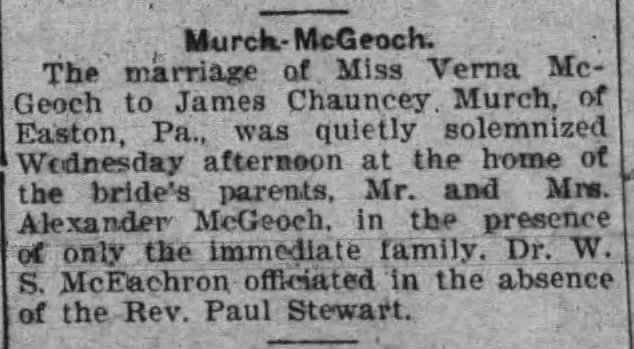
J. C. Murch was a veteran of the first world war and linotype operator originally from New York. The wedding was a small affair:
Lovecraft dutifully noted the nuptials:
On October 12 our former Official Editor, Miss Verna McGeoch, was united in marriage with Mr. James Chuancey Murch of Pennsylvania. Mrs. Murch may be addressed after November 9 at 144 S. 4th St., Easton, Penn.
H. P. Lovecraft, “News Notes,” Nov 1921, Collected Essays 1.303
That is the last word from Lovecraft regarding Verna McGeoch.
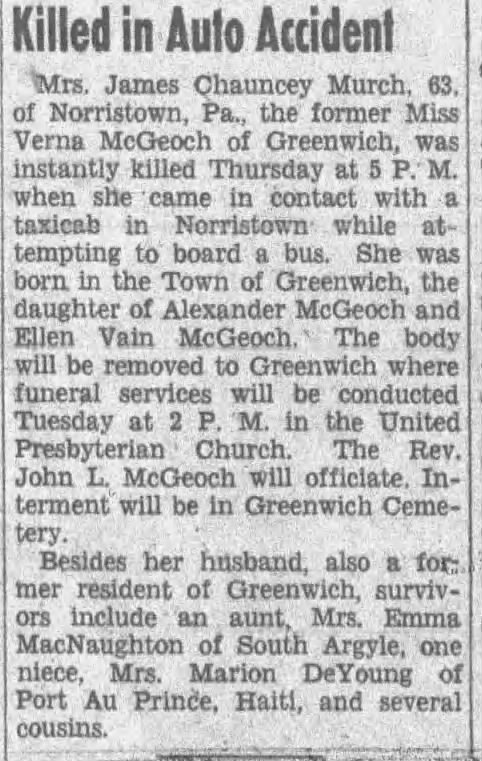
Without access to a full archive of amateur journals it is impossible to say if Verna had dropped amateur journalism completely with her marriage, but I have so far found no further record of her involvement in amateurdom or amateurs after 1921. Verna’s later life can be sketched only briefly: her father Alexander McGeoch died in 1923, her mother Elle McGeoch passed away in 1925, and her niece Marion came to live with Verna and James in Pennsylvania, at least for a while. Verna and James had no children of their own. In 1949 she was hit by a taxicab and died. Her husband James never remarried and died in 1955.
What was Lovecraft and amateurdom to Verna McGeoch? Until and unless more of her own essays or letters come to light, we may never know. They were at least associated, perhaps friends, certainly peers. Then, their lives took different paths. Perhaps it was the political infighting, perhaps it was the pressing needs of family, or some other work of which little public trace remains. From Lovecraft’s words and one-half of a letter, all we have is the image and memory of a woman who was capable, literate, and generous, and who was a friend and ally to Lovecraft during a critical stage of his life.
Bobby Derie is the author of Weird Talers: Essays on Robert E. Howard and Others and Sex and the Cthulhu Mythos.
Deep Cuts in a Lovecraftian Vein uses Amazon Associate links. As an Amazon Associate I earn from qualifying purchases.
 Deep Cuts in a Lovecraftian Vein