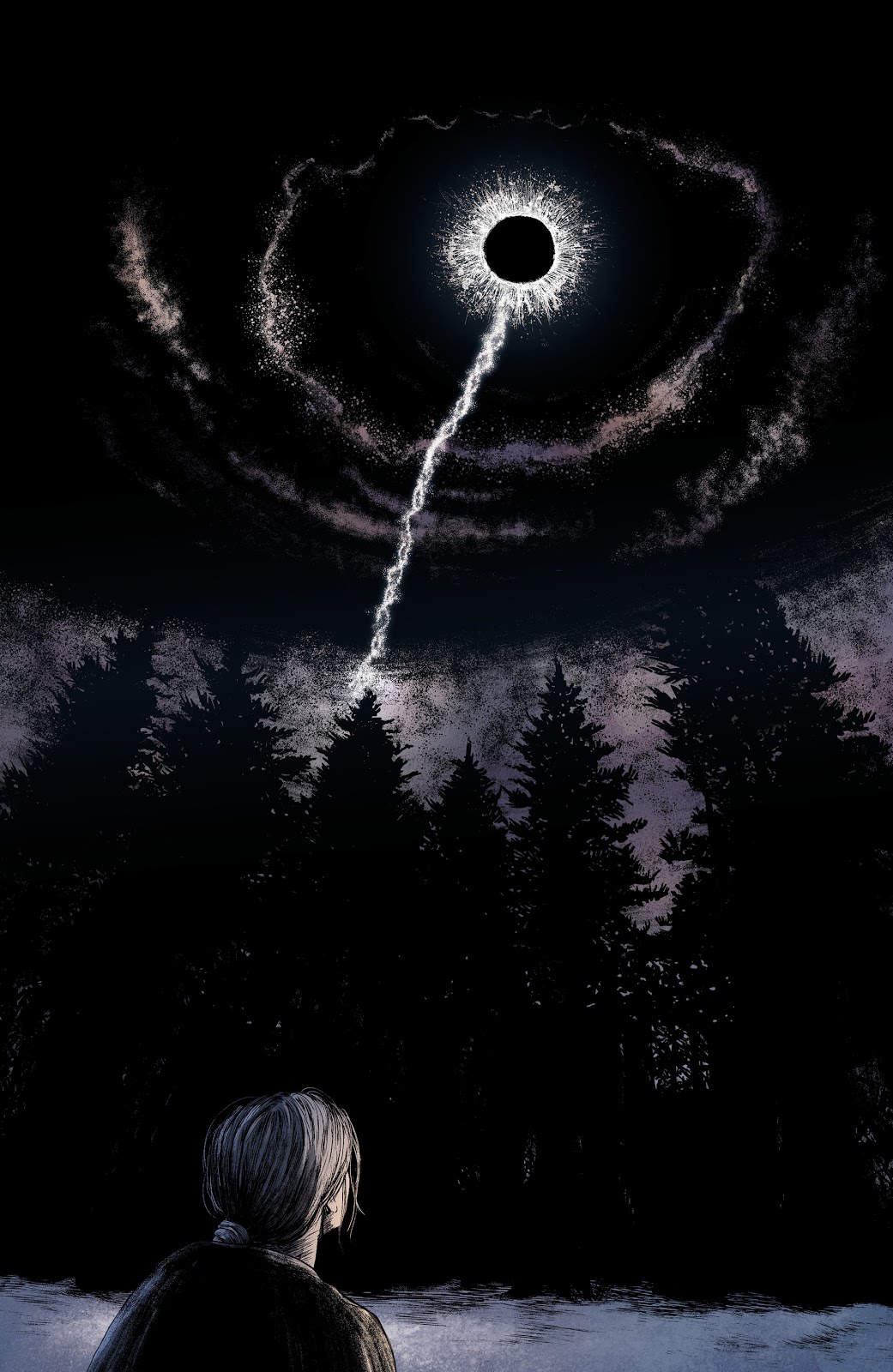
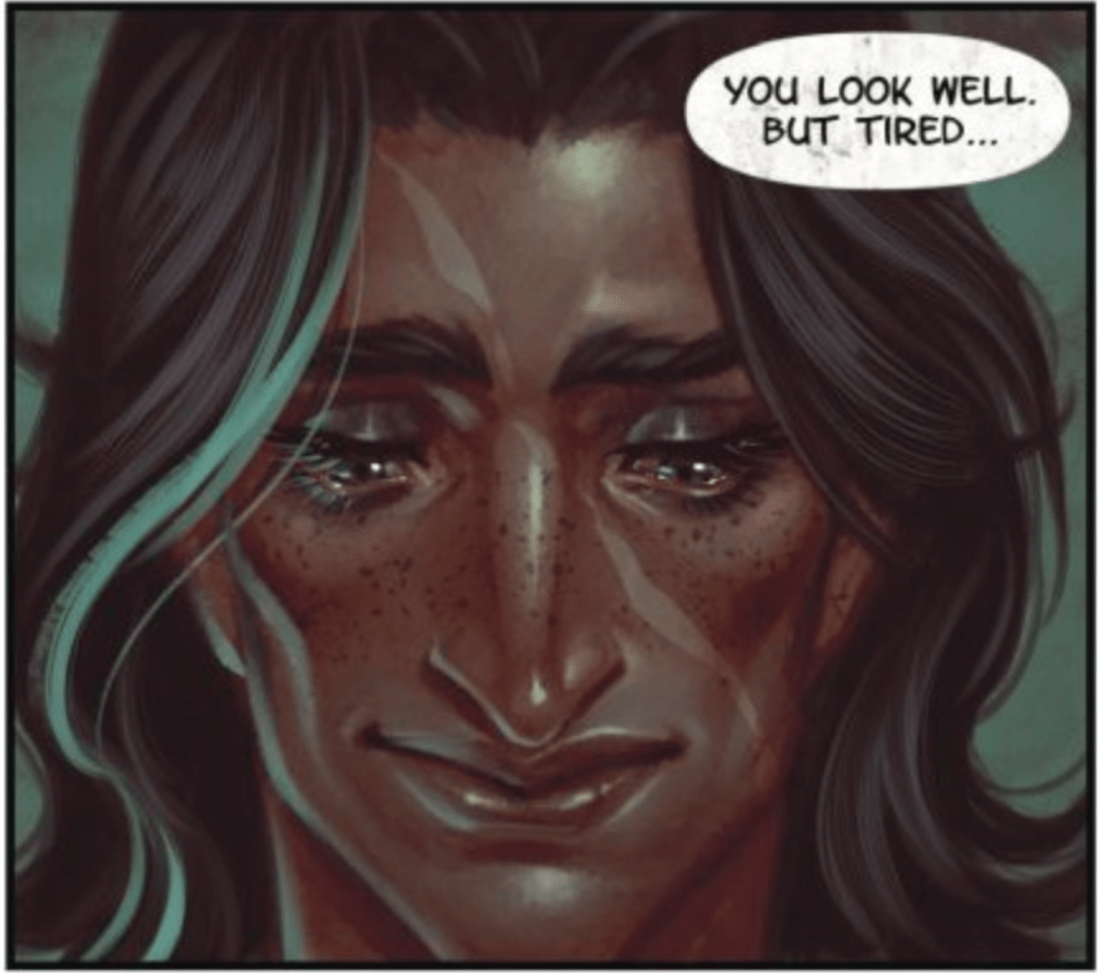
HPL 1920 (2020) by Nick O’Gorman & Tales from the Cthulhuverse #1 (2020) by Zee Romero & Luca Cicognola

I repeat to you, gentlemen, that your inquisition is fruitless. Detain me here forever if you will; confine or execute me if you must have a victim to propitiate the illusion you call justice; but I can say no more than I have said already. Everything that I can remember, I have told with perfect candour. Nothing has been distorted or concealed, and if anything remains vague, it is only because of the dark cloud which has come over my mind—that cloud and the nebulous nature of the horrors which brought it upon me.
—H. P. Lovecraft, “The Statement of Randolph Carter” (1920)

The Lovecraft Mythos was written in a particular cultural syntax. H. P. Lovecraft never tells the reader, for example, that the characters in “The Statement of Randolph Carter” are white. Caucasian heterosexual male was the default state for pulp fiction, and for much of the popular fiction of the 20th century. Once a writer or artist realizes that this is the framework in which the Mythos was set during the time of Lovecraft and his contemporaries, it is easier to imagine how those same stories might look differently within a different context. So it is that adaptation can often remain relatively faithful to the original story in term of plot, characters, narrative, and dialogue, and yet add to the story by providing a different context which changes how the story is read and understood.

In comic books, two examples of this kind of adaptation are Nick O’Gorman’s HPL 1920 (2020) and Tales of the Cthulhuverse #1-3 (2020, Mythx Media). Both are indie horror comics that adapt three stories from H. P. Lovecraft—O’Gorman was specifically adapting stories from 1920, to be published on their centenary, while Tales of the Cthulhuverse aimed for more of an update on the classic Lovecraft tales by setting them in the 21st century. In both cases, the authors remained very faithful overall to the original story—but in both cases simple, subtle changes to presentation can drastically affect how the story is read and understood.

HPL1920 - 1

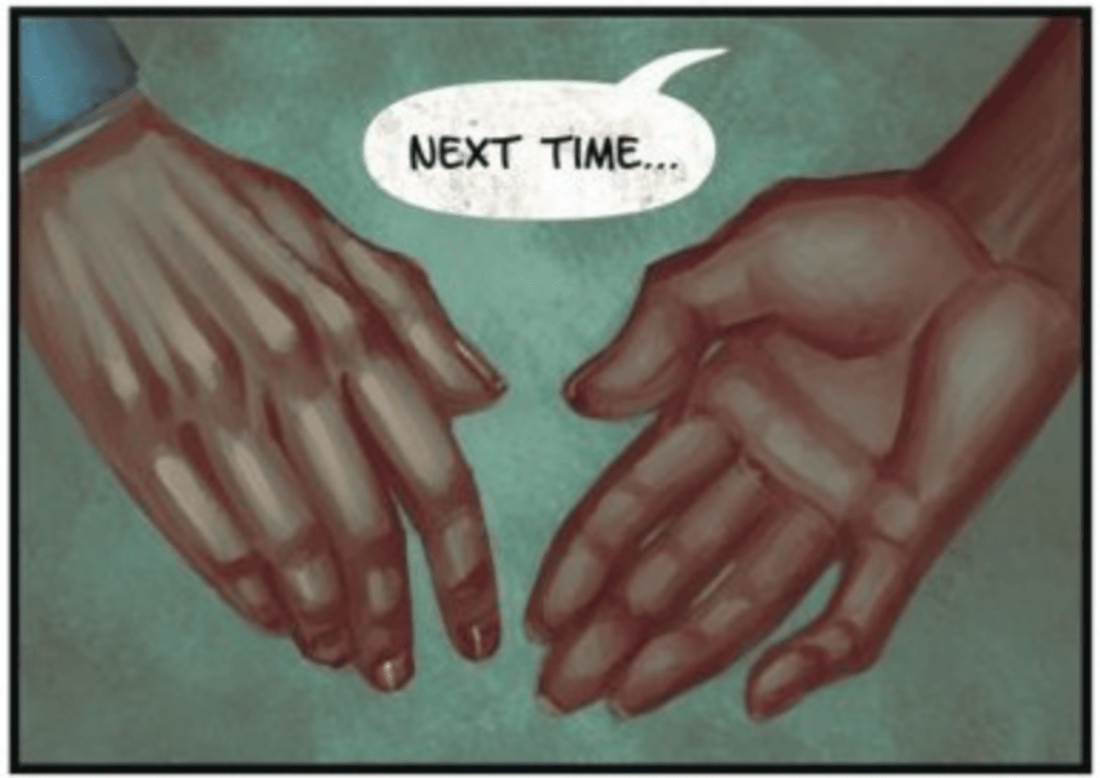
HPL 1920 adapts “The Statement of Randolph Carter”—except now Randolph Carter isn’t an older white male, he’s an African-American teenager. This puts an entirely different perspective on talking with the police in any contemporary American context, and yet it doesn’t require any substantial change to how the story works—two people, searchers after horror, go into a graveyard and one descends while the other waits behind. The basic idea of “The Statement of Randolph Carter” is not particular to any particular race or culture; curiosity and breaking taboos are universal human traits. What changes the story is how we receive it when the person relating it is someone other than “the default”—African-American teenagers are subject to systemic bias by the justice system in the United States, which adds a layer of tension to the story…and O’Gorman plays with that, at least a little bit:

HPL1920 - 2

Does a white male Randolph Carter in this exact same situation affect the reader in the same way—or is there a part of the story unspoken here, just in these two panels, because people of today can fill in the unwritten details? How would this scene have played out differently if it wasn’t two white cops? We can ask these questions because we’ve stepped outside of the cultural syntax which Lovecraft was writing in…and there are more possibilities to explore the Lovecraft Mythos than just changing up race.

It is true that I have sent six bullets through the head of my best friend, and yet I hope to shew by this statement that I am not his murderer. At first I shall be called a madman—madder than the man I shot in his cell at the Arkham Sanitarium.
—H. P. Lovecraft, “The Thing on the Doorstep”

Cthulhuverse - 1

Where HPL 1920 changes the race of the principal characters, Tales of the Cthulhuverse #1 changes the gender. Daniel Upton becomes Danielle, Edward Derby becomes Eve, Asenath Waite becomes Asa—there are a few other changes, since the setting is now contemporary Massachusetts (2020s) and the Danielle & Eve are college roommates of a similar age and unmarried; the plot is condensed down considerably—but the main change is simply a what if scenario:

How would “The Thing on the Doorstep” have changed if the genders had been reversed?

As with “The Statement of Randolph Carter” and HPL 1920, the initial response would be: not by much. Lovecraft’s original story already involves gender change due to body-swapping; in a literary shell game, it is largely irrelevant what the writer uses for shells, as long as the same relationships are in place. So it is in Tales of the Cthulhuverse #1, where much the same events as Lovecraft’s story play out despite changing the genders of the main characters. If that was all there was too it, the adaptation would be boring.

Cthulhuverse - 2

Lovecraft’s frame for “The Thing on the Doorstep” is minimal: it’s a statement, but unlike “The Statement of Randolph Carter” it’s not to any particular party. Daniel Upton isn’t explicitly talking to the police; Danielle Upton in Tales of the Cthulhuverse #1 is. So like HPL 1920, there’s a specific dynamic of interaction being invoked—the police procedural dynamic, only this time a little more sympathetic. After all, Danielle Upton is a white woman…and so was Eve Derby.

Cthulhuverse - 3

Domestic violence is not usually the first thing that springs to mind when reading Lovecraft’s “The Thing on the Doorstep”—not because men aren’t subject to domestic violence and abuse, but because the audience is generally not used to thinking about his marriage in that context. Because Daniel Upton wasn’t talking to the police, they weren’t trying to fit two dead bodies and a bad romantic relationship into a context they understood in Lovecraft’s narrative. Change the genders, though, and suddenly this becomes a much more logical leap for the cops to make…and maybe another one.

Daniel Upton has a weird angle in Lovecraft’s “The Thing on the Doorstep.” He is Edward Derby’s closest male friend, and Derby then marries Asenath, so Derby is caught between Daniel and Asenath. It isn’t explicitly a lover’s triangle because there are no indications that Daniel is homosexual (and if he is, being married and with a son indicates he’s at least in the closet), but the close relationships between men in some of Lovecraft’s stories have inspired homosexual interpretations of those stories (as explored in depth in Sex and the Cthulhu Mythos).

The exact same dynamic still applies in the Tales of the Cthulhuverse adaptation, and Zee Romero plays it as straight as can be (no pun intended)—there’s no explicit idea given that Danielle Upton is a lesbian or in love with Eve Derby in any kind of romantic sense. The story can be read as a perfectly platonic tale of shooting the bastard that stole the body of your best friend. That said, there’s also definitely enough subtext here to read it as a genuine lover’s triangle too—unlike Lovecraft, who gave Daniel a wife and baby to at least imply a heterosexual relationship, Romero doesn’t give Danielle any romantic interests at all. It is definitely an interesting way to re-imagine Lovecraft’s story…and that’s before the final revelations come out.

Ultimately, HPL 1920 and Tales of the Cthulhuverse are two parallel approaches with the same aim: contemporary writers and artists seeking to remain faithful to the core of Lovecraft’s narratives while also finding new things to say about those narratives in the way they present them. By and large they both succeed. If there’s a flaw in these comics, it’s not the approach, but sometimes the execution. Indie comics can’t always afford the most polished art, and it shows—the production values aren’t bad on either of these, but for Tales of the Cthulhuverse in particular the lack of detail in the gore and nudity feels like a misstep, or at least a missed opportunity. O’Gorman and Cicognola definitely know their material, because there are little allusions to the Gate sigil from the Simon Necronomicon and August Derleth’s version of the Elder Sign as popularized by the Call of Cthulhu Roleplaying Game, but a lot more could have been done with these same scripts if Jacen Burrows, Kelly Jones, or Laci had been handling the material.

HPL 1920 was written, drawn, and colored by Nick O’Gorman, and funded through Kickstarter. Copies of the comic are available through his Etsy shop.

Tales of the Cthulhuverse #1 was written by Zee Romero, pencils and inks by Luca Cicognola, colored by Sean Burres, with a cover by Jeff Chapman, and published by Mythx Media. They are currently available for purchase on Comixology.


Bobby Derie is the author of Weird Talers: Essays on Robert E. Howard & Others (2019) and Sex and the Cthulhu Mythos (2014).

Black Stars Above (2019) by Lonnie Nadler & Jenna Cha

At length we observed a total change in their demeanour. From absolute stupor they appeared to be, all at once, aroused to the highest pitch of excitement, and rushed wildly about, going to and from a certain point on the beach, with the strangest expressions of mingled horror, rage, and intense curiosity depicted on their countenances, and shouting, at the top of their voices, Tekeli-li! Tekeli-li!
—Edgar Allan Poe, The Narrative of Arthur Gordon Pym of Nantucket (1838)

Of course common reading is what prepared us both to make the interpretation, though Danforth has hinted at queer notions about unsuspected and forbidden sources to which Poe may have had access when writing his Arthur Gordon Pym a century ago. It will be remembered that in that fantastic tale there is a word of unknown but terrible and prodigious significance connected with the antarctic and screamed eternally by the gigantic, spectrally snowy birds of that malign region’s core. “Tekeli-li! Tekeli-li!” That, I may admit, is exactly what we thought we heard conveyed by that sudden sound behind the advancing white mist—that insidious musical piping over a singularly wide range.
—H. P. Lovecraft, At the Mountains of Madness (1936)

RCO032_1576717890

Black Stars Above was published as a five-issue series from Vault Comics in 2019-2020, and collected in a trade paperback in 2020. The creative team was Lonnie Nadler (writer), Jenna Cha (artist), Brad Simpson (colorist), and Hassan Ostmane-Elhaou (letterer).

They tread rare territory.

Canada, 1887. Eulalie Dubois, a young Métis woman living on the edge of things with her family, trading moccasins and skinning muskrats. Yet at night she reads The Narrative of Arthur Gordon Pym, and hopes one day to escape this life. There’s fascinating intersectionality there—youth and gender and race, all mixed up and coming together. Then it gets weird.

There were Canadian pulp magazines. Not just the Canadian edition of Weird Tales, but home-grown pulps by Canadian artists, writers, and publishers, set in Canada. Where the United States had Westerns, there was also a market for Northerns, pulp stories and novels set in Canada’s Northwest Territories, often investigated by Mounties as in Tales of the North-West Mounted Police (Sep 1933). Like the Westerns, the Northerns were concerned with Canada’s frontier—the extremes of climate and survival that comprised man vs. nature, the stress on human relationships that added frisson to man vs. man, and out at the edge of the known world…sometimes things slip over into man vs. supernature.

There are a few “Weird Westerns” out there. Not so many “Weird Northerns.”

Contrast Jack London’s “To Build A Fire” (1902), which is a straight survival story with shades of psychological horror, and Algernon Blackwood’s “The Wendigo” (1910), where the extremes of the environment is only the beginning of the horror, the prelude to things. There are stranger things in the Northern woods, and plenty of mundane horrors—Nadler and Cha give us a taste of that in the opening chapter. A grandfather whose leg was cut off by Mounties. A mother discriminated against for being First Nations. A daughter sold into marriage, as long as she passes for white…

One of the key aspects of frontier fiction—Western, Northern, Sword & Planet, etc.—is the primary motivation for going into that frontier. Sometimes it is altruistic: Star Trek went on a mission to explore and investigate, to scribble in the borders of the map. Often, it’s meaner: people want to exploit the resources and indigenous peoples, make their fortune, and get out, as in H. P. Lovecraft and Kenneth Sterling’s “In the Walls of Eryx” (1939).

Black Stars Above plays with motivations very strongly and with great intent. Not just Eulalie Dubois in her mission, but everyone else in the story has some reason to be there, some hope or need or order that drove them beyond where they should have gone. Which drives them still, far past where they should have turned back. That is part of what makes the story work, above and beyond the weirdness that is very Lovecraftian but which does not make any attempt to tie in explicitly to the Cthulhu Mythos or any other; despite the reference to “black stars” and the obvious influence of Robert W. Chambers’ The King in Yellow there’s no other direct connection to the Yellow Mythos as with “Slick Black Bones and Soft Black Stars” (2012) by Gemma Files or “While The Black Stars Burn” (2015) by Lucy A. Snyder. It borrows the weird cry from The Narrative of Arthur Gordon Pym, but that is exactly all that it is: the cry of the weird. Out beyond the unknown, signifying something that can’t be deciphered.

There are great and terrible hints, but this is a narrative that does some of its best work by choosing to show rather than tell. Jenna Na’s art works well because when things are real, the panels are sharp and defined, close and intimate; and when she pulls back for the wider shots…when the gutters fade away…the dreamlike quality is stark and beautiful but somehow more epic in perspective.

RCO030_1576717890

Brad Simpson’s colors add depth to the artwork. It would have been easy to leave this black-and-white, let the chiaroscuro hit the reader between the eyes, but the colors make the “real” portion of the story seem more real, and the “unreal” portions more strongly bizarre by contrast. There are a lot more shadows of darkness that can be shown with blues and reds than just white and black.

With the handwritten journal pages and Lovecraftian focus, it’s tempting to compare Black Stars Above with Alan Moore and Jacen Burrow’s Providence (2015-2017), and Lonnie Nadler does acknowledge the influence:

And just in terms of trying to do similar things, Alan Moore’s Providence. It’s definitely an influence on Black Stars Above, but I think it does different things, and more powerful things with responding to Lovecraft, in that it’s a direct response to Lovecraft and only to Lovecraft. (Well, I guess Chambers, too). I love that book. It doesn’t get enough credit in Alan Moore’s body of work. He said what he was trying to do was what Watchmen did with superheroes, Providence was trying to do for Lovecraft. And I think he very much accomplished that. And anyone who is a fan of Lovecraft, I think should read it, because it’s, it’s densely intelligent and rich. And I might like it more than Watchmen. And I say this, like, as someone whose favorite comic is Watchmen. I don’t know why, but people didn’t seem to latch on to that one like they do some of his other work. Maybe because Neonomicon was so off-putting to people.
—Robert Secundus, “Lonnie Nadler Part II: On ‘Black Stars Above,’ Margaret Atwood and why trains are weird” (28 Jul 2020)

Black Stars Above does do different things than Providence. For one, Eulalie Dupois does not follow Robert Black in suicide after the final revelations. Both of them faced the choices of simply going with the flow, to continue to exist without making waves. Neither of them could face that. Simply existing on the edge of things is not winning, even if the heart is beating and blood is pumping. Settling for a life of quite desperation on the end of everything, trapped in a life you don’t want…

For so many characters in such narratives, death is the only escape from the frozen hell.


Bobby Derie is the author of Weird Talers: Essays on Robert E. Howard & Others (2019) and Sex and the Cthulhu Mythos (2014).

Her Letters To Lovecraft: Zealia Brown Reed Bishop

Dear Mr. Lovecraft :—

Your letter of the 20th just arrived. I shall be only too glad to have your friend have The Mound for sale or to see—especially that since it offers an opportunity to partially discharge my already disgracefully lengthened debt to you— (You are so patient about money—especially when you need it so very much.)
—Zealia Brown Bishop to H. P. Lovecraft, 26 May 1934, The Spirit of Revision 177

In 1927, Zealia Margaret Caroline Brown Reed turned 30 years old. She had been married at seventeen to James P. Reed (1891-1935); a son (James Reed, Jr.) was born seven months after the wedding. The state of her marriage in 1927 is unknown, but three years later she would be listed on the U.S. Census as “divorced.” Living at the time in Cleveland, Ohio, Zealia Brown Reed worked as a court reporter and sold stories and articles to support herself and her son, but was looking to improve her writing. Via Samuel Loveman, she got in touch with a friend of his that did revision work and dispensed writing advice: H. P. Lovecraft.

I wrote to Lovecraft and he replied immediately that he would be glad to examine any of my work I cared to send and offer what assistance he could.

Thereafter I became an established recipient of the famous Lovecraft letters. He wrote regularly, sometimes fifty and sixty page letters, in a fine spidery script which often counted five hundred words to the page. These letters were filled with the strictest rules of rhetoric and meaty literary advice.
—Zealia Bishop, “H. P. Lovecraft: A Pupil’s View” in Ave Atque Vale 254

The correspondence of Zealia and Howard would last for the final decade of Lovecraft’s life. It would result in three weird tales: “The Curse of Yig” (written 1928, published 1929), “The Mound” (written 1929, published 1940), and “Medusa’s Coil” (written 1930, published 1939). Lovecraft also had a hand in revising a number of Zealia’s non-weird manuscripts, none of which are known to have been published or survive. As with some of his other revision clients, Lovecraft’s correspondence goes much beyond the simple “business” side of things. Writing apparently every week or two, his letters would be filled with advice on writing, suggested readings, remarks on articles or newspaper cuttings that Zealia had sent. One letter from Lovecraft to her son James survives, showing how friendly and familiar that the two had gotten, although Lovecraft never failed to address his letters as “Dear Mrs. Reed,” or “Dear Mrs. R”—at least until 1930, when Zealia remarried to Dauthard William Bishop, Sr. and the letters were sent to “Dear Mrs. Bishop.”

As is the case with many of Lovecraft’s correspondents, the bulk of the surviving correspondence are his letters to Zealia, which makes it difficult to get a read on the woman herself. What is apparent from Lovecraft’s responses to her is that she was not primarily interested in weird fiction, being more focused on stories of relationships, real life, and human interest—and apparently sold at least one story “One-Man Girl” the confession pulp Cupid’s Diary (26 Dec 1928). While Lovecraft was always polite to Zealia in his letters to her, to his other correspondents he would occasionally gripe:

And the light diversion wherewith I’m paying it off is the most deodamnate piece of unending Bushwork I’ve ever tackled since the apogee of the immortal Davidius himself—the sappy, half-baked Woman’s Home Companion stuff of a female denizen of once illustrious Cleveland whose pencil has hopelessly outdistanc’d her imagination. Gawd bless the money-orders, but Pete sink the manuscripts!
—H. P. Lovecraft to James F. Morton, 23 May 1927, Letters to James F. Morton 138

David Van Bush was a prolific early revision client of Lovecraft’s who specialized in mediocre poetry and pop-psychology essays; any revision work that that was especially tedious became “Bushwork.” While that might well be the case for some of Zealia’s more romantic fiction, it’s difficult to say that the same should apply to their weird fiction—Lovecraft himself noted that “The Curse of Yig”: “gave me quite an opportunity to practice up on my old creative processes” (Letters with Donald and Howard Wandrei and to Emil Petaja 206); and the extensive narrative of “The Mound” stands as one of Lovecraft’s longest stories, based on a very bare premise, so he could hardly have had no interest in it. There is a lacunae in the extent Lovecraft/Bishop correspondence around the time “Medusa’s Coil” was written, and because it was never published almost no references in Lovecraft’s other letters, so it is unclear what his feelings were toward that work.

Zealia herself, however, seemed overall very grateful for the long friendship in letters. When August Derleth contacted Bishop after Lovecraft’s death, looking for his letters and any unpublished stories, she noted:

You see when I first began writing I was prone to be too schoolgirlishly romanticHPL snapped me out of that & made me infinitely ashamed of myself. My sister has a ranch in Okla & while visiting her over a period of many years I have studied & learned much of Indian folklore. The Mound & Yig are both based on actual stories throughout the locality of my sister’s ranchMedusa’s Coil might also interest you?

I am sending you a few letters which cover minutely Howard’s principles of revision instructions–one is the first letter ever received from him in ’27 on this subject. Yes he helped me on nearly everything I’ve done in some mannerthe storiesYigThe MoundMedusa’s Coilwere my first real stories of their kindthe novelThe Adopted Sonwas carefully corrected by HPL & revised where he felt necessaryhe suggested the method of rhythmwhich I endeavored to carry out& which you will catch when you have time to read it.
—Zealia Bishop to August Derleth, 14 Apr 1937, MSS. Wisconsin Historical Society

For all that the correspondence between Zealia and Howard seems to have run for about a decade, and is mentioned in her memoir “H. P. Lovecraft: A Pupil’s View”, surprisingly little of it survives. In part, this appears to be a factor in Zealia’s re-marriage and moves. When Derleth contacted her about the Lovecraft letters project, she apparently sent some of the letters in her possession. Eighteen of these became part of the Arkham House Transcripts; fourteen of them appear in Selected Letters II (1968). In her correspondence with Derleth, she hinted at other surviving letters:

My yet unfinished tale is one with Aztec mythology woven through it and I think Howard was well pleased with the progress I made without his supervision…even as he was with three of my novels. Sometimes I shall send you the letters he wrote about them…telling me how I had progressed with structure and the choice of words.
Zealia Bishop to August Derleth, 13 Jan 1950, MSS. Wisconsin Historical Society

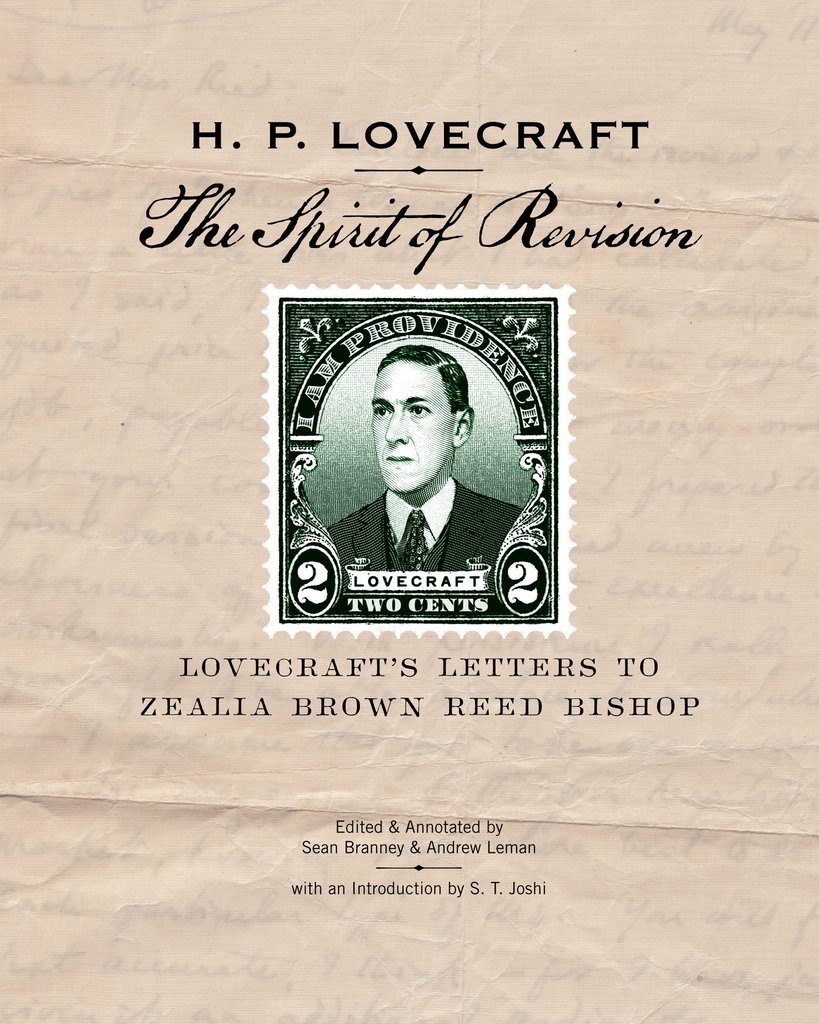
These letters appear to have never made it to Derleth, but some of it did survive; in 2014, it came to light that 36 letters (including the letter from Lovecraft to her son Jim, and one surviving letter from Zealia to Lovecraft) had been in the possession of Zealia’s great niece. This, combined with the letters that Arkham House transcribed and biographical materials on Zealia’s life and her correspondence with Lovcraft, were annotated and published as The Spirit of Revision (2015) by the H. P. Lovecraft Historical Society.

The correspondence is still very incomplete; the fifty-four published letters covers a period of 1927-1930, 1934, and 1936. In addition to this, there is one letter which Zealia quoted from in writing to August Derleth, which has not been published:

But I do want you to know that under H.P.L. I most certainly had the finest fundamental training one could ever receive in years at any university.

Thus as example: “I am genuinely astonished by Wright’s attitude toward your last story. It only confirms my opinion of his capriciousness and lack of all objective standards in judging stories. This tale was not so long as the one he accepted the week beforeand I don’t see where it could be any less “convincing”. But Wright’s Wrighthe will have his self-important ex-cathedra personal reactions. I give him up! In fact I gave him up long ago. It would take some superhuman and veteran behaviourist like Thomas H. Uzzell to fathom the intricacies of his psychology.”
Zealia Bishop to August Derleth, 6 Apr 1949, MSS. Wisconsin Historical Society

This would presumably be a reference to Weird Tales editor Farnsworth Wright rejecting either “The Mound” or “The Curse of Yig.”

One aspect of Zealia’s letters to Lovecraft that has mostly gone unremarked are the dealings she had with the other authors in Lovecraft’s circle. Samuel Loveman has already been mentioned; the two do not appear to have any lengthy correspondence. At the time she began to engage Lovecraft’s revision services, he was in partnership with Frank Belknap Long. “Sonny” Long may have revised and/or typed some of her manuscripts, and acted as literary agent in trying to get “The Mound” published after it was rejected by Weird Tales. In addition to Long, Zealia got in touch with Robert H. Barlow, the avid fan who later became Lovecraft’s literary executor, in 1934.

Dear Mr Barlow:-

After so long a time I generally get around to accomplishing the thing I’m supposed to. Today I am expressing The Mound to you and am also enclosing a copy of Medusa’s Coil for you to read, then I wish you would please send it on to Mr Frank B. Long of New York (230 West 97th Street) as I’m going to give him a chance to dispose of it unless you would particularly like to have it. Anyway, you may advise me. I have no idea what the Londodn [sic] Publishers will offer. They have asked to see it and are the publishers who made a reprint of The Curse of Yig. […]

Mr Lovecraft must have had a marvelous time at your home and on his trip. Isn’t he a wonderful person? I feel deeply indebted to him for anything I have and may ever accomplish. His letters are always sources of great inspiration to me.

My fingers are getting buttery so shall stop, but wanted you to know that the manuscripts go forth today. Sorry I’ve been so negligent.
Zealia Bishop to R. H. Barlow, 11 Jul 1934, MSS. John Hay Library

Barlow collected manuscripts from pulp writers, and eventually had an eye toward publishing them in his amateur journals The Dragon-Fly and Leaves. Her correspondence with Barlow would be relatively brief, but Barlow would form an important link in the chain to eventually getting all of her weird revisions published in Weird Talesand eventually by Arkham Housealthough this involved a bit of miscommunication and misunderstanding:

Am glad you liked The Moundaltho’ I wonder if you saw Medusa’s Coil after HPL revised it? The partial copy I sent you was the original before his revision? I was shocked at young Barlow’s claim–for it was untruthful from the starkas I believe one of Lovecraft’s to me proved. HPL wrote me of a “young chap in Florida” who was interested in printing on “his own machine some weird stories” & asked me if I would let Barlow “use” my stories for his “private collection”or something like thatlater Barlow wrote me asking my permission & even asking me to let him use the pictures used by Wright in the Curse of Yig!I hope I’ve proved that the stories are mine? Barlow never found the stories in Lovecraft’s effects& has no claim on them. Every one of the three talesThe Curse of YigThe Mound & Medusa’s Coilis based on material acquired on my travels around my sister’s ranch in Oklatho Medusa’s Coil was written around another location. Tell Barlow for mehe’s a poor sport!

The revision prices on all stories were duly noted when HPL had finished, tho’ I owed him either 18.00 or 21.00 at the time of his death on some work done last yearWhatever Wright or anyone else will pay for either or both tales please arrange that half (regardless of the indebtedness) be paid to Mrs. Gamwellin appreciation for all HPL did for me.
Zealia Bishop to August Derleth, 11 May 1937, MSS. Wisconsin Historical Society

H. P. Lovecraft mentioned Zealia in several letters to his various other friends and correspondents, usually in relation to “The Curse of Yig” or to the other stories her revised for her, but it doesn’t appear that many of them attempted to actually get in touch with her. Besides Derleth, who contacted Zealia after Lovecraft’s death and seems to have remained in touch with her off-and-on for most of the rest of her life. The only other possible contact she had was with Lovecraft’s friend and fellow pulpster E. Hoffmann Price:

It was just before Bill’s and my brother’s tragic deaths, that H. Hoffman Price (maybe I have that first initial wrong) turned me over to his agent August Lenniger. At that point when he was advising me my heart and mind seemed suddenly to stand still. […]
Zealia Bishop to August Derleth, 24 Apr 1949, MSS. Wisconsin Historical Society

August Lenniger was Price’s literary agent; it’s not entirely clear when they got in contact, if it was in the 1930s, there is no reference to any correspondence in Price’s letters with Lovecraft, nor in Price’s memoirs of other pulp writers.

As a writer, Zealia Brown Reed Bishop seems to have found little professional success in terms of sales—her “confession” pulp stories are long forgotten, her novels remained unpublished—except for those stories revised, to the point of being ghost-written, by H. P. Lovecraft. This work is not without distinction: The Curse of Yig (1953, Arkham House) is the first volume of Mythos fiction published under a woman’s name, and the weird fruit of Zealia’s correspondence with H. P. Lovecraft continues to be published and re-published. While many fans may find The Spirit of Revision principally of interest because of the light it sheds on Lovecraft’s revision practices, it should be noted that their correspondence covered much more ground than just that—and Zealia’s letters may yet prove more valuable as a record of their personal and professional relationship.

ZealiaBishopc1945

I could mention one thing more, however, which can hardly be considered of minor importance. Mrs. Bishop was a woman of great charm and quite exceptional beauty.
—Frank Belknap Long,
Howard Phillips Lovecraft: Dreamer on the Nightside xiv


Bobby Derie is the author of Weird Talers: Essays on Robert E. Howard & Others (2019) and Sex and the Cthulhu Mythos (2014).

“H. P. Lovecraft: A Pupil’s View” (1953) by Zealia Bishop

Some of Lovecraft’s friends remonstrated with him and regretted that he spent so much time as a revisionist. There is no evidence, however, that Lovecraft chafed at this means of making an extremely meagre living. He was generous with his astounding sapience and derived a genuine sense of pleasure and satisfaction out of giving his wisdom and erudition to help others.
—Zealia Bishop, “H. P. Lovecraft: A Pupil’s View” in Ave Atque Vale 253

As much as scholars of H. P. Lovecraft’s life and work rely on the rich trove of letters that he has left behind, they do not cover all of his life—and his many friends, family, acquaintances, and revision clients left their own record of his life, in letters and diaries and memoirs. The sources are valuable accounts, but as new information becomes available, they are also subject to new scrutiny, and what might have been considered rock-solid “facts” about Lovecraft in the 1950s and ’60s is sometimes subject to reinterpretation and change.

“H. P. Lovecraft: A Pupil’s View” was published in 1953 as part of The Curse of Yig (Arkham House). The author was Zealia Bishop, who from roughly 1927-1937 was one of Lovecraft’s correspondents and revision clients. From her synopses Lovecraft produced three weird tales (“The Curse of Yig,” “Medusa’s Coil,” and “The Mound”) and had a hand in several of her unpublished stories. This memoir was for many years was essentially the only information that most fans and scholars had on this part of Lovecraft’s life.

It was not until the Selected Letters II was published, containing fourteen abridged letters from the Lovecraft/Bishop correspondence and scattered references about Zealia Bishop by Lovecraft in letters to others that there was anything to verify or compare her account…and it would not be until 2015, when a trove of recently-found letters from the Lovecraft/Bishop correspondence was published as The Spirit of Revision (H. P. Lovecraft Historical Society) that a fuller picture of their professional and personal relationship could be established.

Even before The Spirit of Revision, however, scholars questioned parts of Bishop’s essay.  For example, her account of how she came into contact with Lovecraft:

It was in 1928 in a small bookstore in Cleveland that I first learned of Lovecraft. The bookstore was managed by Samuel Loveman, a bibliophile and writer of verse who had achieved some minor fame as friend of the poet, Hart Crane. […] Bookstore proprietors are always being asked by amateurs to recommend publishers, teachers and critics. I was no exception. At my inquiry, in the course of our conversation, Mr. Loveman told me about Lovecraft.

“Write to him,” he advised. “He can help you, if anyone can.”
—Zealia Bishop, “H. P. Lovecraft: A Pupil’s View” in Ave Atque Vale 253-254

The problem was, Samuel Loveman was not in Cleveland in 1928, but in New York City, where he had moved in 1924; the earliest letter from Lovecraft to Zealia is dated 10 May 1927 (SOR 29). While she might well have gotten in contact with Lovecraft via his friend Sam Loveman, it almost certainly could not have happened the way she said it did. Nor is this the only discrepancy that can be pointed out in Zealia’s memoir.

To understand some of the problems in “A Pupil’s View,” it might help to know how and when it was written. August Derleth wrote to Zealia Bishop shortly after Lovecraft’s death in 1937, asking for any letters she could contribute to what would become the Selected Letters and about the stories that R. H. Barlow had said Lovecraft had revised/ghostwritten for her. In one of her answering letters, Zealia promised:

I shall prepare an article or—data—on what I think may be of general interest in regard to Howard’s revision work—and send you within the next week—but shall await your reply and if I have anything which you can use I shall compile it for you—and do all in my power to assist you in every way.
—Zealia Bishop to August Derleth, 8 Apr 1937, MSS. Wisconsin Historical Society

There is no evidence that Zealia actually produced an article in 1937, and the subject come up again in the Bishop/Derleth correspondence in 1950:

I hope you won’t find too many things wrong with the Lovecraft article. If that passes, then I shall not worry about the others, for he is not an altogether easy subject about whom one can write, yet a very interesting one. Thank you for sending me Cats etc. I shall send you a check for same…but you are always hitting me between the eyes, it seems, as being the only one who was really indebted to Lovecraft as a “client”, paying him for revision! Do you think that is all quite “cricket” as hard as I’ve worked for so many years? Remember, it was Loveman who first sent me to Lovecraft (when he was living in Cleveland) and I sometimes wonder if he remembers about it, however, it was Howard who had me take a course at Columbia University and also study privately with Thomas Uzzell—while I was in New York and it was then we found out I could gain much more by my own efforts with Howard guiding me along the way when I needed it…but I never should have followed the path of the weird tale despite all the material I gathered from the people in the south and in Mexico and Latin America. My yet unfinished tale is one with Aztec mythology woven through it and I think Howard was well pleased with the progress I made without his supervision…even as he was with three of my novels. Sometimes I shall send you the letters he wrote about them…telling me how I had progressed with structure and the choice of words.
Zealia Bishop to August Derleth, 13 Jan 1950, MSS. Wisconsin Historical Society

Cut to two years later:

You’re wrong, fellow, I haven’t fallen down on the job about the articles on you and H. P. L. I finished them two years ago, but kept rewriting them, unable to throw off that damnable self-consciousness instilled in me by Lovecraft. Now, however, I’ve developed more positiveness and will send them to you for approval and corrections where you feel necessary.
—Zealia Bishop to August Derleth, 12 Aug 1952, MSS. Wisconsin Historical Society

Far from being the fresh recollections of a Lovecraft just recently passed in 1937, then, “H. P. Lovecraft: A Pupil’s View” was really written some 13-15 years after his death. A few allowances for memory might be made in such a span of time, but there are other key factors in the composition of “A Pupil’s View” to consider. The first of these is August Derleth’s quiet role in the production.

Would you prefer that I send on the Lovecraft and Derleth articles for you to groan over, and cut, augment and suggest in person?
—Zealia Bishop to August Derleth, 15 Sep 1952, MSS. Wisconsin Historical Society

At last here is the article. I hope that it does not fall far short of my opinion of you and that you will see some improvement in my writing. Feel free to augment and delete as you see fit. […] At the time I began the article on you I started one on Lovecraft this should be finished for your approval before I get there—you understand I will need photographs for both? […] In the event my short stories are published as a collection I plan to include both articles. Does that meet with your approval? If only the weird are selected for one book then both articles—DERLETH-LOVECRAFT—would be most appropos—Zealia Bishop to August Derleth, 15 Oct 1952, MSS. Wisconsin Historical Society

At this point, Zealia had committed to writing two profiles, one on Lovecraft (“A Pupil’s View”) and one on Derleth himself (“A Wisconsin Balzac”). Bishop’s letters to Derleth continue to talk about re-writing these articles into 1953, when Zealia Bishop signed a contract for Arkham House to publish The Curse of Yig. Whatever the final product that Zealia delivered after years of re-writing, she apparently did not think it adequate, and instructed Derleth:

Evidently you misunderstood me that day at lunch in Madison. I thought I was very explicit—as well as Helen—that I told you “everything was ready to go except I wanted to rewrite the DERLETH and LOVECRAFT articles. And that I would positively have to rewrite the LOVECRAFT article entirely.”

I have done what I could on it and am sending it as is, “but I am not in the slightest pleased with it and feel that I should be the one to rewrite it.”

The material is here and could be redone beautifully but it would take me at least another two weeks so I am sending it so that you may pass judgement edit it and then if you think I should rewrite it return or bring it.
—Zealia Bishop to August Derleth, 25 Apr 1953, MSS. Wisconsin Historical Society

If necessary “brush up” the Eschutcheon [sic] as well as the Derleth & Lovecraft articles
—Zealia Bishop to August Derleth, n.d. (1953?), MSS. Wisconsin Historical Society

Looking at “A Pupil’s View” with an eye toward a possible Derlethian influence, several parts of the memoir jump out immediately. The first few glowing paragraphs of “A Pupil’s View” do not sound like Zealia Bishop; they discuss Lovecraft’s rise in prominence in American letters (which Zealia does not seem aware of), his devoted followers and fellow pulpsters (including several she never mentions in any other letter and probably never heard of, such as Robert E. Howard and Henry Kuttner); and references to overseas sales, the Arkham House collections of Lovecraft’s fiction, and “magazines containing his work command equally high premiums” which sound very much like the standard Derlethian sales line.

Later in the narrative, Zealia Bishop goes into a very atypical reference to the Cthulhu Mythos—in accordance with Derleth’s interpretation:

[…] our conversation naturally turned to Lovecraft and his fantastic story themes, especially those of the Cthulhu Mythos, which were based on a curious pantheon of Gods and Elder Beings with a marked basic similarity to the Christian Genesis story of the struggle between good and evil.
—Zealia Bishop, “H. P. Lovecraft: A Pupil’s View” in Ave Atque Vale 261

It is conceivable that Bishop had absorbed this point of view from Derleth’s introductions in Arkham House books and his various Cthulhu Mythos stories. The conversation is supposed to have happened in June 1928, and “The Call of Cthulhu” had been published in the February 1928 Weird Tales, so the timing for talking about Cthulhu isn’t necessarily off—but the phrase “Cthulhu Mythos” wasn’t coined or popularized until some years later by Derleth. The last paragraphs too are very Derlethian in tone, especially:

But in this rather specialized field, undoubtedly Lovecraft’s own attitudes about sex and love (capably discussed in H.P.L.: A Memoir, by August Derleth) got in his way when he revised the work of his pupils. These were experiences not entirely within his ken.
—Zealia Bishop, “H. P. Lovecraft: A Pupil’s View” in Ave Atque Vale 263

Without access to the original manuscript that Zealia Bishop submitted to August Derleth, it is speculative to guess at his how much or any of this was material he wrote. To play devil’s advocate: If Derleth did have a large hand in this piece, or at least did a proper editorial pass on the the manuscript, we might expect certain little details to have been quietly edited out that were left in. For example, Zealia’s rather hyperbolic claims about Lovecraft’s ability with languages:

He was well versed in the language of the Kaffirs, Damoras, Swahilhi and the Chulhu and Zani—who are extremely tenacious of their ancient religion. […]  He wrote as fluently in Greek and Latin as in English and when he began his strict instructions in Aztec Mythology he often wrote to me in Spanish.
—Zealia Bishop, “H. P. Lovecraft: A Pupil’s View” in Ave Atque Vale 254, 255

While Lovecraft was proficient in Latin, and had some rudimentary knowledge of Greek and Spanish (the latter at least for the Spanish phrases in “The Mound”), he had no knowledge of African languages. It’s possible that Lovecraft had written something about these language (probably referencing from an encyclopedia article) in a letter which does not survive, but you’d think Derleth would have caught this error…but, we can only speculate. Taken together, a Derleth editing/partial re-write and aged memory might explain a few of the parts of the “A Pupil’s View” that don’t fit what we know of Lovecraft from other sources.

The second key factor to consider in “A Pupil’s View” is why Zealia wrote it, and her motives were not restricted to praising Lovecraft and preserving his memory. She wanted to make it absolutely clear who actually wrote the stories in The Curse of Yig:

There in Oklahoma, doubting more and more that I would ever become a writer, let alone a successful one, I sat one evening with a group of old Oklahoma settlers who had driven out to my sister’s ranch. We sat around the kitchen fire and talked. Finally the conversation rambled on to folklore. Grandma Compton, my sister’s mother-in-law, told a horror story about a couple who pioneered in Oklahoma not far from where we were. This story was a spark to me. I wrote a tale called “The Curse of Yig,” in which snakes figured, wove it around some of my Aztec knowledge instilled in me by Lovecraft, and sent it off to him. He was delighted wit this trend toward realism and horror, and fairly showed me with letters and instructions.

Now at least I really went to work. I rewrote the story and together we revised and injected erudition into it about the Aztec Snake God, Yig. Finally, under his careful direction, I had a decent and I felt salable weird-horror story.
—Zealia Bishop, “H. P. Lovecraft: A Pupil’s View” in Ave Atque Vale 258

So on with “Medusa’s Coil” and “The Mound.” Zealia Bishop would not admit to Lovecraft’s authorship, or even of his editing. Even the name of her memoir “A Pupil’s View” shows how she wanted the relationship to be perceived: she was Lovecraft’s student, paying him for his writing advice, not a client paying him to ghost-write stories for her. So above and beyond all else, “A Pupil’s View” was written specifically to convince readers and critics that these were not Lovecraft revisions or collaborations—which is what Derleth and Arkham House had been selling the Bishop/Lovecraft stories as in Beyond the Wall of Sleep (1943) and Marginalia (1944).

Lovecraft told a different story in his letters, including to August Derleth and his friend and future literary executor R. H. Barlow. August Derleth had written to Zealia Bishop on Barlow’s advice, with the specific aim of publishing the Lovecraft collaborations. So Derleth was certainly well aware of what Zealia Bishop was doing, and why she was doing it. One late letter makes this perfectly clear:

Remember, August, in Howard’s new book—His Letters etc., please don’t let it appear that I was never able to do anything for myself. Is it your opinion that in these anthologies all credit goes to Howard? Was that your intention or what?
—Zealia Bishop to August Derleth, n.d., MSS. Wisconsin Historical Society

Selected Letters II was published in 1968, the same year that Zealia Bishop passed away.

Taking it as a given then what Zealia Bishop was trying to accomplish with “A Pupil’s View” was primarily to preserve her reputation as a writer—that writing in 1952-1953 should would be trying to recall events from about 25 years prior when she first began to correspond with Lovecraft—and that August Derleth appears to have had at a quiet hand in amending and editing the document—is there anything of value to be extracted from it? Can we trust anything that Zealia Bishop wrote?

Surprisingly, more than you think. While some of her claims are farcical (Lovecraft wasn’t an expert on Aztec mythology either), the correspondence in The Spirit of Revision actually supports Zealia Bishop’s general narrative of the relationship. In the absence of more of her letters to Lovecraft, which are long gone at this point, it is her only account of her side of the relationship, including her frustrations at their different tastes in writing. In addition to this, “A Pupil’s View” is the only first-person account of Zealia’s brief meeting with Lovecraft and Frank Belknap Long, Jr. in New York City on 29 May 1929.

The most difficult question remains Zealia’s account of the actual conception and background behind “The Curse of Yig,” “Medusa’s Coil,” and “The Mound.” Lovecraft’s letters make it pretty clear that he ended up writing most of “The Curse of Yig,” and basically all of “Medusa’s Coil” and “The Mound” from synopses provided by Bishop. So what, if anything, can we trust of her account?

In our conversation we discussed among things my short novel, “The Mound”—an outgrowth of another tale told by the Comptons from their recollections of two old Indians living near Binger, Oklahoma—and my stories, “The Curse of Yig” and “Medusa’s Coil,” which I had picked up as an idea from a Negress who did some housecleaning for me and expanded into a story similar in treatment to my earlier horror tale.
—Zealia Bishop, “H. P. Lovecraft: A Pupil’s View” in Ave Atque Vale 259-260

The sources of inspiration given seem plausible. “Grandma Compton” appears as a character in both “The Curse of Yig” and “The Mound,” and Zealia Brown Bishop’s sister was Grace Brown Compton—so there is no reason to doubt that Grace Compton’s mother-in-law was the original for “Grandma Compton.” The locale of “The Mound” is reasonably accurate to the mound-legends around Binger, Oklahoma. “Medusa’s Coil” is not tied to the Grandma Compton mythos, but an African-American housekeeper telling the story of a mixed-race woman “passing” as white is not far-fetched.

Serious cracks in the Zealia Bishop’s narrative don’t appear to have been seriously appeared until after her death. In “A Pupil’s View,” she alleges that at Lovecraft’s advice, Frank Belknap Long worked with her on “The Mound”:

In the ensuing conversation we took up the subject of “Medusa’s Coil.” It was decided that I should continue working on that under Lovecraft’s direction. “However,” he said, “I would like Belknap to work with you on your new story ‘The Mound.’ He may have something fresher and more interesting to offer.[“] […]

At Lovecraft’s gentle insistence, I left “The Mound” with Frank Belknap Long, and it was Long who advised and worked with me on that short novel. Lovecraft’s instructions were negligible; he merely advised both Belknap and myself when we felt we were not following his guidance.
—Zealia Bishop, “H. P. Lovecraft: A Pupil’s View” in Ave Atque Vale 260

In his own memoir of Lovecraft, Frank Belknap Long refuted this:

I had nothing whatever to do with the writing of The Mound. That brooding, somber, and magnificently atmospheric story is Lovecraftian from the first page to the last.
—Frank Belknap Long, Howard Phillips Lovecraft: Dreamer on the Nightside (1975) xiii-xiv

The truth appears to have been somewhat more complicated, at least according to the surviving correspondent and typescripts. Lovecraft certainly appears to have written “The Mound” based on the Binger mound legends provided by Zealia Bishop; when it failed to sell, he advised her to let Belknap market it, and he had abridged the novella and tried to do so, but failed:

You perhaps did not remember that I sent The Mount to Sonny Belknap over two years ago—in fact immediately after the old Boston lady—I’m grieved to learn of her death—returned it.) I wired him just not to send the unabridged copy to Mr. Barlow at once […]
—Zealia Bishop to H. P. Lovecraft, 26 May 1934, The Spirit of Revision 177

As to the matter of the Bishop MSS.of course, it’s only fair to Mrs. Bin view of what she’s paid for ghosting or revisionto let her try the stuff on any possible markets. I assumed that Sonny Belknap, as her literary agent, had done so; & am astonished to find that any stone was left unturned.
—H. P. Lovecraft to R. H. Barlow, 26 Jun 1934, O Fortunate Floridian! 143

R. H. Barlow was able to eventually cobble together a complete version of the manuscript, which he then bound with letters from Zealia Bishop and Frank Belknap Long relevant to its provenance.

In 1978, S. T. Joshi launched a more serious criticism at Bishop’s narrative in his essay “Who Wrote ‘The Mound?'” in Nyctalops #14. Joshi’s careful picking through the available evidence (Lovecraft’s published and unpublished letters, and manuscript material in the Lovecraft collection at John Hay Library at Brown University) reconstructed the convoluted textual history, and dismissed Bishop’s claims of authorship.

Others were coming more-or-less to the same conclusion and articles like “The Mound of Yig?” (1973, Etchings & Odysseys) by W. E. Baardson, “In Search of Yig” (1974, Nyctalops #9) by John J. Koblas, “‘Yig,’ ‘The Mound’ and American Indian Lore” (1983, Crypt of Cthulhu #11) by Michael DiGregorio all looked for the genuine lore underlying “The Curse of Yig” and “The Mound,” taking Bishop’s basic claims of inspiration from regional folklore as true—and unfortunately spending a lot of time looking in the wrong places for a bit of lore that Lovecraft had invented.

Joshi would edit the corrected third printing to The Horror in the Museum and Other Revisions (1989, Arkham House), and in his “A Note on the Texts” referenced the abridgement, mistranscription, and editing of Bishop’s stories by Long and Derleth. The book also reprinted August Derleth’s 1970 introduction (“Lovecraft’s ‘Revisions'”), where the Arkham House founder quoted from “A Pupil’s View”:

The stories I sent to him always came back so revised from their basic idea that I felt I was a complete failure as a writer.
—Zealia Bishop, “H. P. Lovecraft: A Pupil’s View” in Ave Atque Vale 257

There is a certain pathos to this statement, because it is probably true. It is rather sad in many ways that we cannot take more of “A Pupil’s View” as the unvarnished truth. It would be easier to read and believe Zealia’s account of her struggles with the difference between where she wanted to go in her writing versus the direction that Lovecraft direction if it wasn’t necessary to put each statement under the critical microscope. Her affection for her “mentor” certainly seems genuine, even if she sometimes disagreed with him, and the occasional overblown claim about his linguistic abilities seems to be more a sign of admiration than a deliberate effort to mislead. Errors like Lovecraft’s age (she gives his age as 35 in 1928, he was actually 38) appear to be honest mistakes, the kind of thing Derleth should have caught.

“H. P. Lovecraft: A Pupil’s View” was first published in The Curse of Yig (1953, Arkham House) and has been reprinted in Lovecraft Remembered (1998, Arkham House) and Ave Atque Vale (2018, Necronomicon Press).


Bobby Derie is the author of Weird Talers: Essays on Robert E. Howard & Others (2019) and Sex and the Cthulhu Mythos (2014).

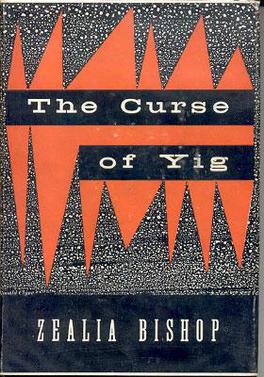
The Curse of Yig (1953) by Zealia Bishop

After the death of H. P. Lovecraft in 1937, his friends August Derleth and Donald Wandrei (founders of Arkham House), and R. H. Barlow (Lovecraft’s literary executor) began a concerted effort to get his fiction, poetry, and letters into print. This process took decades, publication being relatively slow and expensive, and the audience being mostly restricted to hardcore fans. Among all the legendary Arkham House publications, Zealia Bishop’s The Curse of Yig (1953) stands out as the first Mythos collection attributed to a woman—and would remain the sole such book for some decades. The contents are fairly succinct:

Like many books, The Curse of Yig didn’t just happen. At the time of Lovecraft’s death, only “The Curse of Yig” (1929) was published; both “The Mound” and “Medusa’s Coil” had been rejected by Farnsworth Wright, editor of Weird Tales, and apparently failed to find a home elsewhere. One of the first jobs that Derleth & co. faced was finding out what revision-work and collaborations that Lovecraft had actually done and obtaining manuscripts and permission to publish them.

H. P. wrote stories for a half dozen, some of which I can prove by documents. Bloch (Don’t quote me—there are amenities to be preserved), Heald, Reed, Lumley, had outright jobs done, Rimel & others his enormous tinkering resulting in a wholly re-written ms. These things are—some of them worth collecting–but not in his own books. He said many times he would not permit a collaboration in his collected stories, so certainly he’d resent these things. We’re going to have a hamper full as it is.

Mrs. Reed had him do 3 stories,

  1928 – YIG – pub. – written outright for her
*1929 – THE MOUND – novelette – ditto
*      ”  – Medusa’s Coil – embodying a notion of hers, but all HPL nonetheless

* I have only the ms. of these

[…] Perhaps the works he ghosted could be called “collaborations” without scaring off the ghostees, & made another book. There’s years of work to be sorted & printed.
R. H. Barlow to August Derleth, 31 Mar n.d. [1937], MSS. Wisconsin Historical Society

Derleth managed to get in contact with Zealia Bishop in 1937, and they discussed Lovecraft’s letters and revisions. In an early letter, Zealia promised:

I shall prepare an article or—data—on what I think may be of general interest in regard to Howard’s revision work—and send you within the next week—but shall await your reply and if I have anything which you can use I shall compile it for you—and do all in my power to assist you in every way.
—Zealia Bishop to August Derleth, 8 Apr 1937, MSS. Wisconsin Historical Society

The article didn’t come. What did happen is that Derleth apparently edited these stories and then apparently acted as Bishop’s agent to sell them to Weird Tales. The timeline on how exactly this happened is a little unclear, but over a year later in the January 1939 issue of Weird TalesDerleth’s version of “Medusa’s Coil” was published. Fan response was positive, and ‘The Eyrie’ for March 1939 reveals it was voted the second-favorite story in the issue. The success of “Medusa’s Coil” might explain why Bishop’s “The Curse of Yig” was included as a “Classic Reprint” in the April 1939 issue of Weird Talesand it was also positively received in “The Eyrie.” “The Mound” did not see print until the November 1940 issue of Weird Tales, possibly due to its length. None of these stories were presented with any mention of Lovecraft’s authorship in Weird Tales.

Following Barlow’s suggestion, Arkham House initially focused on publishing H. P. Lovecraft’s fiction on its own: The Outsider and Others (1939) and Beyond the Wall of Sleep (1943) collects nearly all of his fiction. The latter book, however, also included some of his “collaborations,” including “The Curse of Yig” and “The Mound”—this would have been the first time Lovecraft’s hand in Zealia Bishop’s stories was publicly acknowledged. “Medusa’s Coil” was republished in Marginalia (1944), alongside other revisions and collaborations; these Arkham House texts both used Derleth’s edited versions of “The Mound” and “Medusa’s Coil,” rather than the original Lovecraft/Bishop version.

Was it your intention to make them appear as his stories?
—Zealia Bishop to August Derleth, 28 Jan 1949, MSS. Wisconsin Historical Society

Zealia Bishop’s letters with Derleth in the mid-to-late 1940s defend her authorship of the three weird stories, other evidence of Lovecraft writing them from synopses notwithstanding. She also continued to promise him an article on her relationship with Lovecraft:

I hope you won’t find too many things wrong with the Lovecraft article. If that passes, then I shall not worry about the others, for he is not an altogether easy subject about whom one can write, yet a very interesting one.
Zealia Bishop to August Derleth, 13 Jan 1950, MSS. Wisconsin Historical Society

Arkham House was slowing down publication in the late 1940s and early 50s. Derleth had repeatedly cited low sales, with books selling out only very slowly despite the relatively small print runs. By the 1950s most of the weird fiction pulps had folded, and even the venerable Weird Tales was on its last few years of existence. So it is somewhat surprising that around 1952, Zealia’s letters start to discuss a print collection of her fiction…and she was also working on not just the long-promised article on Lovecraft, but another on Derleth himself:

You’re wrong, fellow, I haven’t fallen down on the job about the articles on you and H. P. L. I finished them two years ago, but kept rewriting them, unable to throw off that damnable self-consciousness instilled in me by Lovecraft. Now, however, I’ve developed more positiveness and will send them to you for approval and corrections where you feel necessary.

I plan to use both of them in the story collection but if, after reading them, you wish to suggest a market, it might be well to have them previously published.

After you read them and also see the assembled collection, how about writing a “Foreword”? You know I worked and studied hard before I began studying under Lovecraft and Long. Considering that it was during the darkest years of the depression, I paid them both well for their instructions, criticism and any revision. My record at Columbia University will bear out my years of studying and ambition. What shall I do about reprints of stories published in magazines now out of print? […]

What about the reprinting of stories once published in stories now out of business or publications discontinued by a publisher tho’ still in business? What of those published in Confessions?
—Zealia Bishop to August Derleth, 12 Aug 1952, MSS. Wisconsin Historical Society

Derleth’s reaction to this had to be a bit mixed. The time and place for Zealia’s memoir of Lovecraft would ideally have been earlier—in Marginalia maybe, or The Arkham Sampler (1948-1949)—and it didn’t seem that Zealia Bishop had anything genuinely weird to offer besides the three Lovecraft revisions, and those had already been published and re-published. “The Curse of Yig” in particular had been published twice in Weird Tales, three times in hardcover, and most recently in the paperback Avon’s Fantasy Reader No. 14 (1950).

At last here is the article. I hope that it does not fall far short of my opinion of you and that you will see some improvement in my writing. Feel free to augment and delete as you see fit. […] At the time I began the article on you I started one on Lovecraft this should be finished for your approval before I get there—you understand I will need photographs for both? […] In the event my short stories are published as a collection I plan to include both articles. Does that meet with your approval? If only the weird are selected for one book then both articles—DERLETH-LOVECRAFT—would be most appropos—Zealia Bishop to August Derleth, 15 Oct 1952, MSS. Wisconsin Historical Society

Will have some time to redo my DERLETH and LOVECRAFT articles. If they meet with your approval do you have a market for them or will you suggest one to me, though later they will go in the book with the weird short? Why don’t you quote me a price for publication (by ARKHAM HOUSE) for such a volume? I would like to have such a book done well, such as ARKHAM HOUSE does.
—Zealia Bishop to August Derleth, 18 Nov 1952, MSS. Wisconsin Historical Society

The discussion with Derleth now takes on a more business-like tone. The moment that Derleth might have been dreading arrived: Zealia had fixated on Derleth as a possible publisher for her collection. Vanity publishing was a skeleton in Arkham House’s closet: not a service that was widely advertised or ever publicly acknowledged, but a circumstance occasionally resorted to, at least with old Weird Tales authors that Derleth was familiar with and presumably whose material was not vastly divergent from Arkham House’s core focus. Given the relatively expensive costs of publishing, the high cost of the resulting books, the small print numbers, and the slow sales, it also wasn’t likely to be a strong financial investment—and that’s before you consider that most of the volume’s contents would be reprints. Derleth presumably expressed at least some of these risks to Zealia Bishop:

What you say about the publishing of the stories interests me. In the event we come to an agreement, how must this money be paid your company? You say you must get $2.50 for you to break even—then what of the author?

I would like to do this, followed by at least three other books, if you could pass on the work, but I would not want the weird tales published if you feel more credit should go to LOVECRAFT. After all, August, he was the teacher and I  the pupil and he was polishing my efforts, trying to direct me, but he did not do any more than you and Frank Long did. While erratic and always in need of money, Frank was an excellent and driving tutor even though we could not always see “eye-to-eye”. I was always pulling between the two teachers trying to write as I wished, not as they were determined I should, but I gained much from both of them as well as from your own kind interest and advice. Yet I would not want to publish the stories as my own efforts if you do not feel I am justified in claiming them. So be perfectly frank and we shall proceed from there.

Am re submitting the articles with the one on H. P. L. Maybe this time you will like the Derleth one better.
—Zealia Bishop to August Derleth, 14 Dec 1952, MSS. Wisconsin Historical Society

I would like very much to work out a plan with you for the publishing of not only the one volume but possibly several more. I feel after your editing, they will all be good and should have reasonable sales. […] My reason for asking how the money is to be paid is that under the circumstances, I cannot draw from a personal fund. I have talked to our banker who has told me “if the contract warrants it” I may borrow the sum.

It is now up to you about the contract. […] I will have the weird tales and articles to you immediately after Christmas. What you choose and assemble will be, of course, entirely up to you.
—Zealia Bishop to August Derleth, 22 Dec 1952, MSS. Wisconsin Historical Society

It isn’t clear what Zealia means by “editing” here—that is, whether she means the usual services of copy-editing by removing typos and grammatical errors and checking for factual accuracy, or editing that was more along the lines of wholesale revision, as Lovecraft would have done. Possibly she didn’t know herself. At the very least, he seemed to have convinced her that the volume should consist solely of the three weird tales revised by Lovecraft, plus her articles (if she ever finished them). The issue of cost and “breaking even” is another key issue: assuming that Zealia Bishop was paying for the printing, who was getting what percentage of the cover cost? Without the actual contracts or the Arkham House business records it is difficult to assess, but we get further hints as their correspondence addresses more details of the project.

First, though, Zealia had to finish her articles on Lovecraft and Derleth.

In three days I wrote exactly four words on the revision of the DERLETH article. Howarver [sic], after your letter I set up all night finishing it as well as the ESCHUTECHEON [sic]—so go over them both with a “curry comb”—streamline them where necessary-especially with newspaper publication in mind for DERLETH—and elaborate upon the “HOUSE OF GHOSTS” as I have no details on that other than behind it is: that ARKHAM HOUSE was founded on the memory of LOVECRAFT and his fictious [sic] name of ARKHAM – Incorporate that as you see fit.

I do not think, however, that for the book the real meaty stuff should be deleted.

But revise both article and story as necessary and have both retyped and send me a statement. Do please send the ESCHUTCHEON to your editor friend if it passes your approval. I will work on the LOVECRAFT article tonight and tomorrow night and it will follow as quickly as typed to be handled the same as the DERLETH one. If you find these two articles and the three Weird stories adequate for publication in book form, then let’s get down to figures, publicity plan etc;.

You know I told you I would have to know how muchwhen the bills had to be met and so on. After all, I have to plan ahead for any unusual expense or it would not pass D. W.’s approval—certainly not for writing. He loathes publicity and does not encourage my writing—maybe I should use my little granddaughter’s name—LESLIE S. REED—and become an individual-new-unknown-etc.-and after the successful publication of several things bring out a good personality story—?
—Zealia Bishop to August Derleth, 14 Apr 1953, MSS. Wisconsin Historical Society

This was a little over a week after August Derleth’s marriage; one can imagine that it had begun to dawn on him that for the monies to get the book published, she apparently wanted him to put her articles into printable shape as well as every other task involved with assembling a manuscript. D. W. Bishop was Zealia’s husband, and at that time was essentially an invalid, although he apparently still largely controlled the couple’s finances. The idea of using a pseudonym was probably vetoed by Derleth: one of Zealia’s most bankable assets was likely name recognition from Weird Tales fans from over a decade prior.

Evidently you misunderstood me that day at lunch in Madison. I thought I was very explicit—as well as Helen—that I told you “everything was ready to go except I wanted to rewrite the DERLETH and LOVECRAFT articles. And that I would positively have to rewrite the LOVECRAFT article entirely.”

I have done what I could on it and am sending it as is, “but I am not in the slightest pleased with it and feel that I should be the one to rewrite it.”

The material is here and could be redone beautifully but it would take me at least another two weeks so I am sending it so that you may pass judgement edit it and then if you think I should rewrite it return or bring it.

I will do the foreword as quickly as possible.
—Zealia Bishop to August Derleth, 25 Apr 1953, MSS. Wisconsin Historical Society

The Lovecraft article is finished—but you’ll have to have it retypedHelen cannot type fast enough & my secretary has had a baby, has to stay home—etc—etc—so—take it as is—but it must be slicked up & retyped.
—Zealia Bishop to August Derleth, n.d. (after Apr 1953), MSS. Wisconsin Historical Society

Ultimately The Curse of Yig was published without a foreword, so presumably it was either cut or never finished.

In the correspondence, there are suggestions that Derleth may have been trying to agent the Lovecraft and Derleth essays to magazines or fanzines before the book was published. If this was the case, no record of a prior publication has been found. It’s reasonable to assume that the original manuscripts for the two profiles “H. P. Lovecraft: A Pupil’s View” and “A Wisconsin Balzac: A Profile of August Derleth” required more than a little copy-editing, and possibly wholesale re-writing, including lengthy bibliographical lists in Derleth’s profile, which elicited a comment:

Approve manuscript-with exceptions: some typographical errors and suggest Derleth profile be cut to eliminate so much commercialism and cataloging which should be in a separate pamphlet. Suggest I proof read—What about contract? We should settle on that before printer begins work—
—Zealia Bishop to August Derleth, 29 Jun 1953, MSS. Wisconsin Historical Society

The contracts arrived—but you do not mention in your letter that the DERLETH & LOVECRAFT articles are included in THE CURSE OF YIG. Without them the publications would be of little, if any, value to me. I merely mentioned that I thought the article about you included too much listing of your works and killed the interest about the writer and man. […] Your prices do not correspond with those in the printers’ letter. I shall send a check to the artist. Also, watch for proofs from photographers.
—Zealia Bishop to August Derleth, 19 Jul 1953, MSS. Wisconsin Historical Society

Before desktop publishing, print costs would be a bit vague: the printer’s letter would have included the quote for costs for an approximate number of books at so many pages; the addition of photographs, large changes in the text, etc. could require substantial rework in terms of layout and raise the cost of the final product. Which is apparently about what happened with The Curse of Yig.

I am going to ask that you proofread this manuscript—particularly the Lovecraft. It needs some smoothing—it seems a little jerky—Maybe you will not think so—. […] I’m much too anxious about publicity, August—that can come with my new name—But I do wish the picture of Derleth & Lovecraft included in the Curse of Yig.
—Zealia Bishop to August Derleth, 16 Sep 1953, MSS. Wisconsin Historical Society

You should add that I have done journalism or writing for several newspapers including an historical series around Clay County Missouri—That I am a member of the National Federation of Press Women & the Missouri Womens Press Club. These women hold pretty well together & would feel slighted if mention were not mad on the blurb.

It would be better if the book dd not come out too soon or at least that the printers bill does not come before Dec if you can so arrange it.

Our Dispersion sale is Oct 21—Final settlement & especially in the case of a dispersal, if normally takes from 60 to 90 days—
—Zealia Bishop to August Derleth, n.d. (Sep 1953?)

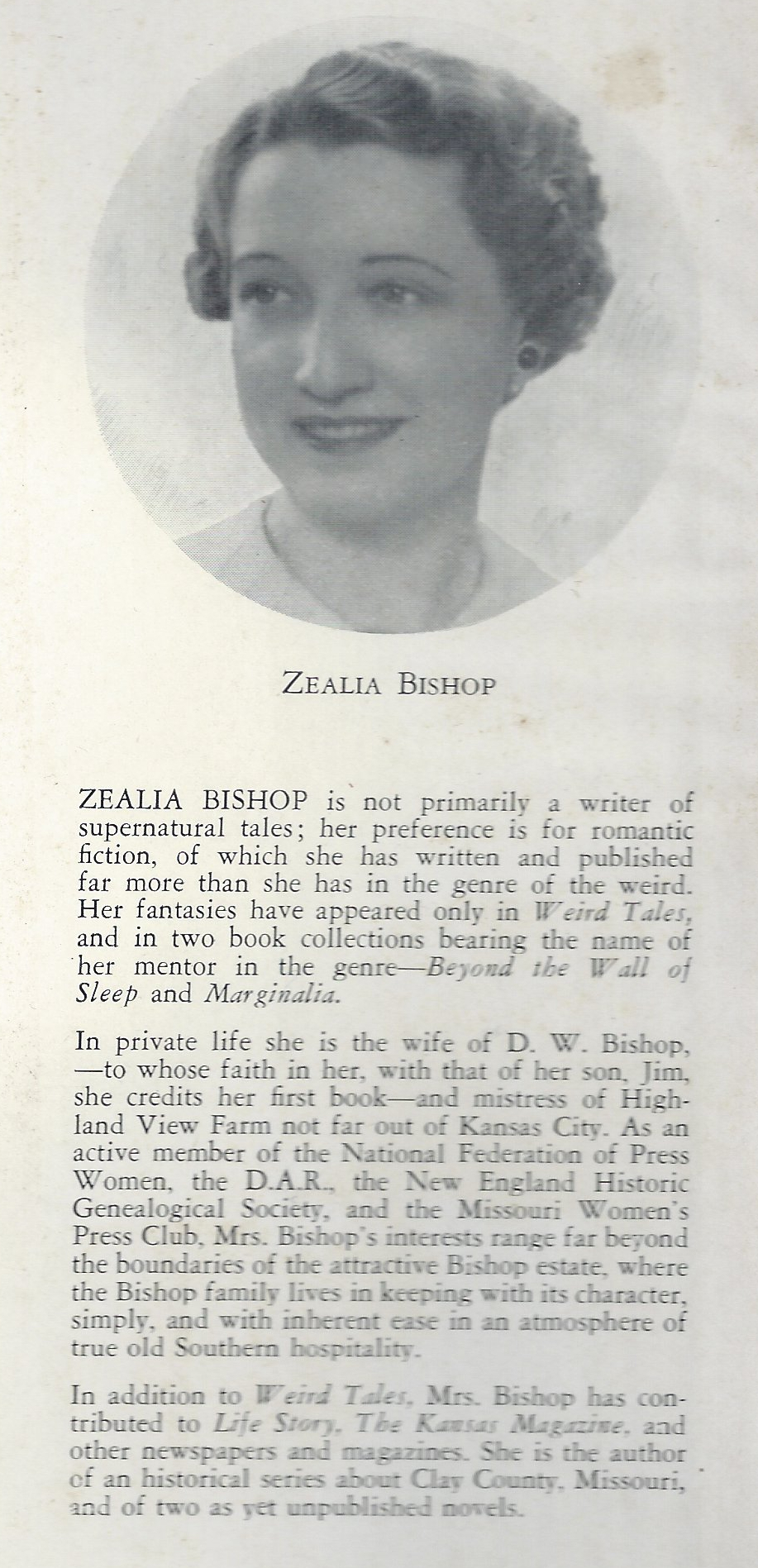
The “dispersion sale” refers to the selling off of the livestock of Highland View Farms, which the Bishops owned; presumably with D. W. Bishop incapacitated they were no longer able to manage the rigorous cattle business. The blurb on the inside rear flap of her book jacket does include all of the points she wished included in the above letter.
Zblurb

We have not yet had the bill from Banta, but it will be coming along in a week or ten days, and it will be due thirty days from its date. I will send you a copy of it promptly, but I will not notify you how much you will have to pay until some time later, since we will want to wait at least until November 10th to give payments and orders time to come in. We have had 27 advance orders to date, and of course we have about 100 standing orders with the shops, though their payments will very probably not come through at once, and you will have to be remitted to you after you have met the bill.  Our shipment indicates that somewhere between 1200 and 1220 copies of THE CURSE OF YIG were printed; the book itself is very handsome, I feel.
—August Derleth to Zealia Bishop, 20 Oct 1953, MSS. Wisconsin Historical Society

I enclose a copy of the bill from the printing company for THE CURSE OF YIG. This is due November 15. You will note its details, please, and then return it to me in the envelope enclosed for that purpose. You will see that 1217 copies of the book came to $1,698.23, or a cost over all of approximately $1.40 per book. The deduction of $14.45 is listed as “150 copies of last section” which I had printed for lecture platform use, and it is thus my personal expense, and is included here only because it is part of the “job” of printing for Banta.

Now, then, as of today, the book has actually brought is, with the per copy deduction for our handling charge already taken off, a total of $127.40, which, deducted from $1698.25, would leave you—as of today, that is—the sum of $1,5580.73 to send to me. However, this sum will be further reduced by still further orders to come in and to be paid for. $127.50 represents only 50 copies of the book at $3 the copy, less .45$ handling charge […] We have, however, sold 157 copies of the book thus far, and there are thus manifestly more payments due to us. I do not know how many of those payments will come in before the bill must be paid, but it seems certain that the total amount you will have to pay will be not less than $1,400.00, judging by previous experience with payments to us.

A study of the bill will show you some interesting things. For instance, the inclusion of the two photographs, which you wanted inserted, added a total of $55.78 to the cost of production. Alterations in text and jacket, at $5.50 an hour, added a further total of $73.60. These were potentially avoidable expenses, of course; to offset them I could arrange only for an $11.58 deduction as indicated in the final credit entry. On the other hand, the 200 extra copies I added to the print order, cost only another hundred dollars, which, it seems to me, is well worth the additional expense, since we have just 200 copies more with which to come into the black from the red on this title. We should come out all right; happily, we are discovering that patrons who do already have your stories in our earlier collections are still ordering this title because they want a complete Arkham House collection. […] Do now please arrange to send the required sum as soon as I let you know; figure on paying at least $1,400.00 […]
John Stanton to Zealia Bishop, 27 Oct 1953, MSS. Wisconsin Historical Society

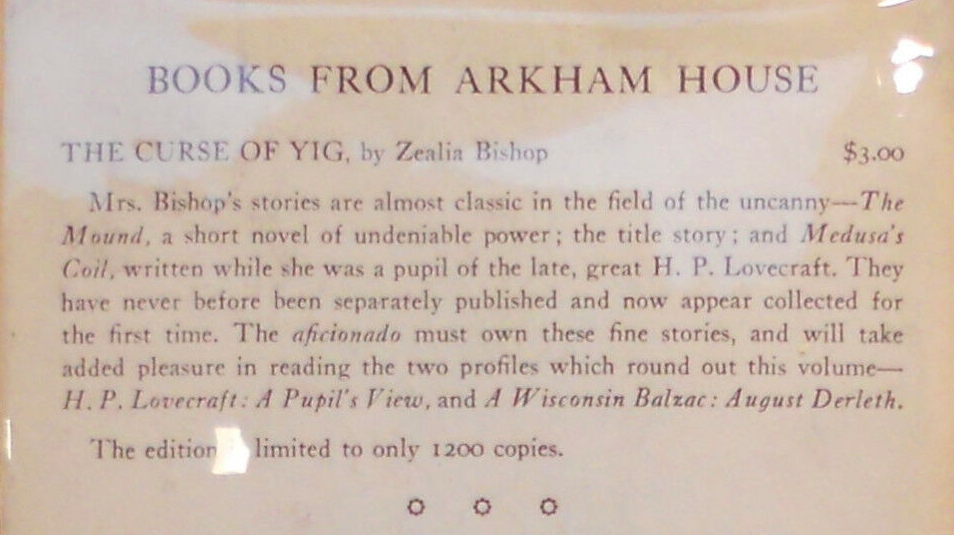
Arkham House contracted with George Banta Publishing Company of Wisconsin for the physical publication of the books; John Stanton was an Arkham House employee that handled some of the business matters. Copies of the “lecture platform” edition of “A Wisconsin Balzac” appear to be extremely rare ephemera.
s-l1600

As the bill comes due, the question of reimbursement and profits comes up again. The stock price of the book was $3, and the “handling fee” was $0.45/book, so the gross value of each book was $2.55. At 1217 books, that left a potential gross of $3103.35—but how much of that would Zealia be getting? How many copies would have to sell for her to recoup the cost of printing? There’s no doubt that Derleth had to be getting at least a portion of the cover price to keep the lights on at Arkham House. Nevertheless, the terms must have been acceptable enough, because Zealia footed the printer’s bill.

Herewith is check on account for 300.00—leaving a balance of 1100.00 which you shall have not later than November 14th. I may be in Madison on that day or before—but you may depend on the check on that day in any eventuality. This has been a little difficult to handle as you told me that the bill would come in on Nov 10th & be payable in thirty days—If this is the fact let me know as it would be easier for me & I would not have to borrow any money—as I will have checks coming in to cover the amount early in Dec—Write me about this at once. It means a great deal to me—as previously explained. […]

I’m not interested in publicity–merely that sales pay the amount used to publish it—
—Zealia Bishop to August Derleth, n.d. (c. late Oct 1953), MSS. Wisconsin Historical Society

Herewith is the 1100.00 balance on the printing bill etc.—in three checks. I would like, if possible, for you to deposit them a few days intervals. The money is on deposit—but we have a devil of a banker—who is just as apt as not to call me out of a sound sleep & say “why are this….”  knowing that D. W. would know nothing of the deal & that I would be called upon to explain. Things will not always be like this—at present, however, to antagonize anyone could be disastrous. Since you can be assured that the money is in the bank I know you will arrange to handle the amount with your usual diplomacy.

It is impossible to say now how “Yig” is going or will go over. I’m receiving “fan” mail, of course—but that’s all happened before— […]

D. W. took one fleeting glance at the book. He did not so much as touch  it & has never mentioned it. That has cut me deeply—the girls, too, are wounded over his attitude—but it has only made me more determined to continue on—to do something more as often as I can—I cannot be destroyed—so many & so much depend upon me & my well being. […]

I hope “Yig” is successful enough to offset the printer’s bill & that we may publish one or two more under this plan then perhaps the other things will sell outright.
—Zealia Bishop to August Derleth, n.d. (c. Nov 1953), MSS. Wisconsin Historical Society

If Zealia Bishop hoped that the book would sell quickly, she had either deluded herself or else Derleth hadn’t been entirely forthright about the economics of the situation. As it was, it was not many months later when he was forced to write the kind of letter a writer hates to get.

I’m afraid you haven’t read your contract with Arkham House. There is no money due you by February 10th, I am sorry to say. The very earliest that any payment would be earned, would be in June, and I am not sure that there will be a payment then. The contract specifies that royalty reports on earnings shall be made after every half year, and that payments shall be made thereon not later than June and December respectively, following. Thus your first royalty reportwhich I shall try to have made up and enclose for youcarries you up to 1 January 1954, and covers the sale of only 250 books. And we have sold just 20 books since then, for a total of 270 books so far.

You will recall, too, that the total bill was $1,712.68, of which $14.45 was my personal responsibility—see my letter of 27 October 1953—leaving the actual cost of THE CURSE OF YIG—not counting other expenses incurred here which I did not put on the bill—at $1,698.23. Of this sum, you were asked to pay only $1,400.00, in the hope that the remaining figure would be earned by the time the bill was met. It was not quite earned; so you do not begin to receive monies until some months after (the first June to December) our royalty reports show that your book has earned the full $298.23. That is to say, form the first report of earnings, we must deduct no less than $298.23 plus a .45¢ per title handling charge, as per contract. If my estimate, purely off the cuff, is correct, the payment to you in June will be approximately $150.00, $20 more or less. My rough estimate puts it at just short of $150.00, but if I can have Alice make up the royalty statement in time to enclose it in this letter, than you will know for certain just what is due you in June; following which, the next payment will be made to you in December of this year, and on the same basis, at the same intervals, thereafter.

I am sorry that THE CURSE OF YIG has not sold faster; we are now just under 25% of the edition sold, and I know we will sell all the books, but they are just not moving fast, and none of our titles do so move. It took us 10 years to sell 1200 copies of THE OUTSIDER & OTHERS; yet, on the other hand, we sold 4,000 copies of SLAN in short of 4 years. But you will recall that I told you in advance not to expect any miracle sales, but a slow, steady accretion of sales. An initial payment of $150 or slightly less does represent 10% of your investment, and that is not too bad for two months’ sales, considering. […] We published Seabury Quinn’s ROADS in a 2000 copy edition in 1948 under a similar arrangement; it took him 4 years to recoup his $900 investment, and he is still earning his royalties now. We published David Keller’s TALES FROM UNDERWOOD in 1951 under a similar arrangement; he invested $1725, and still has $1450 to be earned for him.
—August Derleth to Zealia Bishop, 22 Jan 1954, MSS. Wisconsin Historical Society

25% would equate to about ~300 books sold in only two months (or a bit longer, counting advance sales); that should have grossed $900, or $765 minus the handling charges. If Zealia still owed ~$300 on the printing and might still expect $150 in June, that suggests her share or 300 books sold amounted to $450 net, so she was getting something like $1.50 per book (and remember that the printing cost was $1.40 per book). That leaves a full dollar of the cover cost unaccounted for, so either Derleth’s math is fuzzy, or (hopefully) there is a large piece of the accounting picture missing, because at $1.50 a copy Zealia would have to sell almost the entire run to earn out her initial investment ($1,698.23 / $1.50 per book = 1133 books), much less expect to see a profit.

We can compare these estimates with the one extant earnings statement:
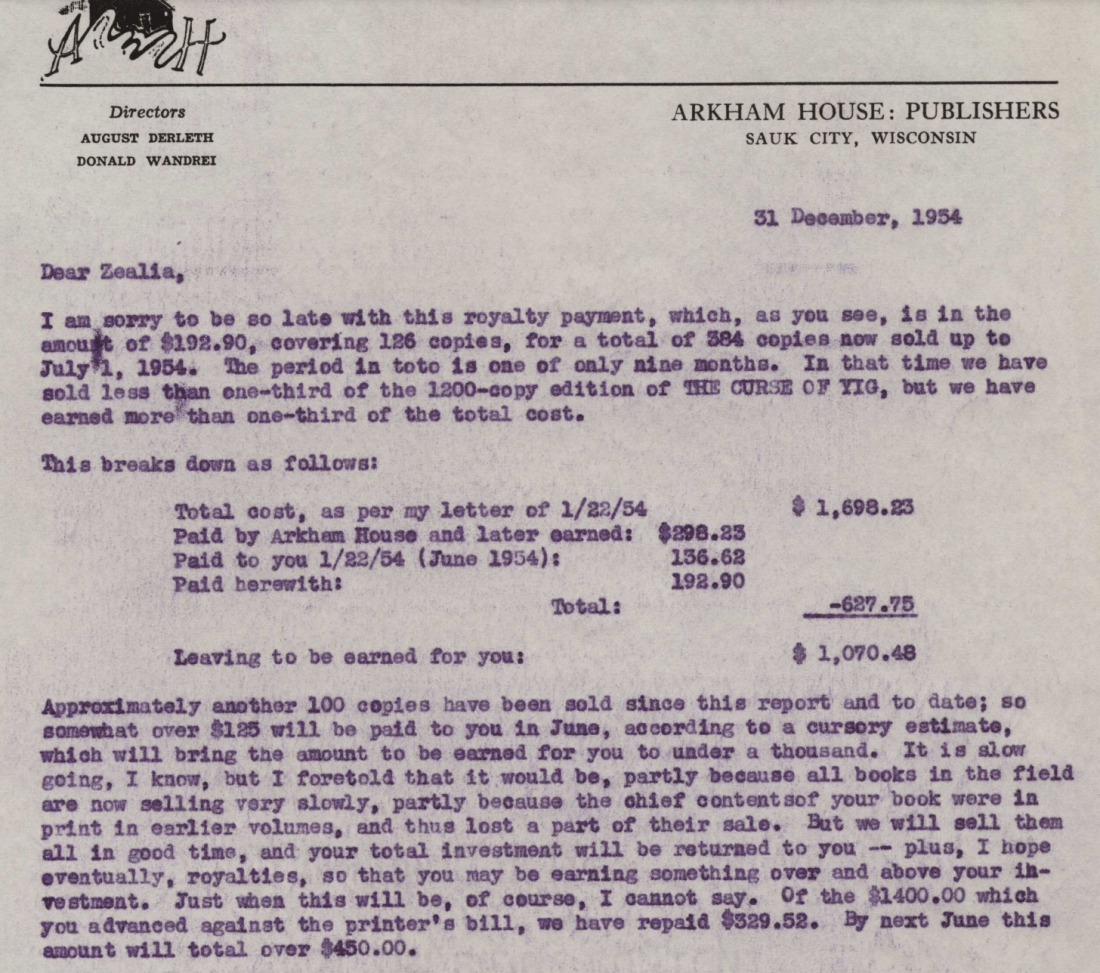
Screenshot 2020-12-20 at 6.52.30 PM

$627.75 / 384 books = $1.63 per book, which isn’t far off from the estimate (presumably Derleth is rounding somewhere), but the basic picture is the same: to actually earn back her money, much less make a profit, The Curse of Yig would need to sell most of the edition. Just to break even, Arkham House would need to sell ($1,070.48 / $1.63 per book = 657 books), and there were only 833 left in the edition—and some of those might probably be author’s copies, archival copies, etc. At the current rate (384 books/year) the book wouldn’t be expected to show a real profit until 1956.

Unfortunately, that didn’t happen. Instead of sales remaining steady, they appear to have decreased:

Our Bishop book, done in October 1953, has sold only 450 copies so far; and our Metcalfe, done in April 54, only 400. The one was largely reprint material, true, but the other was new work, though by a British author.
—August Derleth to Clark Ashton Smith, 26 May 1955, Eccentric, Impracticable Devils 451

Several of Zealia’s later letters to Derleth, tracking her economic decline, include requests for checks ahead of the agreed-upon schedule, no matter how small. In at least some cases, Derleth appears to have done his best to comply…but any hopes of actual profit, much less further publication, probably vanished quickly.

Certainly there seems to be an even interest in Yig—What do you think about a paperback for it—& in Airports etc?
—Zealia Bishop to August Derleth, n.d., MSS. Wisconsin Historical Society

The reason it’s called vanity publishing is because it is vain.

At the end of the day, The Curse of Yig would seem to largely be a book for Arkham House collectors more than general fantasy or horror readers. One contemporary review probably said it best:

Zealia B. Bishop’s The Curse of Yig (Arkham House, $3) contains three negligible stories from Weird Tales, plus two first-rate biographical profiles: one plausibly presenting H. P. Lovecraft in a somewhat less favorable light than that in which he is shown by his idolaters, and one which comes close to doing justice to the fabulous career of August Derleth.
—”Recommended Reading” in Fantasy and Science Fiction, vol. 6, no.2 (Feb 1954) 95

Much of the enduring legacy of The Curse of Yig lies not with the stories themselves—these were the Derleth-edited texts, later superseded by corrected texts compiled and edited by S. T. Joshi in The Horror in the Museum and Other Revisions (1989, Arkham House). “A Wisconsin Balzac” has never been reprinted, and may well have been written entirely by Derleth himself.

What has been reprinted, and is perhaps the most remembered inclusion to The Curse of Yig is “H. P. Lovecraft: A Pupil’s View”—Zealia’s long-simmering, often re-written memoir of being Lovecraft’s student-cum-revision client. While not without its flaws, this was until the publication of their letters the only account of Lovecraft and Zealia Bishop’s professional and personal relationship available.

Which in its own way is what The Curse of Yig is: a testament to the lasting impact of these two human beings on one another, and through their fiction on the world. No other woman would be so associated with Lovecraft for decades afterwards; no other woman would have her own Mythos anthology until after the death of August Derleth in 1971. The Curse of Yig might have been a commercial failure, but those books still exist, and are purchased and read today. While every writer might hope for profit during their own lifetime, what more could a writer hope for, after they’re dead and gone, but to be read and remembered?


Bobby Derie is the author of Weird Talers: Essays on Robert E. Howard & Others (2019) and Sex and the Cthulhu Mythos (2014).
Mexican Gothic (2020) by Silvia Moreno-Garcia

This novel dramatic paraphernalia consisted first of all of the Gothic castle, with its awesome antiquity, vast distances and ramblings, deserted or ruined wings, damp corridors, unwholesome hidden catacombs, and galaxy of ghosts and appalling legends, as a nucleus of suspense and daemoniac fright. In addition, it included the tyrannical and malevolent nobleman as villain; the saintly, longpersecuted, and generally insipid heroine who undergoes the major terrors and serves as a point of view and focus for the reader’s sympathies; the valorous and immaculate hero, always of high birth but often in humble disguise; the convention of high-sounding foreign names, mostly Italian, for the characters; and the infinite array of stage properties which includes strange lights, damp trap-doors, extinguished lamps, mouldy hidden manuscripts, creaking hinges, shaking arras, and the like. All this paraphernalia reappears with amusing sameness, yet sometimes with tremendous effect, throughout the history of the Gothic novel; and is by no means extinct even today, though subtler technique now forces it to assume a less naive and obvious form.
—H. P. Lovecraft, “Supernatural Horror in Literature”

Silvia Moreno-Garcia would probably agree with H. P. Lovecraft in that there was nothing more insipid than the traditional heroine of the Gothic novel. Which is why the heroine of her Gothic novel is a spurt of new blood in the veins of an old and decaying family, one able to pull a trigger when she has to, and light a cigarette when she wants to. For all that Moreno-Garcia consciously pays homage to the tropes of the Gothic novel, make no mistake: this is a fresh story, a slow burning, slow building tale that goes unexpected places and does so with confident skill and creative flourish.

Gothic fiction was a primary influence on H. P. Lovecraft, and much of his early Poe-inflected fiction especially can be considered as “modern Gothics.” When you read “The Rats in the Walls” with its family mystery, the ancient Priory with its haunted legends, the ghostly skitter that the cat chases—that is an echo of Edgar Allan Poe’s “The Fall of the House of Usher,” and before that Horace, Walpole’s The Castle of Otranto. Readers who ignore this school might find that they’ve missed some excellent fiction, and Lovecraft himself noted:

Indeed, we may say that this school still survives; for to it clearly belong such of our contemporary horror-tales as specialise in events rather than atmospheric details, address the intellect rather than the impressionistic imagination, cultivate a luminous glamour rather than a malign tensity or psychological verisimilitude, and take a definite stand in sympathy with mankind and its welfare. It has its undeniable strength, and because of its “human element” commands a wider audience than does the sheer artistic nightmare. If not quite so potent as the latter, it is because a diluted product can never achieve the intensity of a concentrated essence.
—H. P. Lovecraft, “Supernatural Horror in Literature”

Mexican Gothic is what it says on the cover. Not just “a Gothic novel set in Mexico,” but an original Gothic novel which could not be written except in Mexico. It would not have the same effect if the protagonist Noemí Taboada was an American cousin, the relationships in the story would be entirely different; the Doyles would not be the same if the story was set in New Mexico versus Old Mexico, because the historical events and prejudices that they carried with them and experienced would be entirely different. The story carries its sense of place with it right down to its bones, which is something Lovecraft himself would no doubt have appreciated.

Readers who know Silvia Moreno-Garcia for her Mythos fiction and as editor/publisher at Innsmouth Free Press might be looking for Mexican Lovecraft connections. After all, Lovecraft set a story in Mexico involving a mine (“The Transition of Juan Romero”), played with Aztec mythology (“The Mound” with Zealia Bishop), and revised another story about a miner in Mexico (“The Electric Executioner” for Adolphe de Castro)—but there are no copies of the Necronomicon in the Doyle library, not even a copy of Moreno-Garcia’s own El Culto de los Muertos from The Starry Wisdom Library.

Mexican Gothic is not a novel of the Cthulhu Mythos. But it is a very Lovecraftian one.

[…] all the people in the family seemed to have that similar physiognomy, which she was dubbing in her head “the Doyle look.” Like the Habsburg jaw of Charles II, only not quite as concerning. Now that had been a case of sever mandibular prognathism.
—Silvia Moreno-Garcia, Mexican Gothic 126

There are a number of themes in the book that echo some of Lovecraft’s stories; it’s hard not to see a shadow of unspoken sexual relationships of “The Thing in the Doorstep,” the strange ‘scandals’ of “The Dunwich Horror,” and terrible near-destruction of the family by one of its members a la “Facts Concerning the Late Arthur Jermyn and His Family”—but this isn’t just a mix-and-match of ideas from Lovecraft and old Gothic tropes. Silvia Moreno-Garcia knows what she’s doing, and if she deliberately re-purposes a few old stones in the house she’s building, it’s because they’re the right size and shape, not because they’re the closest thing at hand.

Which really comes into sharp focus in the character of the Doyle family. In a Lovecraft story, a Mexican character like Noemí Taboada would be the outsider, intruding into the narrative with a corrupting presence; the Doyles almost certainly see themselves as Lovecraftian protagonists and view her as an outsider. Yet in the narrative of Mexican Gothic, it is clear that it is the Doyles who themselves are the intrusive element: the aliens that refuse to be assimilated, who cling to their own traditions and live apart, pursuing their strange and disturbing practices.

Any change which involves an interference with a developed race’s folkways and language and cultural integrity is cruelly deplorable—but in each threatened case it is up to each neutral power to decide whether armed intervention is really justified in the interest of general civilisation. However—in practice, most nations do instinctively draw a line betwixt the civilised and the definitely non-civilised. […] Sometimes a nation forms a sort of borderline case—Mexico being an example. As a whole, Mexico has enough of an established Hispanic civilisation to win it a place in the instinctively favoured category, but this is not true of all its parts. When at various times the U.S. took sections of its southern neighbour, these sections were among the least settled and civilised—hence the gradual Americanisation. But if we were to conquer the entire country in some future war, it seems certain that the intensively developed central area containing the capital would be granted a cultural autonomy like that enjoyed by Puerto Rico.
—H. P. Lovecraft to Robert E. Howard, 7 May 1936, A Means to Freedom 2.930

From a Lovecraftian point of view, the Doyles and their mansion form an enclave or colony of English civilization in Mexico; having conquered and “civilized” a portion of it. Yet to the actual Mexicans, the Doyles are greedy, unlovely, incestuous (recall Lovecraft’s claim that several of his ancestors had consanguineous marriages), and as one wise woman put it: cursed.

Readers familiar with Howard Phillips Lovecraft will find many commonalities with Howard Doyle, patriarch of this clan. Doyle’s obsession with scientific racialism, and his verbal sparring with Noemí on the topic, are a different way of addressing Lovecraft’s prejudices than N. K. Jemisin did in The City We Became (2020). Where Jemisin’s characters mocked Lovecraft’s beliefs from the safe vantage point of Lovecraft being long dead, Noemí has to deal with a very real racist who in 1950s Mexico clings to ideas more suited to the 1890s. The tenseness of the encounter plays against the racial tensions of Mexican history as well as Lovecraft’s personal prejudices: Noemí is neither ashamed of her indigenous heritage, nor does she see herself as particularly defined by that. She is first and foremost a contemporary Mexican, and doesn’t care to be slotted into Doyle’s categories.

Which writer, living or dead, would you most like to meet? What would you like to discuss?
I think I’m obliged to say I’d like to reconstitute Lovecraft using his essential salts. I did my thesis work on him and feel in a strange way that I grew up with him. In a way, he was one of my best friends as an awkward kid growing up in Mexico City—which sounds bizarre, but it’s true. I don’t know, however, how the conversation might go. It would probably be very stilted. […] As for talking, I like to talk about books nobody knows about and old movies, so I’d probably show Lovecraft Get Out and Annihilation, and see what he thinks.
—Jared Jackson, The PEN Ten: An Interview with Silvia Moreno-Garcia (9 July 2020)

The slow build-up of the first two-thirds of the book gives way to a precipitously fast descent into hell in the last third. All the hints and suggestions planted lead to a genuinely and fantastically weird climax. The book is worth reading twice just to pick up on some of the care with which the first part of Mexican Gothic is built on, and without which the book as a whole would have fallen apart. Shades of “Arthur Jermyn” again in the final conflagration—but as with “The Fall of the House of Usher,” there’s a certain inevitability to it all. The House of Doyle was always a tinderbox, waiting to be ignited by any stray spark…and no one tells Noemí Taboada that she can’t smoke.


Bobby Derie is the author of Weird Talers: Essays on Robert E. Howard & Others (2019) and Sex and the Cthulhu Mythos (2014).
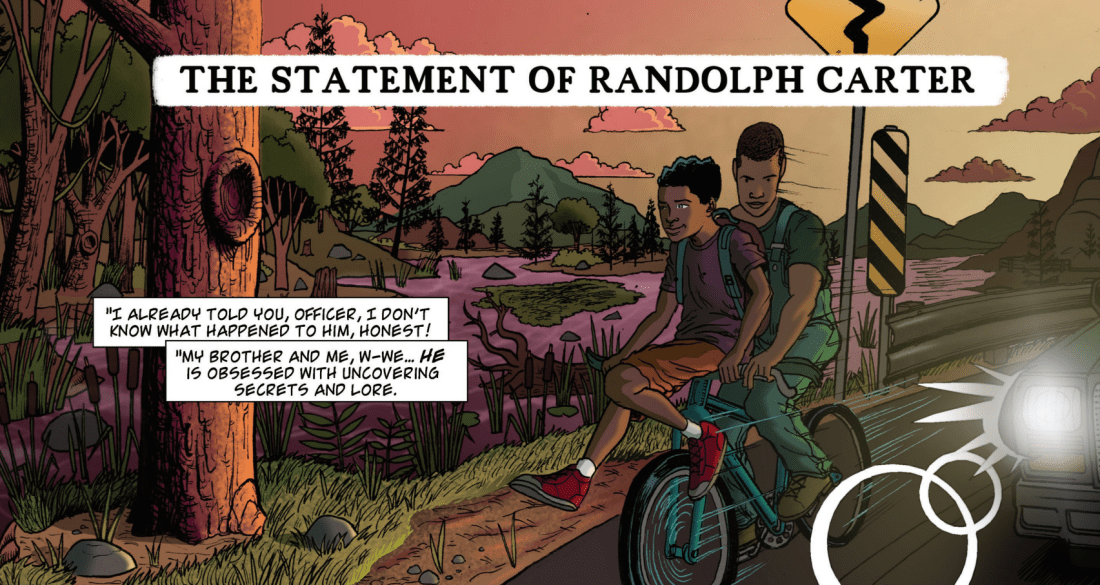
“The Wyrd Voyage” (2020) by Kari Leigh Sanders

I know that this tale seems unbelievable, and had I not come across a different one before it, I would have thought it a jest or a lie. However, a few years ago, before I was presented with this collection, I was given a transcript of Karl Heinreich, Graf von Altberg-Ehrenstein, Lieutenant-Commander in the Imperial German Navy*, dated in 1917 wherein he encounters a very similar place—at the bottom of the sea. I leave it to you to decide.
* This is a reference to H. P. Lovecraft’s “The Temple”
—Kari Leigh Sanders, “The Wyrd Voyage” in More Lore from the Mythos 171

The English word weird is derived from the Old English wyrd. The older word represents a concept of personal fate or destiny, being cognate with the Old Norse urðr, which was also a name for one of the Norns. When Shakespeare wrote of the “Weird Sisters” in Macbeth, he meant that the witches were those who could see—or declare—the personal destinies of others, to which they were bound. They were supernatural entities, and in modern English this was the sense that came into common usage: weird as supernatural, uncanny, odd.

“The Wyrd Voyage” is then a deliberate pun: because while it is weird fiction in the contemporary sense, it is also very explicitly wyrd fiction in that much older sense: a story about fate. This is particularly fitting as it is woven as a near-Mythic prequel to H. P. Lovecraft’s “The Temple.” This isn’t so much a story about what has happened or what might happen, but what is bound to happen. “The Temple” was written long ago; we know where the story is going. The question is how it got there.

H. P. Lovecraft didn’t write much about the ancient Norse peoples or going viking. His friend Robert E. Howard did, and some readers might like to try and draw a connection between the Mythos and stories like “The Cairn on the Headland” or “Marchers of Valhalla,” but for the most part, ancient Scandinavia is a blank slate as far as the Lovecraft Mythos stories go. Anyone that wants to write Mythos fiction set during the period of the Viking Age has more literary freedom in their depiction of the Mythos because it is terra incognita.

In the case of Kari Leigh Sanders and “The Wyrd Voyage,” she keeps it fairly self-contained: no effort to draw in Cthulhu or the Deep Ones or any other familiar names, beyond the Norse Mythos itself. It isn’t quite sword & sorcery (although is it very much Vikings & Völva), and it is a bit more Mythic than Mythos, in the sense that recognizable Norse deities like Loki and Hel make their personal appearances. If readers are used to more recognizable human pantheons being absent or effectively non-existent compared to the physical reality of Mythos entities like Cthulhu, that might be a little jarring. Yet it also presents certain interesting possibilities.

By itself, “The Wyrd Voyage” is basically a standalone story. It is a precursor to “The Temple,” but the events of that story happen centuries later, so they are chronologically isolated. Now imagine that this story is not considered in isolation. Imagine after you read “The Wyrd Voyage” you read “The Viking in Yellow” (2014) by Christine Morgan—and now you have two data points, two stories which share a Viking Age setting and as well a supernatural element…and if you’re a reader of a certain inclination, maybe you’ll look for more. Maybe you’ll find them. Take notes, see how those stories might work as, not two separate stories, but part of a larger setting…and like that, you’ve got the basis of a new corner of the Mythos. Or at least, one that hasn’t been quite as thoroughly explored as a few others.

When looking at settings in the past like there, there is a certain foreordained quality. You the reader know the world will not end in the Viking Age, because you live after that period and the world, at least for you, has not ended. So you as a reader know something of the wyrd of those characters and stories: while they may live or die, the world itself shall continue. Which tends to lend a tragic cast to these characters: no matter how hard they fight, no matter if they succeed, one day the stars will be right…

There’s more than a hint of wyrd fiction to the Mythos over all. Stories like “The Call of Cthulhu” and The Shadow Out of Time emphasize a certain inevitability. It is one of the more profound, if often misunderstood and mischaracterized themes in Mythos fiction: the idea that, over a long enough span of time, human effort becomes negligible. The Dunwich Horror may be banished, but that is at best only a slight reprieve: the Old Ones will break through again—if not today, then tomorrow, or in a hundred or a thousand or ten thousand years. How characters respond to that realization that realization of the cosmic scale of what they face—that “victory” in any sense must be temporary, a stopgap, a momentary breathing space—is critical.

You might wonder what the silent, sometimes unseeing dead could teach me, they taught me silence and acceptance. It might not be as exciting as the stories and secrets of the gods, or as useful as capturing the winds and weaving, but it is still a good lesson. Particularly for someone with my wyrd.
—Kari Leigh Sanders, “The Wyrd Voyage” in More Lore from the Mythos 152

“The Wyrd Voyage” in More Lore from the Mythos (2020). Kari Leigh Sanders also wrote “A Governess in Innsmouth” in More Lore from the Mythos Vol. 2 (2020).


Bobby Derie is the author of Weird Talers: Essays on Robert E. Howard & Others (2019) and Sex and the Cthulhu Mythos (2014).
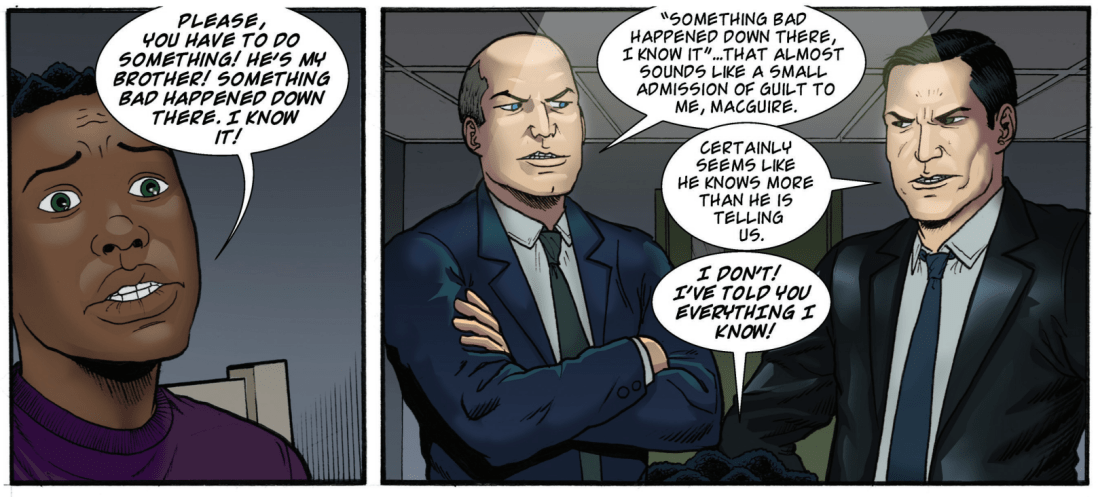
“Unseen” (2020) by Claire Leslie

What if we focused an entire anthology on the gods and monsters of Lovecraft, instead of just the horror? How would that feel, especially since Lovecraft specifically kept the gods in the background, lest we look upon them and go insane?
—Russel Nohelty, Cthulhu Is Hard To Spell: The Terrible Twos

It is a popular trope—sometimes amounting to a complaint—that Lovecraft kept his most tremendous horrors off the page; that all of his bogeys and Mythos entities were impossible, indescribable, ineffable, and unnamable. The truth is a little more complicated. Lovecraft recognized that a reader’s imagination could go places which no artist could achieve with pen and ink, and often strove to put off showing the horror to let the terror build and build, to strengthen the atmosphere by degrees with careful excitation, to hint darkly to suggest certain things that were more effective for being unseen.

In this, Lovecraft was not alone. Guy de Maupassant’s “Le Horla” (1887), Ambrose Bierce’s “The Damned Thing” (1893), Algernon Blackwood’s “The Willows” (1907) are all characterized by unseen or unseeable horrors; subtlety in description was characteristic of Edgar Allan Poe, Arthur Machen, and M. R. James who were all influences on Lovecraft. Lovecraft was working within an established tradition when he held off from immediately describing the exact shape and form of some of some his Mythos entities in clinical detail…and yet, when the time came for them to appear, Lovecraft wasn’t shy about that either. Nor did the sight immediately drive the viewers mad.

Poor Johansen’s handwriting almost gave out when he wrote of this. Of the six men who never reached the ship, he thinks two perished of pure fright in that accursed instant. The Thing cannot be described—there is no language for such abysms of shrieking and immemorial lunacy, such eldritch contradictions of all matter, force, and cosmic order. A mountain walked or stumbled. God! What wonder that across the earth a great architect went mad, and poor Wilcox raved with fever in that telepathic instant? The Thing of the idols, the green, sticky spawn of the stars, had awaked to claim his own. The stars were right again, and what an age-old cult had failed to do by design, a band of innocent sailors had done by accident. After vigintillions of years great Cthulhu was loose again, and ravening for delight.
—H. P. Lovecraft, “The Call of Cthulhu”

“The Thing cannot be described”—then Lovecraft goes ahead and describes it.

Like many of the tropes of the Cthulhu Mythos, the idea of seeing a Mythos entity driving an individual insane is something that developed in the secondary literature, where authors were more likely to copy the more superficial aspects of Lovecraft’s work instead of the core themes that they served. Sandy Petersen in The Call of Cthulhu Roleplaying Game introduced the Sanity mechanic as a sort of mental equivalent to Hit Points in Dungeons & Dragons. In D&D, when your hit points run out your character dies and the game ends for that character; in CoC, when your Sanity runs out your character is insane and the game ends for that character. In games of Call of Cthulhu, seeing the monsters really does shave points off your Sanity. This has led to a lot of un-Lovecraftian behavior on the tabletop: player characters, wanting to continue to play, may deliberately avoid looking at the eldritch horrors as they toss a grenade or a stick of dynamite in that direction, or perhaps they might burn the ancient Mythos tome instead of suffering whatever Sanity it would cost them to read through the terrible pages.

In terms of illustrating the Mythos, this creates an obvious issue: how do you try to visualize and capture some of the indescribable quality of these entities and places? Some artists achieve at least partial success: John Coulthart’s R’lyeh in The Haunter in the Dark and Other Grotesque Visions springs to mind, the delightfully detailed morbid and erotic fantasies of Raúl Cáceres’ Insania Tenebris, probably a few others whose art isn’t afraid to tiptoe up to and past the point of taboo. Yet even if some of these images are haunting, they are ultimately just that: images. As with “The Picture in the House,” there’s not that sense that staring too long at them is going to shave off a few Sanity points or necessarily instill some terrible knowledge.

That is one of reasons that comics and graphic novels based on the Mythos are so interesting: it isn’t just a question of the technical quality of the artist, or even of the power of their conception and execution. It is the interaction of art and text which come together. Anyone can make a comic adaptation of a Lovecraft story; At the Mountains of Madness could be adapted on sticky notes with stick figures, and Lovecraft’s text would come through and hold the same power. The question is, what interplay is offered in the combination of art and text? How can one serve and enhance the other? What kind of stories can you tell in comic form, that would be impossible to tell with art or text alone?

“Unseen” by Claire Leslie is one such example. In four pages, Leslie manages a surprisingly complex narrative, not so much by what is spoken, but what is unspoken. The reader, looking at the page from without, sees more than one of the characters does—and there is plenty of room to read between the lines regarding what they want to say to each other, but can’t. As an exploration of a concept, the length is perfect: readers get a sense of the Lovecraftian goings-on, the slow build of intrusive elements, without getting tired of them. The whole story can be read in a few minutes, yet the reader might turn back to it two or three times and still find some new little detail to reflect on.

Leslie Abdul

Leslie’s style has a certain quality that’s somewhere between bishōnen and Tom of Finland, with a bit of a Gothic quality, reminiscent of Olivier Ladroit’s work for Requiem Chevalier Vampire, but with a more dreamlike quality to her digital paint technique, tight clothes on muscular figures, but with long, effeminate eyelashes and manicured hands. The art suits the writing; readers pick up on character traits without having to be told them directly, and this sells the idea of things left unspoken, or perhaps something else that one of the characters just cannot see but that the reader can.

Leslie hands

“Unseen” was created by Claire Leslie and published in Cthulhu Is Hard to Spell: The Terrible Twos (2020, Wannabee Press), edited by Russell Nohelty. The book was originally launched on Kickstarter, though you can still buy hardcopies on etsy and digital editions are available on Kindle/Comixology. Leslie also did a separate mock cover for “Unseen,” which is available as a print from her etsy store.


Bobby Derie is the author of Weird Talers: Essays on Robert E. Howard & Others (2019) and Sex and the Cthulhu Mythos (2014).
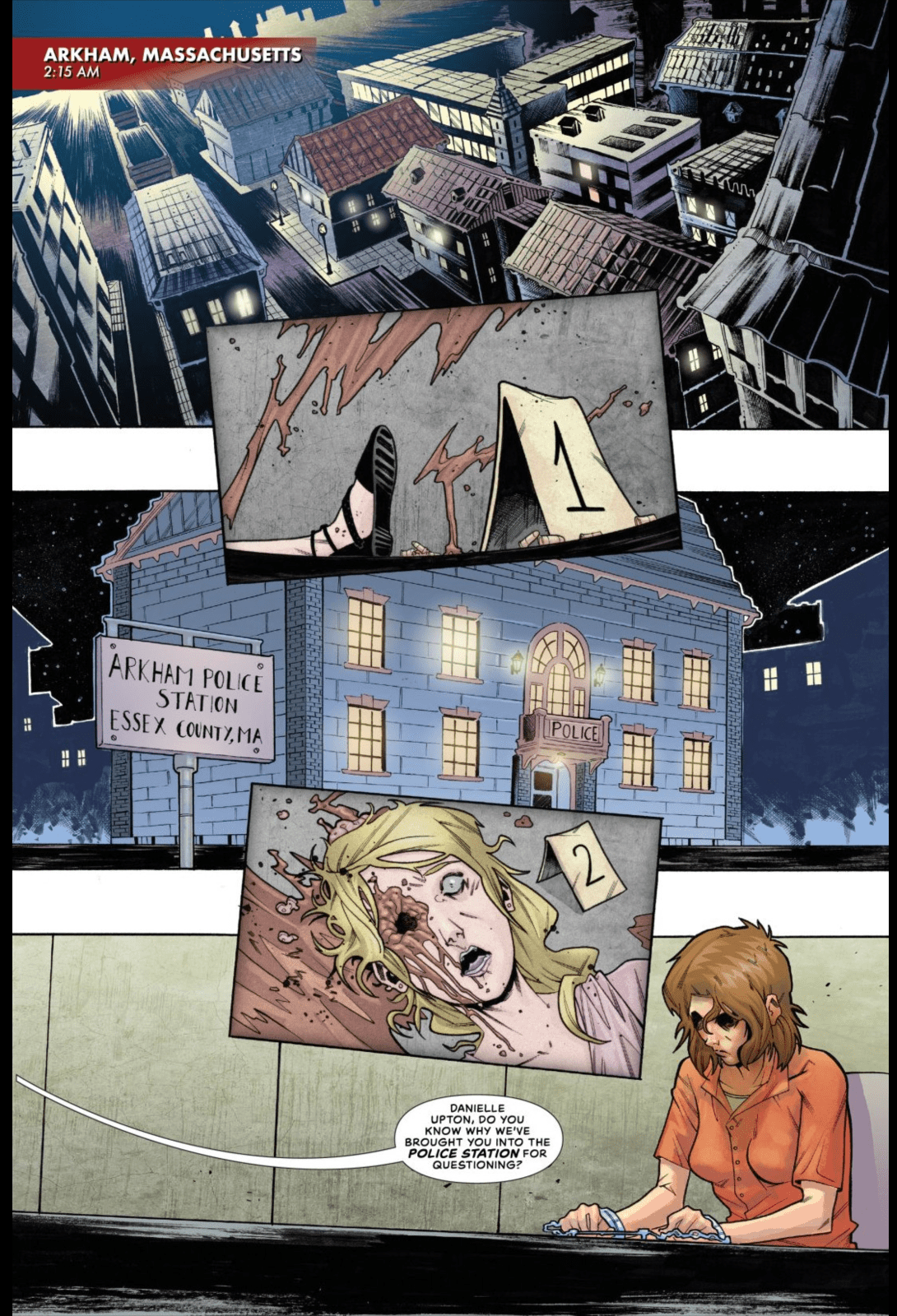
“The Descent of Reginald Pembroke Live” (2020) by Cathy Smith

Your imagination is too pedestrian.
—Cathy Smith, “The Descent of Reginald Pembroke Live” in Eldritch Dream Realms 156

H. P. Lovecraft set most of his stories in the 1920s and 30s. They were not, for the most part, stories of the long ago no matter how ancient the horrors might be, those horrors were intruding on the present. Readers would have recognized this; the suspension of disbelief was that such things could occur in the now.

Many of those who followed Lovecraft continued to focus on that Jazz Age period. It became a part of the atmosphere and mood of the setting. Rumrunners and gangsters, such as in “Moonshine” (2018) by G. D. Penman; confessionals like “I Wore The Brassiere Of Doom” (1986) by Sally Theobald; colonialism and Yellow Peril as in “Dreams of a Thousand Young” (2014) by Jennifer Brozek. Not everyone chose to confine themselves to that period, but enough did to strongly flavor Mythos fiction as a whole. It is no surprise that The Call of Cthulhu Roleplaying Game‘s default setting is the 1920s and 30s.

Some writers have sought to drag the Mythos into the current now—and in so doing, face a continuously shifting target. August Derleth’s depiction of nuclear weapons versus the Mythos in his “Trail of Cthulhu” serial is only possible in a world where the atom bomb is a reality; Robert Bloch’s Mythos novel Strange Eons (1979) is first and foremost a contemporary novel, both in setting and perhaps more importantly in tone and content; the Call of Cthulhu Roleplaying Game settings of Cthulhu Now (1987) and Delta Green (1997) both seek to bridge that gap between Lovecraft’s setting and how it might be adapted to the world we live in today—and these efforts always contain a certain amount of baked-in obsolescence. Today becomes yesterday, tomorrow becomes today.

This is the basic reason why CthulhuPunk fiction, rare enough in itself, tends to age out pretty quickly. Stories like “Star Bright, Star Byte” (1994) by Marella Sands become quaint when technology zigs instead of zags. We don’t have fully-immersive virtual reality settings which are structured according to old-school bulletin board systems. That just never happened; the internet blossomed into its own weird, terrible, awe-inspiring way. The zeitgeist, even if captured with tremendous decision, tends to fade very quickly.

Why do you think transhumanism is the way to immortality? Doesn’t our computer tech become obsolete every few years?
—Cathy Smith, “The Descent of Reginald Pembroke Live” in Eldritch Dream Realms 151

One of the great strengths of the Mythos as a discrete flavor or set of buildings blocks is that it does mix well with a great many things—different genres, tones, forms, and settings. You can have a lighthearted Mythos-inflected noir story, set it in outer space in the distant future, written in as an epic poem, and that is still very much recognizable as “Mythos.” In that sense, the Mythos is extremely versatile and adaptable, which may be why it has continued to attract new readers and writers. Individual stories may chase the zeitgeist, but Mythos fiction itself is both eternal (in that so much of it remains in print) and perennial (in that so much continues to be written).

Cathy Smith’s “The Descent of Reginald Pembroke Live” is a story that lives entirely in the contemporary zeitgeist. It could, possibly, have been written in 2015 or so, but the culture of the internet, video blogging, crowdfunding, “fake news,” and debunking is very much the finger on the pulse of the world with Donald Trump as president, even if Smith is careful to avoid any direct mention of the president or politics in general. Perhaps by 2020, the story might already be obsolete; Patreon might dissolve, YouTube might transform itself, “apps” and smartphones might evolve. We cannot foresee the future, some people cannot even see the present.

In many ways, this story is a good pairing with “The Nyarlathotep Experience™” (2019) by Miguel Fliguer. It too is a take-off from Lovecraft’s “Nyarlathotep,” a “what if?” that drags the old familiar horrors into the syntax of the now, and imagines how contemporary sensibilities would skew that reception. Yet there is something a little different at work here too; more than crass commercialization, the story is at heart a sickening pokes-fun at a world and culture and perspective of online rage and militant disbelief. Smith stops short of an abject moral: while the inability to allow the experience of wonder is portrayed as a toxic condition that harms those who cling to it, the same narrow world view proves an effective buffer and defense against those very forces that prey on the more easily awed and gullible.

If only because Nyarlathotep bemusedly decides to there is appeal in those who torture themselves in such internet drama, gaining courage only when safely and anonymously behind a screen. Who is to say that such a view is wrong? How would the Mythos be perceived today, if it was real and uploading Youtube videos? A very crass and earthbound thought—but that is the issue with the Mythos marrying the zeitgeist. If the story is set in the present, the view is almost always myopic; it doesn’t look at the present as seen from the 1920s, as Lovecraft might have seen it. “Now” stories are grounded in the life we can see and absorb around us, newspaper headlines and ways of life we are familiar with. Smith handles that very well.

Cathy Smith’s “The Descent of Reginald Pembroke Love” was published in Eldritch Dream Realms: Tales from Lovecraft’s Dream Realms (2020).


Bobby Derie is the author of Weird Talers: Essays on Robert E. Howard & Others (2019) and Sex and the Cthulhu Mythos (2014).
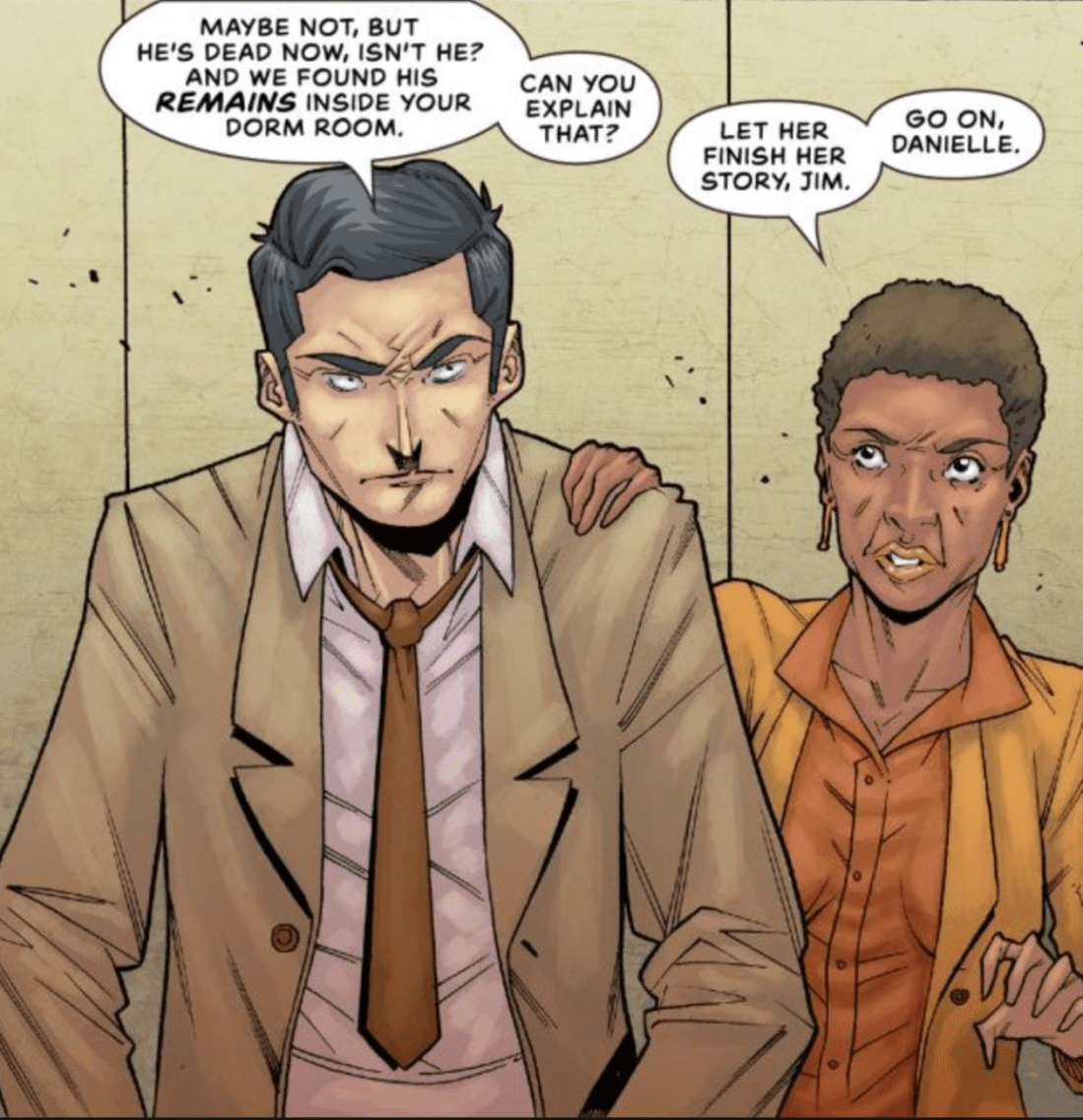
The City We Became (2020) by N. K. Jemisin

“Cover up that shit,” Bronca snaps at them. “Took me a minute, but I get it now. ‘Dangerous mental machines,’ hah.” […] “Yeah, that was H. P. Lovecraft’s fun little label for folks in Chinatown—sorry, ‘Asiatic filth.’ He was willing to concede that they might be as intelligent as white people because they knew how to make a buck. But he didn’t think they had souls.”

“Oh, but he was an equal-opportunity hater,” Yijing drawls, folding her arms and glaring at the men. “In the same letter, he went in on pretty much everybody. Let’s see—Black people were ‘childlike half-gorillas,’ Jews were a curse, the Portuguese were ‘simian,’ whatever. We had a lot of fun deconstructing that one in my thesis seminar.”
—N. K. Jemisin, The City We Became 148

And of course the New York Mongoloid problem is beyond calm mention. The city is befouled and accursed—I come away from it with a sense of having been tainted by contact, and long for some solvent of oblivion to wash it out! …… How in Heaven’s name sensitive and self-respecting white men can continue to live in the stew of Asiatic filth which the region has become—with marks and reminders of the locust-plague on every hand—is absolutely beyond me. In fact, I’m jolly well certain that they won’t continue. New York will become a vast trading-mart for long-distance white commuters—and for the nameless spawn. When, at length, the power of the latter rises to dangerous heights of rivalry, I can see nothing short of war or separation from the union. There is here a grave and mighty problem beside which the negro problem is a jest—for in this case we have to deal not with childlike half-gorillas, but with yellow, soulless enemies whose repulsive carcasses house dangerous mental machines warped culturelessly in the single direction of material gain by stealth at any cost. I hope the end will be warfare—but not till such a time as our own minds are fully freed of the humanitarian hindrances of the Syrian superstition imposed upon us by Constantinus.
—H. P. Lovecraft to Frank Belknap Long, Jr., 21 Aug 1926, Selected Letters 2.68

Weird fiction cannot afford hagiography. For all that H. P. Lovecraft accomplished during his lifetime, for all the lives and literature he influenced, there is no point in pretending the man was a saint, his memory to be enshrined with only the good things he has done. Every author that stands on the shoulders of giants has to decide on how best to address that legacy. Some ignore it, moving past Lovecraft’s prejudices; others reinvent his Mythos, put their own spin on it; a few use it their fiction as a mirror to highlight Lovecraft’s racism.

N. K. Jemisin calls Lovecraft out on it.

Why not? Dead men cannot have their feelings hurt. He wrote all those words, so there’s no false reporting. The only ones likely to be upset about Jemisin’s bare handful of references to Lovecraft in the novel are those who either share in his prejudices, or are so strongly attuned to the idea of Lovecraft as an icon that they perceive a simple statement of facts as an attack.

It seems evident that Jemisin didn’t open a random book on Lovecraft and pull out the first racist quote she came across, so it’s not like the “On the Creation of…” scene in Lovecraft Country (2016) by Matt Ruff. This moment in The City We Became and those that follow it aren’t exactly essential to the novel, but certainly enrich it by expanding on themes of cosmic horror and race. The structure of the story, how the characters react to the information as they get it, how Lovecraft and his work are described, all shows effort and craft in how Jemisin chooses to incorporate Lovecraft into her book.

This is not N. K. Jemisin beating the dead horse named H. P. Lovecraft. It is a way for her to address him and his legacy on her own terms. In a 2017 interview, the question was asked and answered:

So if you’re using Cthulhu, are you an H.P. Lovecraft fan?

Oh, hell no.

This is deliberately a chance for me to kind of mess with the Lovecraft legacy. He was a notorious racist and horrible human being. So this is a chance for me to have the “chattering” hordes—that’s what he called the horrifying brown people of New York that terrified him. This is a chance for me to basically have them kick the ass of his creation. So I’m looking forward to having some fun with that.
N. K. Jemisin’s New Contemporary Fantasy Trilogy Will “Mess with the Lovecraft Legacy”

This approach can probably safely be called cathartic (NK Jemisin: ‘It’s easier to get a book set in black Africa published if you’re white’). Many writers exorcise their demons and address their issues by writing them out. It is a process which can often be as beneficial for the reader as well: how many women, how many people of color, who have felt uncomfortable knowing that Lovecraft was racist but unwilling to say anything might feel a relief to actually see it called out in print?

There are other ways Jemisin could have expressed her point. The reference to Lovecraft’s 1926 letter to Long is factually accurate, but lacks context. In 1926, Lovecraft’s New York adventure—and his marriage, in all but name and legalities—was over. He had slumped back off to Providence, Rhode Island, having been unable (like millions of others) to make his way in the city, to find gainful employment, to be with his wife and friends. Lovecraft had left Providence for New York less than two years prior, with hopes and aspirations for work, married life, a home of his own with his wife—and returned older, alone, wiser in the world, richer in experience of a thousand things. One memoir stated that:

He came back to Providence a human being—and what a human being! He had been tried in the fire and came out pure gold.
—W. Paul Cook, “In Memoriam: Howard Phillips Lovecraft” in Ave Atque Vale 43

What Cook does not add is that the stresses and failures Lovecraft had experienced in New York had brought his prejudices to a fever point; throwing himself into the “melting pot” of New York City had only exacerbated his prejudices, and for the rest of his life he would write about his hatred of the city, which he considered no longer culturally a part of the United States, but completely overtaken by immigrants and people of color. Nothing of which excuses Lovecraft’s prejudices in  his letter…but perhaps gives more context as to why Jemisin chose to focus on this particular letter.

The City We Became is not a book about H. P. Lovecraft. Jemisin’s references to him and his fiction are symptomatic of the real crux of the novel, which is the city itself. Her novel is a love affair of New York City, in the same vein as Fritz Leiber, Jr.’s Our Lady of Darkness (1977) or John Shirley’s City Come a-Walkin’ (1980) for San Francisco. A snapshot in time of New York as it is, the people that live there are represent it; an acceptance and an exorcism of old ghosts.

But she is a city, in the end—fair R’lyeh where the streets are always straight and the buildings all curve, risen from the brine-dark deep well between universes. And no living city can remain within the boundary of another while it is unwelcome.
—N. K. Jemisin, The City We Became 428

Lovecraft’s New York—the New York of Al Smith and Fiorello La Guardia, Prohibition, the Harlem Renaissance and the Harlem Hellfighters—is long gone. Jemisin’s novel is about her New York, the post 9/11 New York, the New York of Lyft, IKEA, and Dunkin’ Donuts. It isn’t any less diverse, it isn’t really any weirder. Where a novella like “The Ballad of Black Tom” (2016) by Victor LaValle deals with the fictional New York that Lovecraft presented in his writings, Jemisin deals with Lovecraft himself—and finds the only real use for him as a springboard to talking about bigger things, or perhaps a bedrock of ideas and images to mine. If there is any criticism to be had of the book, it’s that it feels like having evoked Lovecraft and R’lyeh, Jemisin could have made more use out of the connections with the city…but again, this isn’t a book about H. P. Lovecraft.


Bobby Derie is the author of Weird Talers: Essays on Robert E. Howard & Others (2019) and Sex and the Cthulhu Mythos (2014).