Never send to know for whom the bell tolls;
it tolls for thee.For ego and satyr,
for lover and beloved;ask to know for whom the heart beats,
send to ask for whom the quickened pulse,
bend to hear the hushed impassioned voice
sobbing your name or mine in all the body’s rapture:
or send to know for whom arms’ clasp,
eyes’ love, the hot possessive mouth;for lover and beloved,
August Derleth, canto XIV of “Enigma: Variations on a Theme of Donne,” in Psyche (1953) 25
islandless man, of sea and land equally,
of sky and stars, of heaven and hell—
but never need to ask for whom the bell tolls;
make each man’s answer to yourself:
It tolls for me.
No man is an island, entire of itself; every man is a piece of the continent, a part of the main. If a clod be washed away by the sea, Europe is the less, as well as if a promontory were, as well as if a manor of thy friend’s or of thine own were: any man’s death diminishes me, because I am involved in mankind, and therefore never send to know for whom the bell tolls; it tolls for thee.
John Donne, Meditation XVII in Devotions Upon Emergent Occasions, and severall steps in my Sicknes (1623)
August Derleth’s greatest fame today is as a publisher, co-founder of Arkham House in 1939 with Donald Wandrei. Derleth was also an editor and anthologist of note, and a writer of diverse works of fiction and nonfiction, from the quiet regional portrayals of his Sac Prairie Saga to the potboiler horrors of Weird Tales, from the delicately plotted pastiches of Solar Pons to young adult and juvenile fiction; in non-fiction his works included everything from a book on Wisconsin’s rivers to newspaper columns on his nature walks to his biography of Henry David Thoreau.
Yet before, and during, and among all this other writing, August Derleth was a poet. He wrote, and what is more importantly published, reams of verse from the fantastic and the macabre to the lighthearted, odes on nature to sonnets on love, in many different meters and forms. Poetry was a sensibility and avocation that Derleth shared with many of his contemporaries, including Lovecraft, Clark Ashton Smith, Robert E. Howard, and many other writers for Weird Tales. Some of it has been republished here or there, particularly those bits of verse dedicated to or relevant to Lovecraft fans such as “Providence: Two Gentlemen Meet at Midnight” and “On Reading Old Letters, For H. P. L.,” but for the most part Derleth’s poetry remains unreprinted and largely unexamined.
This is a pity as such works provide, if nothing else, an interesting study of the importance of historical context. Derleth’s 1953 collection of love poetry Psyche is a good example.
These are poems of love and anguish. In this cycle of thirty-one poems, August Derleth tells the moving story of a love from its first awakening through uncertanty and agony to its foreseen dissolution.
These poems not only represent August Derleth at this best, but bid fair to take a place among the finest love poetry of our time.
Psyche, inner jacket flap
To anyone that holds this book in its hands, it may appear the prosaic but well-made product of a small press—in this case, the Prairie Press of Iowa City, Iowa—72 pages of good paper on cloth boards with a floral print; the dust jacket, when intact, is often rather tanned by sun and age. The contents are divided into two sections; “Enigma: Variations on a Theme of Donne” runs to 14 cantos, each taking inspiration from John Donne’s lines, and the second cycle of thirty poems runs the gamut of a love affair, from “I. When first I saw you” to “XXX. Beloved, now you are gone.” A few of these later poems have erotic elements, such as:
Something speaks for the essential you scattered here
August Derleth, “XVII.” in Psyche 46
in the black skirt and the blue blouse,
and the aqua pants with the embroidered I love you
and Forget-Me-Not (and who could?),
the slip in the usual pink and the gold slippers,
and the little bra from which the breasts
have spilled tightly above the taut belly
and Venus’ mound and the indolent legs
in their skilled proportions where you lie
waiting for love, savoring your victory
sweet in your smile, in your eye,
aloof, serene: the thin shoulders,
the slender arms, the small round
still firm nates behind,
all waiting for love, to be possessed
and to possess in ecstasy of union,
knowing my Achilles’ heel:
with that small cat’s contentment of triumph
the smile aware and the eyes
confident and the legs parted
where the dark hair already glistens
and the lips, there shadowed, opening
to sheathe my sword, waiting for love and lust,
knowing I will cross the room and touch and feel,
knowing I will possess and be possessed,
not alone because our mutual wish dictates
but because I must.
This collection of thirty poems was apparently a selection from a much longer cycle of love-poetry, which came to light after Derleth’s death when Peter Ruber, who had become editor of Arkham House in 1997, went through some of Derleth’s old files:
Another very important find was the entire Psyche lyric love poems cycle. Derleth published 30 in a 72-page book of that title in 1953. In reality, he had written 233 Psyche poems, and we have them in chronological order. The entire group will be published late 1997 or early 1998.
M. Dianne Bergenske, “Hidden Literary Treasures Revealed: Unpublished Works of Wisconsin Author August Derleth” in BookLovers (V5, N1), 7.
As with Ruber’s projected biography of Derleth and other projects, this never came to pass. However, Psyche did reach a wider audience in another form: as an LP.
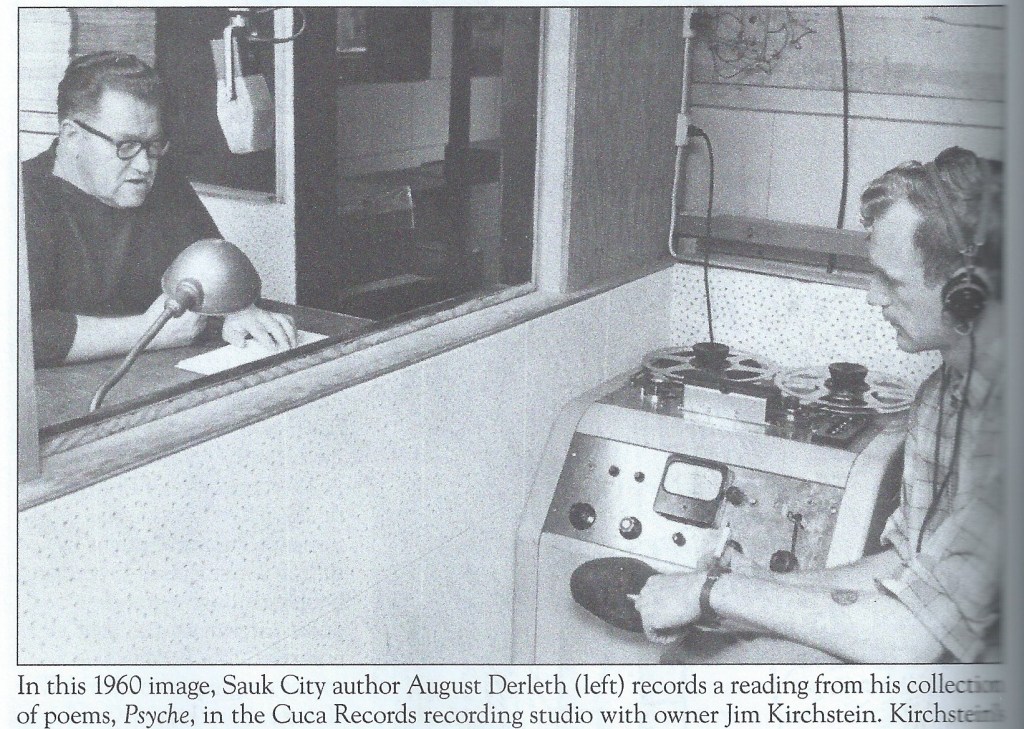

It isn’t clear how well Psyche sold, but it evinced enough interest that in 1960 Derleth recorded the lyrics onto vinyl at the Cuca Records Company in his native Sauk City:
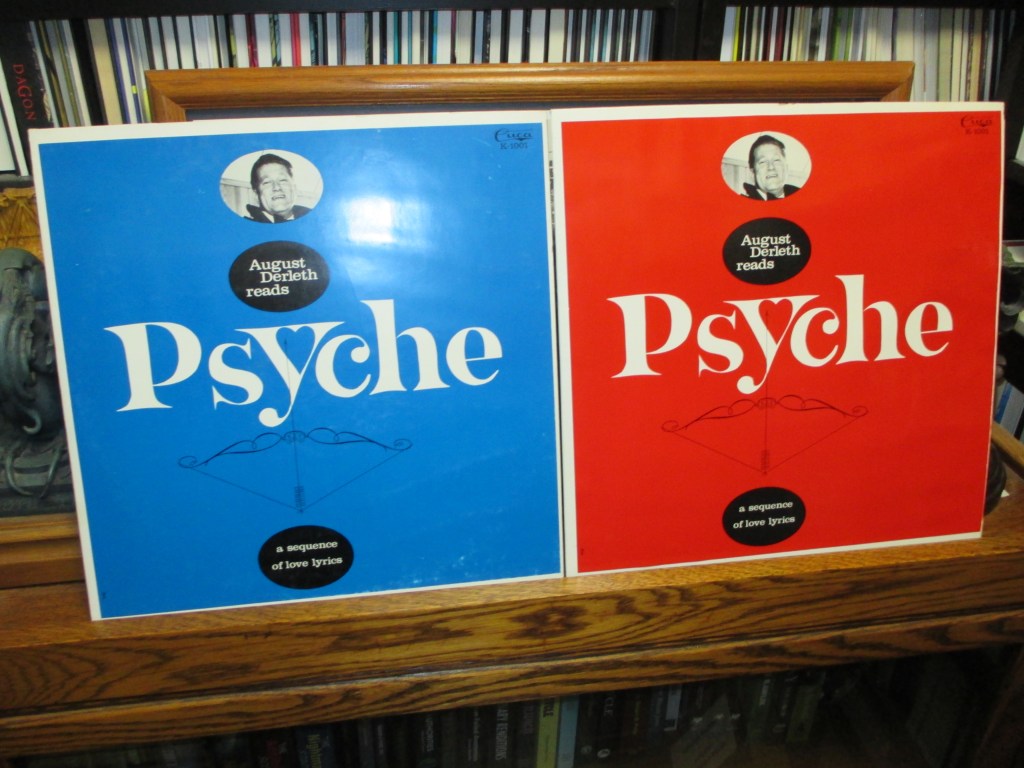
The title Psyche is in reference to the tale of Cupid and Psyche from the Metamorphoses of Apuleius, and Derleth’s dedication in the book is: “for the woman who was Psyche and is gone…” which casts Derleth as Cupid, overcoming obstacles to achieve union. Such dramatic romances were not unusual within Derleth’s fiction, and there was often a quasi-autobiographical element, for example, the teenaged romance with “Margery” (a local Sauk City girl) which formed the basis for his first novel, Evening in Spring (1945).
The liner notes are clear on the autobiographical element of Psyche:
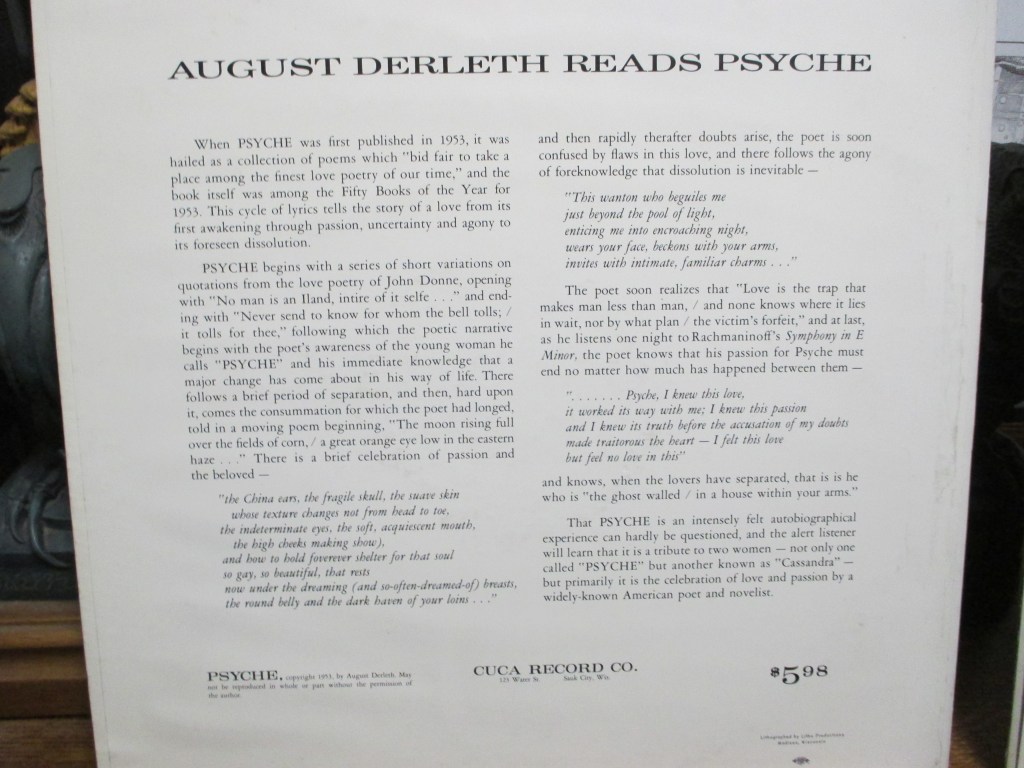
That PSYCHE is an immensely felt autobiographical experience can hardly be questioned, and the alert listener will learn that it is a tribute to two women—not only one called “PSYCHE” but another known as “Cassandra”—but primarily it is the celebration of love and passion by a widely-known poet and novelist.
Liner notes to Psyche (1960)
“Cassandra” had been the subject of a previous book of primarily nature poems, Habitant of Dusk: A Garland for Cassandra (1946). In Psyche, Cassandra is mentioned by name only in a single poem:
Death is my mistress; what name I give her matters not—
August Derleth, canto XIII of “Enigma: Variations on a Them of Donne,” in Psyche (1953) 24
call her Psyche or Cassandra,
Call her by any name you will,
Death it is in love’s own guise,
my mistress.
According to Derleth: Hawk…and Dove (1997) by Dorothy M. Grobe Litersky, Cassandra was another romantic entanglement of Derleth’s in the early-mid 1940s, and their affair would be the subject for his unpublished novel Droughts of March.
For all that Derleth mined his personal experiences for fictional and poetic material and inspiration, he was not keen to publish his love affairs and generally avoided providing sufficient information in print for the average reader to identify who he was talking about. Sauk City was, after all, a small town and people would talk. Still, students of Derleth’s life would not be surprised at reading in Litersky’s biography that “Psyche” was none other than Sandra Winters, who married August Derleth in 1953, the year that Psyche was published. There is nothing unusual about a man writing love-poems to his wife, after all.
Except for one important detail.
PSYCHE is now virtually done in its 4th draft, and it seems to stand up very well in amatory verse, at which I have never pretended to be very good. But then, I have always had that as a poet I am at best a second-rater, which is saying a good deal, because there are a lot of poets far worse than that. But this book is most revealing and cannot be published for some (3) years because it is plainly about an affair with a girl who is not more than 15, and the facts wd currently be too obvious to local readers.
August Derleth to Carl Jacobi, 9 Jul 1949, MSS. Bowling Green University Library
Sandra Evelyn Winters was born 1 March 1935; according to Litersky she met August Derleth in 1948, and they married on 6 April 1953. That his relationship with her before their marriage was sexual is not much doubted; in another letter, he wrote:
Oh, yes, I would not deny that Sandra has done me a lot of good. Not just making love to her, Sandra herself. Of course, she is sharp enough to know that, and I think that in this lies the ultimate dissolution of the affair, unless an accident makes it necessary for us to be married. For, being young, she is entirely likely, even with her mother’s advice, to take me for granted, and that might well be fatal. She has been frank enough to say that she intended all along that I should ultimately need her more than she needs me, and, while she intends to marry me, she intends also to have as much of her cake and eat much of it too, as possible. That never works, manifestly. But whatever takes place, it is certain that I have already benefited a great deal, and all the clothes and jewelry I’ve bought her won’t balance my own benefits.
August Derleth to Zealia Bishop, 18 Aug 1949, MSS. Wsconsin Historical Society
Given the age gap (August Derleth was born in 24 February 1909, making him 40 years old in 1949 when these letters were written), Derleth may have had more to worry about than his reputation; statutory rape charges were a real possibility. As Litersky points out, this fact rather changes how Psyche is read. When Derleth writes:
When first I saw you,
but one among a sea of faces,
my glance swept past, came wondering back
in search of something from alien places
to see the countenance of little more than child,
demure, aloof, and bland,
not akin to what I felt—that wild,
strange beauty, that warm impassioned spirit
lurking deep,
hidden by a child’s serene and lovely face,
inscrutable as sleep.As Iseult, Helen of Troy,
August Derleth, “I.” in Psyche 26
immortal Psyche—you, too, in this child’s guise:
something from deep within gazed tranquil back,
the challenge of your untamed spirit looked
from out your eyes.
At what age would you as the reader have put Psyche and Derleth based on this poem? Do you read it differently now that you know he met his future wife as a thirteen-year-old girl, and this poem might be an attempt to capture—or at least capitalize on—the beginning of that relationship? Without that piece of information about who Psyche was based on and her age at the time, Psyche is little more than an innocuous curiosity. With that bit of historical context, it becomes a different thing entirely, and a reader might not only look for new meaning in the lines, but find it. Comparable in some ways to “Doom of the Thrice-Cursed” (1997) by Marion Zimmer Bradley, it is impossible to turn back the clock to before you knew, and read the words they wrote with innocent eyes.
With thanks and appreciation to John Haefele for his help with this article.
Bobby Derie is the author of Weird Talers: Essays on Robert E. Howard and Others and Sex and the Cthulhu Mythos.
Deep Cuts in a Lovecraftian Vein uses Amazon Associate links. As an Amazon Associate I earn from qualifying purchases.
 Deep Cuts in a Lovecraftian Vein