Those Virginia pictures probably came from some member of that Poetry Circle branch in Washington–whose personnel persistently & rather insanely address me as “Judge” because I judged a poetry contest of theirs six years ago.
H. P. Lovecraft to Lillian D. Clark, 20-21 May 1930, Letters to Family & Family Friends 2.841
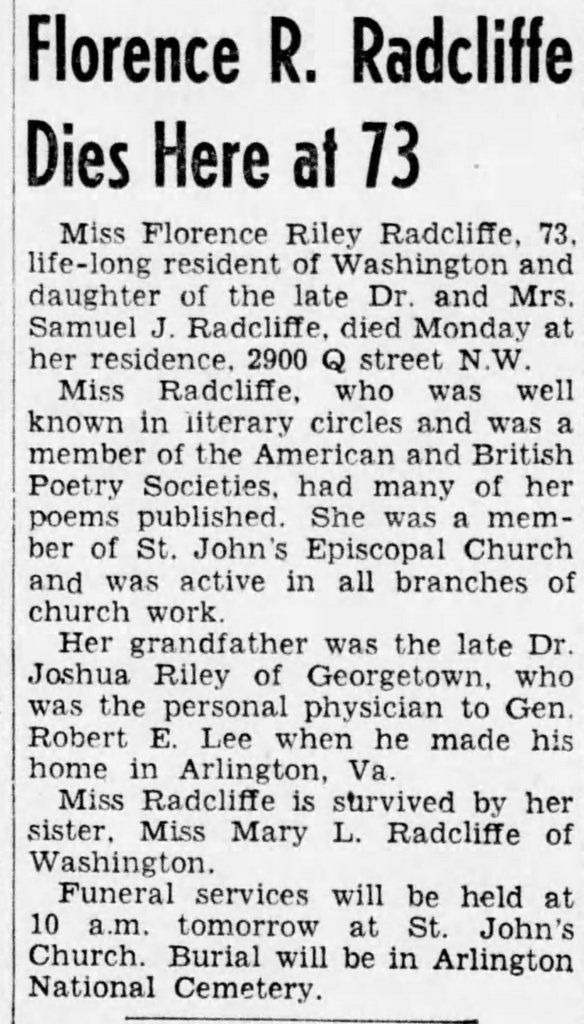
According to census data, Florence Riley Radcliffe was born in January 1870, the first surviving child of Dr. Samuel J. Radcliffe and his wife Florence C. Radcliffe. She was joined by a little sister, Mary L., about four years later. We get only the barest outline of a life from the census data—Florence R. Radcliffe never married, her formal schooling stopped with the 8th grade, she lived all her life in Washington, D.C. with her parents and her sister, having never married. The 1900 census lists her occupation as “Author”; 1910 working in accounting for some government office; 1920 a telephone operator at a bank; by 1930 the 60-year-old Florence is listed as a “nail cutter.”
Beyond the census data, we know one thing for certain: Florence R. Radcliffe was a poet. She was a member of the American and British Poetry Societies, and the American Poetry Circle. Her first encounter with H. P. Lovecraft came in 1924, when Lovecraft served as judge for a poetry contest held by the League of American Penwomen. Four years after that contest, Lovecraft received a letter from one of the participants, Elizabeth Toldridge of Washington, D.C., sparking a correspondence that would last the rest of his life. In 1929, we get the first mention of Toldridge’s fellow Washingtonian and American Poetry Circle member Florence R. Radcliffe:
Incidentally, I trust that Miss Radcliffe will persevere in her idea of having a book, & that she will entrust its publishing to the able & conscientious W. Paul Cook. You might shew her the two Recluse Press products sent under separate cover—fair specimens (except for one hideous misprint in the Loveman book, due to an 11th hour text change & not really Cook’s fault) of Athol typography & workmanship. As to my ‘not being interested in her poetry’—I’m sure here’s nothing in the two printed specimens I ahve seen to warrant such a prophecy. I would be glad to see more, if you have any easily transmissible copies; though as I have previously pointed out, I am no authority whose verdict can be considered of any ultimate value.
H. P. Lovecraft to Elizabeth Toldridge, 21 Feb 1929, Letters to Elizabeth Toldridge 34-35
At the time, W. Paul Cook of Athol, Mass. published a few small works through his Recluse Press, including The Hermaphrodite (1926) by Samuel Loveman; Cook was also busy with a small edition of Lovecraft’s The Shunned House, but this particular endeavor would end in disarray—not that Lovecraft knew that at the time. He was simply trying to promote his friend’s printing business.
In the beginning, neither Lovecraft nor Radcliffe wrote to one another directly, so their first correspondence happened through the medium of his letters to Toldridge. We can get a sense of their correspondence during this period through passages like this one:
Oh, yes—& you need not hesitate to send specimens of Miſs Radcliffe’s work when you have some on hand; although as always, I must not be regarded as any supreme authority or final arbiter of merit. If suggestions will assist, well & good—but I can’t guarantee the insight & acumen of my suggestions! Incidentally, I am sure that Miss R’s recent depreciation of all her work is based on modesty rather than on impersonal analysis. In the matter of the last line of “Love”, she is entirely in the right; for so far as I can see, the editor’s substitution produced a wholly false, & unintended, & peculiarly meaningless implication—i.e., an implication that the answer to life is the fact that he who love knows that answer! Puzzle—find the sense! In the original, the idea is clear—that love provides an answer to life because the process of loving provides a sense of the adequacy of living. In other words, the editor’s unwarranted liberty placed the substance of the last line in the position of being the answer referred to in the line preceding; whereas the poet’s intention was obviously to have it form the reason for the condition referred to in that preceding line. So much hinges on one apparently insignificant conjunction! But I have known errors in mere punctuation to produce almost equally great distortions of meaning.
H. P. Lovecraft to Elizabeth Toldridge, 8 Mar 1929, Letters to Elizabeth Toldridge 44-45
The connection seems to have finally been made in 1929, when Radcliffe sent Lovecraft some of her poetry for review and comments. Very little of this correspondence survives; there are two letters from Radcliffe to Lovecraft and a handful of her poems listed in the inventory at Brown University in Providence. Lacking Lovecraft’s side of the correspondence, we have to rely on his letters to Toldridge with their small asides about her friend. For example:
I appreciated yours of the 27th with enclosures, & am glad you found the “Brick Row” lines worth reading. If the thing appears in print* I’ll send a pair of copeis for you & Miſs Radcliffe.
H. P. Lovecraft to Elizabeth Toldridge, 8 Jan 1930, Letters to Elizabeth Toldridge 120
* It has appeared–this morning. Copies enclosed.
This was “The East India Brick Row,” a poem Lovecraft composed on the demolition of several old brick warehouses in Providence, which was published in the local paper. It was probably this poem which caused Radcliffe to write back:
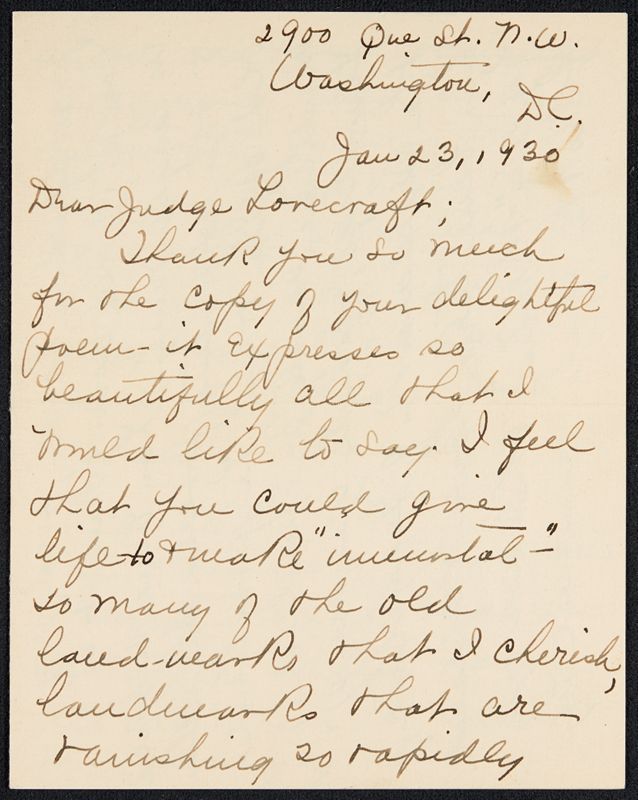
Dear Judge Lovecraft;
Thank you so much for the copy of your delightful poem – it expresses so beautifully all that I would like to say.
Florence Radcliffe to H. P. Lovecraft, 23 Jan 1930, MSS. Brown University Library
A follow-up to this exchange on the demise of old landmarks in the name of progress is recorded in Lovecraft’s letters to Toldridge:
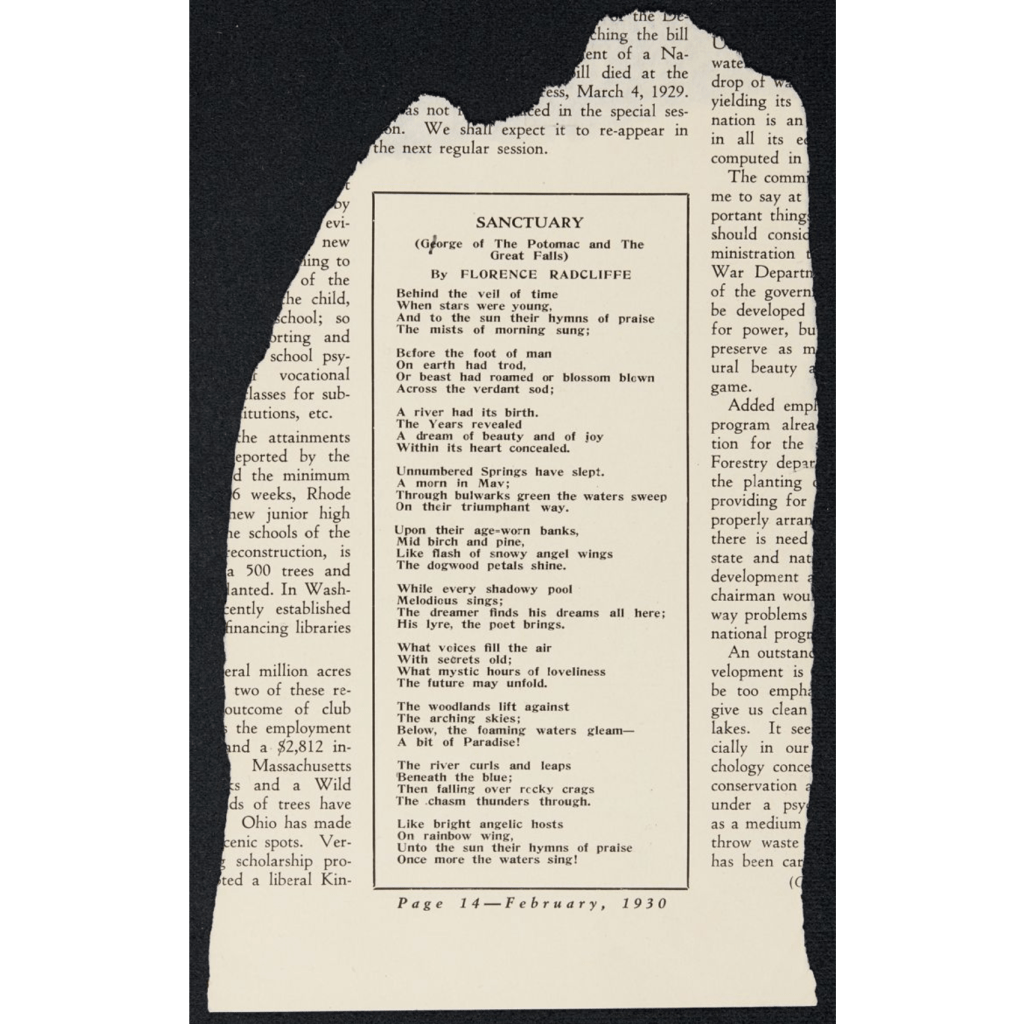
Not long ago I received from her a magazine with a very appealing poem about the Great Falls of the Potomac, which I believe are imperilled by some miserable mechanical water-power project.
H. P. Lovecraft to Elizabeth Toldridge, mid-Mar 1930, Letters to Elizabeth Toldridge 137
A series of dams had been proposed along the Potomac River to generate hydroelectric power and for flood control; they never came to pass, and both Radcliffe and Lovecraft would likely be happy to know that the natural features were eventually protected as part of Great Falls National Park. Radcliffe wrote a poem “Sanctuary” on the beauty of the Great Falls, which was included in her letter dated 6 Apr 1930.
Florence Radcliffe was 60 years old in 1930, and had been working in some form for her entire adult life. Reading between the lines a little, by now she was probably on the verge of retirement, if not from lack of work opportunities than from ill-health:
I’m sorry, likewise, to learn that Miss Radcliffe’s health continues to be so unsatisfactory.
H. P. Lovecraft to Elizabeth Toldridge, Aug 1930, Letters to Elizabeth Toldridge 155
The nature of the illness is undisclosed in Lovecraft’s letters, and the possibilities are too numerous to invite speculation. She was unwell, and Lovecraft gave his sympathy and continued to correspond with her, as he did with many older people. The primary topic, besides her health, seemed to be her ongoing desire to publish a book of her poetry. Lovecraft tried to help as best he could:
I am sorry likewise to hear of Miss Radcliffe’s continued indisposition, & hope that rest & interesting activities may bring about a decided improvement. In time I am sure that you & she can issue your respective collected verse, even though a resumption of Cook’s enterprises seems unfortunately unlikely. When in Vermont I shall inquire further into the conditions & prices of the Stepehn Daye Press—Orton’s venture, which I think I mentioned to both you & Miss R. Last week I returned Miss Radcliffe’s book of manuscripts for safety’s sake; since my room is likely to be upheaved by a wholesale cleaning during my absence, & I don’t want any important items to be lost or mislaid.
H. P. Lovecraft to Elizabeth Toldridge, 29 Apr 1931, Letters to Elizabeth Toldridge 182
Vrest Orton was a friend of Lovecraft’s in Vermont. Ultimately, however, it appears none of Lovecraft’s suggestions for printers panned out in the end. The references to Radcliffe get fewer in his letters to Toldridge, so there is little data to go on. They must have still been in touch as late as 1934, because Radcliffe is listed among those correspondents to whom Lovecraft sent postcards on his trip to Nantucket (Collected Essays 5.267), and the final reference to her in his letters to Toldridge is in 1936.
In many ways, Florence Radcliffe’s letters to H. P. Lovecraft were the shadow of Elizabeth Toldridge’s own correspondence. While we can’t but guess at the true extant, she found in Lovecraft someone who encouraged and praised her poetry, who shared her appreciation for old landmarks, a sympathetic ear for her pains and praise for her small victories when a poem was placed or an honorable mention awarded. A small friendship via letters, but perhaps a light in the waning days of life.
Bobby Derie is the author of Weird Talers: Essays on Robert E. Howard and Others and Sex and the Cthulhu Mythos.
Deep Cuts in a Lovecraftian Vein uses Amazon Associate links. As an Amazon Associate I earn from qualifying purchases.
 Deep Cuts in a Lovecraftian Vein