After Lars’ and my collaboration on the book CREATION OF A GOD [ATT BYGGA EN GUD, 2015], the plans of a trilogy began to take shape. While CREATION OF A GOD was a cross between the works of Lovecraft and Lord Dunsany, the second book, CREATION OF THE NECRONOMICON, was pure Lovecraftian fan fiction. The third will be a kind of Clark Ashton Smith-inspired postapocalyptic dark fantasy about three pregnant outlaws running from the law after a trainrobbery [SKAPANDET AV EN MYT —CREATION OF A MYTH, 2018].
Henrik Möller, introduction to Vägen till Necronomicon—Creation of the Necronomicon (2017)
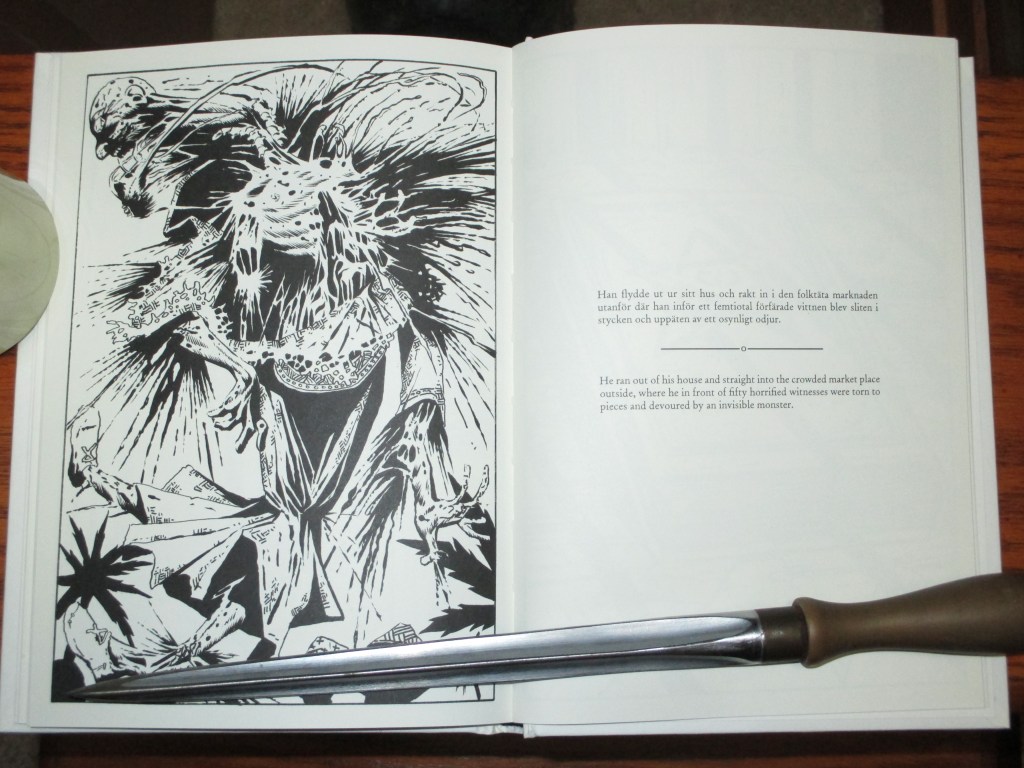
The middle of a trilogy of illustrated books, Vägen till Necronomicon—Creation of the Necronomicon (2017) consists of a text in Swedish and English by Henrik Möller, and black-and-white illustrations by Lars Krantz. While some sellers have categorized this book as a graphic novel, it would probably be more correct to label this an illustrated novel; text and image stand in contrast to one another, complementing one another: where one is sparse, the other is detailed; when one is subdued, the other is vivid. The result is as effective a work of graphic fiction as has yet been produced.
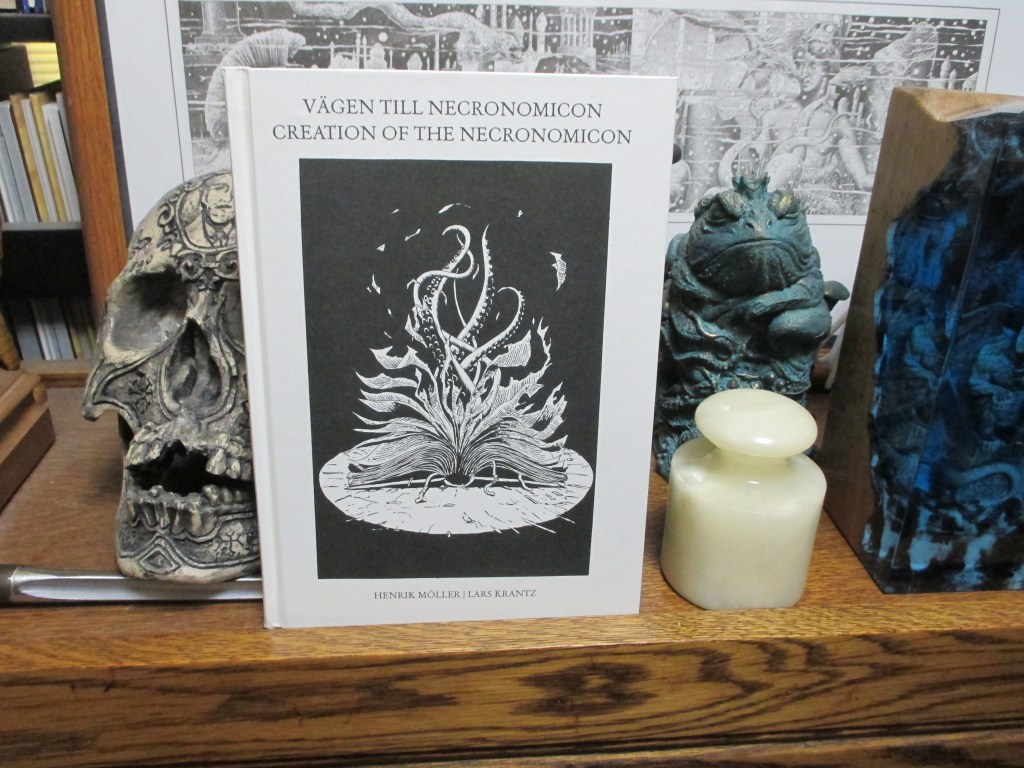
Möller’s description of the work as “fanfiction” is accurate, although that doesn’t quite do it justice. The story is an expansion of Lovecraft’s “The History of the Necronomicon,” retaining the essential elements of the story but expanding the narrative of Abdul Alhazred, adding a Vathek– or 1,001 Nights-style doomed romance. However, like many fans Möller and Krantz chose to weave fact with fiction, and the story has a framing narrative: one night in Providence, H. P. Lovecraft is out in a walk and finds his mind cast back a thousand years.
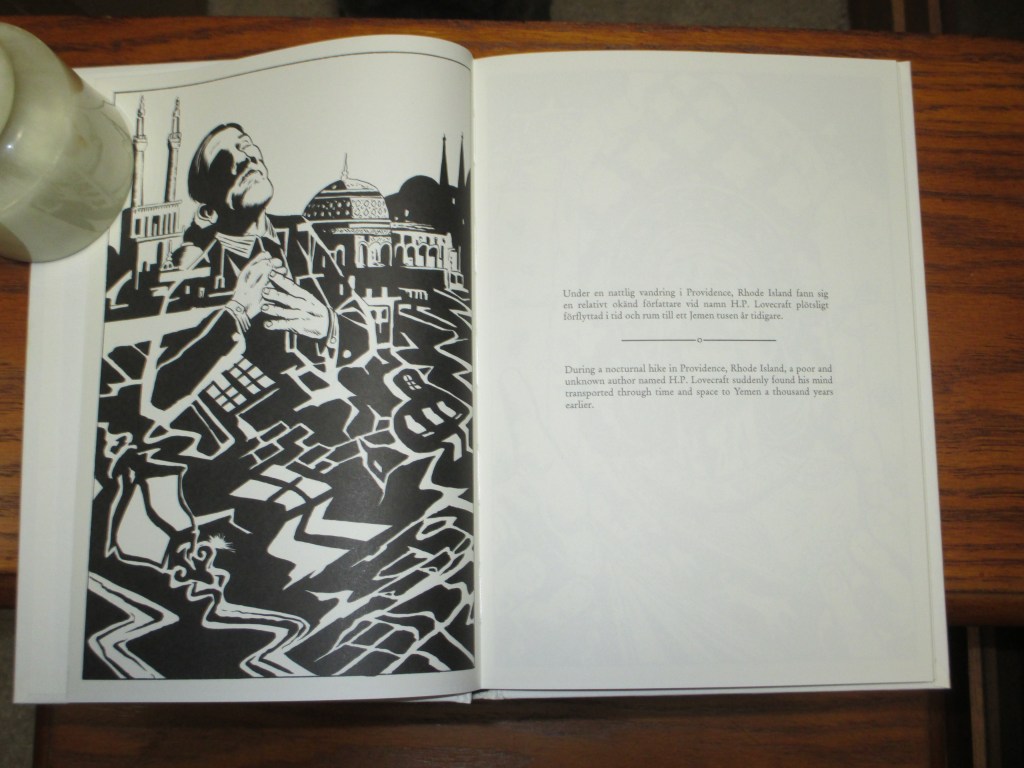
This is a not-uncommon device, the idea that Lovecraft and his fictional creation were both real, that the Mythos he created was real, at least to him—that the stories he told are occult truth, or even that he found or inherited a copy of the Necronomicon, from which he learned all this eldritch lore. The idea tends to rob Lovecraft of a certain genius, or at least agency; it makes him from a master storyteller to a kind of pulp journalist or cryptic occultist.
However, when carried out with sufficient style, the narrative convention of “the real Necronomicon!” still holds a bit of cachet. The tome, and its creators real and fiction, have achieved that legendary status where fact and fiction easily flow together. There are dozens of Necronomicons in the world today, from comic books to grimoires like Magic of Atlantis: Sauthenerom: The Real Source of the Necronomicon (1985) by Frank G. Ripel & Necronomicon: Il Libro Proibito di Abdul Alhazred (2022) by Mirando Gurzo, long novels to pillowbooks. All variations on the idea of the terrible book whose secrets are so terrible they make the skin crawl and the bright light of day a bit dimmer.
The Necronomicon is a sourcebook of horror. So it should come as no surprise that parts of Möller and Krantz’ book are appropriately horrible.
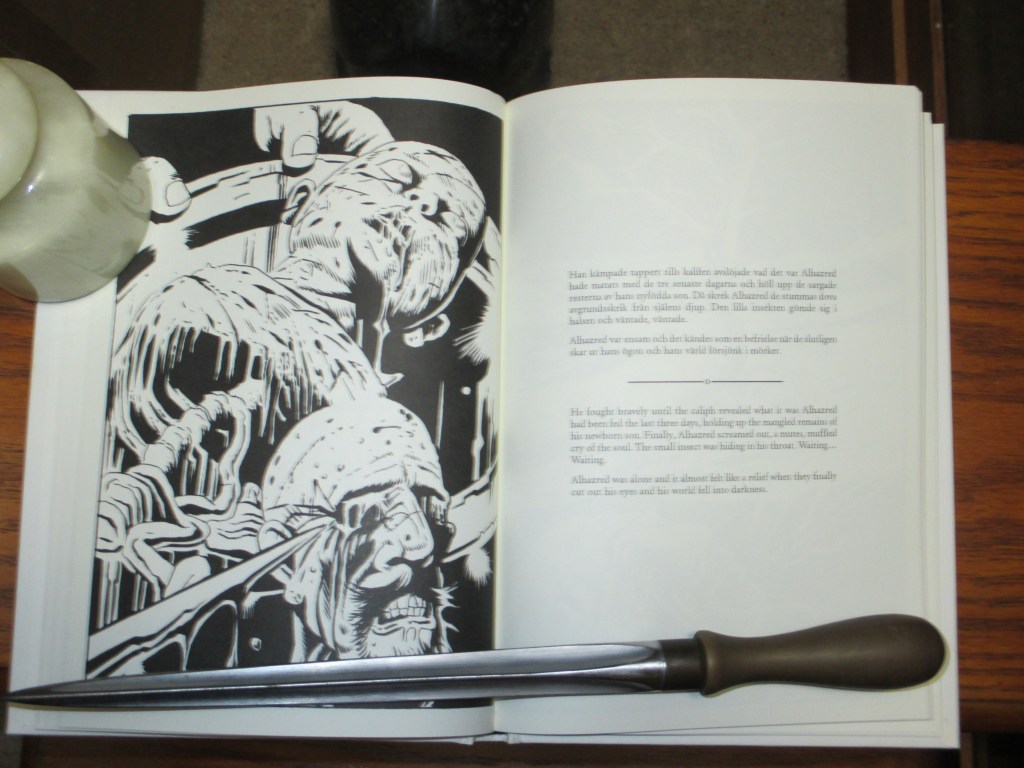
He fought bravely until the caliph revealed what it was Alhazred had been fed the last three days, holding up the mangled remains of his newborn son. FInally, Alhazred screamed out, a mutes [sic], muffled cry of the soul. The small insect was hiding in his throat. Waiting… Waiting.
Henrik Möller, Vägen till Necronomicon—Creation of the Necronomicon (2017)
This motif of the insect comes from a very small, often overlooked detail about the Necronomicon, which Lovecraft had borrowed from another source:
Original title Al Azif—azif being the word used by Arabs to designate that nocturnal sound (made by insects) suppos’d to be the howling of daemons.
H. P. Lovecraft, “The History of the Necronomicon“
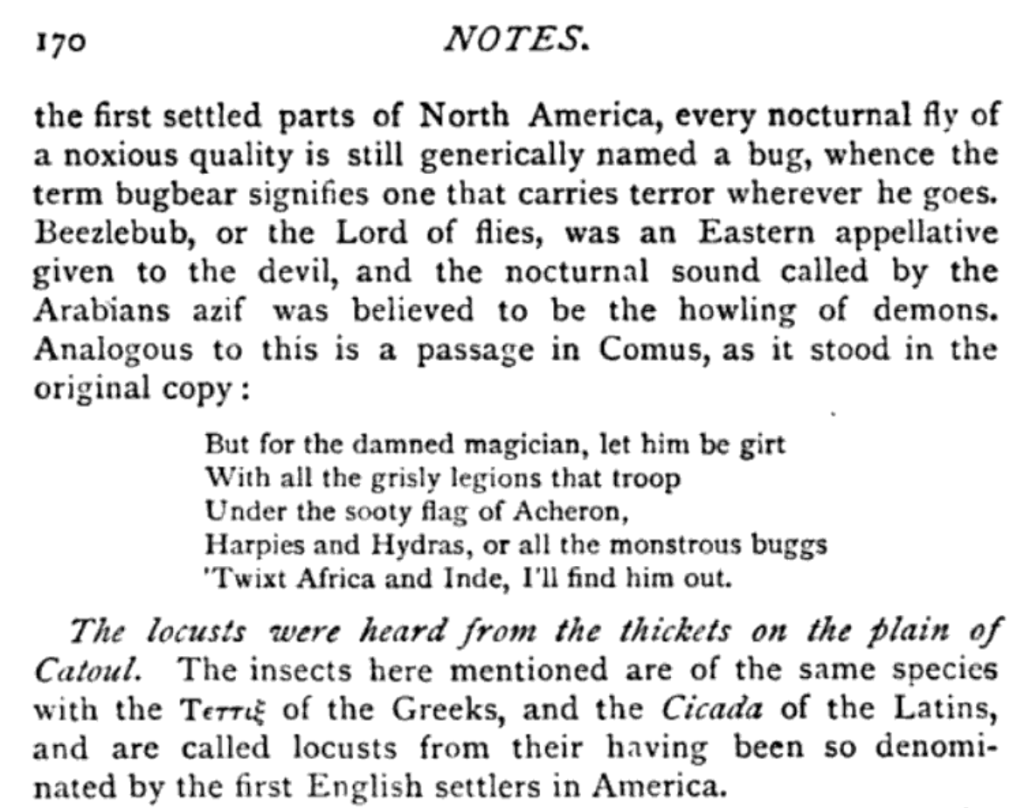
It is a small detail, often overlooked. Some authors credit Alhazred as an arch-cultist, heretic, and magician; others a hero whose dire warnings are often misinterpreted and abused; or a prophet, puppeted about by unseen powers. His life is a function with a single output: the Necronomicon. It is often the book that matters, the text itself, not necessarily where it came from or how it got into its current form.
Yet for Lovecraft, the whole point of “The History of the Necronomicon” is that the story of the text was what was important. The contents could never match the darkest depths of the readers’ imagination. Alhazred is integral to the story; it was the first such book to have a proper author and history, to be more than a strange and terrible name on the shelf in the secret library of some cultist. The story of the Necronomicon is important, because without that story, it is just another odd tome, no more special than the rest.
It is a book born in blood and mystery.
There is an epilogue. The narrative returns to the frame-story. Lovecraft at his typewriter. The temporal loop is closed. In the final pages, the story comes to a bit of an ugly and unsettling close, weaving fact and fiction again:
Finally, on his deathbed, he wrote down all of Alhazred’s writings from memory into what he called his death diary and bequeathed it to his friend Robert Barlow.
After Lovecraft’s death, Barlow took the book to Mexico where he eventually committed suicide. The book is, as of today, still missing.
Henrik Möller, Vägen till Necronomicon—Creation of the Necronomicon (2017)
The truth of Lovecraft’s “death diary” is more prosaic, and perhaps more terrible for that. It was a minute record of Lovecraft’s final, fatal illness and last days, beginning 1 January 1937. While the actual diary is missing, Barlow copied and condensed some entries, which are reproduced in Lovecraft’s Collected Essays volume 5. The entry for March 7th simply reads “hideous pain.”
The reality of the death diary puts the Necronomicon in context. We may fill it with whatever terrible cruelties and eldritch lore we may dream up. The Necronomicon Files by Daniel harms & John Wisdom Gonce III has a list; everything from the secret of telepathy to how to breed worms in the carcasses of camels. The real world is often more prosaic, but no less horrible. Lovecraft’s death diary is an account of adult fears, the yawning death in hospital beds as cancer gnaws at our bowels. A death by inches, punctuated by a thousand indignities, and then…nonexistence. Throwing the gates wide to let the Old Ones come again would at least be a choice.
Henrik Möller is also a filmmaker, and to accompany the publication of Vägen till Necronomicon—Creation of the Necronomicon (2017), he also released a short video adaptation of the work, which is still available on Youtube. The film in narrated by Möller in Swedish and English, to Krantz’ illustrations, with a soundtrack by Möller. If you cannot get the book, it is a good way to experience their story.
Bobby Derie is the author of Weird Talers: Essays on Robert E. Howard and Others and Sex and the Cthulhu Mythos.
Deep Cuts in a Lovecraftian Vein uses Amazon Associate links. As an Amazon Associate I earn from qualifying purchases.
 Deep Cuts in a Lovecraftian Vein