Antisemitism
The following article deals explicitly with antisemitism in a historical context. Frank discussion of these matters requires the reproduction of at least some samples of antisemitic speech from historical sources (e.g. Lovecraft’s letters). As such, please be advised before reading further.
In early May of 1934, H. P. Lovecraft was in DeLand, Florida, soaking up the sunshine. His young friend and correspondent R. H. Barlow had invited Lovecraft to stay with his family for a few weeks—and after Lovecraft had overcome his shock at finding out that Barlow was only a teenager, he had enjoyed the generous hospitality of the host family. One day, Lovecraft and Barlow were driven into town and took in a new film playing at the Athens Theatre: The House of Rothschild.
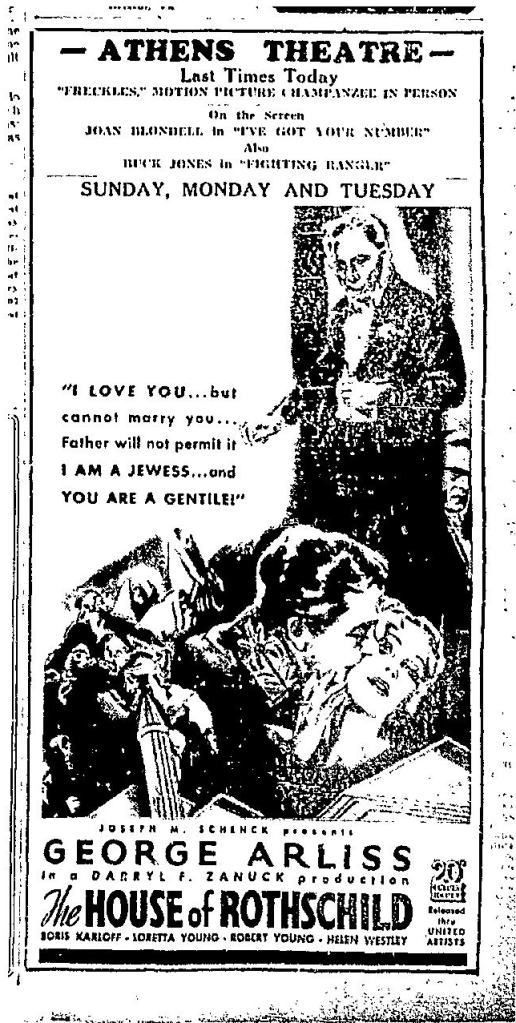
Adolf Hitler had come to power in Germany in 1933 and immediately moved to put his antisemitic rhetoric into effect. Hollywood’s response was slow; antisemitism was rife in the United States as well, and any film dealing with Jewish subjects risked censure from the Anti-Defamation League on one hand, and feeding fuel to bigots on the other. It was in this atmosphere that The House of Rothschild began production. For more details on the background of the film, check out The American Jewish Story Through Cinema.
Screenwriter Nunnally Johnson adopted George Hembert Westley’s play of the same name, interjecting the Prussian Count Ledrantz (played by Boris Karloff) into the picture to give a face to the antisemitic bigotry that the Rothschilds would contend with. George Arliss, in the lead roles of Mayer Rothschild and Nathan Rothschild, had already played prominent Jewish characters such as Benjamin Disraeli in the play Disraeli and the 1921 silent film of the same name. The result was that the 1934 film, while definitely cinema, had a strong theatricality to the staging, shooting, and performances. In 1935, looking back at the films he had seen over the last year, Lovecraft noted:
I saw the Rothschild film—which was smooth, but obviously theatrical.
H. P. Lovecraft to J. Vernon Shea, 10 Feb 1935, Letters to J. Vernon Shea 244
Lovecraft had a noted fondness for historical dramas, and while he did not address the issue in his letters, likely appreciated the attention to detail in historical costumes and settings. Likewise, Lovecraft did not comment on one of the technical achievements of the film: while most of it is shot in black-and-white, the final scenes were shot in Technicolor, rendering a vibrant finish to culminate with the Rothschild’s triumph over adversity.
One detail that Lovecraft did notice was an odd emblem mounted on the wall outside the door of the Rothschild house, which each member would touch as they come in or leave throughout the film. Neither he nor Barlow knew what this was, but back in Providence Lovecraft’s aunt took it upon herself to find out, and so Lovecraft wrote back to his young friend:
Also—to be returned—an echo from the recent past in the form of an explanation of that queer door-post thing that the Jews kissed in the Rothschild cinema. My aunt saw the film & was as curious as we were—& at her request a friend connected with the public library looked it up (& had a helluva time finding it!) & made a transcript of the information for her. So here you have it all at your finger-tips…mezuzah….sounds like a name out of Klakaksh-Ton!
H. P. Lovecraft to Robert H. Barlow, 21 Jul 1934, O Fortunate Floridian 153
The mezuzah is a parchment with verses from the Torah, affixed to the doorposts of homes in Rabbinical Judaism. One can imagine a rather confused Providence librarian, working only from a description of something half-glimpsed on screen, consulting the 12-volume Jewish Encyclopedia or equivalent source and copying out the relevant article.
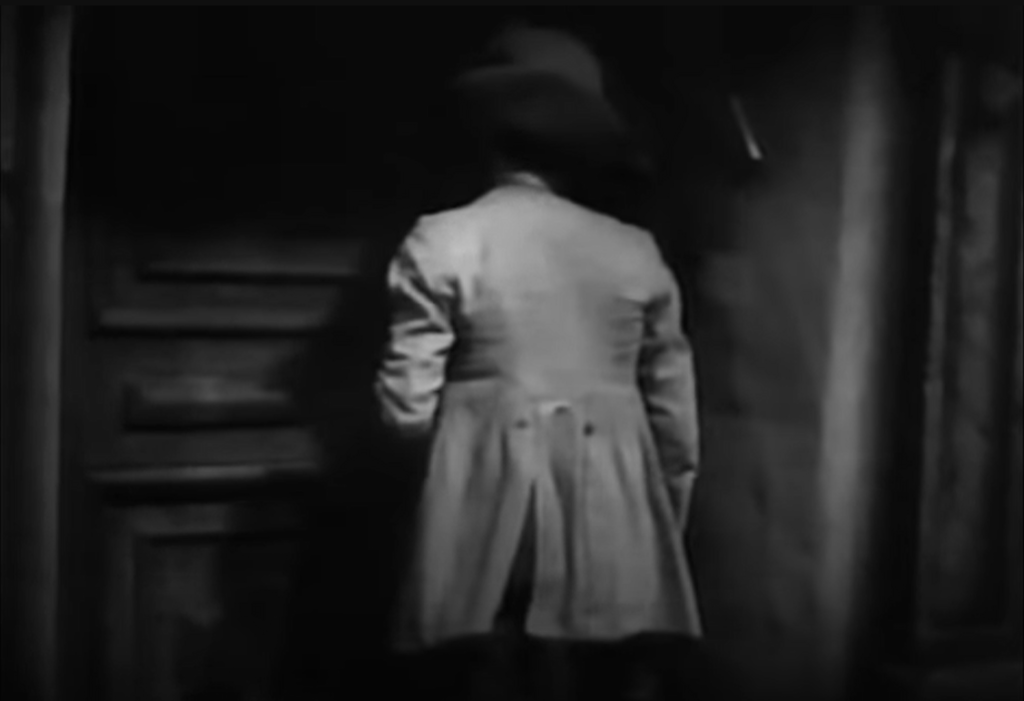
The film was a commercial and critical success. While it did not shake the stereotype of “the Greedy Jew,” it was generally received as a positive portrayal with an emphasis on the discrimination that the Rothschilds and other Jews in the film had suffered. It emphasized that even relatively wealthy and successful Jews were, at best, pariah capitalists whose wealth could be taken away because of prejudicial laws, and emphasized the threat of violence that all Jews lived under. A timely message considering Nazi Germany’s enactment of antisemitic laws, pushing Jews out of various occupations, stripping them of rights and citizenship, and finally coming for their lives and property, had just begun.
The ambiguity of The House of Rothschild—the way it both plays to the stereotypes of Jewish greed and financial influence and to the real discrimination that Jews faced in Europe—and its critical and commercial success left it open to exploitation. Director Fritz Hippler and Nazi propaganda minister Josef Goebbels pirated two scenes from The House of Rothschild in the antisemitic Nazi propaganda film Der ewige Jude (“The Eternal Jew,” 1940), co-opting the same imagery presented in The House of Rothschild to deliver the entirely opposite message. The Nazis also made their own, openly antisemitic version of the story as Die Rothschilds (“The Rothschilds,” 1940).
By the time The Eternal Jew came out, Lovecraft was long dead, so it cannot be said whether he would have recognized the scenes that the Nazis stole from The House of Rothschild. It can be said with some certainty that Lovecraft would have recognized the stereotypes of Jewish prejudice that the Nazis presented. This can be said because Lovecraft’s letters give a fairly detailed account of his own antisemitic prejudices and how they changed over time; he even recorded encounters with Jewish media such as The Dybbuk (1925) by S. Ansky and Jewish characters and themes in fiction such as The Golem (1928) by Gustav Meyrink.
What Lovecraft’s letters do not show, perhaps surprisingly, is any specific prejudice against the Rothschild family, or any general belief in Jewish conspiracy theories. The fabricated text of The Protocols of the Elders of Zion (1903) and related conspiratorial works find no mention in Lovecraft’s letters, even during those letters where Lovecraft wanders into the idea of Jewish control of newspapers in New York City, e.g.:
I didn’t say that Jews own all the papers, but merely that they control their policies through economic channels. The one great lever, of course, is advertising. Virtually all the great department stores of New York (except Wanamaker’s) are solidly Jewish even when they deceptively retain the names of earlier Aryan owners; & a clear majority of the large shops of other sorts are, as well. These Semitic merchants are clannish & touchy to the very limit, & will arrange to withdraw all their advertising at once whenever a newspaper displeases them. And, as Mencken has pointed out, their grounds of displeasure are limitless. They even resent the frequent use of the word “Jew” in the news, so that papers speak of “East Side agitators”, “Bronx merchants”, “Russian immigrants” &c. Let any N. Y. paper try to refer to these people in the frank, impartial, objective way a Providence or Pittsburgh or Richmond paper would, & the whole pack of synagogue-hounds is after it—calling down the vengeance of heaven, withdrawing advertising, & cancelling subscriptions—the latter a big item in a town where 1/3 of the population is Semitic in origin & feelings. The result is, that not a paper in New York dares to call its soul its own in dealing with the Jews & with social & political questions affecting them. The whole press is absolutely enslaved in that direction, so that on the whole length & breadth of the city it is impossible to secure any public American utterance—any frank expression of the typical mind & opinions of the actual American people—on a fairly wide & potentially important range of topics. [(in margin:) P.S. Better not quote any of this to Bloch (who I discover is of Jewish extraction). While of course this question does not involve any aspersion on the Jewish heritage as a whole, it nevertheless makes embarrassing reading for anybody having more than an academic connexion with Semitism. One would handle it differently with a Jewish correspondent.] Only by reading the outside press & the national magazines can New Yorkers get any idea of how Americans feel regarding such things as Nazism, the Palestine question (in which, by every decent standard, the Arabs are dead right & both England & the Jews intolerably wrong), the American immigration policy, & so on. This is what I mean by Jewish control, & I’m damned if it doesn’t make me see red—in a city which was once a part of the real American fabric, & which still exerts a disproportionately large influence on that fabric through its psychologically impressive size & its dominance both in finance & in various opinion-forming channels (drama, publishing, criticism &c.). Gawd knows I have no wish to injure any race under the sun, but I do think that something ought to be done to free American expression from the control of any element which seeks to curtail it, distort it, or remodel it in any direction other than its natural course. As a matter of fact, I don’t blame the Jews at all. Hell, what can we expect after letting them in & telling them they can do as they please? It is perfectly natural for them to make everything as favourable for themselves as they can, & to feel as they do.
H. P. Lovecraft to J. Vernon Shea, 8 Nov 1933, Letters to J. Vernon Shea 170-171
This is about as close as Lovecraft gets to outright Jewish conspiracy theories in his letters. Lovecraft’s particular prejudice in this instance is colored by his antipathy toward New York City in general, which he had left seven years prior, to return to his native Providence.
The sticky question: is this absence of evidence or evidence of absence? It is entirely possible that in some lost letter that has not come down to us, Lovecraft went all-in on some antisemitic tirade that recapitulated Nazi propaganda wholesale. When Robert E. Howard made a few dog whistles about “international capital” causing wars for profit (MF 2.819), we don’t know what Lovecraft’s response was because his next letter is non-extant. On the other hand, there are hundreds of letters where, even when airing his worst antisemitic prejudices, Lovecraft never brings up the issue. Hugo Gernsback, for instance, is never depicted as part of a conspiracy. So it is not entirely clear if Lovecraft had heard of these conspiracy theories and did not credit them, or if he did credit them but we simply don’t have those letters anymore.
Since we know that Lovecraft saw The House of Rothschild (1934), we can definitely say that Lovecraft was at least introduced to the idea of the influence of Jewish bankers and financiers, and their influence on European conflicts. We also know that in the limited context of New York newspapers, Lovecraft felt Jewish economic influence amounted to suppression of speech on certain topics. Yet for all that, Lovecraft’s prejudices do not seem to have extended so far as to believe wholesale in conspiracy theories about Jews. Even considering how much Nazi propaganda Lovecraft did swallow, several points of Nazi antisemitism went too far even for Lovecraft:
It is amusing to think of the thoroughly Aryan people who would be placed outside as aliens if the strict Nazi test were made worldwide. Palgrave, compiler of the Gold Treasury (whose sire was born Cohen), the present Lord Rosebery (whose mother was a Rothschild), the aristocratic Belmont family of America (whose forebear change his name from Schönberg), the Hamiltons of Philadelphia (Andrew Hamilton, the lawyer famous in the Zenger freedom-of-the-press case of 1735 & the designer of Independence Hall, married a Jewess named Franks) & so on! Indeed—since the Nazi ban is not merely on Jews but on all non-Aryans, it would come down heavily upon all who bear a trace of Indian blood—such as the descendants of Pocahontas, famous throughout Virginia & including men as eminent as John Randolph of Roanoke! Plainly, then, the present attitude of the Nazis on this point is an extreme & unscientific one….. although, as I have said, I certainly believe that actual members of the Jewish culture-group ought to be kept from securing a grip on the legal, educational, artistic, & intellectual life of any Aryan nation. They had gone too far in Germany, & they have gone too far in America—where so much literary & critical material is either of Semitic origin or (through Jew-owned publishing houses) Semitic selection. It is certainly time that the Aryan people everywhere made sure that they are not being led by fundamentally antipathetic aliens, & that they are not permitting such aliens to serve as their mouthpieces of opinion.
H. P. Lovecraft to Alfred Galpin, 25 Jul 1934, Letters to Alfred Galpin 209-211
Prejudice has to be seen as a spectrum of ignorance and discrimination; while it is common to label historical figures as antisemitic or not, the truth tends to be more nuanced. Antisemitic stereotypes were common in the United States in the 1930s, but it does not follow that every antisemite believed exactly the same things, or even agreed with one another on the exact details of their prejudices.
How much of the message of The House of Rothschild did Lovecraft actually take in? Films are both a product of their time and actors in it; they present ideas that already exist and they also shape them. It does not seem likely that Lovecraft’s beliefs in Jewish conspiracies were strengthened by watching George Aldiss on screen say: “Money is the only weapon that the Jew has to defend himself with.” Yet we have to wonder if he was at all moved by the sentiment: “To trade with dignity, to live with dignity, to walk the world with dignity.”
Again, we have no evidence either way. Certainly, Lovecraft was not often driven by sentiment in his arguments. It cannot be said with any certainty that Lovecraft’s slow turn against the Nazis in his letters was driven, at least in small part, by popular media that depicted the historical persecutions of Jews. Yet we cannot say that didn’t play its part either. On the balance, we are left only with Lovecraft’s two neutral comments on the film, and an awareness of the social and historical context in which he watched it. Lovecraft and Barlow sat in that darkened theater and saw on screen the naked prejudice which was being enacted half a world away in Nazi Germany…and came out, no doubt, blinking in the Florida sunlight, with some questions about what they saw.
Beyond that, we can only reflect on what The House of Rothschild means for us today, as a piece of cinematic history. It is worth watching.
The House of Rothschild (1934) can be watched for free.
Thanks to Dave Goudsward for his help.
Bobby Derie is the author of Weird Talers: Essays on Robert E. Howard and Others and Sex and the Cthulhu Mythos.
Deep Cuts in a Lovecraftian Vein uses Amazon Associate links. As an Amazon Associate I earn from qualifying purchases.
 Deep Cuts in a Lovecraftian Vein
One thought on “The House of Rothschild (1934)”