A visit was also made to Eglin’s book store where Sam Loveman delighted all who had the privilege of becoming better acquainted with his magnetic personality. He was one of the most pleasing surprizes of the convention, and like Howard Lovecraft, despite his profound poetical effusions, is really quite human and intensely interesting.
Hazel Pratt Adams, “The National Convention” in The Brooklynite July 1923
She was born Hazel Bosler Pratt on 10 January 1888 in New York City; the middle child of Abram E. Pratt and Jeannette (also spelled Genette or Jannett in various census rolls) Bosler Pratt. Her early life is somewhat vague; census data indicates she was still living with her family through 1910, and her obituary claims:
Financial reverses made it necessary for her to enter business life at an early age, and she was first employed in different financial institutions of Brooklyn, later becoming secretary to George McLaughlin, who afterward became State Superintendent of Banks and Police Commissioner. She also did considerable newspaper and magazine work, including contributions to Brooklyn Life, over a pariod of many years […]
The 1910 Federal census lists her profession as stenographer, and that she was then working as a private secretary; a 1915 criminal trial of banker Edward M. Grout brought Hazel in as a witness, as she had worked as a stenographer for him in 1908, and a 1911 list of those who passed civil service exam for stenographers lists Hazel Pratt. From all this, we can gather that she was literate, competent, and professional.
What this obituary does not mention is her amateur journalism activity. While it isn’t entirely clear when Hazel joined amateur journalism, she was elected the inaugural Official Editor of the Brooklyn Amateur Journalists Club in 1908—which in 1912 would change its name to the Blue Pencil Club. Pratt would serve various roles in the Brooklyn club, including Secretary/Treasurer (1910), and the editor/publisher of the amateur journal The Brooklynite. In 1912, she was elected president of the newly-labeled Blue Pencil Club, and various newspaper articles indicate the club frequently met in her home. Her involvement also spread to other organizations; in 1911 she was listed as Eastern manuscript manager for the United Amateur Press Association, and in that same year attended a convention of the Interstate Press Association.
Hazel was presumably working as a stenographer during this time, and helping to care for his mother; her other interests are unknown, although a 1912 letter to the editor on the subject of women’s suffrage suggests she was forward-looking and politically conscious.
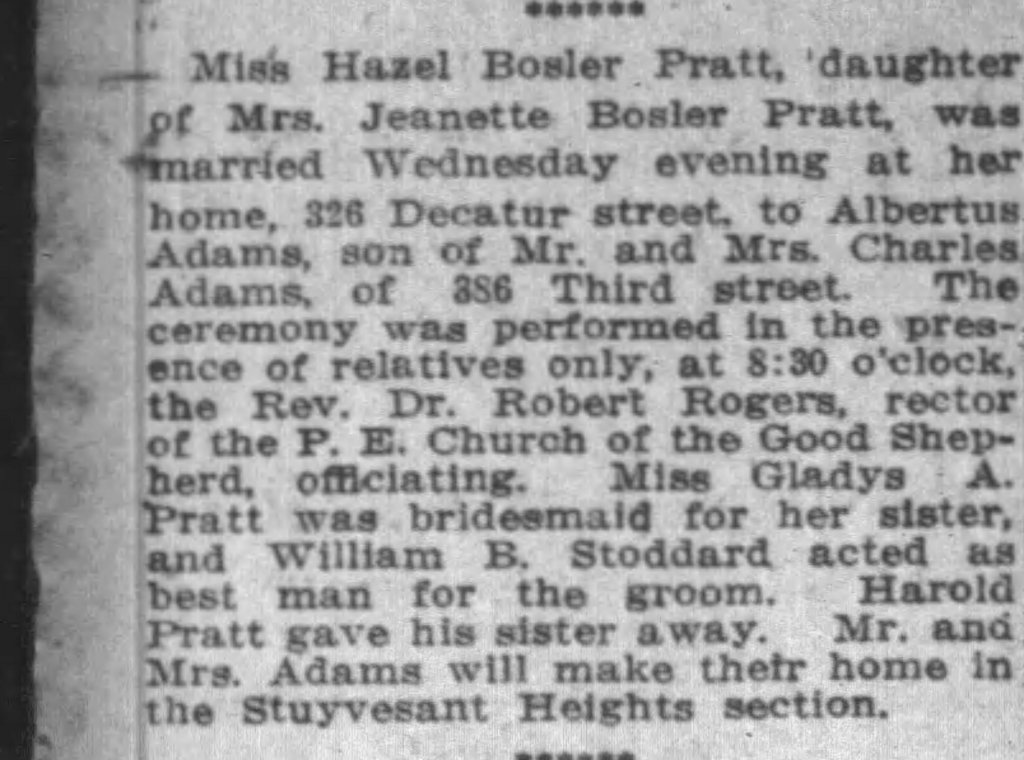
In 1914, Albertus Milton (A. M.) Adams (1879-1952) was elected President of the Blue Pencil Club, with Hazel Pratt Adams as the secretary and treasurer. A. M. Adams was the editor of the National Hotel Review, and with Hazel’s work in newspapers and magazines as well as amateur journalism, they seem to have shared interests in literature. By the end of the year, they were married.
So it was that when H. P. Lovecraft joined amateur journalism in 1914, he would likely have known her only as Hazel Pratt Adams. His first mention of her is from around this time:
Mrs. Adams’ essay on ghosts displays considerable literary knowledge, though the anecdote at the end is rather ancient for use today. We last heard it about ten years ago, with a Scotchman instead of a negro preacher as the narrator, and with the word “miracle” instead of “phenomena” as the subject.
H. P. Lovecraft, “Department of Public Criticism” (United Amateur Mar 1915), Collected Essays 1.23
Married life must have been interesting. In 1916, the Adamses bought the Tupper Lake Herald, a local newspaper for Tupper Lake, N.Y., and ran it for three years. Two sons were born to the marriage, Raymond Pratt Adams (5 Sep 1917-19 Dec 2010) and Charles LeRoy Adams (7 May 1920-9 Jan 1996), and Hazel continued her involvement in amateur journalism. In 1916, Hazel was named the Official Editor of the National Amateur Press Association.
In 1922, William B. Dowdell was elected as president of the National Amateur Press Association. Dowdell subsequently resigned, and H. P. Lovecraft filled out the remainder of his term. During his time in office, Hazel Pratt Adams impressed Lovecraft with her dedication to quality and leadership:
To stimulate more publishing, which we need so desperately, Mrs. Hazel Pratt Adams has unselfishly offered to assume complete charge of the issuance of any paper which any member may care to publish, attending in full to the arrangement, printing, addressing, and mailing, at a charge of only $20 for eight pages or $12.50 for four pages the size of the recent Brooklynite. This opportunity is so marvellously favourable, and so easy for even the newcomer, that we see no excuse for the lack of a striking revival of individual publishing.
H. P. Lovecraft, “President’s Message” (National Amateur Mar 1923), Collected Essays 1.325
When the next election loomed in 1923, Lovecraft wanted someone else—ideally someone ideologically in line with his vision for the organization, in terms of supporting high literary and print quality, even at the sacrifice of frequency—to lead the organization. The candidate settled on was Hazel Pratt Adams.
Concerning that other dark shadow, whose bat-wings flapped so menacingly above the bright lights of that elegant dining saloon where I was so mercilessly grilled, I am half convinced that the fates have saved me by giving to Mrs. A. an unalterable resolution to continue her candidacy. At least, I received from her an epistle wherein, besides a two-buck checque for the O.O. fund, was distinct mention of a campaign requiring money, & of a prospective Adams-and-Liberty journal to be intitul’d The Campaigner.
So, as Ya-know-me-Al would put it—that’s that! If Mme. Eve & Bro. Mortonius choose to alter their deep-laid designs, I suppose I can’t help myself; but just now it looks as though they were sailing ahead in fine shape, so that Fortuna will spare a victim whose (semi-)willingness to mount the scaffold hath been so conclusively demonstrated. But even so, I hardly look for utter chaos. Something’s been started, & if the ball is well rolling by the nones of Quintilis it will surely have enough momentum to keep on a while. It’ll take a full year to wipe Mike White off the map—& you can be sure Long & Galpin won’t still till that’s done! Still—me word is gave, & if the Adams-Morton move is changed, I stand ready for the axe.
H. P. Lovecraft to Edward H. Cole, 23 Feb [1923], Letters to Alfred Galpin & Others 42-43
I find that J. Ferd. [Morton] is completely & finally committed to the Adams candidacy, & that any other move would now be a positive act of hostility toward him. He is too far committed to withdraw without seeming traitorous to the Adams cause; a cause which he embraced because he knew how abhorrent office-holding is to me. […] [45] However, as I said before, I believe that the Adams arrangement will agreeably surprise you. Mrs. A. is certainly a capable routine administrator, & Morton assures me that he stands firmly in the background as an inspiration & intellectual influence . . . . . not that he uses those words, which from him would be less becoming than from another! He will continue whatever policy is started this term—& Mrs. Adams is heartily ready to act as a sympathetic standard-bearer.
H. P. Lovecraft to Edward H. Cole, 24 Feb [1923], Letters to Alfred Galpin & Others 44, 45
“Mme. Eve” was apparently Lovecraft’s nickname for Hazel—because she was the wife of Adam(s). As puns go, it isn’t very good, but a ticket with Hazel Pratt Adams and James F. Morton was a strong one. Cole, apparently, was not happy about this nomination, and had wanted Lovecraft to run.
About the Cole mess—I’d better curl up with a bottle of cyanide & get it over with before I do any more harm to myself and others. Bah. Probably I’ve incurred his undying coldness—he hasn’t answered that definitively declinatory epistle yet—and now Mrs. Adams writes that he’ll probably be peeved at her! Undertaker, put a good shot of embalming fluid in the old simp’s head—it’s been dead a long time. Tell Mrs. A.—though I’ll answer her myself in a day or two—that I’ll take all the Colic blame myself & exculpate her, & you, & everybody but poor me—in toto. He might as well be damn mad at one guy as half mat at several birds.
H. P. Lovecraft to James F. Morton, 1 Mar 1923, Letters to James F. Morton 26-27
“Her epistle” suggests that Lovecraft and Hazel Pratt Adams were in correspondence by this time; when and how this started it is not clear, but presumably came about through his NAPA presidency, if not before. As it happened, with the support of Lovecraft and Morton, Hazel Pratt Adams was elected almost unanimously as the 4th woman president of the National Amateur Press Association. From the convention, she sent Lovecraft a telegram:
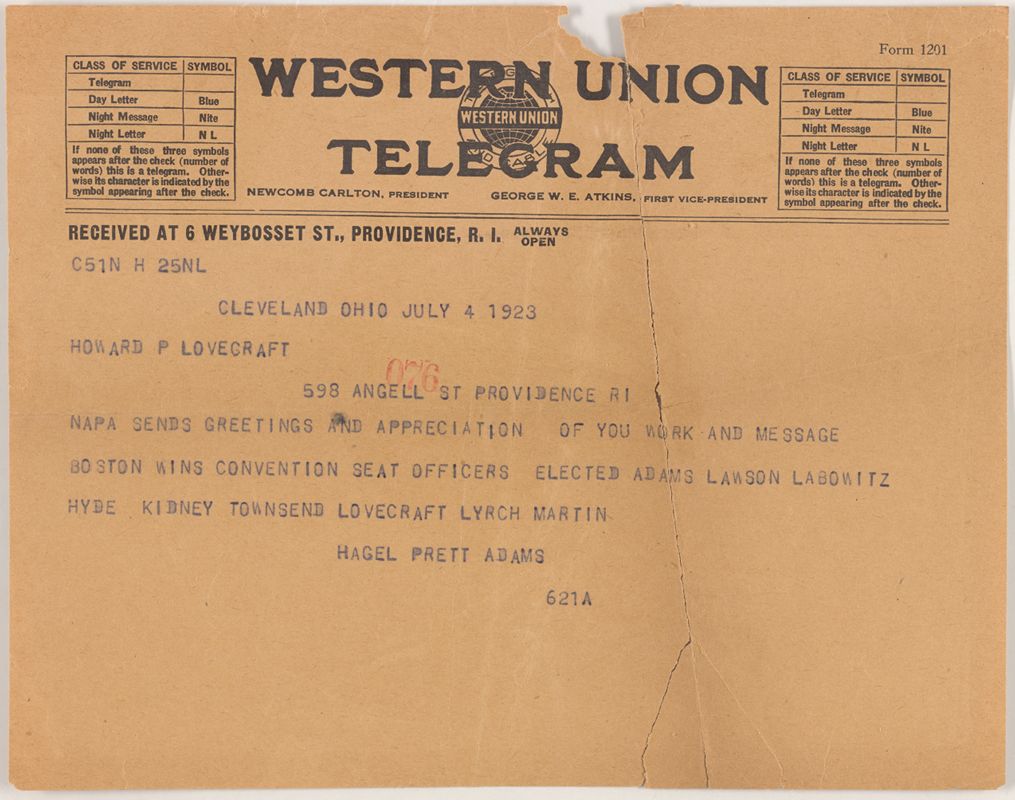
It was apparently not an easy time for her:
President Adams labored under serious difficulties, personal and otherwise. Throughout her entire term illness in her family added to her burdens. But she set an excellent example of activity by publishing 15 papers, and although the institution was entering upon one of its periodical times of depression, she maintained the high standard of work established by her predecessor.
The Fossils: History of the National Amateur Press Association
Lovecraft, for his part, was busy with his other things. On 3 March 1924, Lovecraft married Sonia H. Greene in New York; the couple set up their household in Brooklyn. Among their first visitors was Hazel Pratt Adams:
We had our first callers yesterday—Mrs. Adams of Plainfield, N.J., and Mrs. Myers of Cambridge, who is visiting Mrs. Adams before sailing for Paris for six months. They seemed very favourably impressed with the new household, and S.H. assures me that I did not appear altogether ridiculous as a host.
H. P. Lovecraft to Lillian D. Clark, 18 Mar 1924, Letters to Family and Family Friends 1.115
Sonia had been a member of the Blue Pencil Club, and almost assuredly was already friends with Mrs. Adams; it isn’t clear if this is the first time Lovecraft met Adams in person, or if they had met at an earlier convention, or Lovecraft’s prior trip to New York. In any event, it was the newlywed’s first time receiving callers as a couple.
Lovecraft apparently continued to correspond with Hazel Pratt Adams through at least 1925, because “The Horror at Red Hook” was composed on the backs of a letter dated 13 November 1925 (Midnight Rambles 225n78). The text of this letter has not yet been printed, and no other letters from the Hazel Pratt Adams/H. P. Lovecraft correspondence are known to survive.
Hazler Bosler Pratt Adams died on 6 August 1927. The cause of her death was not recorded in her obituary.
The Blue Pencil Club arranged the publication of In Memoriam: Hazel Pratt Adams. Sonia and Howard Lovecraft both penned tributes to their friend:
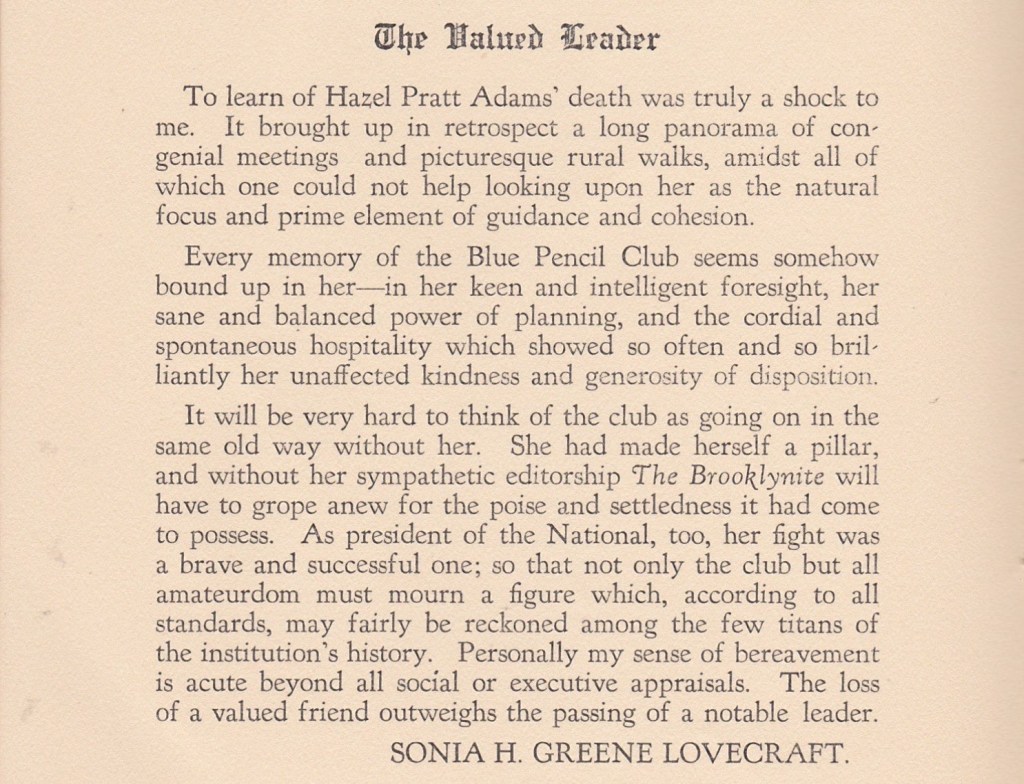
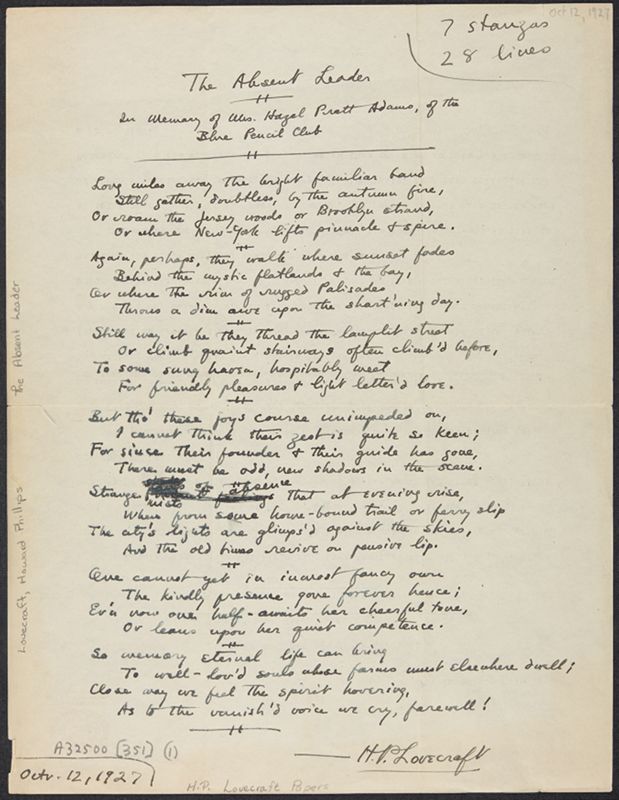
With such scanty evidence, it is difficult to say anything for certain about the friendship and correspondence of Hazel Pratt Adams and H. P. Lovecraft, except that they did correspond, and they were friends. They shared friends and interests in common, and wrote well (if sparingly) of one another. What else they might have talked about, we may never know, unless some new cache of letters turns up.
Thanks and appreciation to Monica Wasserman for her help with this piece.
Bobby Derie is the author of Weird Talers: Essays on Robert E. Howard and Others and Sex and the Cthulhu Mythos.
Deep Cuts in a Lovecraftian Vein uses Amazon Associate links. As an Amazon Associate I earn from qualifying purchases.
 Deep Cuts in a Lovecraftian Vein