| Hay quienes consideran el género de TERROR como un subproductio. Es cierto que, como en todo, a veces domina una calidad ínfirma, pero no sólo en los Comics. También en cinema, televisión, literature… Tal vez porque el tema se ha explotado a fondo con abusos commerciales aprovechando que a la gente le gustan las emociones fuertes y muchos, sin saberlo, las utilizan para liberarse de sus propios miedos. Pero también es cierto que otros se han servido de sus miedos para expresar sus sentimientos y emociones segun su condición psicológica dando lugar a las mejores obras del género. Tal as el caso de POE, LOVECRAFT, KAFKA, y muchos más. El experto en la materia no dejará nunca de reconocer que el TERROR es un tema de gran interés que además nos revela la personalidad más intrínseca de sus autores. Por eso, repito, el TERROR no se debe subestimar a la ligera sin un previo análisis. Conociendo lo suficiente (presumo) sobre la vida atormentada y la obra de Los maestros del terror, he seleccionado una serie de relations pasándolos al Comic, Bien adaptando fielmente algunos, Bien dando mi toque personal a otros. Y aquí está el resultado: Este libro con el que deseo rendir homenaje a los «GRANDES DE LO MACABRO». Espero que lo pasen de miedo. | There are those who consider the TERROR genre as a by-product. It is true that, as in everything, sometimes a low quality dominates, but not only in Comics. Also in cinema, television, literature… Perhaps because the topic has been thoroughly exploited with commercial abuse, taking advantage of the fact that people like strong emotions and many, without knowing it, use them to free themselves from their own fears. But it is also true that others have used their fears to express their feelings and emotions according to their psychological condition, giving rise to the best works of the genre. Such is the case of POE, LOVECRAFT, KAFKA, and many more. The expert on the subject will never fail to recognize that TERROR is a topic of great interest that also reveals the most intrinsic personality of its authors. Therefore, I repeat, TERROR should not be underestimated lightly without prior analysis. Knowing enough (I presume) about the tormented life and work of The Masters of Terror, I have selected a series of relations, transferring them to the Comic, either faithfully adapting some, or giving my personal touch to others. And here is the result: This book with which I wish to pay tribute to the “GREAT OF THE MACABRE.” I hope you have a scary time. |
| Introduction to Homenaje: Grandes de Los Macabro (1985) | English translation |
Joan Boix (born Juan Boix Sola Segales in Badalona, Spain) is not well-known to English-reading audiences, although he has had a long career both in Spain and internationally, able to turn his hand from everything from romance comics in the 1960s to being one of the artists that drew The Phantom comic strip in the 1990s. Yet for those who appreciate horror comics, Joan Boix holds a special place for his work in that field. Even there, in English his work is a bit of a footnote: a story in Marvel’s Monsters Unleashed #5 (1974), which was reprinted in the Monsters Unleashed Annual (1975). Yet his Spanish-language work, never translated into English, is his best. And in 1985 he published a collection of adaptations of classic horror fiction: Homenaje: Grandes de Los Macabro (Tribute: Greats of the Macabre).

“La Maldicion del Amuleto” is an adaption of H. P. Lovecraft’s “The Hound.” In Spanish, the story is typically translated as “El Sabueso,” and while there are many words for dog in Spanish (perro, can or canino, cacharro (“puppy”), chandoso, etc.) “sabueso” has the specific meaning of a hunting dog; we might even say “bloodhound” in English. Which is a nice shade of meaning, given the context.
Boix’s tastes in terms of illustration are gloriously Gothic, redolent of an 18th-century macabre that recalls the horror films of Hammer Films in Britain and Profilmes in Spain. There’s that sense that Peter Cushing, Christopher Lee, or Paul Naschy could step onto the panel at any time, and be right at home.
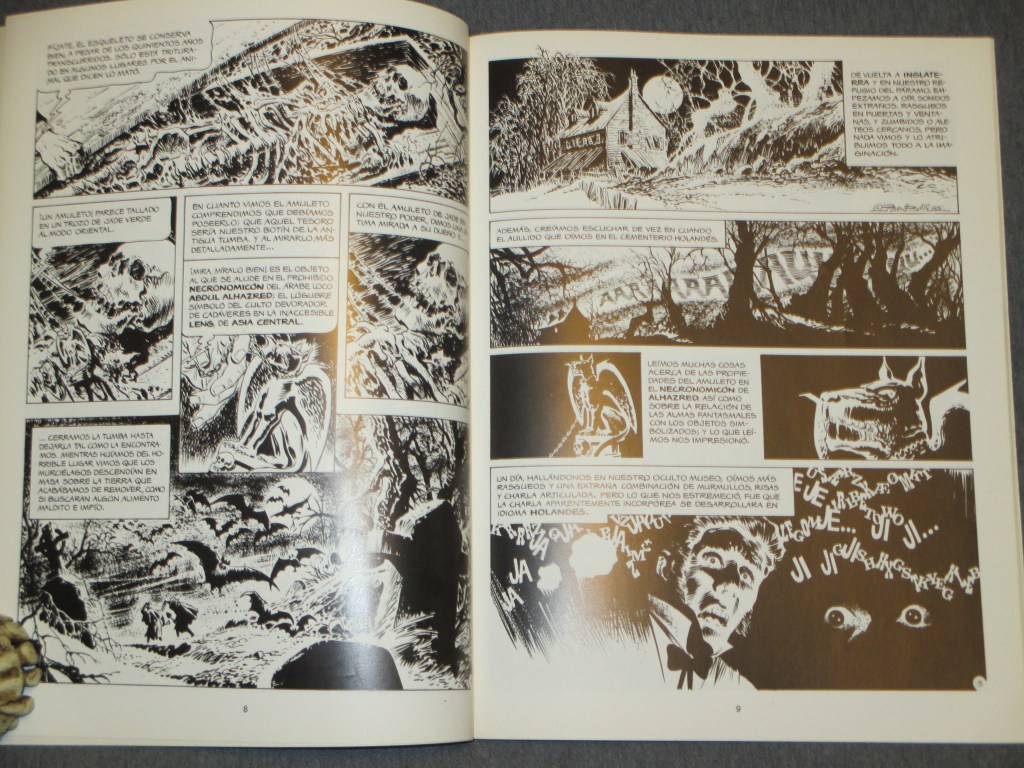
The starkness of the black-and-white works to Boix’s advantage; there are single panels that could be glorious two-page spreads, with a lot of detail that might have been muddied by a careless colorist. The chiaroscuro effect is glorious, the kind of deep shadows that drink in the light which would inspire the likes of Mike Mignola’s signature aesthetic.
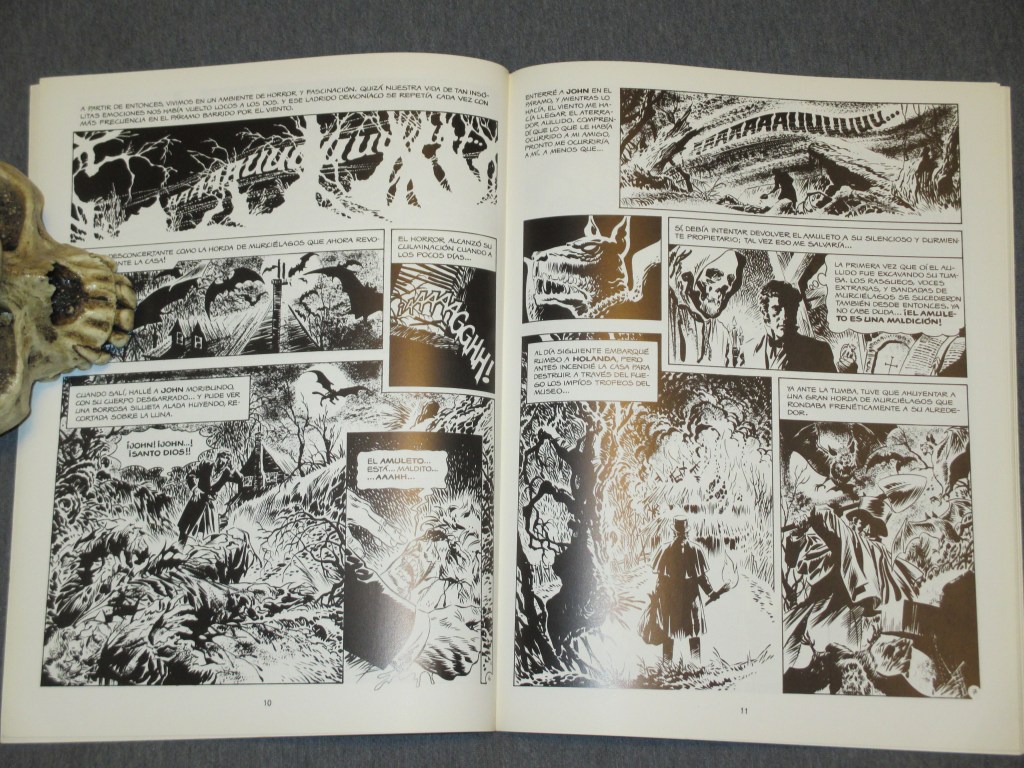
It is always tempting, when reviewing one of these adaptations of Lovecraft, to compare it against all the other adaptations. Jack “Jaxon” Jackson in Skull Comix #4 (1972), Stuart Gordon and Tula Lotay in The Thought Bubble Anthology #1 (2011), Chad Fifer and Bryan Baugh in The Lovecraft Anthology: Volume II (2012), Tanabe Gou in H. P. Lovecraft’s The Hound and Other Stories (2017)—and all of these have their charms and advantages, their different takes and take-offs on the material.
For sheer joie de morte, however, Boix’s tendency to revel in a single panel is hard to top. It’s a world where the moon is always full and glaring like the eye of some forgotten God, where every tombstone is encrusted with grave-mould, and the collection of the pair of necrophiles would put Hammer’s prop department into giddy ecstasies of macabre delight.
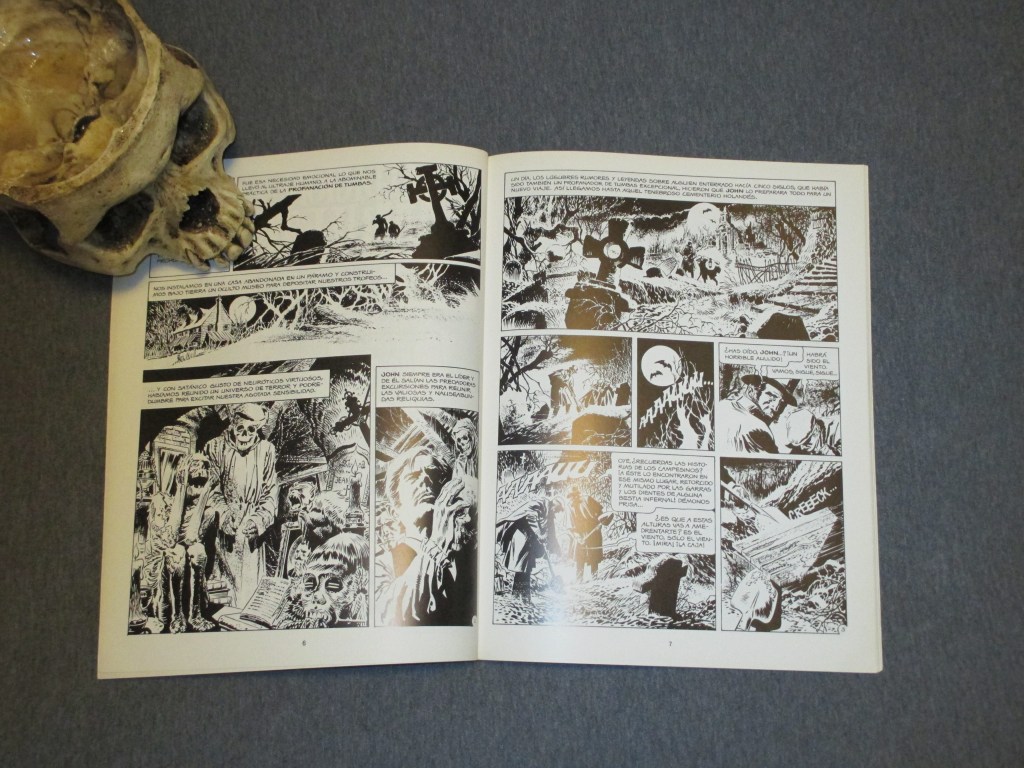
As horror comics have gained new appreciation, so too has awareness of Joan Boix’s work begun to grow, with new critical editions in Spanish like Grandes de la Macabro (2021), and Joan Boix. Antología: Relatos pasados, recuerdos presentes, maestría absolute (2022). Very fortunately for English-reading audiences, for the first time ever his horror comics have been translated into English: Terror! The Horror Comics Genius of Joan Boix (2022).
Bobby Derie is the author of Weird Talers: Essays on Robert E. Howard and Others and Sex and the Cthulhu Mythos .
Deep Cuts in a Lovecraftian Vein uses Amazon Associate links. As an Amazon Associate I earn from qualifying purchases.
 Deep Cuts in a Lovecraftian Vein