The Story Behind The Curry
The notice of the Algiers restaurant is charming; but alas, they spoil it all by babbling of “plain, home cooked food.” Alas, alas—when I crave dishes neither home cooked nor plain, but poisonously spiced with saffron and cardamon [sic] and ginger and fenugreek and cumin and chilis and cayenne and coriander and pepper; when I crave a place serving curry and kous-kous and sheesh kabab and humus bi-tahhini and babaghanouge, tacos, enchiladas, tamales, and what have you, smoking, fuming, exhaling corrosive blasts of weird spices and foreign condiments! But the decorative scheme and the historical note is indeed appealing.
—E. Hoffmann Price to H. P. Lovecraft, postmarked 12 Sep 1934, MSS. Brown Digital Repository
Weird fiction and exoticism have long gone hand-in-hand; from the 1,001 Nights and William Beckford’s Vathek to when Farnsworth Wright launched Oriental Stories as a companion to Weird Tales, the weird and fantastic in Western literature has often included a fascination for other cultures, far places, the novelty of unfamiliar religions, folklore, art, music, and customs. At its worst, this tendency could lead to the promulgation of stereotypes and prejudice, Yellow Peril stories and Orientalism. Yet for many it represented an honest and active interest in other cultures, at a time when information on those cultures was often scarce and flawed.
Edgar Hoffmann Price (b. 3 Jul 1898, d. 18 Jun 1988) joined the army in 1917. As a private in the 15th Cavalry Regiment, he shipped out to Fort McKinley in the Phillippines with his unit. He passed through Honolulu in Hawaii, then a U.S. territory, to Manila. A few months later the unit returned to the continental U.S. from Manila via Nagasaki, Japan. Although his time in Asia was brief, Price soaked up the local color and remained for the rest of his life a devoted Asiaphile, fond of Turkish coffee, Persian carpets, Buddhism, Islam, and Asian food in general. His early pulp fiction in magazines like Weird Tales often featured Asian and Middle Eastern characters and settings, and his personal memoirs and letters include snatches of Arabic, personal anecdotes from his travels, affections such as signing his letters with a Chinese chop, and in making curry. When Lovecraft met Price for the first time, in New Orleans in 1932, Price reported:
When I mentioned my Indian curry recipe, he sighed. Not even he, with his love of spices from Araby and Ind, would be equal to a pot of curry—he had ingested quite too great a quantity of chili with beans.
Although HPL’s fame rests on his Olympic status in ice-cream eating, I remember him as one who found his peak in dishes featuring coriander, ginger, cardamom, fenugreek, cumin, oregano, tamarinds, and violent little peppers which tender-skinned folk should never touch until first putting on rubber gloves.
We agreed that when I visited him in Providence, Rhode Island, I would build an East Indian curry.
—E. Hoffmann Price, Book of the Dead: Friends of Yesteryear: Fictioneers & Others (2001), 45
In two letters to his friend H. P. Lovecraft, Price gives his recipe for “East Indian curry.” But what is curry?
In the 1930s, “India” and “East India” in common use were synonymous with what was called British India or the British Raj. In 1858, the United Kingdom had taken over direct rule of the territories controlled by the East India Company in the Indian subcontinent and Southeast Asia, which would persist until the partition of India in 1947. While the British governed and frequently thought of India as more-or-less a single political and economic unit (notwithstanding the several nominally independent states which administered themselves, though under British suzerainty), the idea of a singular cultural or geographic “India” is a bit of an anachronistic simplification—or, perhaps more accurately, a colonial ideology imposed on the colonized.
The region historically comprising contemporary India (historically referred to as “Hindustan” or “Hind” after the Indus River) was never one single historical state, ethnicity, or identity. Rather, the region has throughout history been a multicultural and multiethnic crossroads; sometimes parts of it have been unified politically, but the peoples and polities of India often remained distinct—and this diversity extended to their approach to food. There was no single national cuisine of India; every individual region had its own peculiarities based on available ingredients, food traditions, and the cultural, social, and religious preferences and mores of the local population.
From Persia came rosewater and saffron; from Afghanistan and Central Asia, almonds, pistachios, raisins and dried fruit; from the Middle East, sweet dishes and pastries. They introduced sherbets and other sweetened drinks; pulaos and biryanis, elaborate dishes of rice and cooked meat; samosa, a meat- or vegetable-filled pastry; dozens of varieties of grilled and roasted meats called kabobs; yakhni, a meat broth; dopiaza, meat slowly cooked with onions; korma, meat marinated in yogurt and simmered over a slow fire; khichri, a blend of rice and lentils; jalebi, coils of batter deep-fried and soaked in sugar syrup; and nans and other baked breads.
—Colleen Taylor Sen,Curry: A Global History (2009), 19
The European colonial period in India began with the arrival of the Portuguese in the late 15th century, and introduced new foods from both Europe and the Americas to India, such as chili peppers, potatoes, tomatoes, pumpkins, and turkeys. The Europeans brought along their own preferences and dietary habits, which were adapted to local conditions and ingredients. For example:
Vindaloo is normally regarded as an Indian curry, but in fact it is a Goan adaptation of the Portuguese dish carne de vinho e alhos, or meat cooked in wine vinegar and garlic. The name vindaloo is simply a garbled pronunciation of vinho e alhos. The Portuguese particularly savored the sour, but fruity, taste of meat marinated and cooked in wine vinegar. When they arrived in India, however, they found that Indians did not make vinegar, though a similar sour-hot taste was produced by south Indian cooks using a combination of tamarind and black pepper. Some ingenious Franciscan priests are said to have solved the problem by manufacturing vinegar from coconut toddy, the alcoholic drink fermented from the sap of the palm tree. This, combined with tamarind pulp and plenty of garlic, satisfied the Portuguese cooks. To this basic sauce they added a garam masala of black pepper, cinnamon, and cloves, some of the spices in search of which Vasco de Gama had made his way to the Malabar Coast in 1498. But the key ingredient, which gave bite to the granular sauce of vindaloo, was the chili. Like their Spanish counterparts in South America, the Portuguese in India had developed a liking for the fiery taste of the chili pepper and they used it in excessive quantities in a vindaloo. Some recipes call for as many as 20 red chilies.
—Lizzie Collingham, Curry: A Tale of Cooks and Conquerors (2006), 67
A masala refers to a pre-prepared mix of spices. While most cooking in India before refrigeration would have been done with fresh ingredients and fresh-ground herbs and spices, each added to the dish separately at the appropriate time, sometimes ground herbs and spices would be pre-mixed together for convenience—an idea universal to many cultures, from French quatre épices and Chinese five spice powder (五香粉) to the pumpkin spice and Italian seasoning blends found in many North American grocery stores. Garam masala is the most common such spice blend, although “common” is perhaps a misnomer, as the ingredients and proportions vary from region to region and taste to taste. Common ingredients include cumin, fenugreek, turmeric, and coriander; other typical ingredients may include cloves, cinnamon, cardamom, dried chilies, black pepper, mustard seeds, curry leaves, fennel, asafetida, and bay leaves, though rarely all of these, and often in varied proportion.
When Europeans began to transmit recipes from India back to their own countries in the 17th century, one of the defining characteristics was the mix of spices used. In The Art of Cookery Made Plain and Easy by Hannah Glasse, for instance, there is a recipe “To make a Currey the India[n] Way”:
| Take two Fowls or Rabbits, cut them into ſmall Pieces, and three or four ſmall Onions, peeled and cut very ſmall, thirty Pepper Corns, and a large Spoonful of Rice, brown ſome Coriander Seeds over the Fire in a clean Shovel, and beat them to Powder, take a Tea Sponful of Salt, and mix all well together with the Meat, put all together into a Sauce-pan or Strew-pan, with a Pint of Water, let it ſtew ſoftly till the Meat is enough, then put in a Piece of Freſh Butter, about as big as a large Walnut, ſhake it well together, and when it is ſmooth and of a fine Thickneſs diſh it up, and ſend it to Table. If the Sauce be too thick, add a little more Water before it is done, and more Salt if it wants it. You are to obſerve the Sauce muſt be pretty thick. | Take two ſmall Chickens, ſkin them and cut them as for a Fricaſey, waſh them clean, and ſtew them in about a Quart of Water, for about five Minutes, then ſtrain off the Liquor and put the Chickens in a clean Diſh; take three large Onions, chop them ſmall and fry them in about two Ounces of Butter, then put in the Chickens and fry them together till they are brown, take a quarter of an Ounce of Turmerick, a large Spoonful of Ginger and beaten Pepper together, and a little Salt to your Palate; ſtrew all theſe Ingredients over the Chickens whilſt it is frying, then pour in the Liquor, and let it ſtw about half an Hour, then put in a quarter of a Pint of Cream, and the Juice of two Lemons, and ſerve it up. The Ginger, Pepper, and Turmerick muſt be beat very fine. |
| 1747 edition | 1775 edition |
While Glasse uses European cooking terms like fricassee, fry, and stew, the process is reminiscent of an Indian cooking technique:
A common Indian cooking technique with no exact equivalent in the West is called in Hindi bhuna. Spices and a paste of garlic, onions, ginger and sometimes tomatoes are fried in a little oil until they soften. Pieces of meat, fish or vegetables are sautéed in this mixture. Small amounts of water, yogurt or other liquid are then added a little at a time. The amount of liquid added and the cooking time determines whether the dish will be wet or dry. This is the basic technique used in making the dishes called curries.
—Colleen Taylor Sen, Curry: A Global History (2009) 24-25
This was the first form of “curry” in English, and while the language is a bit antiquated and the recipe pretty simple and straightforward, the essential takeaway is a dish like a stew or ragout, with a thick, spicy sauce. In a very broad sense, that is the definition of curry as it is currently used today; although in the more British sense of the term “a curry” can be used to refer to almost any dish associated with any of the cuisines associated with India. As Collingham puts it:
The idea of a curry is, in fact, a concept that the Europeans imposed on India’s food culture. Indians referred to their different dishes by specific names and their servants would have served the British with dishes that they called, for example, rogan josh, dopiaza, or quarama. But the British lumped all these together under the heading of curry.
—Lizzie Collingham, Curry: A Tale of Cooks and Conquerors (2006), 114
The export food culture from India was (and is) a centuries-long process; new ingredients are swapped in and out, recipes simplified, translated, and transformed by different tastes. Islamic dietary laws are observed by Muslims in India, and similarly many Hindus are vegetarian; these aspects of culture and religion are reflected in their respective cuisines. By contrast, most Europeans did not have the same cultural mores against eating animals except in certain circumstances (such as Catholic fast days), so European curry recipes tend to reflect European eating habits with meat as a major ingredient.
As the British spread throughout India, the uniformity of British experience helped to transmit and to a degree unify disparate aspects of various regional cuisines, or at least to begin to export a version of those familiar dishes back to the United Kingdom and its colonies. It was the beginning of what would become a loose canon of “curry” dishes, including vindaloo, kedgeree, korma, mulligatawny soup, and kebabs/kabobs, but also a growing uniformity in how to prepare those dishes. These were dishes that came from all across India and its many food cultures, but were often transformed, simplified, and then formulated for easy preparation—often using curry powder.
Hannah Glasse in The Art of Cookery Made Plain and Easy provided instructions for the preparation of spice mixes, and so did many other recipe books. Those that were more accurate to indigenous Indian methods emphasized grinding your own spice pastes and powders, but the simplification and adaption of Indian food in Britain led to the commercialization of these masalas into pre-made curry pastes and powders. Curry powder, which often utilized similar ingredients to various Indian spice mixes, became a defining staple of the more Anglicized recipes, and through the British Empire spread the British idea of “curry from a can” around the world.
Which is about where curry lay in the Anglo-American world in the 1930s. The Immigration Acts of 1917 and 1924 prevented immigration from Asia, including British India, into the United States which limited the establishment of Indian restaurants during that period. Nevertheless:
By the end of the 1920s New York had half a dozen Indian restaurants known for their fiery curries, among them The Rajah on 44th Street, west of Broadway, and Ceylon India Inn on 49th Street, which operated until the mid-1960s. Thanks to racial exclusion laws, the country’s Indian population remained very small: only around 3,000 people in 1930, many of them students living in New York City.
—Colleen Taylor Sen, Curry: A Global History (2009), 57
While Lovecraft did broaden his culinary horizons in New York City in the 20s, getting his first taste of everything from spaghetti to goulash, apparently he did not visit any of these Indian restaurants. If he had, Lovecraft might have found something very different from what we think of as Indian fast food today. The Indian takeaway fast food revolution in the United Kingdom, which has redefined “a curry” for the 20th century, didn’t take place until after World War II—and many dishes like chicken tikka masala had not been invented yet. The curry tradition that E. Hoffmann Price was familiar with would have been any of dozens of variations of a stew or ragout with a thick, spicy gravy, often served on or alongside rice.
After Price and Lovecraft met in New Orleans in 1932, they continued to keep in touch by mail, and in one letter Lovecraft confessed:
Another bit of ignorance. I don’t think I’ve ever tasted East Indian curry—a delicacy so universal in Bayonne that you even feed it to the dogs around the city gate. But if it’s what I think it is, I’d like it—for as you know from my response to chili con carne, I’m all for high seasonings. I suppose the Hindoos go in for that kind of thing because they have a genial climate plus a lack of that refrigeration which makes unseasoned meats dependable. I believe Worcestershire sauce (a favourite with me) is based on some sort of East Indian recipe, is it not?
—H. P. Lovecraft to E. Hoffmann Price, postmarked 2 Mar 1933, Letters to E. Hoffmann Price 67
This admission of ignorance requires a bit of explanation. Bayonne in France was where Price was stationed during World War I; presumably Lovecraft’s comment on curry was in response to something Price had mentioned at some point, either in person or in a letter that does not survive. “Genial climate” is a discreet reference to the tropical heat of India, since Lovecraft was sensitive to cold and enjoyed semi-tropical climates like that of Florida; “lack of refrigeration” is a reference to the popular (though false) stereotype that Indian cookery used spices to cover up the taste of spoiled meats, which wouldn’t keep in the heat. The reference to Worcestershire sauce reflects a legend used to promote Lea & Perrins’ sauce:
Many years ago Mrs. Grey, author of ‘The Gambler’s Wife’ and other novels, well known in their day, was on a visit at Ombersley Court, when Lady Sandys chanced to remark that she wished she could get some very good curry-powder, which elicited from Mrs. Grey that she had in her desk an excellent recipe, which her uncle, Sir Charles, Chief-Justice of India, had brought thence and given her. Lady Sandys said that there were some clever chemists in Worcester, who perhaps might be able to make up the powder; at all events, when they drove in after luncheon they would see.
Messrs. Lea & Perrins looked at the recipe, doubted if they could procure all the ingredients, but said they would do their best, and in due time forwarded a packet of the powder. Subsequently the happy thought struck some one in the business that the powder might, in solution, make a good sauce. The experiment was made, and by degrees the thing took amazingly. All the world, to its remotest ends, now knows of Worcestershire sauce as an article of commerce; and, notwithstanding that, in common with most good things, it is terribly pirated, an enormous trade is done in it. The profits, I am told, amount to thousands of pounds a year, and I cannot but suppose that liberal checks, bearing the signature of Lea & Perrins, have passed from that firm to Mrs. Grey, to whom it is so indebted for its prosperity.
—“History of Worcestershire sauce,” New York Times, 9 Feb 1884, quoted in History of Worcestershire Sauce (2012) by William Shurtleff and Akiko Aoyagi
Shurtleff and Aoyogi go on to quote Brian Koegh’s The Secret Sauce: A History of Lea & Perrins:
The section titled “The Sandy’s family” (p. 29-30) debunks the myth of an early and oft-repeated connection between “Lord Sandys” and the invention / discovery of Worcestershire sauce. It states: “… no Lord Sandys (either as Sandys of Hill) was ever a governor of Bengal, or as available records show, ever in India. The identity of the nobleman thus remains an intriguing mystery.”
While the Lea & Perrins legend was basically public relations and embellished over time, it struck a chord with consumers (like Lovecraft), and there is probably a note of truth in it insofar as the original recipe derived from soy sauce, catsups, and Indian spice mixes, tweaked for British tastes.
Which is a long way to say that Lovecraft was effectively ignorant of Indian food except that it was supposed to be spicy. E. Hoffmann Price decided to educate his friend by sending him a recipe for a curry:
East Indian Curry: a dish prepared perfectly in but 2 places holy Shamballah, and the Throne Room.
Directions: Into a small pot put a tablespoon of butter, brown a finely minced, small onion, then a finely minced clove of garlic; add sliced mutton (raw or roasted) veal, chicken, as you wish; add suitable amount of curry powder (conglomerate of from 5 to 10 spices—coriander, turmeric, ginger, cardamon [sic], cloves, pepper, god knows what, including fenugreek) and sauté the meat (if raw, until done; if previously cooked or roasted, until permeated with the fragrance of spices) then add 4 cloves, a cup of soup stock, let simmer 20-30 minutes, then add cup of cream or evaporated milk, thickened with spoonful dissolved cornstarch; stirr [sic] smooth, and when well wobbled around, you are ready to serve, by dumping the tawny, golden curry into the center of a fortress of cooked rice, which forms a parapet about the edge of a platter. May be garnished with sliced, cooked eggs.
Curry may be made, substituting cooked eggs for meat.
A glass of sherry may be added just before serving. Optional.
Lemon rind may be grated into the simmering hell brew. Optional.
It is a dish for gods and demons, and for men also. Oh, divine Curry! It is the peer of dishes, and withal simple.
Get a 15¢ can of curry and try it. Cross[e] & Blackwell has a very good powder, uniform of strength, excellent of flavor, but it costs about 50¢ (though the bottle hold more than a small spice can.
—E. Hoffmann Price to H. P. Lovecraft, postmarked 10 Mar 1933, MSS. Brown Digital Repository
Crosse & Blackwell produced one of the first British commercial curry powders, and helped define the taste of Anglo-Indian curry. The pre-mixed spice was ideal for feeding masses of troops, and was adopted by the British Navy for that purpose, which introduced it to Japan. C&B curry powder became the standard for Japanese curry in the early 20th century, until the curry scandal of 1931, when it was found that many of the curry powders sold in Japan were local mixes being sold fraudulently under the C&B brand. Since then, Japan has embraced many different curry powders, and the C&B brand has now been sold and resold. The old jars of vibrant yellow powder are no longer for sale, although the curry powder itself continues to be produced for the Japanese market.
Tracing Price’s recipe back to an original source is tricky. It contains similar elements to several contemporary recipes, and it has features of a number of Anglicized Indian foods, including the inclusion of sliced hard boiled eggs and fried onion (common garnishes), the use of lemon rind (in place of tamarind) to add a note of sour. Curry powder instead of individual spices is highly characteristic of British curries, but unusually Price does not use the curry powder with flour to form a roux, which is also a common attribute of early 20th century recipes. The use of evaporated milk and cornstarch to thicken the gravy seems characteristic of an early 20th-century recipe, since evaporated milk became widely available commercially in the 1920s. While stewing meat in wine harks back to the Portuguese tradition, the addition of sherry “just before serving” seems more like Price’s personal taste. Perhaps like many cooks he simply adjusted the recipe to taste and available ingredients over time; he notably doesn’t give any directions for the soup stock.
Lovecraft was delighted:
Your explanation of the inward nature of curry is surely a tantalisation of the palate! I must sample this gift of the Djinns, in all its perfection, either at the Peacock Thone or in the Citadel of Holy Shamballah, before I make the final incantation precipitating me into Avichi. In the interim, if I can find any 15¢ cans (what’s the make?) I shall make this one of my regular dietary items in place of Campbell’s soups & Heinz’s beans & spaghetti. We shall see . . . . but I won’t make the mistake of confounding any base commercial imitation with the real thing, as prepared according to the precepts in the Book of Dzyan.
—H. P. Lovecraft to E. Hoffmann Price, postmarked 24 Mar 1933, Letters to E. Hoffmann Price 73
References to Shamballah, Avichi, and the Book of Dzyan reflect the fact that Lovecraft and Price had been discussing Theosophy, a new religion which drew in part on Eastern esoteric religion for its lore and trappings. The “Peacock Throne” would be Price’s own home; Price had made a habit of reference to Tawûsî Melek (rendered as Malik Taus and variations), the “Peacock Angel” of Yazidi religion, in several of his stories, and Lovecraft had made it a nickname for Price himself.
Lovecraft, like many men during the 1920s and 30s, was raised completely ignorant of cooking. He learned during his brief marriage and years of bachelordom to produce some simple meals so as not to be eating out for every meal, but even these were largely based around pre-packaged or canned foodstuffs, such as the increasingly popular canned spaghetti dinners. This also suited Lovecraft’s pocketbook, since canned goods were generally relatively cheap and kept for long periods of time.
Price, unfortunately, appears to have lost Lovecraft’s question on curry brands in a flurry of short responses on postcards (and Lovecraft appears to have misunderstood that Price was talking about canned curry powder, not a meal-in-a-can). When E. Hoffmann Price made it to Providence in late June 1933, he made his curry for Lovecraft and his friend Harry K. Brobst. In his memoir, Price recalls:
The curry and its preparation fascinated HPL, all the more so because of our discussions of it by mail. At last, he was observing the process, sampling from time to time, as I developed the sauce in which cubes of mutton would simmer.
“By building it up gradually,” I told him, “I’ll get exactly to your taste. At the moment, we have something for women and children, and the American public—a pallid, gutless gravy. Yes, the odor is delightful, but—”
“Bland,” he conceded, as did Harry, after sampling.
I added more spice. After this has blended into the sauce, I asked, “Still more chemicals and acids?”
“Savoury. By no means lacking in fire, but this is not the blighting, blasting, searing mixture you described. Harry?”
“I’m still with you.”
More spicings, more samplings.
Finally HPL said, “To assert that this would raise blisters on a cordovan bot would be poetic exaggeration. Another increment of spices would make your description a statement of fact. If Harry agrees, be pleased to serve us this ambrosia and nectar.”
—E. Hoffmann Price, Book of the Dead: Friends of Yesteryear: Fictioneers & Others (2001), 51
A few decades later, Brobst remembered the event but had little to add:
We made some Indian curry, and we had some beer—we had a pleasant evening.
—Will Murray, “An Interview with Harry K. Brobst” in Ave Atque Vale 322
Price went on to add that Lovecraft relished the curry and rice. This may be why soon after the visit that Price repeated a slightly simplified version of this recipe was later included in another letter:
Indian Curry: In a small pot dump some butter, and brown therein minced onions (1/2 a small onion); when beginning to brown, it is desirable but not necessary to add a clove of minced garlic, & brown. Add 1 cup of thinly sliced veal, lamb, mutton, or chicken—either fresh or previously roasted or cooked. In either case, add 2 teaspoons of curry powder, and let the mixture simmer until, in the case of raw meat, it is done, or if roasted meat is used, until well saturated by the fragrant spices. Then add 1 cup of soup stock or lacking that, a cup of bouillion [sic] made of beef cubes. Let simmer 10 minutes; add 2/3 cup evaporated milk or cream, which has been thickened with teaspoonful cornstarch, and heat until sauce is smooth & thick. Serve with cooked rice. An egg Curry is made as above except that in lieu of meat being sauté[e]d, a curry flavored gravy is prepared & thickened, and into it hard cooked eggs are sliced—and served as noted.
—E. Hoffmann Price to H. P. Lovecraft, 15 Jul 1933, MSS. Brown Digital Repository
Lovecraft duly responded:
Thanks abundantly for the mystical curry formula. I’ll certainly have some adept prepare a brazier full before long, to offer up to the gods of Shalmali & Shamballah
—H. P. Lovecraft to E. Hoffmann Price, 19 Jul 1933, Letters to E. Hoffmann Price 88
Taken together, these recipes and descriptions should be enough to make a reasonable approximation of Price’s dish.
An Interpretation of E. Hoffmann Price’s Curry
1 tbsp. [14 g] butter*
1/2 small onion [~60-65 g], minced
1 clove garlic, minced
1 cup [340 g] meat (veal, lamb, mutton, or chicken), thinly sliced**
2 tsp. [10-12 g] curry powder***
4 whole cloves
1 cup [340 g] soup stock****
2/3 cup [115 g] evaporated milk
1 tsp. [5-6 g] cornstarch; stir this into the milk before cooking
3 hardboiled eggs, peeled and sliced
1-2 cups [340-780 g] rice*****
2 tbsp [28-30 g] sherry******
1 tsp. [5-6 g] grated lemon rind
* Many traditional Indian dishes call for ghee (clarified butter), and if you have that, use it. Price would probably have been using regular salted butter from the supermarket. Almost any other cooking oils (e.g. coconut, olive, avocado, lard, schmaltz, etc.) can work, just avoid ones with a low smoke point (e.g. salad oils, etc.).
** Price doesn’t specify the cut of meat, but generally you’ll want something without bones or excess fat (i.e. bacon is going to make a quite greasy curry). If it’s a very tough piece of meat like beef brisket, marinate it in yogurt overnight. Price specified “raw or roasted,” and the recipe works whether the meat is pre-cooked or raw, but if the meat is uncooked it will need to cook longer in the pan. Remember to wash your hands & cooking area after handling raw meat!
*** Crosse & Blackwell curry powder is still available in Japan, and possibly on the international market. In a pinch, S&B Oriental Curry Powder is generally much more available and has a very similar flavor.
**** You can purchase stock or bouillon or make your own (handy 1926 recipe for go-getters); ideally, the stock should complement the meat (e.g. beef stock for veal, chicken stock for chicken, etc.) Prepare the stock before you begin cooking your curry.
***** Price doesn’t specify the amount or type of rice or how he cooks it, so it’s up to you. Electric rice cookers were first introduced in 1923, so feel free to use one, but Price would have boiled his rice in a pot on the stovetop. While any rice you like will do, Price probably would have reached for Basmati rice if it was available. Rinse the rice to remove any powder that will make it extra sticky, and remember to add a pinch of salt and a tsp. [5-6 g] of butter or oil per cup of rice to the water when cooking.
****** Price does not specify the type of sherry (a fortified wine traditionally made in Spain’s Jerez de la Frontera region), and maybe didn’t know the difference between cooking sherry and a drinking sherry like Amontillado. Use a cooking sherry or a dry drinking sherry like Fino. Price specified “a glass” (~4 ounces/113-115 g), but that’s probably excessive if you’re just looking to add the flavor of the wine. If you don’t drink alcohol, skip this, or use 1 tbsp [14-15 g] of white wine vinegar, just to get some of the flavor. Price would have left this out when making curry for Lovecraft, who was a teetotal.
0) Prepare the rice and boil the eggs. When finished cooking, toss the rice to fluff it up, then keep the dish covered.
1) In a medium sauce pan, place the heat on medium high, melt the butter, and sauté the onion and garlic for 3-4 minutes, but don’t let it brown. Then lower the heat.
2) Add in the curry powder—the oils will accentuate the flavor of the spices—and stir until the powder is absorbed by the liquid; let it cook for 1-2 minutes. If you burn the curry powder (you should be able to smell it before you see it blacken if you do), rinse out the pan and start over with fresh ingredients at a lower heat.
3) Add the meat. Toss lightly, so that the meat is evenly coated, then let it cook. Eating raw or undercooked meat is dangerous, so make sure the meat is cooked thoroughly, which should take 8-10 minutes depending on the thickness. Stir to keep anything from sticking to the bottom of the pan, and so the meat cooks through. For thicker cuts of meat, cook longer. If something starts to burn, you’ve gone too far; take it off the heat for a minute, add a little water, and stir, then move it back onto the heat and keep an eye on it. Repeat as needed.
4) Toss in the whole cloves and add the soup stock; try to avoid anything sticking to the bottom of the pan. Wait for the stock to begin to simmer.
5) Stir in the milk and cornstarch slurry. Adding colder liquid will lower the heat of the whole sauce, so do it gradually and try and keep it simmering.
6) Stir until the color is and consistency is even—probably a bright yellow or brown; there might be pools of oil on the surface, that’s fine, the rice will soak it up. Let it simmer and reduce until the gravy is thick enough for your liking, stirring occasionally.
7) Sample the curry and add spice to taste. If you’re adding in the sherry, do it now, stirring constantly, but don’t let it continue to cook for more than 3-4 minutes.
8) When everything is simmering, consistent in color, and hot enough for your taste, turn off the heat, and pour or ladle the curry onto the serving-dish with the rice. Price and many others liked to have the rice around the edges of the serving-dish.
9) Add sliced hardboiled eggs and sprinkle on the lemon rind just before serving.
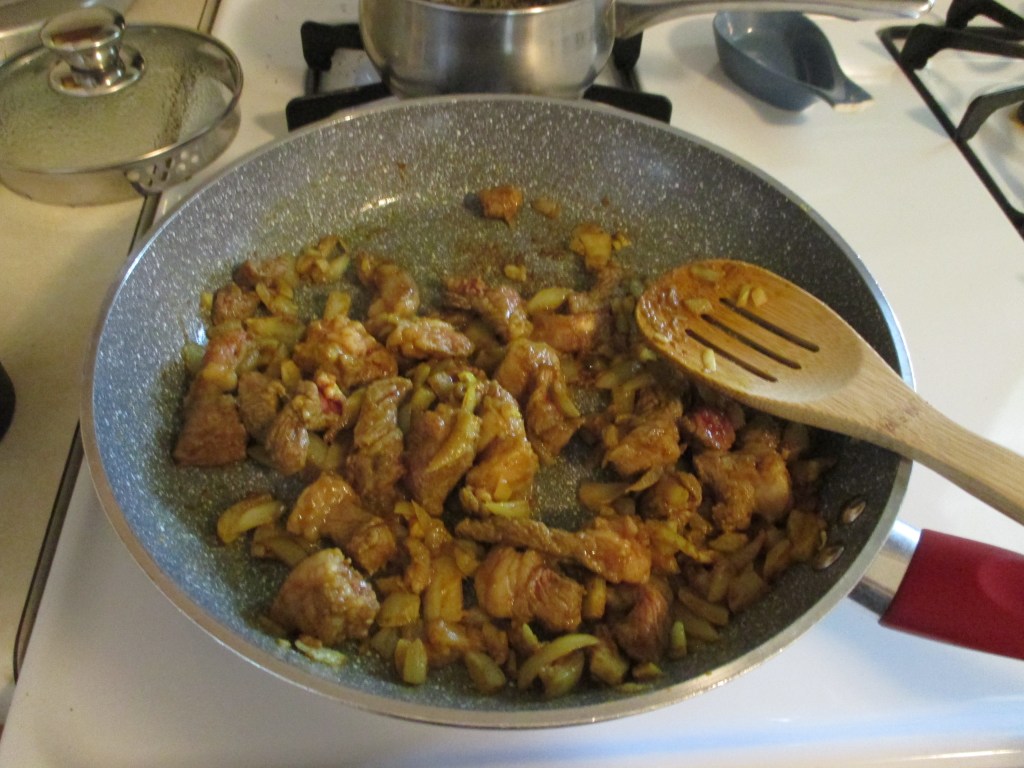
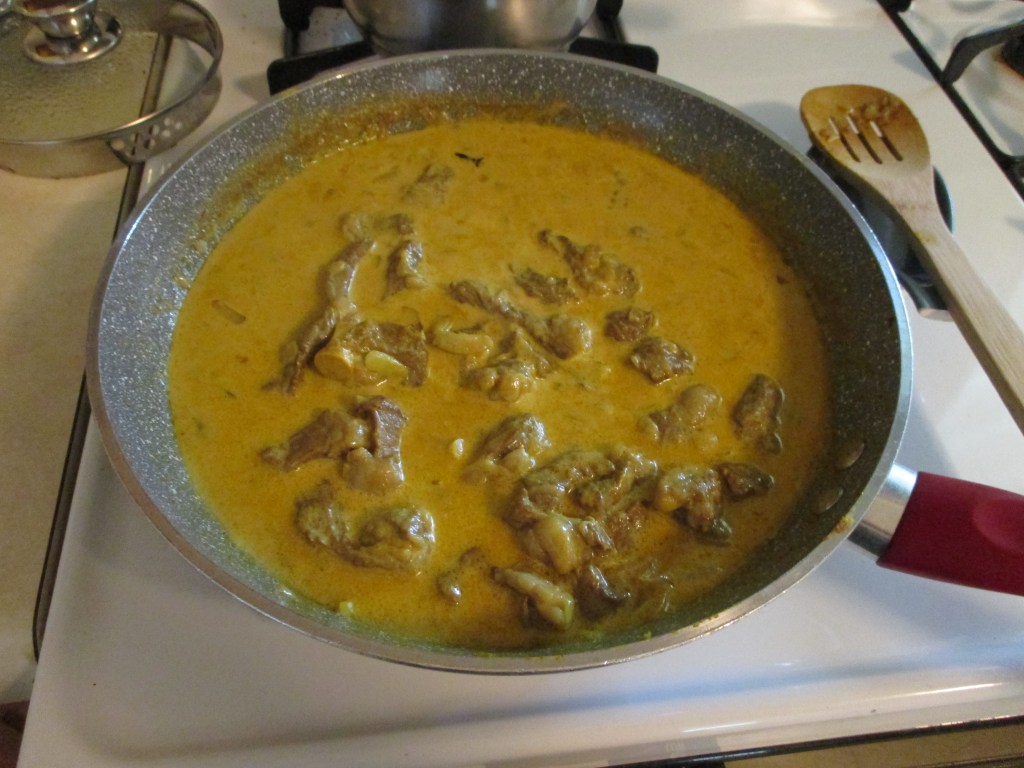
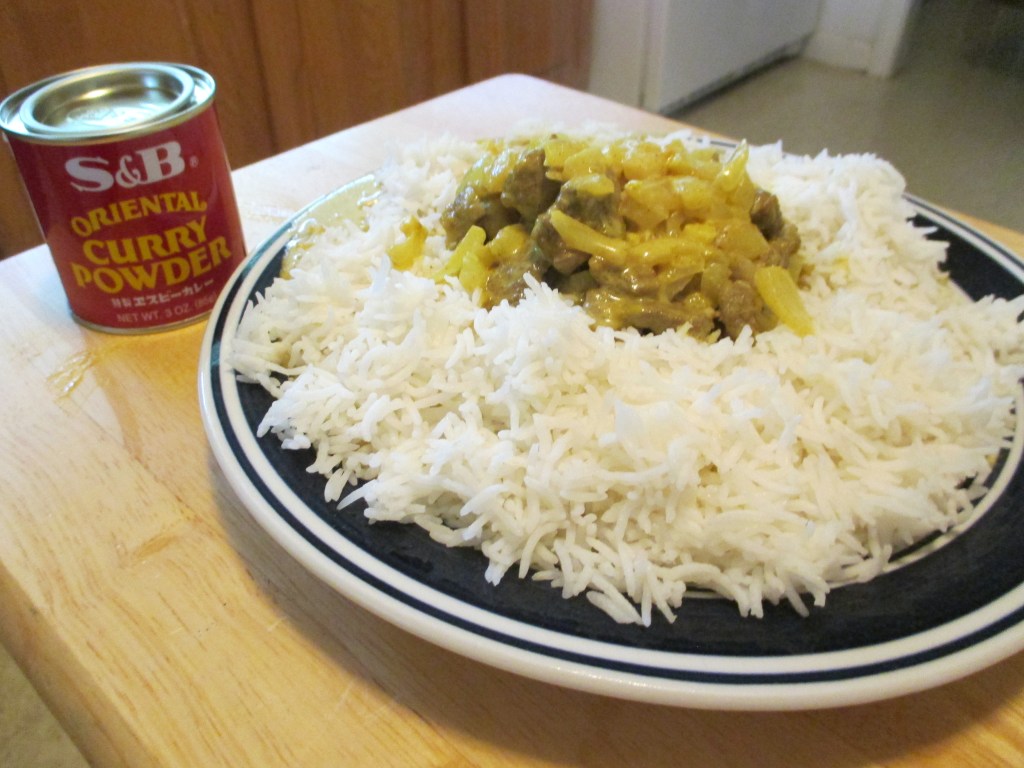
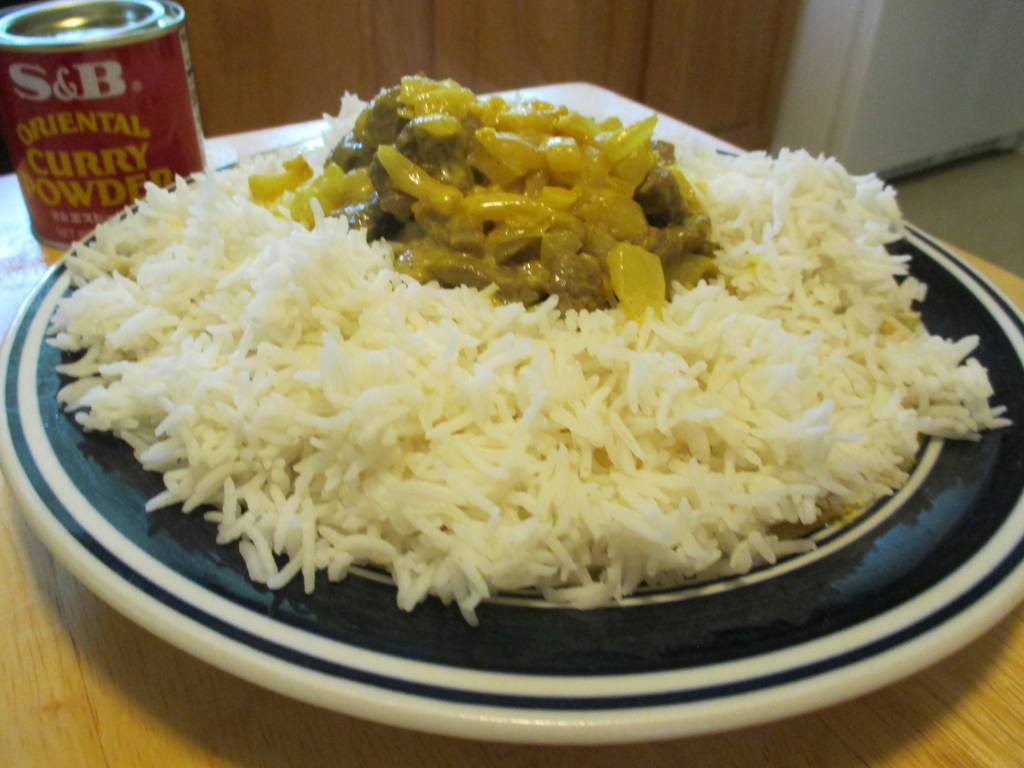
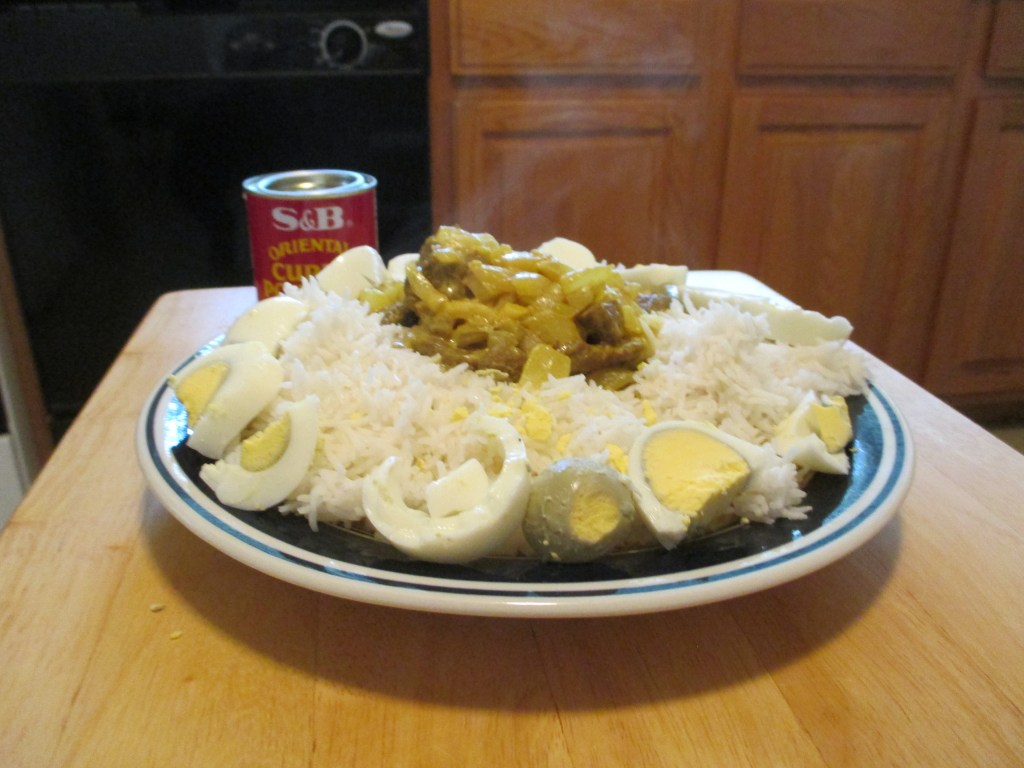

For the example dish above, I cut up a lamb chop (the bones are in the pot in the back burner, to make stock). I used S&B curry powder and bismati rice, but left out the sherry. No points for presentation.
The resulting mix isn’t hot in terms of Scoville ratings; the spice blend in commercial curry powder tends to be stale and can be a bit bland for those used to cooking with fresh spices and whole chilies. However, if it doesn’t make your tongue burn it is pleasantly aromatic and piquant, and goes well with fluffy rice. Price’s curry is a long way from the actual Indian dishes that inspired it.
Yet once you appreciate the basic nature of the recipe, you can also see how flexible and easy it was to tweak to individual tastes. Chicken on sale at the supermarket? Make a chicken curry. Leftover turkey from Thanksgiving dinner? Turkey curry. Vegetarian? No problem; switch out the meat for your mixed vegetables of choice and the meat stock for vegetable stock. Allergic to dairy? Swap out the butter for coconut oil and thicken the sauce with an equal amount of coconut milk or almond flour instead of evaporated milk. Not hot enough? Add more spice. Fresh spices, different spices. Want to throw some sultanas or chutney in there? No one can stop you. Price himself often varied things a little:
Kiki & Potlikker have licked the East Indian curry from a plate, and seem to relish it. Potlikker’s 1st experience at curry. This was a blighting, blasting, devastating curry of intolerable power. It was worthy to be served in Malayan or Javanese style—with 5 servants to approach with trays of “sanbals” or relishes—embalmed Chinese eggs; mangoes; minced coconut; pickled walnuts; slices of pineapples; chutney; dried Bengal fish, faintly suggestive in odor of zoological specimens not thoroughly preserved; and numerous other relishes. 40 assorted “sanbals” is adequate; but I had to content myself with pickled beets & cauliflower.
—E. Hoffmann Price to H. P. Lovecraft, postmarked 23 Oct 1936, MSS. Brown Digital Repository
Kiki and Potlikker were two of Price’s cats; the word he’s looking for is usually rendered in Latin characters as sambal, which refers to a spicy Indonesian chili sauce or paste, or a dish that uses sambal as an ingredient. While European food culture typically serves food in courses, Indian and Southeast Asian food cultures tend to present all the food at once at the beginning of the meal. Thus, a diner at a formal or elaborate meal might be confronted with a table covered with many bowls or plates, with a number of differently-compounded dishes, relishes, and condiments to try. Many of the items Price lists are part of authentic Indian dishes, and might easily find themselves in an Anglo-Indian curry, or accompanying one.
Curry in Context
“Authenticity” is a bit of an odd concept when talking about something practically unrecognizable compared to its source. While Price may have thought he was making an authentic Indian dish, what he was actually making was a translated, redefined Anglo-Indian fusion cuisine dish—and if you look at it as an example of that tradition, it is as authentic as any other curry descended from Hannah Glasse’s The Art of Cookery Made Plain and Easy and its many culinary literature cousins.
To E. Hoffmann Price and H. P. Lovecraft, curry was an exotic food item, a literal taste of a distant culture that they had read about all their lives but had never—and would never—experience for themselves. Their reactions to Anglo-Indian food in their letters are rife with ignorance, stereotypes, and an Orientalism verging on mysticism, but also enthusiasm to try new things and appreciation for something different from their standard bill of fare. In an era when there was so little Indian food made in the United States, where legal barriers prevented immigration and discriminated against immigrants—this little home-cooked meal was almost as close as they could get to a taste of India.
Price was one of the few pulpsters who had met Lovecraft and his contemporaries in person, and over the long decades of his life, he became something of a memoirist, writing the stories of his visits with friends long dead. The tale of that pot of curry was told and retold, over and over. To give a taste:
But in other fields we see each other eye to eye: blistering hot and blighting chili con carne, East Indian curry that would raise welts on a pack saddle, and devastating coffee, night-black and strong enough to tan an ox-hide, are among his greatest gustatory delights.
—E. Hoffmann Price, “The Sage of College Street” in Amateur Correspondent (May-June 1937)
He relished highly spiced dishes; and when, a year or so later, I saw him in Rhode Island, he asked me to make him the Indian Curry I had described. The spices—coriander, ginger, cardamon, fenugreek, pepper, Lord alone knows what else—caught his ear, and the blistering, blasting sauce tickled his palate.
—E. Hoffmann Price, “Howard Phillips Lovecraft” in The Acolyte (Fall 1944)
While Harry was getting the six-pack, I was making the curry, and HPL was sampling it.
“Is it hot enough for you?”
“Ah, a few more spices from Araby and the Indies would help.”
So I dumped in more curry powder, and yet more. When it was hot enough to raise blisters on a pack saddle, he said, “It is just about right.”
—E. Hoffmann Price, “Reminiscences of HPL” in HPL (1971)
In this way, Price’s curry has become a small part of the myth and legend of H. P. Lovecraft.
Bobby Derie is the author of Weird Talers: Essays on Robert E. Howard and Others and Sex and the Cthulhu Mythos .
Deep Cuts in a Lovecraftian Vein uses Amazon Associate links. As an Amazon Associate I earn from qualifying purchases.
 Deep Cuts in a Lovecraftian Vein
Wow!! This is amazing! 🤩
LikeLiked by 1 person
Good post! Makes me hungry for Indian food, both derivative and authentic kinds.
LikeLiked by 1 person