His funeral was held at High Noon at a funeral home, and, though the little gods of fate seemed to will that we should arrive there too late for the services, we did visit Swan Point Cemetery, with its many tombs, winding lanes and exquisite monuments—and did I imagine it, or did the spirit of our late beloved friend and fellow-writer hover over us as we bowed our heads in reverence and respect to the memory of one of the finest men—yes, and greatest geniuses, who ever walked this earth? A man little-known, perhaps, by the majority, but a man who, to those who came in more than casual contact with him, exemplified all that is fine and good in a fellow human being.
—Muriel E. Eddy, “Howard Phillips Lovecraft” in Rhode Island on Lovecraft (1945) 21-22
From the very first, Muriel E. Eddy’s memoirs of H. P. Lovecraft were fairly rose-tinted—and, occasionally, given to flights of imaginative fantasy like the above. The Eddys did not make it on time to Lovecraft’s funeral; such things happen, but they did apparently visit his grave periodically. Lovecraft’s grave, initially unmarked, was not the point of pilgrimage for fans and admirers that it is today; but he had long known and expected this to be the resting place for his mortal remains, in the family plot, and it is clear from Lovecraft’s letters to the Eddys that they were well aware of that.
H. P. Lovecraft was an atheist and materialist; he had no expectations for survival of consciousness after death. His afterlife, as it is, lay in the publication of his work, the memories of his friends, and increasingly his appearance as a fictionalized character in various works. Muriel E. Eddy was, apparently, not a materialist, and was at least open to the idea of ghosts or consciousness that survived after death. At least, she was willing to write about it for Fate Magazine, which offered $5 for tales of evidence of existence after death. This was not exactly new territory for Muriel, who had sold a “psychic experience” to The Occult Digest in 1939. So it was that in the October 1956 issue of Fate, “Message in Stone” appeared.
Message in Stone
We were greatly saddened when Howard Phillips Lovecraft, the famous Rhode Island writer of weird and uncanny tales of the unknown, died in March, 1937. Mr. Lovecraft had been a friend of the family for years. He often had brought his weird writings, still in manuscript form, to our house, reading them aloud in his sepulchral voice and awaiting our approval or disapproval. He considered the Eddy family “good critics.” I still can see him, sitting in our humble abode and reading his famous horror tale, “The Rats in the Walls,” which has been reprinted frequently since his untimely demise.
We often discussed the mystery of death and one night Lovecraft expressed the opinion that the human brain was practically indestructible. He believed that, whether or not his body was embalmed, his brain would continue to function. He said that if his brain continued to “work,” as he believed it would after death, he would send a message in some material form that we could understand.
At that time he was in excellent health and death seemed distant. However, shortly afterward Howard Phillips Lovecraft suddenly became seriously I’ll and died in Jane Brown Hospital in Providence, R.I., in March, 1937. He was only 47 years old.
After the funeral I often visited his grave and placed floral offerings there. The grave is in Swan Point Cemetery and is marked by a tall granite shaft.
One night in September, 1937, I had a very vivid dream about Howard Phillips Lovecraft. In my dream I visited his grave, now covered thickly with grass, and was on my knees, parting the grass as I hunted for something.
My dreams haunted me and early the next day, a Sunday, I drove out to the cemetery. I felt driven by an invisible force.
As I stood beside Lovecraft’s grave, I seemed to hear his sepulchral voice again, intoning the words, “If my theory is correct, if my brain continues to function after my death, I will send you a message in some material form that you can understand.”
My eyes scanned the grass on the burial plot, still wet with dew, and then I glimpsed something white shining on Lovecraft’s grave. Stooping, I parted the heavy growth with my hands and picked up a heart-shaped stone, as smooth as satin and about two inches across. It was milky white and looked oddly like a quarried stone of the translucent variety. I recalled that Lovecraft’s grandparents, long dead, had owned a stone quarry in East Providence.
How the stone happened to be lying on Lovecraft’s grave may be only a matter of conjecture. However, he had known that I collected odd-shaped natural specimens, such as unusual shells, odd bits of wood and minerals, especially stones and rocks of unusual formation.
I could find no stone in the cemetery that resembled even remotely the one I found on Lovecraft’s grave. —Providence, R. I.
[Fate Magazine (Oct 1956), 103-105
Some of the details in the piece are correct, others likely honest mistakes. The description of the grave is accurate; at the time, there was no individual marker for HPL, only the granite shaft for the family plot. Lovecraft was 46 at the time of his death, but if Muriel E. Eddy was counting by year, it’s an easy mistake to make. The Phillips did not own a quarry in Providence, but they owned a small mortgage on such a quarry, and in Lovecraft’s letters he talks about sometimes getting mineral samples from there for his friend James F. Morton, who was curator of a museum of geology in New Jersey.
As for the more imaginative part of the Fate piece—there is no account in Lovecraft’s letters or other memories of him hoping for the functioning of his brain after death. However, it is notable that several of his stories for Hazel Heald, notably “Out of the Æons” (1935) and “The Horror in the Burying-Ground” (1937) both deal with a kind of living death, with the mind functioning in a paralyzed or petrified body. Muriel E. Eddy claims to have introduced Heald to Lovecraft, and Heald features prominently in Eddy’s later memoirs, so possibly she remembered either the stories or Lovecraft writing or talking about the stories.
Another likely influence on “Message in Stone” is the magician Houdini, whom both Lovecraft and her husband C. M. Eddy, Jr. had worked with:
I remember Mr. Eddy’s painstaking revision of Houdini’s “Thoughts and Feelings of a Head Cut Off”….an experience which the master magician had undergone in his youth. Harry Houdini said in his story that somewhere in his travels he came across an ancient supersitition that if a head was severed quickly and unexpectedly from a body, the brain in the head kept on thinking for several seconds! […]
I am quite sure this story was never offered for sale by Harry Houdini, as it lacked the ring of veracity . . . perhaps it was somewhat exaggerated! When we told H.P.L. about it, he exclaimed, “Oh, what I could have done with that story, but perhaps Houdini wouldn’t have liked it if I’d changed it too much. I took a lot of liberties with his ‘Pharaoh’ story and he seemed satisfied, but this one!” And a far-away look was in his eyes. . . .
Later on, were were discussing the possibility of the truth of a brain functioning after death, and Lovecraft averred that perhaps the brain did function . . . for a few minutes after the death of one’s body. It was a weird subject, and there I ended! I sometimes wondered what Lovecraft’s true feelings regarding this matter really were. […]
My husband spent some time investigating Spiritualism at Lake Pleasant, Massachusetts, for Harry Houdini, and when he returned home with much data about some of the mediums he’d met, Lovecraft came over to see us and seemed much interested in the subject. He scoffed at the idea of communion with the dead, and said that, in his opinion, death was the absolute end.
—Muriel E. Eddy, “A Gentleman from Angell Street” (1961) in A Gentleman from Angell Street 20-21
The Harry Houdini Circumstantial Evidence blog relates a possible manuscript related to this story, titled “Thoughts and Visions of a Head Cut Off.” Houdini is an important connection as well because of a tradition that began after his death; his wife Bess began to hold séances annually on Hallowe’en, in an attempt to contact her husband’s spirit. Muriel was aware of this:
By the way, Houdini’s last desire was that on every Hallowe’en his resting-place should be visited by friends to see if his (Harry Houdini’s) ghost appeared. . . . he made light of ghosts and Spiritualism, you jnow. As Lovecraft was a “ghost-writer” also for Harry Houdini . . . . . . well! Mrs. Harry Houdini . . . and Harry’s brother Hardeen . . . have joined the ranks of every human’s ultimate glory . . . . could not supervise the weird visition at Houdini’s grave this Hallowe’en. I supose that trek will now be abandoned . . . . Houdini proved his own point . . . he STAYED dead! Somtimes, in a joking mood, Lovecraft used to say that . . . . . PERHAPS . . . . the human brain NEVER stopped functioning . . . . . even after death. A weird thought, and, visiting H. P. L.’s grave one day recently . . . . . your friends the Eddys . . wondered . . . just vaguely. But OF COURSE H.P.L. was just joking!
—Muriel E. Eddy to Winfield Townley Scott, 2 Nov 1945, MSS. Brown Digital Repository
Muriel’s information was a little out of date; while Bess Houdini died in 1943 and Theodore Hardeen in 1945, Bess had passed the séance tradition on to Walter B. Gibson in 1936, who in turn would ask Doroth Dietrich to carry on the tradition, which is still ongoing.
Something said in jest would definitely be more in keeping with what we know about Lovecraft, and of course Muriel E. Eddy would have had to play up the belief in his posthumous existence to get published in FATE Magazine. Her account, minor enough as it is, caught the attention of at least one journalist, who distilled it for a fluff piece to fill a few column inches:
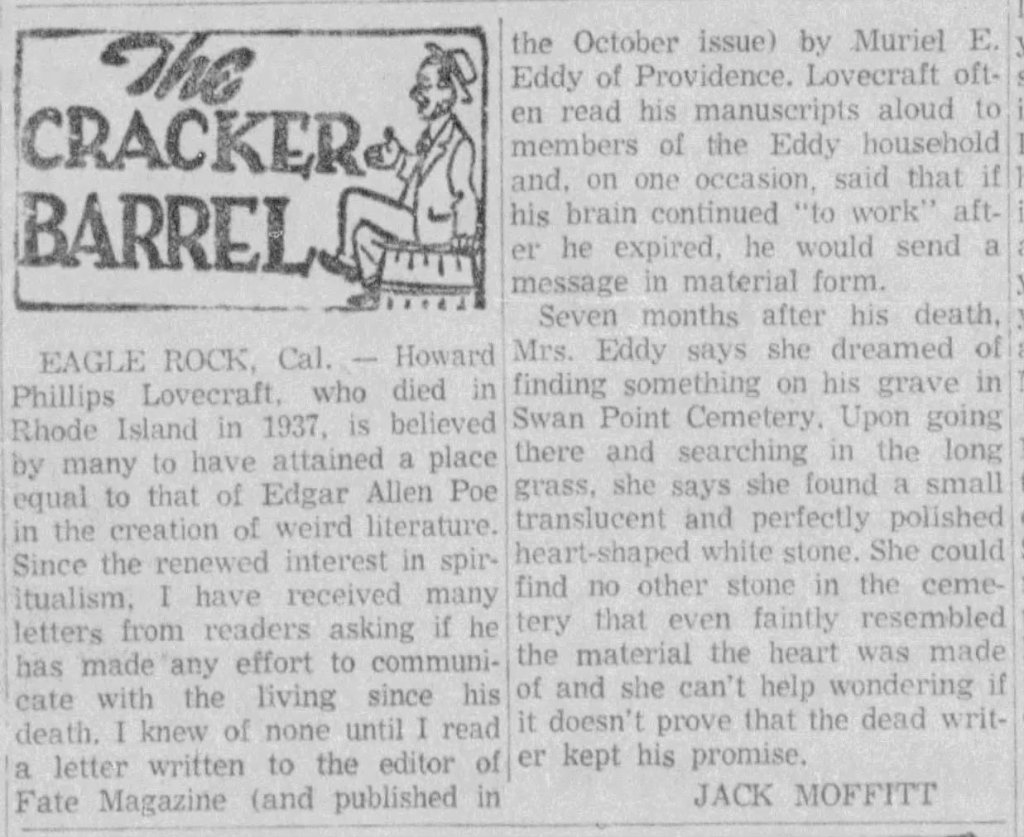
This item was reprinted in other papers as well.
“Message in Stone” was never republished, and the whole incident is largely ignored in Muriel E. Eddy’s most well-known memories. Yet in H.P.L.: The Man and The Image (1969), she ends a rambling collection of memories with the note:
On one of my visits to H.P.L.’s grave, I found a heart-shaped stone. I wondered if he had seen it there, what type of storey might have been concocted by his fertile brain.
Bobby Derie is the author of Weird Talers: Essays on Robert E. Howard and Others and Sex and the Cthulhu Mythos .
Deep Cuts in a Lovecraftian Vein uses Amazon Associate links. As an Amazon Associate I earn from qualifying purchases.
 Deep Cuts in a Lovecraftian Vein
As much as I have my issues with Muriel’s accounts, I loved reading “Message in Stone”. This is the first time I’ve read it. It’s very touching, and very clear that she deeply loved HPL.
LikeLiked by 1 person