In the August Derleth (1909 – 1971) archive of the Wisconsin Historical Society, there is a slim file of correspondence from Hazel Heald (1896 – 1961), comprising 23 letters and postcards (41 pages) over a period of about twenty years (1937 – 1958). The first letter is dated only ten days after Lovecraft’s death, as August Derleth quickly moved to secure permissions for the prospective publication of Lovecraft’s fiction. Weird Tales editor Farnsworth Wright gave Derleth her mailing address in a letter dated 22 Mar 1937, so Derleth must have written her practically immediately.
Dear August Derleth,
It was with great interest I read your letter this morning. Of course I will do anything in my power to help you in your work. With Wright’s permission you may print “The Horror in the Museum” and “Out of the Eons” if it does not detract from my part. I was a beginner and happened to be lucky enough to find HPL who certainly was the best to be found.
—Hazel Heald to August Derleth, 25 Mar 1937, MSS. Wisconsin Historical Society
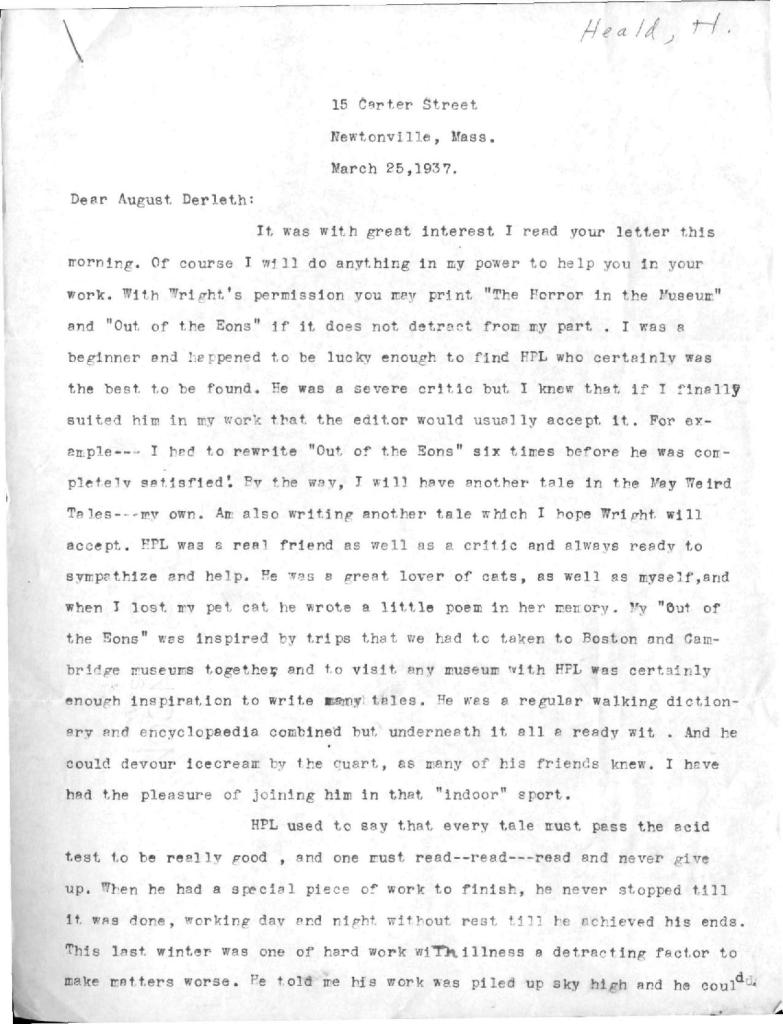
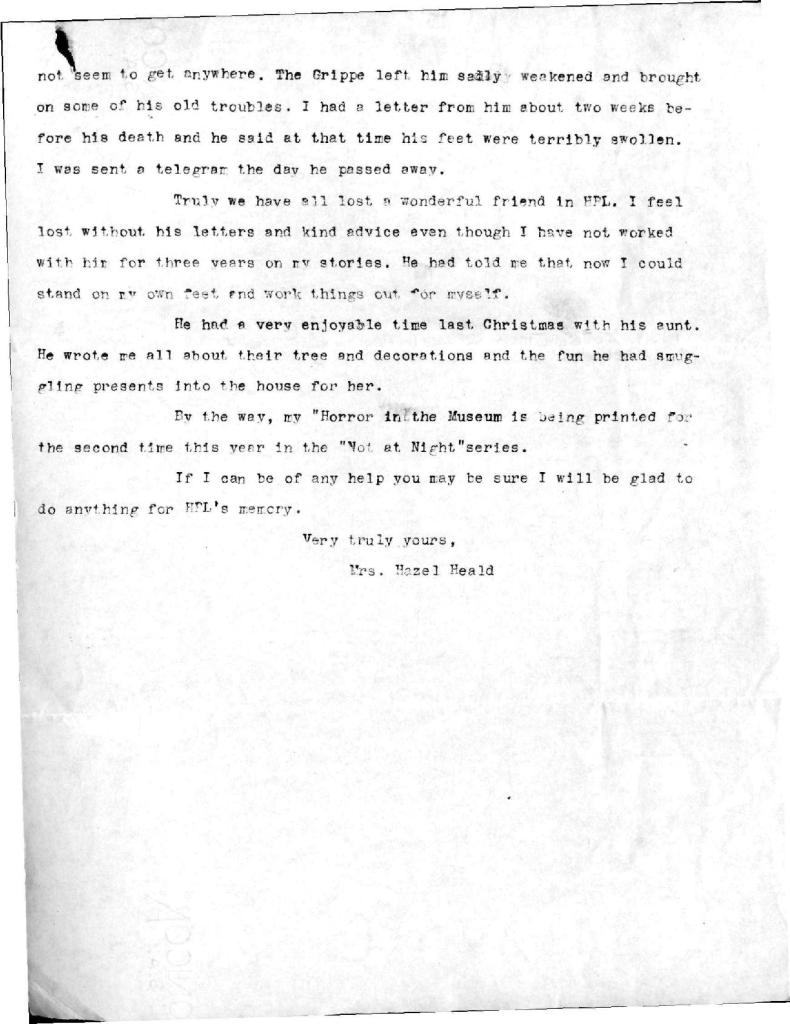
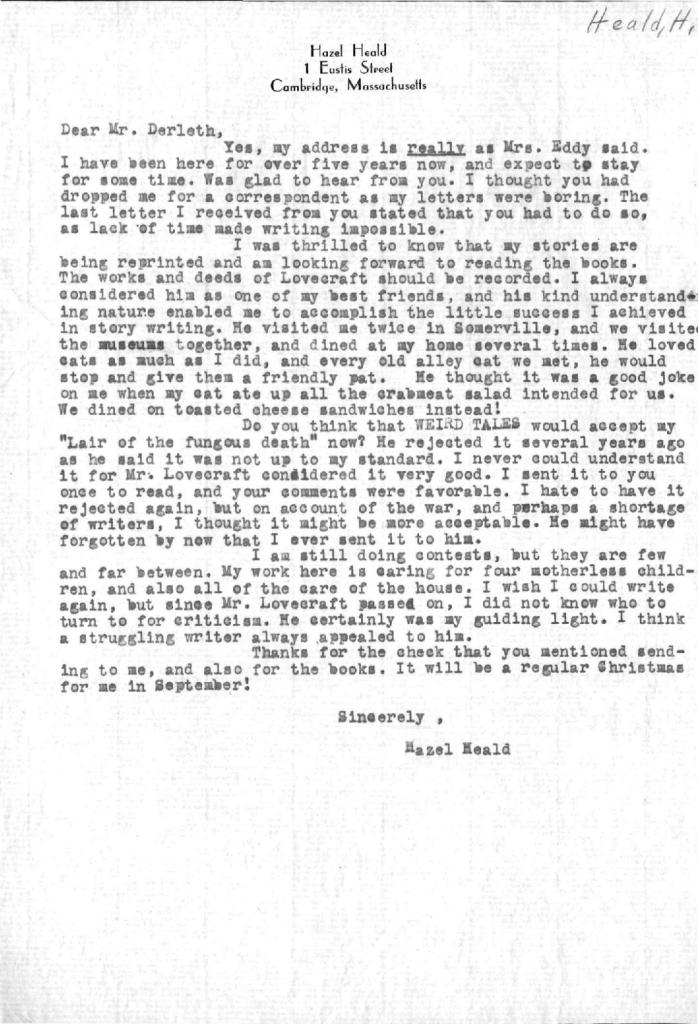
The first spate of letter-writing took place in 1937, as Heald discussed her work, relationship, and correspondence with Lovecraft, and a little about her own life. Derleth seemed to have been particularly interested in how much of the tales published under Heald’s name that Lovecraft had actually written, and whether she had kept any of his letters—when pressed on the subject, admitted Lovecraft had rewritten some of her stories, and that she hadn’t kept any of his letters.
Yet the most interesting parts of the letters are the tidbits about her own life:
HPL and I both had something in common—unfortunate marriages that ended in the divorce court. He sympathized with me all through that trying period (1928) and as he had had the same experience you can readily see that he fully understood. And since then he has known my troubles and his understanding heart gave me the courage to carry on. I miss him more than words can say and only hope that he is now at rest with the Heavenly Father I put all my trust in. It worries me because Howard didn’t believe in everlasting life and I pray the All-forgiving Father forgave that.
As story writing cannot make me a living, I have to take whatever work available to earn a living. I have always worked in an office but the younger generation have the preference, and as I am forty I have to take a back seat. At present I am housekeeper in a motherless home of five youngsters, so you see my spare moments are few. As I am not a servant type it humbles my pride, but what can one do? I would like to give all my time to writing but anyone must east and have a place to live, and I haven’t enough talent to ever be famous. I know it requires plenty of study and I have no spare time for that.
Our lives seem to be cut out for us and we have nothing to say about it. I have had business and musical education and am doing work that the humblest scrubwoman could do. My talents are few but they could be fully developed if I only had the chance. Even HPL with all his talents had a hard time to make both ends meet.
—Hazel Heald to August Derleth, 31 Mar 1937, MSS. Wisconsin Historical Society
Heald also discussed the stories she had placed with John Weir. The mention of Lovecraft’s marriage prompted further questions from Derleth:
About HPL and whether he was separated or divorced—I am certain he was divorced but have written to someone I know who will give me all the facts as her husband signed certain papers at that time. His wife’s name was Sonya Green [sic] and she is now a librarian in New York City. HPL gave me to understand it was a divorce for they had no similar interests. He talked it over with me to quite an extent, perhaps because I had received a divorce myself and fully understood.
—Hazel Heald to August Derleth, 7 Apr 1937, MSS. Wisconsin Historical SocietyHPL’s wife was a tall, regal looking woman wearing black, large picture hats, etc. He met her as her critic for at one time he advertised for work and she answered. I guess she chased the poor man to death for that was what I was told.
—Hazel Heald to August Derleth, 15 Apr 1937, MSS. Wisconsin Historical Society
Heald’s source of data was Muriel E. Eddy (see The Gentleman from Angell Street); Hazel Heald was never in direct contact with Sonia H. Greene (who is not known to have worked as a librarian in New York at any point, and who met Lovecraft at an amateur convention, not through an advertisement). Derleth’s interest was no doubt piqued since Lovecraft had barely mentioned his marriage in their own correspondence.
The overwhelming atmosphere of Hazel’s early letters is sadness. Stuck in an unhappy situation, unable to sell her stories, and now with one of her few friends dead.
This is vacation week and I’m nearly crazy with the children. The two oldest boys are saucy and won’t mind me at all, and the younger ones copy them. If I could only make a living by my writing I would be happy indeed instead of existing in an atmsophere of discontent. HPL knew my trouble and his sympathy meant a lot. I do for these children like an [sic] own mother but they call me names and their father doesn’t make them mind me. When I tell them they can’t do something he will say they can.
—Hazel Heald to August Derleth, 14 Apr 1937, MSS. Wisconsin Historical Society
We get the title of two unpublished Heald stories—”The Devil’s Jigsaw” and “Terror by Midnight”—which she submitted to Weird Tales and Amazing Stories respectively, but were apparently not accepted and is now lost. Heald also states that she had to go through a lawyer to get the money from Gernsback for “The Man of Stone.” Yet for the most part, she was discouraged:
HPL told me I could stand on my own feet without help but I have no confidence in myself. I think it takes special talent and training to be a writer and I have neither. HPL studied all his life and his works proved it. And I know you have worked hard for success and succeeded, which is more than I can do. Do you live with your parents? If I had started when I was younger and had their encouragement I would have been better off. They planned a great future for me—and I’m doing what any ignorant fool could do!
—Hazel Heald to August Derleth, 28 Apr 1937, MSS. Wisconsin Historical Society
This first period of correspondence appears to have ended in May 1937, shortly after the June 1937 issue of Weird Tales came out, filled with letters about Lovecraft from grieving fans, including one from Hazel Heald.
Good luck with the new books and also the one about HPL. The Eyrie was good this month. I wish they had all told him these nice things when he was alive. He got plenty discouraged at times and said when things got too bad he was going to take the laudanum route to oblivion.
Sincerely,
Hazel Heald
—Hazel Heald to August Derleth, 6 May 1937, MSS. Wisconsin Historical Society
Why the break? We can only guess; though Derleth was certainly busy. Efforts to get a collection of Lovecraft’s fiction in print through established publishing houses failed, and in 1939 Derleth and Donald Wandrei combined their resources to found Arkham House for the specific purpose of publishing The Outsider and Others. The war also interfered with Arkham House’s publishing schedule, due to Wandrei being drafted (Derleth got a deferment for health reasons) and paper rationing.
Nevertheless, in 1943 Arkham House published Beyond the Wall of Sleep (reprinting “The Horror in the Museum” and “Out of the Eons”) and in 1944 Marginalia (reprinting “The Man of Stone” and “Winged Death.”) Derleth was also stretching his wings as an anthologist, and reprinted “The Horror in the Burying-Ground” in Sleep No More: Twenty Masterpieces of Horror for the Connoisseur (1944). This necessitated new correspondence because Heald was due monies and copies of the books.
The 1940 Federal census lists Hazel Heald living as a housekeeper with the Curry family in Cambridge, Massachusetts, which consisted of James Curry (32), his sister Elizabeth Curry (35), and children James Curry, Jr. (10), Rita Curry (7), Ronald Curry (5), and Lillian M. Curry (1). The mother of the children, Lillian May Curry (née Hill), had died 16 Sep 1938—the same day listed as the younger Lillian’s birthdate.
Unfortunately, Hazel Heald was badly out of the loop: Farnsworth Wright was no longer editor of Weird Tales, and had in fact died in 1940, being replaced by Dorothy McIlwraith. Derleth apparently informed her of this. She also inquired about the business side of things—Heald had no formal contract with Derleth, who had gotten permissions and reprint rights for Lovecraft’s stories (and Heald’s, apparently) from Weird Tales (it was not uncommon at the time for a magazine to buy all rights for a story, unless there was agreement otherwise).
For Marginalia, Derleth sought out permission from Heald—although given the dates involved, this might have been a bit of an afterthought.
Contact with Derleth also informed Heald about the memoirs about Lovecraft, including those that touched on her own life. When she read W. Paul Cook’s “An Appreciation of H. P. Lovecraft” in Beyond the Wall of Sleep, for instance, she wrote:
I was interested in Paul Cook’s account of Lovecraft’s Boston visit, and how he made him rest up before coming over to my house. He certainly did not act tired, and ate very well, although Cook said he gave him a good meal before he came. I wonder if he thought that he would be starved at my house? He seemed to enjoy himself a lot. Soon after that he came again, and we visited all of the museums together. That was where I conceived the idea for OUT OF THE EONS.
—Hazel Heald to August Derleth, 14 Oct 1944, MSS. Wisconsin Historical Society
Once again, the letters go back and forth between Heald’s everyday life (in which the war and looming presidential election feature prominently), reminiscences of Lovecraft, and book-talk. Heald had begun an evening writing class, and:
Glad that “Sleep No More” is such a success. My hairdresser read my story while she was giving me a permanent. It is a wonder I didn’t end up burned to a crisp!
—Hazel Heald to August Derleth, 6 Nov 1944, MSS. Wisconsin Historical Society
Derleth expressed an interest in her unpublished tale “The Lair of Fungous Death”—probably out of the vague hope of an unknown Lovecraft revision—but nothing seems to have ultimately come of this. In publishing Heald’s stories, Derleth made little effort to hide his opinion that they were effectively Lovecraft tales under a different name:
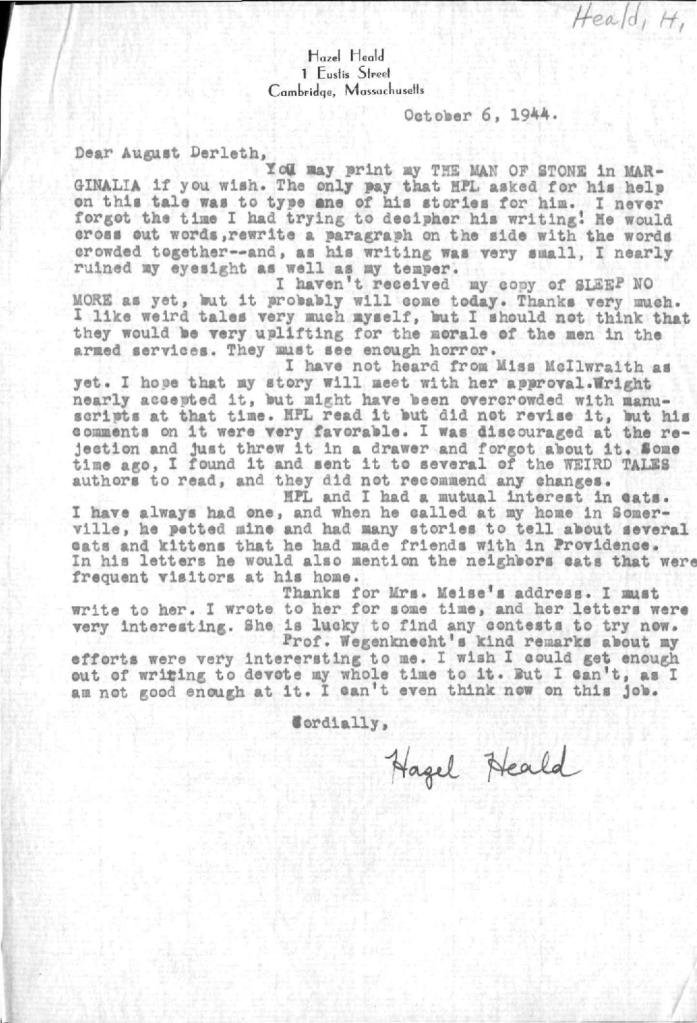
The Man of Stone was Mrs. Heald’s first-published story. It was revised by Lovecraft to somewhat less an extent than her later stories. Under date of Septemember 30, 1944, Mrs. Heald wrote: “Lovecraft helped me on this story as much as on the others, and did actually rewrite paragraphs. He would criticize paragraph after paragraph and pencil remarks beside them, and then make me rewrite them until they pleased him.” There is conclusive evidence to indicate that Lovecraft’s revision-work divides sharply into two classes—the bulk of purely professional revision of the language and punctuation; and a certain small group of stories in which he took a keen personal interest, and which he managed to permeate with his own literary personality. This is less true of The Man of Stone, than it is of later work under the byline of Hazel Heald. Lovecraft also revised, in addition to work already printed by Arkham House, stories bearing the bylines of Sonia H. Greene (the lady who was for a short time Lovecraft’s wife) and Adolphe de Castro, appearing in Weird Tales. The Man of Stone is included here primarily as an example of early Lovecraft revision, which bears the marks both of a purely professional interest and in part of a personal one, as witness the injection of the Book of Eibon, etc.
—August Derleth, Marginalia 116
Heald would read this and reply:
By the footnote on “The Man of Stone” people might get the idea that HPL actually wrote my stories Of course he helped me a lot by his criticism, but I was the one who did the hard work.
—Hazel Heald to August Derleth, 1 Feb 1945, MSS. Wisconsin Historical Society
Whether Derleth headed this or not is unclear; the correspondence gets sporadic for the next few years. Derleth may have kept in touch periodically, since “Out of the Eons” was reprinted in The Sleeping and the Dead: Thirty Uncanny Tales (1947) and Avon Fantasy Reader #18 (1952), “The Horror in the Burying-Ground” was reprinted by Arkham House in Something About Cats and Other Pierces (1949). But this seems to have been less of the friendly correspondence of Yesteryear, and more business-like.
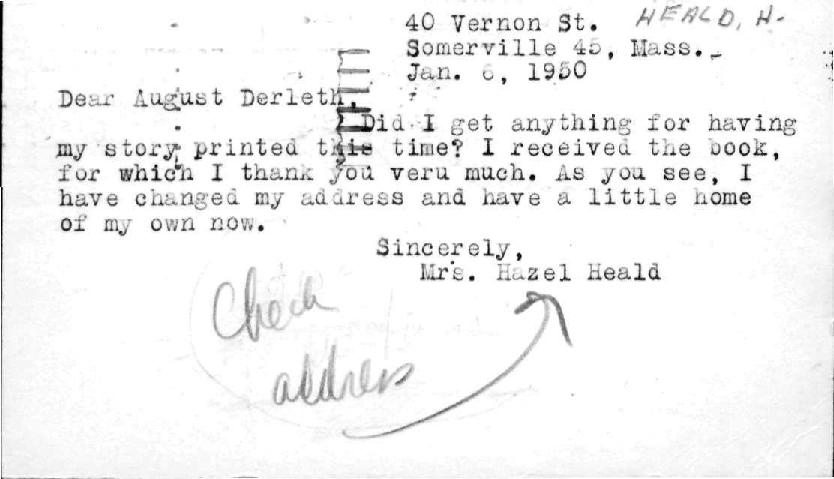
We can only speculate, but it seems likely that there was little more that Hazel Heald could offer Derleth in terms of reminiscences of Lovecraft or fiction revised by him; and he for his part could not (or would not) revise her stories and try to agent them as Lovecraft had done.
The final letter from Hazel Heald in the file is dated 19 Jan 1958, only a few years before her death.
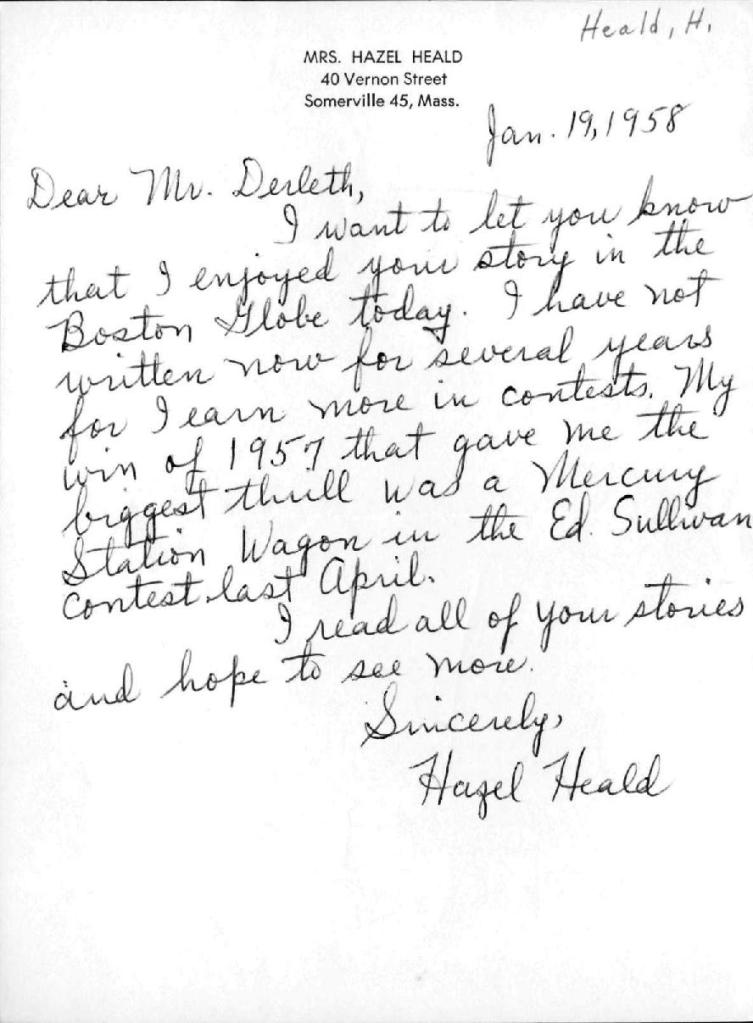
The story was “The Adventure of the Man with a Broken Face” by August Derleth (Boston Globe, 19 Jan 1958, magazine supplement page 4).
Hazel Heald’s correspondence with August Derleth was friendly enough, but they do not appear to be friends in the strictest sense. They had a friend in common in Lovecraft, and his death provided the spark that began their correspondence—but they had little else in common. Heald’s brief reminiscences added to Derleth’s store of Lovecraftian lore and the stories he could publish, but Heald never wrote a proper memoir of her own, and there was little interest in her for her own sake.
Through Heald’s letters to Derleth, we get the only real glimpse into her own life in her own words, something quite different from the impersonal census data and odd newspaper clippings, or reading about her through odd comments Lovecraft dropped in his own letters.
Bobby Derie is the author of Weird Talers: Essays on Robert E. Howard & Others (2019) and Sex and the Cthulhu Mythos (2014).
 Deep Cuts in a Lovecraftian Vein
Phenomenal!
I wonder why she got the idea that Sonia was working as a librarian. I mean, she likely learned it from Muriel Eddy, but I’m curious from where these women got that idea.
LikeLike
No idea. It’s such an oddly specific bit I had to leave it in.
LikeLiked by 1 person
Hmm, oddly specific, indeed! 🤔Another little puzzle piece to verify…
LikeLike