I’ve lived for long, uncounted eons
Since Time and I were young;
I dwell in hidden crypts and eyries,
And speak with witch’s tongue.
When blood drips from the horned moon,
And wild winds lash the sea,
And men and ships die in the night,
I laugh with demon-glee.
For well I know my evil curse—
That I shall never die;
My soul will dwell with snakes and toads,
and bats that blindly fly.
I walk my dark, forbidden ways,
And none of human race
Can ever flee my awful spell,
Who look upon my face.
And when the sun at last grows cold
In its vain, ageless quest,
I’ll seek once more the alien land
Where I was born unblest.
—Pauline Booker, “The Eldritch One”
※
Pauline Booker was a pulp poet during the 1940s and 50s with a long list of verse published in magazines like All-Story Love, Love Book Magazine, Max Brand’s Western Magazine, New Love Magazine, Rangeland Romances, Romance Western, Sweetheart Love Stories, Star Western—and three poems in Weird Tales. Of her life and broader career, practically nothing is known. All we can say for certain is that she had her finger on the pulse of weird fiction, at least a little.
H. P. Lovecraft did not coin the word “eldritch”—did not even use it in the majority of his stories, and only once or most twice in any given story (although he did use it three times in “Supernatural Horror in Literature.”) Yet it is a keyword that has become associated with Lovecraft and his mode of fiction as surely as “cosmic horror,” “squamous,” “non-Euclidean,” or “tentacle.” Eldritch has become part of the vocabulary of cosmic horror, used and abused with love and affection by all manner of writers.
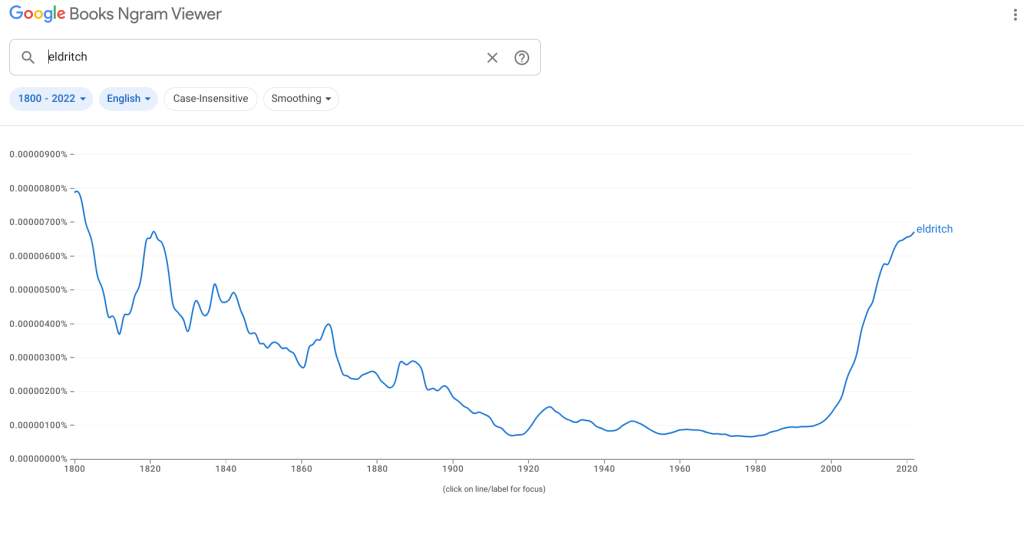
When did that transition happen? Google’s n-gram viewer is a handy snapshot for a word’s use, and the word was decreasing in frequency, almost at the nadir of its use until the 1910s—and forms a little peak around the time when Weird Tales began to be published in 1923. Is the recent spike in usage all down to Lovecraft and the fiction he inspired? Maybe. Andrew Eldritch, lead singer of Sisters of Mercy, and Philip K. Dick’s The Three Stigmata of Palmer Eldritch (1964) probably also contributes to the trend. Yet Pauline Booker was writing during a period when “eldritch” was on the decline again, at least outside of Mythos pastiches.
Yet how many fans of Lovecraft and weird fiction would not have caught her meaning, just from the title?
While it is tempting to try and connect “The Eldritch One” to some specific inspiration from Lovecraft, the imagery of the poem is rather traditional, combining favorite elements from Weird Tales, and not anything specific to one of Lovecraft’s stranger horrors. There are hints of witchcraft, of gorgons, immortality or the undead. A miscellany of horror, a real witch’s brew of familiar elements, but nothing concrete. Yet in its own way, as with all good poetry, it is timeless, as relevant and enjoyable to horror fans now as it was then.
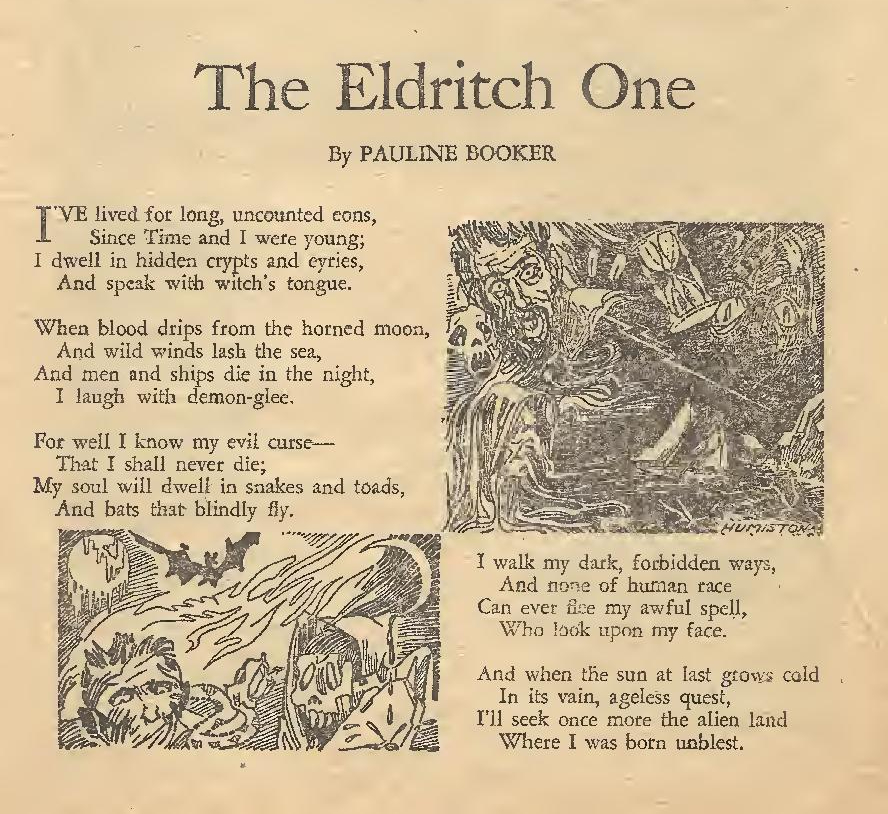
“The Eldritch One” was published in Weird Tales May 1948. It has not been reprinted.
Bobby Derie is the author of Weird Talers: Essays on Robert E. Howard and Others and Sex and the Cthulhu Mythos.
Deep Cuts in a Lovecraftian Vein uses Amazon Associate links. As an Amazon Associate I earn from qualifying purchases.
 Deep Cuts in a Lovecraftian Vein