In the August Derleth (1909 – 1971) archive of the Wisconsin Historical Society, there is a fairly substantial file of correspondence from Zealia Bishop (1897 – 1968), comprising ~83 letters and postcards (192 pages) over a period of about thirty years (1937 – 1966, roughly; many letters are undated). The first letter is dated 8 Apr 1937, and is a reply from Bishop to Derleth:
Dear August Derleth:—
I am overwhelmed with shock & grief at the tragic message your letter conyed to me for I had not learned until then of Mr. Lovecraft’s death. No on can ever know what his means to me as it was he who steered me into the path of writing—who taught me the necessity & fascination of playing with words—taught me humbleness rather than arrogance—and it was always to him that I rushed when in difficulty—how willingly, patiently and kindly did he always pull me from the chaos—regardless of the sacrifice to himself—Poor Howard! What a beautiful spirit he possessed—& how insignificant the rest of us are beside his shining armor! How I shall continue without him I don’t know—for he was as an anchor in my stormy career. Anything—anything I can do for his old aunt—& to partially repay him for his goodness & patience, to me—let me know— His letters to me—I have hundreds & hundreds—are so beautiful & inspiring. Why could we not use excerpts from them? Also I have two stories which were never published—you might be interested in reading them— F. Wright—read one: Medusa’s Coil—but could not use it then—I never sent it again nor endeavored to place it with another publisher—Two years ago Howard helped me with a book—The Adopted Son—He liked it so very much—and urged my sending it out tirelessly—but after I’ve done a piece of work I can’t bring myself to struggle over the financial ends—the book is here—Would you care to read it?
And on in that vein. In effect, Bishop’s correspondence with Derleth picks up where her correspondence with Lovecraft drops off. Zealia Bishop was at the time relatively comfortable with her husband Dauthard William Bishop in Missouri, where they owned a farm/ranch (and later a furniture manufacturing business). Their sons from previous marriages were now grown and out of the house, according to the 1940 Federal census, and they had not yet adopted their two daughters.
As with Hazel Heald, Derleth wrote to Zealia Bishop primarily in search of Lovecraftiana, as part of his nascent plan to publish the fiction and letters of H. P. Lovecraft. She had two weird stories revised by Lovecraft as yet unpublished: “Medusa’s Coil” (1939) and “The Mound” (1940), which Derleth would see published (and in the former case, whose ending he would bowdlerize). Bishop’s letters from Lovecraft were transcribed and some of them made it into the Selected Letters published by Arkham House. Derleth appears to have shown rather less interest in Bishop’s non-weird fiction.
The majority of the letters are from Zealia Bishop to Derleth, and this gives a different perspective, since we can read about her own life and experience with Lovecraft in her own words. These first 1937-1941 letters in particular deal considerably with her memories of Lovecraft and the publication of her stories at Weird Tales. After this, the correspondence appears to have fallen off for a space. The next letter from Bishop to Derleth is dated 19 Jan 1949, where she details the losses suffered during the war.
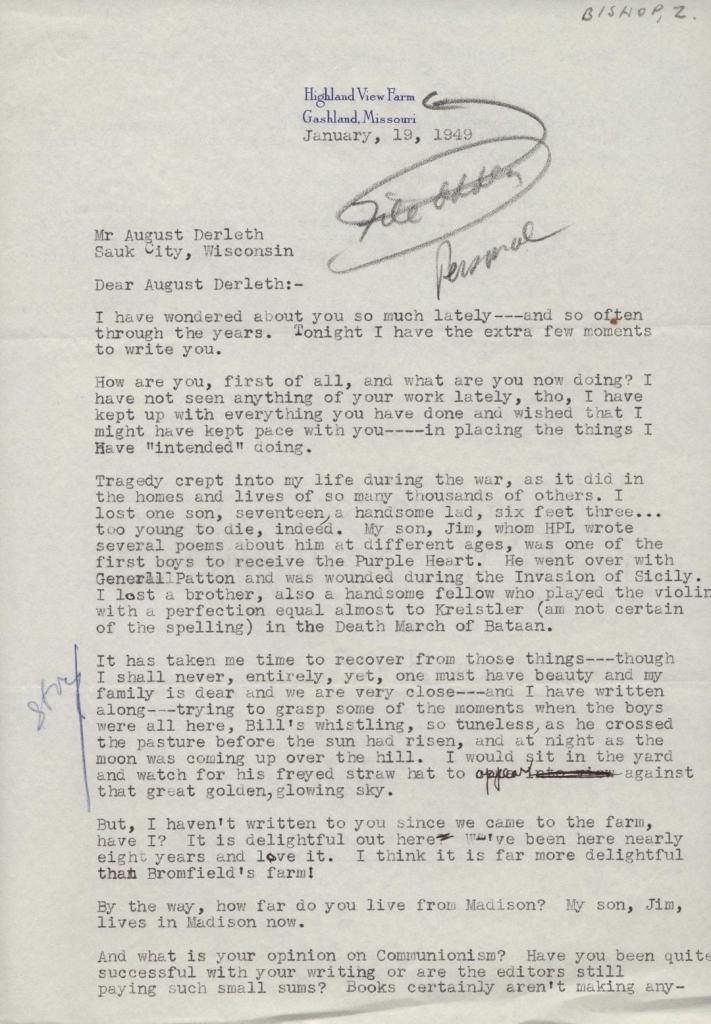
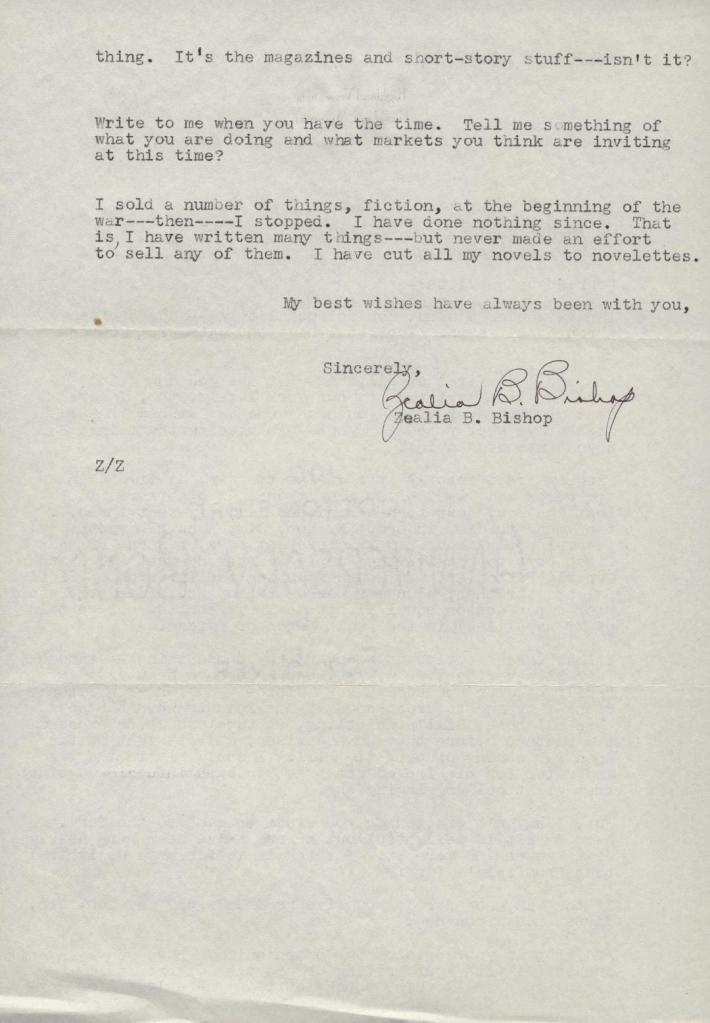
Her letters veer between reminiscences of Lovecraft and matters of the present, especially where they came together in the printing of her stories. Both “The Mound” and “The Curse of Yig” appeared in Beyond the Wall of Sleep (1943) from Arkham House, so presumably there would have been permission sought and granted, but Bishop did not apparently receive a copy of the book until after she wrote to Derleth in 1949, which prompted the comment:
He knew that I prefered lighter fiction, tho he encouraged my continuing on with weird stories for he thought I would gain more depth. He was delighted when I went to Oklahoma and became interested in folklore and wrote the story of Yig. This is strictly a story that came from my sister’s husband’s grandmother and the Indians around Binger. The names all authentic. The Mound also came from the same source and Medusa’s Coil originated from a tale told me by my negro maid.
I am wondering how the fact that it is listed as HPL’s story in this book will effected its being reprinted in a collection of my own? Was it your intention to make them appear as his stories?
—Zealia Bishop to August Derleth, 28 Jan 1949, MSS. Wisconsin Historical Society
When and how Zealia Bishop decided she might publish a collection of her stories isn’t clear, yet this became the trend of her correspondence with Derleth over the next few years, which resulted in The Curse of Yig (1953) being published by Arkham House as a more-or-less vanity press arrangement.
Business aside, their friendship improved when they actually met in person in 1949—her son Jim (James P. Reed) was out of the army and living in Madison, Wisconsin, Derleth’s home state, so they were close enough to visit. Her reaction was positive, if perhaps not exactly heartening:
Dear August:
A little late in telling how much Jim and I enjoyed the visit with you and how much it meant to me. That trip was exactly what I needed to get me back in harness and on the road again. Believe this time I shall continue on and, at least, get a peek at the bull’s eye. How foolish for me, with all the years of training I’ve had, to have let people discourage me. From now on—well, I’ll keep plugging. […]
I fell more at ease with you now. You’re just another boy—big, fat—spoiled as hell—
My best always,
Zealia
—Zealia Bishop to August Derleth, 6 Apr 1949, MSS. Wisconsin Historical Society
At the time, Derleth had some issues with his weight and hypertension; he was also “pitching woo” with a local teenage girl (Sandra Winters, whom Derleth would later marry), which Bishop found amusing. Much of the focus on her own life and writing in the letters surrounds Bishop’s critical lack of confidence in her own writing, her inability to finish things, and her concern over the perception of her work as her own:
It was just before Bill’s and my brother’s tragic deaths, that H. Hoffman Price [sic] (maybe I have that first initial wrong) turned me over to his agent August Lenninger. At that point when he was advising me my heart and mind seemed suddently to stand still. Oh, I always did some writing, kept notes religiously. That was simply second nature . . . . but it was difficult to settle down to creating anything in particular. Then suddenly things changed for me. I knew I must do everything I had been seeking (at least make the efort) But, for some reason, I began to feel, that possibly my writing weird tales and having HPL revise them had made it difficult for me to do things of any importance, without editors believing I had been unable to create alone. Is that true, or is that merely me own fancy? Now, I believe I should begin to sell—if I have developed characterization well enough. The plots are there . . . but— Of all the eight novels I wrote I never tried to sell any of them. The last time Professor Moe read my pottery novel ater my final revision, he said it was a ‘work of art’; that I ahd done a wonderful job and he thought it would sell; but I didn’t send it out. I had that feeling I still couldn’t sell my work to an editor. I would like to have you read one or two either short stories or nevels and tell me what you think of them and point out specifically what I should or shot not do.
—Zealia Bishop to August Derleth, 24 Apr 1949, MSS. Wisconsin Historical Society
E. Hoffmann Price and Maurice W. Moe were friends of Lovecraft’s; Price was a professional pulp writer during the 40s, and August Lenninger a hard-nosed agent, while Moe was primarily an English teacher. Bishop’s fear of rejection is almost palpable in these letters; for Derleth, who needed to publish constantly to survive, it was almost a matter of course that some stories or novels would be rejected—and rewritten, resubmitted, until they sold. That was how he worked.
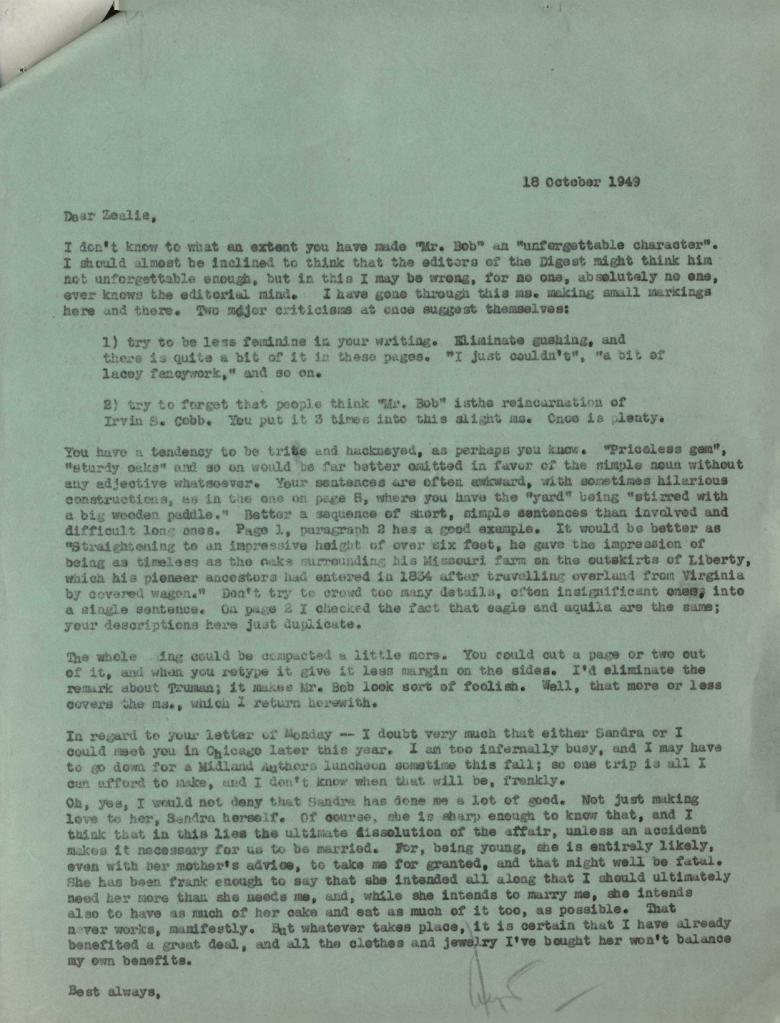
Derleth was willing to be friendly, and even read and offer a few comments on her manuscripts, evident from a carbon of a letter that survives, with notes like: “try to be less feminine in your writing. Eliminate gushing, and there is quite a bit of it in these pages.” and “You have a tendency to be trite and hackneyed, as perhaps you know.” While these might seem a bit harsh, they’re also probably fair and well-meant.
The file of correspondence is spotty 1950-1952. The long-promised articles on Lovecraft and Derleth that Bishop had meant to write took a long time to actually come to fruition, and both were very busy with their respective lives. The adoption of the young women Helen and Frances May (“Frankie”) by Zealia and her husband apparently was completed in 1950. August Derleth and Sandra Winters were engaged to be married and Zealia congratulated them about it a little early (the letter of 10 Jun 1952 is addressed to “Mr. & Mrs. Derleth”; they would not be married until 6 Apr 1953—unless the letter is misdated, which is possible).
Then, disaster.
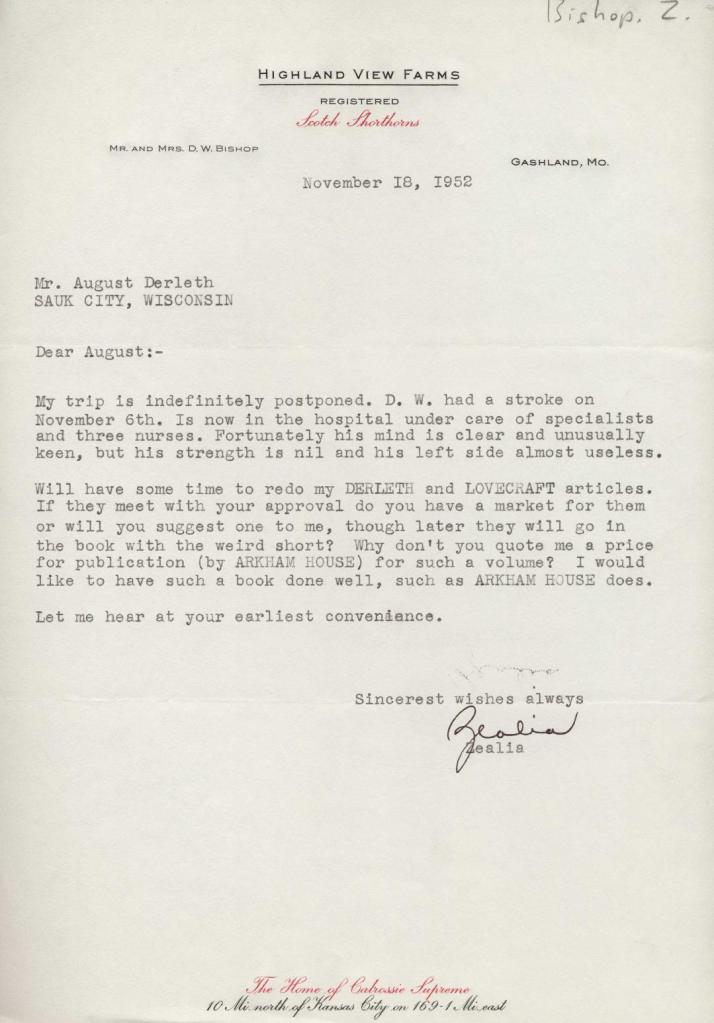
D. W. Bishop would live until 1956, but would never regain his full health. This was a major change to Zealia’s life and to the businesses that the Bishops shared. At the same time, she was determined to publish something; and Derleth was amenable for her weird fiction to come out through Arkham House. So the letters focus on the details of the publication of The Curse of Yig, which provided a relief from managing the farm and her life as caretaker:
Since D.W. is in this state—whether or not to be of long duration I shall be confined closely. Were I unable to keep busy and accomplish something, I could not exist. I cannot play or practice on the organ or piano. We have to whisper most of the time and slip about on tip-toe. Except on the surface, all idea of keeping the house clean by vacum [sic] or waxer is remote. Any noise seems to set him into a tantrum. Yes, it is very hard on one who has been so active and I would give my own life if I could give back to him his health and activity. Nothing could be worse or more heartbreaking than to watch his slow disintegration and one whom you love so dearly. So, you see, why I am especially eager to keep so busy and must not dwell too much upon the conditions about me.
—Zealia Bishop to August Derleth, 22 Dec 1952, MSS. Wisconsin Historical Society
D. W. is not now bedfast. He sits in a contour chair in a darkened library fourteen to eighteen hours a day—and never moves from there except to go to his meals, to the bath or, on occasion, to look out one of the windows in another room. For amusement or diversion he listens to a radio beginning at 5:A.M. and continuing until sometimes midnight. (I loathe a radio.) He likes only hillbilly msuic. He insists that I sit with him at all times. If I go upstairs or into another room he calls or starts ringing a bell for me. In three days I wrote exactly four words on the revision of the DERLETH article.
—Zealia Bishop to August Derleth, 14 Aug 1953, MSS. Wisconsin Historical Society
Things aren’t going so well here. Drs. have had to tell D.W. his true condition. I am going work of the day & night—so I am weary, very weary—and must do all the planning for this cattle sale Oct 21st.
—Zealia Bishop to August Derleth, 16 Sep 1953, MSS. Wisconsin Historical Society
Without D. W. Bishop at the helm to manage the business, the decision was made to close it out—sell the cattle at least—which in itself was a complicated process that involved some involvement with the Internal Revenue Service, according to Zealia Bishop’s 19 Jan 1954 letter to Derleth. The same year, their adopted daughter Frankie was married. The promotion for The Curse of Yig included a brief appearance on local television:
Anne Hayes had me on TV last Tuesday—with Frank Glenn—who has the more complete book stores in this aera [sic]. He gave a fine plug for the book, and immediately afterward had a number of calls for “YIG”—I am profoundly surprised that so much interest is being shown because I am not too elated. Had this come ten years ago I would have loved it and perhaps been a bigoted nit-wit—now, I feel only humility and gratitude for having the honor of being instructed by so great a man and teacher—In the interview your pitcutre was held before the camera and we discussed you—
—Zealia Bishop to August Derleth, 19 Jan 1954, MSS. Wisconsin Historical Society
As it happened, Zealia had misunderstood her contract with Arkham House, which probably exacerbated her financial difficulties at this trying time, due to having taken a short-term loan to cover the cost of printing the book and not understanding that the immediate receipts from initial sales would not begin to pay it back.
It was, it happened, a bad time for Arkham House. The Curse of Yig (1953) was followed by The Feasting Dead (1954) by John Metcalfe, but Arkham House did not publish another book until The Survivor and Others (1957), Derleth’s collection of his posthumous collaborations with Lovecraft. Derleth’s letters to Zealia Bishop during this period give a peak into Arkham House’s business, and the harsh realities of independent press publishing. The slowness in which The Curse of Yig sold probably discouraged any further publishing plans Bishop had.
There seem to be fewer letters from Zealia to August during this period, though they appear to have remained on good terms. A letter of congratulations was sent to August and Sandra Derleth on the birth of their first child, April Rose Derleth, in 1955. For herself, Zealia was still dealing with her husband:
D. W. is holding own. We still have three nurses and our income is rapidly vanishing. he is helpless, it requires two people to turn or move him. he doesn’t get up at all anymore, but we try not to let it discourage us. Rather, we endeavor to feel this is our God-given job and we must go about it happily and unselfishly. Such an attitude does wonders for us! I believe I feel younger and certainly do not feel one day older . . . tho my hair is quite silver!
—Zealia Bishop to August Derleth, 4 Jul 1956, MSS. Wisconsin Historical Society
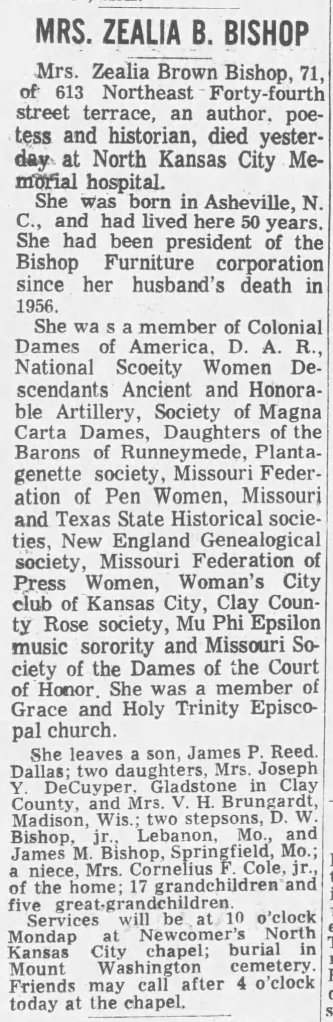
D. W. Bishop died 11 Sep 1956; the death certificate lists immediate causes of death as pyelonephritis (kidney infection), uremia (high urea in the blood, from kidney failure), and pneumonia. Zealia announced her husband’s death in the same letter where she congratulated the Derleths on the birth of their second child, Walden William Derleth. The death meant more legal matters to deal with, including government audits of the furniture factory, and Zealia was a grandmother eight times over. She tried to keep in touch. Yet there are gaps in the letters, and signs of weariness from the years of caretaking which, now over, left her bereft of purpose.
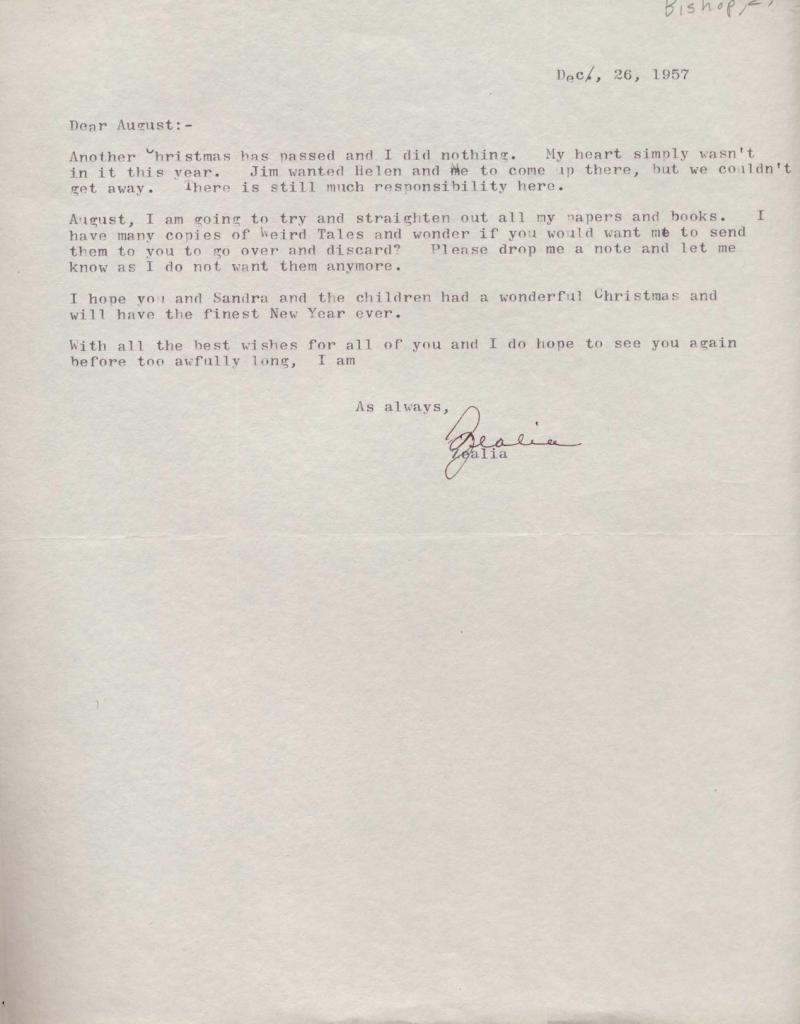
Never a year went by without a letter or two from Zealia Bishop to August Derleth, but in 1963 her financial situation took a sudden and dramatic turn for the worse:
Have lost practically everything—through no fault of my own—Go over your books—See if you can send me a small check each month instead of semi-annually—Never needed help before in my life—& so desperately—Will tell you all later—Am living with my niece—
—Zealia Bishop to August Derleth, c. Jun 1963, MSS. Wisconsin Historical Society
What exactly happened isn’t clear from the letters; she wrote in 1959 that Kansas City absorbing Gashland changed the “tax picture” on her property—probably that meant higher taxes. There may also have been some business mismanagement, for she wrote that she was not often in the office, that her problems were placing her trust and confidence in others, and in one undated letter: “I had no debts—they were debts of others—”
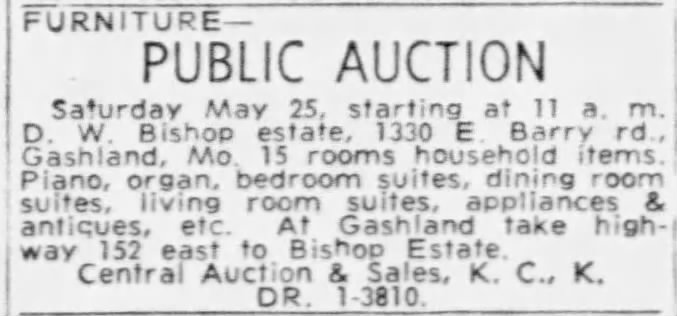
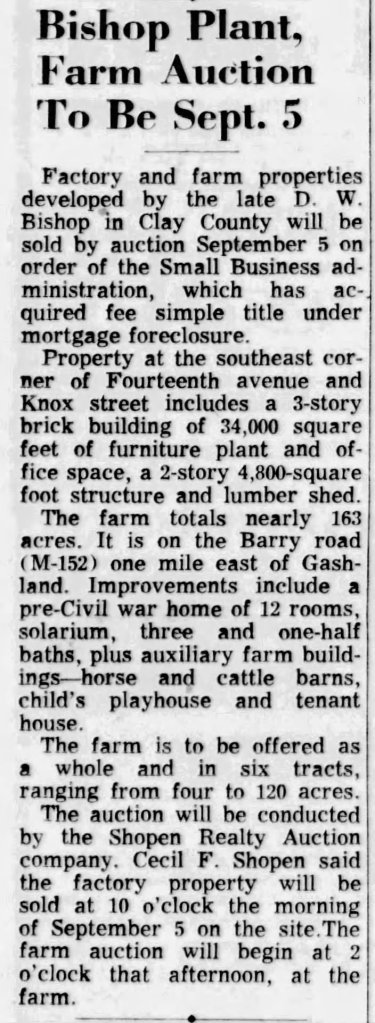
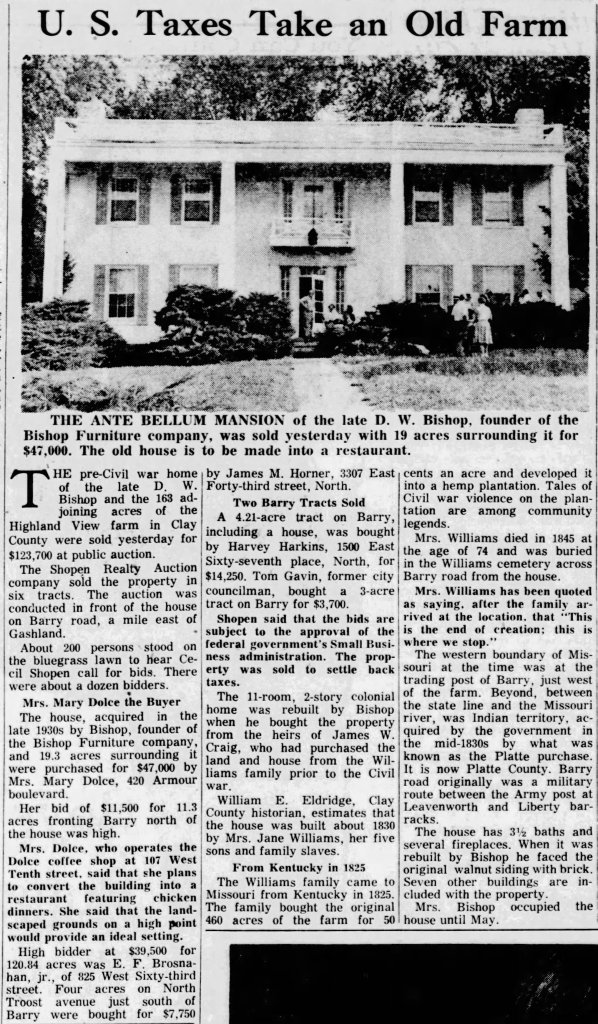
Newspaper ads suggest that Zealia Bishop owed the government several years of back taxes, and when they came to collect the farm, factory, and house were all foreclosed on and had to be sold.
The letters to Derleth did not cease. Zealia Bishop did her best to go on with her life, though at times she would write things like:
Am so unsettled—so unaccustomed to living this way—my heart simply isn’t in anything. It’s difficult to realize this is actually “me”—
—Zealia Bishop to August Derleth, c. 1965, MSS. Wisconsin Historical Society
She was 68 years old and had lost her husband, her home, presumably most of all of her savings and many belongings. On top of which, there seems to have been a breakdown in her relationship with her son:
Never hear from Jim—& we were such truly good friends—as well as mother & son—& my only child! I shall never recover from all this—it was so tragic—so unnecessary—
—Zealia Bishop to August Derleth, 8 Mar 1966, MSS. Wisconsin Historical Society
We do not have Jim Reed’s thoughts on his mother, or what the circumstances were; perhaps he had simply not called or written to her for a while, and there was no real break, only a lonely old woman who wanted to hear from her child more often than she did. The end of life is almost always tragic, if only because it is written out long beforehand, and cannot be avoided. Many of the later letters, where Zealia’s handwriting becomes noticeably more shaky, ask for Derleth to send her anything he can—any check, however small—and with every indication is that she was near the end of her resources. In an undated letter, she wrote:
To one who has tried to make life worthwhile for others I cannot believe so much has been put upon my shoulders—everything stripped from me with an hour’s warning—& not one bit of it my fault except trust & confidence.
How I would love to see & talk to you, August, & have your advice as a column.
—Zealia Bishop to August Derleth, n.d. [1964?], MSS. Wisconsin Historical Society
While the occasional small royalty check on The Curse of Yig was no doubt welcome, what she always asked for from Derleth was news of him and his children—what she always expressed was a desire to visit and see him once again. Friendship, as much as anything, was what Zealia Bishop seemed to crave in her extremity—and perhaps Derleth did his part to provide that.
Into every life comes ups and downs, and Zealia weathered her storms with whatever dignity she could manage. Lovecraft, no doubt, would have approved.
We are in the direct line of a tornado at the moment so I’ll stop & go to the basement with the rest—
—Zealia Bishop to August Derleth, n.d. [1965], MSS. Wisconsin Historical Society
Bobby Derie is the author of Weird Talers: Essays on Robert E. Howard and Others and Sex and the Cthulhu Mythos.
Deep Cuts in a Lovecraftian Vein uses Amazon Associate links. As an Amazon Associate I earn from qualifying purchases.
 Deep Cuts in a Lovecraftian Vein
A little Bishopiana I ran across in looking to see what became of their rather grand residence. It still stands, with the exterior broadly similar, at 1333 NE Barry Road, K.C., (the NE being a later interpolation, I think) and houses the Souder Family Funeral Home.
According to the article, for some intervening period it also operated as Bob’s Grocery. However, more interestingly, it describes the Bishops’ donation of a Hammond organ to the new Gashland Community Church. Given that those started at $1,295 (see 1950 ad below; perhaps about $16,000 in today’s money), the Bishops clearly had considerable means and Zealia’s late-life penury must have been all the more deeply felt.
https://gashland.org/windows-on-our-world-may-2023/
https://www.goantiques.com/hammond-organ-1950-1954569
P.S. The church, now Gashland Evangelical Presbyterian, seems to still have the organ, based on the photo here, and it’s clearly more deluxe than the base model depicted in the Hammond ad.
https://gashland.org/kelly-hackleman/
LikeLiked by 1 person