Thanks extremely for the interesting cuttings, which I herewith return. I also have kept a file of these things for years—would you care to see some of the choicest items? I’d be glad to lend any number of envelopes full. That fog in Washington surely was a curious ‘colour out of space’ . . . . . I wonder if the preparations to reprint my story in that state had anything to do with it? The case of the Boer lady—Mevrouw van de Riet—certainly offers dark food for the imagination. She seems to be a sort of female Aleister Crowley—or a striga, lamia, empusa, or something of the sort. An odd—& potentially evil—face. Actually, she probably has the same degenerate psychology found in the old maleficae whom Sprenger & Kramer & Boguet & the other Renaissance prosecutors encountered—no doubt seeking to start cults or groups of loathsome practices wherever she settles. For fictional purposes you could use the South African birth—hinting at a childhood visit to the ruins of Zimbabwe by moonlight, & at whispers overheard there . . . . . . for is that not one of the points visited by the Fishers from Outside?
—H. P. Lovecraft to Clark Ashton Smith, postmarked 18 Nov 1933, Dawnward Spire, Lonely Hill 479
I’m glad the newspaper clippings were of interest. Thanks for your suggestion about the Boer witch-woman: she might well have gone to Zimbabwe and imbibed certain vaporous or shadowy outside influences from those unholy ruins. I may yet use her in a story; she certainly looks the part assigned to her.
—Clark Ashton Smith to H. P. Lovecraft, postmarked 4 Dec 1933, Dawnward Spire, Lonely Hill 491
Today, friends widely separated geographically can easily send each other news articles and images from different parts of the world through social media and the internet. In Lovecraft’s day, they would stick clippings from newspapers and magazines to each other alongside their letters. As the clippings themselves often do not survive, researchers are left to figure out what Lovecraft and friends were talking about via the references left in their letters—which, for Mevrouw (“Madam” or “Mrs.” in Dutch/Afrikaans) van de Riet, little has come to light.
Fortunately, the ongoing scanning and uploading of newspaper archives has at last put forward a promising candidate:
Crash Is Laid To Woman
Witchcraft, darkly sinister, fraught with all the mystery that has coursed uncertainly through the ages, found its way into the port of San Francisco yesterday.
A tale of black magic was told by men of the sea who shuddered fearfully as they whispered of the strange curse that has pursued the Silver Palm, British freighter, which collided with the cruiser Chicago in an “unnatural” fog off Point Sur.
Woman in Mystery
As this saga of sorcery was recounted, it was almost as if a a marrow chilling wind from a long forgotten civilization swept through the city, desstrying every concept belonging to this generation.The story concerns a woman. The only passenger aboard the Silver Palm at the time of the fatal crash, whose very presence on the freighter caused high seas to run and desne fogs to fall. Whose familiarity with gods of the underworld brought disaster upon the shop, and whose artful malevolence resulted in a near collision with the Tattosh lighthouse and the unforseen accident with the Chicago.
This is what members of the Silver Palm’s crew are whispering about Mrs. Maude A. C. Van der Riet, former resident of Marin county, who is now being detained at Angel Island at the request of the British Government, pending the arrival of another ship to take her to South Africa.
Fear Seals Lips
So convinced are they that she is a “witch woman,” and that she along was responsidble for the ship’s misfortunre, that two Hindu sailors refused to testify under oath at the inquiry board session at Mare Island for fear she would put a curse on them.And yet, as Mrs. Van de Riet basked in the bright sun yesterday at Angel Island, watching her three kittens scamper about, she seemed anything but a “jinx woman.” She exuded no mysterious force, and spoke in simple terms of her weariness and her desire for beauty.
She boarded the Sil[v]er Palm at Vancouver at the request of the British Government who tactfully insisted upon her immediate return to South Africa, the land of her brith.
—S. F. Chronicle

As this article doesn’t include a photograph of Mrs. van der Riet, this wasn’t exactly the clipping that Smith sent Lovecraft—probably it was the original version from the San Francisco Chronicle, whose 1933 issues are not yet available. Still, it seems to be the only article that attributes witchy attributes to van der Riet, whose story is a bit more prosaic.
The 1930 Federal census lists Maude van der Riet as a resident alien from South Africa, a widow living on her own in Marin, California. A card from a 1925 crossing to Mexico gives her full name as Maude Anna Catherine Vander Riet. She was about 46 in 1930, and is listed as having entered the U.S. in 1926. A 1925 passenger departing/arriving list for Hawaii lists her occupation as “Nurse,” as does her entry in the 1928 San Francisco city directory. A 1925 newspaper article says that she was a Red Cross nurse, and that when denied to go to shore in the port of Los Angeles, she jumped off a ship, the Rakuyo Maru (same as the 1925 passenger list above), and swam ashore before walking back to the ship (Defies Law By Swim To Reach Land).
In 1933, Van der Riet was in Vancouver, Canada when she was apparently requested by the British government to return to South Africa. She boarded the M.S. Silver Palm as the only passenger when it left Vancouver on 20 October. On 24 October, the Silver Palm collided with the U. S. S. Chicago off Point Sur during a heavy fog. The collision left three U.S. seamen dead (Paymaster John W. Troy, Lt. H.A. McFarlane, Lt. F. S. Chappelle,), and one injured (machinist J. A. Oehlers) (Warship in Crash, Two Killed In Crash In Fog Off Point Sur). Later newspaper accounts reveal gruesome details: Oehlers had a “fractured arm and mashed hand” which required amputation of the army just below the elbow; Troy was crushed to death in his stateroom; the head and face of Chapelle was found as the wreckage was torn away, and McFarlane was initially believed missing, but the crushed and mangled body was found after hours of work with torch and saw—his stateroom had been directly hit (Mystery Ship in Crash).
Newspaper accounts list the Silver Palm arriving in San Francisco regularly; the Chicago was on the way to San Francisco for Navy Day celebrations. The Point Sur lighthouse could not see clearly what happened. As details emerged in the paper, Capt. Herbert E. Kays of the Chicago claimed that he was attempting to avoid a collision with a third, unknown ship (later described as a “rusty tramp freighter”) in the fog when the Silver Palm emerged from the fog to starboard. The third made of the Silver Palm, George Ellis Stanley, confirmed Capt. Kays’ report of a third ship (Quiz Pressed In Ship Crash).
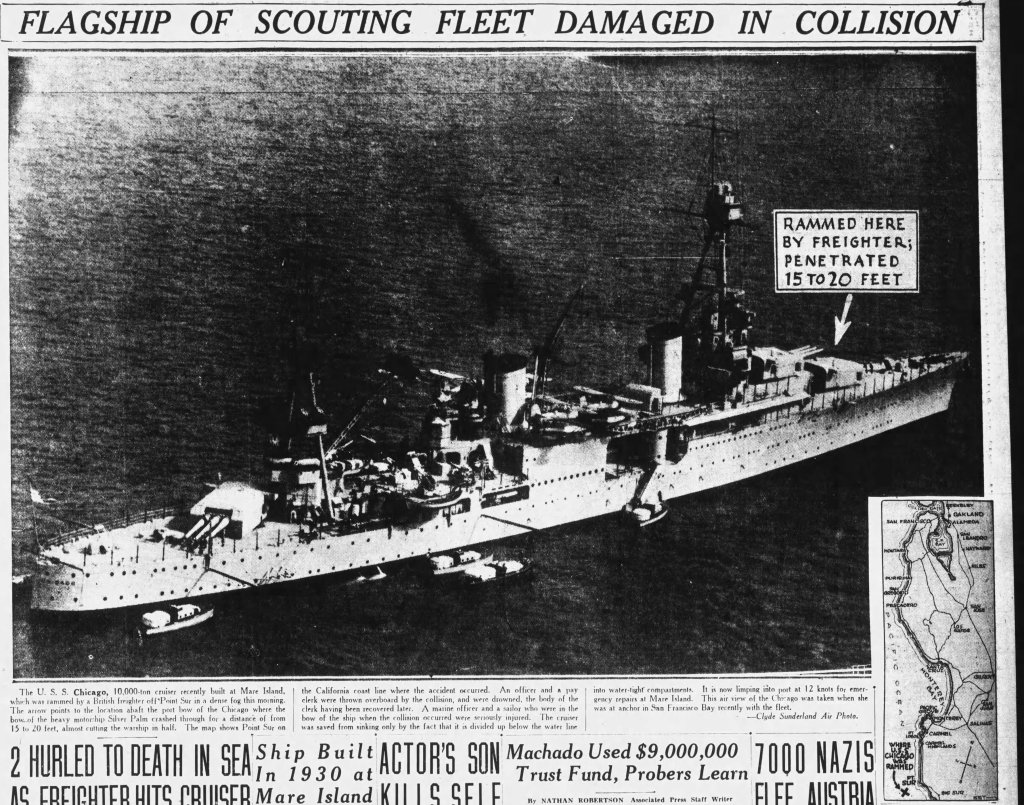
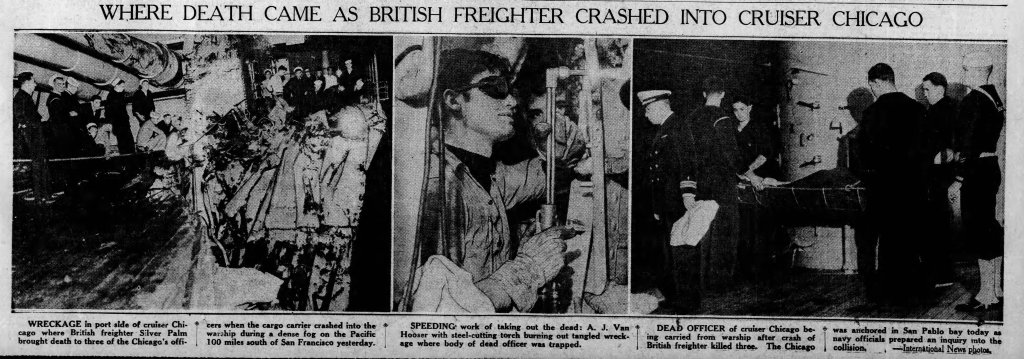
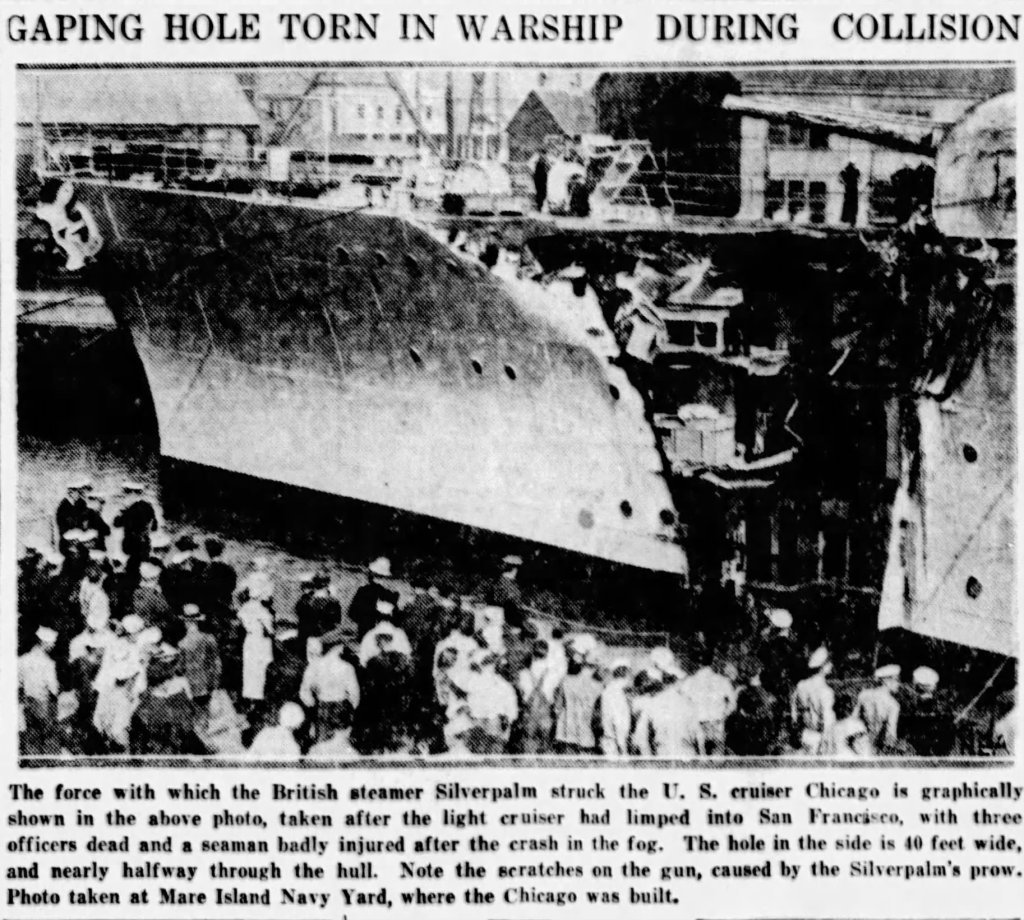
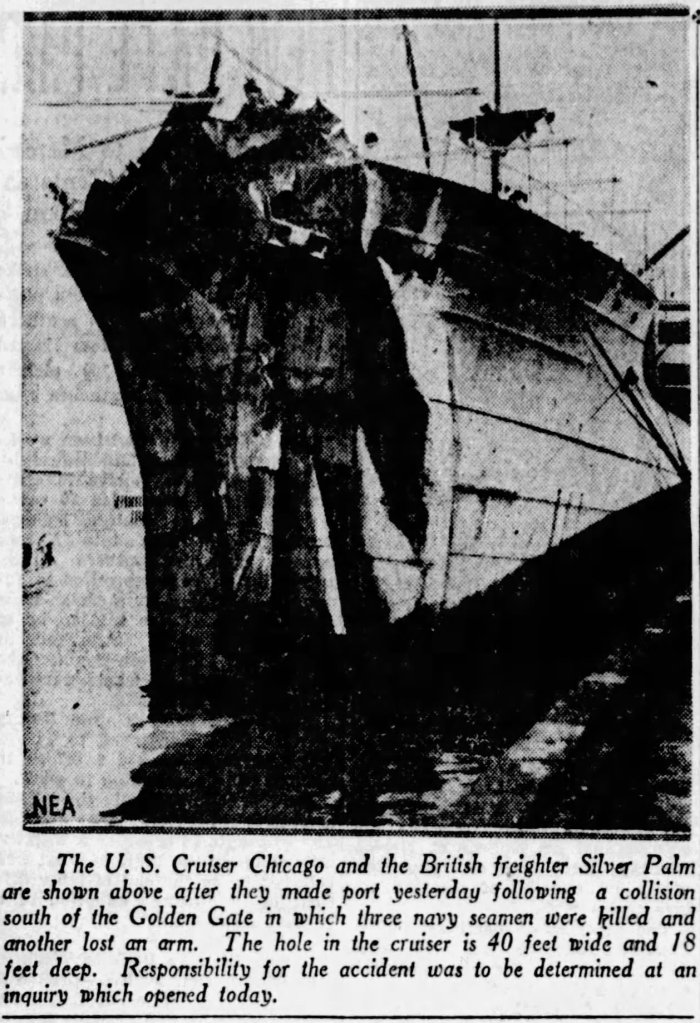
The first articles were focused on the crash itself, and the dead and missing officers of the Chicago. An official inquiry would be made and interviews taken (Naval Inquiry Board Starts Probe of Ship-Cruiser Crash), yet there was one witness that got into print the day after the accident: Maude van der Riet.
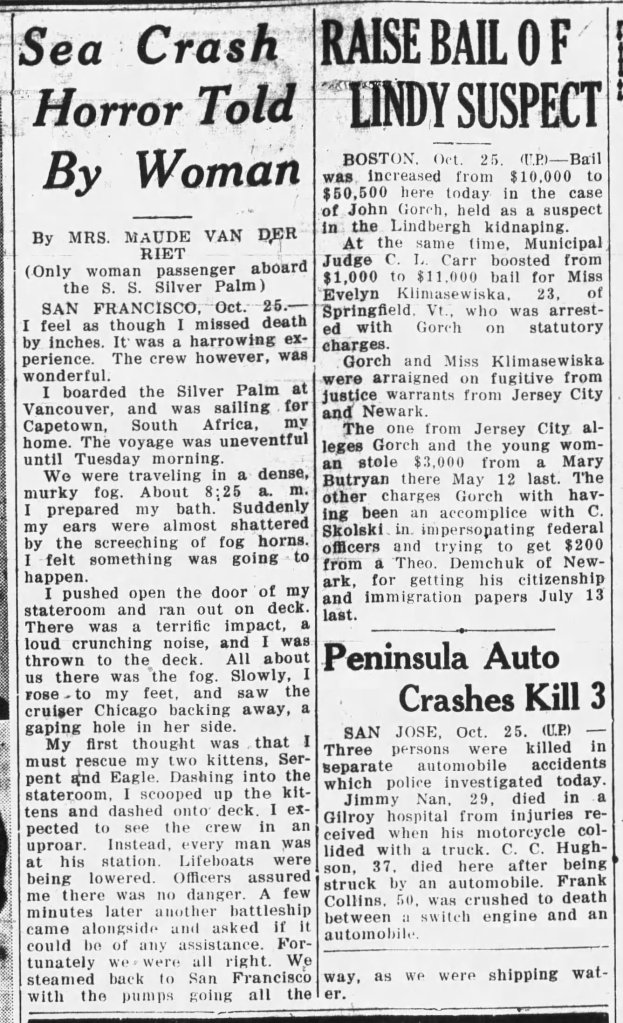
The news of the collision was widely reported; the aftermath a little less so. Reporters followed the inquiry, and the testimony given by crew and officers. Libel suits by the freighter company and the U.S. Navy were filed, and the tragic accident took on the narrative of a legal drama. Mrs. van der Riet is not mentioned in the lists of witnesses called—nor, perhaps, was she expected to be, as she was only a passenger. The sensational claim that Maude van der Riet was a witch appears to be only a bit of yellow journalism. They couldn’t even get the number of kittens she had correctly.
What happened to Maude van der Riet? Presumably, she was put on another ship to go back to South Africa; the why and wherefore of that trip and her earlier and later life aren’t recorded in sources I have access to, though possibly someone with better sources in South Africa, Canada, Australia, or the U.K. might have better luck.
Lovecraft and Smith probably had little more to go by than the one article declaring van der Riet a witch, and that is what tickled Lovecraft’s imagination. He would set a story partially in South Africa, “Winged Death” (1934) by Hazel Heald & H. P. Lovecraft, which was published a few months later, and the reference to Great Zimbabwe and the “Fishers from Outside” is a reference to “The Outpost” (1930) and his conception of an African Mythos. The idea of a woman who had learned witchcraft in the ruins of Great Zimbabwe was also a minor plot point in “Medusa’s Coil” (1939) by Zealia Bishop & H. P. Lovecraft, written c. 1930. The reference to Aleister Crowley is simply a reflection of the Great Beast’s reputation, which Lovecraft commented on elsewhere in his letters.
In the end, Clark Ashton Smith doesn’t seem to have used Maude van der Riet in any of his stories, and this potential plot idea was dropped by both men. Yet it is a good example of the kind of oddness that could crop up in newspapers during their lifetime, how this information (or disinformation) could be spread, and could inspire stories in pulp authors. It shows too how easily Lovecraft could adopt new material into his existing framework as the Mythos slowly grew.
Bobby Derie is the author of Weird Talers: Essays on Robert E. Howard and Others and Sex and the Cthulhu Mythos.
Deep Cuts in a Lovecraftian Vein uses Amazon Associate links. As an Amazon Associate I earn from qualifying purchases.
 Deep Cuts in a Lovecraftian Vein
This reminds me of mystery novelist Harry Stephen Keeler, who would keep a clipping file of peculiar happenings. While his novels were in outline form he’d paste some into the manuscript with a note like “have this happen”.
LikeLiked by 1 person
I’m impressed with your self control in not calling this the Boer Witch Project.
LikeLiked by 1 person