One of his stories in Weird Tales was so frightening that it caused removal of the magazine from the newsstands in at least one city.
—Howard Wolf, “Variety” column, The Akron Beacon Journal 12 Dec 1927, p10
In his 1927 article on H. P. Lovecraft, Howard Wolf relates the above brief anecdote, which probably came from Lovecraft himself, or one of his close associates. In writing to his aunt Lillian D. Clark about the article, Lovecraft explained:
He is wrong in saying that it was a tale of mine which caused an issue of Weird Tales to be barred from the stands in Indiana. The story in question was Eddy’s “The Loved Dead”—which, however, had much of my work in it.
—H. P. Lovecraft to Lilian D. Clark, 10 May 1928, LFF2.652-653
Lovecraft had mentioned a brush with censorship and “The Loved Dead” in his letters since late 1925, although details were vague. One of the key points seemed to be that it involved Indiana and, strangely enough, the Parent-Teacher Associations.
“In the Vault” he rejected because he feared its gruesomeness would get him into trouble with the censors—O Gawd! O Montreal!
—H. P. Lovecraft to Clark Ashton Smith, 4 Nov 1925, DS 86Glad you like “In the Vault”. Wright’s rejection of that was sheer nonsense—I don’t believe any censor would have objected to it, but ever since the Indiana senate took action about poor Eddy’s “Loved Dead”, he has been in a continual panic about censorship.
—H. P. Lovecraft to Lilian D. Clark, 13 Dec 1925, LFF1.507About poor Eddy’s tale—it certainly did achieve fame of a sort! His name must have rung in tones of fiery denunciation all through the corridors & beneath the classic rotunda (if it has a rotunda) of the Indiana State Capitol!
—H. P. Lovecraft to Lillian D. Clark, 22-23 Dec 1925, LFF1.520This worthy editor has been amusingly timid about very bizarre tales ever since he had had some trouble with state censors and parent-teacher associations over a story he printed three years ago—a story, as coincidence would have it, by an acquaintance of mine in Providence.
—H. P. Lovecraft to Bernard Austin Dwyer, [June 1927], LMM 455
C. M. Eddy, Jr. and his wife Muriel E. Eddy were pulp writers that lived a few miles from Lovecraft in Providence, Rhode Island. In the early 20s, Lovecraft and the Eddys were fairly close, and Lovecraft would have a hand in several of C. M. Eddy’s weird stories “Ashes” (Weird Tales Mar 1924), “The Ghost-Eater” (Weird Tales Apr 1924), “The Loved Dead” (Weird Tales May-Jun-July 1924), and “Deaf, Dumb and Blind” (Weird Tales Apr 1925), as well as work on The Cancer of Superstition for Harry Houdini. The degree of Lovecraft’s involvement in the stories is difficult to trace; the Eddys and Lovecraft gave different accounts of his work in “The Loved Dead,” though all agree the initial idea was Eddy’s, and it appeared under his byline when it was published in Weird Tales‘ large anniversary number in 1924, which was an oversize issue on the stands for several months.
The reason for the oversize issue is that Weird Tales itself was going through a critical re-organization. Initially, Weird Tales was published by the Rural Publishing Co. with Edwin Baird as editor, and Farnsworth Wright as first reader for the magazine; the offices were in Chicago. Mounting debts forced a change: Baird departed, and Weird Tales was now published by Popular Fiction Publishing of Indianapolis, Ind., with Wright as editor. The oversize 1924 May-Jun-Jul issueof Weird Tales marks the transition from Baird’s editorship to Wright’s, and the move from Illinois to Indiana.
This, then, at the beginning of Wright’s career as editor of Weird Tales, is when something happened—at least, according to Lovecraft, who would continue to refer to the event in his letters for the rest of his life:
Of course, you would have to use vast care & subtlety in suiting the tale to Wright’s idea of its reception by the Indiana Parent-Teacher Association—& even so, his timidity might bring about rejection in the end. Poor chap—he’ll never forget the row that Eddy’s “Loved Dead” stirred up some seven years ago!
—H. P. Lovecraft to Clark Ashton Smith, [8 Nov 1931], DS 301Quinn’s new offering would surely seem to be strong stuff—hope it doesn’t produce another situation like that aroused by Eddy’s “Loved Dead”.
—H. P. Lovecraft to R. H. Barlow, [3?-6 Aug 1934], OFF 157Poor Farny! That censorship of ‘24 absolutely broke his nerve, so that he has ever since been timid about publishing anything with a corpse over 10 hours old! As you may know, he once rejected my “In the Vault” as “too horrible”—although he did take it later on. It may interest you to know that I revised the now-notorious “Loved Dead” myself—practically re-writing the latter half. Eddy is a Providence man, & I was in fairly close touch with him in ‘23. I did not, though, devise the necrophilic portion which so ruffled the tranquility of parents & pedagogues on the banks of the Wabash.
—H. P. Lovecraft to Robert Bloch, [mid-Mar 1935], LRBO 132Did I tell you that he rejected a splendid corpse story by Kid Bloch because it was ‘too horrible’? He brought up the spectre of C. M. Eddy’s “Loved Dead” again after 10 years. Poor chap—he’ll never forget the Indiana Parent-Teacher’s Association!
—H. P. Lovecraft to R. H. Barlow, [24 Mar 1935], OFF 230A recent experience of little Bobby Bloch does not form an encouraging omen—for Pharnabozus turned down a yarn of his (about a chap who found that his bedfellow in an hotel was a badly decomposed cadaver) on the ground of excessive horror, bringing up the now-classic case of 1924 . . . . . C. M. Eddy’s “Loved Dead” (the latter half of which I re-wrote!) & the Indiana Parent-Teacher’s Association. Poor Farny—he’s like a dog that has received a nerve-breaking scare, & cringes every time anything reminds him of it!
—H. P. Lovecraft to Clark Ashton Smith, [26 Mar 1935], DS 594Poor Farny has been timid ever since 1925, when he had a run-in with the Indiana bourgeoisie over a yarn by C. M. Eddy Jr. of Prov., which I revised!
—H. P. Lovecraft to Robert Bloch, [mid-May 1936], LRBO 170
As with Edith Miniter and the Dracula revision, Lovecraft’s accounts are generally consistent throughout the years, and many scholars and critics have taken him at his word that perhaps the May-Jun-Jul 1924 issue of Weird Tales was banned in Indiana, or at least Indianapolis, and that the Parent-Teacher’s Association had something to do with it. The problem is, no specific evidence of such a ban has ever been uncovered. Unfortunately, the Lovecraft-Farnsworth Wright correspondence has a gap in that timeframe when it would have occurred, and the surviving letters do not mention it; the same goes for Lovecraft’s letters to C. M. Eddy, Jr. and his wife Muriel. While Lovecraft’s data for the anecdote must have come from Wright or Eddy—there would hardly seem to be anybody else in a position to know—we are left with speculation as to what really happened.
John Locke in The Thing’s Incredible! The Secret Origins of Weird Tales (2018) offered one possible explanation:
The editorial offices for Weird Tales at this time were at 854 North Clark Street, Chicago; thier business address was 325 North Capitol Avenue, Indianapolis, the address of a brick building constructed and owned by the Cornelious Printing Company, a well-known, family-owned Indianapolis company of solid standing, who happened to be the printer of Detective and weird Tales, and the largest creditor of Rural Publishing. Their building sat a mere block-and-a-half from the capitol. We suspect that Lovecraft’s initial comment—”His name must have run . . .”—was based on infortmation he misunderstood and which he tuned into a delectable joke. What fun to imagine that Eddy’s devilish little story threw a puritanical state goverment into a tizzy! In fact, what probably happened was that the PTA, a member, or even a state senator, visited the Cornelius office to complain about “The Loved Dead,” and the unwholesome influence it might have on the youth of America, etc. et.c, and that the company, which had financial leverage, asked Henneberger to exercise more caution in the future. Then when “In the Vault” was rejected, Lovecraft converted his initial faulty suppostion into a fact. (173)
New evidence, however, suggests there was at least a germ of truth in Lovecraft’s account.
The Indiana Magazine War of 1924
In the Spring of 1924, a grassroots campaign of concerned parents, educators, and other busybodies had enough of salacious pulps on the newsstands. With a cry of “think of the children!” (or a foreshadowing of the later campaign against comic books by Frederic Wertham), the Parent-Teacher Associations of Indiana came together to petition Governor Warren T. McCray to do something about the pulp menace.
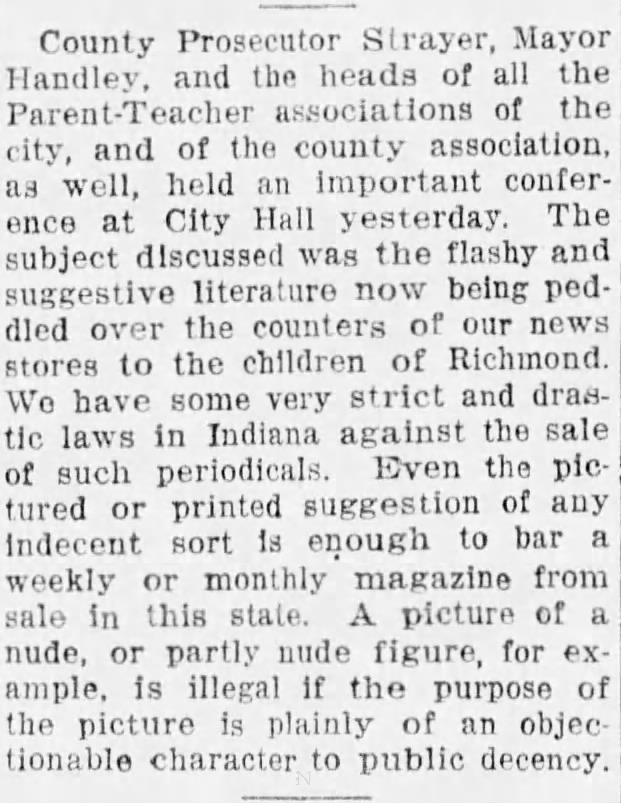
McCray dropped the issue in the lap of Indiana State Attorney-General U. S. Lesh. The focus of the petition was not on all pulp magazines, but seemed to be centered on confession pulps and the slightly risque (for the time) spicy pulps, confessionals, and the men’s humor magazines such as Hot Dog, which might have a few pin-ups that bared a shoulder, an ankle, and a filmy veil through which a reader might catch a glimpse of a nipple. Indiana, like most states, already had legislation on the books to deal with obscene publications (Sale of Obscene Magazines To Be Halted In State part 1, part 2), which had occasionally resulted in successful prosecutions (Johnson County Bars Magazines).
Lesh decided now was the time to enforce these laws, and sent out letters to state prosecutors naming 22 pulp titles that the PTA had put forward as wanting off the stands.
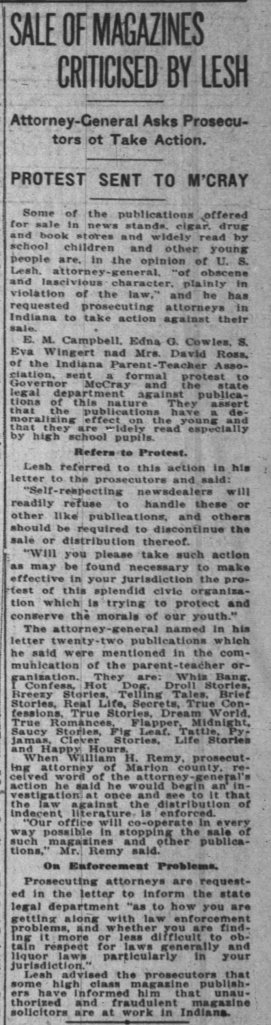
Weird Tales was not on the list; it was neither a confession pulp or a spicy pulp, and the covers during that period were often done by Andrew Brosnatch, and fairly unsalacious.
The news spread quickly in Indiana’s newspapers. Immeditately, there was question of enforcement, cries of censorship, and pushback from newsstands, distributors, and pulp magazine publishers. Several state prosecutors such as Frank T. Strayer, Henry T. Hardin, John Summa, Mark I. Thompson, William H. Remy, and P. H. Hurd garnered notices and grabbed headlines (1924 was, after all, an election year) as they moved forward with enforcement, which initially meant seeing what was actually being sold at the local newsstands and bookstores and making the owners aware of possible legal consequences. As the focus was on the point of sale, several news agents removed the magazines from their stock rather than face arrest, fines, and possible imprisonment:
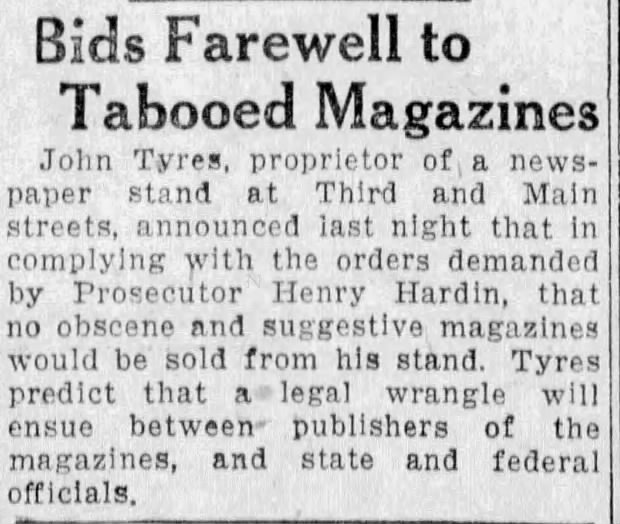
On Monday, 24 Mar 1924, raids were made at newsstands throughout Indiana. Police and prosecutors confiscated thousands of magazines. Macfadden Publishing, who had three confession pulps on the ban list (True Romances, True Stories, and Dream World) organized a meeting of news agents in Chicago (Publishers To Fight Seizure of Magazines). It was the opening salvo in what several Indiana newspapers would dub the “Magazine War.”
However, there was little that pulp publishers could do except circle the legal wagons. One of the first layers of censorship in the United States in that era was the U. S. Post Office, which had the authority to prevent the sending of obscene matter through the mail. Pulp magazines were classified as second-class mail, and subject to inspection; lawyers for the pulp publishers argued that if the post office accepted it, the content must have passed the postal censor (Ignore Attorney-General). This argument, however, did not hold water with the state attorneys. (Publishers Protest, Briefs Are Sent To Prosecutors).
Soon, rumors started of a “test case”—someone to actually be charged with a crime, tried in court, to see if the law would hold against legal reasoning (A “Test Suit”, Seen and Heard About Richmond). Lesh knew that this would be the litmus test of the campaign, and urged prosecutors to proceed cautiously (Lesh Changes Magazine Rule). Such a case soon became reality. State prosecutor B. H. Hurd had set a deadline of 1 April for local dealers to stop selling the banned pulps; one dealer resisted (One Dealer Selling Tabooed Magazines).
The affadavit charged the appellant on April 4, 1924, at Huntington county, in the State of Indiana, did unlawfully sell to one Sophronia Wannas an obscene, lewd, lascivious and licentious publication in the form of a pamphlet, to wit, a pamphlet bearing the name and title of, “Hot Dog, The Regular Fellows Monthly, price two bits,” being then and there of the issue of the month of April 1924, Vol. 3, which printed matter of said pamphlet being then and there too lewd, lscivious and licentious to set out herein and to incumber the records of the court therewith.
—Sunderman v. State of Indiana, Reports of Cases Decided in the Supreme Court of the State of Indiana, vol. 197, p705
William F. Sunderman was the manager of the South Side News Agency in Huntington, Ind. (The American News Trade Journal, vol. VII, no. 8, p4); Sophronia Wannas was Huntington’s first policewoman (Huntington Mayor-Elect Completes Apopintments). Charges were filed both for the circuit court and the local justice of the peace, Willis A. Jones (News-Agent Is Arrested For Sale of “Peppy” Magazines). The latter trial was speedy; Sunderman was charged on 4 April 1924 and by 12 April the jury had rendered a guilty verdict, with the guilt man fined $10 (the minimum)and costs, with no jail time (Jury in “Snappy” Magazine Test Case Finds Sunderman Guilty part 1, part 2; State Wins First Test on Lurid Magazine Sale). Sunderman vowed to appeal the decision. The PTA was pleased at the result (P. T. A. Members Here Pleased by Victory in Magazine Case).
At the same time as the PTA celebrated, however, Lesh was modifying his order. Macfadden’s pressure had succeeded in getting their publications off of the banned list, and there were outstanding questions about mail subscriptions (News-Agent Is Arrested For Sale of “Peppy” Magazines). At the same time, it appears that the PTA was attempt to add titles to the blacklist (Magazine Blacklist Order Is Forthcoming). Some publishers sent copies of their publications directly to state prosecutors, in an attempt to prove they weren’t obscene (Waltz Will Put A Ban on Severl Publications), and others held conferences with them in an attempt to change their mind (Persuasive Talk Fails To “Take”). Some dealers openly threatened to enjoin prosecutors from enforcing the ban (Evansville Magazine Dealers May Go To Court, Evansville Men Defy “Obscene” Ban); in reply, prosecutor Henry T. Hardin threatened to posecute anyone in possession of a banned magazine (Obscene Literature War in Vanderburg County, Death Knell for 22 Barred Magazines Will Be Sounded Here at Midnight Tonight).
Enforcement of the pulp ban was uneven. While Attorney-General Lesh could send letters to direct and guide state prosecutors, local authorities had considerably leeway into how hard they pursued the matter. When the new governor, Emmett Forrest Branch took office in May 1924, he pushed Lesh to send another letter to aid enforcement , but not every county took up the ban (No Objection to Magazines Heard, Obscene Magazine Fight Gets Impetus, The Indiana Anti-Pulp Crusade). On the other hand, other prosecutors appear to have been more keen: William H. Remy presented evidence before a grand journey to see if he could prosecute (Grand Jury May Get Bad Magazine Cases). Others set a deadline of August 1st to remove offending magazines from their county.
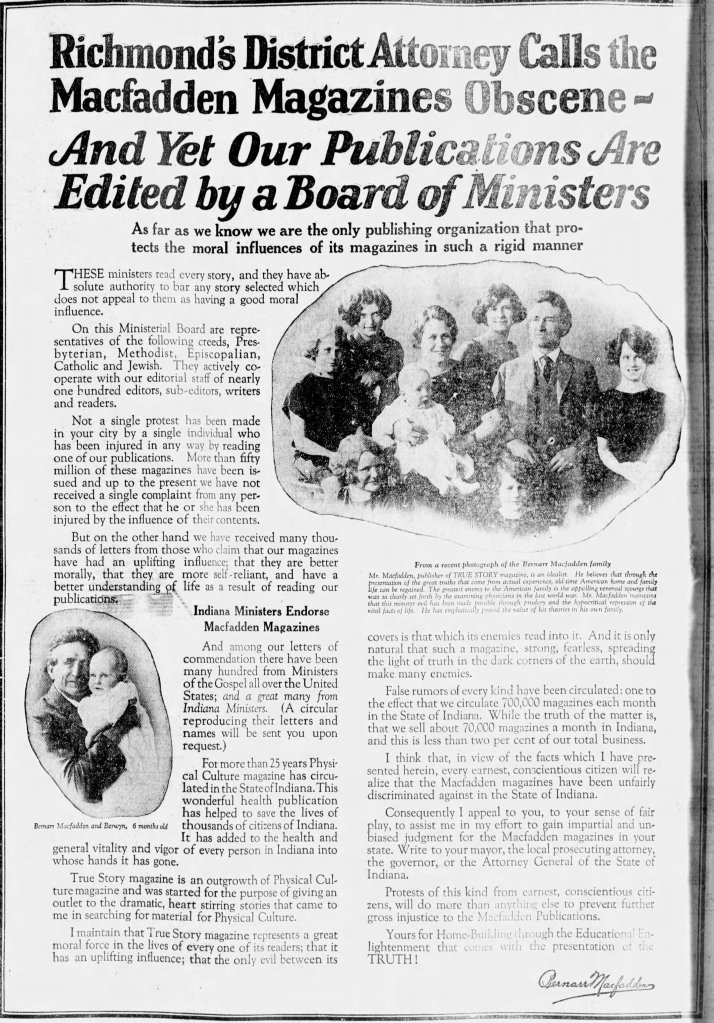
Pulp publishers such as Macfadden and distributors such as the Hoosier News Agency continued to resist however they could. Macfadden managed to convince several Indiana ministers to come out in favor of the moral stories in their confession pulps (Pastors Aid Magazines Banned Here), and Lesh apparently agreed to allow Macfadden’s pulps to be sold until a test case could be resolved (Magazines Under Ban Are Being Sold Thru “Truce”), but the individual district attorneys were the ones who decided which magazines to ban…which may explain why, in September 1924, Macfadden took out a large advertisement against the Richmond District Attorney.
As autumn turned to winter, the magazine war slowed. Lesh consulted with postal inspectors, presumably to stop the offending periodicals from coming into the state (In Postal Campaign). Some pulp publishers were accused of having changed tactics, producing pulp magazines with new titles that didn’t appear on the ban list (New Magazines Are Suspected), but this seems unlikely—or at least, the turnover of old pulps folding and new ones forming doesn’t seem to fit with Lesh’s list or the publishers of the pulps on that list. In practice, the pulp field was so fecund, with new magazines published and ceasing publication every year, that any static blacklist could not possibly keep up.
1925 brought a change: U. S. Lesh was no longer Attorney-General of Indiana. Lesh and the PTA had shifted their attention from enforcing existing laws to pushing new legislation. Their reasoning behind this was clear:
In a report submitted by the state committee it showed that among the 92 counties in the state, only eight had prohibited the sale of this literature. It was also found tha tmost of the books were being bought by high school students.
—“Women Behind Bill Against Obscene Books,” The Evansville Journal, 29 Jan 1925, p10
Lesh prepared the bill, which provided for magazine sellers to be licensed by the state. The bill died in the Indiana house of representatives (Magazine Bill Goes Down in the House).
William Sunderman filed an appeal for the case he lost on 7 Jan 1925 (First Appeal Is Filed); the second case, which apparently never went to trial, was dismissed in July 1925 (Session Closes Cir. Court Term). The Indiana Supreme Court finally heard Sunderman’s appeal in May 1926; the court was not convinced by arguments that the issue of Hot Dog was not obscene, and conviction was affirmed (Higher Courts’ Record; Supereme Court Abstracts of Opinions on May 21, 1926; Magazine Fine Upheld; Court Rules Magazine Lascivions [sic]). Huntington city directories suggest Sunderman continued to work as a newsdealer.
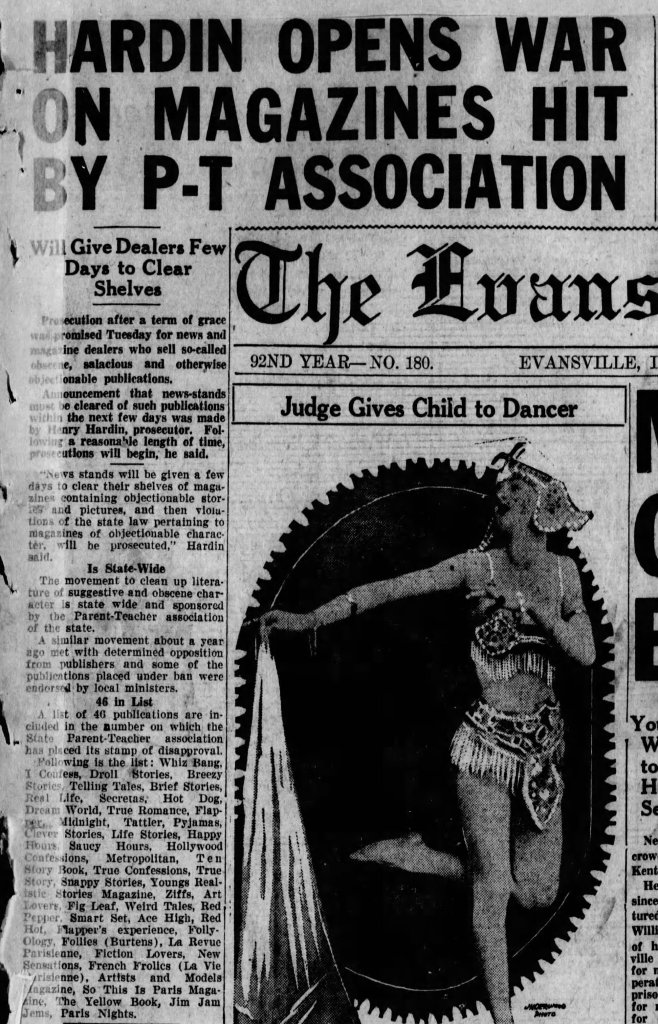
Weird Tales entered into the picture near the end of the drama. While Lesh was out, individual prosecutors could and did continue to enforce magazine bans. Henry T. Hardin was a particularly tenacious and truclent. In June 1925, he published a list of 46 pulp titles banned in Evansville, Indiana—based on the initial list of 21 titles provided to Lesh by the PTA, it also included Weird Tales. Hardin’s reasons for including the weird fiction pulp among the spicies, romance pulps, and girlie magazines is not stated. Perhaps someone really did read “The Loved Dead” and got offended.
In addition, Jim Dyer, the grandson of C. M. Eddy, Jr., wrote in the introduction to The Loved Dead and Other Tales:
Farnsworth Wright, who took over as editor of Weird Tales from Edwin Baird, wrote in a September 1924 letter, “The Richmond (Indiana) Parent Teachers’ Association tried to get an injunction out against the further publication of Weird Tales because of ‘The Loved Dead.'” (vi)
Without access to that letter, this quote cannot be confirmed, and no news notice in support of this has yet been located. Yet if accurate, that would be another instance of Weird Tales being targeted.
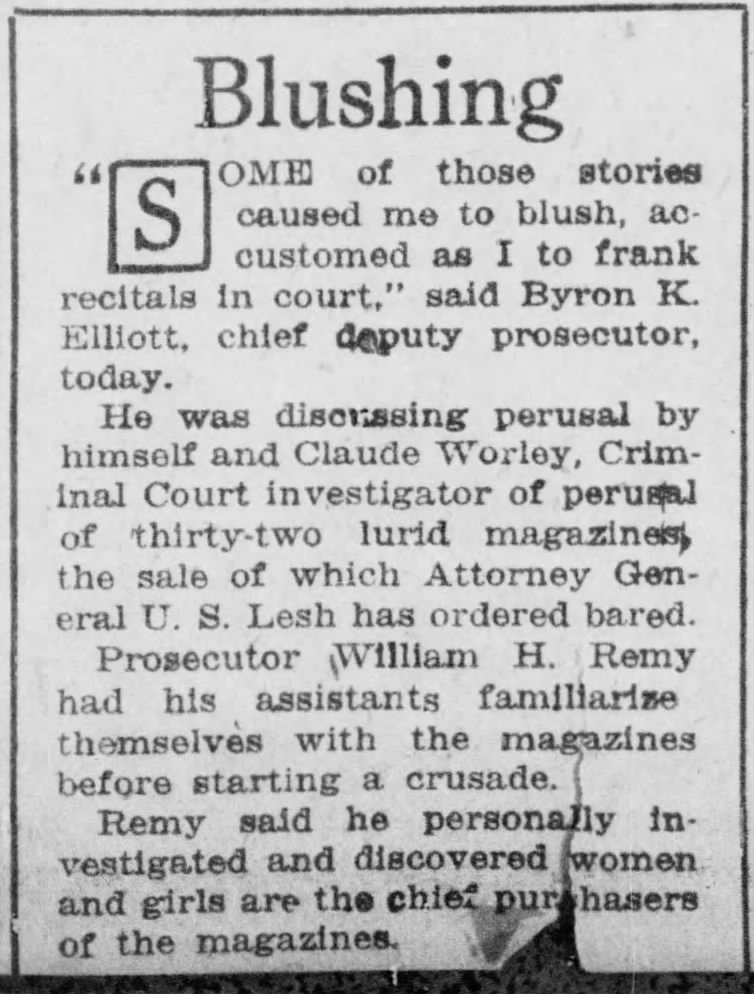
While the stated intent of the campaign was to save the children, the magazines targeted had an audience largely comprised of older teens and adults, many of them women (“Bootlegging” of Magazines is Predicted). Confession pulps like True Romance and True Confessions more often than not contained morality tales where women expressed their regret for terrible decisions or circumstances that left them wiser and dealing with the consequences; yet to hear state prosecutor William H. Remy tell it:
They make a heroine of the unfaithful wife and a martyr of the renegade husband. The divorce evil is already serious enough in Marion county, and so is the matter of crime, and magazines which tend to encourage either or to condone offenses against the laws of the land ought to be blacklisted by public opinion as well as by law.
—“To Prosecure Sellers of Obscene Magazines” part 1, The Indianapolis News, 3 May 1924, p1
Even the spicy pulps like Breezy Stories and Saucy Stories sold the sizzle, not the steak—no pulp publisher was going to print an explicit account of sex. Yet to the stolid men of the state attorneys offices, these were considered obscene.
Conservative groups largely supported Lesh and the state attorneys on their anti-pulp crusade. They received endorsements from the Indianapolis Local Council of Women (Women Indorse Lesh Drive on Obscene Books), the North Indiana Methodist Episcopal conference (Election of Laymen to M. E. Conference Center of Interest), the Indianapolis Ministerial Associtation (Ministers Back Lesh In Fight on Magazines), the Duaghters of the Union (Magazine Blacklist Order Is Forthcoming), and other groups. Meanwhile, Lesh and the PTA reached out for support from the local Chambers of Commerce, Rotary Clubs, and Kiwanis Clubs (Civic Clubs to Be Asked to Aid in Magazine War), PTAs in other states (To Indorse Magazine War, Start Crusade on Obsene [sic] Magazines), and the powerful Anti-Saloon League of America (Lesh Asks Drys To Fight Lurid Literature Sale).
Yet despite all the hullaballoo, it is clear this was not a popular crusade. At a time when the state prosecutors and law enforcement were wrestling with the Volstead Act, Indiana’s Magazine War went unsupported in a majority of its counties, seems to have resulted in few prosecutions or fines, and did not apparently change or diminish the content of any of the pulp magazines involved—unless Lovecraft was correct, and Farnsworth Wright, wet behind the ears as editor of Weird Tales, was scared because his magazine was numbered, however briefly, among the obscene materials that might be banned from the newsstands.
The players in this little drama are little more than footnotes in Indiana state history, but the outlines of the conflict are an old, ugly tale, one which has played out again and again—censorship by an outspoken minority, and the rule by fear.
Loose Ends
As with any old puzzle, there are a few pieces that don’t quite fit, and those deserve to be briefly addressed. In one letter recounting various experiences he has and has not had, Lovecraft wrote:
I have several times been in a police station—usually to inquire about stolen property, & once to see the Chief of Police about the banning of a client’s magazine from the stands—but never in the part devoted to cells.
—H. P. Lovecraft to J. Vernon Shea, 29 May 1933, LJS 131
Lovecraft does not give a date or place for his incident, and some have suggested that this might be a reference to the banning of Weird Tales‘ May-Jun-Jul 1924 issue. However, on the balance this seems unlikely—Lovecraft was never in Indiana, and there doesn’t seem to be anything the Chief of Police in any city he did visit could have done. It is possible that this is a forgotten incident with another magazine—one can imagine the New York Society for the Suppression of Vice getting a hold of a copy of Home Brew and squinting at the phallic shapes of Clark Ashton Smith’s vegetation—but lacking any hint of that in Lovecraft’s letters, it must remain a mystery.
In a memoir of Lovecraft, his friend and literary executor R. H. Barlow wrote:
He tells me he ghostwrote “The Curse of Yig,” “The Last Test,” “The Electric Executioner”; some Houdini stuff in WT—“The Loved Dead”; that the latter was nearly suppressed in Milwaukee because of the necrophilic theme.
—R. H. Barlow, “Memories of Lovecraft (1934)”, OFF 402
Milwaukee is in Wisconsin. In this case, I believe Barlow simply misremembered what Lovecraft had said.
Bobby Derie is the author of Weird Talers: Essays on Robert E. Howard and Others and Sex and the Cthulhu Mythos.
Deep Cuts in a Lovecraftian Vein uses Amazon Associate links. As an Amazon Associate I earn from qualifying purchases.
 Deep Cuts in a Lovecraftian Vein
There is a copy of The Author & Journalist, August 1927, volume 12, issue 8 available on Archive.org. On page 16, there’s an interview by Willis Knapp Jones with Farnsworth Wright. Wright makes the following remark about what he looks for for publication in WT:
“We don’t like the waking-up-and-finding-it-a-dream sort of yarn, and we draw the line on the too horrible. Before I came, the magazine ran a story about a ghoul who ate up dead bodies. It was too strong fare for most readers. We’re perfectly willing to scare you, but we don’t want you to be nauseated.”
I learned about “The Loved Dead” because I tried figuring out which story Wright refers to and while I’m still looking for other possibilities, so far I think he is talking about “The Loved Dead”.
LikeLike
If it was “before I came,” then it was a story published under editor Edwin Baird in 1923 or 1924. Possibly “The Ghoul and the Corpse” by G. A. Wells. https://archive.org/details/WeirdTalesV01n01192303/page/n65/mode/2up
LikeLike
“The Ghoul and the Corpse” has a bait-and-switch title. It’s about a man who goes looking for gold and finds a frozen caveman. He hacks and thaws the caveman out, the caveman resumes being alive, they fight, the man survives, and almost all evidence of his story goes up in flames. The title refers to the man as a ghoul because he digs up a corpse, even though the caveman turns out not to be dead yet. It’s an exquisitely tame reading experience (that might in its day have been a little juicier for its early use of the thawed caveman scenario).
“The Loved Dead” is before Wright’s time because all sources I can find credit him as editor starting the revival November issue. Other options considered are “The Loved Dead”‘s twin “The Hound”, which, like “The Ghoul and the Corpse”, uses the term “ghoul” for graverobbers, and “Under the Pyramids”, which features a rat- or ghoul-eaten face. But neither these nor any other I’ve gone through seem to have made much of an (documented) impact.
“The Eyrie” of the November issue contains this bit:
—-
The editor of Weird Tales has something on his mind about which he wants advice from the readers. Just what do YOU think of horror stories—we mean really strong stories, such as “The Hermit of Ghost Mountain,” by C. Franklin Miller, in this year’s March number, and “The Loved Dead,” by C. M. Eddy, Jr., in the Anniversary Number?
“The Hermit of Ghost Mountain,” as those of you who have read the story will remember, told of a hermit who solved the secret of long life by a diet of human blood, mixing the various kinds—young blood, bold blood, old blood—in jars so that he could regulate his diet according to the characteristics of his victims. It was a masterpiece of gruesome literature, but it called out many letters of protest from the readers. “The Loved Dead” described the mania of a young man for exhuming and eating the bodies of his relatives.
One reader writes (anent “The Loved Dead”): “Why will you give us such sickening stories? I read Eddy’s yarn late at night. It nauseated me, but I could not stop reading, for the story was fascinatingly told. My eyes must have bulged in horror as I read, for when I finished I was covered from head to foot with clammy sweat, but wild horses could not have dragged me away from Weird Tales before I had read through to the end. But please, please—why will you feed us such disgusting themes? Surely you can give us mystery thrillers, and even strong horror stories, without making us sick at the stomach. Poe did it, in such weird masterpieces as ‘Ligeia’ and ‘The Tell-tale Heart,’ even though he also was sickeningly disgusting in ‘The- Case of M. Valdemar.’ Ambrose Bierce’s best story is that eery thing of wonder and beauty, ‘An Inhabitant of Carcosa,’ but one hates to read a volume of Bierce for fear of stumbling upon some such nauseatingly morbid tale as ‘The Death of Halpin Frayser.’ Give us all the ‘Ligeias’ and ‘Tell-tale Hearts’ you can find, but for the sake of all that is sweet and wholesome, spare us any more stories such as ‘The Loved Dead’.”
Readers, the editor puts it up to you. Do you want an occasional story such as “The Hermit of Ghost Mountain” or “The Loved Dead,” or shall we purge the magazine of all strong horror? If we find a nauseating story as well handled as these two stories, shall we print it anyway? The editor wants to hear from you on this question, and he will follow your advice.
—-
The verdict comes in the February issue, but its motivation is confusingly worded:
—-
“The readers of Weird Tales have spoken in no uncertain terms. Every mail brings to the editor’s desk letters protesting against any lessening of the “weird” quality of the stories in this magazine. “Let Weird Tales remain weird” is the tenor of the communications; “you have a magazine that prints a type of stories we can get nowhere else, and if a few of your readers are horrified by gruesome tales, then let them go elsewhere; but don’t spoil the magazine for those of us who like eery fiction.”
[some sample reactions affirming the above]
There are a few voices on the other side. L. Phillips, Jr., of Berkeley, California, writes: “It seems to me that there are plenty of ideas for weird and hair-raising stories without invading the graves of the dead. I think you should cut out what you term the ‘necrophilic’. The old ‘Black Cat’ was one of the most widely read magazines of its day. They went in for the weird and unusual, too, but they never printed anything sane people would turn from in disgust. No rotting corpses in theirs. The mysterious, the supernatural, the startling and bizarre from all lands and all times—I wouldn’t place a single limitation on locale, historical period or race, but I would draw the line at the grave. Even in fiction the dead have a right to rest in peace.”
The vote of our readers, to date, is overwhelmingly in favor of a few horror stories in each issue. But those who want cannibalistic and blooddrinking stories (specifically those who indorse Mr. Eddy’s “The Loved Dead” and Mr. Miller’s “The Hermit of Ghost Mountain”) are as few as those who want no horror stories at all. We bow before the decision that has been made by you, the readers; and along with other bizarre and weird tales we shall continue to print horror stories—but they will be clean.”
—-
Hereafter curiously follows what seems to be a defense of, if not “The Loved Dead” (and “The Hermit of Ghost Mountain”. Which, incidentally, I can’t fathom would have “called out many letters of protest” and the focus of the survey certainly seems to be “The Loved Dead”), then gruesome stories on average. Text from “Romeo and Juliet” and “Hamlet” is quoted and it’s argued that if these weren’t the works of a well-respected author, then they would be objected to too. I personally get the impression that this addition to the survey isn’t aimed at the reader base but at an external/peripheral group.
LikeLike
You make a strong case.
LikeLike