Comic books arose during the peak of the pulp magazine era, and commonly shared writers, artists, and sometimes publishers. Given the crossover in creative talents, it is no surprise that several ideas and sometimes entire stories were lifted from the pages of Weird Tales and other pulps to appear in the pre-Code horror comics. Many of these stories were produced basically anonymously, with little or no credit given to the writers or artists involved, which makes it more difficult to determine who did what, or whether a particular idea was borrowed, stolen, or just carried over by a creator from one project to another.
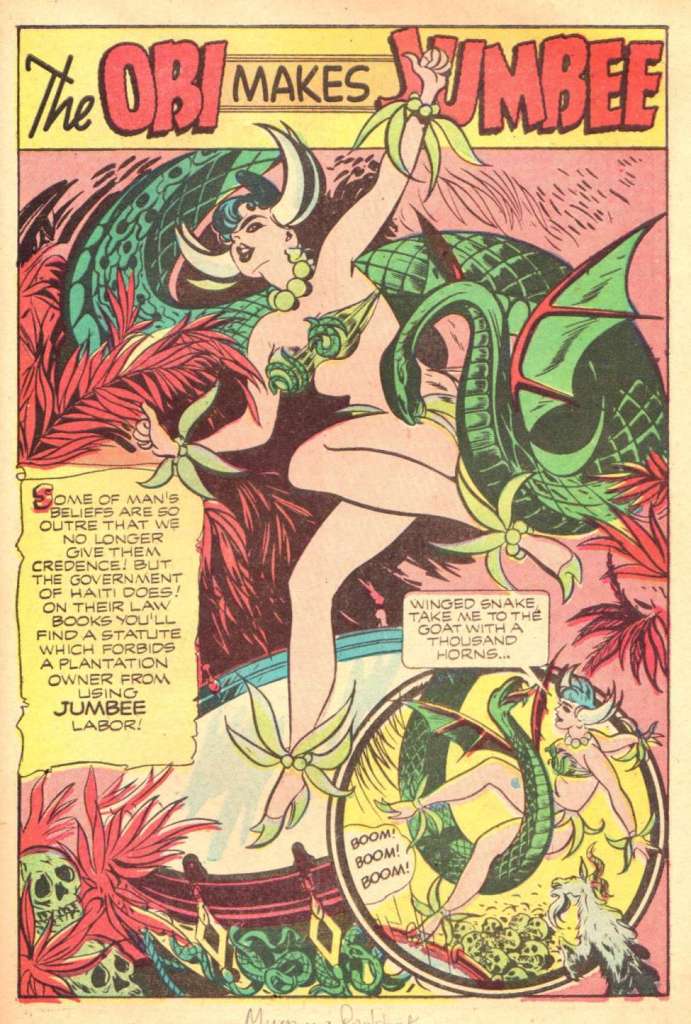
This is the case for “The Obi Makes Jumbee,” an 8-page story that first appeared in Spook Comics, a one-shot horror comic from Baily. Though not dated, the issue is thought to be published in 1945 or 1946 (in one panel, a character reads a newspaper with the date December 1945). No writer is credited. The Grand Comics Database says the art is credited to Robert Baldwin (I can’t find a signature on any of the pages, so I’m not sure where that came from), but also claims the art was actually done by Munson Paddock. Based solely on the art style, I lean toward Paddock. Since Paddock is only known to have worked with Baily in 1945, that would support that date.
The one thing we can say about the script is that it probably came from a Weird Tales fan.
The U.S. invasion and occupation of Cuba (1906-1909, 1917), Haiti (1915-1934) and the Dominican Republic (1916-1924), and the purchase of the Danish Virgin Islands in 1917, brought more and more of the Caribbean into their sphere of influence. So too, more U.S. citizens gained contact with the island cultures, which differed radically from the hard racial limits of Jim Crow. More tantalizing to many would-be anthropologists or tourists were the syncretic African diaspora religions on these tropic isles—remnants of African indigenous religions, often hybridized and combined with elements of Roman Catholicism.
In the 1930s, zombies and Haitian Vodou were popularized in the United States through William Seabrook’s The Magic Island (1929), and works that were inspired by it like the film White Zombie (1931). Seabrook wasn’t the first to write about Vodou or Vodoun; novels like The Goat Without Horns (1925) by Beale Davis, but it was Seabrook who captured the imagination of a generation of writers, whose zombie stories trickled into first pulps and then comic books. H. P. Lovecraft read Seabrook, as did Seabury Quinn, August Derleth, and many others. While far from the only source of data on African diaspora religions—Zora Neale Hurston would write Tell My Horse (1938) and other works, to name one—Seabrook was the most sensational and popular, and his version of Haitian Vodou made a lasting impression on “voodoo” as it appeared in pulps, comics, and film.
“Jumbee” however, is something a bit different. As a category of supernatural being, jumbee is most often associated with the folklore and African diaspora religion (“Obi”) of the Virgin Islands, and Jumbee tales were told by a substantially smaller group of authors—especially Henry St. Clair Whitehead, H. P. Lovecraft’s friend, correspondent, and fellow Weird Tales writer. Although Whitehead died in 1932, in 1944 Arkham House published his first collection of supernatural fiction: Jumbee and Other Uncanny Tales. A follow-up collection, West India Lights (1946) includes Whitehead’s non-fiction article “Obi in the Caribbean.” Given how scarce Jumbee stories are in comics (“The Obi Makes Jumbee” is the only comic story with that word in the title on the Grand Comics Database), it seems likely the author of that comic script had to have read Whitehead.
They knew enough to differentiate Jumbee from zombies, Obi from Vodou. Yet they make what seems to be an odd mistake or artistic license. “The goat without horns” is a term used for human sacrifice in some works that discuss Haitian vodou. Seabrook didn’t originate the term, though he helped popularize it, and in his book he quotes from the March 1917 Museum Journal of the University of Pennsylvania, Philadelphia:
In Hayti the basis of Voodooism is the frank worship of a sacred green snake that must be propitiated to keep off the evil spirits. The meetings of the cult are held at night about bonfires in secret places in the forests. The presiding official is an old man “papaloi,” or woman “mamaloi” who has gained renown as a Voodoo sorcerer. After assembling, all present take an oath of secrecy and then the priest exhorts them to remember the sacred green snake, and to hate the whites. Prayer is offered to the divine serpent that is supposed to be present in a box placed near the fire. Then follows the sacrifice of a cock which the “papaloi” kills by biting off its head. With a great deal of drumming and incantation the blood is smeared over the faces of the worshipers and drunk by the officiating priest. A goat may be sacrificed with similar ceremony. After the goat there might be a human sacrifice, as was reported by a French priest. He said that it was the wish of some of the devotees that “a goat without horns,” that is a child, be sacrificed. This was done and the flesh, raw or partly cooked, was eaten by the members of the cult.
Readers familiar with blood libel will recognize the familiar tropes at work; similar accusations were made against witchcraft and against many non-Christian religions. For a horror comic dealing with Hollywood-style voodoo in the 1940s, a human sacrifice wouldn’t be unusual—but the odd thing is that the writer doesn’t use “the goat without horns.” Instead, the mamaloi dancer Caresse invokes “The Goat with a Thousand Horns.”
There’s no such figure in Seabrook’s book, or any other text or story on Vodou (and, in context, it is being used as another appellation for Damballah). But it is awfully close to the epithet of “the Black Goat of the Woods with a Thousand Young” associated with Shub-Niggurath in H. P. Lovecraft stories like “The Whisperer in Darkness” and “The Dreams in the Witch-House.” Is that a sub rosa reference to Lovecraft? Maybe. Certainly, it’s not the only oddity in the tale.
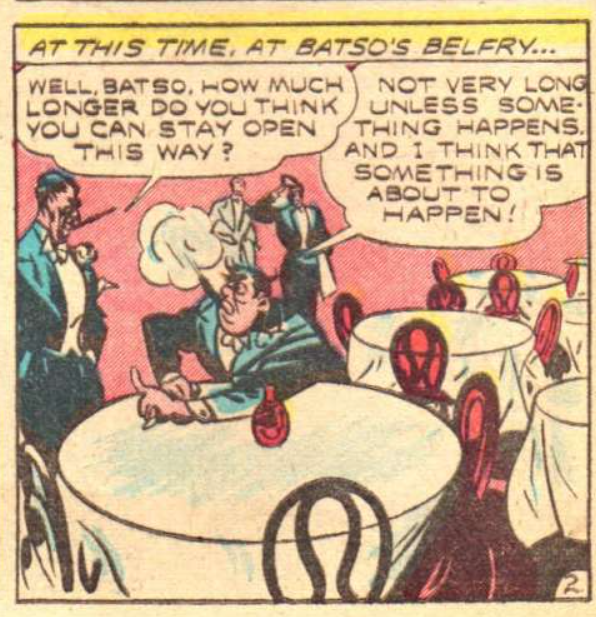
For example, the rival club is called the Belfry, and is owned by Batso…Batso’s Belfry… “Bat’s Belfry” (1926) by August Derleth. Coincidence? Or an Easter egg for Weird Tales readers?
The basic idea of the narrative seems to borrow very heavily from the beginning of Manly Wade Wellman’s “The Third Cry to Legba” (Weird Tales Nov 1943), where a new voodoo-themed club has a dancer (Illyria) that provides authentic Haitian dances for the clientele. In Wellman’s story, this is a plot by the evil magician Rowley Thorne to start a new cult, and he is thwarted by occult detective John Thunstone.
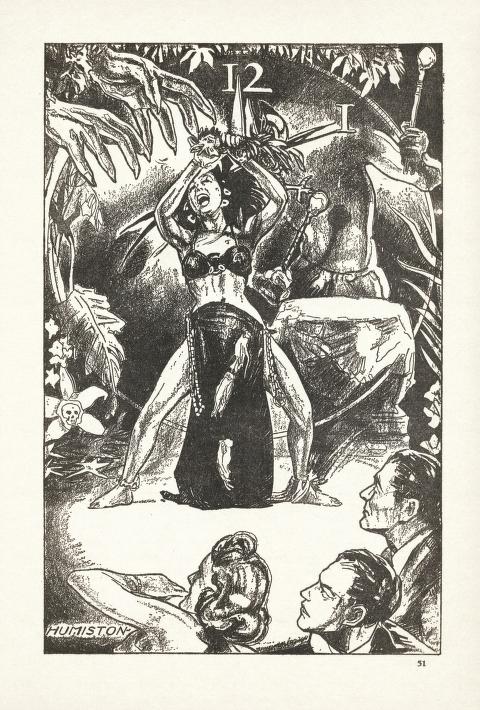
Interestingly, Wellman was inspired by real life, as he mentioned in ‘The Eyrie‘:
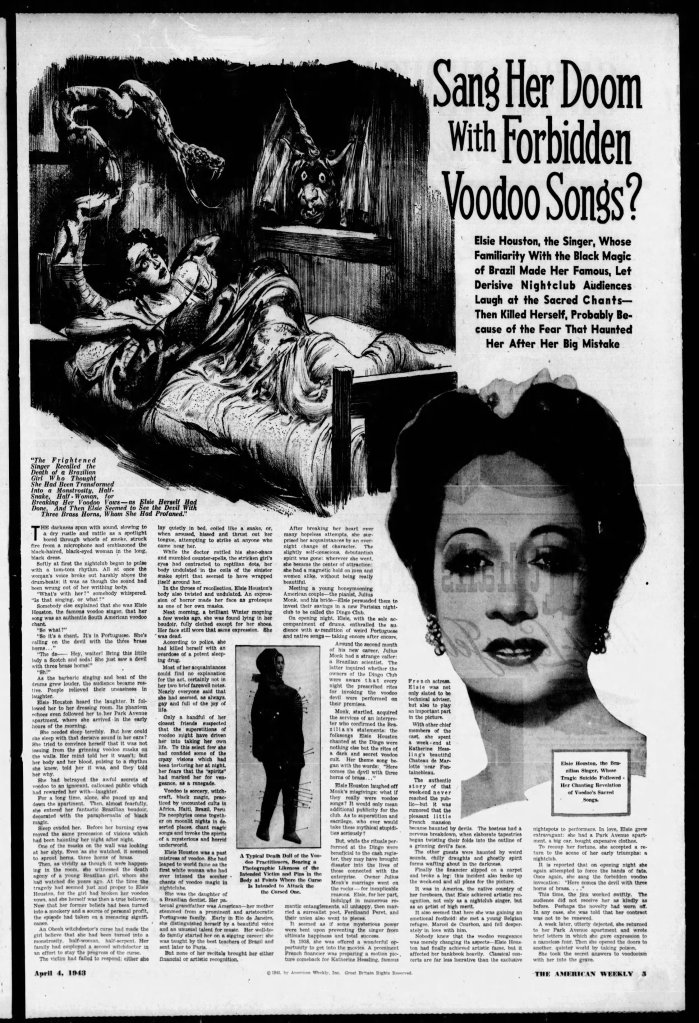
It is a fact that something appeared recently in New York newspapers that might be the public version of THE THIRD CRY TO LEGBA. Some may remember an account of how a certain singer chanted black magic songs and attracted big audiences, including at least one attentive being that she must have wished would stay away. We can’t check on that now, for the singer is untimely dead.
Wellman was probably referring to the case of Elsie Houston:
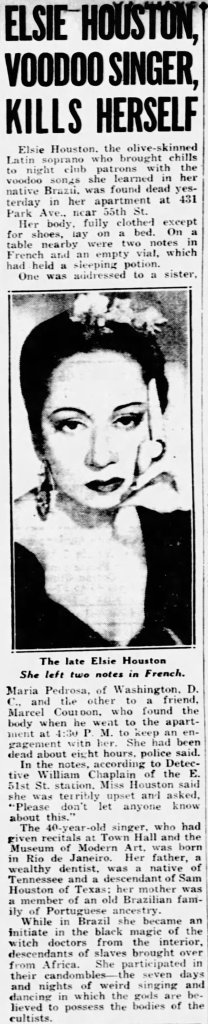
Ironically, the Brazilian singer was apparently claiming initiation in another African diaspora religion, Candomblé. To the general public of the United States of America, ignorant of the differences, it was all “voodoo” in their eyes. The Daily News article is actually fairly restrained; the American Weekly gave Houston an entire page to herself.
While the Weird Tales connections (real or apparent) are fun, “The Obi Makes Jumbee” also has a bit more plot than you might expect for a mere eight pages. The setup has readers expecting a zombie yarn—and they get gangsters, a fake death, a doublecross, a fake zombie, double murder, and then at the end—it’s all true. Which is as neat a bit of storytelling as you can expect. I might almost believe Wellman wrote it himself; he did a good bit of comic book scripting. Unless we find evidence to prove that, however, that remains speculative.
Does “The Obi Makes Jumbee” belong on the list of pre-Code Lovecraftian horror comics? It depends entirely on how much weight you place on “The Goat with a Thousand Horns” as a sneaky reference to Shub-Niggurath. The story has been reprinted a handful of times according to the Grand Comics Database, and can be read for free online at Comic Book Plus.
Bobby Derie is the author of Weird Talers: Essays on Robert E. Howard and Others and Sex and the Cthulhu Mythos.
Deep Cuts in a Lovecraftian Vein uses Amazon Associate links. As an Amazon Associate I earn from qualifying purchases.
 Deep Cuts in a Lovecraftian Vein
Elsie Houston’s story sounds a lot like short story “Dark Melody of Madness” by Cornell Woolrich (1935) 🤔
LikeLike