Hanukkah is an ancient holiday, but a modest one. The holiday of the
Hasmoneans is new, yet it is full of spiritual exaltation and national joy. What
was Hanukkah forty years ago? ‘Al ha-nissim’ and Hallel; a short reading in
the synagogue; lighting the tiny, slender wax candles or oil lights; at home,
levivot [latkes–potato pancakes], cards for the older children, and sevivonim
[dreidels–spinning tops] for the little ones. But what is Hanukkah today? The
holiday of the Hasmoneans. A holiday of salvation. A great national holiday,
celebrated in all the countries of the Diaspora with dances and speeches,
melody and song, outings and parades, as if a new soul has been breathed
into the ancient holiday, another spirit renewed within it. One thing is clear:
if those tiny, modest candles had been extinguished in Diaspora times, if our
grandparents had not preserved the traditions of Hanukkah in the synagogue
and at home . . . , the holiday of the Hasmoneans could never have been
created. There would have been nothing to change, nothing to renew. The
new soul of our times would not have found a body in which to envelop itself.
—Chaim Harrari, Sefer ha-Mo’adim, Sefer Hanukkah (1938),
quoted in “Zionist Awareness of the Jewish Past: Inventing Tradition or Renewing the Ethnic Past?” (2012) by Yitzhak Conforti
On the 25th day of Kislev in the Hebrew calendar is the feast of Hanukkah. Originally a very minor holiday in the Jewish holy calendar, Hanukkah gained increasing prominence during the 20th and 21st centuries as it was embraced as a nationalist holiday by Zionists, and because Hanukkah often occurred near the major Christian holiday of Christmas. The massive increase of secular pop culture surrounding Christmas, especially in English-speaking countries, has led to the increased awareness of Hanukkah, and sometimes its depiction as an equivalent holiday among both religiously observant and secular Jews.
In some cases, elements of secular Christmas celebration have influenced or been adapted for Hanukkah, a process sometimes referred to as Chrismukkah. Jewish families might put up a Hanukkah Bush, or watch Hanukkah-themed movies and animated specials like A Rugrats Chanukah (1996) or Eight Crazy Nights (2002). The influence of Christmas pop-culture on secular Hanukkah media is often very notable. Even when things get a little weird and Lovecraftian.
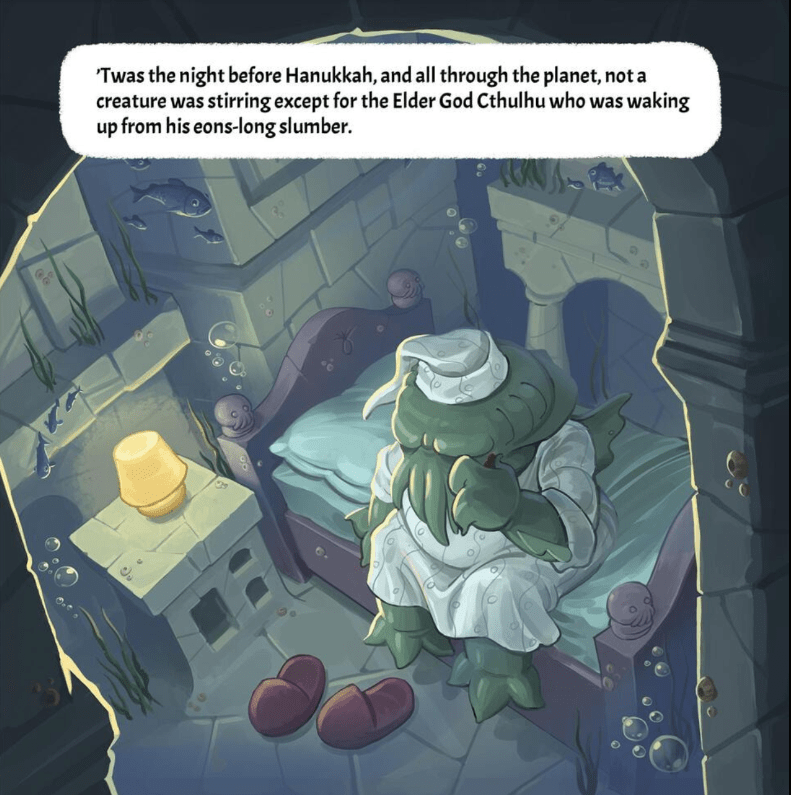
So, when Alex Shvartsman (writer) and Tomeu Riera (artist) set about making Dreidel of Dread: The Very Cthulhu Hanukkah (2024), they took as their initial model the classic Christmas verse “A Visit from St. Nicholas” (1823).
To be fair, Shvartsman and Riera are very aware of it. In fact, that’s quite the point. The book gets very meta very fast, directly addressing how much Hanukkah has played second-fiddle to Christmas in pop culture. Cthulhu is just the catalyst for an ongoing dilemma about the cultural footprint of Hanukkah in a world dominated by Christmas. So with a mix of Yiddishisms and Lovecraftian references, Hanukkah Harry goes off to save Hanukkah from the apocalypse of Cthulhu.
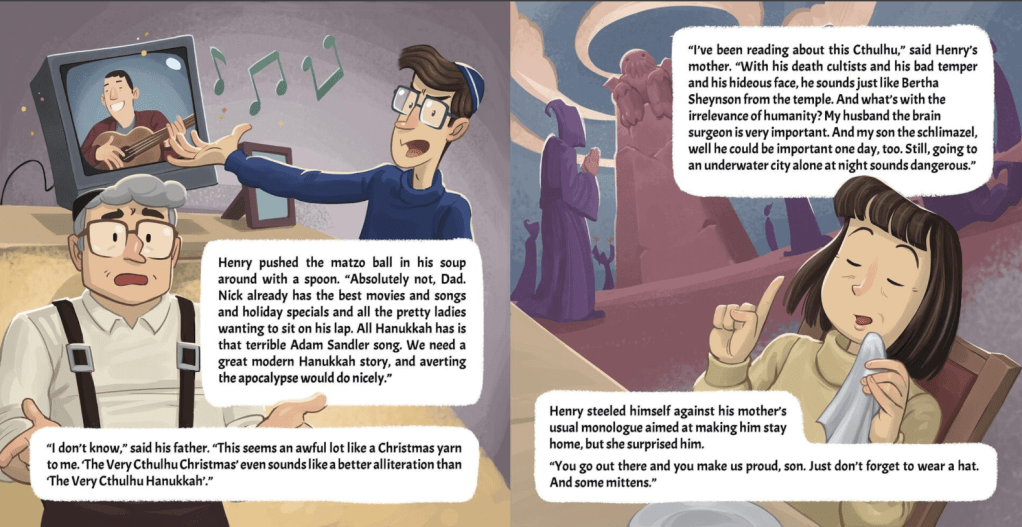
Which he does with a sly insinuation about Lovecraft’s antisemitism and a dreidel.
Riera’s heart is lovely, a soft-focus blend of stylized and detailed that could easily serve as the basis for an animated short. The colors in particular strike a fine balance between the traditional greens and purples favored for eldritch horrors and the more subdued coloring of Harry’s mother and father’s modest dress, while Harry himself favors blue and white. Implicit details of dress suggest the family are probably Reform Jewish, since Harry lacks the payot and none of them wear the typical clothing associated with the hasidim (whose distinct garb Lovecraft noted and commented on in New York City).
It is not a very long book, and thematically it’s not a very deep book. Cthulhu goes down without devouring so much as a latke. Cosmic horror takes a back seat to wanting to sort things about before Christmas comes for Cthulhu. While suitable for and probably geared toward a young adult audience, the youngster would have to be perspicacious enough to be aware of the cultural references for both Hanukkah and Cthulhu to really grok it—and maybe get a chuckle at some of the jokes.
Dreidel of Dread: The Very Cthulhu Hanukkah (2024) is a fun little book, but readers looking for something a little more serious or action-packed might want to check out Edward M. Erdelac’s Merkabah Rider or “The Chabad of Innsmouth” (2014) by Marsha Morman. As Jewish/Cthulhu Mythos mash-ups go, this is distinctly light-hearted and tongue-in-cheek, less concerned with either the details of Lovecraft’s Mythos or the origins of the holiday.
It’s about Hanukkah Harry saving Hanukkah from Cthulhu. Which is, really, all it claims or needs to be.

Bobby Derie is the author of Weird Talers: Essays on Robert E. Howard and Others and Sex and the Cthulhu Mythos.
Deep Cuts in a Lovecraftian Vein uses Amazon Associate links. As an Amazon Associate I earn from qualifying purchases.
 Deep Cuts in a Lovecraftian Vein