| Habían pasado siete años desoe la desparaición de su abuelo Whipple cuando Ward Phillips recibió la lámpara. | Seven years had passed since the disappearance of his grandfather Whipple when Ward Phillips received the lamp. | It was seven years after his Grandfather Whipple’s disappearance that Ward Phillips received the lamp. |
| “La Lámpara de Alhazred” (2023) by Manuel Mota & Julio Nieto, Cthulhu #28.5 | English translation | August Derleth, “The Lamp of Alhazred” (1957), The Watchers out of Time 114 |
Many of August Derleth’s “posthumous collaborations” with H. P. Lovecraft have been derided as pastiches. Yet “The Lamp of Alhazred” is more homage—and more accurately a collaboration than most of Derleth’s stories, since it incorporates a large chunk of text from Lovecraft’s letter to Derleth dated 18 Nov 1936, where Lovecraft described coming across a previously unknown wood west of Neutaconkanut Hill.
| On Oct. 28 I penetrated a terrain which took me half a mile from any spot I had ever trod before in the course of a long life. I followed a road which branches north 7 West from the Plainfield Pike, ascending a low rise which skirts Neutaconkanut’s Western foot & which commands an utterly idyllic Vista of rolling Meadows, ancient stone walls, hoary groves, 7 distant cottage roofs to the west & south. Only 2 or 3 miles from the city’s heart—& yet in the primal rural New-England of the first colonists! | He penetrated a terrain which took him almost a mile from any spot he had ever before trod in the course of his life, following a road, which branched north and west from the Plainsfield Pike and ascending a lot rise which skirted Nentaconhaunt’s Western foot, and which commanded an utterly idyllic Vista of rolling Meadows, ancient stone walls, hoary groves, and distant cottage roofs to the west and south. he was less than three miles from the heart of the city, and yet basked in the primal rural New England of the first colonists. |
| H. P. Lovecraft to August Derleth, 18 Nov 1936, Essential Solitude 2.756 | August Derleth, “The Lamp of Alhazred” (1957), The Watchers out of Time 119 |
Derleth also took inspiration from an entry in Lovecraft’s commonplace book:
| From Arabia Ency. Britt. II.–255. Prehistoric fabulous tribes of Ad in the south, Thamood in the north, and Tasm & Jadis in the centre of the peninsula. “Very gorgeous are the descriptions given of Irem, the City of the Pillars (as the Koran styles it) supposed to have been erected by Shedad, the latest despot of Ad, in the regions of Hudramant, and which yet, after the annihilating of its tenants, remains entire, so Arabs say, invisible to ordinary eyes, but occasionally, and at rare intervals, revealed to some heaven-favored traveler.” Rock excavations in N. W. Hejaz ascribed to Thamood tribe. | It had once been the property of a certain half-mad Arab, known as Abdul Alhazred, and was a product of the fabulous trident of ad—one of the four mysterious, little-known tribes of Arabia, which where ad—of the south, Thamood—of the north, Tasm and Jadis—of the center of the peninsula. it had been found long ago in the hidden city called Irem, the city of Pillars, which had been erected by Shedad, last of the despots of Ad, and was known by some as the Nameless City, and said to be in the area of Hadramant, and, by others, to be buried under the ageless, ever-shifting sands of the Arabian deserts, invisible to the ordinary eye, but sometimes encounter by chance by the favorites of the Prophet. |
| The Notes and Commonplace Book of H. P. Lovecraft 21-22 | August Derleth, “The Lamp of Alhazred” (1957), The Watchers out of Time 115-116 |
While nearly every Lovecraft story has been adapted to comics at some point, rather fewer of Derleth’s stories have attracted the same treatment. Yet it makes sense that Manuel Mota (script) and Julio Nieto (artwork) would adapt “The Lamp of Alhazred” for Cthulhu #28, the Lovecraft special issue. Because there are homages which capture as much of the pathos of H. P. Lovecraft as well as this one.
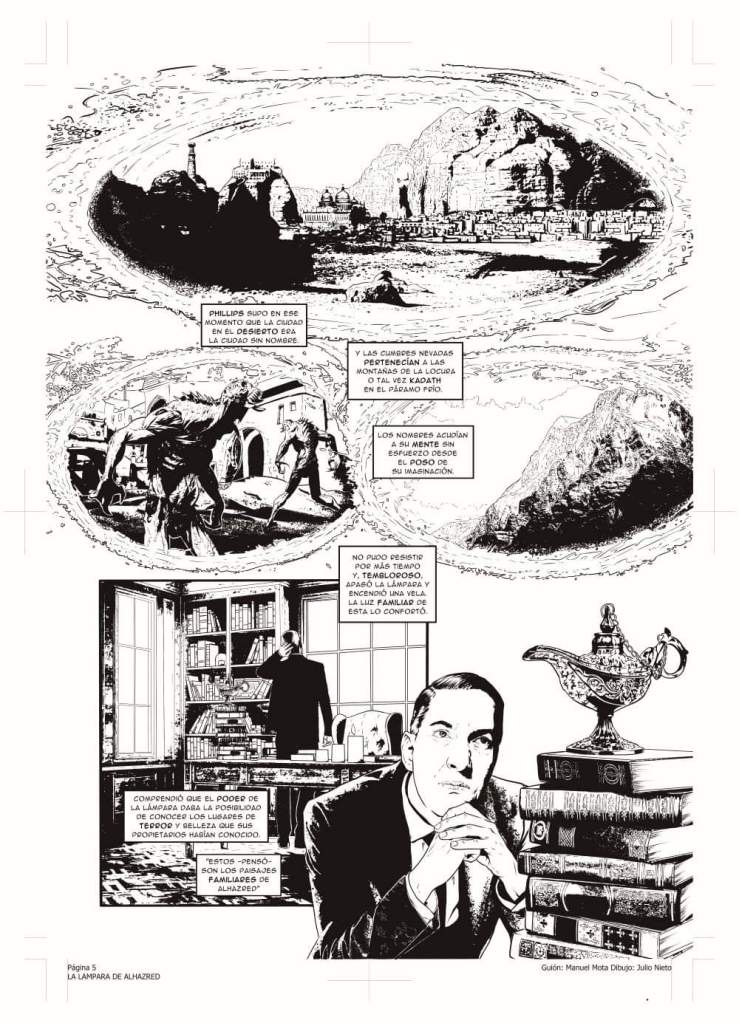
Manuel Mota’s script is a fairly straight translation of Derleth text, albeit truncated for space and with the illustrations serving in place of much of the description, which inadvertently cuts out most of Lovecraft’s text. Yet the presentation and framing of the words and Julio Nieto’s art does much to lend a sense of action to what is a largely contemplative story that draws on both Lovecraft’s life and the sentiment of “The Silver Key.” Readers feel Ward Phillips loss and loneliness, his refuge in his imagination, and the visions of other worlds, other times.
It is escapist in the most literal sense of the word, and one of several stories that reflect that quiet, profound desire to abandon the daily grind of life, with its quiet indignities, defeats, and injuries.
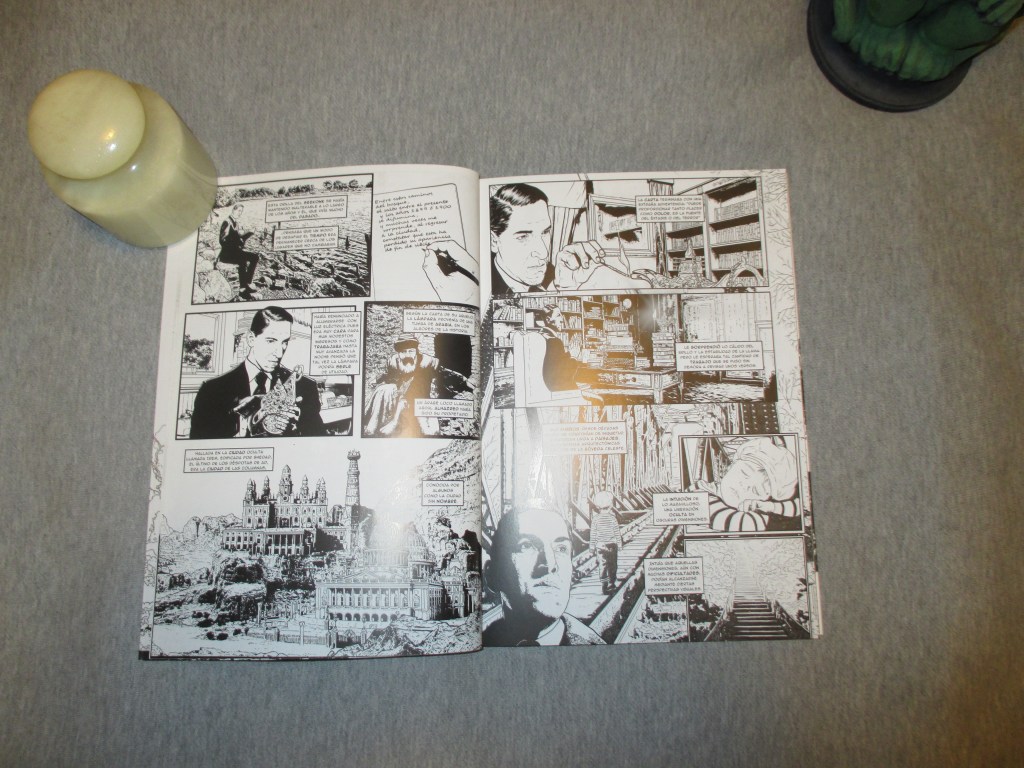
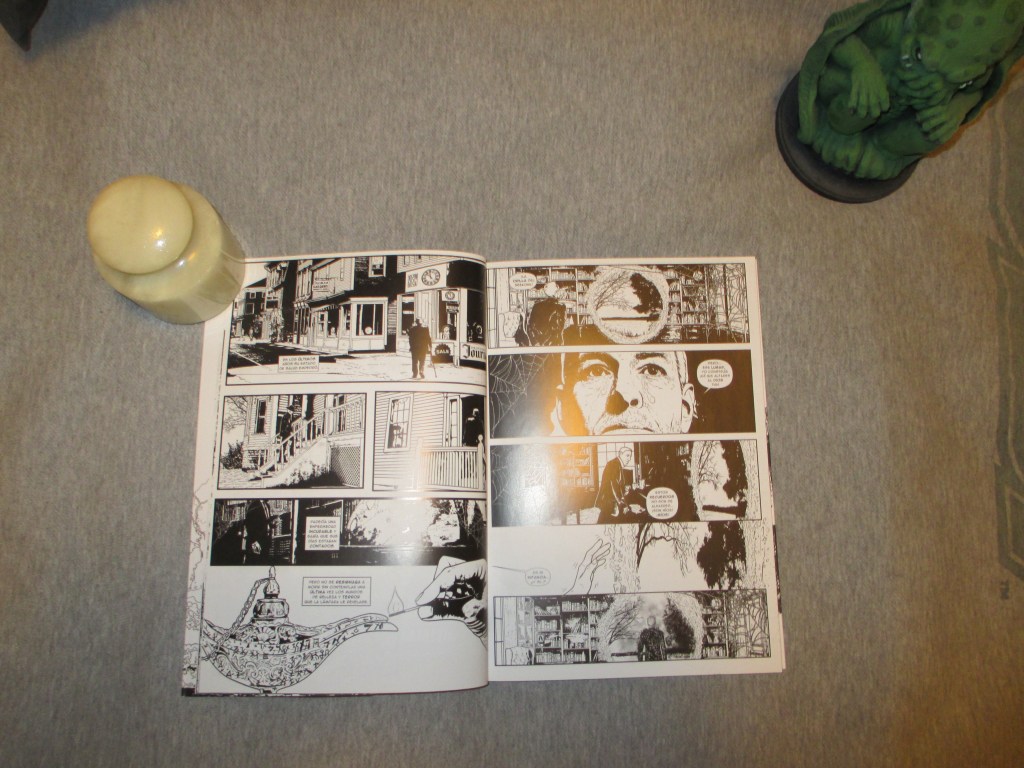
Nieto’s artwork is carefully realistic, the page layout traditionally grid-like; it is a straight-forward presentation that puts the more fantastic sequences, the break-outs where the panel cannot contain a wondrous scene, in context. The weirdness isn’t a part of Ward Phillips world; it is the way out.
| Jamás se encontro el cuerpo de Ward Phillips. La policía aún espera queue sus restos aparezcan en Alguno de los lugares queue solía frecuentar en sus solitarios paseos. Con el paso de Los años, la vieja casa fue derribada, la biblioteca adquirida por librerías anticuarias y lo queue quedó gue vendido como chatarra incluida una vieja lámpara Árabe a la que nadie encontró utilidad alguna. | The body of Ward Phillips was never found. Police are still hoping that his remains will turn up in one of the places he used to frequent on his solitary walks. Over the years, the old house was demolished, the library was acquired by antiquarian bookstores and what remained was sold as scrap, including an old Arabic lamp that no one found any use for. | Though desultory searching parties were organized and sent out to scour the vicinity of Nentaconhaunt and the shores of the Seekonk, there was no trace of Ward Phillips. The police were confident that his remains would some day be found, but nothing was discovered, and in time the unsolved mystery was lost in the police and newspaper files. The years passed. The old house on Angell Street was torn down, the library was bought up by book shops, and the contents of the house were sold for junk—including an old-fashioned antique Arabian lamp, for which no one in the technological world past Phillips’ time could devise any use. |
| “La Lámpara de Alhazred” (2023) by Manuel Mota & Julio Nieto, Cthulhu #28.14 | English translation | August Derleth, “The Lamp of Alhazred” (1957), The Watchers out of Time 123-124 |
It is a story that almost demands a familiarity with Lovecraft to truly appreciate; those who have read his letters, who knows what Lovecraft struggled with during his life, can recognize more of the man in Derleth’s framing of the Nentaconhaunt narrative. Mota and Nieto do well to capture and depict as much of this atmosphere as they can, and the sensibility of the story is necessarily both sad and romantic in the older sense—this is not a Mythos story, despite the name “Alhazred.” it is a fantasy, a myth, so much more elegant than the reality that saw Lovecraft end his days in pain in a hospital as the cancer consumed him.
“La Lámpara de Alhazred” (2023) by Manuel Mota & Julio Nieto is an excellent overall adaptation of Derleth’s homage to Lovecraft, one that captures the spirit of the original—the echo of Lovecraft, as it were—for a new medium and a new audience.
Bobby Derie is the author of Weird Talers: Essays on Robert E. Howard and Others and Sex and the Cthulhu Mythos.
Deep Cuts in a Lovecraftian Vein uses Amazon Associate links. As an Amazon Associate I earn from qualifying purchases.
 Deep Cuts in a Lovecraftian Vein