Eldritch Fappenings
This review concerns a work of explicit adult literature. Reader discretion is advised.
Men’s adult magazines emerged during the 1950s. Titles like Modern Man (1952) and Playboy (1953) featured softcore nude pictorials of women models, intermixed with a combination of editorials, articles, interviews, advertisements, cartoons, letters from readers, and quite a bit of fiction. The relative success of Playboy in particular inspired numerous imitators of various degrees of sophistication and quality. Loosening censorship restrictions in the United States and other countries in the 1970s saw some magazines become more explicit, directly depicting genitalia, sex acts (including penetration), and sexual fluids, but every magazine publisher and editor had to find the right balance for the time and place—to sell the magazine to readers, and not to get thrown in jail if they went too far.
Weird fiction has a surprisingly long history in men’s adult magazines; Playboy published William Hope Hodgson’s “The Voice in the Night” in the July 1954 issue, and various other publications have published articles on pulp magazine art, Robert E. Howard’s Conan character, H. P. Lovecraft, and related subjects. Even a revised version of “The Rats in the Walls” (1956) by H. P. Lovecraft first appeared in a minor men’s magazine. So it might not come as too big of a surprise that there’s a small body of Cthulhu Mythos fiction which has appeared first—and only—in men’s adult magazines.
Such is the case of the “Wicked Walter” series by grandmaster of horror Brian McNaughton (under his pseudonym Mark Bloodstone), which ran in the magazine Beaver from 1981 to 1983, and are comprised of “Wicked Walter” (July 1981), “The Panty Demon” (October 1981), “They Don’t Write Them Like They Used To” (November 1981), “Glamour Puss” (February 1982), “The Enchanted Dildo” (July 1982), “The Great Cat-House Raid” (January 1983), “How Are They Hanging?” (February 1983), “I’ll See You In My Dreams” (May 1983), and according to Robert M. Price a final unpublished story “Her Night to Howl.”
The eponymous “Wicked Walter” is about an Arkham cop and Miskatonic University graduate named Walter Finn, a hereditary witch who uses his powers to solve other magical crimes.
You don’t expect a red-blooded American cop to pack every room of his partment from floor to ceiling with mouldy old books, some of them in Latin and Greek. Nor do you expect him to have a pet crow named Dr. Dee who squawks that he’s a raven when you call him a crow, and whose favorite perch is a human skull on Walter’s desk. Walter didn’t even have a television set. She would have laid odds that he didn’t have a bowling ball in his closet or a six-pack in his icebox, either, like every other guy on the force. But he did have a bed, and once he got her into it she forgot everything else.
—Brian McNaughton (as Mark Bloodstone), Beaver July 1981, 66
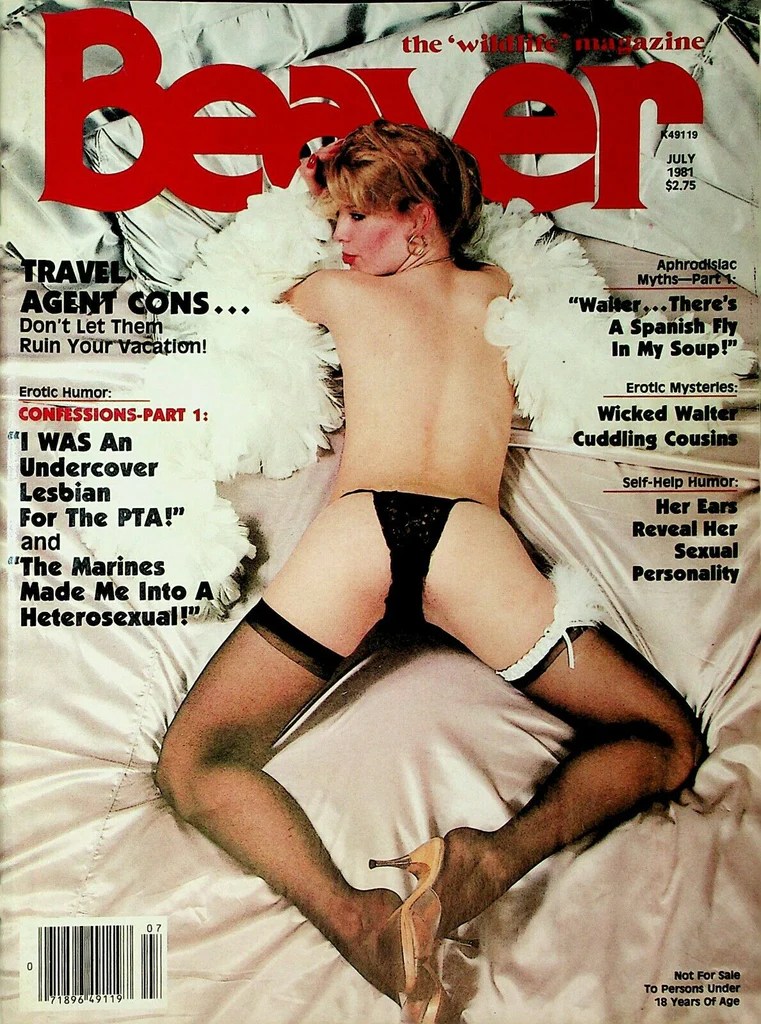
Wicked Walter came along at an odd time and place for McNaughton.
McNaughton began his career in the fanzines of the 1950s while in high school; he attended Harvard but did not take a degree, and for a decade worked as a newspaperman at the Newark Evening News until the paper folded, and he turned to other work, including a decade as night manager of a motel. In 1971 he began writing adult fiction with In Flagrant Delight (1971) by Olympia Press. Under his own name and pseudonyms he would go on to write at least twenty erotic novels and a couple dozen short stories published between 1971 and 1983. The vast majority of these works have no reference to the Mythos, nor does McNaughton’s thriller Buster Callahan (1978; also released as The Poacher).
McNaughton’s breakthough came in the late-1970s, when he convinced longtime publisher Carlyle Communications to print a series of non-erotic horror novels. Although stuck with editorially mandated titles by Carlyle, the novels Satan’s Love Child (1977), Satan’s Mistress (1978) and its sequel Satan’s Seductress (1980), and Satan’s Surrogate (1982) proved successful enough to help relaunch McNaughton as a writer of dark fantasy and horror fiction. Aside from the middle two books, the Satan novels are not part of the same series as the titles would indicate, and the share little with one another besides a common writer and certain common themes. However, the success of these novels signaled McNaughton’s transition (or return) to weird and horror fiction, including contributions to Weirdbook (1968–97) and Lore (1995–98), and culminated in such masterpieces as The Throne of Bones (1997).
Brian McNaughton also wrote a number of pornographic “romance” novels under the pen names Sheena Clayton and Mark Bloodstone as well as his own, mainly for Carlyle Communications under imprints like Beeline, Tigress, and Pandora. The exact number and titles of his books I have been unable to determine, but the ones written as Sheena Clayton include Love and Desire (1982), The Aura of Seduction (1982), Tide of Desire (1983), Danielle Book Two (1983), There Lies Love (1983), and Perfect Love (1983)—all of which to greater or lesser extent contain supernatural elements and references to the Mythos. It was during this same time frame that McNaughton wrote his Wicked Walter stories.
In the first story, Walter Finn encounters a new cult in Arkham, run by a woman who calls herself Isobel Gowdie. Finn takes a magical precaution before he confronts Gowdie, and once inside her office he confirms she’s up to no good.
He hadn’t needed more proof, but it was all here in the decor of her office. One of the supposedly modern paintings on her wall was in fact the very old and awesome Yellow Sign. The tapestry on the opposite wall incorporated secret symbols of Nodens and Magna Mater, whose worshippers had been driven underground by the horrified pagans of ancient Rome. The paper-weight on her desk was a statuette of the dread Cthulhu. Few people would recognize the significance of these clues, but they alerted Walter that he was in the presence of a power darker and more terrible than he had suspected.
—Brian McNaughton (as Mark Bloodstone), Beaver July 1981, 70
The language is very pulpy, with lots of straightforward action and declarations, not getting too bogged down into details but offering enough details to tantalize, titillate, and even assure readers that they’re reading about consensual sexual encounters and not rape or coercion…this time.
Walter seldom used his occult powers to overcome a girl’s resistance, partly from masculine pride and partly because it took some of the spontaneity out of it. He was glad he hadn’t done that with Isobel. Apart from taking her dress off, everything she’d done had been done of her own free will. Maybe she was hoping to con him in some way, but she sure as hell wasn’t faking her responses.
—Brian McNaughton (as Mark Bloodstone), Beaver July 1981, 70
The character of Walter Finn very much falls into a certain male archetype of the period; a guy who is confident, amiable, willing and able to have sex at nearly any opportunity, but who isn’t extraordinarily strong, good-looking, rich, intelligent, cruel, or overly moralistic. A kind of hypersexual everyman, not unlike many characters in period films like Animal House (1978), Stripes (1981), Police Academy (1984), or Revenge of the Nerds (1984).
It isn’t a very long story, and McNaughton sets things up and wraps them up quickly, with two very explicit sex scenes taking up a considerable chunk of the word count. Yet “Wicked Walter” is, without a doubt, a bit of fun. McNaughton had no need to build up Walter Finn’s character as well as he did, didn’t need to add in the Mythos references. Yet they don’t come across as padding, either. McNaughton was finding a happy middle ground between erotic fiction and what today we might call urban fantasy. The series as a whole makes entertaining light reading, if the mandatory sex scenes often throw the pacing off a little.
McNaughton’s “Wicked Walter” stories, with their occasionally dated references and language, are artifacts of erotic fiction from an age before shaving pubic hair was commonplace, and practically unique for their content at the time of publication. Unfortunately, unless you’re a collector of vintage men’s adult magazines, you will probably never read them. “Wicked Walter” and its sequels have never been reprinted since their original publication, and anyone who did desire to do so would probably have an interesting time sorting out who owns the rights and getting the correct permissions to do so.
Bobby Derie is the author of Weird Talers: Essays on Robert E. Howard and Others and Sex and the Cthulhu Mythos.
Deep Cuts in a Lovecraftian Vein uses Amazon Associate links. As an Amazon Associate I earn from qualifying purchases.
 Deep Cuts in a Lovecraftian Vein