The space opera comic strip Jeff Hawke by British cartoonist Sydney Jordan (with William Patterson 1956-1969) ran from 15 Feb 1955-18 Apr 1974 in the Daily Express. While cut in the mold of Flash Gordon, Jeff Hawke was aimed at an adult audience (including some mild erotic elements in the form of topless women, which also appeared in British newspaper strips like Axa), and found an appreciative audience not just in the United Kingdom but in translation outside of English, particularly in Italy, Spain, and Sweden. Because the Express owned the rights to the strip, there were no English-language reprints until the 1980s, wheren Titan Books obtained the rights, although various European collections appeared.
In 1976, Sydney Jordan launched a “new” strip, Lance McLane (1976-1988), which ran in the Scottish Daily Record newspaper (several strips, 1-238, also ran in the London Evening News under the title Earthspace.) This was, more or less, a soft relaunch of Jeff Hawke under a different title; Jordan even made it clear in a connecting storyline that “Lance McLane” was simply Jeff Hawke, several decades into the future, and some European editions continued the series numbering without interruption (which leads to some confusion, especially as some strips were created specifically for European magazines or fanzines that didn’t run in the daily paper).
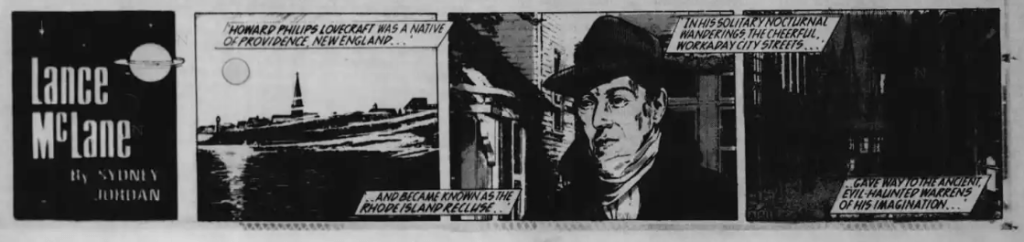
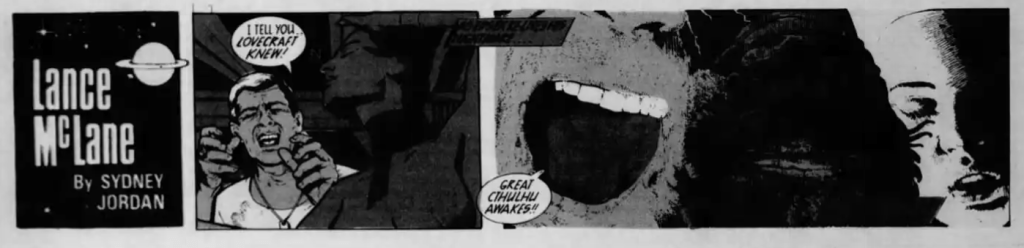
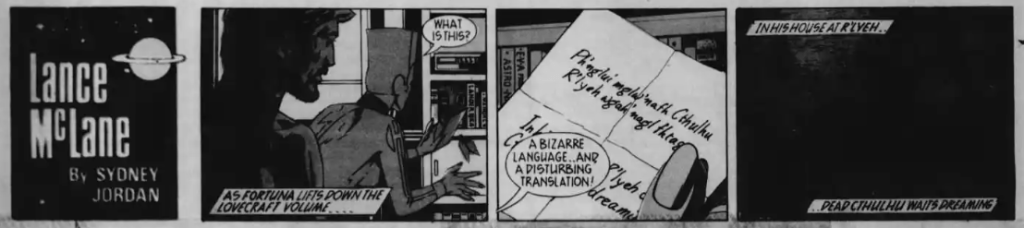
In 1985, the “Even Death May Die” storyline began which saw Jeff Hawke and the telepathic female android Fortuna up against the Cthulhu Mythos—a run has only been collected once in English, in Jeff Hawke’s Cosmos vol. 10, no. 3, a subscription-only publication of the Jeff Hawke Fan Club. The storyline is more available in the Italian collection Jeff Hawke/Lance McLane 2 Storie Inedite (2014), which also offers some valuable background material, if you can read Italian.
| Io fui uno dei pochi a non esere totalmente sorpreso dall anuova direzione che aveva preso la storia, a circa metà di Vele nel Rosso Tramonto, perché sapevo che Sydney Jordan aveva acquisito i diritti di un racconto di H. P. Lovecraft da utilizzare per una storia chiamata The Dark Tower che non fu mai pubblicata. Le prime citazioni derivano da Il Richiamo di Cthulhu (1928), ristampato da August Derleth nella raccolta L’Orrore di Dunvich e altre storie, 1963, e in una selezione di storie da essa tratte, Il Colore dallo Spazio e altre storie (Lancer, 1964). Marise Morland suggerì la litania “O Gorgo, Mormo, luna dalle mille facce, guarda con benevolenza ai nostri sacrifici”, e altri dettagli, perché Sydney aveva letto solo poche storie, mentre lei le aveva lette tutte. | I was one of the few who wasn’t totally surprised by the new direction the story had taken, about halfway through Sails in the Red Sunset, because I knew that Sydney Jordan had acquired the rights to an H. P. Lovecraft story for use in a story called The Dark Tower that was never published. The earliest citations are from “The Call of Cthulhu” (1928), reprinted by August Derleth in the collection The Dunwich Horror and Other Stories, 1963, and in a selection of stories from it, The Colour from Space, and Other Stories (Lancer, 1964). Marise Morland suggested the litany “O Gorgo, Mormo, thousand-faced moon, look kindly upon our sacrifices,” and other details, because Sydney had only read a few stories, while she had read them all. |
| “Note a ‘..Anche la morte può morire!’” di Duncan Lunan, Jeff Hawke/Lance McLane 2 Storie Inedite (2014) 96 | “Notes on ‘Even Death May Die!'” by Duncan Lunan Translated into English |
Sails in the Red Sunset was the storyline immediately preceding Even Death May Die, and includes the first references to Lovecraft and Cthulhu, on the lips of a madman in a derlict spaceship; it is this clue that leads McLane and Fortuna to Earth to investigate the cult of Cthulhu. It isn’t clear which Lovecraft story Jordan might have attempted to license for the never-published “The Dark Tower” story; presumably this would have been a deal with Arkham House. Based solely on the title, I wonder if it didn’t involve The Lurker at the Threshold (1945).
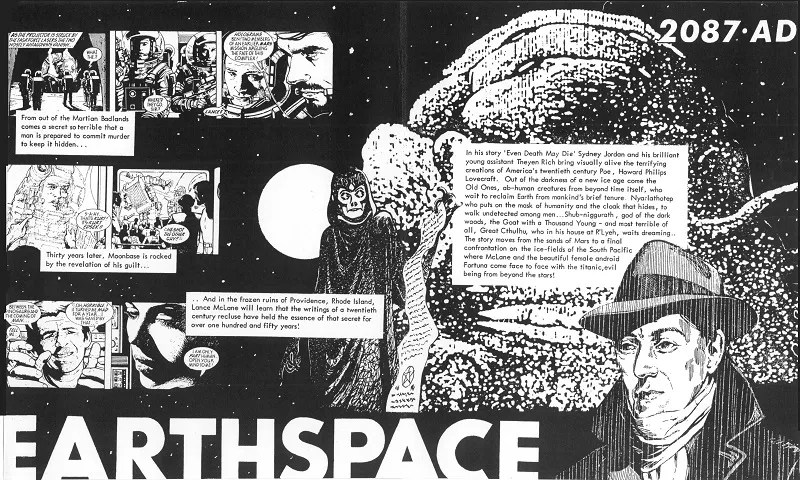
Duncan Lunan also shared the above image in his post Space Notes 24 Jeff Hawke Part 4 – Not As We Know It (29 Oct 2023), a montage that combines panels and images from several strips in the storyline under the Earthspace banner.
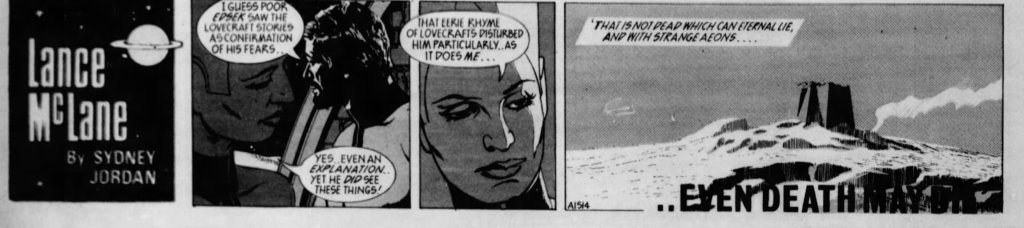
Many of Jordan’s storylines ran 12-16 weeks (~72-96 strips), but but according to Tony O’Sullivan’s index “Even Death May Die” ran for 145 daily strips (A1508 – 1653), making this one of the longer storylines, and according to O’Sullivan’s notes the storyline wasn’t even syndicated in Europe (hence “Storie Inedite”—”Unpublished Stories”). Italian Wikipedia gives a different numbering, 149 strips (A1503 – A1652), but with the way “Even Death May Die” dovetails with the previous storyline and idiosyncrasies of international publishing it can be tricky to decide where one story starts and ends, exactly.
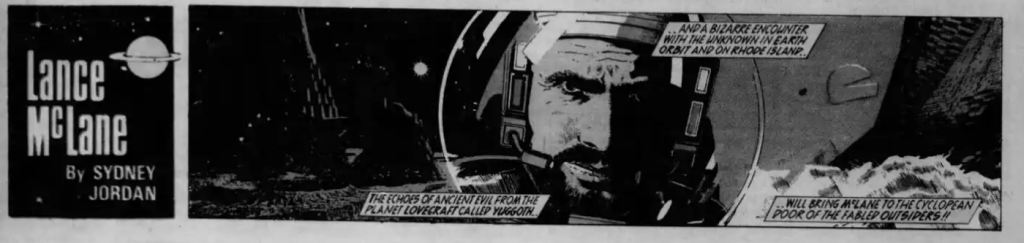
Given that there are ~10,000 strips, that the Cthulhu material came nearly at the end of this long-running project, wasn’t even published in Europe at the time, and that reprints nearly always focus on the beginning of the run, it may be no surprise that collections are scarce and that Jordan’s take on the Mythos has been largely overlooked. I only stumbled across it because the Daily Record archive is available on newspapers.com. I was trying to find the first newspaper comic strips to include Lovecraft and Cthulhu; this may well be it.
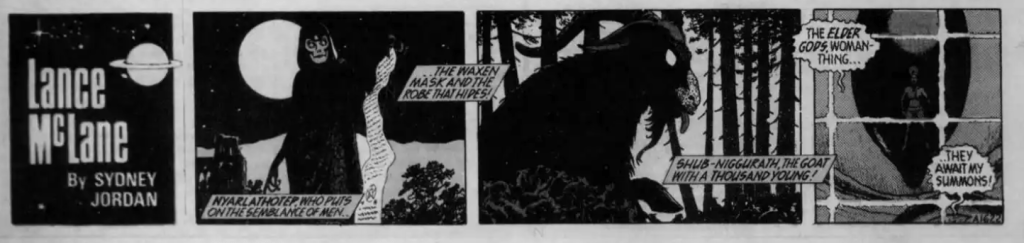
The story itself follows what is now fairly familiar territory: Lovecraft was writing more than fiction, the Cthulhu Mythos is real, malevolent, and it’s up to Lance McLane and Fortuna to stop their nefarious plans for the human race. The pace of a daily strip can seem plodding compared to a comic book or graphic novel, and the often muddy tones of newsprint often render Jordan’s artwork very dark in the newspaper scans. Which is a pity, because Jordan’s artwork is strongly realistic, grounding the strip in a way that makes the fantasy elements appear as truly intrusive…even if the darker text boxes are sometimes difficult to read.
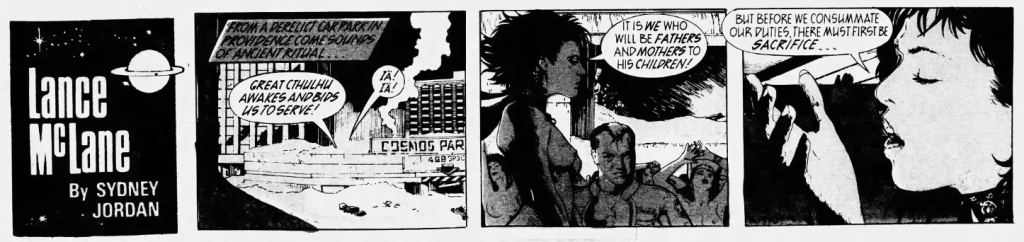
The 1980s UK sensibilities allowed a degree of eroticism, which is probably one of the reasons Lance McLane never found syndication in the United States newspapers. This is measured titillation (Jordan couldn’t be explicit even if he wanted to), but not inappropriate to the material: the idea of an orgiastic cult comes straight from “The Call of Cthulhu,” after all, and it’s a bold storyteller that manages to get as much on the screen as Jordan does.
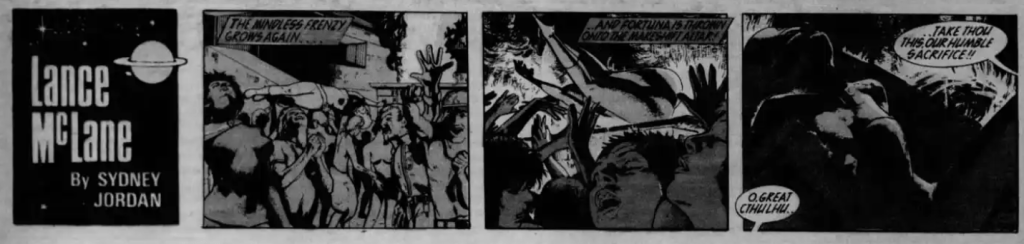
However, this has to be read in the context of works like “The Discovery of the Ghooric Zone” (1977) by Richard Lupoff and Strange Eons (1978) by Robert Bloch: this was one of the first attempts to project the Mythos into the space opera future, and it was doing it in a mainstream newspaper, not in the pages of Metal Hurlant/Heavy Metal or other specialist comic magazine.
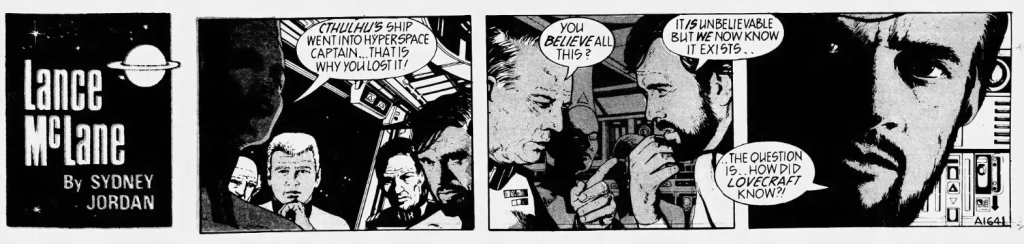
It is a pity that “Even Death May Day” hasn’t received a more widespread publication; at the moment, your best bet to read it in English is to get a newspaper.com subscription and manually scroll through the Daily Record day by day. For those that read Italian, Jeff Hawke/Lance McLane 2 Storie Inedite (2014) is a choice option to see the strip compiled and restored, looking better than it ever did on newsprint, being on glossy paper and in color:

Bobby Derie is the author of Weird Talers: Essays on Robert E. Howard and Others and Sex and the Cthulhu Mythos.
Deep Cuts in a Lovecraftian Vein uses Amazon Associate links. As an Amazon Associate I earn from qualifying purchases.
 Deep Cuts in a Lovecraftian Vein
A great find, and interesting read!
LikeLiked by 1 person