| Sasturain: Mais mesure un peu l’influence que peut avoir un regard critique sur ton oeuvre: dans les années 1960, tu as tout laissé tomber jusqu’à ce qu’apparaissent des gens qui te lisaient, te suivaient, t’appreciaient. Qu t’ont renvoyé un écho positif de ce que tu avais fait. Ce n’est qu’en 1968, à la sortie du livre de Martínez Peyrou, puis celui de Masotta, qu’on t’apprécie, qu’on reconnaît ta valeur. Ton travail est reconnu en Europe, tu retrouves une stimulation. La réaction de l’extérieur te motive, t’encourage. Breccia: Et j’ai trouvé un marché où proposer des choses dont tout le monde se fichait ici. Quand j’ai fait L’Éternaute, on m’a tiré dessus à boulets rouges. Mort Cinder n’a pas eu de succés. Richard Long est passé completèment inaperçu. Je veux dire par là que toutes ces ouevres relativement valables, tout le monde s’en battait l’oeil, en Argentine, alors qu’elles ont eu du succès en Europe. Si je propose Le Couer révélateur ici, personne ne le publie. Il est paru dans Breccia Negro, édité par Scutti, mais c’est moi qui l’ai imposé. À cette époque, Scutti publiait n’importe quoi. Je lui ai dit: «Faisons un livre», et c’etait parti. Le cas de Là où la marée monte et se retire, l’adaptation de la nouvelle de Lord Dunsany, par exemple, montre qu’un tas de choses n’ont pas reçu non plus un bon accueil en Europe, elles sont restées et restent inédites. Mais c’est vrai que ce genre-là m’a intéressé. Après, quand j’ai voyagé en Europe et que j’ai vu ce qui se passait la-bas, tout a changé, j’ai découvert qu’il existait un marché immense, un public qui attendait des oeuvres différentes, et qu’on pouvait faire du neuf. Un endroit où la bande dessinée était très respectée, pas comme ici, où elle demeure encore aujourd’hui un genre marginal. | Sasturain: But consider the influence that a critical eye can have on your work: in the 1960s, you dropped everything until people appeared who read you, followed you, appreciated you. Who gave you a positive response to what you had done. It was only in 1968, with the release of Martínez Peyrou’s book, then Masotta’s, that you were appreciated, that your value was recognized. Your work was recognized in Europe, you found stimulation. The reaction from outside motivated you, encouraged you. Breccia: And I found a market where I could offer things that nobody cared about here. When I did The Eternaut, I was shot at with red-hot cannonballs. Mort Cinder was not a success. Richard Long went completely unnoticed. I mean by that that all these relatively valid works, nobody cared about them, in Argentina, while they were successful in Europe. If I offer “The Telltale Heart” here, nobody publishes it. It appeared in Breccia Negro, published by Scutti, but I was the one who insisted on it. At that time, Scutti published anything. I told him: “Let’s make a book,” and that was it. The case of “Where the Tide Ebb and Flow,” the adaptation of Lord Dunsany’s story, for example, shows that a lot of things were not well received in Europe either; they remained and remain unpublished. But it’s true that this genre interested me. Then, when I traveled to Europe and saw what was happening there, everything changed, I discovered that there was a huge market, an audience that was waiting for different works, and that we could do something new. A place where comics were very respected, not like here, where they still remain a marginal genre today. |
| Breccia: Conversations avec Juan Sasturain (2019) 306 | English translation |
Alberto Breccia, a comic artist now hailed as a master and whose work is internationally recognized and translated into myriad languages, got his start like pretty much every other artist: wherever he could. When opportunities in his native Argentina were few, Breccia turned to Europe, which welcomed international talent. His fame in the English-speaking world largely rests on a series of nine adaptations of H. P. Lovecraft’s stories that he first completed and published in the 1970s, but while these have gained fame and been published and republished, they were part of a broader turn in his career toward adapting classic works of horror and fantasy into the medium of comics during the 70s.
One of the more obscure of these adaptations, especially to English-language audiences, is “Donde suben y bajan las mareas” (1978), adapted from Lord Dunsany’s “Where the Tides Ebb and Flow” from A Dreamer’s Tales (1910). The script was written by Carlos Trillo, and Breccia did the artwork using a collage method; a technique that provides a certain texture to his more experimental 70s works. At a scanty 8 pages, it was probably intended for an Italian market like Il Mago, but as near as I can determine the first—and for a long time only—publication was in the now rare Breccia Negro (1978), a collection of his unpublished and scarce work, which has itself never been reprinted.
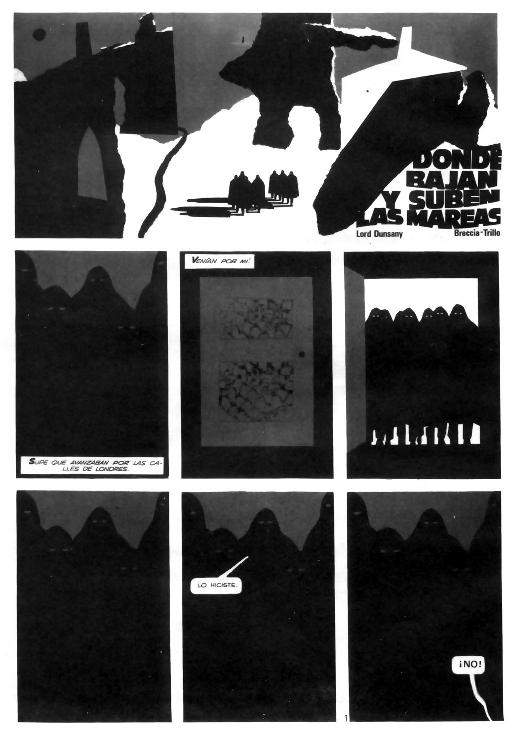
| Supe que avanzaban por las calles de Londres. Venían por mí. Lo hiciste. ¡NO! | I knew they were advancing through the streets of London. They were coming for me. You did it. NO! |
| Informe sobre ciegos y otras historias 101 | English translation |
The effect is dark, almost minimalist, a chiaroscuro nightmare. As in Dunsany’s tale, it is told primarily from the view of the protagonist, who cannot see the faces of his friends and executioners clearly. Only their eyes, only the numberless mass of them who come to execute justice for the unspoken crime. When in Europe in the 70s, Breccia went to Great Britain to stand on the banks of the Thames.
| Sasturain: Un jour, tu m’as raconté que tu étais allé à Londres pour chercher… Breccia: Pour chercher la boue de la Tamise, celle de Là où la marée monte et se retire. Je suis allé voir ça de nuit. Et j’ai marché dans les ruelles de Soho, tu vois? Les ruelles de Jack l’Éventreur. Tue sais que je ne suis pas vraiment un rigolo. (Rires) J’ai suivi la piste de Lord Dunsany et de Jack l’Éventreur. Mais la ville de Lonres m’a plu tout entiere, tout ce que j’ai vu de l’Angleterre m’a plu. | Sasturain: One day, you told me that you went to London to look for… Breccia: To look for the mud of the Thames, the one Where the tide ebbs and flows. I went to see it at night. And I walked in the alleys of Soho, you see? The alleys of Jack the Ripper. You know I’m not really a joker. (Laughs) I followed the trail of Lord Dunsany and Jack the Ripper. But I liked the whole city of London, everything I saw of England I liked. |
| Breccia: Conversations avec Juan Sasturain (2019) 366 | English translation |
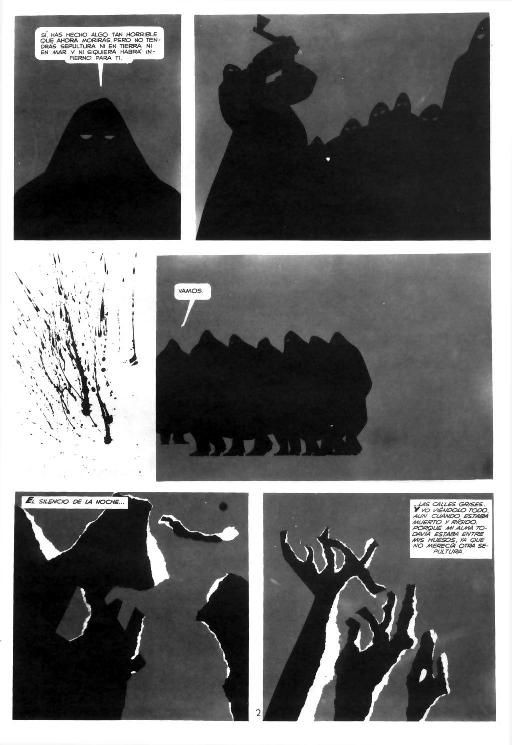
| Sí. Has hecho algo tan horrible que ahora morirás. Pero no tendrás sepultura ni en tierra ni en mar y ni siquiera habrá infierno para ti. Vamos. El silencio de la noche… …las calles grises yo viéndolo todo. Aun cuando estaba muerto y rígido. Porque mi alma todavía estaba entre mis huesos, ya que no merecía otra sepultura. | Yes. You have done something so horrible that now you will die. But you will have no burial on land or sea, and there will not even be hell for you. Let us go. The silence of the night… …the gray streets, I saw it all. Even when I was dead and stiff. Because my soul was still among my bones, for it deserved no other grave. |
| Informe sobre ciegos y otras historias 102 | English translation |
I dreamt that I had done a horrible thing, so that burial was to be denied me either in soil or sea, neither could there be any hell for me.
I waited for some hours, knowing this. Then my friends came for me, and slew me secretly and with ancient rite, and lit great tapers, and carried me away.
It was all in London that the thing was done, and they went furtively at dead of night along grey streets and among mean houses until they came to the river. And the river and the tide of the sea were grappling with one another between the mud-banks, and both of them were black and full of lights. A sudden wonder came in to the eyes of each, as my friends came near to them with their glaring tapers. All these things I saw as they carried me dead and stiffening, for my soul was still among my bones, because there was no hell for it, and because Christian burial was denied me.
—Lord Dunsany, “Where the Tides Ebb and Flow”
Truncated, translated; in dark blacks on greys and stark whites, Breccia sought to capture, not the cityscape of London or the lushness of Dunsany’s prose, but that shadowy limbo in which the murdered man was caught. In describing this style, Laura Caraballo wrote:
| En premier lieu, les papiers lisses constituent des aplats et sont souvent utilisés pour créer des figures elliptiques qui se détachent du fond créant aussi une réversibilité entre les deux, comme on peut le voir dans Là où la maree monte et se retire (adaptation de la nouvelle de Lord Dunsany, Where the Tides Ebb and Flow), où le collage est la seule technique apploquée. Dans ces séquences, la qualité tangible des couches de papier est mise en avaunt. Breccia ajoute un élément qui redonne son caractère palpable au papier collé, notamment la trace du papier arraché qui vient à la fois avertir sur la technique et fonctionner comme accent de lumière ciblée au niveau de la composition. Dans cest formes construites par la technique du papier arraché, on peut donc retracer le geste de l’auteur qu exerce un mouvement intempestif au moment de définir ses plans et ses figures en coupant brusequement le papier. Il explore ainsi, avec une quantité minimale d’éléments et trois valeurs achromatiques, la possibilitié de construire des images avec des atmosphères très pesantes et un état d’esprit déscenchanté, tout comme la voix du narrateur dans le text de Lord Dunsany, à l’origine de cette adaptation. Le collage oscille alors entre sa fonction de trace de la technique en elle-même et de contiguïté physique avec le geste, et sa fonction mimétique, par exemple pour représenter l’impact de la lumière sur les objets. | In the first instance, smooth papers are used as solids, often to create elliptical figures that stand out from the background, also creating a reversibility between the two, as can be seen in Là où la maree monte et se retire (an adaptation of Lord Dunsany’s short story, “Where the Tides Ebb and Flow”), where collage is the only technique applied. In these sequences, the tangible quality of the layers of paper is brought to the fore. Breccia adds an element that restores its palpable character to the collaged paper, notably the trace of the torn paper which both warns about the technique and functions as an accent of targeted light at the level of the composition. In these forms constructed using the torn paper technique, we can therefore trace the author’s gesture, which exerts an untimely movement at the moment of defining his planes and figures by abruptly cutting the paper. He thus explores, with a minimal quantity of elements and three achromatic values, the possibility of constructing images with very heavy atmospheres and a disenchanted state of mind, just like the voice of the narrator in Lord Dunsany’s text, at the origin of this adaptation. The collage then oscillates between its function as a trace of the technique itself and of physical contiguity with the gesture, and its mimetic function, for example to represent the impact of light on objects. |
| Alberto Breccia, le Maître Argentin Insoumis 46-47 | English translation |
The result is a rather stark, dark tale, in keeping with the mood of Breccia and Trillo’s other adaptations of Edgar Allan Poe and the like; probably the grimmest adaptation of any story by Lord Dunsany to comics to date, though they preserve Dunsany’s ending. While no one would claim this is one of Breccia’s masterworks—the collage technique is effective but lacks some of the energy and brilliance of his pen and mixed media art—it is an effective adaptation, and one that deserves more attention.
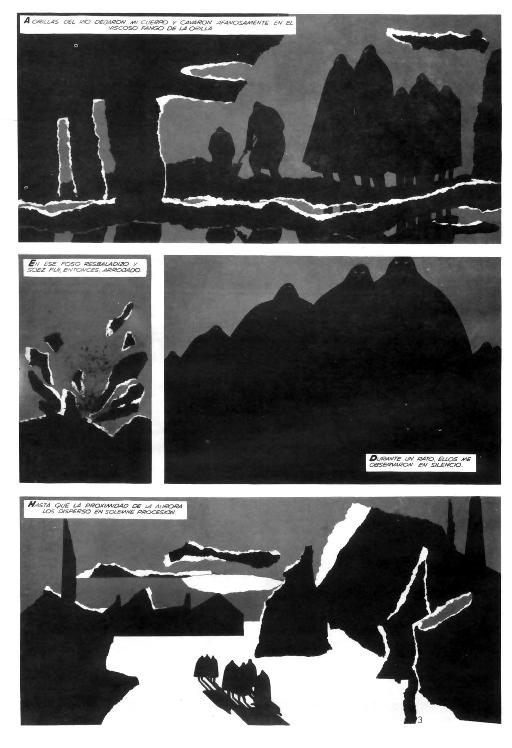
| A orillas del río dejaron mi cuerpo y cavaron afanosamente en el viscoso fango de la orilla. En ese foso resbaldizo y soez fui, entonces arrojado. Durante un rato, ellos me observaron en silencio. Hasta que la proximidad de la aurora los disperso en solemne procession. | On the banks of the river they left my body and dug busily in the slimy mud of the shore. Into that slippery and foul ditch, I was then thrown. For a while, they watched me in silence. Until the approach of dawn dispersed them in solemn procession. |
| Informe sobre ciegos y otras historias 103 | English translation |
“Donde suben y bajan las mareas” has been reprinted and translated into several languages, but the only English-language adaptation I could locate is Alberto Breccia Sketchbook (2003, Ancares Editora), a bilingual edition in English and Spanish, but difficult to locate as it was published in Argentina and is now out of print. Most curious readers will have to satisfy themselves with the Spanish-language version reprinted in collections like Informe sobre ciegos y otras historias if they wish to read this tale.
A Note: I am aware that the Breccia interviews conducted with his occasional collaborator Juan Sasturain were originally done in Spanish, but the only edition I have of them is in French. Sometimes we have to work with what we have on hand.
Bobby Derie is the author of Weird Talers: Essays on Robert E. Howard and Others and Sex and the Cthulhu Mythos.
Deep Cuts in a Lovecraftian Vein uses Amazon Associate links. As an Amazon Associate I earn from qualifying purchases.
 Deep Cuts in a Lovecraftian Vein