Eldritch Fappenings
This review concerns a work of erotica, and as such may involve text and images of an adult nature.
Reader discretion advised.
Yes, if you spell Uhluhtc backwards it becomes Cthulhu. It’s not terribly clever as an authorial tool, but it is a semi-smart homage to that fine animated filme Heavy Metal.
—Grace Vilmont, “Author’s Note,” “Uhluhtc’s Sacrifice”
Uhluhtc appears in the segment “Den” in the film Heavy Metal (1982); this was an adaptation of Richard Corben’s character and story of the same name in Heavy Metal Magazine and Métal Hurlant—there being a lot more Lovecraftian material in the pages of those magazines than just in the Métal Hurlant/Heavy Metal/Metal Extra Lovecraft Special. Corben had used “Uhluhtc” in one of his early Den episodes.
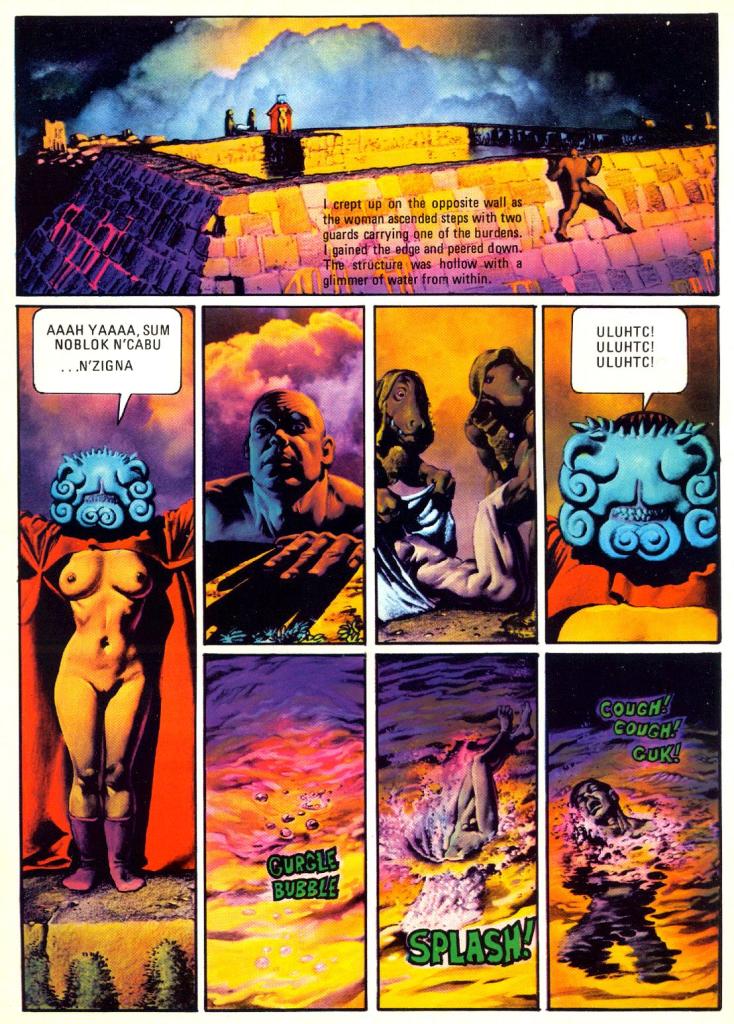
Corben was likely inspired by “Count Alucard” in Son of Dracula (1943), a transparent anadrome used as an alias by the vampire played by Lon Chaney, Jr. In both cases, the purpose of the reversal isn’t really to conceal the identity as much as to plant an Easter egg for fans to find. It’s a nod and wink, a signal to readers that the writer is a horror fan too.
What makes it an appropriate title for Grace Vilmont’s tentacle and cultist erotic novella, a light-hearted and sexually explicit horror-sex-comedy that leans heavier on the sex comedy than the horror, is the way Vilmont’s approach to the Lovecraftian tropes inverts traditional ways of casting sexuality as evil or depraved. The way it plays with the tropes is very explicitly tongue-in-cheek (and tentacle-in-cheek, and every other orifice), but there is a core of message there. It is good unclean fun that manages to be sex-drenched and irreverent without being nasty or raunchy in the way of some erotica titles that play more with violent or onerous taboos, but is also very expressly contrasting itself against negative depictions of sexuality.
It does get a little silly at parts:
“I probably should have told you more. But I never expected this. You’re carrying Uhluhtc’s spawn—”
“I know,” Cassie said proudly.
“Brenda continued as if Cassie hadn’t spoken. “—and your body needs a near constant supply of human semen. I don’t pretend to understand the reasons why or the logic behind it. But you need to get fucked and fertilized right now.”
—Grace Vilmont, “Uhluhtc’s Sacrifice”
Vilmont’s tale is one of a spate of tentacle-sex-with-optional-impregnation stories that have appeared, often in waves, in ebook format; a sister to Booty Call of Cthulhu (2012) by Dalia Daudelin and its sequels. While readers may or may not be titillated by the tentacle sex, it is the approach to the setting and characters that is often more interesting from the perspective of historical context.
This tale is centered on the completely consenting cultists; who, aside from their tendency toward orgies and summoning eldritch entities, have less malice per capita than the average book club. Their robes have zippers and while race is seldom explicitly mentioned, it’s clear that the majority of characters at least are coded as Caucasian; the racial dynamics of Lovecraft’s cult of Cthulhu were left at the door, no one is being violently sexually assaulted or hurt. If there is any shade thrown in this story, it is a swipe toward the sexual repression and bigotry associated with Evangelical Christianity:
“I was sick of the way Mom used Christianity as a hammer to control me and everything else around her.” […]
“Nothing we do here is illegal in any way.”
Cassie nodded. “But the evangelicals she fell in with would consider this an affront to God.” She nodded sagely then broke character and giggled. “I used Mom’s journal and her descriptions of the orgies and everything else when I masturbated for the first time. That’s why I’m here.”
—Grace Vilmont, “Uhluhtc’s Sacrifice”
There is an example of an important broader point in horror and erotic literature. Both horror and erotica are often fundamentally concerned with transgression, whether of social and moral norms or physical laws and reality. The corpse that rises from the grave is unnatural and violates our sensibilities of the distinction between life and death; incest violates sexual norms regarding appropriate partners (and often involves some complicated relationships and power dynamics, to boot). When they come together, this collision of transgressions can sometimes achieve a greater frisson than either could alone.
However, the narrative desire for sex positivity also means that the rhetoric of the story can easily get flipped.
Satanic and Lovecraftian cults are staples of horror fiction in large part because they are cast in contrast to Christianity, the dominant religious and moral framework for much of the intended audience. This emphasis on Christianity is useful because Christian dogmatic norms of sexual behavior means you can get that element of sexual transgression—the Black Mass with the body of a naked woman as an altar, the wild ritual orgies, the occasional sexual sacrifice to an eldritch entity—which really works in stories like “The Black Stone” by Robert E. Howard.
When those sexual antics are displayed as evil, corrupting, illegal, etc.; the cult itself and its members assume those attributes. When those same cults are aligned in a sex positive manner to contrast with the often reactionary and sexually repressive ideology of Christian sects, you get to an odd place where you are essentially confirming the biases of the majority in one regard (look at all the sex they’re having!) while at the same time casting the Christians as the real bad guys (look at those prejudiced, sexless bigots.
If that sounds familiar, it’s because it is very much a real-world issue translated onto the page and dressed up in horror clothes. Progressive and open attitudes towards sexual activity are nothing new, but they are very much still contentious and topical issues because the folks trying to repress that sexuality (whether or not they claim to be Christian) have never given up on the topic. The cult of Cthulhu (well, Uhluhtc in this case) becomes a stand-in for all of those who have suffered prejudice from those attempting to control or repress their sexuality.
Except they can summon some tentacles to really spice things up. It is a fantasy, after all.
This progressive framing of what would traditionally be “evil” cults, particularly in terms of their approach to sex, is in part driven by the real-world shift in attitudes regarding sex and religion, and ongoing cultural clashes between opposing ideologies and questioning of traditional narratives of sexual morality and religious dogma. The syntax of the era continues to find expression in the fiction of that era, even when it’s tentacle porn. While Lovecraft and Vilmont Grace may not have been consciously modelling their respective works to reflect ongoing societal issues, it is clear when reading them in historical context that the how and why of their cults’ approach to sex was in part shaped by the issues they faced at the time.
While I had initially first found this as an Amazon ebook, it seems to no longer be available from Amazon, but is still available on Goodreads.
Bobby Derie is the author of Weird Talers: Essays on Robert E. Howard and Others and Sex and the Cthulhu Mythos.
Deep Cuts in a Lovecraftian Vein uses Amazon Associate links. As an Amazon Associate I earn from qualifying purchases.
 Deep Cuts in a Lovecraftian Vein