Eldritch Fappenings
This review deals with a work of erotic content. As part of this review, selected art displaying cartoon nudity will be included.
As such, please be advised before reading further.
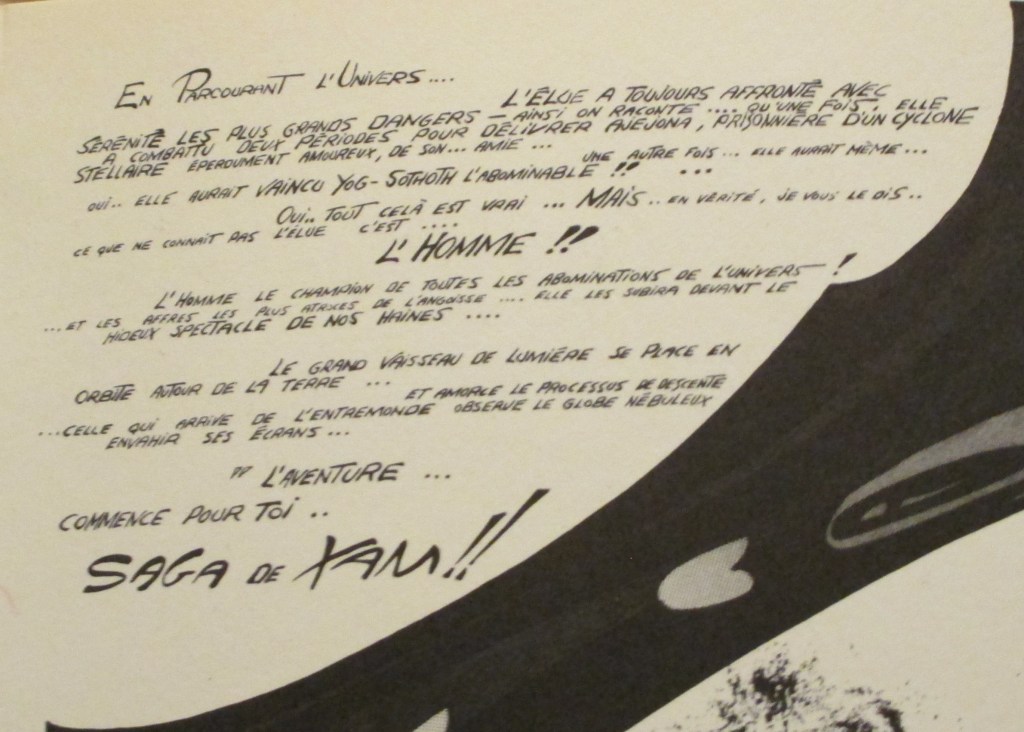
| En Parcourant l’Univers . . . L’Élue a toujours affronté avec sérénité les plus grands dangers—ainsi on raconte . . . . qu ‘une fois, elle a combattu deux périodese fois . . . Elle aurait m pour délivrer ajejona, prisonniére d’un cyclone stellaire éperoument amoureux, de son . . . amie . . . Une autre fois . . . Elle aurait mème . . . oui … Elle aurait vaincu Yog-Sothoth l;abominable!! . . . Oui . . tout celà est vrai . . . MAIS … en verité, je vous Le ois . . ce que ne connaître pas l’élue c’est . . . . L’HOMME !! L’Homme le champion de toutes Les abominations de l’univers—! . . . et Les affres Les plus atroces de l’angoisse . . . . Elle Les subira devant Le hideux spectacle de nos haines . . . . Le grand vaisseau de lumiére SE place en orbite author de la terre . . . Et amorle Le processus de descente . . . celle qui arrive de l’entremonde observe Le globe nébuleux envahir ses écrans . . . L’aventure … commence pour toi . . Saga de Xam! | Traveling the Universe . . . The Chosen One has always faced the greatest dangers with serenity—thus it is said . . . . that once, she fought twice . . . She would have to free Ajejona, prisoner of a stellar cyclone, desperately in love, from her . . . friend . . . Another time… She would have even… yes… She would have defeated the abominable Yog-Sothoth!!… Yes… all this is true… BUT… truly, I tell you… what not knowing the chosen one is… MAN!! Man, the champion of all the abominations of the universe—! . . . and the most atrocious pangs of anguish . . . . She will endure them before the hideous spectacle of our hatreds . . . . The great ship of light places itself in orbit above the earth . . . And begins the process of descent . . . she who arrives from the in-between world observes the nebulous globe invade her screens . . . The adventure… begins for you . . Saga of Xam! |
| Saga de Xam (1967), chapter 1 | English translation |
In 1967, French director Jean Rollin had not yet made his mark on cinema. While he had directed a few films, his moody, unconventional erotic horror/fantasies like Le viol du vampire (1968, “The Rape of the Vampire”), La vampire nue (1970, “The Nude Vampire”), and Le Frisson des Vampires (1971, “The Shiver of the Vampires”) all lay in the future. However, he was in contact with Éric Losfeld, a French publisher of literary and artistic works that challenged the sensibilities of the day, including fantasy, science fiction, and erotic comics like Barbarella by Jean-Claude Forest, Lone Sloane: Mystère des Abîmes by Phillipe Druillet, and Phoebe Zeit-Geist by Guy Peellaert, as well as Nicolas Devil (Nicolas Deville), who served as art director for Rollin’s short Les pays loin (1965, “The Far Countries”).
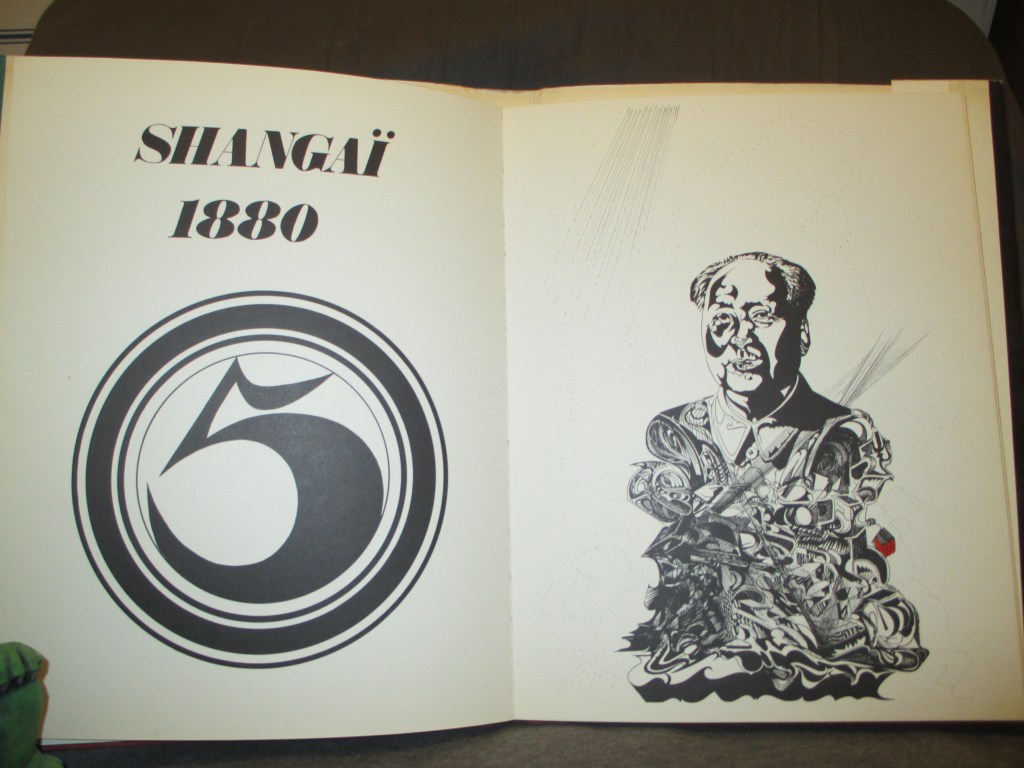
Together, they produced Saga de Xam. Rollin’s scenario had been intended for a science-fiction film that never materialized. Nicolas Devil took that script and realized it artistically. The blue-skinned woman Saga from the planet Xam is on a mission to Earth, and moves through a series of surreal adventures that expose her to the best and worst of humanity in a blend fantasy, science fiction, and eroticism for six chapters, plus a seventh chapter that is largely splash pages. Barbara Girard, Merri, Nicolas Kapnist, and Phillipe Druillet all lend their talents, and actor Jim Tiroff provides a poem in English, “Grease and Oil Myth.” While Devil is the primary creator, the final chapter uses the Exquisite Corpse approach, with creators building on each other’s work.
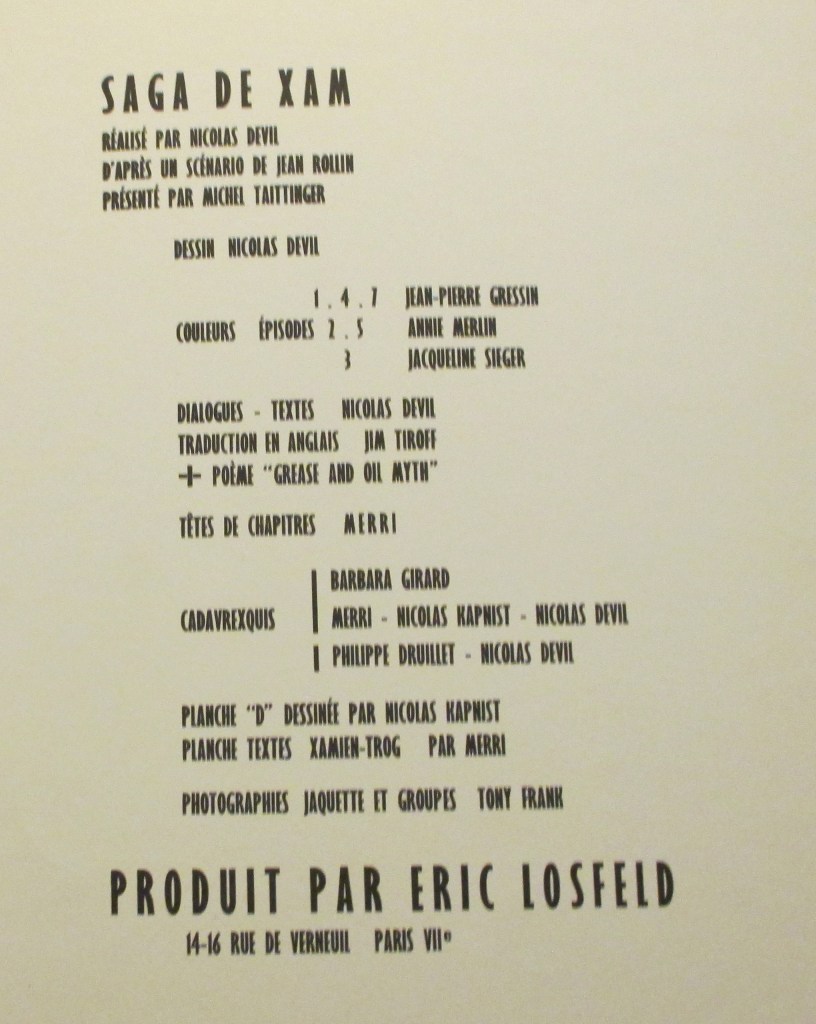
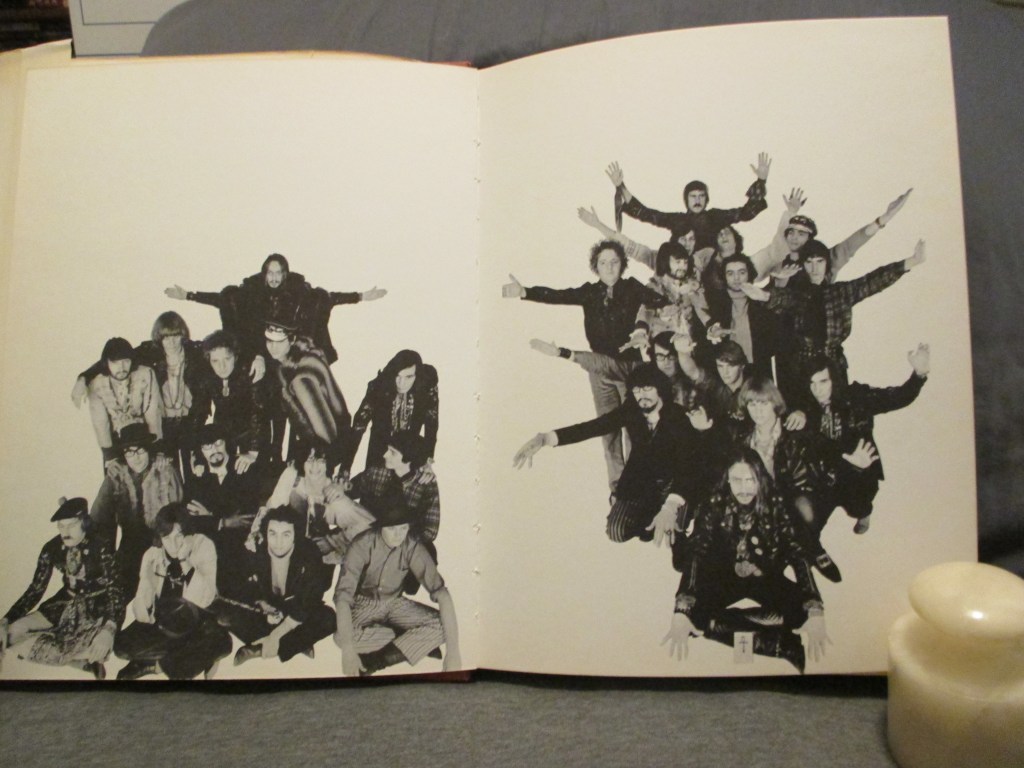
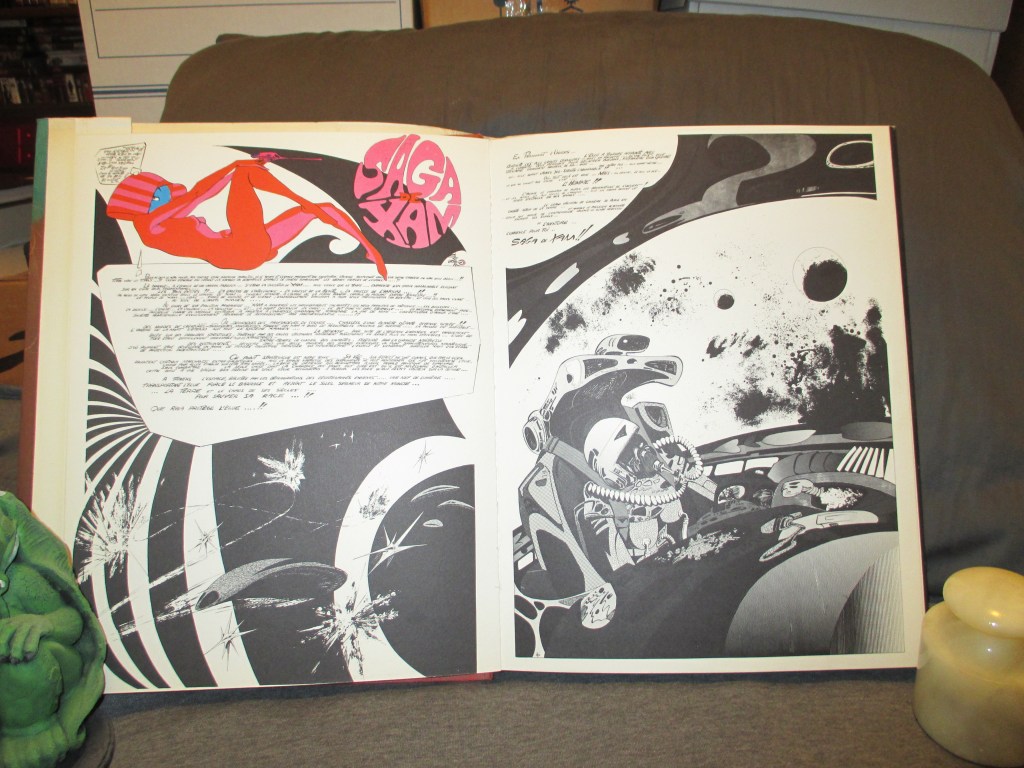
Saga de Xam was released as a single large hardbound album by Éric Losfeld in 1967. Because it was drawn on large boards and reduced to fit the page size, some of Devil’s hand-lettered text is very difficult to read without a magnifying glass, but the overall production quality was high, with excellent print quality and vibrant colors. It was in every sense of the word an avant-garde production, a psychedelic graphic novel that played with all manner of artistic styles, techniques, layout, coloring, and storytelling. Published in an edition of 5000 copies that quickly sold out, the book was somewhat legendary until relatively recently: there were reprints in 1980 and 2022, and an English translation is due for release in 2025.
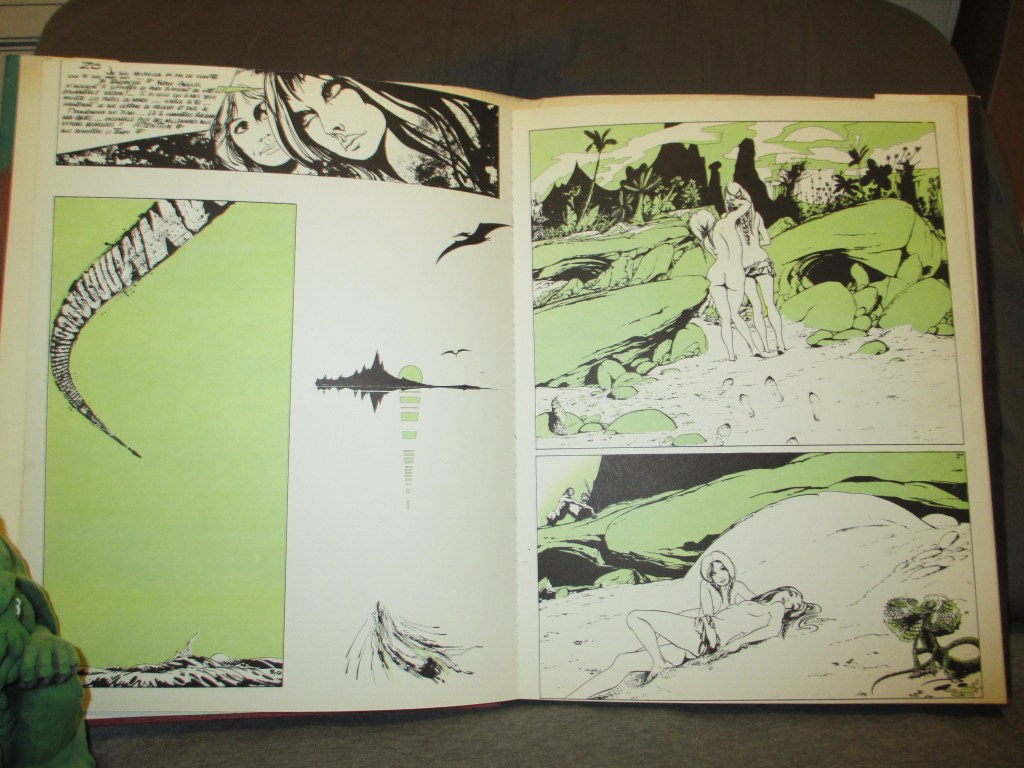
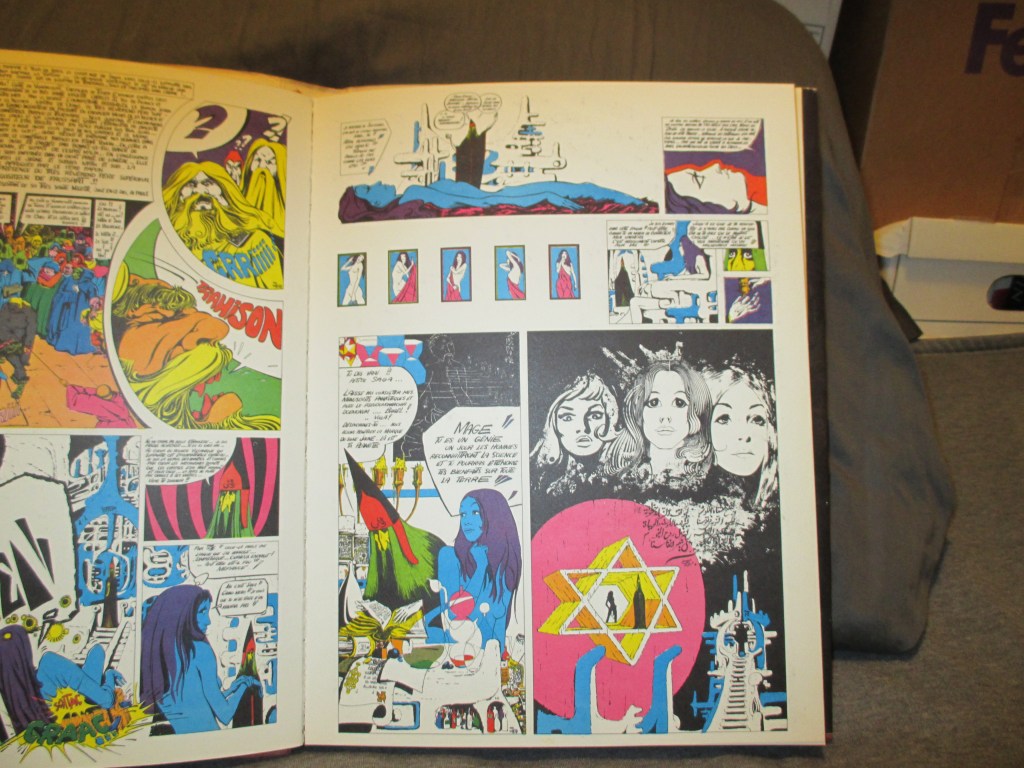
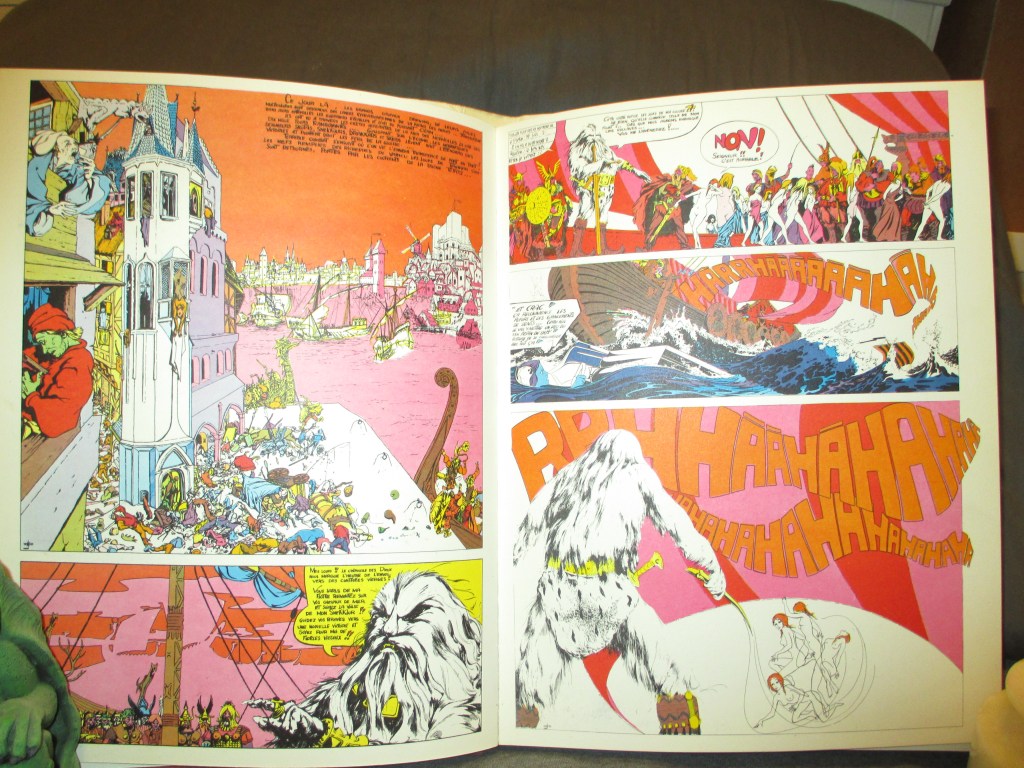
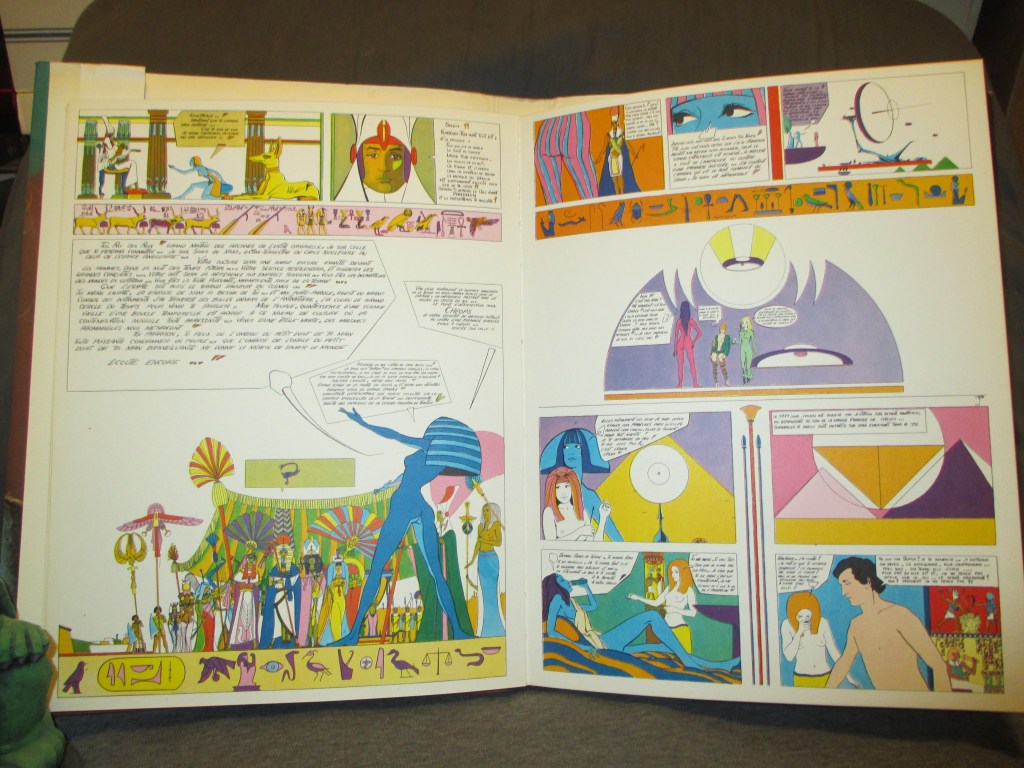
Lovecraft’s Mythos are subtly but consciously present in the text, woven into the storyline at different points. At one point, for instance, Saga encounters Abdul Alhazred; in another, a poem by “Klarkash-Ton” is quoted:
| Klarkash-Ton avait tout dit, etc Le passage: Pour que vive le diable Le bruit du silence Laisse toute éspérance. Les rivages de la nuit, De flamme et d’ombre Dans un manteau de brume Le marque du démon | Klarkash-Ton has said it all, and the passage: Long live the devil The sound of silence Leaves all hope. The shores of the night, Of flame and shadow In a cloak of mist The demonic mark |
| Saga de Xam (1967), chapter 4 | English translation |
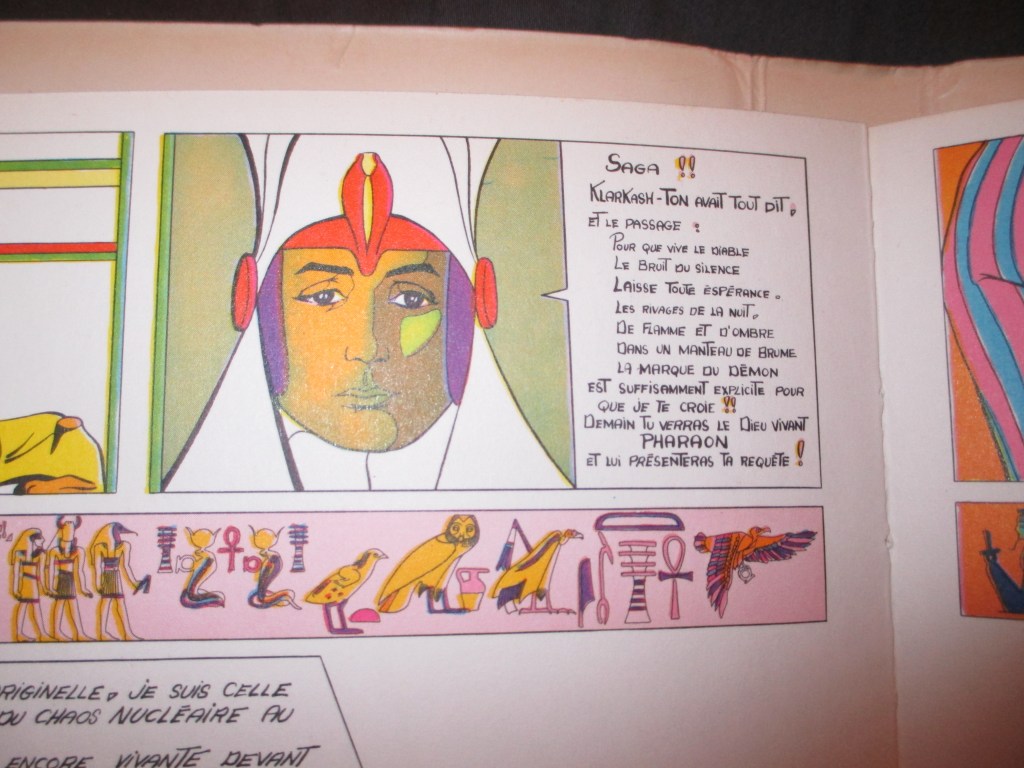
While such blank verse isn’t a translation of any poem of Clark Ashton Smith’s that I could find, it is a nice homage to the master of Averoigne. There are several other references scattered throughout the book, not necessarily playing a large part in the proceedings but adding to the charm for fans of the Mythos. Among Fruillet’s pages in chapter 7 is one ripped straight from the Necronomicon, or at least definitely in keeping with the pages that would be published in the Métal Hurlant/Heavy Metal/Metal Extra Lovecraft Special a few years later. It’s tempting to speculate that all the Mythos elements in the book might come from Druillet’s contributions, but it is impossible to tell on such a collaborative work.
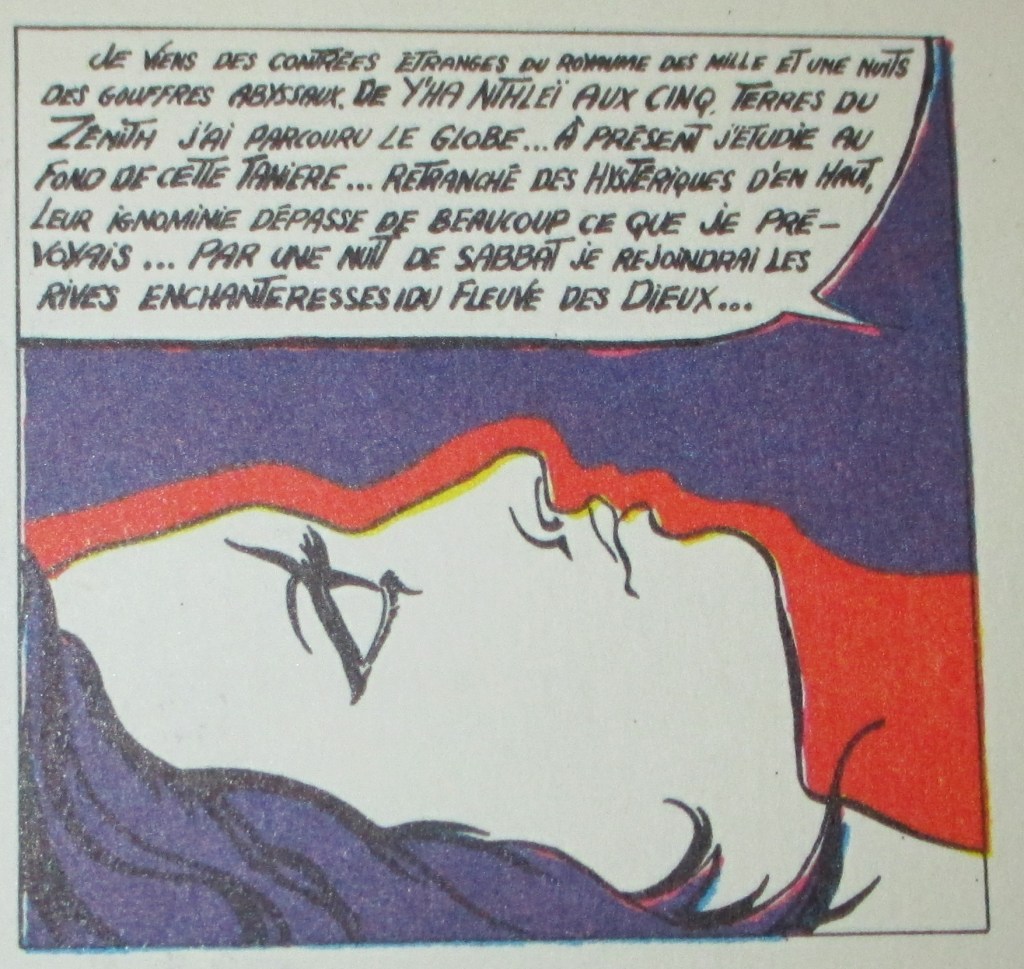
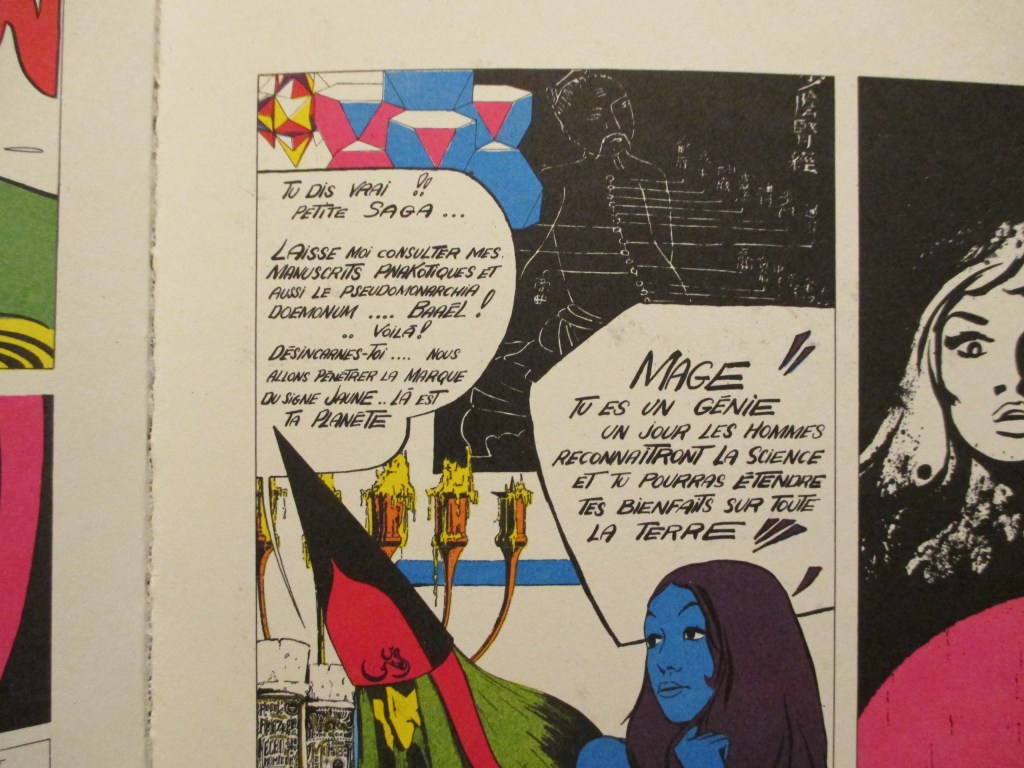
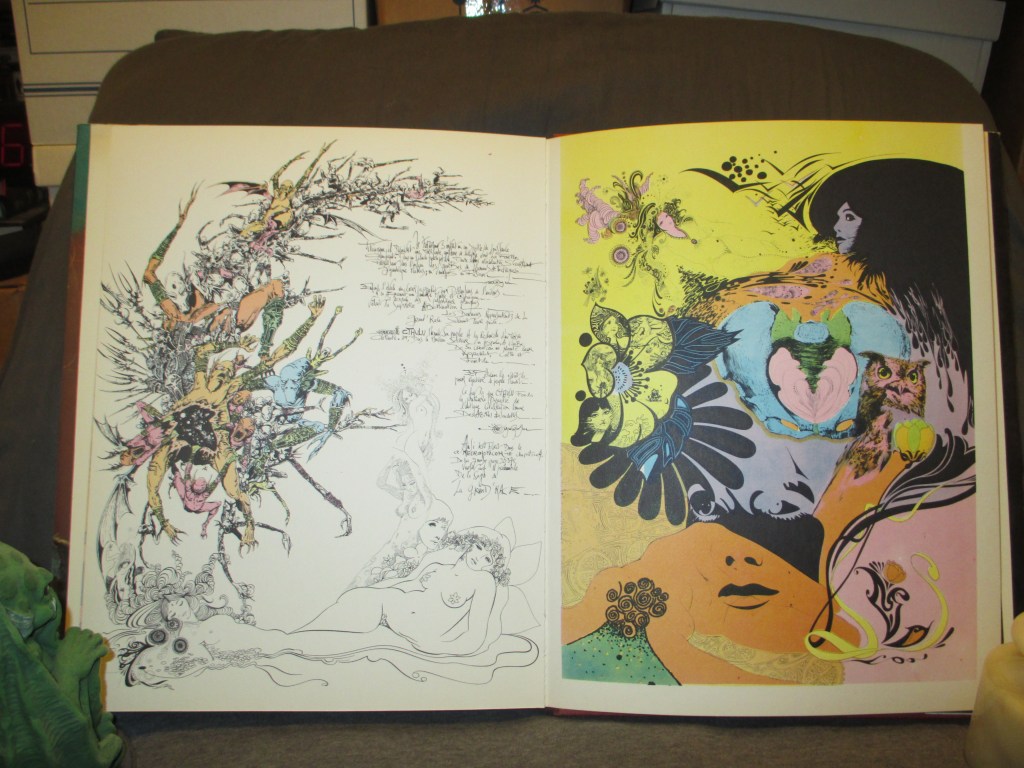
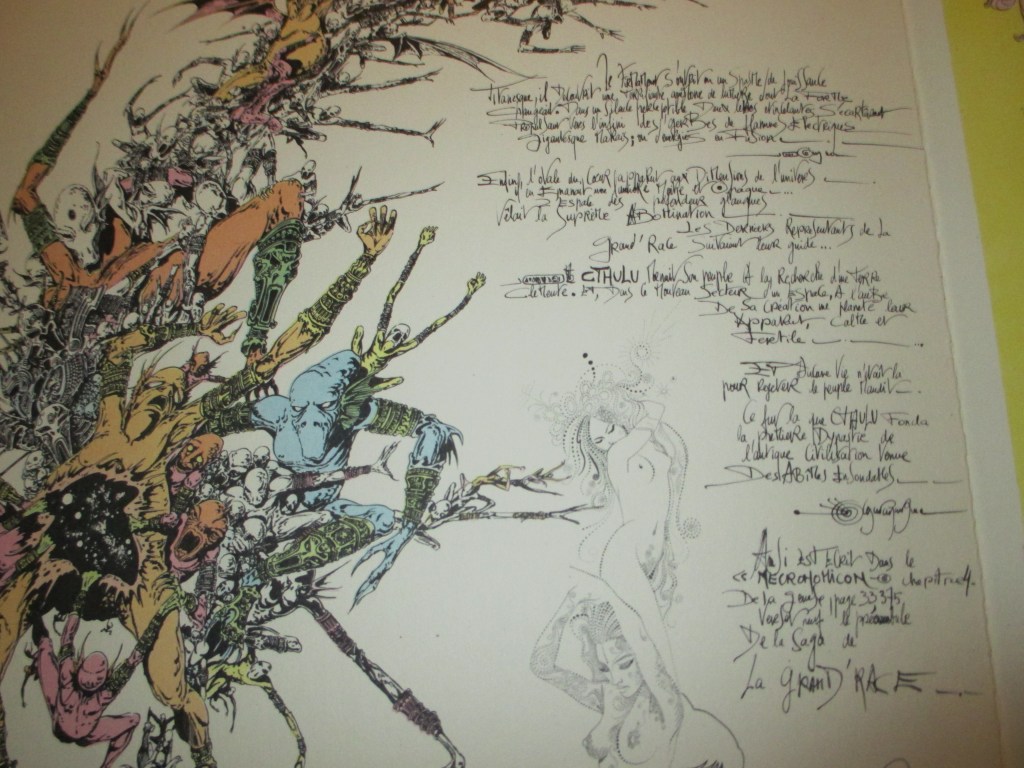
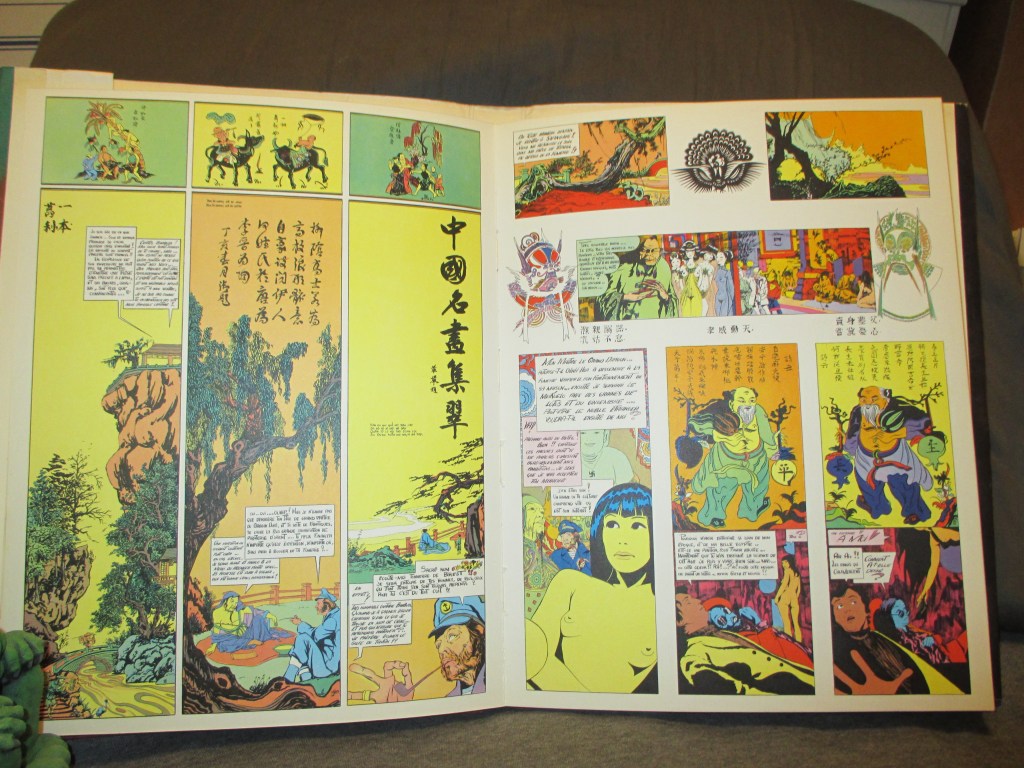
The visual style and politics are both very ensconced in the 60s counterculture; Saga is often nude but rarely powerless, violently rejecting rapists, leading women to free themselves, and developing love affairs with other women. There is a certain quirky mid-century aspect to the depictions, for example. Chapter 5 is specifically set in China, and the color tone literally renders the Asian women yellow, just as Saga is depicted as blue.
The ending is also a bit stark; when the hideous and violent Troggs invade, rather than destroying them Saga chooses to make love, not war—literally, by conceiving a hybrid child with the Grand Trogg. In an era dominated by the Vietnam War, the idea of finding a peaceful means of coexistence had its appeal.
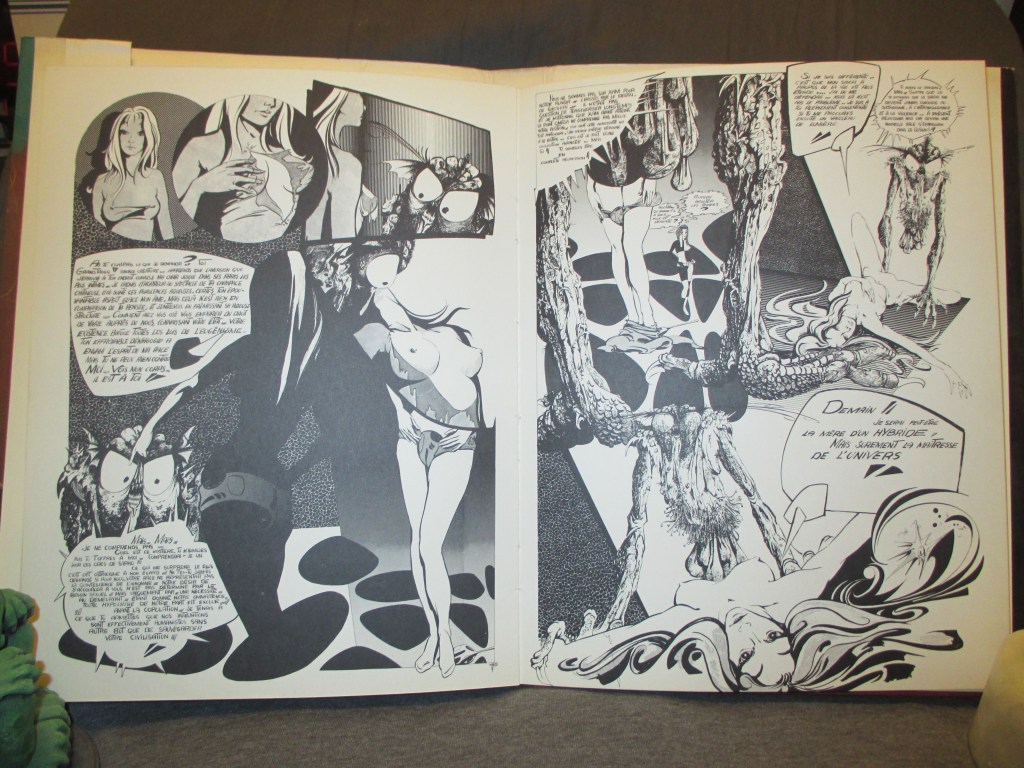
That, then, is the story of Saga of Xam: to learn that love and sex should be given freely, not taken by force.

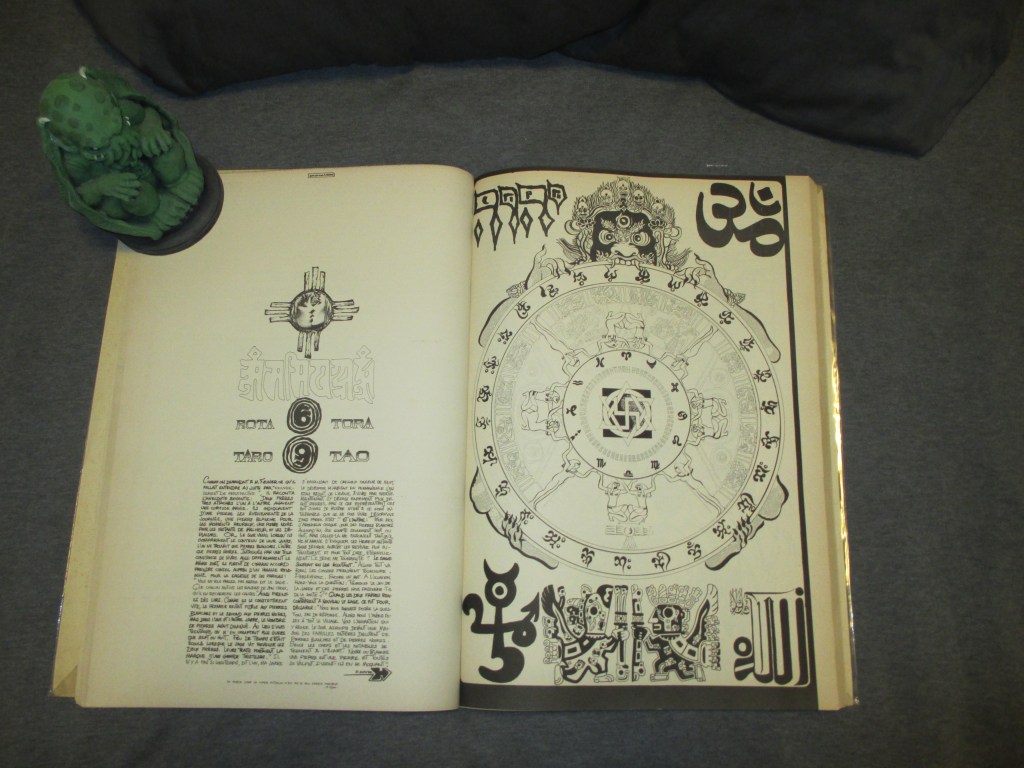
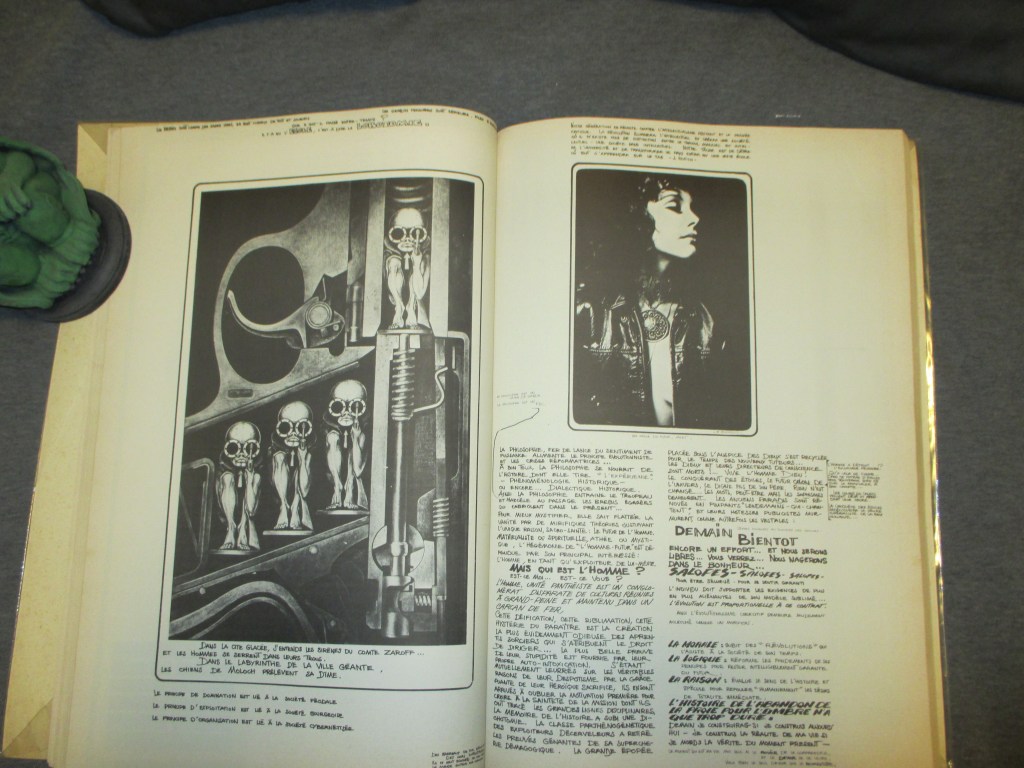
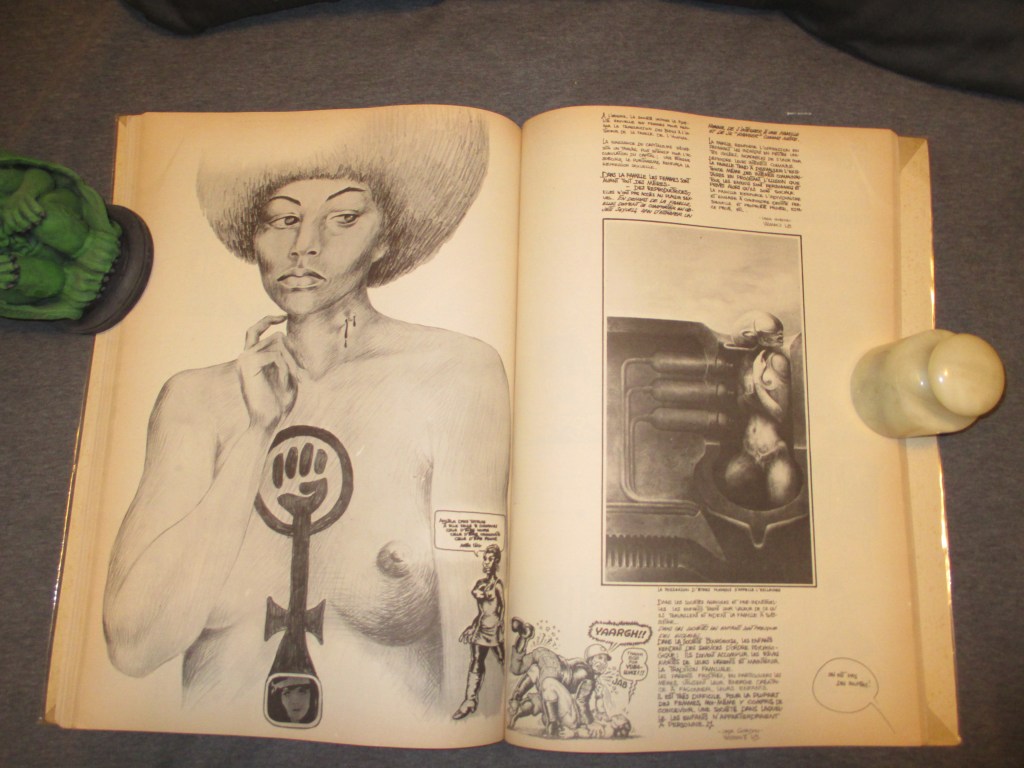
Nicolas Devil had another major graphic novel, Orejona ou Saga Generation (1974), in the form of an enormous softcover with soft paper. Despite the name, there is no direct connection to Saga de Xam except philosophically, continuing the countercultural vibe. Stylistically, it is another masterpiece of the moment, a collage of American underground comix, newsprint, original art, photographs, occult designs, and even some H. R. Giger thrown in for good measure, but there is no explicit Mythos material that I can see.

While the original Saga de Xam and its 1980 reprint remain scarce, the 2022 French reprint and the 2025 English translation remain available, and hopefully this book will continue to find an appreciative audience as something more than a scarce collector’s item.
Bobby Derie is the author of Weird Talers: Essays on Robert E. Howard and Others and Sex and the Cthulhu Mythos.
Deep Cuts in a Lovecraftian Vein uses Amazon Associate links. As an Amazon Associate I earn from qualifying purchases.
 Deep Cuts in a Lovecraftian Vein